




Abstract
In his address at the Madrid Peace Conference, the Head of the Palestinian Delegation, Dr Haidar Abdul-Shafi challenged the persistent myth that has defined Palestinian existence for at least a century by saying: “For too long the Palestinian people have gone unheeded, silenced […] we have been victimized by the myth of ‘a land without a people’” (Abd Al-Shafi, 1992: 133). Negation coupled with the trauma of the loss of territory has augmented the Palestinian silence. In this article, I look at Mahmoud Darwish’s Journal of an Ordinary Grief (2010) and In the Presence of Absence (2011), drawing on Edward W. Said’s After the Last Sky (1999), in which the authors recount the untold story of their marginalized people to give voice to the silenced through accounts of a lived and observed experience.
Introduction
In his opening speech at the Madrid Peace Conference on 31 October 1991, the Head of the Palestinian Delegation, Dr Haidar Abdul-Shafi challenged the persistent myth that has defined Palestinian existence for at least a century when he addressed a world audience by saying:
1
We, the people of Palestine, stand before you in the fullness of our pain, our pride, and our anticipation, for we long harbored a yearning for peace and a dream of justice and freedom. For too long, the Palestinian people have gone unheeded, silenced and denied. Our identity negated by political expediency; our rightful struggle against injustice maligned; and our present existence subdued by the past tragedy of another people. For the greater part of this century we have been victimized by the myth of a land without a people and described with impunity as the invisible Palestinians. Before such willful blindness, we refused to disappear or to accept a distorted identity. (1992: 133)
In spite of the Madrid Conference, the Oslo Agreements, and the failed peace talks that followed, the myth of the non-existent Palestinian and the dehumanization of the people survive till this day. The Declaration of Principles on Interim Self-Government Arrangements, which was the result of the Oslo Agreement in 1993, failed to produce any solution to the Palestinian issue. If anything, the situation in the occupied territories has deteriorated, and the hope of resolution to the refugee problem is growing dimmer. Endless failed negotiations have only weakened the position of the Palestinians, rendering the possibility of a homeland improbable. Even the November 2012 recognition of Palestine as a non-member observer state status has not helped in alleviating the Palestinian condition. The Palestinian is still fighting to be accepted as the rightful owner of a land he or she has occupied for thousands of years, against a deafening discourse of erasure and marginalization, initiated by Zionism and the colonial powers more than a hundred years ago.
This negation coupled with a political struggle that is still ongoing has rendered the Palestinians silent, unable or reluctant to tell their stories. The Palestinian story has, for a long time, been told by someone else. This othering and usurping of the narrative has deemed that the Palestinians remain invisible until this day. Edward W. Said writes, even though some Palestinians may have passports, they “still bear the onus of being displaced and hence, misplaced” (Said, quoted in Barghouti, 2000: ix). Irrespective of where they are, Palestinians feel an absence at the core of their being, having been denied the homeland, normal existence, and more importantly the right to their history and geography. Mahmoud Darwish argues that the Palestinians are not only banished from their place of birth but also from the world consciousness (Abdel-Malek, 1999: 189). Equally, the absence of the story leads to the absence of the people, especially when the name Palestine is no longer on the world map, and its only mention is in the news when its original inhabitants become numbers of casualties or deaths. Paradoxically, Palestinians at once embody this absence and presence. In this article, I look at Darwish’s Journal of an Ordinary Grief and In the Presence of Absence, drawing on parts of Said’s After the Last Sky. These are non-fiction works, through which the narrators try to write themselves back into a history that has marginalized and negated them, to become present in this absence, and regain a lost identity. Part diary, part memoir and essay, these atypical works by Darwish and Said are generally absent from the literary corpus on both men; yet, as Palestinians will soon mark 70 years of the Nakba, or catastrophe under Israeli occupation, they are more relevant than ever today. The books, which draw on inevitable tensions between the historical past and the personal present, recall the mundane in detail to help render the Palestinian as human.
In his writings, Darwish selects moments in his personal life (house arrests, imprisonment, and interrogation by Israelis) and political events that have shaped his country, as part of his attempt to resituate himself and his identity vis-à-vis a country and a people that have been erased from the world’s collective consciousness. Darwish’s rhetoric, which fluctuates between the first and second person pronouns, is at times subjective and is his way of interpreting the story. The “I” on some occasions belongs to the poet, while at other times it stands for the Palestinian people as a whole (Muhawi, quoted in Darwish, 2010: x). The suffering belongs to a single individual, but the tragedy is that of a people (Jayyusi, 2008: viii). His prose, which often shares the complexity and obscurity of his poetical language, not only entwines the political with the poetic, but also reflects on questions relating to his identity (Muhawi, quoted in Darwish, 2010: ix, xii). Journal of an Ordinary Grief, first published in 2010, forms the first part of a trilogy of the major non-fiction prose work by Darwish; published in 1973 in Arabic, يوميات الحزن العادي, Yawmīyyāt al-huzn al-‘ādī, was reprinted in 1994. The English edition of In the Presence of Absence,
In After the Last Sky, first published in 1986, and consisting of four chapters, Said narrates the story of ordinary Palestinians who have survived the catastrophic events and rhetoric of negation, through a dialogue between the visual represented by the photos of Jean Mohr and the author’s narrative. The book embodies within its folds the existential question of what a Palestinian is. Merging the subjective and objective voice, this book is a departure for Said. He writes it for himself and his people, questioning the perception of the self, and the presentation/self-presentation of the Palestinian in the world (Hawley, 2006: 203). With a combination of narration and elegant language, Darwish and Said give voice to the unheard in these literary works.
Pebbles of a lost heart: Invisibility and memory
Journal of an Ordinary Grief, comprising a series of prose and poetical essays, does not follow a chronology. This memoir consisting of diary entries allows the poet to document the daily activities that have shaped him as a Palestinian exile vis-à-vis his lost homeland. Darwish’s fragmented writing mimics the fragmentary nature of his country. The poet is bearing witness to events that have shaped his homeland, and he translates his experience into poetical prose. Journal of an Ordinary Grief, even more than his poetry, explores historical moments in the poet’s life, along with issues relating to the Palestinian existence and struggle. In the foreword entitled “These Pages”, Darwish writes that even though this work cannot tell the whole story, and is only the “beginnings of a small voice that shook the rock a little”, the everyday grief and death will be written, “so that this ordinary grief [stemming from the lost homeland] may stop accepting being acceptable” (Darwish, 2010: xv). Sinan Antoon elaborates: The grief here is that of surviving daily life in a nation-state whose founding myth is premised on the erasure and denial of one’s own existence and collective history. The heart of Darwish’s grief, like that of any Palestinian, is the Nakba of 1948: the catastrophic destruction of Palestinian lives and society and the dispossession and depopulation of more than 400 villages. One of these was Al Birweh in the Galilee, Darwish’s place of birth, where he spent the first six years of his childhood. (Antoon, 2011: n.p.)
The night his family was expelled to Lebanon haunts Darwish’s work. He reconnects with the homeland through tangible objects. References to pebbles and rocks are prevalent in Darwish’s work, and they represent the poet’s attempt at rendering the abstract tangible through his use of metaphor. In the first section of the Journal of an Ordinary Grief, the son enquires of his father who has recently become a refugee in Lebanon as to why he is picking up pebbles, to which the father answers: “I’m searching for my heart, which fell away that night” (Darwish, 2010: 3). The night, which is the night of the Nakba, is the one on which the father and his family were forced to leave their village, Al Birweh. 3 This night, which Darwish returns to repeatedly in his writings, is recounted through the memory of the child and, later, the adult. The child recalls his father’s symbolic description of a broken heart through the concreteness of pebbles. The writer compares the act of collecting pebbles to the action of fellahin women picking up olives in October, “one olive at a time”, a metaphor that mirrors the broken homeland (2010: 3). The olives symbolize the words, written one at a time to resurrect the fragmented nation.
An account of a similar dispossession is recounted by one of the 1948 Palestinian refugees who witnessed the expulsion of the people of the village of al Rama in Galilee, as the inhabitants were evicted from their homes and forced to walk towards the Lebanese border. Elias Srouji recalls: Meanwhile the gunfire was continuing, clearly intended to get people moving. We saw families holding their children and lugging big bags […] some supporting old parents. Sobbing loudly […] Joining the main road leading up the steep slope of the mountain on which their village was built, they were setting off on a “trail of tears” towards the Lebanese border. The most heartrending sight was the cats and dogs, barking and carrying on, trying to follow their masters. I heard a man shout to his dog: “Go back! At least you can stay”. (2004: 77)
The memories of the lost homeland are recalled though minute details; in this instance, the dogs and the cats embody the loss of territory. The dreaded night in 1948, which has also traumatized Darwish’s father, is one over which the adult poet obsesses. As with the above recollection, Darwish’s narrative self remembers the barking of the dog, and that on the family’s trail of tears, nature stood by bearing witness. The child recalls the moon, which to him was higher than his forehead and closer to him than his grandfather’s mulberry tree. He remembers that when he heard the first gunshot, he thought it was a wedding celebration, only to realize that the moon became his companion as he joined the road to exile (Darwish, 2010: 4). Once exiled, picking up the pebbles becomes “a good exercise for memory and perception”, and these pebbles evolve into “petrified pieces” of a wounded heart (2010: 3). The pebbles are emblems of not forgetting and resisting; they become part of the loss that was precipitated by the loss of the homeland. Jacques Derrida argues that the greater the crisis, the more out-of-joint a person’s existence becomes, and this forces the person to convoke the old and borrow from the spirits of the past (Derrida, 1994: 109). For Darwish, the homeland is often remembered through “its lakes and rivers, its mountains and plains, its sea and shores, its fauna and flora, its olives and oranges, its trees and birds, its folk and folklore” (Boullata, 2008: 66). This natural detail not only strengthens the exile’s relationship to the land but validates his or her right to it as well.
Along with dispossession and exile, the ultimate forfeiture is losing the right to tell one’s own story and history (Bresheeth, 2007: 180). The father in Journal of an Ordinary Grief tells the reader that he is adamant not to lose himself in this loss (Darwish, 2010: 4). Darwish has often invoked his father in his writing; the father symbolizes exile and loss, the person sacrificing the future for the past (Rahman, 2008: 43). Here, the father hopes that the pebbles that resemble fragments of his heart can be transformed into words that will put him in touch with “the distant homeland” (Darwish, 2010: 4). Those who tried to return to Palestine “were herded in trucks then dumped like damaged merchandise on the border” (Darwish, 2010: 14). Later in this work, Darwish writes that even though the Israelis “put Palestine in the pockets of their military uniforms […] Palestine remains your homeland, be it a map, a massacre, a land, or an idea” (2010: 113–14). Palestine exists in exile merely “as a signifier whose signified does not match its shape and magnitude” (Muhawi, 2006: 31). In exile, the father and ultimately the author hold onto the memory and the place through the pebbles that he chooses to collect, and which inadvertently become symbols of resistance, preserved by the son through his account.
Said and Barsamian write: Because so much of [the Palestinians’] history has been occluded[,] [t]hey are invisible people. The strength and power of the Israeli narrative is such that it depends almost entirely on a kind of heroic vision of pioneers who come to a desert and in the end deal not with native people in the sense that these are people who have a settled existence and lived in towns and cities and have their own society, but rather with nomads who could be driven away. (2003: 20–21)
Nomads, by virtue of their life, have no history that ties them to a particular place, nor memories attached to a particular location. Historically, Said writes that at best the Palestinians were looked at as a people who could be discarded and disposed of, the subject people of a higher order of being, and this belief has justified dislocation, dispossession, and expulsion (Said, 1999: 130).
Said writes that Mohr’s photographs were initially commissioned by the United Nations, but when they were to be exhibited in Geneva, Mohr was forbidden from adding any captions to his pictures (1999: 3). The text captures and signifies meaning, and the word itself points and notifies (Barthes, 1957: 115). According to Said, Mohr saw the Palestinians as no one else had previously seen them, as they would have seen themselves (1999: 6). Said’s words coupled with Mohr’s photos challenge the mythical notion of the nomadic by depicting the Palestinians in their milieu. Said wants the viewers to come to the right interpretation of Mohr’s photos, erasing any ambiguity that may arise (Hawley, 2006: 205, 207). Designating pre-1948 Palestinians to a nomadic life and thereby reducing them to an order of lesser beings has denied the Palestinians both their homeland and their memories of that homeland. Mohr’s Palestinians cannot be muted. Although memory can burden the present, memories can help affirm identity and moral claims to justice (Abu-Lughod and Sa’di, 2007: 3).
Darwish’s childhood memories of the village with its narrow alleys evolve into the first clues of the adult man’s awareness of his exile (2010: 10). The insistence on remembering and the preservation of memory are some of the few weapons available for the Palestinians against the silencing of “the thundering story of Zionism” (Abu-Lughod and Sa’di, 2007: 6). Said recounts a time when an elderly Palestinian man was “prodded into reminiscences of life in Palestine by a group of his young male relatives [and how he] spoke about it very elaborately — the village he grew up in, the family gatherings, feasts and memorable occasions”. However, when he was questioned about how he became a refugee, his story ended abruptly (Said, 1999: 68). The richness of the vivid memory, and the reluctance of the subject to recall the events that turned him into a refugee, are in themselves telling. Becoming a refugee is the beginning of this silencing, the feeling of being out-of-joint. Rejecting his current situation and holding on to his memories is the man’s way of keeping the possibility of return to the homeland alive.
The old house key has become the emblem of this wait and a symbolic burrowing from the past that refuses to die. Nearly every exiled Palestinian family has kept the key to its ancestral home. On his deathbed, a Haifa patriarch who has spent 34 years in exile, asks his children to hold on to their keys and the deeds of their lands (Said, 1999: 14). The key not only symbolizes the hope of return but also affirms the right to the homeland. Moreover, it provides the anchor to a life that is in continual deferral and out-of-joint. Derrida argues that différance can cause the being as presence to tremble in its entirety (Derrida, 1982). The self is in the making. Young Darwish recalls the feeling of humiliation at becoming a refugee vividly as he stands in the food line with his father, feeling like beggars. The poet writes: “The other children put on new clothes and spoke about feasts. And you stood alone with your father in a line of beggars to obtain clothing and a portion of food that came from anonymous sources” (Darwish, 2010: 11). Using the second person pronoun distances Darwish from the shame incurred. In another scene, he remembers spending a night at a Bedouin encampment, where “guests” ate fried eggs from a single dish, and in Jezzine, the water ran in canals through the houses (2010: 11–12). The Palestinian is a refugee, a beggar, then an unwelcome guest. Darwish’s voice wavers between a child’s and that of an adult. His earlier memories of exile are recounted through the child’s “new playgrounds”, the banana orchards and the seashore (2010: 12). His childhood is quickly truncated, when he tells us that one day he crossed a wide street and his brother, who followed him, was struck by a car. As such, the street becomes a metaphor for his induction into adulthood (2010: 12). The adult Darwish recollects the weakness of his once prosperous grandfather as the old man surrenders to defeat: Grandfather was a good reader and read the newspapers, which assured us of a quick return. We sat around him in a circle as he read in a powerful voice, his eyeglasses nearly falling off. The newspaper took him from readiness to pack his bags, to a state of not hurrying, and from there to waiting, until we noticed a weakness beginning to creep into his voice, which became more subdued as his glasses started to move back up. (2010: 12)
In an imagined dialogue between the adult and the child, Darwish surmises that they finally parted ways with his grandfather’s death and burial outside his village (2010: 24).
Darwish has said that rhythm chooses and chokes him (2010: xi). In his portrayal of Gaza, his short urgent fragments expose a place that is strangled by occupation. The poet compares Gaza to a woman who is worthy of life: “Nothing diverts her attention. She is dedicated to rejection. Hunger and rejection. Thirst and rejection. Dispersion and rejection. Torture and rejection. Siege and rejection. Death and rejection” (Darwish, 2010: 126).
One of the claims of the Zionist myth is that Palestinians never really existed. In a 1969 Sunday Times’ interview the former Israeli prime minister, Golda Meir, said, “There was no such thing as Palestinians, they never existed” (Meir, 15 June 1969). Incidentally, Meir herself was living in a house in 1968 that was built and owned by the Bisharat family (see Figure 1) in the Talbiya neighbourhood in Jerusalem when she articulated her famous statement (Krystall, 1998: 19).
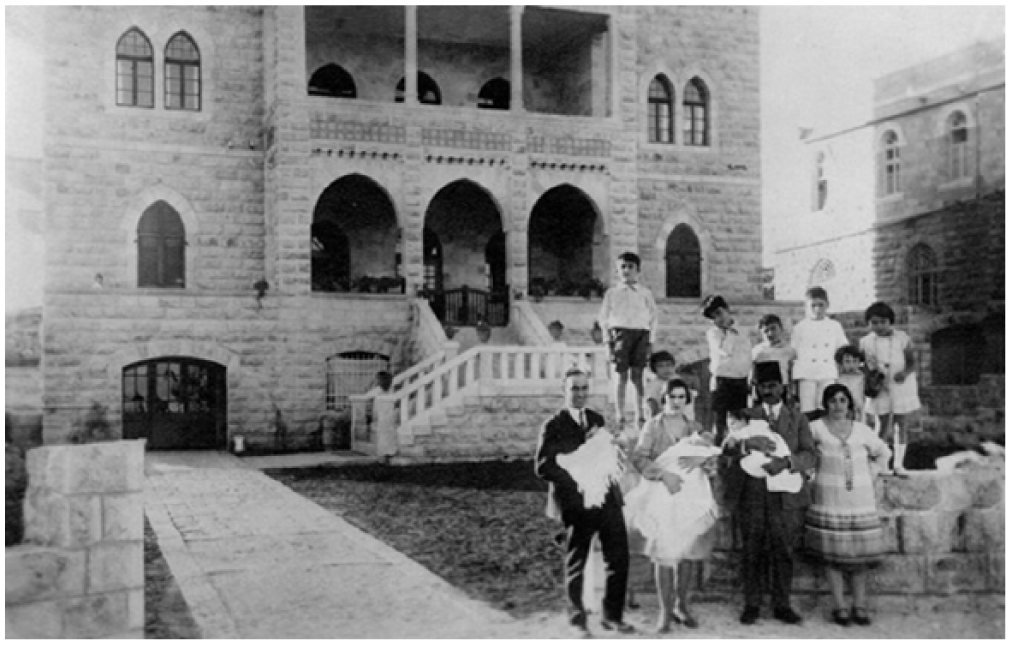
The Bisharat Family poses for a family photo in front of their villa Harun ar-Rashid, 1926.
Jewish immigrants from Europe were later encouraged to settle in these confiscated Arab houses; massive looting and wilful destruction of Arab property ensued. In all that followed, the original inhabitants were denied even the fact of having ever existed in their homes or on their land. The nascent Israeli nation used the Absentee Property Regulations of 1948 “to confiscate all Arab homes”, including the looted contents of these houses (Krystall, 1998: 15). Darwish recounts a dialogue between him and an Israeli who bragged about the destruction of Al Birweh, “You won’t find it on this earth”, he said. “We blew it up, raked the stones out of its earth, then plowed it until it disappeared under the trees” (2010: 13).
The obliteration of place, which negates existence, makes the need for preserving the homeland through memory or writing all the more urgent. The memory is in exile and not of exile, at one in the locality and inside the self (Saloul, 2012: 70). Unfortunately, Palestinians are not granted the privilege of remembering; the narrator in Journal of an Ordinary Grief describes an Israeli soldier’s surprise at a Palestinian child’s memory: From a look he could not explain in the eyes of a child, he realized he was an occupier. He did not hide his surprise at the rejection he saw in the eyes of that child. Where did her memory come from? And who taught her that she had a homeland? (Darwish, 2010: 32–3)
The narrator then adds that the struggle is not merely one over the land but also becomes one between two memories. 4 He writes that even though the Jewish motto has long been “We will not forget”, they deny that right to the Palestinians, as the “Israelis refuse to live side by side with Arab memory” (Darwish, 2010: 33). A few pages later, the narrator reflects, “He who allows himself a flood of tears for two thousand years cannot blame the one who has been crying for twenty years of having merely fallen prey to delusion” (2010: 37). Darwish’s recollections in writing are a testimony to what is already gone, as he has only words with which to create the memory (Abdel-Malek, 2005: 59). In Said’s words, “the more recent the people, the more exclusive their claim […], [the] more vigorous the pushing out and suppressing of all others” (1999: 62).
Said explains how for a long time Zionism and Israel have been associated with liberalism, freedom, and democracy, “with knowledge and light, with what ‘we’ [the West] understand and fight for. By contrast, Zionism’s enemies were simply a twentieth-century version of the alien spirit of Oriental despotism, sensuality, ignorance, and similar forms of backwardness” (Said, 1992: 29). In the same vein, a Moroccan Jewish-Israeli taxi driver tells Darwish that Arabs, as with the Arab place names, are dirty, and have to be “erased” (Darwish, 2010: 63). Furthermore, this backward enemy should not be trusted, because any “obstacles to Zionism and/or Israel are nefarious, stupid, or morally indecent […] they are not to be heard from directly” (Said, 1992: 29). Characterizing the Palestinians as barbaric makes them less human, unworthy of their land and ultimately not to be trusted as narrators of their own story.
Having become refugees in another land, the Palestinians try to regain part of their humanity by establishing a counter-history through their memories. They need a place in which they can become a people with dignity and not exist solely as refugee numbers. They need to be able to tell their story, as they know it, a right that has long been denied them. Through the Journal, Darwish has granted them this space. The narrator tells us: “We do not long for a wasteland, but for a paradise. We long to practice our humanity in a place of our own” (Darwish, 2010: 7). Excluded from the unfurling of history, Palestinians are seen at best as ill-fated refugees or faceless victims (Abu-Lughod and Sa’di, 2007: 4). The demarcated refugee camp alienates and marginalizes, and denies entry to both the homeland and the host nation (Schulz and Hammer, 2003: 113). On numerous occasions, the camps became easy targets for violence and war, resulting in new displacements. Darwish describes a recurrent news image of a Palestinian female refugee: The same picture always appears after the bullets: a Palestinian mother, dragging her children along, lugging her bedding, and walking into the wind and the unknown. She goes from one place of refuge to another. When will she settle down in a final refuge before death? It seems that the call for the return has been postponed […] She leaves one refugee camp in the direction of another tent, or a leaning rock, pursued by curses, shells, and destinies set down on paper. (2010: 141)
This Palestinian mother is once again facing eviction under the barrage of shells. Symbolically, her meagre belongings weigh heavily on her back, as she experiences the loss of the homeland anew, dragging her children to another desolate future and temporary home.
For those Palestinians who were able to remain in the new nation that became Israel, their presence became one of absence. Darwish tells us that his own grandfather became a “present-absentee”, and spent his days at the office of the military governor waiting for a permit “to travel to Acre for no other reason than to get a glimpse of his land from the window of the bus” (2010: 19). Internally displaced persons, therefore, experience an acute sense of displacement that stems from being both absent and present on their lands. This term, which was used to legalize the confiscation of the Palestinian lands, completed the Nakba (Abu-Lughod and Sa’di, 2007: 16). 5
This sense of loss prompts the narrator to question the meaning of the homeland. Using poetic conceit, the poet steps back to address the Palestinian exile (himself) in order to understand the oxymoronic term that defines him. He writes: “You are here — here, where you were born. And where longing will lead you to death. So, what is a homeland? You are part of a whole, and the whole is absent and subject to annihilation” (Darwish, 2010: 26). Homeland becomes the negation of the negation (Muhawi, 2006: 31). Darwish poses the same question on the meaning of the word “homeland” in In the Presence of Absence: “What is the meaning of ‘homeland’? They will say: The house, the mulberry tree, the chicken coop, the beehive, the smell of bread, and the first sky” (Darwish, 2011: 42). Abstracting and objectifying the homeland is acknowledging that one is no longer there; the essence of the self becomes the homeland (Parmenter, 1994: 96). In one of the anecdotes, the homeland is reduced to a pillow when a fleeing woman mistook it for her child (Darwish, 2010: 28). For the fleeing woman, the pillow, which she grabbed instead of her infant, evolves into the symbol of the lost homeland and child. Paradoxically, if the Palestinian individual is part of Palestine, and the latter is lost, he or she can hardly be seen as existing. This is affirmed in airports by officials: You saw your self at the next airport a persona non grata because documents lack the logic linking geography to names: He who was born in a country that does not exist […] does not exist either. If you say, metaphorically, that you are from no place, you are told: There is no place for no place. If you tell the passport official: No place is exile; he answers: We have no time for rhetoric. (Darwish, 2011: 49)
Exile is envisioned as a path of stones and longing, in which the adult is searching for the child and the mulberry tree, but only finds the shell of a church bell (Darwish, 2010: 17). The stone for Darwish represents the very essence of Palestinian life and the silent link between the people and the place (Parmenter, 1994: 1–2). Darwish writes about exile from a place of exile, culminating in another exile (Reigeluth, 2008: 299). The exiled being is continually deferred. The narrative of Palestine in the cultural arena has been foremost a story of “erasure, denial, and active silencing by historians and intellectuals” (Bresheeth, 2007: 179). Once again resorting to the second person pronoun, the poet describes himself and his fate: You see yourself in a long film slowly narrating what befell your people whose tongue, wheat, houses, and proof of existence were stolen the moment the gigantic bulldozer of history descended upon them and drove them away, leveling the place according to the dimension of a sacred myth, armed to the teeth. Whoever was not in the myth at that time will not be now. (Darwish, 2011: 49)
The first casualty of the Nakba was the word Palestine itself (Bresheeth, 2007: 179). The Hebrew expansionist phrase Eretz Israel rigorously replaced the historical term Palestine, in turn erasing Palestine as a country with its own history, and a people with their own language (Bresheeth, 2007: 179). On the other hand, Said argues that the word Palestine itself became an interpretation, rather than the name of the country (1992: 10). A mechanism, which linked a future with a past dream, obliterated “the realities lying between past and future”, in which the word Israel was made to provide the continuity to bridge the gap (1992: 10). The gap that has been ignored consists of more than 2000 years of history.
The narrator in Journal of an Ordinary Grief tells us, “The declaration of the birth of Israel is at the same time the declaration of the death of Palestine” (Darwish, 2010: 37). This is confirmed by Israeli writer and politician, S. Yizhar, who writes: Long live the Hebrew Khizeh! Who, then, would imagine that once there had been some Khirbet Khizeh that we emptied out and took for ourselves? We came, we shot, we burned; we blew up, we expelled, drove out, and sent into exile. (2007: 107–8)
The former Defense and later Foreign Minister of Israel, Moshe Dayan, confirmed these actions during a lecture on 19 March 1969, at the Israel Institute of Technology: Jewish villages were built in the place of Arab villages. You don’t even know the names of these Arab villages, and I don’t blame you because the geography books no longer exist; not only do the books not exist, but the Arab villages are not there either […] There is no single place built in this country that did not formerly have an Arab population. (1969: n.p.)
The constructed Israeli settlements and villages sit uncomfortably on top of the annihilated Arab villages and every “kibbutz in Israel is on Arab property” (Said and Barsamian, 2003: 32). Palestinian memorial books have often contained cartographically accurate maps situating the villages and their cultures within historic Palestine, providing accurate detail about its layout and way of life (Davis, 2007: 59–60). The villages and towns survive in the collective memory of the Palestinians, even though most no longer exist and their original names have been changed. By denying the place its original name therefore its existence marks an absence that refuses to disappear. In Journal of an Ordinary Grief, the poet has immortalized his village, as have other Palestinian exiles who have preserved the names of their villages and towns. The narrator comments on Khirbet Khizeh: “The houses Israelis live in are inhabited by ghosts”, and that during the 1967 War, many Israeli soldiers were surprised to find that Arabs have a memory, and remember a homeland that was lost. What surprised them most was that the children born after the loss of the country were still attached to it. An Israeli soldier related that when he went into one of the refugee camps he discovered that the people lived there exactly as they had previously lived in their villages. (Darwish, 2010: 32)
The Palestinians carry their homeland with them in exile and, as Said writes, “Exile is a series of portraits without names, without contexts. Images that are largely unexplained, nameless, mute” until we assign meaning to them (1999: 34). Assigning meaning is in itself a form of struggle against oblivion. The poet in Journal of an Ordinary Grief tells us the true homeland is one that cannot be proven or known (Darwish, 2010: 39). The homeland, according to him, is knowing what the rock smells like after the rain (2010: 39). However, in spite of knowing the land and having dwelled in it for centuries, Palestinians have to prove that they exist in every facet of their lives.
Denied citizenship, life becomes an endless process of proving that they have existed. In a dialogue with a lawyer friend, the poet sardonically questions: “Here, I’m not a citizen, and I’m not a resident either. Then where and who am I?” You are surprised to find the law is on their side, and you must prove that you exist. You ask the Ministry of the Interior, “Am I here, or am I absent? Give me an expert in philosophy, so that I can prove to him I exist.” (Darwish, 2010: 66)
The existential question is also echoed by Said, when he asks: Do we exist? What proof do we have? The further we get from Palestine of our past, the more precarious our status, the more disrupted our being, the more intermittent our presence. When did we become “a people”? When did we stop being one? (1999: 34)
In Journal of an Ordinary Grief, the narrator cynically adds that for peace to reign on earth, “international security becomes conditional upon [his] absence from Palestine, and from humanity”, and the erasure of his memory (Darwish, 2010: 129, 131).
Lack of official papers to prove the Palestinian’s identity in exile becomes the mark that ironically signals his or her lack of being. Palestinian refugees still languish in refugee camps without identity papers. In a French airport, the poet describes his Kafkaesque experience with the officials, as he is interrogated. The official tells him: Your travel document declares that your citizenship is obscure. In vain you explain to the French security agent the meaning of this obscurity, since whatever you say calls for yet further grasp of greater obscurity set into place by his colleague in Tel Aviv. Where were you born? Palestine. Where do you live? Israel. Therefore you are obscure. (Darwish, 2010: 153)
This obscurity has, in effect, not only negated the identity of the Palestinian but also helped in depriving the being of his or her humanity. Said argues: “Identity — who we are, where we come from, what we are — is difficult to maintain in exile. Most other people take their identity for granted. Not the Palestinian, who is required to show proofs of identity more or less constantly” (1999: 16). As the new nation of Israel was being planned and defined, the old nation of Palestine along with its citizens was methodically erased from existence. The narrator argues in Journal of an Ordinary Grief: Those who emerged from ancient books have not only taken your homeland, they also took away the means of your belonging to the world. When they were defining their destinies, they were removing from your face the features that would have enabled the world to recognize you. (Darwish, 2010: 154)
Said writes: “Everything about Arab Palestine is rewritten [as claims of] There are no Arab Palestinians. The land did not exist as Palestine, and perhaps the people did not exist either” (1999: 75). To have or to tell a story is not the prerogative of an invisible person, and whenever Palestinians attempt at narrating themselves, they appear as “dislocations in [the Israelis’] discourse” (Said, 1999: 140). The absence of the state not only makes the relationship between history and memory difficult but also marginalizes all the people’s histories (Saloul, 2012: 4). In his prose, Darwish makes the invisible visible, and gives voice to the silenced.
To become visible through words
The theme of not belonging in the world and the persistent absence at the centre of the Palestinian’s being are felt more poignantly in In the Presence of Absence. In the third part of his memoirs, Darwish writes, “I am my language/I am my words”, and outside of this presence, he feels he is only an absence in a non-place. The poet has described this third volume as “a baffling text”; in it opposites such as presence and absence, prose and poetry, converse and converge (Mannes-Abbott, 2011; Antoon, quoted in Darwish, 2011). Darwish was concerned with celebrating language and making it dance, and he compares his effort to working with a festival of words, images, and aesthetics (Antoon, quoted in Darwish, 2011). The book, which consists of 20 sections, follows the poet’s life from 1948, which at once witnessed the creation of the state of Israel and the eradication of Palestine until the last years of his life. Fearing that his own death is imminent, the book could be seen as a self-eulogy, as the text reflects the “double character of prediction and testament” or “a tombstone promising an eternal presence in words” (Rooke, 2008: 11). As with Journal of an Ordinary Grief, the events that shaped his own life are interwoven with the history of the Palestinians.
In In the Presence of Absence, the poet is at once conscious of his own mortality and concerned that his life may have been futile. Given this absence at the core of his being, the poet agonizes over what will happen after his own death, as he juxtaposes mortality and immortality. This tension of opposites forms the structure of the book — life/death, absence/presence, home/exile — resisting a simple classification of it being either a story or a poem (Qualey, 2011). In this memoir, the poet is seen constructing his own presence and that of the Palestinian people. His prose, as in Journal of an Ordinary Grief, pulsates with syntactic rhythms and internal rhyme (Antoon, quoted in Darwish, 2011). From the onset, the poet’s anguished voice raises an existential question. In an imagined dialogue between him and the world, the poet writes: Who are you? You check all your body parts and say: I am myself. They say: Where is the proof? You say: I am. They say: This is not enough. We need lack. So you say: I am both perfection and lack. They say: Say that you are a stone so we can end our excavation. You say: If only the young man were a stone. But they did not understand you. (Darwish, 2011: 19)
The archaeologists who are questioning his existence are searching for this non-presence in the land. They are looking for a proof that they have inhabited this land and at the same time hope to find proof that he has never existed there. They become the interrogators who want to eradicate his presence from the land, desiring that he becomes a characterless stone.
The act of digging could also be viewed as Darwish’s final resting place, the excavator digging the poet’s grave. The title of the book defies this absence of the poet and ultimately the Palestinian, while the book demands to be read after the demise of its author; the book insists on telling the story of the poet and his people post-mortem and ad infinitum. Once he is dead, his words will acquire a different meaning. In the opening pages, the poet stands at a grave, bidding farewell to a nameless stranger, possibly his corpse, whom he addresses, balancing the sentences using a poetic couplet: “Had I known you, I would have possessed you, and had you known me, you would have possessed me. But then you and I would not be” (Darwish, 2011: 17). Both Journal of an Ordinary Grief and In the Presence of Absence use the second person pronoun to narrate the story of the poet. This technique creates a distance between the “I”, the poet as subject, and the “you”, the poet as object. As the use of “you” positions the narrator in the accusative case, it also enables the narrator to step out of the narrative, looking at events as an outside observer. The “I”, on the other hand, allows complete immersion and subjectivity. Said uses a similar technique, as he shifts from the I, we, you, and they, to expose what he sees as the double vision in his text, and to designate how Palestinians experience themselves, and how they begin to see themselves as others see them (1999: 6). At the funeral scene, Darwish addresses an anonymous corpse, which could symbolize the death of a fellow Palestinian or another human being, or it could be a premonition of his own death; the death of the poet is both private and public. As he stands at the grave, at the threshold between life and death, he interrogates Death on who the winner is; he occupies a place between two worlds, belonging to neither. The transience, which mimics his life, is the story of the Palestinian and not only the poet’s.
In a later scene, the poet aspires to become the stone that can stand the ravages of the occupier. He hopes that his shadow will remain there and eventually turn into stone, a metaphor he repeats often in his work (Darwish, 2011: 19–20). The poet remarks that he does not need a legend to prove that he exists and, referring once again to the night they were expelled, he enquires: “Who will tell our story? We, who walk upon this night, driven out of place and myth. The myth that could not find a single one among us to testify that the crime had not taken place” (2011: 34). The Palestinians are a priori challenging the myth of the other, which in turn has negated their existence. Justifying his or her existence is a continual process for the Palestinian, and this stems from the fact that the occupiers spent endless efforts trying to justify their own presence on the land through ancient texts. The poet warns his people not to try to justify themselves through the same methods the Israelis have used: Therefore do not look for yourself in what is written about you. Do not search for the Canaanite in you to prove that you exist. Grasp your own reality and grasp your name and learn how to write your own proof. (Darwish, 2011: 34–5)
Instead, the narrator asks the poet not to dwell in antiquity but to memorize “this night of hurt by heart” by becoming the narrator, the narrative, and the narrated (Darwish, 2011: 37). The poet is urged to write himself back as a complete presence because it was he, not his ghost, who was driven away on that night (2011: 35). The “he” is the little child, “skinny as a passing thought”, to whom life came to rather shyly, “like a concubine whose fees have been paid; difficult, sweet, and very obstinate” (2011: 21). That dreaded night, which the poet describes as a barrage of megaphones, came to the child roaring his little name along with others’ names as they were preparing to “take off for their random fates in the chaos of genesis” (2011: 33).
The constant annihilation of being pervades the existence of the Palestinian in exile. With Darwish, as with his people, it began with that night of expulsion. Previously in Journal of an Ordinary Grief, Darwish described his condition and that of the Palestinian: You feel you are no longer a citizen. Your history is nothing more than dreams that are torn to pieces like a newspaper, and each dream is a disaster […] You find yourself outside war, outside victory, outside defeat, and outside your own humanity. Accordingly, you become a tree or a stone or any natural thing. (2010: 74)
Not only is the Palestinian not allowed to exist but dreams are also denied him or her. Writing becomes the niche from which the Palestinian can claim that he or she could exist, albeit owning the place that his or her words occupy. The poet tells us: “He who writes something possesses it” and “lethargic letters, which carry no value when separate, build a house when they come together” (Darwish, 2011: 28, 27). Words for Darwish are his way at trying to find a presence in the absence.
Conclusion: The suitcase, the emblem of the lost homeland
In the Presence of Absence is in part a eulogy for the author and his country, which he resents as having become a metaphor of a transit existence. He writes: How often did you ask: How many times must I travel, migrate, or depart? And for your fate the distinction between traveling, migration, and departure never became clear, because words can encompass so much of the illusion of synonyms, and because metaphor is often subject to transformation: from “my homeland is not a suitcase” to “my homeland is a suitcase.” (Darwish, 2011: 74–5)
Life in transit, amidst airports, renders the suitcase as an image at once for the lost homeland and the homeland that one carries along inside it. Palestinians are denied a centre that could define their identity; everything that remains is in the suitcase. Said describes the essence at the heart of being a Palestinian: “We’ve taken on the de-centered role. The Palestinian is very much a person in transit: Suitcase or bundle of possessions in hand, each family vacates territory left behind for others” (1999: 130). Said takes the title of his book from a poem by Darwish, “The Earth is Closing on Us”, in which the poet asks: “Where should we go after the last frontiers? Where should the birds fly after the last sky” (al-Udhari, quoted in Darwish et al., 1984: 13). Refugees who are, in some cases, dispossessed more than once in a lifetime, the Palestinians are still unable to find a place that would provide them with sanctuary, or a world that is willing to restore their denied identity. In the three books that I have chosen to write about, Palestinians have at least been given an existence through words. Said’s book, however, has allowed the Palestinians to exist not only through his text but also through Mohr’s photographs, which depict Palestinians at all societal levels and in various places of exile. In addition, even for those who live in exile, Palestine exists through their memories and the rituals that the book depicts (Beus, 2006: 215). In this minimal space, Palestinians are no longer someone’s object, and Said’s text allows them to become a part of the nation-to-be (Hawley, 2006: 209).
In the photograph taken by Mohr in al Baqa’a camp (see Figure 2), an old Palestinian man stares defiantly at the camera’s lens. His piercing eyes silently tell the story of his people, and according to Said, in the man’s face we discern a force that has been building up for a long period of time, stemming from anger and frustration about the present. Yet, in spite of his determined and sharp look, we sense worries about the future (1999: 90–1). Abdul-Shafi asks, “What requiem can be sung for trees uprooted by army bulldozers? And most of all, who can explain to those whose lands are confiscated and clear waters stolen, a message of peace?” (1992: 134). The same questions are visible in the eyes of the refugee man from al Baqa’a camp: will the future grant him a place to exist? Will the world admit to the injustices amassed against his people? For both Darwish and Said, all this is ultimately the story of a forgotten people who can only exist in words.
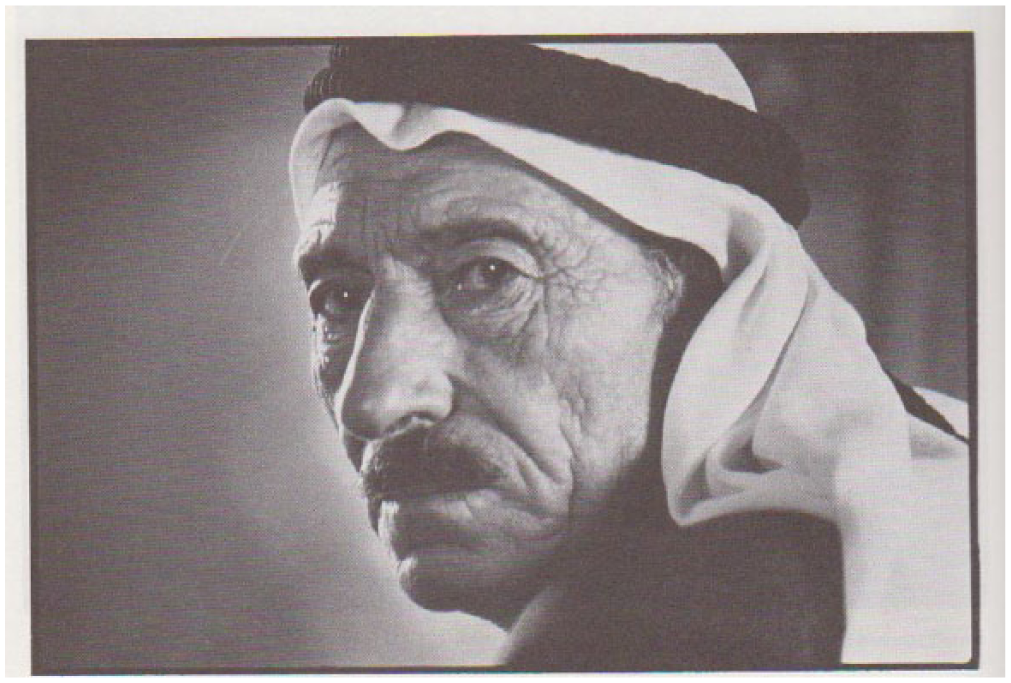
An elderly Palestinian refugee from al Baqa’a Camp stares at the lens, 1983. Photograph courtesy of Jean Mohr.
Footnotes
Declaration of Conflicting Interests
The author(s) declared no potential conflicts of interest with respect to the research, authorship, and/or publication of this article.
Funding
The author(s) received no financial support for the research, authorship, and/or publication of this article.