




Abstract
Graphic novels written in response to the 1994 Rwandan genocide do not confine their depictions of traumatic violence to humans, but extend their coverage to show how the genocide impacted on animals and the environment. Through analysis of the presentation of people and their relationships with other species across a range of graphic narratives, this article shows how animal imagery was used to justify inhumane actions during the genocide, and argues that representations of animals remain central to the recuperation processes in a post-genocide context too. Whilst novels and films that respond to the genocide have been the focus of scholarly work, the graphic novel has yet to receive substantial critical attention. Therefore, this article unlocks the archive of French-, Dutch-, and English-language graphic narratives written in response to the genocide by providing the first in-depth, comparative analysis of their animal representations. It draws on recent methodological approaches derived from philosophy, postcolonial ecocriticism, and postcolonial trauma theory in order to show how human-centred strategies for recovery, and associated symbolic orders that forcefully position the animal outside of human law, continue to engender unequal and potentially violent relationships between humans, and humans and other species. In this way, graphic narratives that gesture towards more equitable relationships between humans, animals, and the environment can be seen to support the processes of recovery and reconciliation in post-genocide Rwanda.
Graphic narratives about the Rwandan genocide show how speciesist forms of representation, aligned as they are to sovereign power, produce and legitimize continuing forms of violence, particularly when mourning is seen as a human privilege, and the real experiences of animals are banished. 1 It is, therefore, important to assess the role of animal and environmental imagery in helping to create both the cultural context in which the genocide became possible, and in reimaging more equitable relationships between humans, and humans and other species, in post-genocide Rwanda. 2 In this, the article seeks to bring together three different, though potentially complementary, theoretical approaches, derived primarily from Jacques Derrida’s writings on animals, the work of postcolonial ecocritics, Graham Huggan and Helen Tiffin, and that of postcolonial trauma theorist, Stef Craps. Craps’ (2013) valuable theorization of trauma as a site of cross-cultural ethical engagement provides an opening to considering trauma also as a site of cross-species ethical engagement. It is in this context that Huggan and Tiffin’s (2010) arguments about the role of literature in creatively transforming and producing ecologically connected human and nonhuman societies, and Derrida’s (2008, 2009) repositioning of the animal as central to our understanding of language, community, death, and mourning, can be introduced. Combining these frameworks, the article focuses on how representations of animals and the environment are connected to the reconciliation and recovery processes imagined or indicated by a range of graphic novels about the genocide. It closes with an examination of the role and representation of the dog in J. P. Stassen’s Deogratias (2006), in light of Jacques Derrida’s work on The Beast and the Sovereign (2009), in order to contend that human laws that exile the animal do not support peacebuilding, and instead, environmentally sensitive modes of representation and ways of living must be found to support recovery in post-genocide Rwanda.
This article also represents a first attempt to collate, and comparatively analyse, the corpus of graphic novels that respond to the Rwandan genocide. 3 These texts have not received the same levels of critical attention as film and text-based memoirs, testimonials, and fictional re-imaginings, which is symptomatic of both the scholarly neglect of graphic narratives from or about places other than Europe, the USA, and Japan; and suggestive of the possibility that the form is still not taken seriously as a medium for account or testimony, despite the major inroads made by artists such as Art Spiegelman, Marjane Satrapi and Keiji Nakazawa, amongst others. Graphic novels are mentioned only as a footnote in Alexandre Dauge-Roth’s book-length study of memory and trauma in film and texts about the genocide (2010: 31), and although articles focusing on Stassen’s Deogratias are more common, fuller considerations of the growing body of graphic novels that represent, or refer to, the Rwandan genocide, have yet to materialize (Burnatay and Warman, 2012; Keen, 2011; Letcher, 2008). This strikes me as strange, because as Hillary Chute and Marianne DeKoven note, the graphic novel provides “an apt form for serious non-fiction” because of the “iconic nature of the traumatic image — the fact that the intensity of trauma produces fragmented, imagistic memories”, and because this is “an art form that could defamiliarize received images of history and yet had the power to make them widely accessible” (2012: 193, 187).
The combined visual–textual form of the graphic narrative is an appropriate medium through which to assess relationships between humans, as well as humans and other species, before, during, and after the genocide, because it works to overcome the premises of unrepresentability and incommensurability that are typically associated with the three concerns of this paper: genocide, the lives of animals, and cross-cultural translations. Differing experiences of suffering of both human and non-human species are introduced via combined images and text, as well as through metatextual support in the form of histories of the genocide, maps, author biographies, photographs, endorsements, and introductions by prominent figures, translator’s notes, etc. Some of the graphic novels are single-authored, whilst others have multiple contributors, and the artists and writers hail from all over West, Central and East Africa, and Western Europe. None of the texts are monolingual, combining French, Dutch, English, and/or Kinyarwandan words; and two of the graphic novels appear in their original French as well as in English translation (Bazambanza, 2007; Stassen, 2006). The publishing companies are based in Belgium, France, Canada, and the USA, whilst Bocar Sy and Mark Njoroge Kinuthia’s 100 Days in the Land of the Thousand Hills (2011), and Rupert Bazambanza’s Tugire Ubumwe — Let’s Unite!: Teaching Lessons from the Rwandan Genocide (2012), are online publications, commissioned by the United Nations International Crime Tribunal (UNICTR) based in Tanzania. These diverse modes of production suggest that the texts are at least intended to be inclusive, with the potential to support the aims of recovery and reconciliation, because as Binita Mehta and Pia Mukherji suggest, “The postcolonial comic […] offers radical and progressive alternatives to the notion of obsolete authenticities” (2015: 3). That is, the multimodal, hybrid form of the graphic narrative means that there is no single point of origination, allowing various voices, cultures, registers, and genres to intermingle in ways that reflect the intermingling of global and local in postcolonial contexts. So whilst there remain some obvious barriers to inclusivity, including the linguistic barrier that characterizes a Hutu/Tutsi divide as a Francophone/Anglophone divide, the texts do seek to work across cultural boundaries, bringing different individuals and groups, visual and textual mediums, languages, readers, and writers, together, to support recuperative processes in Rwanda. 4
Animal imaginings
Genocide is typically characterized as the violent attempt to dehumanize an ethnic, racial, national, or religious group, as Huggan and Tiffin make clear: “both human genocide and human slavery have been, and in some cases, continue to be, predicated on the categorization of other people as animals” (2010: 135). Humanness is, therefore, a strategy that is used to justify slaughter, and as Judith Butler points out, functions as “a differential of power that we must learn to read, to assess culturally and politically, and to oppose in its differential operations” (2009: 77). Descriptions of humans as animals as well as plants played a vital role in instigating the outbreak of the genocide in 1994, and was a prominent feature of the language used by the hate media and génocidaires to describe Tutsis, the Rwandan Patriotic Front (RPF), moderate Hutus, and others who did not promote genocidal aims. Bazambanza, himself a genocide survivor, describes in an interview how “we weren’t called human anymore: we were cockroaches, snakes, things like that” (High, 2014: 175); whilst Roméo Dallaire, Force Commander of the United Nations Assistance Mission for Rwanda, recalls how “the Interahamwe [Hutu youth militia] was encouraging people to show up to the meeting armed with DDT ‘as medicine for the inyenzi’ [cockroaches]” (2004: 186). Gardening metaphors were also common, as Paul Rusesabagina, the manager of Hôtel des Mille Collines (and inspiration for the film Hotel Rwanda), recalls hearing the radio deliver “code language that everyone understood: ‘Cut the tall trees. Clean your neighbourhood. Do your duty’” (2007: xvi). Violent attacks on Tutsi men were also described as “bush clearing”, whilst slaughtering women and children was labelled as “pulling out the roots of the bad weeds” (Prunier, 1997: 142). In this way, the garden becomes an exclusionary setting, supporting the idea of a Rwandan community as culturally contained, and allowing for the cultivation of particular specimens and the destruction of others. Indeed, as Tutsis (and others) were given new signification as unsanitary animals to be exterminated for the health of the human (Hutu) race, and as plants to be destroyed to cleanse Rwanda’s otherwise healthy gardens, the idea of environmental sanitation and purification was widely understood as essential “‘work’, a common euphemism for killing” (Des Forges, 2007: 49).
The varied cultural contexts of production and reception of the graphic novels means that the significance of animal imagery in the texts is similarly varied. Any reading of the animal language must, therefore, necessarily adopt a “cross-cultural comparative perspective” to ensure, as Craps suggests, that the analysis of the trauma of genocide “is not irredeemably tainted with Eurocentric bias but can indeed stay relevant in the globalized world of the twenty-first century” (2013: 124). There are abundant depictions of tactical uses of animal language to dehumanize Tutsis, moderate Hutus, and sympathetic Europeans throughout the texts, with individuals and groups referred to as “inyenzi”, or the English, French, and Dutch equivalents, “cockroaches”, “cafards”, and “kakkerlakken”; “insects”, “vermin”, and “vermine” (Bazambanza, 2007: 9, 20; Grenier et al., 2009: 31, 81; Inongo and Kibwanga, 2001: 5; Janssen, 1997: 40; Stassen, 2006: 34, 57; Sy and Kinuthia, 2011: 13). Whilst, as I have already suggested, descriptions of humans as insects or vermin work to maintain the logic that they should be exterminated for reasons of hygiene, these insults are also associated with particular qualities or characteristics. Given that the graphic novels have different contexts of writing and reading, the meanings generated by the animal terms are contingent on the historical moment being represented, and the languages and/or translations used. Of all animal-based insults, inyenzi is the key example of this, and features heavily in both the graphic novels, and in accounts and records of language used by génocidaires at the time. Jean Marie Vianney Higiro (2007) outlines how in the 1960s, inyenzi was used by much of the Rwandan population in a negative sense to refer to Tutsi rebels, who would kill at night and then disappear into the countryside of bordering countries in the day. At the same time, the term was interpreted positively by the rebels themselves, who redefined it as an acronym of INgangurarugo YEmeye kuba ingeNZI. The Ingangurarugo were an army division under the 19th-century Tutsi ruler of Rwanda, Kigeli Rwabugili, and so inyenzi means “a member of the Ingangurarugo who has committed himself to bravery” (Higiro, 2007: 84–85). The graphic novels written in English, Dutch, and French, and which use “cockroaches”, “kakkerlakken”, or “cafards” instead of inyenzi, of course cannot incorporate a full sense of these etymological variations. However, by 1990, inyenzi was overwhelmingly used in a pejorative way by génocidaires to refer to the Inkotanyi (RPF), then extended to refer to all Tutsis, and again to include moderate Hutus during the genocide, and it is this negative use that predominates in the graphic novels.
A second key example of an animal-based insult used to describe Tutsis during the genocide is inzoka, a term used to refer to either a snake or an intestinal worm. Unlike the commonplace use of the Kinyarwandan word inyenzi in the graphic novels, inzoka does not feature. 5 Instead, the texts tend to use the English and French “snakes”, “serpents”, and “worm” (Bazambanza, 2007: 45; Grenier et al., 2009: 96; Sy and Kinuthia, 2011: 11). Although the translation “worm” works to invoke a similar reaction as “vermin” or “insect”, the translation “snake” has different connotations. In both French and English, “snake” is a derogatory metaphor that invests the animal with the human quality of untrustworthiness. To call someone a snake is, therefore, to suggest that they are both traitorous and a direct threat to human life. This in turn enables an alternative discourse of hunting to emerge, as these animals are destroyed because they pose both a social and mortal threat to humans. The graphic novels thus echo the hunting metaphors that commonly feature in perpetrator testimonies, which Charles Mironko persuasively reads as a carefully-selected strategy by génocidaires to avoid responsibility for their actions (2009: 182–183). In the context of a hunt, the argument goes, animals can be legitimately slaughtered.
The graphic novels’ combined visual–textual responses to the extreme violence of genocide offer new ways for thinking through the differing experiences of the suffering and oppression of animals, and again, the contexts of production and reception multiply the meanings generated. This is particularly the case in the representations of cows in the graphic novels. In Bazambanza’s Smile Through the Tears, a man in the marketplace, and a soldier from the Presidential guard, refer to Tutsi women, Rose and Marie, as “Tutsi cow!”, “Brazen cows!”, and “Cow! Whores, both of you! Nothing more” (2007: 22, 24). The insults seem incongruous with Rwandan culture, where cows are both materially and symbolically important. Jean Hatzfeld notes that “a cow is much more than just livestock”, it is a national symbol associated with royalty, as well as “a sentimental offering, a gesture of friendship, or it’s a loan, a reward, a bribe, a dowry, an investment several families make to provide milk for the children” (2005: 39). To Anglophone audiences then, the insult “cow” in Bazambanza’s (2007) graphic novel registers as a term used to describe unpleasant or degraded woman, and although the anatole cow, the main breed of cow in Rwanda, is used for milk rather than meat, the insult also introduces the idea of culling, in which inferior or surplus animals are destroyed. At the same time, in a Rwandan context, calling a Tutsi a cow illustrates the new order in which the former Tutsi elite, traditionally cattle herders, are now demeaned alongside their animals. Indeed, cows were deliberately targeted by génocidaires in 1994, with Hatzfeld recording how “two thirds of the national livestock was destroyed during the killings”, including 90% of Rwandan cattle, and often “murderers cut the animals’ throats before their owners’ eyes first, to humiliate them, and before killing the owners themselves” (2005: 41). The graphic novel by Sy and Kinuthia (2011) depicts the killing of cattle in this context. Hutu militia are shown drinking beer, with machetes and clubs in the foreground of the panel, and cows in the background. The caption reads: “the Interahamwe slaughter cows and spend the evening eating meat and talking with their friends” (2011: 23). In this act, the génocidaires take away a key food source as well as a symbol of Tutsi status and pride. For both these reasons, cows now play a central role in post-conflict peace-building processes. As their mass destruction greatly affected the speed at which the Rwandan economy, agriculture, and individual livelihoods could recover after the genocide, government strategies continue to focus on cattle as a way of promoting development in Rwanda. 6
The graphic novels show how the premise of the genocide, that some lives are valued more than others, is not only confined to génocidaires, but also underpins the failure of Western powers to prevent or halt the killings. Two examples in particular illustrate how Western projections of the differing values of human and animal lives impacted on both global and localized responses to the genocide. Rwanda 1994: Descente en Enfer (Grenier et al., (2009: 24)) depicts the evacuation of Europeans from Rwanda following the death of President Habyarimana, and a woman asks: “Mon chat, vous avez des nouvelles de mon chat?” (My cat, do you have news of my cat?); to which the French soldier replies: “Nous ne nous occupons que des êtres humains, madame, pas des animaux!” (We’re only concerned with human beings, Madame, not animals!) (2009: 24).
7
The woman values the life of her pet cat more than the human victims of the genocide, whilst the soldier values European over Tutsi lives. The second example, taken from Bazambanza’s Smile Through the Tears, includes a panel showing a dead mountain gorilla lying in a pool of blood, with a caption that states: Following their defeat, the criminals in power went on a rampage of destruction to ensure that nothing remained for the new government. Even the gorilla — an endangered species the world seemed to care more about than the human victims of discrimination it consistently ignored — were destroyed to prevent their being a source of income. In the end, racial discrimination benefitted no one. Had it only known, the world might have at least saved the gorillas! (2007: 61)
High emotion combined with dry irony in Bazambanza’s (2007) caption highlights how maintaining any structure that privileges one life over another, be it human and/or other species, will continue to justify both the treatment of humans as animals, and the treatment of animals cruelly. What both texts confirm, in the starkest of terms, is the arguments laid out by Huggan and Tiffin, that “the racism/speciesism nexus is particularly important in terms of representation, with specific relation to the human/animal symbolic economy” (2010: 148). So the gorilla is prized in Western culture in the context of eco-tourism, whilst the lives of European humans and their pet cats are worth more than the lives of Tutsis. Dallaire addresses a hierarchical notion of life in his emphatic condemnation of Western powers’ ineffective response to genocide, asking: “Are we all human, or are some more human than others?” (2004: 522). Although he challenges inequalities within the human race, the graphic novels push this further, suggesting that the key questions that need to be asked in post-genocide Rwanda are not confined to humanity alone, but instead require a fuller understanding of how all life is valued.
“I’m only a dog!”: Revenge and transformation in JP Stassen’s Deogratias
The centrality of representations of animals to understanding both the cultural context of 1990s Rwanda, and the role of animals in its recovery, is particularly important when considering interactions between humans and dogs before, during, and after the genocide. Both experienced extreme violence in 1994, and not just at the hands of the génocidaires. In fact, one of the most enduring images of this time is of United Nations (UN) and RPF soldiers shooting the dogs that feasted on huge piles of Tutsi corpses. Prior to the genocide, dogs were fairly common in Rwanda as pets, watchdogs, and used in hunting, particularly by the Twa people, who comprised around 1% of the population. When the killing began, Tutsi families fled the génocidaires, abandoning their animals. This instigated a change in the ecological structure as people no longer provided dogs with food, causing the dogs to become scavengers of human remains. Dallaire records how this change in diet changed the relationships between humans and dogs, with each now viewing the other as a threat: “I can’t tell you how disgusting daily life could be, the corpse-eating dogs that we shot on sight now had no qualms about attacking the living” (2004: 379). Although the killing of dogs was seen as necessary for reasons of hygiene and human safety, it also played an important symbolic role. As the UN mandate did not allow their soldiers to fire on génocidaires, and the post-genocide government pursued a policy of truth and reconciliation, the destruction of dogs provided an outlet for those seeking revenge or punishment. This was exacerbated by the fact that Hutu militia, and Twa people forced to ally with the Hutu militia, sometimes used dogs to hunt Tutsis during the genocide, as depicted in Rwanda 1994: Descente en Enfer (Grenier et al., 2009: 52–54).
Stassen’s (2006) graphic novel, Deogratias, uses the dog to explore issues around revenge and reconciliation in post-genocide Rwanda. It tells two parallels stories about Deogratias, a Hutu teenager, who transforms into a dog when he remembers the horrors of the genocide. Deogratias’ past is told through flashbacks, depicting the events prior to and during the genocide in borderless panels, and shows Deogratias wearing a clean white t-shirt. In these flashbacks Deogratias attempts to woo Tutsi half-sisters, Apollinaria and Benina, and he is eventually successful in persuading Benina to have sex with him. When the violence begins, he tries to protect Benina by locking her in his room, but she escapes to join her sister hiding in a latrine. The girls emerge from their hiding place weeks later, to find Deogratias with the Interahamwe and the mutilated corpse of their mother, Venetia. Deogratias rapes Apollinaria and then takes part in killing both the girls. He leaves their bodies and goes to the Turquoise Zone where he meets his friend, Augustine, a Twa, who is searching for Benina and Apollinaria. Julius, a member of the Interhamwe and one of Deogratias’ companions, reveals to Augustine that Deogratias helped to kill the sisters. Augustine is then killed by Julius, prompting Deogratias to abandon the Interahamwe and return to the bodies of Benina and Apollinaria. Julius is prevented from killing Deogratias by a French soldier. Deogratias finds dogs eating the girls’ corpses, and Bosco, an RPF soldier, shooting the dogs dead. [Figures 1 and 2] Deogratias turns into a dog for the first time. The parallel story is set in Deogratias’ present, after the genocide, and is recognizable by the protagonist’s ripped clothes, and the black borders around the panels. Deogratias is an alcoholic, addicted to urwagwa (banana beer), and he sleeps in a cowshed. He is mocked and abused by locals who dismiss him as mad, bark at him and ask “Still a dog?” (Stassen, 2006: 28). Over the course of the narrative, Deogratias poisons and kills the French sergeant, Julius and Bosco. The book ends with Deogratias’ confession to the missionary, Brother Philip, a friend of both Deogratias and his victims, before Deogratias transforms into a dog for a final time and is arrested.
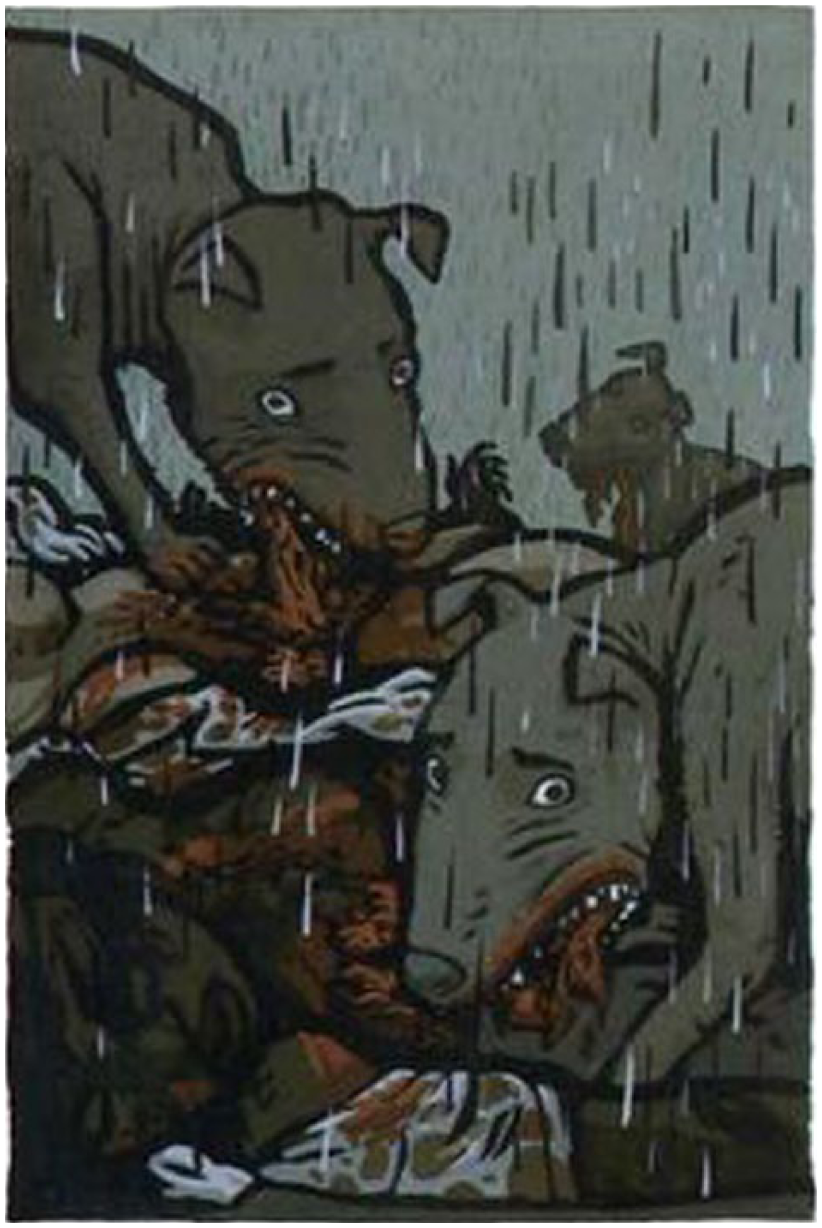
From Deogratias: A Tale of Rwanda © 2006 by J. P. Stassen, p. 75. Reprinted by permission of First Second Books. All rights reserved.
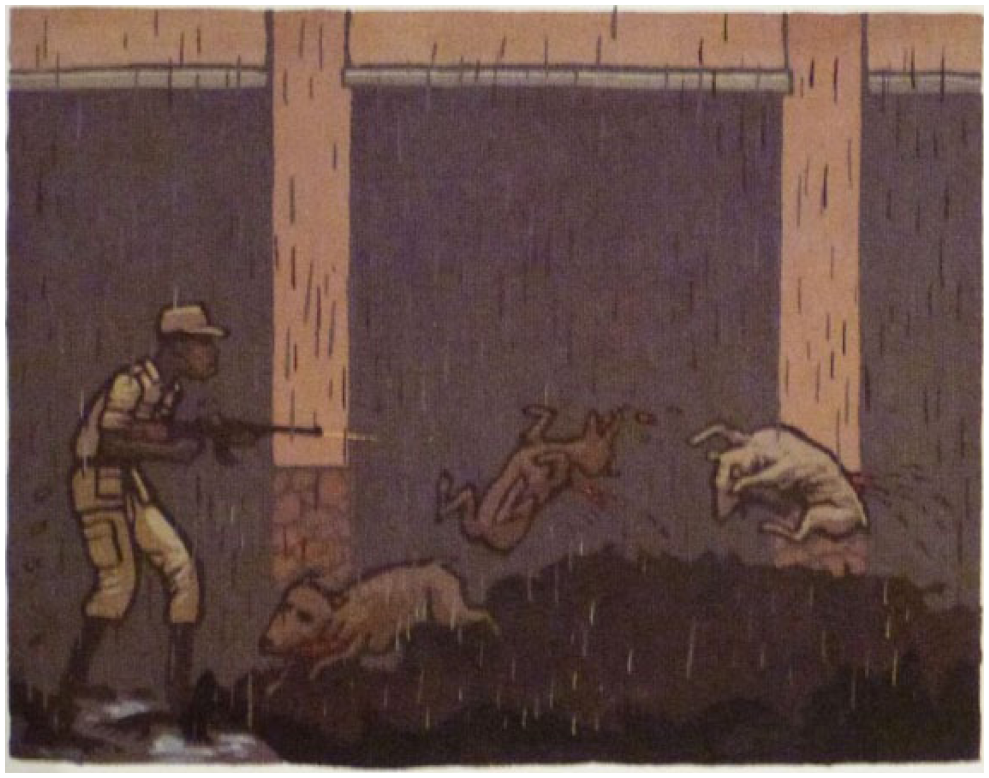
From Deogratias: A Tale of Rwanda © 2006 by JP Stassen, p. 75. Reprinted by permission of First Second Books. All rights reserved.
The meaning of Deogratias is thanks be to God, and the letters d, o and g appear in the first four letters of the protagonist’s name. This association of God with dog can be interpreted using Derrida’s argument that “the living being that is called the ‘beast’ or that is represented as bestiality” and the sovereign, “human or divine”, “seem to have in common their being-outside-the-law” (2009: 14, 17). Although Derrida shows that this relationship is still hierarchical, with sovereign power reliant on the position of God above and animal below, he nevertheless suggests that “sharing this common being-outside-the-law, beast, criminal and sovereign have a troubling resemblance” (2009: 17). When Deogratias transforms from human to animal in a context where the dog is no longer the obedient, domesticated pet, controlled by human law, he becomes a beast, a criminal, or god. This frees him from the confines of human law, including the principle that “Derrida and others have shown, speciesism underpins racism” (Huggan and Tiffin, 2010: 148). From this outsider position, Deogratias attempts to overturn the established hierarchical representational structures of living things. This is illustrated in an early tier where Deogratias prevents the French soldier from squashing a cockroach (Stassen, 2006: 5). The first panel views the cockroach from above, with a speech balloon in which the soldier asks “By the way, Deogratias, do you remember Venetia?”; the second panel is aligned with the perspective of the cockroach, showing Deogratias and the soldier looking down, as Deogratias remembers “Venetia…”; and the final panel is drawn from above and behind the soldier’s head as he clenches his fist and exclaims “Damn bugs!”, to which Deogratias responds “No!”, moving his body low to shield the insect (Stassen, 2006: 5). The tension created by the interaction of word and image in the association of Venetia, a Tutsi woman, with the cockroach, echoes the overwrought animal language used to describe Tutsis during the genocide. At the same time however, the shifting perspective of the images shows how Deogratias now identifies with the cockroach, refusing to see it as vermin that should be destroyed. This affinity with animals frees Deogratias from human laws, and so he sets out to destroy human life as a criminal or god, murdering the people that he associates with the deaths of Apollinaria and Benina. He poisons the French soldiers, Julius and Bosco, with “the product farmers use to fight parasites on cows’ hides” (Stassen, 2006: 77). This revision of the respective values of the lives of humans, cows, and parasites thus inverts a hierarchical model of sovereignty by invoking Derrida’s vision of the shared quality of beast, criminal, and god as outside-the-law.
As Derrida suggests that the relationship between beast and sovereign is one of force, there is little scope in this model for an ecologically united and peaceful society to emerge. This conception of sovereignty is violent, and so Deogratias attempts to atone for murdering Benina and Apollinaria within the context of this symbolic order, killing the others who “knew what the dogs do” (Stassen, 2006: 70). Deogratias’ first transformation into a dog is symbolically connected to the dog’s status during and after the genocide. Like the dogs, Deogratias has feasted on the bodies of his friends in the most shocking and violent way. Yet it is the scavenging dogs, not the killer Deogratias, who are shot by the reinvading RPF soldiers. The association of the dog with death resonates with mythological and religious representations of dogs and dog gods from across the world, including Anubis, the Egyptian Jackal-headed god of the underworld; Cerberus, the three-headed dog guard at the entrance to Hades; and the Hindu dog guards who stand at the entrances to heaven and hell. Where these representations are used to support human rites of mourning, the dogs in Stassen’s (2006) text prevent Deogratias from grieving. As his attempt to mourn is disturbed by the feasting dogs and shooting soldiers, he is forced to endlessly relive his actions during the genocide through disturbing flashbacks. The killing of Bosco is particularly significant from this perspective, as Deogratias seeks resolution by recasting the human Bosco as the disturber of human remains and rites of mourning, and now allies the murdered dogs to the murdered girls, seeing both as victims of human laws. Deogratias thus illustrates how violence, sovereign power, and speciesist representation are yoked together, signalling a need to acknowledge the real experiences of animals, rather than appropriating them as signifiers within the context of human mourning.
The symbolic status of the dog as complicit in the horrors of the genocide, combined with its inability to speak using human language, render it exposed to punishment and exile in a post-genocide context. Derrida explores the relationship between humans, animals, and language, showing how sovereign power relies on the idea that “the beast does not understand our language”, though he goes on to state that “it is false to say that beasts in general […] do not understand our language, do not respond or do not enter into any convention” (2009: 55–56). At the end of Deogratias, as the protagonist begins to shape-shift into his canine form, he still has the sovereignty of the speaking subject. This uncomfortable reversal of anthropomorphism works to challenge the principles of incommensurability and unrepresentability typically associated with both the genocide and the lives of animals by allowing Deogratias to speak using human language during his transformation into a dog. Deogratias’ process of transformation is representative of the site where communication between humans and other species is perhaps possible, though the opportunity is missed. As he completes his transformation in a sequence of dark, claustrophic panels, and is arrested, Deogratias falls silent. His inarticulacy here can be interpreted as the result of the systemic oppression of human sovereignty, and suggests a mistrust of language as a medium to unite different groups and individuals. This is particularly important in the context of the genocide where the animal-based insults such as inyenzi and snake worked to close down human empathy and prevent meaningful intercourse. Once silenced and in his canine form, Deogratias is interpreted by the police as a criminal, living outside the law. The action of the text ends with the police hauling Deogratias, now fully transformed, out of the bar. This rigid application of human law leads to the illogical imprisonment of a dog, and thus misses the potential for communication across species boundaries.
Deogratias’ animality, and the juxtaposition of dog/god throughout the text, can be interpreted as a broader comment on the limitations of human-centred approaches to accountability and recovery in the aftermath of the genocide. About mid-way through Deogratias there is an image of a silhouetted church against a starry sky, with the line below: “My Urwagwa…I am not a dog” (Stassen, 2006: 49). At the end of the text however, whilst Deogratias undergoes his transformation, he shouts: “I don’t need your forgiveness! Nor the mercy of your god! I’m only a dog! It wasn’t a confession!” (2006: 76) Figure 3. The shift from refusing to recognize his animality, to recognizing “the animal that therefore I am” (Derrida, 2008) is not just an individualized response to the trauma of the genocide. Indeed, Craps warns how “by narrowly focusing on the level of the individual psyche, one tends to leave unquestioned the conditions that enabled the traumatic abuse, such as political oppression, racism, or economic dominance” (2013: 28). The visual markers of the church and sky, and juxtaposition of god/dog, bring to light the wider context of the genocide in which churches were no longer sites of sanctuary. In many cases, Christian leaders did not prevent, or even encouraged and took part in, the massacre of Tutsis (Longman, 2010). This is shown in Deogratias, as the missionaries Brother Philip and Father Stanislas abandon their Tutsi congregation to save themselves (Stassen, 2006: 59–60). The role of religion is made prominent in the final line of the book, delivered by Brother Philip, who describes Deogratias with the words: “He was a creature of God” (Stassen, 2006: 78), and this is followed by three wordless panels, including a final image of hills and trees silhouetted against a starry sky. The combination of visual and textual images brings together the beast (creature), the sovereign (God), and the natural world, in a way that suggests that new forms of connection are required between these groupings in order to aid recovery in Rwanda.
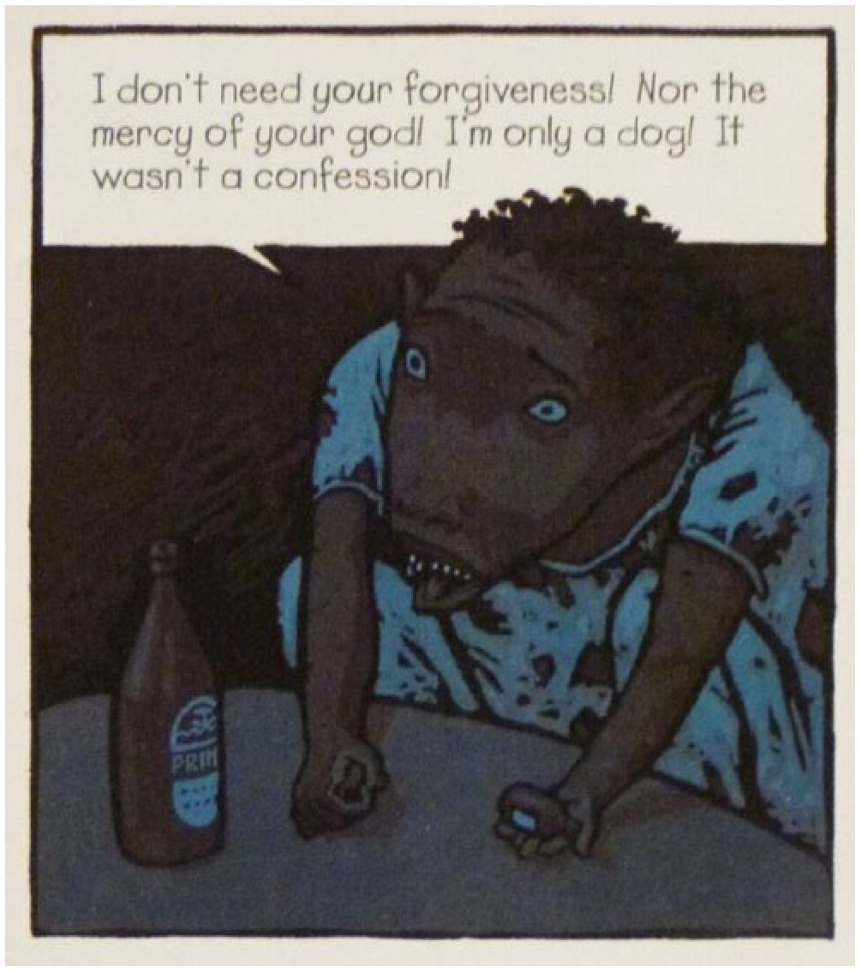
From Deogratias: A Tale of Rwanda © 2006 by JP Stassen, p. 76. Reprinted by permission of First Second Books. All rights reserved.
Conclusion
As Deogratias and the other graphic novels analysed here show, animal and environmental imagery was a key tool for creating the context in which the genocide became possible, and the mass killings were not confined to humans alone. Issues of representation, therefore, have a transformative role in the lived experiences of Rwandan people and animals, and so this transformative role remains an essential tool in imagining and creating a peaceful, equitable future for Rwanda. It seems appropriate then, to end with a brief comment on the most recently published graphic narrative, Bazambanza’s (2012) Tugire Ubumwe — Let’s Unite!: Teaching Lessons from the Rwandan Genocide, a didactic text that explicitly uses animal and environmental imagery to support reconciliation. Here, a teacher shows students how easy it is to break one stick, though how difficult it is to break two or more sticks simultaneously, as a way of encouraging “unity of all Rwandans”; there is a page dedicated to “Lesson three: Respecting our environment and others”, and the conclusion shows children drawing “images of hope” that they find in the clouds, followed by an image of a sunrise emblazoned with the word “hope” (2012: 8, 19, 28). In this, Bazambanza shows commitment to the idea posited by Huggan and Tiffin that: Human liberation will never be fully achieved without challenging the historical conditions under which human societies have constructed themselves in hierarchical relation to other societies, both human and non-human, and without imagining new ways in which these societies, understood as ecologically connected, can be creatively transformed. (2010: 22)
Through creative re-imaginings of animals and the environment, graphic narratives about the genocide facilitate an understanding of the value and importance of animal and plant life in a local context in ways that support reconciliation and recovery in post-genocide Rwanda. Although there remain some significant limitations to the accessibility and interpretability of these texts, their multimodal forms nevertheless seek to promote the idea that it is possible to meaningfully communicate across boundaries of language and culture by overcoming the premises of incommensurability and unrepresentability so often attributed to multilingual and translated literature, the lives of animals, and genocide. For this reason, this corpus of texts should be recognized as providing an important and alternative role in investigating and imagining preferred futures for Rwanda.
Footnotes
Acknowledgements
I would like to thank Judy Kendall, Jane Kilby, and Barry Munslow for their insightful comments on the early drafts of this article.
Funding
This research received no specific grant from any funding agency in the public, commercial, or not-for-profit sectors.