




Abstract
This article offers a consideration of the figure of the child in Benh Zeitlin’s film Beasts of the Southern Wild (2012), a vibrant but urgent ecological drama motivated by the devastating aftermath of Hurricane Katrina. It examines how a film that on its release was praised as an American survival story focused on a feisty young heroine can be more productively understood through a postcolonial lens as a radical vision of world ecology underpinned by a complex critique of childhood, development, and marginality. Exploring how vectors of racial, economic, and environmental relations intersect in the film’s fantastical form, the focus is shifted from survival to the connectivity that the precarious postcolonial child enables amongst actual and mythological animals and between past, present, and future time-worlds. As such, the child de-centres the contemporary notion of the human and the tenets of development, progress, and mastery over nature that hold it in place. By delineating the material coordinates of the film in terms of the capitalist, neo-imperialist world-system and analyzing how its mixing of the real and the fantastic elaborates upon the causes and responses to environmental disaster, the article shows how the postcolonial child provokes new approaches to ecological relations.
Benh Zeitlin’s low budget independent film Beasts of the Southern Wild is an example of deliberately collective outsider art which won major prizes: the Camera d’Or at Cannes and the Grand Jury Prize at the Sundance film festival. The film, Zeitlin’s first feature, was shot in the Louisiana bayou in the USA, with a cast of mostly non-actors, in the wake of Hurricane Katrina in 2005. 1 The film’s documentary-style camerawork tracks Hushpuppy, a six-year-old African American girl (played by Quevanzhané Wallace), as she scrambles through life to a Bayou Creole soundtrack alongside her ill and alcoholic father (played by Dwight Henry) and a motley community of folk down on their luck whose home, known as the Bathtub, is gradually sinking into the ocean. The film’s mood of slow catastrophe, to paraphrase Rob Nixon’s “slow violence” (Nixon, 2011), is made more urgent by the approach of a devastating storm and dramatized through Hushpuppy’s philosophical voice-over and imaginative conjuring of a troop of “aurochs”. 2 These beasts tear across the skyline of a ruined landscape punctuated by spiky black trees beneath sheets of rain. The much-mythologized wild ancestors of domestic cattle, aurochs are altered in Zeitlin’s unconventional vision into enormous wild boars with long hair and horns, a transformation which, I argue, renders their significance provocatively unstable. Hushpuppy’s repeated but unexplained sightings of the aurochs culminate in a face-off that might herald destruction or salvation; like many of the film’s more fantastical features its interpretation is deliberately left open. All we know for sure is that these messengers from the submerged pre-human past portend a bare post-human future. In my analysis I suggest that the aurochs’ interruptions of the film’s carnivalesque narrative, passing as they do through a porthole in Hushpuppy’s mind, push us to realize that Zeitlin’s vision of environmental destruction and human disaster depends upon a critical understanding of the relationship between Hushpuppy and her home; between the child and ecology. It is a realization that disturbs the obvious in both terms and provides the impetus for my examination of the film in postcolonial terms, because it magnifies the life of a community that is effectively a colony on the rapidly eroding edges of a USA that remains the globe’s neo-imperial control centre.
Brought up in the bayou
The setting of Beasts obliquely gestures to Isle de Jean Charles, the island that inspired Zeitlin. The site is threatened by subsidence caused by oil and gas drilling and the rerouting of the Mississippi river; salt-water intrusion; the Exxon Valdez oil spill (1989) and the BP oil spill (2010); and global warming. 3 Yearly storms, including hurricane Rita that devastated the Mississippi Gulf coast three weeks after Katrina hit, mean that the island is in a state of ongoing destruction which, because the island’s residents have been left out of the Morganza to the Gulf of Mexico Hurricane Protection project (Barry, 2006), will not be halted. 4
Knowledge of the geographic and historical contours of Isle de Jean Charles is not strictly necessary for the appreciation of a folkloric film that offers only sideways references to actual events as it sweeps together primordial and future times. Beasts has been praised as “a mythic odyssey laced with modern ecological anxieties”, giving the impression that it might take place in any landscape from Alaska to Atlanta, and beyond (Edelstein, 2012). Critics and audiences have delighted in a local tale of struggle rendered in spectacular shots of a landscape suddenly familiar across the globe, neatly telescoped into the well-loved form of a survival story. Such a reaction rightly highlights the fighting spirit and extraordinary form of the film but focuses rather narrowly on its intrepid child heroine while sidelining its most innovative feature — the relation between catastrophic material conditions and a fluent form that mixes realism with the fantastic in order to stretch the ecological narrative beyond Hushpuppy’s personal journey without evading its knotty actualities. 5 The fantastical aspects of the film are not, I contend, incidental productions of a child’s imagination (however we may conceptualize that child) but are essential to its aesthetic and political coherence and indicative of the ecological debate it stages.
Hushpuppy’s mental scenery includes crashing blocks of Arctic ice viewed from below in a way that literalizes a diminutive perspective. These set pieces are integral to the film’s interest in threatened landscapes and populations, showing, in a manner that recalls the magisterial wild of nature documentaries, how space for living is literally shrinking. I interpret Zeitlin’s eccentric but recognizable creative effects as beginning from the proposition that disasters demand new narrative forms and, in turn, artistic expression has a vital function in revealing and re-imagining, sometimes in contradictory ways, the crisis-driven reflexes of late capitalism. The ecological vision of Beasts therefore relies upon a familiarity with historical relations of displacement, colonization, and economic control that have contributed to environmental destruction.
The predicament of Isle de Jean Charles, and other marginalized communities, refigures to some extent the colonial exploitation that facilitated the global drive for modernity. Régis Debray diagnoses these as “strange times” in which anxiety about dwindling resources, environmental stress, and the economic rise of China and India co-exists with “the hardy-perennial notion of ‘the West’ […] ubiquitously used to ennoble the usual suspects, the US, the UK and France” (Debray, 2013: 29). As Naomi Klein contends, disasters provide “a clean sheet” and a blank cheque that developers and investors are keen to cash, keeping themselves in “pole position” (Klein, 2007: 8; Debray, 2013: 44).
The exploitative operations of George W Bush’s neoconservative policies in post-Katrina Louisiana included the elimination of social housing in favour of privatized developments, “state-of-emergency” deregulation, and redirecting social spending into private coffers in the name of improving services and opportunity for the majority black population. 6 For Klein the fluttering excitement of economic opportunity amounted to an “orchestrated raid on the public sphere” (Klein, 2007: 6). 7 When the disaster occurs in the home of capitalist enterprise, as it did in 2005, the homogeneity of corporatist economics and the stark divisions between the wealthy and the dispossessed that they produce are exposed. Mike Davis goes as far as calling Katrina “one of the great moral watersheds of modern American history” because it both revealed the extent of poverty in the USA and failed to arouse the political will to change it (Davis, 2007: 42).
Hurricanes Katrina and Rita did not provide the kind of swift and lucrative opportunities for tourism that followed the 2004 Tsunami (Carrigan, 2011: 165−167). However, there were worries that New Orleans would become a colourful touristic myth rather than a working city, and there are troubling similarities in the “reconstruction” process, which replaced longstanding communities with gentrified housing and commercial ventures. As Zeitlin’s narrative encodes by highlighting the neocolonial features of American disaster management, “radical social engineering” is not limited to non-Western or postcolonial states (Deckard, 2014: 26). In New Orleans transnational capital operated smoothly as the poor and vulnerable, who were mostly black and often socially isolated, were left to beg for assistance from FEMA (the Federal Emergency Management Agency), whose attentions had been refocused onto anti-terrorism activity following 9/11 (Dyson, 2003: 46−52). 8 In a manner also comparable to the post-disaster grasping for land and development opportunities in postcolonial locations, including Sri Lanka, Haiti, and Iraq, panic regarding basic needs and law and order was used to justify “state violence against demographics seen as economically ‘unproductive’ or ethnically undesirable” (Deckard, 2014: 27).
The inhabitants of the Bathtub form a self-sufficient, economically inactive, and racially mixed group, representing exactly the kind of community which, when its fragile defences are breached, is vulnerable to corporate vulturism.
9
The film combines reference to the racial politics of contemporary Louisiana via its black heroine with a gesture towards the already precarious predicament of the Biloxi-Chitimacha tribe who make up the majority of the population of the real Isle de Jean Charles: they will not be granted the federal recognition they seek were they to sue the state for not protecting their home (Barry, 2006). Their position might even be read as an ironic reversal of the realization amongst New Orleans’ black population post-Katrina that the contract of citizenship they thought was theirs does not guarantee them protection: …the deep inequalities of American society […] were not news to the displaced people […]. What was bitter news to them was that their claims of citizenship mattered so little to the institutions charged with their protection. (Ignatieff, 2005: 15)
It is clear from this brief account of the similarities between environmental and social catastrophes in postcolonial locations and post-Katrina Louisiana that an analysis of Beasts’ ecology must be both materialist (in its attention to local ecologies and capitalist world-systems) and postcolonial (in its focus on the neocolonial marginalization of particular groups even within the USA). As Peter Hulme and Rebecca Weaver-Hightower (Hulme and Weaver-Hightower, 2014: 3) suggest, representing “the fourth world of indigenous/aboriginal/marginal/subaltern peoples […] in the space of resistance” is ever more complicated. Yet, as they insist, calling a film “postcolonial” does, or at least should, frame it in political terms, rather than as a site of “authenticity” outside “the capitalist tentacles of global distribution”. Although Zeitlin’s film relies upon the voice and imagination of a child, often shorthand for authenticity, it uses her to tie together the political, psychological, and social vectors of environmental disaster, refusing to find in her the universal human spirit of the survivor. While Hushpuppy knows that she is “a little piece of a big, big universe” she also believes that “the whole universe depends on everything fitting together just right. If one piece busts, even the smallest piece the entire universe will get busted”. Her pronouncements ultimately prepare her to face a personal and communal disaster already in evidence in the rising water: Everybody loses the thing that made them. It’s even how it’s supposed to be in nature. The brave men stay and watch it happen, they don’t run.
As the inhabitants of the Bathtub flee the processing centre to which they have been evacuated after the storm, to face the effect of salt water on humans and non-human aquatic life, they localize this maxim as their own.
The film espouses a fatalistic humanism through Hushpuppy’s repetition of the tenets of a degraded masculinity represented by her father, whose weakness allows for the reordering of man/nature through slippages and synergies between the human and the non-human (or more-than-human). Hushpuppy’s resistance to demands for innocence and new beginnings brings the clandestine celebration of social marginality that critics have praised in the film face-to-face with a rendering of disaster which, although seen through the forward-facing figure of the child, denies futurity by making its child ambiguous and changeable. As I discuss below, the transformations allowed by the film’s fantastical features, in which animals and humans are reconfigured in terms of each other’s bodily experiences, refuse any identification of Hushpuppy or her community as either victims or survivors.
The postcolonial child
The film requires that we consider how subject positions structured through race, class, and gender can be read with what Elleke Boehmer calls a “resistance inflection” that brings into view the operations of systemic violence across human and non-human nodes (Boehmer, 2010). A postcolonial reading of Beasts clearly demands a rejection of the centre/binary model of postcolonial relations together with the valorization of cosmopolitan interchange (Boehmer, 2010: 143). The resistant, or historical materialist, branch of postcolonial studies that I engage with here has recently been rigorously critiqued and usefully extended in Anna Bernard, Ziad Elmarsafy, and Stuart Murray’s What Postcolonial Theory Doesn’t Say (Bernard et al., 2015) which proposes a “world-systemic” approach and questions whether the term “postcolonial” remains viable. Here, I maintain that the term holds its value both in recognizing that imperialism and its resistant subplots are key components of the contemporary investment in the child, indeed are often contested through that child’s development, and in sharpening our attentiveness to cultural specificity in order to “rehistoricize or reorientate the global vectors of modernization” (Esty, 2012: 197).
Analyzing the postcolonial child means reading developmental plots that are arrested, distended, or distorted even as they are embedded, in ways that obstruct the hybrid logics of postcolonialism, in the singular frame of capitalist relations. The child is part of a process that designates human reproduction as paramount but denigrates all production that does not generate a surplus, thereby “rendering the human inoperable as a foundational or explanatory category” (Wolfe, 2003: xi). As such, the postcolonial subaltern child, designated as a potential labourer but disenfranchized because of being unable to benefit from any surplus the society produces, is necessarily linked with eco-critical and post-human thinking that circumvents the promise of global development peddled by powerful nation-states even as it may refuse the historical congruity of Hegelian–Marxist time.
Focusing on the child in a rural periphery, a colony in all but name, means placing the unevenness of global relations (human and non-human) to the fore. The bayou functions as a subsistence society with no wage labour (but many potential labourers); it is anti-consumerist but socially isolated and environmentally threatened. In examining its situation I want to bring the interests of a resistant postcolonial ecocriticism into proximity with questions about development and modernity that analyses of postcolonial growing-up narratives have raised (Slaughter, 2007; Esty, 2012). I ask how a film which admittedly presents the child as encapsulating our impulse towards human survival and ongoing mastery over nature also rescinds its reliance upon humanism, thereby exposing, through the incursion of the non-human, the structural violence that destroys the very ecology of which this child is a part. Mr Naquin, Chief of the Biloxi-Chitimacha tribe, expresses exactly the brutal reorientation of human−non-human connections that my approach, and this special issue of The Journal of Commonwealth Literature, are interested in: “I used to think I was going to change the world, but the world is changing me” (Barry, 2006).
The jarring of Beasts’ apocalyptic mythicism against its convivial social scene and its ecological gravity arises out of moments just like this. Taking the measure of the human and finding it wanting, Hushpuppy rationalizes the terrifying aurochs: “Strong animals know when your hearts are weak, and that makes ’em hungry. And they start comin”. She refers to hearts in both biological and figurative terms, trying to decipher their workings by listening to the bodies of dogs, birds, fish, humans and mythical creatures.
All the time, everywhere, everything’s hearts are beating and squirting, and talking to each other the ways I can’t understand. Most of the time they probably be saying: I’m hungry, or I gotta poop.
It is unclear in this speech whether the inter-species language of hearts is made up of “beating and squirting” or whether the “talking” is an additional capacity the organs have from which the human is excluded. Moreover, this communication need not be conceptualized as “talking”, for the statements suggested are of immediate bodily needs that could be communicated without a human notion of language. The message is a determinedly embodied one; its circulation and the multiplication of needs it announces will end only at death. This creaturely network means stronger animals know when weaker ones are vulnerable, apparently so they may serve as meat. However, when Hushpuppy and the aurochs stand face to face on a battered wooden jetty beneath a forlorn sky the mood is more of sad, silent recognition than of predator and prey (Figure 1). The threat imposing on the scene, like the talking, is outside of the bodily processes that have brought the child and the beasts together; a supplement approximate to both the language that defines the human and the way the mainland looms over the bayou but does not connect with its networks. The danger associated with the aurochs dissolves in a strangely inaccessible symmetry which proves the point made by Tavia Nyong’o that Hushpuppy is allowed to come the edge of the human world and cathect with the aurochs because she is black: “it is not at all accidental that blackness and indigeneity should stalk the outpost that critical thought has set up in the wild” (Nyong’o, 2015: 262). The connection between wildness and blackness has already been established at the processing centre to which the Bathtub community are removed under a mandatory eviction order. It is the only place where Hushpuppy cannot hear hearts beating, as another (civilized/white) system takes over. When nurses hook her sick father up to machines she remarks, “when an animal gets sick here, they plug it into the wall”. At this moment of machinic intervention the human animal, constrained as it already is by race and poverty, begins to lose heart in both senses.
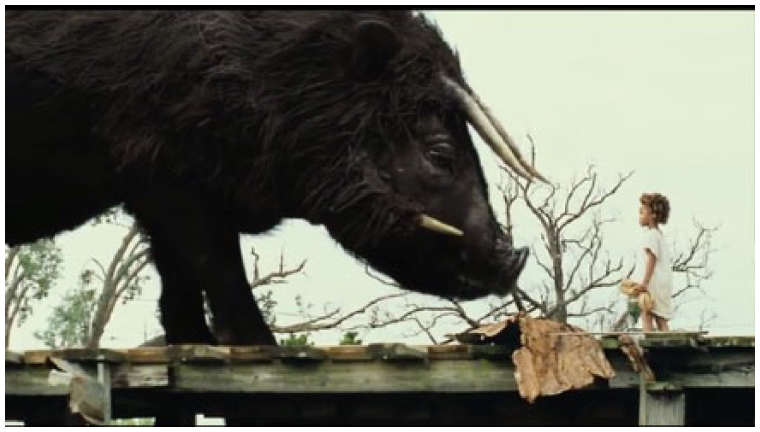
Hushpuppy and the aurochs face-to-face on the jetty.
Hushpuppy’s efforts to comprehend bodily networks enable her realization that the modern human animal is not allowed to be weak; but neither is it allowed to be strong in a “beastly” sense. Hushpuppy’s characterization draws not only upon the propensity of blackness to enable “ecological allegory” (Sharpe, 2013) but also on “the association of childhood with primitivism and irrationalism or prelogicism” that animates our view of the child (Ariès, 1965: 119). As we can see from the example of hearts, the narrative logic and visual arrangement of the film, which repeatedly present Hushpuppy silhouetted against vast waterscapes or standing atop deluged debris, promote the idea that the child is a kind of contact zone, both in human−non-human and formal terms. She brings together the contrasting narrative modes of fantasy and realism and connotes, uncomfortably, both the hopeful survivor familiar in American culture and the dehumanized, racialized, colonized subject who has often been imagined in animal terms. This split creates a paradoxical reading of the child: we can partake of “the Romance of Precarity” (Sharpe, 2013) and view the lone child in the boat or the dishevelled child playing amongst the animals as innocent of environmental destruction, but we can only believe in her potential by separating the bayou from the corporate and consumerist adult world, by allying the child with “nature” rather than history and, therefore, realizing that this child is not ourselves.
As Karin Lesnik-Oberstein (1994: 156) perceives, innocence and “originality” are qualities of comparison. In the Derridean terms that inform her critique, this relation is produced by the intractable desire for “self-proximity” via the other: Man calls himself man only by drawing limits excluding his other from the play of supplementarity: the purity of nature, of animality, primitivism, childhood, madness, divinity. The approach to these limits is at once feared as a threat of death, and desired as access to a life without difference. (Derrida, 1997: 244)
Hushpuppy and by extension her community are evidence that the child polices this limit and the arrival of the aurochs extends the nature/animality connection towards the possibility of divinity or madness. The child is “constructed and often described in different, often clashing, terms” (Lesnik-Oberstein, 1994: 9). Hushpuppy the survivor is not the same as Hushpuppy the helpless ingénue searching for her daddy, nor like the untamed island-dweller that the authorities see her as. Yet all these versions of the child connect her to those who have, in Gayatri Spivak’s well-known phrase, “not yet graduated to humanhood” (Spivak, 1991: 229). Cute yet fearless, obstinate yet ingenious, Hushpuppy commands our desire for the child to reconnect us physically and figuratively with what we were, or wish we could be, in a world whose alterations we cannot decipher as our own, refusing to accept that, …we are no longer able to think of ourselves as a species tossed about by larger forces — now we are those larger forces. Hurricanes and thunderstorms and tornadoes become not acts of God but acts of man. (McKibben, 2006: xviii, emphasis in the original)
Disaster, translated via the bodily communication of the aurochs and the black child into the fantastical sign of a coming apocalypse, drives us back to the human as able to offer reassurance in the form of a rational commitment to rescue the planet from imminent destruction for the sake of new generations, of which Hushpuppy is a part. The difficulty with this account of the childe-cology relation is that its circularity always returns us to the child as the measure and limit of the human, which is precisely the problem that the film raises.
The notions of citizenship and human rights that the bayou community reject are based upon a normative evaluation of the human in accordance with the 1948 UN Declaration on Human Rights. As Joseph Slaughter shows, the civilizing mission of European colonialism “placed development before self-determination in the teleology of modernization” so that “development would prepare dependent peoples for eventual self-governance and the right to practice self-determination among the ‘civilized’ peoples” (Slaughter, 2007: 220). Like children, these peoples were implicitly recognized by their potential, meaning that the figurative work the postcolonial subject and the child do is comparable in tracing “the development of the human personality toward its expression in international citizen-subjectivity” (Slaughter, 2007: 221). The paradox that Slaughter identifies is that self-determination is only allowed after development and on the basis that an individual or group will become self-determining. This allows us to place the postcolonial child’s potential personhood as the ideal figure for neoliberal human rights discourse: “the person represents both the impulse of development and its plot product” (Slaughter, 2007: 224).
Hushpuppy is an agent of development in that she goes to school, wants to “be cohesive” and sees her community as deserving self-determination. She is also the beneficiary of the state’s efforts to foster development. But here the human rights plot breaks down because Hushpuppy can only become a citizen by giving up her community’s desire for recognition: their demand to stay in their homeland places self-determination before development. This leads to the absurd situation of the Bathtub dwellers refusing the rights they are due as potentially self-determining subjects — “they think we’re all gonna drown down here. But we ain’t going nowhere” — while those already displaced, the inhabitants of the Convention Centre in New Orleans, are denied the right to return safely to their homes which they believe they have already earned by capitulating as citizen-subjects. Rights are of no use to the community that has chosen to place itself apart from the capitalist and neo-imperialist system. As Zeitlin puts it: I wanted to get at the issue that you can’t just transplant people somewhere else if their culture and way of life is connected to the land […] these people are making a defiant decision to live somewhere that values freedom over comfort and commodities. (Zeitlin, 2015)
The bayou way of life, always “on the precipice of destruction”, cannot be consonant with post-9/11 human rights discourse that enforces restrictive measures to protect the “aspirational figure” of the citizen-subject (Slaughter, 2007: 225).
Reflecting on her situation, Hushpuppy wonders how people in future civilizations will tell her story: “once there was a Hushpuppy and she lived with her daddy in the bayou”. She links it not with self-development or imminent personhood but with how the world will look after the storm: One day, the storm’s going to blow, the ground’s going to sink and the water’s going to rise up so high there ain’t going to be no Bathtub, just a whole bunch of water.
Here it becomes difficult to distinguish the present situation of the bayou from Hushpuppy’s projected future: the cultural memory that she imagines appears less fantastical than the social and political impact of the current storm, revealing the inadequacy of the international citizen-subject as a concept. Hushpuppy does not dream of leaving the bayou, of working in the service economy or going to a condo in the metropolis: she denies these possibilities by imagining only what will happen if she does not leave. She thus quashes the association of the child with survival and a citizenship that she has already been denied. Hushpuppy’s acceptance of her unimportance does not work as a decoy that can take us back to a position of benevolent humanism. Instead, it encourages us to look closely at how the film’s re-orchestration of human−non-human relationships intersects with actual racial and economic divisions and therefore to ask what the fantastic contributes to Zeitlin’s refusal to ratify the neoliberal recuperation of America’s marginal communities in the wake of disaster.
Attentive manoeuvres: child/animal/race
Zeitlin frames his story in the fair-is-foul terms of fairytale: Hushpuppy’s Bathtub lies downstream from a levee, while on the landed side looms a huge factory; a fantasy castle with the shine washed off, visible through a grainy sky. By setting up the factory as the ironic promised land, but shooting life in the bayou from ground-level in a documentary style that allows the actors and crew to impress themselves upon the process and denies the feasibility of individual aspiration, Zeitlin creates a situation defined by both contingency and polar oppositions. In keeping with this recognition of extreme inequalities, and rebellion against them, Hushpuppy is defined as both a delinquent and a dependent. Hers is the kind of “sideways” motion that Katherine Bond-Stockton identifies as challenging the notion that “growing up” to become a responsible subject will be the outcome of childhood (Bond-Stockton, 2009). Bond-Stockton’s take on the potentiality of queer relations isolates the oddness of our interest in the child and suggests a rerouting of desire outside of the normative family. When Hushpuppy moves in with Wink, after setting fire to her own “house” while cooking with a blowtorch, there follows an alternately violent and affectionate co-habitation that exemplifies this queerness in the child. Hushpuppy states, “I hope you die and after you die I’ll go to your grave and eat birthday cake all by myself ”. We then learn that Wink is suffering a serious illness and that, albeit in a haphazard fashion, he does provide his daughter with food, shelter and, most urgently, a boat that will save her from the storm. Hushpuppy responds with wonder at the distinction this gives her: “For the animals that didn’t have a dad to put them in a boat, the end of the world already happened” (Figure 2). Her refusal to accept the role of docile, rescued child facilitates a critique of the gendered developmental demands placed upon the family and its function in the wider human−non-human hierarchy.
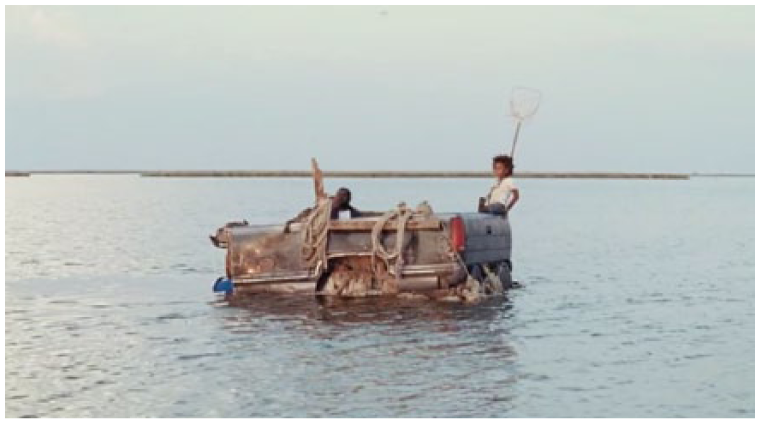
Surviving the end of the world: Hushpuppy in her boat.
The recognition of interspecies connectivity provided by Hushpuppy’s “queerness” breaks down social and political oppositions in unexpected ways. The scene in which Hushpuppy holds up a chick to her ear proves to be an ironic critique of modern machinic relations; the bird has the function of a telephone both in the way it is held and in being listened to. However, it is not noise coming through the receiver that Hushpuppy hears but the noise of the receiver itself, the animal’s body (Figure 3). This confrontation with corporeality supports Anat Pick’s argument that the cinematic animal breaks the boundaries between the real and the figural not by signifying something else (in this case the telephone) but simply by sharing the screen with the human (2011). Whilst the birds, dogs, pigs and animalistic humans of the bayou do not have the kind of violent agency that the aurochs do (and which Pick discusses in relation to bulls), they do have an unchoreographed physicality that prevents them from becoming objects to be known and dominated. In the vulnerability of the bird’s body (that mirrors her own), Hushpuppy finds “a way of attending (seeing, hearing, articulating, and responding to) the inhuman within and without” (Pick, 2011: 192). This embodied attention takes precedence over, or even interferes with, the commanding of rights and responsibilities.
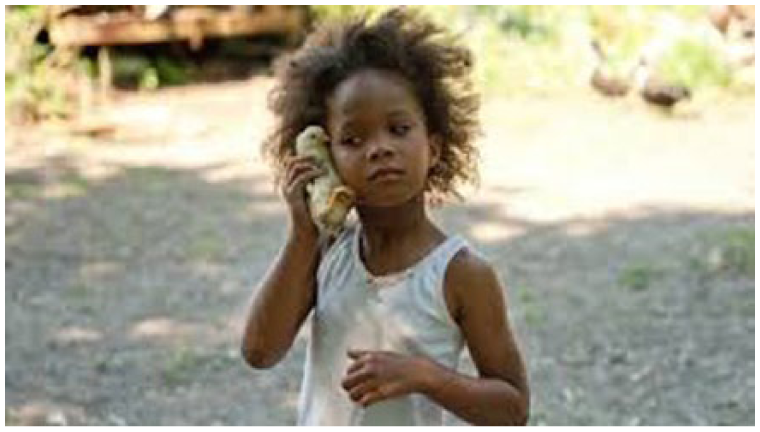
Hushpuppy listening to the chicken.
Hushpuppy manoeuvres carefully between human and animal identifiers, considering her father worse off than an animal when he is “plugged into the wall” in a humanitarian act that humiliates its object. The episode encapsulates the humiliation of the bayou community as a whole, recalling the struggles of the civil rights movement as forced “humanization”, which ironically places Wink in solidarity with animals in a way that denies the vulnerability and environmental dependence of humans. It is therefore no surprise that an actual “survivor” of Katrina complained “We was treated worse than an animal”, revealing the trauma caused by the evisceration of public services and poor disaster management that were undeniably racialized (Stein and Preuss, 2006: 37).
Hushpuppy’s ethnicity allows Zeitlin to draw upon the cultural legacies of slavery, while the island setting brings Native American traditions into play, pointing backwards to colonization. However, while race is certainly a factor in the Bathtub’s marginalization it is braided thoroughly with economic divisions, demonstrating that neo-imperialism relies upon the same motions of underdevelopment and exploitation that drove colonialism while jettisoning recognizable colour or gender-coded practices of discrimination. The film subsequently participates in a contemporary figuration of blackness as allied with other subaltern positions that, Richard Iton suggests, is at once destabilizing to the tenets of modernity and a vital part of them (Iton, 2008). The black in Iton’s notion of “the black fantastic” is applicable to the formal as well as the racial cartography of Beasts and connotes “underdeveloped possibilities and the particular ‘always there’ interpretations of […] postracial and post-colonial visions and practices generated by subaltern populations” (Iton, 2008: 16). The understanding that blackness is at once a fluctuating factor in postcolonial marginality and an emergent sign of resistance accounts at least partially for Beasts addressing race uneasily. In Bond-Stockton’s view, the child “queered by color” cannot satisfy the tautological demand for “being who you are”, either in terms of innocence or responsible citizenship. The black child is often constructed as too experienced: not weak enough to be innocent, and therefore “queer” in the sense of non-normative (Bond-Stockton, 2009: 184). Hushpuppy can perhaps be said to grow sideways in this accretion of identifiers that defy expectations of white heteronormative development. But even this skewed potential may be stultified by the “anxiety about cinematic depictions of black (and other subaltern) people as primitives on a continuum with nonhuman animals” that, according to Nyong’o, is the price to be paid for “the film’s ambition to valorize feral human nature” (Nyong’o, 2015: 251). The possibility that race can both define and interfere with the discursive structures around it enables the recognition that although the marginal status of those in the bayou is implied by who they are – black, poor, mentally or physically ill, addicted, uneducated or unemployed – it is not defined primarily by these variegated identities but by where they are. It is their precarious environment and their attachment to it, partly as a result of racial and economic factors, that reveals the neocolonial pushing of environmental frontiers and the increasingly aggressive state control of the poor. The emphasis on blackness in situ, rather than any appeal to transnational racial or hybrid identities, makes the film understandable as a postcolonial text that surpasses Hulme and Weaver-Hightower’s rather limiting expectation that postcolonial criticism is “more interested in the political project of a film than the space it represents” (Hulme and Weaver-Hightower, 2014: 5). Zeitlin’s film shows that the space is the political project. The space of the Bathtub also becomes symbolic of other places that are sinking, literally or metaphorically, beneath the tides of global corporatism. Its people are coerced into accepting assistance that amounts to control of their bodies and homes until they resort to violent resistance. Their history thus resonates with those of other communities, including those in Sri Lanka, Haiti and the Caribbean, that have been cut off, seen their resources ransacked, and been offered only unappealing rescue narratives of relocation or redevelopment, which render their populations in thrall to their Western saviours.
The child/animal at the almost-apocalypse
As Anthony Carrigan (2011), Sharae Deckard (2014), and Michael Dyson (2006) make clear, calling an event a natural disaster “frees us to be aware of, and angered by, the catastrophe” (Dyson, 2006: 3), to probe its causes as unfathomable, unavoidable or God-given. Their analyses point to the holes in the neoliberal narrative that to rescue the weak from unstoppable nature we must, in the words of George W Bush, “rise above the legacy of inequality” by force of rhetoric and for-profit enterprise rather than political (and environmental) reform (Dyson, 2006: 9). In Hollywood this might be done conversion-style through a cathartic process after which we are left with a sense that righteousness survives. Beasts does not fit this model: firstly, because it has a marginalized black protagonist (as Deckard (2014) highlights, disaster−survival films favour the white nuclear family) and, secondly, because its storm is not a rupture in daily life but part of the expected return of the hurricane season and the revolving reconfigurations of the past (the histories of the Biloxi-Chitimacha tribe and slavery). Zeitlin’s use of the apocalyptic fantastic must therefore be read as arising out of and still situated within “the legacy of inequality” rather than as avoiding its implication in disaster.
Iton writes: If we think of the fantastic as a genre that destabilizes at least momentarily, our understanding of the distinctions between the reasonable and the unreasonable, and reason itself, the proper and the improper, and propriety itself, by bringing into play those potentials we have forgotten, or did not believe accessible or feasible, I would suggest its effects are not at all that dissimilar from those of blackness. (Iton, 2008: 289−290)
This notion of blackness as an ungovernable energy takes it to the edge of understanding but refuses, in insisting on potentiality, to imply that fantasy is able to rise above or move beyond racial, economic, and social distinctions. The fantastic, then, is able to encompass the difficulties that happen when we approach the limit of the human — via blackness, queerness, childhood, or animality — and to transform them, as Zeitlin does in creating the aurochs.
As mentioned, the auroch is an extinct wild ox, the ancestor of domestic cattle and the subject of numerous mythologies, from the story of Zeus appearing as a bull to frequent depictions in cave paintings. The creature was also prized as a trophy across much of Europe and is therefore a recognizable symbol of wild strength, and of man’s victory over it. This significance, however, is only tangentially relevant to Zeitlin’s film because, although called “aurochs”, these beasts appear to be wild boars with large horns and black hairy bodies. They are, in fact, Vietnamese potbellied pigs that the producers expended much effort teaching to wear costumes made from swamp rodent skins and rubber. The aurochs’ amalgamation of cultural assumptions and practical challenges contributes to a slippage in the way the beasts represent the past in the film. Aurochs were never native to North America and the wild pig, as opposed to the ox, does not function satisfactorily as a generic stand-in for a valued species now extinct. However, wild pigs are associated in European and Asian mythologies with warrior qualities, often with heroes doomed to death, confirming Nyong’o’s suspicion that the introduction of these animals in Zeitlin’s reorientation of William Blake’s Southern Wild “reenacts the European colonization of the New World in bovine form” (Nyong’o, 2015: 265). 10 Consequently, Zeitlin’s beasts offer an incomplete allegory, being neither properly spectral nor securely attached to myths that might be reanimated. Even as the rush of their approach is fearful, they are almost ridiculous in their unreality.
Placing Hushpuppy face-to-face with these anomalous creatures disallows the transformation of ecological disaster into apocalyptic myth. Like the bird scene, their meeting pushes against “the ‘human’ viewing positions of identification and exchanged looks” by parodying them (Pick, 2011: 7). Zeitlin’s approach is image-driven, exaggerating both the largeness of the beasts and the smallness of the child against the breadth of the landscape. The child is exposed to a double risk: that of communicating with towering, unfathomable beasts and that of their refusing her any meaning beyond the irreducible reality of the animal. The aurochs, in their not-quite irreality, enable a triangulated relation to form around the child between the inescapable past, the almost-apocalyptic future and the undeniable “mammalian existence” of the present (Pick, 2011: 14). In a reversal of the assumption that children are not afraid of mortality because they have no sense of temporality, Hushpuppy faces the undoing of the human heralded by the aurochs and positions herself — black, colonized and creaturely — as already in its grasp.
The long-haul motion of environmental destruction meets the short hop of human lifespan as Hushpuppy propels the real-world co-ordinates of Isle de Jean Charles into contact with archetypal images that disappear even as they gesture beyond the human, dramatizing the search for a new form through which to express ecological disaster. As the triangulation of time-worlds suggests, the film’s narrative does radiate outwards from the figure of the child. However, its meaning cannot be found in her but in her revolving attention to her world. Beasts is concerned with its own contingency. By allowing the precarity of this child caught between the “otherness” of colonization, race and class and the enforced aspirations of the citizen-subject we can read the film as disarticulating the human and the systems that encase it. In this way we can at least endeavour to do justice to the intricacy of its ecology and the provocations its postcolonial child offers for altering, rather than merely exposing, what happens to already delicate socio-environmental relations when disaster occurs.
Footnotes
Funding
This research received no specific grant from any funding agency in the public, commercial, or not-for-profit sectors.