



Abstract
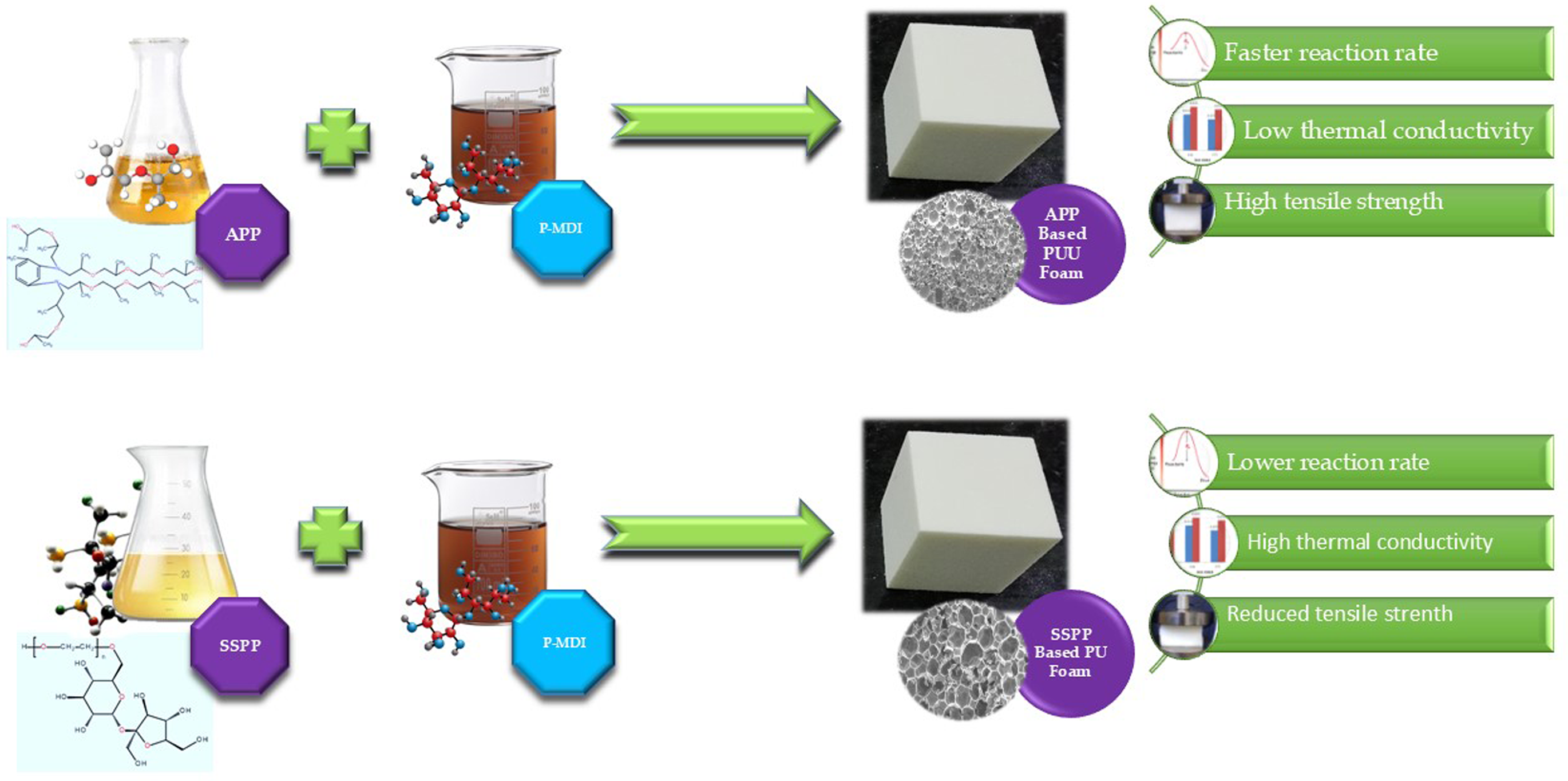
Poly (urethane-urea) foam (PUU Foam) from an amine-based polyether polyol (APP) is different from Sucrose-Sorbitol based polyether polyol (SSPP). In this study, rigid PUU Foams produced from an amine-based polyol, (Amine value: 100 mg KOH/g, Hydroxyl value of 408 mg KOH/g) was compared with Sucrose-Sorbitol based polyether polyol, (Hydroxyl value:380-420 mg KOH/g, Amine value: 0 mg KOH/g) using varying isocyanate ratio (Isocyanate index). Effect of varying Isocyanate index on foaming parameters, physical, chemical, morphological as well as thermomechanical properties were evaluated in both kinds of foams. A higher NCO index resulted in increased crosslinking, which improved the compressive strength of PUU foams through the formation of isocyanurates, thus enhancing their thermal stability. Fourier-transform infrared (FTIR) spectroscopy was utilized to analyze the chemical properties of the foams. Cell size through scanning electron microscopy (SEM) and closed cell content and dimensional stability of the foams were also carried out to assess the morphological structures of the foams. Differential scanning calorimetry (DSC) and thermogravimetric analysis (TGA) were performed to examine the thermal properties of the foam. The thermal conductivity of the foams, prepared with various isocyanate indexes, ranges from 25 to 45 mW/m K, especially for APP based foams with NCO index of 175 resulted in low thermal conductivity of 25 mW/m K (at RT) and 14 mW/m K (at LN2), indicating their potential suitability for cryogenic insulation.
Get full access to this article
View all access options for this article.