




Abstract
Personal naming culture among the Igbos in South-eastern Nigeria is ethnopragmatically conceived to contextualize their collective worldview which communicates their religious and sociocultural connections. This paper explores an aspect of Igbo naming practices which shows the diverse conceptualization of Chi (God) from an ethnopragmatic perspective that situate names and meanings within the language and religious interpretations. Data for the study were generated through participant observation, semi-structured interviews and informal interactions with 40 recruited participants as representative sample of the name-givers, bearers and users among Mbaise and Ngwa people in Aboh Mbaise and Aba North Local Government Areas in Imo and Abia States of Nigeria. Findings show that the personal names contextualize Igbo Christians’ conceptualization of Chi as supreme, virtuous, extolling and trustworthy, giver of wealth and a faithful promise keeper. We conclude that Chi has a deepened value in the Igbo sociocultural and religious beliefs nuanced in their naming practices that construct particular circumstance(s) of the name bearer, parents and community. The emerging orientations expand the ethnopragmatic functions of the personal names beyond linguistic and sociocultural identities to situate Igbo as a society with supreme attachment to Christian religion, reverence to, and propagation of the virtues and nature of God.
Introduction
Colonial indoctrination has introduced a significant shift from the traditional Igbo personal names and naming practices to construct Anglo-Christian worldview and socioreligious norms that situate the new religious orientations of the name bearers, givers and users. The Igbos are one of the three majority ethnolinguistic groups (including Hausa and Yoruba) and are situated in South-eastern Nigeria (particularly in Abia, Anambra, Ebonyi, Enugu, and Imo States). The majority of the people are scattered all over Nigeria, Africa, and the world. The language (Igbo) of the people is spoken by over 25 million people (Adibe, 2009; Okagbue et al., 2016). Language, aside being the tool for communication, is also a cultural device for personal names and the preservation of the unique identity and beliefs system of the bearers (Uwen & Ekpang, 2022). In the Igbo sociocultural context, these beliefs are replicated in their cultural naming ceremonies. Such ceremonies are held between the fourth and twenty-eight day after the birth of a child.
Generally, Igbo personal names reflect the people’s worldview. This is evidently “derived from their beliefs system, philosophy, ideology, language, norms and values” (Nnamdi-Eruchalu, 2018, p. 16). Going by this assertion, the personal names are therefore connotative, historic and circumstantial, and are drawn largely from the Igbo cultural heritage to show their shared identity (Anyabuike, 2020). Mbabuike’s (1996) study on the sociological and philosophical explications of Igbo personal names claims that the names communicate the history, philosophy and social precepts of the people that situate their beliefs system and origin. Also, Onukawa (1998) and Mmadike’s (2014) study on the anthropolinguistic description of Igbo personal names portray them as aspects of the Igbo language used in widening the sociocultural context and complex practices of the people. Other scholars contend that Igbo personal names are aspects of the relationship between the Igbo language and the society they exist (Nkamigbo, 2019). These studies provide deepened insights on Igbo trend of personal names that connect the bearers to their roots, and historical and sociocultural preserves. The personal names convey the people’s fundamental nature of knowledge and existence, and maintain an intergenerational communication system in Igbo language through the name bearers.
Another set of studies present Igbo personal names as a reproduction of the peculiarities in the Igbo linguistic system. For instance, Maduagwu, 2010; Ubahakwe, 1981) argue that Igbo personal names are aspects of the structural and semantic components of the Igbo language. Also, Uwalaka (1993) and Udoye (2020) maintain that this category of Igbo personal names also show innovations in emerging spelling system, clipped forms, compounding (with non-Igbo names), morpho-syntactic forms, and others that indicate meaning shift at the lexical and sentential levels. Similarly, Oluchukwu and Azuanke (2014) argue that some other emerging Igbo personal names are tailored toward possible translation that produce unambiguous English meaning equivalents that show some form of Anglicization arising from Igbo contact with English language. These scholars advertently expand the domains of Igbo language usage to include the linguistic description of Igbo personal names that show innovative lexical, phrasal, and clausal forms. The names underscore the instrumentality of Igbo language in the synchronic and diachronic linguistic patterning, and to fashion out linguistic scripts that also nuanced the semantic impulses in the address forms of the Igbo people. Other studies focus their investigations on Igbo personal names that are related with the people’s complex conceptualization of wealth (Guyer, 1995; Mensah & Iloh, 2021; Smith, 2017). The authors argue that Igbo wealth related personal names are conceived as instruments for family aspirations and intergenerational heritage, a tool for social stratification, a device for social power exertion, a means of showing social prestige, and an apparatus for social domination and domineering.
The post-colonial dimension of Igbo personal naming practices show a somewhat gradual replacement of Igbo indigenous personal names with Pentecostal Christian names. According to Okagbue et al. (2016), this category of names reconstruct the people’s increasing affiliation with Christian religion and marked a gradual departure from the traditional belief system. These set of personal names which also occur in indigenous languages are connected with the implantation of the Christian religion through the people’s encounter with the early missionaries (Uwen, 2019). The names are therefore used to construct the people’s emerging reconceptualization of Chi (Christian God), following the conversion of a larger number of Igbos from traditional beliefs to Christianity.
Previous Studies on Chi and Chi-Personal Names
Chi is generally described in the Igbo traditional context (before the advent of Christianity), as individual’s personal god, guardian angel, individual providence and companion (Achebe, 1975). This traditional conceptualization portrays Chi as a guiding invisible being that every individual needs and has in the duration of one’s life time. It is also established that Chi is conceived as a religious identity, and the Christian God was not in the traditional Igbo religious conception, but associated with contemporary Anglo-Christian beliefs (Echeruo, 1979; Nwoga, 1984). This position corroborates Achebe’s (1975) assertion that Chi, within the traditional Igbo worldview, is deeply rooted in the people’s sociocultural beliefs. Exploring the rich proverbial content of Igbo language, Itesieh’s (1983) study depicts Chi-names as reflection of Igbo proverbs that reconstruct the sociocultural milieu of the people. Proverbs are aspect of people’s language practices using artistic utterances that explores traditional and social currency of the Igbo culture and its philosophical contents that convey situated connotative meanings. Arguing from the dimension of gender, Onukawa (1998), Ọnụkawa (2000) posits that Chi-personal names in the Igbo naming practices are used to index gender and gendering. Personal names in this order are categorized on the basis of gender that clearly construct gender distinctions such that the name-givers and bearers could rely on the names to know males and females. In another study, Okeke (2017) adds that colonialism has introduced a conflict between African traditional religion and Christianity in Eastern Nigeria that is the dominant region of the Igbos. According to the author, while the traditionalists maintain the conception of Chi in its sociocultural portrayal, their Christian counterparts believe that it is the great Christian God conceived as transcendental and incomprehensible. Also, Udoye’s (2019) study on the perspectives of Igbo anthropolinguistics suggests that some aspects of Igbo personal names enact the people’s belief in the Christian God. Chi and Chi-personal names, in the reviewed studies suggest that such names originated from, and were originally rooted and construed within the Igbo traditional system. However, colonialism which introduced Christianity as one of its legacies, appeared to have generated a paradigm shift and contemporaneity in the conceptualization of Chi by Christians of Igbo extraction. The implication is that, Christian religion brought by the White missionaries altered the beliefs system of the Nigerian society and its traditional practices (Okeke, 2017). This shift to bestowal of personal names that communicate and reflect Igbo beliefs in the Christian God, are derived from the complex contexts of the Igbo language, entrenched sociocultural milieu and Christian religious beliefs. Although these personal names situate the social context and other levels of distinctions (Lindsay & Dempsey, 2017), they also connect the sociolinguistic with the ethnopragmatic contexts that broaden the construal of the Igbo Christian religious beliefs.
However, the relationship between Igbo language, socioreligious background and ethnopragmatic context in naming culture, is an interesting area that is yet to be (sufficiently) investigated. The study is informed by the increasing trend of bestowal of Chi related personal names as a conscious response to Igbos’ affiliation with Christianity. Viewing ethnopragmatics as aspect of the larger component of sociolinguistics, this study is aimed at investigating the new dimensions in the conceptualization of Chi in the Igbo naming practices particularly by indigenous Christians. Limiting the participants to Christians is to provide an opposing worldview to the traditionalists’ conceptualization of Chi. To achieve this, the study draws participants from Mbaise and Ngwa people in South-eastern Nigeria, particularly from Aboh Mbaise and Aba North Local Government Areas (henceforth LGAs) in Imo and Abia States respectively. It is believed that the findings would provide insights on the relationship between Igbo language, Christianity and the social contexts of the naming practices that construct the diverse conceptualization of Chi (the supreme Christian God) among the Igbo name-givers, bearers, and users.
Theoretical Framework
Socio-onomastics and Divine motivation theories are considered relevant analytical frameworks for this study. Socio-onomastics in ethnographic research accounts for the origin, history, variations and contexts of names across cultures. The variables for naming in socio-onomastics are derived from the experiences captured in “different societal and cultural registers” (Nicolaison, 1985, p. 123). Following the utilization of socio-onomastics insights into personal names, Hough (2016) argues that such knowledge accounts for investigations on names, naming, naming systems and varieties related to their etymology and the meanings in different sociocultural contexts. Here, according to Clark (2005), rather emphasizes that meaning, through the society’s linguistic and sociocultural systems and situational context, becomes the pointer to the people’s worldview and the names the people’s bear. The meanings in names are therefore aspects of the sociocultural context that are interpretable by the name-givers, bearers and users based on common experience. The focus of socio-onomastics research in personal names is on the investigation of the variation in the popularity of names, name-giving, grounds for the bestowals, names practices and the situational variations upon which they occur (Ainiala & Ostman, 2017; Hough, 2016). Socio-onomastics establishes that personal naming culture is a universal event and cross cultural practices that convey sociocultural meanings and perform ethnopragmatic functions. These concerns are often explained within the perceptions and situated experiences of the name bearers, users and givers. Personal names correlate with the people’s belief system, culture and experiences (Agyekum, 2006). In the context of this study, Socio-onomastics deepens knowledge on how personal names connect with the people’s religious beliefs that generate non-traditional worldview and conceptualization of Chi in the Christian perspectives.
Also, divine motivation theory is a theologically based moral theory propounded by Zagzebski (1998). The theory is anchored on the properties of persons, their conscious acts and the outcomes that are related to God’s motives. The tenets presuppose that God’s virtues such as love and compassion are morally motivating and should be the basis that determines the metaphysical and conceptual reference for practicing moral values. Moral concepts are derived from the motivating emotions to do good things as aspects of virtues instantiated through actionable processes (Zagzebski, 2004, 2010). The theory claims that the motivations to do good against evil (and vice versa), are mere imitation of the foundational nature of God. It provides insights into a unified account of the evaluative principles of divine and human actions that account for the way we treat others (Zagzebski, 1998, 2004). Although Lippitt (2008) queries the lofty metaphysical virtues and generous conception of God, the author argues that the nature of God is good-intentioned and emulative. The theory highlights God’s divine capabilities, and resonates the nature and supremacy of God over mankind. These virtues are believed to have motivated Igbo Christian religion’s adherents to adopt a naming culture that communicates the complex nature of God in their personal naming practices. The above insights further construct the interconnection between the variations in naming practices across time and cultures (socio-onomastics), motivations to bestow personal names arising from the enviable virtues of the Christian God (divine motivation theory) and socioculturally interpretable meanings of discourse events that are situated within the people’s beliefs (ethnopragmatics). This interface forms the theoretical basis for the analysis of the plurality in the conceptualization of Chi in the personal naming practices among the subpopulation of Mbaise and Ngwa in Imo and Abia States in South-eastern Nigeria.
Methodology
The study adopts the qualitative research method in the collection and analysis of data. Data collection involved a six-month fieldwork in Aboh Mbaise and Aba North among the Mbaise and Ngwa people in Imo and Abia State, South-eastern Nigeria. Aboh Mbaise is one of the three LGAs that the people of Mbaise are spread across in Imo State while Aba North is among nine LGA occupied by Ngwa people as the most populous ethnic group in Abia State (Izugbara, 2000; Njoku, 2003). The occupation of the people in the heartland of the Igbos and their deepened practices of the Igbo onomastic tradition informed the choice. Through purposive sampling on the criteria of deep knowledge of Igbo naming practices and the diverse conceptualization of Chi in Christian beliefs, a total of 68 indigenes were approached, but 40 (20 from each city) indicated willingness and were recruited to participate by giving formal consent. The participants’ socio-demographic information such as religion, age, education, gender, and occupation were documented. The participants were Christians into Christian families and converted into the faith along time. The participants’ age bracket ranged from 32 to 80. In terms of the educational qualification of the participants, six (5%) claimed to have obtained informal education, eight (20%) had primary school education, 14 (35%) had senior secondary certificate while 18 (45%) graduated from tertiary institutions such Colleges of Education, Polytechnics and Universities. On gender basis, 28 (70%) were male while 12 (30%) were females. On the occupation of the participants, 20 (50%) were employed in government and private companies, 12 (30%) were proprietors of their own businesses, six (15%) were engaged in farming while two (five%) were students of tertiary educational institutions. This information is believed to have some impact on the participants’ deepened understanding of the topic.
Ethnographic research methods such as participant observations, semi-structured interviews and informal interactions were deployed. Participant observation technique enabled the researchers to closely observe the name-givers, bearers and users and their attitudes toward the names in their natural sociolinguistic context. Semi-structured interviews helped the researchers to meaningfully engage the participants involved in mentioning the relevant indigenous names. From there, relevant questions were asked on the sociocultural and religious meanings of the names and the ethnopragmatic functions they perform given with Christian religious doctrines. Informal interactions elicited other relevant information from participants in addition to those obtained from the formal context. Participants were also asked to comment generally on the conceptualization of Chi from a diachronic point of view in the Igbo onomastic tradition and their beliefs on the supreme Christian God.
In the six-month fieldwork, 118 names were elicited from participants, out of which 63 Igbo personal names associated with the people’s diverse conceptualization of Chi were selected from the corpus and coded into categories. The data were then checked to ascertain the appropriateness. The data were further transcribed and translated into thematic scripts for a descriptive analysis. Since the data were supported by participants’ opinions, the descriptive analytical approach becomes relevant as it allows the manipulability and flexibility in the interpretation of the views of the participants.
Data Analysis and Discussion
Chi related personal names and their conceptualizations in the Igbo worldview are categorized into six themes that show God as supreme, virtuous, promise keeper, dependable and source of genuine wealth who deserved to be adored. Chi and Chukwu, as reflected in the personal names, are used interchangeably among the participants to refer to the same God. These themes are discussed in details in the analysis below.
Igbo Personal Names Portraying the Supremacy of God
As Jokengwa (2021) argues, those who believe in the Christian God know that he is supreme in all aspects of human existence and they show this in their discourses, events, circumstances and personal names that would reflect this supremacy. It is this reflection that is captured in the personal names of the people Mbaise and Ngwa represented in Aboh Mbaise and Aba North LGAs. This is shown in Table 1below.
Showing Igbo Personal Names Portraying the Supremacy of God.
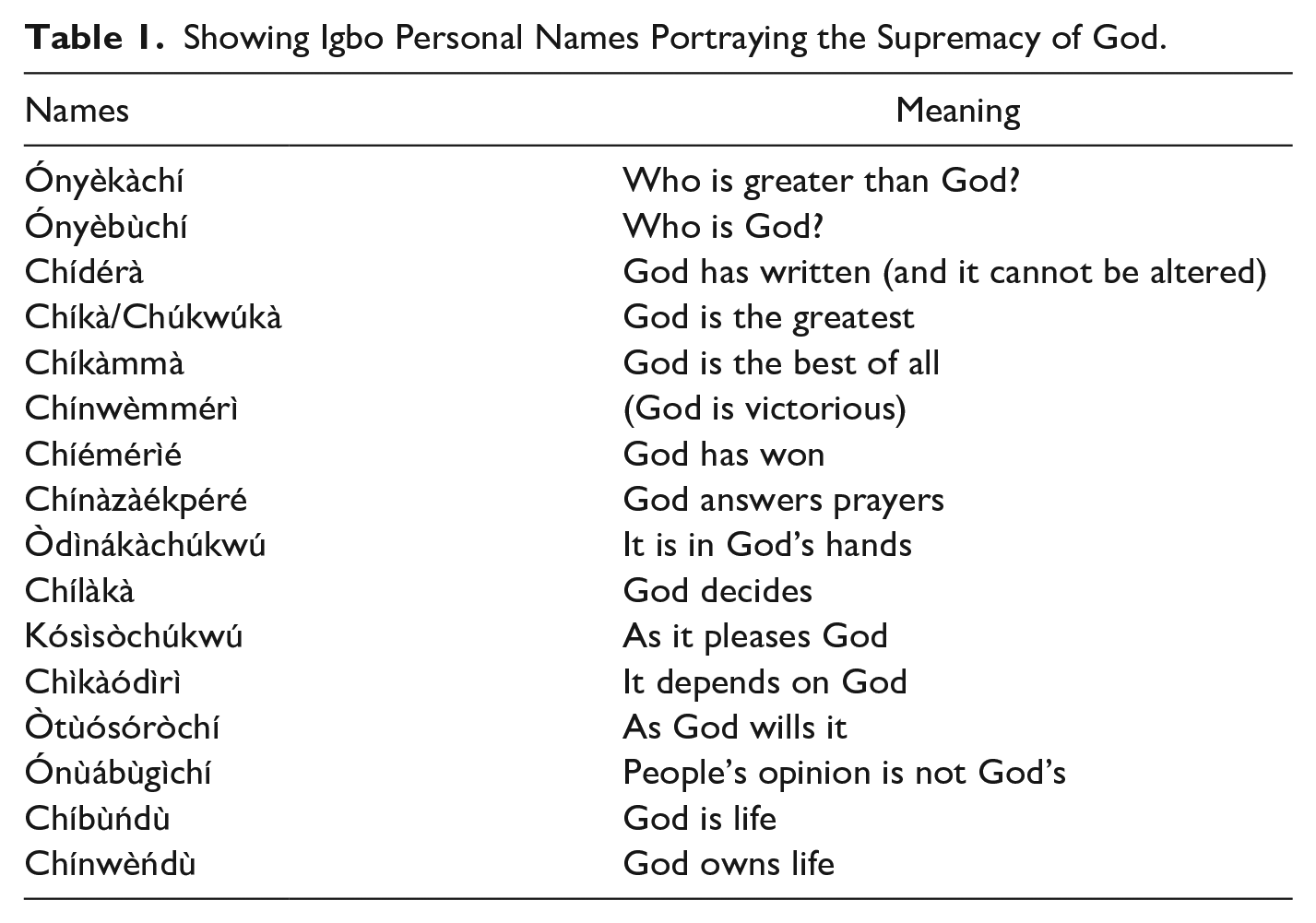
The names Ónyèkàchí (who is greater than God?), Ónyèbùchí (who is God?), Chídérà (God has written), Chíkà/Chúkwúkà (God is the greatest), Gínìkàchí (what is greater than God?) and Chíkàmmà (God is the best) jointly index an aspect of supremacy that conceive God as the highest ranking deity. Also, Chínwèmmérì (God is victorious), Chíémérìé (God has won), Chínàzàékpéré (God answers prayers) is another strand of supremacy that suggests the victory of God in any tribulations. Òdìnákàchúkwú (it is in God’s hands), Chílàkà (it is God who decides), Kósìsòchúkwú (as it pleases God), Chìkàódìrì (it depends on God), Òtùósóròchí (as God wills it) and Ónùábùgìchí (people’s opinion is not God’s) are combined to instantiate another level of supremacy that constructs the unquestionable discretion of God. Again, Chíbùńdù (God is life) and Chínwèńdù (God owns life) show God’s supremacy as the custodial of human life. According to Ónùábùgìchí who was a 62-year old woman, she was born amid doubts that her parents would no longer bear children after many years of her mother’s “barrenness.” She reported that: “It was when my parents surrendered and hoped entirely on God that my mother was said to be conceived and I am the product of that conception.” The participant’s account suggests her parents’ beliefs and conceptualization of Chi as a supreme God that has the final say where all human efforts and knowledge are proven futile. Also, Chíémérìé, 54-year old man narrated the circumstances surrounding his birth this way “my father told me that he gave me the name because he won a 21-old land dispute in the court at the time of my birth after his conversion to Christianity. He said his opponent who consulted ńdí díbíà (local doctors) could not win. The victory showed the supremacy of God with evidence of his great works as represented by my name.” This opinion, as observed, does not trivializes the people’s belief in their local gods which may help or could fail the adherents as it is in this instance. However, the account resonates Igbo Christians’ beliefs that victory in any dispute is in the hands of God. This naming culture also re-enacts Christians’ shared religious knowledge of the supremacy and supernatural power of God which cannot be doubted (Bonaventure, 2020; Uwen, 2023a). The personal names in this order show a situated contextual variation that indexed their beliefs in the supremacy of God as recorded in Psalm 115:3 thus: “Our God is in heaven; he does whatever pleases him.” The names show a new trend of naming practices using the Igbo language with meanings are ethnopragmatically conceived in line with the people’s knowledge of God.
Igbo Personal Names Extolling God
Another set of personal names that draw from the sociolinguistic and ethnopragmatic contexts of the people of Aboh Mbaise and Aba North LGAs to instantiate their conceptualization of Chi are the names that extol God. It is argued that one of the prominent duties of those who have knowledge and understanding of how God works is to praise, extol and reverence him always (Bonaventure, 2020). This Christian tenet of reverence is shown in the personal names in Table 2 below.
showing Igbo Personal Names Extolling God.
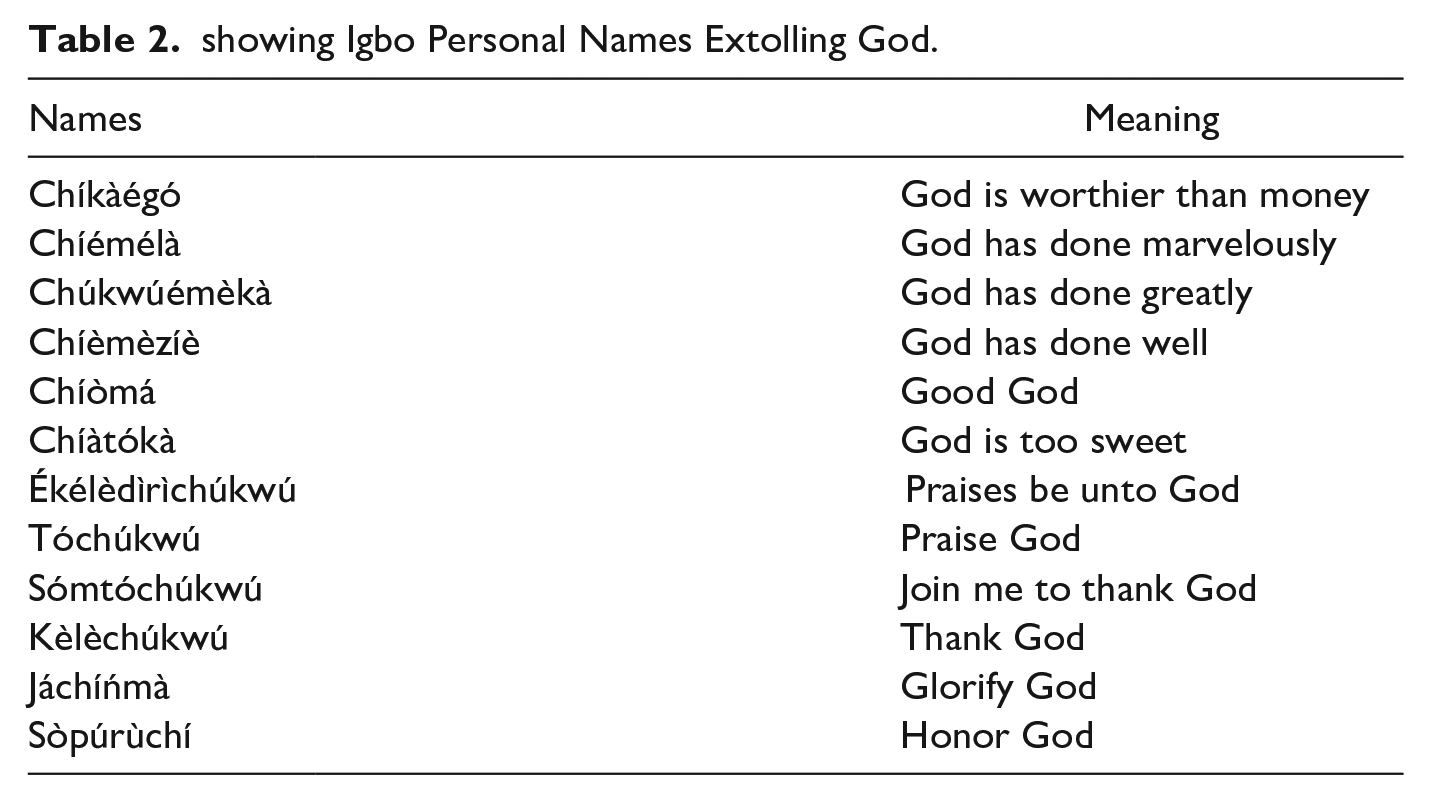
The personal names above adore the God the bearers serve. For instance, Chíkàégó (God is worthier than money), Chíémélà (God has done marvelously), Chúkwúémèkà (God has done greatly), and Chíèmèzíè (God has done well) extol the exceptional goodness of God far above what money can do. Also, Chíòmá (good God) and Chíàtókà (God is too sweet) extol the goodness of God to man. Again, Ékélèdìrìchúkwú (praises be unto God), Tóchúkwú (praise God), Sómtóchúkwú (join me to thank God) and Kèlèchúkwú (thank God) adore God with thanksgiving and praises for the great things he has done for the name bearers and name givers. The other names, Sòpúrùchí (honor God) and Jáchíńmà (glorify God) exalt God with special reverence. Personal names in this order enact the exceptional goodness of God over man, money and other creations such that he is worthy of adoration and deserves to be reverenced (Daramola, 2019; Lippitt, 2008). They are somehow a symbolic signification for the religious command to praise, worship and reverence God. Kèlèchúkwú, a 53-year father of Chíkàégó argued that he bestowed the name on her daughter because “I spent all I had and borrowed so much to save my wife and the child when she was pregnant and during delivery. She was very sick throughout the period and everyone thought I will lose both of them. I became so poor then, but I had recovered exceedingly.” This narration indexes the name givers and users’ beliefs that God is more than any amount of money, and has the power to restore any lost wealth. Another 48-year old mother reported that they named her child Sómtóchúkwú because of the circumstances of her birth. She narrated that “against the doctor’s prediction that she would be delivered through a risky cesarean section, she had a safe delivery that saved the family a lot of money and the trauma of fear and pains. So, the name is a call on relatives and friends who were aware of that circumstance to join her family to thank God.” She emphasized that some of the Chi-personal names existed before colonization and advent of Christianity, but there is a changed Christian perception from their traditional links with local deities and idolatry, to their spiritual association with the Christian God. This participant’s view recounts the existence of a few similar names before the Anglo-Christian influence. The (re)conceptualization of Chi by Christians is reflective of a new belief system that has impact on the traditional cosmos and worldview of the Igbos. Through the name (Sómtóchúkwú), the participant re-enacted her religious beliefs while calling on adherents to praise and thank God for his love and goodness as captured in Psalm 106:1 thus: “Praise the Lord! Oh give thanks to the Lord, for He is good, for his steadfast endures forever.” Drawing from the theoretical frameworks, the name bestowal is motivated by the need to exalt God, while the meaning, using Igbo language as the tool, is interpreted within the ethnopragmatic and religious conception of the people.
Igbo Personal Names Portraying God as the Source of Wealth
Another set of Igbo personal names is the category that portrays God as the only source of their wealth. This belief suggests the existence of other (bad) sources of wealth which are not from God and could bring sorrow to the acquirers. In the social context of the Igbo indigenes in Aboh Mbaise and Aba North LGAs, the acceptable and good source of wealth that adds no evil is from God. This religious indoctrination is derived from the biblical injunction in Proverbs 10:22 which records that “the blessings of the Lord makes a person rich, and adds no sorrow with it.” It is corroborated that the pride of the wealthy Igbo man is to use such riches from divine source to help the poor from his community (Agozino & Anyanike, 2007). Such names that establish the people’s belief in the divine source of wealth are listed in Table 3 below.
Showing Igbo Personal Names Portraying God as the Source of Wealth.
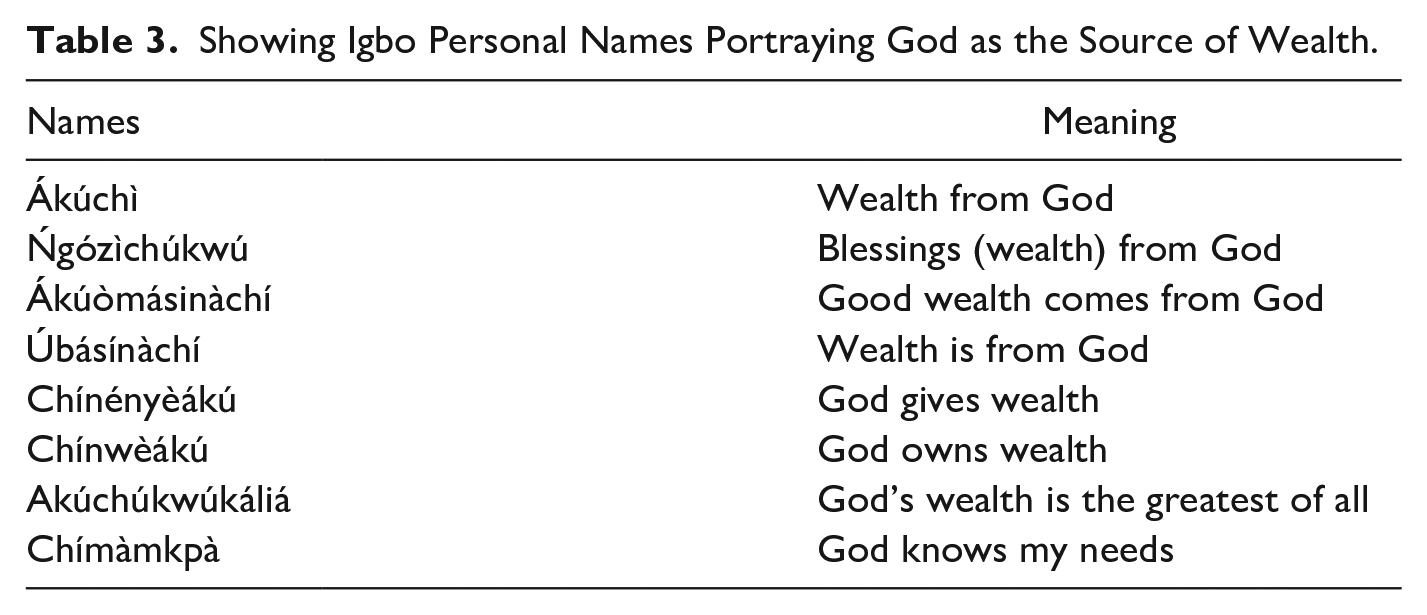
In Table 3 above, Ákúchì (wealth from God), Ńgózìchúkwú (the blessings/wealth from God), Ákúòmásinàchí (good wealth comes from God), Úbásínàchí (wealth is from God) and Chínényèákú (God gives wealth) reiterate the people’s belief in wealth that comes from God as the only source of genuine riches. Also, Chínwèákú (God owns wealth) shows God’s possession of wealth that he gives to people. The ethnopragmatic implication is that, it is God’s discretion to give wealth to who he wants and at his own time. Ákúchúkwúkárià (God’s wealth is the greatest of all) symbolically places the wealth given by God as the greatest, safest and the type to be sought for. Chímàmkpà (God knows my needs) suggests God’s divine knowledge in giving to those who need riches to do good and not evil. These strands of personal names situate the Igbos’ value of wealth as an instrument of power, a means of acquiring social prestige, a measure to delineate social boundaries and a source to help others (Guyer, 1995; Smith, 2017). When asked why he bestowed Akúchúkwúkáliá on his son, the 67-year old Ònyèóchá reported that: “I gave him the name as a lesson in his life time to be very conscious of the fact that it is only the wealth that comes from God that is most honorable and free from evil reward.” Also, Chímàmkpà, a 32-year old man argued that his father gave him the name as a cautionary instrument. According to him, he has to be patient not to run into making quick and evil money that could ruin the image of the family. He is admonished to be patient, for God who knows his needs will provide the means to attend to them. These personal names are in their discursive forms and manifest in several levels of their social interactions (Uwen & Ukam, 2020). Mensah and Iloh (2021) argue that this category of names were bestowed on the Igbo children to consistently remind them of the illegitimacy in wrongfully, illegally and diabolically acquired wealth and the possible consequences. Therefore, the names are reflections of the beliefs system of the Igbos, and they propagate a sociocultural re-orientation of the young people to deploy good virtues of hard work, resilience and perseverance, and to depend on God for riches. Apart from drawing the names from the sociolinguistic milieu of the Igbos, they ethnopragmatically serve as a guide to re-order and inculcate good morals in the acquisition of wealth among the people. The names, as the participants have suggested, have deepened implications and perform intergenerational socio-cognitive functions that are rooted in Christian doctrines
Igbo Personal Names Showing the People’s Dependence on God
This category of Igbo personal names recount that the people’s dependence on God in every activities of their existence. The names are meant to express religiosity and communicate the people’s religious consciousness (Uwen, 2020). The personal names in this description, become recurring forms that sustain the awareness in the renewed worldview of the people. The examples are shown in Table 4 below.
Showing Igbo Personal Names Indicating the People’s Dependence on God.
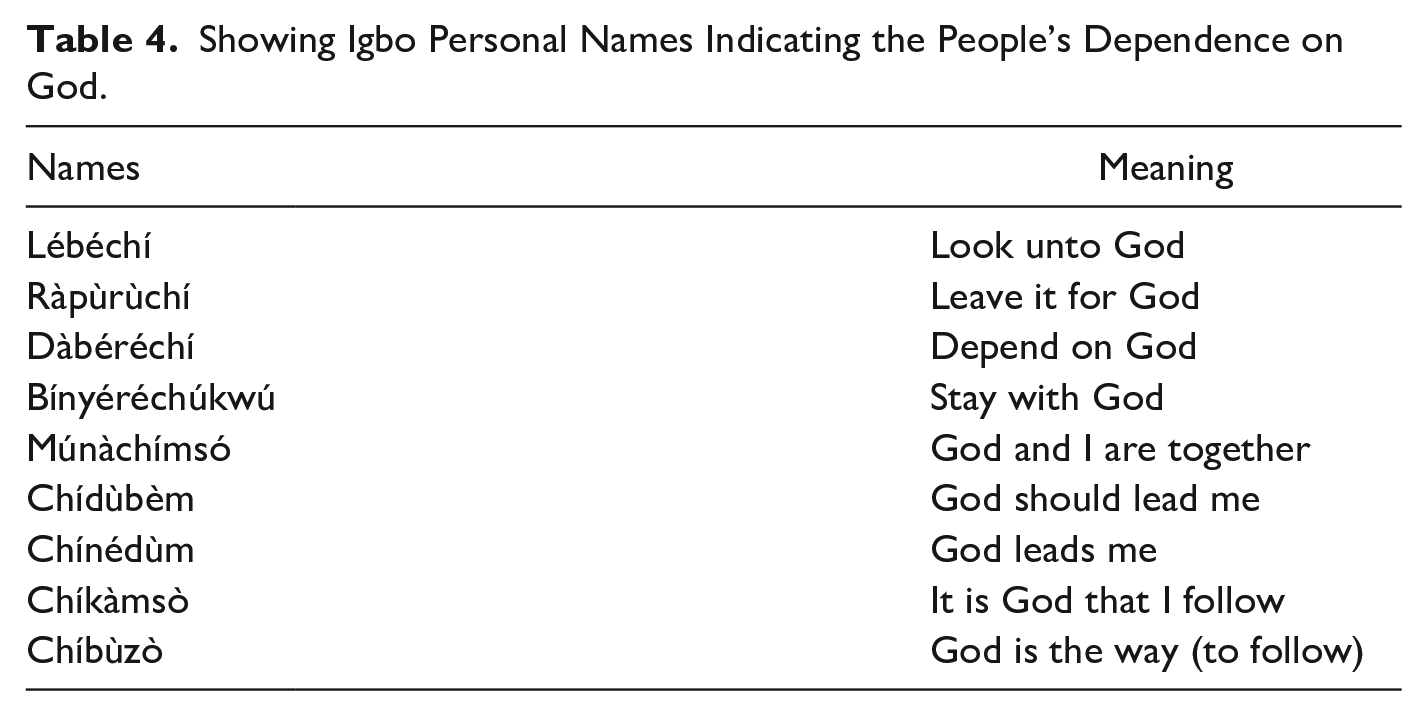
In Table 4 above, Lébéchí (look unto God), Ràpùrùchí (leave it for God) and Dàbéréchí (depend on God) underscore the people’s reliance on God for the direction of their affairs. Looking unto God, leaving issues for him to decide and depending on him situate the people’s devoted exercise of religiosity. Also, Bínyéréchúkwú (stay with God) and Múnàchímsó (God and I are together) show divine companionship and protection as a measure for physical and spiritual empowerment toward self-actualization. Again, Chídùbèm (God should lead me), Chínédùm (God leads me), Chíkàmsò (it is God that I follow) and Chíbùzò (God is the way to follow) jointly portray God, not as just the only way to follow, but he is the leader they yearn for to lead their path to greatness. The names, in this context, present God as their guardian along the rough paths of their lives. This Christian belief corroborates the argument that the naming culture of the Igbos shows “the people’s awareness of their complex dependence on the spiritual being, namely the supreme God” (Onumajuru, 2016, p. 308). On reliance on God, Ányáélè, 53-year old man argued that the people “bestow this category of personal names to continually remind the bearers of the need to depend on God who controls human affairs of mankind. This is because the path to fulfilment is sometimes rough and unpredictable and requires God to take you to the destination.” This trust is recorded in Psalm 118:8 thus: “it is better to take refuge in the Lord than to trust in man” and Psalm 91:11 which says “for he shall give his angels charge over thee, to keep thee in all thy ways.” It is further established that man’s dependence on God is the better way to success as God offers the desired protection to his believers (Laurin et al., 2012). For, Chídùbèm, a 59-year old woman recounted her experiences this way: “the religious, sociocultural and socio-cognitive meanings of these Igbo personal names work for us. As a person, my name (God leads me) has proven to be true in the many trembling stages of my life, the name recounts and communicates my experiences showing that God (has been, and) is still leading me for good and to victory.” In many instances, as observed, the personal names drawn from Igbo language, visualize divine, invisible and spiritual companions in the lonely moments of the people which construct the ethnopragmatic and religious interpretations that motivated the bestowal.
Igbo Personal Names Portraying the Virtues of God
Virtues are the guiding moral principles that give meaning to human existence and convert the mind to do good things. Virtues “lead the mind to the pursuit of divine love, and give man the constant disposition to pursue good” (Bugiulescu, 2018, p. 63). The virtues of God are more rewarding to mankind. Christians believe that God shows genuine love, prudence, justice, faithfulness, fortitude, mercy and temperance, virtues that motivate adherents to emulate the morally acceptable principles. The virtues of God are placed in prominence and high value among the people of Aboh Mbaise and Abah North LGAs. Such names are represented in Table 5 below.
Showing Igbo Personal Names Portraying the Virtues of God.
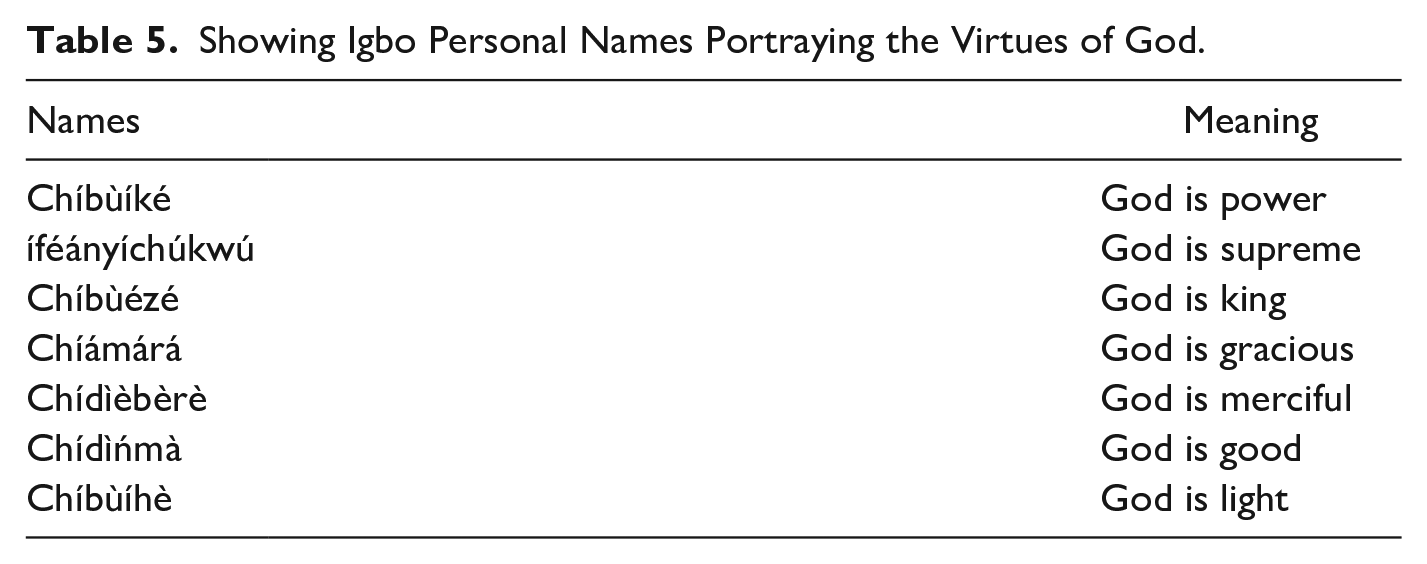
In Table 5 below, the names are conceived as products of the sociocultural context of the people which is influenced by Christian religion. The meanings are therefore ethnopragmatically interpreted by the users based on their shared experience. Goddard (2007) has argued that names, whether as lexical, phrasal or sentential components of the larger language, are interpretable within the speakers’ norms of interaction, beliefs and collective experience. Based on this commonality, Chíbùíké (God is power) and íféányíchúkwú (God is supreme) are believed to be bestowed on the bearers in order to eulogize God as the exceptionally superior being that has the final but favorable consent in the matters that concern his worshipers. Having conceived this, it is therefore of no use dealing with, or worshiping any other deity with lesser powers. Chíbùézé (God is king) is honorific and address term that communicates priesthood, royalty, power, prestige, command and control over the mortal. Chíbùézé re-enacts the conception of kingship in the Igbo cosmology to see the bearers as divinely conferred the tittle of righteous kings who would show wisdom in communal decisions. On this, Ekeopara (2011) argues that the virtue of kingship ascribed to God is drawn from the Igbo sociocultural and religious beliefs on mortal kings and title holders who wield authority and command respect within the Igbo communities. Also, Chíámárá (God is gracious), Chídìèbèrè (God is merciful) and Chídìńmà (God is good) are virtues that communicate the passionate, merciful and forgiving nature of God expected of his believers. Similarly, Chíbùíhè (God is light) is a metaphorical representation of God as the shining light that shows the path to follow. On the ethnopragmatic implications, Chídìèbèrè, a 44-year old man reported that his father bestowed the name on him to continue to remind the family of how God has been merciful to them. By this virtue, Chídìèbèrè had promised to show mercy on anybody that comes his way. Another participant, Ósóńdù, an 80-year old man who bestowed Chíbùíhè on his son, argued that the name is symbolic. “It is a symbolic translocation from worshiping idols to adoring the true and supreme God. Chíbùíhè was delivered at the time I repented, and God has since proven that he is the shining light.” Among his worshipers, God is portrayed as a symbol of light, goodness, grace, love, mercy and grace (Damoah, 2021). The names, as the participants have argued, are moral virtues that the bearers and users should practice for a peaceful and rewarding co-existence. The bible has also admonished Christians in Colosians 3:12 to “put on then, as God’s chosen ones, holy and beloved, compassionate hearts, kindness, humility, meekness, and patience.” The ethnopragmatic impulses are the motivations for the bestowal of the names that translate Christian doctrines.
Igbo Personal Name Portraying God as a Promise Keeper
In the context of this study, personal names contextualized different requests made from God with the expectations that he would grant them. The names in this category as shown in Table 6 above were bestowed to represent the fulfilled promises of God.
Showing Igbo Personal Portraying God as a Promise Keeper.
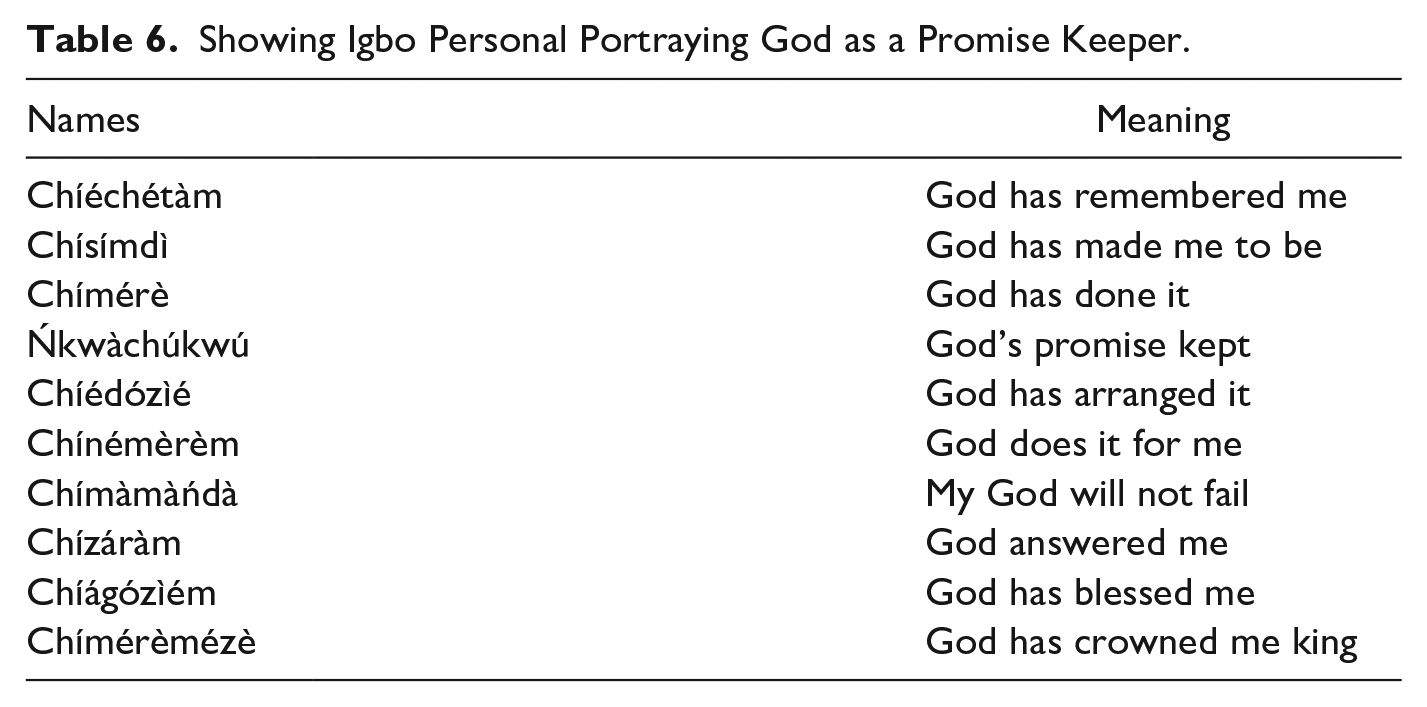
In Table 6 above, Chíéchétàm (God has remembered me) signifies renewed hope from abandonment and a response to expectations previously requested for. Chísímdì (God has made me to be) shows a fulfilled promise and a symbol for its remembrance through the name bearer. Chímérè (God has done it) and Ńkwàchúkwú (God’s promise kept) were bestowed to construct the reality of the promises of God while Chíédózìé (God has arranged it) shows where expectation meets fulfilment. Chínémèrèm (God does it for me) signifies the continuity of the fulfilment of God’s promises in the life of the bearer while Chímàmàńdà (my God will not fail) dissociates God from a being that reneges commitment to his worshipers. Also, Chízáràm (God answered me) signals request granted by God through the name bearer while Chíágózìém (God has blessed me) portrays God as a source of the blessings he promised his followers. The other name Chímérèmézè (God has crowned me king) portrays God as the one who makes, crowns and dethrones kings. This set of personal names presents God as a communication partner with the bearers and users of the names. It is through such communication that the worshipers make their requests from where the fulfilments are constructed through the names that also present God as a promise keeper. It is argued that God’s virtue of fulfilling promises makes his integrity prominent and exceptional (Ojemba, 2020). On this, a 63-year old Onyénmá who named his daughter Chízáràm on confirmed that she is the symbol for the fulfillment promises of God. According to the participant, “I have three boys and had prayed to have a female child when my wife got pregnant for the fourth time. To our surprise, God granted the request as my wife delivered of a baby girl. We gave her the name to remind us that God answers prayers.” Another participant, Nwàézè aged 71, reported that the name Chíédózìé (God has arranged it), that he bestowed on his son is very symbolic because he prayed and was given a well-paid job as soon as the wife conceived. The participant argued that there is a trending departure from some traditional untranslatable names to the ones that are embedded in deepened meanings within the Christian religious circles. This situates circumstantial meanings as the motivations for names’ bestowal. Personal names in this description, are situated within the sociocultural and local conditions of language use that connect with the people’s emotions, norms and beliefs system (Goddard, 2006, 2007). It is this level of interpretation that creates variation in language use and naming practices, and ethnopragmatic context that generate the motivations for the name-givers.
Conclusion
Drawing insights from socio-onomastics and divine motivation theories, we have discussed different dimensions of conceptualization of Chi (God) in the Igbo worldview and as presented in the naming practices in Aboh Mbaise and Aba North LGAs among Mbaise and Ngwa in Imo and Abia States in South-eastern Nigeria. The personal names which were prominently derived from the circumstances of the name givers, bearers and users at the birth of the child, evidently expressed the commonality of the shared beliefs and experiences within the sociocultural milieu of the people. The naming system shows the complex nature of Chi as a supreme, dependable, adorable, praiseworthy and trusted being whose blessings are profitable to the worshipers. The personal names depict the social reinforcement of the outcomes of the interface between religion (Christianity implanted through colonization) and the Igbo language explored in the naming practices that express the socioreligious beliefs of the people. Through the names, it is established that Christianity, though a non-indigenous religion, is not only popularized among the people of Aboh Mbaise and Aba North LGAs, but it also explored the use of indigenous language to domesticate the people’s conceptualization of the religion and benefits derived from worshiping the God that Christians serve. The personal names are consciously devised instruments that communicate the emotions, experiences and expectations of the people from the God they worship.
The researchers’ observation corroborates participants’ views on the emerging trend of Igbo personal names that are reflective of Anglo-Christian beliefs that communicate the shift from traditional conceptualization of Chi to a new alignment with the tenets of Christianity and the Christian God. This changing perception has less reverence on the indigenous conception of the personal god (among the Christians) and increasing adoration of the Christian God by the practitioners of these sets of naming practices. This implies that while the non-Christians might still hold onto the traditional pattern of personal names, the Christians are immersed in bestowing personal names that communicate a transgenerational flow of their new belief system that propagates godliness. This observation establishes a juxtaposition in the naming practices in Igbo land that symbolize traditions on one hand, and others that are informed by the doctrines of Christianity. Though the names strengthen the use of Igbo language, they re-enact how colonization and the legacy of Christianity it implanted, is taking its toll on the Igbo people and their socio-onomastic tradition. In view of this realization, and since naming practices and personal names are aspects of the people’s sociocultural identity, the new trend of Anglo-Christian names are apparatus for modern utilization of colonial indoctrination and the spread of colonial ideals used in devaluing and devisualizing the traditional values, cultural identities and indigeneity of the subpopulation in Mbaise and Ngwa in particular, and the Igbos in general. It is therefore recommended that a study should be carried with focus on Igbo non-Christians’ pattern of personal names. This would provide insights on the synchronic and diachronic traditional perspectives on Igbo naming practices to establish a balance in conceptualization of names among non-Christians.
Footnotes
Declaration of Conflicting Interests
The authors declared no potential conflicts of interest with respect to the research, authorship, and/or publication of this article.
Funding
The authors received no financial support for the research, authorship, and/or publication of this article.
