



Abstract
Agricultural extension plays a crucial role in agricultural development and supports farmers and rural communities; it remains a powerful strategy for enhancing agricultural productivity. This study assessed the views of agricultural extension staff on the major constraints to effective agricultural extension services in the North Central region. The analysis was based on data collected through a mixed-methods approach, including a survey of 26 extension staff members, focus group discussions and interviews with key informants. Data were analysed using descriptive statistics and thematic analysis. This study revealed major constraints include low farmer participation (88.5%), large area coverage (57.7%), limited budget (80.8%), poor linkage between extension and research (69.2%), limited kilometres for vehicles (69.2%), lack of technical support (61.5%), lack of technology and innovations (57.7%) and lack of supervision (46.2%) and limited skills (34.6%). Therefore, it is recommended that the government, through the Ministry of Agriculture, Water and Land Reform (MAWLR), allocate more financial and human resources in terms of the operational budget for logistical support, staff complement and continuous capacity building. There is a need to use appropriate transportation technology that is cheaper to reach as many farmers as possible, such as motorbikes instead of motor vehicles, to reduce fuel costs. There is also a need to strengthen the relationship between extension and researchers, as well as to emphasise farmers’ motivation to actively participate in extension activities to ensure the effective delivery of extension services. This can be achieved by codesigning research and coproducing solutions with farmers.
Introduction
In many developing countries, agriculture plays a vital role in the lives of the majority of the rural population, and Namibia is no exception. According to the World Urbanisation Prospects report (2014), approximately 3.4 billion people (70% of the global population) live in rural areas, with the majority residing in developing countries. The global population is projected to reach 9 billion by 2050 (Motaroki, 2016; Pande and Kumburu, 2019). Sub-Saharan Africa (SSA) is experiencing the fastest population growth, which demands higher food production (Pande and Kumburu, 2019). The agricultural sector plays an important role in socio-economic development in many countries in terms of employment creation, poverty reduction and improving the standard of living (Billah et al., 2025; Ongachi and Belinder, 2025; Pundir et al., 2025) and improves the livelihoods of many communities in developing countries (Cloete et al., 2019; Giller et al., 2021; Maoba, 2016; Tambile et al., 2024; Trentinaglia et al., 2023). In Africa, many people acquire their livelihoods directly or indirectly from agriculture (Tambile et al., 2024). In SSA, approximately 70% of the total population is employed and derives its livelihood from agriculture, accounting for 15% to 50% of the Gross Domestic Product (GDP) (Wollburg et al., 2023). Agricultural extension is recognised as a crucial strategy for enhancing agricultural development in developing countries. Agricultural extension refers to a set of services that assist individuals involved in agricultural production to address challenges; connect with markets and other stakeholders in the agricultural value chain; and access the information, skills and technologies needed to enhance their livelihoods (Anaeto et al., 2012; Davis et al., 2019; Iwuagwu et al., 2020; Mutimba, 2014; Ongachi and Belinder, 2025). Similarly, extension is also seen as a public or private service that responds to the needs of farmers and rural people for knowledge and can be used to improve their productivity, income and welfare and sustainably manage natural resources (Richardson, 2006; Vanclay and Leach, 2006) and remains a driving force for sustainable livelihood (Loki and Mdoda, 2023).
In Namibia, 52% of the population resides in rural areas and is mainly dependent on the agricultural sector as its main source of livelihood (NSA, 2018; Sichoongwe, 2024). Agriculture contributes approximately 5% of the total GDP, of which livestock is the main contributor (NSA, 2024). This production accounts for approximately 40% of the consumption needs, with up to 70% of food requirements imported, mostly from South Africa (MAWLR, 2021). Despite its relatively small share of GDP, it remains crucial to the lives of the Namibian population, making it one of the basic contributors to GDP (Mubita, 2018; NSA, 2024; Simasiku and Sheefeni, 2017) and a leading employment provider in Namibia, accounting for 23% of the total labour force (NSA, 2018).
The agricultural sector in SSA is confronted with many challenges leading to low productivity, including low usage of agricultural inputs, lack of technological development, low levels of knowledge, high levels of risks and uncertainty, which are exacerbated by climate change. In addition, current education, training and extension structures are not aligned with innovative approaches to agricultural development (Adolph, 2011; Ibidunni et al., 2023; Mutimba, 2014; Shimeles et al., 2018). The agricultural sector in Namibia is characterised by low and declining productivity, driven by factors such as poverty, insufficient technological advancement, labour out-migration, lack of market access, high agricultural and transport costs, and ineffective agricultural extension support services for small-scale farmers (Mushendami et al., 2008; Vigne and Whiteside, 1997). In addition, challenges such as climate change, water shortages, high production costs, inadequate financing, limited agricultural skills and poor soil fertility further exacerbate the problem. Consequently, attaining food security at both the household and national levels remains a significant challenge in the country (Mubita, 2018).
Agricultural development has been a priority for Namibia, and various agricultural policies and frameworks have been developed to guide and support the sector’s development. Among them is the National Agricultural Policy 2015 (NAP), which focuses on promoting sustainable agricultural production, improving market access, enhancing rural livelihoods and ensuring food security. Therefore, agricultural extension services play a vital role in disseminating agricultural knowledge, promoting innovative farming techniques and providing technical support to farmers. They remain a powerful strategy for enhancing agricultural productivity and improving the livelihoods of rural people worldwide (Agbarevo, 2013; Anaeto et al., 2012; Conceição et al., 2016; Danso-Abbeam et al., 2018; Yang and Ou, 2022). In Namibia, agricultural extension is largely a public service and one of the main instruments used by the government through the Ministry of Agriculture, Fisheries, Water, and Land Reform under the Directorate of Agricultural Extension and Engineering Services to achieve its agricultural development goals. Agricultural extension also plays a crucial role in helping farmers access and adopt relevant technologies (Alam et al., 2024; Xu et al., 2023). Furthermore, its role extends beyond farmer training and technology transfer. It encompasses group formation, marketing, resource conservation, monitoring food security and nutrition, security and safety, and poverty alleviation while safeguarding the environment (Dia and Kobani, 2024).
In contrast, agricultural extension services in Namibia have been criticised for several reasons, such as doing nothing, being incompetent and rarely visiting farmers (NSA, 2019). Furthermore, extension institutions worldwide have been reported to face several challenges, such as limited operational budget, minimal physical infrastructure (Swanson, 2008), lack of subject matter specialists and poor linkages between researchers and extension (Davis, 2009). According to Maake and Antwi (2022), the effectiveness of extension services depends on the relevance, quality of services, capability and provision of information that improves agricultural production, facilitates access to technologies and provides timely information. In corroboration, extension services should be decentralised and participatory to meet farmers’ and community needs (Maulu et al., 2021; Nnadi et al., 2013).
Although the Namibian government has made efforts to improve the agricultural sector through investments in agricultural extension services, such as the establishment of Agricultural Development Centres (ADCs), technology development and dissemination of information on innovations and technologies such as new crop varieties, new crops and other improved farming practices, there is suspicion that much is anticipated, but very little is being delivered. Therefore, addressing the needs of extension officials is essential to ensure the effective delivery of agricultural extension services.
For agricultural extension agents to effectively serve small-scale farmers and rural communities and improve their agricultural production, it is crucial to understand the constraints they face by extension agents in fulfilling this important mandate. Constraint identification is crucial for improving the quality and effectiveness of extension services (Davis and Terblanché, 2016; Hawary, 2019). Attempts made so far to assess the constraints to effective extension services in Namibia are limited. Previous studies in Namibia have mainly focused on the perceptions of extension officials on technology adoption (Togarepi et al., 2018) and understanding farmers’ perceptions of the frequency, adequacy, relevance and quality of agricultural support services provided by different service providers (Jona and Terblanche, 2015), among others. Therefore, this study aims to assess the perceived constraints affecting agricultural extension agents in delivering effective extension services in the Omusati and Oshana regions. Specifically, the main research question addressed is what are the perceived challenges experienced by extension agents that affect the effective delivery of extension services, and how can this situation be improved?
Literature review
Agricultural extension services are a cornerstone of rural development and are essential for facilitating the transfer of innovation, knowledge and technologies to farming communities. Extension officials, as the primary facilitators of these services, play a critical role in bridging the gap between institutions and farmers. Despite their critical role, extension agents face numerous challenges that hinder their effectiveness in delivering extension services. Several studies have identified institutional limitations as major barriers to effective extension service delivery. These include inadequate staffing levels and poor logistical support, such as a lack of transportation and delayed funding, which constrain extension agents’ ability to reach farmers (Adebayo and Worth, 2022; Kibrom et al., 2025; Mwangi and Kariuki, 2015; Wekesa et al., 2025). Wekesa et al. (2025) examined the key challenges affecting the provision of agricultural extension services and their impact on maize production in Kwanza subcounty. The findings highlighted that challenges such as staffing shortages, poor coordination among stakeholders and inadequate funding are the most significant barriers to effective extension service delivery (Wekesa et al., 2025). Kibrom et al. (2025), in a study conducted in North-Western Ethiopia, identified several structural and operational challenges, including poor functioning of farmer training centres, a top-down extension approach, higher workloads, limited training opportunities and technical capacity as key bottlenecks. These factors contributed to low motivation and high turnover rates, which negatively impacted service continuity and emphasised the need for participatory and locally tailored extension models to replace the prevailing one-size-fits-all approach.
Similarly, Mbatha (2024) examined the provision of agricultural extension services to rural farmers in South Africa and observed poor attendance at vital meetings and training sessions. In addition, Mkuki and Msuya (2020) found that extension officers in Tanzania were often assigned nonextension duties, such as tax collection, which diverted them from their core responsibilities, while the lack of in-service training and logistical support further constrained their ability to perform effectively. In Tanzania, Mosha and Daudi (2024) highlighted that inefficient funding; poor organisation, coordination and management; political interference environment; weak linkage with research; insufficient number of staff; and poor infrastructures and facilities led to dissatisfaction with rendered services among farmers, resulted in low morale among extension workers and reduced service quality. Public extension systems often face budget shortfalls, delayed funding and limited access to essential resources, such as transportation and communication tools, which hinder the mobility of extension officers in remote areas (Arowosegbe et al., 2024). Similarly, Ojo et al. (2024) highlight that insufficient staffing, lack of incentives and inadequate training significantly hinder the dissemination of climate-smart agricultural practices in Nigeria. In India, inadequate funding, limited extension personnel, inaccessibility to proper information, ineffective policy reforms and poor infrastructure have significantly weakened public extension services, rendering them unable to meet the evolving needs of modern agriculture (Dey, 2024). Chauke and Adam (2025) noted that poor Internet connectivity, geographical isolation and low digital literacy among farmers limit the potential of mobile apps and digital platforms to bridge the information gap between researchers and farmers. On the other hand, Maake and Antwi (2022) assessed the challenges experienced by farmers and found that relevance and good quality services, provision of information on improving agricultural production and availability of relevant technologies required by farmers were limited.
In many rural areas, low literacy levels, language barriers and gender dynamics limit the ability of extension officers to communicate effectively with farmers, and women farmers are often underserved because of a lack of tailored technologies (Saikia et al., 2021). Apantaku et al. (2016) highlighted that in Nigeria, inadequate equipment and poor planning were major constraints to effective service delivery. Extension agents lack vehicles, mobile devices and access to digital platforms, which hinders their ability to reach remote farming communities. Swanson and Rajalahti (2010), in their comprehensive review of global agricultural extension systems, identified key constraints including insufficient funding, limited access to information and technology, inadequate training of extension personnel and weak institutional linkages between research and extension services. Similarly, Jona and Terblanche (2018) focused on the determination of coordination linkages among various stakeholders of agricultural support services and revealed poor coordination among stakeholders in the Oshikoto Region of Namibia. The study emphasised that extension services were fragmented, with overlapping roles and unclear mandates, while budget constraints and lack of strategic planning further weakened service delivery.
Most challenges experienced by farming communities are exacerbated by weak extension support (Jona and Terblanche, 2018; Thomas and Togarepi, 2025). The key issues highlighted include a lack of transportation, demonstration materials and digital tools, as well as poor stakeholder coordination and unclear mandates. Togarepi et al. (2018) assessed extension officials’ perceptions of rural farmers’ adoption of agricultural technologies in Namibia’s Omusati region. They found that the low adoption of agricultural technologies stems from poor farmers’ attendance at meetings, minimal interest in innovations and large jurisdiction areas managed by extension agents, while many lack specialised knowledge in climate-smart agriculture, agribusiness and information and communication technologies (ICTs) tools. It is therefore concluded that there is a need for context-specific analysis to understand the constraints faced by extension agents in delivering services.
History of agricultural extension in Namibia
Namibia’s agricultural extension history reflects a transition from a narrow focus on commercial agriculture to a more inclusive, participatory approach that caters to the needs of small-scale farmers and rural communities. The government, in collaboration with development partners and stakeholders, is continuously working to enhance agricultural extension services to promote sustainable agriculture, rural development and food security in Namibia.
Before Namibia’s independence in 1990, agricultural extension services were mostly centralised top-down structures with considerable subsidy inputs, including ploughing services to the community, farming inputs such as seeds and infrastructure maintenance (Jona and Terblanche, 2015). Black communities practised farming without any support from the apartheid government; thus, they concentrated only on White farmers by providing loans to build dams, drill boreholes and buy livestock and provided subsidy inputs such as ploughing services, seed inputs, expert advice and other free support services (FAO, 1995). In addition, several parastatals and statutory bodies provided additional research, financial and marketing services to the commercial sector. Consequently, the apartheid government favoured White farmers over Black farmers, leaving the majority of farmers in communal areas without extension advice and farmer training (Vigne and Whiteside, 1997).
Agricultural extension is mainly provided by the public sector through the Ministry of Agriculture, Water, and Land Reform (MAWLR) using the conventional extension approach, often referred to as the transfer-of-technology approach. Although private organisations, such as NGOs, also contribute, their role is limited, with the majority of extension services being provided by the public sector (Kumba, 2003). Before independence, Namibia’s agricultural extension services’ primary goal was to help farmers develop and adopt improved farming technologies and practices, organise themselves in cooperatives and access information such as markets, policies and infrastructure. After independence in 1990, the Ministry of Agriculture, Water, and Rural Development (MAWRD) created the Directorate of Extension and Engineering Services (DEES) to provide agricultural extension services to farmers, agro-based industries and other stakeholders in the form of information, communication, advice and training services. Simultaneously, several female extension staff members were trained and recruited (Vigne and Whiteside, 1997). During that time, the extension was geared towards the adoption of new technologies by supplying highly subsidised inputs and ploughing services to achieve the sector’s policy objectives of farmers, increasing agricultural production and concentrating on the administration of government programmes such as drought relief and credit schemes (MAWLR, 1995).
In 1995, the NAP was formulated through a consultative process aimed at addressing inequalities in income, food security and environmental sustainability in the agricultural sector. The policy also provided an enabling environment for increased food production by small- and large-scale farming sectors (NAP, 1995). The NAP was revised in 2015 to consider the socio-economic and environmental changes that have occurred (NAP, 1995, 2015). After Independence, government-led agricultural extension services also slowly started moving away from the Transfer of Technology (ToT) to the Training and Visit (T&V) approach, followed by the Farming System Research and Extension (FSRE) approach (Jona & (NAP, 2015). The T&V approach was found to be too costly and did not consider farmers’ needs. Thereafter, the FSRE approach was officially introduced as a participatory, demand-driven, multidisciplinary and problem-solving development strategy in Namibia (Kumba, 2003; Kwenani and Terblanche, 2009). However, this approach has been challenging because extension offices in many remote areas are situated far from the nearest ADC (Kumba, 2003). The FSRE approach has been inconsistently implemented across the country due to a lack of a proper mechanism. (IFPRI, 2012). Despite the FSRE approach being introduced as a development strategy to farmers, its success was hindered by poor understanding of the approach itself, weak stakeholder linkage, a shortage of technical experts and insufficient financial resources (IFPRI, 2012; Kumba, 2003). This could be attributed to research, extension, and training sections, which are spread across different directorates within the Ministry of Agriculture, Fisheries, Water and Land Reform, thus creating poor coordination (Jona & (NAP, 2015). It was also highlighted that the FSRE approach lacked effective support from top management, leading many to abandon it in favour of traditional top-down extension approaches (Chikaire et al., 2011; Kumba, 2003).
Methodology
Study area
The study was conducted in two regions of the North Central areas of Namibia, namely, the Omusati and Oshana regions, which are geographically adjacent to each other. Omusati region borders the Kunene region to the west, Oshana borders the Oshikoto region to the southeast, the Ohangwena region to the north and northeast and both regions border the Kunene region to the south. It falls approximately between latitude 18° 43’ 05 S, longitude 15° 68’ 82 E in the Oshana region and 18°40’70 S, 14°84’55 E in the Omusati region (Atlas of Namibia Team, 2022). Furthermore, the Omusati region has a total population of 316,671, while the Oshana region has a population of 230,801, according to the Namibia Census Survey Report (NSA, 2023). The study was undertaken in 2024 to identify the constraints on agricultural extension delivery in the target regions. Each target region has 12 constituencies. In terms of agricultural extension, each region is assigned a chief agricultural scientific officer, who is accountable for all extension activities in the region and monitors the extension activities of extension agents. Under the chief agricultural scientific officer, there are agricultural scientific officers and chief agricultural extension technicians who are expected to supervise the agricultural extension technicians on new farming innovations, technologies and any interventions. Each constituency has at least one agricultural extension technician, with the support of other officials, who are responsible for the delivery of extension services in terms of innovations and technologies to farmers within the constituency, consisting of several villages and community members.
Study design and data collection
This study used a mixed-research design to assess the challenges experienced by agricultural extension officials in providing extension services to clients. A mixed-method design is a methodological approach that captures and integrates both quantitative and qualitative data and analysis techniques and allows researchers to explore and gain a deeper insight into respondents’ experience, perceptions and contextual factors. (Creswell and Inoue, 2025). Specifically, an exploratory mixed-research method was used to explore and gain a more comprehensive view and understanding of the challenges affecting the delivery of extension services. This study employed a purposive sampling strategy, as outlined by (Creswell and Inoue, 2025). Purposive sampling involves the deliberate selection of participants who are most knowledgeable and experienced with the phenomenon under investigation. The aim is not statistical representativeness but rather to obtain rich, in-depth insights from information-rich cases. Participants were chosen based on their relevance to the research questions and their ability to provide meaningful perspectives, ensuring alignment between the sample and the study’s qualitative design. This design began with quantitative data collection through a structured survey, followed by qualitative inquiry to elaborate on the findings. Moreover, to elicit information on the constraints of agricultural extension agents, a mixed-methods approach was used, including a survey questionnaire and key informants.
The structured questionnaires were sent to each agricultural extension technician via email, while some were dropped off at their respective offices. The same questionnaire was also sent to the two chief agricultural scientific officers to distribute to all extension agents in their respective regions to ensure receipt of the questionnaire by all extension officials. The study initially aimed to interview all 36 agricultural extension agents operating in the Omusati and Oshana regions. However, only 26 extension officials responded to the survey, resulting in a response rate of 72%. In addition to the survey, two focus group discussions were conducted, each consisting of five participants. The selection was done based on the availability of extension agents. This approach aligns with the recommendation of Onwuegbuzie (2009) and Prosser et al. (2024), who suggested that smaller groups of four to six are sufficient for exploratory studies, allowing for greater depth of discussion and easier management. These discussions provide deeper insights into the experiences, perceptions and challenges extension officials face in delivering agricultural extension services. Furthermore, key informant interviews were held with three key informants to triangulate by examining how the two datasets relate and enrich the study findings. The respondents were informed about the survey, including their rights, ethical considerations, handling of confidential information and withdrawal from the interviews with no consequence. Before the study commenced, ethical approval was sought and granted by the Decentralised Research and Ethics Committee of the University. The researchers followed all the procedures for data collection in accordance with the relevant guidelines and regulations as per the approval conditions.
Conceptual framework for effective delivery of extension services
Extension delivery service effectiveness is supposed to deliver improved productivity, decision-making, income and overall well-being of farmers (Figure 1). When the right mix of institutional, sociocultural, economic, technical, physical/climatic and political factors interacts, a desirable outcome for the farmers’ needs is achieved. Any anomaly in any one of the factors results in not achieving the farmers’ goals, and productivity suffers as a result.

Conceptual framework of normative effective delivery of extension services.
Data analysis
The data collected from the study were analysed using the Statistical Package for Social Sciences (SPSS). Quantitative data from the structured questionnaires were analysed using appropriate descriptive analyses, such as frequency, percentages, mean and standard deviations, to rank and profile perceived constraints. Qualitative data were analysed using thematic analysis to identify key themes emerging from these discussions. Thematic analysis is a qualitative approach that emphasises the identification and interpretation of themes derived from theory or empirical data, without the use of quantification. This method prioritises the contextual richness of the themes, often highlighting their complexity and depth (Creswell and Creswell, 2023). Data from key informants and focus group discussions were analysed qualitatively in three main stages: coding the materials to generate main themes from the interviews, identifying and refining themes and synthesising the generated themes into a meaningful construct. To gain a deeper understanding of the responses and context, each response was systematically examined, and meaningful segments of text were labelled with codes that represented the basis units of meaning in the broad sense of key issues that extension officials raised, such as lack of transport, limited funds and limited technologies, among others. These initial codes were then grouped into broader categories based on similarity and relevance through an iterative process to identify overarching themes, in which five key themes emerged: resources and infrastructure, institutional and administrative, human capacity and motivation, technological and sociocultural issues. The quantitative and qualitative results were merged at the interpretation stage, where ranked constraints were triangulated with thematic insights to locate constraints within the conceptual framework (Figure 1) and delivery conditions and thus enhance explanatory depth (Table 3 and Figure 3). This integrative process enabled the positioning of identified constraints within the study’s conceptual framework, thereby clarifying how these constraints influenced the conditions necessary for effective extension service delivery.
Results and discussion
Demographic characteristics of extension officials
The demographic characteristics of the agricultural extension officials are presented in Table 1. The majority of respondents (80%) were female. In Namibia, females dominate the public agricultural extension services, and this could be attributed to the fact that Namibia is one of the countries that has made significant efforts to train and recruit more female extension staff soon after independence. A higher representation of female extension staff can improve the efficacy of extension (Diaz and Najjar, 2019). In contrast, it has also been documented that female farmers in SSA Africa prefer working with female extension agents (Adebayo and Worth, 2022; Diaz and Najjar, 2019). Most respondents were relatively old, with a mean age of 46 years. All respondents had formal education at the tertiary level, with the majority (73.1%) of staff attaining a diploma. It is clear from the results that the educational level of extension agents in the two regions is generally high.
Sociodemographic characteristics of the respondents.

On average, the extension agents had approximately 17 years of working experience, with a minimum experience of 4 years and a maximum of 34 years, and a standard deviation of 7.75 years. It is clear from the survey results that the extension agents were experienced. It is crucial to consider staff experience since it plays a crucial role in any decision-making process and extension services delivery.
Agricultural extension approaches
Extension officials were asked to highlight the extension approach used within the extension systems. Table 2 indicates that 61.5% of extension agents used the T&V approach to support small-scale farmers, 34.6% of extension agents used the FSRE approach and a very small percentage (3.8%) used the participatory approach. Although the official extension approach to be used within the MAWLR is the FSRE approach, the T&V approach was the most used by extension agents. Although the fundamentals of T&V as stipulated by Benor et al. (1989) those extension workers are to identify farmers’ problems, give advice, train and visit farmers on a regular fixed schedule every 40 nights; assess farmers’ performance; and link with subject matter specialists, which is not necessarily done. It could be interpreted that most extension officials do not have a good understanding or sufficient knowledge of the operations of the extension system, which may suggest a lack of effective operational support from management. On the contrary, it could also be interpreted that extension officials have practically abandoned the FSRE approach (Kumba, 2003). In addition, extension technicians and extension officers have been trained on farmer-first approaches through FAO and have used project approaches through various projects, such as JICA and others. This indicates a shift towards a pluralistic approach rather than a rigid approach to extension delivery. Thus, a fluid and adaptable approach that uses appropriate tools to suit the context seems to be what is done in practice, despite there being no official shift towards pluralistic approaches.
Perceived agricultural extension approaches used by extension officials.
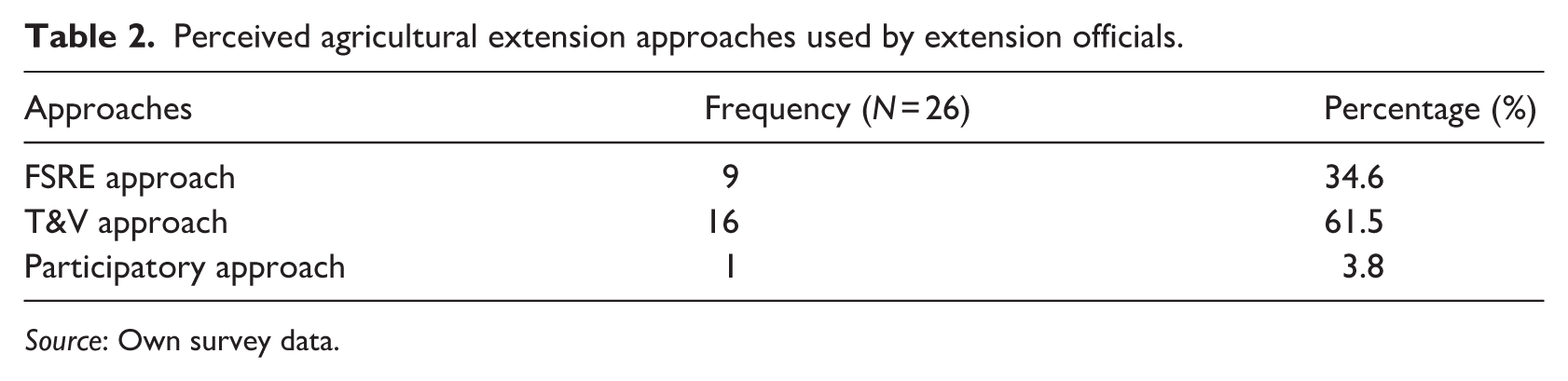
Source: Own survey data.
Major constraints to agricultural extension services
The effective delivery of extension services to farmers is a dynamic process that involves multiple actors, approaches, contexts and knowledge and understanding of extension officials’ challenges. An assessment of the constraints on the effective delivery of extension services could inform some of the critical areas for the improvement of service delivery by extension officials. The constraints perceived by extension officials regarding effective extension services are illustrated in Figure 2. This section focuses on descriptive and qualitative results of extension officials’ perceptions of the major constraints to effective extension service delivery. The constraints map directly into the framework’s factor domains, thereby validating the framework structure.

Major constraints to effective extension delivery as perceived by extension agents (own survey data).
Quantitative findings
The survey results highlight a number of constraints confronting agricultural extension agents’ efforts to assist small-scale farmers in improving their agricultural production in the Omusati and Oshana regions. Ten constraints were identified (Figure 2): (1) low farmers’ participation, (2) limited budget for extension activities, (3) poor linkage with researchers, (4) limited kilometres, (5) lack of technical support, (6) poor understanding of the extension approach, (7) lack of technology, (8) lack of supervision, (9) limited skills and (10) limited time. However, six constraints stood out above the rest, scoring more than 60% of the responses, including low farmers’ participation, limited budget for extension activities, poor linkage with researchers, limited kilometres and lack of technical support. Most of the challenges identified in the survey were echoed during the discussions.
Qualitative findings
Focus group discussions were conducted to further probe the perception of extension officials’ challenges inductively about agricultural extension service delivery. In this study, we found some factors impeding extension service delivery as perceived by extension officials. Our analysis revealed five themes that emerged (Table 3) as (1) resources and infrastructure, which covered issues on transport, ICT tools, funding availability and others; (2) institutional and administrative, which broadly covered issues related to structure, large coverage areas, bureaucratic challenges in communication and others; (3) human capacity and motivation, which covered training opportunities, incentives, number of extension officials and lack of incentives, among others; (iv) technological, which included technological development, limited technologies and limited innovations, among others and (v) sociocultural issues which broadly covered resistance or low uptake of innovations and poor farmer attendance due to attitude towards extension innovations. The challenges reported in the survey were reaffirmed during the discussions, demonstrating consistency across the two data sources. However, qualitative discussions provided deeper insights, highlighting additional constraints not captured by the survey. These included lack of incentives, conflicting roles, bureaucratic communication processes, poor feedback mechanisms and resistance to innovation. This indicates that while the survey effectively established a baseline of common challenges, the discussions enriched the findings by highlighting more context-specific barriers.
Summary of qualitative findings.
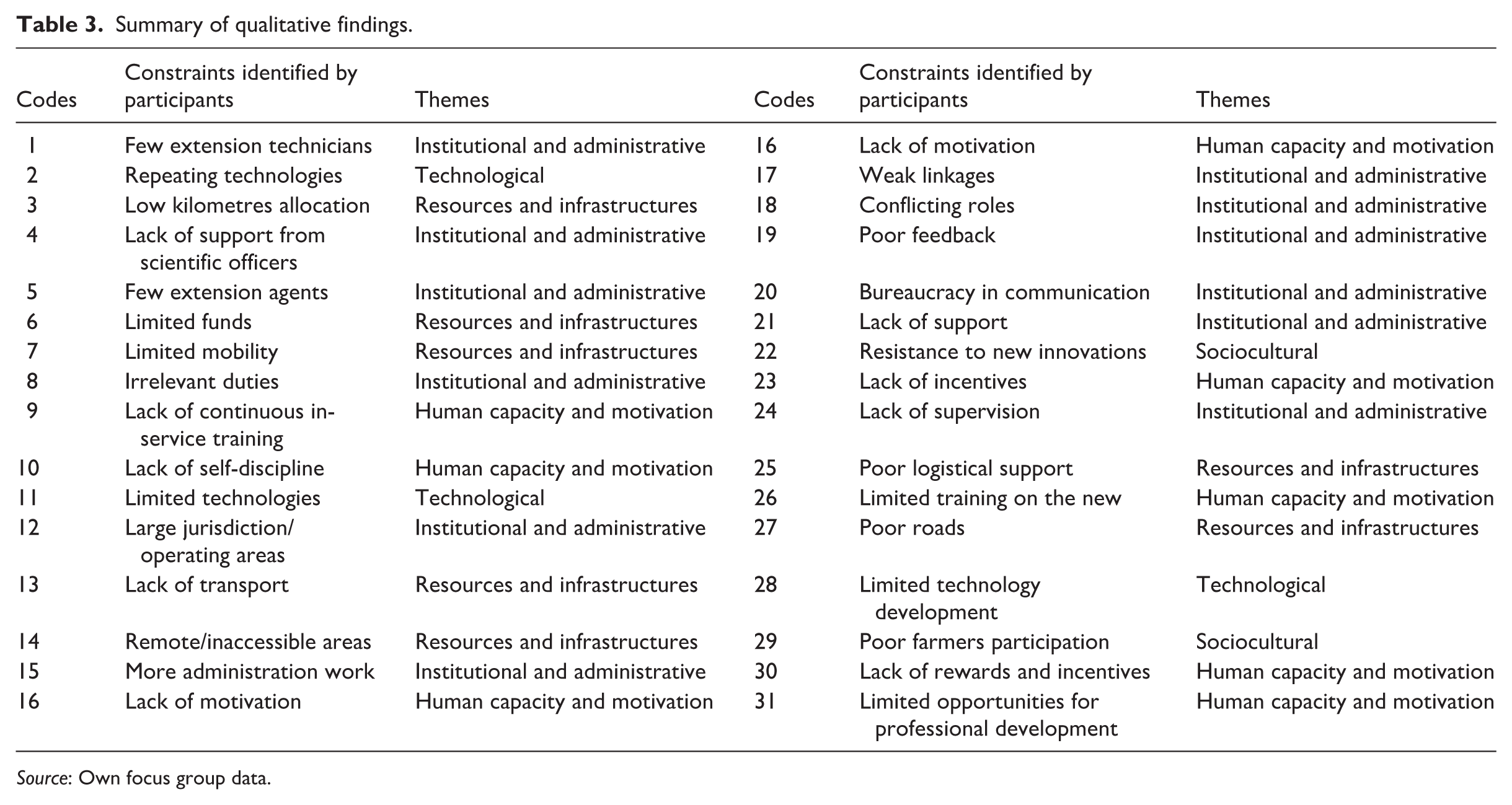
Source: Own focus group data.
Theme 1: Sociocultural challenges
Low farmers’ participation and resistance to innovations
One of the biggest challenges is the low farmers’ participation, which undermines the effectiveness and sustainability of agricultural extension service delivery. Agricultural extension agents highlighted that most farmers are hesitant to sacrifice their time to attend extension training sessions, which can enhance their capacity to improve their agricultural production and productivity and thus improve their livelihoods. Some extension participant responses were: In most cases, our farmers do not have an interest in participating in our extension activities, such as our regular meetings, since most of our farmers spend most of their time at the Cuca shops and expect more from us than just providing training to them.
Another participant indicated:
‘They mostly expect us to provide them with financial resources or the actual agricultural inputs such as seeds and fertiliser, medicine for their livestock when their animals are sick, and when we cannot provide all these, most farmers eventually withdraw.’
‘Usually, it is the same few farmers who partake in our extension meetings and activities’, another participant. These results are consistent with those of previous studies, where Jona and Terblanche (2015) observed that farmers’ interest was one of the biggest problems in the Oshikoto Region of Namibia.
Similarly, a study by Sebeho and Stevens (2019) in South Africa found that many farmers expected extension officers to assist them in accessing financial funding and loans, and when they could not offer such support, farmers’ attitudes towards extension changed negatively. This cited low farmer participation in extension activities could be an indication that farmers lack awareness of the value of participation in agricultural extension programmes. From the focus group discussion, it could also be deduced that there is a mismatch in priorities, and farmers give less priority to extension activities; as a result, they allocate limited time to extension activities. Low participation could also be attributed to the perceived use of a top-down approach (T&V approach) by extension staff, in contrast to a participatory approach, whereby farmers may not be allowed to fully participate in extension programme planning and decision-making. These findings are consistent with previous studies in other parts of Africa, Suvedi et al. (2017), which observed that poor participation of farmers in extension was attributed to age, education, household size and distance to the extension office. However, farmers are more likely to engage with support staff who they perceive as relevant to their needs and can benefit financially. It is also important to note that human behaviour is influenced by either autonomous or controlled regulation (Ryan et al., 2008). For instance, previous studies have shown that individuals’ decisions to participate in extension programmes are mainly influenced by intrinsic factors that help farmers seek knowledge (Charatsari et al., 2017). In addition, farmers’ willingness to participate in agricultural extension programmes depends on opportunity cost, membership in farmer groups, production purpose and demand for agricultural technologies, age, education, household size and distance to the extension office. Extension agents may also feel discouraged when farmers do not participate actively in extension activities. Although all farmers have the opportunity to participate in extension activities, one cannot expect complete success from extension programmes without the active participation of farmers, who are the beneficiaries of the intervention. This is particularly important for improving the efficiency and effectiveness of extension services and sustaining the changes brought about by the extension programme (Berhanu et al., 2014; Osei-Kofi et al., 2023).
The quantitative part of the research revealed several challenges. However, resistance to change did not appear in the quantitative results. Focus group discussions highlighted resistance to new technologies/innovation and added a new cultural dimension to understand constraints to effective extension service. In one of the discussions, one of the technicians cited that ‘Sometimes, prefer to their traditional way of doing things and makes it hard to convince farmers to adopt some technologies and that the technology is better than the traditional one and will benefit them greatly’. In addition, another one further indicated that sometimes they would get difficult questions, such as: ‘What if the technology does not work?’ This question shows how risk-averse farmers can influence other farmers’ decisions and undermine the effectiveness of the extension service. On the contrary, one of the participants cited that ‘Our technology package is very narrow with limited technologies to offer to our farmers, year in year out such early maturing varieties, fertilizer application, use of conservation agriculture among others’. This is likely to discourage farmers from participating. The conceptual framework anticipates that weak sociocultural issues could stall decision-making, reduce trust and may lead to poor adoption, even when other delivery conditions are improved. There is thus a need to put more emphasis on participatory planning in order to improve the relevance and farmers ‘participation.
Theme 2: Resources and infrastructure challenges
The most immediate stressors that arise from resource and infrastructure constraints are limited operational budget and kilometres, vehicle shortages or sharing arrangement and poor rural roads that make remote villages inaccessible, especially during the rainy periods.
Limited budget and limited kilometres
One of the biggest challenges is the limited budget, which undermines extension officials’ mobility to cover the large jurisdiction areas they serve. The regular mention of limited funds was an indication that extension officials were operating under financial constraints, which likely limited their ability to implement extension programmes, provide adequate support and reach target communities effectively. This finding aligns with national reports indicating that inadequate funding remains a persistent constraint, reflecting a systemic issue that requires strategic intervention to improve service efficiency. The limited kilometres of about 800 km per month, for carrying out extension activities, were also one of the most cited challenges to the effective delivery of extension services. This ceiling is quickly exhausted by essential travel, such as mandatory meetings and refuelling, leaving little capacity for routine farmers’ visits. This suppresses farm visits frequency and the reach of demonstrations, while increasing the opportunity cost for both extension agents and farmers. This has been reported in Namibia and in other developing countries (McDowell, 2004; Ragasa et al., 2016; Sebeho and Stevens, 2019). The discussion highlighted that extension officials received a very limited operational budget for logistics, such as fuel, demonstration materials and equipment. This budget limitation can impede their ability to visit all their target farmers regularly and deliver quality extension services. One of the participants highlighted that Most of farmers live far away from the Agricultural Development Centres (ADCs) and are scattered throughout their communities and constituencies, hence, we need proper transportation to get to these areas to reach out to farmers who are scattered over the operational area.
Although the MAWLR provided vehicles to most of the extension technicians to make them more mobile, unfortunately, these extension technicians were limited by the kilometres they could travel monthly, while some had to share one vehicle sometimes. Key informant interviews highlighted that kilometre allocation per extension technician was limited and set at 800 km per month. One participant mentioned that some villages were inaccessible and particularly problematic during rainy seasons. Some villages have poor roads and are hard to reach due to long distances or poor roads. Some participants’ responses were: ‘The area is very big, and distances are long, this makes it very difficult to reach everyone’. Our budget is often so small that we cannot even conduct regular meetings or demonstrations as we wish. One of the participants narrated
Given a large operational area with many farming households, this situation could lead to poor mobility of extension agents and fewer visits to farmers, thus hampering their daily extension programmes, as captured by one of the extension technicians: We have a very challenging situation in our working operations; we are expected to deliver, yet we are given very limited kilometres to travel per month. How do you expect us to reach out to all target farmers in the constituency with only 800 km? These kilometres are literally enough to go fuel the car at the nearest town/service station, back to the office, attend monthly reporting meetings and probably visit one or two villages.
The implication of this narration is worrisome because, without the necessary financial support as per the conceptual framework, it is likely to hinder extension agents’ ability to reach farmers, provide adequate training and support, disseminate new information and deliver effective extension services. Insight from the discussion indicated that most extension technicians spend most of their time at the office doing administrative work and selling seeds and fertilisers to farmers. This could indicate that extension agents do not fully concentrate on their extension work, and their attention might be diverted from the dissemination of technical information. Such findings align with previous studies, highlighting that the majority of agricultural extension agents are demotivated to perform their duties due to limited transport and other logistical support (Baah et al., 2009; Belay and Abebaw, 2004). FAO highlighted that extension personnel in developing countries spend most of their time on noneducational activities, which could be a reason for this.
Lack of transport
Another participant added, ‘Transport is another challenge; sometimes we have to share a vehicle’. Another one indicated ‘We end up restricting our extension activities based on our allocated budget, but not necessarily on what we wanted, nor on what farmers really need’. It is noted that extension officials, particularly extension technicians, have very limited funds allocated for daily operations as well as very limited kilometre allocations. This makes it challenging for them to provide personalised and timely assistance to farmers and often leads to weaker farmer engagement and slower adoption of innovations. The remoteness of farming areas, combined with inadequate infrastructure, increases the cost and time required for extension visits. According to the conceptual framework, adequate resources such as funding, transport and tools serve as foundational inputs for effective extension operations. The study findings align with this framework component and reinforce these views, as extension agents consistently identified insufficient funds and logistical resources as some of the major constraints. This supports the framework that resource constraints weaken the operational capacity of extension agents and eventually affect the quality and coverage of extension service delivery.
Theme 3: Institutional and administrative challenges
Large area coverage
Other constraints highlighted by farmers include large area coverage, as cited by almost half of the respondents (57.7%). According to extension norms and standards, the ratio of agricultural extension agents to farmers should be 1:500. Extension technicians perceive that their operational area coverage is too large and cannot reach out to most farmers. One extension technician is allocated per constituency, and each constituency has approximately 2000 to 3000 farming households. This implies that one extension technician is expected to serve many farmers of about 2000 to 3000, who are scattered throughout the constituency. Extension officials acknowledged that covering vast areas undermines their ability to provide timely and effective services. One official indicated that, ‘I have the whole constituency to take care of, and I can only have limited visits to my target communities’. Another one indicated that ‘the constituency is too big for one person to take care off. We are too overwhelmed with the large areas of operation; the government should employ more extension staff members to relief the pressure from us’. These insights reveal systemic constraints within extension service delivery and underscore the urgent need for enhanced logistical support and improved staffing ratios to ensure equitable access to advisory services. Insights gained from the investigation suggest that there is a need for more extension technicians to be recruited, to visit farmers more regularly and provide much-needed support to all target farmers in order to facilitate innovation and technology uptake and improve agricultural production in rural areas.
Poor extension – research linkage
Poor extension research linkage has been cited as another important problem affecting the effective delivery of extension services. The persistent disconnect between agricultural research and extension services remains a critical challenge to effective extension services. The results are, however, in agreement with earlier studies by Dulle (2000) and Mugwisi (2013), in Tanzania and Zimbabwe, respectively, who found extension agents’ contact with researchers to be very low. It was further emphasised that poor coordination often results in research outputs being confined to the academic domain, leaving farmers to continue relying on outdated farming practices. This is likely to hinder the effective delivery of agricultural innovations. This disconnect often results in delayed or poorly adopted technologies and information gaps, ultimately reducing farmers’ confidence and limiting the adoption of innovations, as compromising extension agents’ credibility. This research-extension gap also reinforces a top-down approach, where innovations are introduced without farmer involvement, thus reducing their relevance and long-term sustainability (Mapiye and Dzama, 2024). Extension officials expressed concerns over the poor coordination with research. One extension technician indicated that: ‘Sometimes we get new technologies from the researchers without involving us, and sometimes, it is not what farmers urgently need’. Another pointed out: ‘Our working relationship with researcher is very poor; sometimes we only get to know the technology when it is ready for dissemination’. We need to engage actively with researchers on issues of technology development, to ensure relevance and higher adoption rate’. These sentiments reveal a critical gap that may limit adaptive research as well as technology adoption, underscoring the need for stronger coordination, joint planning and feedback mechanisms between research institutions and extension services to ensure innovations are timely, relevant and accessible to farmers. However, the framework advocates for responsive research and strong institutional linkages as nonnegotiable conditions for extension delivery. It is therefore important to note that continuous interactions build good relationships between extension and research. This calls for proper link creation to ease the communication flow between researchers and extension agents. Specifically, there is also a need for an adequate budget and proper coordination to organise joint meetings to update both parties on new information and technologies, while extension agents should consult with researchers. Furthermore, effective collaboration between researchers and extension agents is also imperative to bridge this gap, to enable timely dissemination of context-specific technologies that are tailored to local conditions and farmers’ needs, thereby fostering farmers’ engagement and accelerating agricultural transformation and thus promoting resilience and sustainability within farming systems. Within the conceptual framework, these are institutional and governance issues that weaken planning and quality assurance, thereby compromising effectiveness of extension service delivery.
Lack of technical support and supervision
Agriculture is a dynamic field, and this sometimes poses challenges in understanding a specific field of agriculture. Agricultural extension agents are regarded as the frontline between farmers and research and often face technical support challenges that undermines their ability to deliver effective and efficient service s to farmers. It was highlighted that many extension agents f lack access to ICT tools such as reliable computer and proper Internet connectivity, materials such as demonstration tools and equipment, which limits their mobility and capacity to reach remote farmers. In addition, insufficient training workshops opportunities would mean that extension agents are not always well equipped with the latest knowledge and skills on new farming practices. In addition, weak monitoring and supervision systems further compound these difficulties, leaving extension agents without clear guidance. Below are some of the quotes from the group discussion: ‘I hardly get any support from the subject matter specialist. I find my ways and means to become relevant to my clients.’ Another official indicated that ‘Monitoring and supervision is often not adequately provided; sometimes we don’t have the basic tools and materials to train the farmer or conduct demonstrations for our clients.’ I do not have internet connection at my office; I spend a lot of my money on mobile data to stay updated with the latest information or share information with my clients.
The study highlights a gap in extension officials’ capacity to disseminate information and new technologies to farmers, mainly due to inadequate skills and training. Similar findings by (Becerra-encinales et al., 2024) point to inadequate technical support among extension agents in developing countries. In addition, the most crucial aspect for a successful extension intervention is sound technical knowledge, which is credible and unbiased enough to gain acceptance by farmers (Stevens et al., 2012). Therefore, to bridge this gap, extension directorates and organisations should prioritise structured training programmes to enhance agents’ technical skills and farmer outreach. This recommendation aligns with (Kibrom et al., 2025), who emphasises that the limited capacity of development agents and government support significantly undermines extension effectiveness, while (Raji et al., 2024) emphasised structured training and capacity building as crucial for improving extension agents’ technical competence and outreach.
Lack of supervision was highlighted by 46.2% of the respondents. It is crucial to note that in every working environment, there is a need for supervision, monitoring and evaluation of staff members to evaluate performance and allow a person to improve their weaknesses. Most extension technicians have revealed that in most cases, they work in isolation without fieldwork supervision. This can compromise the quality of the extension services provided by extension technicians.
Supervision is very minimal, and I end up working in isolation. Another one: ‘I hardly get supervised and get very limited feedback for my field work’. One of the extension technicians said: ‘We need a proper and regular supervision system in place to allow for proper guidance and timely support, and interventions where necessary’.
Earlier scholars argue that without robust supervision frameworks, even well-designed programmes risk inefficiency and failure. Suvedi et al. (2016) highlighted that without strong monitoring and supervision systems, extension programmes fail to achieve intended outcomes, leading to inefficiency and wasted resources. While other scholars argue that effective supervision and management are critical for aligning extension activities with organisational goals and preventing programme failure (Fadairo, 2016).
The conceptual framework further emphasises the role of institutional structures, policies, and administrative systems in enabling or constraining extension performance. The study’s findings confirm weaknesses in institutional support, which may contribute to lower motivation among agents and reduce the effectiveness of the extension service delivery. By linking these findings to the framework, it becomes evident that institutional obstacles disrupt the enabling environment required for extension agents to deliver effectively.
Theme 4: Technological challenges
Limited technologies
Through discussion, agricultural extension technicians revealed that sometimes they do not have any new extension messages or packages to promote to their clients and in most cases, they are expected to promote some technologies to farmers that were outdated or repeated over and over again, such as fertiliser application, short-duration crop varieties, among others. This lack of relevant extension messages can be attributed to poor extension research linkage. Therefore, coordinated efforts should be made to ensure the development of appropriate technologies.
Theme 5: Human capacity and motivation challenges
Lack of skills and motivation
The least cited constraints were lack of skills (34.68%) and language barriers (3.8%). Surprisingly, only a few extension agents perceived their agricultural development skills to be limited. This indicates that most extension staff can carry out their extension work, but they are limited by resources. Despite extension agents’ high education level with a minimum of a diploma, some extension staff still require the in-field skills to effectively deliver extension services. Although extension agents often hold higher education qualifications, they still report lacking skills because their training may be largely theoretical or there may be gaps between academic curriculum and local farming realities and not tailored to practical extension needs. In addition, rapid changes in agricultural technologies as a result of climate change, limited opportunities for continuous professional development may also leave them inadequately prepared. All these may further restrict their ability to apply knowledge effectively, reinforcing the perception of inadequate skills despite advanced education level.
Insights from the key informants suggest that most extension technicians attended several in-service training courses, workshops or short courses. However, there is still a need for continuous training to keep up with the latest information or technologies, given the dynamics of farming systems and the changing climatic conditions. One of the extension officials cited that ‘We have the skills, but I just need the support in terms of financial resources or demonstration material to conduct demonstrations to my clients’.
‘Sometimes we have limited skills on a new technology, such as on climate-smart agriculture and animal health management, to enable us to guide our farmers properly and effectively, and this may affect our credibility’. One of the extension officials. These narrations point out that extension technicians require continuous professional development, training and support to stay updated with new agricultural practices, technologies and research findings that are relevant to farmers. In the conceptual framework, human capacity, knowledge, skills and professional development are recognised as crucial pillars for quality extension service. Therefore, extension staff must be lifelong learners to be able to address emerging agricultural challenges and remain credible and effective. This was also highlighted by earlier scholars that for an extension advisor to be effective, professional and personal skills are necessary to provide practical and useful advice to farmers and exploring alternatives cannot be overemphasised (Sebeho and Stevens, 2019).
Overall, the study findings directly satisfy the study objective by providing a comprehensive account of what extension agents perceive as the key challenges to effective service delivery. The perceptions reported by the extension agents highlight logistical, institutional, human resource, financial and motivational constraints, thereby fulfilling the study objective of assessing the constraints that limit their effectiveness. By capturing their views on logistical, institutional, human resource, financial and motivational constraints, the study findings offer insight into the practical challenges that shape the implementation of extension programmes. It also highlights critical areas necessitating policy attention, enhanced resource allocation, and institutional reform to strengthen the performance of extension services.
Policy, research and practice implications of findings
Results indicate that the effectiveness of extension delivery services is blighted with many challenges, including unclear policy position of the extension approach to be used by extension officials, who indicated several approaches being given as approaches being used for extension services (Table 1). A policy framework that would provide how extension would be carried out, which is updated regularly, would ensure that extension officers are clear about how they carry out their activities. In addition, most extension officers indicated budgetary and transport constraints, which would require a paradigm shift in the transport used. Budgetary constraints limit the amount of fuel available for farm visits, and thus, the government would benefit greatly if it provided motorbikes, which are more fuel efficient and can go to places where there are no roads which normal vehicles cannot reach. Furthermore, using pluralistic approaches would ensure that the best approach that suits the context and situation of the farmer is used rather than being rigid as the approach that the Ministry uses is FSRE which has been deemed to be very expensive and has been since abandoned in practice but not as a policy position, disempowering the extension officers and also at times leaving them unsure of what to do due to lack of policy support when farmers request for services that they are not able to render to the farmers. Using insights from both the quantitative and the qualitative analysis, we used the conceptual framework (Figure 1) to assess extension agents’ constraints to effective delivery of agricultural extension services in northern Namibia, with key findings presented in Figure 3. Figure 3 indicates the current challenges that hinder effective extension service delivery and where they are experienced in the framework, enhancing our understanding, thus providing areas of intervention to improve the effectiveness of extension services. We find that extension agents are frustrated and do not have up-to-date knowledge and research is not responsive to the identified needs of farmers, while farmers themselves have limited input into designing and producing the technology that they need (Figure 3). There is poor coordination between research and extension services, in adequate budget and limited mileage for transport to offer farmers the services they need which leads to ill-informed farmers resulting in poor adoption of technology and low productivity (Figure 3). There is a need for a functional linkage between research and extension and farmers (codesigning and coproducing technology) in responding to farmers’ needs to improve extension service delivery, accompanied by adequate budgetary provisions and appropriate transport for extension staff.

Reality of extension delivery services in the northern communal areas of Namibia.
Conclusion and recommendations
This study sought to identify the major constraints perceived by extension agents on the effective delivery of agricultural extension services using a mixed-methods approach. Agricultural extension services play an important role in improving agricultural production and productivity, thereby ensuring food security at the household level. Our results show that agricultural extension staff are confronted with several constraints that impede the effective delivery of agricultural extension services. The major constraints included low farmer participation, large area coverage, limited budget, poor linkage between extension and research, inadequate funding of extension activities, limited kilometres, lack of technical support, lack of understanding of the extension approach, lack of technology, lack of technical support and lack of supervision. The conceptual framework provides a structured basis for translating these findings into actionable policy interventions. Policies that address only one dimension, such as capacity building or transport, are unlikely to produce significant improvement unless accompanied by complementary institutional, financial, technical and sociocultural reforms. It is therefore recommended that the government, through the MAWLR, should commit more to human resources by recruiting at least two to three extension technicians per constituency. The government should also provide more financial resources in terms of the operational budget for logistical support and allocate a vehicle per extension technician to ensure effective and efficient delivery of extension services in the target regions. Appropriate transportation, such as motorbikes, would go a long way to address fuel and vehicle shortages and provide a clear policy framework that allows for pluralism. There is a need for the proper implementation of extension activities and for strengthening the relationship between extension, researchers and farmers. However, improvement in extension alone does not guarantee successful extension service outcomes. Therefore, there is a need for farmers to be motivated and supported to understand and eventually adopt new ideas/technologies to boost agricultural production. Therefore, this calls for more continuous in-service training for extension staff, especially on communication skills, to prepare them to carry out their extension work successfully. However, the study had some limitations which may affect the generalisability of the findings. First, the sample size was small and limited to the Omusati region only, which may not capture experiences from other regions. In addition, the study focused on extension officials only and the farmers’ perspective is not included, which may not give a broader outlook of the extension service delivery. Since this study was a cross-sectional survey, it may not capture all the various changes that may be season-specific or that change over time.
Footnotes
Funding
The authors received no financial support for the research, authorship, and/or publication of this article.
