




Abstract
Employing a post-colonial lens, this study investigates the lived experiences of land reform claimants in the Musekwa and Kuvule in the Vhembe District, Limpopo, South Africa, regarding the Akkerland farm. Through qualitative analysis of semi-structured interview data, the findings reveal that claimants have not received their land after more than 28 years of land claim. Instead, it was sold to the mining company without consultation. This study argues that land reform follows a top-down approach, where black communities are passive receivers of policies, reflecting entrenched power relations. This study recommends a more participatory, transparent and community-driven approach to land reform.
Introduction
Colonialism has left profound socio-political and economic scars on African nations, manifesting in issues such as inequality, poverty and corruption (Montle, 2024). The political structures established during colonial rule are still evidently reflected in complex land issues, perpetuating injustices and hindering democratic progress (Yingi and Benyera, 2024). Post-colonial land reform initiatives in Africa emphasise social justice challenges, such as property rights, dispossession and conflicts over land ownership and use (Chemhuru, 2021). However, these initiatives have had limited success as landlessness among Indigenous populations still exists (Akinola, 2018). The main challenge is to address the historical injustices and effective contemporary governance while honouring the needs of the affected communities by land dispossession (Lu, 2018). The complexity of land reform in the post-colonial era and its impacts on the claimants form a crucial nexus that demands thorough exploration. This is critical for addressing the lingering effects of colonialism in African countries, of which South Africa is one. In this study, claimants refer to individuals who have lodged claims for land restitution due to apartheid policies (Akinola, 2018).
For three decades, land reform policies in South Africa have been a contentious issue associated with colonialism and the legacy of apartheid. During the apartheid era, black people were systematically dispossessed of their land for the distribution of white settlers, shaping the patterns of land ownership, inequalities and economic organisation of the country (Van Staden, 2024). Since the end of the apartheid era in 1994, the African National Congress (ANC), a ruling political party, has attempted to address historical injustices through a three-legged initiative called the land reform programme. This programme was driven by a need to reverse inequalities in land ownership caused by apartheid laws, including the Natives Land Act of 1913 and the Group Areas Act of 1950, which restricted land ownership for non-white South Africans (Kloppers and Pienaar, 2017). The land reform programme consists of land restitution, land tenure and land redistribution as defined in the Constitution of the Republic of South Africa, 1996. Land restitution advocates for restoring land to people who were dispossessed of their land due to discriminatory land policies of colonialism (Carlos Bezerra and Paphitis, 2021). Land redistribution aims to transfer land from wealthy landowners to marginalised people to address inequality and advance economic and social justice (Abdullateef, 2024). Finally, land tenure is about the legal and social displays that reveal how land is owned, accessed and used (Lahiff and Li, 2012).
To operationalise the land reform programme for socio-political transformation, some policies were enacted, but their contestations and criticisms have impeded their intended goals. The Willing Buyer, Willing Seller (WBWS) policy was formalised in the 1997 White Paper to promote voluntary land transactions at market value, but failed due to favouring market principles over equitable redistribution to the landless people (Sebola and Tsheola, 2014). Consequently, the Land Expropriation Without Compensation (LEWC) policy was proposed in 2017 to directly confront historical injustices by facilitating redistribution without financial compensation (Jili and Masuku, 2021; Xaba, 2021). However, its implementation has been challenged by legal and political interests (Van Zyl-Hermann and Verbuyst, 2022). As a result, only 9% of land has been redistributed to black South Africans (Maruma, 2024), highlighting the limited impact of the land reform programme and a wide gap between policies and reality. Despite the formation of Communal Property Associations 1 (CPAs) to facilitate land claims on behalf of communities, most remain ineffective due to limited support from the government (Sebola and Mamabolo, 2020) This has led to increased uncertainties in possibly restoring the past injustices through the current land reform programme.
Nonetheless, issues such as tenure security, land title disputes and restricted access to resources persist, worsening inequalities and marginalisation in rural communities (Popoola et al., 2023). Gender disparities exacerbate these challenges, with women facing significant barriers to land ownership due to cultural norms (Masenya, 2024), raising questions about the inclusivity and comprehensiveness of a land reform programme to address social issues, including disquieting inequalities. In addition, land reform has faced criticism for prioritising economic gains over social injustices, necessitating an inclusive approach that will incorporate social fairness (Abdullateef, 2024; Jwilisi and Onwuegbuchulam, 2025).
Despite the considerable literature on land reform in South Africa (Beinart, 2024; Popoola et al., 2023; Xaba, 2021), there is a lack of in-depth qualitative studies that explore the lived experiences of land reform claimants, which is the gap that this study seeks to address. Existing literature focuses on land reform as a catalyst for agricultural productivity and rural development (Beinart, 2024) and a panacea to address significant racial disparities in land ownership (Popoola et al., 2023). Some studies have explored challenges surrounding land reform policies, such as expropriation without compensation (Yingi and Benyera, 2024) and the capacity of local governance to support beneficiaries (Xaba, 2021). Although these studies offer valuable insights into a legal and political framing of land reform, they provide limited insights into the social dimension, power struggles and inequalities entrenched in land reform initiatives. Furthermore, the post-colonial legacy of land dispossession and its continued social impact on communities have received little attention in the academic literature.
Against the preceding background, using a post-colonial lens and qualitative case study approach, this paper aims to answer the following question: What are the lived experiences of land reform claimants and the land disputes in Musekwa and Kuvule Communities, in the Vhembe District, South Africa? By answering this question, the study sheds light on how historical and contemporary forces shape the experiences of these communities, providing empirical evidence and recommendations for district and national policymakers. This is essential for aligning land reform initiatives with existing socio-political realities to achieve sustainable, just and efficacious land reform programmes.
Post-colonial theory on land ownership, inequalities, conflicts and reform
Post-colonialism began in the mid-20th century as a complex and multifaceted academic discourse due to the ongoing effects of colonialism and imperialism on third-world countries (Bhambra, 2024). Post-colonialism remains a contested concept since no universal definition has been accepted. However, it is commonly defined as ‘attempts to oppose the philosophy about the relationships among Western and non-Western peoples’ (Young, 2020: 2). For some scholars, post-colonialism reflects the political, cultural, aesthetic, economic, linguistic, historical and social impacts of (generally European) colonial rule (Elam, 2019). For others, it refers to the conflict of colonialism discussions, social arrangements, power structures and conceptions (Gilbert and Tompkins, 2002). Despite all the contestations around the meaning of post-colonialism, there is a consensus that it explores, critiques and deconstructs the legacies of colonial rule and its impacts on societies, including politics, economics, cultures and identities in previously colonised states (Lucas Dos Santos, 2023).
As a theory, post-colonialism originated from the deterioration of colonialism, demonstrating its importance in influencing modernity (Bhambra, 2024). It considers different societal features, frequently shaping post-colonial heritage and calls for a re-assessment of community organisation and changes in power (Lucas Dos Santos, 2023). Post-colonial theory has been used in various disciplines, such as economics, to redress disparities and social justice. It is centred on the notion that colonial frameworks must delink decolonial approaches, advocating for complementary epistemologies (Anciano and Wheeler, 2021).
Post-colonial theory provides a lens to understand the complex challenges of implementing land reform policies in a democratic context, where there is a pressing need to balance land hunger with economic destabilisation and conflict prevention (Wissink, 2019). This theory acknowledges that colonial powers retained control over land that belonged to Indigenous people, exacerbating inequalities in land redistribution (Weeks, 2024). Furthermore, it places Indigenous worldviews at the centre of land reform to resist colonial and neo-liberal frameworks. Among Indigenous communities, the land is not merely a physical resource; it symbolises ancestral heritage and a foundation for community unity and cultural preservation (Evitasari et al., 2024). Therefore, at the centre of land reform, power dynamics are leading to conflicts over authority, governance and cultural importance beyond economic value (Van Huffel, 2024).
The historical land ownership patterns in Africa have been severely shaped by colonialism, leading to a dualistic agrarian system supporting minority groups and changing prevailing land rights (Ajala, 2021). This has intensified ongoing disputes for existing land reforms, causing persistent debates focusing on rectifying historical injustice deep-rooted in colonial land dispossession (Levien, 2017). The post-colonial theory argues that social-political disputes emanate from historical land ownership inequalities, as seen in the ongoing conflicts in Sudan, the Democratic Republic of Congo (DRC) and Nigeria (Green, 2012). The intricacies of land reform programmes are also evident in countries such as Namibia, South Africa’s historical dispossession and Zimbabwe’s Fast Track Land Reform Programme. In these countries, the enduring effect of historical legacies on land policies continues to manipulate land ownership interpretation, stressing the necessity for land reform determination to exceed policy dynamics and address deep-rooted socio-political challenges (Chipenda, 2024; Dande and Mujere, 2019; Moyo, 2007).
The ongoing land reform challenges in Kuvule and Musekwa communities and the entire Vhembe District, in the Limpopo province, South Africa, highlight the complex interplay between historical injustices and the current socio-political realities. Given that the Vhembe District was part of the former homelands, 2 land claims are still going on. However, the intricacies and disputes of an unresolved land claim by the Musekwa and Kuvule communities present a researchable problem. In 1996, the Musekwa community lodged a land claim for the Akkerland Boerdery farm, which was formally noted in the 2006 Government Gazette No. 29397 (Egersdorfer, 2025). Since the Kuvule community initially lacked independent representation, they were also represented under the Musekwa Traditional Council. In 2018, the Department of Rural Development and Land Reform issued the farm owner a seven-day notice of expropriation to vacate the farm. However, the Land Claims Court ruled out the department’s notice as unlawful and reckless, disregarding property rights and judicial oversight (Egersdorfer, 2025)
According to Eloff (2018), a disagreement over the farm valuation also fuelled disputes, since the government valued it at R20 million 3 and the owner valued it at R200 million. Moreover, the Akkerland land claim is further complicated by mineral resource discoveries, mainly diamonds and coking coal underneath the land, which have attracted international investors (Petzer, 2025). This has led to endless legal disputes over access to the farm for economic development and social justice between the government, CPA leadership, traditional leaders, communities and farm owners. In addition, the farm owner sold the land for R80.5 million to Coal of Africa, which has commenced mining operations, and the other part of the land was sold to the Saudi prince (Thompson, 2025). These intricacies and disputes surrounding the Akkerland farm claim have led to uncertainties about whether the claimants will receive their land. However, using a case of Musekwa and Kuvule communities, this paper focuses mainly on the lived experiences of land reform claimants, which remain underexplored in the literature.
Study setting, methods and materials
The study focuses on the Musekwa and Kuvule communities in the Makhado Local Municipality (MLC), Vhembe District, located in the north-east of Limpopo Province, South Africa, as shown in Figure 1. The Akkerland farm is located approximately 60 km from the Makhado municipal offices along the National Road (N1) and close to the Mutamba River. The municipality is predominantly rural and had a population of approximately 502,397 in 2022, with 53% composed of females (Statistics South Africa, 2022). Given the dominance of a youthful population structure with insufficient employment opportunities, the unemployment rate, poverty level and dependency ratio remain high (Makhado Local Municipality, 2025). Educational levels are mixed in the municipality; about 32% either have primary or no formal education, 35% have some secondary education, 27% have passed grade 12 (matric) and only 6% have tertiary education (Statistics South Africa, 2016). The municipality has a sizable number of traditional leaders, which is evidenced by the existence of the Makhado Senior Traditional Leaders Consultative Forum, a platform for improved coordination and enhanced service delivery within the municipality (Makhado Local Municipality, 2024). Most rural dwellers rely on subsistence farming and the manufacturing of Indigenous arts and crafts for their livelihoods. Makhado is one of the municipalities in the district endowed with mineral resources, including diamonds and coking coal; consequently, manufacturing, agro-processing and logistics are key economic activities (Petzer, 2025). To date, the Makhado municipality has lodged 1042 cases with the Department of Rural Development and Land Reform, with 898 settled and 124 still outstanding; hence, it continues to receive increased scholarly attention (Greenberg, 2011; Ludere and Mphambukeli, 2025; Makhado Local Municipality, 2025; Manenzhe, 2007; Nortje et al., 2014).
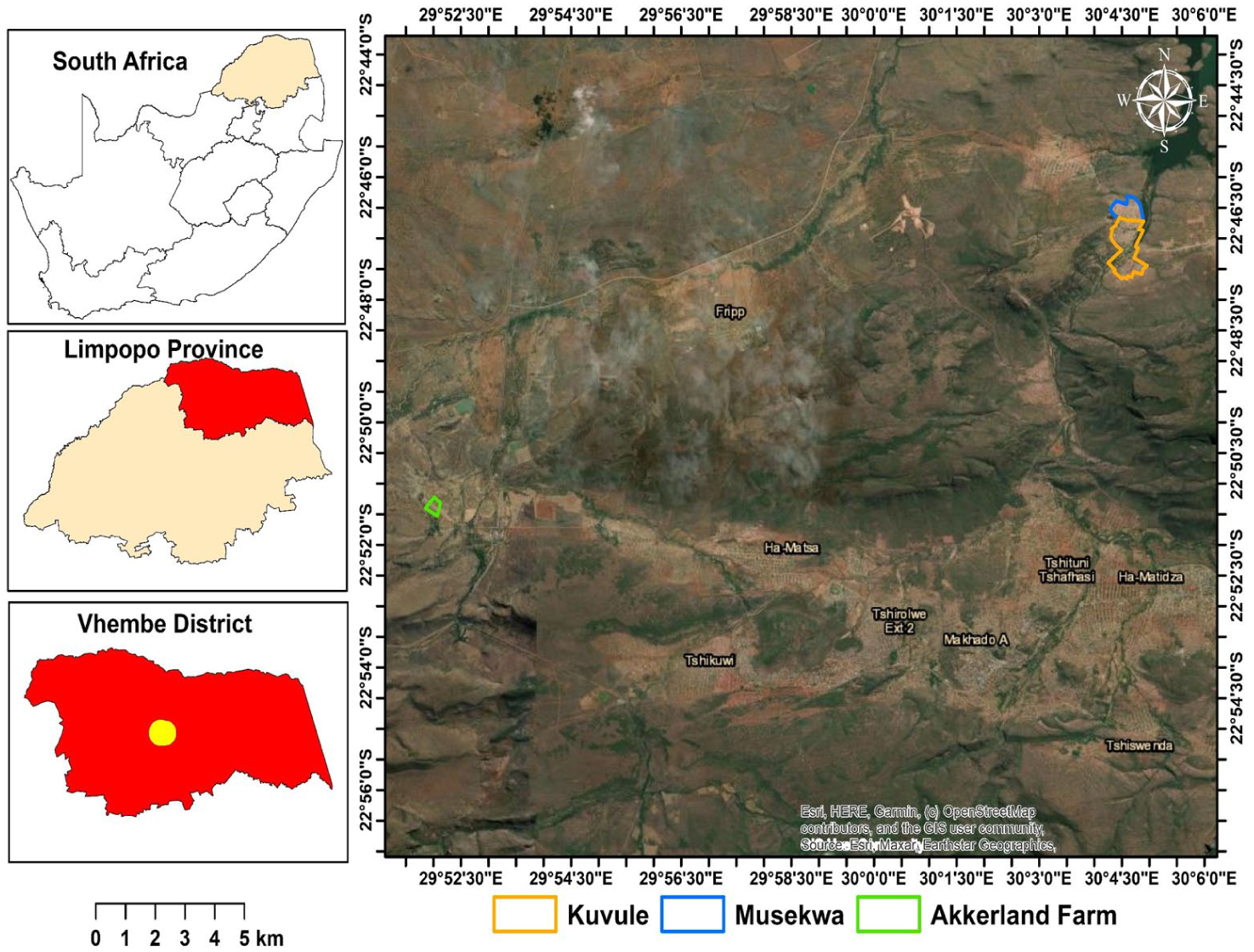
Location of the study area.
Adopting a qualitative approach in this study was a deliberate choice, as it best suited a contextualised analysis of the socio-political dynamics shaping the lived experiences of land reform claimants, from which various lessons could be learnt (Priya, 2021). In line with this approach, purposive and snowball non-probability sampling methods were employed to select land reform claimants. Merging purposive and snowball sampling improved the study’s depth, reliability and inclusivity as it captured different viewpoints of the targeted population (Palinkas et al., 2015). A purposive method enabled researchers to select experienced and knowledgeable participants who could provide rich, relevant and specific information to satisfy the research objectives (Etikan, 2016). The fundamental criterion for selection was that participants were involved in the land reform process in Musekwa and Kuvule, as claimants and directly affected by land reform disputes. Considering the study’s sensitivity, the snowball method, which relies on referrals, ensured the inclusion of land claimants who may not be formally verified but had significant lived experiences and knowledge of land claim disputes (Sharp, 2003). Referrals were endorsed by other claimants during initial interviews. Initially, 45 interviewees were identified and selected purposively through the Department of Agriculture, Rural Development and Land Reform database, and based on local community leaders’ recommendations while 12 interviewees were selected through referrals by other interviewees. In total, 57 participants were selected, including Kuvule (n = 25) and Musekwa (n = 25), traditional leaders (n = 3), CPAs (n = 1) and political organisations (n = 3).
Data were collected through individual semi-structured interviews with 57 participants. Semi-structured interviews ensured flexibility and adaptability, allowing researchers to adapt questions based on the participant responses, and enabling exploration of unexpected themes while retaining predefined research main themes (Mikuska, 2017). The interviews were conducted from October 2024 to January 2025 at claimant households, traditional palaces, political party offices and each lasted between 40 and 90 minutes. Before the interviews, the researchers reviewed existing land reform court judgement documents from the Makhado Municipality, which informed the interview guide and ethical considerations. 4 The interviews comprised both open and closed-ended questions to comprehensively answer the research question. While closed-ended questions focused on claimants’ demographic characteristics, open-ended questions focused on participants’ personal experiences with land ownership and dispossession, the land reform claim process and the nature of land disputes.
Data were manually analysed through a thematic analysis outlined by Braun and Clarke (2006). Thematic analysis was chosen because it remains prominent in health and social sciences, and it focuses on identifying and analysing key themes arising within qualitative data (Byrne, 2022). While this method is praised for its versatility, it is essential to note that it depends on the researcher’s ability to read and understand the data. Before data analysis, one researcher, a native Tshivenda speaker, transcribed and translated recorded materials from Tshivenda to English. After transcribing the interview recordings, the researchers started by reading through the transcripts several times, identifying and classifying similar expressions into themes, which were grouped and arranged in the write-up. The writing-up reflects key aspects of the participants’ experiences of land reform and disputes, supported by verbatim quotes. Themes that emerged from the study included: Communities’ exclusion and power struggles in the land reform process; economic and political manipulation over social justice realities; and inconsistencies and ineffectiveness of Land Reform Policies.
Results and discussion
Demographic profile of claimants
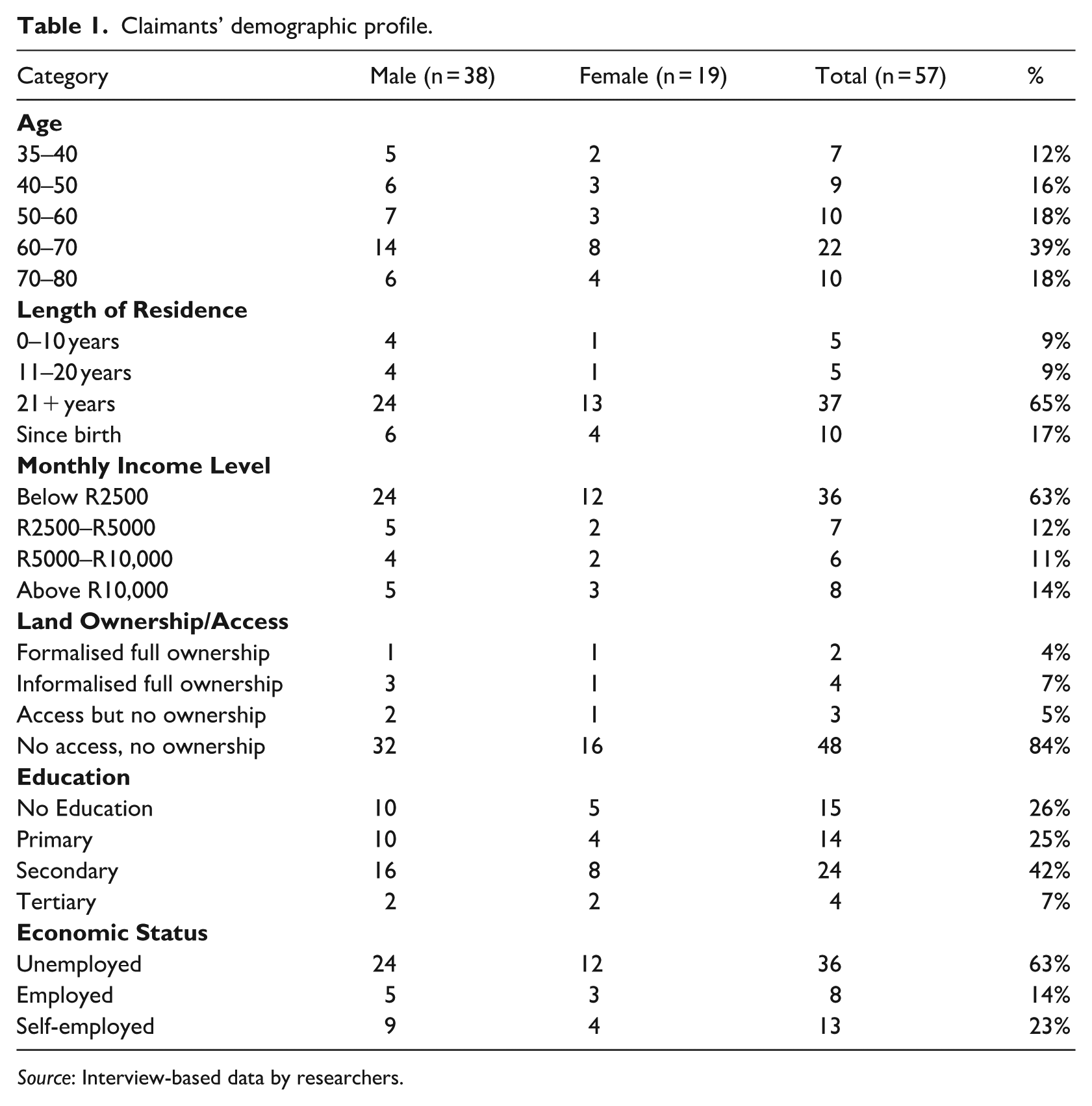
To understand the experiences of the claimants who formed part of the research sample, it was pertinent to examine their demographic profile as shown in Table 1.
Claimants’ demographic profile.
Source: Interview-based data by researchers.
The findings suggest that most of the interviewed claimants are between 60 and 70 years old and have stayed in the area for more than 21 years or since birth. These are low-income communities, as 63% of the interviewees are unemployed and earn less than R2500, particularly from government pension grants, a similar trend in the entire municipality (Makhado Local Municipality, 2025). The current poverty conditions in Musekwa and Kuvule communities may not be accidental but a direct consequence of the apartheid governance, given the communities’ location within the former Venda homeland. During apartheid, black communities in homelands were systematically denied access to productive land and economic opportunities, relegating them to impoverishment and marginalisation, which often remain difficult to escape (Fadem and O’Sullivan, 2020; Heffernan, 2022). After the end of apartheid in 1994, there were hopes that the land reform would stimulate economic independence and empowerment of black people; however, the slow progress and fragmented implementation have impeded socio-economic transformation.
Considering the age of the participants, it is not surprising that more than 50% either have a primary education or no education. This is because 60 years ago, the existence of apartheid policies such as the Group Areas Act 41 of 1950 and the Bantu Education Act 47 of 1953, limited socio-economic opportunities, such as quality education for black communities (Houston et al., 2022). These findings support previous claims that the lingering effect of these apartheid policies in post-apartheid South Africa continues to influence current socio-economic status, especially among older generations (Adonis, 2018). Moreover, despite the transition to a democratic government, there are significant disparities in education, income and employment opportunities for black communities (Saka, 2024). The current findings echo land reform challenges in the post-colonial context, in the Global South, particularly Africa, where historical dispossession, intertwined with contemporary governance failures, continues to shape Indigenous communities’ experiences. For instance, in Kenya, Botswana, Zambia, Ethiopia and Zimbabwe, land redistribution initiatives have had limited success in empowering marginalised communities because of bureaucratic inefficiencies, elite capture and insufficient institutional capacity to facilitate equitable land access (Bah et al., 2018; Bhanye et al., 2024; Holden and Ghebru, 2016; Mushinge and Mwando, 2016; Opono, 2020)
Demographic findings suggest that males may be more inclined to claim the dispossessed land compared to females, which is a recurrent theme in the land governance literature. This resonates with previous research that most land reform claimants and beneficiaries in South Africa are men, and various factors justify this (Hart et al., 2018). First, this gender disparity is strongly linked to the cultural and societal norms that govern land ownership and gender roles within black communities. Most interviewed males revealed that land ownership is a symbol of power, reverence and virtue, hence why they take a leadership role in claiming the land back for their families. This is consistent with Mashau (2015), who posits that land ownership for men is a critical asset and is crucial for asserting control within families and communities.
Second, during colonialism, it was customary for black men to protect and provide for their families, while women confined to the domestic sphere (Vahed, 2015). This enforced labour division not only undermined black family structures and the expected responsibilities, but also left women vulnerable to land dispossession and excluded them from economic decision-making, reinforcing their dependency on male family members (Levien, 2017). Therefore, drawing from post-colonial insights, the continued dominance of men in land reform suggests deep patriarchal structures, which land reform has done little to challenge and dismantle for improved gender equality. As a result, only about 30% of women own land in Sub-Saharan Africa, compared to 70% of men, and existing national and local policies have not encouraged women’s participation in land governance (Chiwuzie et al., 2023; Wamboye, 2024).
This necessitates a gender-sensitive approach to the land reform programme, to ensure women have equal rights to land and strong representation in land reform claims. This will expedite progress on the United Nations (UN) Sustainable Development Goal 5 (gender equality), particularly SDG target 5.7, which aims to give women equal rights and access to economic resources, ownership, and control over land (Martin and Smith, 2023). Therefore, given the current socio-economic status of land reform claimants in Kuvule and Musekwa, the effectiveness of land reform should be measured by its ability to reconstruct a more transformed and equitable society, which it has failed to achieve. Since South Africa is still among the countries with the highest income inequality, accelerated land reform claims should improve socio-economic and political conditions, fostering inclusivity and equity (Abdullateef, 2024). This will also contribute towards the achievement of 10 (reduced inequalities), particularly SDG target 10.2, which seeks to empower and promote the social, economic and political inclusion of all (Martin and Smith, 2023).
Communities’ exclusion and power struggles in the land reform process
The findings indicate that communities are not involved throughout the land claim process. Most interviewed claimants expressed concerns regarding how the Akkerland farm case has been handled. They accuse the government of excluding them and swaying the land restitution process for economic gain rather than restoring their ancestral land. Community members revealed that the land had not been expropriated; instead, it was sold to the Saudi Arabian prince and the Coal of Africa, and they were not involved in the transaction’s decision-making. Given that mining activities are happening on their land, the communities believe that if they were involved in the land transactions, they would have received monetary compensation from the buyers. However, they have been restricted from accessing the land. A community representative asserted that ‘Land expropriation without the community’s voice is ineffective, and we don’t rule out taking land by force since the government sold the land to the unknown Saudi Arabian prince’. 5 Community members believe that the government’s failure to expropriate land through the land reform process emphasises that this process alone is insufficient and cannot effectively restore their land. One community member questioned, ‘How can this be allowed to persist? Our ancestral land was taken by force, yet the government expects us to wait for 28 years?’. 6 Another member declared, ‘We want our land back, or we will grab it forcefully’. 7 The CPA leader elaborated, ‘As claimants, we were not consulted when the land was sold; we only heard about it like everyone else on the SABC News’. 8 One frustrated community member revealed, ‘We have lost hope in our government and see no difference between this government and the oppressively inconsiderate apartheid government’. 9
These findings align with existing research that the land reform process often lacks meaningful participation of claimants, leading to decisions that do not reflect their needs, and causing dissatisfaction (Jwilisi and Onwuegbuchulam, 2025). The exclusion of communities from land reform decisions poses a risk of retaining inferiority and disenfranchisement among the claimants, raising questions about the primary goal of the land reform programme. The fact that land claimants were not formally consulted or informed about the land transaction, which they are claiming, suggests the power struggles entrenched in the land reform process. From a post-colonial lens, the exclusion reflects a historical trend where black communities were passive recipients of policies imposed without consultation and consent (Wissink, 2019). These findings underscore a limited capacity of the land reform programme to empower black communities that were institutionally and structurally marginalised during the apartheid era (Maruma, 2024). Instead, it continues to disregard their perspectives in the name of government-led reform, retaining colonial top-down governance, and oppression of black communities. This study challenges the government to take accountability in transparent governance and inclusive decision-making to empower disempowered communities.
Economic and political manipulation over social justice realities
During the interviews, most participants claimed that economic and political influences have influenced the land reform claim of the Akkerland farm at the expense of redressing historical social injustices. Most interviewees were adamant that the South African government succumbed to global economic and political influences and decided to abandon them. Considering how these communities were left out when the land was sold, they are not convinced that the mining operations were approved for the local upliftment, but rather for the benefit of the government and the rich. One community member lamented, ‘Economic interests, political meddling, and foreign investment undermine our land claim’. 10 In echoing, one school principal cited the old saying, ‘When two elephants fight, the grass suffers’, 11 implying that they as communities suffer the consequences of global economic and political interests between governments.
The following assertions indicate that the claimed land is of socio-cultural importance to the claimants compared to its associated economic benefits: ‘This land is part of our ancestral heritage, we used to perform traditional dances and other sacred ceremonies on this land, but now, all of that will be lost’. 12 Another member echoed, ‘We have a vast history on this land, our previous chiefs and forefathers used to reside here, but we are now prevented from accessing it’. 13 Although the economic benefits associated with mining activities cannot be discounted, social justice is more important to claimants, as getting their land back will restore their identity and preserve their cultural customs. One member expanded, ‘Our family remains are still on that land, our traditions and identity were stolen by the apartheid government, and all we want is justice’. 14 One traditional healer stated, ‘Akkerland has abundant traditional medicinal plants that were historically used in the coronation of chiefs and other ritual ceremonies, sadly, all this will be destroyed by mining activities’. 15 Despite numerous protests staged by local political parties such as the International Revelation Congress Party (IRC) and Economic Freedom Fighters (EFF) demanding access rights to the land on behalf of the communities, there has been no progress.
Concerns raised by the communities suggest that the land is more than just a resource; there is an emotional and spiritual connection that shapes who they are. This is congruent with Evitasari et al. (2024), who state that Indigenous communities value land for social benefits, including ancestral heritage, cultural preservation and unifying the community. However, the fact that the land has not been returned to the claimants after 28 years exposes land reform’s frailty and vulnerability to economic and political influences. This corroborates the literature that land reform in South Africa prioritises economic gains over redressing social injustices, worsening inequalities and marginalising rural communities (Popoola et al., 2023). This study reiterates the need for a diversified and democratic approach to land reform that will incorporate social fairness and reconciliation, ensuring that land is returned to the previous owners (Abdullateef, 2024).
Impacts of the coal of Africa mining activities on local communities
The ongoing mining operations conducted by Coal of Africa on the Akkerland not only undermine the aspirations of communities to reclaim their ancestral land but also shape their daily lives and overall well-being. Subsistence agriculture is the dominant livelihood strategy in these communities; however, the optimism that land restitution can empower claimants to increase agricultural activities and restore food sovereignty has been derailed by mining activities. The weakening of subsistence agriculture as the main livelihood strategy threatens communities’ food security and keeps them trapped in poverty, reversing the country’s progress on SDG 1 (no poverty) and SDG 2 (zero hunger). This aligns with Cousins (2016), who note that the failure of land reform undermines the sustainability of livelihoods and local economic development. This has sparked disputes and divisions in these communities. While some members believe this foreign mining investment will create job opportunities for them, the majority see it as an empty promise and still prefer land restoration. One member stated, ‘Job opportunities will scant in our communities as high-skilled jobs will be offered to outsiders’. 16
The mining activities have severely impacted the spirituality, religious beliefs and cultural practices of Musekwa and Kuvule communities. The elders in these communities revealed that some parts of Akkerland are sacred sites that preserve spiritual remembrances and ancestral burial grounds. Therefore, community dispossession has dissolved communities’ religious relationship to the land, threatening the persistence of their ancestral practices. In addition to the cultural losses, community members expressed dissatisfaction about the state of Akkerland since the introduction of mining activities. They revealed that the Coal of Africa mining activities have caused wildlife displacement, destruction of forests and medicinal plants. Communities also raised concerns that upon decommissioning of mining operations, the land would be rendered ineffective, and no one would account for that.
The findings emphasise a common trend in Africa, where mining does not improve the socio-economic status of the host communities (Bryceson et al., 2023). This study echoes wider criticisms of South Africa’s neo-liberal approaches to land reform, which frequently prioritise market interests and foreign investors over the restitution of dignity, land and identity (Popoola et al., 2023). The Musekwa and Kuvule experiences underscore that when land reform fails to consider cultural protection and community autonomy, it risks becoming complicit in new forms of dispossession under the guise of development. Drawing from post-colonial insights, it can be deduced that without a fundamental shift in how land rights are recognised and enforced, the cycle of exclusion, manipulation and defiance may persist.
Inconsistencies and ineffectiveness of land reform policies
The experiences of land reform claimants in Musekwa and Kuvule indicate inconsistencies and disconnects between what policies stipulate and what is happening on the ground, affecting policy effectiveness. South Africa’s Constitution (1996) and the Land Restitution Act (1994) provide a legal basis for previously dispossessed communities to reclaim their land, but do not enforce rigid guidelines to ensure that land claims are successful. Furthermore, the Interim Protection of Informal Land Rights Act (IPILRA), Act No. 31 of 1996, was established to provide temporary protection for individuals and communities whose land rights were insecure or not protected by existing laws (Meyer, 2020). The Act identifies informal land rights, inhibiting people from being unlawfully denied their land without proper consultation and consent. Nonetheless, the Act fails to safeguard community land rights from foreign economic and political interests. The IPILRA fails to prohibit land transactions when there are ongoing land disputes or if the land is in the process of redistribution.
These inconsistencies and ineffective land reform policies have resulted in the transaction of the Akkerland without any community consultation or consent, while the communities are still waiting for their land to be returned to them. This undermines the process of Musekwa and Kuvule land claims, making it nearly impossible to further exacerbate legal disputes. One disgruntled member asked and postulated, ‘How can our land be purchased before the resolution? this is a miscarriage of justice, further delaying our ancestral land restorations’. 17
In addition, the Restitution of Land Rights Act, Act No. 22 of 1994 established the Commission on Restitution of Land Rights to expedite land claims and redress past injustices by restoring land to the dispossessed communities. In contrast, the Musekwa and Kuvule communities have waited more than 28 years, and there is still no hope that they will get their land. Instead, they have been faced with exclusion and long-standing legal and administrative difficulties. This is consonant with Cousins (2016), who argues that community participation is often emphasised in land reform policies for formality, but in reality, they support government bureaucrats and powerful individuals to control land matters, while excluding claimants. The Act also aimed to redress poverty and inequality, yet, in practice, the slow-paced restitution has exacerbated these socio-economic conditions in these communities.
The claimants’ experiences indicate that while land reform policies are well-crafted, they lack enforcement measures and implementation capability, leading to inconsistencies in practice. This confirms the wider criticism that South Africa’s land reform process, though well-framed, is complicated by weak administration and inadequacies, leading to poor implementation in rural communities (Maruma, 2024; Xaba, 2021; Yingi and Benyera, 2024). Until land reform policies are recalibrated with a more participative community role and proper enforcement, efforts will remain fruitless. When land reform’s expected outcomes are not met, the apartheid legacy will continue to trap previously disadvantaged communities into marginalisation and inferiority.
Conclusion and recommendations
This study aimed to investigate the lived experiences of land reform claimants and the land disputes that shape their daily realities in the Musekwa and Kuvule communities. The findings indicate that, despite the land claim having been submitted for the Akkerland farm more than 28 years ago, these communities have not received the land back, necessitating urgent intervention. However, the land was sold to the Coal of Africa mining company and a portion to the Saudi Arabian prince. These purchases emphasise the inconsistency in the land reform process, as most claimants view it as a betrayal and a failed state project. Consequently, there is a growing willingness among claimants to consider land occupation as a strategy of desperation and the government’s inability to fulfil its constitutional mandate.
This case study exposes the disconnect between policy and legal frameworks of land reform implementation. Although the law provides for land restitution, claimants have been excluded from critical decision-making pertaining to the disposition of their land. This exclusion resembles the legacy of apartheid and colonialism, where indigenous people were restricted from purchasing or owning the land (Seutloali, 2024). The use of a post-colonial perspective was efficacious in revealing hidden power struggles that exist in land reform, which continue to reinforce a sense of exclusion and disenfranchisement among claimants.
The delays in resolving the Akkerland claim signal bureaucratic inertia, which persists to undermine land reform legitimacy, necessitating a more comprehensive approach that will challenge colonial structures of power. With the current structure and approach, land reform fails to challenge the deeper power dynamics and socio-economic systems that perpetuate inequality. A more transformative approach is needed to dismantle neo-liberal and colonial frameworks that perpetuate exclusion. Given claimants’ demographic profiles, which reflect socio-economic inequalities, land reform initiatives should be accompanied by efforts to create education and employment opportunities for claimants. Land reform should not only address historical grievances but should also empower communities to reclaim their self-sustenance. This can be done by integrating land reform into municipal Integrated Development Plans (IDP) and Local Economic Development (LED) plans. Furthermore, considering claimants’ dissatisfaction and frustration with the government’s handling of the Akkerland farm, the government should provide two-way communication channels to engage affected communities in decision-making and policy implementation. This will improve transparency and increase government accountability in ensuring that land reform aligns with claimants’ needs.
Footnotes
Acknowledgements
The authors would like to thank all the participants who willingly and effectively provided relevant information during data collection.
Declaration of conflicting interests
The authors declared no potential conflicts of interest with respect to the research, authorship and/or publication of this article.
Funding
The authors received no financial support for the research, authorship and/or publication of this article.
Consent to participate
All participants were made aware of this declaration, and consent was obtained for their involvement.

Data availability
Data sharing not applicable to this article as no datasets were generated or analysed during the current study.