




Abstract
Land and agrarian reform in former settler colonies is an overlooked aspect of social policy, especially in the African context. This is, however, changing with the recognition that it is a policy instrument with functional equivalents to other conventional forms of social policy. Since the cataclysmic COVID-19 pandemic exposed the shortcomings of conventional social policy approaches, a renewed interest in land and agrarian reforms has emerged. Increasingly there has been a call for the decolonisation of social policy in Africa and for transformative social policy (TSP) initiatives, which privilege local needs and policy perspectives. With scholarship crystallising around possibilities of post-pandemic social policy transformation, this article explores lessons that can be learned from Zimbabwe's agrarian welfare regime in dealing with the challenges of rural poverty and inequality. Using empirical evidence gathered from the Goromonzi and Zvimba districts in Zimbabwe and the analytical lenses of the TSP framework, this article argues that land reform beneficiaries in an agrarian welfare regime have better opportunities for the enhancement of their welfare and wellbeing, as well as their productive and reproductive capacities. Arguably, the pandemic highlighted that access to land enhances the resilience of land reform beneficiaries and surrounding communities. Land access can be utilised to overcome rural poverty and inequality, which makes it critical for inclusive and sustainable growth.
Introduction
The cataclysmic COVID-19 pandemic will be remembered as being one of the greatest threats to humanity in modern history. Its rapid global spread, high prevalence, and mortality levels, led the World Health Organisation (WHO) to immediately declare COVID-19 a “Public Health Emergency of International Concern” in January 2020. Only in May 2023, following a decrease in COVID-19-related incidences, deaths, and hospital admissions was the health emergency lifted (WHO, 2023). COVID-19 management protocols, which were premised on epidemiological advice from WHO, high levels of vaccination, and population immunity, all cumulatively contributed to humanity having an upper hand over the pandemic. Despite having won the battle against COVID-19, the pandemic has a legacy and will always be remembered as representing one of the darkest periods in contemporary history, and it persists as a public health challenge. While mortality rates have fallen significantly in the past year, as of September 2023, COVID-19 accounted for 6,958,499 deaths and 770,778,396 confirmed positive cases globally (WHO, 2023).
For the African continent, while COVID-19 was largely negative, it was not as catastrophic as was initially feared (UNECA, 2020). With 9,547,425 confirmed positive cases and 175,426 deaths as of September 2023, Africa has so far reported the lowest COVID-19 statistics globally (WHO, 2023). In Zimbabwe, the subject of this article the prevalence of COVID-19 was not as serious as was initially projected, with 265,748 confirmed COVID-19 positive cases and 5,718 deaths as of September 2023 (WHO, 2023). These are among the lowest numbers in Southern Africa.
Despite Africa's low COVID-19 prevalence and mortality, the negative global economic impacts of the pandemic did not spare the region. COVID-19 shook the global economy with economic losses far greater than the 2008 global financial crises (Maiti and Locke, 2021). Its negative impact was clear in the agrarian sector, which predominates in many African countries, where negative dynamics and losses were witnessed in agricultural value chains, input supply, production activities, distribution, food and nutrition security as well as agro-based livelihoods. In Zimbabwe, emerging evidence suggests that it negatively impacted peasant livelihoods in several ways (Chipenda, 2023a, 2023b) and caused disruptions on other forms of livelihoods, including those of the informal sector. In South Africa, it disrupted the informal sector, increasing unemployment, poverty, and vulnerability (Khambule, 2022). In both rural and urban areas, this cumulatively elevated the risks of poverty, food insecurity, hunger, and malnutrition as the food and economic systems came under severe threat (Koloma and Salami, 2023; Wegerif, 2022).
While the negative impact of COVID-19 has subsided, with the world entering what can be termed a post-pandemic context, the legacy of COVID-19 and multiple crises confronting the world have created further challenges and are cumulatively contributing to a global state of fracture (UNRISD, 2023). The world, which is just recovering from the pandemic, is therefore confronted by – not only socio-economic, political, and ecological crises, but also – increasing inequalities and broken social contracts, which impede progress towards the achievement of the Sustainable Development Goals and the vision of a just and equitable world (UNRISD, 2023). The impact of the pandemic demands that scholars and policymakers rethink policymaking and look at ways to build a post-pandemic world that is responsive to pandemic-induced shocks and uncertainties. It has reignited debates about, and the desire to, develop policies that are effective in dealing with inequalities and poverty. Such policies ideally have inbuilt mechanisms to respond to exogenic shocks and stresses, while building resilience among the poor and vulnerable. In this post-pandemic period, more attention is also being paid to building sustainable agrarian futures in Africa, with attention to the role of transformative, inclusive, and egalitarian policies. Such policies have the potential to deal with the marginalisation, disenfranchisement, inequality, and inequities in power and resource allocation that were exposed during the pandemic.
This article examines the lessons rural Zimbabwe can offer regarding the land reform as a transformative social policy (TSP) in post-pandemic Africa. It asks multiple questions about the lessons that the COVID-19 pandemic revealed concerning the utility of land and agrarian reforms (in an agrarian welfare regime) in addressing rural poverty and inequality, building resilience, enhancing productive and reproductive capacities and promoting inclusive and sustainable growth. It answers these questions by undertaking an investigation grounded in a TSP approach, which emphasises the multiple and interlinked tasks of land and agrarian reform as a social policy instrument and its potential to cater for the welfare and wellbeing of beneficiaries. Central is the idea that land and agrarian reform in an agrarian welfare regime, and a post-pandemic context, present an opportunity for the enhancement of the productive and reproductive capacities of beneficiaries. The article conceptualises Zimbabwe as an agrarian welfare regime given that most of its socio-economic activities and social protection thrust are crystallised around the agronomic sector.
In Zimbabwe, the state formulated a COVID-19 social policy response built around its existing social protection architecture, aimed at minimising the pandemic negative impact (Chipenda and Tom, 2021). It was especially cognisant of the negative implications of the pandemic on the agrarian sector, offering the sector significant attention and support. Emerging evidence suggests that COVID-19 affected the agrarian sector in different ways. In areas where farmers had been resettled following the fast-track land reform programme (FTLRP), evidence suggests that, despite challenges, rural households managed to utilise human, financial, social, natural, and physical capital to deal with the risks and exogenic shocks directly linked to the pandemic. Beneficiaries of land reform acted with agency and resilience, adapting to the challenging and unpredictable environment brought on by the pandemic (Chipenda, 2023a, 2023b).
The article's findings help fill a lacuna in our understanding of the role of land and agrarian reform in dealing with the challenges of rural poverty and inequality in a post-pandemic context. It advances the argument that land, and agrarian reforms are social policy instruments and have functional equivalents as other social policy instruments. Using the TSP framework, the article explores how the redistribution, production, reproduction, and protection tasks of land reform as a social policy instrument help overcome the inequalities exposed during the pandemic. The next section provides a brief literature review of the land and agrarian reform context in Zimbabwe and the idea of an agrarian welfare regime. This is followed by a discussion of the TSP conceptual framing followed by research sites and methods. The study findings intertwined with a discussion are then presented with a reflection and conclusion wrapping up the article.
Zimbabwe's Agrarian and Contemporary Political Context: A Review of the Literature
It is now a little over two decades since Zimbabwe embarked on a radical, unprecedented, divisive, and controversial FTLRP. Although it was more radical than land and agrarian reforms witnessed in other countries in Africa, Asia, and Latin America, it had similar objectives and goals as land reforms in Japan, South Korea, Taiwan, and China. In these counties, land and agrarian reform acted as a redistributive tool aimed at equalising incomes and wealth with concomitant improvements in the welfare of smallholder beneficiaries (Haki Network, 2013: 2; Iscan, 2017: 4; Jeon and Kim, 2000). The FTLRP also differed from the previously unsuccessful first and second phases of Zimbabwean land reform programmes undertaken between 1980 and 1998. These land reform programmes had been premised on a willing-buyer and willing-seller method and had several limitations. The FTLRP sought to overcome these by engaging in massive state-led expropriation of agricultural land without compensation, 1 making it become one of the biggest agrarian transformations in a single country in modern African history. Polemical and divisive debates on the programme have persisted to date (Bhatasara and Helliker, 2018; Marewo, 2019; Moyo and Chambati, 2013).
When compared with land reform initiatives in other countries, particularly former settler colonies in sub-Saharan Africa, the FTLRP differed in scope, character, impact, and outcomes (Hellicker, 2021). The Zimbabwean government engaged in broad-based land reform to reverse the legacy of colonial accumulation by dispossession, which had alienated Africans from land ownership and access to resources. The colonial state had long legislated unequal agrarian relations and a skewed tenure regime, which alienated the indigenes from governance, sidelined them from development initiatives, and effectively cut them off from the land, which was an important source of livelihoods and prosperity (Tom and Banda, 2023: 77). To redress historical land imbalances and empower indigenous people with key economic resources. The FTLRP transferred land from the largely white-owned large-scale commercial farming sector (LSCF) to mainly black people in the newly created A1 farming sector and the A2 farming sector. This effectively reconfigured patterns of landownership as 5.8 million hectares of land were acquired by 2011 (Moyo, 2011a). This impacted social differentiation and contemporary class formation in Zimbabwe. The FTLRP thus resulted in a radical transformation of the agrarian and land tenure structure with a transition from a bi-modal agrarian to a tripartite agrarian structure, with important implications for landholding patterns, land use, markets, social organisation, and agrarian relations (Moyo, 2011a, 2013; Scoones and Murimbarimba, 2022: 15).
Zimbabwe's unexpected political transition in 2017 has reshaped the country's politics and economic policies including policies in the agricultural sector. A cohort of young emerging scholars are re-examining the FTLRP from diverse ideological and epistemological standpoints, asking not only how the FTLRP reshaped the countryside and agrarian legacies (Moyo, 2011a) but also how the political dynamics of the country's political transitions impact its agrarian present and future. In 2017, former President Robert Mugabe, who had been the country's leader since independence in 1980, was deposed of in a coup organised by the military and his fellow comrades in the ruling Zimbabwe African National Union – Patriotic Front Party (ZANU PF). Mugabe was replaced by his long-time deputy and ally Emmerson Mnangagwa. The new administration promised economic revival, poverty eradication, and reduced corruption, all of which crippled the state and society. It also committed to a reconciliatory local and international re-engagement agenda and embarked on what many saw as a neo-liberal policy agenda (Chipenda, 2022a; Mkodzongi, 2022). The policy trajectory of the new administration from the onset was premised on rebranding. It presented itself as a “new dispensation” and sought a clear break from the redistributive and indigenisation policies of the Mugabe era, leaving ZANU PF in an ideological and identity crisis (Mkodzongi, 2022: 3). Despite this effort, the new administration has overseen unprecedented elite resource accumulation by an unrestrained “comprador bourgeoisie” to the detriment of the general population whose livelihoods and wellbeing have worsened (Mkodzongi, 2022). The neo-liberal policy trajectory of the new administration and its capitalist orientation have heavily impacted the agricultural sector, a major pillar of the Zimbabwe economy (GoZ, 2020). Current land grabbing, resource dispossession, and elite accumulation differ from the previous administration whose controversial policies and actions were usually driven by a national development agenda (Mkodzongi, 2022). The current political dynamics necessitate renewed interest in Zimbabwe's agrarian trajectories in a neo-liberal policy context.
At the same time, scholarship on the FTLRP, specifically, has shifted in recent years away from earlier history, controversies, and debates to considerations of social policy, with scholars asking how land reform can be leveraged as a social policy instrument (Chipenda, 2022b; Tekwa, 2023; Tekwa and Adesina, 2018; Tom and Banda, 2023). This article adds to this literature, using the COVID-19 context to examine the FTLRP's impact on social welfare while considering Zimbabwe's political transition and new macro-economic policy imperatives.
The Zimbabwe State and Agrarian Welfare Dynamics
Increasingly, Africa's predominantly agrarian countries, like Mozambique, Zambia, Malawi, and Tanzania, see agriculture as a means of addressing precarious livelihoods and poverty. As such, governments are adopting “agrarian welfare regimes,” using agro-based programmes, like farm input support schemes and cash transfers, to address rural poverty, and inequality (Chinyoka, 2023: 286). There is significant debate about the role of the state and social policy in reducing poverty and vulnerability in Zimbabwe's largely agro-based economy (see Chinyoka, 2023; Shonhe and Chinyoka, 2023; Tekwa, 2023; Tom and Banda, 2023). The distribution of agricultural inputs and food aid have been subject to patronage, cronyism, and capture. Scholars have frequently noted the inadequacy of state support for farmers in all of Zimbabwe's tenure regimes (see Chiweshe, 2011; Murisa, 2009; Ncube, 2018) and have decried elite capture of the land reform process and subsequent agrarian support initiatives (Zamchiya, 2023). While valid, these arguments do not negate the primarily welfare-oriented purposes of the Zimbabwe government's agricultural projects, particularly land and agrarian reform. I contend that these projects, undertaken within the ambits of the FTLRP, qualify Zimbabwe as having an agrarian welfare regime. Moyo (2011a, 2011b) for example outlines how, in the 2000s, following the FTLRP, the state mounted several support schemes in the form of mechanisation, input support, and subsidies. In addition, the state engaged in quasi-fiscal activities to fund and support agriculture. Although some of these often benefitted elite and medium-scale farmers disproportionately, they represent an underlying agrarian welfare objective that is recurrent in post-colonial Zimbabwe's agrarian trajectory.
As noted by Chinyoka (2023), Zimbabwe's agrarian trajectories clearly demonstrate evidence of a welfare regime. Although Zimbabwe does not fit into the social democratic, liberal, or conservative welfare regime typology proposed by Esping-Andersen (1990), it nonetheless fits with the regime proposed by Seekings (2005, 2012). Seekings, paying closer attention to the Global South, proposes a welfare regime typology with agrarian, inegalitarian corporatist, and redistributive regimes. Agrarian regimes are distinguished by the private provision of welfare and dependence on land and kin. In this regime, the role of the family is central, that of the state is varied, and employment is marginal. The system depends, however, on supportive state policies that facilitate access to land and kin. Inegalitarian corporatist regimes are defined by achieving income security through risk-pooling and saving. Redistributive regimes are defined by the recognition of citizens’ rights to income security through non-contributory social assistance. In this regime, the role of the family is marginal and so is employment, with the state providing universal support.
I contend that Zimbabwe can be largely classified as an agrarian welfare regime based on these criteria. Zimbabwean rural society and its largely agrarian economy have strong kinship (familial) ties, communal systems of social provision, and an agrarian regime favouring access to land and agri-food value chains. It also has social protection mechanisms that focus on the deserving poor with categories of targeted non-contributory social assistance, thus making it somewhat redistributive, but it does not appear that cash transfers enjoy support under the ZANU PF-led government, thus making it unlikely that they will become the sole basis of the country's welfare regime. This argument comes in a background where evidence of the agrarian welfare regime in Zimbabwe is numerous. Post-independence initiatives like drought relief, provision of agricultural inputs to peasants, land reform, mechanisation support, and financial assistance targeted the rural poor with the underlying objective to provide social protection to this vulnerable demographic group (Chinyoka, 2023; Chipenda and Tom, 2021; Moyo, 2013). Only under the government of national unity (2009–2013) was there a temporary interruption to this social protection initiative as the government prioritised cash transfers as part of the social protection agenda and ZANU PF continued with its agro-based social assistance initiatives as it provided inputs to rural peasants (Chinyoka, 2023; Chinyoka and Seekings, 2016). To date, and despite the neo-liberal leanings of the post-Mugabe government, the government prioritises agro-based social assistance as a tool to reduce vulnerability and eradicate rural poverty, in part because the beneficiaries of agro-based social assistance are an important electoral constituency for ZANU PF.
In recent years, further evidence of Zimbabwe having an agrarian welfare regime can be found in agrarian policy trajectories that increasingly emphasise social protection as well as production objectives. In an interview, the then Permanent Secretary in the Ministry of Lands, Agriculture, Fisheries, Water, Climate and Rural Development (MoLAFWCRD), John Basera, had pointed out that the ministry's goal is to transition farmers from subsistence to more lucrative commercial farming. The vision of the MoLAFWCRD is to transform 360,000 A1 farmers and 20,000 A2 farmers into “serious businessmen and women” (Mataire, 2023). The government has also continued its agrarian welfare and redistributive trajectory through its Agriculture Productive Social Protection Scheme and several initiatives, like the Rural Development Initiative, which includes interventions targeting mainly the rural poor and vulnerable. These include prominent interventions like the Climate Proofed Presidential Inputs Scheme (popularly known as the Pfumvudza/Intwasa), the Zunde RaMambo/ISiphala seNkosi Programme Input Packages, and the numerous Presidential schemes targeting goats, cattle, poultry, cotton, fish, horticulture among others. In the 2022–2023 season, the Pfumvudza/Intwasa programme provided 1.6 million rural households with seed, fertiliser, pesticides, and extension support (UN Department of Economic and Social Affairs, n.d.). Similarly, the Presidential Poultry Scheme aims to support three million beneficiaries with ten (four- to six-week-old) chicks to improve household nutrition and income security (Manomano, 2023). The Presidential Goat Pass-on Scheme had seen support in the form of goats being provided to 4,400 (as of April 2023) vulnerable households. The scheme aims to reach 600,000 vulnerable households and has the underlying objective of promoting nutrition and income security (Manguwo, 2023). The Presidential Tick Grease was said to have supported one million cattle-owning households with between one and three kilogrammes of tick grease. The Presidential Cotton Scheme aims to support 520 000 beneficiaries with a standard input packageand of seed, fertiiliser, and ammonium nitrate (Manomano, 2022). The Presidential Rural Development Programme aims to drill a borehole in each of Zimbabwe's 35,000 villages and to establish commercially integrated one-hectare farm business hubs in each village with village nutrition and income garden, a fishpond, village poultry run, an orchard, and a co-operative of fifty women and youth-led households (Mataire, 2023).
The examples provided above show that to a large extent Zimbabwe seeks to improve social protection via an agrarian pathway rather than direct state provision of social services, as per the agrarian welfare model proposed by Seekings. The government aims for inclusive agricultural transformation that can achieve food security, import substitution, diversified exports, enhanced value addition, employment creation, improved incomes, and better standards of living. The government's initiatives are crystalised around economic redistribution, enhanced productive potentials, protection from the vagaries of the market and changing life circumstances, and reconciliation of the burden of reproduction with other social tasks (Adesina, 2015; Mkandawire, 2011). At the heart of these interventions is a drive towards structural transformation of the economy, social institutions, and social relations. In other words, these policy and practical interventions from an agrarian welfare perspective reflect a TSP agenda with land and agrarian reform at its core.
The TSP Conceptual Framework
This article assesses FTLRP using the TSP framework to assess the potential of land and agrarian reform in providing better opportunities and enhancing the welfare, wellbeing, and productive and reproductive capacities of land reform beneficiaries, their households, and immediate surrounding communities. The TSP approach is a product of the flagship United Nations Research Institute for Social Development (UNRISD) research programme, Social Policy in a Development Context (2000–2005), which lists land and agrarian reform as a social policy instrument with functional equivalents to other social policy instruments like health, education, pensions, social insurance, labour market reforms, child, and old age care. As Adesina (2015: 113) argues, land and agrarian reform can be viewed as a social policy instrument and social policy frameworks can be used to evaluate the outcomes of redistributive land reform in enhancing human welfare and wellbeing. Adesina (2015: 113) argues that: While land reform may be inspired by efforts to redress a historical legacy of land expropriation and colonialism, with the appropriate agrarian support, it can simultaneously address the different tasks of social policy. Inherently a redistributive process, land reform enhances the productive capacity of rural beneficiaries. In doing so, land reform (again, with appropriate agrarian support, upstream and downstream) addresses the protection task of social policy, ex-ante by smoothing household consumption and enhancing accumulation.
Scholars of TSP contend that many African social policies have primarily been underpinned by a neo-liberal philosophy that emphasises targeting of the “deserving poor” via safety nets, leading to a social policy that is restricted to a myopic anti-poverty agenda. These social policies fail to address the structural causes of inequality, marginalisation, and poverty and consequently do not lead to developmental transformation and broader well-being (Tekwa, 2023; Tom and Banda, 2023). Figure 1 summarises the TSP concept. It highlights the connecting normative goals, multiple tasks (functions), policy instruments (of which land and agrarian reform are critical for this article), and development outcomes.
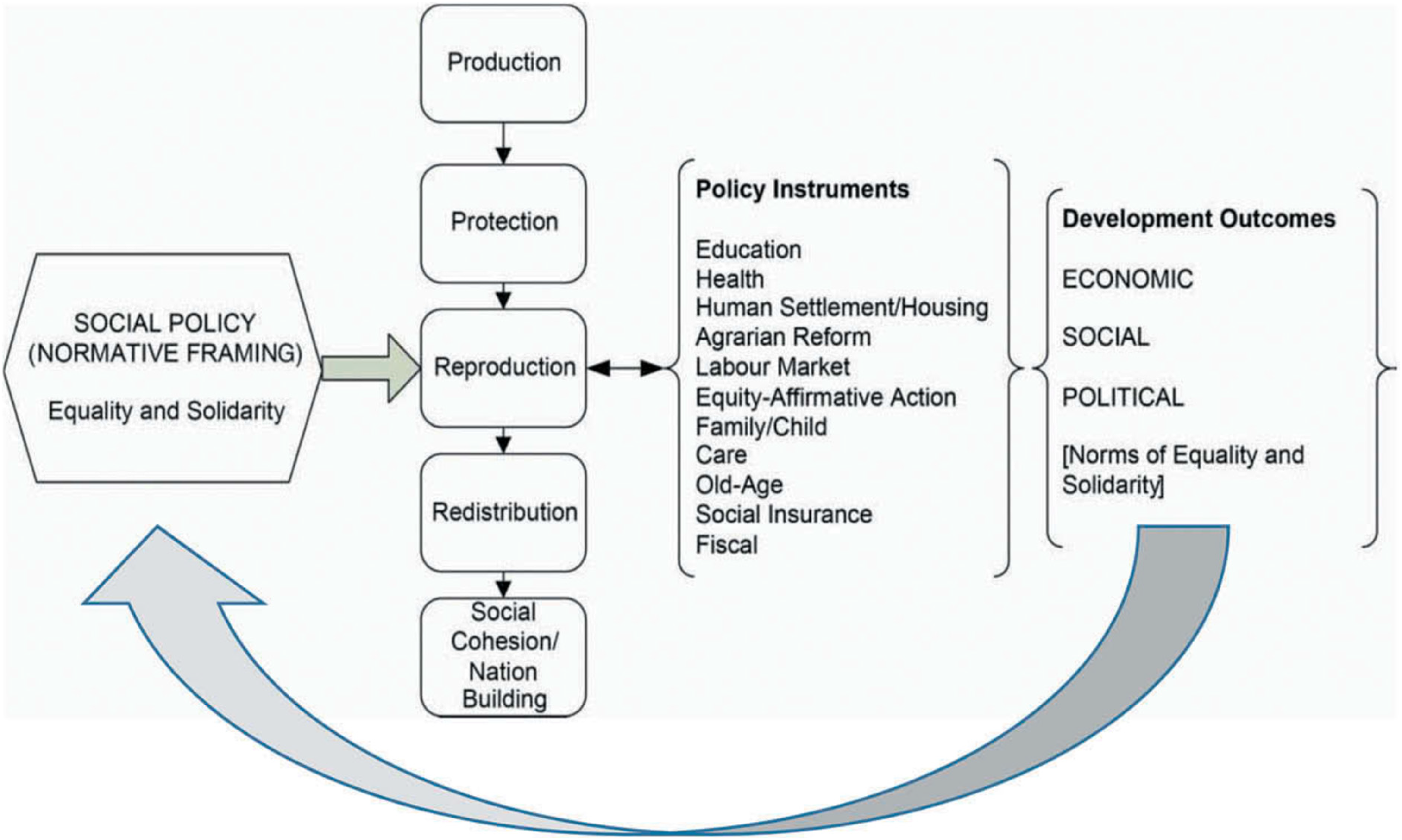
Transformative Social Policy: Norms, Functions, Instruments and Outcomes.
Figure 1 demonstrates how social policy and economic policy are intertwined in TSP, a feature which earlier regimes of social policy are seen as having lost (see Adesina, 2009). It presents the diversity of social policy instruments are available to policymakers for the attainment of multiple progressive social policy objectives. These outcomes can be seen feeding back to the framing, allowing reformulation and new weighting of the social functions over time. Of note is that social policy functions are not mutually exclusive, and there are interlinkages. The TSP approach emphasises the centrality of a better society for all, with social solidarity and equity as shared goals and the active participation of the hitherto disadvantaged groups. As can be seen in Figure 1, land and agrarian reform constitute an important social policy instrument, with redistribution, production, social protection, reproduction, and social cohesion outcomes.
Research Sites and Method
To assess the impact of land and agrarian reform as a form of social policy, this article examines two districts in rural Zimbabwe, Goromonzi and Zvimba, located in the Mashonaland East and Mashonaland West Provinces respectively in Zimbabwe, in agro-ecological region II. Both are suitable for intensive crop production, as well as beef and dairy production. Both experience high annual average rainfall and have diverse soil types. Consequently, they contribute significantly to the country's agricultural production and food security (Chipenda and Tom, 2022: 187). The study target was 200 households comprising 100 from the A1 (small-scale) tenure regime and 100 from the A2 (medium-scale) regime. The study employed a predominately interpretive research paradigm, a mixed methods research approach, and a random probability sampling design. The selection of respondents involved utilising the district and ward registers of the MoLAFWRD.
The main data source was a survey questionnaire, consisting of a set of standardised questions with a fixed scheme with exact wording (Cheung, 2014). The survey was administered to a cross-section of participants whose views and lived experiences provide pertinent and in-depth understanding of agrarian dynamics in the resettlement areas created by the FTLRP. It provided in-depth information that included resettled beneficiaries’ profiles as well as household demographics, agricultural production activities undertaken, asset ownership, farm investment, sources of agricultural finance, income generation, access to agricultural inputs and irrigation facilities, agricultural labour dynamics, land tenure issues, social organisation in the resettlement areas, agricultural extension issues, and household food security and nutrition. In utilising the survey questionnaire, the researcher was cognisant of its limitations, which include inflexibility, lack of depth due to question standardisation (which creates limitations), sampling and non-response errors, limitations in scope and depth, limitations in capturing lived experiences and views, and challenges in respondent motivation, willingness, and availability (Cheung, 2014). These limitations make the structured questionnaire a challenge in social science research and in particular this study, which focused on human thought, behaviour, and motivation. Nonetheless, inspiration for using this data collection method was drawn from the pioneering work of the agrarian political economist, Sam Moyo, who wrote extensively of land issues in Zimbabwe and utilised the survey questionnaire in most of his work (Scoones, 2016: 228). Questionnaires’ advantages include their capacity to gather large amounts of data at low cost, convenience, inclusiveness, capacity to gather data which would be difficult through other means, and the reduction of observer subjectivity. The structured survey questionnaire was thus considered suitable despite its deficiencies. The survey questionnaire was complemented by observations, interviews, and the use of secondary data sources.
Findings
The Redistributive Outcomes of Zimbabwean Land Reform
The TSP framework emphasises the redistributive task of land and agrarian reform as a social policy instrument. Land and agrarian reforms are considered as a pathway to achieve redistributive outcomes (Tom and Banda, 2023). The redistributive aspect does not function in isolation and is not mutually exclusive from other social policy functions. Redistribution can lead to production, social protection, and then social cohesion with the reverse also being true in a symbiotic relationship. To better understand the redistribution outcomes the study looked at the year in which respondents were resettled on the farms. Figure 2 summarises the years in which land reform beneficiaries were resettled on the land in both Zvimba and Goromonzi. It shows that most beneficiaries were resettled in 2002 (57.28 per cent) and 2003 (32 per cent) at the height of resettlement during the FTLRP. Of note is that in both districts, since 2012 some beneficiaries have been allocated land up until 2019 in the Zvimba A1 sector. The tenure regime with the oldest land allocations was the Goromonzi A2 sector where the last allocations in the study were made to eight (16 per cent) beneficiaries in 2004.
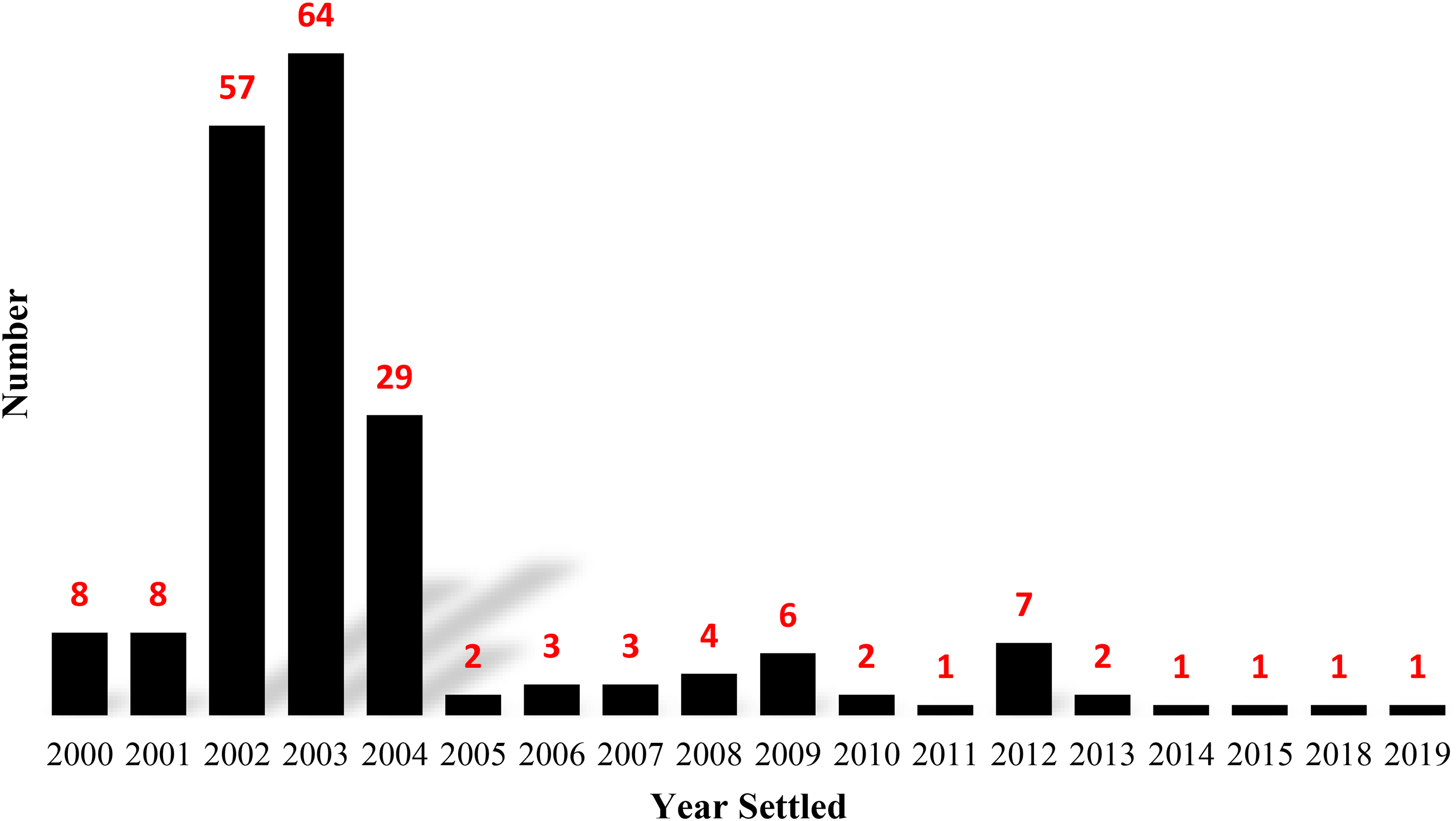
Year of Land Allocation (N = 200).
The findings summarised in Figure 2 highlight, to some extent, the nature and pattern of land redistribution since the early 2000s. Most importantly, the findings show that beneficiaries have been on the land for over two decades and have not been evicted, as was previously feared. Moreover, most of them reported that they were the original beneficiaries of the land. To some extent, the length of tenure suggests tenure security in these two districts, although in some context's tenure insecurity has been a major challenge. The findings show that for two decades now, land beneficiaries have had access to land as a productive resource.
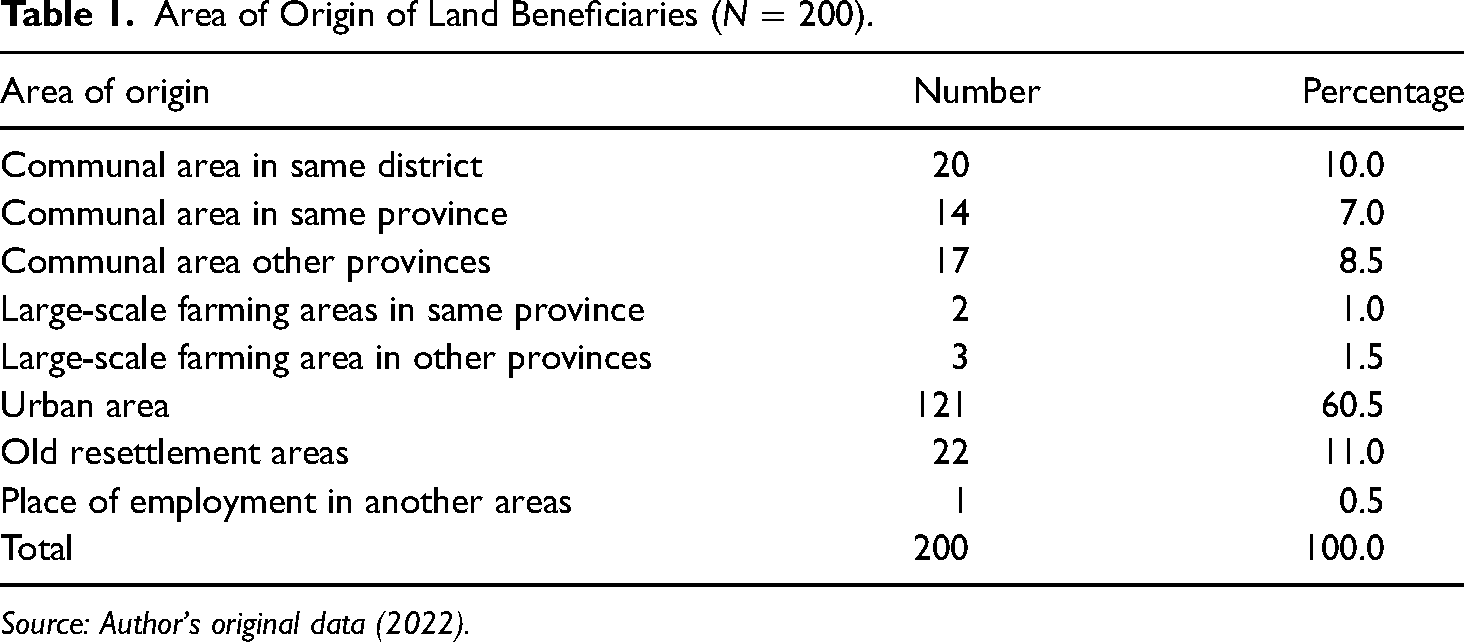
In addition to the year of settlement, beneficiaries’ origins are key, as it sheds light on the redistributive dimensions of the FTLRP. The data show the diverse backgrounds of beneficiaries which runs counter to the neo-patrimonial narrative that the FTLRP mainly benefitted the political elite and the cronies of the late President Robert Mugabe. By contrast, my work supports the counter, evidence-based argument that – although a section of the political and business elite did benefit – the programme also benefitted persons of various backgrounds (Chipenda, 2019, 2022b). The findings from both districts are summarised in Table 1, which highlights the redistributive dimensions of the FTLRP and the provision of land to persons of diverse geographical backgrounds. This diversity of beneficiaries is an important dimension in answering the question on how the FTLRP has enhanced the productive capacities of beneficiaries and by extension it also highlights the importance of land and agrarian reform in alleviating rural poverty and inequality.
Area of Origin of Land Beneficiaries (N = 200).
Source: Author's original data (2022).
Table 1 shows that a large proportion (60.5 per cent) of beneficiaries in both districts originated from urban areas, followed by the land poor communal areas in the same district as well as other districts and provinces (25.5 per cent). The A2 sector had many beneficiaries who originated from urban areas. Forty-seven (94 per cent) of Goromonzi A2 beneficiaries indicated having originated from urban areas. The dominance of urbanites in this sector is attributable to its design and allocation processes whereby applicants had to demonstrate that they had the capital, experience, and a business plan before they could be allocated land (Shonhe et al., 2020). The A1 model, by contrast, was driven by local actors who made allocations primarily to local people mostly from communal areas. These findings provide insight on the area of origin of land beneficiaries and the redistributive character of the FTLRP. Importantly, from a TSP perspective, we see that land redistribution dynamics and the FTLRP benefitted persons from diverse social, geographic, and economic backgrounds. This provides us with a foundation for subsequent discussions in answering the research question on how access to land has enhanced the productive and reproductive capacities of beneficiaries.
Land Size, Household Size, and Land Utilisation
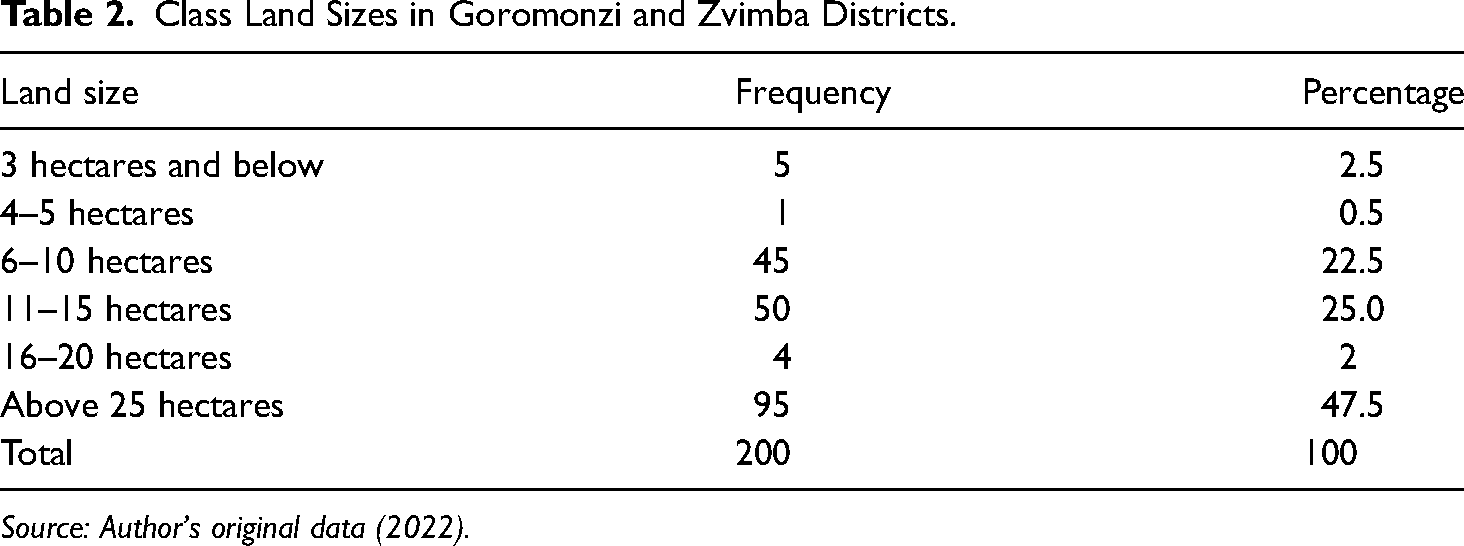
Having established the year of land allocation and origins of land beneficiaries, the study was interested in understanding land sizes, land utilisation, and household sizes. This is important because these further impact on the welfare dynamics of land and agrarian reform, as they affect agricultural activities. Table 2 summarises landholding patterns.
Class Land Sizes in Goromonzi and Zvimba Districts.
Source: Author's original data (2022).
The land sizes in the table show that the FTLRP significantly increased the average landholding sizes of beneficiaries. If one compares them to the communal areas, it can be noted that the landholdings in the resettlement areas are significantly higher. In the Goromonzi communal areas for example, they range between 2 and 5 hectares depending on area and in the communal areas of Chivi (2.1 hectares), Gutu West (1.6 hectares), Gutu North (1.4 hectares), and Mwenezi (6.5 hectares) (Scoones, 2019). The landholdings in fast-track areas point to the redistributive nature of the FTLRP, which sought to expand the landholdings of the peasantry and, thus, their potential to undertake agricultural production activities that would help them accumulate resources. Thereby, inequalities in wealth and income distribution, as well as in opportunities, are eradicated.
In addition to the landholding sizes highlighted above, it is worth noting that the minimum land size in the study areas was 3 hectares, which was sufficient to support the family. This was found mostly in the Zvimba A1 areas. Findings from the study suggest that available land was sufficient, and beneficiaries reported that they were managing to support 929 household members. The highest per capita land sizes reported across the two tenure regimes was 1.5 hectares with sixteen (8 per cent) households, 3.1 hectares with fourteen (7 per cent) households, 3.8 hectares with thirteen (6.5 per cent) households, 1.2 hectares with thirteen (6.5 per cent) households, 2 hectares with ten (5 per cent) households, and 5.9 hectares with nine (4.5 per cent) households. The highest per capita land size was 25 hectares which had six (3 per cent) households. The largest land size owned by a single individual farmer was 297.8 hectares in the Zvimba A2 area. Overall, however, the per capita land size was critical to providing an overview of the redistributive nature of the FTLRP. The average land available to individual household members was said to be sufficient to provide for the needs of the households. This is an indication of resource and opportunity access which has arisen due to the FTLRP.
Having established land and household size, the study was interested in looking at current landholdings versus land utilisation patterns with a focus on cropped areas in 2019, 2020, and 2021. The total land size allocated to beneficiaries in both study sites and the total cropped area from 2019 to 2022 is summarised in Figure 3.
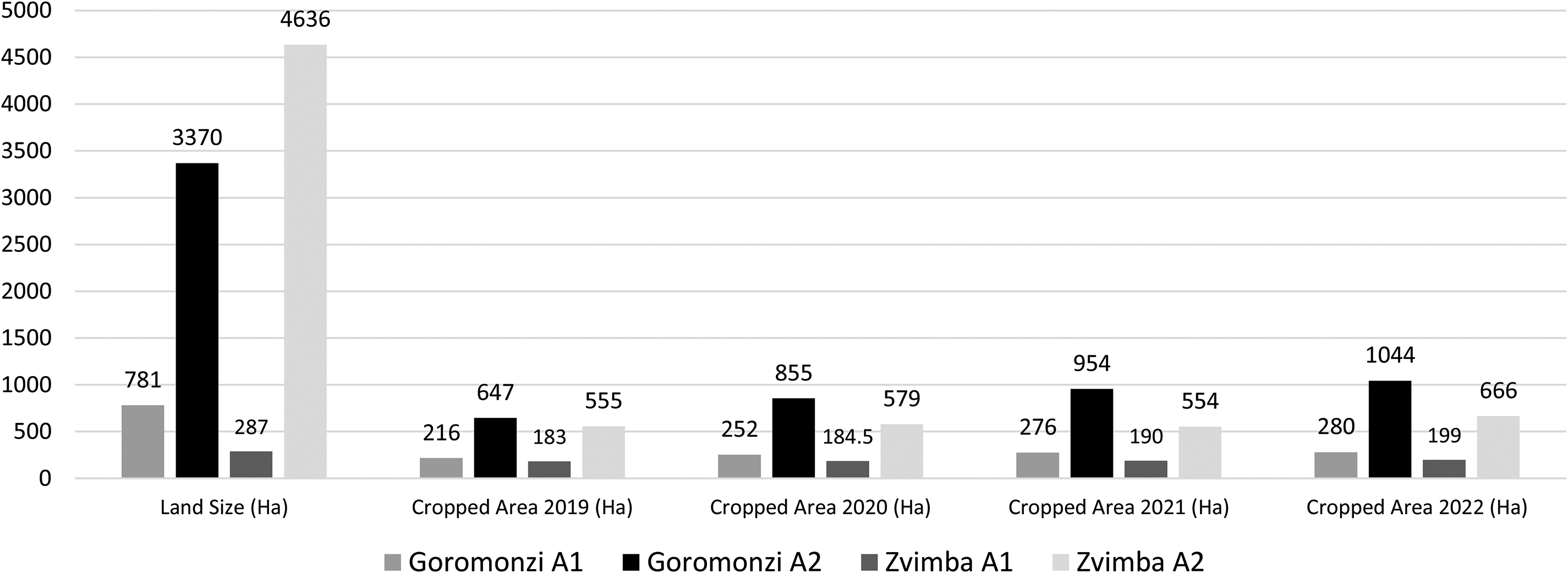
Land Size and Cropped Area (N = 200).
The major highlights of Figure 3 are that cumulatively landholding in the A2 tenure regime stands at 8,006 hectares while for the A1 sector, it is 1,068 hectares. In other words, the FTLRP compulsorily acquired and redistributed a substantial amount of land in the area. Statistics on land use for crops between 2019 and 2022 in Figure 3 indicates, however, land utilisation remains low – even when one considers that some of the land is utilised for livestock production, and some is reserved for homesteads. Such underutilisation is a challenge of the FTLRP, highlighted by Binswanger-Mkhize and Moyo (2012) and Moyo (2013). Yet, across the two districts, we find land use for crops varies. Land utilisation in the Goromonzi A1 sector has increased from low levels. In 2019, it was 27.6 per cent, rising to 32.2 per cent in 2020, 35.3 per cent in 2021 and 35.8 per cent in 2022. In contrast, the Zvimba A1 sector – significantly smaller than Goromonzi at 287 hectares – has higher levels of cropped areas. In 2019, the cropped area was 63.7 per cent dropping to 62.5 per cent in 2020. In 2021, it recovered and rose to 66.2 per cent and in 2022 it was 69.3 per cent. In the A2 sector, in Goromonzi, land utilisation was 19.1 per cent and it rose to 25.3 per cent in 2020. In 2021 it dropped to 23.3 per cent before rising to 30.9 per cent in 2022. The Zvimba A2 sector had the largest land size at 4,636 hectares and its total cropped area was very low. In 2019 it was 11.9 per cent, rising to 12.4 per cent in 2020, then dropping to 11.9 per cent in 2021 and recovering to 14.3 per cent in 2022. In part, these percentage differences are a function of the relatively small hectarage available in Zvimba's A1 sector, but the low levels of cropped area in other areas, nonetheless, put into perspective some important issues worth considering in investigating the utility of land reform in enhancing productive capacities and reducing inequalities. From the evidence presented, in this section and in the following section on production dynamics, we see that land utilisation and total cropped area is no longer at a subsistence level. There is production for surplus and discernible agricultural commercialisation pathways (see Chambati, 2022; Marewo, 2023; Moyo et al., 2009; Shonhe et al., 2022). Nonetheless, significant room for improvement remains. From a TSP perspective, land reform in Zimbabwe has had discernible redistributive outcomes and appears to be starting to favour production. It has availed a productive resource – the land – to beneficiaries and by extension their households. Ideally, this land can be an instrument for building resilience, can enhance the productive capacities of those who own it, and can be an instrument for inclusive and sustainable growth. In the next section, I focus on practical examples of the productive capacities of the FTLRP beneficiaries to assess whether such improvements are occurring, and whether Zimbabwe's land and agrarian reform appears to be alleviating rural poverty and inequality while building resilience.
Agricultural Production
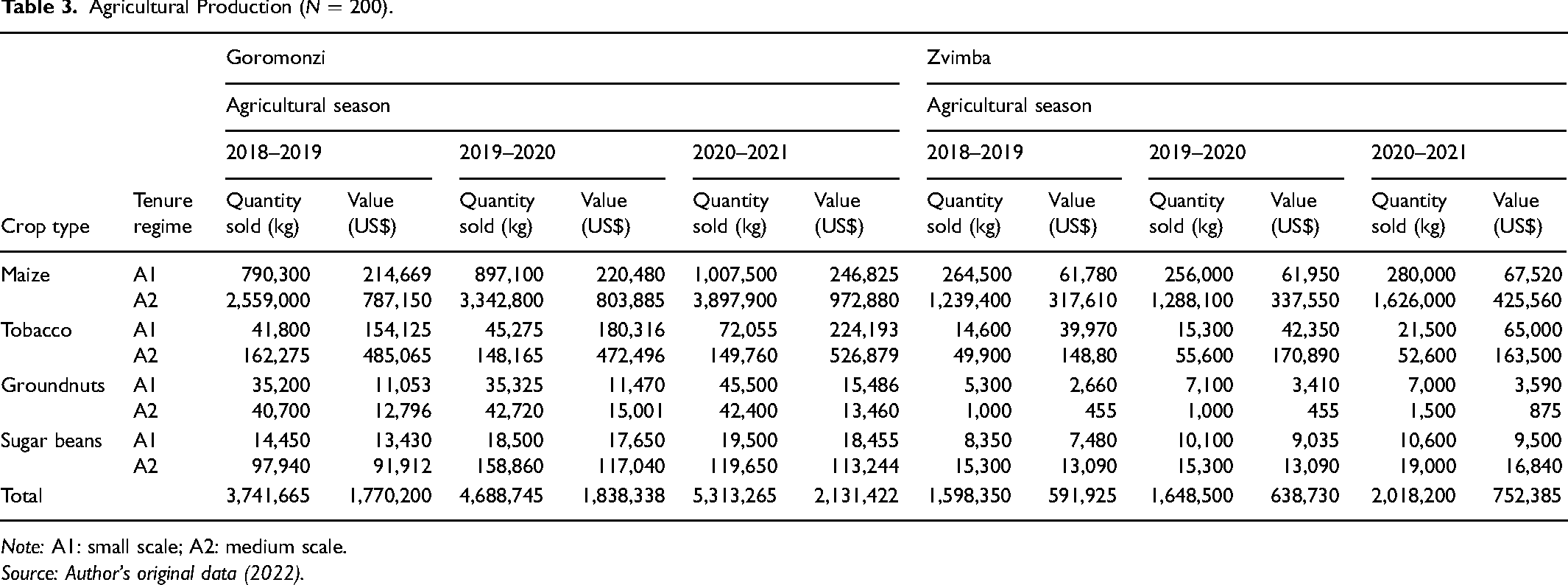
When we look at land reform from a TSP perspective, it is theorised to facilitate household consumption, generate income, and enhance accumulation via production, among other tasks (Adesina, 2015). In both districts, beneficiaries are undertaking agricultural production activities and producing a significant number of food and cash crops, including maize, tobacco, groundnuts, and sugar beans. There has been a steady increase in the production of these crops and other agricultural activities over the past three seasons from 2018 to 2021. This agricultural production was further resulting in reasonable income. Table 3 summarises the findings.
Agricultural Production (N = 200).
Note: A1: small scale; A2: medium scale.
Source: Author's original data (2022).
Table 3 demonstrates notable increases in production over three seasons with high production levels being witnessed in Goromonzi in both tenure regimes compared to Zvimba. For the four crops, in Goromonzi between the 2018–2019 and 2020–2021 season, agricultural output witnessed an increase of 42 per cent, which translated to an income increase of 20 per cent. The engagement of land reform beneficiaries in agricultural production activities has thus resulted in income generation. In Zvimba, agricultural output in the same reporting period increased by 26 per cent, which increased income by 27 per cent, suggesting output increases had an even greater impact on income in the district than in Goromonzi. From all agricultural production activities undertaken, gross income from agricultural activities in the 2019–2020 season in Zvimba A1 farmers grew from US$255,230 in the 2019–2020 season to US$317,740 in 2020–2021. The total for all agricultural production for Zvimba A2 farmers’ gross income grew from US$558,860 to US$691,925. For Goromonzi the figures were higher with A1 farmers in the 2019–2020 season grossing US$474,329 and in 2020–2021 US$568,808. Collectively, the Goromonzi A2 farmers were the highest producers with US$1,512,864 in 2019–2020 and US$1,803,136 in 2020–2021. The figures highlighted above are sufficient to indicate beneficiaries are utilising their land productivity and realising income. By virtue of owning land, resettlement beneficiaries are thus managing to engage in productive activities and generate income. The generation of income by rural households is important as it has been shown that even in other contexts, it has the potential of enhancing citizens’ welfare and wellbeing (Morrissey et al., 2021). It creates opportunities for livelihood diversification, and more importantly in a pandemic context, it allows farming households to be resilient against systemic and idiosyncratic shocks while narrowing down inequalities and inequities, which present persistent challenges for Africa's rural context (Chipenda, 2023a; Morrissey et al., 2021).
Asset Accumulation
Closely related to the issue of production highlighted above is the issue of asset accumulation, which is a dynamic linked to social reproduction and production tasks of the TSP framework. One goal of the FTLRP, which has received much scholarly attention, is capital formation – with beneficiaries having been capacitated to own land and to undertake agricultural production and entrepreneurial activities. Evidence suggests that this has contributed to social reproduction. Chipenda (2023a, 2023b) notes that capital formation in the form of productive assets, like infrastructure and handheld and power-driven tools, has been one of the most discernible outcomes of the FTLRP. The acquisition of productive assets has enhanced livelihoods allowing land reform beneficiaries to expand agricultural production activities (Tom, 2021). This study's findings support this claim. Using income realised from agricultural production, land reform beneficiaries were managing to acquire productive assets to assist them in their agrarian initiatives.
Figures 4 and 5 show the assets beneficiaries acquired exclusively from income generated from agricultural production activities. Figure 4 shows the hand-driven tools that beneficiaries managed to purchase with proceeds from their agricultural activities across all the tenure regimes. Hoes, knapsack sprayers, watering canes, spades, and wheelbarrows were the most common purchases. In addition to these assets, land reform beneficiaries have also invested in the acquisition of power-driven tools and infrastructure, as summarised in Figure 5. In this figure, it can be observed that major investments have been made in water pumps, water bowsers, and boreholes (for irrigation purposes), as well as storage facilities, granaries, trucks, and to a limited extent tractors, tractor-trailers, ploughs, and planters.
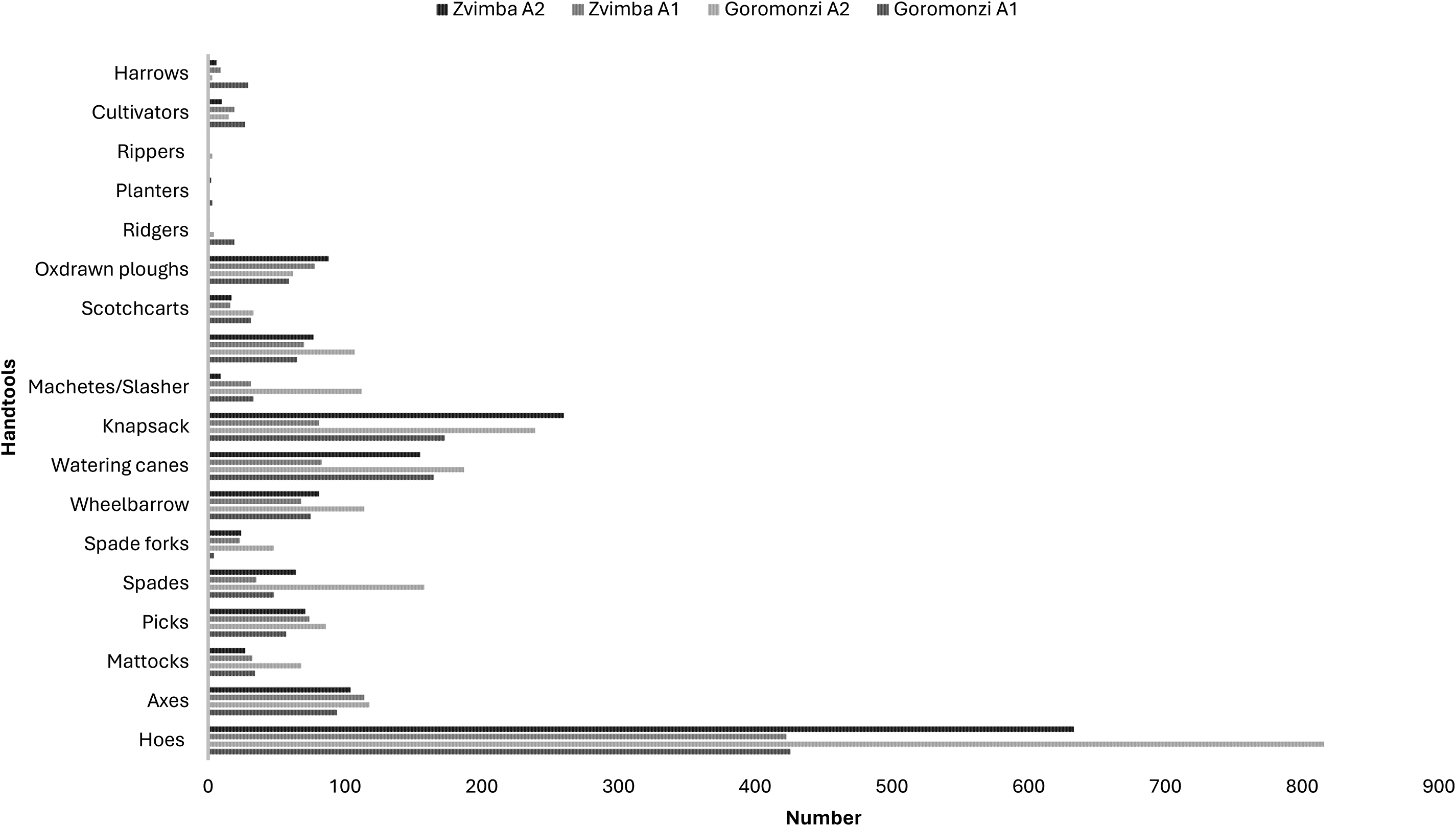
Asset Accumulation of Handheld Tools.
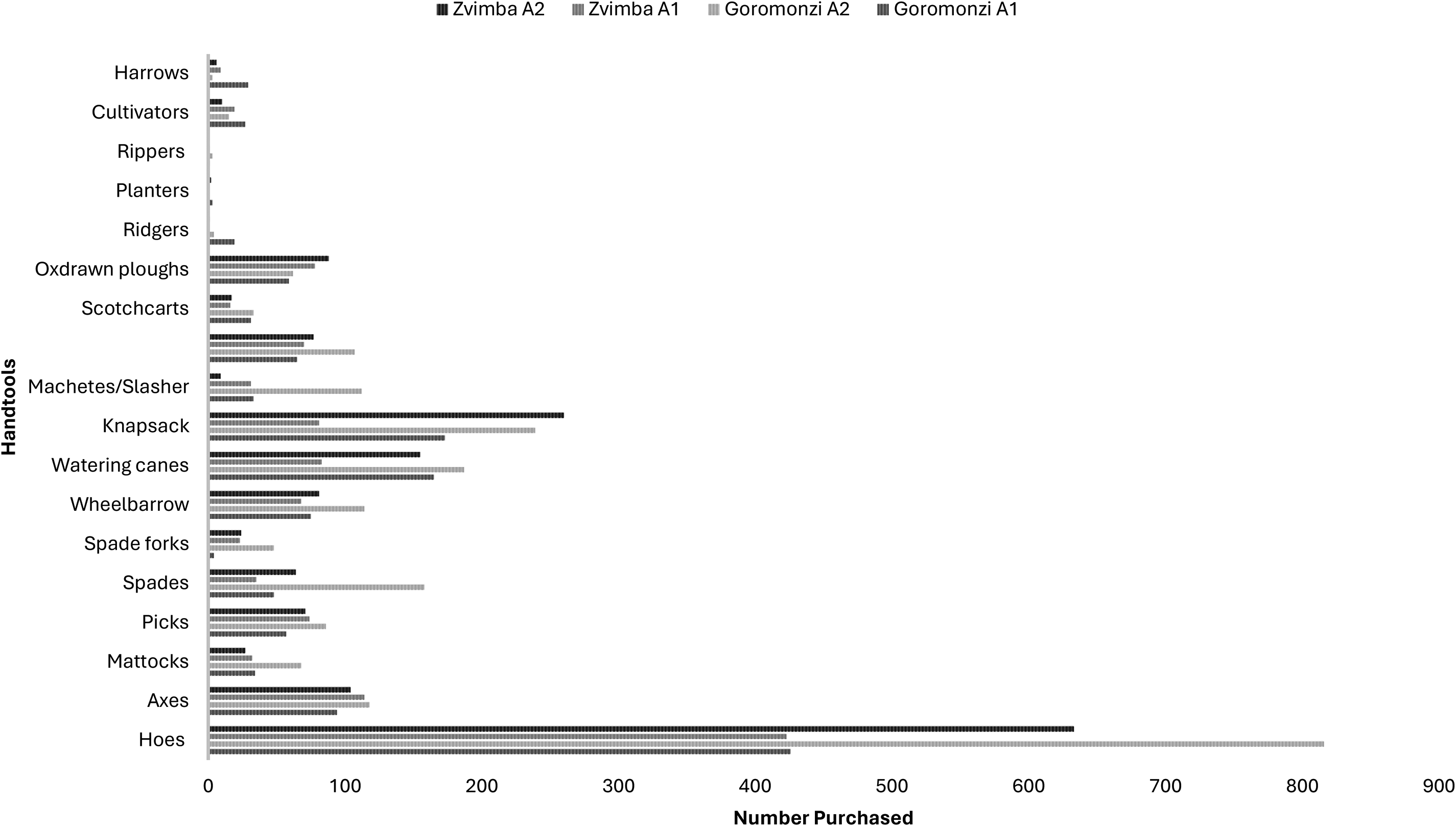
Asset Accumulation of Power Driven Tools.
A2 sector beneficiaries reported much greater asset accumulation than A1 beneficiaries. This confirms findings in other studies that asset accumulation is lower for farmers with smaller landholdings (see Chipenda, 2019). This underlies the importance of redistributive land reform for the landless and those with very small unproductive landholdings (those in communal areas) as it provides a productive resource which they can utilise for asset accumulation. The acquisition of productive assets especially by A2 farmers points to the positive outcomes of access to land which has in turn enhanced productive activities and allowed beneficiaries to generate income. However, it demonstrates the importance of land reform to be accompanied by the requisite agrarian support to ensure the land is utilised to its fullest potential as inequalities can be seen persisting across the tenure regimes. The evidence suggests that there is room for improvement, and this outcome points to the capacity of land reform beneficiaries to be productive and to generate income. Increased asset accumulation among land redistribution beneficiaries is an important outcome critical for social reproduction, poverty alleviation, and the reduction of inequalities. It further creates a buffer for farmers in times of crisis.
Agricultural Labour
As the focus of the study was to explore whether land and agrarian reform could potentially alleviate rural poverty, build resilience and enhance the productive and reproductive capacities of beneficiaries, I now turn to agricultural labour dynamics as they have the potential to expand the benefits of land reform. Particularly with COVID-19, scholars and governments have become more aware of the importance of agricultural labour for economies, employment, and food security (AgriSeta, 2020). Creating agricultural employment opportunities for locals in Zimbabwe during the pandemic had been considered critical in building resilience, providing protection, and guaranteeing income and a measure of food security (Chipenda, 2023a, 2023b). From a TSP perspective, it is clear that labour dynamics in the resettlement areas, despite numerous challenges, have discernible social reproduction outcomes which are clear in both the pandemic and post-pandemic period. The labour dynamics found in the resettlement areas generally support the potential of land and agrarian reform to alleviate poverty and inequality while building resilience.
The ability of land reform beneficiaries to employ temporary and hired labour demonstrates an often-overlooked dimension of the reproductive outcome of redistributive land reform. Such hiring served an important social welfare role during the pandemic period and immediately after the worst of COVID-19. The number of casual and hired labour is summarised in Table 4 from 2020 to 2022, which are critical years of COVID-19 representing the height of the pandemic and the period immediately after. It demonstrates that in both tenure regimes, even during the pandemic period the land reform beneficiaries recruited a significant number of permanent and casual employees. Goromonzi had the highest number of workers compared to Zvimba, especially in its A2 category. Of note is the reliance on casual employees who are more flexible and cheaper to hire compared to permanent employees. A major takeaway from the labour dimension highlighted in this section is the capacity of beneficiaries to hire labour and provide income-generating opportunities for both skilled and unskilled labour during the pandemic and in the post-pandemic context. Access to land enhanced the productive potential of land beneficiaries, allowing them the capacity to employ and contribute to the livelihoods of persons who were not necessarily direct beneficiaries of the FTLRP. Potentially this can contribute to the reduction of rural poverty and inequalities although this remains a huge challenge. Engagement and utilisation of agrarian labour can potentially contribute to production and social reproduction, which are key aspects in dealing with the challenges of rural poverty and inequality while building resilience in a post-pandemic context.
Agricultural Labour in 2022 (N = 200).
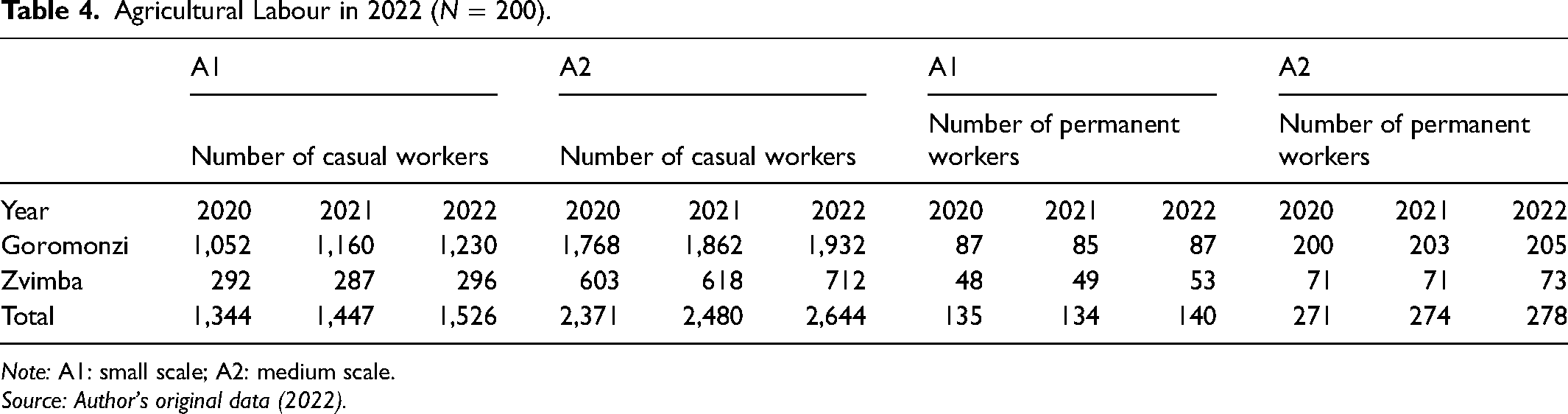
Note: A1: small scale; A2: medium scale.
Source: Author's original data (2022).
Maize Retention as Social Protection
An often-overlooked dimension of the FTLRP relates to its capacity to enhance social protection. According to Mkandawire (2007), social protection refers to the various formal and informal ways meant to protect people from life cycle risks, including sickness and old age, the negative effects of economic policies, market shocks, unemployment, and other socioeconomic vagaries. The TSP framework emphasises the protective task of land and agrarian reforms, accomplished through increased food production and consumption, improved marketing of agricultural produce, and greater income which improves things like food and nutrition security. These protective roles were especially important during the pandemic given rural households’ frequent vulnerability to shocks and stresses. During the pandemic, rural households needed to deploy risk coping mechanisms, using their agency as well as their human, financial, social, natural, and physical capital to deal with risks and shocks. Through diversified livelihood pathways and social capital households managed to cope and respond to the pandemic (Chipenda, 2023a, 2023b: 142, 144). This study specifically asked whether land and agrarian reform facilitated such improved social protection as a transformative agenda would require.
The study found numerous social protection outcomes from Zimbabwe's land reform during the pandemic period that helped build resilience and protect households from risks, shocks, and unforeseen vulnerabilities. Even in the post-pandemic period, these social protection strategies continue to be useful. It is not possible to capture all the social protection initiatives used by households, but a good example is the retention of maize for household consumption and as a food reserve by resettled households. Findings are displayed in Table 5, which summarises the total amount of maize retained (after sales) in the 2019–2020 season and 2021–2022 season.
Maize Retention in KGs.
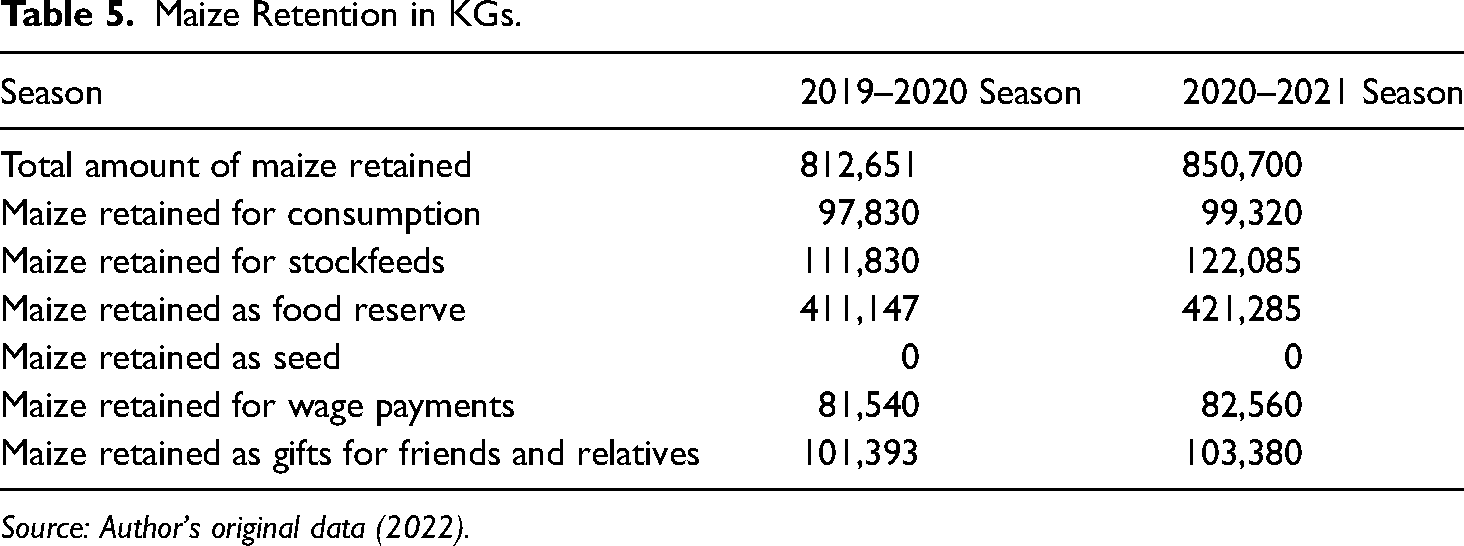
Source: Author's original data (2022).
A major highlight from the table is the increase in maize retained in the two seasons. The high amount of maize retained for household consumption is an indication of food security and explains findings in the study that most households are managing to consume adequate food at least three times a day. The production of maize for household consumption is quite adequate considering Dekker and Kinsey (2011: 1007) point out that for smallholder farmers “[…] at even moderate standards of cultivation, the output from one acre should have been over 1,000 kg, enough to feed a family of five for a year.” This provides us with a perspective of how much is adequate to feed a household and considering the amount of maize retained for household consumption in the study, it is adequate. The table further shows that in addition to maize being retained for household consumption, it was also used as livestock feed, for wage payments, and as a support to family and relatives. The retention of grains and their use as livestock feed, for labour payments, and support for families is an often overlooked aspect of the social protection and reproductive aspects of access to land. Access to land access allowed recipients to engage in productive activities that then enabled them to weather crises and support their larger community. The study further found that land reform beneficiaries also retained sugar beans, ground nuts, and sorghum for food security, wage payment, and support to relatives and friends.
Reflections
Do land and agrarian reforms have the potential to alleviate rural poverty and inequality in a post-pandemic context? What is the potential of land and agrarian reforms in building resilience and enhancing the productive and reproductive capacities of beneficiaries? How can land and agrarian reforms be utilised as an instrument for inclusive and sustainable growth? These were the critical questions with which the article engaged. From the empirical evidence presented, I argue that the pandemic demonstrated that agricultural producers in the rural areas are vulnerable to shocks, food insecurity, and wealth losses – not only during times of crises, but also during normal times. The pandemic context, however, presented important lessons and mechanisms that can be utilised to contribute to poverty eradication and inclusive growth. In answering the questions posed, the study findings suggest that Zimbabwe's agrarian welfare regime has, indeed, enabled important transformative social changes among land beneficiaries of the FTLRP, as well as in surrounding communities.
State intervention in redressing historical and structural inequalities can be shown as having implicated the productive and reproductive capacities of resettled households two decades after land reform. From the 200 households surveyed, evidence indicates that they continue to have access to a productive resource, the land, despite initial predictions to the contrary. This control over land is an important outcome of the redistributive objective of the FTLRP. After two decades, diverse beneficiaries with various landholdings still occupy the land. Reform has given rise to diverse agricultural production activities in a transformed agrarian structure. Evidence suggests that access to land has enabled engagement in diverse agricultural production activities, which has enabled beneficiaries to generate income. Despite some challenges in income generation, the evidence suggests that the income that is being generated is, in turn, supporting agricultural production activities in a cyclic manner. This production is contributing to social reproduction as households are managing to meet their subsistence and commercial requirements. The capacity of beneficiaries to create employment opportunities by hiring casual and permanent labour is another indication of social reproduction outcomes, and it demonstrates that land and agrarian reforms are now benefitting a wider constituency and not just the beneficiaries. Despite several challenges in agricultural labour on the farms, there is potential for growth, and farm employment has the potential to contribute to community welfare and wellbeing.
The study helped clarify how land and agrarian reforms impacted individual household and community resilience to the pandemic and how self-production of food can help communities survive shocks, like the pandemic, at a time when scholars and policy makers debate the utility of local and national food production versus exports. The empirical evidence suggests that households that benefitted from land and agrarian reforms, as well as surrounding communities, were resilient in the face of COVID-19. They adapted and utilised their agency and available opportunities to engage in diverse livelihood activities in times of crisis. Moreover, self and local production of food was critical on the African continent, as COVID-19 translated into increases in food prices, food shortages, and income losses. Globally, the pandemic exacerbated food insecurity and increased the number of food-insecure people (Koloma and salami, 2023). Local and family production by land reform beneficiaries helped insulate them from the external shocks to the food system. This resilience is an important lesson learned from the pandemic and worth considering in debates on the utility of subsistence, local, and national food production versus reliance on imports. It also provides valuable lessons in a post-pandemic context where issues of global food insecurity persist. For example, the Russia and Ukraine conflict has inadvertently resulted in disruptions in global energy supplies and food markets. Consequently, it has caused surges in the prices of energy, inputs, and food (AGRA, 2023). Lessons from Zimbabwe during the pandemic illustrate the need to develop and nurture localised agrarian food systems that are resilient to systemic and idiosyncratic shocks and crises.
In the Zimbabwe example, exposure to exogenic shocks and stresses highlighted the critical but often overlooked utility of redistributive land reform in dealing with rural poverty, food insecurity, wealth and income inequalities, and lack of opportunities. It showed that some of the persistent challenges facing rural communities in former settler colonies can potentially be addressed through land and agrarian reforms. The empirical evidence presented provides us with insight on some of the available instruments that can be further supported and developed to deal with the persistent challenges of poverty and inequality. While the COVID-19 pandemic was largely negative, it was useful in highlighting existing policies, social infrastructure, and social capital that can be utilised to improve rural livelihoods. For societies facing the challenges of poverty and inequalities, land and agrarian reforms have been shown to have utility and provide the necessary access to human and natural resources, as well as financial and social capital. This can enhance their productive and reproductive capacities and, in turn, positively contribute to their welfare and wellbeing. From a TSP perspective, the Zimbabwean case has important lessons that land reform beneficiaries in an agrarian welfare regime have better opportunities for the enhancement of their welfare and wellbeing, as well as their productive and reproductive capacities. This case motivates the need for the adoption of a radically transformative, inclusive, and egalitarian social policy agenda that will have utility for African agrarian futures.
Conclusion
The article has shown that to a large extent, land and agrarian reform in an agrarian welfare regime holds significant potential to alleviate rural poverty and inequality. The COVID-19 pandemic in Zimbabwe, while it was largely negative, unearthed outcomes of the FTLRP that – under normal circumstances – would have escaped scholarly attention. Empirical evidence has demonstrated that the FTLRP was redistributive, empowering, and transformed agrarian relations. This redistribution became critical during the pandemic in the face of increased vulnerability, food gaps, income losses, and rising inequalities. Experiences from Zimbabwe's rural context during the pandemic provide important lessons for a post-pandemic world characterised by multiple crises. The challenging COVID-19 pandemic-induced context showed that access to land can capacitate beneficiaries and communities, allowing them to be resilient and utilise their agency and resources to protect families and livelihoods. The pandemic also showed the importance of local and familial ties, and the need for robust locally oriented food systems that are resilient to exogenous shocks. Going forward, the experiences of farmer households in the study demonstrate the importance of land and agrarian reforms and provide lessons in terms of practice and policy trajectories in a post-pandemic context.
The article has also shown that from a TSP perspective experiences from rural Zimbabwe provide the critical insight that land and agrarian reforms constitute an often overlooked aspect of social policy. This is unfortunate, given the utility thatland and agrarian reform are shown as having especially in crises context. The experiences from rural Zimbabwe have shown that during the pandemic, access to land had discernible production, reproduction, protection, and redistribution outcomes. These impacted, and contributed, in different ways to the social wellbeing of individuals and communities. Production, accumulation, and social protection dynamics that were explored have shown that land and agrarian reform as a social policy instrument have utility – just like other conventional instruments – in contributing to and addressing the challenges of rural poverty and inequality, while enhancing productive and reproductive capacities, building resilience, and acting as an instrument for inclusive and sustainable growth. These attributes provide a critical foundation for a transformative policy agenda in a post-pandemic context. From a TSP perspective, land and agrarian reforms are shown as being instruments in part of a broader initiative in a post-pandemic context that places emphasis on structural changes in the economy, social relations, and social institutions with the overarching objective of expanding and deepening human wellbeing. The Zimbabwe agrarian experience has shown us that in a post-pandemic context, there exist possibilities of addressing structural underpinnings that promote diswelfares and inequality. Zimbabwe's agrarian welfare regime has demonstrated the possibilities of a synergistic correlation between social and economic policy; and a shared normative premise for economic and social policy. From a TSP perspective in a post-pandemic context, the Zimbabwe experience lays illustrates the utility of an agrarian welfare regime in the structural transformation of the economy, social institutions, and relations. It shows that land and agrarian reforms are part of a social policy architecture that is coherent with, and presents immense possibilities for, addressing the challenges of poverty and inequality.
Footnotes
Declaration of Conflicting Interests
The author declared no potential conflicts of interest with respect to the research, authorship, and/or publication of this article.
Funding
The author disclosed receipt of the following financial support for the research, authorship, and/or publication of this article: This work was supported by the DSI/ NRF South African Research Chair in Social Policy (SARChI-SP), University of South Africa.
