




Abstract
This article explores party financing in the developing world, analyzing an African case to suggest ways of improving regulations as part of reducing corruption in the political process. With evidence from a nationwide survey conducted in Ghana, we argue that the economic situation of developing countries creates the required policy environment for the implementation of regulated elite funding of political parties. Building the will of political actors is cardinal for these conditions. We also offer suggestions on how political will can be built to increase transparency and openness in electoral politics and party funding in general.
Introduction
While party financing plays a crucial role in the political landscape, it often does not receive the attention it deserves in discussions about party politics. Existing literature on political parties tends to overlook the importance of financing these institutions (Abdulai, 2023; Bonotti and Nwokora, 2024; Van Biezen, 2004). This oversight becomes even more significant in the context of developing democracies, where the financing of political parties presents a substantial challenge. Despite this, empirical studies on party finance in developing countries remain largely in the periphery of the literature on party politics. Consequently, the question of the most effective method for African democracies to fund their political parties remains open and unanswered.
This article explores the complex issue of political party financing in developing countries, a subject that has attracted significant interest in both theoretical and empirical research. While there is a general agreement on the need for enhanced transparency and accountability in the financial operations of political parties, differing views exist on the optimal funding mechanism for these organizations in Ghana (Bagbin and Ahenkan, 2017; Gyampo, 2015; Sakyi and Agomor, 2016). Notably, a prior study discovered that political affiliation plays a role in shaping funding preferences (Sakyi and Agomor, 2016). Members of smaller political parties demonstrated a marked preference for public funding. However, the study did not explain the nuances in the preferences of respondents associated with the larger political parties. For instance, a question then arises: Do attitudes vary based on affiliation to the two main political parties? Following this gap, this study explores the topic of party financing in a Ghanaian context. What are the preferences of political actors regarding the mode of political party financing? What key factors explain this preference? The paper refreshes the empirical literature on party financing systems in Ghana and provides insights into the dynamics of political funding among the major players in Ghana’s political landscape. The findings inform a feasible and pragmatic reform strategy for party funding in sub-Saharan democracies, with a proposition for a regulated elite system for Ghana and similar maturing democracies.
The study actively engages with the topic of political party financing in Ghana, based on a comprehensive study conducted in 2019. It involved interviewing local political stakeholders across all 275 electoral districts in Ghana, with a focus on the pressing need for reform in political party financing. The insights gained from these interviews significantly contribute to the existing body of literature on political party financing in sub-Saharan Africa. The article strongly advocates for the regulation of elite funding for political parties, not only within the region but also in developing countries at large.
The discussion begins with a thorough examination of the existing literature on party finance, identifying and engaging with the various forms of party finance. Following this, the article presents a case study from Ghana to make a compelling argument for the regulation of elite funding of political parties. This approach offers a practical perspective on the subject, firmly rooted in real-world experiences and insights, thereby providing a clear and active discourse on the matter.
Literature review on party finance
The party politics literature reveals that funding issues constitute a good portion of party politics literature. A search of entries in party politics-related journals such as Party Politics, Journal of Elections, Public Opinion and Parties, and the Journal of Democracy validates this assumption. For example, search results for “finance,” “funding,” “cost,” and “money” show 755, 747, 491, and 256 entries, respectively. This is very impressive considering the relevance of finance in the effectiveness of political institutions. Nonetheless, the minimal availability of literature with a contextual focus on Africa has skewed this literature to favor other parts of the world, especially the West. For instance, attaching the word “Africa” to “Funding” in the search for literature in Party Politics reduces entries from 747 to 96. This suggests that a considerable gap exists in the literature regarding the balance between political financing studies on Africa and the rest of the world (especially the West).
Moreover, the literature on political party financing was primarily historical, theoretical, comparative, or prioritized the need for some reforms in party finance architecture in Western countries (Wiltse et al., 2019). Literature on the historical development of party finance traced the phenomenon from a Western perspective (Nassmacher, 2019). For instance, Hopkin (2004) traced the evolution of political parties from the mass-funded model to elite and cartel models of funding due to the decreasing interest of their followers to invest in their activities. He characterizes party finance in the modern government architecture as a collective action problem and proposes a political economy perspective to understand party financing. However, his analysis is based on Western Europe and America: Italy, Germany, Spain, the United Kingdom, and the United States. Equally, Weekers et al. (2009) trace the evolution of political parties in Belgium. They attribute the evolution of political parties from a state-funded era to new funding regimes to four main factors; the occurrence of political corruption, changes in party organization, the financing strategies of parties, and the geographical or institutional proximity to other political systems.
Similarly, Fisher (2018) traces the evolution of party funding regulations in the United Kingdom. The focus on these countries is worthwhile due to the vast experience these countries have built over the extended period they have nurtured democratic systems. Equally important, however, is the need to explore the nature of party financing in developing democracies, most of which are in Africa.
Comparative studies are readily available in the study of party finance. Several works have compared the legal framework for party financing across democracies (Clift and Fisher, 2004; Heidenheimer, 2017; Scarrow, 2007). Others have sought to compare and critique common trends in the source of flow and the expense of funds by political parties in Western democracies (Nassmacher, 2019). Flowing from the populist democratic perspective, the expected conclusion of these studies has been that elite party funding is pervasive (Hopkin, 2004). As a result of this observation, these scholars push for greater participation of the state and the masses in funding political parties to ensure their interest in the governance process.
However, theoretical advancement in the party finance literature has been slow-paced (Hopkin, 2004; Nwokora, 2014; Wiltse et al., 2019). The field borrows theories from economics, political sciences, and public administration (Gulzar et al., 2020; Hopkin, 2004). Some literature on party finance adopts democratic theory to demonstrate the need for greater involvement of the masses in the finance of party activities (Hopkin, 2004). This is backed by the perception that the dense involvement of the elite in financing political parties may lead to the emergence of cartel funding which may eventually relegate the interest of the masses in favor of their parochial profit-making agenda.
Issues regarding party financing reforms were also at the forefront of the literature. Indeed, party finance literature commonly concludes with some recommendations to improve the management of political parties as cardinal agents for democratic consolidation (Arthur, 2017; Gyampo, 2015; Gulzar et al., 2020). Core among these recommendations is the call for strategies to increase the involvement of citizens in the finance of political parties (Arthur, 2017). Public funding and control of political parties are deemed critical to improving accountability and transparency in the finances of political parties (Gyampo, 2015). In effect, accountability and transparency are requisite ingredients for building the legitimacy of political regimes and ensuring democratic regulation (Gulzar et al., 2020). Nevertheless, questions relating to the feasibility of mass funding and control of political parties in young democracies—and African democracies—remain largely unanswered in the prevailing literature. The focus of party finance literature on Western-country contexts is mainly responsible for this gap.
Our study is unique because it focuses on party finance in African democracies: an underrepresented region in the party finance literature. Consequently, this focus produces an unpopular stance on the requisite reform for improving the effectiveness of political parties. The proceeding section explores the alternative regimes for party finance explored in the literature and the strengths and shortfalls of these alternatives.
Forms of party finance
Examining the party finance literature produces a perception of convergence on some critical variants of party financing across developed or Western democracies. Generally, there seems to be a convergence of four types of party finance systems (Hopkin, 2004; Wiltse et al., 2019). In his historical examination of Western democracies, Hopkin (2004) identifies these variants as the clientelist mass parties, externally financed elite parties, self-financed elite parties, and cartel parties. In practice, these systems tend to coexist rather than subsist exclusively. In that, political parties or, more broadly, a political system may involve using one or more methods for generating funds (Wiltse et al., 2019).
The study adopts three main classifications of political party financing based on the source of funds generated and appropriated by political parties, namely, mass, state, and elite financing systems.
Mass-funded system
A mass-funded system depends on contributions and premiums paid by political party members to run its activities. Card-bearing party members give their contributions with the hope of retaining some control over the activities of the political party. These individuals contribute their time, resources, and abilities to the service of political parties with the expectation of accruing some benefits in the forms of:
allocation of state jobs to party workers or their relatives, allocation of public contracts or other forms of paid work for the state in the case of business people who help the party, or the preferential allocation of welfare benefits such as public housing, disability allowances or any other kind of discretionary benefit (Hopkin, 2004: 632).
This form of financing is beneficial because it affords citizens an avenue of political participation and control over state resources. It also ensures downward accountability in partisan politics, which tends to improve the legitimacy of a regime. Nonetheless, political parties with smaller membership populations may struggle to finance their activities. Moreover, a significant number of financiers of this system may work against this system. This is true because the parochial interests of citizens are not aligned; the satisfaction of one interest may lead to the dissatisfaction of the other. In effect, the demands and incentives of most donors will not be met. This would eventually erode the confidence of the party members, as was the case in the United States in the 19th and early 20th centuries (Shefter, 1994).
State-funded system
Another mode of funding political parties is through the state funding system. This system is characterized by states providing financial resources or indirect assistance to political parties to support their activities. The state may usually generate funds for political parties through public taxes and private contributions of individuals and corporate entities. Western countries that have experienced some form of state funding include Germany, Ireland, the United Kingdom, Australia, and Canada (Van Biezen, 2003). In Africa, countries like Lesotho, Mali, Zimbabwe, South Africa, and Botswana have some arrangements for the state to fund political parties (Gyampo, 2015).
A primary argument for state funding of political parties has been the cost of campaigns in the current technological era coupled with the lack of internal party financing sources. This system is also favored by reducing tendencies of state capture by corporate party financiers. It is also favored for allowing equal opportunities, fairness, and the equality of political competition (Van Biezen, 2003). On the contrary, this system has some shortfalls primarily associated with maturing democracies. In an electoral democracy, this form of financing can only exist where political parties maintain a joint agreement to retain state funding of political parties. The joint agreement is critical to the maintenance of the system as a unilateral decision of any significant party may lead to its collapse if the dissenting party wins political power. In this event, the dissenting political party would most likely amass popular support to the disadvantage of the opposing parties (Nwokora, 2014). The potential for the assurgency of this situation may be a disincentive for political parties to maintain such a system.
Elite-funded system
An alternative to the state-funded party system is the privileged system. Elite funding is widespread across democracies in all parts of the world, with the rise of multibillion-dollar corporate giants like Facebook, Amazon, Apple, and Twitter, among others. These organizations may seek to influence their business environments, and one means of doing such is the contribution of funds to support political parties in exchange for political favors. This system is also possible due to advancements in communication technology. The invention of the radio, television, and Internet-related technologies has given political parties alternative means to reach citizens than labor-intensive mass party financing. However, this comes with enormous financial investments in campaign activities. Political parties under this system are obligated to acquire resources from corporate bodies owned and controlled by the economic elite. These elite sponsors use their corporate institutions to finance the activities of political parties in exchange for favors, including but not limited to contracts, favorable policies, tax breaks, and loosened regulatory regimes, among others. At the extreme, a corporate organization may fund the activities of a political party in return for unitary control over the significant decisions of the party. In effect, the party is used as a conduit to promote the corporate interest of the funding institution. A clear example of this system is Silvio Berlusconi’s Forza Italia, a political party in Italy (Hopkin, 2003). “In sum, Berlusconi’s business empire has underwritten Forza Italia, while the party, whose parliamentary representatives include key Berlusconi’s legal team members, has defended the party leader’s private and corporate interests” (Hopkin, 2004: 635).
Elite funding may free citizens of financial contributions to fund political parties; however, there are trade-offs. Citizens may lose their control over the activities of political parties. By controlling key democratic institutions and processes, these elites can ensure that public policies are developed to serve their interests, often at the expense of broader societal needs. This can lead to a political system that appears democratic but operates to benefit a select few (Gyimah-Boadi, 2021). In effect, without proper accountability and transparency measures, the elite funding model may counteract bottom-up participation of citizens in partisan politics (Mayhew, 2004).
Should African democratic political parties reject funding from the elite? What alternatives are viable? Despite the challenges that come with elite funding, a regulated form of this model seems to be the most practical in democracies that are mature and consolidating (Gulzar et al., 2020). This is not unique to Africa; most political candidates in the United States rely on financial support from the economic elite to fund their campaign activities (Mayhew, 2004). In Ghana, for instance, there is limited political support for funding of political parties by the masses or the government, as found in previous studies (Arthur, 2017; Ashiagbor, 2005; Gyampo, 2015). Therefore, a regulated model of elite funding appears to be the most appropriate.
The following section explores this debate falling on an empirical case set in Ghana, a sub-Saharan African country credited for great strides in democratic consolidation.
Party finance in African democracies; empirical insights from Ghana
Apart from Lesotho, Mali, Zimbabwe, South Africa, and Botswana, which provide state funding for political parties, all Sub-Saharan democracies fall on financial support from the elite and masses. Parties, however, accrue most of their funding from elitist sources (Gyampo, 2015; Sakyi and Agomor, 2016; Shale, 2018). The low economic capacity of most maturing democracies is a prime incentive for the appropriation of this form of system. Nonetheless, the literature supports the assertion that political parties in the sub-Saharan region have a notorious record of having no regard for accountability and transparency in their financial management (Arthur, 2017; Gyampo, 2015; Kura, 2014; Shale, 2018). This phenomenon has been partly blamed for political corruption, patronage, and the stagnated pace of democratic consolidation on the continent (Arthur, 2017; Beresford, 2015; Gyampo, 2015; Kura, 2014; Shale, 2018).
After several failed attempts at democratizing, Ghana is now making enviable progress at democratic consolidation. Since 1992, Ghana has sustained its electioneering democracy through eight general elections. These elections have resulted in three (3) electoral turnovers of political power between the two main political parties; the New Patriotic Party (NPP) and the National Democratic Congress (NDC). The case of Ghana represents a stellar model of democracy for the sub-Saharan region and arguably the African continent. A recent publication by the Center for Democratic Development (CDD) (a reputable think tank in Ghana) claimed that a presidential candidate requires about USD 100,000,000 to win a presidential election. For legislators, about USD 650,272.40 (¢4 million) is needed. In the case of the legislators, half the amount is dedicated to nurturing constituencies and the remaining half for securing the candidature position (Annan, 2021). Although speculations about the extravagance of political activities exist, the sources of wealth remain a secret. Nevertheless, the need for transparency in government business is imperative in this era of low levels of trust in government (Rauh, 2021).
Another, CDD-Ghana study strongly asserts that
the absence of an effective campaign financing regime provides opportunities for ill-intentioned donors, local criminals and organized crime actors to gain influence over elected officials by financially supporting their campaigns. This undermines democracy, good governance, and the rule of law and has negative consequences for economic and social development (Nyarko, 2022 [2021]: 5).
To this point, Lassou et al. (2024) discuss the relationship between corruption in public procurement. They argue for the need for a “gradual demonetization of elections, and the consideration of the fundamental function of public procurement as a policy instrument embedded in economic, social, cultural and environmental plans” (Lassou et al., 2024: 1).
Both the theoretical and empirical literature on the phenomenon agree on increased transparency and accountability in the financial activities of political parties through the enactment of legislation and the activities of media groups and civil society (Arthur, 2017; Bagbin and Ahenkan, 2017; Beresford, 2015; Gyampo, 2015; Kura, 2014; Sakyi and Agomor, 2016). However, there are disagreements on the ideal funding mechanism for the political parties. A theorical article, Bagbin and Ahenkan (2017) recommend various modalities of public funding of political parties to “grant the Electoral Commission the moral right to enforce regulations banning illegal funding of political parties” (p. 129). However, the empirical literature paints a different picture (Gyampo, 2015; Sakyi and Agomor, 2016). For instance, Gyampo (2015) recommends a mass-funded system of payment of monthly dues and special levies to strengthen their financial independence and operational effectiveness. He found that political parties in Ghana function as weak “election machines” and are inactive during inter-election periods (p. 23). Further, the study found a lack of commitment from governments and support from Ghanaians for the public funding of political parties. Nonetheless, their study fails to discuss the nuances that result in the lack of commitment. For instance, what was the commitment of civil society versus politicians? Were there significant differences between views of financing held by different political parties? To this it notes, “the survey was not about people’s political affiliation, we did not probe further to ask respondents to indicate the parties they voted for in the 2012 General Elections” (Gyampo, 2015: 16).
In their 2016 study, Sakyi and Agomor investigated the perspectives on state funding of political parties in Ghana, with a focus on both members and non-members of these parties. However, they do not necessarily recommend a mass-funded, state-funded, or elite-funded system; they suggest that both private and state funding require strong regulation and the need for public dialogue to address the issue comprehensively. Their findings revealed that the elite are perceived as the primary financiers of these parties, while funds from the state or government and contributions from ordinary members are seen as less significant sources of funding. This aligns with Gyampo (2015) findings, which highlighted a noticeable lack of support for public funding of political parties. Sakyi and Agomor’s research further uncover a split opinion on state funding among Ghanaians, with a higher degree of opposition, especially among regular party members. Interestingly, they found that political affiliation influences funding preferences. Specifically, members of smaller political parties showed a significant preference for government funding. However, their study did not delve into the preferences of respondents affiliated with the bigger political parties. Do sentiments differ based on the affiliation to two main political parties?
The current study refreshes the empirical literature on the nuances in the support of party financing systems in Ghana (Sakyi and Agomor, 2016). It examines the complexities in the preference of political actors in the two leading political parties in Ghana consistent with the previous literature (Sakyi and Agomor, 2016). The exploration of preferences within this group is crucial as it provides insights into the dynamics of political funding among the major players in Ghana’s political landscape. Preferences are crucial as it is directly linked to public support for the policy alternatives. Here the policy alternatives are three main types of party funding regimes identified in the theoretical literature, namely, mass funding, state funding, and elite funding.
Public support for reform is critical because it builds legitimacy for government decisions. Moreover, public support for policy actions is the core means of building the political will of leaders to implement policies. This analysis forms the basis for making a feasible and pragmatic reform strategy for party funding in sub-Saharan democracies. Understanding these dynamics informed our proposition for a regulated elite system for Ghana and similar maturing democracies. The next section discusses the methodology adopted by the study.
Data and method
This study is the outcome of analyses of data collected from respondents in a joint project between the Department of Political Science of the University of Ghana and Konrad Adenauer Stiftung, a center-right German political foundation. Data collected from the survey included both party actors and non-actors. The current study only analyses the responses obtained from the key political actors; 1,582 political party executives of Ghana’s two main political parties, National Democratic Congress (NDC) and New Patriotic Party (NPP) based on insights from the previous study (Sakyi and Agomor, 2016). Comprehensive data on all the variables and the dataset is in the archives of the Accra Office of Konrad Adenauer Stiftung Foundation.
One-on-one, face-to-face interviews were the main primary data source for the study. These interviews were conducted throughout January 2019 at all constituencies in Ghana by trained research assistants, graduate students, and faculty members of the Political Science Department of the University of Ghana. There was a total of 51 enumerators trained for this research exercise. Approximately every interview lasted a maximum of forty-five (45) minutes. Qualitative interview questions were included in the survey questionnaire for all participants. The interview process was semi-structured. It was facilitated by an interview guide, a set of predefined questions based on the research objectives interspersed with occasional probing and follow-up questions. The main instruments for data collection were a tablet and a voice recorder for primary data gathering. The research questionnaire was loaded on an Android tablet, also used to record responses obtained for closed-ended questions. Interviews were also recorded and played to capture responses to open-ended questions. The recorded interviews were then transcribed. Afterward, a thematic analysis was done. Themes were generated based on the research objectives for coherence in the presentation of findings. A total of 16,766 respondents engaged in the study from across Ghana’s 275 constituencies (electoral districts).
The study presents the findings and respondents’ views on political party funding, including their opinions on the need for reform in this area and their preferred funding method. While respondents easily grasped the concepts of state funding and mass funding, they found the concept of regulated elite funding more challenging to understand. This type of funding, as explained in the study, involves private individuals with a cap on total allowable revenues and expenditure. The study improves upon previous works (e.g. Gyampo, 2015) that did not ask respondents about their party affiliation. In contrast, this study collected demographic data, including political affiliation, income level, gender, age, and the level of attachment to a political party.
To answer the second research question, the study employed a lasso regression, a technique used to identify influential variables associated with respondents’ funding choices where there is multicollinearity. This was the case as most demographic variables are highly correlated. All demographic items were used as independent variables. In addition, the study included a variable on respondents’ perceptions of campaign costs and a variable asking if respondents would be willing to provide information in the future over the phone. The dependent variable was the respondents’ party finance preference. This was done to explore the nuances in support for elite funding. Table 1 provides a description of the variables used in the study.
Descriptive statistics.
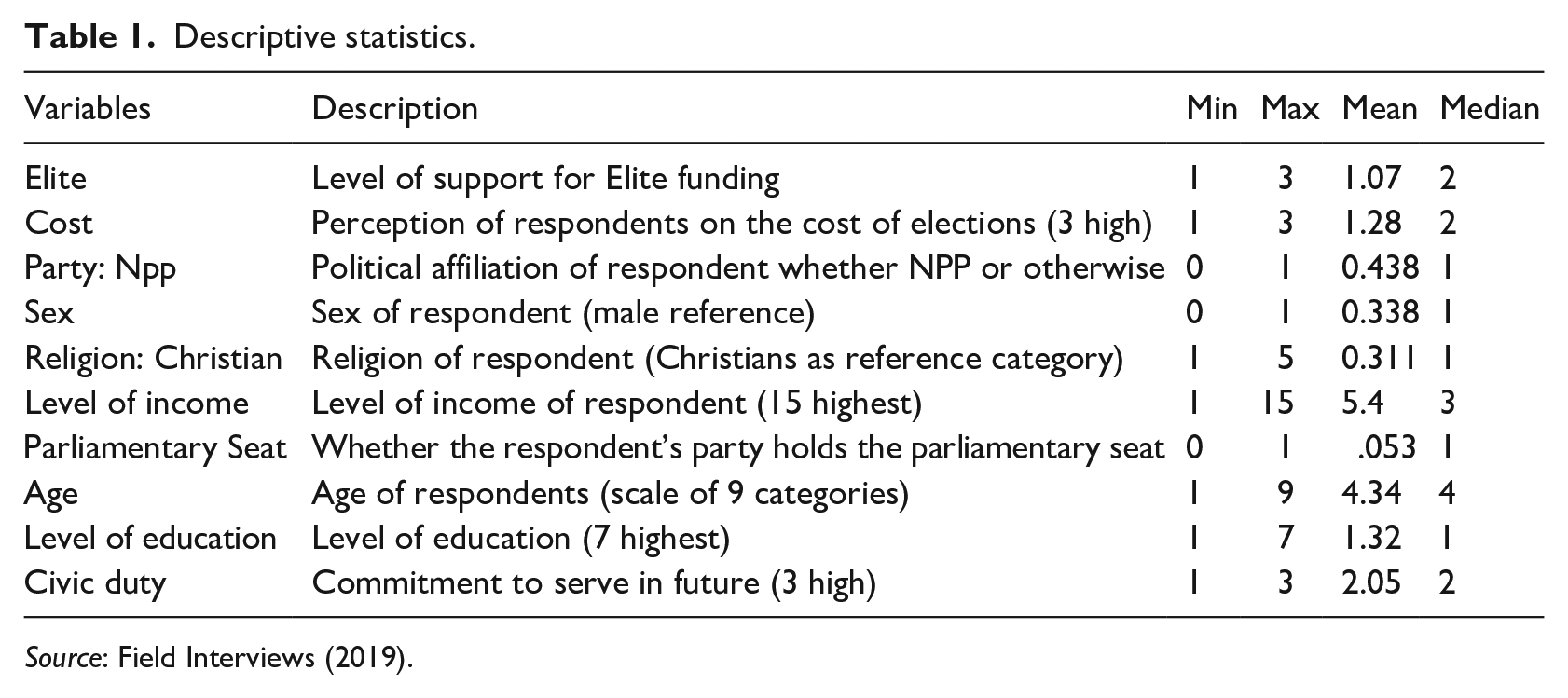
Source: Field Interviews (2019).
Findings and discussions
The study’s objective is to ascertain the perceptions of local political stakeholders regarding the prevailing party finance regime in Ghana and assess their views on the requisite reforms. In response, 90 percent concurred that the party finance regime required some reforms. They outlined some weaknesses of the current party finance regime, which made these reforms imperative. For instance, a significant concern was the magnitude of unaccounted funds expended by candidates during general elections (Annan, 2021). The study examined the views of key political actors from the two major political parties in Ghana. Their views confirmed the assertions made by earlier reports on party financing (Annan, 2021). Specifically, the study as illustrated in Table 2 found that 82.7% of the respondents was convinced that the expenses made by respondents were exorbitant.
Perception of respondents on the current funding method.

Source: Field Interviews (2019).
Party financing in Ghana; the need for reforms
Respondents’ views were also obtained on their preferred funding method for political parties in Ghana. Despite the issues experienced with the current funding regime, they were not convinced that either government funding or mass funding was feasible because of the economic situation in the country. Neither the government nor the citizenry was perceived to be able to fund the activities of political parties. However, majority of respondents noted that they were, in support of a regulated elite funding regime. According to the study, 77.3 percent of respondents preferred elite funding, whereas 13.3 and 11.2 percent preferred government and mass funding respectively (see Table 3).
Respondents’ preferred funding method.

Source: Field Interviews (2019).
While Sakyi and Agomor (2016) found that smaller political parties significantly prefer mass funding, the current study found the opposite for major political parties. The preferences of political actors appear to be influenced by the structure of their respective parties. Smaller parties, which have fewer members and less alignment with business interests, logically may prefer government funding. These business interests may favor larger parties. Interestingly, the study found that leaders of larger parties (NPP and NDC), despite having more members and business interests, were not convinced about mass funding. Furthermore, the study revealed that the recommendations made by Gyampo (2015) in support of mass funding lacked support from the partisan elite. The study also filled the void in the current literature by examining the antecedents of the preference of party financing regimes by political elites.
To probe further, the antecedents for the preference for a regulated elite funding regime, the study also estimated a lasso regression. Lasso regression is a dimension reduction technique to identify the key variables associated with the support for regulated elite funding. Appendix I provides a visual summary of the variable selection process performed by the Lasso regression. It shows which variables are consistently important predictors (those with lines that stay away from zero) and which are less important or redundant (those whose lines reach zero at relatively low values of λ). This allowed the study to identify a parsimonious subset of variables that best explain the variation in support for regulated elite funding, effectively reducing dimensionality and preventing overfitting.
Appendix II shows the results of k-fold cross-validation used to select the optimal value of the tuning parameter (λ) for the Lasso regression (Best Lambda=0.0047). The graph shows a curve. Initially, as λ increases from 0, the prediction error decreases because the regularization helps reduce overfitting. After reaching a minimum point, the prediction error begins to increase. This is because too much regularization starts to remove important variables, sacrificing predictive accuracy. The optimal value of λ is usually chosen as the one that minimizes the cross-validation error (the minimum point on the curve). This λ value is then used to select the final set of variables and their coefficients from Appendix 1. The vertical line often indicates the selected optimal λ. This selected lambda would then be used on Appendix 1 to identify which variables should be included in the model.
In sum, Appendix 2 helps determine the best balance between model complexity and predictive accuracy, crucial for obtaining a reliable and generalizable Lasso model. It ensures the chosen model is not overfitting to the specific training data.
Evidence from the model indicated that the primary variable associated with the request for reforms was the magnitude of funding expended by political parties during elections. The variable (question) on people’s agreement with the extravagance of political parties was the most significantly correlated with the preference for different forms of funding (see Table 4).
Lasso regression of demographic variables on preferred party funding.

Source: Field interviews (2019).
Best Lambda: 0.0047 *Variables is insignificant (decomposed to zero)
The study reveals that, in addition to the respondents’ perceptions of government costs, their political affiliation significantly influences their preference for a funding mechanism. The lasso regression results as shown in Table 4 indicate that members of the NPP have a stronger preference for a regulated elite funding model than NDC members. This is not surprising, given that the NPP is a right-wing party. Male and Christian respondents showed a marked preference for elite funding, although the impact of these variables was not highly significant (below 0.1). Respondents from constituencies with elected representatives from their party also showed similar preferences. The study also found that older respondents had a stronger preference for elite funding.
On the contrary, the study found a negative association between respondents’ income levels and their preference for elite funding. Respondents with higher reported incomes had less preference for elite funding. This suggests that respondents with lower incomes may support regulated elite funding because they may have less disposable income to contribute to political parties through mass funding. This discussion of findings provides valuable insights for academic research on political party funding.
Arguments for regulated elite funding
As noted in the previous section, it was clear at the end of the interviews that respondents did not support either mass or state funding of political parties, rather they support a modified version of elite funding. For easy understanding by a nonacademic audience, which was described as a funding by private individuals where the cap is placed on the total allowable revenues and expenditure. There was overwhelming support for that arrangement and the reasons given are discussed.
Most respondents believe that the absence of a limit on campaign financing creates a system where elections are won by those who spend the most. They argue that this system motivates the winners to recover their hefty expenditures through any means possible, including dishonest ones. The need to be the highest spender to win an election incentivizes current officeholders to accumulate wealth, potentially through corruption, to fund their future campaigns. This highlights the concern that increased public spending during campaigns has amplified corruption in politics. They agreed that political parties overspend during elections.
Some respondents suggest that implementing regulations on party financing could decrease vote-buying and potentially deter unqualified individuals from gaining office. They note that there are individuals ready and willing to serve the country’s interests, but the high costs associated with campaigning discourage them from entering the electoral process. The current political system tends to favor those who can afford to finance their campaigns, leaving those with limited resources at a disadvantage. These respondents argue that if a spending limit were introduced, the selection of leaders would be based on their proposed development initiatives rather than their campaign budgets.
Respondents suggest that government regulations on party financing are necessary as they believe the current system promotes favoritism and societal division. They observe that election winners often reward their supporters, particularly those who contributed significantly to their campaign funds, while those who did not contribute are often overlooked. This practice, they argue, fosters bias and partisanship, leading to corruption and hindering development. The respondents consistently link unregulated party financing to underdevelopment. They propose that the substantial funds spent on campaigns could be redirected toward developmental projects. They also express concern about the excessive monetization of elections. Candidates with limited resources, but a strong desire to win, often resort to borrowing money to finance their campaigns. Once these candidates assume office, they use state funds intended for development to repay their campaign debts. This cycle, respondents argue, is detrimental to the country’s progress.
Arguments against regulated elite funding
A significant minority of respondents hold a divergent position on the issue of regulated elite funding. One such critical position is that political parties are not funded by the state and should be unrestricted in their expenditure. Advocates of this position contend that it is not within the purview of the state to dictate how persons should spend private funds. This group of respondents contends that the foremost aim of a political party is to capture political power, and so long as political parties are spending private funds, they must be given the liberty to spend any amount that would ensure their success at capturing political power. Nevertheless, some respondents indicated that the government could place a cap on the financing of parties only if the state can provide sufficient financial support for political parties.
Furthermore, some respondents concur that expenditure is relative and dependent on each jurisdiction or constituency. For instance, it is observed that the cost of running a campaign in a constituency with a relatively small voter population will differ from the cost of running an election campaign in a constituency with a large population of voters. Therefore, placing a blanket cap on all expenditures irrespective of geographical differences will be a great disservice to candidates who run campaigns in places with a high voter population.
Another argument observed from the data collected is that it will be complicated for the state to track political parties’ expenditures properly. They posit that the level of accountability in our political system is shallow, which is consistent with previous studies (Arthur, 2017; Gyampo, 2015; Gyimah-Boadi, 2021). Therefore, it will be an arduous task for the state to track the individual expenditure of candidates across the country. A political party may understate its expenditure to delude the state. Respondents also claim that the phenomenon of vote-buying, which comes in both cash and kind, will make accountability even more complex.
Conclusion
The evidence from the study indicates support for regulated elite funding by political stakeholders in Ghana. This stance is mainly favored due to the state of the Ghanaian economy, coupled with the extravagant spending by political parties in recent times. Stakeholders expressed the need for a limit on the budgetary allocation of political parties. There is a need to create legal instruments to regulate the funding of political parties. These institutions must require political parties to render accounts of their funds and the sources of the declared funding. Political parties must also be required to publish their financial statements, including their expenditure, for public scrutiny.
Nonetheless, this would only be a mirage without the political will to sustain such strong institutions. The study finds transparency the most cardinal ingredient in instituting a regulated elite funding system in developing countries. The regulation of activities would depend on the openness of political stakeholders to the regulatory agencies. Therefore, the effectiveness of any regulation on political parties would depend on a mix of institutional arrangements and sustained political will for openness and transparency.
The role of academics, the media, and civil society is fundamental to building the political will to promote and maintain regulations to improve transparency and reduce the monetization of partisan politics in developing countries. These groups need to provide information and educate citizens to demand accountability from political stakeholders. Academics must continue to publish papers to educate their community on the need to push for institutions and regulations to increase transparency in electoral contestations and party funding. Civil society groups must also partner with the media to educate citizens on the need for transparency and openness in electoral politics. This can create an agenda in favor of transparent and regulated funding in developing countries.
To conclude, the study has some flaws. The use of the case study design reduces the generalizability of the study. In an unlikely event, the need and demand for regulated elite funding may be exclusive to Ghana. Nevertheless, this study offers insightful findings for countries with similar characteristics as Ghana. More so, further studies could replicate the work in another developing context. They could also model statistical relationships between the preferred choice of party funding and other variables.
Footnotes
Appendix I
Path of coefficients of lasso regression.
Appendix II
Visualization of the cross validated critical value.
Funding
The author(s) received no financial support for the research, authorship, and/or publication of this article.
