




Abstract
This study concentrates on the impact that marriage has on the personal development of Israeli Arab women in the field of higher education and employment. These women are a minority within a minority as they belong to Israel’s Arab ethnic community but are also a gender-segregated minority within their patriarchal society. Whereas other studies touch on the overall struggle of Arab women to reach personal fulfillment despite intense family life, the focus of this study is specifically the marriage itself as a watershed in the young Arab Israeli woman’s life. To fully understand the challenges constructed by marriage, 25 Israeli Arab women were interviewed in-depth on a university campus. The findings indicate the negative effect that traditional marriage has on these women’s personal futures. The study concludes on the optimistic note that the interviews also revealed a deep awareness among young Arab women of their personal rights and liberties.
Introduction
One of the authors of this paper met May, a feminist girl from an Arab city in northern Israel, shortly before her marriage. They met on the campus of Tel Aviv University, where May was on the verge of completing her MA degree, and she shared with the author her dream to continue her PhD studies and then develop an academic career. She spoke enthusiastically about the upcoming wedding, which would be a modest one, and she told the author how she and her future husband intend to live in Tel Aviv for several more years. Ultimately, none of what May planned took place. Her wedding was a traditional one, held strictly according to the rules dictated by her parents and family. Once married, she left Tel Aviv and moved to a housing unit above her husband’s parents’ house. She abandoned her MA studies, and a year later, she was fully occupied with raising her firstborn child.
Scholars have long indicated the inherently different social attitudes of men and women stemming from their social roles. Women tend to emphasize cooperation, care for others, and maintaining good relationships, whereas men often act based on their competitiveness and their motivation to gain leadership (Arnania-Kepuladze, 2010; Eagly and Johannesen-Schmidt, 2001; Patel and Biswas, 2016; Steven et al., 2003).
As one can learn from the social stratification in Middle Eastern countries, particularly in Muslim society, there is a distinction between men’s and women’s legal status. This results from the prescribed social role of women according to Islamic theology. Women are destined to be wives and mothers; they must marry and reproduce. Men, however, are the guardians; they are responsible for the economic provision of the family. Islamic Shari’a justifies and reinforces this societal segregation according to gender (Moghadam, 2003).
Israeli Arab women are a social sub-group that forms a minority within a minority. They belong to Israel’s Arab ethnic-national minority (21% of the population), which counts nearly 2 million citizens, but they are also a gender-segregated minority within their community. According to the Israeli Central Bureau of Statistics, these women are residents of cities, towns, and villages and come from a variety of social and religious groups—Muslims, Christians, Druze, and Bedouins (CBS, 2023).
Ever since the establishment of the State of Israel, measurements have constantly indicated relatively low employment rates and low levels of education among Arab Israeli women. However, in recent years, there has been a significant increase in women’s educational achievements, such as success at high school and in their academic studies. There has also been a rise in employment rates, especially in the case of Arab women who graduated college or university. Likewise, there has recently been a change in the tendency among Arab women to choose academic and professional fields that promote their potential to earn more, particularly science and engineering tracks (Fuchs and Friedman-Wilson, 2018; Oplatka and Tevel, 2006). Accordingly, the rates of Israeli Arab women who have completed academic studies increased from 11.1% in 1995 to 17% in 2020 (CBS, 2023).
May’s story, with which we opened this paper, is illustrative of the story of many young Arab women in Israel: powerful and capable young feminists leaving their traditional conservative environment at home to experience the wide world awaiting them outside the village where they grew up. Hence, May followed a path that many young Arab women take. She entered university, moved to the big city of Tel Aviv, and planned to live her life differently to her parents. However, what happened to May has happened to many young women in Israeli Arab society. Getting married compels them to give up their dreams and to drop their aspirations for a career, for employment, and for freedom of choice.
Other studies that touch on the topic of Arab Israeli women and their exclusion from education and employment concentrate mainly on women’s general struggle to reach personal fulfillment in a patriarchal society (Abu-Baker, 2002, 2016; Greenberg and Sagiv-Reiss, 2013; Hadad Haj-Yahya et al., 2018). However, the focus of this study is specifically the marriage itself as a watershed in the young Arab Israeli woman’s life. We initiate with a broad examination of academic literature exploring the impact of marriage on an individual’s prospects within the theoretical context of gender role orientation and the notion of work–life balance. Next, we delve into a sociological review of the development that has taken place in recent decades and points to an advance in the Israeli Arab woman’s ability to develop and prosper. Based on the aims of this study, the sociological review focuses on marriage as a game-changer in this process. To fully understand the barriers constructed by marriage, this study also reports on the findings of in-depth interviews with 25 women that indicate the negative effect that traditional marriage has on women’s personal futures.
The research population comprises Arab women residing in the northern and central regions of Israel, with ages ranging from 22 to 37 years. The sample includes both married and single women. While most participants hold academic degrees, a portion of them have completed only 12 years of formal education. The study predominantly includes Muslim women, reflecting the demographic distribution of the Muslim population within Arab society in Israel. However, the sample also includes two Christian women. It is important to note that populations residing in East Jerusalem, as well as the Bedouin and Druze communities, are excluded from this study.
Finally, the findings are compared with the ideas of gender orientation and gender roles presented in scholarly literature, and this analysis facilitates their comprehension, leading to relevant conclusions.
Gender role orientation theories
Various aspects of marriage can significantly impact an individual’s life and career trajectory. Interactions within marital relationships can mutually influence partners, with characteristics of one’s spouse playing a pivotal role in determining personal outcomes. The personality traits of a spouse can influence an individual’s happiness, health, and professional success, with emphasis on achievement-related goals correlating with occupational achievements, while spousal similarity in life goals may moderate these effects (Wright et al., 2023).
Central to women’s personal development is the concept of gender role orientation (Eagly, 1987), which elucidates behaviors, stereotypes, attitudes, and ideologies concerning gender roles. Gender role orientation, as a prominent theory in social psychology (Eagly and Sczesny, 2019; Eagly and Wood, 2012), encompasses items reflecting views on women’s societal roles, such as preferences for women’s roles in the workplace and at home.
Overall, gender roles, functioning as social constructs, wield a substantial influence in shaping individuals’ beliefs and attitudes, impacting various facets of life, encompassing their perceptions, expectations, and even their mental health and well-being. Gender ideology is constructed by traditional gender roles delineated by the division of labor based on gender. Women predominantly assume roles involving reproductive labor within the household and family, encompassing tasks like household management, maintenance, and caregiving. Conversely, men are traditionally tasked with productive labor, contributing to the production of public goods and services, and often receiving economic remuneration and social acknowledgment. This societal framework fosters conventional stereotypes of masculinity and femininity, embodying societal norms regarding desirable attributes for individuals based on gender. Masculine ideals frequently embody qualities like dominance, leadership, and competitiveness, whereas femininity is linked with characteristics such as empathy, warmth, and understanding. These ingrained societal expectations influence individual behaviors, garnering societal acceptance or disapproval, and ultimately impact mental health and overall well-being (Delgado-Herrera et al., 2024). Globally, empirical evidence across diverse cultures highlights how gender role orientation negatively affects women’s opportunities for educational attainment, job market success, and subsequent leadership roles (Terpestra-Tong et al., 2022; Wang and Wareewanich, 2024).
The impact of marriage on the life trajectories of young Arab Israeli women aspiring for progress and education is intertwined with comparable personal challenges faced by women globally, even in societies less conservative than the Arab community. Despite advancements in societal expectations around gender roles, women frequently encounter distinct work–life balance dynamics compared to men (Chen et al., 2023).
While historically men were primarily regarded as providers and women as homemakers, contemporary norms dictate equal responsibilities for both genders concerning work and family life (Sundaresan, 2014). To effectively manage their careers while balancing personal and professional obligations, women must strategize and plan ahead, considering factors such as marriage, childbirth, and notably, their academic pursuits as addressed in this study. The reshaping of traditional gender roles has brought into sharper focus the dilemmas surrounding work–life balance, a dynamic accentuated within conservative societies.
Sociological background
Generally, the Arab community in Israel has witnessed transformations in recent decades, marked by an upsurge in the proportion of educated and employed women. Education levels among Israeli Arab women, their integration into the workforce, and interactions with Jewish society have led to the embrace of more egalitarian views concerning gender roles (Barakat, 2024). Shifts in gender equality perceptions within private spheres across three generations of Muslim women in Israel suggest a generational trend where younger cohorts exhibit stronger beliefs in gender equality compared to older generations, indicating potential long-term shifts toward egalitarian practices (Haj-Yahia and Lavee, 2018). Noteworthy changes in gender role divisions have emerged in Arab urban communities in Israel, influenced partly by the relocation of young, predominantly educated couples to mixed cities fostering a more egalitarian lifestyle due to reduced family and societal oversight (Meler, 2017). Furthermore, neoliberal policies have reshaped the political-economic landscape, integrating values of personal empowerment and self-realization within Arab society (Sa’ar, 2017, 2023). These values encourage women to persist in pursuing success despite challenges in the labor market. Recent research indicates that middle-class Arab women in Israel are increasingly entering the workforce for financial security, personal fulfillment, and to serve as role models for their children, albeit at a familial cost of extended hours away from home (Sa’ar, 2023).
The transformation underway among Arab women in Israel is evident in their navigational strategies within their communities, enabling them to relocate to areas offering better professional opportunities (Meler and Benjamin, 2022). The advancement of egalitarian gender perspectives hinges on the younger generation’s capacity to challenge prevailing gender norms through ongoing dialogues with family and society concerning gender practices in daily life (Barakat, 2024). Notably, a recent study observed young Arab women in Israel who opted to settle in the more liberal urban setting of Tel Aviv-Jaffa post-graduation, facing anticipated responses from their original family and community. These women utilize urban spaces and leverage societal norms to engage in intricate negotiations, ultimately succeeding in their decision to relocate to Tel Aviv for both academic pursuits and post-graduate life (Herbst-Debby et al., 2022). Within this context, shifts in perceptions and societal norms contribute to the advancement of gender equality in labor division (Kaplan et al., 2020).
Amid transformations, the integration of Arab women into traditionally masculine professions poses greater challenges compared to their Western counterparts, given the additional hurdles stemming from intersecting factors of gender, ethnicity, and nationality—particularly within a predominantly Jewish state (Barakat, 2024; Meler, 2023; Yonay and Kraus, 2017). Arab mothers with young children in Israel encounter heightened levels of work-family conflict in comparison to their Jewish peers. In addition, Arab women face heightened societal expectations to prioritize family commitments despite being engaged in employment, exerting greater social pressures on them than their Jewish counterparts (Abu-Hasan Nabwani and Sharabi, 2023). Moreover, within conservative Arab households, women encounter familial resistance to extended periods away from home, particularly in environments occupied by traditionally male-dominated professions, exacerbating their challenges in assimilating into these roles (Barakat, 2024).
Nevertheless, despite the complexities of varying trends, research affirms that women, including those within the conservative Arab community in Israel, actively navigate and challenge the prevailing cultural and social norms by seeking integration into the workforce. Their motivations include a desire to contribute to the family’s financial well-being while balancing responsibilities as mothers (Meler and Benjamin, 2022).
The young Arab Israeli woman at the pre-marriage stage
At the age of 18, many young Arab women in Israel complete their matriculation studies and are at a crossroads. In the past, in Arab society, most women would finish their studies and immediately get married, but today, there is a significant trend of postponing the age of marriage in favor of personal, economic, and academic development. The age of marriage has risen by 4 years in recent years, and many young people enjoy later years of singlehood. As of 2020, according to the Central Bureau of Statistics, the average age of Muslim women at marriage is 22.8, while the average age of Muslim men is 26.6.
Being single at an age of fertility creates premarital relationships, which in the past was unacceptable and was even considered a serious moral offense. In Muslim society, contrary to what is customary in the West, every declared relationship is considered the first stage in preparing for marriage and starting a family. Traditional Arab society does not accept temporary relationships because every relationship is measured as a potential marriage. This does not mean such relationships do not exist, but in most cases, they are kept secret. The same applies, of course, to premarital sex (Abu-Baker, 2002).
Young women who do not marry at 18 often find their place in colleges and universities (Aviv-Matok, 2023). Higher education forms a significant stage for young Arab women because, after years of social and family supervision, they gain independence and self-empowerment and, in quite a few cases, develop a new female identity that allows them to integrate better into general society (Oplatka and Tevel, 2006). Hence, it has become common in Arab society to accept the significant role of higher education in developing human capital and acquiring knowledge and skills for life (Hadad Haj-Yahya et al., 2023).
According to the Central Bureau of Statistics, 17% of Muslim women in Israel undertook undergraduate studies within 8 years of graduating from high school; this reflects an impressive increase in the number of educated women in Arab society. Young Arab Israelis begin their studies at an early age, usually immediately after graduating from high school, and receive their bachelor’s degree (or sometimes science and technology BSc degrees) by 23; in contrast, Jewish students’ average age when completing their bachelor’s program or its equivalents is 26.8. Academic studies and access to new knowledge and skills present opportunities and challenges for young Arab women in Israel that do not exist within the traditional gender system from which they come. Higher education allows these women to claim more control over their lives and identities (Aviv-Matok, 2023; Oplatka and Tevel, 2006).
The expectations and concern about the difficulties of integrating into the Israeli employment market in the future, together with societal/family messages, leads many women to study and then work in the welfare and health professions as nurses, social workers, occupational therapists, and speech therapists. Few pursue the fields of medicine, law, pharmacy, or engineering and sciences (Abu-Oska, 2012; Lewin-Epstein et al., 2015). In a sense, in an era of growing social equality, Arab women find themselves in a society where inequality is strengthened (Sa’ar, 2017, 2023). In addition, very few young Arab women choose to study abroad—most go to Jordan or universities in the West Bank (Aviv-Matok, 2023). The reasons for studying abroad are the barriers to acceptance to study in Israel, mainly in the fields of medicine or other paramedical professions, due to a low psychometric score, or the age limit for studying medicine in Israel (Arar and Haj-Yehia, 2010).
In recent years, young Arab women have been challenging accepted norms and traditions by confronting traditional constraints and breaking social expectations and old cultural codes. In many cases, these women express their independence by adopting a different style of dress from the traditional one, adopting new manners of speech, and engaging in the public sphere in ways that were formerly prevented or forbidden (Arar and Haj-Yehia, 2010).
The wedding and its significance in Arab Society in Israel
Arab society in Israel is a traditional patriarchal community with a collectivist orientation and culture with internal mechanisms of social control. On one hand, Arab society sanctions those who do not fully obey tradition, conservatism, and family hierarchy, and on the other, it provides personal and family security, cooperation, and relatively low levels of competition (Triandis, 1995; Triandis et al., 1990). The Arab family is considered a social system that directs the behavior of individuals and organizes them according to a specific set of rules based on respect for its standards, values, customs, and traditions. These elements maintain and regulate the behavior of family members, and the family framework is where security and stability await the individual (Suad, 2018; Young and Shami, 1997).
Marriage is a significant issue for young Arab women because Arab society attaches great value to this institution, which is considered an essential component of the traditional family. The marriage agreement is between the two families involved in the marriage process and, later, in the life of the young couple. In many cases, the traditional family lives within one common household, with the spouse joining the husband’s extended family (Abu-Baker, 2013). This is a family with a clear division of labor, in which the woman’s role is to work in the household and the man’s role is to provide for her. Within the family framework, there are strict rules that correspond with the needs, beliefs, and values of the entire family. Any attempt to make an independent decision is perceived as harming family cohesion and may lead to internal sanctions (Al-Darmaki et al., 2016; Al-Haj, 1989).
Like other traditional societies, Arab society adopts the idea that men are superior to women and therefore male control after marriage is legitimate. The traditional view is that men gain fame from waging war while women gain fame through motherhood. As a result, tasks and roles are divided based on gender. Men are assigned to the productive, social, and political fields, and women are assigned to the sphere of reproduction, child-rearing, home, and family. In addition, men have the legitimate authority to control the family. Thus, the father has authority over his daughters, the husband over his wife, and brothers over their sisters. The father is the undisputed leader, responsible for internal and external affairs in the family. In contrast to Western society, which encourages individualism, the dilemmas of the individual and their problems in Arab society are, in many cases, the responsibility of the whole extended family. Any harm to a family member, particularly to a female, may lead to a struggle involving the entire family, sometimes even the entire clan (Suad, 2018; Young and Shami, 1997).
A woman’s status in Arab society is determined by her family status. That is, a married woman and a mother of children (especially boys) enjoys more respect than a divorced or single woman. Since the ramifications of breaking up the family are damaging to, among other things, the woman’s social status and personal reputation, there is always a fear of the possibility of divorce. In addition, a divorced Muslim woman often finds it difficult to marry a second time and often loses custody of her children to the husband’s family (Al-Darmaki et al., 2016; Al-Haj, 1989).
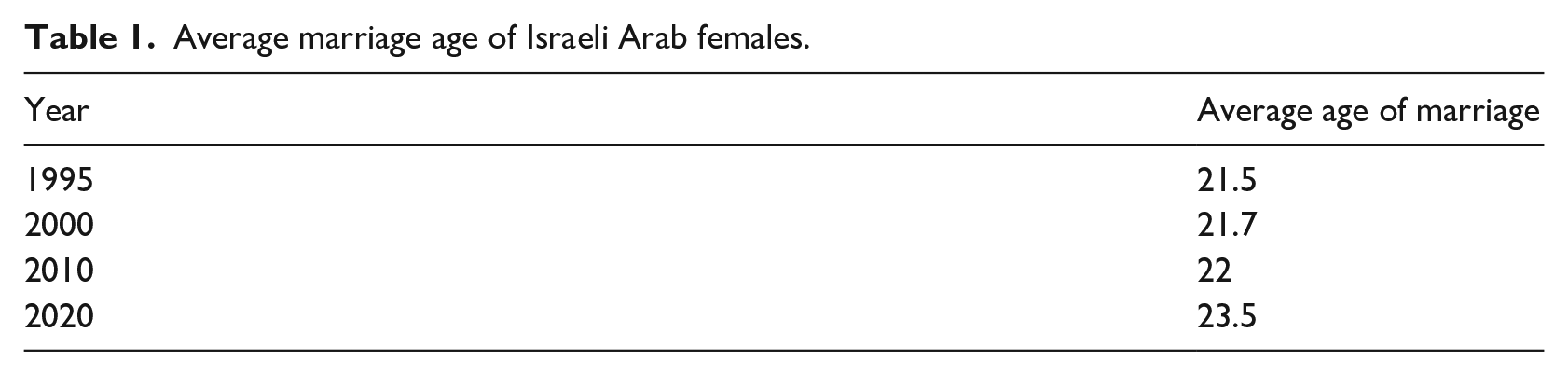
The desire to fulfill the act of marriage starts at an early age. In Arab traditional societies in general, postponing marriage to a later age can only be accepted if there are good reasons for doing so (Harkness, 2020; Kislev, 2022; Lari, 2022; Wang and Kassam, 2016). Early marriage often makes women financially dependent on their husbands and on their husbands’ families. This restricts their options in terms of higher education and career opportunities. Societal expectations concerning marriage prioritize family obligations of having offspring and caring for the home over individual aspirations for education and employment. Marriage and the completion of the relationship at a later age (especially among women) are not socially accepted if it is the result of academic studies or the acquisition of a profession. Consequently, women with less education marry earlier, thus fulfilling family and social expectations. On the other hand, educated women who did not marry early enough find it difficult to marry an educated man like them and might therefore remain single (Sabbah-Karkaby and Stier, 2017). Table 1: Average marriage age of Israeli Arab females shows the trend of postponing the wedding age in Arab families. The data is according to the Israeli Central Bureau of Statistics.
Average marriage age of Israeli Arab females.
After the wedding
After marriage, social norms and generally accepted social rules are strictly observed. These rules were established by previous generations, but they are binding on the young members of the social group. For example, for generations, the husband’s role in the Arab family has been to be the breadwinner and head of the family, while the wife was defined as belonging to her husband and being responsible for caring for her children and family. These responsibilities were exclusive to her and, in most cases, were carried out without any help from her spouse. These traditional commitments remain in modern times, even when the wife works outside the home. Even today, it is still accepted in Arab society that women leave their parents’ home after marriage and are placed into the care of their husband’s family home, an event that is often accompanied by serious problems. The move to the husband’s family home, as a long-standing traditional phenomenon, effectively deprives the wife of the possibility of independently choosing her place of residence. The demand that the husband build a house comes together with the demand that the wife move into the same house. Therefore, in contrast to what is customary for most young people in Jewish society, where the couple begins their lives independently in a separate apartment, many wives in Arab society remain under the authority and control of their husband’s parents (El Feki, 2014; Fortier et al., 2018; Haj-Yahia, 2000).
Arab society expects a husband to build a home as a condition for marriage, but not everyone can finance the task. This creates significant economic pressure, especially for those who come from poorer families. Young Arabs find it difficult to obtain bank credit and mortgages; many do not even have regular bank accounts. Since banks are afraid to give out loans or confront Arab landowners in such circumstances, their chances of obtaining a mortgage are very limited. This is why many young couples find themselves dealing with financial pressure and heavy debts (sometimes from relatives or even gray market factors), often severely damaging their relationship (Al Bashir, 2023; Kulik and Rayyan, 2003; Thriwaty, 2016).
According to previous research, women who live in unmixed Arab localities and joint households with their husband’s parents reported close family supervision and family involvement in their children’s education. These women testified that instead of social support, they experienced oppression through their extended family’s imposition of customs, behavioral patterns, and attitudes (Meler, 2017, 2019).
Traditional patriarchal and family control has been found in Arab families in all spheres of life, including dress style, with women unable to voice their opinions. With no dichotomous division between religious and secular customs, after marriage, the woman is often required to wear traditional dresses as part of expressing her identity and culture (Lavee and Katz, 2002). The object of shifting to a more traditional or conservative dress is to demonstrate that the woman has become a man’s wife.
It is noteworthy, however, that Arab women with management duties testify that they changed their dress style to a traditional one in accordance with social expectations in their workplace and that the change gave them a feeling that they gained more dignity and power in their social environment. Moreover, traditional dress allows women to reduce their levels of family and social supervision and thus integrate better into society and the world of employment (Arar and Shapira, 2016; Shapira and Arar, 2017).
Another matter that comes up after marriage is the issue of equality. Despite the general admission that there should be equality between spouses, in practice, men’s behavioral patterns do not allow it, and women are still perceived as inferior. However, studies also indicate that social stratification, education, and income influence the equitable distribution of household duties. Upper-class and middle-class households have a higher tendency toward equality in managing family tasks, while women who belong to the lower class tend to manage the household alone. Accordingly, the higher the education of both the husband and wife, the greater the equality in household duties. In addition, the more educated the woman is, the more involved she becomes in the family’s financial management (Haj-Yahia, 2000; Haj-Yahia and Lavee, 2018; Kulik, 2007; Lavee and Katz, 2002, 2003; Sabbah-Karkabi, 2020, 2022).
For years, the dominant perception in Arab society was that a woman who leaves home for work, particularly in the company of other men, violates her family’s honor and brings shame upon herself (Abu-Baker, 2002, 2016). Even though many Arab women in Israel have integrated into the labor market in recent years, demonstrating courage and strength to break these traditional conventions, the gender limitations of previous generations still prevail. Even now, young Arab Israeli women face frustrating tensions between the desire to pursue an education and a career and the expectations of their community. A successful career requires emotional and financial support from one’s entire family, and when this does not exist, many Arab women prefer domestic peace to the potential for additional income or personal achievements (Abu-Baker, 2002; Bligh and Hitman, 2018; Sa’ar, 2007).
Traditional characteristics of patriarchal society still prevent women’s full integration into the modern labor market after marriage, and even those who do are channeled to specific fields. For example, 35% of Arab working women in Israel are engaged in education and 25% in health services, social services, and welfare. In addition, according to the Central Bureau of Statistics, most are employed in the local Arab environment, where opportunities for promotion and mobility are inherently limited. The result is that despite significant tendencies toward change in the field of employment, Arab women in Israel still have one of the lowest rates of participation in the paid labor force in the world, contrasting markedly with the situation of their Jewish counterparts, whose participation in the labor market is considered very high (Bligh and Hitman, 2018).
Consequently, clashes often occur after marriage, with conflicts and internal arguments in the family. The transition of women into a coercive framework of a marriage that denies them their freedom of choice leads to family tensions. These conflicts, at times, translate into violence, with women forced to flee their homes. Although not all occurrences of violence are necessarily reported, many women have even lost their lives. The number of femicides in Arab Israeli society during the decade from 2011 to 2020 peaked at almost 100 women murdered by their husbands or by other male family members every year. Studies of these many cases indicate that a common motive was the woman’s decision to pursue independence (Benita, 2017; Kayan Feminist Organization, 2021).
One reaction to this phenomenon is a growing number of cases where women do not agree to countenance violence within the marriage framework and prefer to divorce at an early stage, that is, before children are born. As a result, the divorce rate among young Muslims has risen dramatically. The Central Bureau of Statistics reports that out of 11,477 Muslim couples who were married in Israel in 2020, by the end of 2022, 2386 had divorced (almost 21%).
Methodology
This study is a component of a broader investigation into the Arab society in Israel, emphasizing historical and sociological aspects, particularly focusing on a generational cohort of young individuals born in the late 1980s and early 1990s, who are anticipated to assume leadership roles within the Arab community in Israel soon. Predominantly, this cohort consists of descendants and survivors of Arabs who remained within the boundaries defined by Israel after the 1948 Arab Israeli war. As of 2023, Muslims constitute the largest religious minority in Israel, making up 18% of the nation’s total populace (Robinson, 2023). As the Arab society is diverse with significant differences among its segments, this study solely focused on a portion of the Arab society (the Muslim and Christian communities residing in northern and central regions), excluding other populations such as the Druze community, the Bedouin population in the south, or Eastern Jerusalem residents. These excluded populations tend to be more traditional and conservative, likely yielding different findings. Moreover, the research targeted the younger generation within the Arab society in Israel, with the interviewed women being relatively young. Within the defined research population, attempts were made to include a wide range of interviewees from various segments of the Arab society based on factors like religion, education, place of residence, and family status.
This study specifically targets young women within this demographic, employing qualitative research methodology guided by the following principles:
Sampling considerations
Considering the varied composition of the Arab population in Israel, our focus was on young individuals hailing from Muslim and Christian communities situated in mixed cities where Jews and Arabs coexist in the northern region of the country. In addition, respondents were selected from the Triangle region, which encompasses Arab towns and villages along the former 1967 border line, positioned in the eastern Sharon plain amid the Samarian foothills and towns, housing locales like Umm al-Fahm and others in the Wadi Ara valley (Cohen, 2010). Consequently, this study excludes young individuals from the Druze communities, Arab residents of East Jerusalem, and young individuals from the Bedouin community residing in the Negev and southern regions. The details of the 25 respondents are portrayed in Table 2: Demographics of the respondents.
Demographics of the respondents.

Sampling means
We selected 25 Muslim and Christian Arab Israeli women using purposeful sampling, which involves the deliberate selection of interviewees who best represent the research population. Purposeful sampling is a common approach in qualitative research, aiming to identify and choose cases that provide rich and relevant information regarding the area of study. While there are various purposeful sampling methods, criterion sampling is often employed in implementation research. This approach involves selecting participants who meet predefined criteria of significance (Moser and Korstjens, 2018; Nyimbili and Nyimbili, 2024). The interviewees were meticulously chosen based on specific criteria, including demographic attributes—Arab young women, Israeli citizens with academic backgrounds. It is crucial to note that participants also needed to demonstrate willingness to engage, integrity and dependability, openness, personal resilience, and a sincere eagerness to contribute to the research, acknowledging its importance.
Among the 25 participants, eight agreed to take part in the study through personal connections, while an additional 17 were sourced through a snowball sampling method. Snowball sampling is a widely utilized technique in qualitative research where researchers commence with a small group of initial contacts (seeds) who meet the research criteria and are invited to participate. These initial participants then suggest other potential participants who also meet the criteria and might be interested in participating, leading to a chain referral process. This method leverages researchers’ social networks to initiate the sampling process, with the participant pool expanding iteratively (Emery et al., 2023; Parker et al., 2019). In this research, the initial eight respondents facilitated the recruitment of the remaining 17 participants through recommendations by the researchers.
In-depth interviews
In qualitative research, in-depth interviews involve engaging individuals in open-ended discussions to uncover fresh perspectives and comprehend social interactions. These interviews represent a unique form of dialogue, specifically a research dialogue, that adheres to its rules and standards. A key aspect of delving into personal experiences is comprehending the language and beliefs of the interviewees. Establishing a conducive interview setting and fostering rapport are crucial in encouraging participants to openly share authentic and insightful narratives (Kvale and Brinkmann, 2008). Consequently, most in-depth interviews in this study were conducted in person, predominantly taking place in cafes, workplaces, and universities. However, some interviews were also carried out via Zoom or phone, upon the interviewees’ preference. The interviews were conducted in Arabic, Hebrew, or a blend of both languages according to the participants’ needs.
We opted to conduct semi-structured in-depth interviews as they provide a balance of structure and adaptability, making them suitable for research with specific objectives aiming for consistent and substantial insights. Initially, we utilized a standard set of questions for each interviewee but allowed for flexibility, ensuring depth while maintaining focus. This semi-structured approach allowed the interviewer to probe further while staying aligned with the main research goals. This adaptable technique facilitated a deep dive into the interviewee’s narration, unveiling unexpected themes and profound insights, capturing the intricacies of personal experiences and perspectives (Kvale and Brinkmann, 2008). Ultimately, all questions, especially those related to the interviewee’s personal narrative, were directed toward addressing the core research inquiry: What impact does marriage have on the lives of young Arab women in Israel concerning employment, education, relationships, and family dynamics?
Analysis method
Qualitative content analysis involves distilling raw data into categories or themes through meticulous inference and interpretation. Employing inductive reasoning, this method entails themes surfacing from data examination and comparison, facilitating a systematic interpretation of interview content. By unveiling patterns, concepts, and overarching themes, this approach enhances understanding and context, aiding in the interpretation of extensive information and offering insights into the analyzed content (Mayring, 2014). One prominent sub-method within content analysis is thematic analysis, characterized by its intuitive nature in exploring patterns within qualitative data. Thematic analysis serves as a valuable tool for comprehending experiences, thoughts, or behaviors apparent in a data set, involving the identification and comprehension of key themes and their interrelations. These themes, which represent overarching categories of shared information related to a research phenomenon, weave a narrative about the various dimensions of that phenomenon (Braun and Clarke, 2022). In our study focusing on the effects of marriage on the lives of young Israeli Arab women, the derived themes actively shape patterns of significance to address the research question.
Thematic analysis aims at three primary objectives: (1) recognizing significant themes within the data, (2) discerning the interconnections among themes and their manifestations in the data, and (3) utilizing themes to yield fresh insights on a specific phenomenon (Nowell et al., 2017). In this study, researchers identified seven themes signifying various aspects that serve as indicators of how marriage impacts the lives of young Arab women: (1) the importance of academic studies as a significant tool before and after marriage; (2) pre-wedding employment and post-wedding restrictions; (3) the effect of postponing the age of marriage; (4) the significance of moving to the husband’s family home; (5) equality in the relationship after marriage; (6) academic degrees or employment as an influential factor in a relationship; and (7) dress as an influential variable affected by the wedding.
Findings
The research engaged women from traditional and conservative families compared to those from more modern backgrounds, including first-generation educated women contrasted with those from educated families. A notable finding is the commonality observed in how the interviewed women navigate their circumstances, employing strategies to navigate between societal expectations aimed at perpetuating traditional female roles and their personal aspirations for learning and growth. In this sense, it can be argued that despite their differences, the interviewed women form a cohesive group. The findings highlight seven main themes that enable us to assess the level of influence marriage has on young Arab women:
The importance of academic studies before and after marriage
Studies and pursuing a prestigious profession have a significant importance in Arab society. Many families dedicate considerable efforts to assist a family member in completing a degree in medicine or engineering. Yara, a resident of a village in the Triangle, testified,
I come from a simple family, all my father’s family members have no degrees, and most of them are engaged in simple jobs. However, they are all proud that they helped my father to study and to become a doctor. They funded all his study expenses abroad, and that is their pride—they have a doctor in the family.
Unexpectedly, this attitude can be found also when referring to young women. Mira, a 27-year-old resident of a village in the north, says,
I come from a relatively simple family; my father can barely read and write, and in the extended family, there are no individuals with academic education. However, from a young age, it was clear that we needed to pursue university studies. When I was accepted to university, the joy at home was as if I had earned a doctorate. My parents’ pride was that their daughters were educated and pursued academic studies.
Indeed, almost all the interviewees counted academic studies as the most important thing for them and insisted that they would never give up studying, even if it came with a personal cost. Sahar, a 23-year-old resident of a village in northern Israel and an undergraduate student at Tel Aviv University, put it this way:
Studies today are the most important thing for us. Many girls choose to study just to get out of the house a little bit. Studies are a legitimate way for us to achieve freedom.
Yusra, a married resident of a village in Wadi ‘Ara, claims,
I think that every family wants their children to learn and encourages their children to learn.
A large portion of the interviewees presented gender expectations as a factor that influences the choice of their field of study. As Nur, a 20-year-old law student, phrased it,
I have always loved mathematics. But when I wanted to study, I was told that as an Arab, I could have nothing to do with studying math and engineering. So, I went to study law in Tel Aviv so I could at least have a profession in the future.
Samah, a 23-year-old resident of a northern village who studies at Tel Aviv University, testified,
Nearly all my friends went to study social sciences, and almost none of them went to study engineering. Many women simply do not believe that their families will allow them to work in industry or that Jews will accept them in high-tech companies, so they all study therapeutic professions or teaching so they can find jobs more easily.
Despite the religious and traditional background that dictates choices in life, the choice whether to stick to a profession one wishes to acquire or to compromise is connected not only with tradition and gender expectations but also with personal considerations that are typical not only for female students and—not necessarily for Arab young women. For example, Halla, a 29-year-old student from Jaffa, told us,
My dream was to become a doctor, but I knew I had no chance of being accepted to study in Israel. I really wanted to study abroad, but I come from a religious family, and my mother did not agree. She explained that it was part of the family’s traditional beliefs, so I gave up on studying medicine. In the end, I stayed in the country and studied biology.
Quite a few young Israeli Arab women go to study in Jordan or the West Bank to postpone the family pressure to get married immediately. Some testify that this choice has to do with their search for an environment that resembles their home, where Arabic is the dominant language, and where they feel a greater sense of security than in Israeli Jewish cities or even in Europe.
Pre-wedding employment and post-wedding restrictions
All the interviewees testified that they worked for a living before their wedding. Some even began working at the age of 17 in their area of residence and then continued their employment in their study area. Mia, a 31-year-old single woman from a village in the north, portrayed some of the difficulties, demonstrating that working is essential for young Arab women, even in situations that may appear unsuitable:
Near my house, there is one of the largest employment areas in the country, full of young men and women who are working there. However, the conditions are appalling, the salary is below the minimum wage, and they do not receive a pension. They are there because they have no other place [to go].
Shirin, a 28-year-old single woman from the north, added,
I worked for several years in a clothing store in a mall. At first, my parents objected, but after they realized that all my friends worked this way, they accepted it.
However, once the marriage takes place, the difficulty of going out to work increases, and some of the women testified how their new family status narrowed the scope of their opportunities. Nariman, a 32-year-old who lives in a village in central Israel, explained,
To fulfill my family and work commitments, I would get up at four o’clock in the morning every day, prepare food for the family, get the kids ready for school, and then go to work. I had to leave work early so I could get back in time to tidy up the house, clean it, and take care of the kids.
This is typical not only for young women who enter the job market but also for those who want to develop an academic career. For example, 36-year-old Rim, a PhD student from Tel Aviv University, stated,
Although I completed an MA degree with honors, I did not continue studying for years. My husband wanted me to raise our girls, and that is what I did. Only now that they are more independent have I found the time for my doctoral studies. [. . .] I do not regret it; some things are more important than one’s personal success!
Generally, both those who try to build a career and those who continue their studies at university find that once they are married, the first duty they must fulfill, regardless of any employment or personal academic development, is to be a wife and a mother at home.
The effect of postponing the age of marriage
Many interviewees presented the delay in marriage age as a factor influencing the existence of personal relationships prior to marriage. Some said they had been in personal relationships prior to marriage, but in most cases, it was kept confidential, and only a few acquaintances knew about the relationship. Sometimes this would be one of the parents and sometimes close friends; however, the individuals’ wider social circle and extended family were usually unaware of the relationship. This was the case, for example, with 28-year-old Inas, who comes from a village near Nazareth:
Everyone in the village knew I had a boyfriend and that we also lived in separate apartments in Tel Aviv, but after a year in Tel Aviv, we moved in together. We did not tell anyone, and my parents kept paying for my apartment even though I was no longer there.
Hadil from Wadi ’Ara, who married after age 30, testified,
I got married at a relatively late age until I found the right guy. I have a 45-year-old sister who is still single because she has not found the right guy for her. Once it was unusual to marry at a late age, today it is less unusual and less frightening for women.
The impact of delaying marriage due to studies was also presented by Jasmine, a 28-year-old single woman from northern Israel:
I studied at Tel Aviv University while my friends, who did not go to university, got married right away. Several years have passed since then, and I am still single and looking for a husband. My friends don’t have a profession or an academic degree, but they already have two or three children.
This is also the case of Mia 31-year-old single woman from a village in the north, who stated, “I am currently focused on my studies and career. I don’t know what price I might have to pay in the future.” However, postponing marriage is not always a result of studies or employment and sometimes stems from social demands. For example, as 38-year-old Najua from Wadi ‘Ara said,
I did not get married because they expected me, as the youngest daughter of the family, to take care of my parents. For me, this commitment to the family was stronger than anything else. So, I did not get married, but I am respected by the family, nevertheless. If I was single for any other reason or divorced, my social status would be very low.
Naturally, postponing marriage and getting married at a later age enables young women to fulfill some of their personal aspirations, but the price is a social one, together with a smaller number of children in the family. Furthermore, as seen above, it does not necessarily come with the ability to concentrate on an academic career in the job market after marriage.
The significance of moving to the husband’s family home
The difficulty of living close to the husband’s family was often raised during the interviews. As 24-year-old May from the northern part of the country testified,
I did not want to move to my husband’s village, but I had no choice. He did not ask me, and I did not express any objection. In my opinion, it was pointless to argue. Even if I objected, no one would have listened to me, so I did not even try to fight it.
Such a situation was echoed by 36-year-old Rim,
It was clear after the marriage that my husband was making sure we had an apartment above his parents’ house. We moved there right after the wedding, but no one asked me [for my opinion]. It was my parents who decided, and we did what we were told.
Proximity to the husband’s family is far from a convenience. As 38-year-old Yusra bluntly put it,
My husband’s family intervenes in everything. I really cannot stand it. His mother is a good wife, but she intervenes in everything, and she thinks she understands everything too.
May, who moved from the north to her husband’s family residence in Tira, an Arab town in central Israel, portrayed how this process begins:
The clash between our young and adult worlds had already begun with the wedding preparations. We wanted a modest wedding with just one celebration. However, no one asked us. Eventually, there were three big events, a lot of money was invested, and there were many arguments between the families. In the north, where I come from, there are different customs from those of my husband’s family in the center of the country, but we had to give in, otherwise the debate would turn into a fight.
The relative freedom that young women in Arab society enjoy before marriage often clashes with domestic traditions and the conservatism of the spouse’s family. Notably, while society is patriarchal, it is also generationally hierarchical; therefore, the pressure does not necessarily come from the husband but rather from his family. This was the case with 33-year-old Fatma, a resident in a small town in Wadi ‘Ara, who recalls the inherent restrictions she experienced following her marriage:
After the wedding, I suddenly felt that I was much more limited. I could no longer go to Tel Aviv alone because if I did, they would talk about me in the village. I could no longer sit with my friends in a café because it was seen as disrespectful. No one told me those things explicitly, but there are things that you figure out on your own, even if they are not said.
The interviewees also revealed that women who lived with high degrees of freedom before their wedding found themselves pressured to change their habits by their new family after the marriage.
Equality in the relationship after marriage
In practice, all the women indicated that they, as women, are those who are entirely responsible for cleaning the house and preparing food, while their husbands are hardly involved in household duties. In most cases, their testimonies indicated that their expectations were different before the wedding, but they got used to seeing the situation as part of married life. As May put it most vividly,
I am a feminist, and it was clear to me that the division of duties at home would be equal. At first, it really was that way, but as time passed, I found myself more and more involved with cleaning the house and tidying up. Today, the division is anything but equal.
37-year-old Lucy offered a somewhat anthropological explanation for this process:
Before the wedding, my husband told me that he would help me with running the house—with cleaning and everything. In practice, he does not do anything at all. At first, he did try to help, but very soon I realized that there was no point in asking for his assistance. He saw his father doing nothing at home, he saw his grandfather behaving the same way, so he is continuing their path!
Notably, the unequal carrying of domestic burdens existed in all the young women’s testimonies, regardless of their level of education or area of residence.
Academic degrees or employment as an influential factor in a relationship
The level of equality in education between both partners is a significant factor both in the choice of the groom and in the actual decision to marry, as indicated by the statements of many interviewees. Halla from Jaffa referred to choosing the appropriate partner for marriage:
The aspiration is that both partners will be at the same level, with the husband being in the same academic and financial situation as you, there is more opportunity for family balance. I want a husband who will assist me and help me advance myself. I will support him, and he will support me. I believe in the saying that behind every successful woman, there should be a man who encourages her, a partner who allows for balance between home and career.
However, at times, the decision-making process related to the education of the intended spouse can lead to tensions and even delays in the actual occurrence of the wedding. Abir, an unmarried scholar over the age of 30 who lives in Haifa, told us,
Despite the heavy pressure from my family that I should already find a groom, I am not rushing; I must find someone who suits me. We no longer live in the past like previous generations who only thought about the wedding. I am not willing to marry just anyone to say that I am married.
In cases where educational considerations are not taken into account, detrimental outcomes can occur. Nur from a Triangle village claims,
I have a few friends who have divorced; in most cases, they separated shortly after marriage due to a significant disparity in education between them and their husbands. Most of my friends were educated, and they married men who did not always successfully complete their high school studies. Immediately after the wedding, they noticed the gap. Following the initial excitement of the event, they suddenly realized the mistake and left before having children.
On the other hand, many times the interviewees also testify to a process of compromise, of concession, and of marriages that do not necessarily highlight the educational gap. Rim, a bachelor from a village in the north, told us that
I see most of my friends who studied with me at university. Almost all of them are already married. Many of them married men who are less intelligent and less educated than they are. So why did they marry them anyway? It seems to be family pressure and fear of remaining single.
Some of the interviewees’ testimonies point out that academic studies have a negative impact on a woman’s prospects of building a family. Yusra, a 38-year-old doctoral student, remembering the days before she was married, said,
The fact that I was an academic and worked in Tel Aviv brought a lot of respect, but it also brought a lot of fear. My family was afraid that nobody would want to marry me because I represented a strong, educated woman.
Similarly, Maya, an academic who lives in a village in the north, said,
I am 31 years old and still single. I have already completed two academic degrees. I am under no pressure to get married, but people around me are already starting to ask what’s going on. The subject did not come up until about two years ago, but now we are starting to get stressed at home. I am not willing to settle for someone who is not as educated as I am, and that is probably why I will not get married anytime soon.
Unlike in Maya’s case, the desire for a wedding and environmental pressure often leads to making compromises for a partner. Shirin, still single at 28, said in this regard,
Most of my friends are married. I don’t think they got married out of love or their own independent choice. Many of them chose to get married because of family pressure and the fear of staying single.
Overall, there is tension between the young women’s desire and ability to develop on a personal level and the costs that such personal advances might have at the family level.
Dress as an influential variable affected by the wedding
One of the most significant issues raised in the interviews was the change in the style of dress among young Arab women with their transition to a large city for academic studies. Arriving in a new modern world prompted a switch in clothes, as portrayed by 26-year-old Samah, who left a northern village to study in Tel Aviv:
At school, all my good friends from the village came to the big city, and suddenly they started changing their clothes, putting on makeup, and going out with guys. I really saw how they behave in one way in Tel Aviv, and then at home, they are completely different.
However, exposure to modern society also draws other reactions in defense of traditional culture, as revealed by Iman, a 24-year-old student:
During their university studies, some of the girls began to dress in a more Western way, but there were also others who, precisely because they were in Jewish surroundings, chose to emphasize their Arabness by wearing a headscarf despite not being religious at all.
Another motivation for young women who are studying or forming a career to turn to traditional clothes is fear of their home environment. When 28-year-old Shirin goes to her village in the north, she dresses traditionally because
Many times, a single girl at an advanced age like me is viewed as problematic and can be bullied. That is why, in the past year, I’ve started dressing more traditionally when I am in an Arab environment, not with a headscarf, but with more modest clothes. It is like telling society around me that I am OK!
Fatma, a 33-year-old mother originally from northern Israel who now lives with her husband’s family in a small town in Wadi ‘Ara, told a story that reflects the clash between personal free will and the ramifications of fulfilling the custom of moving to the husband’s family residence after marriage:
I never wore traditional dress, nor did I intend to do so. It was clear to my husband that I would continue to dress just the way I wanted, whether we were married or not. However, shortly after we moved to his town, his mother started asking why I dressed provocatively. She bullied me until I realized I had no choice and started wearing a headscarf. At first, I was very angry about the whole thing, but somehow, I got used to it.
It can be concluded, then, that the discourse concerning women’s dress symbolizes a triangle of tensions between the individual woman’s desire to be free, supported by the academic environment, the dress that represents the traditional origins of the Arab society where the young woman came from, and the necessary compromises of marriage life.
Discussion
This paper focuses on how marriage affects the personal development of Israeli Arab women in terms of higher education and employment. At the center of our study were Millennial Muslim and Christian Arab women, aged 22 to 37, residing in northern and central Israel. The research aims to examine the impact of marriage and education on their lives, considering their unique personal and social characteristics. The seven identified themes suggest that marriage serves as a critical juncture for Arab women in Israel, often conflicting with their aspirations to complete higher education. Across various societies, both Western and non-Western, entrenched gender norms can hinder women’s progress. Yet, even in contexts where these norms loosen, lingering societal and psychological factors persist, frequently propelling young women into personal quandaries (Bosak et al., 2017; Cuddy et al., 2015; Garnham and Oakhill, 2015; Tabassum and Nayak, 2021). In essence, as evidenced by this study, the notable advancements made by women in Arab Israeli society frequently stall post-marriage. Only a select few continue to progress post-nuptials. Many women opt to cease working altogether or transition to part-time employment, abandon their academic pursuits, depart from their familiar surroundings, and relocate to their husband’s familial residence. Following marriage, numerous ambitious young women encounter roadblocks that impede personal development (Zahidi, 2022).
This research began by examining the concept of gender role orientation, a prevalent aspect in societies worldwide. In societies characterized by more traditional norms, such as the Arab Israeli community, gender role orientation holds greater significance, making the achievement of work–life balance more challenging. Through the lens of these theoretical frameworks, we identified scenarios in Israeli Arab society where women may prioritize their personal aspirations over marriage, either postponing it or opting for an earlier union. Nonetheless, the fundamental dilemma persists for them regardless of the path they choose.
Arab society in Israel has made a few significant strides in recent years regarding the status of women. Today, there are many more young women with academic degrees, and Arab Israeli women are trailblazers in many fields of employment and society. As revealed in the interviews in this research, as well as in other studies, integration into academia is a significant stage for young Arab women when, after years of close social supervision, they are given the opportunity for the first time to experience a space that is significantly different from the environment from which they came (Ali, 2013; Gali Cinamon et al., 2016). These women experience liberation from family chains and patriarchal control. They gain independence and self-empowerment and, in quite a few cases, develop a new feminine identity that allows them to integrate better into general society. Both women and their families understand that higher education plays a significant role in the development of human capital. Learning and education free them from the shackles of tradition and conservatism; they acquire knowledge and skills for life, cultivate independent thinking, and shape new worldviews as part of their preparation for the global labor market. This is why many more women attend university and college than men in Israel (Mandel and Birgier, 2016).
However, as this study has indicated, the rise in feminist discourse in Arab society in recent years has not fully brought about the desired change, and many still have traditional perceptions about the employment of Arab women. On the one hand, there is an expectation that they contribute to the family economy, but on the other hand, the traditional chains still exist. While Arab men have complete freedom in terms of professional, social, and political employment, women are forced to conform to accepted social expectations. In many cases in Arab society, freedom, personal development, and liberation from social conventions end with marriage. The Arab woman’s loss of independence sometimes occurs immediately after marriage. Their transition to their new husband’s home is a very significant stage for many young women because, after a period in which they gain relative independence, they lose it again. After the wedding, they are placed once more under pressure and restrictions. The wedding, with all its importance in traditional Arab society, is often a significant burden on the young couple. Thus, after marriage, many women lose the ability to integrate into society academically and occupationally and instead adapt to traditional demands.
Consequently, the reaction is an increase in the termination or postponement of academic studies, a transition to employment close to home, and an acceptance of the social demand that a woman’s role is to manage the home while the husband is responsible for the family’s livelihood. Even within the home, the process of liberation and feminism that started to develop in adolescence often stops. For the most part, the division of duties at home is unequal. The woman is the one who does the housework and raises the children, whereas the man is hardly involved. Women who do work, in most cases, do not work in the profession they studied but engage in traditional professions such as education and social care. Those unwilling to accept the social demands of their families remain single until a late age, divorce, or refrain from marriage entirely.
In sum, as this study has shown, women’s impressive steps forward in Arab Israeli society stop abruptly with marriage. Only a small fraction of them decide to pursue personal progress and advancement after marriage. Many women stop working or move to work part-time, skip their academic studies, leave their familiar living environment, and move into their husband’s family home. After marriage, many ambitious young women find themselves at a dead end that prevents them from personal growth (Kraus and Yonay, 2016; Mandel and Birgier, 2016).
To borrow terms from the field of psychology, the reaction of Arab women can be seen as dealing with danger. Many adopt the fight or flight response, meaning they either give up their aspirations and align themselves with social and family demands (flight) or give up or postpone the wedding (fight). According to our findings, most women give up their personal battle for independence. They act according to traditional, binding demands that see them as a man’s wife and responsible for the home.
Most married women in this study did not express frustration or disagreement with the limitations that marriage imposed on them. They are aware of the limitations that getting married and entering a mandatory family framework create but handle these with acceptance and, in most cases, without frustration. The married women in the study demonstrated their acceptance of the situation and explained that there is no choice; this is how society behaves, and this is what is acceptable for a man’s wife.
The few women who do fight are those who choose not to enter a restrictive relationship or divorce (a phenomenon that has been gaining momentum in recent years, as mentioned above). These women understand that to develop an independent career and be free in thought, employment, and even the way they dress, they must be alone. Indeed, many of the single women in this study are college-educated women in their thirties who are not yet married. They want to get married and suffer from family and environmental pressure to do so, but they are not willing to give up their principles and or compromise on the quality of their partner. This is also why many were forced to leave their parents’ homes to live independently in major cities.
This study also found that these women prefer not to get married (or do not try to get married). Although some of them have already passed the age of 30, which is considered very old for a single woman in Arab society, they did not sound stressed or desperate about their family situation. Some who have already married choose to break up the family at the very beginning of their marital journey. These women expressed their acceptance of the path they chose, aware of the heavy social price they would pay upon receiving the status of newly single or a divorcee.
However, these women are still few in the Arab environment in Israel. Most young women give up the personal war for independence, give up their professional and academic aspirations, and accept social and family demands. The passion for success and advancement that characterizes Arab women at a young age before marriage is replaced by a deep acceptance of the concept that raising a family according to traditional norms is the only way.
Nevertheless, one should also point out that in recent years, many more women have been undertaking academic studies, many young women leave home during their studies, and some even study abroad. Many work in malls or industrial centers in Jewish communities, quite a few go on vacations throughout the country and around the world, and their dress is much more Western and modern. Nonetheless, while Westernization is a crucial factor, it alone may not be adequate. Discussing women’s capacity to navigate personal and family-career challenges in scholarly publications and educational materials and showcasing successful young female role models who have surmounted pivotal obstacles in their lives, can foster a heightened self-awareness among other women regarding their personal freedoms and entitlements. This holds true across all societies, including particularly traditional ones such as the Arab Israeli community.
Alongside recommendations for action and advocating recognition of the researched subject, it is important to acknowledge the research limitations. This study focuses solely on one sector of Arab society in Israel and does not encompass other segments within this society such as the Bedouins in the Negev and the North, Druze communities, and the residents of East Jerusalem. Furthermore, the research concentrates only on youth, without conducting interviews with their parents to cross-reference information and gain feedback on the societal changes taking place. Future research should therefore also examine other groups within Arab society in Israel. In addition, future research should closely examine the extent to which the social phenomena analyzed (gender role orientation and life-work balance) manifest themselves—both within other groups and in various aspects of life. In other words, future research should include, for example, the employment patterns and work of Arab women in different workplaces in the economy.
Overall, this study demonstrated how marriage impacts the personal progress of Israeli Arab women in the areas of higher education and employment. Unlike other research that addresses the broader challenges faced by Arab women in achieving personal fulfillment amid demanding family lives, our study specifically examined marriage as a pivotal moment in the lives of young Arab Israeli women. After conducting in-depth interviews, we concluded that traditional marriage tends to have a negative effect on women’s personal futures. However, we also found a hopeful aspect: the interviews highlighted a strong awareness among young Arab women of their personal rights and freedoms, which is undoubtedly a crucial first step toward their continued advancement in academia, the economy, and society.
Footnotes
Funding
The author(s) received no financial support for the research, authorship, and/or publication of this article.
