




Abstract
This study deploys the ecolinguistics perspective to examine how purposively selected signs communicate environmental conservation issues in the city of Bulawayo as a linguistic landscape construction. Drawing on Haugen’s language ecology model and Halliday’s eco-discursive approach, the study reveals that the dominance of English and the invisibility of indigenous languages violate an inclusive ecosophy couched on principles of diversity and harmony, interaction and coexistence. The study also reveals an ecological orientation that is both beneficial and ambivalent. We therefore recommend the inclusion of indigenous languages and the framing of more eco-beneficial messages that foreground the benefit of positive environmental stewardship.
Keywords
Introduction
Although environmental conservation debates have occupied the minds of scholars for some time, the impending ecological catastrophe emanating from climate change has placed greater importance on environmental conservation awareness now more than ever (Cheng, 2022; Ponton, 2023). Following the stark warning that failure by the current generation to effectively curtail the course of climate change could occasion permanent damage to the environment and a loss of terrestrial and marine species (Ponton, 2023), environmental awareness campaigns have increasingly become salient aspects of climate change mitigating initiatives (Corner and Randall, 2011). Understanding the contribution of linguistics towards this endeavour has often been peripheral, despite language being the pre-eminent channel for the dissemination of environmental knowledge and communication (Harrison, 2023; LeVasseur, 2015). The language(s) through which environmental awareness campaigns are packaged has implications not just for the reach of the messages, but also for ‘shaping our understanding of ecological issues and influencing actions towards sustainability’ (Prodanovska-Poposka, 2024: 458). In urban areas, industrialisation and other human activities such as recreation, transportation and urbanisation-associated processes often lead to environmental degradation and pollution. As most urban areas are language-saturated environments (Siziba and Maseko, 2024), how language is used to communicate, regulate and educate about the environment can mitigate or exacerbate environmental challenges. As noted by Poole (2018), the current earth’s precarious environmental status is intricately linked to ‘language practices and discourses that are situated and embedded within a complex of cultural, social, historical, and geographical networks’ (Poole, 2018: 525). The notion of language practices is a component of Spolsky’s tripartite model of language policy which relates to what people do with language as opposed to what they believe should be done (Spolsky, 2004). To this end, an area’s linguistic landscape – the language that is inscribed on visible public signs (Gorter, 2023; Gorter and Cenoz, 2023; Ivkovic and Lotherington, 2009) is a critical feature that can positively or negatively impact environmental stewardship.
In multilingual contexts, how environmental awareness messages on the linguistic landscape resonate with citizens is not only a function of language choice. It is also linked to how the urgency and gravity of the crisis are framed (Corner and Randall, 2011; Prodanovska-Poposka, 2024). The ecological turn of the 21st century (Cheng, 2022; LeVasseur, 2015) has thus begun to spotlight the contribution of linguistics in influencing sustainable environmental practices (Corner and Randall, 2011; Prodanovska-Poposka, 2024), a dimension referred to as ecolinguistics. While studies that examine the interaction between humans and the environment have infiltrated a range of research fields, capturing the interdisciplinary efforts of geographers, biologists, social scientists and environmental activists (Ruijie and Wei, 2021), linguistic landscape and ecolinguistics studies have been growing as separate fields (Yi, 2019). Following Landry and Bourhis’ (1997) conceptualisation of the linguistic landscape, the majority of studies have focused on how language representation on billboard advertisements, entertainment posters, shop signs, street names and public buildings is shaped by extra-linguistic systems to index power relations and the existence of multilingualism or the extent of its acknowledgement (Gorter, 2013; Hong, 2020; Ndlovu, 2023; Siziba and Maseko, 2024). The linguistic dimensions of the global environmental crisis have largely been overlooked (Yi, 2019). On the other hand, ecolinguistics has mainly approached the crisis through the analysis of media discourses, consequently overlooking the resources in public space (Yi, 2019). There is therefore a dearth of studies that link ecolinguistics and the linguistic landscape to examine how environmental conservation messages imprinted on the linguistic landscape may shape perceptions about the urgency of the environmental crisis and galvanise citizens towards collective action (Prodanovska-Poposka, 2024).
To address this gap, this study integrates ecolinguistics and the linguistic landscape perspectives to examine how purposively selected environmental conservation signs on the linguistic landscape of Bulawayo’s Central Business District (CBD) communicate the environmental crisis at a local level. Analytically, we draw on Haugen’s (1972) language ecology model and Halliday’s (1990) eco-discursive approach to examine the representation of linguistic diversity and framing of messages respectively. We argue that the absence of linguistic diversity on the linguistic landscape risks promoting a perception of environmental stewardship as an elitist endeavour not resonating with speakers of excluded languages. We also show how the choice of certain words and phrases on the linguistic landscape frames environmental conservation as both an individual and collective responsibility. Additionally, the study reveals how different orientations towards environmental conservation can be read from how messages are framed. The study sought to answer the following research questions:
How is linguistic diversity imprinted on the Bulawayo CBD as an ecolinguistic landscape construction?
What environmental orientations can be read from the framing of messages on the ecolinguistic landscape?
What implications do these language practices have for environmental sustainability?
Inclusive of this introduction, this article is divided into seven main sections. The next section is a brief discussion of the research context. It is followed by a discussion of the theoretical toolkit undergirding the study. We then provide a review of related literature, followed by a discussion on the adopted data collection and analysis approach. The penultimate section is the presentation and discussion of findings, followed lastly, by the conclusion and recommendations.
Research context
Environmental awareness and conservation campaigns have gained prominence in Zimbabwe recently. This growth is a response to increasing environmental degradation partly occasioned by the chaotic fast-track land reform programme, uncontrolled artisanal mining and rapid urbanisation (Montana and Mlambo, 2019; Moyo et al., 2015). While previous environmental programmes such as CAMPFIRE focused on the conservation of natural resources in rural areas (Clifford et al., 2015), there is a noticeable shift by the present government to curtail environmental degradation and pollution caused by the collapse of service delivery and solid waste management in urban areas (Makwara and Magudu, 2013). One of the flagship programmes of the so-called ‘new dispensation’ 1 under the presidency of Emmerson Mnangagwa was the introduction of the National Clean-up Campaign in 2018. As a commitment to upholding environmental rights and freedoms provided for in section 73 of the constitution of Zimbabwe, the president declared every first Friday of each calendar month as a ‘National Clean-Up Day.’ The campaign is meant to complement the work of existing government agencies such as the Environmental Management Agency (EMA) and municipal organs tasked with environmental protection and conservation. The national clean-up programme has since cascaded to local authorities, with the Bulawayo City Council (BCC) adopting its own format. The recently elected Mayor, Councillor David Coltart has sought to reinvigorate the campaign by spearheading a BCC-led programme to rid the CBD and suburbs of accumulated waste. 2
Since the launch of the BCC campaign in October 2023, there has been increasing visibility of environmental awareness and conservation messages on Bulawayo’s linguistic landscape. As part of the linguistic landscape, the city’s environmental awareness campaigns supply yet another avenue through which to harness its linguistic diversity as part of a broader goal of fostering environmental stewardship and the realisation of sustainable environmental practices. How language is used in the city’s environmental campaigns is not only important as a window into attitudes towards multilingualism, but it can also significantly influence public understanding and engagement with sustainability programmes (Prodanovska-Poposka, 2024).
Bulawayo is Zimbabwe’s second-largest city. It is renowned for its history as the former seat and capital of the last Ndebele monarch led by King Lobengula. The city of Bulawayo is therefore synonymous with the Ndebele people, language and culture (Dube, 2018; Ndlovu, 2023; Siziba and Maseko, 2024). Bulawayo is also recognised for its contribution to the country’s economy as one of the earliest colonial cities to be industrialised in Southern Africa (Msindo, 2007). As an industrial city, it drew its labour force from across the country and region, thus later evolving into a diverse ethnic and cultural urban agglomeration that accommodates local groups such as the Shona, Kalanga, Venda, and Sotho, among others. Contemporary Bulawayo is also home to immigrants and descendants of immigrants from neighbouring countries such as Zambia and Malawi, who settled for employment (Msindo, 2007). Despite its cosmopolitan reality, the BCC has tried to preserve the city’s Ndebele linguistic and cultural essence. This is evident from its various programmes to imprint and foreground Ndebele cultural symbols on the city’s linguistic landscape such as the naming and remaining of streets and buildings after Ndebele heroes and icons among other endeavours (Dube, 2018).
Ecolinguistics and the linguistic landscape: An eclectic theoretical toolkit
Ecolinguistics is a relatively new and interdisciplinary research field (Rahardi, 2023). Its emergence coincided with the ecological turn to appreciate the place and role of language in mitigating the ecological crisis (Cheng, 2022). The basic premise of ecolinguistics regards ‘the survival of life on earth and key philosophical questions hitherto underacknowledged by mainstream science’ (Ponton, 2023: 797). As a theoretical precept, it draws on Haugen’s language ecology model (Haugen, 1972) and Halliday’s eco-discursive approach (Halliday, 1990; Halliday and Matthiessen, 2014) to explain the interaction between language and the natural world (LeVasseur, 2015; Yi, 2019). Since its emergence in the 1990s, the term ecolinguistics has tended to assume a polysemic character to mean different things to different people (Ruijie and Wei, 2021; Yi, 2019). Notwithstanding these differences, there is consensus among scholars that the concept is undergirded by the ideas of Einar Haugen and Michael Halliday (Prodanovska-Poposka, 2024; Rahardi, 2023; Ruijie and Wei, 2021). Accordingly, the terms ‘ecology of language’ and ‘language ecology’ permeate all ecolinguistics approaches (Jocuns, 2019). In line with the ‘Haugenian tradition,’ ecolinguistics recognises language as being part of a larger environment which comprises an ecological system made up of languages spoken in society, including languages interacting within the mind of the speaker (Derni, 2008; LeVasseur, 2015). These languages form ‘part of a larger ecology of individual-society-social forces-natural environment, all of which mutually interact with and shape one another at multiple scales’ (LeVasseur, 2015: 22).
On the other hand, the Hallidayan approach seeks to establish a link between biological ecology, ecological, and environmental problems and language (LeVasseur, 2015). By elaborating on Haugen’s ideas, it seeks to expose how discursive strategies and practices can aggravate or alleviate the environmental crisis (Ruijie and Wei, 2021). The Hallidayan approach deploys ‘principles of Critical Discourse Analysis and Positive Discourse Analysis to analyse the ecological discourse’ (Cheng, 2022: 189). It takes an ‘eco-critical’ stance to reveal how various forms of environmental degradation can be attributed to how language is used to talk about it, especially in contemporary media (LeVasseur, 2015). The tendency of the media to be saturated ‘by discourses promoting consumerism and material growth’ presents it as a site for ecological critiques (Chen, 2016). The Hallidayan approach therefore assumes a functionalist posture that is premised on the view of language as ‘anthropocentric’, thus making it partially ‘responsible for human being’s unecological conducts’ (Chen, 2016: 110). Along the Hallidayan Systemic Functional Linguistics (Halliday and Matthiessen, 2014) this approach is useful to unmask ecological orientations encoded in language choices and how particular propositions reproduce or contradict the guiding ecosophy of ‘Diversity and Harmony, Interaction and Co-existence’ (Cheng, 2022: 189). The term ‘ecosophy’ refers to a philosophy of ecological harmony that reveals orientations towards a state of affairs (Cheng, 2022). In our study, this ecosophy relates to value judgements attached to particular ways of using language and what they reveal about the orientations towards environmental conservation. This value judgement allows us to expose these orientations as ‘eco-beneficial, eco-destructive or eco-ambivalent’ (Cheng, 2022: 30). In line with the foregoing, discourses that promote and align with an ecosophy are evaluated as eco-beneficial, while those that violate this ecosophy are subjectively judged as eco-destructive. Accordingly, an ambivalent orientation assumes a neutral posture that neither violates nor aligns with an ecosophy (Cheng, 2022). For our study, we consider these orientations as inalienable features of an ecolinguistic landscape, that is, the inscription of environmental conservation discourses on the linguistic landscape.
The concept of the linguistic landscape is often attributed to the pioneering work of Landry and Bourhis who defined it as ‘the visibility and salience of languages on public and commercial signs in a given territory or region’ (Landry and Bourhis, 1997, p. 23). It applies to both official top-down signs put up by a central government, a municipality or other related authorities (Hult, 2018; Shohamy, 2006) and unofficial bottom-up signs erected by commercial enterprises, private organisations or individuals (Gorter, 2006). A reconceptualisation of the linguistic landscape to include ‘the motives, uses, ideologies, language varieties and contestations of multiple forms of ‘languages’ as they are displayed in public spaces’ (Gorter, 2018: 4) has been proffered. This facilitates an understanding of the linguistic landscape as not randomly generated but as being a product of language ideologies intersecting with language policies and the general communicative needs of a given territory (Albury, 2021). The linguistic landscape therefore creates impressions about the attendant power relations between languages that are foregrounded or backgrounded on the signs, thus supplying important cues about the area’s linguistic ecology and attitudes towards linguistic diversity.
In this study, integrating ecolinguistics and the linguistic landscape is productive not only to examine how linguistic diversity is represented in communicating the environmental crisis but also to show how the framing of messages on the signs communicates the urgency of the ecological crisis to solicit an immediate response from residents. In bringing ecolinguistics and the linguistic landscape paradigms into this eclectic theoretical interaction, we take a cue from Yi (2019) who uses the term ‘ecological linguistic landscape’ or ‘ecolinguistics’ to understand how the linguistic landscape provides an important medium towards solving ecological problems. This novel theoretical gesture helps us to make sense of the role of language in environmental conservation in and around Bulawayo CBD as a linguistic landscape construction.
Literature review
Studies on ecolinguistics and linguistic landscapes as unconnected disciplines are generally scarce. Globally, studies that seek to integrate these two approaches are even fewer as the two have been developing as distinct approaches (Yi, 2019). However, this appears to be changing as scholars begin to appreciate the role of the linguistic landscape in promoting inclusive and positive discourses about the environment (Ponton, 2023). Although most of these studies focus on environmental discourses on both fixed and mobile physical linguistic landscapes in various contexts (Jocuns, 2019; Ogunyemi and Bada, 2019; Wang et al., 2021), some have concentrated on the virtual sphere by examining social media discourses about environmental conservation (Ponton, 2023) and language use in government and tourism websites (Isti’anah, 2020). While previous studies have been conducted in various contexts, those focusing on major cities are more dominant (Backhaus, 2006; Kosatica, 2024).
Haugen’s language ecology model and Halliday’s eco-discursive approach have influenced previous studies on ecolinguistics. Inspired by Haugen’s language ecology model, Wang et al., (2021) analysed the linguistic landscape of the ‘Z6801 train on the Qinghai-Tibet Railway’ to examine how it represented the linguistic diversity of Tibet. The study findings revealed a dominance of Tibetan, Chinese and English signs on the linguistic landscape, followed by Tibetan–Chinese bilingual signs, with monolingual Chinese signs occurring less frequently. The study thus concludes that the diversity of languages on the linguistic landscape can help foster an inclusive tourist experience since the Qinghai-Tibet Railway passes through ‘a large number of enchanting uninhabited areas, which attracts tourists from every corner of the globe to take this train’ (Wang et al., 2021: 184). They also show how the design of the logos on the linguistic landscape is integrated with the environment, bringing tourists and passengers into intimate interaction with the environment while riding on the train.
Most Haugenian-inspired studies tend to evaluate language visibility or invisibility on the linguistic landscape as representing the authorities’ orientation towards multilingualism and linguistic diversity since multilingual signs have implications for the reach of the messages contained therein. Jocuns (2019) investigated environmental discourses in a Thai university as a linguistic and geosemiotic landscape. Findings revealed the dominance of English as the language of environmental discourse. While Thai-English signs were also present, English occupied a dominant position as the language of preference on those bilingual signs. Emplacement and the degree of permanence of English signs also indexed authorities’ positive attitudes towards English. In both cases, this practice serves to validate English as the legitimate language of ‘green discourses’, thus reproducing a pattern consistent with the sociolinguistics of globalisation (Jocuns, 2019). The study suggests that signs that implore the reader to perform an action that fosters environmental conservation serve to affirm the university as an environmentally friendly space (Jocuns, 2019). Also focusing on a university context, Ogunyemi and Bada (2019) also reveal the dominance of English in Nigeria. They argue that the non-use of indigenous languages on the ecolinguistic landscape not only devalues them but is also detrimental to the sustainability of bio-cultural diversity (Ogunyemi and Bada, 2019). However, in the case of Jocuns (2019), the voices represented on Thai-English signs serve to illustrate environmental awareness as both a global and local concern, thus encouraging local efforts at sustainable practices.
Also informed by a semiotic approach, Kosatica (2024) illustrates how the emplacement of ‘green semiotic material’ in privileged and valorised spaces as well as politically inflected environmental practices in a German city, dubbed the European Green Capital (Kosatica, 2024) reproduces social inequalities. In particular, Kosatica demonstrates how the tendency of clean-up campaigns and environmental efforts to be intertwined with local politics results in the exclusion of some residents from sustainable practices, thus creating a ‘green space paradox’ (Kosatica, 2024). For example, the study reveals how average-income neighbourhoods with low-value properties rarely benefit from environmental clean-ups. The linguistic landscape of such places is thus dominated by traffic, direction and parking signs without additional text (Kosatica, 2024). Such language practices are thus implicated in environmentally exclusionary practices.
Further demonstrating the interdisciplinary nature of ecolinguistics, Poole, (2018) combined Geographic Information Systems and Corpus Linguistics techniques to examine environmental debates in the United States. Deploying the ecolinguistics framework, Poole (2018) analysed linguistic patterns emerging from a corpus of text gathered from contesting positions between an international mining corporation seeking to build potentially America’s largest open pit copper mine and environmental activists protesting the development. Findings reveal that the divergent ideological positions of the two opposed groups were encoded in each group’s framing of its relationship with the environment. For example, the activists’ naming of specific places, plants and animal species in their communication indexed their intimate connection to the environment, thus justifying their rejection of the mining venture as it would disrupt this relationship. This study demonstrates how language choice in framing debates about environmental protection is key in securing collective consensus on what needs to be done.
Focusing on the ecolinguistics landscape in the virtual space, Isti’anah (2020) sought to evaluate language attitudes as revealed by the ‘eco-lexicon’ used on the Indonesian tourism website. Using textual data drawn for the website, the study revealed how a lexicon that is appreciative of the physical environment tended to dominate the website. This study also suggests that the ecolinguistics paradigm can be applied to understand how environmental stewardship is promoted and encouraged in the virtual linguistic landscape. This allows for environmental conservation messages to reach potential tourists to Indonesia even before they arrive in the physical Indonesian space. Also approaching ecolinguistics from a positive discourse analysis perspective, Ponton (2023) explored public responses to the felling of the Sycamore Gap tree in Northumberland as a case of ‘eco-vandalism’. By examining data drawn from social media and online newspapers, Ponton revealed how social media users and newspaper readers’ mixed reactions towards the felling of the tree correlated with their complex attitudes towards environmental conservation (Ponton, 2023). While some discourses expressed grief, others were indifferent to the felling of the tree, arguing that ‘it was just a tree’ (Ponton, 2023: 807). This study suggests that responses that bemoan the felling of the tree help frame ‘eco-vandalism’ as a tragedy that should be avoided. Such discourses serve to discourage the felling of trees in general.
As evident in the reviewed literature, there is a dearth of ecolinguistics-oriented studies from the African context. The majority of studies are located within the European, Asian and American contexts. The European and American contexts are English-dominated and there is little contestation about linguistic diversity on the linguistic landscape. Within the context of Zimbabwe, ecolinguistics as an approach to examining the linguistic landscape has yet to take off. This study therefore builds on reviewed studies from other contexts to contribute to understanding the implications of linguistic landscape towards environmental awareness by focusing on the city of Bulawayo.
Data collection and analysis
This study adopted a qualitative approach to collect and analyse data. For data collection, the study utilised a common approach used in most linguistic landscape studies (Gorter, 2018). This data consists of digital photographs of environmental awareness and conservation signs placed in multiple sites in the CBD area bounded by Masotsha Ndlovu and 15th Avenues as well as Basch and Parirenyatwa Streets. Some photographs were taken from Bulawayo Centenary Park, whose boundary lies along Parirenyatwa Street. The photographs were taken by the first author using a mobile phone camera. Data collection was done between the 1st to the 17th of March 2024. Gorter (2018) agrees that mobile phone cameras can be used to collect large amounts of linguistic landscape data in a relatively straightforward manner without any sophisticated training required of the linguistic researcher. Because this study sought to incorporate an ecolinguistics approach to the analysis of the linguistic landscape, data collection purposefully focused on those signs that carry messages explicitly related to environmental stewardship. Consistent with the identification of the linguistic landscape unit of analysis as ‘any piece of text within a spatially definable frame [. . .] including anything from small handwritten stickers to huge commercial billboards’ (Backhaus, 2006: 55) our data includes both fixed and semi-fixed signs. Semi-fixed signs were collected from a digital display billboard located strategically across Bulawayo City Hall. Although there are debates on whether transient signs such as texts on moving objects and billboards should be included (Gorter, 2006), we follow the example of previous researchers (e.g., Moriarty, 2014; Wang et al., 2021) who included such signs in their studies. While the City Hall billboard is fixed, it displays rolling signs that change from time to time. Despite this transience, careful observation of the sequence of the signs during the study period allowed the researchers to locate specific signs within definable frames (Backhaus, 2006) that tell an ‘eco-story.’ Digital display billboards now constitute a substantial part of urban landscapes and can no longer be excluded (Gorter, 2018). Since our study does not include any human participants but focuses on public signs, ethical issues relating to data collection did not arise.
The data analysis approach was both thematic and discursive. Following Haugen’s ecology of language approach, we examined the presence or absence of linguistic diversity in the collected signs. We used this to make sense of the orientations towards the linguistic bio-diversity of the city of Bulawayo and extant language ideologies. We thus categorised signs into monolingual or multilingual signs, or as being official top-down or unofficial bottom-up signs (Backhaus, 2006; Gorter, 2006). We also deployed aspects of discourse analysis along the Hallidayan tradition to reveal how readers’ positioning towards eco-conservation may potentially be influenced by the discursive framing of environmental conservation messages. Data analysis was treated as a circular and iterative process that commenced with and proceeded alongside data collection. In presenting data, we use cropped digital photographs as evidence of the linguistic landscape configuration of the research site.
Findings and discussion
Environmental conservation as a top-down endeavour
The study findings reveal that the ecolinguistics landscape in and around Bulawayo CBD is top-down generated. The majority of environmental conservation signs bear the BCC emblem, suggesting that they are part of the city council’s efforts at curbing environmental degradation. Most of the signs are placed in strategic locations in and around the city centre. These locations include intersections between major streets and avenues, the Bulawayo City Hall and the Bulawayo Centenary Park. Besides being written on specific sign boards along pavements, walkways and the vicinity of the park, some environmental conservation messages were also inscribed on visible city features such as rubbish bins placed on street corners. Notably, environmental messaging was not visible in some dirty areas around the city where people openly dump litter. While most of these linguistic landscape structures are municipal property as evinced by the city council emblem, there is a suggestion that some corporate, educational and other interest groups have collaborated with the BCC to promote eco-beneficial practices. Along with the BCC emblem, some environmental awareness campaign banners also bore logos of corporate entities such as Coca-Cola, education institutions such as ‘[ ]MBS NURSERY AND INFANT SCHOOL 3 ’ and the ‘Bulawayo Publicity Association’ (Figure 1). This collaborative dynamic suggests a collective concern for environmental protection by the municipality and these entities. Notably, most of the messages seek to discourage littering.

Top-down and bottom-up collaborative efforts.
The dominance of English and the exclusion of indigenous languages
In terms of representation of linguistic diversity, findings reveal the dominance of English monolingual signs on both the fixed and semi-fixed ecolinguistic landscape. Although contemporary Bulawayo is cosmopolitan, it is perceived to be a Ndebele-dominant city because of its history as the former capital of the Ndebele kingdom (Dube, 2018). However, this historical dimension is also invisible on the ecolinguistic landscape as a strategy to solicit collective environmental stewardship from the dominant linguistic group. All the signs are written in English as shown by the examples in Figure 2.
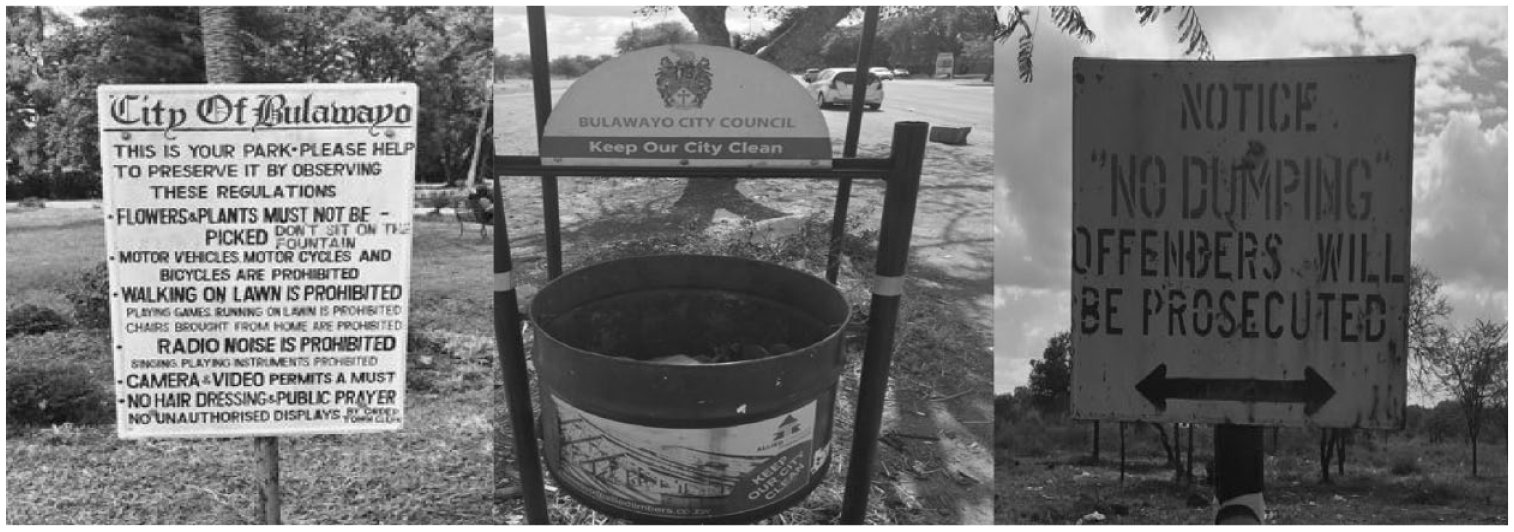
Fixed monolingual English signs.
The signs in Figure 2 are examples of fixed monolingual English signs which saturate the city’s ecolinguistics landscape, contrary to the city’ sociolinguistic realities. Semi-fixed signs on the digital display billboard are also English-dominant. The following frame in Figure 3 is an example of these signs.

Monolingual English signs from a moving frame.
As evident in Figures 1–3, there is a conspicuous absence of indigenous languages for the preference of English. The use of indigenous languages that constitute the language ecology of Bulawayo on the ecolinguistics landscape would be critical not only to ensure these environmental awareness messages are understood by a wider audience, but also to appeal to residents through a language(s) familiar to them. Haugen’s language ecology model explains that an appreciation of language diversity fosters bio-diversity as languages are inextricably linked to the environment. The invisibilisation of indigenous languages thus violates the ecosophy of diversity and harmony, interaction and co-existence (Cheng, 2022). The sole use of English on environmental conservation signs tends to reproduce the ideology of English as the ‘green language’ (Jocuns, 2019), consequently backgrounding and devaluing insights into ecological wisdom that are encoded in indigenous languages. As noted by Prodanovska-Poposka (2024), the use of diverse languages to communicate environmental issues can foster a diverse appreciation of how different languages influence environmental perceptions and behaviour across linguistic communities. Because each language encodes unique nuances, perspectives, and insights about speakers and the environment (Crystal, 2000), metaphors that readily connect language speakers to their environment are better expressed and understood in people’s own mother tongues. They have the potential to create organic bonds between speakers and the environment (Ponton, 2023). Messages on monolingual English signs may not resonate with non-English mother tongue speakers who happen to constitute a majority of Bulawayo, and indeed Zimbabwean residents. The invisibilisation of indigenous languages projects an eco-ambivalent orientation which takes it for granted that all residents of Bulawayo can read and understand English.
These findings resonate with previous studies on the linguistic landscape in Zimbabwe and other African contexts which show the pervasiveness of ideologies that valorise English at the expense of indigenous languages (Akindele, 2011; Siziba and Maseko, 2024; Ssentanda and Ncube, 2023). The disparate representation of linguistic diversity on Bulawayo’s ecolinguistics landscape is likely to foster perceptions of environmental conservation as an alien and elitist notion that does not concern speakers of indigenous languages. Because ‘public signs and semiotic material around sustainability shape environmental values and generate divergent environmental interpretations’ (Kosatica, 2024), the dominance of English and the invisibility of indigenous languages can be interpreted as reproducing a certain political economy which does not have an environmental sustainability intention at its core. Considered this way, this could have eco-destructive effects if such language practices are perceived to be half-hearted. As also suggested by some studies, the dominance of English on the linguistic landscape reproduces enduring post-colonial ideologies that valorise English as the language of power, economy and globalisation at the expense of the communicative needs of local communities (Siziba and Maseko, 2024; Ssentanda and Ncube, 2023). From an ecolinguistics perspective, these practices therefore affirm the ideology of ‘English as the green language’ (Jocuns, 2019).
Framing environmental conservation
From a Hallidayan functionalist perspective, the discursive framing of environmental conservation messages on the linguistic landscape can serve to construct and communicate the urgency of the crisis thus informing collective action (Corner and Randall, 2011). Most environmental messages are framed in an imperative mood to suggest that environmental stewardship is not a matter of choice. As such, every citizen has a responsibility and a duty towards environmental sustainability. Figure 4 exemplifies the framing of sustainable environmental practices as an obligation.
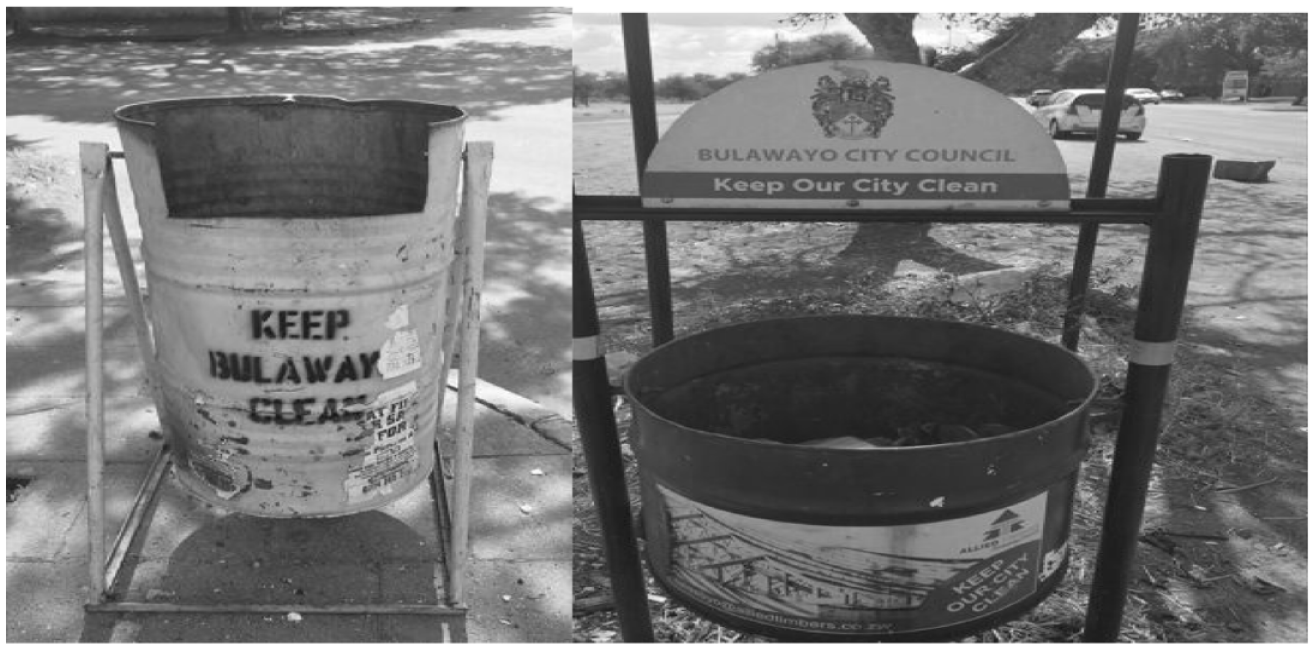
Framing cleanliness as an imperative.
The messages ‘KEEP BULAWAYO CLEAN’ and ‘Keep Our City Clean’ are framed in an instructive mood. These messages are meant to discourage littering as one of the main environmental scourges afflicting Bulawayo as it does other urban centres in Zimbabwe (Moyo et al., 2015). Such messages clearly have an eco-beneficial orientation. The accumulation of solid waste and the mushrooming of illegal dumpsites have been an increasing problem in urban areas of Zimbabwe (Mlilo et al., 2021). By incorporating language that frames littering as a personal responsibility, such messages may result in reduced rates of littering and heightened environmental awareness as was the case with the ‘Keep America Beautiful Campaign initiated in the 1970s’ (Prodanovska-Poposka, 2024: 456). The use of the inclusive possessive marker ‘Our’ in ‘Keep Our City Clean’ cultivates a sense of inclusive and collective responsibility towards environmental protection. Potentially, this inclusive framing is important to change the mindset of ordinary residents ‘to a set-mind where litter [is] everyone’s concern’ (Makwara and Magudu, 2013: 68), thus also suggesting an eco-beneficial mood.
In addition to signs that seek to instil a sense of individual and collective responsibility, some ‘regulatory’ and ‘prohibitive’ signs were found. Signs such as ‘NO DUMPING’ (Figure 2), ‘WALKING ON THE GRASS IS PROHIBITED’ (Figure 5) and those specifying a regime of penalties for violation of environmental protocols (Figure 5) were also found.
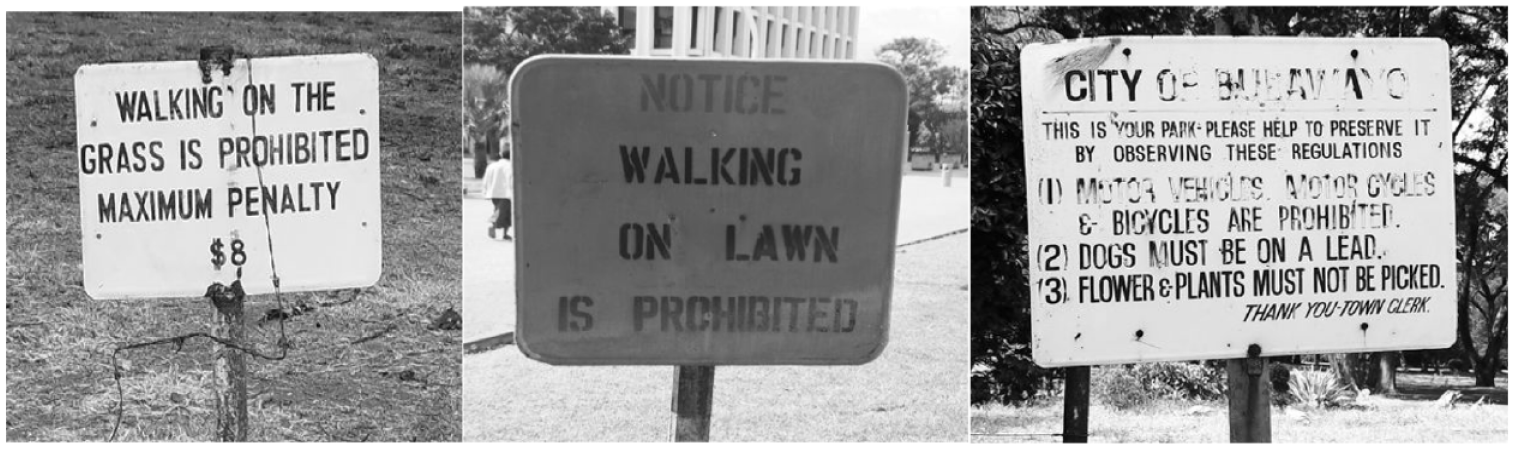
Regulatory and prohibition signs.
Framing environmentally unfriendly behaviour as a ‘punishable offence’ is meant to discourage such behaviour. As evident in Figure 5, these signs also frame environmentally sustainable practices as non-negotiable and non-conformity as criminal (also see Figure 2). Although the language is typically non-persuasive, threats of prosecution (Figure 2) against environmentally unfriendly practices such as illegal garbage dumping have not translated to increased conformity as evinced by the increased illegal dumping of garbage in Bulawayo (Mlilo et al., 2021). Such signs as those shown in Figure 5 encode both eco-beneficial and eco-ambivalent orientations. Their framing in the declarative and imperative moods suggests an eco-beneficial intention, while their lack of persuasive strategies is eco-ambivalent to some degree.
However, persuasive techniques were also evident in how some messages were framed. These signs framed environmental conservation not just as an achievable feat, but also as a rewarding practice. For example, framing a ‘CLEAN CITY’ as a ‘BEAUTIFUL CITY’ (Figure 1) is an eco-beneficial persuasive strategy to encourage sustainable environmental practices and discourage littering. It is everyone’s wish to live in a ‘clean’ and ‘beautiful’ city. In the CBD, littering is also framed as an inexcusable misdemeanour since the city council has provided enough rubbish bins throughout the city. Figure 6 is a sequence of signs taken from the digital display billboard in the city centre to emphasise this point.

Framing littering as inexcusable.
By specifying the excess number of bins in the Bulawayo CBD, the signs emphasise littering as inexcusable. The declaration ‘NO MORE RUBBISH EXCUSES’ in capital letters also serves to emphasise the same point. There is also a sense that ‘RUBBISH EXCUSES’ is used in a condescending and critical sense to deter would-be polluters, thus serving to discourage the act. Together these positive discourses about the environment are made more appealing by foregrounding the tangible benefits of environmental care. In turn, this could entice citizens to voluntarily participate in environmental conservation to achieve their dream of living in ‘a clean and happy city.’ As shown by Prodanovska-Poposka (2024) messages which resonate and align with individuals’ values and emotions are more likely to stimulate environmentally sustainable action than those that solely present factual information.
One of the advantages of the digital display billboard located by the Bulawayo City Hall is its use of ‘storytelling’ techniques that appeal to citizens’ visual and emotional senses. Because the environmental messages are accompanied by pictures depicting the adverse effects of littering, they are likely to discourage it. The littering ‘eyesore’ accompanying these messages serves as a reminder of what could happen to the environment if such environmental advice is not heeded (Figure 7).

Incorporating story-telling technique in environmental messages.
The City of Bulawayo has been grappling with perennial water shortages that have led to the diminishing of its status as the country’s industrial capital. As a result, many manufacturing industries have relocated to Harare. Some environmental signs therefore seek to encourage water-saving practices. Also using the storytelling technique (Corner and Randall, 2011; Prodanovska-Poposka, 2024) on the digital display billboard, the water problem is framed as a solvable crisis that hinges on residents’ cooperation and collaboration. This entails reporting and attending to water loss through pipe leaks. This is shown in the frame in Figure 8.

Framing water crisis as solvable.
Just as littering is also framed as solvable if certain protocols are followed as shown in Figure 7, Bulawayo’s water crisis can be abated if citizens play their part. The framing of water as being ‘worth it’ is also an eco-beneficial persuasive strategy to convince residents to invest their time in identifying and attending to water leakages. These signs suggest that the city council alone cannot solve the water crisis without the active involvement and collaboration of residents. This is likely to invoke a sense of worth and importance within the residents to engage in water-saving practices.
From both a Haugenian and Hallidayan sense, the findings of the study affirm the link between language use and environmentally sustainable practices. An explanation for English dominance relates to post-colonial ideologies that continue to legitimise English as the language of official discourses. English dominance is not unique to the ecolinguistic landscape but pervades other spaces such as street and building names as well as shop signs (Dube, 2018; Ndlovu, 2023; Siziba and Maseko, 2024; Ssentanda and Ncube, 2023). While the dominance of English on the ecolinguistic landscape of Bulawayo confirms ideologies that present it as the ‘green language’ (Jocuns, 2019), it also affirms the marginality of indigenous languages on the linguistic landscape in general (Ndlovu, 2023; Siziba and Maseko, 2024), and environmental awareness messaging in particular. Critically, the mismatch between the language ecology of Bulawayo and language representation on the linguistic landscape de-emphasises linguistic diversity and its potential to foster the promotion of inclusive and equitable environmental conservation efforts (Prodanovska-Poposka, 2024).
Findings have also shown how the ecolinguistic landscape of Bulawayo CBD uses various framing strategies to emphasise the urgency of environmentally sustainable behaviour. To this end, the ecolinguistic landscape is dominated by signs that discourage littering through language that threatens prosecution and fines to deter environmental degradation as well as language that frames environmental stewardship as both an individual and collective responsibility. The potential benefits of environmentally friendly practices are also emphasised in how environmental discourses are framed although such signs are negligible. As shown by Corner and Randall (2011), successful attempts to inspire public engagement with ‘bigger-than-self problems such as climate change must ultimately seek to promote reasons for solving the problem that are rooted in self-transcendent values’ (Corner and Randall, 2011: 1011). Similarly, framing environmental conservation as a rewarding endeavour often correlates with positive environmental behaviour (Corner and Randall, 2011; Prodanovska-Poposka, 2024). Conversely, messages that threaten punitive action such as prosecution or imposition of fines may invoke images of colonial practices especially when conveyed in English. This study thus contributes to the burgeoning literature on the role of language in promoting environmentally friendly practices.
Conclusions and recommendations
This study was limited to examining how environmental conservation messages are imprinted on the linguistic landscape of Bulawayo as a response to the deteriorating environmental situation. Findings reveal the dominance of English and the invisibility of indigenous languages on the ecolinguistic landscape. Using different strategies, these English messages are framed to speak to the urgency of ecological conservation. By using language that projects environmental stewardship as a matter of compulsion for individuals and collective society, the linguistic landscape has positively responded to environmental degradation. By framing sustainability issues in the imperative mood, the linguistic landscape helps construct a narrative that compels residents to commit to environmentally sustainable practices (Ponton, 2023; Prodanovska-Poposka, 2024). However, the study notes that the absence of indigenous languages that intimately connect people to their environment by appealing to their values does a great disservice to the cause of environmental stewardship.
In light of these findings, the study recommends the inclusion of indigenous languages in environmental messaging to align with the linguistic ecology of Bulawayo. Although contemporary Bulawayo has evolved into a multilingual hub incorporating speakers of diverse languages such as Shona, Kalanga, Sotho and other historically marginalised languages of Matabeleland Provinces, a starting point could be the inclusion of Ndebele in environmental messaging, since Bulawayo is perceived to be a Ndebele dominated city (Dube, 2018; Ndlovu, 2023). However, an ideal linguistic landscape should reflect the linguistic diversity of Bulawayo by including all the languages named above. Currently, the dominance of monolingual English signs risks presenting environmental stewardship as an elitist endeavour that does not resonate with ordinary residents. Inclusive environmental practices can be supported by language policies that promote the development of signs that celebrate and foster cross-cultural exchange and collaboration between speakers of different languages. This could serve to affirm and appreciate that different languages encode different worldviews about the environment, and each mother tongue organically connects its speakers to the environment. To this end, the famous quote by the late former South African president, Nelson Mandela that, ‘If you talk to a man in a language he understands, that goes to his head, but If you talk to him in his language, that goes to his heart’ 4 is instructive. It vividly encapsulates the potential benefits of using indigenous languages that resonate emotionally with the majority of residents to promote positive environmental practices. To effectively appeal to the residents’ emotions, there is also a need to use language that foregrounds potential rewards and benefits of environmentally sustainable practices rather than language that threatens punishment for non-conformity. At the time of authoring this paper, EMA had set in motion a proposal for the government to craft a statutory instrument that makes participation in national clean-up day activities mandatory for all citizens. 5 This is probably an opportune time to advocate for a language policy that will mandate the national and local authorities to incorporate indigenous languages in their environmental conservation campaigns.
These findings are not generalisable to the city of Bulawayo as a whole as they are only based on the CBD as a linguistic landscape construction. Therefore, future studies could expand this scope to focus on other areas of the city, including the residential areas. Another study’s limitation is the absence of the voices and perspectives of the city’s residents. Future studies could also examine residents’ perceptions of the environmental conservation messages as well as the treatment of linguistic diversity on the ecolinguistic landscape. This would be useful to understand their responses and stances towards sustainable environmental practices and behaviours.
Footnotes
Declaration of conflicting interests
The authors declared no potential conflicts of interest with respect to the research, authorship, and/or publication of this article.
Funding
The authors received no financial support for the research, authorship, and/or publication of this article.
Ethical approval and informed consent statements
The study does not include any human participants.
Data availability statement
Available data is presented in the article.
