




Abstract
Following the adoption of the Organisation of African Unity -OAU (now African Union -AU) led African-wide border arrangement, which provides for the ‘sacredness’ of the inherited colonial borders in 1964, Nigeria deployed its geographical advantage as an instrument of diplomatic relations in the continent. Drawing from field observation and data collected through key informant interviews with Nigerian border enforcement officials, the study contends that in the quest to explore the inherent benefits of the borders, Nigeria’s border diplomacy has taken two opposing outlooks of nationalism and ‘Pan-Africanism’. It argues that, albeit contradictory, the two border postures follow the same pattern of a state-centric ‘top-down’ approach, which has proven ineffective in arresting the border situation. Thus, in addressing the border challenges to salvage its national security debacle, the study submits that Nigeria must understand its borders’ dynamics while deploying a practicable border diplomatic approach from the ‘below’ that factors the dynamics of its border regions and other non-state/sub-national transborder actors in the country.
Introduction
As theoretically and empirically accentuated, inter-state relations are premised on certain indices, such as trade streams, diplomatic recognition, alliance systems, sociocultural ties, technological advancement and territorial border resources (Starr and Most, 1976; Wanjohi, 2011). Since the emergence of the ‘modern order’ in international relations, geographical borders have become more significant and are regarded as a primary condition for identifying states, promoting transborder cooperation and resolving conflict (Shrestha, 2021; Starr and Most, 1976). Following the African-wide diplomatic border arrangement in line with the principle of uti possidetis in 1964 under the auspices of the Organisation of African Unity (OAU), Nigeria, like other newly independent African states, advanced border diplomacy in terms of ideals, concessions, negotiations, policies and institutional structures to manage its borders for peaceful resolution of disputes and to promote transborder relations (Asiwaju, 1999; Ratner, 1996). Nigeria’s border diplomacy mainly focuses on its immediate neighbours and, by extension, the region. This is, among other things, exemplified through its Africa-focused transborder relations.
Notwithstanding Nigeria’s border diplomatic advances, its borders are laced with cross-border security challenges, such as terrorism, smuggling, banditries, human trafficking, informal trading, and other cross-border illegalities. Over the years, these have ‘trapped’ the country in ideological/policy dilemmas while the challenges persist. Despite Nigeria’s increasing border threats, little is known about how Nigeria’s border diplomatic practices impact its security architecture. Literature in border studies and geopolitics in Africa has largely overlooked the context of border diplomatic practices of states with territorial contiguity, such as Nigeria, and the dimension to which they impinge on its national security. This study, therefore, examines the practice of border diplomacy vis-à-vis its border security challenges. It examines Nigeria’s border practices in Africa. It tests the substance of such border diplomatic practices on Nigeria’s security situation. The study adopts a qualitative research design, including primary and secondary sources. The primary data were collected through field observation and Key Informant Interviews with five border enforcement officials, including two immigration officials, a customs official, a police official and an armed forces personnel. The secondary literature included government papers, geographical reports, and online commentaries/reviews, among other secondary sources. The content-analytic framework is applied to the collected data.
The diplomacy of borders: concept, theory and praxis
Since the inception of the Westphalian international order, territorial borders have bred conditions of cooperation and confrontations (violent and non-violent) between state actors. Aside from the pockets of border disputes/conflicts among nation-states in Africa, Asia, Europe, America and other parts of the world, the two devastating World Wars, which redefined global history and interactions, centred on the question of territorialities (MacMillan, 2003). In essence, borders make states, states make borders, and their engagement variably defines the international structure and its attendant issues (Anderson, 1996). This is so because the relational nature of borders infringes on states’ territorial power (sovereignty) (Shrestha, 2011). However, state’s borders do not exist or are managed without challenges because political regimes (democracies and despotism) and their ideological principles variably impact borders. This informed the conventional state-centric paradigmatic explanation of borders anchored on security imperatives (Deleixhe et al., 2019). The orthodox thinkers see borders as a defensive military frontier that must be protected and fortified to prevent any incursion or aggression from neighbouring countries (Andreas, 2003; Gilpin, 1981). This form of border orientation largely influenced and inspired border engagement in Europe in the 19th and 20th centuries (Brunet-Jailly, 2010). It is a statist form of border practice, on ‘security realism’, which involves using coercive instruments of national power and other ‘necessary means’ to safeguard a state’s territoriality. Following World War II’s end, a new border orientation surfaced which is the liberal school of thought (Moraczewska, 2010). This paradigm sees and explains borders beyond the state-centric view and explanation. Instead, it presents the practice of border from ‘below’, emphasising the place of borderlands and ‘transborder people and other’ non-actors border actors in the making and operationalising transborder policies of a state (Asiwaju, 1993; Hansen, 1985). This school of thought favours a ‘soft approach’ to transborder relations rather than the power-politics option of the classic border thinkers. Strassoldo (1989) described these non-state-centric border thinkers thus:
They are characterised by a new emphasis on the socioeconomic aspects; focussed on integrative, rather than conflictual processes, and on the problems of border people, instead of the nation-states; and are instigated by local authorities and European organisations, rather than by national governments. [They] are policy-oriented (p. 384).
Historically, borders represent a symbol guaranteeing a state’s sovereignty, and every state does all it can to defend and protect its carved territorial domains from incursion or interference from the ‘outsiders’. Borders were traditionally engaged in demarcating a state’s territorial sphere of influence (Brunet-Jailly, 2010). Borders do not only define a state’s territory but also the lives of people, especially those living in the border regions or borderlands in a state (Okunade, 2019). Territorial borders portend hydra-headed influences on the transborder people and the state at large. It can either function as an opportunity for transforming national lives or as a barrier. It can be an instrument of separation or contact (Kolossov, 2012). Border impacts a state’s political, economic and social dynamics. Borders delineate and protect the ‘us’ (insiders) from ‘them’ (outsiders) (Newman, 2003). Newman (2003) explained further that such protection can safeguard the citizens of a country from external aggression/invasion or serve as a barrier against unwholesome infiltrations and illicit cross-border exchanges. According to Afolayan (2000), a border is a line of divides that marks the limit of a country’s legal and sovereign coverage from another. Within this delimitated boundary, nations exercise authority and influence regarding what goes in and comes out of the state. Afolayan explained further that within a geographical sphere, a state has the legal mandate to restrict, accept or ban persons and goods from gaining exit or entry into the country. Contextually, a border is defined as an institution which may or may not be directly located at international border domains such as airports, seaports, borderland or frontier posts, where a state exercises sovereign authority and deploys as an instrument of its policies in interaction with the external environment (other states). Borders are not just physical or invisible line(s) of demarcation known as boundaries or frontiers but also denote a proximate area, which may or may not be located precisely on the frontiers. Borders can be national or international demarcations, but this study focuses on the international border.
On the inherent potentials of geographical borders vis-à-vis inter-state relations, Starr (1975) observed that the proximity of state borders creates risk situations as much as it possesses potential opportunities for international interactions. This is to say that geographical borders have inherent blessings and burdens for a state, and its engagement and management would determine what it unleashes. Starr further noted that if a nation-state is proximate to many other nations, it is likely to experience a high risk of cross-border threats. On the contrary, if two nation-states share no common frontier, they will unlikely have the chance to become involved in border glitches. Boulding (1962) theoretically validates this position in his ‘viability theses’, that a nation-state with proximate neighbours is more likely to be threatened than those with distant neighbours. That is, nation-states that possess many contiguous neighbours, as in the case of Nigeria, are provided with many strategic advantages, but they are also confronted with risks and uncertainties because they must protect and defend themselves against many potential opponents. Starr and Most (1976) also note that nation-states with many proximate neighbours might seek to reduce their risks through diplomatic border means in terms of transborder cooperation, alliance or by an instrument of coercion/force. This is to say that border diplomacy, in terms of bilateral and multilateral partnerships, collaboration and other means, is essential in turning the potential risks of a state’s territorial borders into opportunities in interaction with its proximate neighbours.
Border diplomacy involves using transborder cooperation, negotiations, alliances, policies or, at times, other instruments of coercion to address issues affecting state borders in interaction with the external environment. It peaceably resolves border-related conflicts through demarcation, control/management or other means (Shrestha, 2021). According to Ogunnubi and Awosusi (2021), border diplomacy is the diplomatic practice of deploying the geo-strategic advantage of a state’s border (land, airspace and seaport) to facilitate transborder cooperation or resolve territorial conflict with proximate neighbours or other affected cross-border actors. These scholars emphasised the dimension/elements of border diplomacy, which has to do with the state’s engagement of the traditional border domains, namely, frontier/borderlands, air and sea, as diplomatic tools to negotiate or advance its national interest (e.g. security, economy or influence). As emphasised, elements of border diplomacy are airspace, frontiers/borderlands and the sea. Albeit the under-exploration of these elements of border diplomacy, they are in practice by states across the world. For instance, maritime border diplomacy, or blue diplomacy, has been invariably deployed to drive trade, economy, security, climate change and resolve inter-state disputes, by some state actors in many parts of the world, including Africa. In this regard, the island states of Seychelles and Mauritius have also been referenced by Otto (2022) as countries advancing maritime border diplomacy to drive their economy, climate change and other national aspirations. Similarly, the practice of blue diplomacy is evident in the Lake Chad Basin region of Africa. Following the end of Cold War politics and the breakthrough in Information and Communication Technology, border diplomacy has also taken a virtual dimension involving cyberspace and outer space, and today, the virtual variants of cyber diplomacy and space diplomacy (Haselsberger, 2014). This study, however, focuses on traditional border diplomacy.
Border Diplomacy involves international border dialogues between states, requiring engagement by professional diplomats towards bilateral or multilateral collaboration and harmonious resolution of disputes (Shrestha, 2011). This also draws attention to the practice of border diplomacy, either bilaterally or multilaterally. The unending United States–Mexico border negotiation is also an example of bilateral border diplomacy. The European Union (EU)-led ‘Schengen’ agreement and the Economic Community of West African States (ECOWAS) ‘borderless’ region have been cited as an instance of multilateral border diplomacy (Okunade and Ogunnubi, 2019). Border diplomacy is not practised in isolation. It is usually employed in interaction with other elements of state policies such as economy, military, culture and so on. For instance, a state can use a borderland’s cultural affinity or border economic resources to negotiate mutual understanding, resolve conflict or facilitate border relations with the neighbouring state. A case in point is the brokering of a shared border agreement to resolve maritime disputes between Nigeria and some other neighbouring states through the Lake Chad Basin Commission (LCBC) in 1964, mainly because of the water resources of the Lake Chad border region. For Ndirangu (2020), border diplomacy aims to facilitate transborder cooperation for peaceful border conflict resolution and territorial preservation/security. Interestingly, however, border diplomacy is not limited to dispute resolution but encompasses an array of border-related issues, such as migration controls, refugee/asylum policies, visa regimes and so on (Shrestha, 2021). It involves statutory functions and policies of immigration, customs and other border security agencies. It hinges on controlling and regulating the movement of people and goods across a state’s border to advance national interests (e.g. national security and socio-economic development).
Border diplomacy also encompasses the maintenance, control and management of boundaries or frontiers that mark the physical confines of the state’s territory. Border diplomacy can take a ‘hard’ or ‘soft’ dimension. The hard practice of border diplomacy can be through border closure, sanctioning specific persons or goods, stringent visa regimes, building border walls and border militarization. It involves using elements of coercion rather than persuasion (Neff, 2005). This is the case with the US approach to its border after the 9/11 experience. The soft dimension usually takes the form of an alliance system, mutual agreements, transborder collaboration or leveraging the socio-economic and cultural resources across the borders to facilitate peaceful relations between bordering states. The two approaches can be simultaneously engaged depending on the interest per time. It is imperative to note that border diplomacy is advanced beyond security to achieve states’ economic, sociocultural and political aspirations. From the realist framework, the practice and idea of border diplomacy are advanced from the realpolitik paradigm, anchored on using a state’s geographical power or border potential to facilitate its national interest (e.g. security). This emphasises a state-centric approach to border engagement premised on self-help, self-interest and national interest. Gilpin (1981) echoed thus: ‘The conquest of the territory is to advance economic, security, and other interests’ (p. 23). This state-centric border orientation is driven by ‘self-security’ and ‘self-help’. In contrast, African realist hinged practice of border on the deployment of the state’s geographical influence or border resources to promote transborder relations, development, and security (national and human) in ways that factor the various interest groups or non-national actors and dynamics of the territorial confines of the state. The primary argument of African realists is that African states are pluralistic in nature, hindering the practicality of the self-help realist notion of security (see Ogunnubi and Oyewole, 2020; Oyewole, 2024). Thus, in examining Nigeria’s border practices, this article draws from the African realist orientation of borders.
Nigeria and its proximate neighbours
The 19th-century European scramble for and division of African territories occasioned the current geographical status of Nigeria with respect to its West African neighbours. There is undeniable splitting and division of Nigerian peoples and social groupings into a different independent state, as seen in the case of the Hausas split by the Anglo-French division in the eastern borderlands with Cameroon, and the Yoruba-speaking people, split between Nigeria and Benin Republic (Asiwaju, 1984; Bonchuk, 1999). However, geographical artificiality is not peculiar to African states. Comparative border studies anchored on detailed case studies have revealed that African border demarcations replicate the European border experience (see Asiwaju, 1993). This is to say that, aside from historical and social uniqueness, the structures/configuration of Nigerian borders and other African borders in terms of arbitrariness are not so different from those found in Europe and some other parts of the world. Meanwhile, in post-colonial Africa, it is not uncommon for policymakers and scholars to ‘scapegoat’ and blame the contemporary socio-economic and political failures in most states on the arbitrariness of the colonial border. Abuja policymakers, for instance, have, on different occasions, invoked the ‘arbitrariness narrative’ over the years to justify their policy woes.
Geographically, the post-colonial Nigerian state lies between latitudes 4° and 14°N and longitudes 2° and 15°E, with a total area of 923,768 km2 (910,768 km2 of land and 13,000 km2 water areas), making it the 32nd largest nation-state in the world. The inherited borders cover 1049 km of international border expanse with Niger Republic in the North, 87 km with Chad in the North, 1690 km with Cameroon in the East, 773 km with Benin Republic in the West and 853 km of coastline (maritime border) with the Atlantic Ocean’s the Gulf of Guinea (CIA World Fact Book, 2024). Across the Northern and Southern border regions, 17 component states of Nigeria share about 364 international borders with Nigeria’s neighbours, thereby serving as ‘gateways’ for entry, exit, and cross-border activities in the West African bloc. 1
However, the inherited colonial borders in Africa did not result in any significant crisis until various independent African states, Nigeria inclusive, began to deal with issues related to boundary management, claims and counterclaims over national frontiers in determining borderlines between and among them (Babatola, 2015). This is to say that the lack of defined border practices and management strategy, statist policies, neglect of borderlands and neo-patrimonial order, among others, have made not only Nigeria’s borders a source of confrontation with the proximate neighbours but also a conduit for cross-border illegalities and criminalities (Awosusi and Ferim, 2024). For instance, the Nigeria–Chad border in the Lake Chad Basin (LCB), has occasioned a conflict between the two countries, as the permeable status of the border between the two countries saw an influx of Chadians into Nigeria in the 1980s. Following the expulsion of over 30,000 Chadians from Nigeria in 1983, tensions between Chad and Nigeria over their mutual frontier heightened into violent confrontations (see Collelo, 1990). Over what Nigeria described as harassment of Nigerian fishers by some Chadians in the LCB, it deployed soldiers to the border region, resulting in the deaths of 75 Chadian and nine Nigerian soldiers before it was later resolved to avert major war (Albert, 2017; Aremu, 2013; Azevedo and Decalo, 2018). The Nigeria–Cameroon border is another source of conflict and cooperation between the two countries. Aside from the sociocultural affinity of the borderlanders across the borders, 2 it is also known for the protracted border dispute over Bakassi Peninsula. The border conflict lingered until the International Court of Justice (ICJ) ruling ceded the disputed oil-rich region to Cameroon in 2002. The Nigeria–Niger border, even though porous and heralded with cross-border illegalities, has not bred confrontation between the two states. The linguistic and sociocultural ties between the transborder peoples on both sides of the borders have played a fence-mending role between the two countries (Adeola and Fayomi, 2012).
The Nigeria–Benin border (Southern border corridor) is another strategic domain with peculiar challenges. The border region is strategic not necessarily because of the sociocultural affinity of the transborder people across the borders but for its ‘eco-link’. It economically links other West African states, such as Ghana, Togo and Burkina Faso. Notwithstanding its strategic status, the border region poses the most ominous threat to Nigeria. The borders are generally known as the region’s illicit trade and smuggling hub. It is ‘accredited’ as the most notorious human trafficking and smuggling route in West Africa (Golub et al., 2019). As the author has observed across the northern border with the Benin Republic, textiles, rice, vegetable oil and automobile parts, among others, are smuggled daily into the country from the Benin Republic despite the presence of border security personnel positioned at different checkpoints. According to Ogunwusi et al. (2019), informal cross-border trade (ICBT) in West Africa accounts for about 50% of the sub-region’s gross domestic product (GDP), precisely 70% of Benin’s GDP being the headquarters of informal trading in the West Africa sub-region. Similarly, Nigeria’s maritime borders, particularly in the Gulf of Guinea (G-Guinea), have been rendered world piracy hotspots, laced with piracies, kidnappings and oil bunkering, among others. The prevalence of the attacks has put Abuja in the International Maritime Bureau (IMB) piracy hotspot lists, as 73% of global kidnappings and 92% of global hostages are attributed to the G-Guinea. In 2019, Nigeria experienced over 35 piracy attacks on the same maritime border, making it the highest case globally (International Maritime Bureau (IMB) Reports, 2019), and about 7% of Nigeria’s oil resources are said to have been lost to such cross-border criminalities (see Hellenic Shipping News Worldwide, 2019).
This study’s findings affirmed that cross-border illegalities and criminalities herald the length and breadth of the Northern and Southern borders. All the respondents confirmed that almost all the border entry and exit points are used for drug peddling, illegal migration, human trafficking and other cross-border illegalities. A respondent noted that smuggled goods, especially agricultural products and vehicles, are imported daily into the country via several porous and illegal channels, causing Nigeria to lose revenues from import duties. 3 Across the land borders with the proximate neighbours, research shows that there are about 84 legal routes compared to over 1970 illegal routes and about 250 un-approved footpaths from Nigeria that lead directly to the neighbouring states, and then to other African nations, including Libya, Burkina Faso and Mali (Osimen et al., 2017). As lamented by an official of the Nigerian Army, while most of the people in Nigeria’s border towns and villages, especially in the Northern border region, have been displaced, others are living in perpetual fear of attacks by bandits and Boko Haram terrorists. 4 Adetula (2014, 2015) argued that most of the cross-border criminal gangs took advantage of porous and poorly manned Nigerian border to navigate the Nigerian border communities in the Northern border region. He adds that the bulk of the terrorists and bandits known as (Fulani) herdsmen are foreigners from the Sahel and Western Sahara, particular members of these terrorists and bandits are aliens from Niger’s and Chad’s neighbouring state of Libya who dispersed across African states after the fall of Gaddafi’s regime. In effect, the lack of defined border enforcement strategies has rendered the borders a conduit of cross-border criminalities and illegalities. This argument shall be further demonstrated in the subsequent sections.
Nigeria and the pan-African border practices
Pan-African border diplomacy was first advanced via the OAU-led principle of uti possidetis in 1964, through which the newly independent African states acceded to recognise and respect the existing colonial borderlines. This was entrenched in the OAU Charter, Resolution AHG/Res. 16(1), marking the first diplomatic border effort on the continent. 5 Upon succeeding the OAU in 2002, the African Union (AU) adopted the same in its Constitutive Act. Among other efforts to further African stability, the AU designed the African Union Border Programme in 2007. The African Union Border Programme (AUBP, 2007) aims to coordinate and synergise/consolidate national efforts, policies and initiatives on border diplomatic practices to facilitate peaceful border engagement and regional integration in Africa. In facilitating its Agenda 2063 anchored on forging a ‘borderless Africa’, the AU launched the Free Movement Protocol in 2015 and the African Continental Free Trade Agreement in 2019 (Dick and Schraven, 2019). Beyond these, the AU and other Regional Economic Communities (RECs), such as the ECOWAS, have also initiated diverse multilateral diplomatic border arrangements anchored on a ‘borderless border’ regional agenda.
However, Nigeria’s role in the pan-African border practices is premised on the national role perception that its strategic location in the West African sub-region has positioned it to promote or build African transborder relations (Adams, 2012; Ogunnubi and Awosusi, 2021). That is, Nigeria saw its geographical advantage as a means to advancing its ‘messianic vision’ in Africa. This informed its Afrocentric foreign policy posture in the continent (see Balewa and Epelle, 1964; Ogunnubi, 2018). To this end, Abuja advanced towards its immediate neighbours through unilateral, bilateral and multilateral border policies. This first saw the practice of an ‘open border’ system in the 1960s and 1970s. The adopted border approach culminated in the establishment of the Lake Chad Basin Commission in 1964 in collaboration with Chad, Cameroon and Niger. This aimed to promote a seamless and shared usage of LCB water resources and advance regional integration, security and development. Nigeria–Niger Joint Cooperation was formed to address the emerging transborder issues involving the ‘transborder people’ and the border communities in 1971. In a bid to contain smuggling and other cross-border issues involving the Nigeria–Benin borderlands, the Nigeria–Benin Joint Border Commission was established in 1981 (Asiwaju and Barkindo, 1993). To further facilitate its transborder agenda involving its Limitrophe neighbours, Nigeria, in 1987, the National Boundary Commission (NBC) was established. The Commission promotes transborder cooperation by peacefully settling border-related matters involving its Limitrophe neighbours (Asiwaju and Igue, 1992).
Aside from acceding to the OAU-led principle of inviolability of the colonial borders, Nigeria also led the establishment of the ECOWAS in 1975. Central to ECOWAS formation is advancing transborder cooperation in the West African bloc. This is evident in ECOWAS ‘borderless Protocol’ called the ECOWAS Protocol on Free Movement of Persons and Goods, which became operational in 1979. In demonstrating its open border approach, Nigeria immediately opened its borders (land, sea and airspace) to the ECOWAS citizens. Literature is replete with Nigeria’s ‘strides’ in advancing transborder relations in the continent through its ‘good neighbourliness’ border stance in the AU and ECOWAS (see Adams, 2012; Adetula, 2014; Ogunnubi and Awosusi, 2021). Notwithstanding these efforts, for instance, transborder regionalism is far from being achieved. Africa lags behind other regions in the practice of regionalism. This signals a gap between the principles and actual practices of Nigeria and other African states. The border practice of most African states, particularly Nigeria, favours regionalism or pan-Africanism in principle, but the practice is tilts towards ‘security realism’- a self-help border security behaviour. This explains why the ‘borderless Africa’ agenda remains stalled till today. Faleye (2016) echoed this while observing that border policies in West Africa are unrealistically masked with preferences of the government and the policymakers rather than the people. This is a ‘top-to-bottom’ approach to African transborder relations, which results in a security debacle across Africa. Nigeria’s border practice in Africa is self-security-oriented, and its border practices are patterned on the ideas and principles of the state-centrist European transborder model, which have little or no bearing on the realities of their inherited colonial borders (Faleye, 2016; Awosusi and Ferim, 2024). For instance, the ECOWAS Protocol in the West Africa axis has since suffered a setback as the second and third phases remain largely unimplemented. The implication is that the core agenda of ‘borderless borders’ in West Africa is yet to be realised (Adepoju and Boulton, 2007; Okunade and Ogunnubi, 2018). There is a shared apprehension between and among member states that if the ECOWAS Protocol is fully implemented, it will further deteriorate the security situation and mar their territorial integrity. This depicts the transborder regional arrangement as a necessity not premised on member states’ mutual trust and willingness.
The challenges, however, lie in the perception of borders as barriers in Africa. Despite Nigeria’s self-acclaimed pan-African border posture, it continues to approach the border mainly as a symbol of its sovereignty that must be ‘protected’ by all ‘necessary means’. As several scholars have consistently argued, transborder relations/regionalism in Africa remains a ‘castle in the air’, as most of the concessions, policies and agreements of the continental institutions are only on paper without any political will on the part of the member states to enforce them genuinely (Adepoju and Boulton, 2007; Faleye, 2016; Okunade and Ogunnubi, 2018, 2019). This explains why Nigeria, the self-acclaimed regional enforcer, has not reaped the benefits of transborder relations on the continent. Nigeria’s type of border practice, which is based on the policymakers’ and political elites’ preferences, has gravely complicated its border security situation. The resultant effects of the state-centric border engagement are the cross-border illegalities and criminalities, such as smuggling, insurgencies, informal cross-border trade and so on, that are now the ‘new normal’ in the country.
Nigeria’s border practices: the policy contraption and the implications for border security
Drawing from the primary data and secondary literature, this section situates Nigeria’s border enforcement practices in Africa. The unending argument in literature, which has been echoed on many occasions by Nigerian policymakers, is that Nigeria’s pan-African border practice of an ‘open border’ system has resulted in border security debacles negatively impacting Nigeria’s national security architecture. As often claimed by the Abuja policymakers, the lingering cross-border illegalities and criminalities are due to its liberal approach in a bid to drive the ECOWAS regional borderless agenda. This is to say that the ECOWAS Free Movement Protocol and, of course, the recent AfCFTA have turned Nigeria’s borders into a conduit of transborder criminalities such as smuggling, human trafficking, banditries, terrorism and so on (Faleye, 2016; Ogunnubi and Awosusi, 2021). However, the study findings revealed that the security debacles of Nigeria do not necessarily lie with the open border system but with its state-centric border practices in terms of securitisation and militarisation. A respondent, for instance, noted that Nigeria’s borders did not pose any significant security threat to the country until the 1980s when it began to securitise migration and importation. In the respondent’s words, ‘Since the independence, Nigeria lived peacefully with neighbours and other West African states until the 1980s when it started putting embargoes on some goods and expelling Africa citizens from the country . . .’ 6 On the AU and ECOWAS Free Movement Protocols, some respondents noted that the challenge is not just about the free movement but the policymakers who design policies that suit them. The respondents admitted that though the ECOWAS and the AU ‘borderless agenda’ lacked a collective security or institutional framework that allows for some cross-border illegalities, they emphasised that when it comes to border control, Nigeria most of the time acts unilaterally, not minding the implications on its contiguous neighbours. While the ECOWAS and the AU lacked the institutional measures to ensure regional security in driving a borderless Africa, the self-seeking policy advances of Nigeria have implicated the security of the country. In effect, the lingering security defeasance is a direct implication of Nigeria’s policy imprecision. As previously accentuated, the age-long pan-African posture of Nigeria’s border diplomacy is characterised by elitist preferences, corruption and statist policies. Nigeria’s border enforcement practices do not galvanise the realities of the borders. Albeit its pan-African posture, Nigeria favours top-down classical realist practices, which approach borders from a security orientation. Nigeria’s border enforcement trajectories further situate this argument.
Following the establishment of the ECOWAS in 1975, Nigeria proposed a borderless West Africa through the Protocol on Free Movement of Persons, Goods and Services, which came into force in 1980. The Protocol aimed to foster a seamless, ‘borderless’ movement of people, goods and services within the West African bloc (see Adepoju and Boulton, 2007). To demonstrate its self-paraded title of ‘pan-African border enforcer’, Abuja opened its borders, and several African migrants entered the country through diverse border corridors. For reasons anchored on national security, which Aremu (2013) termed as ‘domestic exigencies’, Nigeria expelled over two million African migrants from its territories between 1984 and 1985. Other draconian border enforcement measures, such as importation bans and border closures, followed this expulsion order (see Golub et al., 2019). In 1984, for instance, the Buhari-led military administration shut the Nigerian borders on its neighbours. The closure, however, led to the Quadripartite Extradition Agreement (QEA) in 1984 between Nigeria and the other four neighbouring states, namely Benin Republic, Ghana and Togo (Asiwaju, 2003). Amid Nigeria’s stringent border regime, it established the Nigeria Boundary Commission (NBC) in 1987 to facilitate transborder relations with its immediate neighbours (Asiwaju and Barkindo, 1993). While NBC was supposedly advancing transborder cooperation with its neighbours through seminars and workshops with its five adjacent neighbours (Aluede, 2017), Abuja perpetuated its import bans and border closures (Golub et al., 2019). Between 1990 and 2003, the borders were shot at different times while the importation restrictions persisted (see Asiwaju, 2003). On the functionality of the NBC in promoting transborder cooperation with its neighbours, a respondent sarcastically noted that the agency’s report card is cross-border insecurities across the borders and insisted that Nigeria only promotes cooperation with the neighbours on paper. It is a self-help state that formulates policies based on national interest with little concern for its neighbouring states. 7
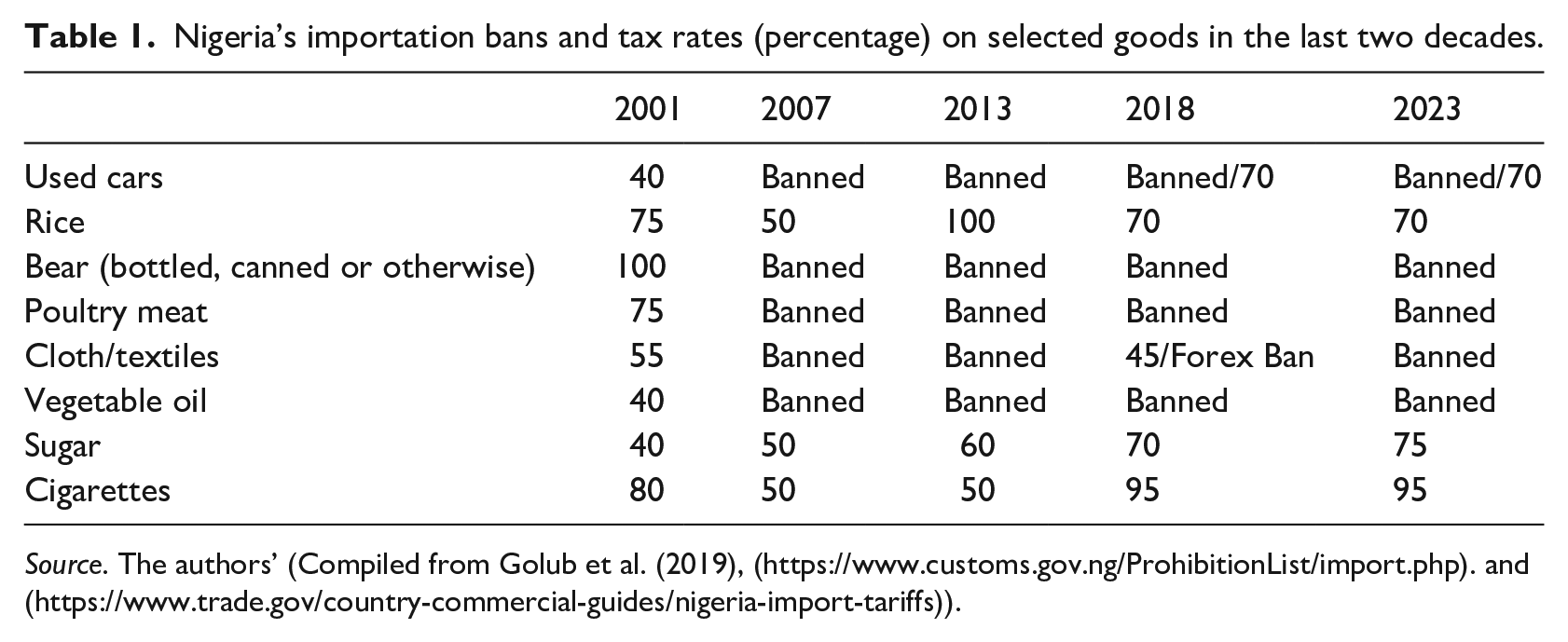
To further demonstrate this, in a regional effort to address Informal cross-border Trade in the West African bloc, ECOWAS, in 1990, expanded the Trade Liberalisation Scheme (ETLS), which was originally implemented in 1979, to achieve a zero rate of import duties and tariffs in all member states by the end of the year 2000 (space of 10 years) (Karaki and Verhaeghe, 2017). Despite Nigeria’s headship in the regional bloc, it has failed to liberalise trade to drive the border arrangement on the West African axis. Abuja either places an embargo on some goods on the ECOWAS Common Tariff (CET) exclusion list 8 or increases its import duties and tariffs beyond the CET maximum band/limit. In principle, Nigeria condones the ECOWAS-CET, but the practice is the opposite. Nigeria maintains various additional levies/duties on selected imports, resulting in very high effective tariff rates. For example, Nigeria has an effective duty (tariff, levy, excise and value-added tax (VAT) of 50% or more on over 80 tariff lines. These include about 35% tariff lines whose effective duties exceed the 70% limit set by ECOWAS (International Trade Administration (ITA), 2024). As demonstrated in Table 1, while the importation of rice via the land borders has been banned since 2013, the import tariff currently stands at 70%. Cars beyond a certain manufacturing age are also placed on the importation list. While the permissible manufacturing age changes periodically, the importation of cars through land borders has been banned since 2016. In 2001, any car whose manufacturing age is more than 5 years was banned; in 2007, it was increased to 8 years; it currently stands at 15 years. 9 As Golub et al. (2019) observed, Nigeria has attempted to comply with the ECOWAS-led tariff harmonisation arrangement and the removal of some goods from the importation prohibition list. However, such attempts yielded no significant results; they are usually reversed quickly by the policymakers. For instance, Abuja removed textiles (cloth and clothing) from the import ban list in 2015, but unfortunately raised the import tariff to 45% in 2016 and placed it on a list of ineligible goods to use the official foreign exchange (Forex) market. Enlisting textiles in the list of goods prohibited from using the official foreign exchange market would raise the transaction costs, resulting in a de facto additional tax on such imports. As the Naira devaluated in Oct 2023, Abuja removed some goods, including textiles, rice and 41 other items, from the forex ban list (Eboh, 2023).
Nigeria’s importation bans and tax rates (percentage) on selected goods in the last two decades.
Source. The authors’ (Compiled from Golub et al. (2019), (https://www.customs.gov.ng/ProhibitionList/import.php). and (https://www.trade.gov/country-commercial-guides/nigeria-import-tariffs)).
This action owes to the national pre-emption that such liberalisation might negatively affect its national security and local industries (Golub et al., 2019). The tempting rhetorical question is, what is the status of its national security and local industries despite such a nationalistic stance? Nigeria’s border diplomatic imprecision has not only given impetus to cross-border insecurities in the country. The study findings revealed that importation bans, border closures and tariff increases, among other security-oriented border practices in Nigeria, breed more insecurities. A respondent noted that more pressure comes on the borders when the borders are closed, and more illegal routes are ‘invented’ across the borders. 10 The current security situation during and after the 2019/2020 border closures amid countless military checkpoints across the borders validates the respondent’s position. For instance, in February 2024, a Nigeria journalist through his LinkedIn account lamented that he and others narrowly escaped banditry attacks despite the presence of 48 police checkpoints and about 13 military in the Kadauri–Mayanchi axis of the Nigeria–Niger border region. 11 Also, despite the presence of about 40 checkpoints mounted by the military, customs, immigration, police and others between Abeokuta and Imeko/Afon border town, smuggling of diverse kinds, human trafficking, and other cross-border illegalities are daily occurrences in the border region. 12
Nigeria is evidently obsessed with its domestic exigencies, such as, growth of its local industries and self-security, while parading itself as a key driver of African regionalism. The argument, in essence, is that while Nigeria juggles between pan-Africanism and national demands such as security and economy, the underlying motivations are the same. This undefined diplomatic stance in Africa implicates its national security architecture. To further demonstrate this, in the wake of the Boko Haram insurgencies, President Buhari revitalised and expanded the existing ‘security community’ known as the Multinational Joint Task Force (MNJTF) to involve all its Limitrophe neighbours (Albert, 2017). As the security community involving the neighbouring states was still attempting to build mutual trust among the member states, Abuja displayed another nationalistic behaviour by shutting its borders on its neighbouring states between August 2019 and December 2020. As Nigeria’s policymakers argued, such was necessary to salvage the cross-border illegalities at the borders (Kwarkye and Matongbada, 2021; Ogunnubi and Awosusi, 2021). Interestingly, to note that this border closure came barely 4 months after Abuja showed its willingness to drive the AU-led AfCFTA by ratifying the Agreement in May 2019. The paradox of the situation is that amid the border closures, insecurities persisted across the borders (Kwarkye and Matongbada, 2021). This suggests that cross-border criminalities are a form of resistance to failures of states’ policies.
As Curzon (1907) observed, borders are ‘the razor’s edge on which hang suspended the modern issues of war or peace, of life or death to nations’ (p. 8). In other words, geographical borders can either foster peaceful co-existence or conflict in a state or region. What borders unleash over time lies with the adopted measures. However, the underlying realist state-centric approach does not suit the context and geographical configuration of the Nigerian state. In the African realist perspective, Nigeria’s territorial space comprises individuals, ethnocentric actors and sub-national actors with vested interests, making it a pluralistic state (Oyewole, 2024). Hence, Nigeria’s self-security-oriented practices through coercive border diplomacy in terms of border closures, import bans, and militarisation, among others, are a mere top-down approach that does not address the lingering security issues. Despite the colonial and post-colonial territorial reconfiguration and the attendant state-centric border policies, for instance, the transborder populations and communities between Nigeria and its neighbours see themselves as ‘one people’.
According to Bonchuk (2012), transborder people are sustained through interconnected networks of sociocultural, socio-economic and even political transborder exchanges. A case in point is the Borgwa transborder peoples divided between Nigeria and Benin Republic, who see the territorial community of Borgu as their ‘country’ that must be defended (see Asiwaju, 1999). Similarly, in the twin territorial communities of Igolo and Idiroko between the Benin Republic and Nigeria, ethnic and cultural affinities continue to facilitate relations and interactions across the borders. Besides, the twin communities are mutually complementary, so much so that Idiroko residents depend on health care and other facilities in Igolo, while the former offers markets for the smuggled or re-exported goods from the latter (see Faleye, 2016). A respondent affirmed this while noting that the people on both sides of Nigeria’s borders are more cooperative than the security personnel deployed to secure the borders and that any security action by border officials that impairs their interest or means of survival can lead to mob action against such officials. This explains why, amid the 2019 border closure, informal trading, smuggling and other cross-border illegalities persisted across the borders. A respondent noted thus: ‘Aside from the fact that corruption would render the policies “dead on arrival”, they do not address the issues of the various border communities . . .’ 13 This is to say that Nigeria’s security threats are beyond the nationalistic or the realist self-help conception. The borderlands feature diverse interest groups and actors with strong transborder networks that will always resist any policy undermining their interests. Thus, in formulating or enforcing Nigeria’s border policies, the dynamics of the borderlands/territorial communities and the regional dynamics across the borders must be considered. As Kukathas (2010) observed, for instance, in the globalised world, opening and closing borders transcend adding or removing physical barriers but changing the ‘rules’ of border engagement. In other words, without reconsidering Nigeria’s border approaches to suit the contemporary realities and the nature of its borders, its border security situation would persist.
Conclusion
So far, the effort has been to situate Nigeria’s border practices in Africa. The study reveals that Nigeria’s border enforcement takes liberal and state-centric outlooks. The study contends that despite the contrivance in the policy postures, the same state-centric security orientation underlies them. The pan-African posture of its border relations is shrouded in state-centrism, which has so far rendered the border a conduit of cross-border illegalities. The lingering security debacles are direct implications of these policy disconnects and imprecision. This study contends further that Nigeria’s border challenges do not necessarily lie with the acclaimed pan-African ideal of an open border system but with state-centric practices. The border practices are based on the policy choices and preferences of Nigeria’s ‘men of affairs’, far from the realities of the borders. As demonstrated, ‘security realism’ involves responding to national demands through instruments of national power (e.g. coercion). The study submits that given the Nigerian state’s pluralistic status, such an approach will always result in a backlash. Abuja, thus, needs to define its border policy frameworks and galvanise non-state transborder actors in its border practices.
Footnotes
Funding
The author(s) received no financial support for the research, authorship, and/or publication of this article.
