




Abstract
Social policy, development and democracy in Africa are dominated by externally engineered and controlled philosophies. This has resulted in policy regimes and architecture that fail to sustainably improve the wellbeing of the continent. The article is conceptual and utilises interpretive methodology, and Transformative Social Policy to draw insights from Thandika Mkandawire’s philosophy on social policy, development and democracy. The prime argument of the article is that Mkandawire’s ideas contribute immensely to interrogating and improving inclusive development, governance and social policy in Africa. Nonetheless, Mkandawire’s philosophy is not the sole pathway to Africa’s transformation, and cannot be applied uniformly across Africa.
Introduction
Significant literature on achieving development in Africa is available (Ake, 1996; Amin, 2011; Cheru, 2009; Schmidt and Mittelman, 2009; Shivji, 2006). However, perspectives in Africa’s development reveal conceptual contradictions. Achieving development has been a central preoccupation of post-colonial African leaders against a context where the continent has had a long history of colonisation that denuded and mired its development prospects and trajectories (Mafeje, 2003; Mkandawire, 2011a; Moyo, 2011). Earlier development strategies implemented in this regard – the Structural Adjustment Programmes, Poverty Reduction Strategy Papers, Highly Indebted Poor Countries Initiative, Blair Commission on Africa, New Millennium Challenge Account under the Bush Administration, African Growth and Opportunity Act under the Clinton administration, and Power Africa of the Obama administration – were externally designed and controlled (Gumede, 2018a: 11). Moreover, while national and continental frameworks have been developed including the Lagos Plan of Action for Accelerated Development in Africa, African Alternative to the Structural Adjustment Programme, Abuja Treaty, the New Partnership for Africa’s Development (Gumede, 2018a: 11) and recently, the African Continental Free Trade Area (AfCFTA), Africa remains dominated by a sustained barrage of development philosophies and approaches that are detached from its realities and needs. Furthermore, Africa continues to experience multiple socioeconomic and political challenges with endogenous and exogenous roots and routes (Gumede, 2008, 2015; Ismi, 2004). In some cases, the challenges are entrenched, enduring, and escalating particularly in a context of serpentine neoliberalism, covert and overt neo-colonialism, and an obstinately unequal global order (Nhemachena, 2023). Whereas the challenges are afflictions to Africa’s wellbeing, the emergent epistemic moments have implications for knowledge production and making sense of scholarship in Africa, innovation, and policy change (Mkandawire, 2010). In this context, the social sciences and humanities, among other disciplines, are contending with societal problems and changes in and outside the remit of development, social policy and democracy. Accordingly, knowledge generation on African affairs to improve the continent’s development is ascending (Adesina, 2022; Hormeku-Ajei et al., 2022; Ndlovu-Gatsheni and Ndlovu, 2022).
This is commendable but adoption of transformative philosophies and approaches for improving Africa that link and advance social policy, development and democracy are under-explored. Yet, other scholars made significant contributions in this area. Scholars interrogated how colonial arrangements and Africa’s post-colonial political economy contributed to underdevelopment (see Onimode, 1988; Rodney, 1981), with some scholars advocating delinking. However, restricting the search for development to the ills of colonisation remains inadequate. The quest for improving Africa’s wellbeing in its diversity was also explored in relation to African renaissance and changing the development discourse (Nyerere, 1968; Shivji, 2006). For instance, freedom and socialist ideology were considered paramount to social, political and economic development in Africa. Still, post-colonial socialist ideologies and expansionist approaches, despite being noble, were derailed by several factors, chiefly neoliberalism and the hegemony of the global North in Africa’s development, governance, and social policy. The contribution of inappropriate policies to Africa’s development challenges is also explored by many scholars (Adesina, 2020a; Gumede, 2008, 2011). Adesina (2008, 2011, 2015) engaged a rear-view of social policy in Africa and calls for a return to the wider vision of social policy. Such an approach to social policy will trigger and sustain development through broader instruments and the multiple tasks of social policy – redistribution, production, reproduction, protection, social cohesion. Gumede (2013, 2018a) revisited the discourse on development in Africa, drawing insights from several scholars who directly or indirectly interrogated the continent’s development and underdevelopment. In this context, several scholars (see Ayittey, 1994; Cheru, 2009; Gumede, 2018a) reiterate that despite the existence of various intractable challenges that are often externally determined, inappropriate policies and paths are the major constraint to Africa’s development. Accordingly, Vusi Gumede advances the centrality of inclusive social policy for enhancing the effectiveness of social and economic development in Africa. Lessons of development for Africa from Africa in search for context-relevant, inclusive and transformative social policy and development in Africa were also interrogated (Adesina, 2020a, 2021a, 2022; Hormeku-Ajei et al., 2022; Hujo, 2021). Focus on autonomy and democracy in Africa has also been valuable in analysing development and policy issues (Ake, 1996; Engelbert, 2009). The central argument is that autonomy, democracy, unity, and development in Africa are intertwined, and should be determined by Africa. Decoloniality emphasised earlier (see Amin, 1992; Chomsky, 1999) has been reignited in contemporary Africa affairs. Some scholars (see Ndlovu-Gatsheni, 2012; Nhemachena, 2023) centre neoliberalism and asymmetrical post-colonial global relations in evaluating limited transformative development in Africa and push for the desirability of decolonisation. Rather than analysing and developing solutions based on individual aspects, Mkandawire pushed for a new agenda that links literature and practice on development, social policy and democracy in Africa.
As Africa grapples with multiple challenges and envisions a better continent for all, the quest for transformative social policy is principal. While this focus is appropriate, the continent’s social policy landscape is bedevilled by multiple enduring obstacles. Neoliberal economics have permeated all areas of Africa’s social policy and development, resulting in policy regimes and architecture that fail to support production, redistribution, reproduction, and social compact of the present and future generations. Social policies that are cast in a neoliberal agenda are devoid of a wider vision and universal delivery measures and are restricted to social protection (Adesina, 2015; Mkandawire, 2006a). Particularly in Africa, where policy merchandising by the global North is rife, social policy has been downgraded to charity rather than an investment in human capabilities and development and mono-tasked to narrow social protection (Adesina, 2020a). Social policy has also been highly limited in addressing intersecting inequalities of class, gender, generation, disability and space. Whereas social and economic policies informed by neoliberal traditional foundations and the practice of hegemonic social policy institutions operate at cross-purposes, sustainably improving people’s wellbeing requires a synergy of social and economic policies (Mkandawire, 2010). The corpus of social policy experts who should be contributing to transformative knowledge and practice in and for Africa is lean. Furthermore, the disruptive and decimating COVID-19 is a grey reminder of the failures and weaknesses of dominant social policy institutions and infrastructure. Accordingly, the orientation of such policy is unfit for realising the African Union’s Agenda 2063 (The Africa We Want), the Sustainable Development Goals (SDGs) of the United Nations (UN), and national framework with a transformative agenda.
At a juncture when African scholars and practitioners are calling for increased quality knowledge production and dissemination in and on Africa, and for the benefit of Africa, this article applies Thandika Mkandawire’s towering philosophy to understand the issues and dynamics of social policy, development and democracy, and how such understanding informs pathways for enhancing people’s wellbeing now and in future. Important to acknowledge is that many African scholars have contributed to exploring ways for addressing Africa’s development and governance challenges (Asante, 2007; Gumede, 2016; Mafeje, 2000; Noyoo, 2020), and transforming African people’s wellbeing (Adesina, 2010, 2021a; Plagerson et al., 2019). Yet this article centres insights from Thandika Mkandawire (1940–1920), who in 2009, raised concern on the divergence of literatures on welfare policies and on democratisation. Focus is attached to his expansive contributions through Transformative Social Policy (TSP) – explained in the next section – which is cast on the prime argument that social policy should be linked directly to issues of development and democracy. Worth noting early in this article is that while at the United Nations Research Institute for Social Development (UNRISD), Mkandawire initiated the Social Policy in a Development Context project that led to Transformative Social Policy (Hendricks, 2020; Meagher, 2019). Mkandawirean philosophy continues to inspire African scholarship on political economy, economic development, and social policy (see Adesina, 2021a; Hendricks, 2020). Furthermore, the TSP is the lens to social policy that his colleagues – Jimi Adesina, Katja Hujo, Ilcheong Yi and others are advancing.
The overarching objective of the article is to enhance the remit of ongoing effort aimed at improving Africa’s development, standing and contribution to the global community. Focus is on Mkandawire’s scholarship on transformative social policy, development and democracy herein referred to as ‘Mkandawirean philosophy’. The spectrum of his philosophy is broad, and scholars may focus on selected aspects. These include epistemology and ontology that prioritises Africa and the global South, political economy of development, pathways for moving beyond colonialism in pursuit of development, enhancing state capacity and autonomy, development states, transformative social policy for and in development, significant investment in human capabilities and institutions, and addressing structural and intersecting inequalities. The study informing the article differs from earlier studies in several ways. First, the study draws on a scholar and practitioner with monumental experience in development and social policy in both the global North and global South. Second, the study is on African affairs based on Mkandawire’s Africa-centred epistemology and ontology. Third, the study is grounded in Transformative Social Policy – a logical alternative to externally generated and out of context approaches to Africa’s development and social policy. Fourth, in addition to exploring development, social policy and democracy individually, the article interrogates the linkages among the three. Fifth, due to its unique orientation, the study is envisaged to be immensely significant to multiple stakeholders that are contributing to social policy, development and democratisation in Africa. Scholars particularly of African affairs, can enrich research and publication by adopting Mkandawire’s conceptual and analytical foci and rigour. Neo-Mkandawireans and other strands of scholars can interrogate and apply Mkandawire’s philosophy in a changed context thereby bringing forth inroads and innovations for contemporary and future Africa. African politicians, governments, regional and continental institutions can leverage assessment of externally produced frameworks and bargaining power with the global North on what is best for individual countries and the continent. Mkandawire’s ideas are also essential to improving generation of evidence-based solutions and advisory services of thinktanks on development, policy and governance in Africa. Furthermore, Mkandawire’s philosophy is not restricted to Africa, but provides substantial insights and strategies for improving the global South broadly in a global context. Accordingly, the article is significant to these and other stakeholders.
The article is organised into four sections. The subsequent section highlights the conceptual frame that underlie the study. Pertinent in this section is Transformative Social Policy (TSP) that was initiated by Thandika Mkandawire through the Social Policy in a Development Context project while at the UNRISD. Anchoring this conceptual lens is the prime argument that social policy should be linked directly to issues of development and democracy. The methods and materials utlised to generate data are explained in the second paragraph. Justification for using a semi-systematic review approach, Web of Science, Google Scholar and Research Gate, and the inclusion and exclusion criteria is provided. In the third section, results are presented drawing on selected themes of Mkandawirean philosophy. Direct quotations were also incorporated to enhance clarity and emphasis. Prioritised in that section are five thematic areas – development that is democratic, inclusive and equitable; significant investment in institutions of knowledge production and technology development; governance that is purposeful and accountable; social policy that is transformative, coherent, normative and holistic; and resolving intersecting inequalities. The fourth section focuses on discussion of selected aspects of Mkandawirean philosophy. Concluding remarks and recommendations are provided in the last section centring on ways of improving and sustaining inclusive development and wellbeing in Africa based on lessons drawn from Thandika Mkandawire.
Conceptual underpinnings
The article is informed by Transformative Social Policy. This conceptual frame was a product of the Social Policy in a Development Context project that was led by Mkandawire while he was a Director at UNRISD. All social policies are informed by paradigms, models and conceptual underpinnings (Choi et al., 2020; UNRISD, 2015), and the associated ideologies, values, norms and instruments (Hujo and Yi, 2015). Transformative social policy as envisioned by Mkandawire and his counterparts (Adesina, 2011, 2021a, 2021b; Hujo, 2021; Yi, 2015) is situated in a political economy that seeks to advance Africa’s development and position in the global economic and political order. Africa’s history of colonial and post-colonial development challenges, dominance of neoliberalism and externally generated and driven philosophies and strategies of development, the persistence of structural bases of poverty, inequality and marginalisation, and the significance of transformative pathways for uplifting Africa’s development shaped transformative social policy conceptual framings. A brief outline of earlier approach that dominated Africa’s social policy and development is paramount to understanding transformative social policy and justification for inclusion in the study. The social protection paradigm has several variants and a long history in Africa. However, three variants are briefly explored in this section – the Social Dimensions of Adjustment, Social Risk Management and Transformative Social Protection.
The Social Dimensions of Adjustment was launched in 1987 as a multi-agency programme in response to the social costs of structural adjustment programmes (SAPs) by the International Monetary Fund (IMF) and World Bank (WB; Stewart, 1991). Defining this approach were targeting of the deserving- or ultra-poor and application of safety nets to improve their situation (Hickey et al., 2018; Ouma and Adesina, 2019). The Social Dimensions of Adjustment failed to reduce poverty (UNDESA, 2009: 16). Moreover, from the Highly Indebted Poor Country (HIPC) to Poverty Reduction Strategy Papers (PRSP), Adesina (2011: 3) argues that safety nets did not improve the performance of Africa’s economies and developmental transformation. The Social Risk Management approach re-emphasised the restriction of social policy to social protection and attaching importance to anti-poverty policy instruments. Based on this approach, poverty is due to vulnerability of people to environmental and man-made rooted risks (Holzmann and Jorgensen, 2000: 6). Accordingly, tools for addressing the multiple risks to poverty are pertinent (World Bank, 2001). However, the anti-poverty agenda anchored on Social Risk Management did not result in significant change due to restriction to the ultra or critically poor and rigid targeting. Stark failure of the other social protection approaches led to various alternatives. Of importance in this article is Transformative Social Protection. Devereux and Sabates-Wheeler (2004) working within this approach defines social protection as
all public and private initiatives that provide income or consumption transfers to the poor, protect the vulnerable against livelihood risks, and enhance the social status and rights of the marginalised; with the overall objective of reducing the economic and social vulnerability of poor, vulnerable and marginalised groups. (pp. iii, 9)
Despite the promise of transcending the Social Dimensions of Adjustment and Social Risk Management, Transformative Social Protection did not live up to expectations. Several factors contributed to flop – restriction to the socially vulnerable, means-testing and targeting, failure to question and address the structural causes of poverty, inequality and marginalisation especially neoliberalism, and inability to ensure synergy between economic and social policy. Transformative social policy (see Figure 1), adopted in this article, is a better alternative to the various approaches that are engineered in the global North and strategies that are primarily restricted to social protection.
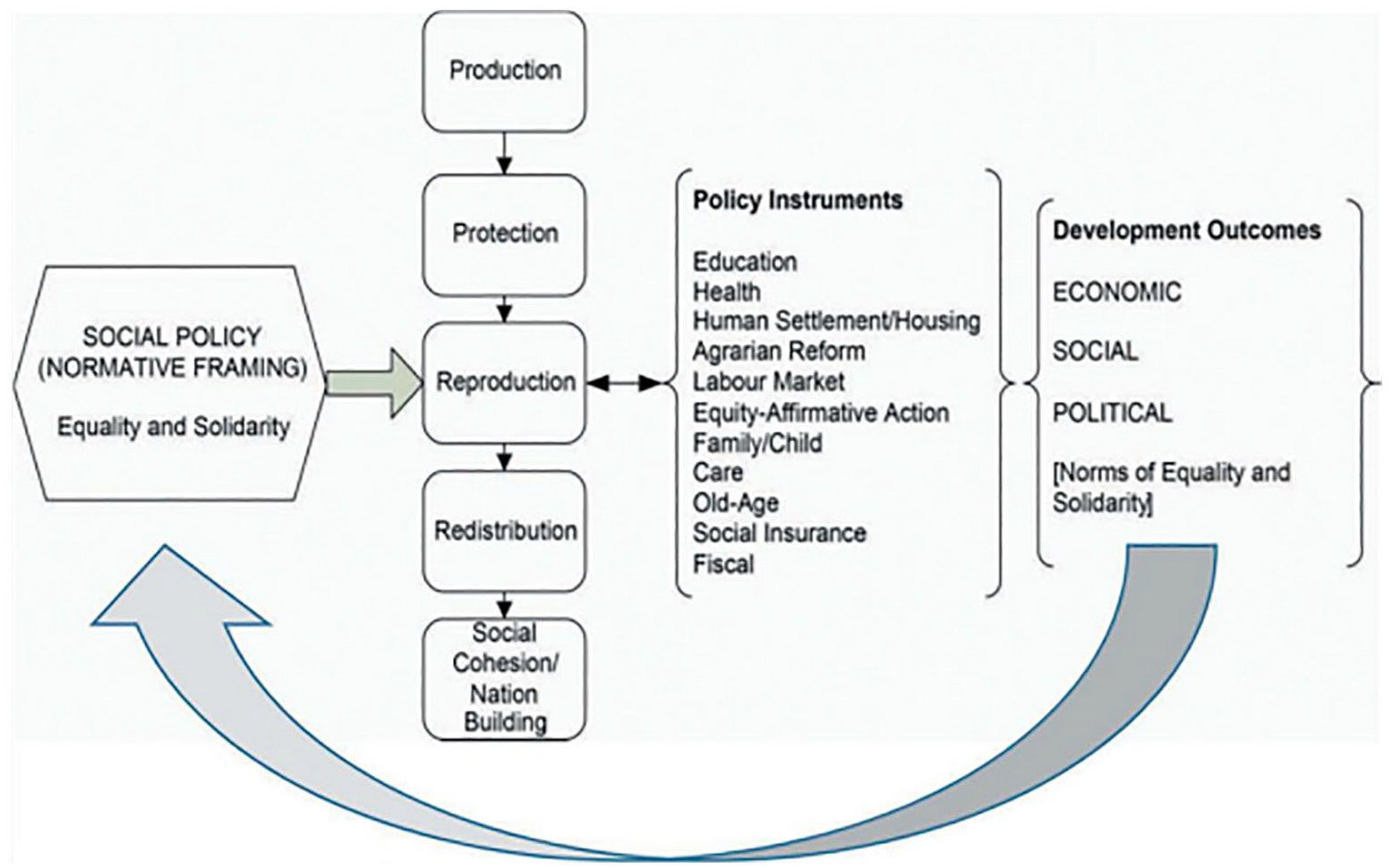
Transformative social policy.
Transformative development is attainable when countries recognise and pursue socially inclusive projects and thrive for a better society for all based on norms of social solidarity, cohesion and equity. Development with a transformative and inclusive agenda should provide collective membership and coverage. All-encompassing social policy invokes shared goals and active participation of all citizens. Unlike approaches that are limited to social protection, are fragmented, palliative, temporal and informed by neoliberal social provisioning – the Social Dimensions of Adjustment (Stewart, 1991), Social Risk Management (Holzmann and Jorgensen, 2000; Holzmann and Kozel, 2007), and Transformative Social Protection (Devereux et al, 2020; Devereux and Sabates-Wheeler, 2004) – Transformative Social Policy has a wider vision and seeks to trigger and sustain people’s wellbeing through multiple instruments and tasks of social policy (redistribution, production, reproduction, protection and social cohesion). This approach to social policy and development is prophylactic and guarantees the synergetic link between social and economic policies is guaranteed. Drawing on these fundamentals, social policy then is about achieving a collective good and holistic wellbeing. Scholars have upheld the centrality of an encompassing social policy (Korpi and Palme, 1998; Titmuss, 1964). While Transformative Social Policy is not a solution to all social policy and development problems in Africa, the approach engrains novel policy thinking and practice. For more detail on Transformative Social Policy, several scholars can be consulted (Adesina, 2010, 2015, 2020a; Hujo, 2021; Yi, 2015).
Methods and materials
This section justifies the methods and materials applied, and methods for analysis. The study was grounded in interpretivism. Accordingly, a qualitative approach informed concerted review of relevant literature. The review focused on the connections among social policy, development and democracy, and associated influence on people’s wellbeing. Secondary data were gathered from multiple sources to enhance coverage. Priority was accorded to online databases particularly Web of Science, Google Scholar and Research Gate. These databases were selected because they are reputable internationally, host impactful articles, and are accessible. Literature by and on Thandika Mkandawire, and linkages among development, social policy and democracy was sampled purposively. The core terms guiding the search for included ‘Thandika Mkandawire’, ‘linkages among/between development, social policy and democracy’, ‘development, social policy and democracy’ and ‘development, social policy and democracy’.
Due to the wide breadth of these key words, the literature search of Mkandawire led to 188 articles. The articles had to be trimmed based on an inclusion and exclusion criteria established prior to initiating the study. First, the article had to explicitly relate to Thandika Mkandawire and his insights on ensuring the linkages among social policy, development and democracy. Second, the article should have been peer reviewed. Third, the articles by Mkandawire should have been published before 27 March 2020 when he passed on, while articles on Mkandawire should have been published prior or post the passing on of Mkandawire. Fourth, the article had to be in English because this is the only international language that the researcher/author can comprehend. These were the fundamentals of the criteria applied to include in or exclude the articles from the study. Accordingly, 20 articles by Mkandawire and five on Mkandawire (reflections and tributes by Adesina, 2020b; Chelwa, 2020; Gumede, 2016; Hendricks, 2020; Hoffmann, 2018) were selected and included in the study. Moreover, articles that provided the socioeconomic and political context, development and social issues and dynamics in Africa were also reviewed. The articles are listed in the ‘References’ section.
Content and discourse analysis were applied in analysing the articles. Both methods of analysis facilitate finding meaning and understanding from the data. The analysis led to five themes of Mkandawirean ideas on social policy, development, and democracy. The ‘Discussion’ section is organised around themes. Reviewing literature as a method of research to generate secondary data, techniques for review and analysis, and the significance of reviewing literature are justified by scholars of social science research (see Creswell and Creswell, 2018; Synder, 2023). The author also drew on experience accumulated through engagement with the DSI/NRF SARChI Chair in Social Policy in the College of Graduate Studies of the University of South Africa, to enhance analytical rigour. Research at the Chair is cast on Transformative Social Policy – the lens used by Mkandawire. For instance, the ‘Social Policy Dimensions of Land and Agrarian Reform in International Perspective Research Project’ of the Chair engages with the social policy, development, governance and political economy dimensions. Currently, the project covers Zimbabwe. However, the project is rooted in an African context, and requires research fellows to engage with issues in Africa and the broader context of developing countries.
Results
Various perspectives can be applied to assess social policy, development and democracy in Africa and the broader global South. Drawing on Mkandawire’s philosophy, this section prioritises the following five core interdependent themes.
The primacy of inclusive, equitable and autonomous development
Mkandawire’s philosophy centres development as a focal optic for assessing the human condition and public policies. What development means and should be marks his focus, and use of Bandung to conceptualise development. Mkandawire (2010) in Gumede (2018a) justifying why developing countries should run while others walk, defined development as a ‘liberatory human aspiration to attain freedom from political, economic, ideological, epistemological, and social domination’ (p. 4). Important to note is that Mkandawire also sought to expand the understanding of what constrained (economic) development in Africa, emphasising that ascribing the constraints to neopatrimonialism is problematic. In this regard, Mkandawire (2013) describes ‘neopatrimonialism [as] a marriage of tradition and modernity with an offspring whose hybridity generates a logic that has had devastating effects on African economies’ (p. 3). He argues that it is factually incorrect that the African economy has not performed well as the neopatrimonialism reasoning submits. Empirically (through annual average GDP growth rates by region and per capita income), Mkandawire showed that Africa is returning to pre-SAPs and pre-2007–2008 global economic recession growth levels. However, Mkandawire further notes that the level of economic development is still less than the continent’s potential.
Earlier, Mkandawire (2001a) exploring social sciences and the next development agenda had explained that ‘the aim is to move Africa from the development challenges and social engineering that was created by colonialism and other constraints to a state of high equilibrium or self-sustained growth rates and transformation’ (p. 101). In its quest for development (leapfrogging in development), Mkandawire (2011) advanced the view that the nationalist developmentalist framework should be understood in detail than merely dismissing it. A country’s development needs, and focus can be discerned from the nationalist framework. Other scholars – Isa Shivji and Joseph Ki-Zebro – also made this argument. Furthermore, Africa should assess the pathways navigated by both the front-runners of industrialisation and the development experiences of countries in every part of the world. Emphasising on the need to learn from other contexts, Mkandawire and Yi (2014) explored lessons from the South Korean developmental success, prioritising effective developmental cooperation and synergistic institutions and policies. Learning from diverse contexts calls for ‘levels of education and learning that are far higher than those attained by the pioneers at similar levels of economic development’ (Mkandawire, 2011a: 18).
Centrally occupying Mkandawire and other scholars of Africa’s development (see Gumede, 2018a: 13) is the underlying reason why economic development has not resulted in inclusive development and equity rather than why it has not been fast enough. This is the thrust of social policy in and for development states. According to Mkandawire (2001b), a developmental state is ‘a state that is able to set developmental goals and is willing to create and sustain a policy climate and an institutional structure that promotes development’ (pp. 289–313). Pushing for inclusive development economics and focusing specifically on development in Africa, Mkandawire drew essential insights from other development economists including Gunnar Myrdal, Albert Hirschman and Alexander Gerschenkron (see Bangura, 2022: 4). He also tapped on Bandung ideological orientation, which also justifies his concern with social policy even though he was an economist. In 2011, Mkandawire emphasised the importance of inclusive social policy in pursuit of development states. Informed by political economy lens, Mkandawire distilled various factors that contribute to limited inclusive development in Africa – colonial history, lack of appropriate models and policy reforms, poor implementation, institutional and political weaknesses, social challenges, asymmetrical global order. He argued that social policy plays a major role in inclusive and equitable development. Bolstering the importance of inclusivity and equity, Mkandawire (2001a) views ‘social policy as an instrument for ensuring a sense of citizenship and an important instrument for conflict management, which is in turn a prerequisite for sustained economic development . . . ’ (p. 12). Inclusive development and its role in enhanced social compact are explored by other scholars (Adesina, 2015; Gumede, 2018b).
Social policy and development that are transformative, holistic, normative and lucid
Thandika Mkandawire’s philosophy also provides useful insights on social policy in and for development state, particularly that approaches to development and social policy in Africa and other parts of the developing world should be holistic, normative, deliberate and coherent (see Mkandawire, 2004a, 2006b). Although the conceptualisation of social policy is characterised by ambiguities, social policy remains important in achieving comprehensive and transformative development as emphasised by Mkandawire (2007a, 2009) that ‘social policy [is] important in the nation-building project’ (p. 141). Earlier, Mkandawire (2001a) defined social policy as the ‘collective interventions directly affecting transformations in social welfare, social institutions and social relations . . . [And] access to adequate and secure livelihoods and income’ (p. 1). Further arguing for the significance of social policy, Mkandawire (2007a) notes that
social policy is today receiving greater attention in the field of development studies. Much emphasis is placed on the important issues of reproduction, redistribution, and social protection. However, in the context of development, one must add to these concerns the vital issue of production. (p. 13)
Pivotal in relation to this view is that Mkandawire delves beyond social policy and emphasises transformative social policy. Approaching social policy, this aims to transform social structures, institutions and relations for broader wellbeing. For instance, Mkandawire (2010) defines social policy as the
collective interventions to directly affect social welfare, social institutions and social relations . . . . concerned with the redistributive effects of economic policy, the protection of people from the vagaries of the market and the changing circumstances of age, the enhancement of the productive potential of members of society, and the reconciliation of the burden of reproduction with that of other social tasks. Successful societies have given social policies all these tasks, although the weighting of tasks has varied among countries and within each country, from period to period. (p. 149)
Furthermore, Adesina (2015) who worked closely with Mkandawire argues that transformative social policy
involves a wide range of instruments to raise human well-being, transform social institutions, social relations, and the economy . . . The transformative role of social policy is not simply in relation to the economy but social institutions, social relations, and human capability and functioning. (pp. 113–114)
Holistic, transformative and lucid development is embedded in Mkandawire’s philosophy as championed in the argument that social policy and development must be broad, and focus has to delve beyond mere relief of (extreme) poverty. In a similar context, Mkandawire (2010) argued that
a shift towards issues of poverty is a welcome antidote to policy-making that had expunged poverty from the central agenda to focus on stabilization, debt management and static allocative efficiency. Unfortunately, in correcting a narrow policy agenda the new focus pushes a good point too far when it focuses attention only on the proximate causes of poverty and narrows the development agenda. (p. 37)
Emphasis on holistic social policy and development also marks the contributions of Mkandawire’s counterparts. Yi (2015) argued that social policy as espoused in the Transformative Social Policy approach emphasises the centrality of a ‘holistic approach in dealing with the economic, social and political relations, policy linkages and the comprehensiveness of social policy interventions to transform existing unequal and unjust social, economic and political relationships’ (p. 1) in the quest to enhance the wellbeing of the people. Furthermore, the all-inclusive character of transformative social policy informed by norms of parity and solidarity is captured by Adesina’s (2009) conceptualisation of social policy ‘as the collective public efforts aimed at affecting and promoting the social well-being of people within a given territory’ (p. 38). Transcending poverty alleviation to achieve transformative development demands a synergetic link between economic policies and social policies – ‘social policy [should] work in tandem with economic policy to lead to socioeconomic development’ (Mkandawire, 2009: 22). The overall argument from Mkandawirean insights in this section therefore is that development, which in essence is advancing people’s wellbeing, is not achievable without social policy. Accordingly, inclusive development is not possible without transformative social policy.
Firm investment in institutions of knowledge generation and technology development
Thandika Mkandawire also foregrounded (Africa’s) development in public investment in education and technology. Such investment is deliberately and specifically intended to raise the productive capacity of the population by building human capital and addressing the production task of social policy. Mkandawire (2001b) notes that
‘labour [-power] is a produced means of production’ . . ., effective labour [-power] is not an exogenous or biological given, but a socially constructed capacity or potential resulting from deliberate investment in human capital or institutional arrangements that determine the participation of individuals from different social groups in labour markets. (pp. 5–6)
This view is also espoused in Mkandawire’s (2009) authoritative assertion that ‘social policy has three important primary roles – productive functions that is, producing human capital, redistributive, and protective roles’ (p. 6). The significance of investing in institutions of knowledge generation and technology development also characterises the contribution of other scholars of social policy.
Adesina (2015: 113), building on Mkandawire (2001b) advances the significance of raising the productive capacity of the population through public investment in education arguing that it directly enhances the human capital base and contributes to the productive function of social policy. In addition to contributing to the productive task of social policy, investing in human capabilities through education enhances the reproductive function of social policy. With reference to the views of nationalist pioneers on growth and redistribution as welfare, Adesina (2007a, 2007b) in Adesina (2015) notes that ‘rather, public spending on education and healthcare played the “instrumental” role of enhancing production, and the “normative roles” of “social cohesion” and enhancing functional citizenship’ (p. 108). Furthermore, Adesina (2015) brings in the ex-ante significance of investment in education, and emphasises that
raising the educational achievement of the current generation gives the beneficiaries a greater chance of higher capability and functioning than their parents. In combination with the growth and transformation of the economy, the generation will enter the labour market, become tax payers, and widen the tax base for sustaining further investments in economic and social policy instruments. (p. 17)
Corroborating these views, Noyoo (2018) argues that ‘one issue that needs to be stressed here is that universal education is self-sustaining and must be seen as an economic imperative and not regarded as a drain on the economy’ (p. 26). Accordingly, investing in education and technology is an imperative of sustainably developing and improving people’s wellbeing.
Governance that is democratic, focused and guarantees accountability
Indelibly marking Mkandawire’s philosophy in pursuit of development and deepening people’s wellbeing (in Africa), and notable in other scholarly contributions (Ake, 1996; Mafeje, 2003) is democratic, purposeful governance and accountability. The justification is that implementing and delivering development based on these pillars ensures effective delivery for collective and equitable benefit. Essential in this regard is emphasis beyond development states to democratic developmental states. Gumede (2008) in Gumede (2018a) defines a development state as ‘a state that is active in pursuing its developmental agenda, maintains strategic relations with stakeholders, and has the capacity and is appropriately organised for its pre-determined developmental objectives’ (p. 8). These states enhance autonomy that is the ability to distance itself and take decisions independently while working with diverse stakeholders in society – local or global. Emphasising independent, focused, and accountable development and nationalist frameworks, Mkandawire (2014) also argues that ‘countries need space not only to craft policies that are appropriate to their circumstances, but also for experimentation’ (p. 171). Reinvigorating the thrust, Gumede (2018a: 8) argues that ‘a democratic developmental state can be viewed as a state that pursues higher levels of socioeconomic development, in a participatory manner, guided by a robust long-term plan’. The state has requisite capacity, the elite is developmental in its approach influenced by a developmental ideology, and the state is appropriately organised for pre-determined goals. Clarifying development states, Mkandawire (2001b) emphasises that ‘any definition of a developmental state that is drawn deductively from the performance of the economy “runs the risk of being tautological”’ (p. 290). This is associated with conceptualisations of a development state that emphasise the role of economic policy but are silent on the role of social policy.
Mkandawire (2004b, 2007b) argues that democracy/democratic governance is a pillar of development, and development should centrally constitute the national sovereign project. With reference to social policy in a development context, Mkandawire (2007b) notes,
both the contemporary normative discourse and the emerging consensus on development insists on putting in place social institutions (including states) that are developmental (in that they sustain high rates of growth and the structural transformation of economies), that are socially inclusive and that are sanctioned by democratic processes that fully respect the human rights of all citizens. (p. 1)
In this regard, Mkandawire (2007b) notes that
such an understanding can be surmised from the many resolutions of major international conferences of the 1990s and is reflected at the national level in struggles for democracy, equity and the clamour for bringing development back onto the economic policy agenda. (p. 1)
Accordingly, ‘the new challenge in Africa is to bring back development, but now one that is democratically anchored and socially inclusive’ (Mkandawire, 2010: 37). Moreover, though at a theoretical level, this has been advanced by Amartya Sen who viewed development as freedom. Sen (1999) argues that economic development, equity and democracy are mutually constitutive. This fundamental contribution was also made by other scholars of African affairs and development (see Adesina, 2008; Amin, 2017).
For development states to be functional, however, policy-making should be endogenous, guarantee policy autonomy and popular interest. Several insights can be discerned from Mkandawire (2007b, 2013) interrogation of the political landscape and democratic governance issues in Africa, particularly governance reform in the context of the neoliberal counter-revolution in relation to social policy and development. Singled out in this section is Mkandawire’s foundational idea that in the contemporary world, democracy is increasingly being limited to periodic elections. Yet, elections may be mere performative processes that may not guarantee or resemble the full breadth of democracy and democratic development. While elections are not necessarily bad, they may not serve the intended purpose of improving democracy, governance and development. Elections may lead to manipulated democracy that does not reflect the genuine interests of the majority. Moreover, elections may be used as a leeway for neoliberal infiltration or derailing of the national sovereign development and transformation agenda. In the process, democracy may be weakened, limited, denuded or stalled leading to what Mkandawire terms ‘disempowered democracy’ or ‘choiceless democracy’ and ‘hijacked development’.
Rectifying gender inequity and other intersecting inequalities
Through linking the role of social policy to national questions and social questions, Mkandawire provides fundamental insights on addressing intersecting inequalities – gender, race and class. These questions – national and social – are important in all African countries particularly in a context of the increasing search for effective and inclusive development. Mkandawire (2009) explains that ‘the intersection between race and class as well as horizontal and vertical inequalities make attention on social and national questions in Africa critical’ (p. 130). This concern can be viewed from Mkandawire’s (2009: 141) argument for the nation-building role of social policy. The eminent view is that both the social question and the national question can be addressed through nation building if social policy is robust and transformative.
Mkandawire’s philosophy was also crystallised around the importance of addressing gender inequality within the broader remit of transformative social policy and development. This is notable in some of his most impactful scholarly contributions. Mkandawire (2006b) reiterated that
social policies with a reproduction function aim to reconcile the burden of family and childcare with other social tasks and sharing this burden of responsibility. Specific measures can include gender equality and women empowerment, public childcare services and parental benefits. (p. 1)
The UNRISD (2006) corroborated by Mkandawire (2007a) and Adesina (2011) reiterates that the transformative role of social policy is not restricted to the economy but stretches to social institutions and social relations. For instance, social policy can transform gender, social and other relations through diverse instruments including affirmative action, anti-discrimination legislation and laws that relate to marriage and the family. Linking the search for gender equity and investment in human capital development, Adesina (2015) argues that ‘in tandem with specific affirmative action interventions, public investment in education (access from early childhood education onwards) is a critical element in redressing gender inequality and the transformation of gender relations’ (p. 17). Previously, scholars and institutions (ECLAC, 2001: 113–144; Pierson, 2004: 237) had argued that public investment in education complemented by universal access, is extensively understood to be meaningfully redistributive in relation to gender and other axes of poverty, inequality and marginalisation.
Discussion
The primacy of development crosscuts Africa. For instance, the efforts of African leaders post colonialism as shown by the various strategies implemented in individual African countries, continental and sub-regional levels since attaining independence show a quest for development. This also marks the concern of current development scholars. Despite multiplicity of blueprints and strategies, development in Africa has been elusive. A critical question revolves around how Mkandawire’s towering philosophy on the primacy and crisis of development can be tapped on in pursuing Africa’s development. His scholarship delves beyond the search for development, to what development should be, and alternatives to hegemonic Western conceptions and strategies for development. Gleaned from Mkandawire’s philosophy are six essential dimensions. Development should sustain levels of high growth and economic diversification. However, unlike some conceptions of development that are restricted to high levels of economic growth (see International Monetary Fund, 2022; World Bank, 2023), Mkandawire is particular on development as structural change. Without the concomitant change in structures and institutional arrangements, development will be narrow and not inclusive. Accordingly, the desired high level of economic growth is a necessary but insufficient condition for improving people’s wellbeing. Furthermore, development is not merely quantitative but also qualitative. Measures of development should also centrally be constituted by assessment of qualitative improvements in wellbeing. This dimension should be broad in coverage but is more important for categories of the population that are on lower on the income scale or the social ladder. Fourth, development is and should enhance improvements in social relations and institutions. These fundamentals of development should be casted in autonomy, inclusivity and equity. Fifth, Africa is diverse in relation to history, development challenges, governance structures and approaches, resource endowments, culture and so forth. This diversity should be considered when assessing, designing and implementing development. Sixth, Transformative Social Policy with its norms of solidarity and parity and multiple instruments provides a useful alternative to neoliberalism and market-orientation.
Analysis of most African countries and broadly the global South shows that they are experiencing multiple development, social policy, and governance crises. Application of Mkandawirean philosophy (see Mkandawire, 2005, 2009) reveals that at the heart of the crisis are ideological and epistemological muddles, external determination, and super-imposition by the global economic powers. This provides analytical insights on why Africa has not achieved its development aspirations through hegemonic perspectives and theories of economic and social development many decades after attaining independence. Paradoxically, due to dependence on the global North, some African governments are still relying on imported models of development, social policy, and governance. Major failure to meet Africa’s needs should therefore be the basis for re-orientation towards the continent for appropriate models. Africa and the other sections of the global South should therefore (re)think, (re)envision and (re)claim development, social policy and democratic governance. However, this does not imply delinking from the ‘global community’ – a recommendation provided earlier by Andre Gunder Frank and other neo-Marxists but was impractical.
Grounded in Mkandawirean philosophy (see Mkandawire, 2011b, 2011c) is the centrality of investing in critical African scholarship, and the consciousness of current and future African leaders for African development states. Scholars should reflect on, deconstruct, and reconstruct epistemologies and ontologies relating to development, social policy and governance in Africa. The continent and its individual countries should have space to design and experiment on what, given the particularities, is appropriate. In this regard, Mkandawire’s transformative social policy backed by contributions from other scholars (Jimi Adesina, Ilcheong Yi and Katja Hujo on transformative social policy) and (Sabelo Ndlovu-Gatsheni and Artwell Nhemachena on decolonality) provides immense contribution to enhancing Africa’s development and social policy performance. This is primarily due to the ideological orientation, broader vision, multiple instruments and spheres of influence of Transformative Social Policy. For instance, transformative social policy recognises the importance of approaching Africa’s development and social policy problems through diverse instruments because these vary within and across countries. Some of the instruments include investments and reforms in education, health, human settlement, agrarian structures and relations, labour, child and family care, old age, social insurance and fiscal.
African leaders ought to develop a culture of consciousness and interrogation of the roots and roots of Western manipulation and domination in governance, development and social policy. This is often done through multilateral institutions, international non-governmental organisations, and policy merchandising (see Adesina, 2020a; Mkandawire, 2010). Historically, Euro-generated strategies were implemented in Africa – Structural Adjustment Programmes, Poverty Reduction Strategy Papers, Highly Indebted Poor Countries Initiative and social protection programmes. However, these have proved to be manipulative and palliative. Apparently, democratic, and inclusive development and social policy for Africa and by Africa are better than imported variants. Overall, alternatives to the dictates of global capital are required. While covert and overt backlash from the proponents and benefactors of neoliberalism should be expected, Africa should be agentive – both by individuals and the state.
Consonant with Mkandawirean philosophy, Gumede (2018a) pushes approaches to development in Africa that ‘reject, oppose and pursue an alternative path to complete liberation of the continent and reclaim its dignity’ (p. 10). This invokes the need to adopt the Bandung approach to development if the conception of development is to be significant to Africa. Encapsulated in Bandung-informed development as conceived by Mkandawire and emphasised by Ndlovu-Gatsheni (2012) in Gumede (2018a), is a ‘liberatory human aspiration to attain freedom from political, economic, ideological, epistemological, and social domination that was installed by colonialism and coloniality’ (p. 10). Central to Bandung’s a broader view of development and ‘overcoming those major obstacles to human happiness and attainment of material welfare, civil and political liberties, social peace, and human security, which can be named as colonialism and coloniality’. Adopting this conceptualisation of development enriches the understanding that socioeconomic development is broader than neoliberalism’s preoccupation with economic measures, for example, Gross Domestic Product, Gross National Product and Income Per Capita.
Given a proven record of how neoliberal agendas in development, social policy and aid for democracy are perennially constraining socially and economically inclusive policies in Africa, Mkandawire’s (2001a, 2007a) social policy in and for inclusive development should be invoked. Development must be conceived in terms of improving people’s wellbeing. Ideally, development is not practicable in the absence of social policy. Consequently, inclusive development is not possible cannot be achieved if deprived of transformative social policy. Transformative social policy which is a priority for Africa, is associated with transformation of social relations and institutions. While this may relate to various aspects, for illustrative purposes, reference is made to addressing intersecting inequalities. For example, gender equity and the transformation of gender hierarchies as an overarching concern. Incorporating Mkandawire’s (2001a) views on social reproduction helps to address the lack of interest in the gendered nature of social policy regimes and the gender inequalities in social development across the spectrum of social policy regimes. Although there are increasingly social policy instruments that target women and from which they derive welfare benefits, these do not necessarily challenge gender hierarchies, and may actively reinforce them. The neglect of gender issues in social policy is manifested by unexamined assumptions about the family and household, and the lack of attention to the gender segmentation of employment, and the problematic gender norms that underpin paid and unpaid care work and social reproduction. Addressing these gaps in policy making and the policy literature brings issues which are crucial to economic and social development into the conversation on social policy. Finally, as a point of discussion is Mkandawire’s innovative argument that while scholarly focus has been split among development, social policy and democracy, these should be linked. Analysis of the three factors (in Africa and elsewhere) is intended to improve people’s wellbeing therefore they cannot be distinct.
Conclusion
The article explored development, social policy, and democracy in Africa from Mkandawirean lens with the aim of drawing insights that are pertinent to the continent’s transformation. This is in a context where the continent is experiencing numerous challenges. Mkandawire’s philosophy is expansive therefore focus was restricted to five inter-related themes, with full acknowledgement that these are a mere selection based by the author supported by reputable scholars. These include the primacy of inclusive, equitable and autonomous development; social policy and development that are transformative, holistic, normative and lucid; secure investment in institutions of knowledge generation and technology development; governance that is democratic, focused and guarantees accountability; and resolving gender inequity and other intersecting inequalities. Central to Mkandawire’s insights and corroborated by other scholars of African affairs is that the continent’s development, social policy and governance landscape is dictated covertly or overtly, by external hegemonic philosophies and strategies that are devoid of the Africa’s context, needs and trajectory. Subsequently, development and social policy regimes and architecture are failing to sustainably improve the wellbeing of the continent.
As Africa grapples with diverse development, social policy and governance problems, Mkandawire’s ideas grounded in Transformative Social Policy are significant to academia, policy and practice. Scholars on Africa and other parts of the global South can draw insights that enrich scholarship regarding societal problems. The transformative orientation of Mkandawire’s philosophy built on addressing the structural basis of underdevelopment, poverty, inequality and marginalisation within a global context enriches policy and practice. Furthermore, African leaders individually or collectively through continental and regional institutions – the African Union, Southern African Development Community, Common Market for East and Southern African States and so forth – can develop substantive and focused frameworks based on Mkandawire’s ideas. Consequently, his insights contribute immensely to improving development, governance and social policy in Africa and broadly, the global South. Nonetheless, Mkandawire’s towering philosophy should also be complemented by other scholars, visionary leadership, and focused policies.
Footnotes
Acknowledgements
The author thanks immensely, Professor Jimi O. Adesina for focal mentorship on transformative social policy. Prof. Adesina is the holder of the DSI/NRF SARChI Chair in Social Policy in the College of Graduate Studies, University of South Africa.
Funding
The author(s) received no financial support for the research, authorship, and/or publication of this article.
