




Abstract
This article examines the different aspects that converge to explain food insecurity in the Republic of Sudan from 1989 to the secession of the southern states in 2011. Two phases of the 1989–2011 period are analysed, and within these, three fundamental aspects of the Sudanese scenario: the role of political and social elites, economic dependence and food insecurity. The latter is a corollary of the two previous aspects. Consequently, the successive wars in Sudan cannot be understood with a simple and partial approach. Dependency and permanent repression have crystallised as essential elements of the exercise of power by the Islamist elites in order to understand food insecurity in most Sudanese regions in the last decade of the 20th and early 21st centuries. The three aspects mentioned above also give shape to a phenomenon or syndrome and a concept that is not only specific to Sudan, but which has clearly materialised in Sudan: the ‘Sudanese disease’.
Introduction
The Republic of Sudan was founded during the decolonisation process in the middle of the 20th century and has experienced very few years of peace. This text studies economic dependence, Islamist elites and their power relations, as well as food insecurity in the former Sudan that existed from 1956 until 9 July 2011, when the Republic of South Sudan gained its independence. Therefore, Sudan refers in this text to both the South (present-day South Sudan) and the North (today’s the Republic of Sudan).
The timeframe for this article is Omar al-Bashir’s rise to power in 1989 and the independence of the South in 2011. Therefore, this text studies a period in which a type of political Islamism has been spread by new elites with consequences for the country’s economy and food security.
The economic structure of Sudan and its dependent nature as an extractive economy is analysed, as an indispensable element to explain and connect production and capital flows to conflict dynamics. It is essential to understand factors that make possible the perpetuation of conditions of dependency and that may explain centre–periphery dynamics. On one hand, the process of economic disarticulation that provoked the vertical integration of the Sudanese peripheral economy and the consequent need to export, which generated a process of economic extraversion. Disarticulation refers to the disconnection between internal demand and supply of some commodities and how these were destined for export and not for domestic consumption.
On the other hand, the disarticulation and extraversion of the Sudanese economy induced a situation of dependency due to the structural duality of the economy. This duality manifested itself in the fact that the Sudanese economy has been linked to international markets in the case of mechanised schemes in northern Sudan as well as in oil exploitation. These activities have been cohabiting with traditional, archaic and even pre-capitalist economic processes, in the South and traditional agriculture in the North.
The disarticulation has deepened the extraversion of the economy, which in the Sudanese case will be exemplified, first in cotton trade and later, in oil trade. Furthermore, the external vocation of the economy in terms of export of raw materials has deepened the process of dependency on the outside world (Garcitúa and Bello, 1992; Gowan, 2000; Harvey, 2004).
In addition, two processes of neoliberalisation, known as roll-back and roll-out by Peck and Tickell (2002), have been set in motion. On one hand, a first dynamic of economic neoliberalism, or roll-back, involved the deregulation of the economy and the gradual dismantling of the state. On the other hand, the roll-out process has built a new state with neoliberal foundations, and with it, the consolidation of neoliberalism materialised through structural reforms.
In this text, these elements will be the basis for understanding the situations of severe food insecurity from 1989 to 2011. For this purpose, two chronological stages have been identified according to the prevailing economic structure, economic indicators, socio-political elites in power and historical events:
A first stage during the Islamist neoliberalisation of the new National Salvation Government (1989–1999).
A second phase (1999–2011), which began with the split of the Islamist government and ended with the independence of the South. During this period, the new neoliberal oil-based state continued to take shape and war broke out in Darfur.
In each of these chronological stages, three sections will be presented, explaining, respectively, the role of socio-political and religious elites, the crystallisation of economic dependency, as well as the manifestation of food insecurity and famine. In short, and as reflected in the title of this text, for each of the two periods of time analysed, food insecurity is conceived as the effect of elite dynamics and economic dependency.
Finally, the conclusions summarise the main findings of this article.
Materialisation of neoliberal Islamism (1989–1999)
The emergence of neoliberal Islamic elites
On 30 June 1989, the unknown Brigadier Omar Hassan Ahmed al-Bashir seized the reins of power in a bloodless coup d’état that handed a military junta: the Revolutionary Command Council for National Salvation (RCC). The presidency of the RCC was given to Bashir, who signed successive decrees as a lieutenant colonel, taking over as head of state and assuming the posts of Prime Minister, Minister of Defence and Commander-in-Chief of the army (Khalid, 1990; Salih, 1990). The seizure of power lead to the immediate suspension of the 1986 interim constitution and the dissolution of the Constituent Assembly, the Council of Ministers and the head of the Council of State. Political parties, trade unions and professional organisations were abolished, and their property confiscated, and press was restricted to regime media, as a state of emergency was declared throughout Sudan (Khalid, 1990; Salih, 1990).
The takeover by the RCC terminated the previous brief pseudo-democratic period (1985–1989) and marked the beginning of a phase of civil and military Islamist administration. This administration was politically defined by a two-headed government with Hassan al-Turabi as main advisor and leader of the civil Islamists, and Omar al-Bashir as the president and head of the Islamist officers, including the current president Abdel Fattah al-Burhan.
Turabi was the leader of the National Islamic Front (NIF) 1 and as the emissary of the ‘revolutionary government’ and its Islamic theologian, he became the most powerful Sudanese politician of the time (Burr and Collins, 2003; Warburg, 2003). He was also part of the executive branch as Minister of Justice and the undisputed leader of Sudan’s Islamists.
For the first part of Bashir’s rule, from 1989 to 1999, Turabi’s influence in the government was vital and there was a common conception of the state. Moreover, Turabi’s supporters and collaborators were mobilised, guided and controlled by his leadership (Gallab, 2008; Ortega Rodrigo, 2010). During this period, a hierarchical structure was established, aiming at the creation of an Islamic community instituted through the prism of Turabi’s vision of political and social Islam and the unification of state and religion. In practice, Turabi took the form of a sheikh who served as the supreme leader of the revolution, fulfilling, as Abdullahi H. Gallab (2008) noted, a dual role: defender of the revolution from the outside world and serving as a bridge between the outside world and the new Sudanese Islamist revolution.
At the international level, from 1991 onwards, Khartoum became the headquarters of the Popular Arab Islamic Conference (PAIC), which constituted itself as an alternative international Islamic movement to other such as the Arab League or the Organisation of the Islamic Conference (OIC). The PAIC included delegates from multiple Arab and Islamic organisations, some considered to be terrorist groups, such as Hamas, Abu Nidal, the Palestinian Liberation Organisation (PLO) and the Philippine Abu Sayaf movement, some of which had already established themselves in Sudan (Burr and Collins, 2003).
Turabi, like Bashir, did not belong to either of the main Sufi brotherhoods – the Khatmiyya and the Mahdiyya 2 – and his sympathies were on the Islamist side. Nor did Bashir come from Khartoum’s urban elites, but rather from a modest rural background (Burr and Collins, 2003). However, Ortega Rodrigo (2010) emphasised that Turabi tried to legitimise his power offering to the traditional political elites – Mahdists and Unionists – the formation of a single political party. Nonetheless, this idea was rejected by both groups and a new Islamist elite was created around the NIF.
Thereafter, the NIF’s new Islamist regime relied on a systematic and methodical use of terror to perpetuate itself in power (Gallab, 2008). A police state was thus established over Sudanese society with tight political control and a component of ethnic and religious supremacy of Arab-Muslim and Islamist citizens. Muslims were, similarly, persecuted if they did not follow the doctrines of the new NIF’s Islamism. The influential Khatmiyya and Mahdiyya brotherhoods were dissolved, and their property and capital confiscated by the government (Ortega Rodrigo, 2010). Sufi brotherhoods that disagreed with the new regime were also severely repressed, although later attempts were made to soften the repression due to the Sufis’ strong roots in the country (Collins, 1999).
Regarding the army, existing Popular Defence Forces (PDFs) and Arab militias active during Sadiq Al Mahdi’s previous presidency (1986–1989) continued to call for jihad in support of Bashir, who created armed corps under his command. The aim of the PDFs was to protect the new regime from armed opposition in the North and rebels in the South, as well as to carry out the ‘global or integral call’, 3 as an alternative body to the regular army (Gallab, 2008).
The PDF was conferred as an instrument of the NIF and Turabi, in order to organise and provide military support and training to tribal militias in the war zones. Both saw the militarisation of Sudanese society as the solution to the gap they believed was opening up between the military and civilians. An attempt was made to bridge this gap through the so-called ‘global or integral call’, an initiative designed to encourage Sudanese youth to engage in violence against opposition to the government and to the Islamists (Ortega Rodrigo, 2010; Warbung, 2003).
The result of the global Islamist drift and support for international Islamist movements, some considered terrorist by many Western countries, had consequences for relations between Bashir and Turabi, according to Warbung (2003), as well as between the RCC and the NIF. This led to the beginning of the conflicts that would emerge within the Sudanese power structure and culminate in the break-up of the two-leaders system in 1999.
Privatisations and Islamic-style dependency
From an economic point of view, takeover by the RCC meant that Sudan returned to the economic fold, although its new relationships with Islamist movements maintain its political isolation. Sudan continued the trend that began in the last period of President Nimeiri and the significance of Arab countries for foreign trade, Saudi Arabia in particular, intensified. Saudi forms of Islam into the Sudanese society were introduced consequently and despite attempts to reduce its economic dependence, Sudan remained a peripheral economy. The new NIF elites could not stop the process of extraversion of Sudanese economy but rather materialised a geostrategic shift towards a new dependence on the Gulf economies (ICG, 2002; Rone, 2003).
The regime embraced neoliberal structural adjustment policies, considering prescriptions of the multilateral financial organisations. Nevertheless, the United States began its campaign of sanctions against Sudan for political and geostrategic reasons. In 1997, the US Secretary of State Madeleine Albright began a policy of economic sanctions on Sudan – except for trade in gum Arabic – and it was reflected in Official Development Assistance (ODA) received (ICG, 2002; Rone, 2003).
The attempts to develop political, social and economic Islamisation and a leading contradictory discourse concerning economic self-sufficiency characterised this period. Both Islamisation and self-reliance failed to fully crystallise. The neoliberal shift initiated in the previous years continued during this period, which included controlling public expenditures and reforming the public sector through structural adjustment measures and privatisations. The process of state privatisation was influenced by two important factors, according to Elnur (2009): corruption in the awarding of state contracts and diversion of public funds. Moreover, tax exemptions to Islamic Banks, as well as businessmen and non-governmental organisations (NGOs) close to NIF also played a role.
At the same time, in 1992 the Sudanese government launched the so-called National Comprehensive Plan (1992–2002), which was merged with the National Economic Salvation Programme. The plan contained a fiscal stabilisation programme that included improved management of the tax and customs system, control of public expenditure, rationalisation of the budget process, as well as a reform of fiscal accounting. It was also the first official document to establish price stability and inflation control as monetary policy objectives (Berhanu, 2011; World Bank, 2003). Reforms and adjustment policies were carried out autonomously by the Sudanese government until the mid-1990s. Although the International Monetary Fund (IMF) considered Sudan an outlaw country, the prescriptions of the Washington consensus were considered and implemented. Economic liberalisation policies were considered to boost economic growth, reduce inflation and reduce the balance of payments deficit and external debt, as shown in Figure 1 (Berhanu, 2011; World Bank, 2003).
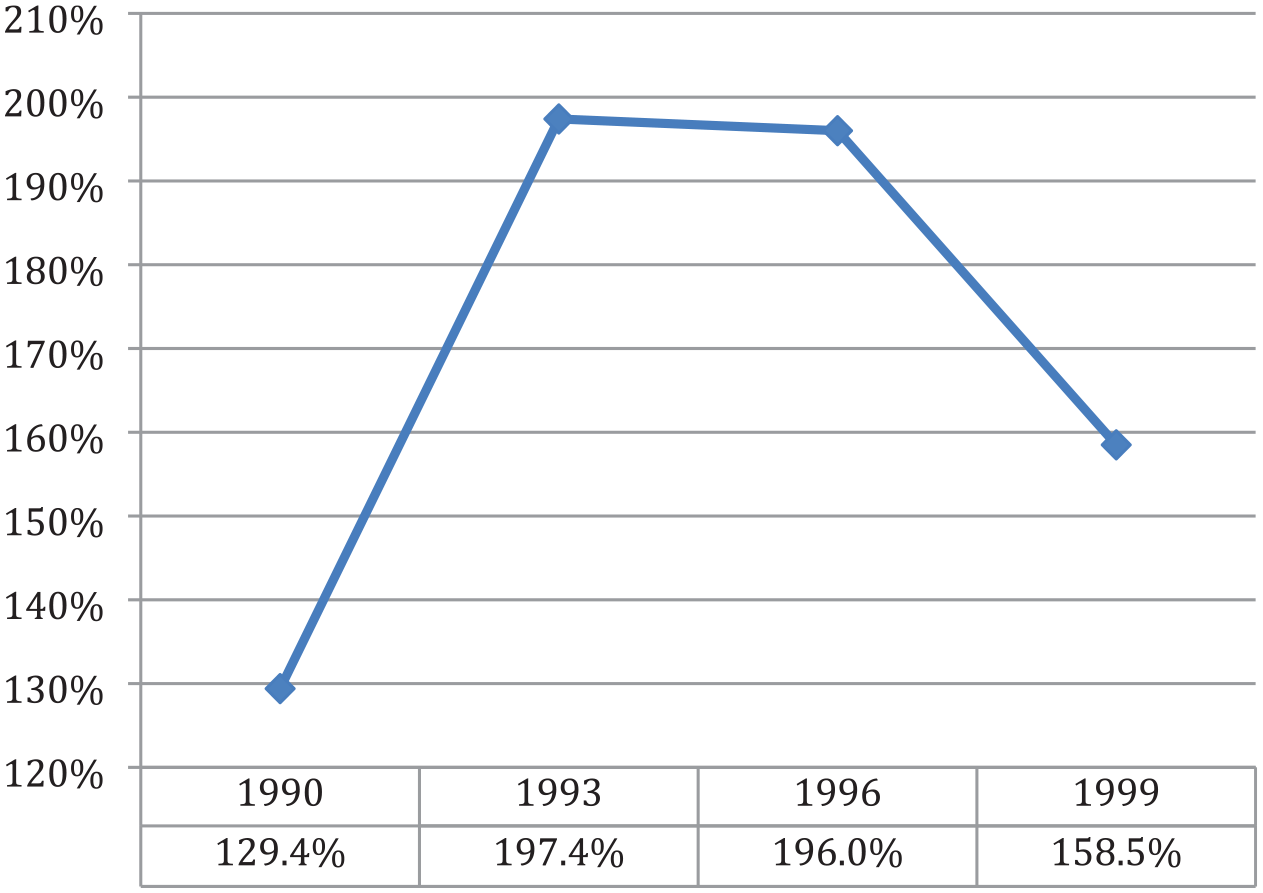
Evolution of accumulated external debt (% of GNI) de 1990–1999.
This strategy obtained positive results in terms of economic growth and since 1997 this programme was monitored with the assistance of IMF officials, following a rapprochement between the multilateral organisation and the RCC government (Berhanu, 2011; World Bank, 2003).
Therefore, two seemingly contradictory elements coexisted in Sudan during the 1990s: political Islamism and economic neoliberalism. None of them accomplished prosperity and welfare for all Sudanese citizens but became a catalyst for the genesis of food insecurity. The combination of both elements led to an intense process of deregulation and dismantling, which facilitated the gradual replacement of former State institutions with Islamist ones.
As a result of this roll-back neoliberal strategies, public expenditures decreased significantly while tax levels remained constant and deficit reduction was also significant during the 1990s (see Figure 2).
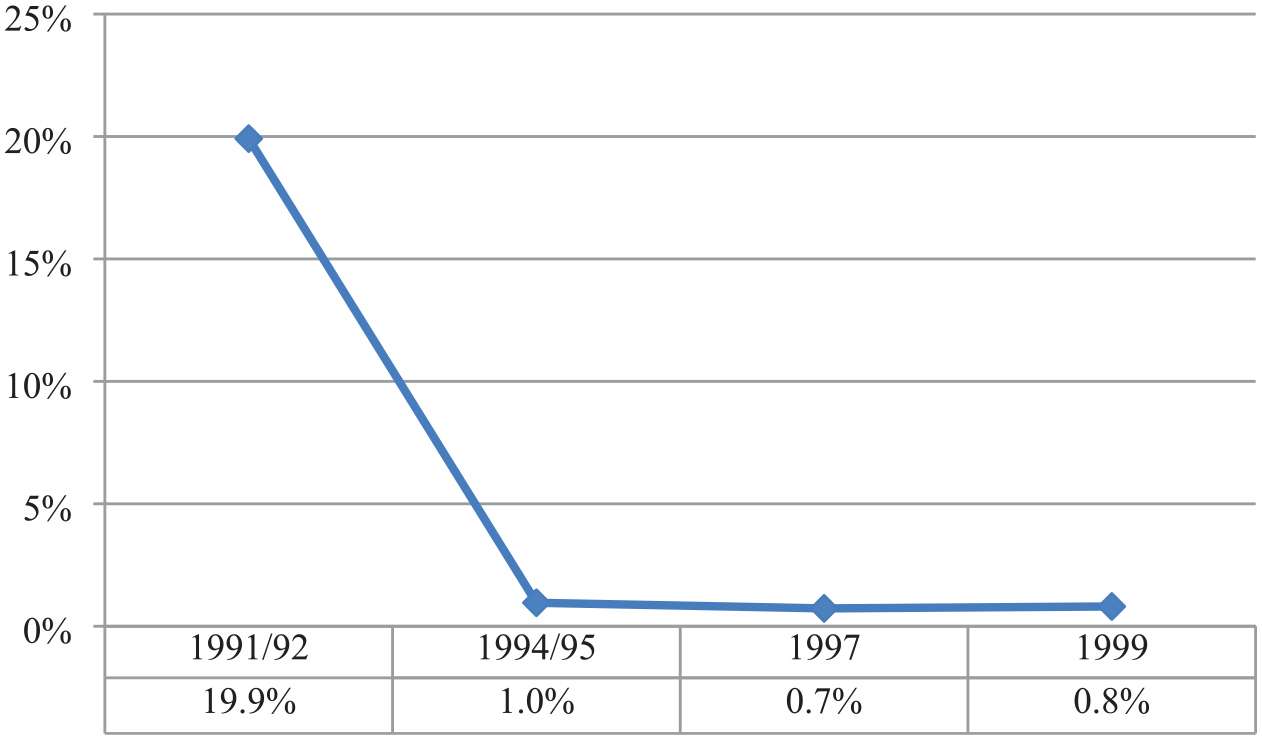
Evolution of the government deficit relative to GDP at market prices 1991/1992–1999.
Nonetheless, the government also needed resources to fight the main rebel group of the South, the People’s Liberation Movement/Army (SPLM/A), and remittances, foreign direct investments, international loans and the new Islamic banking became the main finance sources of the country. The roll-back process was strengthened, and the foundations of a neoliberal state were also established. A transition between the roll-back and roll-out process crystallised, which involved state building on a neoliberal basis, with oil exploitation as its future axis (Berhanu, 2011; World Bank, 2003).
The Government of National Salvation proclaimed the introduction of new ethics and the fight against the corruption of the traditional and Nimeiri elites. Nonetheless, it did not improve the living standards of the poorest population even in the North, despite economic growth. The strategy of dismantling the state brought the elimination of food subsidies. In addition, social spending and infrastructure investments were controlled to reduce the fiscal deficit, but not spending on security and the military (Berhanu, 2011; World Bank, 2012).
The lack of external financing due to political isolation and the public debt deepened the need for public savings (Berhanu, 2011; World Bank, 2012). However, economic growth during this period demonstrates the vitality of the private sector linked to the new Islamist elite compared with the agony of a public sector undermined by neoliberal economic policies. Figure 3 uses Gross Fixed Capital Formation (GFCF) as an indicator to illustrate this point.
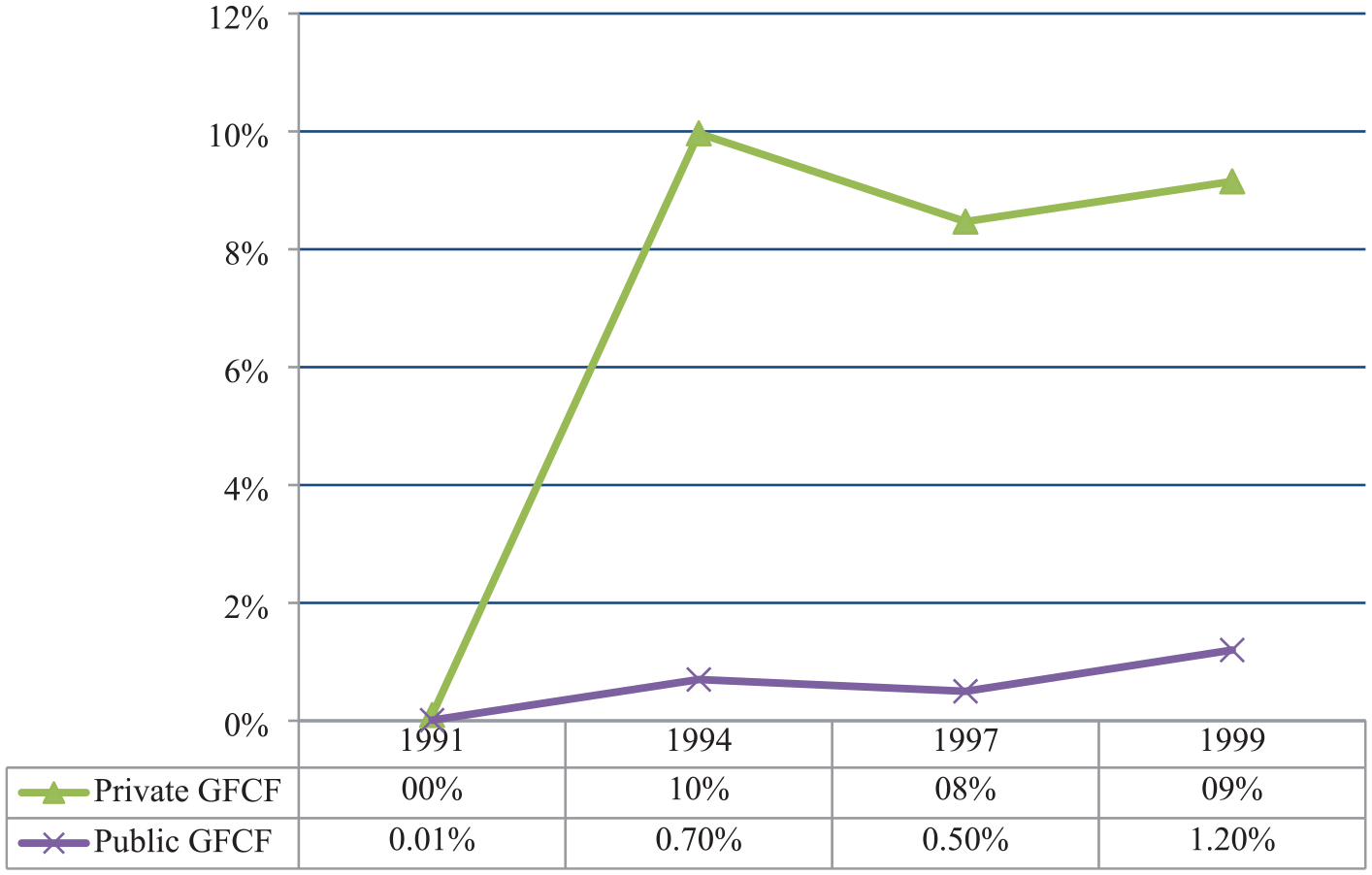
Public GFCF and private GFCF from 1991 to 1999 (% of GDP).
The support needed to energise the private sector came from the organisations close to the NIF and the Islamic private sector, which encouraged and funded the emergence of firms and businessmen in line with principles of Islamists. Nevertheless, the context of civil war prevented a drastic reduction of defence expenditures and hampered oil exploration and exploitation.
Forced displacement crystallised because of a process oil exploration and extraction (Alao, 2007). The oil factor expanded the extractive, dependent and extraverted character of the Sudanese economy and prevented attempts of structural transformation and import substitution through agribusiness. Only in the military sector was there an incentive to promote a strong national industry to impose the Arab–Muslim viewpoint requested by the NIF and its elites. A sort of Sudanese-style Dutch Disease 4 became visible: ‘the Sudanese Disease’. Unlike Dutch Disease, the ‘Sudanese Disease’ refers not only to the negative effects of a significant increase in a country’s foreign exchange earnings, but also to the fact that these earnings are spent in whole or in part to fuel a situation of armed conflict, both by the government or/and by rebel groups.
Food insecurity at the end of the 20th century
The coming to power of the NIF did not change the role of food security on the political agenda; rather, the new government inherited the disinterest in food security shown by previous governments. The compelling reasons for the disarticulation of the Sudanese economy and its inability to feed its entire population in all regions were ignored (De Waal, 1997; Garcitúa and Bello, 1992).
The strategy designed through the so-called National Economic Salvation Programme made no mention of food security and did not include elements relating to support for the most impoverished population. Meanwhile, the militia strategy, which had been a factor in the genesis of the 1980s famine, gripped the populations of the Nuba Mountains and the South, leading to a new humanitarian crisis and famine in 1990–1991 (De Waal, 2010; Jaspars, 2018; Komey, 2010).
The 1989 drought resulted in a meagre harvest of sorghum, millet, groundnut and sesame. These crops were the staple food of rural dwellers and especially of the Nilotic tribes and Khartoum’s response to appeals for help from the affected regions, especially Darfur and Kordofan, was to play down the problem, hoping that the 1990 harvest and coping strategies were sufficient. It was a miscalculation with dramatic consequences, as the drought extended into 1990 and the harvest in the eastern producing areas was not what was expected. As a result of this and the lack of an adequate food security policy, hunger appeared in the central regions of the country and grain prices soared, exacerbating the humanitarian crisis (De Waal, 2010; Jaspars, 2018; Komey, 2010).
The reaction of the military-Islamist government was based on the use of state security services to control prices and stop food speculation through confiscation and threats. The government of Bashir and Turabi tried to handle the situation in vain and determined not to seek international assistance. The government chose to evade the crisis, ignoring appeals for help from various regions and taking the official position that neither famine existed nor was imminent (De Waal, 1997, 2010; Jaspars, 2018).
In this context, the measures taken were limited to the rationing of grain according to political criteria, with Khartoum as a priority, under the control of the Sudanese security and organisations close to the NIF. An ad hoc Food Security Council was set up for the capital and was responsible for establishing various popular committees. They were in charge of the distribution of food under NIF premises and provided the government with an opportunity for political control through the main instruments of urban food survival and supervision (De Waal, 1997; Jaspars, 2018).
Taking the average food and energy supply per person per day as an indicator, Figure 4 shows that it was higher in 1988–1993 than in 1966. However, the consequences of these data were much more severe between 1988 and 1993, due to the policy of forced displacement and the veto on access to food imposed on the Dinka in the border areas of Darfur, Kordofan and Bahr el Ghazal (FAOSTAT, 2015). For example, the 1988–1989 famine in Bahr El Ghazal is estimated to have cost 250,000 lives according to Human Rights Watch (1999).
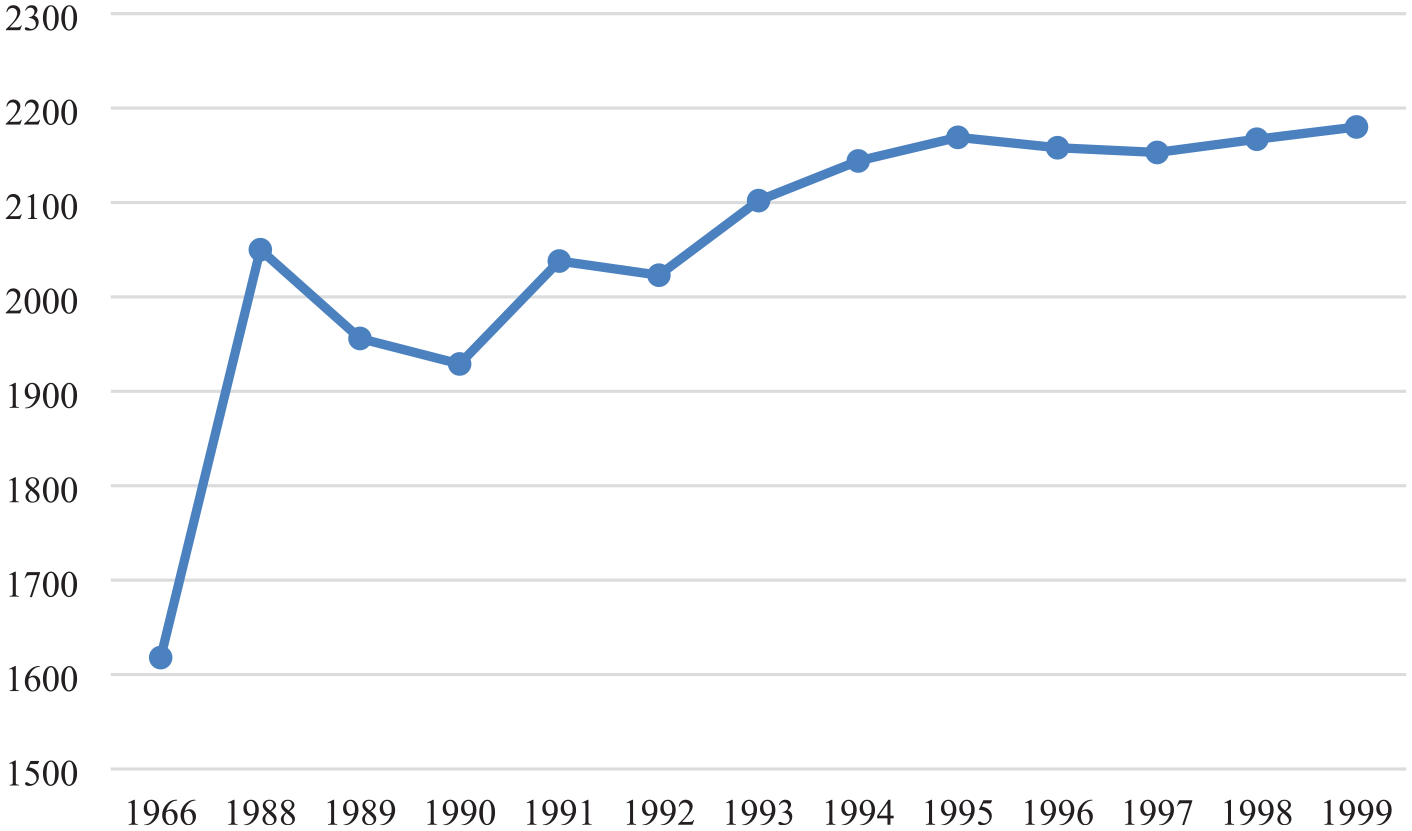
Food energy supply (kcal/person/day) in 1966 and 1988–1999.
In the face of the humanitarian crisis, the government of Bashir and Turabi tried to reduce dependence on international aid agencies, especially Western ones. To this end, the government supported the emergence of Islamist relief NGOs and used the famine to spread the ‘global or integral call’ and with it, the Islamist approach of the NIF. With growing political power and denial of the situation, including mortality prevention, thousands of famine victims were ignored by the new Sudanese government (De Waal, 1997, 2010).
As in the early 1990s, in the late 1990s, the government’s support for the militias continued and was reinforced by the delivery of equipment and troops with the military train that provided supplies to Wau and Aweil. This train had a dual purpose: on one hand, it dropped off militiamen and their horses in Bahr el Ghazal territory, and on the other hand, it transported the loot they took from the attacked villages, be it grain, livestock or even women and children (Human Rights Watch, 1999).
In this scenario, population displacements resulting from Government subjugation and fighting due to divisions and splits within the rebel groups, as well as the drought caused by the 2-year-long El Niño weather phenomenon, set the stage for the 1998 famine, which affected the Bahr el Ghazal region (Human Rights Watch, 1999). Thus, this famine was a convergence of a natural hazard represented by El Niño and reduced sorghum production, as well as a man-made disaster in the form of war. However, the latter was not only a product of pro-government militia attacks, but also of Dinka guerrillas who played their part in bringing about the humanitarian disaster (Human Rights Watch, 1999; Johnson, 2011).
The culmination of such instability was the more than 250,000 displaced persons identified by the UN’s Operation Lifeline Sudan (OLS) in Bahr el Ghazal in January 1998, at high risk of starvation. It was aggravated by government obstructions to humanitarian and emergency access, which were radicalised by attack by SPLM/A dissident groups (Human Rights Watch, 1999; Operation Lifeline Sudan (OLS), 1998; Von Braun et al., 1999). This situation also provoked social polarisation as well as the exodus of thousands of people from cities to rural areas, where they had no means of subsistence. In this regard, both the OLS (1998) and Human Rights Watch (1999) reported a multitude of human rights violations against Dinka and Luo men, women and children, both by pro-government militias, as well as by the Sudanese army itself (Human Rights Watch, 1999; OLS, 1998). Moreover, pro-government forces blocked the planting of crops and there were reports of abductions of women and children, as well as intensive shelling. All these elements together made Bahr el Ghazal, during 1998 and until the signing of the ceasefire in April 1999, a hellhole. Thousands of families suffered from violence and hunger, and malnutrition was so widespread that it was reflected clearly in national statistics as shown in Figure 5 (Human Rights Watch, 1999; Von Braun et al., 1999).
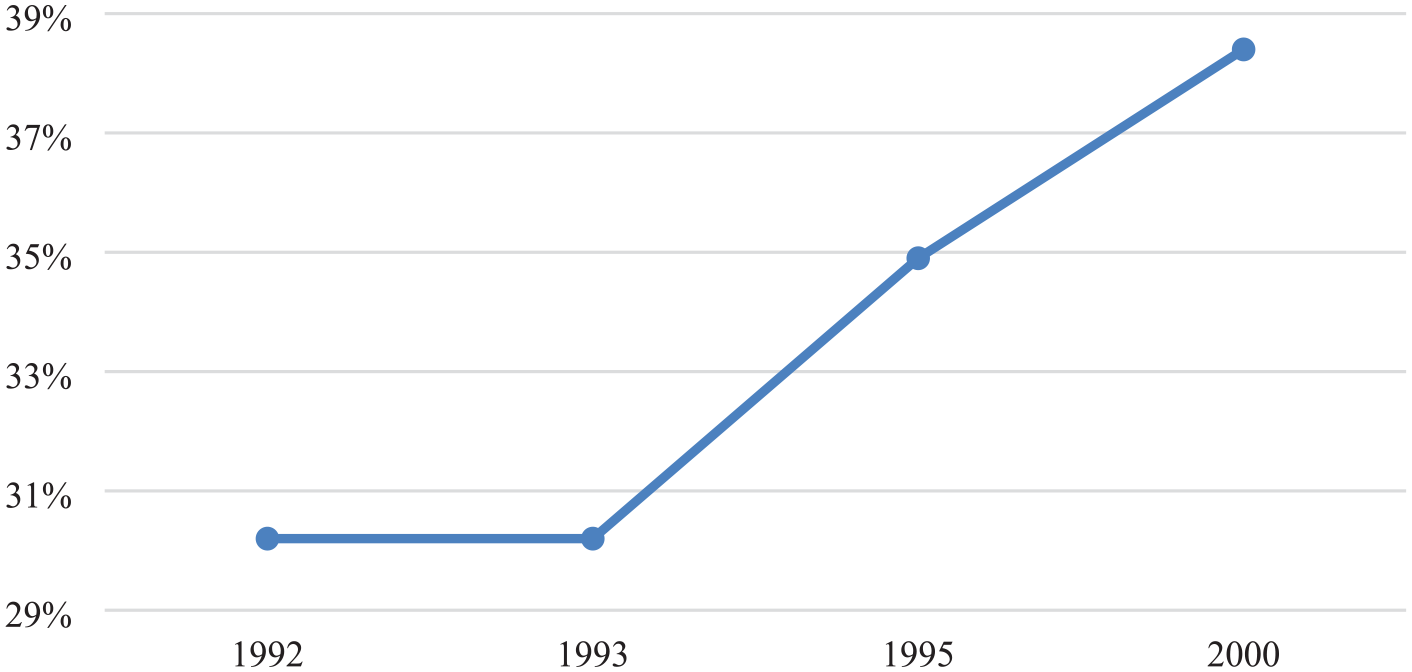
Estimated trend for malnutrition in children under 5 years old. 5
In this regard, World Health Organization (WHO) data collected in 1998 and 1999 provide an indication of the extent of the humanitarian crisis at the dawn of the 21st century. In southern Sudan, almost 30% of the population was in need of urgent famine relief as drought and fighting among South Sudanese rebel factions spread to Unity State and Upper Nile. In these states, as well as in Bahr el Ghazal, the number exceeded 30%. As a result of the raids, from 1986 onwards and after the Bahr el Ghazal famine of 1998, an estimated 2 million people lost their lives in the South and some 4 million were displaced from their homes (Jok, 2001). This is even though data on average food and energy supply per person shown in Figure 4 did not reflect drastic declines in these indicators, especially when compared with 1966, when the consequences were not as severe and only in areas of severe drought were deaths directly related to severe malnutrition reported.
The data in Figure 6 are clear in this regard and show the data collected by the World Food Programme (WFP) in 1999 for states and territories in the North and the South. As can be seen, in the South, the territories of Unity, Jonglei and Bahr el Ghazal concentrated cases of malnutrition, while in the North, Kordofan, Darfur, Kassala and various areas of the Red Sea state accounted for malnutrition. Importantly, the 1998 famine and subsequent malnutrition was concentrated in South Darfur, the Red Sea, the Nuba Mountains in Kordofan and Southern Bahr el Ghazal. Not only because these were areas of dispute between Arabised and non-Arabised tribes, but also because in the case of the Nuba Mountains, Unity, as well as in the case of the border territory between North Bahr el Ghazal and South Darfur, the areas of food crisis were mostly in the oil blocks and oil fields that were being explored at the time (World Food Programme (WFP), 2004).
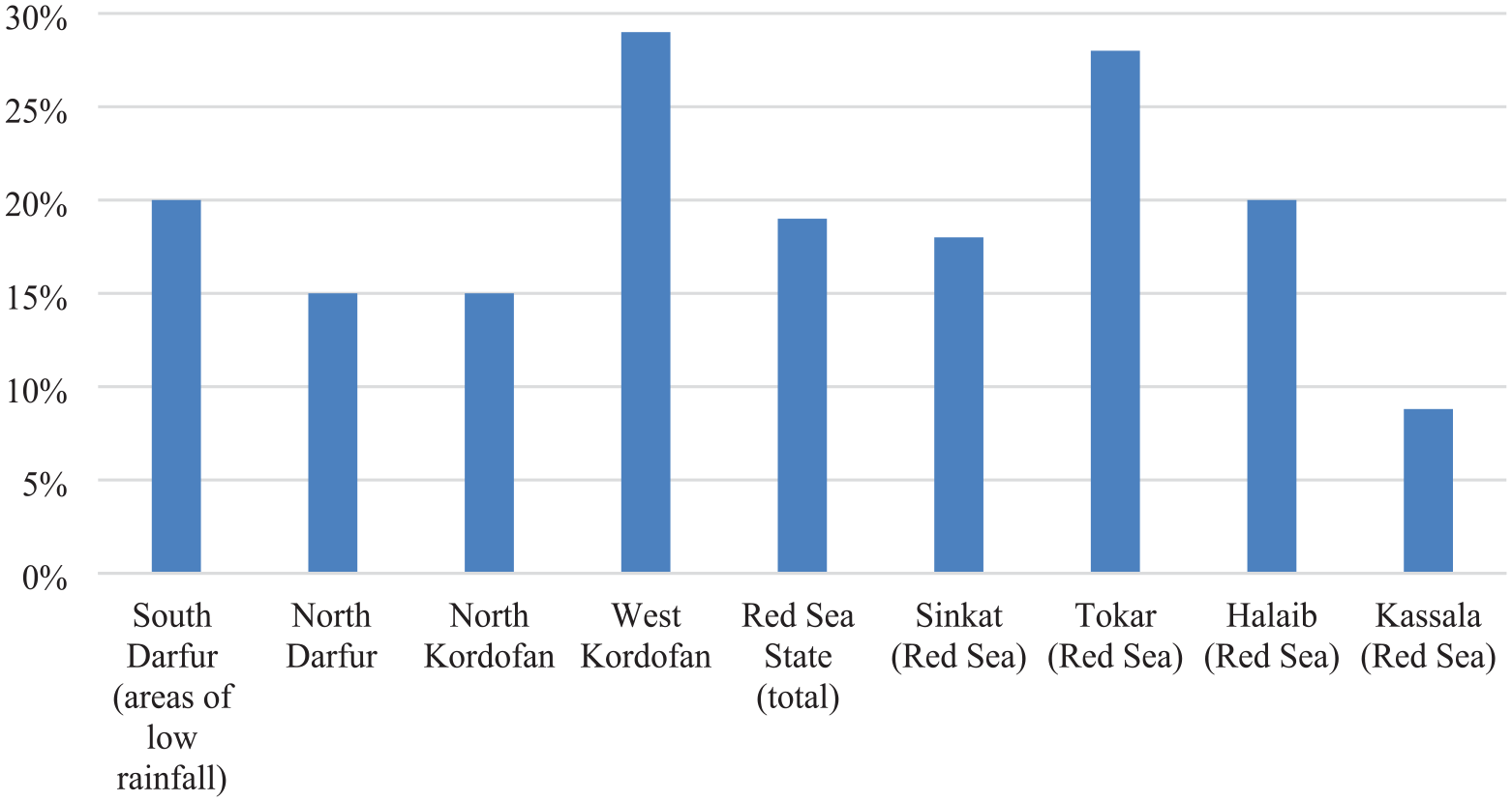
Evolution of malnutrition rates by areas or states in 1999.
Finally, it is also relevant that the export of sorghum continued despite the famine of 1998 and 1999, and even that the export of sheep reached 1.7 million head in 1998 and almost 2 million in 1999. This indicates that the food insecurity situation was not only a problem of food availability due to the drought, but a question of access to food, which in the case of Darfuris, Nubas, Nilotics and Beja people had clear political connotations (Figure 7). The government had no contingency plans and only little effort to contain the crisis was focused on its Baggara allies, especially in this period. Therefore, letting the rest die was a political and not just an environmental issue (Jaspars, 2018).
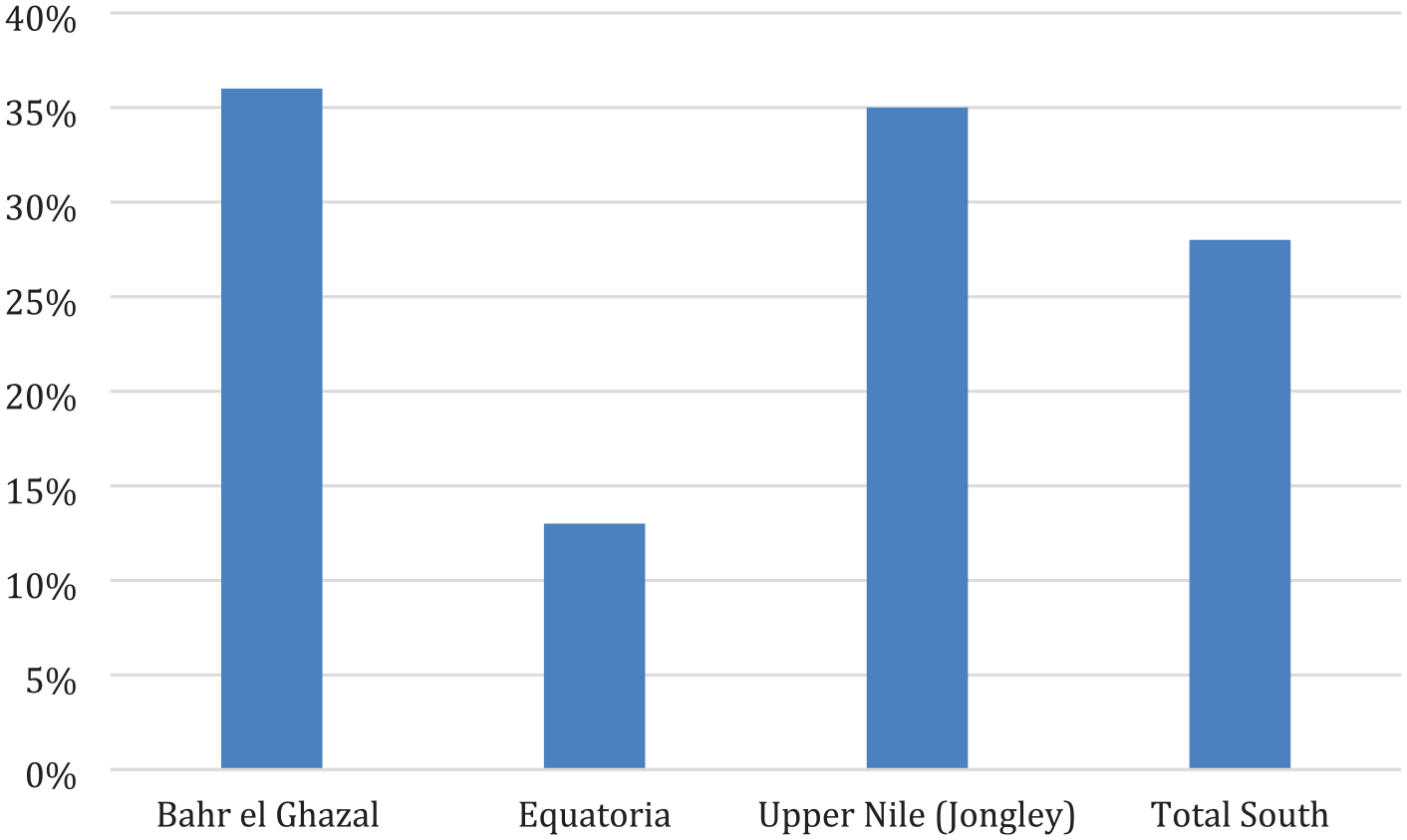
Proportion of affected population in urgent need of food in January 2000.
Genesis of oil in Sudan (1999–2011)
The new oil elites of the 21st century and the peace process in the South
The international isolation of the Khartoum government became more important throughout the 1990s, and Bashir took steps to try to break it. In the spring of 1996, Osama bin Laden 6 was ordered by the government to leave Sudan, which caused that Turabi lost an important support for his Islamic revolution. Furthermore, the PAIC’s main funders sidelined the Islamists in power, making it difficult to hold the PAIC General Assembly, which had to be postponed to January 1999. Bashir also took some actions in the international arena and agreed to a 10-month economic stabilisation programme with the IMF, which included privatisations and strict reforms to avoid being expelled from the institution (Burr and Collins, 2003; World Bank, 2003).
As speaker of the parliament, Turabi introduced a new bill in 1999 that allowed political parties to participate in Sudanese political life through ‘political alliances’. It led to the emergence of many such ‘alliances’ based on traditional northern political parties such as the unionists or the Umma party, as well as small formations in the south. Bashir and Turabi’s late 1999 manoeuvres to maintain their respective positions of power were intense. In December 1999, Turabi launched an initiative to ‘democratise’ the national assembly, with the possibility of dismissing the president with a two-thirds vote in the parliament, which, given the power of Turabi’s faction, would reassert its power. For this purpose, a vote in the parliament was planned to take place on 14 December. However, Bashir anticipated events and used his military might to prevent it, surrounding Turabi’s party headquarters with troops and tanks on 12 December. The assembly was dissolved and Turabi was removed as its speaker, establishing a state of emergency shortly afterwards and terminating the ‘Turabi Islamist experiment in Sudan’ (Burr and Collins, 2003).
In order to curry favour with multilateral financial institutions, the pragmatic Islamist military faction did not hesitate to confront Turabi’s civilian control. The Islamist military faction, led by President Bashir, decided to take a pragmatic view and deposed Turabi and his allies.
Multilateral financial institutions and foreign investors had a vested interest in Sudan’s economic stability, and they wanted to protect their investments and loans, particularly regarding oil. The oil industry had a major influence on the split among Islamists, as oil profits increased from 1999 onwards. The new government employed oil assets to sustain and perpetuate itself in power, especially after the discovery of new oil fields in 1999. To this end, measures were also implemented to reduce the options for the political opposition, even within the Islamist movement, and to gain full control of the state apparatus (Burr and Collins, 2003).
Khartoum’s efforts to secure Unity, Heglig and Upper Nile oil fields, as well as new fields discovery and the construction of a pipeline to transport crude oil to the Red Sea, provided essential support for the continuation of Bashir’s rule. Sudan became one of the world’s leading oil producers and a member of the Organisation of Petroleum Exporting Countries (OPEC) when it began exporting crude oil in the summer of 1999 (Burr and Collins, 2003). In this way, oil crystallised as a factor of strength for Bashir’s government, and with its revenues the regime’s rearmament intensified Sudan’s war capacity. However, the attacks of 11 September 2001 in New York opened the door to the possibility of peace with the South 7 (Danforth, 2002).
Consequently, the government ignored the main supporters of the Sudanese political Islamism and promoted a process of pragmatic economic neoliberalism with a legal system based on Islamic law but not ‘too Islamist’. Gallab (2008) notes that this transition from the ‘first Islamic republic’ – with Turabi – to the ‘second Islamic republic’ – without Turabi – was characterised by two essential aspects. First, the continuation of endless conflict between Islamist groups, as well as the use of power by Bashir and his followers to subjugate Turabi’s supporters. Second, by the seizure of power and control of the state by a faction at the top of power that sought to wipe out rival groups. This faction, which took power around Bashir and still in power under general al-Burhan, despite the current war, has been characterised as being Nile riparian, mostly from the Jaaliyun, Danagla and Shayqiya tribes, and overlapping several categories of membership: senior bureaucrats, security personnel or Islamist military (Gallab, 2008). They entrenched themselves in power and have since become the political and military elite.
As a consequence of the new political and economic scenario, in September 2003, direct talks between John Garang’s SPLM/A and Sudanese Vice President Ali Osman M. Taha resumed in Naivasha (Kenya) and were seen by many as a ‘last chance’ for peace (Rolandsen, 2005). After weeks of negotiation, important security agreements were reached and it was decided, through the Naivasha Agreement of 25 September 2003, to create two separate armies for the North and South: the Sudanese Armed Forces (SAF) in the North and the SPLA in the South.
On 5 June 2004, the Nairobi Declaration was signed, and the parties confirmed their commitment to continue with the peace process 8 (Rolandsen, 2005). A few days later, on 11 June, through Resolution 1547, the UN established the United Nations Advance Mission in Sudan (UNAMIS), which was mandated to support and facilitate talks and contacts between the parties to the North–South conflict under the auspices of the Intergovernmental Authority on Development (IGAD), as well as those carried out by the African Union with regard to the conflict in Darfur. Finally, John Garang, on behalf of the SPLM/A, and Ali Osman Mohamed Taha, on behalf of the government, formally signed the Comprehensive Peace Agreement (CPA) on 9 January 2005.
Unfortunately, the agreement would not close all disputes between the North and the South, as it would leave pending issues and as Alex De Waal (2010: 9) highlighted: ‘Sudan is dominated by two mutually distrustful, defensive, and exhausted parties that playing a game of zero-sum politics’. Furthermore, the possibilities and application of the CPA were not understood in the same way by northern elites and southern rebel leaders. For the northern elites and the ruling party, the autonomy that the CPA allowed was sufficient for the South. However, for some social sectors in the South, the CPA facilitated the path to full independence (De Waal, 2010).
In any case, the CPA prioritised the achievement of the Millennium Development Goals (MDGs) and supposed to start a democratic process, as well as the improvement of human rights. It also moderated the hybrid neoliberal-Islamist character of the regime and attenuated the dismantling of the state, benefitting the health and education sectors, at least in the first years after the agreement.
Oil economy and dependency
Following Turabi’s ouster from government and, with him, some of the civilian Islamists, Bashir’s government continued to follow the National Comprehensive Plan (1992–2002) and IMF supervision. Dependence on the IMF continued to determine economic policies, as well as the hybrid neoliberal-Islamist character of the Sudanese state inherited from the previous phase. Bashir, despite his disengagement from Turabi, had not renounced neoliberalism.
The government removed one of its leaders and placed the Sudanese economy in the hands of the IMF, bringing about a new pragmatic change. Through successive surveillance and stabilisation programmes, the IMF was pleased with the successes achieved, especially in macroeconomic policies and structural reform. This was achieved through the following measures:
Fiscal consolidation, reducing subsidies, rationalising taxes and improving public management;
Monetary policy reform;
Unifying and liberalising the exchange rate system;
Dismantling price controls;
As well as through a major privatisation process (World Bank, 2003).
However, the strong irruption of oil in the Sudanese economy constituted a factor of rupture with respect to the previous period. It generated enormous economic resources that transformed the Sudanese economic structure, and the public apparatus, which had been dismantled in the 1990s, had to be reconstructed.
The construction of the pipeline in 1997 facilitated liquid mobility and was designed to stretch from the South to Port Sudan in the North (Alao, 2007). From 1999 onwards production and revenue figures skyrocketed, proving decisive resources for Bashir’s perpetuation in power. The oil concession company, the Greater Nile Petroleum Operating Corporation (GNPOC), 9 generated 42% of total state revenues and some US$500 million annually in 2001. These emoluments were not earmarked for the economic and social development of the country, but were mainly used to increase military and defence spending, which rose by 45% from 1999 to 2001 and absorbed 60% of oil revenues in 2001. In this regard, President Bashir had already announced in 2000 that he would earmark oil revenues for the development of a national arms industry (Human Rights Watch, 2003; Rone, 2003).
In this scenario, the foreign companies that formed the GNPOC 10 controlled 95% of the concessions, which, especially for the Canadian company Enter Talisman Energy, led to criticism from various groups and NGOs. The international companies argued that their activity would bring about improvements and advances in the democratic and human rights situation in the country, but the truth is that these were not witnessed (Rone, 2003).
The World Bank itself, in its 2003 report, pointed out that oil had become the country’s main economic resource but, at the same time, one of the main factors in perpetuating the war over time (World Bank, 2003). Oil thus became the fuel of war but not the cause (Human Rights Watch, 2003).
Map 1 shows the distribution of different oil blocks in 2007.
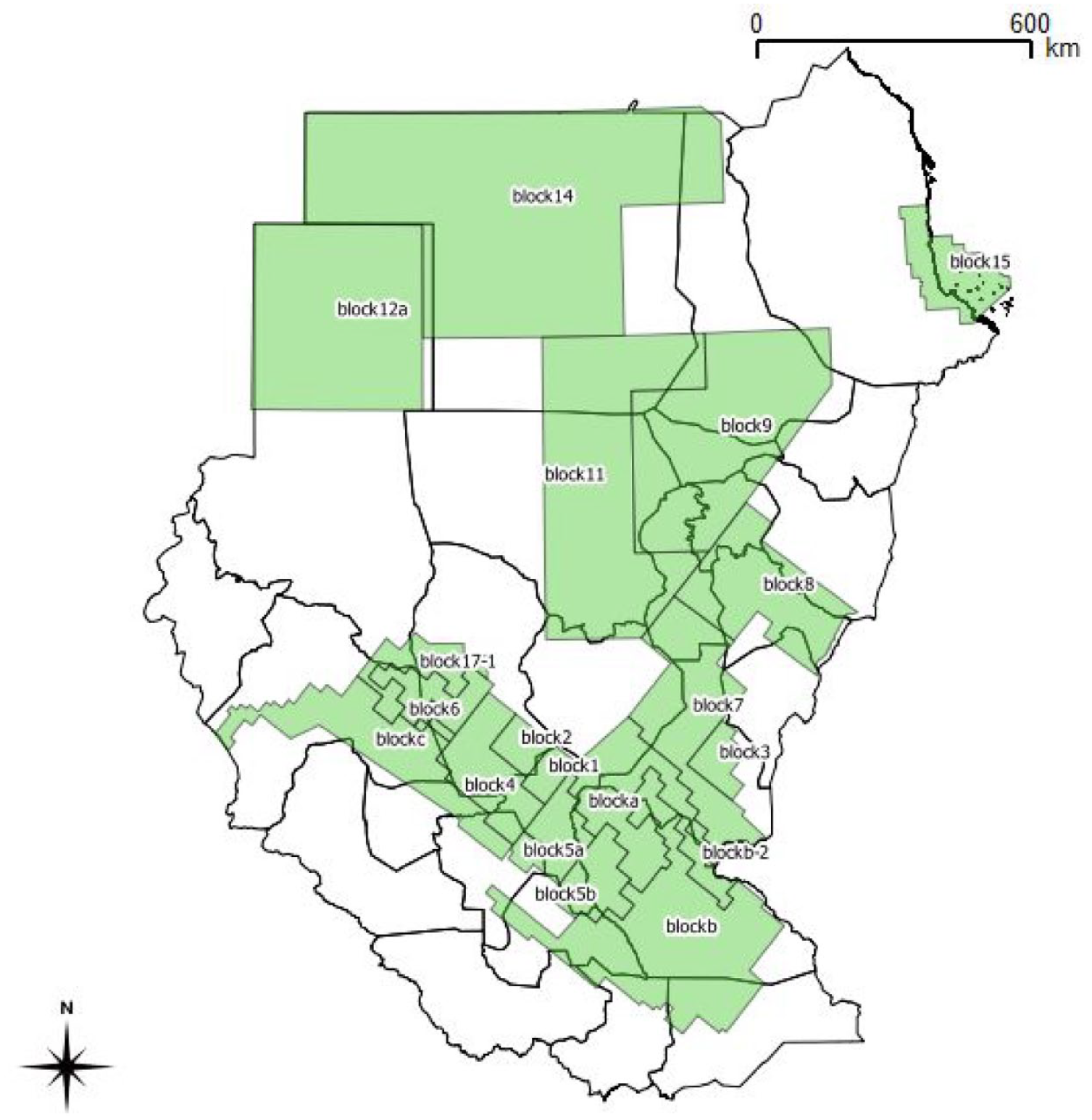
Oil fields and blocks in 2007.
The implementation of the CPA, however, forced the Khartoum government to share oil wealth with the new government of Southern Sudan. By 2007, this sharing was already effective and amounted to a significant sum, though still not quite 50 % as set out in the CPA. These revenues continued to feed a large administration, which spent more than 23% of its expenditure on salaries (World Bank, 2009).
In this context, the National Strategic Plan (2007–2031) was launched in 2006 as a key programming instrument, which included important references to the MDGs. In addition, the plan called for the development of 5-year strategic plans to be consulted with the regional government of South Sudan (International Monetary Fund (IMF), 2013; National Council for Strategic Planning (NCSP), 2007; World Bank, 2009).
To strengthen the development of the country’s oil sector, in October 2005 the Sudanese government established the National Petroleum Commission, which promoted new oil contracts. In addition, at least in terms of its official content, the commission was to ensure a fair and equitable sharing of oil revenues between the North and the new government of Southern Sudan, especially after the signing of the CPA (US Energy Information Administration (EIA), 2013).
Consequently, oil became a strategic resource for the Bashir government’s economy, just as it is today for the military-political elites under al-Burhan. Gross domestic product (GDP) was boosted by oil revenues, which became the country’s main economic resource, although, as Human Rights Watch (2003) pointed out, these revenues were essential to further fuel the war in the south of the country. Moreover, crude oil exports led to a significant increase in government revenues from this source and a change in the structure of government revenues as well as debt reduction, as illustrated in Figure 8.
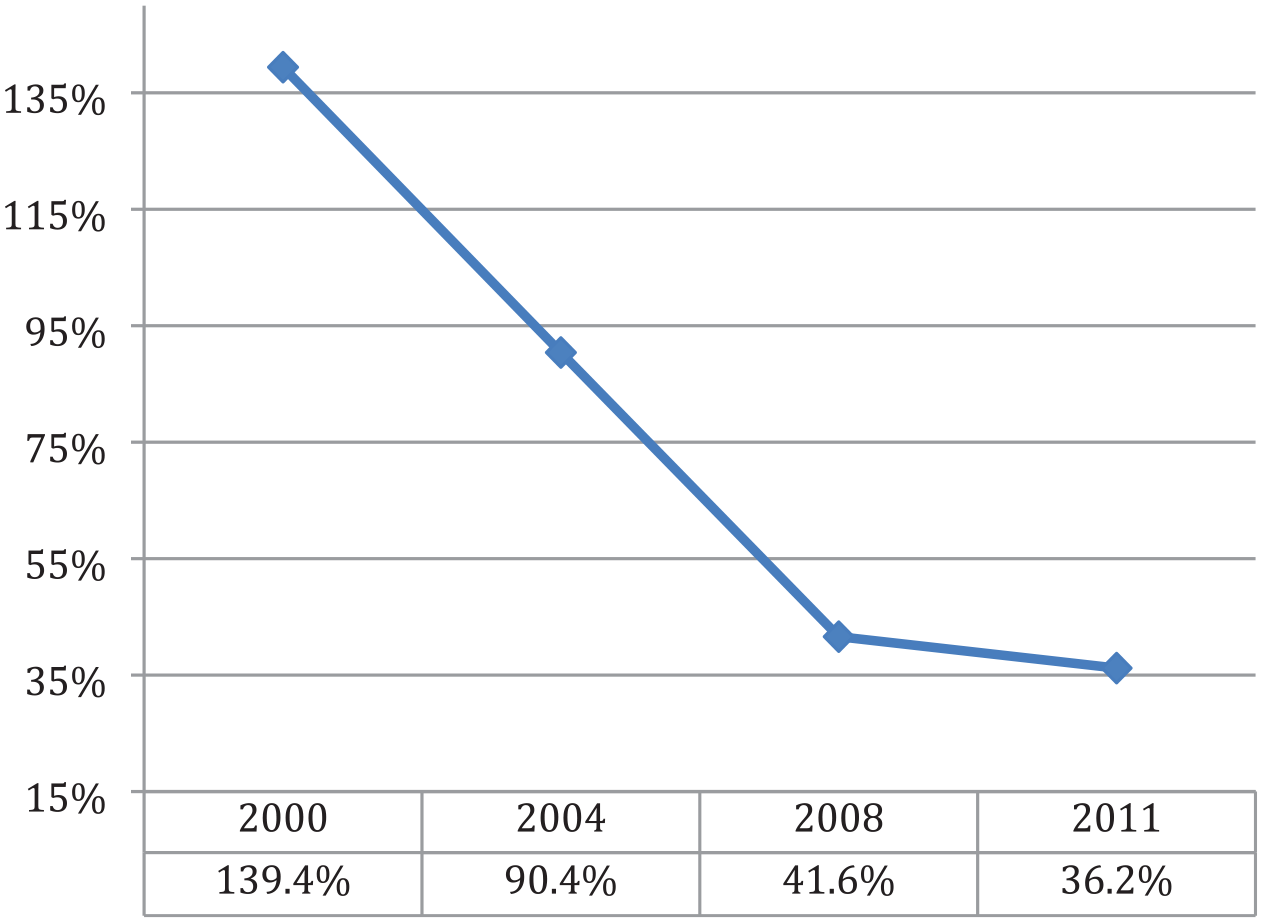
Evolution of accumulated external debt (% of GNI) from 2000 to 2011.
Sudan needed investors and partners for oil extraction and transportation and China became the main partner. Chinese investments were the engine of the Sudanese oil industry, and this relationship was even more important in the 2000s than the Gulf monarchies in the 1990s. China’s contribution to the Sudanese economy also brought dependence and enabled capital surplus generation and a process of capital accumulation. However, it has been placed in the hands of elites linked to political power. Islamist officers in power and bureaucrats around Bashir’s ruling party benefitted from the oil boom, while the majority of the Sudanese people in both the North and the South did not. The withdrawal of Turabi’s civil Islamists has not reduced inequality and repression. Moreover, Sino–Sudanese cooperation fuelled oppression and war in Darfur, using oil as fuel for war and thus consolidating the ‘Sudanese Disease’.
Oil and globalisation brought a deeper disarticulation process, structural duality, extraversion and dependency. Its most dramatic consequence of which were the food security crises during the first decade of the 21st century.
Hunger in the 21st century
The food security situation did not improve significantly in the early years of the new century, despite the relative climate of peace experienced during that time in most of Bahr el Ghazal, Jonglei, Equatoria, the Nuba Mountains and parts of Upper Nile. This trend towards peace came hand in hand with international pressures that forced the signing of the CPA and failed to substantially improve the food security situation, even though the economic resources that oil exploitation was generating were enormous. As Figure 9 shows, with some exceptions, malnutrition levels continued to rise in the country.
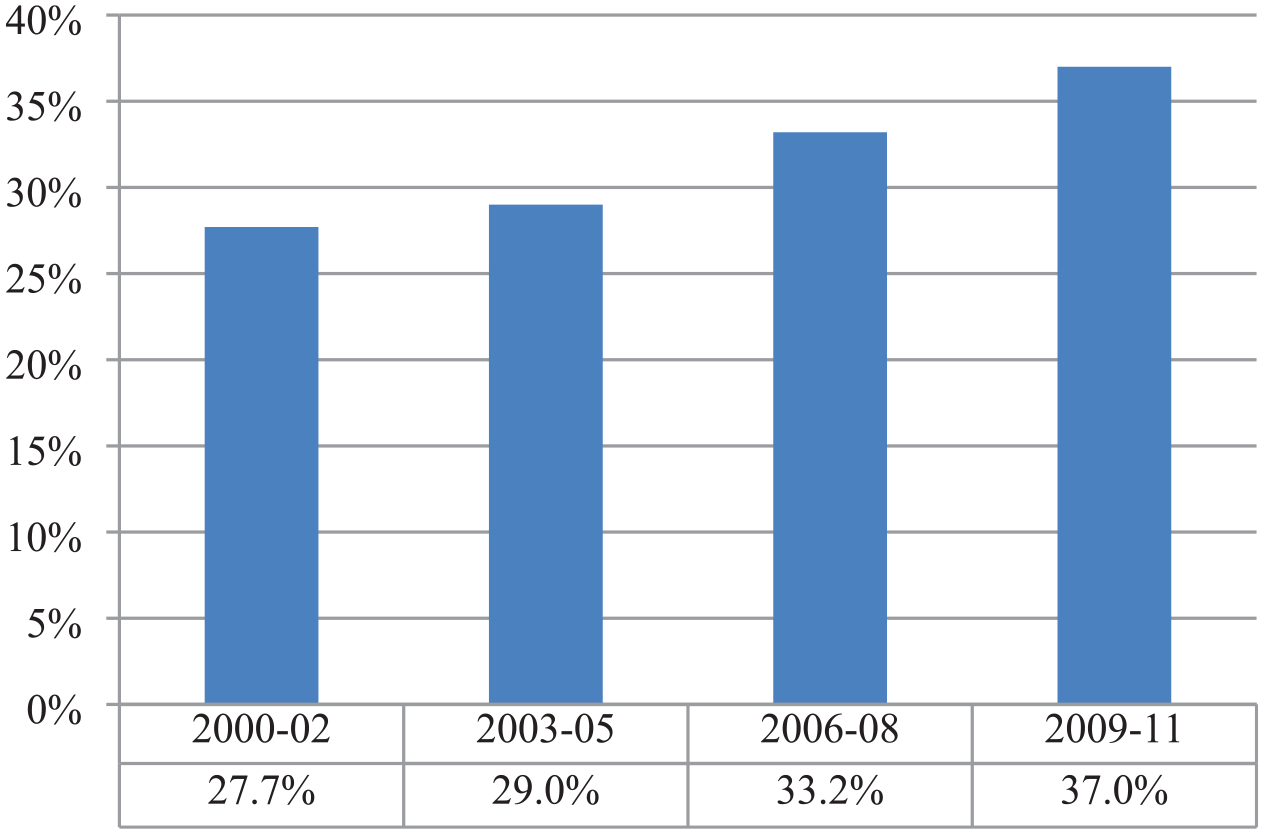
Malnutrition prevalence according to FAO indicators in 2000–2002, 2003–2005, 2006–2008 and 2009–2011.
In Greater Darfur, attacks perpetrated by Janjaweed militias and Sudan Liberation Movement/Army (SLM/A) rebels had deteriorated the physical and food security situation of the population. The effects of the instrumentalisation of hunger as a weapon of war were evident and governmental limitations on access to the most affected areas brought famine and genocide by attrition on the horizon (Daly, 2007; Prunier, 2005; WFP, 2004).
As Figure 10 indicates, between 2003 and 2004 conflict areas required more food, particularly in the case of Greater Darfur and especially West Darfur. Despite good harvests, some 3.7 million people required food assistance in 2004, increasing the number of beneficiaries by 10% and the amount of food required by 27%. In addition, the higher malnutrition rates were related to the armed conflict in the North–South border areas and in Darfur, and not only to climatic conditions (Daly, 2007; Prunier, 2005; WFP, 2004).
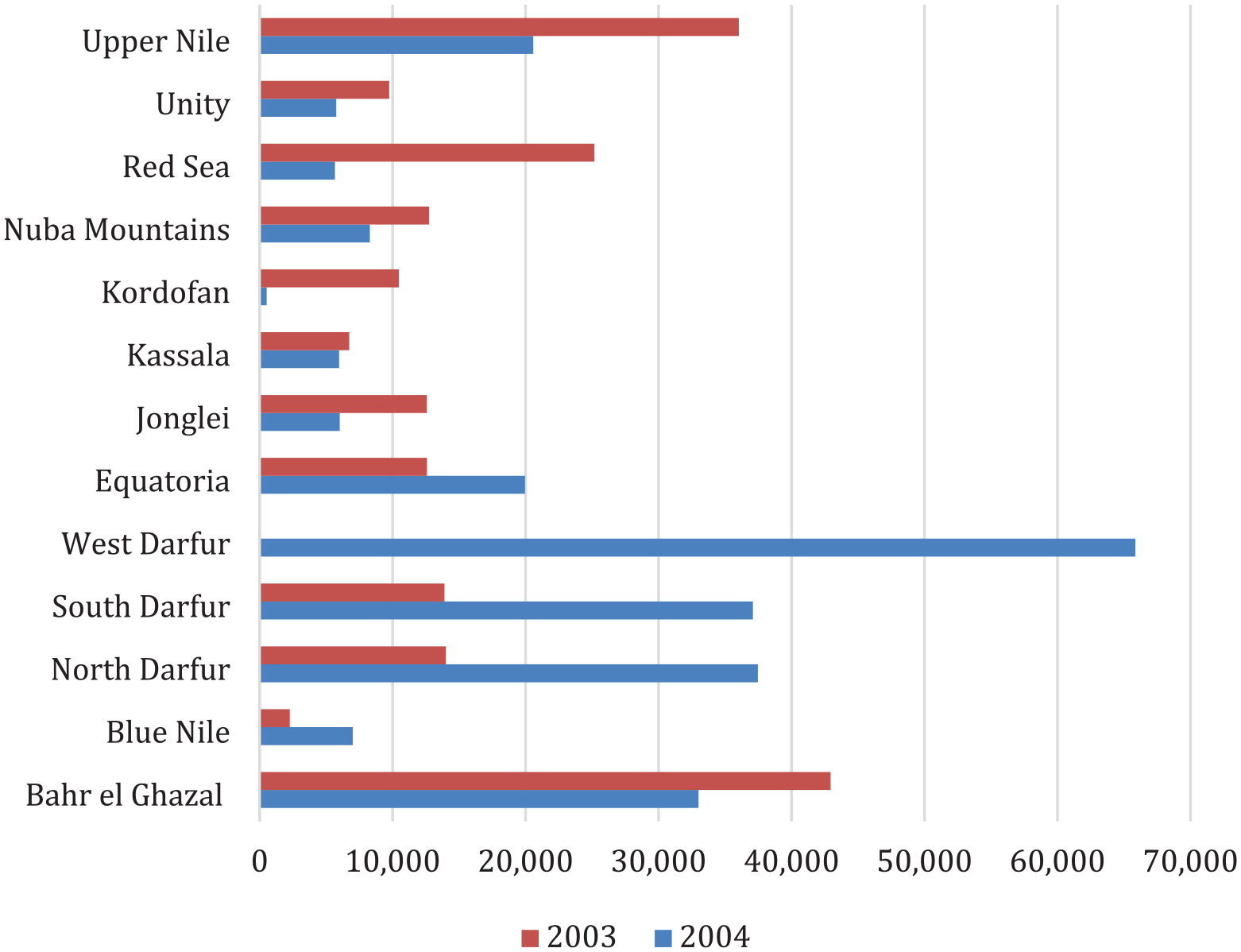
Estimated feed requirements in 2003 and 2004 (in tonnes).
Between 2003 and 2004, hostilities also led to a decrease in the supply of grain and livestock, which increased retail grain prices and decreased the value of livestock, especially in remote areas. However, the price of livestock in Darfur’s three main urban markets – Nyala, El Fasher and Geneina – increased due to the improved condition of the animals, reduced supply from rural areas and higher demand from large traders in the centre of the country (WFP, 2004). Food insecurity was not caused by drought or neglect in the management of food stocks, but the product of a military strategy. 11 In this sense, militiamen and paramilitaries destroyed not only people’s lives, but also the livelihoods of the villages under attack. They also contaminated wells and destroyed water pumps (Flint and De Waal, 2007; Keen, 2008). This set the stage for famine in many rural areas of Darfur, a region where the population was used to subsisting for months on wild fruits (Keen, 2008).
During 2005 and 2006, the increase in sorghum, groundnut, fruit and vegetable production and the maintenance of sesame or tuber production, as well as the upward trend in livestock production, suggested that food availability in the country was not the cause of food insecurity. Food insecurity stemmed from the lack of access to food for populations in crisis, and the responsibility for facilitating such access rested with regional and national executives, as well as with tribal power systems under the Khartoum government. Similarly, major traders sympathetic to the Islamist government or traditional elites were also unwilling to facilitate food access to vulnerable populations, especially in the South and Darfur (Daly, 2007; Prunier, 2005).
However, in Darfur, despite the relative improvement of the war scenario after the signing of the Declaration of Principles between the Khartoum government and the SLM/A-MM 12 (Sudan Liberation Movement/Army-Minni Minawi), the situation did not improve between 2005 and 2006. Once again, it was the Darfuri territories that were most in need of food aid, as Figure 11 shows (WFP, 2006).
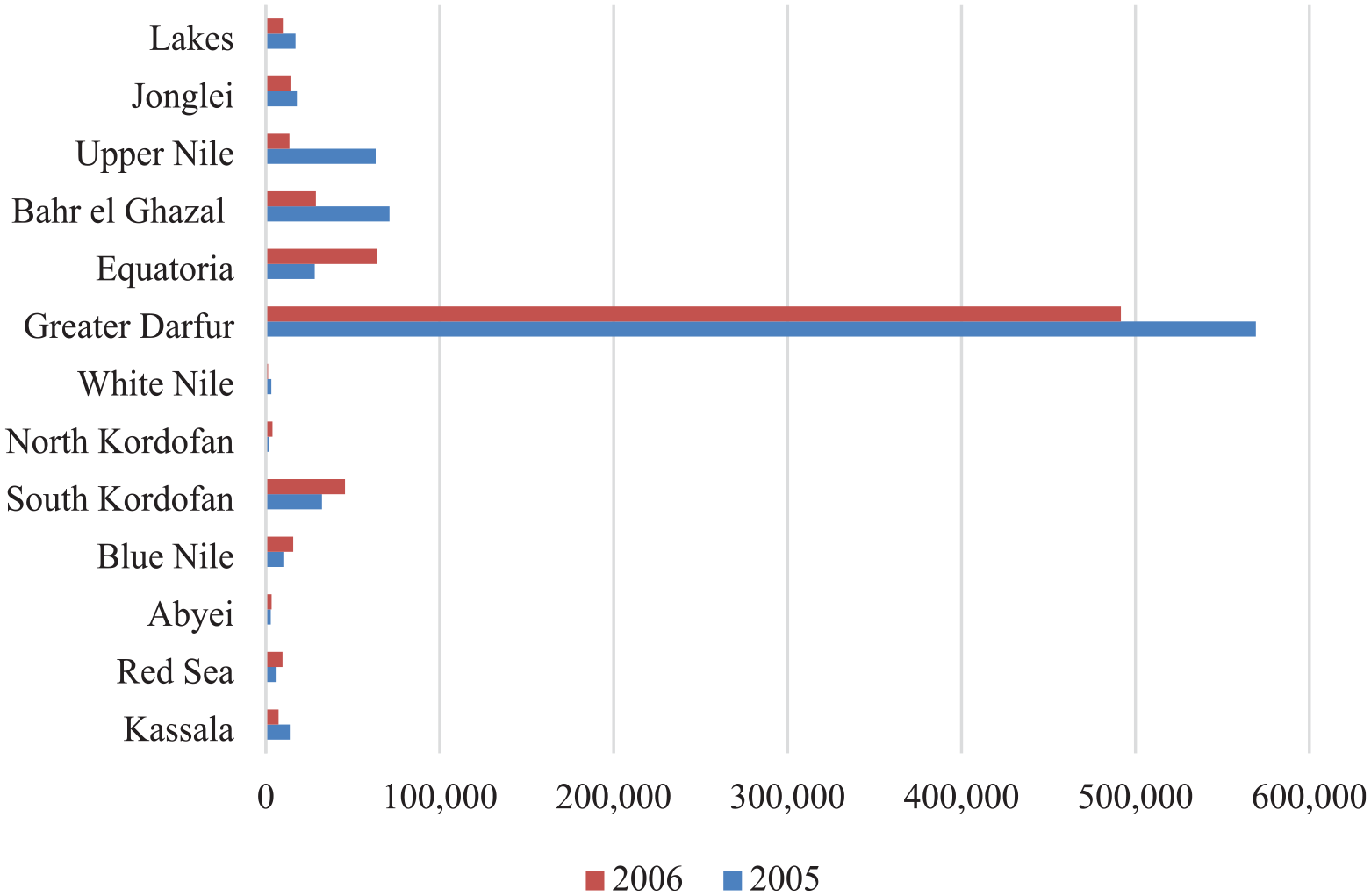
Estimated feed requirements in 2005 and 2006 (in tonnes).
In the South, following the 2005 peace agreement, the food security and hunger situation in most southern states did not improve significantly either, as Figure 12 shows. At the dawn of southern independence, four of the five states with the greatest food security problems were in South Sudanese territory. Not only in the South, but especially in the South, a combination of two aspects may explain the increase in food insecurity in 2006, despite the improvement in production in the 2005–2006 harvest compared with the previous year. On one hand, the needs of people displaced by the armed conflict and, on the other hand, the large number of returnees following the signing of the CPA in 2005 (WFP, 2011).
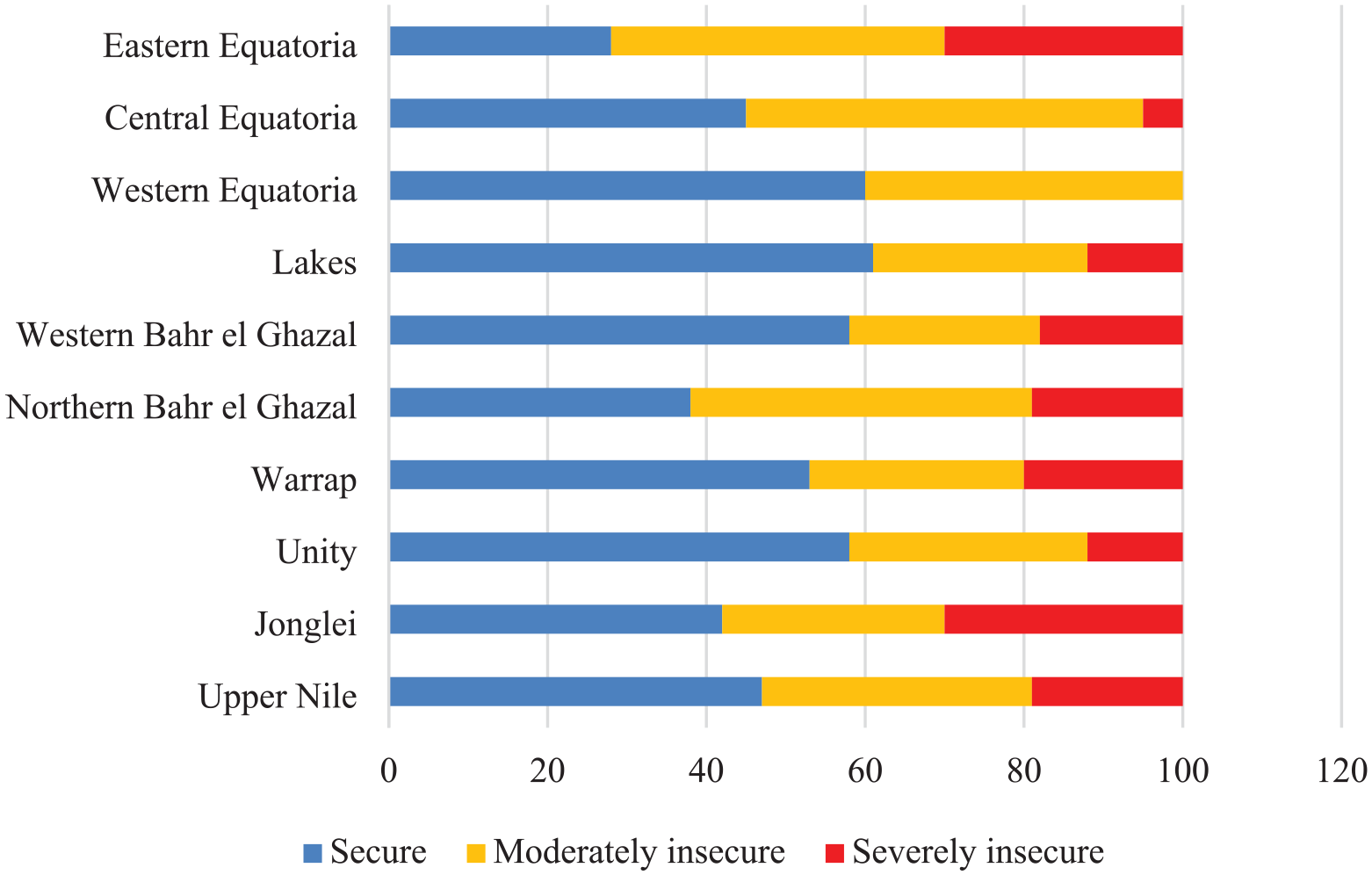
Food security status in the South (% of households).
In the following years, in the North, the greatest food insecurity and risk of famine continued to be concentrated in Greater Darfur, South Kordofan and Blue Nile, as Figure 13 illustrates. It corroborated the fact that, even with oil revenues, Khartoum government lacked the will to put in place real contingency plans that would curb the concurrence of famines in large areas of the country (WFP, 2011).
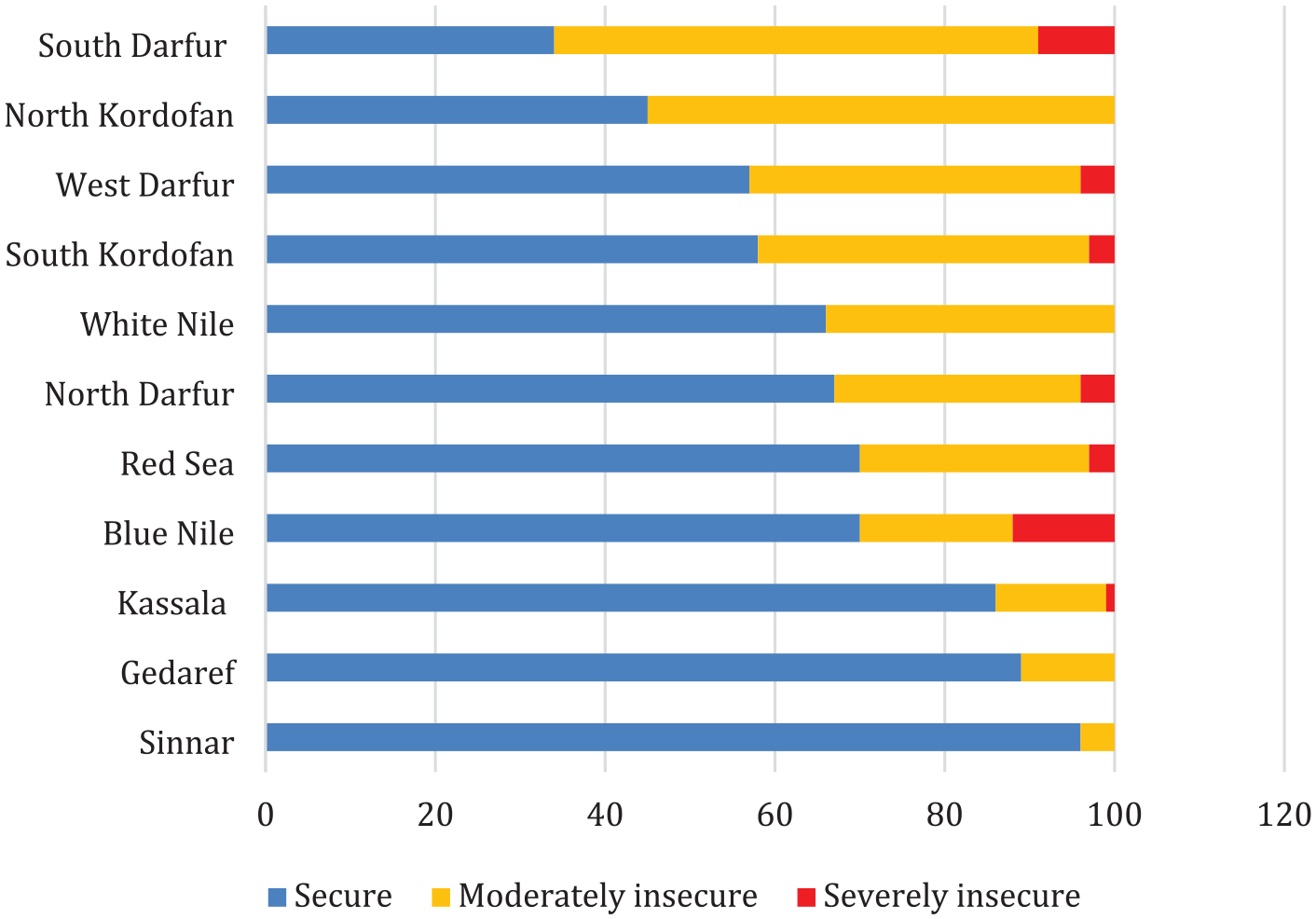
Food security in the northern states in October and November 2010.
Conclusion
When the NIF Islamists, under Turabi and Bashir’s military, came to power in 1989, they combined two seemingly contradictory elements: political Islamism and economic neoliberalism. The Islamist government adopted neoliberal economic policies and reduced public spending and the role of the public sector in the national economy, with the exception of the military industry. This industry was strengthened to exercise Islamist power and impose a new Sudanese identity based on the Arab-Muslim foundation and NIF ideology.
The Salvation Government, after 1989, intensified oppression to consolidate a new Islamist power. The war in the Nuba Mountains, the Blue Nile, Darfur and the Red Sea were examples of such repression, not only against southerners but also against northerners. The government promoted the use of alternative and cheaper forms of warfare, such as paramilitary forces or the generation of famine against southern and even northern opponents (De Waal, 1997; Jaspars, 2018; Johnson, 2011).
Between 1990 and 1999, Islamists consolidated their power and introduced new northern elites around the NIF. They fought against the traditionally dominant groups that had regained power in 1985. However, efforts to transform Sudanese society through a ‘global or integral call’ endowed the Islamist movement with a moral, ideological and religious connotation that faded during the exercise of power, especially when the bureaucratic handover materialised.
The Islamists’ exercise of power involved a struggle between the traditional elites and the new Islamist elites, although some members of the traditional groups became supporters of Islamist strategies. The Islamists tried to achieve a new Islamist state, but international political and financial pressure caused a rift between Bashir and Turabi. The main result was the defenestration of Turabi and his followers from political power in 1999 and the path towards the CPA signed in 2005 between the Sudanese government and the SPLM/A.
President Bashir’s regime reduced violence and repression in the South, but oppression began and intensified in Darfur, where the international community initially ignored the situation. Consequently, the existence of resistance movements and armed struggle in the North showed that the war and repression exercised by the Khartoum-based power groups had reached almost every corner of the country.
With the exploitation of oil in the new century, Sudan remained a dependent country with a dual economy. Gulf countries, especially Saudi Arabia, and China replaced Western countries, although the IMF had begun to monitor Sudanese economic policy in the late 1990s. The process of neoliberalisation evolved from a roll-back to a roll-out neoliberalisation, and a new neoliberal state was built based on the profits of oil.
In the 21st century, Sudan remained a dualistic, extraverted, dependent and disarticulated economy, and went from being the breadbasket of the Arab world to being a Chinese oilfield. However, the Sudanese economy did not take advantage of oil exploitation and a process of economic ‘reprimarisation’ took place. The diversification of productive sectors was once again an illusion. Moreover, the levels of disarticulation and extraversion of the Sudanese economy soared at the turn of the century, with the economy less diversified than in the early years of independence. This resulted in Sudan’s dependence on foreign economies, especially China, as an extractive periphery, transforming the South into the periphery of the periphery.
However, Sudan had access to foreign exchange markets thanks to its oil, which has led to an increase in foreign investment in the oil sector, as well as in oil revenues. The Sudanese government found a source to finance its growing expenditures, especially military, and to consolidate its power. In addition, as oil facilitated access to international capital flows, financial market conditions influenced Sudan’s economy and intensified its dependence.
Regarding food insecurity, throughout 1989–2011 it was not only the result of climatic and environmental factors, but also the consequence of the political, economic and military strategies pursued by the National Salvation government. Food availability was not the fundamental element of food insecurity but rather the lack of access due to power dynamics and violence. Therefore, food shortages have not only been the consequence of an inefficient economic structure, but also the effect of economic policies, which in some extreme cases has been aimed at provoking famine in certain territories and over certain populations. This was the case of the Dinka people in Bahr el Ghazal in the 1990s, as well as the Fur and Massalit in Darfur in the 2000s. In this way, the ‘Sudanese disease’ has crystallised as a term to explain how the abundance of sudden income and wealth related to a commodity or product can lead to increased food insecurity in contexts of oppression and war, as in the Sudanese case, during the 1990s and 2000s.
Footnotes
Funding
The author(s) received no financial support for the research, authorship and/or publication of this article.
