




Abstract
The study uses the framework for sustainability of community radio to investigate challenges that hinder M3O community radio from being an active agent in facilitating development. A qualitative research design was adopted: qualitative data were collected through structured interviews with key informants from the station. The findings revealed that the station fails to achieve financial, social, operational, technical and environmental sustainability and this hinders the station from achieving its broadcasting mandate. The study recommends the station to enhance their fiscal capacity through rigorous marketing to attract advertisers and from receiving funding from spheres of government within its radio frequency influence.
Introduction
Community radio stations are increasingly being recognised as significant agents that facilitate development and further sustainable development goals at grassroots level in the global south. In particular, the South African Broadcasting Act, 1999 mandates these stations to broadcast content that highlights grassroots community matters, reflects local culture, focuses on developmental issues, educating and entertaining communities. Community radio stations, therefore, strive to broadcast public discussions and debates and locally relevant content aimed at facilitating development, but they are confronted with viability and sustainability challenges that deter them from fulfilling their broadcasting mandate (see Correia et al., 2019; Khan et al., 2017; Mawokomayi and Osunkunle, 2019). Lush and Urgoiti (2012) are of the view that sustainability challenges are specifically categorised as financial, social and operational or institutional. If these challenges are unresolved, community radio stations will fail to fulfil their broadcasting mandate of promoting inclusiveness, diversity and social cohesion, consequently communities suffer as a result. To curb this, the South African government put in place mechanisms to fund and support the establishment and the operation of community radios, that is, through the Media Development and Diversity Agency (MDDA) and the Open Society Foundation for South Africa, the National Community Radio Forum. A survey of available literature shows that strategies such as workshops, training sessions, and community radio courses have been utilised or advocated for but fail to solve sustainability challenges confronting the community radio sector (Correia et al., 2019). The United Nations Education, Scientific and Cultural Organization (UNESCO) (2017), echoes the need for exploring alternative approaches, to ensure the long-term viability and sustainability of community radio amid the fourth industrial revolution and digital transitions. These include accommodative policies and strategies, licensing, access to spectrum, and sustainable funding sources.
Although the South African community radio sector celebrates 29 years of existence, sustainability challenges continue to exist. The coronavirus 2019 pandemic was a major setback as it aggravated the situation. Questions or concerns were raised on the sustainability of radio amid a pandemic and post-pandemic period. One of the challenges observed is of financial sustainability as there was a sharp decline in advertising revenue because of the pandemic (Massah, 2022) and in extreme cases, it led to the closure of some community radio stations. The situation was worse in Liberia as the stations operate in areas where audiences are low-income earners, and some stations lack sustainable supply of electricity, and operate using outdated equipment (Massah, 2022). A study by Laskar and Bhattacharyya (2021) show that sustainability of community radio especially during pandemics is a cause for concern: it is apparent that horizontal and top-down communication approaches were used during the coronavirus pandemic. Research report on United Kingdom community radio production responses to COVID-19 highlighted community radio stations are provided health information targeted at local communities in local languages; thus, radio has proved itself to be proficient and resourceful in responding to a crisis by incorporating new content in their usual daily schedules (Coleman, 2020). Although other media, that is, social networks and television played a critical role in informing and educating the masses about the epidemic community radio stations were pivotal in providing rural and hard-to-reach local communities with detailed context-specific information (Dzung, 2022). Therefore, it is vital that community radio stations access resources that enable their sustainability, so that they continue playing their developmental mandate.
If not addressed, sustainability challenges in worst case scenarios lead to the closure of radio stations and in other instances, the stations will fail to fulfil their broadcasting mandate of developing local communities. Although there is an abundance of studies on the importance of community radio in advancing development of local communities, there is dearth of studies focused on the sustainability challenges faced by these stations and how they can survive through time as participatory and inclusive stations (Correia et al., 2019; Mofokeng, 2018). The Council of Europe (2022) acknowledges studies on the earlier focus; however, the shortcoming is that they rarely materialise into funding schemes or sustainable financial mechanisms for community radio. This study therefore explores sustainability challenges that are faced by community radio stations in fulfilling their role of facilitating community development, with a focus on M3O community radio in Eastern Cape Province of South Africa. The study answers the following questions (1) Which sustainability challenges does M3O community radio face in fulfilling its broadcasting mandate of facilitating development of grassroots communities within Buffalo City municipality? (2) Which strategies can be employed to enhance sustainability of community radio stations? The next section provides a brief background on the development of community radio in South Africa.
Phase 1: the advent of community radio in South Africa
Community broadcasting in South Africa started in the 1990s after the end of Apartheid because of the Jabulani! Freedom of the Airwaves Conference which was held in Netherlands in August 1991 (Beham, 2018). This conference triggered debates on South African media policies which resulted in the liberalisation of the airwaves replacing the South African Broadcasting Cooperation state monopoly with a three-tier system of broadcasting: public, commercial and community broadcasting (Beham, 2018). Community radio stations fall under community broadcasting and their aim is to serve the needs of rural communities which were side-lined during Apartheid era (Buckley, 2011; Pavarala and Kumar, 2004). In community broadcasting, programmes are produced by the community, and this is different from public and commercial broadcasting where programmes are imposed on the community (Mawokomayi and Osunkunle, 2019; Mhagama, 2016).
The post-apartheid period, that is between 1992 and 2000 saw the development of community radio stations in South Africa. The first community radio station to operate in South Africa is Bush radio, which operates from Cape Town, the station is referred to as ‘mother of community radio’ and it started operating without a licence before the formation of Independent Broadcasting Authority (IBA) (Bosch, 2014; Ngugi, 2015). IBA was responsible for the regulation of broadcasting activities before it was replaced by the Independent Communications Authority of South Africa. The first radio station to receive the Independent Broadcasting Authority licence was Radio Maritzburg of KwaZulu-Natal province and by the end of 1995, about 82 community radio licences had been issued (Olorunnisola, 2002); 150, by 2003 (Bosch, 2003) and 278 by 2016 (The Broadcast Research Council of South Africa Radio Audience Measurement (BCR RAM), 2016). Among these is M3O community radio (M3O CR), which is the subject of this paper.
M3O CR establishment can be traced back to 1992. During this time a pioneer group of communication students kick started the journey for this radio through mooting a concept for the establishment of a university radio station (Gaqa, 2002). This initiative was applauded for being such a great success and was well received spreading like veld fire in the community and the province at large. This was described as one of the hottest channels serving black population in the province, a redress of marginalisation during the apartheid era. Despite the potential of the radio station, management conflicts between communication students actively involved in running the station and Student Representative Council (SRC) ensued. The bickering over airwaves control stifled the successful growth of the station and this continued to escalate resulting in the closure of M3O community radio (Gaqa, 2002; Mawokomayi, 2017).
Phase 2: M3O community radio 2002 onwards
Gaqa (2002) argues that after a decade long, the conflicting stakeholders came to the realisation of how counterproductive their relations were and set aside their differences. They harnessed the power of collaboratively working together in re-establishing the radio station. The radio continuously received increased interest on posts advertised, almost 60 volunteers and the Department of Computer Science were keen in joining the initiative. However, the station was not financially sustainable, it grappled with serious financial challenges, and it required huge injection of seed funding. Hence for this campus radio to be on air, it was bailed out of this situation through donation of broadcasting equipment and financial resources from Primedia’s Radio 702, SRC and the University of Fort Hare (UFH) (Gaqa, 2002; Mawokomayi, 2017). These fruitful efforts were a result of engagement efforts between the radio management, SRC, UFH Division of Marketing and Communications and Vice Chancellors Office. M3O CR eventually secured a licence and began broadcasting as a community radio in 2008. Thus, M3O CR was established as a campus radio and later evolved into a community station (Manyozo, 2009; Mawokomayi, 2017). It broadcasts from UFH campus in Alice, a small town under Amathole District Municipality in the Eastern Cape Province of South Africa. The station was started as a development initiative to aid the development of Amathole District Municipality (Seti, 2013). The staff of M3O CR is composed of a few permanent employees and a pool of volunteers who come from surrounding rural communities such as Seymour, Fort Beaufort, Middle drift, Ntselamanzi and Adelaide. Although today, a huge number of community radio stations were established, they are not immune to sustainability challenges rampant in community broadcasting sector worldwide. The next section discusses the framework for sustainability of community broadcasting.
Framework for sustainability of community radio broadcasting
Correia et al. (2019) are of the view that community radio stations are confronted with sustainability challenges that hinder their operations. Literature posit that previous studies discussed sustainability in relation to financial resources (i.e. Lush and Urgoiti, 2012; Mtimde 2000). However, the concept was broadened to include social and operational or institutional sustainability (Gumucio Dagron, 2001), technical and environmental sustainability (Buckley, 2011). For community broadcasters to fulfil their mandate of facilitating development in their respective communities, they should address sustainability issues. Thus, the framework for sustainability of community radio is five dimensional, namely, financial, social, operational/institutional, technical and environmental sustainability (Figure 1).
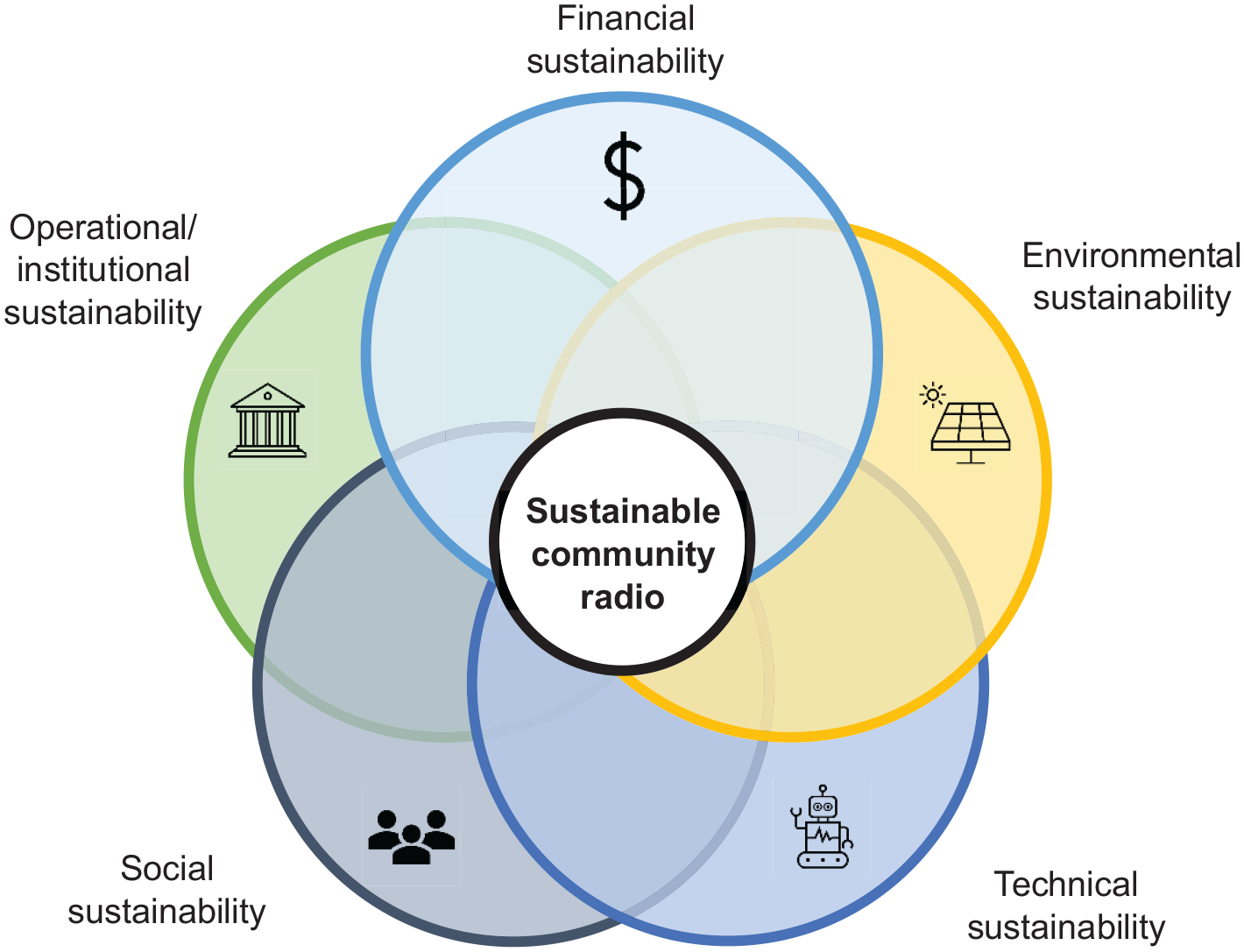
Sustainable community radio framework.
Financial sustainability
The issue of funding has been a challenge to the sustainability of the community radio sector. Financial sustainability is all about the station’s finances, particularly the potential to generate income, how money is utilised in the running of the station and in facilitating development within surrounding communities and how the money is accounted for (Gumucio Dagron, 2001). Although there is an increasing number of established community radio stations worldwide, these stations are confronted with similar challenges, that is, setting up costs, increasing maintenance costs, competition from other broadcasters and online media, struggling to keep abreast with technological innovations (Bonin-Labelle and Demers, 2019). Above all, insufficient financial resources are a major setback to community broadcasting as this hampers all effort to facilitate development.
At the end, community radio stations end up relying on donor funding, non-governmental organisations (NGOs) and state support which affects independence in decision making (Pavarala, 2015). Research conducted by Bonin-Labelle and Demers (2019) indicate that most radio stations in Canada continue to rely on Radiometers grant instead of finding sustainable ways of getting funds. For instance, according to Bonin-Labelle and Demers (2019) from a total of 108 radio stations that received Radiometers grant, only 28 radio stations had previously applied for funding once between 2012 and 2015, The remaining stations had applied at least twice, and this implies that the funding system does not enable the station to be sustainable. In a bid to address this challenge, in countries like India, the Ministry of Information and Broadcasting set up a programme that enables community radio to broadcast government advertisements by publicising, for example, welfare schemes and earn income but this failed amicably in resolving the problem as the rates are very low (Pavarala, 2015). In addition, the Ministry introduced a scheme that subsidise technology costs (Pavarala, 2015) but this is just a starting point in addressing financial challenges faced by the sector.
Literature advocate for the need for community radio stations to be financially independent so that they can serve their local communities. In their quest to be financially independent, radio stations face a myriad of challenges. The stations are forced to rely on sponsorship, selling airtime, monthly or yearly subscriptions and this implies that the stations resort to a business model to attract sponsors or advertisers (Anderson et al., 2020; Order, 2016). Anderson et al. (2020) argue that ‘such funding models have resulted in somewhat of an identity crisis for the sector’ (p. 3). Thus, stations may struggle to fulfil their broadcasting mandate as they focus on programming that attracts advertisers. There are many challenges associated with advertising. Barlow and Johnson (2008) mention that some radio stations prefer not to raise revenue through advertisements citing ethical considerations, and also due to high production costs which mostly outweigh financial gains, not only that, but advertising also comes at a cost, at the expense of freedom. Other studies suggest strategies that can be employed by community radio stations to achieve sustainability. Correia et al. (2019) recommend using open-source technology and content in radio broadcasting in a bid to maximise creative output and at the same time minimise costs. However, to achieve financial sustainability, the station should achieve social and institutional sustainability (Gumucio Dagron, 2001).
Social sustainability
Social sustainability refers to the ownership of a station by the community and includes their participation in producing content and in airing of programmes (Gumucio Dagron, 2001; Lush and Urgoiti, 2012). The community should not merely participate in these activities but be part of decision making in the day-to-day operations of the station to achieve social sustainability (Gumucio Dagron, 2001). Available literature indicates that most community radio stations partially include communities in producing radio content, programming and in managing the station (Faisal and Alhassan, 2018; Mhagama, 2016) and because of various reasons such as financial constraints and time management. According to Msileni (2021), Kumkani FM and Wild Coast FM in Eastern Cape Province do not fully involve their host communities in all activities of radio and the communities do not relate to the station and this implies that the station fails to achieve social sustainability. In some cases, programming schedules limit community participation. For instance, in a study conducted by Matundu and Mapudzi (2023) participants attribute poor participation to broadcast schedules as some shows are aired as early as 07:00 am.
Correia et al. (2019) are of the view that participation should be at the centre of community radio broadcasting practice. Asuman and Subeshini (2023) found that local women voluntarily participate in content production at community radio stations in Ghana. A study by Radelius (2015) on participation highlights that Bush Radio, Radio Zibonele and Valley FM audiences actively participate through social media such as Facebook, Twitter and WhatsApp and these platforms enable the station to collect and build on indigenous communities’ stories. Krüger et al. (2013) are of the view that social sustainability is all about community’s sense of ownership and support through voluntary participation in broadcasting activities and providing constructive criticism. Therefore, Bush Radio and Valley FM are playing crucial roles as far as achieving social sustainability is concerned.
In addition, social sustainability is not only limited to the role-played by community radio audiences, but the station should also play a pivotal role in facilitating development in communities they serve. This is evidenced by various studies which demonstrate the role played by community radio in uplifting their communities. Findings from a study by Adebayo et al. (2022) show that Bush Radio’ youth programmes empower local artists by providing a platform for promotion of their music. Scholars such as Sussman and Estes (2005) found that KBOO, a community radio in Portland has been influential in developing surrounding communities by supporting grassroots initiatives and in community building. Through diverse cultural and language programming, the station attracts a wide range of listeners such as Chinese, Italian, Whites, Latino and African Americans and promotes peace among locals and immigrants (Sussman and Estes, 2005). In African countries, community radio has a central role in people’s development through broadcasting programmes that provide information that improve lives; such programmes range from agriculture, health, education (Khan et al., 2017; Mawokomayi and Osunkunle, 2019). Thus, these stations empower marginalised communities and address poverty (Pavarala, 2015) and as a result they are socially sustainable.
Operational sustainability
According to Gumucio Dagron (2001) institutional sustainability is all about how the station operates, that is, laws and regulations that guides operation of the radio, management styles, stakeholder relations. The regulatory framework affects the operation of community radio. Busolo and Ngigi (2016) argue that for community radio stations to fulfil their purpose, there should be an enabling broadcasting environment that encourages sustainability. Several measures were put in place to support the operation of community radio in South Africa. For instance, the MDDA was established in 2003 ‘to support the sustainability and development of the community broadcasting sector . . . ’ (Buckley, 2013: 25). The MDDA therefore provide grants to community media (Buckley, 2013) and community radio sector also receives advertising and sponsorship revenue through Government Communications and Information System and private sector which include The Media Connection, ABC Ulwazi, Agile Media, Motswako Media and Serongwanyane (Panther, 2012: 37). Although these initiatives are in place, community radio stations are failing to achieve operational sustainability. The funding is insufficient and this in turn impacts their functionality and threatens their sustainability as they must generate revenue from limited sources. In addition, the stations fail to broadcast content that address their target audiences’ needs. As a result, audiences migrate to other stations that meet their needs (Fombad and Jiyane, 2019) and this negatively affects community radio stations as they fail to sustain themselves. Gumucio Dagron (2001) argues that community broadcasting regulations and laws should also enable stations to access funding.
Technical sustainability
Buckley (2011) refers to technical sustainability of community media as, technical support and relevant knowledge, choosing robust technologies that have low operating costs, low maintenance and can be easily replaced if the need arises. Consequently, community radios that use unreliable technical systems are at risk of losing their audiences and staff. It is critical that equipment be kept as per manufacturers’ requirements for them not to rapidly depreciate, but rather to have an extended lifespan. Lush and Urgoiti (2012), findings in the case of Namibia community radios, reveal that most stations are characterised by technophobia, and they perceive technology as hindrance. The implication of this on technical sustainability is that often it is reported that there is installation of transmitters that do not have sufficient power to reach maximum threshold of audiences, poor maintenance and repair of equipment, and lack of skilled in-house technicians. This heavily affects the financial sustainability of community radio as they rely on external experts and consultants that are very expensive. Lush and Urgoiti (2012), adds that other service providers have extended technical training, yet most community radios have not taken up the initiative. They recommended that to address technical sustainability issues, a common challenge faced by several radio stations, there is need for collaborating with providers of technical services. This ensures the sharing of expertise and technical know-how as part of training in-house technicians for sustainable service rendering continuity. It is imperative that community radio stations demystify technology and appropriate new applications, skills and tools associated with the fourth industrial revolution and the advancement in development of highly sophisticated technological innovations to ease and sustain communication (Buckley, 2011; Jallov, 2015; Lush and Urgoiti, 2012).
Environmental sustainability
Most rural community radio stations are faced with environmental and physical infrastructure challenges (Busolo and Ngigi, 2016; Krüger et al., 2013). Environmental sustainability is increasingly being encouraged attributed to implications imposed by climate change induced challenges (Buckley, 2011). This dimension cuts across with programmes interested in sustainable development concerns. However, the interest is in promoting responsible action by adopting green building standards in the fight to combat climate change impacts and to sustain community radio service continuity. Buildings for community radios are expected to use construction materials and features that do not affect the environment they are operating in. In the context of community media, embedding environmentally sustainable strategies has the potential to reduce operation costs which is also essential in the contribution of economic and technical sustainability. The increasingly promoted environmental strategies include integrating and using renewable forms of solar energy, adopting intelligent building systems, energy efficient equipment, water conservation, minimise disposal of electronic waste, re-use and recycling strategies (Buckley, 2011). This is also essential in the time of crises where there are extended loadshedding hours as being experienced in South Africa, which makes it difficult and expensive to rely solely on backup fuel powered generators.
Research methodology
This paper discussed sustainability of community broadcasting through the lens of M3O CR which broadcasts to rural communities under Amathole District Municipality in the Eastern Cape Province of South Africa. The station is a unique case as it evolved from being a campus-based radio to a community station and at the time struggles financially as it has a historic debt with Sentech. Sentech (2022) is a South African-based company licensed to provide Electronic Communications Network Services in the country and across the African continent. This study used a qualitative research design whereby primary and secondary data was collected for analysis. According to Creswell and Creswell (2018), research designs are ‘procedures for collecting, analysing, interpreting, and reporting data in research studies’ (p. 105). Therefore, the qualitative research design selected by the researchers determines data collection methods, data presentation methods and data analysis methods. Qualitative research involves a collection of various materials that include documents, case studies, personal experiences, interview data, artefacts, cultural texts and historical texts (Denzin and Lincoln, 2018). Qualitative methodology enabled a deep understanding of issues facing the station and provides an opportunity for broadcasters to air out their concerns. Primary qualitative data for this study was collected through structured interviews with four purposively selected key informants from M3O CR that comprised the station manager, a news anchor and two presenters. There were three male and one female participants, and these key informants were purposively selected as they have relevant experience and knowledge in community broadcasting, particularly on the day-to-day running of the station. The participants’ views were labelled using the alphabet; likewise, the participants are referred to as Participant A, B, C and D and this ensured the privacy of the participants is respected and they participated willingly.
Media platforms were also employed in gathering augmenting qualitative data for this paper, which include; Facebook: M3O Community Radio; YouTube: SABC News; Parliament of South Africa and Zimbabwe Association of Community of Radios; and Internet: Sentech Website (Annual Reports); UNESCO Website Community Media Publications; Municipal documents; Integrated Development Plans (IDPs). This was also aided by ArcGIS (Geographic Information Systems) spatial tools to present municipalities as potential government funders within the 227 km radius of M3O CR radio frequency influence (see Figure 2). Thus, secondary data collection enabled a detailed analysis of the problem.
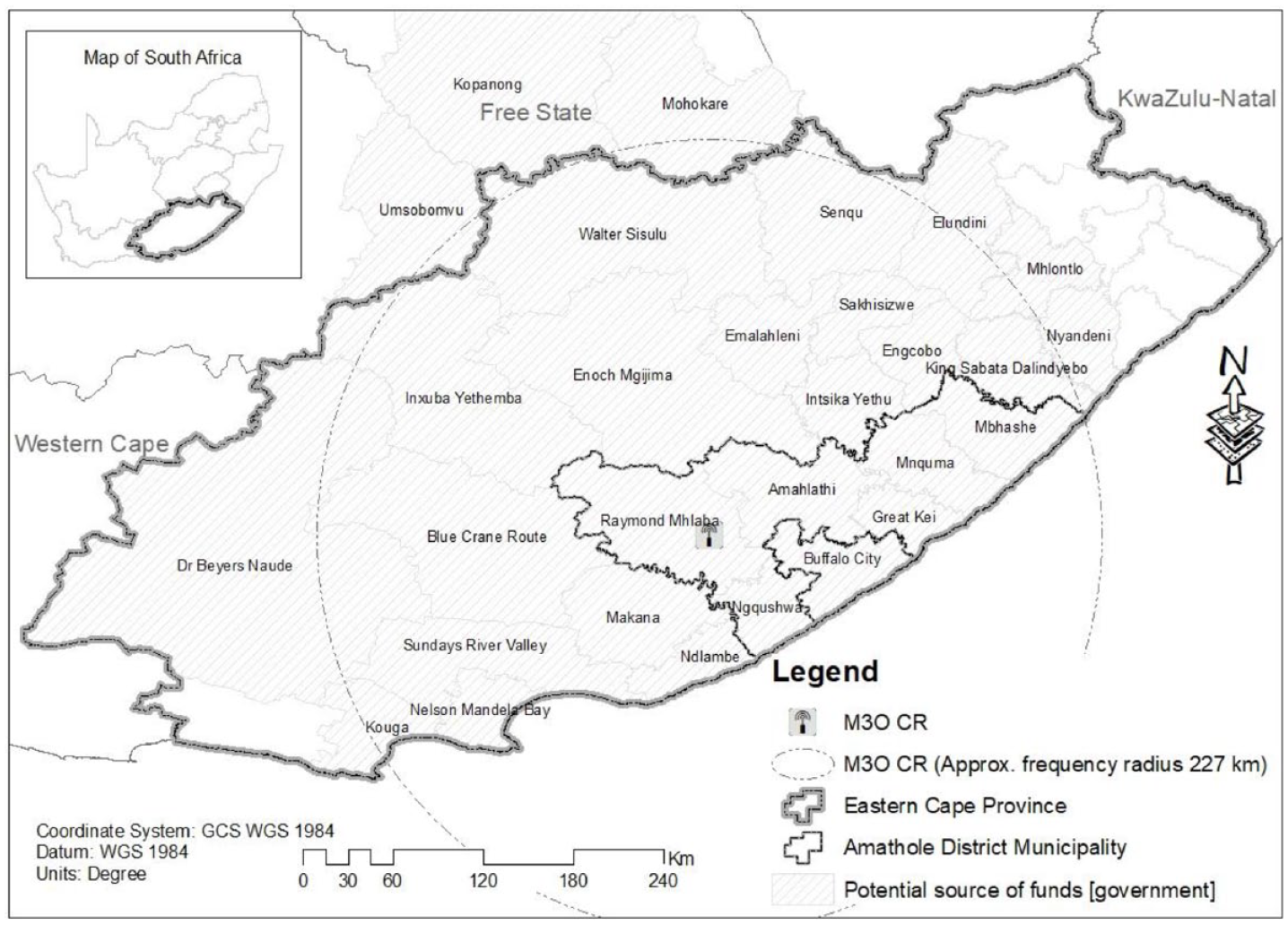
Potential sources of funding within sphere of Forte community radio frequency influence.
Thematic analysis technique developed by Braun and Clarke (2020) was used to analyse qualitative data from interviews with key informants from M3O CR. Thematic analysis was defined by Braun and Clarke (2020) as ‘a method for systematically identifying, organizing, and offering insight into patterns of meaning (themes) across a data set’ (p. 37). Deductive thematic analysis aided the researchers to identify data patterns and to categorise data from interview transcripts into preconceived themes. A deductive technique was employed whereby preconceived ideas from literature guided the analysis. The first step involved familiarising with interview transcripts, the second step was of producing initial codes to organise the data into meaningful categories. The third step included searching for ideas that align with the preconceived thematic categories while the fourth step was to review and refine potential themes. Categorising the themes was the fifth step, and the writing of research was the final step. The themes answer the research questions of the study which are as follows: (1) Which sustainability challenges does M3O community radio face in fulfilling its broadcasting mandate of facilitating development of grassroots communities within Buffalo City municipality? (2) Which strategies can be employed to enhance sustainability of community radio stations? The framing of the analysis and discussion of findings was guided by Gumucio Dagron’s (2001) and Buckley (2011) framework for sustainability of community broadcasting. The framework emphasises that for radio stations to fulfil their mandate of facilitating development in their respective communities, they must achieve financial, social, operational, technical and environmental sustainability.
Results and discussion
This section presents and discusses findings from interviews conducted with key informants from M3O CR, a local community radio and from desktop research. The findings are categorised under five themes: financial, social, operational, technical and environmental sustainability.
Financial sustainability
Insufficient financial resources
The analysis shows that M3O CR faces many challenges that hinder them from facilitating local development. The major challenge faced by the station is insufficient financial resources to cater for operational costs. Participant A stated that the station does not receive enough funding from the key funders of community media such as the Department of Communications (DoC) and MDDA. Participant A went on to say ‘Without them, community radio stations should just find a way of surviving to business adverts and live broadcasts, we are still approaching the private sector for business and lobbing them in to advertise with us’. Participant C also stated that Media Connection also funds the station, but the money is not enough to cover operational expenditure. Participant A, however, added that the station is trying to secure sustainable funding through soliciting funds from the private sector. Participant A also mentioned that to survive, there is need for an outlay of at least R80,000 per month for operational expenditure, ‘20 000 for Sentech, and the rest goes to telephone bills, electricity, water and stipends’. Thus, the station is not financially sustainable, and this challenge is not unique to M3O CR.
Although community radio stations receive income from advertisements, it is insufficient to cater for operations costs. Participants pointed out that at the station is struggling to get businesspeople to advertise with them. This is attributed to the socio-demographics of the community where the station broadcasts. It is argued that when the communities are poor there is limited consumer power as many people do not have an income, and there are no employment opportunities so advertisers may not be interested in that target group (Daniels, 2014). This leaves radio stations such as M3O CR with fewer sources of funding. Consequently, the station struggles to generate income needed to operate in a sustainable manner. Huizies (2007) argues that although community radio stations receive support from the MDDA, The Media Connection, ABC Ulwazi, Agile Media, Motswako Media and Serongwanyane, it does not cover all operational costs.
Gumucio Dagron’s (2001) framework for sustainability of community radio broadcasting emphasises the need for community stations to ensure that they are financially stable for them to achieve their broadcasting mandate. This has proved to be a daunting task; M3O community radio announced the suspension of its broadcasting licence by Sentech with effect from 16 January 2023 (Forte Community Radio, 2023), and this is not the first time this has occurred in the past including 2018. This was attributed to a historic debt of the radio station to Sentech they could not commit to settle within the required 18 months’ notice period, due to slow recovery from COVID-19 stress.
The Sentech 2021, National Council of Provinces Public Enterprises and Communications briefing provided revelations that community radios and televisions are not financially sustainable and are burdening the institution (Republic of South Africa (RSA) Parliamentary Monitoring Group, 2021). Their historic signal distribution year-to-date debt was estimated to be R76 million 1 (96.1% community radio and 3.9% community televisions), was also bailed out of their Sentech debt in the past (R12 million in 2016 and R23 million in 2018) (Parliament of Republic of South Africa (RSA), 2021). There are debt collection challenges experienced by Sentech (2022). In an interview with South African Broadcasting Corporation (SABC) News (2018), Sentech official highlighted that, ‘ . . . suspension of the community broadcasters is a last resort, . . . we have been communicating the arrears since 2016, . . . for more than 30 months . . . ’. Considering this, community broadcasting is characterised by lack of sufficient state support, and policy gaps. Community radios without government support they will not survive.
The 2009 Declaration of the Committee of Ministers of the Council of Europe, call for commitment of funds from the spheres of government to support community radios (UNESCO, 2017). This public funding model is a potential panacea to community radio financial woes in South Africa. Interestingly, Figure 2 reveals that M3O community radio frequency influence covers 36 municipalities, this excludes the Fort Hare University and any other Eastern Cape provincial government departments and sectors. This can further be disaggregated into 27 Category B municipalities, 2 Metropolitan Municipalities (Nelson Mandela and Buffalo City), 7 District Municipalities (DM) (Amathole DM, Sarah Baartman DM, Chris Hani DM, O.R. Tambo DM, Joe Gqabi, Xhariep DM and Pixley ka Seme DM). These spheres of government have a developmental mandate underpinned by public participation. In developing and annually reviewing their IDPs they must engage in public participation and community radios are one such vehicle that reaches the masses unlike the traditional approaches. Municipalities target M3O community radio among others as a communication channel to attain the deliverables of key performance area on good governance and public participation (Amahlathi Local Municipality, 2023; Buffalo City Metropolitan Municipality, 2016). However, what is missing is whether the municipality also set aside a budget to allocate to the radio stations to facilitate such public discussion and participation required by Buffalo city. Considerations like these, reveals that there is potential to relieve financial challenges as municipalities and other spheres of government must apportion their public participation budgets to community radios. What remains a challenge is lack of policies that can enforce this financial sustainability model for community radios.
Social sustainability
Lack of resources
Lack of financial resources hinders effective community participation in programming and management of community radio stations. The participants stated that the station face challenges in involving the communities in programming because they do not have enough resources. Here is what Participant D said in support of the view of lack of resources: [. . .] we don’t even have a single car for the station, [. . .] We do not have the resources to go to the communities. It’s tough [. . .] we might be invited to King Williams Town and we don’t have the resources to cover [. . .]. We can’t afford live broadcasts, unless we are hired to broadcast.
The issue of not having vehicles to travel to communities can be solved by integrating technology in broadcasting. Most community members now have mobile phones capable of voice recording/interview recording and broadcasting. This will lessen the burden on the need for mobile studio and vehicles for communities to participate in broadcasting. Furthermore, Participant D added that they do not have a mobile studio; therefore, it is very difficult for the radio station to involve the communities in programming all the time. This shows that the station does not have the necessary resources required to effectively play its role of facilitating community development. For instance, the participants alluded that the station receives invites to broadcast events that help in educating, informing and entertaining the community. Unfortunately, they cannot afford to take part because they do not have the necessary resources such as mobile studio or station vehicle to travel to the places where the events are occurring. Thus, lack of resources hinders the station from involving the community in programming. This is in line with previous studies which argue that insufficient financial resources cripple community radio stations as they fail to finance their operations (Bonin-Labelle and Demers, 2019; Huizies, 2007).
In addition, lack of resources hinders the radio station from establishing mechanisms and processes that simulate community participation and Participant B had this to say: We give away t-shirts if that year is conducive for us but at times, we can’t even afford to get t-shirts for ourselves, so it is a very serious problem. We can’t afford having shows of people winning prices. We can’t afford to distribute the price.
In the same vein, Participant C added that they do not have the necessary resources for buying T-shirts that can be given out to stimulate community participation. To counter this, it was indicated that the radio station works with the private sector and government departments such as the South African Department of Health. Thus, if there is an event, the radio station is given the prizes or T-shirts to run the competition. All this is testimony that the station is struggling financially; consequently, this affects the social sustainability. Literature indicates that although community radio stations seek to promote development at grassroots’ level, they fail due to lack of resources (Bonin-Labelle and Demers, 2019; Mawokomayi and Osunkunle, 2019; Pavarala, 2015).
Lack of community interest in participation
The other challenge that the station faces is that some of the community members are not interested in participating in programming and management aspects of M3O CR. Participant A stated that ‘We invite the municipality on the agriculture show to come and be part of that but they are reluctant. It needs people who are skilled to deliver, our presenters are not experts, and they are only facilitators’. In addition to the above statement, Participant A mentioned that even the academics and students from the Department of Agriculture at the UFH, Alice campus where the station is located are not keen to participate in agricultural shows. Participant D shared the following view, ‘ . . . they undermine the station, they only go for national radio, maybe they get paid we do not know’.
Authors argue that community radio station should encourage communities to actively participate in content production (Mawokomayi and Osunkunle, 2019; Mhagama, 2016) to achieve social sustainability.
It is evident that there is lack of community interest in participation from some of the influential institutions in the community such as Raymond Mhlaba municipality and Department of Agricultural Economics and Extension at UFH. The relationship between municipalities and radio stations is mostly considered as difficult and radio personnel usually fail to access the municipal officials. Therefore, lack of community interest in participating in programming and management is one of the challenges that hinder the radio station from facilitating community development. As a result, the station fails to achieve social sustainability. It could be argued that it is M3O CR which is responsible for low participation as the station should utilise different strategies that enhance community participation. The weakness noted from the engagements with the staff from the station is lack of patience and perseverance, the members or organisations surrounding the University should be encouraged to participate. Literature survey shows that community stations do not fully engage communities in producing local content (Faisal and Alhassan, 2018; Martínez-Roa and Ortega-Erazo’s, 2018) and this affects the social sustainability of the station. The community should participate in the activities of the station for people-centred development to take place (Moffat et al., 2023; Radelius, 2015).
Operational sustainability
Restrictions in programming
Censorship and restrictions are some of the challenges faced by community radio stations and they limit their democratic role. The participants stated that community radio stations are restricted from broadcasting negatively about the government which is the main source of funds for the station. In support of the view above, Participant A noted that: It’s very tricky bear in mind that once you step on someone’s foot, we are serving under the ANC regime and the money comes underneath them, through MDDA, GIS, DoC [. . .]. We could do that if we were a commercial or private radio stations because there is no injection from them. That’s the bad side about the whole thing.
It is evident that state censorship and restrictions hinders the role of community radio stations in facilitating development through limiting the sharing of information needed in a democratic society. In agreement, Participant A mentioned that: It’s basically the same as what we are doing at the University, do you know that if there is a problem at the administration, we can’t speak ill of the administration we might be chased out from here, we are in their premises. We have to keep it in form of information.
It is evident that M3O CR cannot broadcast negatively about the university in fear of losing their offices since they are located within the university premises. This shows that even though the station wants to play a democratic role, they cannot do that because of policies that restrict them. Participant A stated that if it is time for elections, they wait for the Independent Communications Authority of South Africa to mandate them to broadcast political information. Participant A added that in 2016, the radio station was given 2 months to broadcast these programmes. Furthermore, Participant B added that if the radio station discusses politics when it’s not a political season the station will be closed. Asp (2007) argues that ‘news media should freely and independently keep holders of power under surveillance and scrutinize their actions to enable citizens to form an opinion of their rulers’ performance’ (p. 33). However, in this case it was pointed out that the media is still restricted, and this hinders the radio station from achieving its broadcasting mandate.
Non-governmental organisations’ influence in programming
Sourcing for financial resources to cover operational expenditures for the station has resulted in negative influence on programming. All participants in the sample indicated that outside funders such as churches and NGOs buy slots that could be used for other developmental programmes and because the station is in dire need of operational funds it has to replace some scheduled programmes or change the entire programming format to accommodate these funders. In agreement, Participant A mentioned that, ‘ . . . there are times whereby we have clients asking for a 30 minute programme or an hour and for that you have to give the person and shift our programmes just a bit so that we get that revenue’. In support of the view above, Participant C stated that, ‘We let the prophets choose the slots that they want’. For instance, the participants indicated some of the slots that were bought include One touch, Walking with Jesus, Gospel show and Sikhona Isisombululo. All this shows that the station has no option but to adjust their time because they need the income. Therefore, one can conclude that the NGOs have a negative influence on programming. The station broadcasts many cultural and religious programmes because these institutions are a major source of funds after government funding. Mhagama’s (2015) study on Nkhotakota community radio in Malawi concludes that although NGOs’ funding is vital for radio sustainability, their influence can erode their identity and influence programming. Therefore, the station is prioritising funders, and this hinders the station from concentrating on all societal issues as a community radio.
Furthermore, the station is also in partnership with news organisations and in the end, they must include them in their schedule, and this has an influence on programming. Participant A had this to say in support of the finding above, What we do because we are in partnership with these two news projects, we give them in return airplay and interviews. Isolezwe normally they print out on Thursday, and we put them on air and tell what they have on their news so it’s more like promoting them, we are a community radio, and they are a print and internet kind of business. We need each other in a way, so we use bartering system.
This in a way is a good partnership as they can access news through batter trade since they have limited financial resources. However, this the station must find ways to accommodate other organisations which have their own agendas. Evidently, lack of financial resources hinders the station from effectively playing its role of facilitating community development as programmes aired are not initiated by the community rather imposed from organisations that seek to attain their own objectives.
Technical sustainability
M3O CR also experiences technical challenges as the station was at times reported to be off air. Table 1 highlights technical issues experienced by the station between 14 June 2022 and 5 September 2022.
Technical issues experienced by the community radio.
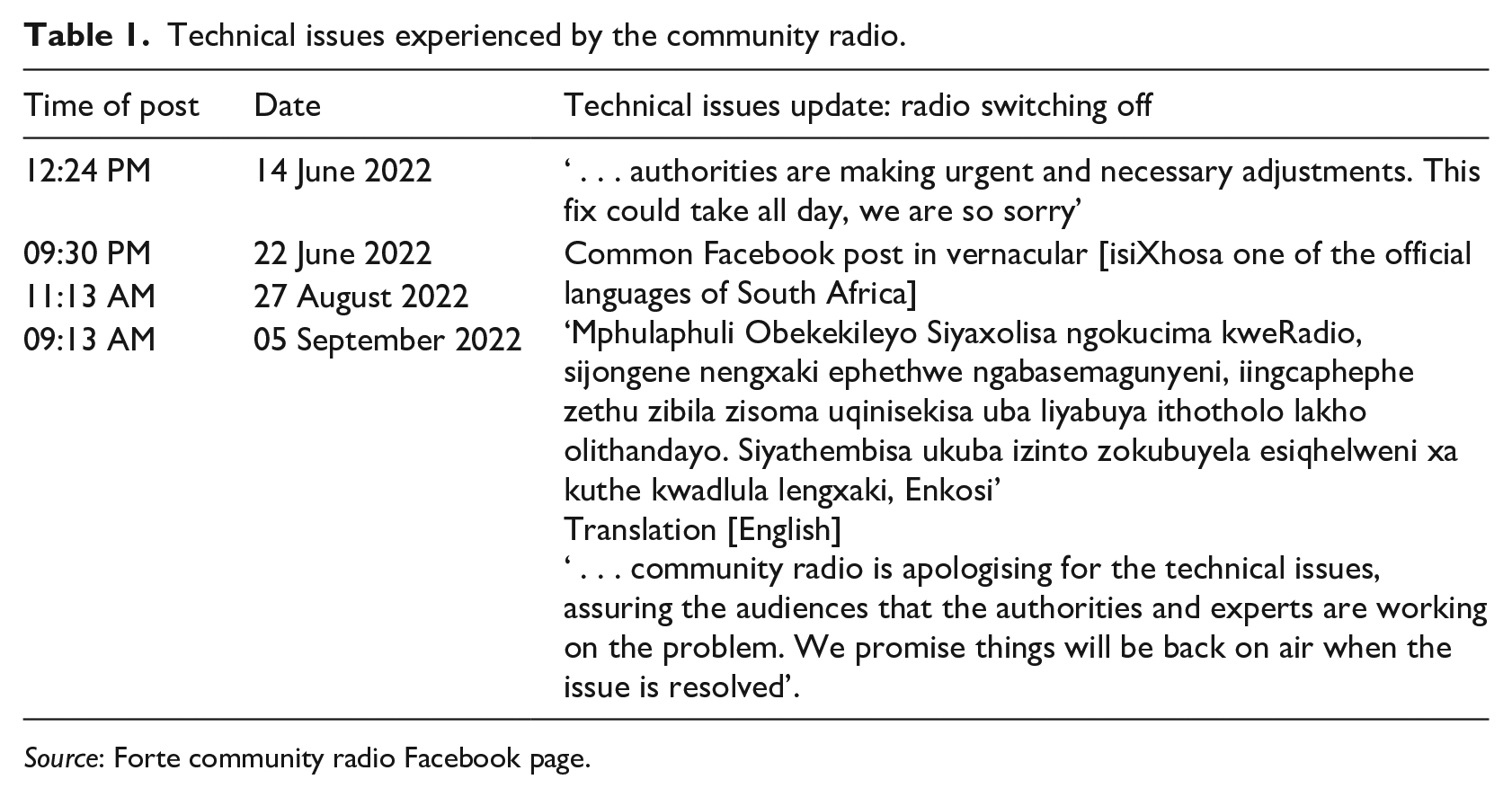
Source: Forte community radio Facebook page.
As shown in Table 1, M3O CR has been experiencing technical challenges and had to apologise to the stakeholders frequently. Equipment that does not receive the necessary care and maintenance as per the manufacturer’s requirements are prone to inherent problems as they age which impacts on the service reliability of the community radio (Zimbabwe Association of Community of Radios (ZACRAS), 2020). There is need for periodic inspection and operation of equipment in reasonably and optimal conditions and having zero dust tolerant policies among others. As mentioned in literature, community radio stations should use technology and appropriate new applications, skills and tools associated with the fourth industrial revolution and the advancement in development of highly sophisticated technological innovations to easy and sustain communication (Buckley, 2011; Jallov, 2015; Lush and Urgoiti, 2012). To put it bluntly, use of reliable and recent technology ensures technical sustainability as the station will rarely experience technical issues.
Environmental sustainability
M3O CR is not immune to the impacts of climate change and energy crises being experienced in the Republic of South Africa. This can be evidenced from M3O CR Facebook post on 17 June 2022, stating, ‘Sorry for the Radio off, we are facing power outage at Alice. We promise things will be back to normal once this problem is over’. This implies that M3O CR does not have sustainable alternative power source to ensure uninterrupted service provision. Hypothetically, if Eskom had announced stage 8 on the 29 April 2022, Alice township would have been shed for approximately 9–10 hours (see Table 2).
April 2023 Eskom loadshedding schedule for Alice township (call for alternative sustainable power source).
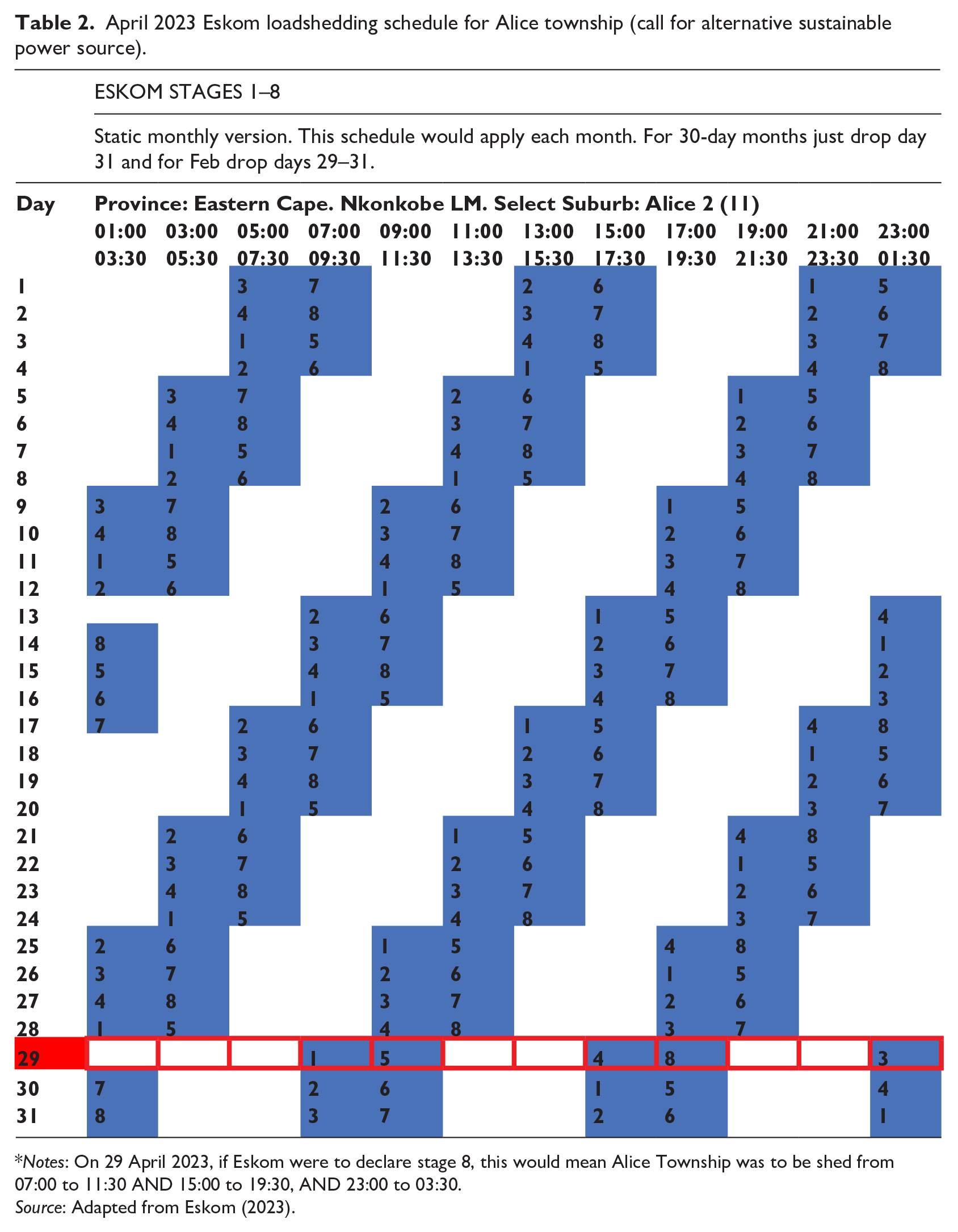
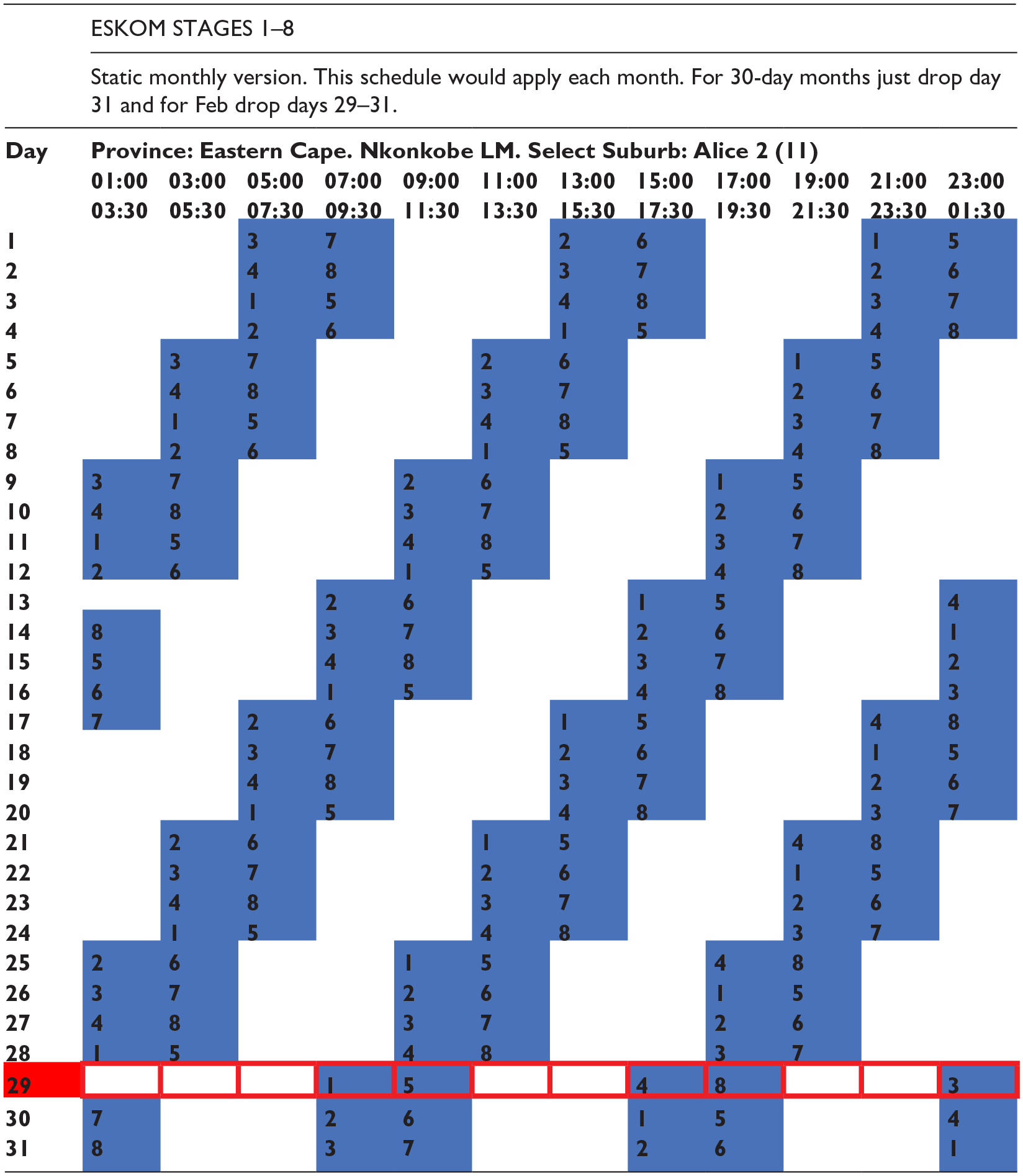
Notes: On 29 April 2023, if Eskom were to declare stage 8, this would mean Alice Township was to be shed from 07:00 to 11:30 AND 15:00 to 19:30, AND 23:00 to 03:30.
Source: Adapted from Eskom (2023).
As indicated on Table 2, loadshedding affects the operation of radio stations as they need electricity to stay on air. The cost of backup power supply using generators is not feasible in scenarios like this. It is imperative that community radio stations explore possible alternative ways to facilitate the adoption of renewable power supply sources such as installation of solar panels. This is critical given the electricity supply crises being experienced in South Africa has no definite solution.
Conclusion
The study sought to determine the sustainability challenges that M3O community radio face in fulfilling its broadcasting mandate of facilitating development of grassroots communities within Buffalo City municipality. The results of this investigation show that although the M3O community radio strives to provide quality programming to achieve its broadcasting mandate, the station fails to achieve financial, social, operational, technical and environmental sustainability. For community radio stations to be sustainable, they should address all dimensions of sustainability as advocated by Gumucio Dagron (2001) and Buckley (2011) framework for sustainability of community broadcasting. The station, therefore, is confronted with sustainability challenges that threaten its existence. As has been noted in literature, the country boosts of quite a huge number of community radio stations servicing disadvantaged communities but their existence is under threat as they struggle to sustain themselves. Corona virus pandemic exacerbated the situation as the already struggling stations were incapacitated. Failing to achieve sustainability has resulted in the closure of some community radio stations in South Africa as they failed to cater for operational costs. This has become a trend and what is surprising is that we have many new radio stations that are being given licences as well. Thus, Beham (2018) advocates for community stations to work together to achieve their goals. This will reduce the burden as they share strategies that may sustain their operations. More studies can be done on the sustainability of community radio to broaden the scope and understanding of the South African broadcasting environment. Potential research could focus on the critical analysis of the notions that (1) adverts are a sustainable method of funding, and that they do not influence content in community radios, and (2) that communities are apathetic about participation.
Recommendations
The findings of this study have several implications for future practice. Markovitz (2023) is of the view that countries in the global south should desist from relying on Western policies on sustainability but rather find innovative solutions and develop local policies to fund broadcasting media. In line with that, M3O CR should benefit from its sphere of influence as their broadcast footprint covers 36 municipalities in Buffalo City. These spheres of government have a developmental mandate underpinned by public participation. Municipalities targets M3O CR among others as a communication channel to attain the deliverables of key performance area on good governance and public participation and they should apportion their public participation budgets to community radios. The station broadcasts from the UFH’s premises, the University should also partner with the station. As advocated by Bulbulia (2021) in the Wits State of the newsroom address, universities should partner with the industry, community radio stations. What remains a challenge is lack of policies that can enforce this financial sustainability model for community radios.
The study recommends that M3O community radio should lobby members of the community to make donations to the station since the station belongs to the community and consider starting income generating projects so that they gain more income to cover operational costs. In this epoch of digitalisation of broadcasting, community radio must utilise digital platforms to create other sources of revenue such as crowdfunding and advertising.
Furthermore, community participation in programming and management of the station can be improved by considering several factors. The study recommends the station to have a fun club that has a programming committee that oversees the programming by deciding the content of the programmes, challenges being faced and bring in new ideas to the station. This increases the number of people involved in management of the station and at the same time can enhance programming.
To achieve environmental sustainability, it is imperative that community radio stations explore possible alternative ways to facilitate the adoption of renewable power supply sources such as installation of solar panels. This is critical given the electricity supply crises being experienced in South Africa have no definite solution.
Community radio stations should use technology and appropriate new applications, skills and tools associated with the fourth industrial revolution to easy and sustain communication Using reliable and recent technology ensures technical sustainability as the station will rarely experience technical issues. All these recommendations assist community radio stations to achieve financial, social, and operational, technical and environmental sustainability.
Footnotes
Funding
The author(s) received no financial support for the research, authorship and/or publication of this article.
