




Abstract
This study examines how perceptions of economic inequality affect political participation focusing on East Asian democracies. It develops nuanced predictions on how perceptions of income inequality and social mobility and their interplay affect individuals’ engagement in various types of political activities in six East Asian democracies. Using the fourth wave of the Asian Barometer Survey, we examine novel arguments built upon the existing inequality-participation nexus. Our analysis suggests that inequality is a multifaceted concept, and the mechanisms of the inequality-participation nexus could vary depending on the regional, socioeconomic, and political context.
Keywords
Rising income inequality has become a major problem in many advanced and developing nations. Even the countries of the so-called “East Asian Miracle,” which were once praised for achieving rapid growth and equity, have been experiencing growing income gaps among their citizens in recent decades (Chi and Kwon, 2012; Koo, 2007). Alongside this, there is a growing concern about declining social mobility (OECD, 2018). People are worried that parents’ privilege or disadvantage is becoming more and more important in determining where their children are later placed in the social hierarchy. For instance, the “spoon class theory” has become popular in South Korea in recent years; it groups people into “golden spoon,” “silver spoon,” and “dirt spoon” classes on the basis of their parents’ socioeconomic status (SES) (Han, 2016). This “theory” postulates that the rich are rich because they were born with a golden or silver spoon in their mouth, and the poor are poor because they were unfortunate enough to have been born with a dirt spoon. The popularity of this vernacular theory reflects the despair of South Koreans that their social elevator does not work any longer and that their society is growing more unequal from generation to generation.
How do these widely shared perceptions of income inequality and deteriorating social mobility affect political participation in democracies? Given that income inequality reflects inequality of outcome, and social mobility reflects inequality of opportunity, which of the two has a larger effect on political activism among citizens in democracies? Moreover, how do these factors interact and affect political participation when combined? Are their impacts uniform or disparate across various types of participation? To our knowledge, the extant literature provides only partial, thus limited answers to these questions. In most cases, scholars focus on income inequality, leaving questions about social mobility unanswered. Moreover, the prevailing theories in the inequality-participation nexus provide contradictory predictions, and previous research offers mixed empirical evidence, leaving the topic far from being settled.
This article aims to fill this gap by examining how perceived income inequality and intergenerational mobility affect different types of political participation, focusing on six East Asian democracies—Indonesia, Japan, South Korea, Mongolia, the Philippines, and Taiwan. East Asian democracies provide a unique context to test the inequality-participation theories beyond the context of advanced Western democracies. First, East Asian countries, except Japan, represent newly industrializing economies that have experienced rapid growth in recent decades (The World Bank, 1993). The rapid industrialization during the postwar era in Japan, South Korea, and Taiwan, in particular, created egalitarian societies with weak class stratification and class consciousness. They also began offering universal education to develop standardized, high-quality human capital to meet developmental goals, resulting in a relatively egalitarian structure of opportunity for education and socioeconomic advancement (Amano, 1997; Dore, 1976; Seth, 2002). This growth pattern might have created unique dynamics of inequality and mobility for political participation (e.g. Takenoshita, 2007).
Second, East Asian democracies have developed a divergent economic inequality pattern from advanced Western democracies. They began experiencing the growth of economic inequality only after the late 2000s, except for Japan, where inequality has taken off since the 1980s. Still, its Gini coefficient is approximately 0.32, indicating it is one of the most egalitarian advanced democracies in the world (Solt, 2020). This presents a clearly different context than advanced Western democracies, which have experienced consistently exacerbating economic inequality since the late 1970s. Exploring how economic inequality affects the political participation of citizens in societies where the phenomenon is at an earlier stage will yield valuable insights.
Related to this, this article focuses on perceived income inequality and mobility. As most people do not perceive inequality accurately (see Gimpelson and Treisman, 2018), subjective measures are more appropriate for testing the inequality-participation nexus than objective measures. This is more so in East Asia because of the reasons discussed above: rising inequality and economic stratification are relatively recent phenomena compared to Western democracies; its preexisting egalitarian socioeconomic structure could make its citizens feel sensitive to growing inequality. This could lead them to feel their society is more unequal than it actually is, which cannot be captured by objective indicators of income inequality and social mobility.
For this purpose, this article uses the fourth wave of the Asian Barometer Survey conducted during 2014–2016. This dataset provides an invaluable opportunity to examine how people’s perceptions of economic inequality, specifically unfairness of income distribution and deteriorating intergenerational mobility, affect various types of political participation: psychological, electoral, institutional, and non-institutional participation. Building on the existing theories, relative power theory and conflict theory, this article proposes that perceived distributive unfairness and social immobility have differential impacts on political participation, their differential impacts are more pronounced in certain types of participation, and their differential impacts become maximal when individuals view both distributive unfairness and social mobility pessimistically.
This study contributes to the literature by clarifying the multifaceted structure of economic inequality and its impact on a comprehensive set of political activities, both theoretically and empirically. Also, by focusing on perceptions of two different aspects of inequality, this study complements the existing literature that has paid disproportionate attention to objective measures of inequality. In addition, this study elaborates on the existing theories on the relationship between inequality and political participation and conducts a rigorous empirical test focusing on East Asia. By studying East Asian democracies, we examine the existing theories in a less-explored context.
Income inequality and political participation
With regard to the impact of income inequality on political participation, scholarship has generated two competing predictions. Relative power theory argues that income inequality discourages political participation. According to Bachrach and Baratz (1962), the wealthy can maintain their dominance by limiting the scope of the agenda to be discussed in the political arena to their advantage. Therefore, electoral competition in a society with a highly uneven distribution of wealth would not adequately address the issues that concern the poor, failing to serve their interests compared to those of the wealthier constituency. Experiencing repeated frustrations that the political system cannot resolve their demands, the poor are alienated from politics (Gaventa, 1982; Goodin and Dryzek, 1980; Lukes, 1986; Schattschneider, 1975). Therefore, income inequality leads to political inequality (Dahl, 2006; Houle, 2018).
Conflict theory presents the opposite argument. It suggests that income inequality encourages political participation since inequality intensifies the existing social cleavage between the haves and have-nots. With increased inequality, individuals are likely to sense economic heterogeneity among the members of society more easily and develop class consciousness. Thus, inequality increases class conflicts over redistribution. The rich become averse to redistributing their wealth to society, while those below the median income develop strong demands for redistribution (Meltzer and Richard, 1981). As income inequality polarizes and politicizes the views over redistribution, individuals from all classes are motivated to participate in politics (Brady, 2004; Newman et al., 2015; Oliver, 2001).
The empirical evidence on this topic is mixed. Some studies find a negative relationship between income inequality and political participation, supporting relative power theory (e.g. Anderson and Beramendi, 2008; Jaime-Castillo, 2009; Solt, 2008, 2010). Others, however, find evidence for conflict theory that income inequality dampens belief in meritocracy and strengthens class consciousness (Newman et al., 2015), which in turn, stimulates political activism among individuals of all classes (Brady, 2004; Oliver, 2001). Moreover, many cross-national studies fail to uncover any discernible effects of inequality on electoral turnout (e.g. Horn, 2011; Stockemer and Parent, 2014; Stockemer and Scruggs, 2012).
We believe that the theoretical and empirical ambiguities in the existing literature result largely from three different sources. First, previous studies have focused largely on one aspect of economic inequality—how unevenly incomes are dispersed in a society—while failing to consider other aspects (Sen, 1997). Consequently, the existing theories overlook that income inequality could carry different meanings to individuals. Building upon some pioneering work (Andrews and Leigh, 2009; Corak, 2013; Kim et al., 2021), we focus on social mobility and analyze how it operates with income inequality in influencing individuals’ political participation. We contend that by adding another dimension of inequality—inequality of opportunity to climb the socioeconomic ladder, this study could improve our understanding of the relationship between inequality and participation.
Second, recent studies suggest that there are discrepancies between subjective and objective inequality because ordinary people cannot perceive inequality in their society correctly (Bartels, 2005; Chambers et al., 2014; Cruces et al., 2013; Evans and Kelley, 2004; Gimpelson and Treisman, 2018; Guenther and Alicke, 2010; Norton and Ariely, 2011; Shariff et al., 2016). For instance, people in the United States tend to feel their society is more egalitarian than it actually is, whereas Europeans hold more pessimistic views of inequality than are true (Alesina et al., 2018; Hauser and Norton, 2017; Norton and Ariely, 2011). Individuals also perceive inequality differently depending on their ideological tendencies (Bartels, 2005). Furthermore, even if people perceive income is unevenly distributed in society, not all of them may consider it problematic; some may consider the distributive unevenness fair (Osberg and Smeeding, 2006). For instance, Yu and Wang (2017) show that people feel happier as they perceive a rise of inequality to a certain degree considering the uneven distribution of income as a signal of upward mobility. Unless people think income inequality is unfair or unjust, it is challenging to believe such inequality would either mobilize or depress the poor into or from politics, as suggested by conflict and relative power theories. This further leads us to believe that perceived distributive unfairness is more appropriate than perceived distributive unevenness when testing the prevailing theories’ mechanisms (Lee et al., 2021; Wu and Chang, 2019).
Recent studies support this view, indicating that perceptions of distributive unfairness determine perceptions of distributive unevenness, not vice versa. For instance, Du and King (2022) show that individuals perceive income inequality differently depending on how unfairly they see the incomes are distributed. Kaufman (2009) elaborates on this, arguing that the politicization of inequality requires a chain of perceptions and beliefs: first, people must perceive inequality as unjust; second, they must see government or elites cause the injustice; then, they must believe in their political efficacy. For this reason, he further contends that “perceptions of unfairness constitute a reasonable first approximation of beliefs about the distribution of wealth” (Kaufman, 2009: 366). Accordingly, recent studies have shown that perceived distributive unfairness is what determines individuals’ political attitudes, not perceived distributive unevenness (Wu and Chang, 2019; Yan and Zhong, 2021). Hence, this study measures perceptions of economic inequality through perceived distributive unfairness and perceived intergenerational immobility.
Finally, prior research does not pay close attention to diverse types of political participation but mostly focuses on voting. Although we agree that voting is the primary form of citizen participation in democracy, the literature suggests that various types of political participation are mutually exclusive, conceptually and practically (Van Deth, 2014). For instance, the motivations and goals for engaging in a protest differ from those for voting in an election. To fully test the impact of economic inequality on citizens’ political engagement, it is important to consider the diversity of political activities and explore potentially varying dynamics between inequality and participation.
Connecting income inequality and social mobility
Income inequality and social mobility present two different dimensions of economic inequality. The former refers to the gap in earnings between the poor and the wealthy in society, and the wider the gap is, the more unequal the society is. This captures the inequality of resources measured as earnings at a given time. Social mobility, on the other hand, refers to the extent of an individual’s chances of moving up or down in the socioeconomic hierarchy. Breen and Jonsson (2007) conceptualize social mobility as social fluidity, defining it as an “index of equality in the chances of access to more or less advantageous social positions between people coming from different social origins” (p. 1776). There are various ways to measure social mobility. For instance, intergenerational mobility considers persistence or fluidity in socioeconomic outcomes across generations, whereas intragenerational mobility looks at shorter periods of time, focusing on how far individuals move up or down the social scale over the individuals’ life course.
When studying the political consequences of economic inequality, it is important to consider these two aspects together and examine how they interplay. On the one hand, there is a mutually augmenting relationship between the two as suggested by the “Great Gatsby Curve”: As the distribution of resources gets skewed, so does the availability of opportunity (Corak, 2013). There could be various mechanisms by which income inequality leads to social immobility. For instance, many scholars focus on the impact of the differential childhood development processes that a skewed income distribution could create through the dynamics of income, residential, and school segregation (Bénabou, 1996a, 1996b; Corak, 2013; Durlauf, 2004; Durlauf and Seshadri, 2018). Given the influence of SES on early childhood development, income inequality can reduce social mobility through differing family resources, connections, neighborhoods, school funding, and even family culture or parents’ innate ability that can be transmitted to the next generations.
On the other hand, income inequality and social immobility are two different processes, and therefore, they do not necessarily go hand in hand. For instance, Kim et al. (2021) report an underwhelming correlation between income inequality and social mobility across U.S. counties. A cross-national analysis also indicates that countries with similar levels of income inequality vary greatly in terms of social mobility, although there is a general tendency for intergenerational mobility to be higher when income inequality is lower (OECD, 2018: 36). We believe this has to do with their conceptual distinctions. Specifically, income inequality measures the structure of cross-sectional income distributions in a society at a given time, whereas social mobility is fundamentally a temporal construct. Although a repeated measure of income inequality could create temporal variations, its operationalization is cross-sectional in nature, while social mobility has a built-in temporal component regardless of its various measures, such as intragenerational income mobility, intergenerational income mobility, occupational mobility, or educational mobility. Applying this to the Great Gatsby Curve, we believe that income inequality should get worse consistently for an extended period so that it reduces social mobility at a certain point. In other words, in a society where income inequality is a relatively new phenomenon or fluctuates so much that its over-time trend is unclear, its impact on social mobility should be ambiguous. It is because social mobility captures an inequality structure formed over a long period of time, affected by income inequality, among others.
Then, how would the deterioration of social mobility affect individuals’ political participation? Although conflict and relative power theories consider income inequality and not social mobility, one can draw some germane implications from them, given that social mobility represents another aspect of inequality. Accordingly, based on conflict theory, low social mobility would mobilize individuals to participate in politics because severe inequality of opportunity could politicize the existing class cleavage. On the other hand, according to relative power theory, rising inequality of opportunity would depress participation.
However, we believe that the two aspects of economic inequality could have divergent effects on individuals’ political participation when considered simultaneously. Compared to income inequality, people’s subjective feelings about social mobility tend to reflect more long-term, cumulative evaluations of the inequality structure of their society, for instance, by comparing their parents’ status and their own and predicting their children’s. For this reason, pessimistic views on social mobility are likely to be associated with chronic frustrations and low political efficacy of individuals due to repeated failures of their political system to fix problems. This particularly taps into the causal mechanism of relative power theory. Perceived income inequality, on the other hand, captures people’s subjective evaluations of income distribution more or less at the time they make such evaluations. Thus, it contains less retrospective and prospective views on the inequality structure of their society but more current views. In short, perceived income inequality taps into short-term grievances. This conforms better to the causal mechanism of conflict theory. Therefore, we are led to the following hypotheses.
H1. Perceived income inequality is likely to mobilize individuals to participate in politics (conflict theory).
H2. Perceived social immobility is likely to demobilize individuals from participating in politics (relative power theory).
Furthermore, we anticipate that the effects of perceived income inequality and mobility could vary across different types of political participation. Scholars have agreed that political participation can be categorized largely into institutional, non-institutional, civic, and expressive or psychological participation (Ohme et al., 2018; Theocharis and Van Deth, 2018; Van Deth, 2014). By focusing on “political” activities, this study rules out non-political, civic engagement (Pfanzelt and Spies, 2019). Moreover, as suggested by more recent studies on political participation, we treat voting as its own category, separate from other institutional activities (Ohme et al., 2018; Theocharis and Van Deth, 2018). Based on this consideration, we can think of four categories of political participation: psychological/cognitive, electoral, institutional, and non-institutional participation.
These four distinct forms of participation differ in terms of goals, motivations, and skills required. For instance, institutional participation, such as contacting elected officials and helping a political party or candidate, is “highly visible and demands a clear allocation of responsibility between participants,” compared to psychological or individualized forms of participation like having political discussions with family or friends (Pfanzelt and Spies, 2019: 45). Therefore, resources and skills like political knowledge and efficacy are especially important for institutional participation. For this reason, Grasso et al. (2019) find that the economically disadvantaged are discouraged from volunteering with parties and conventional political participation. Relatedly, Pfanzelt and Spies (2019) show that higher internal efficacy and political interest shared among men than their female counterparts explain why the former is considerably more active in institutional participation than the latter.
Also, in terms of the target, there is a clear difference between conventional forms of participation, such as voting and institutional participation and non-institutional participation. While the former taking place via institutionalized channels is explicitly state-oriented, the latter is anti-establishment and contentious as seen in protests, demonstrations, and strikes. For non-institutional activities, participatory motivation is more important than resources. In line with this, scholars have found that economic hardship and relative deprivation increase protest and other non-institutional political activities (Bernburg, 2015; Grasso et al., 2019; Grasso and Giugni, 2016; Kern et al., 2015). On the other hand, as voting and institutional participation are state-oriented, these activities require external efficacy and trust in the existing political system (De Moor, 2016).
By applying the features of different forms of political participation to the discussions on how income inequality and immobility affect them, we are led to more nuanced predictions. As discussed above, although conflict theory and relative power theory pose opposite predictions, they differ in the mechanisms to achieve the predictions. Conflict theory focuses more on the motivation for political participation—when perceiving inequality, individuals are motivated to act to change the status quo. In contrast, relative power theory puts the emphasis on the capacity for political participation—when perceiving inequality, individuals feel deprived of the resources such as political efficacy, knowledge, interest, and financial means to change the status quo. Among the four types of participation considered in this research, one should note that non-institutional participation is more closely connected to motivation. In contrast, electoral and institutional participation is more pertaining to capacity. This view is in line with Wong (2022) that finds conflict theory is more applicable to non-institutional, radical political activities, while relative power theory is more applicable to institutional activities.
Building on Wong (2022), we expect perceived income inequality, which closely fits the mechanism assumed in conflict theory, to trigger non-institutional activities more noticeably than other political activities as “people develop grievances over the biased distribution of recourses” (p. 563). As suggested by research on economic grievances and protest, people perceiving distributive injustice are motivated to participate in protests or other forms of radical or non-institutional activities to redress the injustice (i.e. Grasso et al., 2019; Grasso and Giugni, 2016). These activities are “sporadic and immediate by nature, the cost of participation might take a secondary role,” but instead, the lack of resources serves as a powerful mobilization driver (Wong, 2022: 563). On the other hand, perceived income inequality or distributive unfairness is less likely to trigger electoral or institutional participation for the reason Wong (2022) discussed. Elections are not solely focused on economic issues but run on a wide range of issues, making voting a less attractive or effective tool for the economically disadvantaged to express their grievances. Compared to protest that often focuses on a single or specific issue, electoral and institutional activities provide indirect or highly diffused means to express grievances. In contrast, we expect perceived immobility, which closely fits the mechanism assumed in relative power theory, to dampen electoral and institutional participation more prominently than other types of participation. The perception of chronic, structural inequality would lead the poor to find participation in a system dominated by the rich not worthwhile and too costly (Wong, 2022).
Unlike electoral, institutional, and non-institutional types, we do not propose clear expectations on how perceived income inequality and social immobility would affect psychological participation. Perceived income inequality, capturing relatively short-term grievances compared to perceived social immobility, could motivate the citizens disturbed by the unfavorable economic situation to pay closer attention to politics and seek information. This view is in line with the American politics literature on threat and political participation that threat and anxiety stimulate cognitive political engagement such as attention to politics and political learning or information seeking (i.e. Mackuen et al., 2010; Marcus and Mackuen, 1993; Nadeau et al., 1995). On the other hand, perceived immobility, capturing long-term, structural inequality, could alienate affected citizens from politics and marginalize them psychologically. In other words, those who believe there is no better future for them are likely to lose their trust in their political system and develop cynicism about politics in general, disincentivizing them to care about politics. Therefore, we postulate the following hypotheses.
H3. The mobilizing effect of perceived income inequality is likely to be more pronounced in psychological and non-institutional forms of political participation (conflict theory).
H4. The demobilizing effect of perceived social immobility is likely to be more pronounced in psychological, electoral, and institutional forms of political participation (relative power theory).
Finally, we hypothesize that building on the rationale above, these two aspects of economic inequality would synergistically work to amplify the proposed effects. First, the mobilizing effect of perceived income inequality would become amplified as individuals perceive social mobility pessimistically. Individuals seeing incomes are unfairly distributed in their society would be more strongly motivated to participate in politics as they also sense their society is immobile. As suggested by conflict theory, the interclass anxiety and grievances generated by the perceptions of distributive unfairness would get intensified with a heightened sense of immobility. And this increased mobilization effect should be particularly significant in psychological and non-institutional political activities. In contrast, we argue that the demobilizing effect of perceived social immobility would become stronger when combined with pessimistic perceptions of income distribution. As suggested by relative power theory, the sense of long-term frustrations generated by the pessimistic views of upward mobility would get accentuated if individuals also see the distribution of resources as extremely polarized between the poor and rich currently in their society. We expect that this chilling effect should be particularly pronounced in psychological, electoral, and institutional participation.
In short, we believe that the mobilizing effects of perceived income inequality and the demobilizing effects of perceived social immobility are conditioned on each other. The proposed effects of the inequality indicators would be stronger when both reach the highest values (strongest perception of distributive unfairness combined with the most pessimistic perception of social mobility and vice versa). We believe that these scenarios provide a more controlled context to examine the causal mechanisms of conflict and relative power theories accurately. Conversely, as one of the two inequality indicators decreases its severity in its interaction with the other, it would mitigate the proposed effects on participation.
H5. The mobilizing effect of perceived income inequality is likely to be amplified when combined with pessimistic perceptions of social mobility, particularly in psychological and non-institutional forms of political participation (conflict theory).
H6. The demobilizing effect of perceived social immobility is likely to be amplified when combined with pessimistic perceptions of income inequality, particularly in psychological, electoral, and institutional forms of political participation (relative power theory).
Data and methods
To test the proposed hypotheses in the East Asian context, we examine Indonesia, Japan, South Korea, Mongolia, the Philippines, and Taiwan, using data provided by the fourth wave of the Asian Barometer Survey conducted during 2014–2016. 1 This wave of the survey provides an invaluable opportunity to explore our hypotheses. First, it newly added several questions about redistribution and inequality to the questionnaire, two of which specifically measure perceptions of distributive unfairness and intergenerational immobility. Second, it provides data about a comprehensive set of political participation. Therefore, we can examine how two measures of perceived economic inequality affect several types of participation differentially.
We have a total of 11 dependent variables that measure four types of political participation. First, we have three ordinal psychological/cognitive participation variables: political interest, frequency of following news about politics and government, and frequency of discussing politics with family members or friends. Political interest takes four values with 1 indicating “Not at all interested and 4 indicating “Very interested.” The political news variable measures how often respondents follow news about politics and government on a 1–5 scale, with higher values indicating more frequency. Finally, the political discussion variable measures how often respondents discuss politics with family members or friends on a 1–3 scale, with 1 meaning “Never” and 3 meaning “Frequently.”
Second, electoral participation measures how often the respondent voted: “Hardly ever voted (1),” “Voted in some elections (2),” “Voted in most elections (3),” and “Voted in every election (4).” Third, our analysis includes four variables under the category of institutional participation: participating in a campaign rally, helping a party or candidate, persuading others to vote for a certain candidate or party, and contacting an elected official. All variables but contacting an elected official in this category are coded as dichotomous. Measuring how often the respondent contacted the elected officials or legislative representatives at any level in the past 3 years, it is coded as an ordinal variable with three values: “I have never done this (1),” “I have done this once (2),” and “I have done this more than once (3).”
The last set of dependent variables measures non-institutional participation. Three variables are considered: raising an issue or signing a petition, protesting, and rioting. These variables measure how frequently the respondent gathered with others to raise an issue or sign a petition, attended a demonstration or protest march, or used force or violence for a political cause in the past 3 years. The given options vary from “I have never done this (1)” and “I have done this once (2)” to “I have done this more than once (3).”
Having a total of eleven variables, we first create a participation scale by calculating a reliability score that measures the internal consistency among them. Although these variables measure different types of participation, Cronbach’s alpha reliability coefficient is 0.615 across six countries, which is acceptable. This aggregate participation variable is used for testing H1 and H2. For the rest of the hypotheses, we measure different types of political participation by capturing the principal components among the 10 variables except for the voting variable discussed above. Supplemental Table A.2 displays the rotated factor loadings from the full model for each country. These three factors are clearly clustered around the three types of political participation. In Japan and the Philippines, the first factor is institutional participation, while that is for psychological participation in Indonesia, South Korea, Mongolia, and Taiwan. However, eigenvalues do not drop below one until the fourth factor across the countries, which means that these three factors capture three unique political participation concepts. Thus, we create three factor scores for these types of political participation—psychological, institutional, and non-institutional—for each country.
The independent variables are perceptions of income inequality and intergenerational immobility. Perceived income inequality is measured through perceived distributive unfairness using the following question, “How fair do you think income distribution is in your country?” The options were (1) very fair, (2) fair, (3) unfair, and (4) very unfair. Our second independent variable, perceived intergenerational immobility, is measured by the question, “As compared to my parent’s generation, my generation has more or fewer opportunities to improve one’s standard of living or social status?” The respondents were provided with the following options: (1) substantially more opportunities, (2) more opportunities, (3) about the same, (4) fewer opportunities, and (5) substantially fewer opportunities. Therefore, higher values of this variable indicate fewer perceived opportunities to move up or down the socioeconomic ladder, and thus higher perceived inequality of opportunity.
We include a standard set of individual-level control variables that may affect political participation: education, gender, age, income, marital status, employment status, and religiosity. The education variable measures the highest level of education the respondent attained, on a range from “no formal education (1)” to “post-graduate degree (10).” Gender, marital status, and employment status are coded as binary variables for “female,” “married,” and “employed,” respectively. Income is a quintile measure of reported household income for each country. Religiosity quantifies the frequency of attending religious services or rituals measured on an 8-point scale, with higher values indicating higher frequencies. The summary statistics for all variables are included in Supplemental Table A.1. 2
With these variables, we utilize the multivariate regression analysis with the country-fixed effects. When observations are exclusively clustered into geographic levels, the country, in our case, the multilevel modeling (MLM) approach, is widely used (Snijders and Bosker, 2011). However, the country-fixed effect approach is more appropriate in this study due to a degree-of-freedom issue on the country level (see Möhring, 2012). All the equations are estimated with robust standard errors. Our estimation strategy is straightforward: We first specify the two inequality perception measures with the control variables to see how they compete to explain the four different types of political participation. After that, we examine how the same model works for each country.
Results
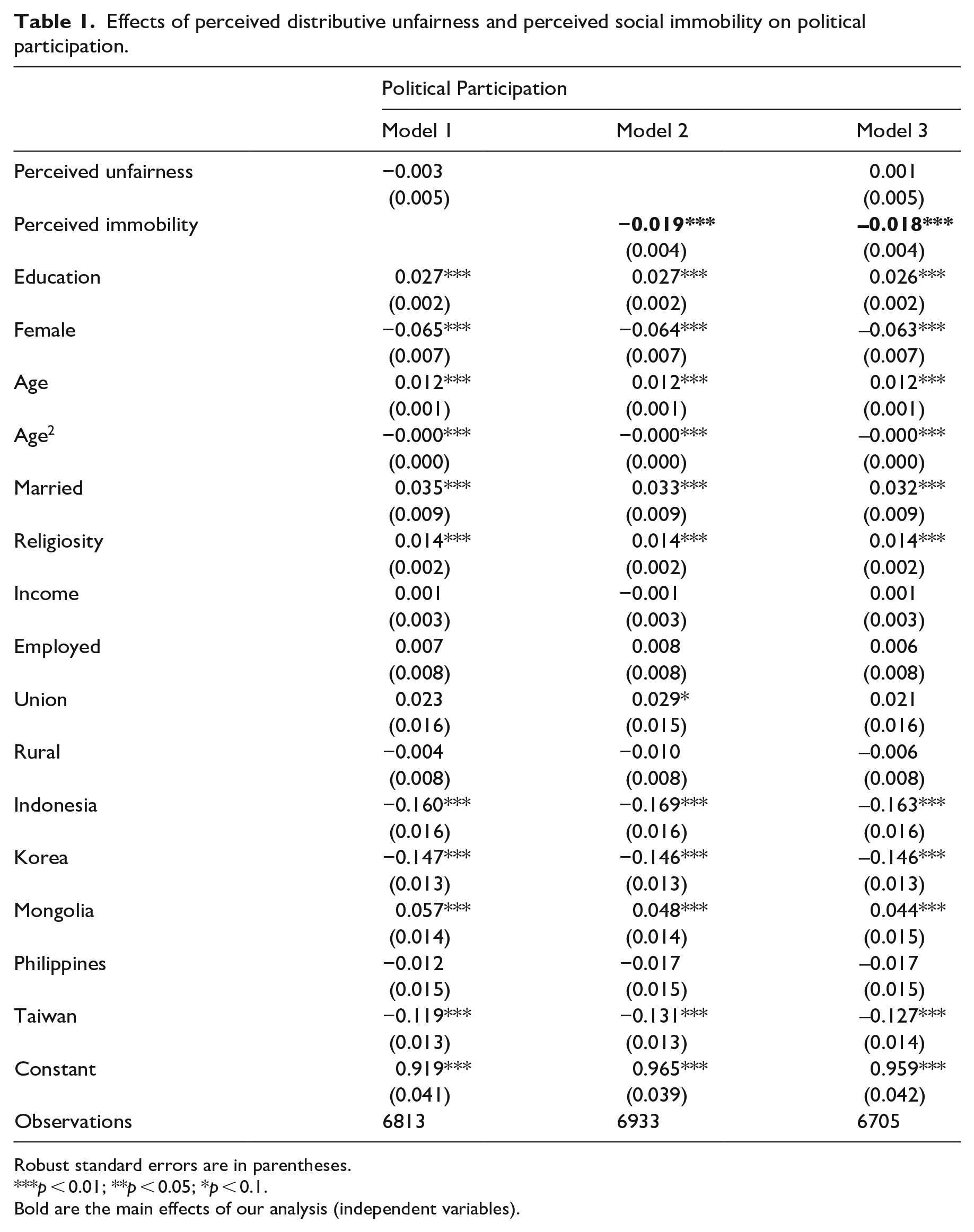
Table 1 presents the results of the multivariate regression analysis on Hypotheses 1 and 2. The results provide strong evidence for Hypothesis 2 that perceived social immobility depresses political participation. In the first two columns, each inequality variable is specified individually. In Model 1, the coefficient of perceived unfairness fails to reach statistical significance. On the other hand, the perceived immobility variable in Model 2 has a negative and statistically significant coefficient for overall political participation. Model 3 includes the two inequality variables together. The results stay the same: while the perceived unequal distribution of income does not have a meaningful influence on political participation, although its sign is positive, perceived immobility negatively affects participation.
Effects of perceived distributive unfairness and perceived social immobility on political participation.
Robust standard errors are in parentheses.
p < 0.01; **p < 0.05; *p < 0.1.
Bold are the main effects of our analysis (independent variables).
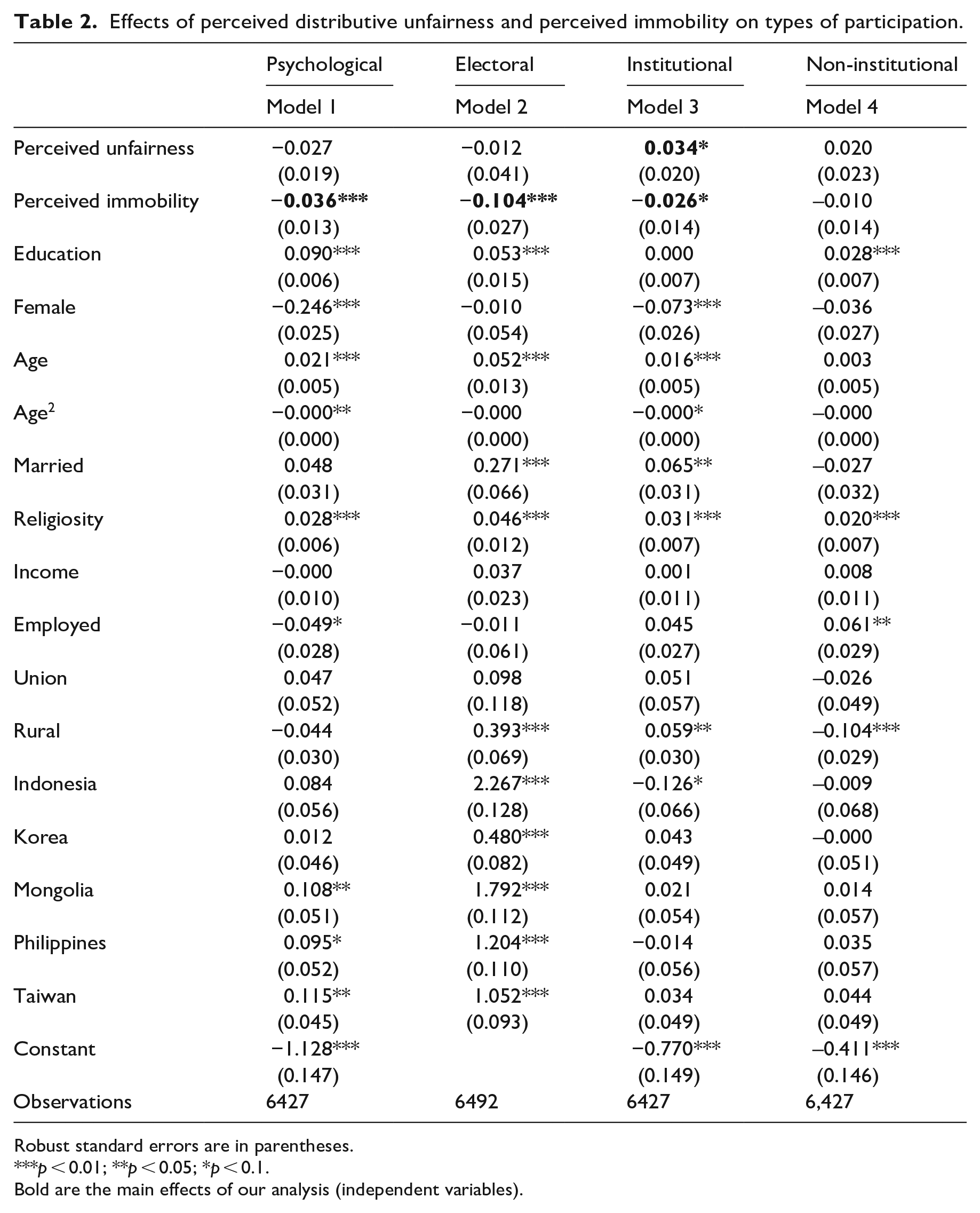
Table 2 shows how perceived distributive unfairness and social immobility affect different types of political participation. We have some interesting results. First, it shows that perceived unfairness has positive and statistically significant coefficients for institutional participation. This suggests that as individuals perceive higher levels of unfair income distribution in their society, they are motivated to participate in institutional activities. This result provides partial evidence for Hypothesis 1 that perceived income inequality mobilizes individuals to participate in politics, supporting conflict theory. However, it does not support Hypothesis 3. The coefficients of perceived unfairness for psychological and non-institutional participation are not statistically significant, although the coefficient for non-institutional participation shows a positive sign. Thus, we do not have enough evidence to argue that the mobilizing effects of perceived income inequality would be more pronounced in psychological and non-institutional types of political participation (H3).
Effects of perceived distributive unfairness and perceived immobility on types of participation.
Robust standard errors are in parentheses.
p < 0.01; **p < 0.05; *p < 0.1.
Bold are the main effects of our analysis (independent variables).
On the other hand, the analysis provides strong evidence for Hypothesis 4 that perceived social immobility depresses psychological, electoral, and institutional participation, supporting relative power theory. As individuals evaluate that they have fewer opportunities to improve their social status in the future, they are discouraged from engaging in politics psychologically, turning out to vote, and engaging in institutional political activities. It is particularly interesting to find that subjective immobility even depresses psychological engagement; higher levels of subjective social immobility lead individuals to turn off their political interests, thus, less likely to follow political news and discuss politics with those in their close networks.
To examine how the two types of perceived economic inequality interact, we add the interaction term to all models in Table 2 and re-estimate the models (the results are presented in Supplemental Table A.4). Figure 1 visualizes the interactive relationships between perceived distributive unfairness and social immobility for each type of political participation. We carefully follow the suggestions in dealing with multiplicative interaction terms as the interaction coefficients only reveal averaged effects (Brambor et al., 2006; Braumoeller, 2004; Solt et al., 2014). Figure 1 shows how the coefficients of each perception measure change as the other perception measure varies from its minimum to maximum values. Figure 1(a) shows how the effects of perceived unfair distribution vary across different values of perceived social immobility. It does not provide evidence for Hypothesis 5 that perceived distributive unfairness has stronger mobilizing effects when combined with pessimistic perceptions of social mobility. Instead, perceived distributive unfairness encourages institutional participation more noticeably as individuals perceive social mobility positively, and its mobilization effect disappears when combined with pessimistic mobility perceptions.
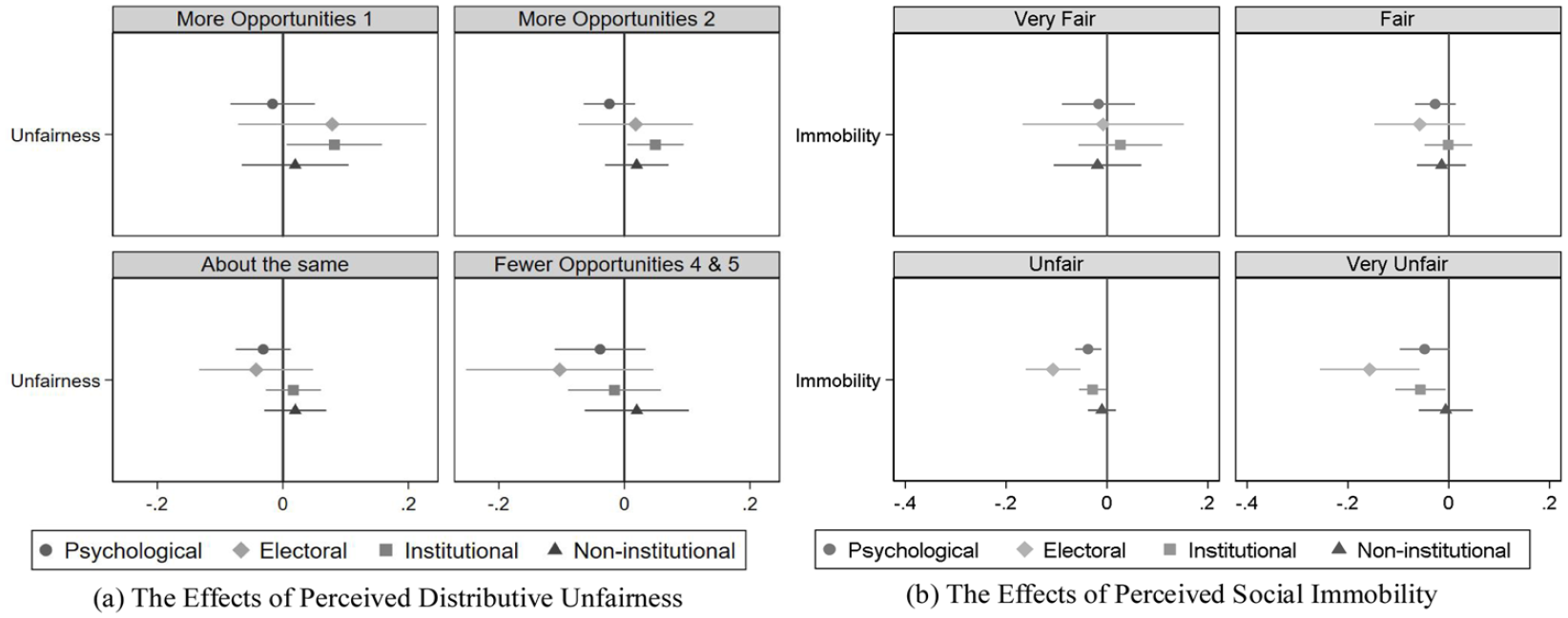
Perceived distributive unfairness and perceived immobility: interaction effects: (a) the effects of perceived distributive unfairness and (b) the effects of perceived social immobility.
Figure 1(b) shows how the effects of perceived social immobility vary as the perceived unfairness variable changes its values. It provides strong evidence for Hypothesis 6 that the demobilizing effect of perceived social immobility becomes amplified when combined with pessimistic perceptions of income distribution. When individuals believe incomes are distributed fairly, all coefficients of social immobility fail to reach statistical significance as the confidence intervals contain zeros inside. However, as individuals perceive incomes are unfairly distributed, the effects of perceived social immobility turn negative for psychological, electoral, and institutional activities at a statistically significant level, as expected by Hypothesis 6.
The results for the control variables are generally in compliance with previous research. In agreement with the conventional SES model, education is shown to increase individuals’ participation in almost all activities except institutional participation. Interestingly, however, income fails to reach statistical significance across the forms of political participation. Age shows a similar pattern: age increases overall participation while having no discernable impact on non-institutional participation. Religiosity turns out to be the most consistent mobilizing factor among the East Asian citizenries across all types of participation examined in the analysis. Females are less likely to engage in psychological and institutional participation than their male counterparts, which conforms to Pfanzelt and Spies (2019) that the gender gap in political participation is particularly conspicuous in institutional forms of participation.
Another noteworthy finding is in comparison to Japan, which is the reference point for the country-fixed effects in our analysis, all countries report higher levels of electoral participation as well as psychological participation to a lesser degree. The coefficients for all country-fixed effects on electoral participation are positive and statistically significant; concerning psychological participation, all countries but Indonesia and South Korea report more activism than Japan. We do not find much cross-country difference in institutional and non-institutional participation. This finding is interesting yet puzzling, given that Japan is the oldest democracy in the region. It contradicts the conventional wisdom that a long history of democracy is associated with more democratic consolidation and citizen participation embedded in the system.
In addition to the country effects relative to Japan, we separately estimate our model for each county and create coefficient plots to examine what the main findings mean for each country in the model. In doing so, we are relaxing the constant slope assumption of the regression analysis with fixed effects while allowing coefficients to vary across countries. The results are presented in Figure 2 (The full results are displayed in Supplemental Tables A.5 through A.8). Overall, we observe cross-national variations. First, the mobilizing effects of perceived distributive unfairness are found in various forms of participation across the countries. Specifically, perceived distributive unfairness increases psychological participation in the Philippines, electoral participation in Mongolia, institutional participation in South Korea, and non-institutional participation in Taiwan. It provides support for conflict theory. However, it also suggests that the mechanisms of conflict theory may vary across countries. Second, perceived immobility discourages electoral participation in South Korea and Taiwan, and it also discourages institutional participation in Taiwan, providing support for relative power theory. Third, across all types of political participation, the effects of perceived unfairness and mobility in the Japanese and Indonesian samples fail to reach statistical significance at the conventional level.
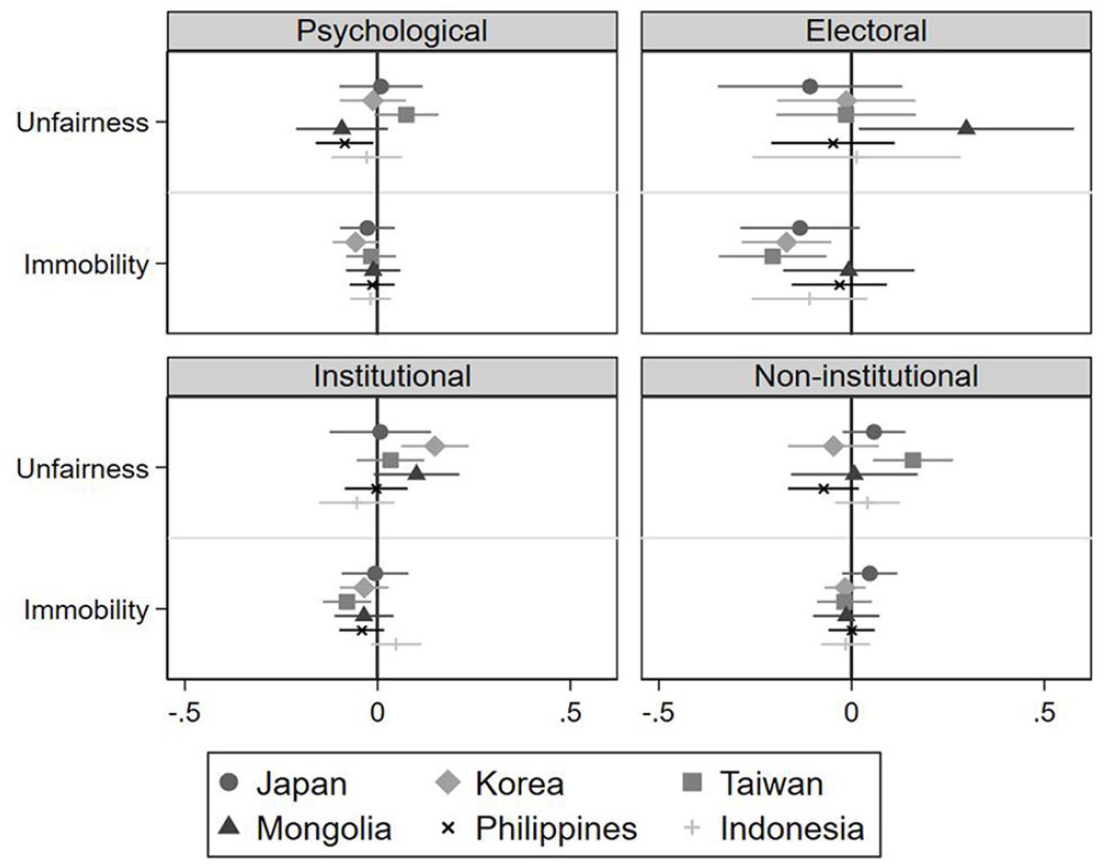
Perceive distributive unfairness and immobility for participation by country.
Discussion
This article re-examines the debate over inequality and political participation in the East Asian context by focusing on the perceptions of distributive unfairness and intergenerational mobility. Our empirical analysis uncovers some interesting findings. First, perceived distributive unfairness mobilizes individuals to participate in institutional political activities. In line with conflict theory, when citizens in East Asia perceive distributive injustice, they are motivated to take political action in response. Second, perceived social immobility depresses almost all types of political engagement, from psychological to electoral and institutional forms. Conforming to relative power theory, this indicates that perceptions of long-term, chronic inequality reduce efficacy and capacity to engage in politics to fix the problems. Third, when individuals perceive both income distribution and intergenerational mobility pessimistically, the mobilizing effect of the former disappears, while the demobilizing effect of the latter gets amplified in electoral and institutional activities. Fourth, our analysis shows cross-national variation concerning the impact of perceived economic inequality on participation, with Japan and Indonesia having null findings across all models.
These findings provide some interesting implications for the extant literature. First, the two rival theories—conflict and relative power theories—provide not necessarily contradictory but complementary explanations about the relationship between economic inequality and political participation. For instance, conflict theory emphasizes motivations for participation in its causal link between inequality and participation, while relative power theory emphasizes resources or capacity for participation. Similar to Wong (2022), we look into different types of political participation and find that some are more closely connected to motivation, while others are more related to capacity. By paying closer attention to the causal mechanisms of each theory, we can develop more nuanced theoretical expectations than have been provided in prior research.
Second, the interaction between perceived income inequality and immobility is nuanced, reaffirming that both theories are at work in East Asia. The amplified demobilizing effects of perceived immobility are found in electoral and institutional participation, while the mobilizing effects of perceived distributive unfairness exist only when individuals hold optimistic perceptions of social mobility concerning institutional participation. It suggests that each type of participation has different dynamics, and the inequality-participation link is much more complicated than has been recognized. Yet, this finding indicates that more conventional political activities like voting and institutional activities are at the core of the inequality-participation nexus in East Asia.
Third, it is notable that people’s perceptions of social mobility matter more than income inequality in determining political activism among East Asian citizens by affecting almost all forms of participation considered. We surmise that this reflects the unique dynamics of income inequality and social mobility in the region. Countries in East Asia achieved rapid economic growth and went through the rapid modernization process, spreading a sense of equal opportunity and contributing to high social mobility and meritocracy (Amano, 1997; Chung and Park, 2019; Dore, 1976; Seth, 2002; You, 2017). However, as the income gaps between the rich and the poor started growing a couple of decades ago, people have become anxious about their societies becoming acutely unequal and stratified. We speculate that the preceding conditions in those societies—relatively egalitarian social structure and high mobility—made individuals more sensitive to social mobility than income distribution. We further believe that the implications of this study are applicable beyond East Asia. In societies that are similarly situated as East Asia, where inequality is a recent phenomenon and has not grown monotonically and consistently over a long period of time yet, such as Scandinavian countries, similar inequality-political activism mechanisms might work.
This study gives us several tasks to be tackled in the future. First, it will be interesting to see whether the difference in inequality structures between East Asia and the West reveals any systematic differences in how people perceive inequality and which aspect of it, for instance, income distribution or mobility, matters more. Second, we need to examine the varying inequality-participation mechanisms in the six East Asian countries to understand the cross-national variations found in this study. Particularly, what explains the null findings of Japan and Indonesia? One possible approach could be categorizing the countries into two groups, one more egalitarian and the other less egalitarian and conducting a more fine-tuned analysis, adopted by Cho (2019). Third, our research suggests that institutional participation is multifaceted and needs to be examined more thoroughly. We find that perceived distributive unfairness increases institutional participation while perceived social immobility decreases it. What makes institutional political action sensitive to both participatory motivation and participatory capacity? Exploring this question will add more knowledge to the inequality-participation nexus.
Supplemental Material
sj-docx-1-jas-10.1177_00219096231168058 – Supplemental material for Economic Inequality and Political Participation in East Asian Democracies: The Role of Perceived Income Inequality and Intergenerational Mobility
Supplemental material, sj-docx-1-jas-10.1177_00219096231168058 for Economic Inequality and Political Participation in East Asian Democracies: The Role of Perceived Income Inequality and Intergenerational Mobility by Mi-son Kim, Dongkyu Kim and Sang-Jic Lee in Journal of Asian and African Studies
Footnotes
Funding
The author(s) received no financial support for the research, authorship, and/or publication of this article.

Supplemental material
Supplemental material for this article is available online.
Notes
Author biographies
References
Supplementary Material
Please find the following supplemental material available below.
For Open Access articles published under a Creative Commons License, all supplemental material carries the same license as the article it is associated with.
For non-Open Access articles published, all supplemental material carries a non-exclusive license, and permission requests for re-use of supplemental material or any part of supplemental material shall be sent directly to the copyright owner as specified in the copyright notice associated with the article.
