




Abstract
Some mainstream political scientists apply the trilogy of exit, voice and loyalty in studying intra-party cohesion. This approach applies more neatly in liberal than in repressive contexts. I therefore make three modifications to enhance the trilogy’s descriptive and explanatory power in an authoritarian context using the ruling Zimbabwe African National Union Patriotic Front (ZANU PF) after Robert Mugabe. First, there is need to integrate non-voluntary exit as party members are mostly expelled against their will in a context where there are limited livelihood opportunities outside party-state patronage and defection is ruthlessly punished. Second, voice should be understood as predominantly expressed over preferences for personalities in internal power distribution rather than over policies. Third, loyalty is not always to the party institution to promote unity but to individuals or factions. From this positioning, ZANU PF is predominantly a non-cohesive party characterised by ephemerally organised leader-follower groups largely seeking power and patronage.
Introduction
I adapt Hirschman’s (1970) classic trilogy of ‘exit, voice and loyalty’ in an attempt to understand intra-party cohesion in authoritarian contexts. Intra-party cohesion refers to the assessment of ‘whether members of a political party are collectively unified to achieve shared goals’ (Hazan, 2003: 3). Hirschman (1970) argued that people can react to organisational performance through exit (leave the firm), voice (express discontent) or loyalty (remain faithful). Some political scientists have applied this framework to understand intra-party politics in the liberal West (Salucci, 2008; Van Haute and Carty, 2012). The central logic is that party members, just like consumers, can react to internal dynamics through exit (leave the party leading to splits), voice (express discontent leading to factionalism) or loyalty (being faithful and devoted, resulting in party unity) (Close and Gherghina, 2019). Hirschman (1970: 70) argued that the trilogy can be applied universally to understand responses to organisational performance. As a result, scholars have adopted it to understand intra-party politics in many parts of the world with different political cultures showing its growing universalisation (Cooper, 2017: 4). In Africa, Cooper (2017) and Sarakinsky (2015) have extended its analytic use to the study of intra-party cohesion to understand splits in former national liberation movements, namely, the African National Congress (ANC) in South Africa and South-West Africa People’s Organization (SWAPO) in Namibia. However, both countries do not provide a fertile ground to understand cohesion in authoritarian contexts. This is because South Africa and Namibia have ‘sustained a relatively high standard of democracy on the African continent’ (Cooper, 2017: 6; House, 2022).
I posit that Hirschman’s trilogy applies more neatly in liberal than repressive contexts. I therefore make three modifications to enhance the trilogy’s descriptive and explanatory power in an authoritarian context using the ruling Zimbabwe African National Union Patriotic Front (ZANU PF) after the Robert Mugabe era as an analytic entry point. The first modification is to integrate what I call non-voluntary exit, which refers to party members being expelled from the party against their will. This is contrary to the normative implication that exit is a voluntary reaction to organisational decline in Hirschman’s formulation. Those expelled can continue to influence intra-party dynamics and even seek re-entry. In other instances, expelled members even continue to sing praises to the party leader (Mpondi, 2015). This is more pronounced in a context where there are sparse livelihood opportunities outside a ruling party that is integral to state resource-allocation through patronage networks. The marked erosion of alternative livelihood opportunities in Zimbabwe has led to a common adage in national politics that it is ‘cold out there’ in reference to life outside ZANU PF (Sharara, 2015). In addition, ‘defectors may also be bankrupted, arrested, or even killed’ in authoritarian states where the idea of loyal opposition hardly exists (Cooper, 2017: 4). Most ZANU PF members face this reality and rather wait to be expelled than exit voluntarily.
Second, voice should be understood as predominantly expressed over preferences for personalities in contests over internal power distribution. This is contrary to the dominant measure of voice in mainstream political science which is based on deviation from the party’s policy agenda (see Van Haute and Carty, 2012). As Van de Walle (2003) observed, there is low ideological salience and a dearth of policy debates for most parties in sub-Saharan Africa. This is more contextualised by Nyambi et al. (2022: 8) who argue that ‘understanding the kinds of political legacies and dispensations in Zimbabwe begins by appreciating the fact that the political landscape has been characterised, and continues to be characterised, by the cult of personalities’. In addition, silence by party members should not always be conceptualised as content because expressing dissent (voice) can invite ruthless punishment because of ZANU PF’s authoritarian culture of crushing internal dissent with impunity (Dorman, 2016; Fontein, 2018; Mazarire, 2017).
Third is the need to understand that loyalty is not always to the party and its programmatic agenda in order to promote unity as in Hirschman’s original formulation. There can be loyalty to an individual party leader or faction rather than to the ideology of the party, hence resulting in leader-follower groups (Salucci, 2008). So ‘while party loyalty may refrain members from exiting the organization, factional loyalty may have the exact opposite effect’ (Close and Gherghina, 2019: 658). These modest modifications help us to understand intra-party dynamics better in authoritarian regimes.
My argument is presented in two broad sections. The first provides the context for one to understand the nature of ZANU PF and its divisive race to succeed Mugabe, critically review literature covering mainly the period 2017–2022 on ZANU PF’s intra-party politics and justify my qualitative approach. The second broad section demonstrates how ZANU PF, from the centre to the periphery, has predominantly remained an incoherent entity characterised by ephemerally organised ‘leader-follower groups’ (Key and Heard, 1949) with little shared ideological values after 2017. I demonstrate this through first analysing the power struggles at the presidential and politburo levels. The politburo is the executive committee responsible for implementing all decisions of the central committee which is the party’s highest decision-making organ in between congresses (ZANU PF Constitution, article 9). I then extend my analysis to the provincial level where the question of internal distribution of power through the 28 December 2021 provincial elections triggered fragmentation. Finally are the insights gained from looking at how these patterns play out at the local levels especially during the December 2020 District Coordinating Committee (DCC) elections where factionalism was rampant. The DCC is the party’s lowest tier of the administrative and coordinating bodies. In giving a more complex picture of a party which is barely holding together from the top to the local structures, I also challenge the belief in ZANU as a unified party or as one where divisions are just about the few national leaders at the apex of the executive. I now explore the nature of ZANU PF and its internecine presidential succession battles to foreground the study.
The fractious race to succeed Mugabe
ZANU PF is a former liberation movement originally formed as the Zimbabwe African National Union (ZANU) on 8 August 1963 under the founding leadership of Ndabaningi Sithole following a split of another former liberation movement, the Zimbabwe African People’s Union (ZAPU). The very nature of ZANU PF’s formation was a result of an enduring legacy of factionalism within Zimbabwean politics (Sithole, 1979). Even Robert Mugabe’s rise to leadership of the party in 1977 was a result of what David Moore (2022) called a ‘prison coup’ on Sithole. Despite the internal ructions, ZANU PF has been a dominant governing party in Zimbabwe since independence from the British colonial rule in 1980. It remained prepotent despite the short-lived coalition government of PF-ZAPU and White minority elements from 1980 to 1982, the merger with PF ZAPU through the Unity Accord of 22 December 1987 and the Global Political Agreement of 2008 which brought ZANU PF and the two Movements for Democratic Change (MDC) formations into an inclusive government (2009–2013) (see Ndlovu-Gatsheni, 2020). Throughout, Mugabe was at the helm of political power as leader of ZANU PF from 1977 and of Zimbabwe first as executive Prime Minister (1980–1987) and as executive President from 1987 until he was removed in a military coup in November 2017 (Tendi, 2020). Mugabe represented ‘big man’ politics in post-colonial Africa characterised by the centralisation of power around the presidency and institutionalisation of one-man rule. During Mugabe’s tenure, ZANU PF has tended to purge internal dissenters against the leadership’s hegemonic trajectory violently (Mazarire, 2017; Nyambi et al., 2022: 6). He used Machiavellian tactics to stay in power, including creating and institutionalising intra-party factions, which, however, later consumed him (Ndlovu-Gatsheni and Ruhanya, 2020).
It is important to note that during Mugabe’s reign, intra-party cohesion became increasingly weakened as Solomon Mujuru, the first Black commander of the Zimbabwe army (1981–1992), and Emmerson Mnangagwa, the country’s first Black minister of state security (1980–1988), became fierce rivals in the succession race from the late 1990s as Mugabe aged (Hove, 2019). Solomon Mujuru preferred to be ‘king maker’ (Tendi, 2020), but this is arguably because the king (Mugabe) wanted him to do so (Mazarire, 2022). Solomon thus fronted his wife Joice Mujuru (hereafter Mujuru) as the faction leader (Tendi, 2020). Mujuru’s faction was known as Gamatox (a banned toxic pesticide in Zimbabwe) and Mnangagwa’s faction as the weevils who deserved to be eliminated by Gamatox (Nyambi, 2016). Following the death of Vice-President Simon Muzenda in September 2003, internal dis-cohesion about who would succeed him and eventually Mugabe intensified in the run-up to the December 2004 congress. There were a series of Mnangagwa and Mujuru factional meetings. However, one of the meetings with historical significance in ZANU PF’s post-colonial internal politics was a meeting that resulted in the so-called Tsholotsho declaration (see Hove, 2019; Mangena et al., 2021; Moore, 2022; Nyambi et al., 2022). Six provincial chairpersons out of 10 and other senior ZANU PF politicians convened at Rainbow Towers Hotel in Bulawayo on 18 November 2004 (Jonathan Moyo, 2004). Most had conspicuously met earlier at the prize-giving day at Dinyane high school in Tsholotsho, Jonathan Moyo’s home area. Jonathan Moyo, a former politburo and cabinet member, had invited Mnangagwa to be guest of honour, but he did not turn up after Mugabe convened an emergency politburo meeting to discuss the processes for the 2004 congress. One of the major resolutions at Rainbow Towers Hotel (dubbed Tsholotsho declaration) was that the party’s top four positions ‘should reflect Zimbabwe’s regional diversity and ethnic balance between and among the country’s four major ethnic groupings, namely, Karanga, Manyika, Zezuru and Ndebele’ (Jonathan Moyo, 2004). The issue of ethnic cleavages and regionalism has been a perennial feature of ZANU PF politics from the colonial to the post-colonial era (Ncube, 2020; Sithole, 1979). As Gumbo (2020: 136) argues, ‘the politics of ethnic hegemony . . . have nurtured and prolonged Zimbabwe’s political culture, in turn shaping its successive political transitions’. Consequently, the Rainbow meeting proposed to nominate Mugabe (Zezuru) for the position of president and first secretary; Mnangagwa (Karanga) for the position of vice-president and second secretary; Thenjiwe Lesabe (Ndebele) for the position of vice-president and second secretary reserved for women; and Patrick Chinamasa (Manyika) for the position of national chairman (Jonathan Moyo, 2004). This was to strategically position Mnangagwa to eventually succeed Mugabe as President. Mugabe saw this as a challenge to his authority. As a result, Mugabe suspended the six provincial chairpersons, expelled Jonathan Moyo and other key figures who attended the Tsholotsho declaration from the party and demoted Mnangagwa in government (Hove, 2019; Nyambi et al., 2022). This means that dissent in ZANU PF was ruthlessly met with forced exit. Within this matrix, Mujuru with the support of Mugabe outmanoeuvred Mnangagwa to become second secretary of the party and the vice-president in 2004 (Tendi, 2020).
Mnangagwa and his military allies (rebranded as Lacoste) did not choose to exit the party as implied in Hirschman’s original framework but chose to fight from within. They prepared intelligence dossiers that accused Mujuru of plotting to depose Mugabe (Tendi, 2016). As a result, Mugabe fired Mujuru and her key allies from the party and cabinet in 2014 (Tendi, 2016). In the run-up to this, Mujuru also suffered multiple misogynistic, sexist and gender stereotypes intrinsic to demonisation and marginalisation of women’s participation in Zimbabwe politics (Bhatasara and Chiweshe, 2021; Ncube, 2020). To show the ‘plasticity’ of alliances (Mangena et al., 2021), Mugabe then appointed Mnangagwa as second secretary of the party and vice-president in the same year, but the latter’s tenure was unstable as he in turn was accused of plotting a coup against Mugabe by a new faction called Generation 40 (G40) (Tendi, 2020). However, Jonathan Moyo claimed that he coined the term G40 to refer to political potential of age groups between 18 and 40 years and not a faction (The Sunday News, 2016). As Tinhu (2016) argues, the denial of political divisions is standard in politics and is not surprising in a political context where factional leaders can face state repression. Even if we were to accept Jonathan Moyo’s explanation, the G40, in political reality, came to refer to a faction associated with former politburo and cabinet members including Jonathan Moyo, Walter Mzembi, Patrick Zhuwao and Saviour Kasukuwere (former national political commissar). The G40 faction was publicly fronted by Grace Mugabe who was married to Mugabe as the succession race intensified. G40 largely represented the ‘young’ generation with no liberation war credentials (Hove, 2019). However, G40 cannot be viewed as a unified entity with monolithic interests at all times.
As G40 attacks intensified, Mugabe eventually expelled Mnangagwa from the party and cabinet in November 2017. This led to a more overt involvement of the military in ZANU PF succession politics which worsened factionalism and is still shaping contemporary internal party politics in Zimbabwe (Maringira, 2021). In particular, Mnangagwa’s forced exit precipitated a military coup coordinated by Mnangagwa’s key ally then who was the Zimbabwe Defence Forces (ZDF) commander, Constantino Chiwenga. Mugabe was forced to resign on 21 November 2017, after 37 years in state power. As the coup was in motion, Grace Mugabe and several of her G40 allies were expelled from ZANU PF and some including Jonathan Moyo, Kasukuwere, Mzembi and Zhuwao were hounded out of the country into exile (Ndlovu-Gatsheni and Ruhanya, 2020). Other scholars have called it a very Zimbabwean coup (Moore, 2018), a coup that never was (Beardsworth et al., 2019: 580) or a military-assisted transition (Bhatasara and Chiweshe (2021: 218). However, Tendi (2019) contests the exceptionality of the coup and argues that it had commonalities with other African coups based on a review of international literature on coup characteristics. More recently, Moore (2022) has stated that his ‘exceptionalist’ interpretation might have overstated the coup’s differences from other African coups. Nevertheless, as Nyambi et al. (2022) argue, specificities in the Zimbabwe case deserve scholarly attention. Of significance here is the convergence among scholars that it was a military coup motivated partly by historical, ideological and political beliefs and economic interests (Helliker and Mazarire, 2021; Moore, 2022; Nyambi et al., 2022; Tendi, 2019). Others have convincingly argued that the coup was also a response to a feminine threat to patriarchal and masculine character of state power paused by Grace Mugabe (Bhatasara and Chiweshe, 2021: 229). It is therefore not surprising that ‘subsequent to the transition, a macho-militarism within the national politics of ZANU–PF has come to the fore increasingly’. Hence, factionalism post 2017 is dominated by male-led groups with women at the periphery. The overt interest of the military in party politics therefore helps us to better understand contemporary internal ZANU PF politics.
Following the subjugation of G40 and Mugabe’s forced exit, Mnangagwa became President and Chiwenga who had assisted him to the throne became his deputy president (Ndlovu-Gatsheni and Ruhanya, 2020). The president was immediately confronted with internal contradictions from the Chiwenga faction and its military allies, the G40 and remnants of Gamatox. Mnangagwa initially promised a ‘new dawn’ (Helliker and Murisa, 2020: 9) and a ‘break with the past’ (Mnangagwa, 2017) ‘with a rhetoric of change and a rejection of past political and economic cultures’ (Nyambi et al., 2022: 1). Mnangagwa even reminded party members that ‘a house divided cannot stand’ while promising to heal the fractionally riven party (Dzirutwe, 2018). However, authoritarian and repressive politics remained (Helliker and Mazarire, 2021: 173).
Given this context, we still know very little about how the internal party dynamics have evolved from the centre to the periphery. The preoccupation with many of these scholars is at the elite level of national leaders, especially the presidium and the relations between the party and security sector leaders (Hove, 2019; Maringira, 2021; Ruhanya, 2020; Tendi, 2019). There has been a paucity of analysis of ZANU PF’s provincial and district structures and their relationships to the centre. This article will extend the scope of analysis to the periphery to help paint a more comprehensive picture about the state of ZANU PF. In addition, it gives an in-depth empirical investigation of the state of party unity after the Mugabe era to complement other approaches that have largely relied on desktop studies. It will also be the first study to understand how party members have reacted through using Hirschman’s adapted trilogy of exit, voice and loyalty through the following study approach.
Investigating intra-party cohesion
I used a mix of qualitative methods between 2017 and 2022 to get a deeper understanding of ZANU PF’s internal politics beyond statistical analysis (see Van Haute and Carty, 2012) that fails to capture empirical accounts from the actors involved. I carried out interviews with the party’s secretariat, its former and current national leaders, ordinary party members and members of the security sector. These respondents had firsthand information about ZANU PF. As Nyambi et al. (2022: 2) argue, my reliance on internal sources does not mean negation of other multidisciplinary approaches in trying to understand this complex situation. For one might question the credibility of the sources, given prevailing state surveillance and the actors’ interests in internal battles. I therefore assessed reliability through data triangulation. First, I counter-balanced the national leaders’ narratives with those of ordinary party members to gauge the objectivity. Second, I conducted in-depth interviews with some opposition leaders and their lawyers who were entangled in ZANU PF factional fights with a view to obtaining alternative information and perspectives outside internal actors in order to increase the validity of observations and conclusions drawn in the research. Third was a systematic and scrupulous study of primary materials, such as official public statements, official letters and minutes from the party. Fourth was an analysis of weekly politburo media briefings and newspaper reports. Independent press critical of ZANU PF such as the NewsDay, NewZimbabwe, News Hawks, Nehanda Radio and Zimbabwe Independent and the state-controlled media sympathetic to ZANU PF such as The Herald, The Chronicle, The Sunday Mail and Zimbabwe Broadcasting Cooperation which I mainly used can offer distinctively different views, but a careful reading of both and triangulation corroborated many internal firsthand accounts of ZANU PF politics and the related political rhetoric (see Alexander, 2006: 108). When one analyses the diverse sources of data collectively, there is a satisfactory account and a systematic pattern of internal party dis-cohesion that emerges from different parts of the country and along the party hierarchy. It is important to note that the individuals I interviewed who are still involved in ZANU PF politics and living within Zimbabwe are presented as pseudonyms not as an ‘effort to bar readers from establishing the veracity of their accounts’ (Mazarire, 2022: 2) but for the purpose of protecting the identity of the informants from possible harm by the authoritarian state.
Based on the data, I now demonstrate how Chiwenga and Mnangagwa were locked in constant power struggles after Mugabe despite public postures of unity.
Bifurcated political authority: president vs vice president
The power-driven struggles between Mnangagwa and Chiwenga after Mugabe were partly shaped by trappings of presidentialism. The power struggles intensified after the 2018 general election (Former ZANU PF political commissar, Dzimbahwe Lodges, Ruwa, 14 July 2019). This was when it became clear that Mnangagwa wanted to run for a second presidential term in 2023 against a possible earlier agreement to serve one term and hand over to Chiwenga (ZANU PF senior official, Harare, 7 January 2021). Even Mnangagwa’s daughter, Farai, revealed that Mnangagwa was going ‘to serve one term to avoid making mistakes made by Mugabe’ (Sengputa, 2018). To understand the rivalry, one has to understand that Chiwenga harboured presidential ambitions (Tendi, 2016). Before the coup, Tendi (2016: 217) asserted that ‘Chiwenga’s plan is to succeed ED [Mnangagwa] after ED succeeds Mugabe. When ED is President, Chiwenga will be his Vice-President. There is an alliance between the two’. In August 2016, Chiwenga also publicly disclosed that at the age of 9 years in 1965, his grandfather had prophesied that he was going to govern one day (The Sunday Mail, 2017). He held this belief to an extent that he officially added the name Nyikadzino (this country) to his names (The Sunday Mail, 2017).
Mnangagwa was therefore aware of Chiwenga’s presidential ambitions and feared another coup (ZANU PF politburo member, 2021, Harare, 10 January 2021). Consequently, Mnangagwa sidelined Chiwenga and his allies from powerful security positions as a way to coup-proof and neutralise him (Cross, 2021; ZANU PF politburo member, 2021, Harare, 10 January 2021). He replaced Chiwenga as Minister of Defence and Security and War Veterans with Oppah Muchinguri, the ZANU PF national chairperson, and his ally in September 2018 (Hove, 2019; Mugabe, 2018). Mnangagwa also retired some of Chiwenga’s allies in the army who had led the coup. For example, Major General Anselem Nhamo Sanyatwe, who was commander of the Presidential Guard (PG) during the coup and a close ally of Chiwenga, was posted to Tanzania in an ambassadorial role (Pindula, 2022). Sanyatwe was so close that Chiwenga sent him to deliver a token of divorce to his former wife, Mary Mubaiwa (Masau, 2022). The PG’s then second-in-command, Colonel David Nyasha, was replaced by Mnangagwa’s trusted former aide-de-camp, Never-Jones Makuyana (Matiashe, 2021). Commander of One PG Infantry Battalion at State House, Lieutenant-Colonel Samson Murombo was re-assigned to the all arms battle school in Nyanga (Mananavire and Chingono, 2021). Mnangagwa’s wife, Auxillia, believed that Murombo was part of the elite military commanders’ plot to kill Mnangagwa in the context of deepening divisions (Mananavire and Chingono, 2021). In August 2019, the commander of the artillery brigade during the coup in Domboshava, Brigadier General Stanley Mangena, was also transferred to command agriculture a state-led farmer support programme (Mabika and Dengu, 2021). Some of the changes happened when Chiwenga was undergoing medical treatment in China (Reuters, 2019).
Some ZANU PF apologists argue that the divisions between Chiwenga and Mnangagwa were fictitious (Mahomva, 2021). However, ZANU PF leaders acknowledged that there were internal forces trying to remove Mnangagwa and replace him with Chiwenga (ZANU PF politburo member, 2021, Harare, 10 January 2021). Former politburo members Cleveria Chizema and the late Tendai Savanhu were expelled from the party on 19 August 2020 for ‘serious treachery’ (ZANU PF politburo member, 2021, Harare, 10 January 2021). Chizema was found by security agents with fliers that denounced Mnangagwa and supported the 31 July 2020 protests against Mnangagwa’s government (Herald Reporter, 2020). A senior opposition Movement for Democratic Change Alliance (MDC A) leader, Job Sikhala, said he and other opposition activists supported the peaceful protests as long as they were held within the confines of the constitution (Interview, Job Sikhala, senior MDC A member and Member of Parliament, Chitungwiza, 26 December 2020). A ZANU PF youth league member, Tinashe Mathusa, was also expelled for printing and distributing anti-Mnangagwa flyers and pro-Chiwenga placards (Herald Reporter, 2020). On some posters were written ‘our generals liberate us from Mnangagwa’ (ZANU PF politburo member, 2021, Harare, 10 January 2021). The youth chair for Matabeleland North Province, Tamuka Nyoni, was suspended for receiving money from MDC A allies to mobilise for the 31 July 2020 protests (Herald Reporter, 2020). The allegations were not baseless. Chiwenga’s alleged allies had told some MDC A lawyers to convince Nelson Chamisa (then President of MDC A) to mobilise for the protests in a bid to weaken or unseat Mnangagwa (Interview, MDC A Lawyer, Harare, 12 January 2021). Chamisa did not comply because he did not want to be implicated in ZANU PF factional fights and he did not trust either side (Interview, Nelson Chamisa, MDC A President, Harare Advocate Chambers, 12 January 2021). Chiwenga’s allies continued to be side-lined in the party with Chiwenga not publicly defending them as they faced involuntary exit.
Other commentators argue that Chiwenga’s presidential bid was further weakened by the death of his ‘perceived’ allies (NewsHawks, 2021a). These allies are said to be Sibusiso Moyo (former Army General and Minister of Foreign Affairs and International Trade) and Perrance Shiri (former Commander of the Air Force of Zimbabwe and Minister of Lands, Agriculture and Rural Resettlement). However, I argue that the demise of these towering leaders inadvertently arrested degenerative factionalism as Chiwenga remained the only centre of power within ZANU PF in serious competition with Mnangagwa. In reality though, Shiri was not even a close ally of Chiwenga as they competed for power within the military hierarchy (Tendi, 2020). Politically, Shiri was emerging as an alternative centre of power (Interview, retired army officer, Mutangadura hideout, Goromonzi, 1 May 2022). When Chiwenga was indisposed in China, some ZANU PF members considered Shiri a senior, a Zezuru and someone with liberation war credentials who could replace Chiwenga (Interview, ZANU PF member, Holiday Inn Hotel, Harare, 2 October 2021). Shiri’s demise left Chiwenga, who medically recovered, as the towering Zezuru figure who could take on Mnangagwa in the succession battle (Interview, retired army officer, Mutangadura hideout, Goromonzi, 1 May 2022).
Sibusiso Moyo was also emerging as a potential successor to Mnangagwa (Zamchiya, 2020a: 7). There was a calculated move by part of the command element to neutralise Chiwenga through exalting Sibusiso Moyo as a possible successor (Interview, retired army officer, Mutangadura hideout, Goromonzi, 1 May 2022). Sibusiso Moyo had military credentials, he was a powerful minister and most Western ambassadors accredited to Harare and Pretoria had a soft spot for him ‘without fully understanding his politics’ (Interview, Sibusiso Moyo, former army general and minister of foreign affairs, Westgate La Rouge, Harare, 19 December 2019; Conversation, Western Ambassador to Pretoria, President Hotel, Cape Town, South Africa, 19 March 2021). In fact, the British partly trained him in diplomacy (Interview, Sibusiso Moyo, former army general and minister of foreign affairs, Westgate La Rouge, Harare, 19 December 2019). There was also a shared war history and regional ties that arguably endeared him ahead of Chiwenga to part of the command element of the ZDF which was dominantly Karanga from Midlands province and former Zimbabwe People’s Revolutionary Army (ZIPRA) soldiers. Phillip Valerio Sibanda, the commander of ZDF; Thomas Moyo, the head of the Military Intelligence; and Elson Moyo, the Commander of the Air Force of Zimbabwe, were former ZIPRA soldiers and from the Midlands province and so was Sibusiso Moyo (Tamborinyoka, 2021). Consequently, Mnangagwa’s appointments have been characterised as ‘brazen’, ‘crude’ and ‘crass ethnic collusion’ by some commentators (Mandaza, 2021; Tamborinyoka, 2021). Makara (2013) has shown that rule by communal ties can help with coup-proofing albeit for a short period of time. My observation is that the bond of the soldiers was not just reducible to the ethnicity factor. Throughout our conversation, Sibusiso Moyo identified himself as a soldier first and foremost (Interview, Sibusiso Moyo, former army general and minister of foreign affairs, Westgate La Rouge, Harare, 19 December 2019). Tendi (2020: 53) argues that army generals in Zimbabwe unite because of the ‘strength of liberation struggle solidarity bonds’. Maringira (2021: 178) has also emphasised ‘a spirit of camaraderie’ in the military as a source of unity. Levitsky and Way (2012: 872) make similar theoretical propositions that bonds forged during periods of violent conflict ‘are a critical source of cohesion. . . ’. In addition, kinship and social ties were important (Interview, Sibusiso Moyo, former army general and minister of foreign affairs, Westgate La Rouge, Harare, 19 December 2019). For Sibusiso Moyo and Elson Moyo were cousins who learnt together at Manama secondary school in the Midlands province and went to join the liberation war together in 1977 via Botswana (Interview, Sibusiso Moyo, former army general and minister of foreign affairs, Westgate La Rouge, Harare, 19 December 2019). Part of the command element therefore preferred Sibusiso Moyo as a successor ahead of Chiwenga but only after Mnangagwa had completed his two constitutional terms (Interview, retired senior military intelligence officer, Newlands, Harare, 15 July 2019). However, the demise of Sibusiso Moyo in 2021 left Chiwenga once again directly pitted against Mnangagwa in the struggle for presidential power.
On the other end, the G40 politics heightened tensions between Chiwenga and Mnangagwa and eroded intra-party cohesion in four ways. First, some of the G40 members in exile preferred Chiwenga as President to Mnangagwa. Kasukuwere said, ‘General [Chiwenga] was close to us taitamba naye [we used to play together] and G40 would rather have him as leader. . . ’ (Interview, Saviour Kasukuwere, former ZANU PF political commissar, Cape Town, 15 January 2022). Jonathan Moyo even reduced criticising Chiwenga on social media platforms at some point but kept on demonising Mnangagwa. Jonathan Moyo claimed to have had a close relationship with Chiwenga (Interview, Jonathan Moyo, former ZANU PF politburo member, Telephone, 18 January 2022). Two G40 members in exile said they worked closely with a ZANU PF member, Sybeth Musengezi, who challenged Mnangagwa’s legitimacy in court on the basis that his ascension to the throne of party leader was ‘tainted by blatant illegalities in violation of the constitution’ of ZANU PF (Musengezi v. ZANU PF, 2021). However, Musengezi was arrested on frivolous allegations of fraudulently obtaining a ZANU PF membership card (Zimbabwe Republic Police, 2021). This typifies ZANU PF’s authoritarian response to voice. Second was Kasukuwere’s 1 December 2019 declaration that he was ready to contest for national leadership (Ndebele and Ncube, 2019). Mnangagwa reacted through threatening politburo members not to associate with G40 elements as they constituted a threat to national security (Mhlanga, 2019). Third, some elements of G40 and Gamatox converged and advocated for the readmission of their expelled faction members into ZANU PF and for the young generation to take over powerful positions (Interview, Saviour Kasukuwere, former ZANU PF political commissar, Cape Town, 15 January 2022). Kasukuwere even contemplated apologising to Mujuru for his role in engineering her ouster in 2014 in order to get full Gamatox support (Interview, Saviour Kasukuwere, former ZANU PF political commissar, Cape Town, 15 January 2022). Finally, ZANU PF leaders feared some G40 and Gamatox elements if left outside the party could mobilise their supporters to back Chamisa for presidency (Interview, state intelligence official, Harare, 30 April 2022). All this increased suspicions and unsettled ZANU PF.
Within this interregnum, some party members publicly expressed loyalty to Mnangagwa than to the party’s policy agenda. For example, the then-acting deputy secretary for ZANU PF youth league, Tendai Chirau, advocated for the amendment of the national constitution to allow Mnangagwa to have more than two terms as currently stipulated (Ndebele, 2021). There was no rebuke from Mnangagwa. Michael Bimha, who was the ZANU PF acting national spokesperson, said that ZANU PF’s elective congress which was due in 2022 was not supposed to be elective because the party had already endorsed Mnangagwa as the presidential candidate for 2023 general election (Tafirenyika, 2021). Given the escalating tensions, Chiwenga also publicly pledged his ‘loyalty’ to Mnangagwa. At one rally, he declared that ZANU PF was going to amend the law to allow Mnangagwa to rule forever and achieve his vision (Mangwaya, 2021). In another public event, Chiwenga patronisingly declared that ‘no-one touches him [Mnangagwa] as long as I live’. (NewZimbabwe Video, 2021).
One cannot substantively conclude that Chiwenga was showing loyalty to enhance party unity given his political history. A year before the coup, he reassured the public that the ZDF would stand by Mugabe (Ruwende, 2016). Even when the coup was in motion in November 2017, he appeared on state television saluting Mugabe, whom he had put under house arrest, as the army’s commander in chief (see SkyNews, 2017). Tendi (2019: 61) has observed Chiwenga’s ruthlessness, constant chicanery and ‘devious behind the scenes manoeuvrings in pursuit of his political leadership aspiration’. Kasukuwere who worked with Chiwenga said, Chiwenga is someone who can smile at you today and kill you tomorrow. He would say to me Chef [Boss], please come and sit in front as a show of respect at public functions. But thereafter he went on to strike. (Interview, Saviour Kasukuwere, former ZANU PF political commissar, Cape Town, 15 January 2022)
I have demonstrated how the power struggles between Chiwenga and Mnangagwa were motivated by long-held personal ambitions to either gain or retain presidential power. Within this conundrum, both protagonists preferred neither to exit the party nor to publicly express discontent despite political setbacks. However, the incoherence at the apex is making ZANU PF inherently unstable as members pledge loyalty to individuals rather than the party. I now focus on the politburo.
The politburo and commissariat: power struggles and ‘voice’
Beyond the fight for presidency and despite Mnangagwa’s promise to unite the party after Mugabe, ZANU PF’s politburo and commissariat remained divided as a result of struggles to control the party and state resources.
Some senior members in the politburo were not happy with Mnangagwa’s cabinet appointments (Interview, ZANU PF senior politburo member not in cabinet, Harare, 9 December 2021). One of the members complained, ‘we were dumped at the Shake-Shake building [ZANU PF’s party headquarters] without direct access to ministerial budgets so we can implement the party’s vision for the people’ (Interview, ZANU PF senior politburo member not in cabinet, Harare, 9 December 2021). He complained that senior politburo members supported Mnangagwa to become party leader during the coup, but ‘political novices without roots in ZANU PF’ were rewarded with cabinet posts such as ‘Kirsty Coventry (Minister of Sport, Arts and Recreation), Kazembe Kazembe (Minister of Home Affairs and Cultural Heritage) and Ziyambi Ziyambi (Minister of Justice, Legal and Parliamentary Affairs) among many others’ (Interview, ZANU PF senior politburo member not in cabinet, Harare, 9 December 2021).
Obert Mpofu, the secretary for administration, who chaired the special session of the central committee of the party convened on 19 November 2017 that expelled Mugabe as party leader and appointed Mnangagwa as successor was not appointed into cabinet (ZANU PF, 2017). Mpofu was former Minister of Mines during Mugabe’s reign with vast control of patronage associated with the sector in Zimbabwe (Nehanda Radio, 2012). Paul Mangwana, secretary for legal affairs, who was gyrating during the same central committee meeting was not awarded a ministerial post (Personal observation, ZBC TV, 19.11. 2019). Mangwana served in various ministerial portfolios during Mugabe’s time. Douglas Mahiya, secretary for war veterans affairs, frantically campaigned for Mnangagwa during the coup and was arrested several times but was not appointed into cabinet (Herald Reporter, 2016). Chinamasa, party secretary for finance, who was the Minister of Finance was replaced by a then ZANU PF outsider, Mthuli Ncube (News24, 2018).
Mnangagwa’s justification was that ZANU PF was following the Chinese communist party model, where the party reigns supreme over government (Chiyangwa, 2018). Although the side-lined members enjoyed benefits equivalent to a sitting minister, the loss of direct control of ministerial budgets was a source of grievance (Interview, ZANU PF senior politburo member not in cabinet, Harare, 9 December 2021). However, unlike in political contexts with choice (see Cooper, 2017), the politburo members lacked voice. Many feared to be killed, to be arrested or to be expelled from the party for publicly expressing discontent. The fears were not unfounded. Lewis Matutu and Godfrey Tsenengamu who represented the youth league in the politburo expressed their discontent at a press conference over rampant corruption by businessmen linked to the party (VOAZimbabwe, 2020) with the support of their youth leader Pupurai Togarepi (Kundai, 2020).
The politburo punished the three for publicly expressing their voice. Togarepi was expelled from the politburo (Matibiri, 2020). Tsenengamu was initially suspended for 12 months (Interview, Godfrey Tsenengamu, former ZANU PF youth league secretary for the commissariat and FEEZ President, Telephone, 20 July 2022) and the politburo later expelled him on 4 March 2020 ‘for his intransigence and continued disparaging of senior party members’ (Madzimure and Mushanawani, 2020). The politburo repossessed Tsenengamu’s Ford Ranger and stopped his salary which he was earning since 2017 to make it difficult for him to survive (Interview, Godfrey Tsenengamu, former ZANU PF youth league secretary for the commissariat and FEEZ President, Telephone, 20 July 2022). Tsenengamu was also arrested for allegedly subverting a constitutionally elected government. This is consistent with Verheul’s (2021: 199) observation that the legal system is used to target and deter ZANU PF opponents. However, upon release Tsenengamu launched the Front for Economic Emancipation in Zimbabwe (FEEZ) party (YouTube Video, 10 November 2021) and managed to attract a few disgruntled ZANU PF members (Interview, Kudakwashe Matibiri, MDC A officer responsible for training and ideology, Telephone, 3 November 2021). The political impact of Tsenengamu’s reaction after non-voluntary exit is still to unravel in whatever direction. Matutu was suspended from ZANU PF for 12 months and his aides and vehicle were withdrawn (Kunambura and Chingono, 2020) before being reinstated as an ordinary member (Tafirenyika, 2020). Given that life is ‘cold outside ZANU PF’ (Sharara, 2015), Matutu chose to be readmitted than exit on condition he remained silent. In as much as there was organisational adversity, voluntary exit or expressing discontent by many politburo members remained limited unlike in more liberal contexts observed by Cooper (2017), Sarakinsky (2015) and Salucci (2008) following Hirschman (1970).
Amid weakening party cohesion, Mnangagwa sought to strengthen his power through appointing some of his allies to key positions in the politburo. In a politburo reshuffle on 1 December 2021, Mnangagwa appointed his wife to be the secretary for environment and tourism (Herald Reporter, 2021). His homeboy and Minister of Foreign Affairs, Frederick Shava who succeeded Sibusiso Moyo, was appointed a politburo committee member (Herald Reporter, 2021). Ziyambi, his trusted lieutenant, was elevated as secretary for science and technology (Herald Reporter, 2021). Josiah Hungwe, his ally and homeboy, was appointed as a senior member of the politburo (Herald Reporter, 2021). Mutsvangwa was appointed the new secretary for information (Herald Reporter, 2021). Mliswa (a former Gamatox), Jonathan Moyo and Kasukuwere alleged that Mutsvangwa harboured ambitions to succeed Chiwenga as vice-president (Interview, Saviour Kasukuwere, former ZANU PF political commissar, Cape Town, 15 January 2022; Interview, Jonathan Moyo, former ZANU PF politburo member, Telephone, 18 January 2022; NehandaTV 20.1.2022). This might have been a mere political plot meant to demonise Mutsvangwa. Saviour Kasukuwere (Interview, former ZANU PF political commissar, Cape Town, 15 January (2022) even claimed that ‘Mutsvangwa says he belongs to the intellectual military generation and that he must take over after the political military generation represented by Mnangagwa and Chiwenga. He is very ambitious’. From this perspective, Mutsvangwa’s appointment can be partly interpreted as an insult to Chiwenga. However, Chiwenga believed that Mutsvangwa was a mere junior who only joined the war in 1975 (Kunambura and Chingono, 2020).
Another important organ of the party, the national commissariat, remained mired in conflict. The commissariat is important because it maintains records relating to organs and membership of the party (ZANU PF Constitution, section 50). The stakes were high because whoever controlled the commissariat had better chances of controlling the party structures. In an unprecedented manner, four people had occupied the position of national political commissar from 2017 to 2021. First, Matemadanda, Mnangagwa’s ally then, was appointed the acting commissar after the coup and he served for only 6 days before Rugeje, Chiwenga’s ally, took over (Lewanika, 2018). Rugeje was accused of presiding over the shambolic 2018 primary polls, where seven cabinet ministers and several allies of Mnangagwa like Muchinguri and Christopher Mutsvangwa were defeated (Africa News, 2018). Mutsvangwa accused Rugeje of being the ‘worst political commissar that the party has ever had’ (Interview, ZANU PF secretariat member, online, 15 July 2021) and of working with Gamatox faction to manipulate the elections (Mutsvangwa, 2021). Consequently, Mnangagwa replaced Rugeje with Matemadanda in June 2019.
However, Matemadanda was later fired, but not before he claimed to have been poisoned at a party function in Mashonaland East (Matenga and Mangirazi, 2020). Some ZANU PF members accused Matemadanda of presiding over chaotic DCC elections in December 2020 that weakened party cohesion and fanned factionalism in the party with his allies calling themselves ‘Super-Lacoste’ (ZANU PF politburo member, 2021, Harare, 10 January 2021). In addition, Matemadanda was accused of hobnobbing with Mujuru’s supporters and G40 elements during his Master’s degree graduation ceremony (ZANU PF politburo member, 2021, Harare, 10 January 2021). Chinamasa was then appointed the acting political commissar in June 2021 to bring stability (Nkomo, 2021). However, Chinamasa had no liberation war credentials, no shared history and memory with the veterans, and lacked a solid social support base in the party. Mnangagwa eventually replaced Chinamasa with Michael Bimha (Herald Reporter, 2021). None of the deposed commissars chose to voluntarily exit, but that did not mean they were unified in an inherently unstable polity which cascaded to the provincial level as elaborated next.
Distribution of internal power and fragmentation at provincial level
The intense struggles over distribution of internal power during the 28 December 2021 provincial elections weakened cohesion in the studied provinces of Manicaland, Mashonaland West, Mashonaland Central and Midlands provinces. This resulted in chaotic and violent meetings, rigged elections and arrests of party members.
I start by focusing on Manicaland province where the chairperson Mike Madiro, a Mnangagwa ally, who came into power in November 2017 faced an internal revolt (Nyangani, 2021). Some party members like Gift Kwageda, the war veterans political commissar and ZANU PF provincial political commissar for Manicaland, accused Madiro of failing to unite the party and voiced their preference for Albert Nyakuedzwa to take over as chairperson (Nyangani, 2021). Consequently, in three out of the seven districts that constitute Manicaland, namely, Chipinge, Nyanga and Mutare, cohesion was at its lowest ebb over struggles for power. Chinamasa who was then acting commissar admitted, Recently, we were in Nyanga and we met leaders there over factionalism and the meeting ended at 1 am as we tried to get things right. . ., we were in Mutare to deal with divisions. . . .We were supposed to be in Chipinge this weekend, but there were other pressing issues. (Nyangani, 2021)
I am inclined to agree with Van de Walle’s (2003) argument about the dearth of debates about policy issues at the altar of personal power struggles in most parties.
The provincial elections showed leadership polarisation in the party as Madiro officially polled 16,263 votes against Nyakuedzwawa’s 14,748. However, some independently collated results showed that Nyakuedzwa won with 15,150 votes against Madiro’s 12,522 votes (Personal observation 2022). Nyakuedzwa’s supporters accused Owen Ncube, former Minister of State for National Security in the President’s office, a Mnangagwa ally, of rigging the results (Interview, ZANU PF Manicaland provincial member, Holiday Inn Hotel, Mutare, 7 January 2022). Ironically, before the results were announced, Madiro (2021) also alleged rigging by Rugeje, a Chiwenga ally. Madiro (2021) complained that Rugeje ‘exhibited unrestrained personal and political bias against my candidature while showing unbridled preference for the other contestants’. Madiro’s (2021) letter was copied to Mnangagwa, Kembo Mohadi (Mnangagwa’s second deputy in the party) and Rugeje. Chiwenga was conspicuously not copied because his ally, Rugeje, was the accused.
However, most ZANU PF provincial members maintained that the election was rigged in favour of Madiro. Some threatened to ‘change the goalposts in 2023 and vote for Chamisa’ (Matasva, 2022) not over ideological differences as observed in other more democratic polities (see Van Haute and Carty, 2012) but in pursuit of factional power. The disgruntled sought to meet Mnangagwa to address the issue without success (Interview, ZANU PF Manicaland provincial member, Holiday Inn Hotel, Mutare, 7 January 2022). However, voluntary exit was not an option because they feared targeted victimisation and to them there was no readily available alternative political home because they believed the opposition was ‘not loyal’ and unwilling to wholeheartedly admit ZANU PF members given Zimbabwe’s polarised politics (Interview, ZANU PF Manicaland provincial member, Holiday Inn Hotel, Mutare, 7 January 2022) – a trend that contrasts dominant reactions in contexts with better freedom of political choice (see Cooper, 2017; Interview, Jonathan Moyo, former ZANU PF politburo member, Telephone, 18 January 2022). The disgruntled remained within ZANU PF not because they were loyal but because they had exiguous options.
Mashonaland West Province, a ZANU PF electoral stronghold, was also deeply divided over power struggles. The key protagonists were Mary Mliswa (Minister of State for Mashonaland West province) and Kindness Paradza (Deputy Minister of Information). They were fighting for the position of provincial chairperson after Mnangagwa appointed former provincial Chairperson Ziyambi to be a politburo member. Ziyambi attested, We have become the worst province, with ZANU PF members taking their fights to social media. I was shocked when l was elevated to the Politburo, l thought it was going to be an occasion of celebrating, but it became an occasion for fighting for the chairmanship. Insults were exchanged on social media, and up to this day members are still attacking one another. (Muonwa, 2021a)
Paradza (2021) bemoaned the fact that some districts in the province like Chinhoyi were now ungovernable because of hooliganism allegedly perpetrated by Mike Chimombe, a national youth member. Organisational adversity became rampant. Nevertheless, Paradza remained in the contest for chairpersonship. Amid allegations of election rigging, Mary Mliswa won as provincial chairperson. Despite the win, divisions continued in Mashonaland West characterised by violence, insults and plots to depose Mary Mliswa, making the party unstable (Muonwa, 2021b). On the other end, Mary Mliswa also allegedly purged supporters deemed loyal to Paradza (Muonwa, 2022a). Apparently, a trend is emerging that weak cohesion is not necessarily over policy differences as Van de Walle (2003) observed in many other parties in sub-Saharan Africa.
Weak cohesion over power struggles was also rampant in Mashonaland Central province, another traditional ZANU PF electoral stronghold. The chairperson, Kazembe, initially faced serious challenges for the position from James Makamba (businessman), Lazarus Dokora (former cabinet minister) and Tafadzwa Musarara (businessman) in the 28 December 2021 polls. Kazembe had lost the support of some key war veterans aligned to ZANU PF in the province. The War Veterans Association chairperson for Mashonaland Central, Sam Parirenyatwa, accused Kazembe of adopting the ‘G40 modus operandi’ by co-opting his allies in the provincial executive committee and creating parallel structures (Ndoro, 2021).
Dokora opted out of the race after targeted violence and an attempt on his life but did not exit the party (Munhende, 2021). Kazembe allegedly used violence and intimidation against opponents (Staff Reporter, 2022). This is consistent with the characteristics of authoritarian parties (Dorman, 2016; Fontein, 2018). On the other end, the politburo disqualified Makamba from the race based on a hostile state security report (Pindula, 2021). As Maringira (2021), Ruhanya (2020) and Tendi (2020) argue, this gives a glimpse of the involvement of the security sector in ZANU PF politics with potential to cause ructions. Amid this controversy, Kazembe was declared the winner with 20,774 votes against Musarara’s 17,919 votes. However, out of the eight districts that constitute Mashonaland Central, Kazembe won in only three as given in Table 1.
The 2021 Mashonaland West provincial executive results.
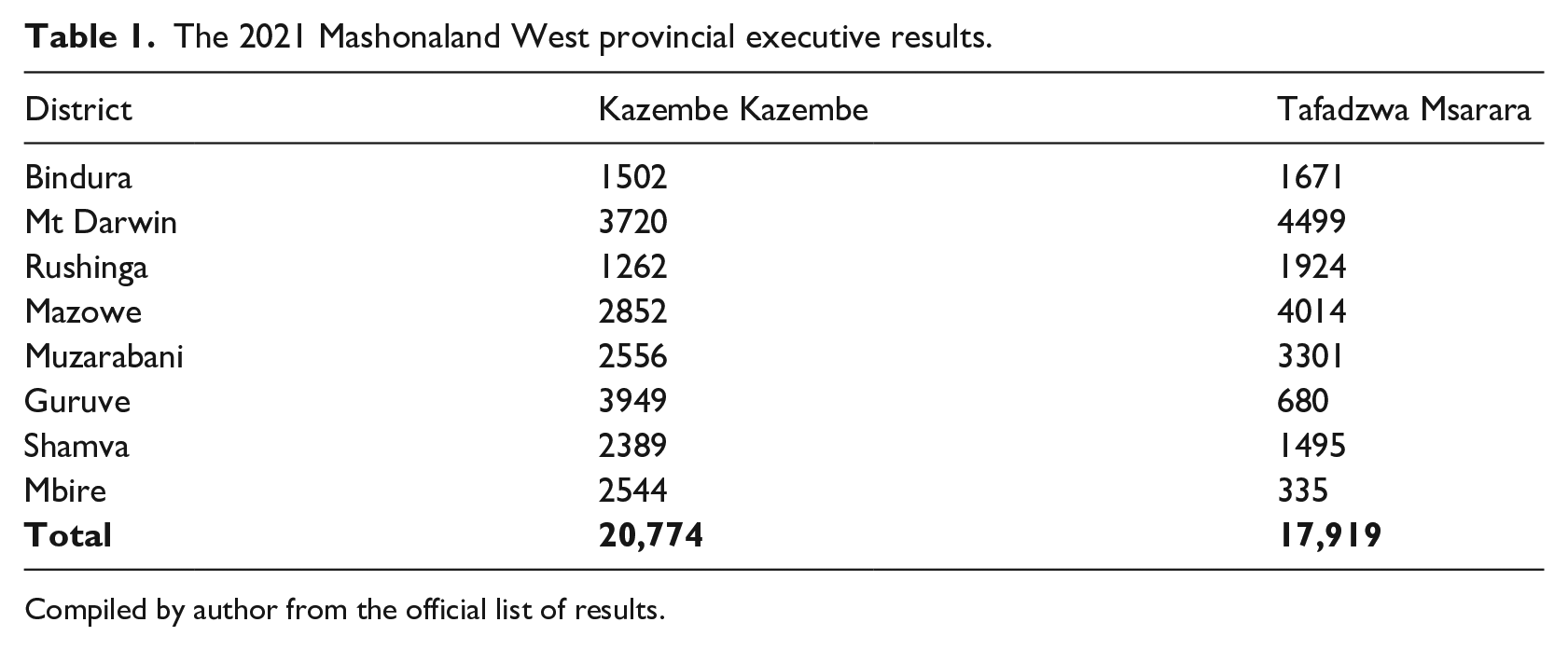
Compiled by author from the official list of results.
A ZANU PF election official alleged that Kazembe manipulated the elections (Staff Reporter, 2022). Some members promised to make the province ungovernable until elections were re-done (Staff Reporter, 2022), but there were no remedial measures.
Mnangagwa’s home province of Midlands also faced internal power struggles that eroded cohesion. The main contestants for the 28 December 2021 provincial elections were initially the provincial chairperson Daniel McKenzie Ncube and Owen Ncube. Owen Ncube’s supporters accused McKenzie of working with G40 and Kasukuwere. McKenzie dismissed this as ‘an aggressive smear campaign’ (NewsHawks, 2021b). July Moyo and Joram Gumbo (senior politburo members and cabinet ministers who both claimed to be godfathers of Midlands politics and loyal to Mnangagwa) backed Ncube and McKenzie, respectively (Mpofu, 2021). Given the nasty internal fights, Mnangagwa asked the candidates to withdraw from the race (Kunambura, 2021). The President eventually imposed his preferred long-term loyalist, Lawrence Mavima, as Midlands chairperson without an election. Mavima played a critical role in supporting Mnangagwa to be President during the November 2017 coup (Mhlanga, 2017).
Nevertheless, one of the state intelligence officials deployed to investigate violence in Midlands told me that Ncube continued to cause chaos (Interview, state intelligence official, Harare, 30 April 2022). At a Midlands provincial meeting held on 8 January 2022 to select provincial secretaries, Ncube caused mayhem in pursuit of personal power (Interview, state intelligence official, Harare, 30 April 2022). Ncube imposed himself as provincial vice-chairperson, his leader-follower allies as secretaries and threatened party members including Fortune Chasi, a politburo member, with violence (Kunambura, 2022). Mavima reported to Mnangagwa (Kunambura, 2022) who eventually fired Ncube from cabinet on 10 January 2022 for displaying ‘conduct inappropriate for a minister of government’ (Office of President and Cabinet (OPC), 2022). Ncube’s political appointments in the province were also nullified but divisions continued to simmer.
However, the politburo approved all the 2021 provincial election results despite contestations (Herald Reporters, 2021). This was for three reasons. First, most of Mnangagwa’s allies had managed to ‘win’ (Interview, ZANU PF politburo member, 2022). Second, ZANU PF needed to concentrate on by elections that were scheduled for 26 March 2022 (Interview, ZANU PF politburo member, 2022). Third, Mnangagwa was confident that he could silence the voices of those who felt aggrieved through prebends and coercion (Interview, ZANU PF politburo member, Harare, 30 April 2022). Mutsvangwa elaborated, Those who lost – the party is big, it has the wings of the chicken – all the chicks will be able to be accommodated somehow (Mangwaya, 2022). Muchinguri chillingly reminded members who still voiced against the provincial results that ‘ZANU PF devours its own children. (Muonwa, 2022b)
This is consistent with ZANU PF’s authoritarian culture (see Fontein, 2018; Mazarire, 2017). Nevertheless, organisational adversity continued with no major voluntary exits. Mnangagwa had to fire two party directors, namely, Munyaradzi Katsiru and Dickson Dzora, for rigging the provincial elections and corruptly awarding tenders to print the ballots (Herald Reporters, 2021). The fractious nature of the party was also evident at the district level albeit it took a different dimension as I elaborate next.
District level: the theatre of leader-follower groups
At this level, leader-follower groups emerged along the Mnangagwa faction, the Chiwenga faction, the G40 largely symbolised by Kasukuwere and the Gamatox faction once attributed to Mujuru. Within this matrix, cohesion weakened especially during the December 2020 DCC elections characterised by fierce factional competition to gain local positions. A former DCC member said, the DCCs had ‘been the glue that sticks people to the party’ before the fractious race to succeed Mugabe gathered pace in the late 1990s (Mambo, 2012). In 2012, Mugabe complained that DCCs had become ‘a weapon used to divide the party’ and politburo resolved to disband them (Mambo, 2012). This was in a context where Mujuru and Mnangagwa jostled to control the DCCs to aid their presidential succession chances discussed earlier (Mambo, 2012). Mnangagwa thought his loyalists would win the DCC elections and restored the DCCs in 2020 (Former ZANU PF Political Commissar, Harare, 8 October 2021). He wanted support from DCCs to consolidate his power (Former ZANU PF Political Commissar, Harare, 8 October 2021).
Nevertheless, the DCCs remained associated with fierce factionalism. First, some senior members battled to control DCCs through their leader-follower groups. Matemadanda who was commissar explained, ‘we [ZANU PF] are having senior politicians trying to impose candidates to be leaders in the DCC. . . ’ (Zvauya, 2020). Second, side-lined members linked to G40 and Gamatox wanted to bounce back through getting positions in the DCCs and this deepened divisions. Lovemore Matuke, the secretary for security in the politburo, said, ‘They [G40 and Gamatox remnants] want to come back to ZANU PF because it’s cold out there. People struggle to survive outside ZANU PF’ (Pindula, 2020a). I give an example of Mashonaland East province, where members who had a history of working closely with either Mujuru or G40 were disqualified as contestants for DCC posts. To illustrate, Lawrence Katsiru, former Marondera Central MP Bornface Mutize and former Goromonzi West MP Beatrice Nyamupinga were disqualified because of their links to Mujuru and there was no recourse to their appeals (Staff Reporter, 2020). This was not peculiar to Mashonaland East. Even in Midlands province, Gokwe Mapfungautsi MP, Tawanda Karikoga, who was vying for the Gokwe South district chairmanship was disqualified over perceived links to G40 (Zimbabwe Mail, 2020). Matuke’s overall justification was that ‘we are going to flush out all G40 elements, but we are also guarding against enmity between some members who are labelling each other G40’. (Pindula, 2020b). While labelling was a real political strategy to delegitimise opponents, some of the G40 leaders claimed that they sponsored candidates for the DCC positions as a way to regain control of ZANU PF and eventually wrestle power from Mnangagwa (Interview, G40 leader, Cape Town, 8 November 2021). One of the candidates allegedly backed by G40 included Owen Sibanda in Tsholotsho district (Interview, G40 leader, Cape Town, 8 November 2021).
The new DCCs suspended or co-opted leaders without authority from the top. A circular from Matemadanda (2021) tried to reprimand DCC chairpersons from taking unconstitutional and divisive actions. However, the DCCs were largely defiant prompting another letter from Chinamasa (2021), which nullified all co-options made by the DCCs from April to December 2021 and banned DCCs from passing a vote of no confidence against elected officials. Rugare Gumbo, who was once fired for supporting Mujuru in 2014 (Gumbo, 2014) and was readmitted in the party (ZANU PF, 2020), also called for the disbandment of the DCCs for undermining party unity (Pindula, 2020a).
The intra-party fights at the DCC level showed that lack of cohesiveness was not only rampant at the top echelons of the party (with the military dimension added) as other studies might portray (see Bhatasara and Chiweshe, 2021; Hove, 2019; Maringira, 2021; Ruhanya, 2020; Tendi, 2019). It is not only elite dis-cohesion that weakens and fragments a party but lack of compliance and unity at the periphery. Nevertheless, voluntary exit (Cooper, 2017; Hirschman, 1970; Salucci, 2008; Sarakinsky, 2015) was not a popular option as many local party members preferred to be rehabilitated in the party. Voice was mainly centred around contestations for internal power distribution. Debates over party policy were difficult to discern at this local level just like at the top level. I now synthesise my submissions below.
Conclusion
I conclude that ZANU PF has predominantly remained an incoherent party after Mugabe’s ouster. The divisions were not so much driven by ideological and programmatic differences but by personal ambitions to either gain or retain political power largely for the sake of it. The resultant factions within the party were ephemerally organised as leader-follower groups. Nevertheless, ZANU PF has remarkably held onto power and is likely to do so in the near future, but this is not because the party itself is internally coherent. This is partly because of the party’s abuse of state institutions including the security sector, weak societal mobilisation against it (Zamchiya, 2013) and systemic manipulations of general elections as I have argued elsewhere (Zamchiya, 2020b). At this juncture, I have modestly made four academic contributions. First, I have adapted Hirschman’s (1970) trilogy of exit, voice and loyalty in an attempt to understand intra-party cohesion in an authoritarian context. While voluntary exit is an important signifier of the state of cohesion, we also need to integrate non-voluntary exit because even in the context of organisational adversity most ZANU PF members wait to face expulsion rather than exercise their agency to leave. This is because they fear state repression if they defect and to lose their livelihood opportunities given the centrality of the party in state-resource allocation. In addition, voice should be understood as predominantly expressed over preferences for personalities in internal power distribution as during the 2021 provincial and 2020 district elections. This contrasts the dominant measure of voice in mainstream political science which is based on deviation from the party’s policy agenda (see Van Haute and Carty, 2012). Loyalty is also not always pledged to the party’s policy agenda in a bid to promote unity but to individuals like Mnangagwa and Chiwenga and to factions, hence fostering divisions and weakening cohesion. Second, my study draws from fine-grained original empirics with better explanatory power of evolving internal political relations than a standard statistical approach from mainstream political scientists based on an assumption of genuine policy-based differences. Third, this is one of the first academic studies that attempts to understand intra-party cohesion in ZANU PF after Mugabe’s forced exit in depth. Finally, I have broadened the scope of literature on understanding intra-party cohesion in ZANU PF beyond the upper echelons with the military dimension added to the local level for a more comprehensive picture in ways that can be replicated in other studies.
Footnotes
Funding
The author(s) received no financial support for the research, authorship and/or publication of this article.
