




Abstract
This article is an empirical examination of ‘victimhood’ in the context of the widespread, deadly and destructive electoral violence that affected Zimbabwe in 2008. It contends that an examination of the behaviour of victims of state-sponsored political violence enhances our comprehension of ‘victimhood’ as a factor in the perpetuation of political violence. The victims were largely ignored by the justice system, the political leadership and the community, all of whom were under the coercive spell of the ruling Zimbabwe African National Union-Patriotic Front (ZANU PF). The trivialisation of their situation, and the absence of legitimate avenues for redress, forced many victims to seek direct revenge. The article traces how this fomented and reproduced the already violent political atmosphere in Norton town during the 2008 election period. It relies on interviews with opposition Movement for Democratic Change (MDC) victims of violence in Norton to consider how they attempted to make sense of their pain by claiming victimhood and exacting physical revenge against their tormentors.
Introduction and background
This article is a contemporary historical study of Zimbabwe’s 2000s violent electoral landscape. As chronicled by the formidable body of both academic and activist literature, Zimbabwe’s postcolonial terrain has historically been fraught with political violence (see, e.g. Catholic Commission for Justice and Peace, 1999; Nyere, 2016; Phimister, 2008; Reeler, 2009; Sachikonye, 2011). However, the literature, largely from a social science background, has predominantly adopted a human rights approach in which attention has overwhelmingly been on the social, political and economic causes of the violence and the resultant psychological, physical and financial effects on its victims (Kasambala, 2011; Sachikonye, 2011). A prior study we carried out thus tried to cover a void that was largely a result of scholarship’s concentration on this human rights framework and the central position of the state-ruling party alliance in the violence (Alexander and Chitofiri, 2010). It argued that such an approach conceals the complex meanings of violence and the nature of participation by, and characteristics of, the people involved in it. It was premised on the notion that ‘local social norms, practices of political mobilisation and an increasingly politicised and ruinous economy powerfully shaped the nature and consequences of political violence’ in Zimbabwe (Alexander and Chitofiri, 2010: 674). The present study concurs with this proposition but stresses the importance of looking at representations of victimhood within particular historical, social and cultural contexts. It demonstrates the complex and ambiguous effects of the representation of victimhood in violent political conflicts. It examines the phenomenon of victim backlash and tackles the dilemmas surrounding the ways in which victims and victimhood are socially, politically and culturally constructed, and how they are deployed for personal and political survival.
Using Norton town as a window to shed light on a situation which affected most of Zimbabwe’s urban areas, this paper focuses on how the targets of ZANU PF and state-sponsored political violence in Zimbabwe reacted to and dealt with their victimhood, and how this was politically, culturally and socially constructed. 1 The nature of the immediate social environment, consideration of the political and cultural implications of being a victim, and the extent to which the targets of the violence considered themselves as victims of another party’s aggression has a huge bearing on the idea of victimhood in Zimbabwe. To a number of the opposition Movement for Democratic Change (MDC) youths in Norton (the focus of this paper), a shared sense of victimhood fomented a drive to confront their ruling Zimbabwe African National Union-Patriotic Front (ZANU PF)-aligned abusers, particularly in the face of non-action by the partisan state security and justice system which few now expected to punish the perpetrators of political violence and protect victims. This context saw disillusioned victims turning into perpetrators who unleashed violence in the name of retribution and self-preservation.
While the situation in Norton, as elsewhere in Zimbabwe, was largely such that victims of state-ZANU PF political violence were overwhelmingly MDC supporters and officials, some ZANU PF members and state actors actually perceived themselves as victims. Indeed, sitting side by side with direct violence by ZANU PF was its indirect formulae of threatening and coercing people towards its politics. The ZANU PF-aligned ‘victims’, widely perceived by outsiders as willing participants, were sometimes actually pressed into participating in the party’s violent activities against opposition elements. Conscripted as foot soldiers sent to ‘deal with sell-out MDC people’, the need to preserve their sources of livelihoods, which could be taken away or jeopardised by ZANU PF, was a crucial push factor. As Alexander and Chitofiri (2010: 674) have already observed, political violence, ‘though centrally directed and ideologically framed’, was also defined by socio-economic and institutional networks and patronage relations. This was crucial in the context of the 2000s’ ever worsening economic crisis that affected many people and forced a number of them to ZANU PF for its unfettered access to state resources. The economic crisis and ZANU PF’s hegemonic challenges eventuated an efficient and blatant patronage system (Matyszak, 2011: 18–20). Beyond shaping loyalty to the party and influencing the organisation of violence, patronage also had a bearing on the status of opposition politics, particularly as their supporters sometimes had to contend with losing their sources of livelihood or were forced to actively demonstrate pro-ZANU PF inclinations (Nkomo, 2015: 91–100). 2
ZANU PF-state violence, and the subsequent retaliation by MDC supporters, had a strong socio-economic background. The decline and closure in the 2000s of Norton’s big employers such as Cone Textiles, Hunyani Pulp and Paper Industry, Bestobell Manufacturing and Wilgro Sawmills rendered thousands of workers redundant (Alexander and Chitofiri, 2010: 678). The most visible consequence was the exponential growth of informal economic activities. People resorted to, for example, informal and sometimes illegal clothing and vegetable market stalls, fishing cooperatives, control of public car parks and bus rank touting. As the economy increasingly ‘informalised’, the informal sector became a political and electoral factor which ZANU PF greatly capitalised on and exercised control and influence over. For example, only ZANU PF members were allowed access to some market stalls, especially those selling secondhand clothing, and only ZANU PF youths controlled the touting, fishing and car park businesses. 3 Many Norton residents, for holding suspected MDC sympathies, were barred from accessing or utilising such sources of livelihood. Therefore, many – including those who did not fully subscribe to ZANU PF politics – had to ensure their continued access to these multiple sources of livelihoods by demonstrating loyalty to the party in ways that included unleashing violence particularly to MDC members, campaigning for their banishment from Norton, and denying them legitimate access to public resources, among other things. 4 While we emphasise the presence of violence in ZANU PF’s quest to retain power and MDC’s victimhood and retaliation, we are aware that coercion sometimes played out in different ways such as denying MDC supporters access to public resources (see essays in Alexander et al., 2014) The paper explores, in the same manner as Hamber’s 2014 study, the complex interplay between ‘individual psychological processes and macro policy interventions’ in the context of victims of political violence in need of help (see also Espeland, 2007; Ferguson et al., 2010).
Norton, the case study area, is a small dormitory town 40 km west of the capital Harare. Possessing a small industrial area, it has been steadily growing over the years in terms of both population, which was 70,000 in 2012, and geographical area (Zimbabwe National Statistics Agency, 2013). However, like all other towns across the country in the 2000s, Norton has suffered acute de-industrialisation which has seen factories and other businesses closing shop (Zivanai, 2016) This forced much of the town’s working age population into the informal economic sector, which is largely centred on fishing as the town is surrounded by two lakes, Chivero and Darwendale. Other informal activities like backyard workshops, vegetable markets and small retail shops have consequently sprouted all over Norton as manufacturing and processing industries laid-off workers (Map 1). 5
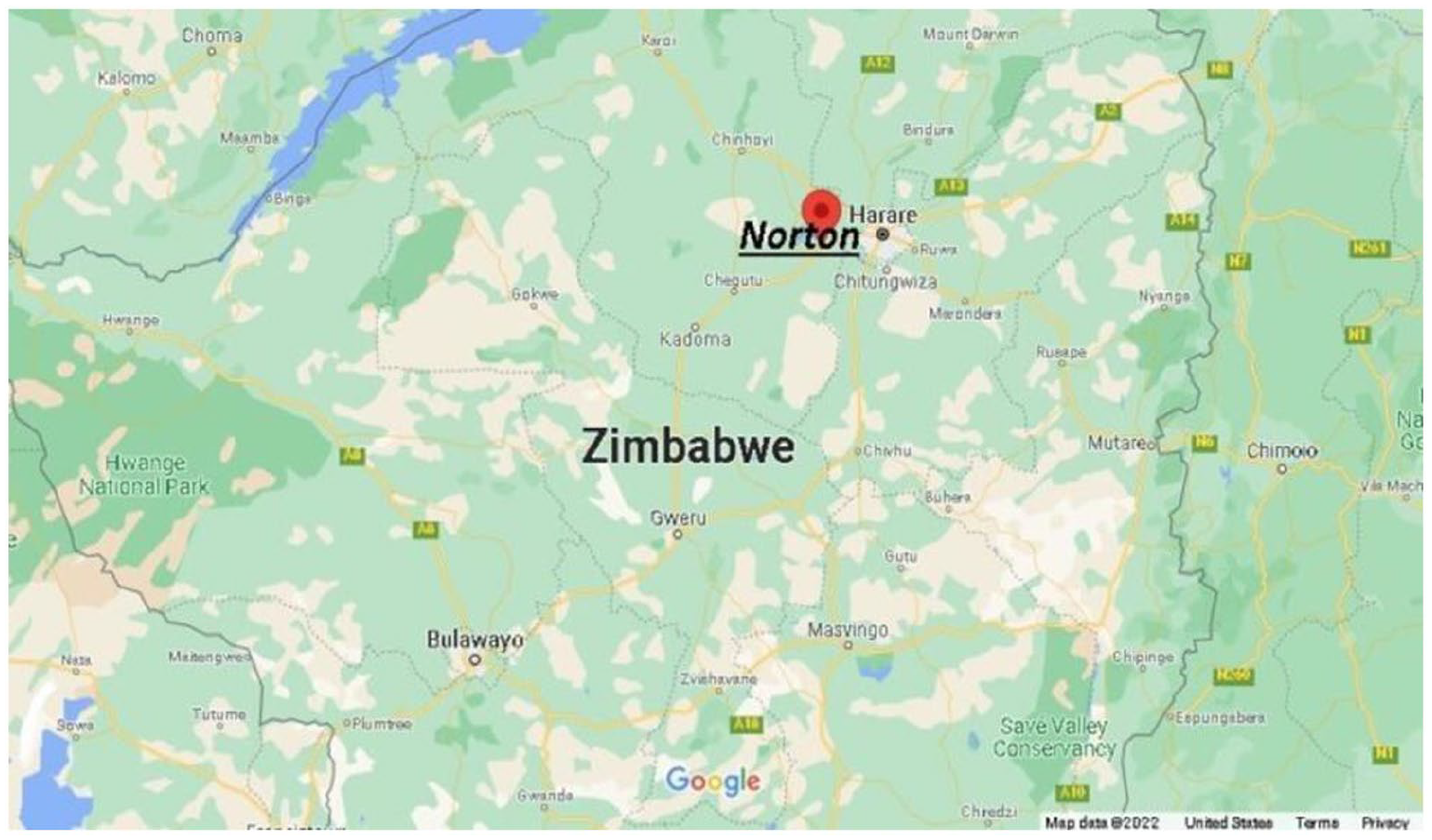
Map of Zimbabwe showing location of Norton, marked with red icon, relative to Harare. Source: Where Is. (https://whereismap.net/where-is-norton-zimbabwe-map-of-norton) (accessed 22 January 2022).
Electoral violence perpetrated by ZANU PF since 2000, and acts of retaliation by MDC activists, affected virtually all areas of Zimbabwe, rural and urban. However, providing a national picture, while desirable, would have been a difficult exercise for a project of this nature. As such, we focused on the town of Norton, which we believe is largely representative of the dynamics that were obtaining elsewhere across Zimbabwe. In addition to being a town one of the researchers lived in for most of the 2000s period, there are a couple of intellectual grounds for this choice. Since 2000, party elections in Norton constituency have been closely and intensely contested affairs, with the difference between winners and losers usually being by a small margin. For example, in the 2000 parliamentary election MDC’s Hilda Mafudze got 10,783 while ZANU PF’s Mavis Chidzonga received 9,118 (Daily News, 30 June 2000). The constituency has alternated between the two biggest political parties in Zimbabwe, MDC and ZANU PF. In the four elections held between 2000 and 2013, the two parties claimed the parliamentary seat twice apiece. The tight contests, and the winner-take-all mentality, added to the intensive nature of election season volatility in the town. Unlike other constituencies that predictably voted MDC or ZANU PF, Norton always provided an interesting mix of voters who projected interesting voting patterns and results.
Research methods
To attempt a reconstruction of victimhood, retaliation and the persistence of conflict in Norton in particular and Zimbabwe in general we adopted a qualitative approach largely based on observations and interviews with MDC victims and perpetrators of political violence. 6 This approach has allowed this study to tease out and understand the experiences and perceptions of urbanites in a contemporary political terrain dominated by violence. We identified interviewees with potential to provide key information by three main ways: historical familiarity with some of the victims and perpetrators of political violence; following up on the information they gave, which led us to other informants; and referrals by community members and political party leadership. This was easy as the people in Norton are a close-knit community. After interviewing a couple of individuals or having declared our intentions to some members of the community, we were able to connect with a wider network of informants. Fortunately for the research, most of the interviewees were willing to share their experiences. 7 The in-depth individual interviews, some carried out in 2010 and others in 2018, gave us access to ‘people’s ideas, thoughts and memories in their own world’ (Reinharz, 1992: 19). These were particularly important in most of the cases given the traumatic experiences that some of the interviewees went through. Indeed, some of them were not comfortable sharing these experiences in the presence of other participants.
In some instances, especially where the informants had shared common experiences, focus group interviews were used (average of four participants). These facilitated more discussion which complemented individual in-depth interviews. The interviews granted firsthand and less-tainted accounts of the events in Norton and captured the raw emotions which cannot be fully attained through secondary sources. Eighteen informants were selected both systematically and by chance encounters, depending on various factors. All the participants were based in Norton and were mostly victims in the violence. We upheld ethical considerations, including obtaining the informed consent of interviewees, and assuring them of anonymity, confidentiality and their rights of withdrawal. Zimbabwe is a politically sensitive environment and individuals and groups fear political persecution. There was thus need to reassure the informants and to earn their trust.
The research also depended on textual and content analysis of newspaper articles and parliamentary debates on political violence in Zimbabwe to frame the image of the political environment obtaining in Zimbabwe. Newspapers, in particular, showed both public and professional opinion on the violence-ridden political environment in Zimbabwe. We used both the so-called independent media (mainly aligned to opposition politics and critical of the ZANU PF government) and the state-controlled media (mainly pro-ZANU PF and anti-MDC) to gain a wider understanding of conversations involving the public, politicians and the media. 8 We went into the field for interviews armed with material gleaned from such sources. In addition, we engaged secondary literature to situate this study within broader or global studies on violence and politics. The use of these complementary sources was immensely beneficial and allowed for a fairly comprehensive account of political violence and victimhood in Norton. While secondary literature, and media and activist sources are important, we kept their use to a minimum to allow the voices of the actors in Norton to speak for themselves. While adopting ‘victimhood’ as a guiding concept, this is a pioneering empirical historical study that does not seek to be constrained by theory.
Victimhood as a concept in political violence
Scholarship has for long widely deployed the concept of victimhood on crime, criminals and the criminal justice system (see Walklate, 2005), it is a fairly recent concept as regards its use in analysing political violence. This is particularly so with regards to historical studies on Zimbabwe. Bar-Tal et-al. (2009) define victimhood as a mind-set shared by members of a group that results from perceived intentional harm inflicted on the collective by another group.
9
This harm is viewed as undeserved, unjust and immoral, and one that the victim group could not prevent (Bar-Tal et al., 2009). This collective sense of victimhood has important effects on the way societies engulfed in political turmoil manage the course and outcomes of conflict, approach peace processes and eventually reconcile. In many cases it feeds and perpetuates the conflict and inhibits peace making (Bar-Tal et al., 2009: 234–244). Montville (quoted in Sonpar, 2016: 155) described victimhood as: a state of individual and collective . . . mind that occurs when the traditional structures that provide an individual sense of security and self-worth through membership in a group are shattered by aggressive, violent political outsiders. Victimhood can be characterised by either an extreme or persistent sense of mortal vulnerability.
But what is also clear as regards the Norton situation is that there was a strong desire by many victims to have their victimhood recognised and affirmed by others.
Aquino and Bradfield (2000: 526) refer to the individuals’ ‘self-perception of having been exposed, either momentarily or repeatedly, to aggressive acts emanating from one or more other persons’. Borrowing from Buss (1961) and Aquino and Bradfield (2000), this study considers that the aggression inflicted ‘harm, injury, or discomfort’ on its victims. In a more general sense, the misfortune that befell the victims was a result of a defined event or series of events. Rosenberg (2003) expands on this definition by adding four components of victimhood: a history of violent traumatic aggression and loss; a belief that the aggression and violence suffered at the hands of the enemy is not justifiable by any standard; a constant fear that the aggressor could strike again at any time; and a perception that the world is largely indifferent to the victim group’s plight. In the African context, scholarship has begun to give attention to political violence and victim backlash. This has particularly been examined in the context of the 1994 genocide in Rwanda, electoral violence in Kenya between 2007 and 2008, and terrorist violence in Kenya in 2014. Enns (2012: 1) saw the 1994 genocide in Rwanda, the retaliation by the state’s Hutu regime against Tutsi civilians, as not surprising as ‘victims of violence are capable of violence themselves’. Kuperman (2003:1) concurred, arguing that perpetrators of violence often expect their actions to trigger a violent backslash. As such, the Tutsis were not oblivious of the possible consequences of their attack on the Hutu government. Anderson (2014: 1) saw victimhood as central to Al-Shabaab’s violent attacks on the Kenyan state, particularly in 2014. Al-Shabaab, at terrorist Jihadist fundamentalist group, pointed to the extrajudicial killings of Muslims as a justification for its violent actions.
The situation in Norton in 2008 and the immediate post-election period resonate with all of the above propositions, as revealed by the testimonies of the ‘victims-turned-perpetrators’. It greatly conformed to the above-mentioned Rosenberg’s four components of victimhood, particularly the last two. The victims constantly believed that, after the initial incidents or attacks, they were now permanently marked for, and vulnerable to, further harassment especially in the face of non-action by the police, ZANU PF and the government. They believed that the entire justice system was not there for them but favoured ZANU PF. Importantly, most victims felt that no or few people cared about what had happened to them. They saw their immediate community, the entire nation, and even senior members of their own party (MDC) moving on with their lives as if nothing happened despite their ghastly fate at the hands of political rivals. To victims, the few individuals who appeared concerned about the violence and their general suffering during this period were only paying lip service to their situation, particularly as their efforts were not sustained and fizzled out after the election season. 10 It was certainly a combination of these and other factors to be discussed later, that drove some MDC victims to put their ‘fate into our own hands’ and unleash a violent backlash on those they perceived responsible for their suffering (Nyasha). Those who carried out revenge attacks on their traditional ‘enemies’ from ZANU PF saw enough justification in their victimhood, reasoning that the community and their peers would understand and forgive their actions given that ‘we were only driven to such extremes by our hopeless situation’ (Nyasha). Victimhood is, therefore, a huge factor in explaining how those initially at the receiving end of violence in Norton, in a cyclical manner, themselves became perpetrators of violence.
However, victimhood alone, or when deployed in isolation, is not adequate to explain all the incidences of victim backlash in Norton. It combines with other factors such as Zimbabwe’s long-established culture of political violence, the skewed justice system, and the use of state paraphernalia by the ruling party against dissenting voices, among others, to foment in individuals or groups the desire for revenge. The ‘survival of the fittest’ mentality that pervades Zimbabwe’s townships, therefore, became an important aspect of the violent social and political terrain. Those born and bred in the Zimbabwean townships are aware of their ‘rough and tough’ character and how, in turn, only the ‘rough and tough’ thrived in them. In these spaces individuals learn from a very young age that they have to struggle for their survival, and fight for their immediate family and the wider community. The ‘dog-eat-dog’ environment, largely emanating from the unforgiving socio-economic and political dynamics, demanded that every individual who one grew up with within the same neighbourhood become part of the ‘brotherhood’ in which an ‘injury to one is an injury to all’ mentality is instilled into them. 11 These ‘survival lessons’ and social and political bonds, therefore, played an important role in fomenting and reproducing the desire for ‘defensive’ violence and retribution. As in other episodes in the long history of political violence in Zimbabwe, the 2008 violence, however, sometimes saw these kinship links breaking as ‘brother turned against brother’ on account of different political affiliations. Where no such a dynamic emerged, the situation strengthened their ties and the ‘injury to one, injury to all’ philosophy prevailed.
Norton as an arena of violence
In the midst of the 2000s economic crisis Norton became one of the sites of the intense electoral struggle between the two major political parties in Zimbabwe, MDC, which identified itself as a workers’ movement fighting for democracy and against increased government autocracy (Alexander, 2000); and the ruling ZANU PF, whose source of legitimacy largely lay in the 1960s and 1970s liberation struggle which brought about independence in 1980 (Herald, 26 March 2015). Indeed, MDC commanded a heavy presence in the town since its formation in 1999. 12 Since 2000, the first election after its formation, it had been defeating ZANU PF by wide margins in local government, parliamentary and presidential elections, following a pattern that had been established across most of Zimbabwe’s urban areas (Alexander, 2000). We now turn our attention to the focus of this paper, the March 2008 parliamentary elections, which ran concurrently with the presidential election. MDC’s Edward Musumbu, a trade unionist-turned-politician comfortably claimed the Norton legislative seat. These elections, untypical of previous post-2000 elections, were in a large measure conducted peacefully as MDC campaigned freely and its supporters celebrated openly in areas it won. MDC won 13 of the 15 Norton council wards, confirming its dominance in the town. Across the country, MDC performed well particularly in its now traditional urban strongholds, whereby together with the smaller faction, got 109 seats against ZANU PF’s 97.
Trouble started in Norton, like elsewhere in Zimbabwe, when the presidential component of the March harmonised election was declared a stalemate (Mail and Guardian, 10 August 2002). Since none of the candidates received enough votes to be declared an outright winner, a runoff of the two front-runners – MDC’s Morgan Tsvangirai, who had won 47.9% of the vote and ZANU PF’s Robert Mugabe, who managed 43.2% – was declared as per the constitution. During the period between the announcement of the first round results, on 2 May 2008, and 27 June 2008, the date for the rerun, ZANU PF conducted a vicious campaign of violence against MDC officials and supporters, causing widespread destruction of property, serious bodily injury and death (Reeler, 2009). The reign of terror was informed by the fact that the harmonised election had demonstrated to ZANU PF that it was facing a real possibility of losing power to MDC. The violence claimed ‘over 200’ lives across the country and left thousands more displaced or banished from their home areas for associating with MDC (Marongwe, Duri and Mawere, 2019: 17). 13 Central to this violence was state security agents operating on the Joint Operations Command (JOC) platform, the supreme organ for the coordination of state security in Zimbabwe (Masunungure and Shumba, 2012: 138). It included commanders of the state’s various military and security agencies, including the army, police, prisons and intelligence. Crucially, in a context whereby the operational distinction between ZANU PF party and the state was increasingly blurred, JOC largely existed as an agent of ZANU PF and ‘almost appropriated the ZANU PF campaign’ (Mail and Guardian, 10 August 2002). As Masunungure and Shumba (2012: 138) observed, JOC sought to ‘control the growth and development of the opposition and maintain the hegemony of ZANU PF . . . [It] played a supporting role in ZANU PF’s unorthodox political campaign’, particularly by coordinating the violent streak of war veterans, youth militia and other pro-ZANU PF groups against MDC supporters. In addition to naked violence, ZANU PF deployed other coercive instruments. For example, amid acute food shortages, ZANU PF controlled food aid became a crucial election tool used to bring people into the party and punish MDC supporters (Matyszak, 2011: 18–20).
In the specific case of Norton a number of MDC supporters and officials were killed, seriously injured, lost movable and immovable property, or were forced by circumstances to move out of their homes to safer places. Entire families, therefore, were not spared the brutality of ZANU PF activists and the state security system. For example, MP Musumbu’s house was burnt to the ground and he was forced to relocate to his employer’s house (Musumbu). MDC Councillor Jonathan Banda escaped to Botswana and up to this day has not returned to participate in Zimbabwean politics (Musumbu). Munyaradzi, a vegetable vendor, recalled how he was burnt with hot wire under his feet at the notorious ‘Base 7’ (Ngoni Community Hall) for displaying MDC-branded regalia at his stall. Sheila considered herself and her friend lucky that at ‘Base 2’ (Katanga Community Hall) they were only forced to sing pro-ZANU PF ‘revolutionary songs’ for almost four hours for refusing to attend a ZANU PF rally at Katanga shops. Another MDC youth from Norton’s high density suburb of Ngoni narrated his midnight ordeal at one of these torture bases. The ‘crime’ was that he was in a car that was playing pro-MDC songs earlier in the day: They woke me up at 1130 pm and took me to Ngoni base, which was operated by familiar people I had always considered brothers, sisters and fathers. They accused me of denigrating Mugabe during the day through MDC music. I told them I was just a passenger in the car and that I had no MDC links. I was still beaten up and told to take out of a fire some red-hot wires with my bare hands. Two hours later I was transferred to another base in ward 10 were I was subjected to further beatings and torture till 3 am. On release I was instructed to delete all MDC music I had (Maxwell).
These are just a few examples of numerous accounts of torture and violence that pervaded Norton during the 2008 election season and left dozens of victims in its wake. It is under these circumstances that on 22 June 2008 Tsvangirai withdrew from the election, a decision that saw ZANU PF winning the presidential re-run with 90% of the vote. The generally peaceful environment of the first phase of the election had given way to terror.
Considering the non-violent atmosphere that had characterised the first round of the election, many MDC supporters had initially expected the situation to continue in the second round. When the violence came and caught them by surprise, they expected the justice system to continue to be non-tolerant of political violence and to immediately punish perpetrators (Group interview). However, it did not take long for them to realise that the ZANU PF-state alliance had reverted to the default mode. A number of them went to report their cases at local police stations but much to their disappointment, little was done by the law enforcement agents. It was extremely rare for perpetrators to be arrested. If they were summoned to the police station they were not fined, and rarely were such cases escalated to the courts. Of the few cases that went to the courts, few of the perpetrators were convicted. However, in the event of conviction, they were usually let off with a modest fine or a tokenistic community service assignment (Simbai). The vast majority of the cases were either dismissed or never reached a conclusion.
In fact, most of those who reported violence faced more ill-treatment and humiliation at the hands of the police, who openly exhibited pro-ZANU PF inclinations. 14 Nathaniel, a street-side vendor in Ngoni, one of Norton’s townships, talked about being harassed and interrogated by two members of the police force who accused him of being a ‘trouble causing supporter of Tsvangirai and his white masters’ and threatened to lock him up for public nuisance (Nathaniel). He had gone to lodge a report against people who brutally assaulted him for distributing MDC regalia to the public. Police were not keen to arrest the perpetrators, and turned the issue around to accuse him of carrying out the exercise without a police clearance. They did not make efforts to inquire about the details of the incident. This way the police station, supposedly the cradle of shelter and justice for these victims, was not only inaccessible but also a source of further persecution and torment for opposition elements. 15 It had become clearer to MDC supporters that the violence and the aloofness of the justice system was part of a synchronised effort by ZANU PF to close out political spaces from opposition politics in the face of possible loss of power.
Indeed, the Zimbabwe justice system’s ‘see no evil, hear no evil’ approach to ZANU PF violence was central to frustrations that were building within opposition politics. A glance at police–government relationship is illuminating. As the Solidarity Peace Trust (2008: 27) reported, ‘officially the police have condemned all political violence and have declared “zero tolerance” for it, but the reality on the ground is that [they] are either powerless to prevent what is happening or complicit in events’. It bemoaned government spokespersons’ seemingly default response that ‘we have not received reports of violence or of deaths from the police’ every time they were confronted with specific cases of political violence.
ZANU PF-state coercion was not only directed to MDC supporters. Junior police officers sometimes faced intimidation from their superiors, who were, in turn, also under pressure from government officials to conform to ZANU PF politics. It was common thinking among MDC activists in Norton that police officers who were transferred from the town during this period were suffering the consequences of appearing to be lenient with MDC people (Group interview). Solidarity Peace Trust (2008: 27) revealed the existence of an April 2008 ZANU PF ‘master plan’ which instructed the police ‘not to arrest [ZANU PF] perpetrators’ even when victims ‘file cases and know their assailants’. 16 After the elections, when calm had returned, some MDC victims tried to make sense of police’s indifference to their plight by conversing with their police neighbours. The responses had the same pattern: ‘we were as powerless as you’, ‘we followed orders from above’ and ‘it is politics’ (Group interview). It can be surmised that the same ‘predicament’ befell other arms of the justice and security systems, including the courts and the army. To an extent, therefore, some members of the police could legitimately claim victimhood. This is not to discount the fact that some of these ZANU PF-aligned tormenters in the police, army and judicial system were fervent party supporters bent on going to any extremes to defend the party from MDC.
Nevertheless, some of MDC victims did not lose hope for justice. They invested their hopes in the prospects of a Government of National Unity (GNU) which was in the process of being negotiated for between key political parties after the bloody June election (for closer examination of GNU politics, see Cheeseman and Tendi, 2010; Chigora and Guzura, 2011; Mapuva, 2010; Matyszak, 2010; Raftopoulos, 2011). For them, the fact that Tsvangirai was going to be part of the GNU and the continued talk especially from within the ranks of the MDC about the need for justice for the victims of violence heightened their optimism. Kerry Kay, who was MDC Deputy Secretary for Health and a victim of ZANU PF political violence had on several occasions expressed the need by any government that was to emerge from the election process to punish the perpetrators. She claimed that MDC and Civil Society Organisations (CSOs) had ‘a database of perpetrators’ which had ‘more than 800 names on it so far’ (The Zimbabwean, 2008). For her, these perpetrators were supposed to ‘be brought to book and the masterminds of this terrible genocide face the International Criminal Court’, for there could not be ‘healing and reconciliation without justice’. Such pronouncements shone a little light at the end of the bloody tunnel. Even during the long process of negotiating for the unity government, most of the victims of political violence had a keen interest in how the coalition government was proposing to deal with perpetrators of the violence who were roaming freely in Norton and elsewhere across the country (Group interview).
The fact that both MDC victims and ZANU PF perpetrators in Norton were usually people who were familiar with each other made the situation hard to bear and difficult to comprehend for the victim group. They socialised with them on different platforms such as churches, beer halls, sports grounds, among other arenas, or they grew up together in the same neighbourhoods. Generally outside of the election seasons the relations were fairly cordial, but would change during election periods. In one incident, Nathan was taken to a torture base and was beaten by a group that involved his former high school classmates, the charge being that he was related to MDC Member of Parliament, Nelson Chamisa (Alexander and Chitofiri, 2010: 676). In another incident, one woman is said to have instigated and participated in the beating of her long-time neighbour who had celebrated MDC’s good showing in the March election (Sally). Indeed, the small geographical area of Norton, highlighted by the fact that the whole town, for instance, only had two secondary schools and one police station (besides a small and temporary satellite one), meant that many members of the community would be familiar with each other. Gidza claimed that he was beaten up at the order of someone ‘whose father was friends with my father’. The fact that one was neighbours to a ZANU PF activist; socialised together at beer halls; were former school or classmates; or were workmates, among other social connections, was no guarantee to shield MDC supporters from ZANU PF violence.
Backlash, vengeance and retaliation
The victims, left bearing psychological trauma and physical injuries, struggled to cope with the fact that, during and after the elections, they met their tormentors walking scot-free and without any consequences for the pain they caused. After the election, perpetrators of ZANU PF-sponsored violence related in two key ways with their victims. Devoid of any sense of guilt, some conducted themselves in a manner that sought to ‘airbrush out’ their election time activities and engage with their victims as if nothing had happened (Sheila). Others boasted about their ‘achievements’ and flaunted their ‘untouchables’ status (Sandra). Besides offhand murmurings by the police in informal post-election conversations with some of their victims, there is no evidence from the narratives of systematic and sincere apologies from various kinds of pro-ZANU PF perpetrators for the pain they had caused. This was agonising to endure for the victims who had almost no legal recourse for their grievances. Even when the much anticipated GNU eventuated, it did little to help them find closure as ZANU PF continued to control key levers of the state, including the five strategic ministerial portfolios of National Security, Home Affairs, Defence, Justice and Information (Maunganidze, 2016: 55). Retaliation, which entailed directly taking matters into their own hands, became seemingly the only hope for the aggrieved MDC victims of state-sponsored violence to get the relief they greatly sought.
MDC’s counter-violence largely mirrored that of ZANU PF. It also included arson, beatings and destruction of property. The difference was in scale, defined by the fact that ZANU PF enjoyed massive material, logistical and financial backing of the state. Therefore, the impact of MDC violence on ZANU PF and its supporters was bound to be only a small dent while that of ZANU PF on MDC was significant. A revealing example of immediate reprisal by victims of Norton violence was when on 28 April 2008 a group of four MDC youths petrol-bombed a car in Katanga that a few days earlier had been used to kidnap and transport MDC supporters to torture bases. However, their moment of glory did not last long. The following day a group composed of ZANU PF militia, the police and the army raided many homes of suspected MDC activists, beating them, taking them into custody and destroying property (Sally). Especially at homes they could not find their targets, they indiscriminately beat up whoever they found there on the basis of harbouring a ‘sellout’ or a ‘criminal’. Indeed, there are a lot of examples in Norton whereby MDC retaliatory acts were met by disproportionate state-ZANU PF response.
Despite the fact that they only landed feeble blows against ZANU PF elements, MDC supporters found their retaliatory activities therapeutic, consoling and in a way restorative. The testimonies of MDC supporters concerning these reprisals attest to their victimhood disposition. They claimed to be ‘sick and tired of being punching bags of ZANU PF’ (Group interview). They also feared reporting beatings, harassment and torture to the police as ‘we would get into more trouble’. Therefore, rather than endure further harassment, they sometimes took the law into their own hands and retaliated. While it provided consolation, retaliation was also to show ‘ZANU PF boys that we were also men’ (Group interview). While they could not torture their rivals in a manner ZANU PF youths did to them, mainly because of ‘logistical constraints’, MDC youths’ retaliatory excursions were mainly in hit-and-run fashion. While to be caught participating in such acts invariably led to imprisonment, which many MDC youths in Norton suffered, almost none of ZANU PF perpetrators in Norton, despite overwhelming evidence against them, were arrested or convicted. It was this situation that provoked violent retaliation by MDC youths, a dynamic which led to the vicious cycle of violence in the small town. This cycle was nourished further by the fact that ZANU PF youths interpreted their immunity from arrest and prosecution, together with the incarceration of their MDC rivals, as endorsement of their actions by the law enforcement agents and the entire justice system.
Sometimes even those MDC supporters not directly or personally affected by the violence participated in the party’s acts of vengeance. Of the roughly 60 MDC youths who were arrested in 2008 in Norton for what they reiterated were not irrational but ‘defensive’, ‘liberatory’ and ‘retaliatory’ actions, at least half of them had not been victims of any form of direct physical violence (Group interview). But they had adopted an ‘injury to one, injury to all’ mentality, which saw them organising themselves into groups of roughly 20 for retaliatory excursions against those who would have harmed their colleagues. As they reasoned, ‘we could not just sit by while our comrades were being beaten, tortured and killed. If you see the scars they carry you would understand why we had to respond in the manner we did’ (Simon). Alfred, one of the MDC youths who was never on the receiving end of ZANU PF physical violence, was adamant that their raids on ZANU PF targets were justifiable because his colleagues ‘had no one to stand up for them but us’. Furthermore, ‘next time it is going to be me and no one will stand up for me’ (Alfred). Primary, secondary and social kinship ties were, therefore, key to binding MDC supporters together and, despite the odds stacked against them, to inflict harm, no matter how little it could be, on ZANU PF elements. Such ties aided in conscription and strategising, and fomented a sense of protection in case of attacks by ZANU PF supporters.
In fact, as most of these opposition youths argued, they had to take either of the three choices. The first was to join ZANU PF and participate in the violence against MDC. This option reveals an important aspect about victimhood: some MDC supporters became active in ZANU PF torture bases and participated in tormenting their former colleagues to protect themselves from the ZANU PF onslaught. Said Gerald, ‘They threatened to kill my mother, wife and children. When they torched our house I realised how serious they were. Joining them was the best form of protection’. However, they all blamed their victimhood for this choice. For them, this was a better alternative to being identified as MDC and be exposed to state violence. Yet still, some did not gain automatic acceptance into the torture bases. They had to be exorcised first of the ‘MDC mentality’, a process which involved beatings, singing, and chanting slogans that denounced ‘sellout’ opposition politics. Nyasha, an MDC youth, narrated how he was instructed to surrender his MDC membership card and regalia, to sing ZANU PF songs, and to reveal the names of his MDC colleagues before being admitted into the torture base. He had come on his own after he had heard from friends that he was on the ‘wanted list’ at one of the bases in the township. After the singing and sloganeering, Nyasha was instructed to participate in a raid of a well-known MDC activist’s house that same night to demonstrate his new allegiance to ZANU PF. He claimed that he had ‘no choice but to do it or risked continued beatings and my family’s safety’. However, he further claimed that he did not betray his MDC ‘comrades’ or the cause as he maintained contact with them and, for instance, helped them in their retaliatory raids by leaking ZANU PF operational plans. 17
The second choice was for MDC youths and activists to continue to avail themselves ‘whenever our friends needed us to help them to fight back’ (Caesar). The third way was for Norton MDC supporters to remain detached from, and aloof to, active MDC politics. Indeed, in Norton there were a number of people who quietly identified with MDC politics and were not involved in its hyper activism. The first option was taken by a number of youths who, either ‘voluntarily’, or through the force of circumstances, were recruited into torture bases. The second option was taken by MDC youths who felt retaliatory violence was ‘the most courageous and honourable’ thing to do (Nathaniel). They were also encouraged in this regard by senior MDC personnel in the area to defend themselves and not to abandon their ‘comrades’ and other vulnerable supporters of the party. Indeed, some senior MDC representatives in the area presented this option as the only available alternative for the youths if they hoped to survive the ZANU PF onslaught. In one incident, MDC youths were told to ‘man up and fight back’ by a senior party official whom they had asked to assist their injured colleague with medical care costs (Jonathan). For Jonathan, it was either joining his friends or ‘risk being alone and isolated’ when state violence befell. The third choice was not very appealing to most of the well-known MDC activists because for them, ‘when you are alone your vulnerability is increased. You support MDC and everyone knows that but you do not want to bond with us, you become an easy target’ (Mike). It was common in Zimbabwe for ZANU PF to label as MDC those who claimed ‘neutrality’ or to be apolitical, or those whose political affiliation was not known.
Though MDC acts of vengeance were carried out in defined groups, there were cases when individuals organised their own retribution. Maduka, a well-known 55-year-old MDC supporter, severely assaulted his neighbour who he claimed to have been responsible for his torture and humiliation at a ZANU PF ward meeting (Maduka). He had been forced to chant ZANU PF slogans and to sing ‘revolutionary songs’ after which he was canned. He did not wait long to exact revenge. The following day he went to the house of his unsuspecting neighbour and unleashed ‘instant justice’. Maduka’s narration of events captures not only the meticulous planning that went into this act but also his victimhood: The boys who embarrassed me are young enough to be my grandsons, I could not just let it go. ZANU PF people know I grew up being one of the best boxers in Harare and they cannot stand a chance with me one-on-one. My neighbour had to be taught a lesson. After all where could I go to report my case? The useless police cannot do anything but further harass the victims.
He continued: I ordered my wife and kids to pack their things and go to my sister in Epworth. After they had gone, I took my belongings to a friend’s place for safe keeping and told my landlord that I was relocating. I went to my neighbour’s house. When he saw me he sensed danger and tried to lock me out, but he was too late. I just cannot explain the fury that engulfed me then but I descended on both husband and wife with all the strength I could gather and destroyed some household property. My other neighbours did not even try to stop me. I guess they were equally tired of this guy and were silently celebrating. After this, I took my bags and left for Epworth.
Three important issues emerge from this narrative. First, the feeling of victimhood drove Maduka to seek revenge. Second, he greatly lacked faith in the police system. Third, the posture of Maduka’s neighbours, who did not restrain him, confirms the attitude of some people in Norton towards the violent conduct of ZANU PF supporters. Maduka’s retaliatory acts found ‘acceptability’ from both neutrals and the predominantly pro-MDC Norton community who believed ‘ZANU PF people have become a law unto themselves’ (Anna). He was a ‘hero’ acting on behalf of a community that suffered at the hands of ZANU PF activists but could not easily fight back. His relocation to Epworth was informed by the fear that he was still vulnerable and had now become a permanent ZANU PF target, which is an important aspect of the victimhood complex.
Not fighting back was sometimes seen as a handicap within the MDC camp. When a group of five MDC youths decided to hide from the violence and stay together at a friend’s house which they thought was safe as it was not known to ZANU PF, they had to contend with starvation. They decided to look for help from a senior MDC official who was in charge of security in Norton district (Group interview). The official advised them that they were making themselves more vulnerable by hiding and not fighting back. He recruited them into a bigger group which he had organised ‘to defend’ party supporters from being taken to ZANU PF bases. The official had to emphasise on their vulnerability and victimhood to make the option of participating in the violence most appealing and viable for the youths. One of the members of the group explained their conscription thus: He told us that we should not think we were safe hiding at the house because ZANU PF had a list of all MDC activists and the houses they were likely to stay. Its either we had to leave Norton because if we continued staying at that house we risked having the house destroyed; or we had to defend ourselves. Either way, we were becoming so much uncomfortable staying indoors every day that the option of fighting back and freeing ourselves became very attractive (Group interview 2013).
A key factor in their retaliatory violence was their victimhood which continued to render them defenceless and exposed. Yet this status greatly informed the decision by the five youths to adopt retaliatory and ‘defensive’ acts of violence, which they ultimately perceived as not only good for themselves but also for the party.
It should be reiterated that the dynamics in Norton, as regards both ZANU PF-state violence and MDC’s victimhood and retaliation, reflected the situation across Zimbabwe. A 14 April 2008 JOC meeting in the rural Nkayi district of Matabeleland North discussed the violence that would be the central pillar of the runoff campaign (Solidarity Peace Trust, 2008: 15). Present at the meeting were senior members of the police, army, prison service, Central Intelligence Organisation and war veterans. Thus, as the ZADHR noted, the situation in rural areas as regards the violence and its consequences was not much different to what was happening in urban areas: The current violence is dramatically more intensive and unrestrained. The level of brutality and callousness exhibited by the perpetrators is unprecedented and the vicious and cowardly attacks by so called war veterans on women, children and the elderly shames the memory of all true heroes of the liberation struggle (quoted in Ndlovu-Gatsheni, 2009: 229).
As regards acts of retaliation, the pattern was established in towns and cities of Mutare, Chegutu, Bindura, Gweru and Bulawayo, where MDC victims of violence attempted to fight back and cause their own ‘mini’ reign of terror. 18 Chipangano of Mbare, a Harare township, and Al Shabaab, based in the town of Kwekwe, were ZANU PF-aligned youth militia groups that terrorised people with suspected MDC links (see various 2008 issues of the Midlands Observer; Mutongwizo, 2014). The Solidarity Peace Trust (2008) cited a case that happened at Gokwe Business Centre in 2008. During the day, ZANU PF youths had vandalised and looted businesses belonging to MDC supporting businessmen. MDC supporters responded at night by stoning and looting stores that belonged to ZANU PF supporting businessmen. The entire business centre was left in ruins (Solidarity Peace Trust, 2008: 30–31).
Conclusion
Using the case of Norton in the context of Zimbabwe’s violent 2008 election, this paper has attempted an empirical examination of the key elements that contributed to the perpetuation of the enduring culture of political violence. While scholarly focus has been on state sponsored violence and its resultant effects on millions of Zimbabweans, this paper has considered an aspect that has hitherto escaped scholarly inquiry: retaliation by MDC victims. It has used the concept of victimhood and assessed how such a condition transformed victims of political violence into perpetrators. A word of warning contained in the Solidarity Trust Report speaks volumes about the contribution of victimhood to retaliation and the cyclic nature of violence in Zimbabwe: While the anger of people who have lost everything can be empathised with, retaliatory violence must be condemned. A cycle of violence and retaliation bodes very ill for the immediate and longer term in Zimbabwe, and in fact feeds into the ZANU strategy as it allows them to claim that violence is on both sides, and to use any MDC violence to step up their own attacks against unarmed, defenceless . . . civilians (Solidarity Peace Trust, 2008).
The failure of Zimbabwe’s justice system to address the plight of MDC supporters fomented victimhood, which in turn fed into the idea of retaliation. Consequently a cycle of violence was established and still continues up to this day. Without recourse to justice, MDC supporters in Norton began to perceive their violent acts as rational undertakings in search for justice which the governmental systems, effectively under ZANU PF direction, were not keen to provide. MDC activists became victims and perpetrators at the same time.
Footnotes
Funding
The author(s) received no financial support for the research, authorship, and/or publication of this article.
