




Abstract
Literature on women’s economic empowerment argues that women’s income builds resilience and leads to reduction in intimate partner violence (IPV). We challenge this by showing a positive (statistically) insignificant link between women’s economic status and IPV, but significant positive links between women’s economic contribution and IPV, and men’s intergenerational violent behaviour and IPV. Based on a sample of 553 married women drawn from Nepal, we find that paid or precarious work is positively but insignificantly associated with IPV. Findings however reveal that after controlling for other factors, women contributing equally or more to household income are significantly at higher risks of IPV. Similarly, if a man has witnessed domestic violence while growing up, he is more likely to commit violence within his own marriage. We therefore argue for the need to transform men’s attitude and behaviours through targeted programmes to break the cycle of violence.
Introduction
Violence against women (VAW) in Nepal is a major problem with the most recent available statistics putting rates in line with global figures (Ahmad and Jaleel, 2015; Atteraya et al., 2014; Dalal et al., 2014; Dhungel et al., 2017; Pandey, 2014; Paudel, 2007). It is estimated that one in three women in Nepal suffer from intimate partner violence (IPV) the most common form of violence against women worldwide (Dalal et al., 2014).
With this context in mind, Nepal has over the past decades made significant policy and programme advancements. For example, in 2006 the Nepal Gender Equality Act amended 56 discriminatory provisions in law, while clarified and expanded definitions of violent crimes against women including rape and homicides. In 2009, the government of Nepal passed the Domestic Violence (Crime and Punishment) Act, which makes it illegal for one family member to commit a violent act against another.
The government also implemented the Integrated Women’s Development Programme (IWDP) for the past 30 years, and in 2009, a component was added to it with Department for International Development (DFID’s) assistance, with the intention of freeing women from Gender Based Violence (GBV). The programme covers one million women, who are formed into Self Help Groups (SHGs). Some of these have also been federated into cooperatives, with 1600 cooperatives spread over different districts of Nepal. Many of the women involved in the IWDP run small business financed through micro loans access through the programme. This made them a useful focus for the current research in terms of being able to understand the impact earning income brought to their lives, particularly in relation to experiences of violence. Therefore, this article based on primary survey data offers useful insights by exploring links between earning an income and experiences of violence. It also offers invaluable insights on how intergenerational violence influences violence against women.
The literature on Women’s Economic Empowerment (WEE) makes strong assumptions between economic engagement, empowerment and resilience to violence. In other words, the underpinning theory of change depicts a linear pathway for change that begins with women earning an income, which in turn translates into a greater sense of empowerment, which further results in challenging and preventing violence in their lives. The findings from this research challenge this assumption by showing the strong and significant link between men experiencing violence in the home while growing up and committing violence within their own marriage. This finding supports a growing body of evidence that argues breaking intergenerational patterns of violence is critical.
This article is structured as follows. The first section offers a comprehensive review of the global evidence linking economic empowerment to violence against women. This includes an unpacking of what these terms mean. In relation to violence, understanding the triggers and relationships between wider structural and contextual issues and the resulting instances of abuse is explored. The second section presents the quantitative approach, the data set and methods used to analyse it. The key findings are presented and summarised at the end of the section. The conclusion stands back and considers the significance of the new data and findings, offering contextualisation within current research on masculinities and the normalisation of violence. The article ends with some recommendations for future programming linking women’s empowerment to behaviour change interventions and the study’s limitations.
Women’s economic empowerment (WEE) and violence
Much of the WEE field is influenced by the economic bargaining model (EBM) which argues that increasing women’s ability to bring resources into the household also increases their decision-making or ‘bargaining’ power (Anker et al., 2003; Bittman et al., 2003; Kabeer, 2003). This argument was made with strength in the 1990s. While the research emerging through the EBM did not focus specifically on violence or even suggest that increased resources reduce violence, it was strongly implied through the link between economic capital and empowerment (Brines, 1994; Doss, 1996; Hoodfar, 1997; Kabeer, 1997; Kandiyoti, 1991; Seiz, 1991, 1995). A specific focus on violence against women unearths a far more complex set of factors that requires a multi-layered and interdisciplinary lens to understand.
Before we go further, it is necessary to distinguish between women’s economic engagement and empowerment. Economic engagement refers to participation in activities that generate an income. Empowerment is different in the sense that it reflects a certain state of being in which a woman feels in control and strong enough to exercise agency to access resource or challenge the structures of power that marginalise. In the literature, engagement in income generating activities is often conflated with a concept of being empowered to such an extent the suggestion emerges that earning an income automatically generates feelings of power and agency.
The assumption behind this over simplistic link is that women who earn money have control over how to spend it. Also, it is felt they can use their income to leverage control over household decision-making. Furthermore, this empowerment extends to control over situations that are or turn abusive through knowledge on how to seek social and legal support. In addition, income is thought to generate new strength, enabling a woman to make changes that lead to a better, safer life. Economic empowerment as a term then promises to bring more than just greater income; it has a transformative quality leading to an enhanced sense of agency and determination.
Let’s now turn to violence as a concept used to categorise certain forms of abusive behaviours and unpack how it has been understood and applied to the realities of women’s daily lives. In research on Violence against Women and Girls (VAWG), a broad definition of violence is generally given, which recognises that violence is both a physical and psychological phenomenon and that it operates on multiple levels from the personal to the macro-structural level. We have chosen, in this article therefore, to follow the example of the What Works Programme in adopting the Declaration of the Elimination of Violence against Women (DEVAW) definition of VAW: Any act of gender-based violence that results in, or is likely to result in, physical, sexual or psychological harm or suffering to women and/or girls, including threats of such acts, coercion or arbitrary deprivations of liberty, whether occurring in public or private life. (Scriver et al., 2015; United Nations, 1993)
The What Works programme (Scriver et al., 2015), as with much research on violence, locates abusive behaviours within an ecological framework that understands it as something multidimensional consisting of personal, structural and institutional linkages. This approach needs to be further developed through the inclusion of an intersectional lens to pinpoint which women are most vulnerable in a given context and why that might be. In addition, a spectrum that locates multiple forms of violence enables stronger recognition that women, likely, will experience various forms of violence throughout their lifetime. What research tells us is that VAW is an endemic global problem, with over a third of women experiencing abuse globally at some point in their lives (Bradley, 2020; World Health Organization (WHO), 2005). We also know that there are common triggers across contexts (e.g. alcohol abuse, young age, external sexual relations, experiencing childhood abuse, growing up with domestic violence etc.) (Abramsky et al., 2011).
However, caution needs to be applied in assuming that forms of violence and its drivers will map out across contexts. VAWG is broadly universal, and yet is entirely context-specific in terms of its triggers and manifestations. If it is to be prevented, this complexity must be understood in terms of the interplay of various contextual factors operating from the personal to the structural levels.
Gender norms: link between intergenerational violent behaviour and VAW
Gender norms are embedded in complex webs of symbolic and material culture that are reflected in institutional structures such as the media, religious teachings and legal frameworks. These factors combine to create unique environments that perpetuate discriminatory behaviour based on interlinked understandings of ethnicity, race, gender, age class and caste (Fulu and Heise, 2015).
Women’s experiences of violence often increase when they have work because they face sexual discrimination, intimidation and violence at the workplace, as well as in public spaces and during their commute. For some women, the violence experienced at home may also increase due to male backlash. Understanding and mapping the realities of this backlash is critical for better programming to support women’s empowerment and reduce violence. Because economic engagement cannot be seen as an isolated entry point for change. Also, understanding what might make some groups of women more vulnerable than others is increasingly important. The precarious nature of some informal work is one factor that renders women more likely to suffer abuse, both inside and outside the home (Mayhew and Quinlan, 2002).
A consistent cross-cultural indicator for VAWG is the contravention of local gender norms (Jewkes, 2002) and the failure to maintain cultural expectations of masculinity/femininity. The transgression of traditional gender norms (e.g. through female employment and/or earning) may actually lead to increased oppression at home. It may in fact trigger a violent ‘backlash’ that seeks to redress the power balance (Goetz and Gupta, 1994). Relative Resource Theory suggests an inverse relationship between men’s economic resources and VAWG (Goode, 1971), and even more importantly, an inverse relationship between spousal economic disparities and IPV (the greater the difference between a husband and wife’s material resources the greater the chance of IPV) (Macmillan and Gartner, 1999).
For example, in India, one study finds that ‘where wives are better employed than their husbands, physical violence is higher’ (Panda and Agarwal, 2005) and another highlights the ‘frustrations that men felt at their inability to fulfil the socially expected role as breadwinner role [and] the frustration felt by many men was magnified when they perceived women to be “getting ahead” or “doing well”’ (Neville et al., 2014). Luke and Munshi (2011) also found an increase in marital violence with increase in female income in the Indian context. This cultural perspective may help to explain the vastly inconsistent findings of studies that have examined the relationship between women’s economic engagement and VAWG in different contexts (Vyas and Watts, 2009). What is needed is a concerted focus on building a convincing evidence base that reveals the realities of what happens when gendered codes are challenged and disrupted.
The intergenerational dimensions of violence have gained increasing attention. While two studies (Atteraya et al., 2014) and (Pandey, 2014) explore women’s childhood experience of witnessing violence perpetrated by their fathers on their mothers, these studies do not explain why women go on to experience IPV and do not seem more resilient. Similarly, the impact of witnessing violence during childhood on the behaviour of men is beginning to emerge (Koenig et al., 2006) but needs more attention. The processes of socialisation and the normalisation of IPV in married life certainly appear to have a strong correlation.
What is very clear from the literature is that gender norms intersect with other issues, including other social divisions including class and caste, life histories, legal frameworks, religious institutions/ideology, local economic structures, marriage patterns and so on, creating varied experiences of violence within countries and cultures. This intersectional focus is therefore a critical analytical lens in this article, which attempts to explore the links between different dimensions and experiences. In the following section, we describe our data, the strongest triggers for IPV and in doing so, we explore the impact of income, and specifically different ways of making an income on violence.
Data and method
The data for this research come from a primary survey conducted among women in Nepal in January 2017. In total, 937 women were surveyed, who were drawn from seven districts of Nepal. Women were randomly selected from 14 cooperative societies based in seven districts, which are active in spreading awareness on violence against women. We had contact information about women through membership rosters that facilitated the selection. The survey was conducted face-to-face with the assistance of local ward representatives, who ensured a safe environment for the interviews. The survey includes extensive indicators on different forms of violence, which were used to generate variables for emotional, physical and sexual violence. It also contained detailed information on demographics, household, employment, social network, participation in community life, decision-making and asset ownership.
Sample
Our final sample consists of 553 married women after removing missing values from all the variables used in this article. We restrict the analytical sample to women who were between 19 and 70 years of age on their last birthday because we expect that the experience of physical and sexual violence but not the emotional violence declines among women over 70 years (Pathak et al., 2019). For example, husbands may still shout and be aggressive with women, but may not necessarily beat up or take sexual advantage. Thus, our sample is broad compared with previous studies, which have analysed violence among women in the reproductive age group (15–49) (Ahmad and Jaleel, 2015; Atteraya et al., 2014; Dalal et al., 2014; Pandey, 2014; Yoshikawa et al., 2014).
Dependent variables
We analyse three dependent variables – emotional, physical and sexual violence experienced by women in the last 12 months. We generated these variables by combining several indicators, which were adapted from the World Health Organisation’s Multi-Country Study on Women’s Health and Domestic Violence against Women (WHO, 2005). We created a scale of emotional violence by combining the indicators, which measured the experience of violence on a 4-point scale from (0) never, (1) once, (2) few times, and (3) many times. The indicators were (i) insulted or made you feel bad about; (ii) belittled or humiliated you in front of other; (iii) done things to scare or intimidate you on purpose; and (iv) threatened to hurt you or someone you care about. We summed up the values of indicators to get final scores on the emotional violence scale. Our scale runs from 0 to 12, where (0) the lowest score indicates no emotional violence and the highest score (12) indicates higher emotional violence, that is, violence experienced multiple times by a woman. The mean value for emotional violence is 0.83 suggesting that women, on average, have experienced emotional violence at least once in the last 12 months. We also computed Cronbach’s alpha to validate the reliability of the scale, which gives the value 0.75.
We further generated a scale of physical violence by combining indicators such as (i) slapped you or thrown something at you which could hurt you; (ii) pushed or shoved you; (iii) hit you with a fist or with something else which could hurt you; (iv) kicked, dragged, beaten, choked or burnt you; and (v) threatened to use or actually used a gun, knife or other weapon against you. The indicators were measured on a four-point scale running from (0) never (3) to many times. We created a scale of physical violence by summing the scores on five indicators, where the lowest (0) score indicates no physical violence and highest score (15) indicates higher physical violence experienced by women. The mean value for physical violence is 0.46 suggesting lower prevalence of physical violence. We further computed reliability of the scale through Cronbach’s alpha test, for which we obtained 0.90.
The sexual violence scale is made up of three indicators: (i) physically forced you to have sex when you did not want to; (ii) How often have you had sex with your current husband/partner or previous partner when you did not want to because you were afraid that he might become violent; and (iii) How often have you been forced by your current husband/partner or previous partner to do something sexual that you did not want to do. To generate a scale of sexual violence, we summed up the score on three indicators, where the lowest (0) score indicates no sexual violence while the highest score (9) indicates higher sexual violence. The mean for sexual violence is 0.35, suggesting lower prevalence of sexual violence among women. The reliability score of this scale is 0.84. While previous research has used the indicators of IPV as employed in this study, our analysis is a step ahead as we test the reliability of all the scales by using Cronbach’s method, which demonstrates the extent to which different items measure different forms of violence adequately. For example, the alpha score for sexual violence scale indicates that items included have 84% internal consistency and the remaining (16%) accounts for measurement error. Thus, our scales are highly reliable.
Independent variables
Our main predictors include one categorical and two dichotomous variables: first, whether women were unemployed (reference), had precarious work (seasonal or occasional work), and had work throughout the year in the last 12 months; second, whether women make equal or more economic contribution to the family income; third, whether the husband has witnessed his father beating his mother during childhood, indicating intergenerational transmission of violence.
Precarious work is defined as uncertain, unstable and insecure work without social and job security (Kalleberg and Hewison, 2012; Maiti, 2012). It is poorly paid, lacks tenure, decent working conditions and social protection (Kalleberg and Hewison, 2012). Women’s engagement in precarious work exposes them to violence among other consequences (Jewkes, 2002) through financial distress, which leads to more conflict at home due to not being able to meet basic needs. Previous research has argued that women engaged in seasonal work are more likely to experience violence because husband may expect more earnings or fulfilment of family obligations from their wives, which is limited due to their engagement in seasonal work (Dalal et al., 2014). This may lead men to inflict more violence on women. We further argue that women’s precarious work also raises question on the simplistic argument of EBM that implies increase in women’s bargaining power through ‘paid work’ but without considering the type of work women are engaged in. Paid work that is available and performed throughout the year may provide more bargaining power, greater sense of empowerment and control over resources than work which is available intermittently and insecure in nature. Thus, merely engaging in paid work does not change the social and economic status of women. It is important to consider the type of work women are engaged in. Women in precarious work, which lacks regular income and other social security benefits, are less likely to feel empowered, which may not change their experiences of violence as they are unable to raise voice against men due to being afraid of them (Dalal et al., 2014).
While most of previous research has overlooked the effect of precarious work on IPV, a study by Dalal et al. (2014) finds higher risk of violence associated with seasonal work (though the effect is statistically insignificant). With intent to adding more evidence, we expect the following:
H1a. Precarious work is positively associated with violence.
Note that we do not have information that could confirm whether women hold precarious jobs because they cannot find work throughout the year or they prefer to work occasionally due to family responsibilities. Therefore, we rely on the measure that tells us whether women have precarious work.
In the economic bargaining model, researchers measure women’s bargaining power through their employment status, while their economic contribution to the households is overlooked. We address this gap by analysing whether women’s economic contribution reduces violence against them. This leads us to expect that women’s economic contribution is negatively associated with violence because women’s financial contribution increases their bargaining power and is likely to decline the chances of experiencing violence (Sen’s bargaining model) (Sen, 1990). Thus, we hypothesise the following:
H1b. Women are less likely to experience intimate partner violence if they contribute to the household income.
To measure intergenerational violent behaviour, we selected an indicator from the survey, did your husband/partner witness his father beating his mother? We collapsed two categories (yes and maybe) to generate a dichotomous variable, suggesting whether a husband has witnessed his father beating his mother during childhood – as indicated by women. Following the literature that argues for normalisation of violent behaviour, we expect a positive association between intergenerational violence behaviour and IPV, particularly emotional and physical, as men are more likely to reproduce violence within marriage – as part of the family culture, if they have seen the father beating their mother (Black et al., 2010; Ehrensaft et al., 2003). Therefore, this leads to our second hypothesis:
H2: Women are more likely to experience intimate partner violence if a husband has witnessed his father beating his mother.
Control variables
We control for socio-economic, household, individual and spouse characteristics. We select caste as a measure of ethnicity and differentiate between privileged groups (hill and tarai caste: reference), tribal groups (hill and tarai janjati) and socially disadvantaged groups (hill dalit and tarai dalit). Previous research has shown higher exposure to IPV among women belonging to disadvantaged groups (Atteraya et al., 2014). Women from disadvantaged group have lower social status and thereby are more exposed to violence than privileged group (Ahmad and Jaleel, 2015; Atteraya et al., 2014). We incorporate religion as a dichotomous variable, indicating whether women are Hindus.
Education is an important indicator of the degree to which women are exposed to violence, as low educated women experience more violence than educated women (Ahmad and Jaleel, 2015; Atteraya et al., 2014; Dalal et al., 2014). However, studies focussing on educational gap between spouses have shown that wives with higher education than their husbands are more likely to experience violence than those women who are equally educated as their husband (Ackerson et al., 2008; Rapp et al., 2012). However, a study by Djamba and Kimuna (2008) in Kenyan context does not find any significant association between differences in education and IPV. The results are mixed in different country contexts. Following this stream of literature, we control for differences in educational level between spouses. We estimate the effect of women’s higher or lower levels of education than their husbands on experiencing different forms of violence.
Similarly, differences in spousal age have been argued to be a strong predictor of IPV in addition to women’s age. Research in Nigerian and Tanzanian contexts has shown that (spousal) age difference of 15 years or more were significantly associated with violence against women (Izugbara, 2018). In contrast to this, Djamba and Kimuna (2008) found that when husband is 7–10 years older than wives, it significantly increases physical abuse against women. The effect of spousal age difference is known little in the Nepalese context. Addressing this gap, we estimate the extent to which age difference between spouses – when women are younger or older than their husbands – exposes them to violence. In addition to age differences, we also control for women’s age. We incorporate age into 5-year age groups: 19–25, 26–30, 31–35, 36–40, 41–45, 51–55 and over 50 to examine the risks of violence in different age groups (Ahmad and Jaleel, 2015; Atteraya et al., 2014; Dalal et al., 2014; Yoshikawa et al., 2014).
We incorporate skills as a dichotomous variable indicating whether a woman has attained training such as tailoring or as a beautician. Home-based work, we know is common in developing countries including Nepal, which is carried out to bolster household income (International Labour Organization (ILO), 2010). We further control for the presence and gender of children through a gender composition variable. We generate a variable that indicates proportion of girl child(ren) in relation to male child(ren) in the household. The variable was computed by dividing the number of girl child(ren) by the total number of children in the household.
We took the proportion of girl children to indicate higher dowry cost associated with girl children, and the presence of more girls than boys in the family may increase the likelihood of violence due to higher son preference in South Asian societies (Bradley and Tomalin, 2009). The Household characteristics include dichotomous variables for nuclear household and male headed household. Previous research has found positive association between large family size and IPV (Atteraya et al., 2014) compared with small family size.
We further control for women’s land and home ownership statuses, owned either independently or jointly with their husbands. Land or home ownership demonstrates women’s status in the family and is associated with lower IPV (Atteraya et al., 2014; Pandey, 2014). We distinguish between two types of ownership because of the different effects they may have. Women owning home may face fewer threats of being deserted or sent back to parental home compared with those who does not own home.
Women’s household decision-making power is also taken as a control variable. We generated a scale by combining the indicators which measured the level of involvement of women in household decisions from low (0) to high (5). The indicators include (1) visiting family, (2) accessing health care services for self, and (3) decision about household purchases. We summed up the score in which the lowest score (0) indicates no involvement and highest score (15) indicates higher involvement of women in decision-making. The mean value on the decision-making scale is 9.74, indicating women’s higher involvement in household decision-making. We also measure its reliability by computing Cronbach’s alpha, for which we obtained the value 0.65.
Other control variables include spouse characteristics such as employment status, whether he earns more than the wife, and alcohol consumption. Research has shown higher incidences of violence are associated with men’s lower educational status, young age and alcohol consumption (Ahmad and Jaleel, 2015; Atteraya et al., 2014; Dalal et al., 2014; Diamond-Smith et al., 2019; Pandey, 2014; Yoshikawa et al., 2014) and their weak employment status. We finally control for districts to see variations in violence between districts. We do not name the districts as the sample size is smaller and respondents may have higher risks of being identified.
Statistical technique
To determine the extent to which women’s economic status (H1a and H1b) and intergenerational violent behaviour (H2) are associated with different forms of violence, we ran a series of regression analyses using ordinary least squares (OLS) multiple regression technique. We build stepwise hierarchical models and present results in Table 1. However, first we provide a full view of the sample in Table 2.
OLS regression: Intimate partner violence in Nepal.
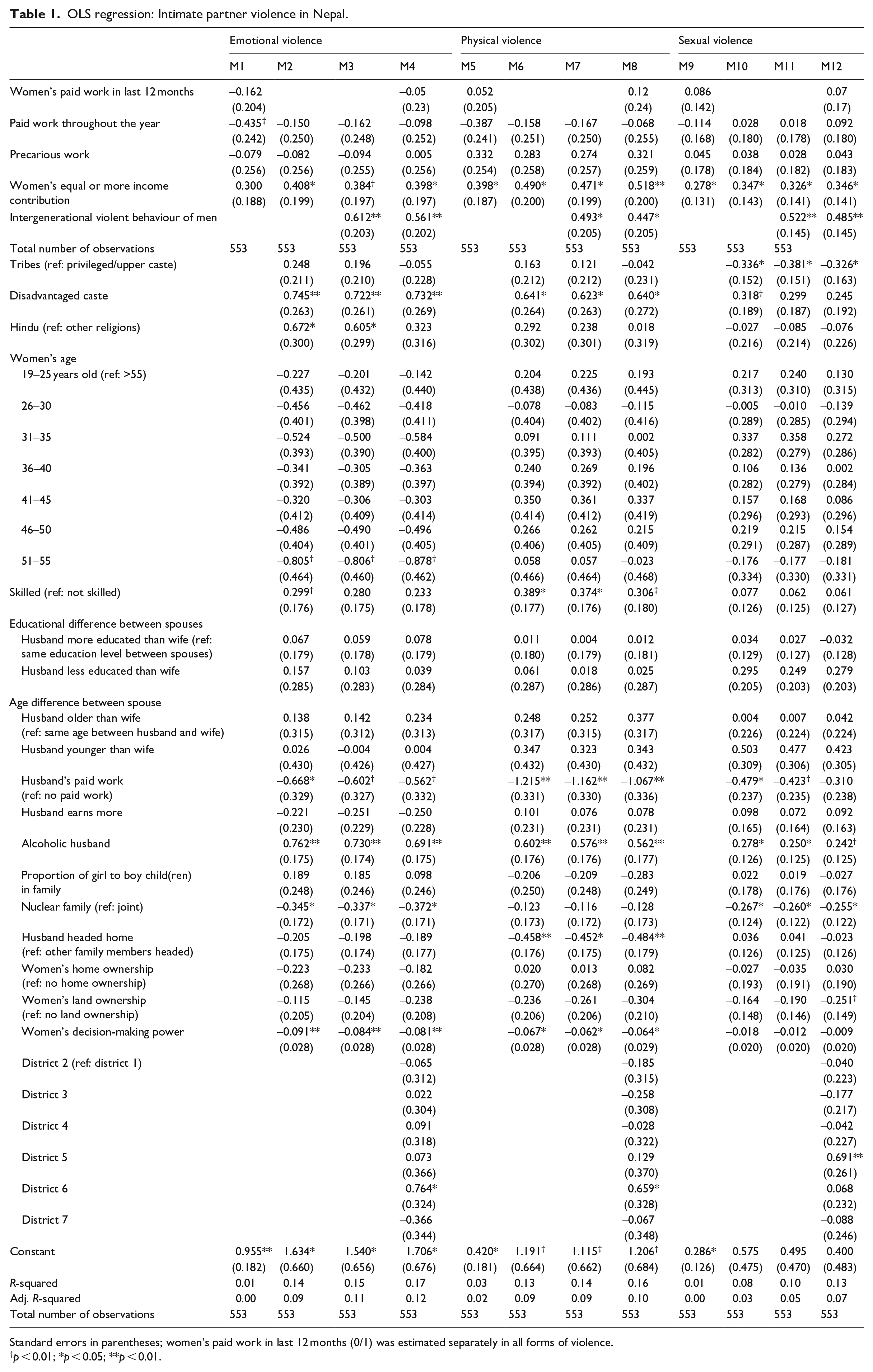
Standard errors in parentheses; women’s paid work in last 12 months (0/1) was estimated separately in all forms of violence.
p < 0.01; *p < 0.05; **p < 0.01.
Descriptive: Intimate partner violence in Nepal.
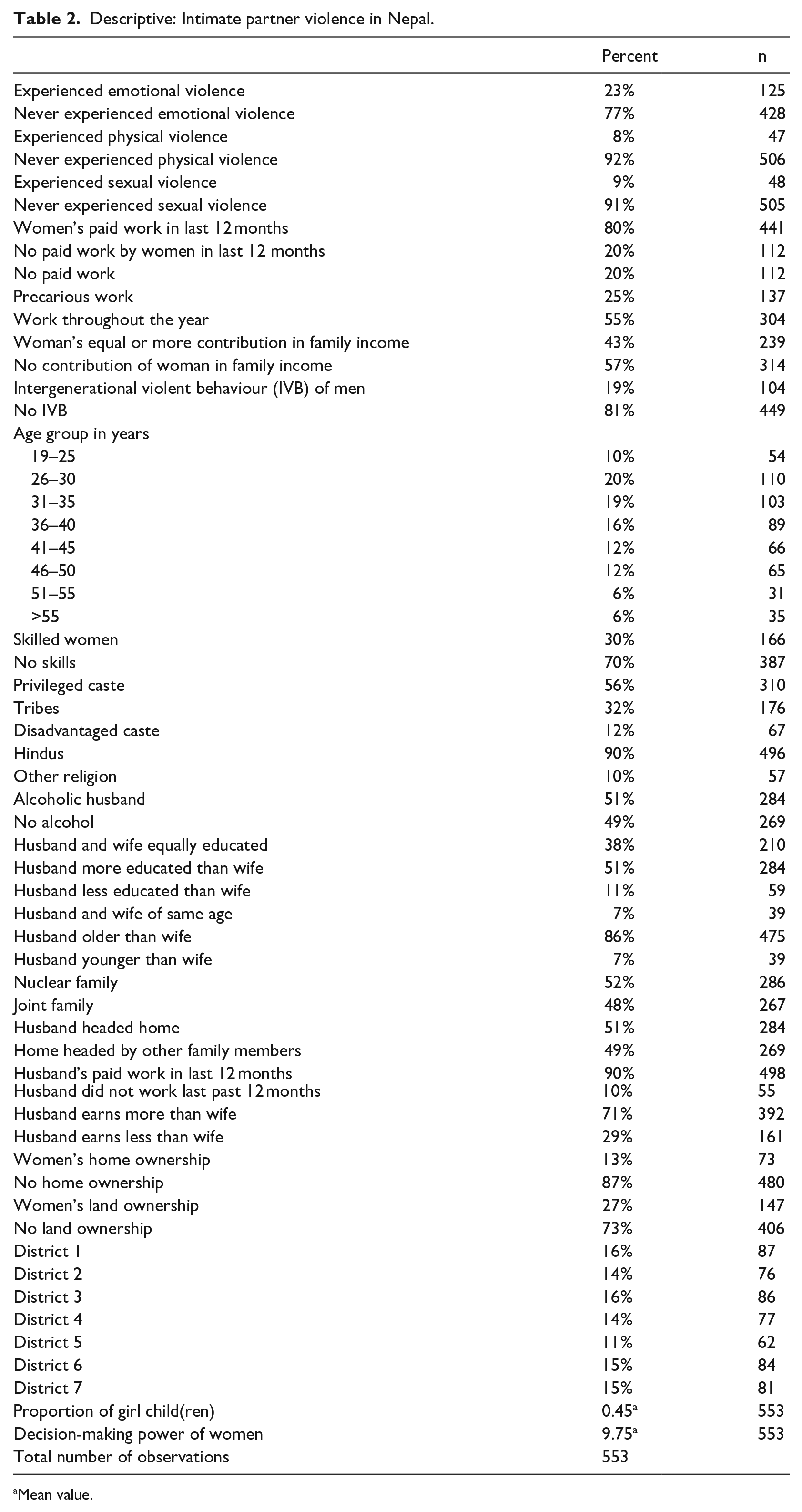
Mean value.
Results
Descriptive
Table 2 reveals that more women experience emotional violence (23%) than physical (8%) and sexual violence (9%). In the sample, 19% of women reported that their husband have witnessed their father beating their mother. More men (90%) than women (80%) had paid work in the last 12 months. A gender gap in earnings is revealed by the fact that 71% of women reported higher earnings of their spouses than them. One-fourth (25%) of women were engaged in precarious work characterised by low wages, poor working conditions, job and social insecurity, while the majority (55%) had paid work throughout the year. However, when it comes to contribution to household income, 43% of women contributed equally or more than their husbands. Demographics reveal that, on average, women were 38 years old at the time of survey. While 90% of women were Hindus, 32% belonged to tribal groups and 12% came from a socially disadvantaged group. Educational gap between spouses suggest that in majority of the cases (51%), husbands were more educated than wives, 38% of couples were equally educated. Similarly, 86% of sampled women had older husbands than them, 7% of couples were of the same age, and in 7% of cases wife was older than husband. Majority of men (51%) were alcoholic.
Regression results
Drawing from the existing literature, we tested two hypotheses. First, we expected that women are more likely to experience violence if they are engaged in precarious work (H1a) but they will experience less violence if they make equal or greater income contribution to the household (H1b) because income increases women’s bargaining power and builds resilience to violence. Second, we expected that regardless of women economic status, intergenerational violent behaviour of men increases violence against women as it indicates its normalisation (H2). Note that we do not claim causality of findings, as our data are cross-sectional. We rather explore associations.
Women’s economic status and violence
Before testing our main hypotheses, we estimated a baseline model in which we explored the relationship between women’s paid work (employment status regardless of type of work) and experience of different forms of violence (M1, M5, M9). Because economic bargaining theory suggests that women’s paid work decline violence against them by increasing their bargaining power and thereby building resilience to violence.
Our findings, however, do not support these arguments as they show that except emotional violence where paid work is negatively associated with IPV (−0.162, M1), it is positively associated with physical (0.052, M5) and sexual violence (0.086, M9), though none of the results are significant at 5% level. The effect does not change in adjusted models as well (M8 and M12). In other words, we do not find evidence that women’s paid work make a difference in their likelihood of experiencing violence. While our findings challenge economic bargaining theory, it is consistent with previous studies which also found insignificant association between women’s paid work and IPV (Dalal et al., 2014; Pandey, 2014).
We expected a positive association between precarious work and IPV – meaning that women engaged in precarious work are more likely to experience IPV than women without paid work. While our hypothesis is partially proven as effects are in the expected direction (M4, M8, M12), they are not significant at 5% level. Noteworthy is that the magnitude of the effect is substantially higher on physical violence (0.321: M8) and relatively on sexual (0.043: M12) than emotional (0.005: M4) violence. Thus, our research is in line with the previous research that found the similar relationship between seasonal work and IPV (Dalal et al., 2014).
Women’s economic contribution and violence
In H1b, we expected that women’s economic contribution to family income reduces the likelihood of violence against them. While our hypothesis is proven, the direction of the effect is opposite to the expectation. We find that women’s economic contribution significantly increases all forms of IPV after controlling for other factors. If women make equal or greater income contribution than their husband, they significantly experience emotional (0.40: M4), physical (0.52: M8) and sexual violence (0.35: M12) compared to those who do not make economic contribution or whose contribution is marginal. Our findings question the assumptions of economic bargaining theory that implies increase in women’s bargaining power through their economic status, while it supports male backlash theory which argues that men use violence to exert their power against female independence resulting from their improved economic status (Chin, 2012).
In summary, we find strong and significant evidence that women’s equal or greater economic contribution significantly exposes them to emotional, physical and sexual IPV after controlling for a range of factors, and precarious work is positively but insignificantly associated with violence.
Intergenerational violent behaviour of men and violence
We expected a positive association between intergenerational violent behaviour of men and IPV (H2). Men who witness domestic violence between parents while growing up are more likely to commit violence in their own marriage. Our findings support the hypothesis (M4, M8, M12). We find that after controlling for a range of factors, women significantly experience all forms of violence if their husband have witnessed father beating their mother during childhood. On average, women encounter slightly higher emotional violence, which includes being insulted, humiliated, or threatened in their daily lives than physical violence including being slapped, pushed, or beaten up and sexual violence. Women’s experiences of emotional violence significantly increase by 0.56 points, while physical and sexual violence significantly increase by 0.45 points and 0.48 points, respectively.
In summary, our study finds a strong evidence that intergenerational transmission of violence significantly exposes women to all forms of IPV. Husbands who have witnessed father beating their mother during socialising years are more likely to commit violence against wives within their own marriage. Our findings are in line with previous research in the Indian context, which has found significant links between intergenerational violent behaviour and violence against women in marriage in the Indian context (Koenig et al., 2006).
Discussion and conclusion
In this paper, we tested two hypotheses relating to the effects of women’s economic status (H1a and H1b) and men’s intergenerational violent behaviour (H2) on different forms of IPV. Deriving from EBM, we also tested a baseline model examining the links between women’s paid work and IPV. Our findings showed that precarious work is positively associated with emotional (0.005), physical (0.321) and sexual violence (0.043), but the effect is not significant at 5% level. Meaning that women engaged in precarious work characterised by seasonal or intermittent work tend to experience more violence than women without work, but the effect is not significant at 5% level. We however assume that the insignificant effect might have been driven by our small sample size – as significance level is the function of sample size (Allison, 1998). Nevertheless, these findings echo with the study in Tanzania context, which found no link between women earning an income as traders (arguable unpredictable in terms of income levels) and resilience to violence (Vyas et al., 2015). This was also the conclusion of a study based in Ghana and Ecuador (Oduro et al., 2015). When it comes to understanding a link between paid work and violence, we observed a positive relationship between the two (in both adjusted and unadjusted models) – indicating women’s exposure to IPV despite earning an income, even though the effect was statistically insignificant. If we evaluate both the findings – the relationship between precarious or paid work and IPV – both tells us that earning an income does not prevent women from marital violence. Therefore, findings showing that earning an income of any type has no impact on reducing violence against women call for greater attention to find out the factors why this may be. Nevertheless, these findings are consistent with existing research that also did not find a statistically significant association between women’s paid work and violence (see Dalal et al., 2014; John, 2020; Pandey, 2004; Pearson, 2004). In fact, in Nepal context a study has shown higher likelihood of severe form of violence for women with paid work compared with those who did not work (Ahmad and Jaleel, 2015).
Pearson (2004) argued that there is an urgent need to look to the wider political economy, both nationally and globally, to understand why income simply does not operate as a protective measure against violence (both intimate partner and non-partner). This is also clear in other studies that bring mixed and inconclusive results in terms of what works to reduce violence against women and girls. For example, studies that look at asset ownership including land and homes conducted in India suggest this does act to reduce violence against women (Bhattacharyya et al., 2011; Panda and Agarwal, 2005). However, in Uganda the reverse can be (Ezeh and Gage-Brandon, 2000). Another study in the Indian context found that increased women’s bargaining power – resulted from their earning a permanent income – put them at higher risk of marital violence – as it challenges patriarchal norms (Luke and Munshi, 2011). The research to date then clearly shows we need to understand the link between women’s economic empowerment and violence against women in much greater detail and consider multiple variables.
In fact, our another finding can be seen in this light, where we found women at higher risks of IPV when making equal or more economic contributions to the family income. Why women should endure violence despite contributing economically to the household? This points to male backlash theory, where men exert violence against women as they feel threat to their dominant status within a patriarchal setting due to women’s enhanced economic self-reliance, ability to accumulate greater economic resources for the household, assertiveness and involvement (see Chin, 2012; Kabeer, 2001; Koenig et al., 2003; Luke and Munshi, 2011; Rahman, 1999).
Our research points to a critical factor that plays a greater role into the process of normalisation as it shows clear significant links between men’s intergenerational violence behaviour and IPV. Men who witness domestic violence while growing up are more likely to commit violence within their own marriage. In fact, intergenerational violence has significantly higher effects on all forms of violence after controlling for a range of factors. Our findings thus contribute to the growing body of literature that shows gender norms, particularly male behaviour as the main trigger of violence (Caykoylu et al., 2011; Ehrensaft et al., 2003; Fikree et al., 2005; Heyman and Slep, 2002; Hines and Saudino, 2002; Koenig et al., 2006; Markowitz, 2001; Maxwell and Maxwell, 2003; Pollak, 2004; Rangul Askeland et al., 2011; Widom and Wilson, 2015). In this context, social norms and gendered theories point to the embedded normalisation of violence as a means of maintaining gendered hierarchies (Bradley, 2020). Ultimately, this relates to gendered power (Connell, 2001).
Our research demonstrates that until we understand how to disrupt patterns of domestic violence, any programme to support women’s empowerment may reduce its effectiveness. That is not to say women’s economic empowerment programmes are not essential, they are, but that a more holistic and gendered approach is needed. An approach is needed that challenges the operation of gendered power and patterns of socialisation based on the exposure of children to instances of violence from a young age. The engagement of men and boys in targeted programming is now emerging as an important area of intervention around ending violence against women and girls. Despite this growing consensus, we are a way off really understanding what kind of activities will work to alter intergenerational behaviours and attitudes. That said, the findings in this study point to the continued urgency of such research.
Limitations of the study
Our study offers useful insights on how violence within marriage can be explained through the intergenerational transmission of violence among men, it also offered critique to the widely used economic bargaining model by showing the positive but statistically insignificant link between women’s paid work (including precarious work) and IPV, but significant positive links between economic contribution and IPV. Instead of declining violence, paid work including precarious work and economic contribution were more likely to increase violence against women within marriage. Supported by empirical evidence, while our study contributes to the growing literature on gender norms that propose to alter men’s attitude and behaviour towards violence, we also acknowledge its limitations. First, the data are not representative of women in Nepal, as it was drawn from the organisation working to spread awareness about violence. This means that female members of such organisations have better awareness of what constitutes violence and many of its facets, and resources they can turn to when they need.
Second, conducting face-to-face interviews on a sensitive topic like IPV has certain disadvantages. It means that many women may have not reported the true extent of violence in the survey, reflected in missing values or do not know responses, which affects the sample size and thereby the results. Under-reporting of violence in face-to-face surveys also relates to the stigma associated with violence, which is often faced by the victims than perpetrators. This can be overcome by using representative data in the future. Third, our data are cross-sectional due to which we could only show associations between factors but do not claim causality. To further establish causality between intergenerational violent behaviour and IPV with the intent to generate more evidence on this, which is of utmost important to stop violence against women, we encourage researchers to use longitudinal data in different country contexts. Fourth, we are fully aware that understanding of the extent of violence in rural and urban is crucial to implement eradication programmes by prioritising the areas where women suffer the most. However, our survey lacked the variable that could distinguish between rural and urban areas. Although we know that most of Nepal’s population is rural (79%) (World Bank, 2018), understanding rural–urban difference would offer additional insights and allow governments to take actions for eradicating it. We thus encourage future research to address this gap.
Supplemental Material
sj-docx-1-jas-10.1177_00219096221141347 – Supplemental material for Is Intergenerational Transmission of Violence a Strong Predictor of Intimate Partner Violence? Evidence from Nepal
Supplemental material, sj-docx-1-jas-10.1177_00219096221141347 for Is Intergenerational Transmission of Violence a Strong Predictor of Intimate Partner Violence? Evidence from Nepal by Tamsin Bradley and Jagriti Tanwar in Journal of Asian and African Studies
Footnotes
Acknowledgements
We would like to thank anonymous peer-reviewer for their insights and suggestions to improve this paper.
Funding
The author(s) disclosed receipt of the following financial support for the research, authorship, and/or publication of this article: This research was funded by DFID’s South Asia Research hub 2016-2018.

Supplemental material
Supplemental material for this article is available online.
Author biographies
References
Supplementary Material
Please find the following supplemental material available below.
For Open Access articles published under a Creative Commons License, all supplemental material carries the same license as the article it is associated with.
For non-Open Access articles published, all supplemental material carries a non-exclusive license, and permission requests for re-use of supplemental material or any part of supplemental material shall be sent directly to the copyright owner as specified in the copyright notice associated with the article.
