




Abstract
In light of China’s rapid growth and increasing engagement in the global climate regime, the authoritarian regulatory model has attracted attention from researchers and policymakers alike. This paper examines the question of to what extent and in what way state authoritarianism leads to (un)successful environmental policy implementation in China, with particular attention to energy transformation. This study inter-connects macro and micro inquiries through a case study of nuclear energy policy in China. An examination of the extended policy cycle as a comprehensive process that brings a policy to fruition shows that authoritarian regulatory environmental policy intervenes in each stage, resulting in a particular path of the evolution of environmental policy in nuclearising energy transformation in China. Adding to commonly accepted tenets of authoritarian environmentalism in general, the explanations of Chinese distinctiveness in materialising environmental policy enhances the understanding of the merits and challenges of authoritarian mechanisms of environmental policy.
Keywords
Introduction
With the rapid growth of China and its increasing engagement in the global climate regime, the underpinning prescriptive and theoretical question about environmentalism among political scientists has been how closely a political system is linked with a country’s environmental outcome and performance. China is the largest greenhouse gas (GHG) emitter in the world (e.g. OECD, 2018), accounting for approximately 27% of global GHG emissions; simultaneously, China is the world’s largest producer of renewable energy. Its ambitious pledges in accordance with the 2015 Paris Climate Deal include lowering its carbon intensity by over 60% by 2030 relative to 2005 levels and ultimately reaching zero carbon emission by 2060 (Myers, 2020). According to the 2020 Environmental Performance Index (EPI) report data published by Yale University, China scored 37.3 out of 100, ranking 120th out of 180 countries and 12th among the Asia-Pacific countries.
China’s EPI shows room to improve considering the country’s sizable economy and increasing competitiveness on the world stage. Nonetheless, its acceleration in environmental performance is worth noting. China marked 8.4 points of rise, whereas Japan fell minus 0.5 points, Singapore minus 8.4, and South Korea had only a 2.2 rise. Of the 180 countries around the world, only 21 have raised their EPI by 8 points or more over the past decade.
China demonstrated overall improvement in environmental performance in many sectors during the Xi Jinping administration. Meanwhile, politically rather than ecologically geared top-down energy transformation policy has had unintended consequences, as seen in the widespread power blackouts in Northeast China in September 2021. Beijing’s sanctions against Australian coal imports immediately after Australia put pressure on China over the investigation in Wuhan at the beginning of the COVID-19 outbreak and its spread in 2020 have contributed to the power outage (Reuters, 2020). The Chinese government prioritises energy transformation, listing its focus on energy sources in the next 5 years in the order of hydropower, wind power, solar power, nuclear power, bio-geothermal heat, coal and petroleum. This contrasts with the previous order of coal, oil, cogeneration, hydropower, nuclear power, wind, solar and biomass. It is noteworthy that nuclear energy remains unchanged in terms of priority (Figures 1 and 2).
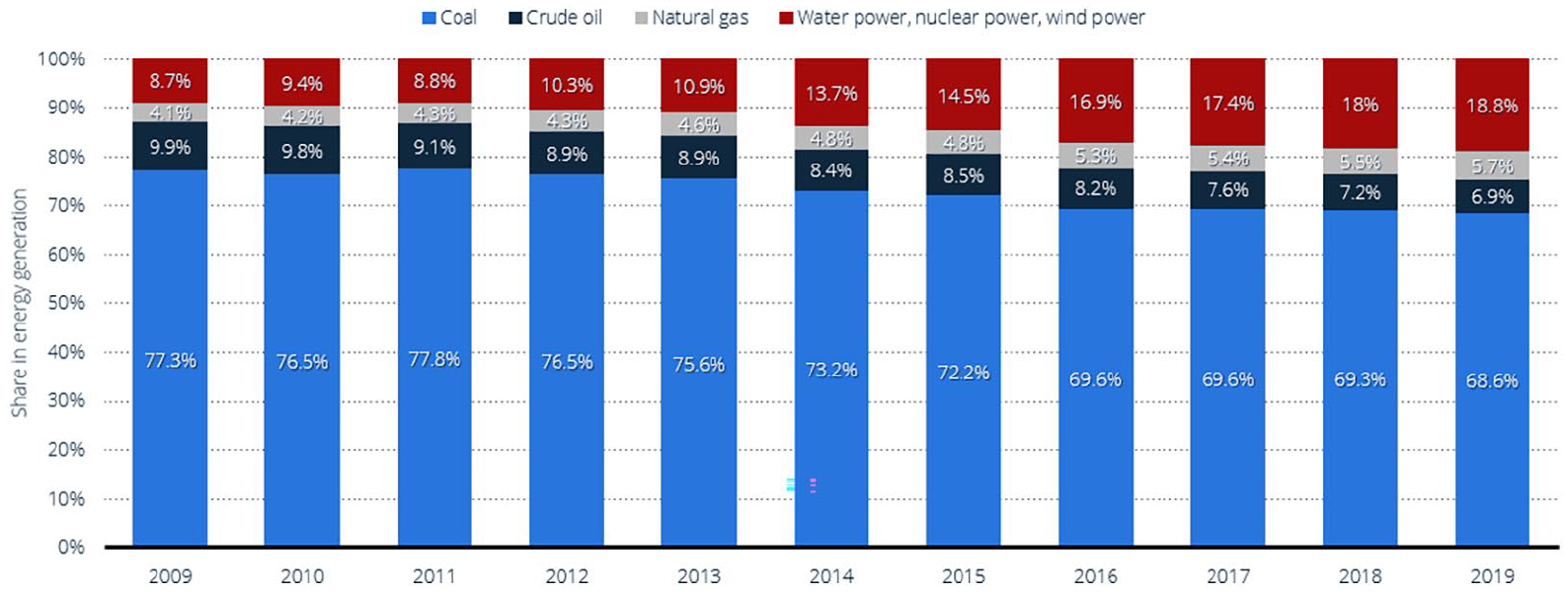
Energy generation in China from 2009 to 2019, by energy source.
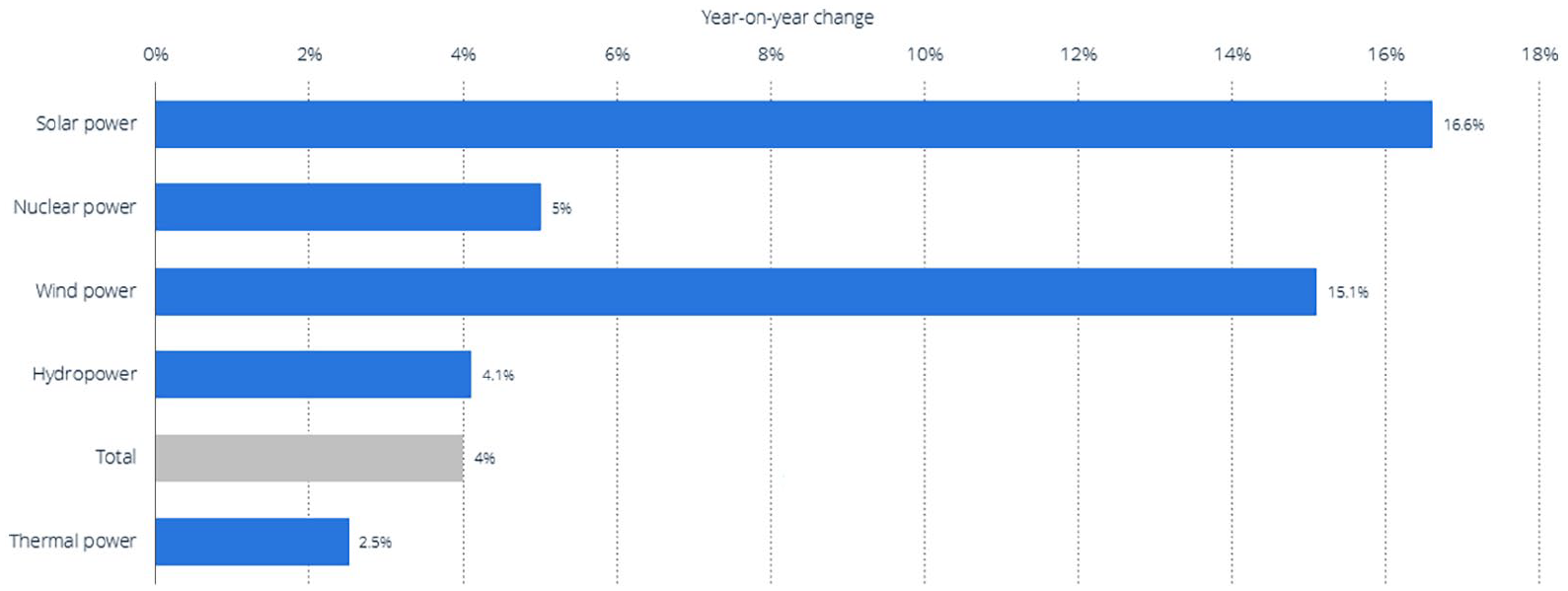
Annual change of power generation (growth rate) in China 2020.
Nuclear energy has been regarded in China as one of the cleanest energy sources due to its low GHG emissions and continues to be an area of high priority for investment (e.g. Wu, 2017). With the growing environmentalism at home and abroad in the contemporary global scene of energy transformation, strong totalitarian governments may take advantage of the opportunity to strengthen or newly establish their nuclear energy sector, effectively resisting the international civil society’s anti-nuclear pressure and gaining nuclear power status in the international nuclear club even though not all environmentalists advocate anti-nuclearism in general. 1 China is one of the nine core players of the International Atomic Energy Agency (IAEA)-led Nuclear Energy for a Net Zero World programme, together with Canada, Finland, France, Japan, Poland, Russia, the United States and the United Kingdom.
In this vein, the intriguing question that arises is whether and how effectively Chinese state authoritarianism deals with a critical environmental question like energy transformation. This article explores the following question: To what extent and in what way does state authoritarianism lead to environmental policy implementation in China with special reference to the nuclear energy sector? Many scholars in the field of environmental welfare politics have been engaged in discussion about the policy implications of political systems and environmentalism (e.g. Bruun, 2020; Connelly et al., 2012; Dobson and Lucardie, 2003; Doherty and de Geus, 1996; Dryzek, 2013; Eckersley, 1992; Humphrey, 2002, 2007; O’Neill et al., 2008; Steinberg and VanDeveer, 2012). Nevertheless, compared with the academic interest in the associations between environmentalism and the various political ideologies and types of democracies, 2 the linkage between authoritarianism and environmentalism remains under-researched.
Methodology
As an empirical case study, our analysis draws attention to the hypothesis that state authoritarianism has varying degrees of effectiveness throughout the process of developing environmental policy. Previous research is usually based on a clear-cut, dichotomised evaluation of whether authoritarianism is positively or negatively associated with the environmental performance of a state in a variety of cases (e.g. Gilley, 2012; Karlsson, 2012). Borrowing from the useful conceptual and empirical work pertaining to authoritarian environmentalism with some modifications, we investigate nuclear energy policy in the Chinese context to elaborate at what stage and how the authoritarian approach associated with regulatory environmental policy mechanisms results in positive symbiosis or negative synergy that creates tensions.
We provide an analysis of China’s nuclear energy policy based on both qualitative and quantitative data, and building on existing literature dealing with similar research questions, official documents released by the Chinese government and intergovernmental organisations, newspaper articles and editorials, and messages in social media. Among these, as the core primary material, we paid particular attention to White Papers produced by the central government. China’s State Council published 82 White Papers between 2011 and 2021, among which seven are scrutinised as they directly relate to the topic of nuclear energy. The reasons for taking the White Papers released in this period as the main primary source are threefold. First of all, compared with other government documents (e.g. Blue Books), White Papers are released at the final stage of policy communication and thus reflect the official stance on the issues under question. Second, the early 2010s is the period when Beijing explicitly pushed low-carbon economic reform. Third, the selected documents directly and sufficiently address the topic of energy transformation in general, as well as nuclear energy development, environmental protection and climate change.
In addition, for a systematic presentation of the data analysis, we offer an analytical framework developed out of existing research that comprehensively and theoretically deals with the policy process cycle. It has to be modified because not all stages of the policy cycle fit China’s case. The suggested framework allows us to explain more clearly the motivation, reality and future direction of China’s energy transformation. Ours is an atheoretical/configurative idiographic case study that can be used in subsequent research for theory building although the case does not aim to build a theory by itself. Moreover, this study intends to contribute to understanding environmental policy in the authoritarian context, therefore, it is also a ‘building block case study’ that aims ‘to identify common patterns or serve a particular kind of heuristic purpose’ (George and Bennett, 2007: 62–63).
Existing studies on China’s environmental policy are micro policy-oriented, narrowly focusing on specific policy (e.g. Ding et al., 2019; Hsiao and Chen, 2018; Liu, 2019; Wang et al., 2019; Xu, 2010; Yu et al., 2020; Zhang, 2015). Political scientists put a greater emphasis on authoritarian environmentalism per se. These studies may overlook the details within the policy process or offer only partial examination, such as research on the conditions of policy change that is not particular to the environmental field (see, for example, Wu, 2020). Policy implications will also affect real-world activities given that authoritarianism rises and sustains while environmental problems in all countries, regardless of political system, affect global climate change. Thus, the international community has to deal with the rise of authoritarian governments in climate diplomacy (e.g. Diamond et al., 2016 for the historical and political context of the surge of authoritarianism and its global expansion). There is a growing need in both academia and diplomacy to deal – willingly or unwillingly – with environmentalism in the authoritarian political context.
As this paper intends to be social scientists’ contribution to energy policy studies, we do not intend to make a climatological judgement about whether nuclearisation in energy transformation is desirable for environmental protection. Our view on the relative effectiveness of China’s implementation of nuclear energy policy through the China-specific authoritarian mechanism is neutral rather than normative, although the findings have implications for theory and policy.
Authoritarian environmentalism versus eco-socialism
China under the single Communist Party system promulgates an ecologically civilised green state. Radical eco-socialism greatly differs from authoritarian environmentalism (e.g. Bookchin). 3 Eco-socialism represents a red-green grassroots communitarian-backed vision by anti-authoritarian organisations that often accompanies social activism against state authorities and is associated with anti-capitalism and anti-growthism, challenging state-led environmental policy and seeking ecologism through fundamental political alternatives to economic reductionism (Burkett, 2006; Foster, 2020; Foster and Burkett, 2008). Eco-socialism may take a libertarian approach to guarantee maximum liberty within a community, with strong advocacy of equity and justice and in pursuit of an ecological self and ecological community where an ideal vision of harmony between humans and nature can be realised.
By contrast, authoritarian environmentalism in the policy field is embodied in state-centred centralised environmental policy. Under this ideological framework, capitalism, growthism and developmentalism are often advocated to sustain the legitimacy of the centralised political system. State-defined environmentalism controls societal demands, only limitedly guaranteeing public participation in decision-making about distributing and controlling environmental goods and harms.
Authoritarianism in politics as opposed to liberal democratic rule can be understood from its particularities. These include exercise of centralised power, monopoly on political power, cultural and institutional repression or effective controls on the institutions of political and decision-making processes (parliament, election system, public administration), limited or nominal freedom of expression on public affairs, lack of transparency, top-down political communication, weak civil society, strong bureaucracy, oppression of civil actions accompanied by strict social control, lack of tolerance for diverse opinions and absence of political mechanisms for leadership change (regime change). Moreover, authoritarian equilibrium may rest on lies, fear and economic prosperity (Karlsson, 2012: 941).
On the surface, a convergence exists at the juncture of ‘authoritarian environmentalism’ and ‘eco-socialism’ (or ‘social ecology’ in Bookchin’s vision) in the sense that both connote non-liberal features and yet integrate environmental concerns horizontally in the political system. However, there are fundamental differences. First, the former emphasises economic development through marketisation, whereas, the latter is rooted in anti-capitalism, taking it as the root cause of pollution and inequality (Huan, 2010a; Newell and Paterson, 2010). Second, in practice, the former can easily be coupled with developmentalism, including technological progress, as economic growth is the core of the legitimacy that buttresses authoritarian leadership. In contrast, eco-socialism is linked with the aspiration of communitarian grassroots participation in the process of decision-making (e.g. Huan, 2010b).
For example, Bookchin’s social ecology represents a vision of human evolution that combines biological nature and human society into a third sphere via ethical and rational social systems. Bookchin’s theory was closely linked with anarchism in the 1960s, but his theories evolved at the end of the 1990s into institutionalised municipal democracy, being inspired from both anarchism and communism. Social ecology refuses both a Neo-Malthusian ecology and a technocratic ecology. This is because the former refuses social relationship, overemphasising natural forces, whereas, the latter over-relies on the technological breakthroughs that are usually guided by the state’s politicised and centralised agenda of environmental development. Strictly speaking, Bookchin may not be a representative ecologist as such, but one of those post-Marxist sociologists who believe in the merits of a communitarian form of social and political system that, if implemented, is highly likely to guarantee individual citizens’ eco-friendly lifestyle. More importantly, Bookchin was an anti-authoritarian and a libertarian socialist who aspired to create a ‘rounded libertarian complement to Marx’s ideas on the radical Left’ (Eiglad and Bookchin, 2006: 12). The detailed policy blueprint of Bookchin’s ecological sociology represents revolutionary thinking about system reform that is not necessarily for the sake of ecological development, but one of the important consequences of implementing Bookchin’s communalism and confederal associations is the rational interaction between human and ecological systems (see Bookchin and Taylor 2015; Eiglad and Bookchin, 2006).
In this context, the ecological civilisation that President Xi has advocated since 2013 and that has been followed by Chinese scholars’ theorisation exhibits different features and nature from the socialist form of ecological modernisation. 4 In China, the deviation from the theoretical root of ecologism occurred due to the Chinese way of adopting Marxism and creating socialist marketisation. In the course of this deviation, advocacy of ecologism is inevitably weakened. Both periods of socialist modernisation under Mao and socialist marketisation under Deng and afterwards resulted in severe destruction of nature and environmental degradation. A number of internal and external factors simultaneously drove Beijing to take urgent measures to resolve these environmental problems, especially during the Jiang Zemin (1993-2003) and Hu Jintao (2003-2013) eras. Consolidating the nuclear energy sector served the central government’s direction of guaranteeing energy security well. Such direction has been set through efficient institutionalisation, managing various risks arising from multi-stakeholder nuclear governance and effectively controlling the risk factors through grassroots environmentalism, proactively reshaping public discourse.
Meanwhile, authoritarianism does not adequately explain the complexity of the various drivers and forces of China’s ecological development. The key factor is the aspiration of the nation reflected in the policy process as ‘policy infusion’ (Biedenkopf et al., 2017). Chinese developmentalism and the global sustainable development agenda converged in the early 2010s. Authoritarianism does not conceptually conflict with environmentalism as long as environment-friendly sustainable development can be achieved regardless of whether it comes from a bottom-up or top-down approach. Theorists, such as Garrett Hardin, William Ophuls and Robert Heilbroner, endorsed the recognition of biophysical limits to growth which, in their view, inevitably necessitate ‘the imposition of socio-political limits through coercive and authoritarian political rule’ (Meyer, 2008: 782–783). Nonetheless, not all authoritarian states have been effective in implementing environmentalism due to the country-specific aspects of each authoritarian government. One important intervening variable is developmentalism, which can be characterised as a longer-term perspective that takes a political ideology as a strategic means with a pragmatic twist, while continuously implementing reform projects. China’s political system fosters environmentalism in different ways at various stages.
Four hypotheses can be drawn out of the juncture of these premises. First, Chinese authoritarianism, with its hybrid marketised socialism, positively reinforces effective environmental policy cycles (Gilley, 2012). This hypothesis may lead to the conclusion that authoritarianism functions more effectively when it is linked with environmental performance. Second, authoritarianism in China functions negatively and will eventually aggravate environmental destruction due to the conflicting goals of environmentalism and developmentalism (e.g. Karlsson, 2012), or changes and reforms are noticeable, but still limited primarily due to the heavy dependence on the top-down approach (e.g. Economy, 2018). Third, in most stages in the cycle, authoritarianism is unrelated or insignificant if environmental policy is taken as a politically neutral agenda and the debate is reframed as techno-centrism versus eco-centrism. Then, the political system is not a crucial factor to consider in analysing the effectiveness of environmental policy or performance. Alternatively, the fourth hypothesis is that China’s authoritarian-guided environmentalism both negatively and positively affects ecological development throughout the nuclear policy cycle depending on various intervening variables at different stages.
Nuclear energy policy in China: linking the energy–environment–economy nexus
China’s ambition to increase its share of nuclear power generation as a clean energy source aims to mitigate serious air pollution from coal smoke, particulate matter (PM) and sulphur dioxide (SO2) by reducing its dependency on fossil fuels. The World Energy Outlook 2014 report stated that by 2040, China will account for 45% of the increase in nuclear power generation, while India and Russia will increase by 30% and the United States by 16% (IEA, 2014: 5–6). The yearly nuclear capacity for electricity generation in China is presented in Figures 1 and 2.
According to previous research on the policy process (e.g. Dunn, 2018; Jordan and Adelle, 2013), ‘policy cycles have comprehensive stages’: motivation, initiating policy design and research, expert consultation, decision-making process, public consultation, policy outcome, dissemination, communication with stakeholders, motivating participation and implementation, enforcement coercion and punishment, feedback discontent, dissatisfaction with compliance, correction, decision on demise or revive, long-term vision and continuity versus short-lived for next election or populism and regional and international cooperation (see Dunn, 2018: 45). As Dunn’s framework with the comprehensive stages was developed based on liberal open society, for further analysis at the empirical level, we merged the categories into three framework stages: (1) agenda-setting, policy formulation and adoption; (2) policy implementation, assessment and adaptation and (3) policy succession and termination.
Although the characteristics of authoritarian rule do not necessarily consistently play the major role in policy-making (Yan and Ge, 2016: 215), the variation and flexibility of policy adaptation still operate within the broader framework of authoritarian environmental policy in the Chinese context. Resting upon the above-indicated general elements of policy-making, Table 1 presents the commonly discussed tenets of authoritarianism in the environmental domain together with criticisms (Ahlers and Shen, 2018: 299–300) 5 to help explain the Chinese context more clearly. Once the agenda is set, final decision-making and subsequent institutionalisation can proceed faster and individual processes, such as policy design, public consultation and adoption can be integrated. Under a top-down centralised system, the implementation process can be more efficient and there will be less multi-stakeholder involvement in policy assessment and adaptation to any policy shifts. Therefore, exit from the government policy will not be based on non-governmental actors. Non-governmental actors will not be able to influence or facilitate a departure from the set policy and it is highly likely that policy development or termination will be decided by the concerned authorities rather than by external inputs or variables (e.g. Wu, 2013).
Operational-level features of state authoritarian environmental policy and criticism.
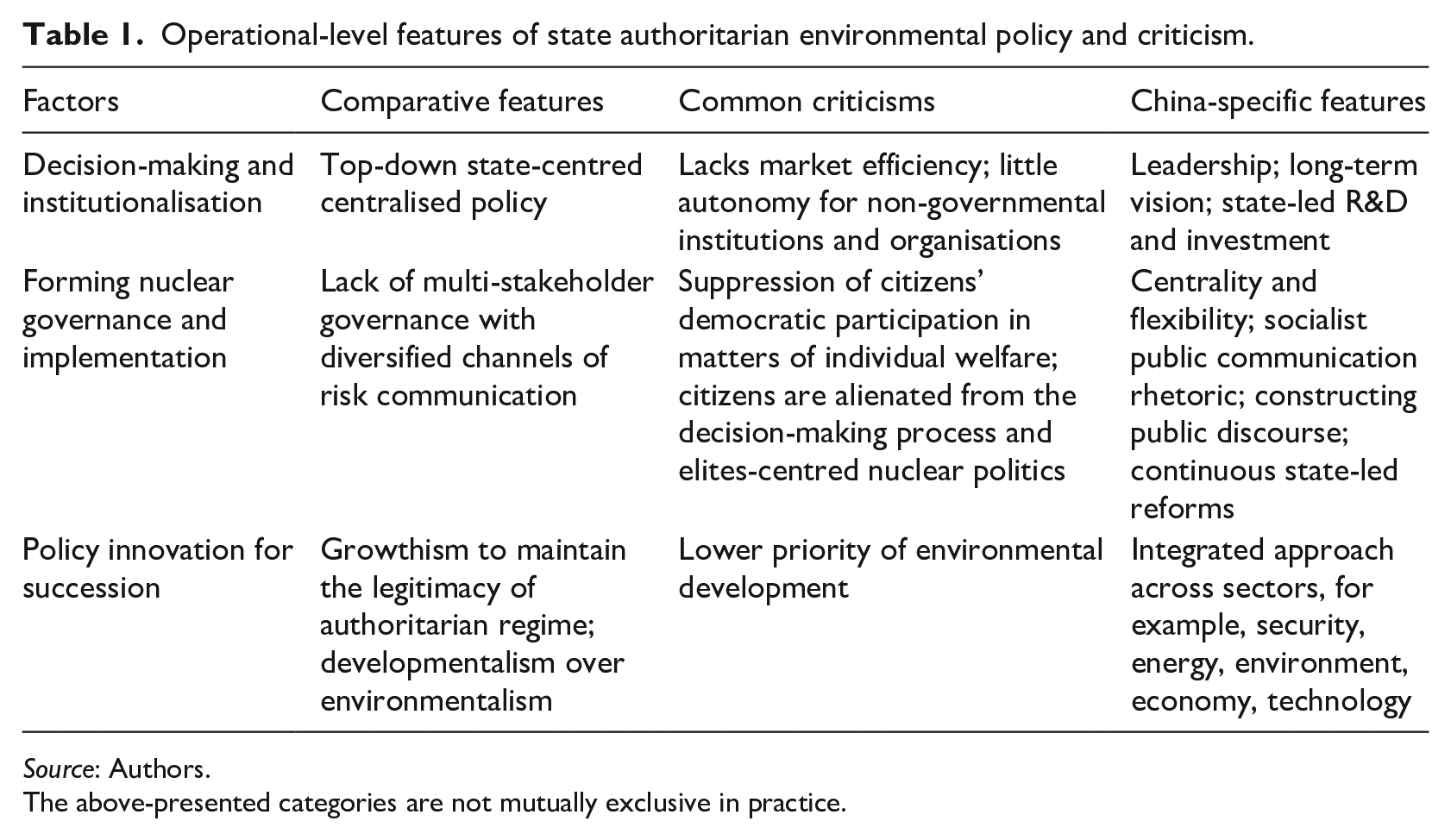
Source: Authors.
The above-presented categories are not mutually exclusive in practice.
Before further developing our case analysis that employs the above-outlined analytical framework, we present a conceptual map (Figure 3) that depicts how the Chinese government defines and promotes nuclear energy. This cognitive map is drawn based on our categorisation of the term ‘nuclear’ as it is used in different contexts (see Table 1 in the Supplemental Appendix). It portrays the contexts in which ‘nuclear energy’ is understood and used as expressed in the seven White Papers. The red arrows categorise the perception of environmental connection with terms, such as environmental protection, renewable energy, sustainable development and ecological civilisation. The blue arrows categorise the connection with economic wellbeing, such as economic development, enhancing citizens’ quality of life and technological innovation. Finally, the green arrows demonstrate how the central government links nuclear policy with top-down policy implementation mechanisms and centralised communication through reiterating regulatory policy as opposed to market-oriented or voluntary approaches in implementing environmental policy.
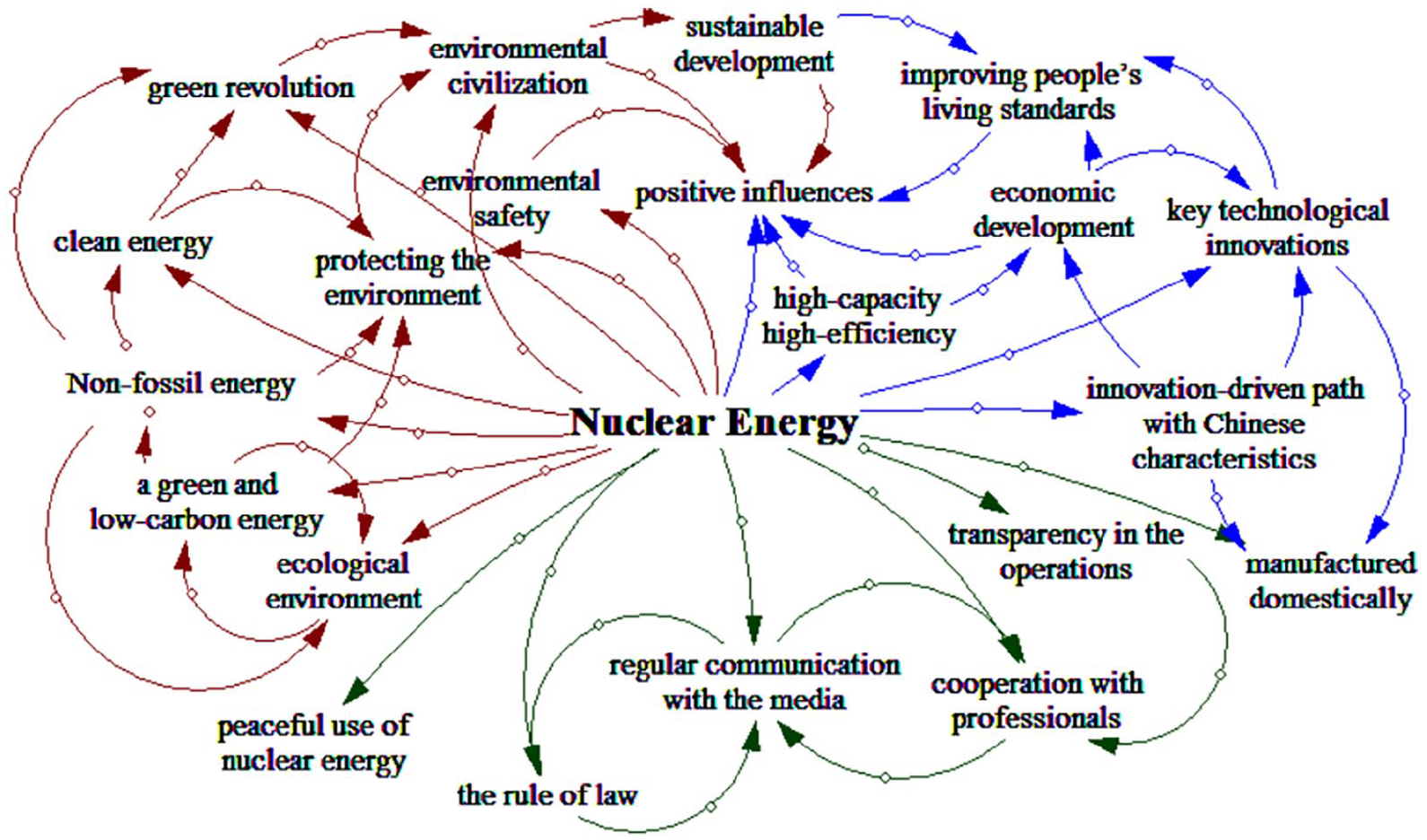
Cognitive map of China’s nuclear energy policy.
Our project focuses on public policy and environmental governance. The state is the core actor in the policy process under the authoritarian system in China. Therefore, the cognitive map helps to clarify the central government’s logic of positivising nuclearisation, showing the direction of public persuasion and ensuring the legitimacy of continuous nuclearisation. The remainder of the paper explores China’s authoritarian way of designing, adopting and implementing nuclear energy policy as part of environmental policy.
Implementation: centralised top-down policy
To overcome the energy shortage and reform the entire energy sector, the country moved quickly to develop nuclear energy in line with other modernisation plans for the country initiated by Deng Xiaoping himself (Xu, 2010). While the nuclear energy sector was developing quickly in the 1970s in the West, China prioritised developing nuclear weapons even though the country was suffering from energy shortages across industrial sectors. Broadly, the evolution of China’s nuclearisation policy can be divided into the following three periods: (1) focusing on military uses of nuclear power (1949–1970s); (2) transforming nuclear power generation to peaceful purposes in response to the rapid economic development after the end of the Cold War in the late 1980s (1980–2010); and (3) strengthening safety and strategically increasing exports in the post-Fukushima era (2011–present).
It took about a decade for the State Council to approve two nuclear power plant (NPP) projects: the Qinshan NPP in November 1981 and the Daya Bay NPP in December 1982 (Xu, 2010: 17). 6 In the late 1970s and the early 1980s, the division over these issues was clear concerning the necessity of NPPs, financing, choosing a technology, the location of NPPs and the leading authority across ministries (Ministry of Nuclear Industry, Ministry of Electric Power and Ministry of Finance), and the central and local governments. When the vice-premier Fang Yi identified the national priority in 1978 as the development of science, nuclear power along with renewable energy sources and anti-pollution technology were included in the list. The strong trust and confidence in the Chinese government’s nuclear energy policy began with Deng and has continued unwaveringly for 65 years in light of the regime’s continuity and stability. Rapid institutionalisation at all levels further expedited the process of realising the state-imposed agenda. In 2020, China celebrated the 65th anniversary of nuclear power generation. The National Energy Administration (NEA) of China confirmed that modern China would not have developed so well without nuclear power and that the country’s endeavours in technological innovation will continue for the next 100 years.
China’s nuclear development system has been under the control of the State Council, with the State-owned Assets Supervision and Administration Commission of the State Council (SASAC) and the National Development and Reform Commission (NDRC) centred on the Nuclear Safety and Security Administration. The other main bodies in nuclear governance include the Ministry of Ecology and Environment (MEP) and the Ministry of Science and Technology (MOST), the parent organisations of the National Nuclear Safety Administration (NNSA), the Ministry of Industry and Information Technology (MIIT), the National Energy Commission (NEC) and the NEA of the NNSA. The State Administration of Science, Technology and Industry for National Defence (SASTIND), the China Atomic Energy Authority (CAEA) and the China National Nuclear Corporation (CNNC) have the power to invest more than 50% of total government budget in nuclear energy projects.
CNNC, a state-owned company, was China’s largest nuclear power generation business entity and was mainly responsible for designing NPPs until 2018, when it merged with the China Nuclear Engineering-Group Corporation (CNEC), a NPP construction company, to become a giant with facility-manufacturing capabilities. It became a state-owned nuclear enterprise, with 600 billion yuan (about 93 billion USD) in assets as of 2018. Founded in 1994, the China General Nuclear Power Group (CGN) is in charge of nuclear R&D and is expanding its nuclear business through 20 subsidiaries. The State Power Investment Corporation (SPIC) is a state-owned company established in 2015 when the China Power Investment Corporation (CPI) merged with the State Nuclear Power Technology Company (SNPTC), which was experienced in localising NPPs. Figure 4 shows the structure of nuclear governing authorities in China.
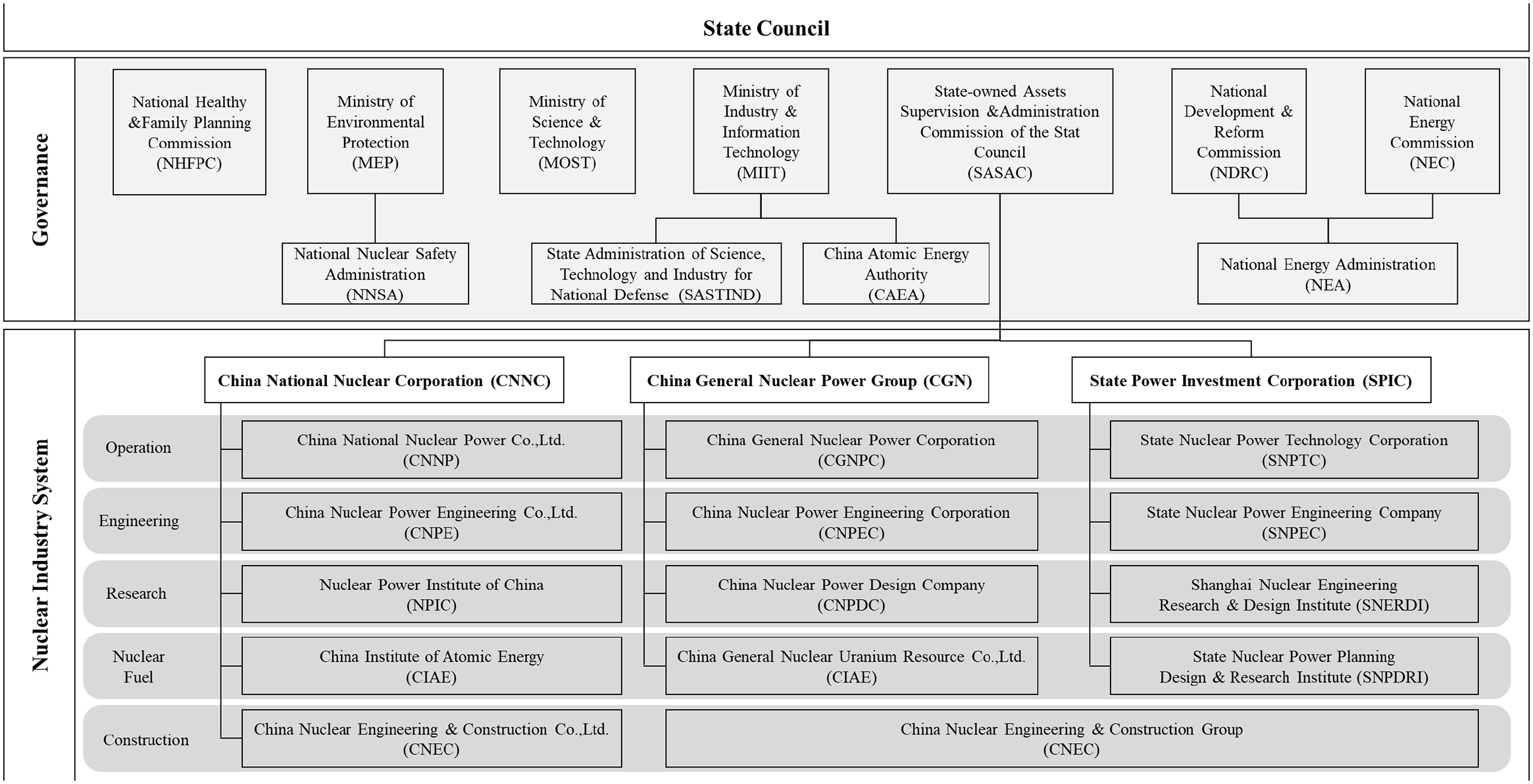
Governance of nuclear power in China.
China will maintain a steady pace of construction on coastal nuclear power projects to rationally deploy new projects, the plan says, setting the goal of elevating the installed capacity of nuclear power operation to about 70 million kilowatts by 2025 (National Development and Reform Commission, 2022).
According to the NDRC’s 2022 report, China will maintain a steady pace of construction on coastal nuclear power projects to rationally deploy new projects, the plan says, setting the goal of elevating the installed capacity of nuclear power operation to about 70 million kilowatts by 2025.
As of December 2021, the cumulative power generation of operating NPPs across China was 407.141 billion kWh, an increase of 11.17% from the same period in 2020 (China Nuclear Energy Association, 2022). China announced plans to build at least 150 more NPPs over the next 15 years to achieve its carbon-neutrality goal by 2060 (Bloomberg Green, 2021). This is more than the number of NPPs established by countries around the world over the past 35 years. China’s nuclear power generation has more than tripled, from 105 TWh in 2013 to 330 TWh in 2019 (World Nuclear Association, 2021). According to the recent data from China’s National Bureau of Statistics, nuclear power generation increased from 73.88 billion kWh in 2010 to 366.25 billion kWh in 2020. In other words, it has increased by 17.4% annually (National Statistical Yearbook, 2021).
The central government plays a leading role in shaping nuclear governance in China. The well-established institutions depicted in Figure 4 represent an important part of such governance. The structure of the governance is mainly formed by state actors, including government agencies, state-owned enterprises (SOPs), recognised scientists and engineers, and universities and research institutes. Together with speedy institutionalisation, China has implemented a centralised environmental policy embodied in a series of government-led laws and regulations as seen in following statement from the 2019 White Paper on Nuclear Safety: ‘China has put in place its own nuclear emergency legal framework, comprising state laws, administrative regulations, departmental rules, national and industrial standards, and management guidelines’.
As early as August 1993, China put into effect the Regulations on Emergency Management of Nuclear Accidents at Nuclear Power Plants. Since the beginning of this century China has, in succession, enacted the Law of the People’s Republic of China on Prevention and Control of Radioactive Pollution and Emergency Response Law of the People’s Republic of China, providing regulations and requirements from the legal perspective on nuclear emergency preparedness. In July 2015, the newly revised State Security Law of the People’s Republic of China was promulgated, further reinforcing the nuclear accident emergency system and emergency response capacity building to prevent, control and eliminate damage to the life and health of the general public and ecological environment. . . . Currently efforts are being made to push forward the legislative process associated with the Atomic Energy Law and Nuclear Safety Law. (White Paper ‘Nuclear Safety in China’, 3 September 2019)
The notable features of China’s nuclearisation in the energy sector include the leadership’s clear understanding of the issue together with a long-term vision regarding overall energy sector reform, nurturing the pool of technocrats in the decision-making process, stability and continuity of the regime that facilitate long-term reform planning, and state-controlled elite-centred governance which is effectively controlled by the government and public sector. These factors are unlike those of other Asian countries, notably Japan and South Korea (Kim and Chung, 2018).
In this process, indigenous technology is emphasised: ‘China’s nuclear industry has always developed in line with the latest safety standards and maintained a good safety record, pursuing an innovation-driven path of nuclear safety with Chinese characteristics’ (emphasis added by authors; State Council of PRC ‘Nuclear Safety in China’ White Paper, 3 September 2019). Safety-related technology with Chinese characteristics refers to, inter alia, higher production capacity using domestic equipment and a robust unified regulatory system over the surveillance of safety including monitoring systems at all levels (see Supplemental Appendix for the detailed statements in the White Paper). This government-led policy communication on nuclear energy has served to mitigate public concerns about nuclear accidents through differentiating China’s domestic manufacturing technology and surveillance system from those of other countries.
Managing the risks of multi-stakeholder nuclear governance
In addition to strident leadership demands for rapid institutionalisation and implementation in the nuclear energy sector, the second significant characteristic of China’s authoritarian environmentalism is the central government’s management of multiple stakeholders and proactive behaviour towards disagreements. Rapid institutionalisation at all levels expedited the entire process of implementing the state-led agenda. During this materialisation of policy cycle, particularly at the implementation stage, the features include massive financial investment and fast-developing core technology.
Since the early 2010s, bolstered by the state’s Nuclear Energy Development Plan (2005-2020) and Nuclear Energy Safety Plan (2011-2015), there has been a re-emergence of public discourse among scholars, scientists and policy-makers, emphasising the safety and cleanness of nuclear energy: ‘Nuclear power is a safe, clean and economical energy, utilization of which is beneficial to CO2 emission reduction and global climate change remission’ (Ding et al., 2019: 170). This discourse has been followed by supporting research and relevant legislation (e.g. Hsiao and Chen, 2018; on public acceptance, see Yu et al., 2020; on the anti-nuclear movement in China, see, e.g. Wang et al., 2019; see Xu, 2010 for a comprehensive discussion of the development of nuclear energy in China). In fact, in the 7 White Papers, there are 73 phrases that connect nuclear energy with environmental protection (see Supplemental Appendix).
At the same time, environmental activism against nuclearisation seemingly triggered by the Fukushima nuclear disaster has emerged in China as it has in other major nuclear energy-producing countries (Wang et al., 2019; Yu et al., 2020). Nevertheless, the rise of environmental activism in general in China was not a new phenomenon directly caused by the external stimulus. During the 11th 5-Year Plan (2006–2010), there were 300,000 petitions related to environmental issues (China Dialogue (zhongwaiduihua), 2012). In 2006, real estate owners and non-governmental organisations (NGOs) in the Shandong Lushan Intan area grouped together under the name Daehai Environmental Protection Corporation and submitted 500 signatures to the National Environmental Protection Bureau and the Development Reform Committee to cancel the construction of NPPs in an effort to protect the marine environment (He et al., 2014: 439). However, most district courts considered only the interests of local governments and refused to draft legislation to resolve environmental issues in favour of affected citizens. As a result, less than 1% of environmental disputes were settled judicially (The Beijing News (Xinjingbao) 2012). Previous research often stresses ‘centralised policy outcome with de-centralised implementation’ as a particularity of China’s environmental public policy (e.g. Gilley, 2012). Nonetheless, the autonomy of local governments is also a feature within the strong authoritative controlling structure of the central government and the tension between the central and local governments (Shen and Ahlers, 2018).
After the Fukushima accident, research on environmental activism in China grew rapidly. More than 80,000 environmental protests took place in 2012 alone (Morton, 2014). The average annual increase in the number of protests was 29% between 2011 and 2012 (Lu and Li, 2013). Despite the overall decline in the number of civil complaints, the number of environmental complaints increased significantly (Economy, 2014). The platforms that collect and organise environmental protests not only increased in number but also rapidly expanded in scale (China Labour Bulletin, 2017). Since the 2010s, in China, environmental protests have taken place in a wide range of provinces, from developed large cities to underdeveloped remote villages (Duggan, 2015).
The Jiangmen region of Guangdong province was the location of one of these protests. Unlike existing industrialisation or real estate projects that successfully attracted activists in Jiangmen, the construction of a nuclear fuel processing plant had to compete with various discourses appearing on the web from the public announcement process. The notice of the construction of a nuclear fuel plant quickly spread through web forums, such as Weibo and Tienya Web and led to intense opposition from the citizens of Jiangmen. At the time, the reasons for citizens’ dissatisfaction were ‘the government’s information disclosure is not transparent and concerns about the safety of nuclear fuel projects’. Weibo users actively shared information on the Jiangmen nuclear fuel plant by posting with the tag ‘Jiangmen nuclear crisis’. The Jiangmen City website included six factors (shehuiwendingfengxianyinzi: social stability risk factors) and crime prevention measures that can pose a threat to social stability. These include the risk of lack of public participation, the rationality of residents’ migration plan, the effect of non-radioactive pollutants, the effect of radioactive pollutants and the risk of residents’ ignorance of nuclear fuel within the scope of the project’s impact. Citizens exchanged information by expressing their opinions through the Internet, using slogans, such as ‘anti-nuclear pollution’, ‘for Jiangmen and future generations’ and ‘for our blue sky’ (Zhao and Qi, 2022).
Corruption as well as ecological concerns became an issue related to China’s aggressive NPP construction. A representative case was that of Kang Rixin, the party secretary and general manager of the CNNC in 2009, who was suspected of concealing various accidents. Investigations centred around whether Kang took bribes from overseas suppliers in exchange for contracts. One company under suspicion was AREVA, which won the contract to supply China with two nuclear reactors in Guangdong province in November 2007. The deal was worth US$8.7 billion, the largest contract ever in the nuclear power sector, and was signed during a state visit to China by then French President Nicolas Sarkozy. In addition to being general manager of the CNNC, Kang was also a member of China’s Communist Party Central Committee, the governing party’s highest committee. The CNNC is responsible not only for China’s nuclear power programme, comprising 11 operational plants and a further 20 planned or under construction, but also for its military nuclear programmes. There has been a concern that the nuclear power project could be abused because there is no effective supervisory authority to monitor the process of bidding for the host area (BBC News, 2010).
The 13th 5-Year Plan (2016) postponed the construction of inland NPPs and included the goal of increasing the capacity of Chinese NPPs by 2020. Concurrently, protests led the central authority to search for more effective coordination of multiple stakeholders. Shortly after the protests, to calm the reaction of the citizens, the Jiangmen municipal government decided to hold an emergency press conference to extend the information disclosure period. The Heosan City Development and Reform Committee and the CNNC held a briefing session, inviting several media outlets from the province and announced that there would be no worrisome situation for citizens and that the opposing citizens did not have a sufficient understanding of nuclear fuel processing. Around this time, the central government also released a White Paper, ‘China’s Nuclear Emergency Preparedness’, in which environmental justification appears 20 times along with detailed emphasis on nuclear safety.
The nuclearisation of the energy sector has continued. In 2020, around 5% of electricity in China was generated from nuclear energy. While many countries started reducing reliance on nuclear power after the 2011 nuclear disaster in Fukushima, Japan, China was one of the few which continued increasing the share of nuclear energy in its power mix. As of May 2022, there were 53 nuclear reactors under construction worldwide. China led the list, with 15 units. To achieve carbon neutrality in 2060, China plans to significantly increase the share of nuclear power (Omar et al., 2022). Table 2 in the Supplemental Appendix presents a list of the nuclear energy power plants that have been built or are under construction in China so far. The continued building of nuclear plants demonstrates that stakeholders other than the central government have insignificant influence in the final decision and that the concerned authorities obfuscate any possible adverse impacts rather than reconsider them.
The nuclear energy plants that have already been built or are currently under construction in mainland China are located in eight provinces. The regions with the largest number of NPPs, including those planned and under construction are: Guangdong (18), Fujian (16), Zhejiang (15), Liaoning (11), Hainan (10), Jiangsu (8), Guangxi (8) and Shandong (6). Four inland provinces (Hebei, Hubei, Jiangxi and Hunan) are among the areas with plants under construction. The province of Henan, where two NPPs are scheduled to be built, surrounds the capital city of Beijing, reflecting the current Chinese government’s confident and radical energy generation strategy of expanding the construction of nuclear energy plants from coastal areas to inland areas. The electricity production capacity of the reactors under construction presented in Figure 5 justifies China’s aggressive NPP construction strategy.
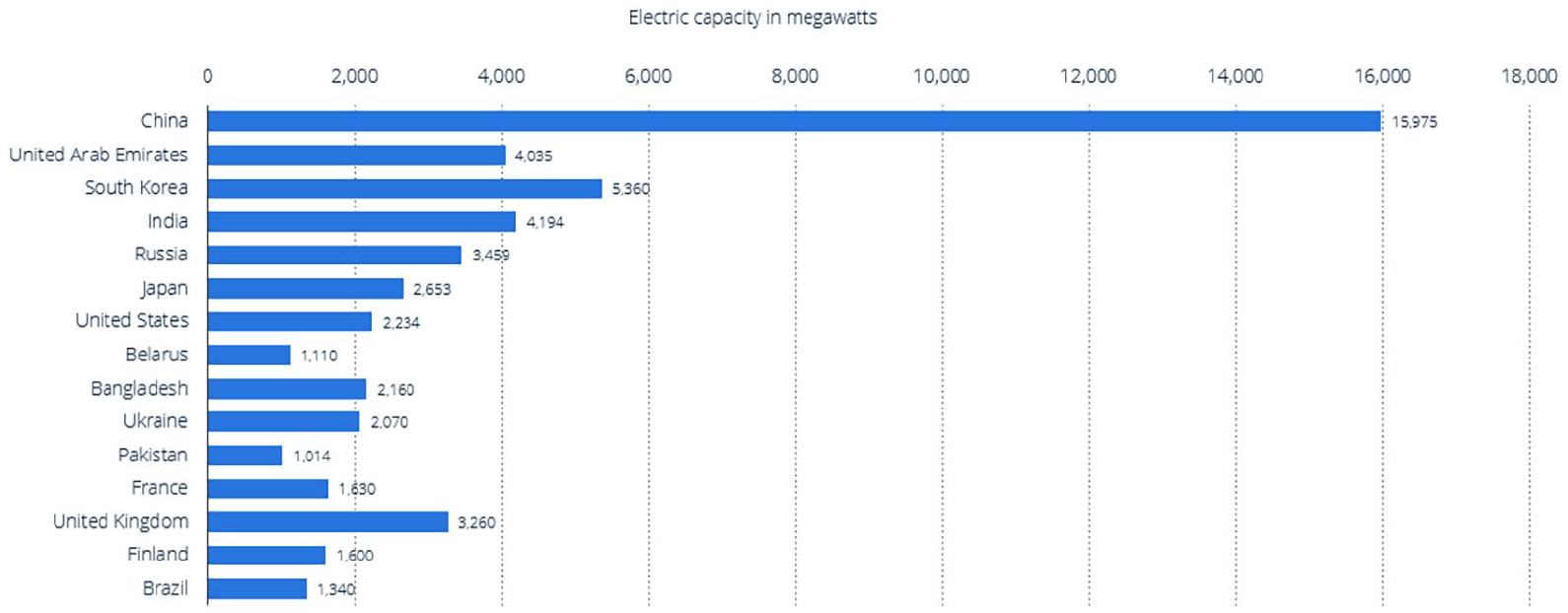
Electricity production capacity of nuclear reactors under construction worldwide.
Although popular protests raise tensions and put pressure on government authorities, unlike the cases of other environmental issues, such as air pollution, government-led multi-stakeholder fora and dialogues dealing with public concerns on nuclearisation in China have been only nominal gestures rather than a ‘horizontal process’ of accommodating diverse views (Ahlers and Shen, 2018).
Controlled environmentalism: multi-level integrated approach
China has made great efforts to quell rising environmental awareness and activism, constructing public discourse on the state’s nuclearisation agenda. At the same time, the public discourse of positivising nuclear energy generation as a clean alternative energy source has been solidly formed by policy-makers and people involved in the nuclear sector. The central and local governments’ roles are divided in coordinating citizens’ reactions to government energy policy while at the same time reinforcing a guided, robust regulatory system even though the scope of participation and autonomy of local governments and civil society may be seen to be expanding.
A number of researchers (e.g. Du and Han, 2020; Guo and Ren, 2017; He et al., 2014; Huang et al., 2018; Qiu et al., 2021; Wang et al., 2019; Yu et al., 2020) have observed that the Chinese public’s awareness of the risks of nuclear facilities greatly increased after the Fukushima accident. In addition, the perceived benefits of nuclear power generation and public trust in government decreased, but knowledge about nuclear power increased significantly (Sun et al., 2016). Opposition to NPPs in China has become increasingly prominent (Buckley, 2015; Lok-to, 2016), reflected in small and large conflicts, such as petitions and protests related to nuclear power generation (Wu, 2017; Huang et al., 2013).
Nevertheless, closer scrutiny reveals that, while China was constructing NPPs, protests related to the construction of NPPs occurred in only two regions, Guangdong and Jiangsu. Even in these two cases, construction was never held back, and Guangdong is still the largest NPP construction zone in China, home to 18 plants. In July 2013, when the nuclear fuel industrial complex encountered resistance from residents during the safety evaluation stage, the provincial authority declared that the project was not feasible and the preliminary work was suspended, but such a measure was only temporary. A second protest occurred in 2016 and was not against the construction of the NPP itself but against the nuclear waste reprocessing plant which was planned to be built using French technology. In July 2013, the municipal-level government at Jiangmen, Guangdong province, posted a document on the Internet. According to the document, a nuclear plant funded by an SOE, CNNC together with a French company, Areva, was on the government agenda. Ten days were given to the general public for comments. With the rising fear of the potential environmental and human health risks, thousands of citizens protested on the streets on 12 July, and the project was suspended on the same day. Similarly, in 2016, demonstrations in the city of Lianyungang, located near the coast of the Jiangsu province, led authorities to call off the building of a US$15 billion nuclear fuel reprocessing facility that would have processed 800 tonnes of nuclear waste per year.
In the early stage, the government stopped the work when there was opposition from residents, and in the process, the Chinese media pointed out the problem of the lack of communication between the government and citizens. The root cause of anti-nuclear protests in China was the public’s anger and sense of incongruity over the violation of their right to know. Considering the sector-specific nature of nuclear energy policy as large-scale, long-term and irreversible, public consultation and multi-stakeholder communication in the early stage of policy design are crucial to minimise environmental risks.
However, in China, ‘public consultation’ and ‘communication with stakeholders’ in the policy cycle have been less emphasised. In this context, government measures of environmental information disclosure were effective to soothe public outrage over environmental harms (Johnson, 2011: 404). The Chinese government’s own rationale for building NPPs was clearly established, and the media supportively promoted it. The government accepted the opinions of the residents, ‘temporarily held them’, and did not ‘completely nullify’ them. While accepting their opinions appropriately, the government made an effort to dispel the public’s fear using the media (Huang and Sun, 2016). As an effective top-down communication tool, the central government released three White Papers: ‘Energy in China’s New Era’ (2020), ‘Nuclear Safety in China’ (2019) and ‘China’s Nuclear Emergency Preparedness’ (2016). The White Paper, ‘Nuclear Safety in China’ (2019), summarises what the central government tried to stress, in particular, policy communication on the possible risks and the Chinese way of developing nuclear energy, emphasising “nuclear emergency preparedness exercises, drills, training and public communication”: continuous efforts have been made to enhance the capabilities of nuclear emergency preparedness organizations at various levels to cope with nuclear accidents, popularize knowledge of nuclear safety and emergency preparedness, create an environment conducive to facilitating nuclear energy development and build society-wide confidence in the country’s nuclear energy sector. . . . China’s nuclear industry has always developed in line with the latest safety standards and maintained a good safety record, pursuing an innovation-driven path of nuclear safety with Chinese characteristics. (White Paper ‘Nuclear Safety in China’, 3 September 2019)
From the local government’s point of view, the construction of NPPs was something to be praised as an achievement as it was directly linked to the gross domestic product (GDP) growth of the region through job creation (Xu, 2010). As a result, Tianwan Nuclear Power Plants in Jiangsu Province announced a re-bid in April 2021 and officially started construction in August. In spite of various environment-related protests by citizens, the number of NPPs increased. In this context, Yan and Ge’s (2016: 215) study on the limited citizen participation in low-risk areas under autocratic rule offers some insights. The interaction between the state-led nuclear governance and the general public in the high-risk areas such as nuclear energy in China typically reveals the alienation of grassroots environmentalism from decision-making.
Local governments in this scene play a particular role between the central government and the general public due to, inter alia economic benefits/incentives for local governments from nuclear energy development in their region. The central government may control the speed of greening the energy sector against the pace of economic development with tools to combine centrality and flexibility. China can continuously develop technical, social and regulatory infrastructure related to green sectors under the agenda of ecological industrialisation through investing in and developing green technology, including the nuclear energy sector, cooperation with advanced economies in this field and boosting exports, adaptively changing the ‘paradigm of energy transformation’ (Kern et al., 2014) and reshaping public discourse on the state’s energy strategy. To legitimise the nuclearisation of the energy sector, the government uses an integrated policy framework, connecting the agenda with economic growth, technological advancement, ecological civilisation and global responsibility.
The new term ‘eco-nuclear’ symbolically entails the top-down move in China’s environmentalism. Until 1978, the Certified Cyber Professional (CCP) led a security-focused nuclearisation, whereas between 1978 and the 1980s, energy sector modernisation for energy security was prioritised. At a later stage of modernisation, under Xi Jinping, economic viability was the core rationale for energy transformation. The practical pillar of Chinese environmentalism embodied in the top-down campaign of ‘ecological civilisation’ was implemented via a green growth agenda and materialised in the policy field as ‘eco-nuclear policy’. Technological innovation and investment are the core of the green growth agenda (Bourdais Park, 2013). Alongside continuous investment in this field, advanced technological innovation includes the emerging ‘digitalisation’ agenda (Zheng and Lavruhina, 2019). China’s domestic agenda reflects the country’s ambition to play a leading role in climate diplomacy, thus proactively accommodating the rapid rise of domestic environmentalism and global pressure. In doing so, nuclear power expands not only in the energy sector but also in the defence sector, with the re-nuclearisation of missiles, submarines and aircraft (Gheorghe, 2019). Chinese public discourse has been reshaped to accept nuclear energy development by coupling it with the green energy transition. Since 2018, China has described ‘nuclear power generation as the engine of innovative green economic growth’ for improving ‘people’s living standards and promoting high-quality economic development’ in a number of papers and newspaper articles. This approach was extensively elaborated in the 2019 White Paper, ‘Nuclear Safety in China’ (3 September 2019).
In addition, since 2019, the term ‘ecological nuclear power plant’ (shengtaihedian) has been a frequent search term in the Chinese Internet space (e.g. Baidu). The ecological NPP is a concept that began to be actively expanded in April 2019, when the CAEA suggested ‘safe nuclear power, scientific nuclear power, and ecological nuclear power’ as the future direction of nuclear power in China. At ‘the Nuclear Safe Use and Industrial Development Prospect Seminar’ held in October 2019, Chinese nuclear experts further clarified the term by presenting a specific blueprint for the utilisation of nuclear technology, the digital control system for a domestic NPP and a nuclear eco-friendly industry.
China is also accelerating its overseas expansion under the agenda of global responsibility in the climate field. For example, in December 2015, the CGN negotiated a commercial consultation with the Kazakhstan Nuclear Industry Corporation for the joint design and construction of a uranium processing plant. In 2017, the CAEA emphasised that it would become an important force for ‘sustainable development and construction of a national ecological civilisation’, going beyond enforcing the technological prowess of nuclear energy. A detailed picture of this agenda was embodied in the 2021 project of the State-owned Asset Management Committee of the State Council of China Nuclear Group. To create an ecological NPP in which humans and nature coexist unproblematically, the China Photonuclear Group under the State Council of China incorporated biodiversity protection into its corporate development strategy and innovatively presented the concept of an ecological NPP characterised by ‘symbiosis, coexistence and regeneration’ (‘Energy in China’s New Era’, 21 December 2020), linking the issue with the international environmental agenda of biodiversity.
At the same time, China aspires to lead the international discourse of an effective and clean image of nuclear energy development backed by elite technocrats and competent scientists, aligning the domestic agenda with the international climate agenda. The China Nuclear Group under the State Council of China has continuously expanded the biodiversity protection management system (China Atomic Energy Authority, 2021), also promoting the policy in the international scene, notably at the United Nations Climate Change Conference (UNCCC) (January 2021). China’s nuclear power efforts are promoting the interest of the global nuclear industry through integrating biodiversity protection, firmly shaping public opinion on nuclear power and anchoring the UN’s Sustainable Development Goals in China (‘Energy in China’s New Era’, 21 December 2020). The following extract from the 2021 White Paper ‘Biodiversity Conservation in China’ clarifies how the central government aligns its eco-civilisation agenda with the country’s overseas developmental instruments: China regards cooperation in eco-civilization as a key component of the BRI [Belt and Road Initiative] and has adopted a series of green measures in infrastructure, energy, and finance to support participating countries with fund, technology and capacity building. These measures are helping them transform faster to green, low-carbon growth to the benefit of the people. (White Paper, ‘Biodiversity Conservation in China’ 8 September 2021)
Nonetheless, the central government’s rhetorical linkage between nuclear energy development and protection of biodiversity does not explicitly call for clear policy communication. Direction for how to gauge public discourse in this field is yet to come under the broader concept of the eco-nuclear plant.- Meanwhile, the position of the current global climate regime is vague on the point of whether emissions reduction from nuclear energy will be included in the assessment of how countries meet their emissions targets, especially in the case of non-Annex 1 countries. In 2021, this issue emerged as a highly controversial question in Europe as well as Asia (e.g. South Korea), dividing the member states of the European Union (EU) over the EU’s official stance announced in early 2022 (Reuters, 2 January 2022). From the perspectives of anti-nuclear environmentalists, the trend of officially recognising nuclear energy as a clean energy source would be something to worry about as it may encourage developing countries to prioritise the nuclear energy sector for both production and proliferation through trade rather than to increase investment in other environmentally cleaner and safer energy sources.
Concluding remarks
Returning to our research question: To what extent and in what way does state authoritarianism facilitate environmental policy implementation in China with special reference to the nuclear energy sector? Addressing the four hypotheses that we raised in the introduction linking the authoritarian system with the environmental policy process, our analysis shows that the first three hypotheses only partially explain the nuclear energy transformation in China. The fourth hypothesis provides some room to understand the different stages of China’s public policy. Positive or negative evaluation on China’s nuclear energy policy depends on the evaluators’ own perspectives on nuclear energy transformation. Chinese authoritarian environmentalism certainly helped to mitigate the potential tension and conflicts in the early stage of the rise of anti-nuclearism through the government’s efforts to positivise the benefits of increasing nuclearisation in the energy sector. If the political system itself is the sufficient condition for the process of public policy decision-making, the Chinese government’s strategic efforts to shape the nuclear governance will be an insignificant factor to explore. In fact, the difficulties of realising and precipitating NPP construction have been proved elsewhere regardless of political system. Therefore, it is significant to pay more attention to the full cycle of public policy implementation in the particular case. Likewise, any authoritarian environmentalism combined with non-participatory democracies may share some of the features. Nonetheless, not all countries with political systems similar to China’s share the degree and effectiveness of the government’s top-down intervention and implementation of nuclear energy development. In this regard, China’s particular way along with the general features of authoritarian environmentalism have generated the current stage of nuclear energy development in China. Throughout the paper, we have demonstrated how such features have interacted to contribute to the current pattern of environmental policy in China, focusing on the case of nuclear energy sector.
China has been successful so far in the nuclear energy sector from the pro-nuclear advocates’ viewpoint, as shown in the policy cycle process of effective implementation, moulding multi-stakeholder environmental governance (including institutionalisation, leading public discourse and controlling civil society) and timely proactive reform with an integrated approach connecting nuclear energy with ecological discourse and the economic development agenda. Each stage of the policy cycle has highlighted the general features of authoritarian environmentalism to some extent. It is nonetheless noteworthy that such general features of authoritarian environmentalism alone cannot sufficiently depict the entire landscape of China’s energy transformation policy. China’s environmental policy demonstrates proactive policy reforms, dynamism and evolution of environmental governance where continuous negotiation, compromise and persuasion occur. In China, green civil society has a limited impact and yet the central government has reacted in its own way to the rise of environmental awareness among citizens through government-led campaigns, continuous reforms, compensation and persuasion, thus proactively leading the sector and controlling the rise of grassroots environmentalism.
Energy transformation in general and in the nuclear energy sector in particular requires the state’s considerable leadership with a clear vision, policy coherence across affected sectors and coordinated governance of multiple stakeholders. However, it must also be noted that, in the long run, uncertainties may eventually lead to further controversies and debates due to the many known and unknown technical, institutional and environmental risks associated with the nuclear energy sector. In the meantime, the China-specific authoritarian environmentalism that is presented in this paper contributes to constructing a useful framework for case studies of energy transformation policy in the developing world. Simultaneously, given that China has been a significant polluter and has also become a major actor in global environmental governance, understanding the country’s general direction for energy transformation offers policy insights for any related fields and stakeholders involved.
Research Data
sj-docx-1-jas-10.1177_00219096221131502 – for ‘Eco-Nuclear’ Energy Transformation? Authoritarian Environmentalism and Regulatory Policy in China
sj-docx-1-jas-10.1177_00219096221131502 for ‘Eco-Nuclear’ Energy Transformation? Authoritarian Environmentalism and Regulatory Policy in China by JeongWon Bourdais Park and DaHoon Chung in Journal of Asian and African Studies
Footnotes
Funding
The author(s) received no financial support for the research, authorship and/or publication of this article.

Supplemental material
Supplemental material for this article is available online.
Notes
Author biographies
*
Note: Accessibility to all of the above-listed links was verified on September 15, 2022.
References
Supplementary Material
Please find the following supplemental material available below.
For Open Access articles published under a Creative Commons License, all supplemental material carries the same license as the article it is associated with.
For non-Open Access articles published, all supplemental material carries a non-exclusive license, and permission requests for re-use of supplemental material or any part of supplemental material shall be sent directly to the copyright owner as specified in the copyright notice associated with the article.
