




Abstract
This qualitative research is a critical analysis of news media reports, political debates, and political and family behaviours to interrogate the centrality of death, corpses, funeral and mortuary rituals in African politics by using the death of Zimbabwe’s former President, Robert Mugabe as a case study. At death, it became clear what a polarizing and yet unifying figure Mugabe was. His dead body became a contested political asset. The paper explores how Mugabe’s family resisted President Mnangagwa’s attempts at gaining control of Mugabe’s dead body for political expediency after he disposed of him in a military coup in 2017. The paper concludes that, true to Mugabe’s wife’s assertions that he will rule Zimbabwe from the grave, Mugabe, as a dead man, caused some considerable political tensions between his family and ruling magnifying the coup architects’ legitimacy challenges and his power in Zimbabwean politics.
We are going to create a special wheelchair for President Mugabe until he rules to 100 years because that is what we want. That is the people’s choice. We want a leader that respects us . . . Do not be deceived. Do not be short-sighted . . . Leaders come from God. It will not work now or in the future. Let’s be well mannered people. You should listen to me now. Therefore, let’s pray to God for many more years for President Mugabe. We say no to factionalism. (Grace Mugabe in Dawber, 2015) One day when God decides that Mugabe dies, we will have his corpse appear as a candidate on the ballot paper. You will see people voting for Mugabe as a corpse. I am seriously telling you . . . just to show people how people love their president. (Grace Mugabe in eNCA, 2017) No one outwitted President Mugabe in playing tsoro, draft and darts. He was a genius. (Ziki in Rusare, 2016)
Introduction
This article is a critical engagement of former Zimbabwean President Robert Mugabe’s death, dead body, mortuary rituals, corpse and its agency.
On Thursday, 26 September 2019, a cold front swept through South Africa. This was 20 days after Robert Mugabe’s death and 2 days before his controversial burial. That evening, I received a telephone call from a colleague who knew I was taking interest on the drama around Mugabe’s death and burial. He told me that that evening he gave a lift to one security guard who explained the cold front to him. ‘It is because of Mugabe’ said the security guard. Shocked, my colleague asked for clarity. The guard told him that whenever important people die, the weather has a way of reacting. My colleague then asked, ‘What happened when Mandela died?’ ‘There was a star that came from the east and then got stuck in the middle of the sky for a long time, everyone saw it’, said the guard. ‘Do you believe in ancestors?’ the guard asked my colleague. Eager to end the conversation, my colleague responded ‘Yes’.
Through an exploration of Mugabe’s death and subsequent politico-theatrical contests around his corpse, this article continues the debate and demonstrates that, true to Kalusa’s (2017) observations, death, mortuary and corpses are intimately connected to contemporary African politics. Writing in reference to former Zambian President Levy Mwanawasa’s death in the Journal of Southern African Studies in 2017, Kalusa demonstrated the importance of a corpse in politics.
The living need the dead more than the dead need the living since ‘the dead body has always been enchanted at the same time as it is known to be rubbish, powerful, dangerous, a thing to be reckoned with’ (Laqueur, 2011: 799), symbol of political and disruption of order (Harper, 2010; Sørensen, 2009; Verdery, 1999) or as a contested terrain (Prior, 1989). While biologically the dead are ‘no more’, with their vital signs extinguished, ‘very few societies regard death in such a clinical way’ (Williams, 2004) as the dead remain connected with the living (p. 265). At some point, especially to the powerful, death becomes a state and point of shame, for they have lived lives, given impressions and exercised powers pointing to their invincibility. Death becomes a shameful defeat they do not feel but is experienced by their families. This qualitative research explores the centrality of death, corpses and funerary rituals in contemporary politics by using Mugabe’s death as a case study. The data were gathered through observation, news articles and social media commentary. Theoretically, at a provincial level that is, I use Mugabeism (Ndlovu-Gatsheni, 2009) and Zanuism (Mpofu, 2014) and, globally, the corpse-power theory, an extension of what Alfred Gell (1998) calls agency, as applied to dead bodies to explore the multiplicity of meanings of death in Death Studies.
This paper uses Mugabe’s death to argue that, just like corpses of dead loyal members of his ruling Zimbabwe African National Congress–Patriotic Front (ZANU-PF) whom he ordained heroes after death and then eulogized their burials at the contested Heroes Acre shrine in Harare, to advance an argument that socio-politically agency is not only embodied on the living human body, as a dead one is equally capable of activating some forms of agency (Ariès, 1975). Concomitantly, for Young and Light (2013), a dead body, ‘though lacking intentionality, nevertheless possess social and mnemonic agency’ (p. 145) while for Williams (2004), a dead body cannot think or act for itself, we cannot but appreciate that ‘for many cultures, the social, symbolic and mnemonic significance of the dead body does not end with the extinguishing of vital signs’. To this end, Howarth (2001) further avers that a dead body has capacity to upset and destabilized a social order as we, the living, understand it. Interestingly, the living are emotionally attached to the dead despite some religious and cultural perceptions that deem the corpse as dirt. In addition, the corpse is indispensable in socio-political relationships of the living. Hence ‘counsellors recommend viewing of the dead body . . . [as it has] a cathartic effect on the bereaved’ (Howarth, 2001: 13–21). In short, a dead body is complex and complicates the lives and careers of the living.
Context
Mugabe, the first Prime Minister and Executive President of Zimbabwe, died on 6 September 2019 in Singapore after running down Zimbabwe, once lauded the jewel of Africa and now the basket case of the continent (Sachikonye, 2002). At death, as was the case during his life on earth, it became clear what a polarizing, divisive, divisible and yet unifying figure he was. His corpse became a contested political asset. This research enters an unexplored territory in Zimbabwean scholarship on the interface of the living and the powerful dead and how corpses mediate power politics between the two worlds since ‘the dead and their corpses cannot be legitimately abstracted from the politics of the living’ (Kalusa, 2017: 1138). Mugabe’s corpse played a critical role in ZANU-PF and country’s politics as the president, Emmerson Mnangagwa attempted to use his power and official position as the head of state to preside over the burial of a man he had dislodged in a military coup 2 years back to ‘mobilise [and] fashion political reality and meaning, to secure [his] followers’ allegiance and, lastly, to legitimate [his] competing claims to power’ (Kalusa, 2017: 1140) in a divided ruling ZANU-PF.
Mugabe, since independence, became the champion of the story of Zimbabwe engaging in belligerent diplomatic tiffs with the West, instigating the land reform programme, undermining democratic principles and denying his citizens, subjects, basic human rights as he tried to create a version of Zimbabwe and Zimbabweans he imagined. At death, he used his dead body as an instrument for political legitimacy where the demarcations of state-power insiders and outsiders were magnified. His official funeral presided over by Mnangagwa, the man installed by the army after a military coup that overthrew Mugabe and whose political and leadership capabilities are contested, drew far less members of the public than did his body viewing service open to members of the public at Rufaro Stadium 2 days earlier. Some citizens paid tribute to Mugabe:
Mrs Netsai Mutanda of Mbare said she had to come to bid farewell to the national hero because of the contributions he made to the nation that included the land reform programme, promoting education and also fighting against the colonial regime that oppressed indigenous people. ‘It is because of his contribution during the liberation struggle that we are now independent. He promoted education and now Zimbabwe is well-known as an educated nation’, she said. Mr Regis Shava of Mufakose said because of Cde Mugabe, he believed that no race was superior to his own. ‘I am proud to be Zimbabwean. Our former President is gone, but his legacy remains and we will be guided by his ideologies’, he said. (Chikwati and Chasokela, 2019)
Of course, the newspaper was selective on the views expressed by the mourners. After the coup, state-controlled media and ZANU-PF ranking officials labelled Mugabe all manner of names, stopped addressing him as Comrade and expressly outlined his weaknesses, mistakes and omissions, when he was dethroned in a coup, something unheard of during his reign. Felex Share (2018) characterized Mugabe as an egotistic and with a sense of entitlement. He is a
protagonist who has a dangerous feeling of entitlement who thought that Zimbabwe belongs to him and him only, someone who could not imagine there will come a certain time he could no longer be on the reign . . . Unfortunately, he was a hero turned villain and no progress minded Zimbabwean cares to listen to sour grapes from a disgraced nonagenarian. What boggles the mind however is that Zimbabweans endured 37 years of his rule but he is already too tired of being ruled in three months.
In ZANU-PF, he was once called the centre of all power by warring factions within the party.
The litany of destruction he had visited to many of his subjects’ lives was not discussed at the official funeral event, but analysts in mainstream media and ordinary people’s discourses on social media illuminated how bad Mugabe’s uninterrupted streak of 37 years and 7 months was. Mugabe died nearly 2 years after a military coup instigated by his most trusted lieutenants and enablers in the military and his former deputy, Mnangagwa, that upset him from power. As a family spokesperson told the mourners at the memorial attended by different heads of state, Mugabe died a ‘broken soul’. Besides he was a liberator gone rogue divisive, tribalistic, segregationist, xenophobic and master political tactician (Ndlovu-Gatsheni, 2009). Mugabe was also a product of a brutal and complex family and political system. A few weeks before his death, his family issued a sensational statement that Mugabe did not want to be buried at the national Heroes’ Acre, a North Korean constructed monument where the country’s ‘heroes’ (Mpofu, 2017) are interred. It is a monument which, for 37 years, Mugabe used as a political theatre to challenge the West, fight his opponents, make or unilaterally reverse government policies, to embarrass or punish his foes and reward allies. The Heroes’ Acre was more than a cemetery, but a theatre where Mugabe performed his heroics; he performed victimhood by magnifying ‘threats’ from opponents in populist fashion and marshalled his supporters to stand closer to him. He coerced and manipulated emotions for support (Mpofu, 2014). For a better comparison, Mugabe used the Heroes’ Acre as Donald Trump used Twitter when the latter was the president of the United States. His rhetoric and disastrous economic policies made him an undisputed hero outside Zimbabwe but a villain in Zimbabwe where his legacy remains contested, celebrated, tattered and divisive.
In the postmodern complex where a corpse could be considered garbage, Mugabe’s held a ‘multiplicity of meanings and therefore [meant] different things . . . the dead body [became] a social [and political] agent’ (Harper, 2010: 311). In this article, I explore the salience of Mugabe’s corpse in Zimbabwean politics and how he masterfully used his dead body to disrupt Mnangagwa’s emerging legitimacy and tumultuous hegemony and how his body became a theatre where a tussle between the late president’s family and the current regime occurred. Compromises made between family and government disrupted the narrative and personalization of the Heroes Acre, politics and corpses of the dead heroes by Mugabe.
I also demonstrate that further to the dead body in Africa having political currency with the ability to act in ideologically and symbolically defining ways at provincial political level (Verdery, 1999), the dead body also offers spiritual and cultural pillars. These, more often than not, work in tandem but where politics is thrown into the mix, its force outweighs the others. Thus, the fact that Mugabe himself managed to override spiritual, cultural and personal preferences of some of the heroes buried at the Hero’s Acre makes an interesting reading and magnifies his political theatrics after his death whereby he did not want to be buried by Mnangagwa at the national shrine in Harare.
What’s more, Mugabe was refusing to be buried at a place where most of his allies lie and a space he had personalized for a long time to an extent that he had his grave reserved at the summit of the hill as shown on Figure 1. There is a probability that Mugabe felt he was too big to lie, even at death, with the mortal men he considered lesser than him and therefore deserved a better place. Another issue could be solely that he could not be buried by his tormentors. Alternatively, Mugabe is said to have been very close to his mother and he needed to be buried by her side. The fact that Mugabe, I argue, had his grave already ready at the shrine makes it more plausible to assume that he refused to be buried there so as to deny Mnangagwa what Mugabe used to enjoy doing with the dead bodies of his colleagues and comrades: instrumentalized them for political expediency and moulding of his statesman stature.
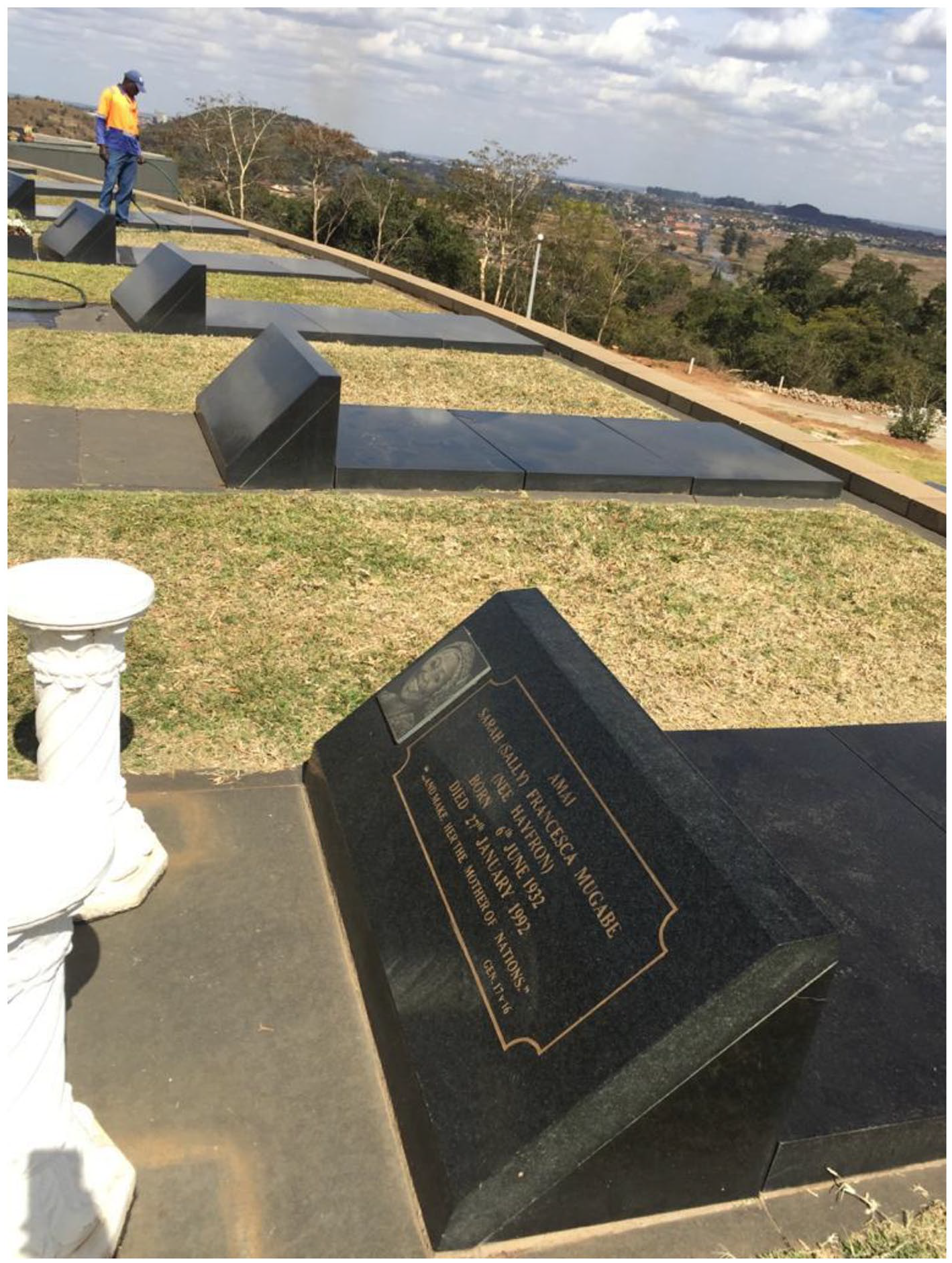
The reserved mystery graves. Mugabe’s reserved grave near that of Sally Mugabe. The second empty grave is presumably that of Mrs Joice Mujuru, Solomon Mujuru’s widow. The next grave to the second empty one belongs to Solomon Mujuru, the man credited with making Mugabe the country’s leader. (Picture copyright: Shepherd Mpofu).
There is another possibility. Mugabe’s reserved grave is next to that of Sally Mugabe, Mugabe’s late wife whom many who were not aware or deliberately chose to ignore her corrupt tendencies (Mpofu, 2020) called the true Mother of the Nation, and it could be possible that Grace Mugabe could not fathom the two’s reunion and therefore could have claimed Mugabe did not want to be buried at the shrine. Besides, Grace Mugabe’s friction with Mnangagwa cannot be overstated as it publicly manifested when the latter was still vice-president. She was the first to intimate Mnangagwa’s downfall as some suspected she wanted to succeed Mugabe. The rift grew when Mnangagwa disposed Mugabe in a coup, leading to him dying a ‘broken soul’. Grace ‘had made it clear to all who would listen that Mr Mnangagwa and his loyalists were not welcome at the burial’ (Thornycroft, 2019) in Zvimba, Mugabe’s rural village.
Dead bodies, funerals and the accompanying rituals play a central role in modern African politics as the influence of the dead has far reaching political capital and consequences. As Kalusa (2017) writes, the corpse is
Concrete and protean, sacred and profane, the corpse is a complex, ambiguous and enigmatic object. It is thus a source of no small amount of ambivalence that energises human and political imagination, evoking multi-vocal meaning and inspiring diverse, if conflicting, political visions and uses among political rulers and their subjects. (pp. 1138–1139)
Before venturing further into this article, let me map out its itinerary. First, I set the theoretical framing. I use Mugabeism, Zanuism and corpse-power to explore what Mugabe meant to the Zimbabwean politics. Second, I explore the meanings of the National Heroes Acre and how Mugabe used the space for personal political mileage to the effect of turning it into a toxic space. Here, I interrogate the meanings of a dead body in Zimbabwean politics and specifically in Mugabe’s hands. Finally, I engage the meanings of Mugabe’s dead body and the political contestations of the body as a political trophy in the current ruling party’s hands.
On theory: Mugabeism, Zanuism and corpse-power
The governability of life and the authority of the state, as a political governing authority has on life is well documented in theories such as biopolitics, bare life (Foucault, 1978) and necropolitics (Mbembe, 2016). These theories are insufficient insofar as they help us understand governmentality and power as they do not afford us a critical appreciation of the political power of the corpse. I propose corpse-power theory, which borrows from Gell’s (1998) anthropological agency theory and is a development of Clymer’s (1999) corpse theory as a framework for understanding the dead body as ambivalent, something more than dirt and a disposable object but as something materially, politically, socially and economically alive ‘imbued with traits, characteristics and meaning’ (Harper, 2010: 311). Corpse-power theory suggests that the corpse exercises its power at three levels at most: over itself, the living and its susceptibility to be used by the living for various socio-political and economic ends. The way Mark Anthony, in Shakespeare’s Julius Caesar, uses Caesar’s corpse to stir the mob into an uprising is a case in point here. The corpse has power and self-determination over itself and also over the living, be it family, business or political associates. Thus, corpse-power theory further proposes that a dead body has an identity and meaning, even the disposable one, and is surrounded by various narratives with political, social and economic possibilities as corpses ‘can be used to demonstrate veneration of a hero or to effect an ultimate punishment on an enemy’ (Clymer, 1999: 92). Corpses are riddled with ‘personal and institutional conflicts, negotiations and appropriations’ (Greenblatt, 1990).
A dead body is cast as a social agent (Hallam and Hockey, 2001; Harper, 2010; Williams, 2004). Drawing from art, Gell argues that art objects ‘act as social agents within a network of social relationships and this agency is intrinsic regardless of cultural conventions’ (Harper, 2010: 311). Agency of the corpse could be construed as coming from two critical places that the living contend with, internal and external. The internal theory posits that
behaviour is caused by factors that well up from within the person, thoughts wishes, intentions etc. Minds are hidden away inside people, rather than being manifested in between them, in the public space in which interaction takes place, as the externalist theory seems to be saying. (Gell, 1998: 127)
The externalist theory deals with the outward seens, the ‘visible superficial, features of the human body make possible the abduction of the “invisible” mind, awareness, and will from the visible image’ (Gell, 1998: 132). The living experiences the dead through inferring the deceased’s inner agency by abducting this from the pre-deceased as primary agent. The acknowledgement of the dead body’s current or possible mental state renders the body agential implying that the corpse ‘has something inside it “which thinks” and “with which it thinks” . . . [having] internal psychology . . . a spirit, a soul, an ego lodged within it’ (Gell, 1998: 129). In most cases, mourners abduct agency from the pre-deceased into the deceased hence they interact and converse with the dead. The author has attended funerals where the dead are spoken to, deemed to spiritually intervene in the lives of the living from heaven, are buried with pots, spears, walking sticks, money and an assortment of goods to symbolise transition into another life. Together with Mugabeism, the corpse-power theory magnifies the complexities over Mugabe’s and those heroes he buried at the Heroes’ Acre.
Mugabeism can easily be conflated with Zanuism. Mugabeism and Zanuism use the nation’s past experiences to legitimate and consolidate their stranglehold on power while dismissing opponents as retrogressive (Ben-Amos, 1991). Mugabeism is a constellation of
political controversies, political behaviour, political ideas, utterances, rhetoric and actions that have crystallised around Mugabe’s political life . . . a populist phenomenon . . . marked by ideological simplicity, emptiness, vagueness, imprecision, and multi-class character. (Ndlovu-Gatsheni, 2009: 1139–1141)
For him to maintain legitimacy, Mugabe sought to unilaterally construct a Zimbabwean identity using patriotic history (Ranger, 2004). This history divided Zimbabweans into outsiders and insiders, patriots and sell outs and scholars into patriotic scholars and critical scholars. According to Ranger (2004), the first person to eloquently articulate patriotic history, patriotic history could be defined as
. . . is intended to proclaim the continuity of the Zimbabwean revolutionary tradition. It is an attempt to reach out to ‘youth’ over the heads of their parents and teachers, all of whom are said to have forgotten or betrayed revolutionary values. It repudiates academic historiography with its attempts to complicate and question. At the same time, it confronts Western ‘bogus universalism’ which it depicts as a denial of the concrete history of global oppression. ‘Patriotic history’ is propagated at many levels – on television and in the state-controlled press; in youth militia camps; in new school history courses and textbooks; in books written by cabinet ministers; in speeches by Robert Mugabe and in philosophical eulogies and glosses of those speeches by Zimbabwe’s media controller, Tafataona Mahoso. It is a coherent but complex doctrine. (p. 215)
Besides being advocated for by patriotic scholars especially professors at the University of Zimbabwe and elsewhere, patriotic history found foot soldiers in state-controlled public-owned media under the Zimbabwe Newspaper (Zimpapers) umbrella and the state-controlled broadcaster, Zimbabwe Broadcasting Holdings. For a long time, the narrative of patriotic history in these media has been in support of the land reform, current ruling regime and its policies anchored on experimental financial policies and mythic mega-deals meant to spawn economic growth. This form of journalism is characterized by uncritical, myopic and even thoughtless support of ZANU-PF, its brutal and mostly undemocratic systems. One such is The Herald, a government mouthpiece and ZANU-PF propaganda outlet that once described Mugabe as ‘Africa’s political grand master’ (Mpofu, 2014: 48) with a grand narrative ‘of emancipation and enlightenment . . . a conqueror of colonialism, fighter against neo-imperialists [and] man of action . . . a just, faithful devout soldier’ (Mpofu, 2014: 144). Furthermore, Mugabe is ‘Africa’s most loved and famous son’, the ‘nemesis of colonialism, and for any imperialist stooge’ (Mpofu, 2014: 144). According to former ZANU-PF Member of Parliament Tony Gara, Mugabe was ‘the second Son of God’ (Meredith, 2007: 80). Joice Mujuru, then Mugabe’s deputy president, member of the ruling ZANU-PF later expelled and now opposition leader, captures this ideology in the extract below:
People are wasting their time by opposing President Mugabe. It was prophesied . . . when he was only 10 years old, that he was going to lead this country. How can a normal person challenge such a leader? There is nothing wrong in people having ambitions and discussing political issues with their wives. They should not, however, tamper with the presidency; it is sacrosanct. These positions come from God . . . Our independence did not come by accident. Thousands of schoolchildren died in the name of the party. People sacrificed their lives for this country. Even when Abraham was about to sacrifice his only son, God saw it fit for him not to sacrifice human blood. However, people here paid the ultimate price for this country to be free. (Meredith, 2007)
Religion is used to mystify Mugabe and ensconce his hold on to power (Mpofu, 2022). The use of words like ‘prophesied’, ‘sacrosanct’, ‘position from God’ and ‘his people’ contextualizes Mugabe’s power, invincibility, sacredness of his presidential office and ultimately ‘ownership’ of Zimbabwe through redemption, that is, liberation. While critical scholars have advanced an anti-ZANU-PF agenda, some have even gone to an extent of creating a crisis industry out of Zimbabwe’s economic situation whereby they have commercialized the democratic struggle and consult for the Western governments or nongovernmental organizations (NGOs) for a fee. Nothing captures this than the following quotation whereby one of Tendi’s (2008) interviewees, an academic at the University of Zimbabwe, argues his position as a critical scholar engaged in commercialisation of the struggle for democracy thus:
. . . my children do not eat book chapters . . . I do consultancy work for NGOs and I bend my analysis to please them. I tell NGOs what they want to hear. I tell them Mugabe is bad and there is a serious crisis and I say it loudly so they are satisfied . . . they will come to me next time . . . and . . . bring new clients. (391)
Those who have thus engaged positively with patriotic history contribute to the three pillars that have largely informed Zimbabweanness as imagined by ZANU-PF: Amadoda sibili, Mugabeism and Zanuism. Amadoda sibili (IsiNdebele for real men) arose out of Mugabe’s call for real men to defend the nation (read Mugabe and ZANU-PF) after one of the ministers Mugabe had appointed ran away and resigned from his new South African base as he could not stand ZANU-PF destructive economic policies. ‘Mugabe’s amadoda sibili discourse is an attempt at resuscitating the colonially pulverized African masculinity and dignity with a new ability to struggle and overcome against real or imagined enemies’ (Mpofu, 2014: 47). During the coup, Mugabe was emasculated. The shame of this castration and being ‘undondaised’ was furthered by that of death. If he did not die of a broken as alleged above, he died with one.
Deathscapes: Heroes Acre as a contested site
Deathscapes have to do with the dead and the dying and are ‘the material expression in the landscape of practices relating to death’ (Teather, 2001: 185). This includes such landmarks and iconic sites as cemeteries
as well as more ephemeral manifestations and artefacts such as scattering of ashes . . . deathscapes are not only spaces associated with the dead and dying, but are also constituted by the meanings which are attributed to such spaces by the living. (Hunter, 2015: 247–261)
As part of memory and national identity construction, different societies use national heroes as potent signifiers of nationhood and exemplariness. These are exemplars of resolve, determination, overcoming and influence. Heroes are usually bestowed a hero status upon death, and there are certain ways in which their burials are handled. Heroes’ Acres or state sanctioned and assisted funerals are important in honouring the heroes. In Zimbabwe and Namibia, there stands two exemplars of Heroes’ Acres. They are identical, and the latter is inspired by the former (Mpofu, 2017). Both shrines are imposing and politically significant and sacred. The Heroes Acre in Harare sits on a 57 hectare piece of land just 7 kilometres outside the city. It was financed and constructed by the North Korean engineers. It is ‘designed like two AK 47 riffles lying back-to-back with graves symbolizing the magazine’ (Mpofu, 2017: 666). The shrine’s artistic detail and imposing stature are propagandistic with ‘many black slabs of memorial granite . . . concretize a moment in a wider project of national inscription’ (Werbner, 1998: 82; see also Marschall, 2006). The state mouthpiece, The Herald describes the shrine as a place that
. . . carries the richness of a people struggle against the brutal oppressive regime. There lies the leadership of a people’s revolution, those who sacrificed their life to bring change in Zimbabwe politics thereby shaping not only the country’s developmental pattern but also the region . . . [It is also a space where] we cherish our history as learning from it can help foster national unity which is one of the aims of the National Heroes Acre. This monument serves as an education centre for students, ordinary Zimbabweans and tourists from abroad about a major part of this nation’s history. (Cited in Mpofu, 2017: 73)
The use of granite, bronze and materials that are enduring and resist the ‘ravages of time’ (Osborne, 1998: 434) suggest Mugabe’s attempt at freezing time, patriotic history and memory, and his legacy in space and time (Mpofu, 2017). The shrine is a paragon of excellence for any commemorative project especially in Africa where politicians are prone to excesses in display and power performances.
The shrine has some symbolic architectural structures such as ‘a tall column, crowned by an Eternal Flame, towers above the monument and is intended to symbolise triumphal victory and the desire for freedom’ (Marschall, 2006: 179) at the centre. Also, of importance to the ‘shrine is the trademark Tomb of the Unknown Soldier, marked by a colossal statue of three heroic soldiers, two males and one female, carrying a flag, a rocket launcher and an AK 47 assault rifle’ (Mpofu, 2017: 66). The Unknown Soldier does not represent any known person or hero but those who died or disappeared during the liberation struggle. More imagery of heroes in the murals at the shrine betrays the phallic nature of space and Zimbabwean politics. There are more men than women on the murals. Where Black liberators are victims of White men’s brutality, this is captured through the victimization of women. While the murals do not depict any specific soldier or hero, there is one which puts to rest the centrality of Mugabe to the making of the Zimbabwe nation and the heroes’ shrine. The mural shows what is clearly an aesthetically exaggerated Mugabe – head towering others, facial profile clearly defined, looking youthful, innocent, facing ahead in pure leadership style. This imposing portrayal has immortalized Mugabe as an embodiment of the liberation struggle and a grand teller of the national narrative (Mpofu, 2017: 67). See Figure 2.
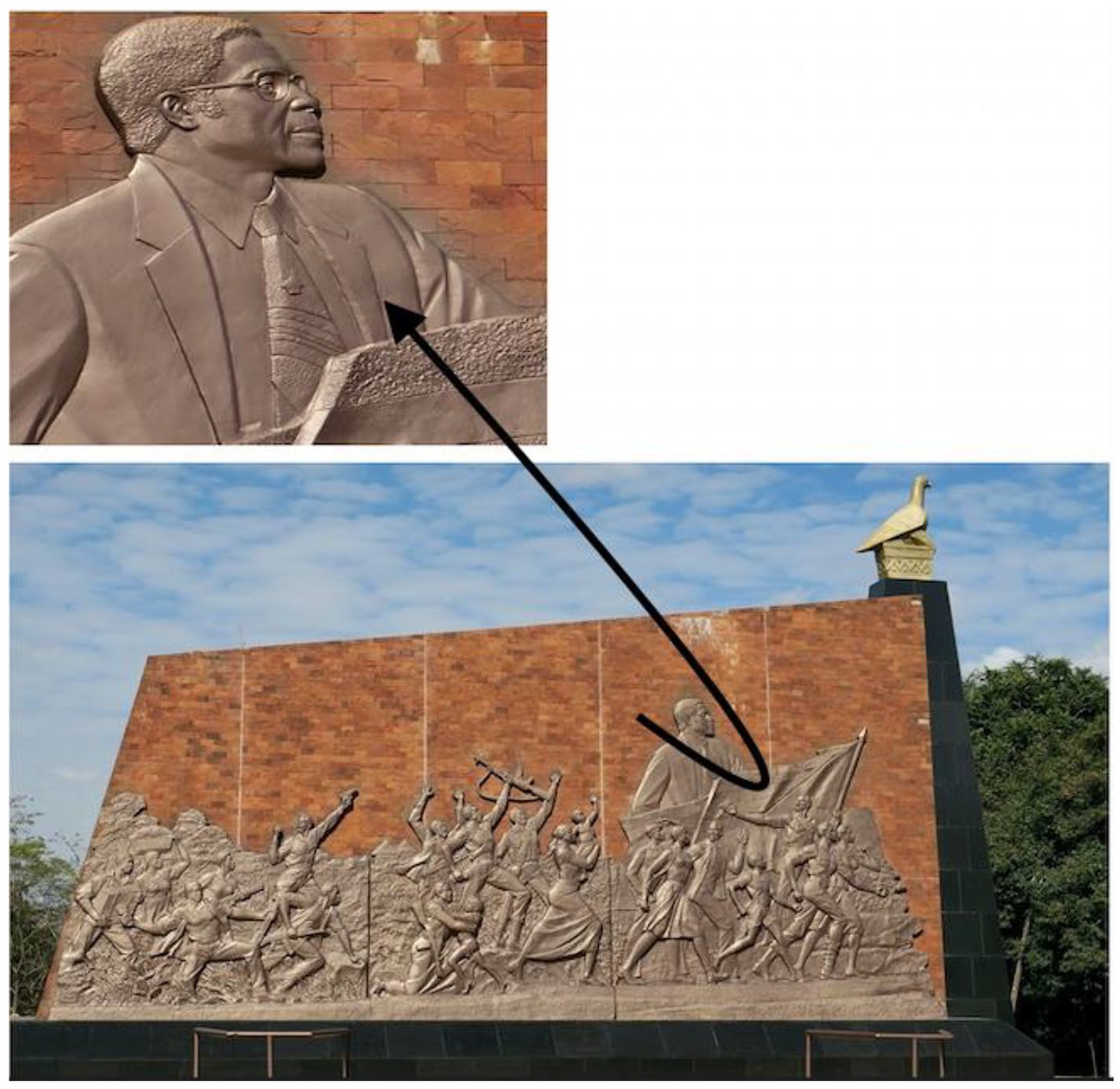
The murals representing the fight for freedom. Most images do not have profiles resembling any known fighters except Mugabe who towers everyone, looks forward in true leadership style justifying assertions that he personalized the Heroes’ Acre. (Picture Copyright: Shepherd Mpofu).
Paul Themba Nyathi (2004) aptly observed that Mugabe ‘appears to use the funerals (conducted at the shrine) as a pretext for making major policy statements and to rail against perceived enemies’ (p. 66; see also Mpofu, 2016b). Mugabe himself said,
This national shrine [Heroes’ Acre], . . . is a place of renewal and re-dedication that strengthens our resolve and pledge that Zimbabwe shall never be a colony again. For, as we look at the pantheon of heroes and heroines who make our roll call today, what greater challenge, what greater patriotism is there, than to faithfully and resolutely guard that which cost us tens of thousands of lives to achieve? Where would our honour be if we were intimidated by imperialism’s-tired trickery into letting go of our sacred land? (Cited in Mpofu, 2017: 73)
Accordingly, as Mugabe’s spokesperson, George Charamba, once wrote in The Herald, the Heroes Acre is
. . . not a facility for bleaching darkened political souls. It is a site and recognition of honour: honour irrevocably achieved and thus honour which cannot be reversed or undone through subsequent transgressions. ZANU-PF, the sole creator of that Acre . . . sole author of rules of entry to that shrine, relies on death for this irrevocability. (The Herald, 28 August 2010 in Mpofu 2017)
This was made in reference to those fighting against ZANU-PF and Mugabe’s despotic regime. Mugabe labelled these opposition forces or ‘darkened souls’ as sell outs and ‘the Heroes’ Acre was a ‘scared shrine that was home to the country’s fine citizens endowed with selfless qualities of humanity’ (cited in Mpofu, 2017: 73) and a space ‘not for sellouts, but patriotic Zimbabweans who sacrificed their lives to liberate the country from the colonial white regime’ (21 February 2013). The shrine is a place where Mugabe ‘shouts’ at his opponents, real or imagined, both locally and internationally; makes policy and other important pronouncements; and buries his allies, where he uses their dead bodies to perform authority; demarcate the nation into insiders and outsiders; and a space for remembering and selective forgetting of the past as long as it is expedient to him. He portrays these dead men and women as ‘paragons of nationalist decorum to be emulated by ordinary citizens’ (Mpofu, 2017). Dead bodies of heroes are thus at the core of ‘nation-building processes and in the consequent creation of distinct national and political identities’ (Kalusa, 2017: 1139). Mpofu (2016b) observes that the rituals at the shrine
are structured in a complex way where at one moment the masses are relegated to the margins and, at another, made to feel as part of the proceedings. The coerced participation of citizens gives an impression that they are rubberstamping in approval the bureaucratic ways Mugabe and ZANU-PF employ in dispensing state power, performance. (pp. 33–34)
The discourses around heroes and access for the dead to be buried at the shrine have been conflictual as the definitions of heroes are diverse and not necessarily aligned with those advocated by ZANU-PF. The Heroes Acre has been rejected by such freedom fighters as Edgar Tekere, Welshman Mabhena and others labelling the place as a resting place for murderers and thieves. Underseving Mugabe loyalists of questionable liberation war credentials such as Chenjerai Hunzi (he led the chaotic land grabs in the early 2000s and also helped bankrupt the liberation war heroes compensation fund), Cain Nkala, Border Gezi among others were rewarded with burials at the shrine. Some were buried at the shrine by mere proximity to Mugabe while those who fought in the country’s liberation such as Thenjiwe Lesabe were punished at death by being not buried at the shrine because they left ZANU-PF to join opposition parties. Mugabe’s cousin, James Chikerema, one of the country’s founding heroes, was buried at his rural home after Mugabe refused that he be buried at the Heroes Acre. Chikerema was one of Mugabe’s fiercest critics in independent Zimbabwe. An unforgiving Mugabe said Chikerema
betrayed his comrades when he joined up with Bishop Abel Muzorewa and Ian Smith as part of the internal settlement . . . [and ignoring party policy of] consistency and persistence . . . [which are] key to our definition of national hero [hence he could not be buried at the shrine]. (Mpofu, 2014: 196)
However, this cannot be said to be a consistent policy of ZANU-PF in its privatizing and personalizing the Heroes Acre around Mugabe. Mugabe’s ally turned opponent, Edgar Tekere, was forcibly buried at the shrine despite opposing Mugabe and this was seen as part of Mugabe’s divisive and tribalistic politics. One discussant in an alternative online publication once argued that ZANU-PF chooses heroes based on a system that
is partisan and tribal. ZAPU is the first political party to be brave enough to openly talk about this . . . [there is need for] condemning the privatizing of the national heroes’ system in Zimbabwe . . . if you want . . . guarantee [of] being a Zimbabwe national hero, you have to be in no order; 1-Shona, 2-ZANU, 3-A thug. The most important of these is being a Shona of course. (Mpofu, 2016a: 101)
Monuments have a dual function in memory and nation making. On one hand, their physical presence ‘assures their place in memory, on the other hand memory does not inhere in the monument and subsequent interpretations of the monuments are open ended’ (Jones, 2003: 66). The debate about the hero status of the departed has been raging for a long time in alternative public spheres where ordinary citizens and other opposition forces are agreed that a heroes shrine is a place where a hero is buried even outside the Heroes Acre. Sithole (2011), writing in NewZimbabwe.com, captures this succinctly as he says
Most profoundly, many Zimbabweans have now come to recognise heroism apart from ZANU-PF pronouncements, and whatever Mugabe and his Politburo say of those with whom they do not agree politically, if people see them as heroes, then heroes they will forever be.
Thus, this is a departure from the ZANU-PF centralized way of recognizing and rewarding heroes. What is key to note is that Mugabe used dead heroes’ bodies for political expediency as his eulogies that seek to shepherd Zimbabweans behind a Mugabeist and Zanuist ideology. Presidential speeches at the burials are critical as they are ‘important rhetorical rituals’ (Mpofu, 2016a: 31) and ‘governing tools since “. . . presidential speeches and actions increasingly reflect the opinions that speaking is actually governing”’ (Ceasar et al., 1982: 234). For Mugabe, the speeches were used to
strengthen bonds between speaker and listeners and among listeners themselves, building a sense of community. To create a sense of community, they usually create a sense of presence for particular ideas and values. They bring to the forefront of consciousness some value or belief that a group holds but may not have thought much about, which makes people aware that they share important values and beliefs . . . and draw people together. (Zarefsky, 2008: 430)
In the nationalist rhetoric, nothing brings people closer to each other than having a shared destiny, heroes, aspirations and common enemies and fears. During burials or Heroes Day celebrations which take place at the shrine, Mugabe rails against domestic opposition parties and the international community opposed to his autocratic rule. He accused these bodies of attempts to recolonize Zimbabwe and reverse the gains of independence including the land reform. According to Mugabe, the Heroes Day and the Heroes Acre underscore ‘the centrality, indeed, the inviolability of the liberation struggle in the past, present and future life of our country. Zimbabwe ndeyeropa! Zimbabwe sayithola ngempi! [Trans: Zimbabwe was won through the spilling of blood!]’ (Mpofu, 2016a: 33). Mugabe thus used the contested concept of the hero status and adulterated the meanings of the national shrine for the burial of heroes for politically expedient purposes. This, however, was challenged from within the party, especially by some dead heroes who refused to be buried at the shrine and by ordinary citizens who argued that they had the ability and right to recognize their own heroes and respect their respective burial places as shrines.
Deconstructing Mugabe’s corpse as a contested political instrument
This section shines a spotlight on the conflict between the Mnangagwa-led military regime that took power from Mugabe through a coup and his family as they tussled over the control, fear and burial of Mugabe. The corpse, in this instance, has power over itself and those around it. It decomposes, releasing tissues, fluids and gasses that affect itself and the surrounding. It also has power to cause the movement and behaviours of those around it as it ‘makes them gather, . . . dig a hole . . . light a fire and . . . shed tears’ (Sørensen, 2009: 111). Mugabe left Zimbabwe under the auspices of the Mnangagwa regime to seek medical care in Singapore in April 2019. He died on 6 September and was buried at his home on 28 September 2019. In August, a private newspaper, The Zimbabwe Independent, ran a story to the effect that a bedridden Mugabe rejected the idea of being buried at the Heroes Acre. The paper claimed that Mugabe ‘made it clear that he would not want President Emmerson Mnangagwa – who seized power from him in a military coup in November 2017 – and his allies to hold forth and pontificate over his dead body’ (Gagare and Mananavire, 2019). Besides, when Mugabe’s body arrived in Zimbabwe from Singapore on 11 September, Grace Mugabe guarded it jealously as she was instructed by Mugabe as ‘some people have an inclination for rituals. We are afraid that some people are after his body parts or even his whole body and they want to use that for rituals’ (Mataranyika and Karombo, 2019). Thus, a dead body, as corpse-power politics suggests, is a meaningful powerful political tool and player hence Grace Mugabe’s behaviour.
Welcoming Mugabe’s body at the Robert Mugabe International Airport, Mnangagwa suggested he would be buried at the Heroes Acre. Initially, the family suggested that Mugabe would be buried at his rural home and lambasted the government for coercion and planning a burial programme without family participation. However, a funeral programme was done at the National Sports Stadium and, as Leo Mugabe told CNN,
we will have a normal government burial function, which normally happens at the Heroes Acre and then the 21-gun salute. But we will not do the actual burial on Sunday. We will take him away. The traditional leaders have asked for some time to perform traditional rituals. (Chingono et al., 2019)
This was going to be a first time a burial ceremony is done that way. On the previous day, Mnangagwa eulogized Mugabe in a poorly attended service where ‘many seats in the arena remained empty as the turnout failed to match the crowds seen during the body viewing earlier this week’ (Chingono et al., 2019). This could have been public protest directed at Mnangagwa and his regime that overthrew Mugabe in a coup. At the funeral ceremony attended by dignitaries from across Africa, Mnangagwa lionized Mugabe as ‘a great son of the soil, a visionary and champion of our empowerment . . . a true Pan African . . . our commander, mentor and leader’ (African News Agency, 2019). This was an attempt to immortalize Mugabe and use his body as an endorsement and continuation of Zanuism and Mugabeism (Clymer, 1999). Many Zimbabweans deemed the speech dull and uninspiring for a president. As adumbrated by Muckraker addressing Mnangagwa’s inadequacies
[B]ut you can always bet on Mnangagwa desperately trying to find a stage to make a speech, something which he . . . is woefully terrible at. Almost two years in power, the man is still yet to convince even himself that he is presidential. (Muckraker, 2019)
It is possible Mnangagwa attempted to marshal the power of Mugabe’s corpse to endorse his contented presidency 2 years after the coup. Mugabe routinely used dead bodies especially of heroes buried at the National Heroes Acre for political expediency (Hunter, 2015).
After some negotiations with the Mnangagwa regime, a deal was struck and Mugabe, whom the family spokesperson claimed was royalty and therefore supposed to be buried according to the rites followed in the Zvimba royal clan in a cave and in privacy, was to be buried at a specially constructed mausoleum at the top of the Heroes Acre shrine. On 13 September, Leo Mugabe said, ‘The government and the chiefs went to the Heroes Acre, showed each other where President Mugabe is going to be buried, and that place would take about 30 days to complete’ (Oliphant and Westington, 2019). Building Mugabe a mausoleum cemented Mugabeism and gave an impression of a special place he commands in the country’s history and therefore this gesture was meant to make his burial special and uncommon. One may also read it as an attempt to make amends considering Mugabe died a ‘broken soul’ with a heartbreak caused by the coup. Fontein and Harries (2009) argue, some deaths are traumatic, and there is need for humanizing efforts towards their burial to compensate for the bad death. The agreement therefore meant Mnangagwa would get a chance to preside over Mugabe’s burial, control the ideological narrative and strengthen his contested legitimacy considering the manner he came into power and the killing of protestors by the military during a disputed election which he allegedly rigged. To this end, Kalusa (2017) says mausoleums could be used as burial sites of ex-leaders by those sitting presidents aspiring to entrench their legitimacy.
Patrick Zhuwao (2019), Mugabe’s nephew who ran away to exile during a military coup as the Mnangagwa regime wanted to arrest him and others it considered ‘bad elements around the president’, previously wrote in his blog signalling cultural and political powers of the dead vis-a-vis Mugabe’s desires to be buried at his home village:
There are people to whom President Mugabe outlined his wishes on where he would like his mortal remains to be interred. President Mugabe’s wishes . . . must be respected irrespective of the desires and wishes of any politician no matter what lofty positions or office they think they occupy. Those who know President Mugabe’ wishes must NEVER be threatened or intimidated. As . . . a (nephew) of the Gushungo clan, I am very aware of the spiritual power that vanaGushungo have over matters to do with their wishes, traditions and legacy. Let those who think they can torment President Mugabe’s departed soul and subjugate the wishes of the . . . ancestors know that they are inviting the spiritual wrath of the whole clan. Be warned; you will never win that spiritual war; kuzvikokera ngozi (that is inviting a curse on oneself). (Zhuwao, 2019)
While the mausoleum was under construction, the Mugabe family announced that he would now be buried at his rural home, a decision Grace reached allegedly after hearing that the new burial place that would be overlooking all other graves would not accommodate Mugabe only, but all heads of state. Thus, burials in African contexts are at the core of identities, calling on
tribes to take cognizance of themselves as collectives, to symbolize their social order [and] objective sense of their own society (Ademiluka 2009: 17). Having control over burial is a form of reaffirmation of belonging [whereby] the funeral at home must reaffirm urbanite’s connections to the village. (Geschiere, 2005: 59)
This was after Grace Mugabe’s request that the burial be at the Blue Roof, a name used by locals to refer to Mugabe’s mansion in Harare, was declined by the Harare City Council. The Mnangwagwa’s government released a terse statement to the effect that it respected the family’s decision that Mugabe was going to be buried at his rural home in Zvimba. This marked the Mugabe’s revenge on Mnangagwa.
The family conflict leading to the burial of Mugabe was political: Leo Mugabe and the Zvimba chiefs did not attend the final burial of Mugabe as they were accused of getting bribes from Mnangagwa’s government so as to allow the latter to bury Mugabe. Leo Mugabe explained,
We had a fall-out on Saturday . . . before the burial. We fell out because she said I took a bribe from Mnangagwa to influence the decision to bury my uncle at the Heroes Acre. It is not true to accuse chiefs of taking bribe . . . Nobody was coerced into taking my uncle to the shrine . . . The designs of the Mausoleum were approved by Grace and relatives. Permission to construct the mausoleum came from Grace, only to change her mind later and leave everyone in the dark. (Chingono et al., 2019)
It is not only Mnangagwa who had a claim on Mugabe’s body and therefore stood to benefit politically from presiding over his burial. Grace Mugabe could have been bitter about her husband’s humiliation during the coup and the final contest she wished to win against Mnangagwa was over the ownership and burial of Mugabe. Citizens formulated their own discourses on the funeral with most of the talk feeding off ‘popular culture of death and beliefs as much as it illuminated their social, economic and political concerns’ (Kalusa, 2017: 1141). There were some citizens who loved Mugabe and his body had to be shown to them before burial. Interestingly, after the National Sports Stadium funeral service, Mugabe’s body was supposed to be flown to Zvimba but some citizens along the way demanded, as the family put it, they wanted to see and bid farewell to their hero forcing the government and family to use the road instead. Conceding to these demands points us to the power of the dead body to do what otherwise an alive Mugabe would not have done. Besides, the event was more complex than that, and Verdery (1999) has a point in saying dead bodies have a ‘capacity to evoke a variety of understandings’ and actions (p. 29). These contests present Mugabe as a man of the people but the bigger picture suggests that ‘it’s a combination of personal vendettas, continued hostilities over the coup and competing agendas’ (Gagare and Kairiza, 2019) that were competing. And of course, in comparison, despite his faults, Mugabe was labelled better than Mnangagwa after the coup. The opposition parties were also peripheral contenders who came into the scene for political rather than humanitarian or goodwill grounds. Mugabe brutalized the opposition, his security agents arrested and physically harmed them. Their presence at the funeral was to magnanimously woo those who sympathized with Mugabe given his endorsement of Nelson Chamisa, Mnangagwa presidential competitor in the 2018 election.
Such was Mugabe, divisive and divisible in life and in death at both political and familial circles. The burial was even more ‘bizarre’ as he was ‘interred in a steel-lined coffin under a layer of concrete’ with Leo Mugabe explaining the steel casing thus: ‘People really are after his body or his body parts, so we wanted something that is tamper-proof. That is why the casket was changed’ (Thornycroft, 2019). For Mnangagwa, an opportunity at political spectacle through performing ceremonial power (Foucault, 1979), to use Mugabe as a symbol of national identity construction and unification, was denied and the denial permanently cast in steel and concrete, never to be appealed again. As the epigraphs above suggest, Mugabe ruled from the grave. The first suggests immortality of Mugabe while the second suggests his powers even beyond life. The narrative that Mugabe was better than his predecessor abounds especially on citizens’ criticism of Mnangagwa on social media (Pindula News, 2019). The third seems fulfilled at death too as he outwitted his opponents: they could not be in charge of his dead body. All this links well with Mugabeism which characterizes Mugabe as a complex politician, at one time a unifier and at another divider, a nationalist, Anglophile, xenophobe and a tribalist, a hero and a villain, a forgiving and an unforgiving man and, above all, a man whose corpse, just like those who died for the liberation of the country and those he buried at the Heroes Acre, re-emphasized the importance of supernatural forces in African political thought and behaviour more than modern political science (Geschiere, 1997; Gordon, 2012).
Conclusion
Funerals of great men are magnified versions of those of ordinary men. Both are rites of passage to the unknown world, characterized by entanglements of political and supernatural tensions, ceremonies and beliefs. While at a familial level, the dead are eulogized as uniting families or communities, at state level, they are magnified as nation builders. At a familial level, displays of opulence and performativity and ceremony are usually minimal. The state spares no expenses at the burial of heroes, not for the heroes or their families, but these are seen as passing on the mantle to the current leaders who preside over the burial. State funeral rites are done at stadia, usually on a Sunday to pull large crowds, broadcast on television, radio and online these days, to make them truly national (Ben-Amos and Ben-Ari, 1995) and deliver that pedagogical messages and examples to be followed to the citizenry. From the foregoing, it is clear that in African politics and cultures, a dead body is as animated, politically, as a living one and has a multiplicity of meanings attached to it especially during heightened moments of the nation and ‘system transformation’. Mugabe’s corpse became a site of political contestation between his family and the regime that usurped power from him through a military coup. The failure to execute the burial properly undermined the possibility of the reinforcement of ‘collective sense of belonging’ rendering Mugabe’s ‘Zimbabwean’ community ‘not fully complete’ (Chabal, 2009: 49).
Through the corpse-power theory, I have demonstrated how Mugabe’s body acquired and exercised of power from five fronts. The corpse had power abstracted from the fact that it belonged to a former head of state. Second, it had culturally imputed power bestowed upon it by virtue of respect and rites performed on the dead in many African cultural settings. Third, the family used the body as a powerful political tool especially to ‘fight’ off the Mnangagwa regime presumably for their treatment of the former statesman. Fourth, there is power by the living-dead, that is the former human Mugabe, over their corpses and since corpses can be used to obey or disobey the former dead’s wishes, it assumes a certain level of power. Finally, corpses have power as and when used by former associates, conquerors or enemies. Thus, Mnangagwa and his associates wanted to use Mugabe’s burial for political expediency. Mugabe, however, alleged they wanted to use his body for ritual purposes. Mugabe was deeply invested into the darker spiritual world (Mpofu, 2020).
Mugabe’s refusal to be buried at the Heroes Acre dealt a double blow to Mnangagwa who had just won a contested presidency and would have benefitted political legitimacy from eulogizing Mugabe and partaking in the spiritual act of delivering Mugabe into a ‘smooth passage of a great man from the world of the living to posterity’ (Ben-Amos and Ben-Ari, 1995: 168). The regime missed an opportunity of profiting from the prestige of the dead. At death, Mugabe revenged on the Mnangagwa and military-led coup that disgraced him. Grace Mugabe also used her late husband’s body as a site and tool to avenge the embarrassment caused to her family by the coup and also the denting of her aspirations, if ever true, to succeed her husband. Indeed, as Pearson (1993) avers, corpses are ‘manipulated for the purposes of the survivors’ (p. 213). The failure to bury Mugabe weighs heavily on Mnangagwa’s legitimacy project and without being prophetic, he seems to be worse off than Mugabe even though he is operating under Mugabeism-influenced ideological framing.
Footnotes
Funding
The author(s) received no financial support for the research, authorship and/or publication of this article.
