




Abstract
This paper analyses the photographic representation of former Zimbabwean President, Robert Mugabe, with the aim of understanding memories that were produced following his death in September 2019. Mugabe was in power for 37 years before being dethroned through a military coup in November 2017. His rule divided opinion with some viewing him as a liberator and African icon, while some view him a dictator and tyrant for his role in disregarding human rights. This paper seeks to explore the role of photography in memory with particular interest being on commemorating contesting figure like Mugabe. We analysed photographs used by The Herald and NewsDay to commemorate Mugabe’s death. Photographs remain one of the under researched genres in communication, especially in the Global South, yet scholars have argued that contemporary societies have, through the use of photographs, turned their citizens into ‘image junkies’ and created ‘the most irresistible form of mental pollution’. The findings demonstrate that photographs are being used to give a ‘testimony’ about the contested legacy of Mugabe. Mugabe is framed as a liberator, Pan-African. On the contrary, he is seen as a tyrant and ruled by an iron fist.
Introduction
Former Zimbabwe’s late President, Robert Mugabe divides opinion among politicians, citizens and scholars. Mugabe ruled Zimbabwe for 37 years before yielding to a military coup in November 2017. His party was quick to strip him of his liberation credentials with some claiming that he ‘can’t shoot a fly’. The state-controlled media reduced him to a ‘Mr’ as opposed to ‘Cde’, a title often given to the ruling Zimbabwe African National Union – Patriotic Front (ZANU-PF) members. Despite such changes, the early years of country’s independence under Mugabe’s leadership were promising leading to some scholars describing it as the ‘years of light’ (Moyo, 2017: 67). For some historians, Mugabe has often been described as a liberator and hero of the country’s armed struggle (Ranger, 2005; Tendi, 2010). However, soon after independence, Mugabe through the 5th Brigade unleashed terror on innocent Ndebele speaking civilians killing more than 20,000 people during a period known as the Gukurahundi genocide which the late president apologized as a ‘moment of madness’ (Ndlovu, 2017; Tshuma and Ndlovu, 2020). Despite having managed to forge a Unity Accord with Patriotic Front – Zimbabwe African People’s Union (PF-ZAPU) opposition leader, Joshua Nkomo in 1987, Mugabe found himself plunging into fresh unpopular policies in early 2000 through the fast-track land reform policy where he violently evicted white farmers. Ndlovu-Gatsheni (2015) and Sachikonye (2011) also add that elections in Zimbabwe became bloodier as Mugabe and his cronies vowed they are sole rulers of the country.
The above description by scholars clearly paints an image of a person who was unpopular and ruled with an iron fist. While this may be accurate, some scholars suggest a different portrayal of Mugabe. Some sections of society view Mugabe as a Pan-Africanist whose sole battle was to emancipate the blacks from the white minority harsh rule and also seen as a doyen of economic empowerment (Matsilele and Ruhanya, 2021). Santos (2020) complements these claims when he notes that African leaders described him as a liberation hero, an outstanding revolutionary and an Africanist who turned the rejection of colonization into action. Therefore, Mugabe had two identities, one as a Pan-African fighting all forms of colonialism and racial equality while on the other hand, he was a ruthless dictator who is famously known for murdering his own countrymen in an attempt to establish a one party state among other atrocities he committed.
Thus, within the field of media and communication in which this study is located, Mugabe, particularly after his death, has been a confusing or conflicting character on whether to loathe or to love as there were so many dissenting views of what he (Mugabe) meant during the liberation struggle and present-day Zimbabwe. This study analyses the photographic representation of Mugabe with the aim of understanding memories that were produced following his death in September 2019. A number of words have been used to describe Mugabe from different studies; however, not much focus has been put on images to decipher hidden meanings that other forms of texts cannot bring about, thus, making this study relevant to existing literature. Empirical studies have found that people believe what they see more than what they read or hear (Shea and Burton, 2001) and when visual and verbal messages are in conflict, viewers have difficulty in remembering the verbal information, as visuals override other messages when processed simultaneously (Kracuer, 1995). Plutchik (1980) also argues that visuals can quickly communicate the full spectrum of emotions – joy, fear, trust, surprise, sadness, disgust, anger and anticipation.
In this paper, we argue that through Mugabe’s representation, we are able to understand the ideas of the ‘national question’, and how they failed to materialize. As such, we contend that since Mugabe participated in the liberation struggle, we are able to pick the values of the struggle and the founding ideas and principles that freedom fighters had on post-independent Zimbabwe. Hence, Mugabe’s failures are important in that they help policy-makers and political players to ratify and build a better Zimbabwe for all. Second, we argue that photographs play an important role in the construction of memory especially the contemporary societies which have turned their citizens into ‘image junkies’ and created ‘the most irresistible form of mental pollution’ (Sontag, 2003: 24) because of the proliferation of photographs as a medium of communication.
Zimbabwe’s media landscape
The media system in Zimbabwe has since independence been bifurcated. Robert Mugabe’s ZANU-PF government soon after independence maintained a tight grip on the media which they control through the Ministry of Information. In this paper, we analysed photographs obtained from The Herald and NewsDay. The two represent competing media systems. The Herald is owned by Zimpapers, a stable which champions patriotic journalism that has been propagating ZANU-PF ideologies (Ndhlovu MP and Santos P (2021); Chuma et al., 2020; Tendi, 2010). However, after Mugabe’s downfall, the media stripped Mugabe of his heroism which they accorded to him for the past three decades. This study used The Herald because it is the flagship of Zimpapers and also the country’s leading daily paper. Given that Mugabe’s light soon after the coup was dimmed, the use of The Herald brings out an interesting dynamic on how the stable, which is the mouthpiece of the nation-state, constructed memories around Robert Mugabe. On the other hand, NewsDay falls under the Alpha Media Holdings (AMH) which has been practicing oppositional journalism (Mpofu et al., 2022). Oppositional journalism has been counter-hegemonic where it challenges the state’s ideologies, and thus has been framing Mugabe as tyrant and dictator Mare and Matsilele (2020). For such, Robert Mugabe has always been framed as a bad leader who rules by an iron fist. Since the media does not operate in a vacuum but it is also influenced by society’s norms and values, understanding how NewsDay framed Robert Mugabe is an insightful task to do given that the society, through ubuntu, ‘doesn’t speak ill of the dead’ (see Chasi, 2014). Therefore, with these media houses representing different sectors or players in society, their representation of Mugabe is, arguable, a reflection of the entire society which has always viewed him from a bifurcated position.
Photography, memory and political elites
For many years, different memory entrepreneurs have been using photographs to commemorate certain events and political elites with the aim of evoking particular memories or discourses. In the Global South, especially Africa, the liberation struggle has been commemorated at great length (Muswede and Sebola, 2020). African governments have mainly been using photographs of their icons to celebrate their independence. According to Sakula (1984: 6), photograph plays a critical role in the ‘maintenance of the status quo and reinforcing the social terrain of class relations and social divisions’. Thus, photographs have been used by governments not only to mark anniversaries or producing memories but mainly to maintain the status quo. Barthes (2000: 9) brings to the mind what he calls the ‘return of the dead’ with photographs acting as a shrine of recalling and memorializing by making the invisible events more visible. Therefore, the ‘dead’ are brought back to life through photographs so as to mediate on-going social issues. In this study, we are looking at the visual memories that were produced around the legacy of Robert Mugabe by The Herald and NewsDay upon his death.
While Mugabe’s legacy as explained earlier is made of events that span for close to four decades, the benefits of using photographs in commemorating events and individuals like Robert Mugabe is that they (photographs) have the ‘spatial immediacy and temporal anteriority . . . an illogical conjunction between the here-now and there now’ (Barthes, 2000: 44) because of their ability to ‘knit distinct points in space together over great distances’. This paper argues that the seemingly distinct phases of the past that mainly characterize Robert Mugabe are easily decoded through photographs. A plethora of studies have been written on Mugabe, and they have come to the conclusion that his legacy is bifurcated (Ndlovu-Gatsheni, 2015; Tshuma, 2021). However, at death, as with memory, the legacy of an individual is bound to change. According to Verdery (1999: 28–29), ‘dead people come with a curriculum vitae or resume – several possible résumés, depending on which aspect of their life is being considered’. Thus, through photographs, we were able to decipher possible resumes that the media ought to tell of Robert Mugabe. While there are studies, although few, that are known by these researchers that mainly examine the work of photographs and iconic figures in Africa, the study uses the nexus between photograph and memory to explore a range of memories that emanates from The Herald and NewsDay photographs.
Photographs and power: a theoretical framework
This paper uses the theory of representation and the concept of ubuntu to understand the work of photographs. To begin with, visual representations should not be seen as objective reality but a construction which serves to project a particular view point because ‘like all forms of photographic representation, it is not simply a record of a given moment, for it cannot be innocent of the values and ethics of those who worked with it’ (Hamilton, 1997: 76). Photographic representation is mainly understood from two positions, the positivists and the constructionists approach. This study rejects the former which sees that meaning lying in the photograph which mirror reality, and authentically represent events (Wells, 2003). However, we support the constructivists approach which contend that photographic representation and its power is contextual because its meaning is ‘dependent on a series of historical, cultural, and technical contexts’ (Clarke, 1997: 19). As such, we were able to make use of historical moments around Robert Mugabe and make sense of meaning that the photographer and, ultimately, the editors ought to make. Furthermore, photographic technical aspects like camera angle and shots help in understanding the meaning that the newspapers wanted people to take or deduce.
We also used of the concept of ubuntu. Ubuntu can’t be understood without power and knowledge. However, the dangers of ubuntu are that they tend to be used by ‘authoritarian, opportunist, and ruthless individuals’ to conceal their bad habits for political gain, in sharp contrast with the people’s will (Tomaselli, 2016: 5). This might be the case with Zimbabwe which has endured a legacy of human rights abuses, and ethnic, racial and tribal divisions that people want to have addressed, but the ruling elites have exploited for political control (Ndlovu et al., 2019). More so, this bad legacy is associated with Mugabe. When intertwined with the work of photographs, it (ubuntu) structures how the past, future and present are represented, and in this paper it helps in understanding the structuring of the representation of Mugabe. Ubuntu conceives knowledge and also provides the way people talk about something. Hence, ubuntu plays an important part in discourse making since it influences what can be said, where and how it can be said and by whom. This means that everyone is expected to abide by the ideals of being umuntu (a person), that is, acting in a manner that unites and fosters ‘communal relationships’ (Chasi, 2014). Therefore, when applied to the construction of collective memory, people are expected to retrieve and circulate memories that build and unite communities. Those who perpetuate memories that are seen as antisocial are framed as deviants or aso bantu (being not a person) or akala buntu (lacks ubuntu). This then entails that as much as Mugabe was seen by some as an evil dictator, at death, he is ought to be seen and framed a good leader. This forms part of the idiom, wafa wanaka/ ofileyo yinkosi (translated as one who is dead is good) which charges that people should not speak ill of the dead (Chasi and Rodney-Gumede, 2016). For some, such a person is treated or labelled inyamazana (an animal) (Pearce, 1990: 147). Through ubuntu, ‘individual conformity and loyalty to the group are demanded and expected’ (Mbigi and Maree, 1995: 58). For photographers, being guided by ubuntu means they have to capture moments that build institutions (Chasi and Rodney-Gumede, 2016) and they further ‘alter and enlarge our notions of what is worth looking at and we have a right to observe’ (Sontag, 2003: 3) or produce knowledge that doesn’t tear the society apart (Foucault, 1980). Hence, this study will be guided by ubuntu to understand the photographic representation of Robert Mugabe.
Methodology
The study analysed photographs published by The Herald and NewsDay. The two papers had a dedicated editorial commemorating Mugabe’s death on 6th and 7th of September 2019. The research focuses on the visual framing of Robert Mugabe’s death. The Herald had 39 photographs while NewsDay published 12 photographs. We analysed all the photographs. The photographs captured key moments of Mugabe’s life and these are the liberation struggle, post-independence politics and the era of the Government of National Unity (GNU). Photographs were then grouped together into the above-mentioned moments. For the liberation struggle, The Herald had 6 photographs while NewsDay used three photographs. For the period between 1980 to 1999, The Herald used 17 photographs and four photographs were obtained from NewsDay. More so, there were seven photographs, two were used by the NewsDay and five by The Herald which captured Robert Mugabe from 2000 up to the end of the GNU era in 2013. In the post-GNU era, the publications used a combined 14 photographs where three were from NewsDay and 11 from The Herald. Having gone through the photographs, three key thematic issues emerged and these were: Robert Mugabe the Liberator, Liberator to Tyrant: Contested legacy of Robert Mugabe and Wafa Wanaka /Ofileyo yinkosi: Ubuntu and the silence of dark history. Under this theme, there were nine photographs – six from The Herald and three from NewsDay – on Robert Mugabe the Liberator. Under the theme, Liberator to Tyrant: Contested legacy of Robert Mugabe, we analysed 17 photographs and four photographs from The Herald and NewsDay, respectively. Finally, we analysed 14 photographs on the Wafa Wanaka /Ofileyo yinkosi: Ubuntu and the silence of dark history with 11 coming from The Herald and three from NewsDay.
Rodriguez and Dimitrova’s (2016) visual framing analysis was used to analyse photographs. We followed the four levels or stages as outlined below. The first level of analysis is the denotative system. At this level, visuals were examined as ‘visual sensations or stimuli that activate the nerve cells in the eyes to convey information to the brain’ (Lester, 2006: 50). Being guided by this level, we described what is being depicted while ‘what they mean to both audience members and the communicator’ was ‘relatively untouched’ (Rodriguez and Dimitrova, 2016: 53). More so, ‘frames result from recognizing design elements and by organizing or combining visual sensations into “themes”’ (Rodriguez and Dimitrova, 2016: 53). In doing so, we looked at titles, captions, inscriptions and other descriptions that were used in the visual. The next level is the use of the ‘gestalt principles of proximity’ where visuals are grouped together based on nearness, similarity and closure (Rodriguez and Dimitrova, 2016). By so doing, we grouped together visuals so as to see the key thematic issues that emerge. Furthermore, ‘this level also takes into account the stylistic conventions and technical transformations involved in representation’ (Rodriguez and Dimitrova, 2016: 54). We looked at camera focus, angle, shots and social distance which were being used. The importance of these conventions is that they aid in framing a particular event. We also analysed visual modality where depth, colour and tonal shades are used to enhance a certain degree of realism (Bell, 2001). The third level looks at the connotative systems where the reader has to decipher the concepts and ideas attached to visuals. Visuals are then analysed ‘as symbols that are able to combine, compress and communicate social meaning’ (Rodriguez and Dimitrova, 2016: 56). The fourth level examines visuals as ideological representations which includes looking for the reasons or the ‘why’ behind a particular representation (Pieterse, 1992: 10). The view being advanced at this level is that images are used to as tools of power to shape public opinion. The next section discusses the findings. The findings are grouped into three themes: Robert Mugabe the liberator, Liberator to Tyrant: Contested legacy of Robert Mugabe and Wafa Wanaka: Ubuntu and the silence of dark history.
Robert Mugabe the liberator
Through photographs, the paper found that The Herald and NewsDay visually framed Robert Mugabe as a liberator. In explaining Mugabe’s role as a liberator, this paper adopts Chatterjee’s concept of moments rather than linear historical stages. Moments are not linear but ‘accommodate overlapping, ambiguities, antinomies, shifts, trials, tribulations, triumph and contradictions in the development of nationalism’ (Chatterjee, 1993; Ndlovu-Gatsheni, 2015: 15). To begin with, in Figure 1, The Herald captured Mugabe at the moment of departure. A ‘moment of departure denotes the formation of nationalists’ movement and its leadership, setting up of liberation goals, and spelling out the parameters of the nation to come’ (Ndlovu-Gatsheni, 2015: 61). In the photograph, a youthful Mugabe is captured with his mother Bona and siblings. The contextual reading of the photograph shows that it was taken in the late 1950s depicting his moment of departure from his comfortable life with his family before leaving for war. This was a time when Mugabe became involved in nationalist politics after returning from Ghana and assumed, in 1960, the information and publicity of the then National Democratic Party (NDP) under the leadership of Joshua Nkomo. Msindo (2004) has referred to this phase (moment of departure) as the ‘golden age’ of nationalism because of the positive complementarities between ethnicity and nationalism where different ethnic and tribal groups worked together under NDP to fight for independence. More so, the moment of departure is treasured because it invokes memories of the united liberation front (Ndlovu-Gatsheni, 2015). Photographs under the moment of departure are taken using a close shot that communicates power and intimately brings the captured individuals closer to the people (Bowen, 2018: 10). Besides the shot, we argue that the use of a photograph that captures Mugabe’s family meant to ideologically show that he, like other liberators, sacrificed his life where he left behind his family and waged an armed struggle.
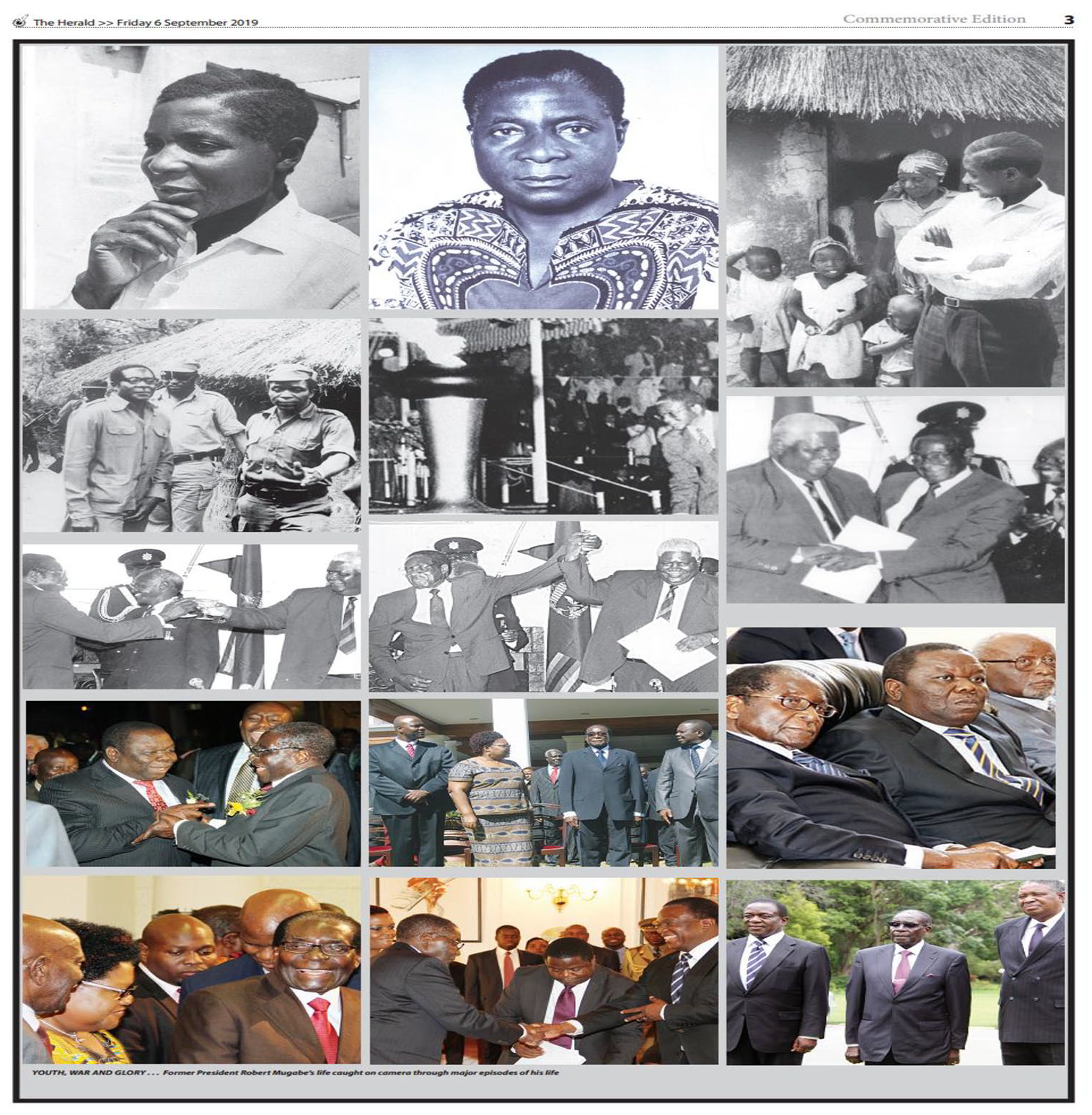
YOUTH, WAR AND GLORY . . . Former President Robert Mugabe’s life caught in camera through major episodes of his life.
The developments in the ‘moment of departure’ set the stage for the next phase of Mugabe’s captured moments, ‘the moment of maneuver’ which involved the beginning of the armed struggle and the building of rear military bases, in Botswana, Tanzania, Zambia and Mozambique (Ndlovu-Gatsheni and Willems, 2009). The photograph analysed depicts Robert to the left, the late Zimbabwe African National Liberation Army (ZANLA) commander Josiah Tongogara in the middle and Mugabe’s then personal assistant Emmerson Mnangagwa in Mozambique in the late 1970s (Figure 1). The NewsDay also used a similar photograph to commemorate Mugabe’s life. The photograph was taken when Mugabe had assumed the ZANU presidency after dethroning the party’s founding leader, Ndabaningi Sithole. In the photograph, Mugabe is captured with his then personal secretary and now Zimbabwean President Emmerson Mnangagwa and the late ZANLA Commander, Josiah Tongogara. Memories evoked by such photographs have been used by ZANU-PF in post-independent Zimbabwe to project themselves and Mugabe in particular as the ‘burden of history’ (Ndlovu-Gatsheni, 2012: 5) suggesting that they were the sole liberators ahead of other equally important participants of the struggle. Therefore, Mugabe’s liberation credentials are validated through photographs by The Herald and NewsDay. Sontag (1977: 4) reminds us that the power of photographs in memory is that they ‘. . . furnish evidence. Something we hear about, but doubt, seems proven when we’re shown a photograph of it’. Furthermore, Mugabe is visually framed as the ‘centre’ while Tongogara and Mnangagwa are the ‘margins’ less important. In photography, the centre is a nucleus and a key component of the discourse being churned out while the margin is less important and derives its meaning from the former (Kress and Van Leeuwen, 1996). In this case, The Herald and NewsDay used photographs that draws our attention to Mugabe who receives the ‘stronger stress’ (Kress and Van Leeuwen, 1996) or centre of attraction. Through such photographic framing, we argue that the media sought to heighten, modulate and hype Mugabe’s contribution or role in liberating the country. Without the liberation struggle in which Robert Mugabe played a fundamental role, this paper argues, there would be no Zimbabwe. In this discourse, Mugabe is the icon of guerrilla liberation warfare, a veteran of the bush war that brought independence.
Mugabe’s frame as a liberator is culminated by a photograph of the Lancaster House conference in 1979. The photograph which was also used by The Herald and NewsDay captures Mugabe with his long-time archrival Joshua Nkomo, ZAPU leader, and Bishop Abel Muzorewa. The negotiations led to ceasefire and first democratic elections in 1980. With Mugabe being in the picture, his presence further cements the view that he is one of the founding fathers of the nation. The ‘moment of arrival’ is captured in a photograph of Mugabe being sworn in as Prime Minister in 1980 at Rufaro Stadium. Again, The Herald and NewsDay used a similar photograph. The photograph captured Mugabe lighting the Eternal Flame of Independence which symbolizes the freedom that was brought by the bloodshed during the liberation struggle. As argued by Clarke (1997), any photograph is dependent on series of historical, cultural, social and technical contexts which establishes its meanings as a photograph and an object. In this case, Mugabe had won the first Zimbabwean election to become the Prime Minister. Therefore, photographs were used by The Herald and NewsDay to frame Mugabe as the liberation war hero and founding father of the nation.
Liberator to tyrant: contested legacy of Robert Mugabe
While the aforementioned photographs were used to show Mugabe’s liberation legacy, some of the pictures evoke memories of Mugabe’s repressive rule. For NewsDay, this study argues, used photographs to perpetuate oppositional journalism which challenges state’s historiography and political discourses (Chuma, 2008; Msimanga et al., 2021). First, The Herald and NewsDay used photographs on the signing of the Unity Accord on 22 December 1987. Such photographs on the Unity Accord signed by Mugabe and Nkomo, this study argues, might reflect the happy moment in the post-colony where liberation movements came together and forged unity. As such, given the context in which photographs are circulating, The Herald might have used the photograph to signify unity and perpetuate patriotic history which also ensured that the unity between Nkomo and Mugabe is heightened (Bull-Christiansen 2005). For NewsDay, their use of photographs is arguable in contrary to the above. Thus, NewsDay might have used photograph of the Unity Accord to evoke memories of the Gukurahundi genocide which remains one of Mugabe’s darkest moments. While Mugabe had at independence promised reconciliation and building a new Zimbabwe that loathe ethnic, tribal and racial differences, he went on to deploy the 5th Brigade that killed more than 20,000 Ndebele speaking people in Midlands and Matabeleland provinces. The genocide was spearheaded by Mugabe’s ZANU-PF government which wanted to establish a one party state. Thus, Nkomo’s PF-ZAPU had to be forced to toe the line which, unfortunately, involved the use of the ‘Gukurahundi policy’. Gukurahundi policy is an ‘undisguised, intolerant, commandist, and deliberately violent policy towards the opposition’ (Sithole and Makumbe, 1997: 133). Till Mugabe’s death, victims had not forgiven him because of his failure to spearhead a truth and reconciliation exercise (Ndlovu, 2017). To date, victims have forged a trauma nation, and remain hateful of Mugabe and his government for the systematic killings Ndlovu and Tshuma (2021). Therefore, NewsDay’s photographs are a testimony that Mugabe is a liberator that turned into tyrant.
Besides photographs on the Unity Accord, The Herald and NewsDay had photographs on the GNU. In the photograph, Mugabe is captured with Global Political Agreement (GPA) partners and opposition leaders, the late Morgan Tsvangirai (Prime Minister) and Arthur Mutambara (Deputy Prime Minister). In some of the pictures, Mugabe is captured with GPA partners and his deputies, the late John Nkomo and Joice Mujuru (former Vice President). Given that meaning in photographs is obtained through understanding the context in which they are produced and read (Albers et al., 2009; Clark, 1997), the GNU came into being after the violent elections of 2008. Following a near defeat to the opposition at the 2008 polls, Mugabe unleashed the military on citizens and further encouraged his supporters to fight the opposition. With the state have turned against its citizens as it did during the Gukurahundi era (Sachikonye, 2011), the opposition bowed down and signed a peace deal with Mugabe. Again, Mugabe’s Gukurahundi policy had to be used so as to retain power. In this milieu, we argue that NewsDay’s photographs help to show that the liberator turned into a tyrant. For such, photographs ‘confirm’ and give ‘evidence’ that Mugabeism becomes Mugabe’s legacy. Ndlovu-Gatsheni (2015: 2–3) explains Mugabeism as having ‘embraced violence as a pillar of governance . . . racism has continued despite Mugabe’s earlier pronunciation of a policy of reconciliation at independence in 1980’.
However, the above-mentioned photographs might as well be showing the other side of Mugabe. Photographs are never pure and have one meaning. Through them, a possible number of meanings emerge, and in most cases, these meanings are contradicting each other. In this case, Mugabe could have been framed by The Herald as a leader who favoured peace not violence. For such photographs might have been used to show that he was a leader who opted to come down from the ivory tower and share power for the benefit of the society. Most importantly, the Unity Accord has been used by the nation-state to construct national identity. The Accord is seen as having managed to unite Zimbabweans into one, and the ‘unity was the key signifier of the postcolonial Zimbabwean nation’ (Bull-Christiansen, 2005: 57). With gestures being semiotic resources used to convey meaning (Halliday, 1985), Figure 1 captures Nkomo and Mugabe with beaming smiles and looking into the camera. The grammar of the visual design indicates that by looking into the camera, the constructed icons are authoritatively looking at people and addressing them emotionally as ‘eyes are the windows to the soul’ (Bowen, 2018: 54; Kress and Van Leeuwen, 1996). Thus, photographs are brought forward to foster ‘coherence in the imagined discourse of a nation, legitimising, validating, and authenticating a sense of national identity’ (Edward, 2015: 321). Against this background, Gukurahundi is held to be forgotten, as invoking it, threatens the survival of the nation (Ndlovu-Gatsheni, 2015). Photographic representation, therefore, constructs, legitimizes and cements the imagined Zimbabwean nation. Hence, despite Mugabe’s death, The Herald is encouraging ‘Zimbabweans’ (despite the term being contested, see Ndlovu-Gatsheni, 2009) to treasure such memories and remain united. As such, memories of Unity Accord are evoked so as to mediate the present and the future. Photographs are used to maintain the status quo since the ‘retention of state hegemony depends on control over the way that past is represented’ (Schwartz, 1997: 243). This can also be said about photographs on GNU where Mugabe is used as a symbol of peace where he is framed as having managed to build a culture of co-existence among different political parties.
Wafa wanaka/ Ofileyo yinkosi: Ubuntu and the silence of dark history
One of the discourses that the state-controlled media propagated in commemorating Robert Mugabe was to erase his dark past. As indicted earlier, Mugabe’s legacy is contested as some of his policies led to the destruction of both property and lives. Through the concept of ubuntu, photographs helped to understand the role of the media in commemorating Robert Mugabe. Ubuntu, which has been popularized in South Africa, is best explained by the maxim, umuntu ngumuntu ngabantu (a person is a person through other persons). This means that everyone is expected to abide by the ideals of being umuntu (a person), that is, acting in a manner that unites and fosters ‘communal relationships’ (Metz, 2011: 541; Chasi, 2014). In this case, The Herald used photographs that captured Mugabe with world leaders and they include (Figure 2): the Queen of England, former South African President Nelson Mandela, former Cuban President Fidel Castro; Libya’s Mu’ammar Gaddafi and the Chinese leader XI Jinping. On the contrary, NewsDay had a picture of Mugabe with former Britain Prime Minister, Tony Blair who later on turned to be Mugabe’s critics, especially during the chaotic land reform programme of 2000.
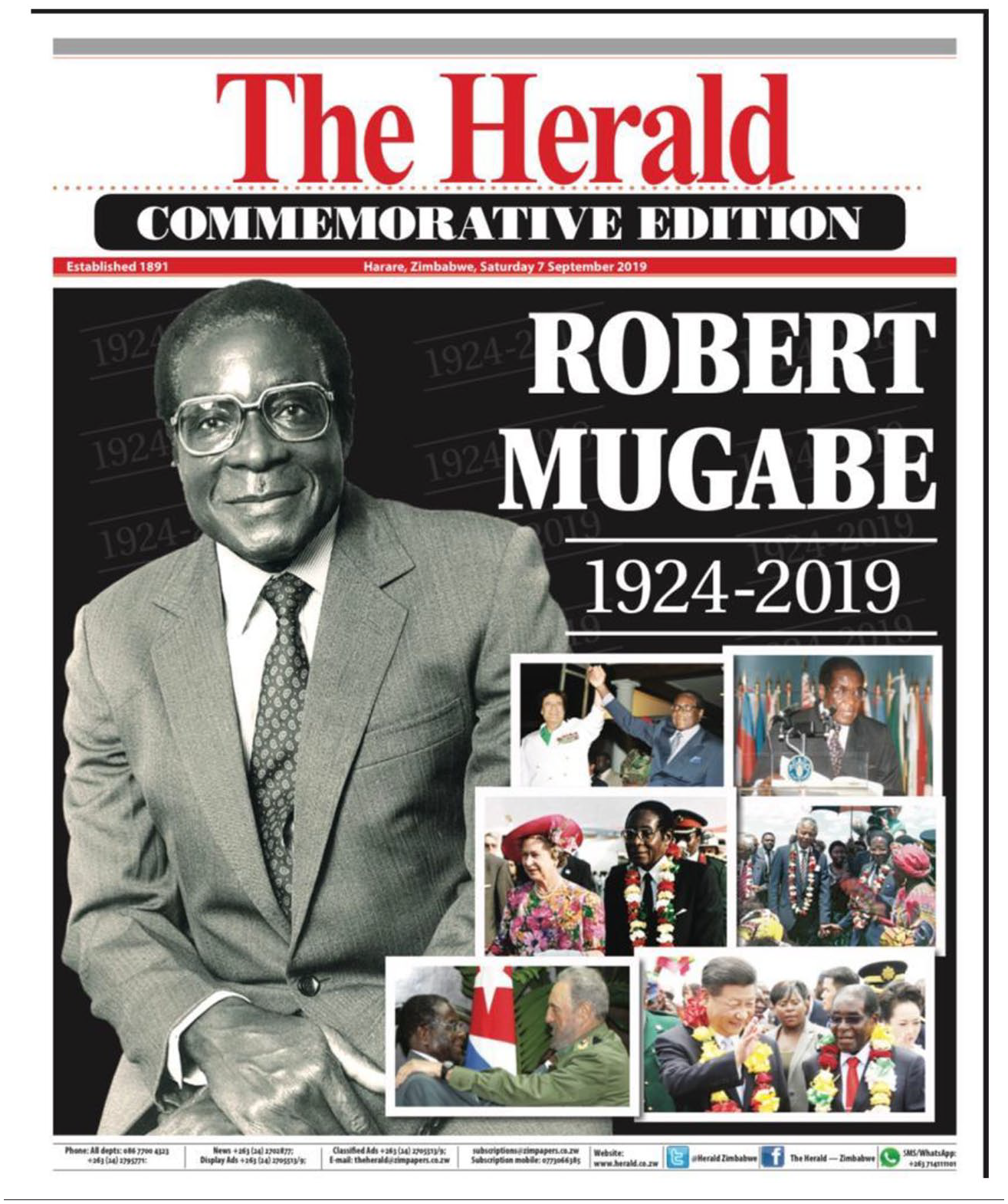
Robert Mugabe captured with world leaders. From Top to Bottom: Mugabe with late Libyan leader, Mu’ammar Gaddafi; Queen Elizabeth II; Nelson Mandela; Fidel Castro and Chinese President Xi Jinping.
Given that The Herald as a state-controlled media has been churning out patriotic memories that framed Mugabe and his ZANU-PF as having liberated the country and economically empowering people, the capturing of Mugabe with world leaders sought to internationalize his rule. Thus, visuals sought to show that Mugabe was a key African figure. Perhaps, the founding African father. As such, photographs, in this paper, we argue that ubuntu conceives knowledge and also provides the way people talk about Robert Mugabe as a leader who was accepted and cherished globally. Being aware that memory is always told in a particular context as a strategy of dealing with the predicaments of the present photographs might have been used to deal with the dominant discourses on Mugabe’s bad record on human rights violations. Mugabe mastered minded the ‘butchering’ of the Ndebele speaking people in the 1980s (Ndlovu, 2017) and also forcefully evicted white farmers some of whom died while others were left maimed (Muzondidya, 2007). According to Edy (1999), the media structures the way in which the society ought to remember events. Thus, visually framing of Mugabe with other world leaders might have been done to ensure that people remember such ‘golden moments’. The Chinese leader evokes Zimbabwe’s ‘Look East policy’ where the nation-state opted to be with friends with China following the West’s imposition of sanctions on Zimbabwe after Mugabe’s chaotic land reform programme. From the above discussion, it shows that photographs can be easily altered and are ‘subject to a continuous state of transformation and metamorphosis. Each change of context changes it as an object and alters its forms of reference and value’ (Clarke, 1997: 19).
The above discussion suggests that photographs by The Herald were mainly meant to paint a good picture of Robert Mugabe. However, one of the key questions that people raised upon Mugabe’s death was his record of human rights abuses and the economic decay. Wells (2003: 65) contends that photographs are portable objects that are changed by their context ‘depending on the context in which they are seen’. As such, Mugabe critics might use photographs in Figure 2 to raise his bad past. According to Sontag (1977: 20), when one views a photograph, he or she has ‘started down the road of seeing more and more’. Thus, a photograph of Mugabe with the Queen leads one to walk down the road and see more, that is, asking questions about the breakdown of the relationship between the two. Hence, such a photograph evokes memories of the chaotic land reform programme and also the subsequent isolation of the country from the West, as Mugabe moved from being the world’s darling – sharing a cup of tea with the Queen – to being the tyrant. More so, it is Mugabe’s land grab that led to the economic demise and the crises that almost led to the total collapse of the country (Chiumbu and Musemwa, 2012). The ‘Look East’ has arguably failed to revive the economy, as seen by the government which keeps blaming the sanctions for poor economic performance. More so, the juxtaposition of Mugabe and Mandela might further dent Mugabe’s legacy. First, Mandela ruled South Africa for one term before passing the button to Thabo Mbeki. Second, Mandela is hyped for creating the contested ‘rainbow nation’ where ethnic, tribal and racial groups co-exist in South Africa. In contrary, Mugabe is accused of having ruled for many years without a clear succession. Second, through iron fist, his legacy is tainted by human rights abuses which include Gukurahundi, land reform, violent elections and Operation Murambatsvina.
On the contrary, NewsDay used a photograph of Mugabe with Tony Blair. Since photographs work through ‘association and juxtaposition’ (Schill, 2012: 130), the juxtaposition of Mugabe and Tony Blair reminds audiences of the golden days when Zimbabwe was also a member of the commonwealth and enjoyed support from its former colonizers. It, however, exposes the fallout between Mugabe and rest of the Western world including Tony Blair. Given that in photographic communication, ‘language of depth replaces that of surface’ (Clarke, 1997: 20), such bad memories that have been evoked through photographs are being used to show that Mugabe went against the ideals of ubuntu by attacking white commercial farmers and their black workers because his action were against the spirit of communalism. Therefore, The Herald and NewsDay photographs have helped to unpack the contested legacy of Mugabe. Key to this is the use of ubuntu to structure remembering and forgetting which are key aspect of memory. Hence, ubuntu is used as a concept that fosters remembering and forgetting where it is used to produce knowledge that people should remember and use while disregarding memories that threaten the peaceful existence of the society. Hence, The Herald used photographs to sanitize Mugabe’s legacy.
Discussion and conclusion: photography’s work in memory
The findings demonstrated that memory is fluid and the legacy of Robert Mugabe is never constant, and also remains contested by different players. This study argues that through Robert Mugabe, one is able to understand the problems associated with the ‘national question’. Given that photographs ‘probes the world into an act of revelation’ (Clarke, 1997: 20), photographs of Mugabe during the liberation struggle up to his later days before his demise reveal that he liberated his people whom he later oppressed. Hence, Mugabe fostered a ‘change with continuity’, as the Rhodesian oppressive system was perfected by Mugabe. Under Robert Mugabe, the founding values and ethos of liberation struggle which then set the tone for the national question that include rule of law, equality of all human beings, guarantee of human rights and freedoms, and the celebration of country’s diversity were trampled upon or violated. Under the leadership of Mugabe, photographs have been used ‘to make known, confirm, and give testimony’ (Hamilton, 1997: 85) that Zimbabwe was ruled by the militaristic mind-set which resulted in authoritarian nationalism. Therefore, Mugabe betrayed the values of the struggle, and became the central figure in the ‘struggle after the struggle’ (Ndlovu-Gatsheni, 2007), as the country has endured deep ethnic, racial and tribal differences while violence became Mugabe’s tool of retaining his power (Ndlovu-Gatsheni, 2009). While studies on media and memory are scarce, in their scarcity, they have also failed to examine the role of photographs in memory. In this paper, we argue that photography is an important medium because of its ability to ‘reveal things that people could not see’ (Sontag, 1977). Thus, memories that the nation-state might have tried to bury like the Gukurahundi genocide, farm invasions and state-sponsored electoral violence are laid bare by the power of photographs which has the ability ‘to open up new, hitherto unsuspected dimensions of reality’ (Kracauer, 1995: 425).
In a photograph, there is a ‘complex play of presence and absence’ (Clarke, 1997: 25). In such a case, photographs serve as a reminder to Mugabe’s critics that he is a champion of African liberation, a Pan-Africanist, an unmatched revolutionary and an avid anti-imperialist who literally ‘spoke the truth’ to Western imperialists. Instead of giving a one-sided view of an individual, photographs are one of the mediums capable of giving overwhelming evidence around issues. Therefore, Mugabe is not only framed as a cruel leader who betrayed the ‘national question’, instead, he is seen as a liberator who empowered his people. Land reform remains one of the Mugabe’s legacy, albeit, in its contested form. While The Herald framed Mugabe in good light, that is, as a liberator, unifier and a hero, NewsDay raised captured discourses but continued with its oppositional journalism where Mugabe’s bad legacy of human rights was evoked. Thus, photographs have showed that Mugabe remains a contested figure in Zimbabwe’s body politic.
In her work on the nexus between journalism and memory, Zelizer (2008) posed a question: ‘what journalism does with the past that is different, singular, interesting or problematic’ (p. 80). In this study, we argue that photographic ‘evidence’ unlike other texts has the capacity to overwhelm evidence on historical events. As such, people are bound to holistically understand issues better through photographs, and that is one of the ‘different’ and ‘interesting’ aspects that photographs can do in memory. To add more, given that most African countries are torn apart by ethnic and tribal wars, and there is also a bad record of human rights, especially being perpetrated by liberators who turned out to be oppressors, more research should be done on the work of photographs and memory in the Global South because of their ability to ‘offer evidence that they are testimonies’ (Wells, 2003: 14) and can assist in addressing failed promises, foster reconciliation and unite nation-states. For future research, this study recommends other studies to look at reception of these photographs. There is a need to understand audience views on how photographs used by The Herald and NewsDay shape their perceptions on Robert Mugabe.
Footnotes
Funding
The author(s) received no financial support for the research, authorship, and/or publication of this article.
