




Abstract
This study modelled the factors that encourage misinformation diffusion behaviour among social media users, with a focus on Nigerian social media users. To gather our data, we used an online survey to sample 385 social media users using a chain referral approach. Smart partial least squares (PLS) structural equation modelling (SEM) was used to analyse the data. We discovered that social tie strength, virality, social media usage intensity and fun all predicted misinformation circulation. Conversely, trust in social networking site (SNS) and parasocial interaction were not found to be related to misinformation spreading. The study concluded with some theoretical and practical implications.
Introduction and background
Social media are the quickest and most convenient Internet platforms for searching and disseminating information on certain topics. During uncertain situations, they are also largely utilised to address and validate certain rumours and facts among other users (Lee and Choi, 2018). For millions of people throughout the world, social media is an essential element of their news diet. This implies that a wide range of news may now be accessed at the touch of a screen, which has favourable implications for political and public participation (Ahmed, 2022). Despite the advantages of social media, it has been reported to be a large source of misinformation sharing (Lazer et al., 2018). A research found that one of the consequences of this platform is that it permits people to receive unconfirmed information which tends to be deceptive and detrimental (Bondielli and Marcelloni, 2019). Researchers have also shown that social media is a powerful medium for the circulation of a large volume of non-supervised journalistic content (Duffy et al., 2019; Lazer et al., 2018; Wang and Fussell, 2020), empowering a misinformation phenomenon (Ireton and Posetti, 2018).
Misinformation sharing online has become so problematic that it has been listed among the main threats to society (Suntwal et al., 2020). It is more prevalent and widely disseminated through social networking sites (SNS) than through traditional media (Zhang and Ghorbani, 2020). In this study, misinformation (widely regarded or interchangeably with fake news) refers to any content such as news, information, articles, messages and so on that are made up to deceive people into thinking it is genuine and as such prompting people to share further (Duffy et al., 2019).
A growing body of works have started paying attention to users’ engagement with misinformation (Lazer et al., 2018; Pennycook and Rand, 2019; Talwar et al., 2019). According to popular belief, most people spread false information because they think it to be real (Pennycook and Rand, 2019). While another work suggests that users share misinformation even when uncertain of its veracity (Pennycook and Rand, 2021). Online users are prone to share fake information on social media because of the novel, startling and emotionally arousing qualities of such false material (Vosoughi et al., 2018). This confusion-based thesis mainly posits that misinformation sharing behaviour is driven by the novelty of information but is still an outcome of a genuine mistake (Pennycook and Rand, 2021).
The aforementioned growing understanding of why people share misinformation is still in its embryonic stages, because it centres on the user-centric motive for sharing misinformation, neglecting the fact that misinformation could also thrive with social networking site (SNS) dependency and perceived online social impact among social media users (Apuke and Omar, 2020; Lee and Choi, 2018). This implies that sharing misinformation on social media could stem from the over-dependency on social media as well as the influence of social media network members. It has been argued that while plenty of research exists on why people share news online, only a handful of studies have examined people’s motivations for sharing misinformation (Metzger et al., 2021). Further evidence suggests that research on the sharing of misinformation, to date, has primarily focused on how misinformation spreads and the literary style of misinformation (Lim et al., 2021). Such findings do not explain why people are inclined to share misinformation.
This current work addresses a gap in the literature by developing a model that evaluates parameters linked to the spread of misinformation on social media. We used SNS dependency theory and social impact theory to test the role that social tie strength, parasocial interaction, virality, trust in social media, social media usage intensity and using social media for fun has in predicting misinformation sharing behaviour. We argue that misinformation does not only stem from the personal desire to share on social media, but people are also affected by the influence of the medium as well as network members. Thus, this work is guided by the following question:
Does misinformation thrive with SNS dependency and perceived online social impact among social media users in Nigeria?
Review of related literature
This section provides studies related to misinformation, then concludes with the theoretical underpinning, hypotheses and model development.
Studies related to misinformation
While plenty of research exists on why people share news online, only a handful of studies have examined people’s motivations for sharing misinformation. In one of such studies, confirmation bias was proposed as one of the key reasons why people spread misinformation in the past (Kim and Dennis, 2019). This implies that social media’s polarising effect helps towards the propagation of misinformation by supporting cognitive bias and generating and facilitating healthy echo chambers where personal data are seldom disputed (Spohr, 2017). Furthermore, the desire to either inform or damage others has been found to motivate misinformation sharing (Chadwick and Vaccari, 2019). In a separate study, it was found that some people believe and distribute incorrect information for political motivation (Warner-Søderholm et al., 2018). Thus, political motivations have often been highlighted as a reason for sharing misinformation, whether to mobilise against a target group or to rail against the whole system (Petersen et al., 2018). In the same view, political orientation has also been noted as a motivating factor for sharing misinformation (Hall Jamieson and Albarracín, 2020).
Further rationale for the propagation of misinformation has been the lack of understanding of digital environments leading to trusting online news without much verification (Khan and Idris, 2019). According to recent research, status-seeking contributes to misinformation sharing (Talwar et al., 2019). This implies that users are encouraged to disseminate information to gain social validation and improve their image (Talwar et al., 2019). Although this study developed a model for fake news sharing, however, it only focused on consumers of brands, limiting its generalisability. Self-promotion, religiosity, enjoyment and exploration have also been shown to be connected to disinformation dissemination (Islam et al., 2020). Similarly, Apuke and Omar (2021) found information seeking, pass time, information sharing and altruism to be associated with misinformation circulation.
There are other existing studies on sub-Saharan African countries that have investigated the issue of misinformation. For example, Madrid-morales et al. (2021) explored the motivations and contributing factors for sharing misinformation in six sub-Saharan African countries. Their analysis of 12 focus groups with university students reveals two common motivations: civic duty and fun. That means people share misinformation because they see it as a civic duty as well as fun. Similarly, Chakrabarti et al. (2018) investigated audiences’ engagement with ‘fake news’ in an African context and found three reasons that help explain the sharing of ‘fake news’ in Kenya and Nigeria. First, there is the desire to be ‘in the know’ socially, so sharing ‘fake news’ becomes a form of social currency. Second, there is a sense of civic duty that might lead social media users to share warnings of impending disasters or crises. Even if the information turns out to be false, the potential harm that could result from not informing others may be seen as outweighing the dangers of spreading false information. And third, there is the sense that information is democratic and needs to be passed on. In another study, Wasserman (2020) provided an exploratory overview of the different types of media output that have recently emerged in South Africa and that have been described as fake news, as well as an overview of the journalistic responses that have been forthcoming. Also, Wasserman and Madrid-Morales (2019) carried out an exploratory study of ‘Fake News’ and Media Trust in Kenya, Nigeria and South Africa. The authors found that perceived exposure to disinformation is high, and that trust in social and national media is low. A significant relationship between higher levels of perceived exposure to disinformation and lower levels of media trust in South Africa was also found.
Using data from 36 focus groups in six sub-Saharan African countries, Tully et al. (2021) examined audiences’ experiences with misinformation and perceptions of institutional and personal roles and responsibility for both preventing and intervening in the spread of misinformation. Findings suggest that participants perceive misinformation as a problem if it has real or potential negative consequences and express a sense of shared responsibility among individuals and institutions for stopping the spread of misinformation.
From the reviewed studies, it could be deduced that while there are increasing questions about misinformation on social media, the reason misinformation is being circulated continually is less well understood (Talwar et al., 2019). The current study contributes to the literature in this respect by concentrating on Nigeria and looking into additional variables that contribute to the spread of misinformation among social media users.
Theoretical underpinning, hypotheses and model development
Social impact theory
We used the Social impact theory of Latané (1981) to elucidate the effect of social experience on individual intention to use and share misinformation on SNS (Latané, 1981). Social impact is defined as any influence on individual feelings, thoughts or behaviour that is created from the real, implied or imagined presence or actions of others (Latané, 1981). The theory helps us understand in which social situations we produce a greater influence. Thus, the social impact will depend on the social forces, which are what cause the changes, the immediacy of the event and the number of sources that produce the impact. We, therefore, contend that an individual’s approval of the content shared on SNS is determined by the social experience of the sender and the receiver (Gong et al., 2020). According to Handarkho (2020), the choice to use and share a piece of information received is generally influenced by one’s acceptance of others’ views, and this is also based on the quality of social experience that occurred on the platform. Therefore, we examined social tie strength, parasocial interaction and virality’s influence on sharing misinformation on social media.
SNS dependency theory
The idea of the SNS dependency was drawn from the Media dependency theory proposed by Ball-Rokeach and DeFleur in 1976 (Ball-RoKeach and DeFleur, 1976). The SNS dependency theory focuses on the degree an individual depends on SNS to carry out a daily task (Lee and Choi, 2018). There are many reasons users could depend on social media and these reasons could lead to trust in social media. The theory assumes that the more an individual relies on SNS platform, the easier it becomes for their conduct and beliefs to be influenced by the ‘opinion’ of others regarding specific issues (Baran and Davis, 2009). Drawing from this premise, we believe that people who trust SNS as their primary source of information or update may presume that information circulated on the platform is trustworthy and dependable. Furthermore, recent studies found an association between social media usage intensity and misinformation (Hou et al., 2020; Huynh, 2020). Another research has also shown that social media users depend on social media for fun and leisure (Thompson et al., 2020). Thus, drawing from this theory, we evaluated the role trust in social media, social media usage intensity and using social media for fun has on sharing misinformation.
Hypotheses and model development
Social tie strength and misinformation sharing
Tie strength is the level of intensity of the social relationship, or degree of overlap between two individuals’ scopes of friendship (Steffes and Burgee, 2009). Generally, within one’s social network, an individual has a wide range of relationship ties which could be categorised as strong or weak according to their strength (Steffes and Burgee, 2009). While some research suggest that weak ties may provide new perspectives and bring ideas into a community, strong ties are regarded as much more important sources of information and found to be more prevalent in information exchange behaviour (El Rayess et al., 2018). Another research found that the quality of ideas or information shared on SNS is more valued when it comes from relatives and friends (Handarkho, 2020). Consistent with this view, it has been proven that information obtained from a strong tie strength source is perceived as more trustworthy. This means that for people to trust specific content, it needs to be delivered by a source that they are already familiar with through prior social experience (Chang et al., 2018). We, thus, contend that the ideas or information shared by individuals that are familiar to the users may cause them to trust the information (Chaouali et al., 2016), without necessarily verifying such information. This act could lead to the consumption of misinformation as well as the circulation of misinformation. Metzger et al. (2010) found that people rely on personal connections as a heuristic to minimise cognitive effort when deciding if a piece of information is credible or not; so, if a friend shares a news item on SNS, it may be more readily believed. Therefore, the association between tie strength and misinformation sharing behaviour could be anticipated. Consequently, we proposed the following hypothesis:
H1. Social tie strength positively predicts misinformation sharing behaviour.
Parasocial interaction and misinformation sharing
Parasocial interaction refers to the degree or propensity of an individual to develop an emotional connection with a figure considered a guide, or a role model (Tsai and Men, 2017). It has been established that closeness and intimacy (emotional tie) lead to the tendency of an individual to ignore the error of another person. According to Handarkho (2020), an emotional tie is not only formed among friends and relatives but also formed among individuals that are admired and respected, such as politicians, public figures and idolised personalities. Parasocial interaction is a one-way relationship. Nevertheless, it has been shown that any relationship developed on emotions tends to progress to a strong bond that may encourage an individual to emulate and follow the idea of the person revered (Singh and Banerjee, 2019). In this view, we assume that people would believe and consider any information disseminated on SNS by public figures they hold in high esteem. For example, during the COVID-19 pandemic, President Donald Trump suggested at a press briefing that disinfectants might be able to clean the insides of people infected with the coronavirus, and this was not medically proven. A lot of people circulated that broadcast on SNS (Apuke and Omar, 2020). Drawing from this, we proposed that:
H2. Parasocial interaction positively predicts misinformation sharing behaviour.
Virality and misinformation sharing
Virality is defined as a social information flow process in which many people simultaneously forward a specific information item within their social networks over a short period, and the message spreads beyond their social networks, resulting in a sharp acceleration in the number of people who are exposed to the message (Nahon, 2013).
When information or a message is spread or accepted by a large number of people, it is said to be viral (Sun, 2009). People are more inclined to believe a source is credible if others believe it is, especially when there is insufficient evidence to judge the source’s veracity (Shu et al., 2019). Each post on social media is accompanied by popularity ratings, which raise people’s awareness of other users’ endorsements of the message (Dabbous et al., 2021). These cues activate bandwagon heuristics, which means that if a significant number of other users have endorsed the information, it is more likely to be perceived as reliable or of high quality (Kim, 2018). Furthermore, other users’ behaviours, such as sharing, liking and commenting, have a substantial impact on people’s views regarding misinformation and their willingness to comment on and distribute misleading news (Colliander, 2019). Given the collaborative nature of social media, where users are constantly interacting, it has been proven that claims are examined less frequently, especially when the message has already been spread since users rely on others to recognise fraudulent news (Jones-Jang et al., 2021). As a result, virality has the potential to reduce users’ capacity to recognise disinformation, resulting in the spread of erroneous information. Thus, we proposed that:
H3. Virality positively predicts misinformation sharing behaviour.
Trust in SNS and misinformation sharing
The degree to which a person feels that utilising social networking sites is safe and trustworthy has been characterised by trust in SNS (Sukhu et al., 2015). Technological trust has also been described as the user’s readiness to depend on its functions believing such technology possesses desirable attributes to protect their concerns (Chang et al., 2017). Thus, in terms of news sharing, trust in SNS is the expectation that SNS can be dependable, reliable, trusted and self-assured that it can be used to accomplish a specific task, which is sharing information without restraint in an unprecedented manner (Warner-Søderholm et al., 2018). According to Salehan et al. (2018), trust in SNS has a significant impact on sharing attitude, and people who trust SNS are more likely to disclose information. The possible reason for this could be that trust in SNS which has been described as a belief is a pre-eminent thing as shown in the literature (Salehan et al., 2018). As a result of their high level of trust in SNS, users may be able to share information freely, which may increase their willingness to share (Chang et al., 2017). As such, this current research argues that SNS users who have higher trust in SNS may possess a better attitude towards sharing and since many people now share information that is sometimes not verified there is a tendency of sharing fake news. Thus, we proposed that:
H4. Trust in SNS positively predicts misinformation sharing behaviour.
Social media usage intensity and misinformation sharing
The amount to which users of a social media platform are emotionally engaged in the platform and the extent to which the platform is incorporated into their everyday activities is referred to as social media usage intensity (Ellison et al., 2007). According to Metzger et al. (2010), people who spend more time on social media are more likely to regard it as a trustworthy source of information. Therefore, the increased use of social media plays a major role in strengthening trust in this channel as a source of credible information which is in line with previous research that established a positive relationship between usage of a medium and ratings of its credibility (Aoun Barakat et al., 2021). Individuals may also feel secure enough in the presence of trust to forego behaviours that they might otherwise engage in, such as verification behaviours (Torres et al., 2018). It has been discovered that people who have a high level of online visibility and availability are more prone to absorbing misleading material online than those who do not (Nelson and Taneja, 2018). Corroborating this view, recent research found that people who predominantly use SNS as a source of information are more likely to get exposed to fake news as well as share fake news (Chadwick and Vaccari, 2019). We anticipate that higher social media users are more likely to share misinformation. Thus, we proposed that:
H5. Social media usage intensity positively predicts misinformation sharing behaviour.
Fun and misinformation sharing
A lot of social media users depend on social media for leisure and fun. Fun in this study refers to the satisfaction users derived from the usage of social media. It entails the fun and excitement attached to using social media. Social media usage has been highly connected to factors such as enjoyment, fun and entertainment (Hur et al., 2017). There have been conflicting findings regarding using social media for fun and sharing behaviour. Thompson et al. (2020) believe that enjoyment derived from social media has nothing to do with sharing behaviour. Sukhu et al. (2015), on the contrary, established a link between pleasure and information sharing behaviour. In terms of misinformation, a recent study discovered that entertainment is linked to the dissemination of COVID-19 misinformation (Islam et al., 2020). While Apuke and Omar (2021) claim that there is no significant link between entertainment and misinformation sharing concerning COVID-19.
Nevertheless, prior research has shown that the desire for enjoyment and entertainment happens, for instance, when users enjoy humorous stories shared on their network and make fun of political figures and celebrities (Rieger and Klimmt, 2019). This is in line with a recent study which found humour, and the use of parody, to be a factor influencing the sharing of political (mis)information in Africa (Madrid-morales et al., 2021). The respondents in the study remarked that they would post fake and fabricated stories about politicians to poke fun at those in power, negating the idea that sharing misinformation is caused by a desire to create chaos (Petersen et al., 2018). Previous research established that people who sincerely want to inform and aid others are more concerned about the validity of the material they publish on social media than those who just want to have fun (Vuori and Okkonen, 2012). According to new findings, a major part of misinformation and social media activity involves a willingness to be entertained (Chiodo et al., 2020). As a result, we proposed that:
H6. Fun positively predicts misinformation sharing behaviour.
The model developed in this study is depicted in Figure 1.
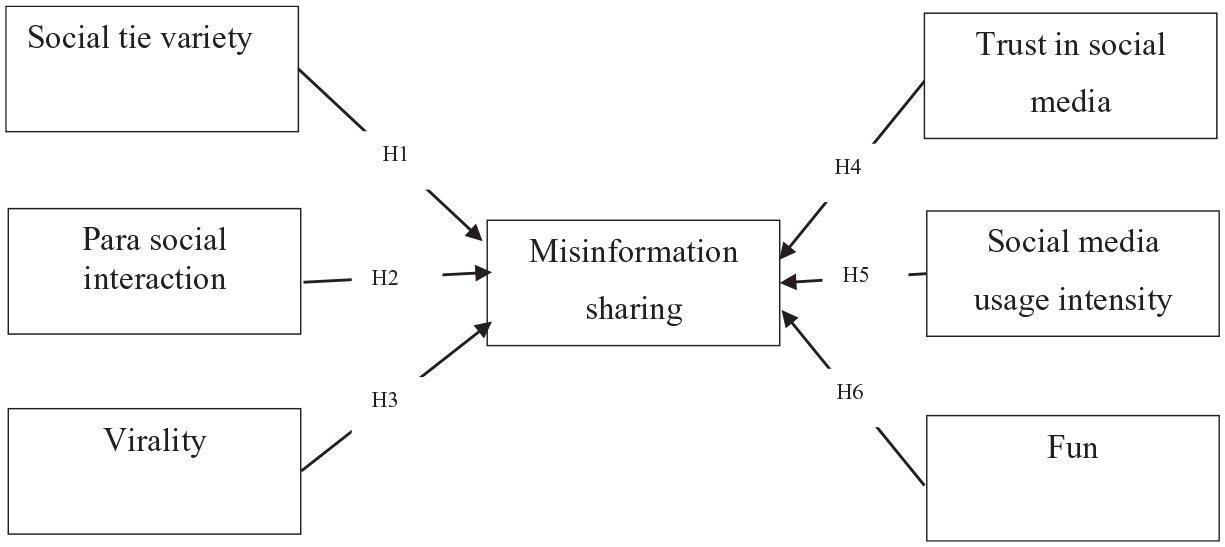
Structural model of misinformation sharing.
Methods
In this study, we used the descriptive survey research because it helps in the description and explanation of a phenomenon. Thus, we used a descriptive survey to realise the factors associated with misinformation sharing among Nigerian social media users. To collect data from respondents, an online questionnaire (created with Survey Monkey) was employed. The data were gathered between October 2021 and December 2021. We retrieved the data from 385 social media users aged 18 and above using the respondents-driven sampling (RDS) chain referrals technique (Babbie, 2013). We sampled (using social media advertisements broadcast on various social media platforms such as Facebook, WhatsApp and Twitter) earlier participants (social media users) referred to as ‘seeds’, who possessed the characteristics of interest. And instructed these initial seeds to assist in recruiting other participants in their networks. Just like a chain, other seeds recruited other seeds and the process continued until we arrived at our sample size. The characteristics of the sample used in this study are shown in Table 1.
Profile of respondents.
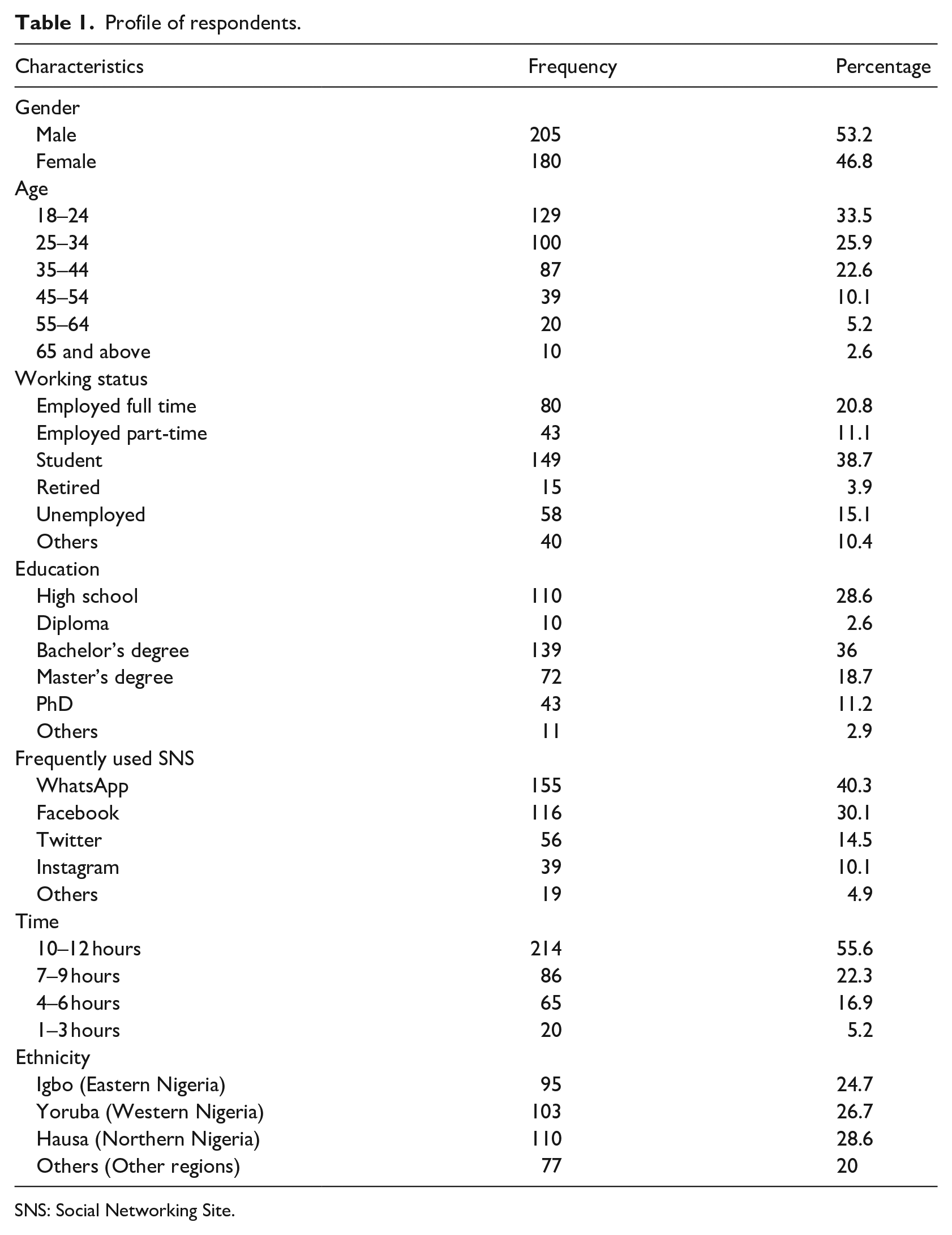
SNS: Social Networking Site.
The questions on the questionnaire were graded on a 5-point Likert-type scale ranging from strongly agree to strongly disagree on a scale of 5 to 1. The questionnaire was broken into two sections: demographics and the main portion that assessed respondents’ sharing behaviour. There was a screening question on the first page of the form with two criteria: being over the age of 18 and being an active social media user. All the items in the questionnaire were derived from prior studies (See Table 2) and verified by three communication specialists. Two of the specialists are from Taraba State University, while the third is from the University of Nigeria. We ran a pilot test with (n = 30) volunteers to look for further anomalies or errors. Based on the results of the pilot test and expert observations, we reworded some of our items, resulting in a final clean copy that was used for collecting data.
Construct reliability, composite reliability and AVE values.
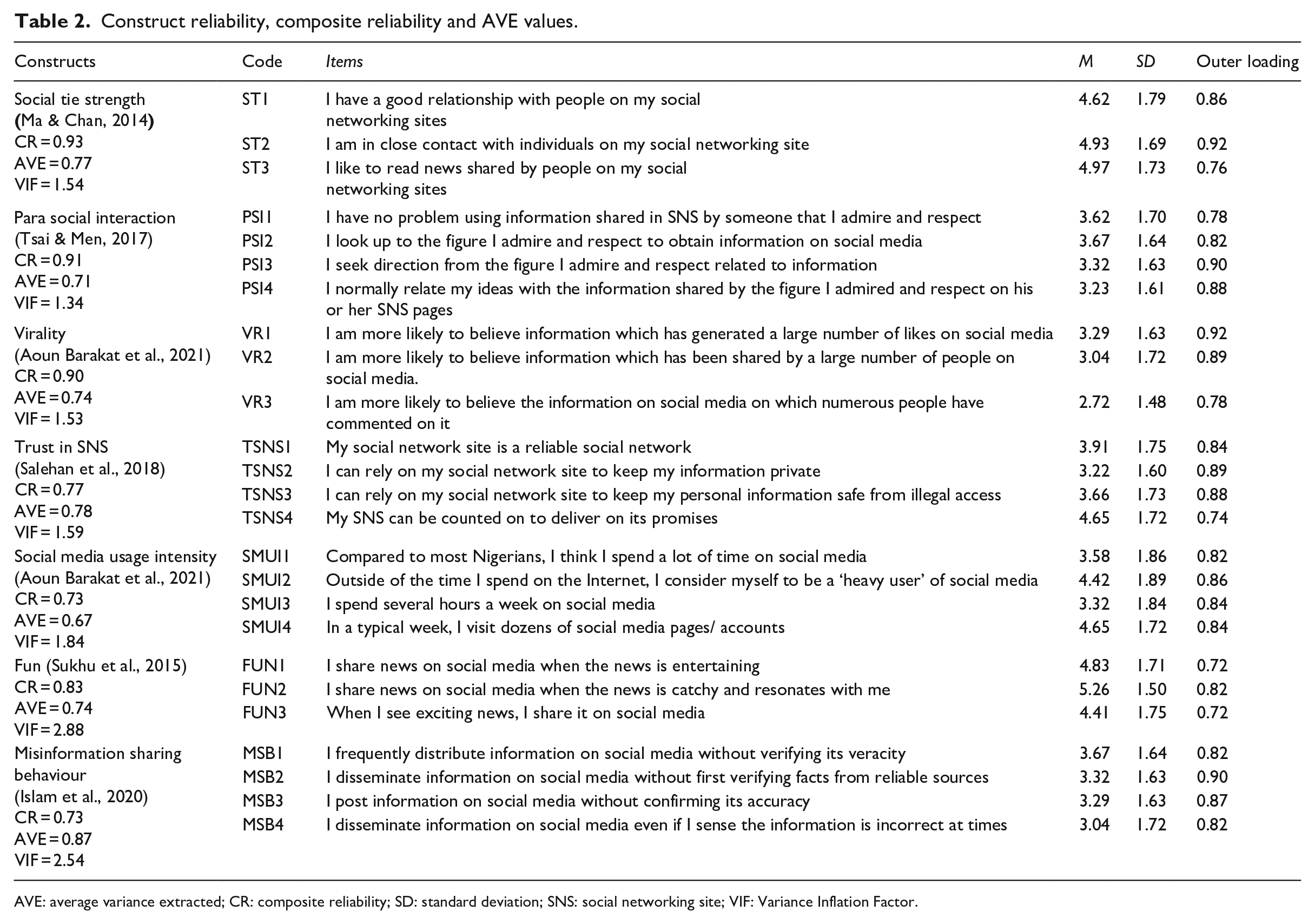
AVE: average variance extracted; CR: composite reliability; SD: standard deviation; SNS: social networking site; VIF: Variance Inflation Factor.
Data analysis and results
Using SPSS version 25, we performed descriptive statistical analysis on the data, while SEM (using Smart PLS 3.2.6) was used to examine the association between variables. Because all the data in this study came from one source, it was necessary to verify for common method bias (CMB) before analysing it. CMB bias was determined using Harman’s single factor test in SPSS version 25. Based on Khan et al. (2019) suggestion, we discovered that a single variable shared not more than 10.4% of the entire variance, which is less than the 50% criterion, indicating that the CMB was not an issue in this study.
Measurement model
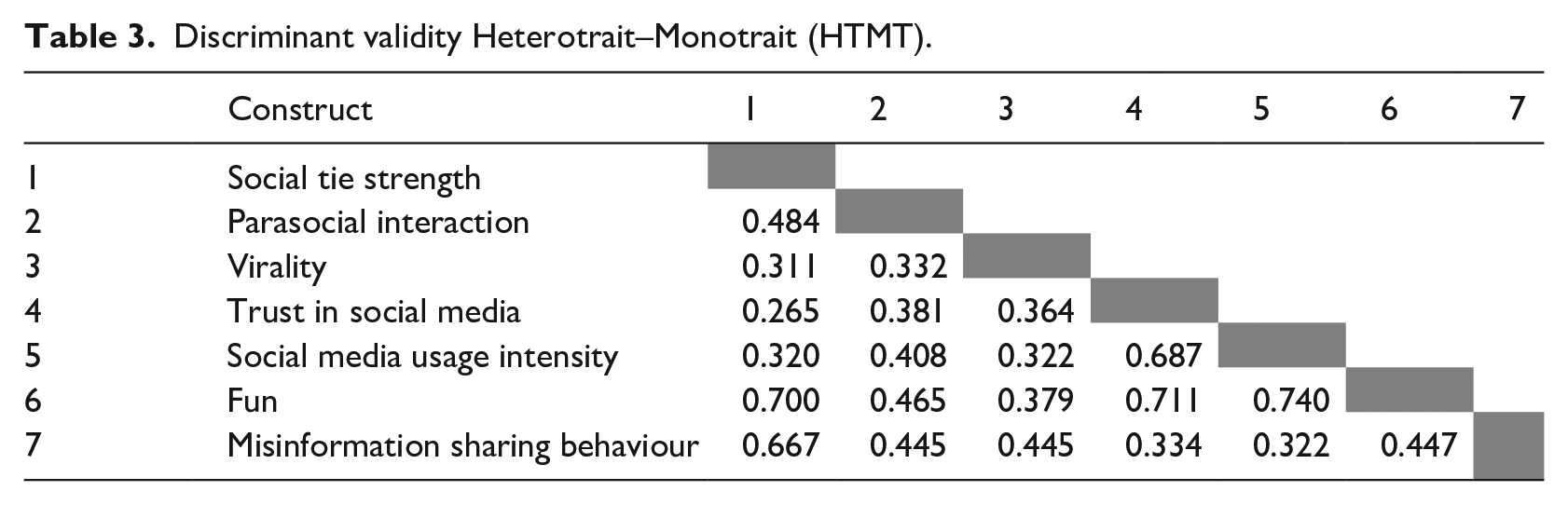
We examined convergence and discriminant validity to see if our measurement model was appropriate. The average variance extracted (AVE), composite reliability (CR) and factor loadings were all assessed to determine convergence validity, and all values were above the acceptable cut-off thresholds of 0.50, 0.70 and 0.708, respectively (Sarstedt et al., 2019), On the contrary, we found no problems with discriminant validity (see Table 3). The HTMT values (Heterotrait–Monotrait Correlations) were found to be less than 0.85 (Hair et al., 2019). Therefore, the convergence and discriminant validity conditions were met in our study.
Discriminant validity Heterotrait–Monotrait (HTMT).
Structural model
Before evaluating the structural model, we double-checked the inner variance inflation factor (VIF) values, which were all less than 5, as shown in Table 2. To examine the hypotheses’ significance, we employed a 5000-resample bootstrapping technique with a 5% significance criterion (one-tailed). As shown in Table 4, only two out of the six hypotheses were not supported. Specifically, social tie strength, virality, social media usage intensity and fun all positively predicted misinformation sharing among the Nigerian sampled population. However, parasocial interaction and trust in social media had nothing to do with misinformation sharing. Furthermore, we realised that the effect size (f2) for the relationships in this study were from low to high, respectively (Cohen, 1988). Moreover, the Q2 was above zero indicating a good predictive relevance (Hair et al., 2012). Overall, our model shows 45% of the variation in people’s intentions to spread misinformation, and this variation is adequate (Cohen, 1988).
Structural model results.
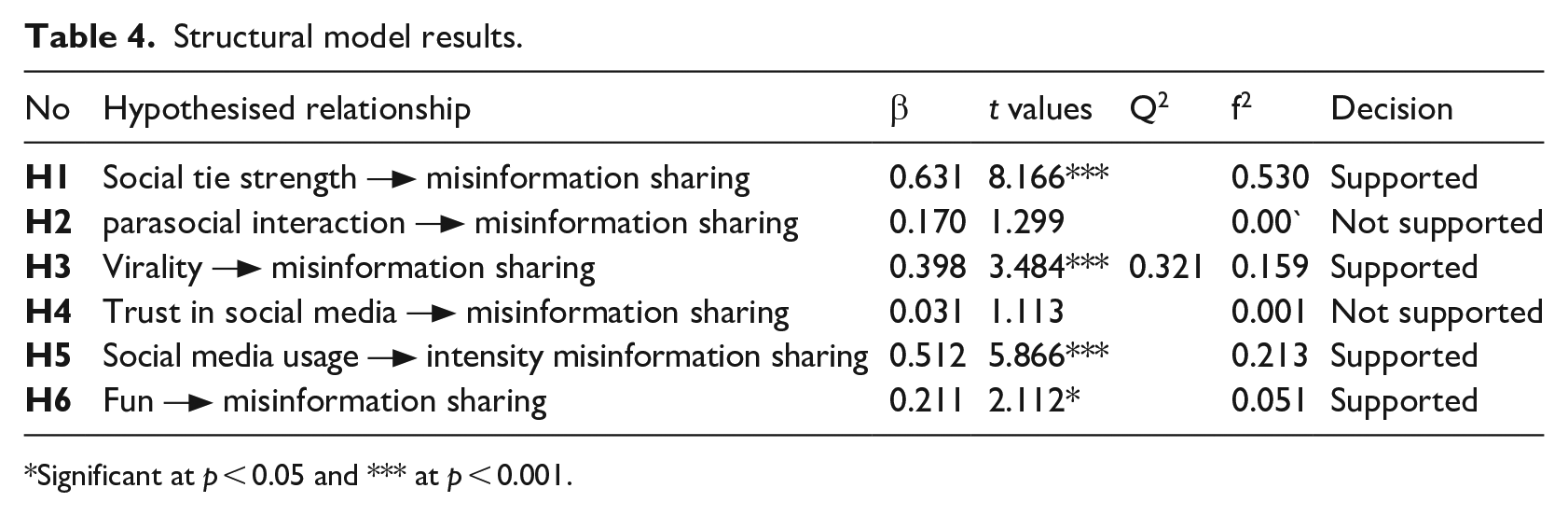
Significant at p < 0.05 and *** at p < 0.001.
Discussion of findings
The present study examined if misinformation thrives with SNS dependency and perceived online social impact among social media users in Nigeria. Results indicated that social tie strength is the strongest predictor of misinformation sharing behaviour of Nigerian social media users. Consistent with this outcome, recent research found that the quality of ideas or information shared on SNS is more valued when it comes from relatives and friends (Handarkho, 2020). Therefore, we contend that Nigerian social media users seem to depend on friends and families for information, contributing to the circulation of misinformation.
The second most significant factor predicting misinformation sharing was found to be social media usage intensity. This suggests that higher dependency and usage of social media are associated with misinformation sharing. By implication, Nigerians who regularly depend on social media as the only source of information as well as spend a longer period utilising social media have higher chances of sharing misinformation. This resonates with a recent study which found that those who depend on social media for news use shared deepfake (Ahmed, 2022). We also found that virality predicted misinformation among social media users in Nigeria. It was the third most significant factor. This means Nigerians are fond of sharing messages that seem to have been endorsed by many, without much scepticism, leading to misinformation circulation. It has been proposed that if a significant number of other users endorsed a piece of information online, it is more likely to be perceived as reliable or of high quality (Kim, 2018), suggesting that other users’ behaviours, such as sharing, like and commenting, have a substantial impact on people’s views regarding misinformation and their willingness to comment on and distribute misleading news (Colliander, 2019).
Unlike prior research that revealed no link between enjoyment, news sharing (Lee and Ma, 2012; Thompson et al., 2020) or false news sharing (Apuke and Omar, 2021), we observed that fun has a link with Nigerian social media users spreading of misinformation. It was the fourth most significant factor associated with misinformation sharing. The study context might have played a part in this outcome. We reason that a lot of Nigerians share more entertaining, sarcastic and political news, or information often than any other type of information. As such, the fun and excitement attached to using social media have been extended to sharing to an extent they share information not minding its authenticity as far as it is exciting and engaging. This is in line with a recent study which found humour, and the use of parody, to be a factor influencing the sharing of political (mis)information in Africa (Madrid-morales et al., 2021).
Contrary to what we expected, we realised that parasocial interaction and trust on social media did not predict misinformation sharing of social media users in Nigeria. A likely explanation with regards to parasocial interaction could be that Nigerians are losing trust in public figures or politicians, thus, the information shared by such public figures or politicians might not necessarily influence their sharing behaviour. Unlike in the case of former US President Donald Trump who shared several fake reports on COVID-19, which were reshared by many, Nigerians might not be willing to follow the news of politicians and other public figures. Furthermore, we could explain the non-significant outcome of social media trust in this study to mean that when a person trusts a medium (social media) he or she could use it for other things other than the circulation of news that leads to fake news. Thus, Nigerian social media users could trust social media to carry out their other tasks rather than sharing information. This is contrary to Salehan et al. (2018) who found that trust in SNS may have a significant effect on sharing attitude and people who trust SNS are more likely to disclose information.
Conclusion
In Nigeria, misinformation sharing thrives with the dependency on SNS and perceived social impact among social media users. Specifically, social tie strength, virality, fun and social media usage intensity were factors found to be associated with misinformation sharing among Nigerian social media users. However, the trust Nigerian social media users have in social media as well as their parasocial interaction has nothing to do with their misinformation sharing.
Our research adds to the current literature on the factors that impact misinformation spreading behaviour among social media users, particularly in Nigeria. There are only a handful of the motivations for sharing misinformation found in the literature, and most of this literature lacked a theoretical model (Chadwick and Vaccari, 2019; Chakrabarti et al., 2018; Duffy et al., 2019; Guess et al., 2019; Petersen et al., 2018). The most crucial antecedent of false news distribution has been identified as online trust (Khan and Idris, 2019; Talwar et al., 2019). We contribute by demonstrating that the most significant predictor of misinformation dissemination is tie strength. By implication, the stronger a person’s tie, the more he or she is willing to accept and share information, including misinformation. Also, contrary to the notion that entertainment has no link to utilising social media to share news (Thompson et al., 2020), the current study findings imply that fun predicts the spread of misinformation. It could be that misinformation sharing thrives more when mixed with humour, fun and excitement.
Our research helps to further the use of SNS dependency and social impact theory. No study has mixed these theories to extend the understanding of misinformation sharing. We thus extend to show new facets of misinformation sharing such as virality, fun and social media usage intensity. This implies that sharing misinformation on social media could stem from the over-dependency on social media as well as the influence of social media network members. Finally, because there are few studies in this area, our focus on social media users in a third world nation like Nigeria adds to the existing body of knowledge.
Conclusively, we are calling on social media users in Nigeria to be mindful of what their friends and family share. Authentication behaviour should always be activated, no matter who shares a piece of information. Scepticism should be activated concerning messages endorsed by a lot of people on social media, as it has been shown in this study to be associated with misinformation sharing. Furthermore, social media users should be cautious about circulating false information because it contains humour. Messages with humour should be thoroughly scrutinised before further propagation to reduce the spread of misinformation. To combat misinformation, collective efforts are required. Those who frequently use social media for news should be more mindful of what they consume as well as share since social media is now a breeding ground for all forms of misinformation. Finally, an intervention method that urges individuals to be sceptical of the information they read on social media should be put in place by the Nigerian government.
Footnotes
Funding
The author(s) received no financial support for the research, authorship, and/or publication of this article.
