




Abstract
Gender discrimination is more frequent among the ethnic minorities in the domain of education. This study among the Muslims in India shows that the Muslims always lag behind the Hindus in literacy rate and there is widening gap between literacy rates of men and women. With particular reference to a bi-ethnic village, it further reveals that discrimination generates from the socio-economic context of a particular community and that the Muslim women are experiencing discrimination in education due to their parents’ poor economic condition, lack of awareness, conservativeness, feeling of social insecurity of their girls, and their early marriage.
Introduction
Empowerment of all sections of people is the key to progress of any society. It is the means by which individuals, groups and communities take control of their circumstances and achieve their own goals, thereby being able to work towards helping themselves and others to maximize the importance of their lives (Adams, 1996). The most crucial tool that enhances empowerment is education. Gender biasness or gender discrimination in accessing and/or achieving education is the most influencing hindrance in achieving empowerment. The term gender is used here as a socio-culturally constructed concept. It draws on the roles and responsibilities between men and women determined by social, political, and economic contexts and not by biological sex (UNICEF, 1991). The other factors of generating discrimination to access education are seen in the dimensions of caste, religion, economy, ethnic origin or even physical features (e.g., skin colour) as seen in many countries. Women are usually at the receiving end of disparity in almost every society. They are denied or deprived of equal rights in connection with the access to food, health care, education and human rights. But without ensuring equal rights for them, progress of a nation cannot be achieved. The women’s movements throughout the world, particularly by the third world feminists, have generated critical debates that have ultimately led to the origin of the notion of women empowerment (Mayoux, 1998; Walters, 1991). For B. R. Ambedkar, an Indian social reformer, progress of a community can be measured by the degree of progress which women have achieved (quoted by Singariya, 2014). Swami Vivekananda also called for freedom and equality of women for the benefit of society and the nation (quoted by Murugan, 2017). However, in India, like in many countries, girls are experiencing discrimination from their very early age (Ramachandran, 2004; Ramachandran et al., 2009). So, the issue of gender discrimination in education is a very important domain that deserves to be addressed scientifically. In the present paper, we have tried to address the issue among the Muslims in India.
The first verse of the Holy Qur’an begins with the words, ‘Read in the name of your Lord who created; [He] created man from the clot of blood. Read about the name of your Lord who taught in pen: [He] taught man what he did not know’ (verses 96: 1–5 [Haleem, 2010]). The verse reveals that the Allah ordains the responsibility of acquiring knowledge to human beings irrespective of their sex or age. Thus, from the Islamic point of view, women are equivalent to man in the domain of accessing education and knowledge.
As said in the Holy Qur’an, ‘Are those who know equal to those who do not know?’ (Chapter 39, l-Zumer, Verse 9). Acquisition of knowledge is binding on all Muslims (al-Sunan 1:81, 224). Allah says in the Qur’an, ‘And Allah has brought you out from the wombs of your mothers while you know nothing. . . And He gave you hearing, sight, and hearts that you might give thanks [to Allah]’ (An-Nahl, 78). It becomes very clear from the above sentences that acquisition of knowledge is required for all Muslims, without any sexual preference. Likewise, the Prophet Muhammad (MPBUH) emphasizes on the significance of seeking knowledge in various occasions. For example, ‘seeking knowledge is obligatory upon every Muslim . . .’ (Saheeh al-Jaami’, 3914). The Hadith, that is, sayings or actions of the prophet Muhammad (MPBUH), also upholds that there is no preference based on sex in getting access to education in Islam. Siddiqi (1999) observes that for the Prophet Muhammad, the pursuit of knowledge is indispensable to every man and woman. The teachings of the Qur’an and the Hadith reveal that the status of women has been for granted to be equal to that of men. Unfortunately, there is a growing misgiving about women education among the Muslims (and many other communities) that Islam constrains Muslim girls from getting education. There is no doubt that the Muslim women, like those in other disadvantaged communities across the world, live and grow within a situation which denies them equal access not only to education but also to economic and political spheres of life.
Education and Muslim women in India
There is a lack of adequate information for reconstructing historiography of women’s education in the Indian sub-continent. However, it appears that during the ancient period education was monopolized by the higher caste men who did not promote women’s education. It was the sultanate period when women’s education was initiated through maktabs or pathsalas and madrasahs (Agwan, 1992; Hussain, 1959). During the 19th century when the Britishers were at the helm in India, the Muslims showed a general apathy towards education based on the Western system (Begum, 1999; Engineer, 1978), and the system of their women’s education was revolved around the orthodox maktabs and madrasahs (Kamat, 1981; Kaur, 1985, 2007). Sir Syed Ahmad Khan, an Islamic reformer, philosopher and educationist of the 19th-century British India, and his associates like Amir Ali, Hali and Ikbal took significant initiatives for education of the Muslim people including women. Subsequently, status of Muslim education witnessed not only a significant gap in literacy rate between men and women (Begum, 1992; Hazra, 2018; Menon, 1981) but also an overall under-achievement by this religious minority (Agwan, 1992; Ashrafi, 1992; Begum, 1999; Biswas, 2016; Census of India, 2011; Ghosh and Kar, 2017; Hasan and Menon, 2004, 2005; Hoque, 2016; Hossain, 2012; Islam and Midya, 2019a, 2019b; NSSO, 2016; Peer, 1991; Rahaman and Bhuimali, 2011; Siddiqui, 1987). It seems that the factors responsible for educational backwardness and for widening the gap in literacy rate between men and women among the Muslims, as in other societies, are situation specific. This is because various socio-cultural and economic factors embedded in a society determine the attitude towards education and achievement in this sphere. Studies to identify such factors are very scanty, with the exception of only a few attempts (Chatterjee, 2015; Hossain, 2012, 2013; Islam and Midya, 2019a; Mondal, 2005). Under this background, we have tried in this paper to identify the impending factors causing hindrance to women’s education among the Muslims with particular reference to a village in eastern India.
This study is empirical and cross-sectional in nature and based on secondary and primary sources. While the secondary data, the 2011 Census of India data in particular, reflect the broader spectrum in reference to those in India and across the districts in the State of West Bengal, the primary data obtained through fieldwork in a Bengal village reveal the ground reality that actually creates the inequality.
For the study, fieldwork was carried out during 2014–2016 at Panapukur village under Bhangar-II block of South 24-Pargana district in West Bengal, India. The village was chosen because the second author had easy accessibility to the people of the village. Population of the village comprises of both Hindu and Muslim religious groups with various sub-groups within each. Standard anthropological methods like observation, interview and case studies were used to procure the data. Family survey schedules (FSS) and questionnaires were used to record the required information. Analysis of the data has been done by SPSS 16.0. Written consent from the informants was obtained before recording the data. Name of the informants whose specific cases have been mentioned were changed for the sake of protecting their personal identity.
Materials and discussion
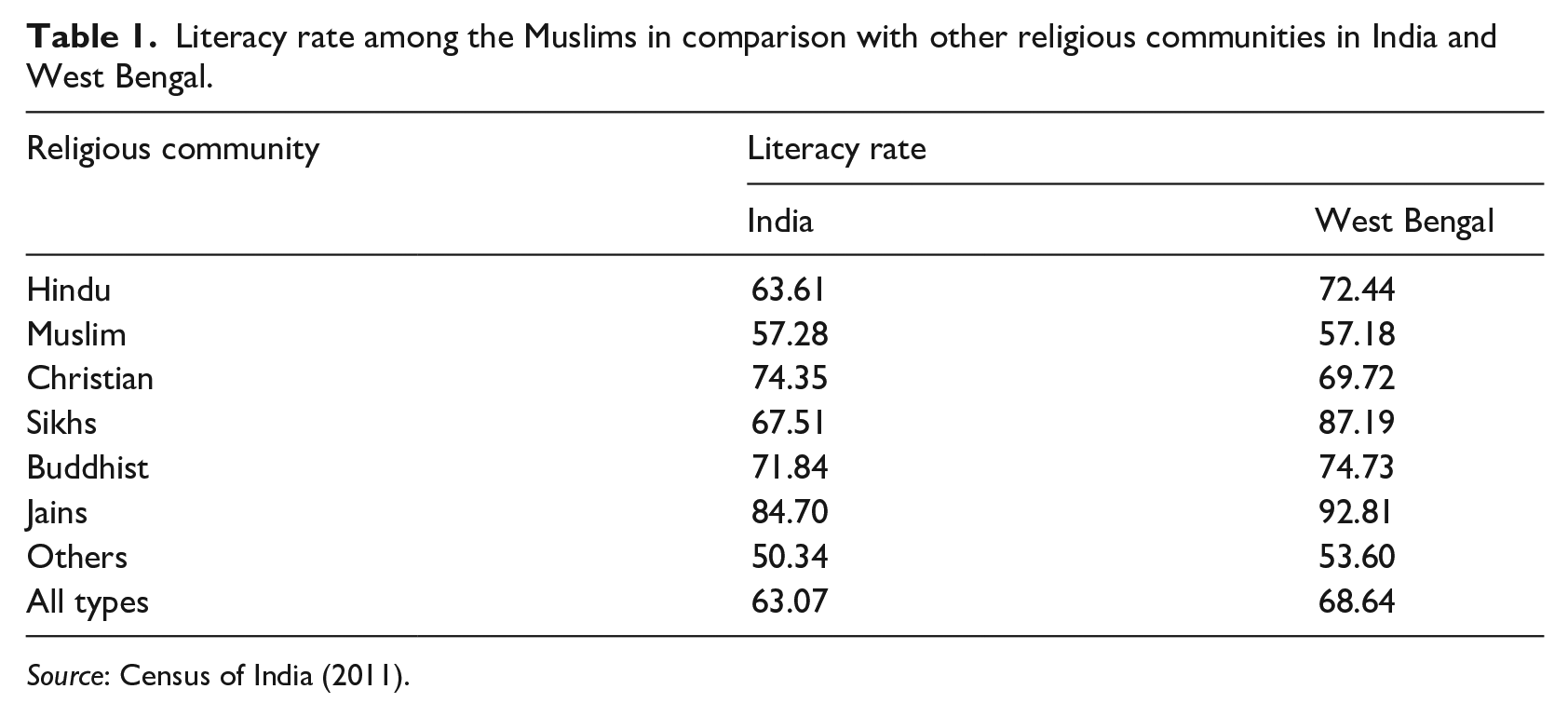
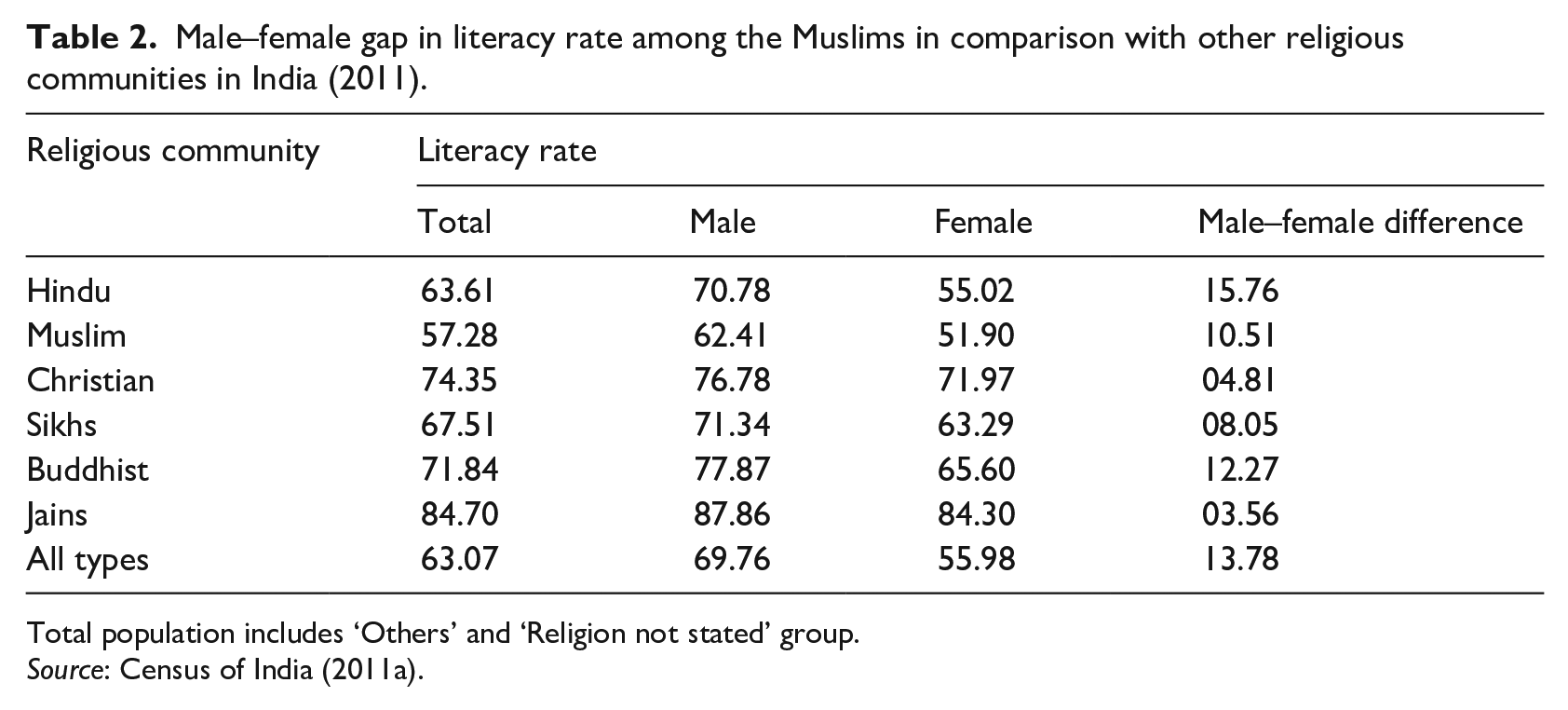
This is not surprising that the Muslim communities in India, the second largest religious group in the country, are lagging behind the other religious communities in education. Their literacy rate (57.28%) sharply contrasts to that of the Hindus (63.61%), the largest religious group, and the other groups in India (Table 1). The situation in West Bengal is in no exception in spite of having frequent claim of development for the Muslims by the ruling political parties for more than the last four decades. The Government of India data on literacy rate of different religious communities are shown in Table 1 (Census of India, 2011). Table 1 shows that the Muslims have been occupying the lowest position, with a literacy rate of 57.18% in West Bengal and 57.28% in India among the major religious communities as per the Census of India 2011 data. The gap in the literacy rate between males and females is shown in Table 2. This indicates that the Muslim population in India has the third highest gap (10.51%) after the Hindus (with 15.67%) and the Buddhists (with 12.27%).
Literacy rate among the Muslims in comparison with other religious communities in India and West Bengal.
Source: Census of India (2011).
Male–female gap in literacy rate among the Muslims in comparison with other religious communities in India (2011).
Total population includes ‘Others’ and ‘Religion not stated’ group.
Source: Census of India (2011a).
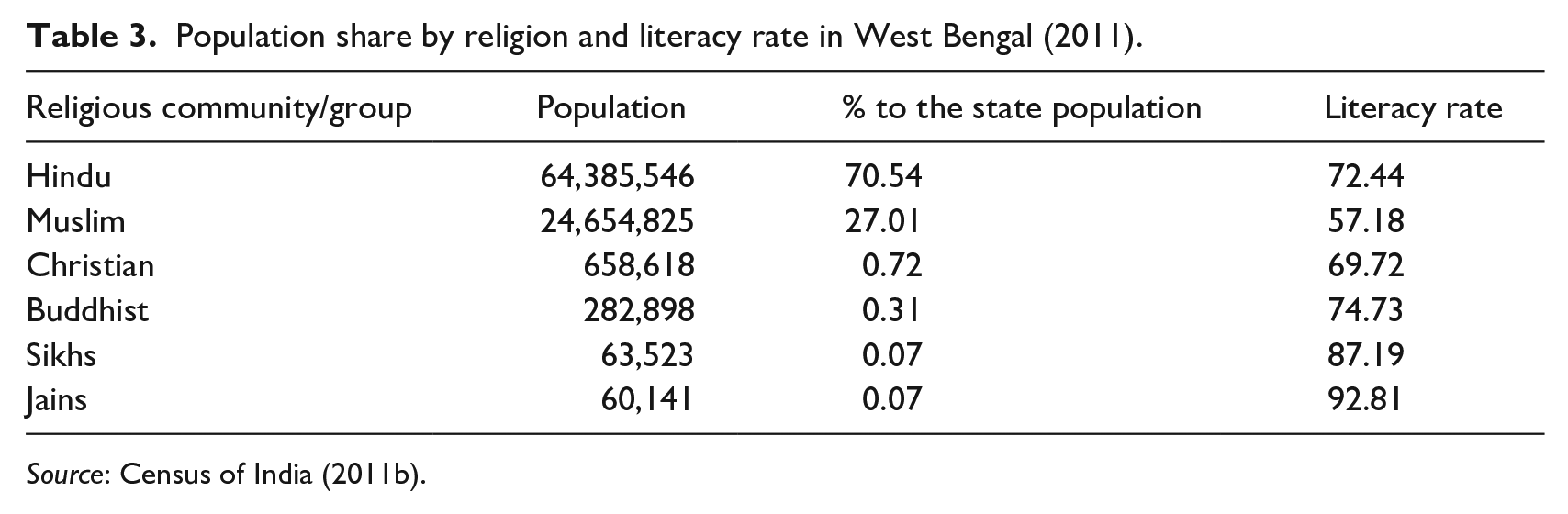
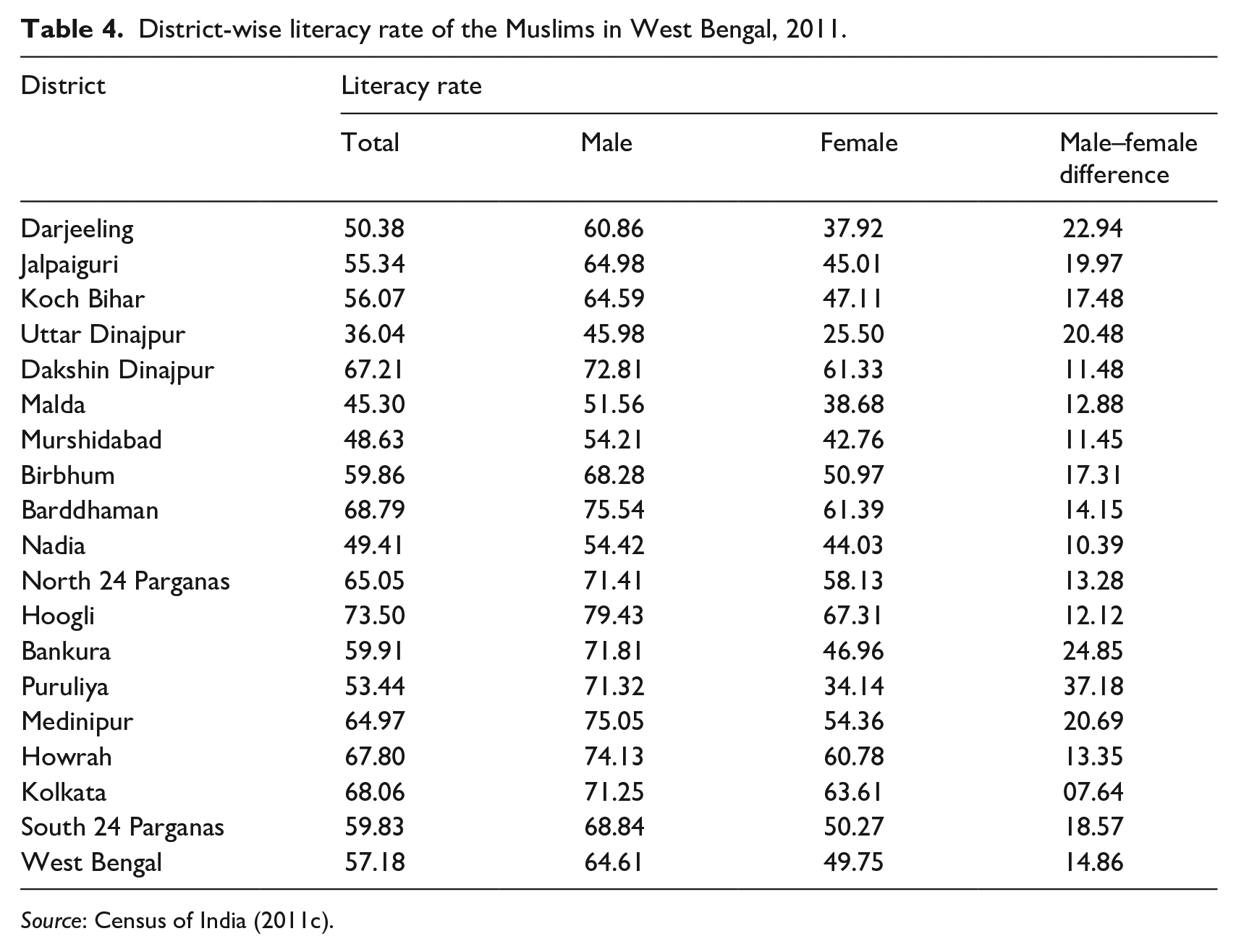
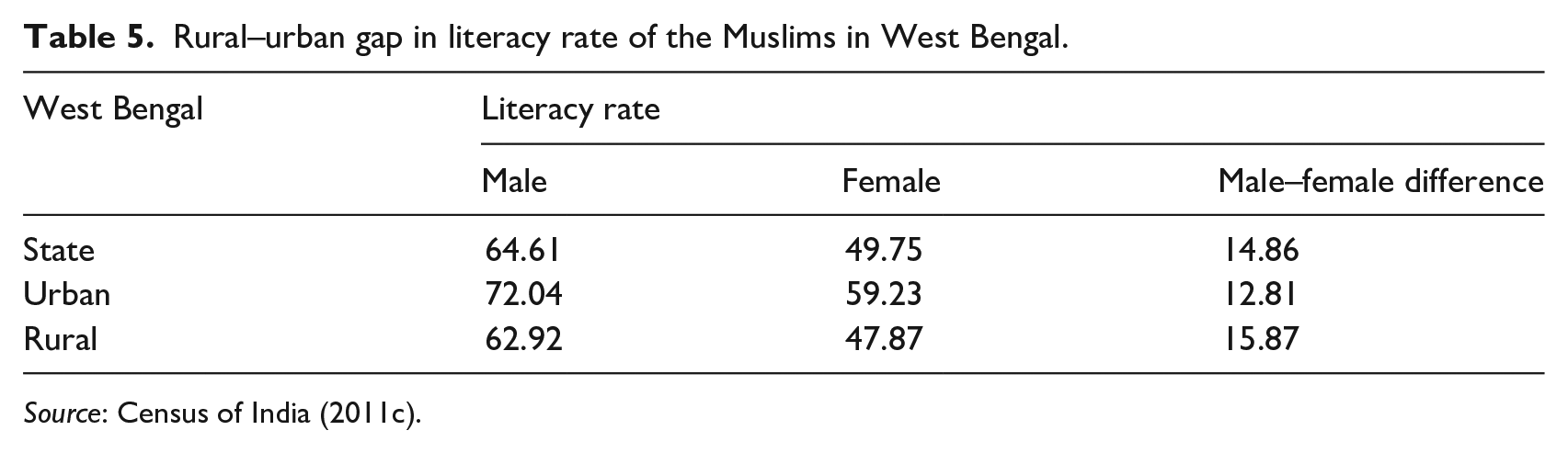
The population shares of different religious groups and their relative literacy rates are given in Table 3. It is found from Table 3 that in West Bengal, too, the Muslims show the lowest literacy rate (57.18%) compared with those of the other religious communities. Table 4 demonstrates the district-level Census data, 2011. This is further found from Table 4 that there are significant gaps between literacy rates of males and females in all districts of West Bengal. Table 5 shows the rural–urban disparity in literacy rate in West Bengal. The table exhibits significant gaps between male and female population both in urban and rural areas in terms of literacy rate.
Population share by religion and literacy rate in West Bengal (2011).
Source: Census of India (2011b).
District-wise literacy rate of the Muslims in West Bengal, 2011.
Source: Census of India (2011c).
Rural–urban gap in literacy rate of the Muslims in West Bengal.
Source: Census of India (2011c).
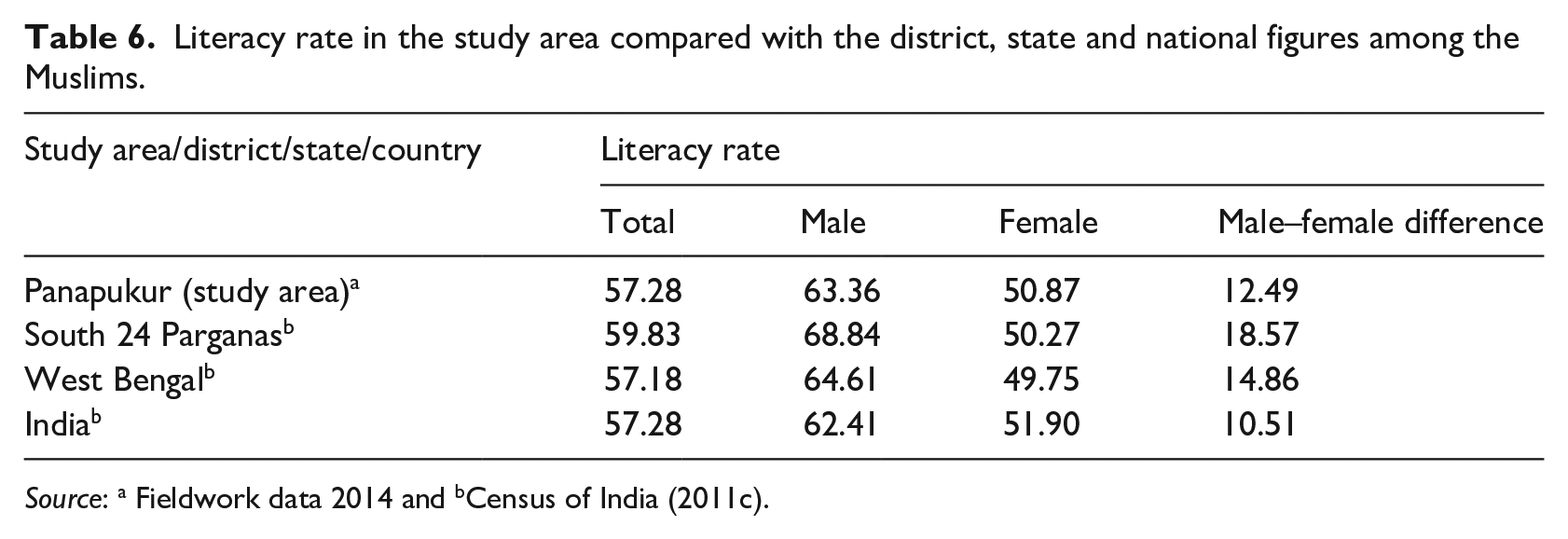
Now the question arises: Why such gender-based gap in literacy rate exists in West Bengal as well as in India? Answer may be in the ground reality that is situational with reference to specific socio-cultural and economic contexts. Though the situation is not uniform in all areas in the country, at least one specific study may help to identify some of the crucial factors affecting literacy rate or the educational achievement of the community concerned. With this view in mind, we have studied Panapukur village in West Bengal. Table 6 shows that the village also witnesses similar trend of male-female gap in literacy rate.
Literacy rate in the study area compared with the district, state and national figures among the Muslims.
Source: a Fieldwork data 2014 and bCensus of India (2011c).
Panapukur case: an eye opener
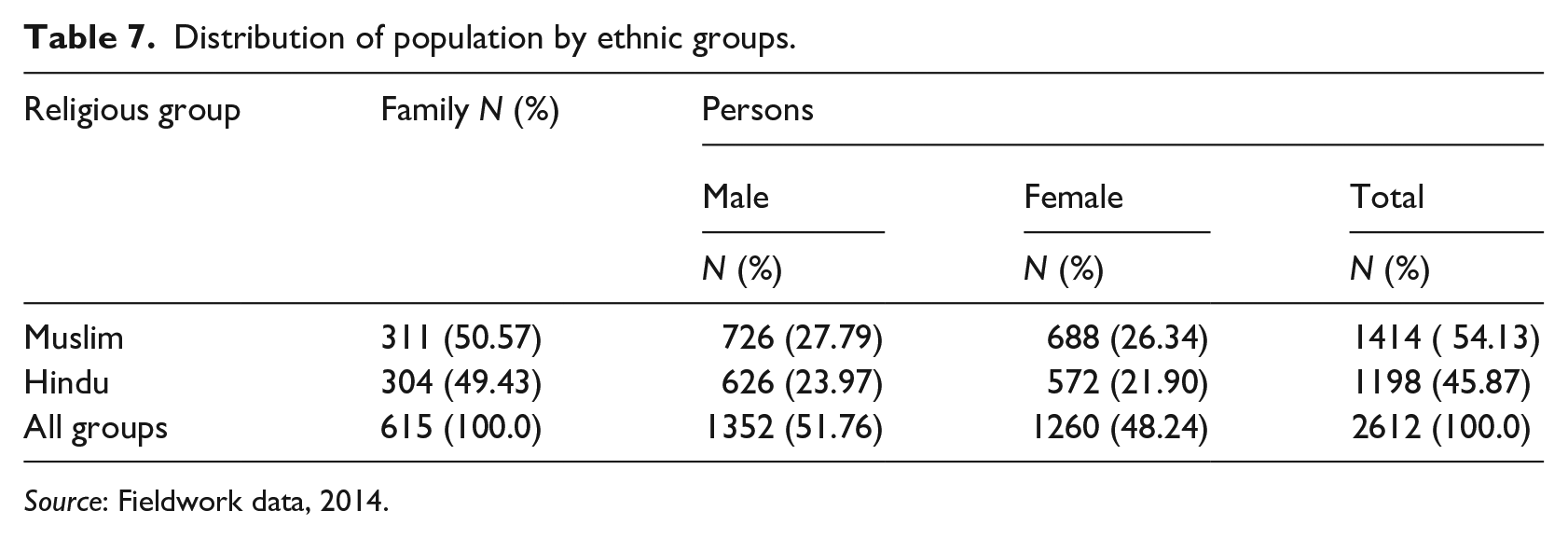
Population in Panapukur village is composed of two religious groups, namely, the Muslim and the Hindu. There are altogether 615 families: 311 families belonging to the Muslim and 304 to the Hindu. The total population in the village is 2612. Muslims have a population of 1414 persons, including 726 males and 688 females (i.e., 27.79% and 26.34% of the village population, respectively). On the other hand, the Hindus have a population of 1198 persons, including 626 males and 572 females (i.e., 23.97% and 21.90% of the village population, respectively). The distribution of village population by religious groups is given in Table 7 which shows that the Muslims constitute 54.13% of the village population, while the Hindus making up 45.87% of that.
Distribution of population by ethnic groups.
Source: Fieldwork data, 2014.
Age at first marriage
As Prophet Muhammad states, Islam always allows every man and woman to marry at their proper age. But in West Bengal, basically in rural areas, it is observed that age is not a restricting criterion for marriage and it, thereby, affects education seriously. In case of early marriage, most of the people entering into marriage are not to continue their education and gradually become dropouts (Adak and Midya, 2020; Islam and Midya, 2019b). Similar phenomenon is observed in the present study. However, there is a decreasing trend of early marriage as a result of introduction of (1) the Prohibition of Child Marriage Act, 2006, by which the legal age of marriage for girls was raised from 15 to 18 years and for boys from 18 to 21 years, and (2) the Kanyashree prakalpa that was introduced in 2012 by the State Government in order to disincentivising marriage till at least the age of 18 years, thereby reducing the risks of early pregnancies, associated risks of maternal and child mortality, and other debilitating health conditions, including those of malnutrition. A few studies certainly found positive impact of the Kanyashree prakalpa at least in delaying girls’ marriage (Biswas and Deb, 2019; Nanda et al., 2016; Sen and Dutta, 2018; Modak, 2019).
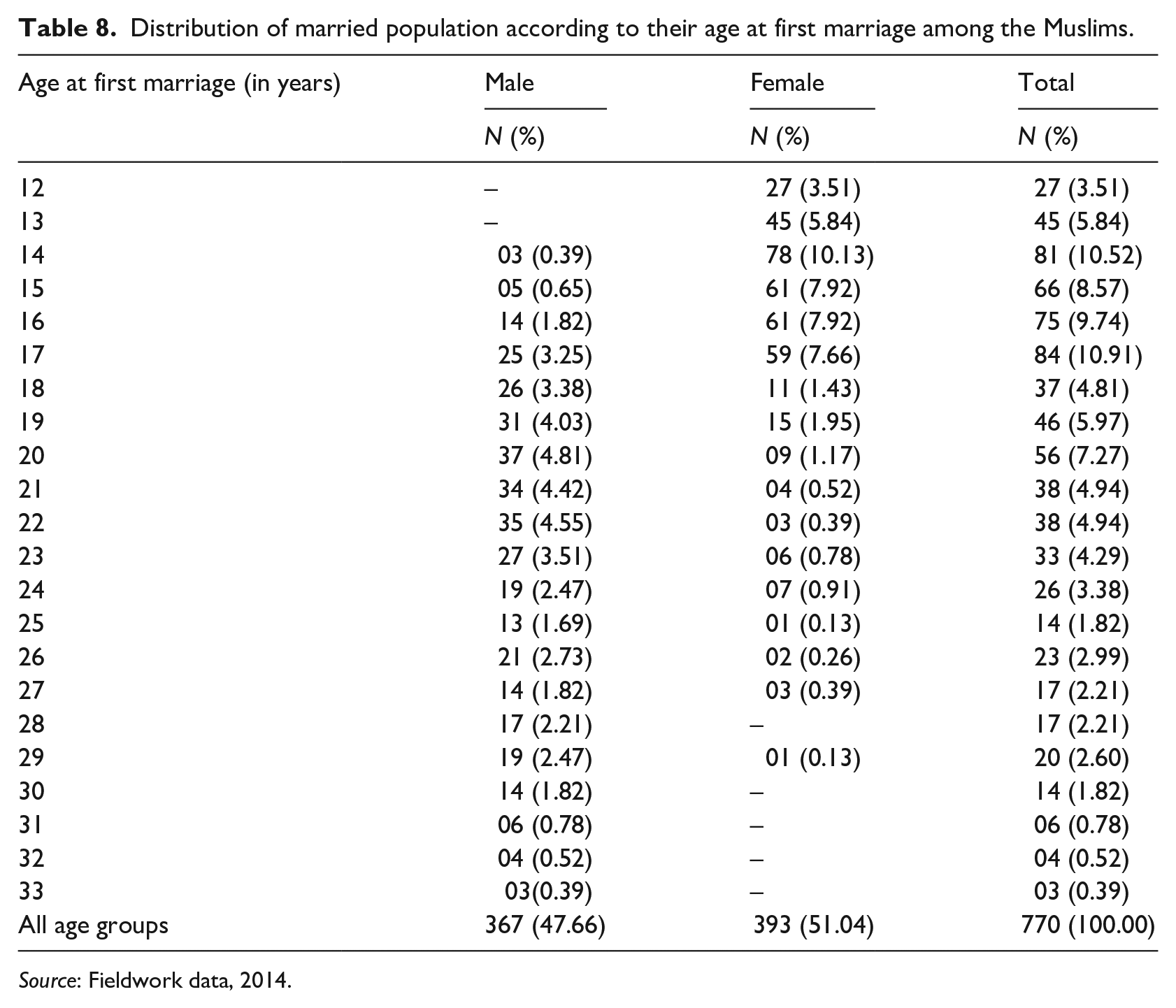
Distribution of married Muslim population within the study group by their age at first marriage is given in Table 8. Table 8 shows some interesting demographic features:
Incidences of early marriage, starting from as early as 12 years, are very common. Early marriage is more frequent among the girls. Although the legal age of marriage for girls is 18 years, they are married from the age of 12 years. Similar phenomenon of early marriage is also found for the boys among Muslims.
Incidents of early marriage for both the sexes account for 49.57% for the Muslim population. This includes 42.99% early marriage for the girls and 6.10% for the boys. This huge number of children becomes eventual dropouts after getting marriage.
Distribution of married population according to their age at first marriage among the Muslims.
Source: Fieldwork data, 2014.
Literacy status
Among the Muslim population in the study area, it is found that 57.28% of them are literate. This is calculated following the guidelines given by the Census of India, 2011, where it is said that a person aged 7 years or above who can both read and write with understanding in any language be considered as literate. Thus, a person, who can only read but cannot write, is not literate. All children of age 6 years or less were treated as illiterate by definition, irrespective of their status of school attendance and the capability to read and write (Census of India, 2011). Therefore, for the present study, children aged less than 7 years have been treated as illiterate or non-literate. The term non-literate has been preferred for the present case in view of the fact that such persons may not read or write with understanding in any language, but have considerable knowledge on culture and ecology and that there is no question of being literate for many of them. Sex-wise distribution of literates among the study population is shown in Table 9. It is found that among the literates, 32.53% are males whereas 24.75% are females. Thus, the number of non-literates is higher among the females like in other communities. If we consider the sex-wise literacy rate among the Muslims, it is found that among the males literacy rate is 63.36%, whereas this is only 50.87% for the females. Thus, the females are found to be lagging behind their male counterpart in educational achievement among the Muslims in the study area.
Distribution of the Muslim population by literacy status and sex.
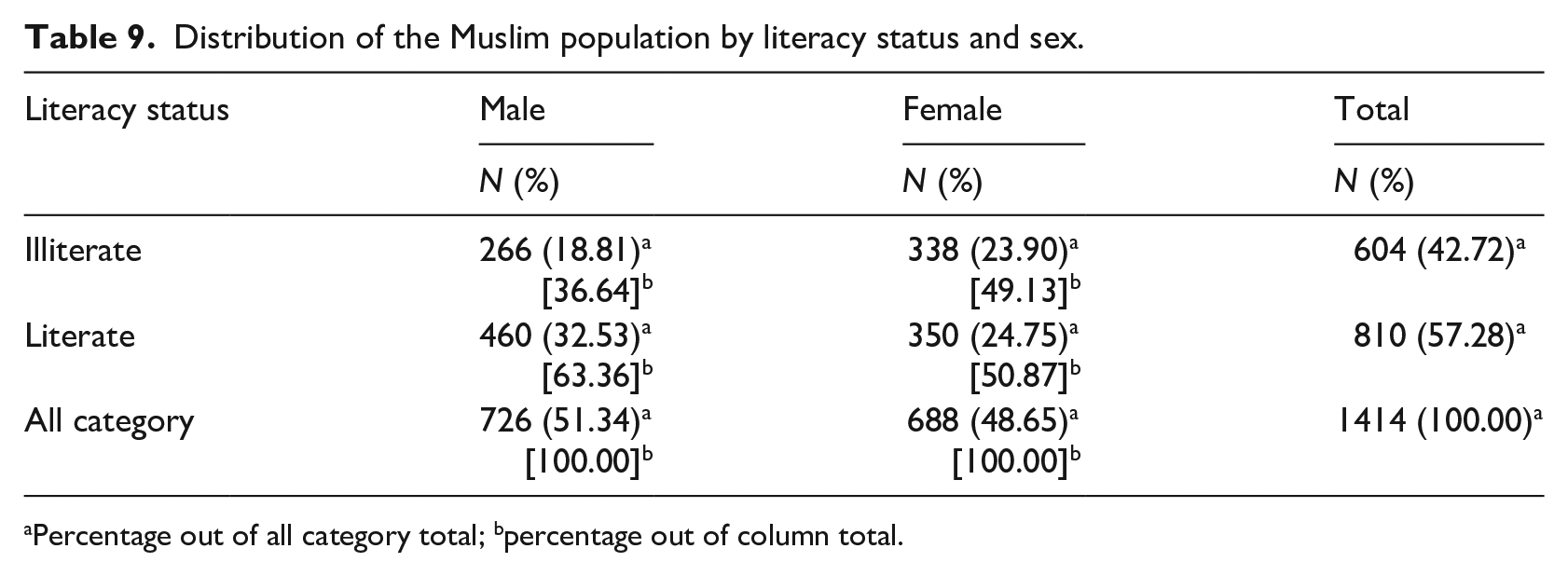
Percentage out of all category total; bpercentage out of column total.
Age group–wise level of education
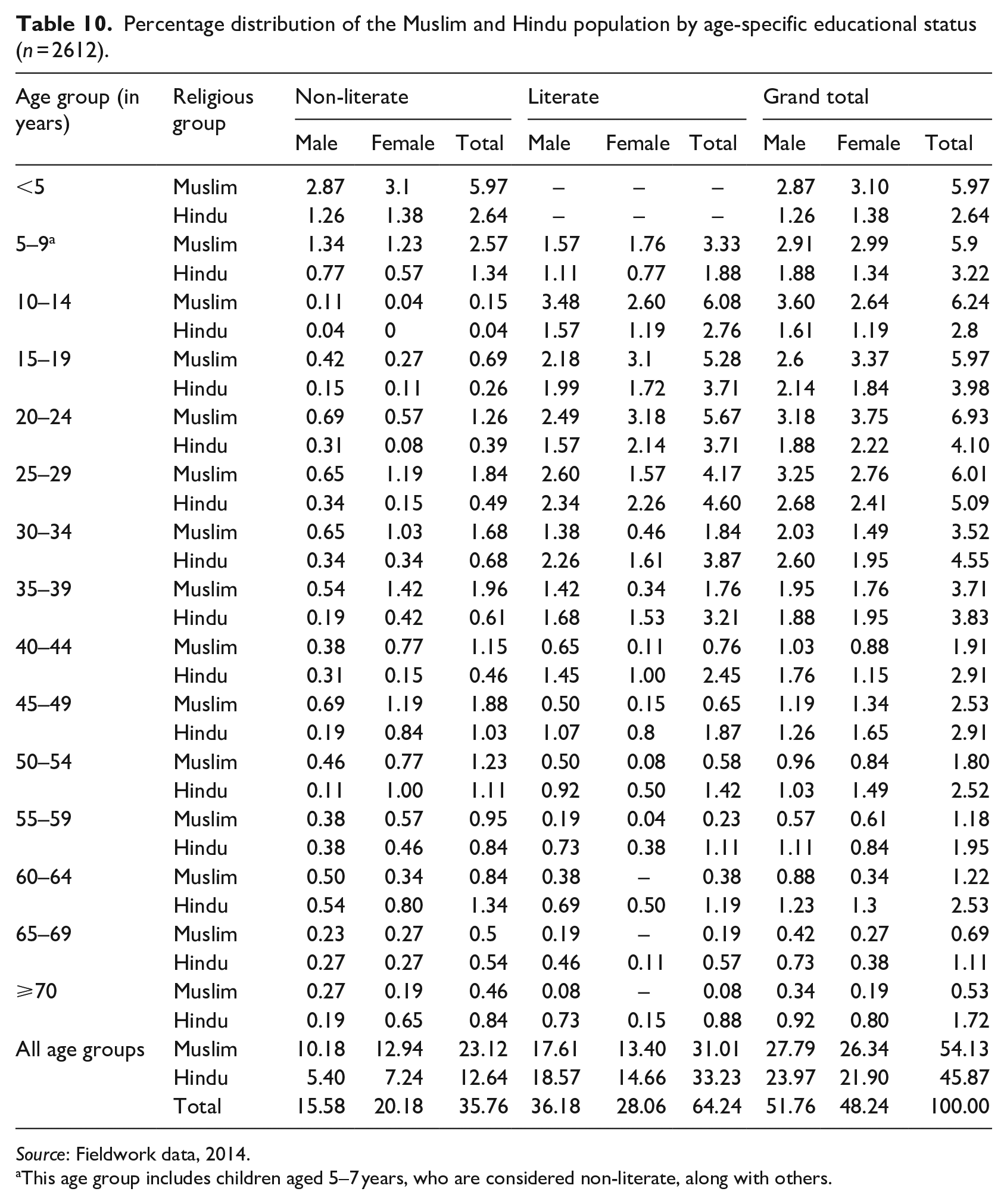
The age group-wise distribution of the Muslim population by literacy status is given in Table 10. The table shows that literacy rate across the lower age groups particularly in 5–9, 10–14 and 15–19 years is good, but it exhibits a decreasing trend as we proceed towards the higher age groups. This suggests that the young generation is more likely to come within the fold of education.
Percentage distribution of the Muslim and Hindu population by age-specific educational status (n = 2612).
Source: Fieldwork data, 2014.
This age group includes children aged 5–7 years, who are considered non-literate, along with others.
If sex-wise distribution of literates is observed, it is found that at the primary level of education male students (13.15%) hugely outnumber their female counterpart (4.74%). But at the secondary level, there is found a phenomenon of gender equality in literacy rates, with 17.19% among the males and 17.96% among the females. Interestingly, at the higher secondary level, male students are found to be outnumbered by the females. The Kanyashree prakalpo is reported to have a deep-rooted impact on girls’ education across the secondary and higher secondary levels. In addition to this, the minority scholarship and the OBC scholarship funded by the State Government in order to encourage the students up to higher secondary level education seem to have a positive reinforcement effect. Compared with the age group–wise distribution of the Hindu students, it appeared that among the Muslims early dropouts are more frequent (Table 10).
Table 10 further shows that the number of literates abruptly falls down after secondary level. This is reportedly because the Muslim parents hardly can afford, or have interest, for their children’s education further. It is also revealed that literacy rate of the aged women is sharply lower than that of the younger generation. This is because the aged women had not received support at their teenage from their parents or the then government in favour of their education. A case study of a woman of 26 years, who had to leave her school when she was in Class IX, in this connection may substantiate their situation as in the following:
Rojina Bibi is a young married woman having two children. She lives in Mallik para. She is basically a house wife and sometimes engaged in Jorir kaj [embroidery work] in order to have a financial support for her family. She was a bright student of Bhangar Girls’ School. She had a great deal of enthusiasm for higher education but had to leave school when she was only at class-IX. Both of her parents were non-literate and did not have interest for her education, unlikely to the present-day scenario. It was also very hard for her parents to afford their children’s education at that time since there was no provision of scholarship for the students in general and for the female students in particular. She was married at her 15. But now Rojina Bibi and her husband have interest in favour of their children’s education at least up to higher secondary level.
Many informants argue that lack of adequate infrastructural facilities was also a contributing factor for early dropouts previously. A case study of a woman of 47 years may illustrate the situation:
Aklima Bibi is a mother of two sons and one daughter. Her father is a literate person who studied up to class IX and mother an non-literate woman. She had her primary education long back from the nearby Hatishala Free Primary School outside the village. But after that she was not admitted to any school since at that time there was no upper primary or high school in Panapukur or its adjacent areas. The only existing school was located at that time about 7 km. from the village. Her grandparents and parents were not in favour of sending her to that school for the sake of protecting her safety and ‘purity’. Her family was very conservative and the women had to use hijabs. Thus, she became an eventual dropout. When she was at her early 17, she got married to a man who had however some knowledge in Islamic education.
From the above case studies, it appeared that poor economic condition and conservativeness of the parents have negatively influenced women’s education. But, girls of the recent generation in particular appear to be in relatively advantageous situation owing to some parents’ positive attitude towards education and to the financial support schemes of the State Government.
Enrolment pattern
The Muslim students in the study area are enrolled in various levels of education in different institutions. Figure 1 shows the distribution of the Muslim students up to higher secondary level of education in various institutions. It is found that the children aged 5 years and above are usually found to get enrolled to the primary school in the village. For secondary and higher secondary levels of education, the children are found to enrol in the Bhangar High School, Bhangar Girls’ School and Bhangar High Madrasah. Some of the Muslim students have been enrolled in various Islamic educational institutions, namely, Kanthaliya Karijee Madrasah, Satuliya Senior Madrasah and Gatakpukur Abu Siddique Madrasah (a hafezi madrasah).
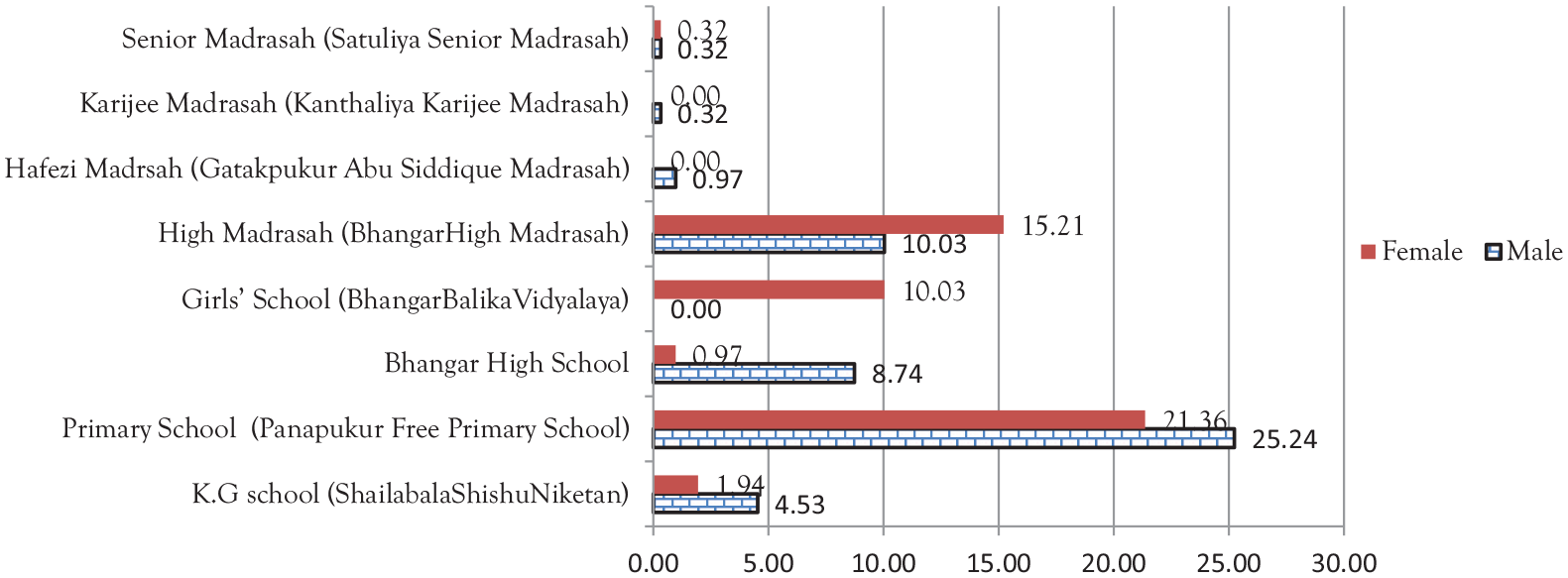
Bar chart showing the Muslim students, aged 6–19 years, in terms of their enrolment pattern and sex.
It is further found that a private KG school (named as Shailabala Sishu Niketan) has only 6.47% of the total enrolled children of the study area. There is also gender disparity in affording education in private school, with 4.55% boys and only 1.94% girls of such enrolment.
Dropout scenario of the Muslim children
Dropout means the premature withdrawn of a student from school before completing his or her study in the last grading of the stage of education in which he or she was studying. Thus, every child who is withdrawn from school before completing the study has been considered as a case of dropout for the present purpose.
The dropout of Muslim children at various stages of education in the study area is given in Figure 2. It shows that there is a high frequency of dropouts at the junior high level of education. Out of 48.80% dropouts at junior high level of education, 24.82% are males and 24.00% females. Dropout rate is also very alarming at the primary level; it is 26.8%. Frequency of male dropouts at primary level is quite high (19.2%) compared with that of the females (7.6%). At the secondary level, frequency of dropouts is high among the females (14.00%) compared with that of the males (3.20%). This is reportedly because of early marriage of girls belonging to the Muslim families which has been observed earlier (see Table 8). Frequency of dropouts in the higher levels is relatively not very high because of having less number of students in these stages.
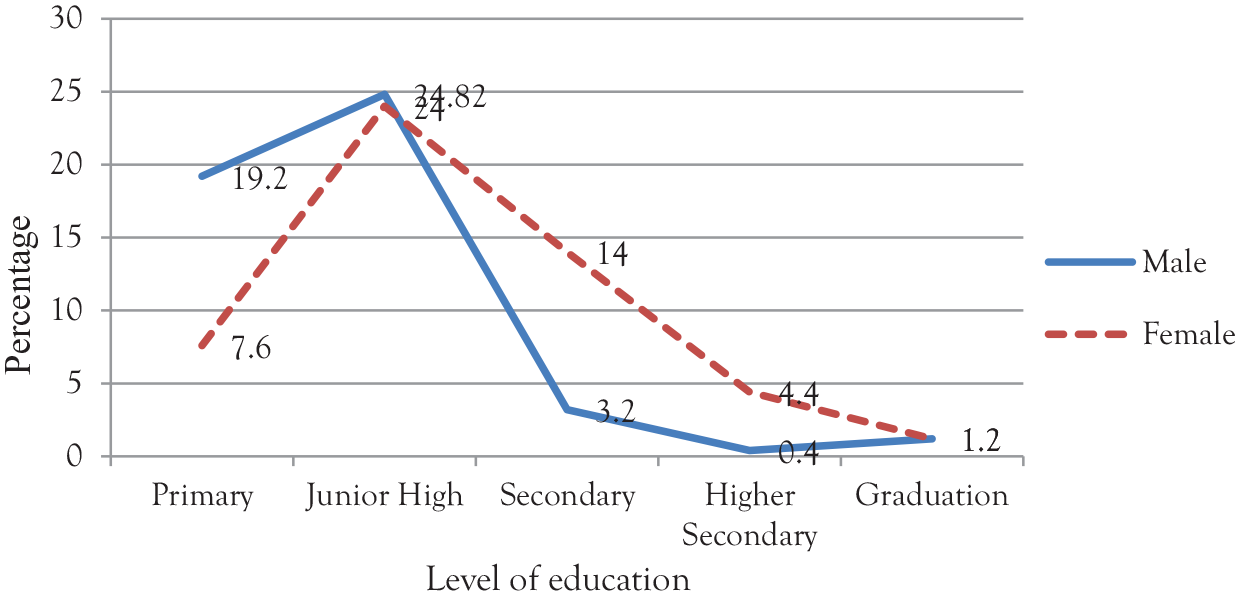
Line graph showing dropout frequencies in different levels of education among the Muslims.
Now the question arises: why the Muslim children become dropouts in their early childhood? Figure 3 shows the dominant factors for dropout among the Muslims. The most prevalent causal factor for dropout is poverty; this is for 43.20% children. The poor parents are hardly interested to allow their children to continue education. Many students become dropouts in search of earning opportunity, however meagre it is. The second important cause behind discontinuing studies is early marriage (18.80%), particularly of girls (16.40%). The poor guardians prefer early marriage of their girls in order to manage their inability to afford for food and clothing and to provide a safe custody for the girls. Lack of awareness about importance of education among the parents is evident in this connection. Moreover, there are some parents who are not interested in their girls’ education because of their religious conservatism (3.20%). On the whole, males outnumber the females in respect of dropping-out. This is happening due to economic compulsion that forces teenage boys to prefer searching earning avenues.
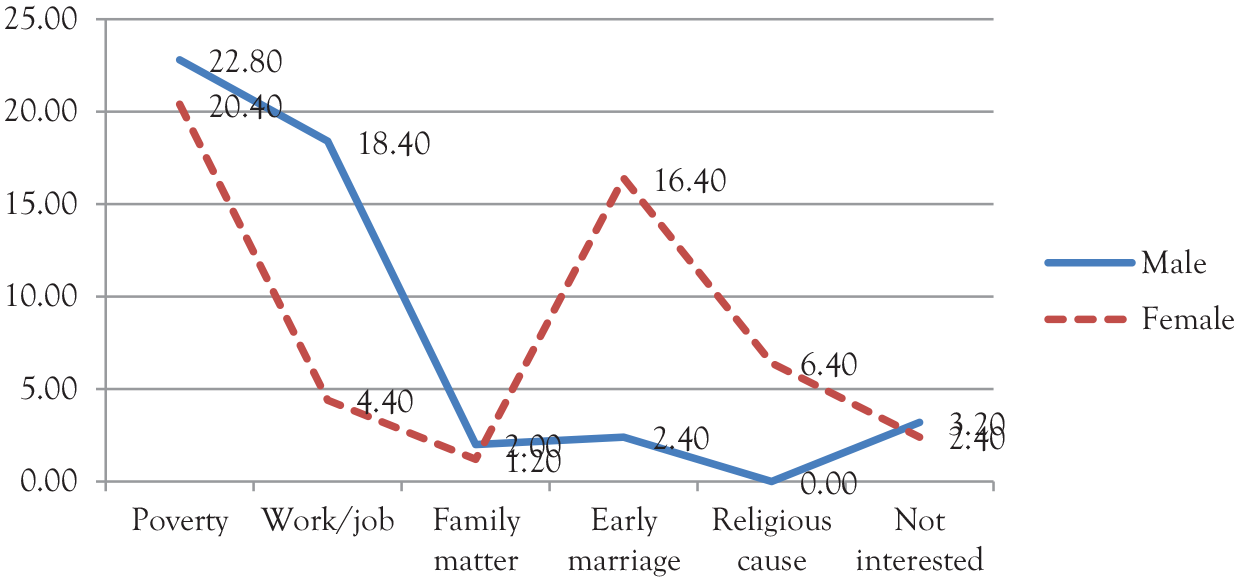
Line graph showing reasons behind dropout among the Muslim children.
Gender preference in education by parents
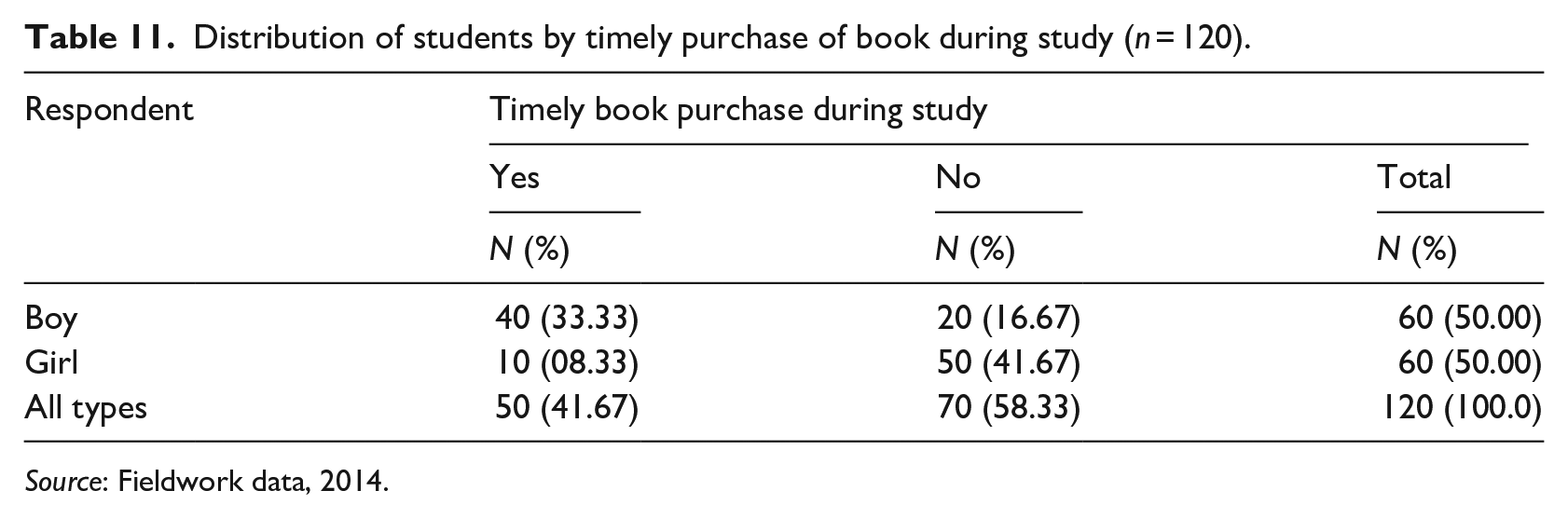
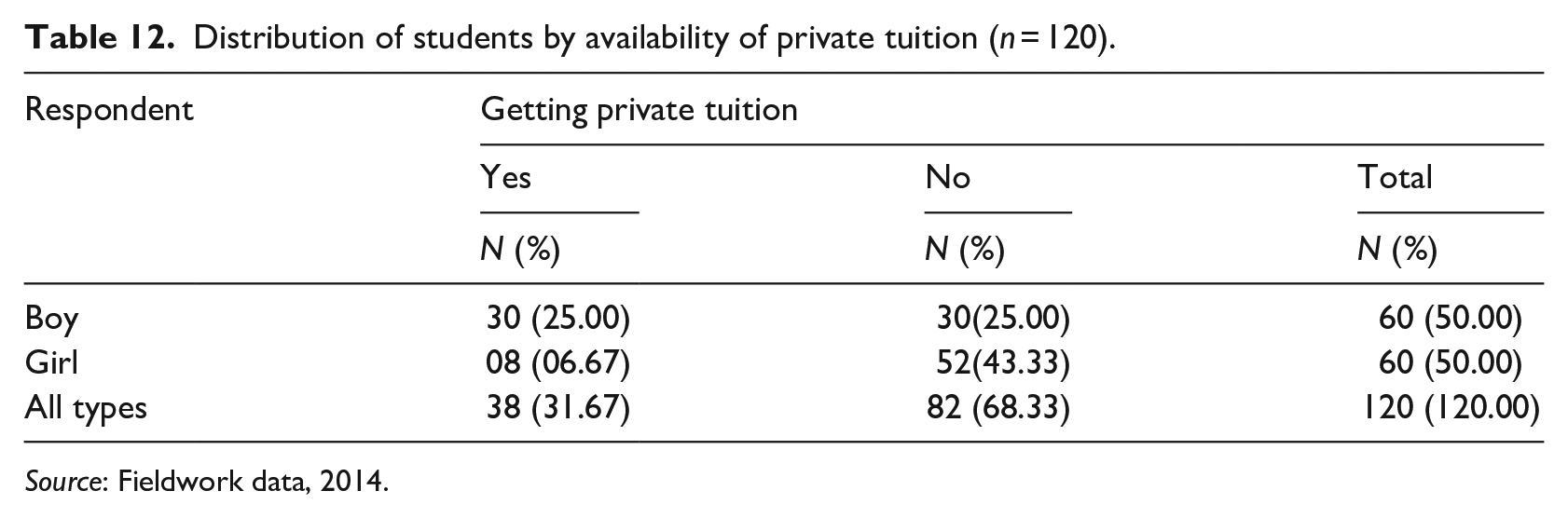
One can find disparity in almost every bit of life, which affects girls negatively in connection with their access to or achievement in education. Although the parents expressed their limited affordability, their gender preference in timely providing books is shown in Table 11. It is found that whereas about 33.33% male students had their books timely, only 8.33% girl students were lucky enough to enjoy similar opportunity. Disparity is also found in accessing private tuition for boys and girls. This is given in Table 12. This is also found that while 25% male students were getting help of private tutors to prepare their lessons, this is only 6.67% for the girl students. This is because many parents think that incurring expenditure for daughters’ education is a bad investment since they will go to serve other’s families after marriage.
Distribution of students by timely purchase of book during study (n = 120).
Source: Fieldwork data, 2014.
Distribution of students by availability of private tuition (n = 120).
Source: Fieldwork data, 2014.
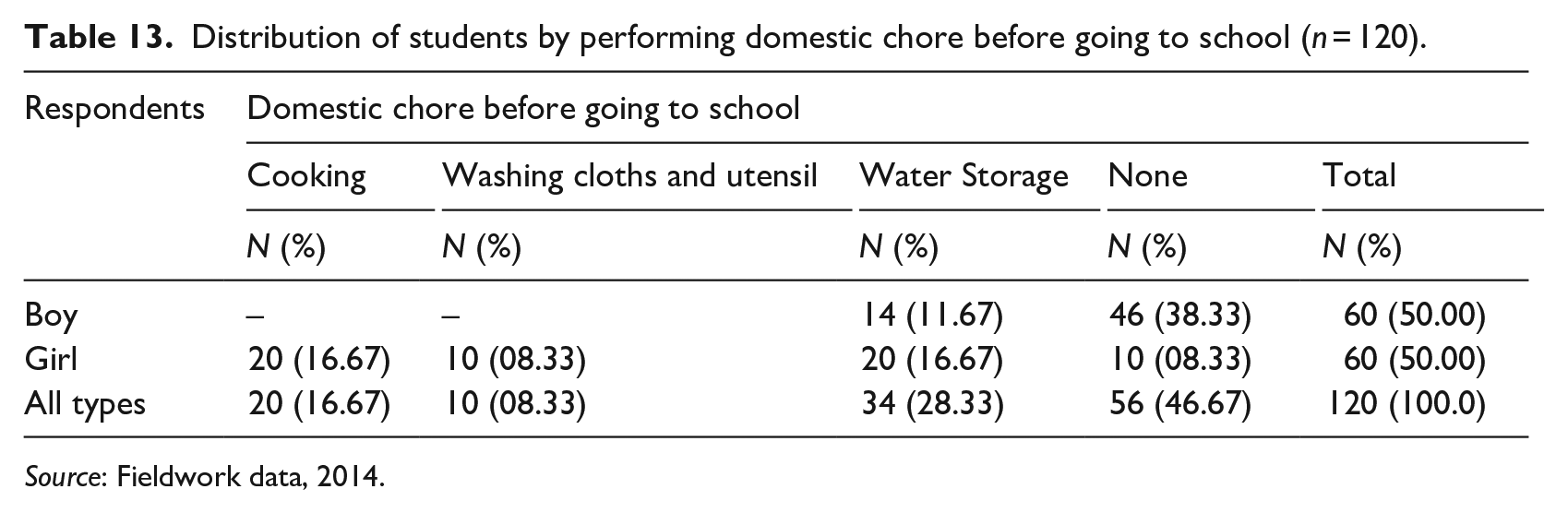
Inequality is very prominent also in the nature of domestic workload of the girl students, as demonstrated in Table 13. It is found that the majority of girl students (41.67%) have to help in regular domestic chore of their families before leaving for schools. This is only 11.67% for the male students.
Distribution of students by performing domestic chore before going to school (n = 120).
Source: Fieldwork data, 2014.
Parents’ perception about girl’s education
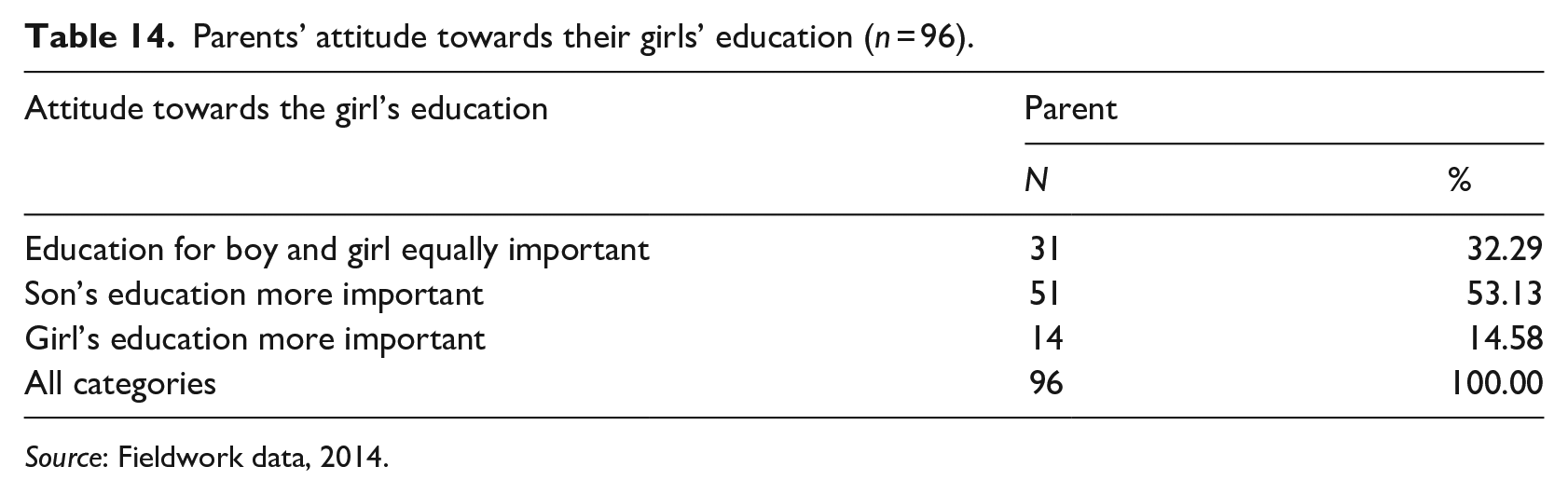
The Muslim parents’ attitude towards women’s education is shown in Table 14. A significant section of parents gives equal value to women’s education with men’s. However, 53.13% parents think that boys’ education is more important than that of girls’. This is because, according to them, after marriage girls will have to leave their parents’ family and cannot support the latter; so, they should be trained in household work. On the contrary, 14.58% parents are of the view that girls’ education is more important because only educated girls can make a family better.
Parents’ attitude towards their girls’ education (n = 96).
Source: Fieldwork data, 2014.
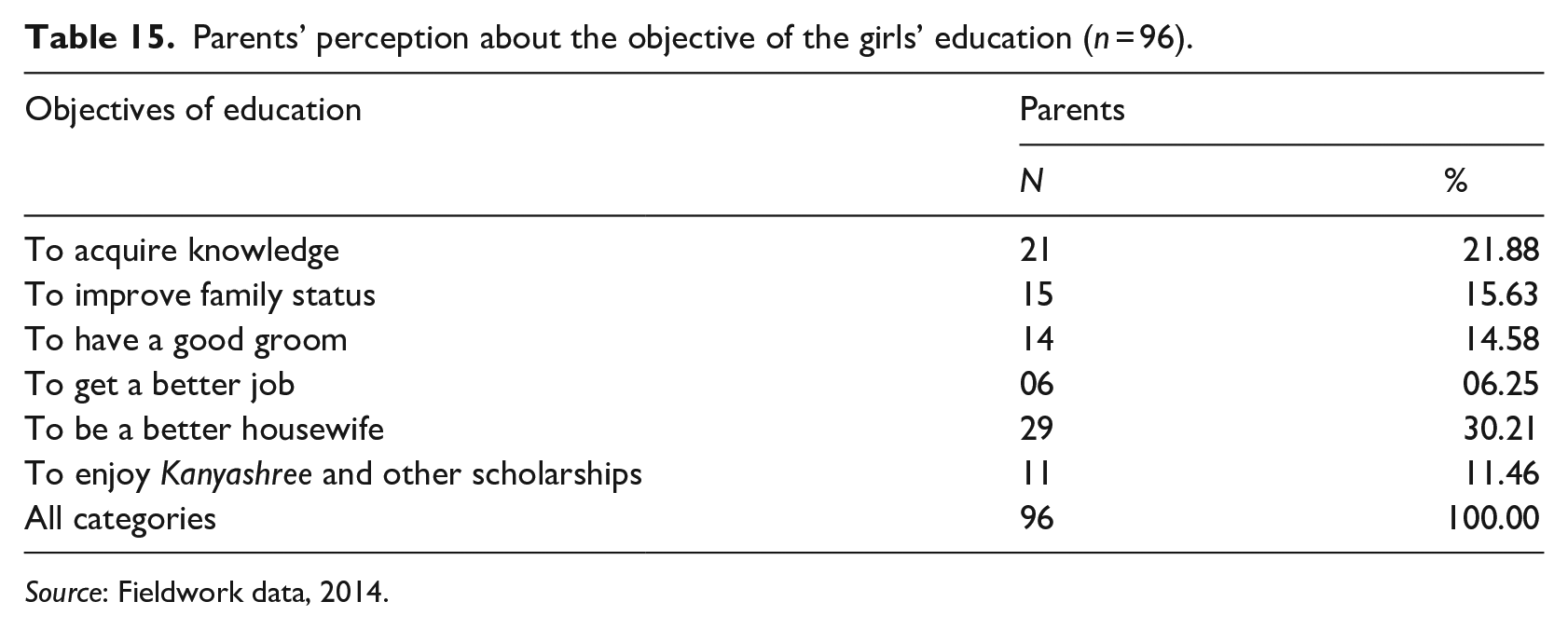
The Muslim perception about the need of education for girls is shown in Table 15. It is found that only 21.88% Muslim parents think that women’s education is essential to acquire knowledge that would make them able to take challenge of future life. But, 15.63% parents like to have girls educated to enhance the status of the family concerned. A good number of Muslim parents think girls are to be educated to become good housewives (30.21%) or to get good grooms (14.58%). Only 6.25% parents are of the view that education will make their girls able to get good jobs. However, 11.46% of them put that to continue education is necessary to get the Kanyashree and other scholarship, which will give a good savings to meet further expenditure in incidences like marriage or medical urgency. A case study in this connection may substantiate the argument. In the words of a class XII student, aged 18 years,
I was born to a very poor family. My parents neither have any interest in my education, nor are in a position to afford for sending me to school. I started my education at my own will. I have been enjoying various scholarships since I was studying in class V. I got minority scholarship and Kanyashree. After completing 18 years, I also got INR 25000/- [USD 336 approx.] under the Kanyashree prokalpo. I am incurring all my expenditure for education from my scholarship. Without scholarship I can’t continue my study.
Parents’ perception about the objective of the girls’ education (n = 96).
Source: Fieldwork data, 2014.
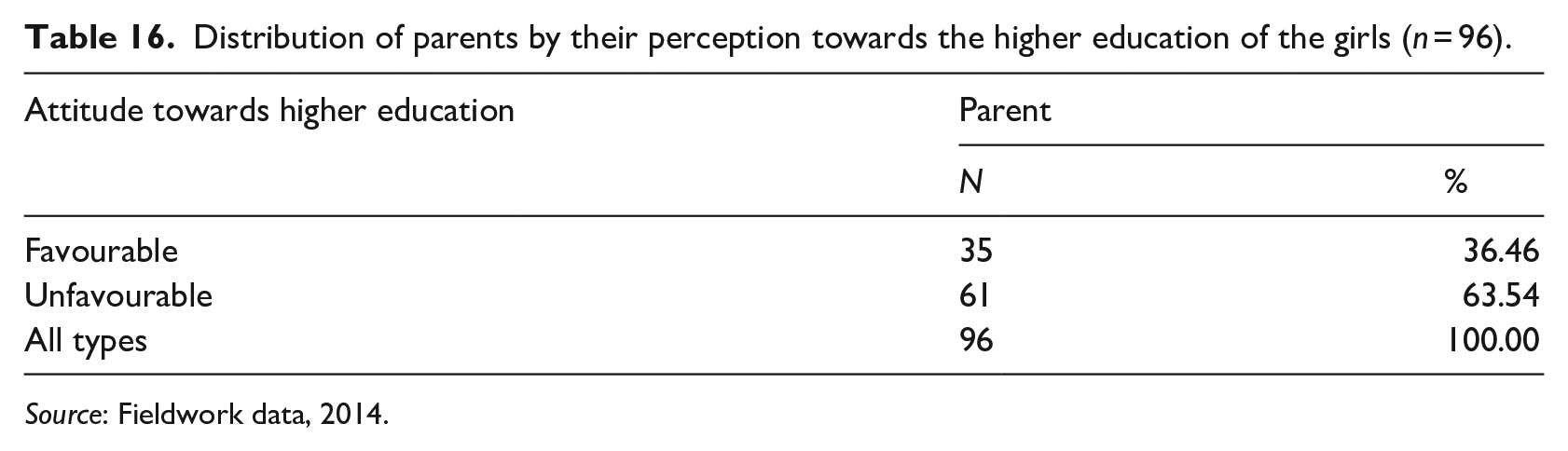
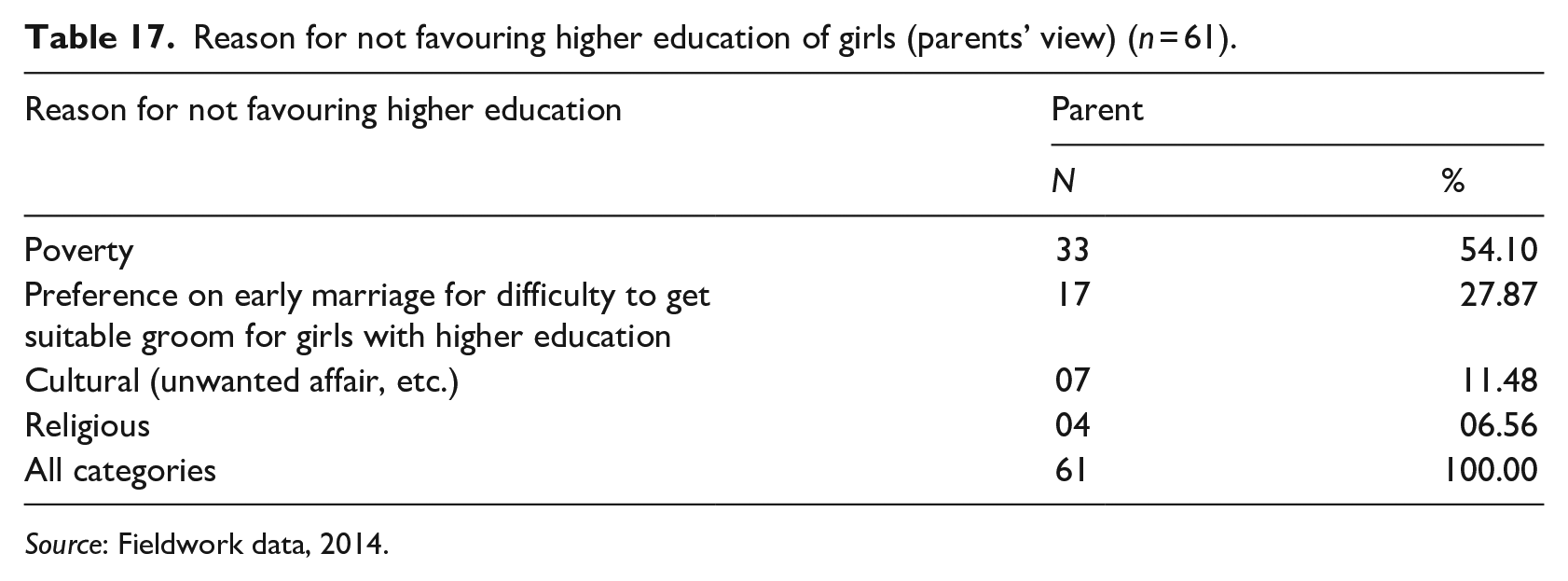
The data presented in Table 16 reveal that 63.54% parents dislike higher education for their daughters, though 36.46% of them favour higher education for them. In the study area, there are 61 parents who do not like higher education for girls. Their stated reasons are shown in Table 17. It is found that as much as 54.10% of such parents do not like higher education for their daughters due to their daunting poverty. About 28% of them think that early marriage of their daughter is good for their society, and that, if girls are given higher education, it will be very difficult to get suitable grooms since only a very few grooms with higher education may be available in Muslim society. There are many parents (11.48%) who are very conservative and are worried that higher education can provide girls with scope of developing illegal affairs or self-opinion. Still there are 6.56% parents who have a religious fanaticism against higher education for girls.
Distribution of parents by their perception towards the higher education of the girls (n = 96).
Source: Fieldwork data, 2014.
Reason for not favouring higher education of girls (parents’ view) (n = 61).
Source: Fieldwork data, 2014.
Thus, it appears that the majority of the Muslim parents do not like higher education for girls because of three prominent reasons, among others: (1) they do not like their girls to go far distance to receive higher education since higher educational institutes are located usually outside the village; this may compromise the safety of the girl students; (2) they can hardly afford for higher education; and (3) it is very hard to find out suitable grooms for the girls with higher education. On the other hand, those favouring higher education for girls have the argument that girls also have the right to acquire higher education and without proper education Muslim society cannot achieve progress.
Conclusion
Gender discrimination in accessing or achieving education is the most alarming challenge all over the world. The present study shows that the Muslims are always lagging behind their Hindu counterpart in terms of literacy rate in West Bengal, as also in India. There is also a wide gap in literacy rate of the males and females in the community like that among the Hindu and the Buddhist religious groups in the country. The study shows that this gap is widened due to various kinds of discrimination the girl child are met out in almost every bit of their life.
Gender discrimination is more among the Muslims compared with their neighbouring Hindu community who are living within the same socio-political contexts of the study area. Early marriage, starting from as early as 12 years, is more frequent for the girls among the Muslims. This is 42.99% compared with that among the boys (only 6.10%). There is wide disparity in accessing primary level education (with 13.15% male and 4.74% female students). However, at the secondary level this is almost balanced for boys and girls. But at the higher secondary level of education, the situation becomes better for the girls. This is reportedly in order to avail the Kanyashree and minority scholarship schemes which are incentivizing them to continue in education for a longer period of time and disincentivising marriage till at least the age of 18 years.
This is further found that the number of literates abruptly falls down after the secondary level of education among the Muslims. This is reportedly for poverty of the parents and their feeling of insecurity over their draughters’ safety. High dropout rate before the secondary level of education is due to twofold reasons: (1) early marriage of girls in particular and (2) leaving of schools in search of earning opportunity by the boys. It is negatively influencing educational achievement of the Muslim community. Moreover, some parents’ preference for the Islamic educational institutions for their girls’ education have also negative impact on girls’ educational achievement since these institutions impart religious teachings only.
Girl students are experiencing further discrimination in the dimensions of timely purchase of books, helping in domestic chores before (and after) attending schools, and choosing better schools that are located in relatively far places. On the whole, Muslim parents do not have proper awareness on the need for girls’ education. For them, girls are to leave their parents’ home after marriage; so, educating them means incurring a ‘bad’ expenditure. It is better for the daughters, they held, to acquire good skills in domestic chore. There is also a prominent view that it is hard to find out suitable grooms within the community for the girls with higher education. Thus, poor economy, lack of awareness about girls’ education and conservatism play crucial role in gender discrimination in the domain of education among the Muslims, as found in the present study. Such discrimination is likely to occur more among any politico-economically vulnerable section of a society like the Muslims in India.
It is the crucial time to think about the importance of female education among the Muslims. If they can make some improvement in education, they would be able to solve many problems in their society in connection with economic development, health care and family welfare. No welfare programme will succeed unless women can put their might for the benefit of the society, may it be in Muslim, Hindu or other society. So, integrative interventional measures are required to generate awareness about the necessity of girls’ education in the Muslim society. For the purpose, educated Muslim women can be utilized as facilitators to highlight the societal and health burdens of early marriage of girls in particular and to motivate the Muslim parents in favour of continuation of their girls’ education.
Footnotes
Acknowledgements
We express our gratitude to the people of study area for their kind cooperation during fieldwork. We are also thankful to the unanimous reviewers whose critical comments certainly enriched us to modify the paper.
Declaration of conflicting interests
The author(s) declared no potential conflicts of interest with respect to the research, authorship, and/or publication of this article.
Funding
The author(s) received no financial support for the research, authorship, and/or publication of this article.
