




Abstract
This paper examines the labor market integration of skilled Pakistani migrant women in Australia by drawing on qualitative data. It explores how the intersections of human, social and cultural capital hinder their labor market participation. It further investigates the redevelopment of these capitals to secure professional employment. We argue that the job-seeking experiences of these women are complex due to their mismatched human, social and cultural capital, resulting in intersectional disadvantages in the Australian labor market. It is concluded that skilled migration programs must be accompanied by labor market integration policies that acknowledge the difficulties faced by skilled migrant women.
Introduction
Immigration has played an important role in Australian social and economic development. The Australian migration program serves as a nation-building project, and it currently incorporates skilled, family and humanitarian streams (Laukova et al., 2022). Since 1979, Australian migration policy has been focusing on skilled migrants to fill the gap of skill shortages in the local workforce. The skilled migration program is based on a points system which considers the applicant’s age, qualification, skills and language proficiency (Hugo, 2014). After 1980, there were higher intakes of migrants from the Asian and Pacific region through the skilled migration program and this trend continued into the 1990s and 2000s (Birrell, 2018; Robertson, 2018). In the 2010s, skilled migration from Asian countries was on the rise resulting in a significant wave of young, qualified people mainly from China, India, Sri Lanka and Pakistan, differing from the traditional source countries of Europe (Birrell et al., 2016). Currently, a large number of Asian migrants are living in Australia, making it one of the most culturally and linguistically diverse countries in the world (Australian Bureau of Statistics [ABS], 2024).
The data shows that the number of skilled migrant women from Asian countries has been increasing over the last few decades, demonstrating feminization of migration in the Asia-Pacific region (ABS, 2024; Webb, 2015). Migrant women’s labor force participation is essential for their successful settlement and social integration in the host country. However, their employment outcome is comparatively lower than local-born citizens and their male counterparts, particularly for those who are from Culturally and Racially Marginalized (CARM) backgrounds (Hamada, 2023; Hundt, 2019; Ressia et al., 2017). The emerging literature indicates that CARM migrant women face a wide range of barriers for entering the Australian workforce. Their employment issues are complex as the intersections of their gender identity, foreign qualifications, language skills, ethnicity, racial identity, migrant status and cultural diversity placed them in a most disadvantaged position in the Australian labor market (Lee, 2013; Ressia et al., 2016; Webb, 2015).
We knew from the existing studies that skilled migrant women from Asian countries face several challenges in securing professional employment. However, there is a paucity of research about the labor market integration of Asian Muslim women in Australia. It is noteworthy that the workforce participation rate among Muslim women from Asia is low in Australia which signals their disadvantages due to their Islamic affiliation (Foroutan, 2011; Khattab et al., 2020; Syed and Pio, 2010). The unique value in examining the Pakistani women’s experiences lies in their Muslim identity, that is particularly distinct from other Asian women. Furthermore, there are limited studies on how Muslim migrant women develop human capital, social capital and cultural capital to gain labor market entry (Shwayli and Barnes, 2018). Our research addresses these gaps and explores how the intersections of human, social and cultural capital serve as barriers to Pakistani women’s labor market integration and further investigates the redevelopment of these capitals to secure professional employment. We argue that the job-seeking experiences of these women compound simultaneously operating inequalities of their human, social and cultural capital in the Australian labor market, resulting in intersectional disadvantages.
This research aims to make a significant contribution to the scholarship on skilled immigration, gendered racism and Muslim women’s workforce integration in the Asia-Pacific region. It adds to the growing body of literature on Muslim migrant women’s experiences in the Australian labor market (Dunn et al., 2007; Fijac and Sonn, 2004; Mahbuba, 2024; Syed and Pio, 2010; Yasmeen, 2020). It offers a new analysis focusing on how these culturally, linguistically and religiously diverse women seek employment and articulate agency within constrained employment opportunities in Australia. This is important because the number of Asian and Muslim migrant women has increased significantly in the last decades (ABS, 2024), and their labor force participation is essential for their settlement, empowerment and social integration into the Australian society. Furthermore, our research identifies policy neglect regarding migrant women’s workforce integration, which questions the efficiency of the Australian government’s migrant support program and gender equality policy. Our findings are critical for government agencies, non-profit organizations and different employment sectors to improve migrant women’s status in the workforce and to prevent their talent from being wasted.
Asian and Muslim migrant women’s employment in Australia
Australia’s migration program is successfully achieving a high number of migrants to support the local economy and fulfill skill shortages in the labor market (Birrell, 2018; Hugo, 2014). However, the statistics show that the workforce participation rate of migrant and refugee women is noticeably lower than their male counterparts, 47.3 percent and 69.5 percent, respectively (Department of the Prime Minister and Cabinet, 2022). Furthermore, the majority of Asian migrant women do not hold secure and well-paid jobs at the level of their qualifications and seniority, which reflects underutilization of skills (Carangio et al., 2021; Cooke et al., 2013; Hundt, 2019; O'Dwyer and Colic-Peisker, 2016). The contemporary literature examines the job-seeking experiences of Asian migrant women from a diverse range of professions, ethnicities and races. The findings reveal that their gender roles intensify after migration, resulting in reduced paid employment and limited time for skill upgradation (Ho, 2006; Mahbuba, 2024; Syed et al., 2020). These women face multiple issues in labor market integration, including non-recognition of foreign qualifications and work experience, limited English proficiency, different cultural values and expectations and a lack of professional networks, which often lead to unemployment, deskilling and downward occupational mobility (Carangio, 2023; Hamada, 2023; Ressia et al., 2016; Tran et al., 2024). Furthermore, they encounter racism in the early stage of recruitment due to foreign-sounding names, accents, racial identity and religious visibility (De Alwis et al., 2022; Haque and Haque, 2020; Kosny et al., 2017; Nilan et al., 2012).
The data shows that the workforce participation rate of Muslim women is noticeably lower than their male counterparts and other minority groups, which reflects their disadvantaged position in the Australian labor market (Foroutan, 2011; Khattab et al., 2020; Mahbuba, 2024). Studies have found that Muslim identities in Australia are racialized (Dunn et al., 2007) and negative stereotypes portrayed by the western media develop anti-Muslim sentiments in the general public (Fijac and Sonn, 2004). Muslims are considered culturally inferior or incompatible with Australians and have a higher risk of discrimination (Carland et al., 2025; Dunn et al., 2007; Karim, 2021; Northcote et al., 2006). Muslim women who wear hijabs and maintain cultural exclusiveness often experience more difficulties in securing employment than other minority groups due to Islamophobia and racism (Ho, 2007; Nilan et al., 2012). Muslim women face “triple jeopardy” in the Australian labor market because of the intersections of gender, ethnicity and religion, which leads to limited employment prospects and workplace discrimination (Syed and Pio, 2010; Yasmeen et al., 2025). Studies on Pakistani women indicate that religious affiliation is central to their identity, further shaping their experiences of racism in Australian society (Akhtar, 2014; Fijac and Sonn, 2004). Furthermore, Pakistani women encounter racism and Islamophobia within Australian workplaces, which negatively impact their employment experiences and career development (Yasmeen, 2020).
The existing literature on the employment experiences of Asian and Muslim migrant women has gone to great lengths to explore their challenges in the process of labor market integration. To study Pakistani women’s job-seeking experience, it is important to consider the complex interplay of human capital, social capital and cultural capital.
Theoretical perspective: The intersections of human capital, social capital and cultural capital
The concept of intersectionality was developed by Crenshaw, 1989. She intended to understand how various forms of social stratification, such as race, gender, class and other identity markers, intersect and create unique dynamics of disadvantage and privilege. The concept has been modified in recent decades to identify disadvantages not only related to gender, race and class but also through other simultaneously operating mechanisms (Anthias, 2012). Ressia et al. (2017) discussed that migrant women face several challenges in job search due to the intersections of gender, migrant status and ethnicity, which often lead to downward occupational mobility. Furthermore, the intersections of foreignness, migrant status and human capital contribute to increasing the incidents of racial discrimination against Chinese migrants within Australian workplaces (Li, 2019). Carangio (2023) examined the career progression of Anglo White and non-Anglo White immigrant women, using a multi-intersectional framework that combined Intersectionality and Critical Whiteness Theory. This framework explores the intersections of gender, race and ethnicity of migrant women and provides a perspective on Anglo hegemonic Whiteness, which is structurally positioned on land taken from Indigenous peoples. While all skilled migrants benefit from this dispossession (Moreton-Robinson, 2004), non-Anglo White immigrant women experience racism and remain disadvantaged in career progression compared to Anglo White women (Carangio, 2023). To study workforce diversity, intersectional approaches are usefully complemented by Bourdieu’s concepts of social capital, cultural capital, economic capital and symbolic capital to identify inequality and disadvantages that individuals may experience in the workplace (Tatli and Özbilgin, 2012). In our analysis, we combine the intersectionality approach and Bourdieu’s concept to shed light on the challenges of Pakistani women in securing professional jobs. We explore intersecting dimensions of inequality within the context of these women’s human capital, social capital and cultural capital to incorporate their disadvantages in the Australian labor market.
Human capital refers to an individual’s marketable skills, including educational qualifications, skills and work experience, which determine their labor market outcomes (Becker, 1993). Australia’s skilled migration program is primarily based on the human capital of migrants, as their qualifications and skills are considered crucial for their labor market success and the country’s economic growth (Birrell, 2018; Hugo, 2014). Research suggests that skilled migrant women from Asian countries often struggle to get the benefits from their human capital in the Australian labor market (Cooke et al., 2013; Ho, 2006; Lee, 2013). The process of transferring their human capital across borders is complicated, and is influenced by gender dynamics, social networks, cultural diversity, language proficiency and country of origin (Carangio et al., 2021; Haque and Haque, 2020). Furthermore, the rewards of human capital vary greatly in the Australian labor market. Qualifications, skills and work experience acquired in less-developed countries are often undervalued and underutilized (Cameron et al., 2019; De Alwis et al., 2020; Tran et al., 2024), leading to poor employment outcomes of Asian migrant women (Carangio, 2023; Ressia et al., 2017).
Social capital are social connections that create value and provide resources to individuals to gain power and privilege in society (Bourdieu, 1986). However, it is not uniformly available to all members of society because of structural constraints and unequal access to institutional resources due to class, gender and race (Bauder, 2005; Bourdieu, 1986). For example, women and minority ethnic groups experience inequality in acquiring social capital, which leads to fewer employment opportunities and limited career progression (Lin, 2000; Stone et al., 2003). Social capital significantly affects migrants’ labor market productivity and determines their workforce participation, employment position and wages (Bauder, 2005). In Australia, many jobs are not advertised to the general public but are allocated through social networks of employers or co-workers (Stone et al., 2003; Webb, 2015). Building effective social capital in the Australian labor market is particularly challenging for newly arrived migrants, leading to difficulties in finding work (Webb, 2015). Furthermore, migrants who depend on ethnic networks often underutilize their human capital and end up in unskilled and low-paid jobs (Colic-Peisker and Tilbury, 2006). For instance, Bosnian refugees’ exclusive reliance on their social capital, which consisted of extended family and ethnic networks from working-class, former Yugoslav communities, resulted in extraordinary occupational downgrading (Colic-Peisker and Waxman, 2005). Torezani et al. (2008) highlighted that refugees struggled to find suitable employment despite possessing relevant skills and accessing job search assistance services. Therefore, they actively sought to build effective social capital and expected to develop professional networks through formal employment services. Similarly, Iraqi Muslim women invested in language learning to acquire social and cultural capital, which further assisted them to secure employment (Shwayli and Barnes, 2018).
Cultural capital has market value and is used to gain social mobility and access to various resources, such as better employment opportunities (Bourdieu, 1986). However, it is inherently geographical and its value changes as migrants move from one place to another (Almeida et al., 2019; Bourdieu, 1986). In job interviews, cultural capital serves as a “personality package” of a candidate that includes accent, style of speech and body language (Pham et al., 2019: 396). Asian migrant’s embodied cultural capital is often considered unsuitable by Australian employers, because they are concerned about potential employees’ workplace cultural fit and language accents (Almeida et al., 2019; Lee, 2013). Furthermore, due to limited cultural understanding of local working systems, these migrants struggle to communicate effectively and often fail to present themselves as a good fit for Australian organizations (Pham et al., 2019). On the other hand, local employers expect certain cultural capital from their workers and require corporeal performances to express competence for certain occupations (Almeida et al., 2019). Due to these expectations, culturally diverse migrants often face rejection in job interviews (Pham et al., 2019). Hage (2012) suggested that the cultural capital of White 1 Australians are considered prestigious and highly valued in society, which facilitates their employment success and the development of superior social networks within the local labor market. In contrast, non-white migrants faced considerable challenges in accessing and accumulating desirable cultural capital, which placed them in a disadvantaged position in the employment context (Hage, 2012; Webb, 2015).
The study
Overview of research participants.
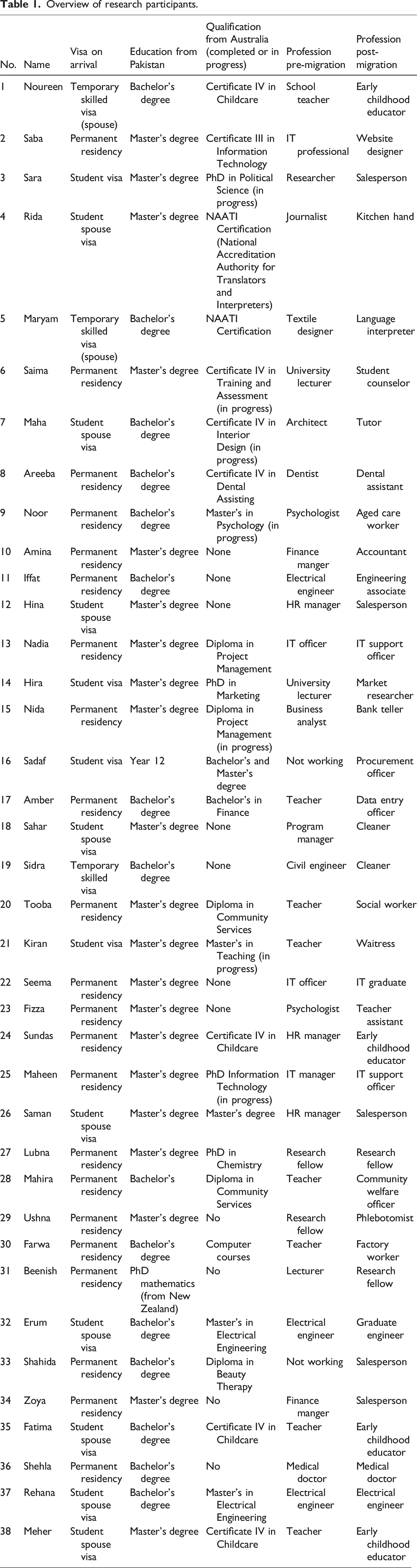
The participants’ information was anonymized by using pseudonyms. The majority of Pakistani women (22) migrated with a permanent residency (PR) visa, some (nine) arrived on student spouse visas and a smaller number entered on student visas (four), temporary skilled spouse visa (two) and temporary skilled visas (one). The participants were from a wide range of professions, including engineering, teaching and information technology (see Table 1). They had a high level of education and experience, except for one participant, and all of them had a bachelor’s degree or above qualifications with foreign work experience. After migration, the majority of them engaged in low-skilled jobs and only a few secured professional jobs, which reflected their downward occupational mobility in Australia (see Table 1). It is noteworthy that most of them (35) arrived with their husbands holding either permanent residency (PR) or temporary visas and their husbands were the main applicants for skilled migration or student visas. Only a few women migrated alone on student visas (two) and temporary skilled visas (one).
The first author conducted this research as an insider of the community, while the other two authors were outsiders. Insider research is a qualitative research stance in which the researcher is a member of the community or has meaningful connections with the community being studied (Aguilar et al., 2025). The first author was born and raised in Pakistan and arrived in Australia as a skilled migrant. The advantage of one insider researcher is having an intimate knowledge of the researched group, which an outsider researcher does not usually have before starting data collection (Griffith, 1998). The first author collected the data. Her ethnic background and gender identity helped to build rapport with potential respondents. The research participants perceived her as an insider in the community.
This research has several limitations. This study examined the experiences of first-generation migrant women from the skilled stream program; it did not include refugee women from the humanitarian stream and second-generation migrant women. Moreover, this research did not incorporate the views of employers, human resources (HR) managers and public and private institutions because it was beyond the scope of this study. Lastly, the study was conducted during the pandemic; however, the participants shared their experiences from the pre-pandemic period. Thus, the findings did not reflect the challenges of migrant women during the pandemic.
Findings
Mismatched human capital
Pakistani women commonly experience challenges related to an unsuitable skill set. These women had studied and worked in Pakistan, where certain skill sets are highly valued, but they are not in demand in the Australian labor market. Their mismatched skills illustrate the country-specific value of their human capital. For instance, Maryam, one of our respondents, had postgraduate qualifications in Textile design with five years of work experience in Pakistan. However, she was unsuccessful in finding professional work because of limited opportunities in the textile industry. Notably, Pakistan’s textile industry is well-established, whereas the Australian textile industry is comparatively small. Thus, Maryam’s skills were not utilized, and she started working as a language interpreter in local community organizations.
Similar to findings of previous studies (Cameron et al., 2019; De Alwis et al., 2020), non-recognition of foreign qualifications emerges as one of the major issues for Pakistani women. Being secondary migrants, they were not required to recognize their qualifications before immigration. Professional women such as doctors, teachers and architects were required to go through a complex process of qualification recognition, which requires substantial financial resources and adequate time. Furthermore, a few qualifications, such as a Bachelor of Education, were not recognized in Australia without additional years of local education. Several women worked as teachers in Pakistan and could not continue their profession (see Table 1). These newly arrived women did not have sufficient financial resources to afford the recognition processes, and they channeled into low-skilled jobs. A few women completed short courses from vocational training institutes to pursue their careers. For example, Areeba had a Bachelor’s of Dentistry qualification; however, she could not afford the examination fees and preparation material costs. Therefore, she completed a certificate IV in dental assisting, which is free of cost for PR visa holders, and started working as a dental assistant in a local clinic.
In many cases, after recognition, local employers did not always accept foreign qualifications. Additionally, the requirement of local work experience serves as a mechanism that reinforces the labor market exclusion of Pakistani women. Several participants reported that employers disregarded their qualifications and foreign work experience, despite their relevant technical knowledge and skills. For instance, Sidra was a Civil Engineer, and her qualification was recognized by Engineers Australia. She had a temporary skilled visa, which was granted to fresh graduates to fulfill the skill shortage in the local workforce. However, she failed to secure a professional job. She explained, I feel that my skills are being wasted here. I applied for jobs at all relevant organizations, but I did not receive a single interview invite. I called all of them, and they said that I was rejected because I did not have local qualifications and work experience. (Sidra, Cleaner, Melbourne)
Sidra’s experience shows that her foreign qualifications and work experience provided a potential justification for discrimination during the recruitment process. Existing studies indicate that racism in the form of undervaluation of skilled migrants’ non-Western qualifications and work experience is a persistent issue within Australian organizations, leading to underutilization of migrants’ human capital (Kosny et al., 2017; Tran et al., 2024).
English language proficiency is another obstacle for Pakistani women in the recruitment process. During job interviews, local employers assessed their language skills based on the similarities to Australian English, including accent and vocabulary. Consequently, their non-Australian English was often scrutinized and led to rejection during job interviews. For instance, Amina, an experienced accountant with 18 years of work history in Pakistan and Qatar, attended numerous interviews in her early months, but she failed to secure a job. She noted, Many times, during interviews, I felt that they did not like my English accent, and they were not comfortable during discussions. They did not ask much about my professional experience. (Amina, Accountant, Brisbane)
This illustrates that linguistic preferences in Australian organizations act as gatekeeping practices, perpetuating the labor market disadvantage for Pakistani women without native English fluency. Similar experiences have been documented by Haque and Haque (2020) and Lee (2013), highlighting that linguistic discrimination against migrants from non-English speaking backgrounds (NESB) is a key factor contributing to their lower employment status in the Australian labor market.
Loss of social capital
Pakistani women lost their social capital after migration, and they did not have family, close friends or professional networks in Australia. The absence of requisite social capital had a devastating impact on their job-seeking experience as they confronted a system where social connections primarily govern access to jobs rather than merit (Stone et al., 2003; Webb, 2015). Their newly developed social capital consisted of their ethnic networks, which included their South-Asian friends and Pakistani relatives. These networks also migrated in recent years and had limited knowledge and exposure to the Australian labor market. These networks lacked authority and power; thus, they could not help them to secure a professional job. For example, Saman, with MBA qualifications, faced challenges in pursuing her career. Her social network consisted of recently migrated South-Asian friends, who were working in the retail sector despite having higher qualifications. She said, I did not know anyone who could guide me to restart my career. My friends told me to work as a sales assistant, and that was the only option I had. (Saman, Salesperson, Melbourne)
The findings show that Pakistani women had limited opportunities to connect and establish effective networks within the Australian labor market. They used LinkedIn for online networking, but it did not prove helpful. For example, Saba was an IT professional, and she was struggling to secure a job. She expressed, After arriving here (in Australia), I did not know how to develop professional networks. How does an unemployed person develop professional networks? There are not many networking opportunities for migrant women. (Saba, IT Professional, Melbourne)
This supports that social capital in Australia is racialized (Carangio 2023), as these women developed ethnic networks, but they failed to build an effective professional network, which restricted their employment prospects. The findings echo the work of Carangio et al. (2021), who identified the prevalence of racism and white privilege in the context of professional networking in the Australian labor market.
With limited social capital, Pakistani women were unable to access information about qualification-matched employment, unadvertised jobs and local recruitment practices. They used the internet to get the information, but this mode of help-seeking did not always indicate job prospects in the area of their expertise. Those who located suitable jobs lacked knowledge about the requirements of recruitment procedures. They needed guidance to make their job applications compliant with the prospective employer’s requirements. Previous studies noted that migrant’s knowledge of local recruitment requirements is a key to success in the host country as curriculum vitae (CVs), job applications and cover letters are highly country-specific (Cooke et al., 2013; Haque and Haque, 2020). Some women got paid training from local institutes to learn how to write job applications. For example, Iffat arrived as a primary skilled migrant with four years of work experience at Karachi Airport in Pakistan. She undertook paid training for CV and cover letter preparation, which helped her to secure a part-time entry-level professional job. She said, I applied for several relevant jobs but did not get a single interview call. I was frustrated and searched on the internet. Then I came to know that I needed to make a CV and cover letter according to Australian standards. I paid for the training from my own pocket. (Iffat, Electrical Engineer, Sydney)
Iffat’s experience shows that skilled migrants tend to be left on their own during the job search period. They did not receive any post-arrival support in terms of financial support or job search assistance as discussed by Wright et al. (2022). Iffat paid for the training because of her financial stability; however, many of the other women could not afford to pay for these services.
Pakistani women’s ethnic networks were working in specific roles such as childcare workers, aged care workers or sales assistants. They directed newly arrived women towards these favorable occupations, which were often low-paid and unskilled. For example, Sara arrived on a student visa and faced financial difficulties. She had a postgraduate qualification in International Relations and had extensive work experience in a Pakistani research organization. Nonetheless, she struggled to find a qualification-matched job in the local labor market. Her Bangladeshi landlady referred her to an Indian shop owner, and she immediately got a job as a salesperson in his Indian grocery store. She explained, Having a qualification in international relations, I am struggling to find a suitable employment. I have asked my friends about the relevant employment opportunities, but they were not able to help me. All of them are working in retail or age-care sector. (Sara, Salesperson, Canberra)
Sara’s experience demonstrates that the absence of professional networks contributed to her exclusion from the mainstream labor market, while the limited efficiency of ethnic networks resulted in a low-skilled job. In many cases, Pakistani women’s reliance on ethnic networks from low socio-economic backgrounds often ended up in poor-quality work, confirming the inefficiency of country-of-origin social capital. This issue was previously identified by Colic-Peisker and Tilbury (2006) and Colic-Peisker and Waxman (2005). However, for Pakistani women, these unskilled jobs provided essential financial support to survive in Australia.
Dissimilar cultural capital
Pakistani women’s dissimilar cultural capital emerged as a barrier at the early stage of recruitment. The gap is wide between their cultural capital and that of mainstream Australians, contributing to inequality in the local organizations. Being unfamiliar with subtle culture-specific rules of social interaction, these women’s self-presentation and ways of speaking emphasized their mismatched cultural capital during job interviews. Several participants reported that they were not able to impress, connect and convince employers about their suitability for the advertised job. Some participants noted that their employers openly discussed that they were not considered a good cultural fit for the organization. In many instances, these women fulfilled the skill and language requirements of professional jobs. However, they might not meet the cultural capital criteria established by recruitment decision-makers. For example, Amber completed a Bachelor’s Degree in Accounting from an Australian university. She learned how to dress up for interviews and practiced good non-verbal communication, such as handshakes and eye contact. However, she often faced challenges during job interviews and failed to secure a suitable job. I wore formal clothes when I went for interviews. Though at that time, I was not very comfortable with a business suit. I still remember once I was told that I am not a good cultural fit for their small organization. (Amber, Data entry officer, Melbourne)
Amber’s experience identifies that bridging the cultural gap is very difficult and learning interview tips and tricks cannot compensate for the applicant’s dissimilar cultural capital. These findings support the work of Almeida et al. (2019) and Pham et al. (2019) by demonstrating local employers’ rigidity towards the applicant’s dissimilar cultural capital.
Verter (2003) identified that religion is also a part of an individual’s cultural capital, and it notably impacts the individual’s personality package. The research participants were practicing Muslims, and their religion shapes their social and cultural practices. They wore modest clothing, and 16 of them wore hijabs (headscarves), despite being advised by their ethnic network that hijabs would increase the risk of rejection. All those women who wore hijabs reported unwelcoming responses from the recruitment team during job interviews. Moreover, wearing a headscarf or avoiding handshakes led to exclusionary effects, resulting in unfavorable treatment during the selection process. Research has found that Muslim women are more likely to encounter gendered racism than other ethnic groups due to their religious identity marker, the hijab (Carland et al., 2025; Yeasmeen et al., 2023). Additionally, stereotyping of Muslim women as passive, submissive and attached to the concepts of motherhood roles further downgrades their human capital within Australian organizations (Foroutan, 2011; Syed and Pio, 2010). For example, Nida had Canadian postgraduate qualifications and work experience. She applied for several jobs and was shortlisted for many interviews. However, she was rejected during interviews despite having suitable qualifications, skills and work experience. She explained, As a woman who wears a hijab, I often face unusual reactions. During interviews, I can see their surprise and disappointment upon seeing me. Sometimes, they also display a lack of interest during discussion. (Nida, Business Analyst, Sydney)
Nida’s Canadian qualifications and work experience met potential employers’ expectations; however, her appearance with a hijab seemed to disappoint them. It reveals employers’ practices of gendered anti-Muslim racism against visible Muslim women. Her well-matched human capital was devalued due to dissimilar cultural capital associated with her religious affiliation. Although the right of Muslim women to wear the hijab in the workplace is protected by Australian laws, Nida faced subtle forms of racism. The findings align with the work of De Alwis et al. (2022), indicating that religious identity markers are negatively perceived by potential employers and result in rejection during job interviews.
Pakistani women’s efforts to upgrade their capital
Pakistani women’s pre-existing human, social and cultural capital did not facilitate them to secure professional jobs in the Australian labor market. Temporary visa holders and PR holders experienced the same level of difficulty in finding suitable professional jobs. However, permanent residents can get other benefits such as free of cost short courses from Technical and Further Education (TAFE) institutes, reduced fees at local universities and provisions to apply for those jobs which are exclusive to Australian citizens or permanent residents.
From job-seeking experiences, Pakistani women learned that they need to upgrade their human capital by getting qualifications and experience from local institutes. In the early days, they needed money to survive in Australia as all their savings were used up during the period of job search. In some cases, their husbands got jobs and fulfilled their basic necessities. However, despite their partner’s support, they still needed financial resources to support their family and upgrade their qualification from local institutes. Thus, they engaged in low-skilled and laborious jobs such as cleaners, salespeople, factory workers or waitresses to earn money. It is important to consider that these women could not get financial support from the Australian government. According to the Department of Human Services (2025), newly arrived temporary and permanent skilled migrants are excluded from several social support programs, such as income support benefits and social security, while permanent skilled migrants are required to wait for four years to access certain welfare payments and concession cards. These policies clearly indicate that skilled migrants are not supported in their early days; hence, they struggle to survive and are compelled to find any kind of job at the start of their careers.
The data show that all the research participants’ first jobs were either low-skilled or below their qualifications and work experience (see Table 1). During the transition of their professional careers, deskilling, incidents of over-qualification and engagement in low-paid jobs were common occurrences. This aligns with the works of O'Dwyer and Colic-Peisker (2016) and Ressia et al. (2016) on the deskilling of qualified migrant women. With their low-skilled jobs, these women developed financial capital and invested money in local qualifications and accreditations. They already had their Bachelor’s or Master’s qualifications, so they found it difficult to locate suitable further education to upgrade their human capital. Some of them enrolled at Australian universities for Master’s or PhD programs and the majority completed the TAFE certificate and diploma qualifications because of their short duration and reduced fee for permanent residents. Some women on temporary residence also completed TAFE courses and university education with their own financial resources. It draws our attention to the fact that funding policies and practices of higher education and vocational education and training programs exclude temporary skilled migrants, which increases Pakistani women’s disadvantages at the start of their careers. This echoes Webb’s (2015) study and added that temporary migrants are excluded from higher education programs as well.
The redevelopment of human capital offered them a variety of practical experiences, made their qualifications and skills compatible with the local labor market and provided them opportunities to develop social and cultural capital. They learned about local practices, work ethics, commonly used computer software and communication patterns at Australian workplaces, which assisted them in securing professional jobs. They got connected with local professionals who supported them in accessing appropriate employment opportunities in their area of expertise. These connections served as referees and provided rich information about the industry, unadvertised jobs and internal jobs.
Our findings confirm that Pakistani women with suitable human capital, such as local qualifications and advanced language skills, were more likely to move into resourceful social circles and develop effective professional networks. In the same way, their social capital also provided opportunities to produce human capital as these connections directed them towards better employment and further education (Bourdieu, 1986). For example, Kiran’s teaching qualification was not recognized, so she changed her career pathway and completed a diploma in social work. During her studies, her teachers recommended her to work as a volunteer in a local welfare organization. She voluntarily worked there and created an efficient professional network within her organization. During volunteer work, I have developed very good relationships with my co-workers and supervisor. I always finished my tasks on time, and my co-workers appreciated my work. After three months, my co-workers informed me about an unadvertised internal position in the organization and then my supervisor referred me to that role. (Kiran, Social Welfare Officer, Melbourne)
Kiran’s conscientious approach to her work helped to develop an effective social network, which was characterized by norms of trust and reciprocity. Trustworthy relationships are critical to achieving desirable outcomes from social networks (Stone et al., 2003). Furthermore, the social situation of her network members, such as being in an influential group and having rich information about employment opportunities, positively impacted her employment outcome. She successfully secured a professional job in the area of her expertise.
Pakistani women modified their cultural capital during the upgradation of human capital. During work and study, they were exposed to Australian culture and behavior patterns. Their social interactions at workplaces and educational institutions helped them to adapt their cultural capital, resulting in improvements in their appearance, self-presentation skills and language accent. They developed their capability to follow norms of behavior and practiced rules of engagement within the Australian context. This modification often enhanced their performance in job interviews and facilitated the development of professional networks. For example, Sadaf had a Bachelor’s qualification from an Australian university. She did not face difficulties in connecting with local professionals and developed an extensive professional network. She explained, My teacher told me to apply for that job. I went there for the interview. I did not face any communication problems in my interview, and I was connecting well with the employer. The interview went smoothly, and I got the entry-level job. (Sadaf, Procurement Officer, Sydney)
Sadaf’s narrative identifies the use of her human, social and cultural capital to secure employment. Her Australian qualification and professional network led to a job interview, while her self-presentation style and communication skills enabled her to connect and convince employers. However, the findings reveal that Pakistani women could not entirely modify their cultural capital, and some differences would always be present. Their pre-existing implicit cultural norms and religious beliefs had a strong impact on their personalities, which may generate exclusionary effects in some situations. These women faced certain restrictions in enhancing their cultural capital, which further limits their access to social capital and reduces their chances of securing highly paid professional jobs. This confirms that social capital is not uniformly available to all members of society (Bourdieu, 1986) and Pakistani women, being a religious minority, face inequality in accessing superior social networks.
Overall, Pakistani women’s job-seeking experience is shaped by the intersections of human, social and cultural capital. By upgrading their capital, some of these women got professional jobs, which reflects the articulation of their agency within constrained employment opportunities. Nevertheless, the majority of them did not hold secure and well-paid professional jobs at the level of their qualifications, skills and work experience, which reveals underutilization of their human capital. This is consistent with the findings of Chiswick et al. (2005) and Fleming et al. (2016), which suggest that skilled migrants initially experience a decline in occupational mobility following migration; however, this mobility tends to improve over time as they develop human and cultural capital.
Conclusion
This article examined the challenges encountered by Pakistani migrant women in securing professional jobs and their strategies for integrating into the Australian labor market. We argue that the job-seeking experiences of these women compound simultaneously operating inequalities of human capital, social capital and cultural capital in the Australian labor market. They faced intersectional disadvantages as their pre-existing capitals had limited efficiency and bolstering it was essential to fulfill the demands of the local labor market. The findings are in line with past research, which acknowledges the inefficiency of migrant women’s pre-existing human capital in the Australian labor market (Ho, 2006; Udah et al., 2019).
This study highlighted that migrant support policies do not consider the challenges faced by temporary and permanent skilled migrant women. After arrival, they are not assisted by Australian government institutions in terms of financial support, the enhancement of their skills, the upgrading of their qualifications and their search for meaningful employment, which negatively affects their labor market integration (Department of Human Services, 2025; Wright et al., 2022). Government support programs are available only for humanitarian migrants, assuming that social exclusion only applies to them. During the early stages of settlement, Pakistani women had limited economic resources to deal with the obstacles in the local labor market. Consequently, they were channeled into low-skilled jobs, leading to the underutilization of their human capital.
Pakistani migrant women were not provided sufficient opportunities to upgrade their human, social and cultural capital. Acquiring local qualifications is the first step towards building these capitals. However, funding policies and practices of higher education and vocational education and training programs exclude many Pakistani women because of their temporary visas, which indicates policy neglect regarding temporary migrants’ labor market integration. Furthermore, despite official recognition of the efficiency of social capital in securing employment (Stone et al., 2003), the issue of migrant women limited social capital is unaddressed. Currently, there are no effective programs for skilled migrant women that facilitate them to develop professional networks in the Australian labor market.
This study identifies that the labor market practices surrounding the utilization of migrant’s human capital do not comply with the Australian government’s qualification recognition policy. In many cases, Pakistani women’s qualifications and skills were recognized by qualification assessment bodies, yet there was no binding obligation on local employers to utilize their skills. Particularly, during the recruitment process, Australian employers overemphasize a candidate’s cultural capital and exclude culturally diverse job applicants from professional employment. Furthermore, rejection from employment due to religious visibility reflects that discrimination in recruitment overlaps with structural racism, anti-Muslim sentiments and Islamophobia within Australian organizations (Dunn et al., 2004, 2007; Karim, 2021; Kosny et al., 2017). There has been systematic and interpersonal discrimination at the structural level of the Australian labor market as the recruitment procedure and employers’ expectations did not consider migrant women’s particular characteristics, such as foreign qualifications, limited social networks, cultural diversity and language skills proficiency. This study makes clear that Australian organizations are facing difficulties in successfully implementing diversity and inclusion policy management, which often results in CARM women’s exclusion in the early stage of recruitment. Furthermore, this research identifies policy neglect regarding migrant women’s labor force participation. The Australian Government is committed to improving women’s economic equality and security (Department of the Prime Minister and Cabinet, 2022); however, the goal of gender equality cannot be achieved without minimizing the barriers of migrant women in the local labor market.
This paper concludes by asserting that skilled migration programs must be accompanied by labor market integration policies that acknowledge skilled migrants’ difficulties caused by mismatched human capital, the loss of social capital, and diverse cultural capital. Skilled migrant women need to be supported by the Australian government and local service organizations in terms of financial help, job search assistance, professional networking, qualification recognition and upgradation, and skills development and enhancement. The Australian labor market practices also need to comply with Australian migration policies by accommodating skilled migrants’ differences, such as foreign qualifications and experience, limited social networks, and cultural diversity. There is an urgent need to make a shift in the Australian labor market that should consider the particular characteristics of CARM migrant women and utilize their human capital to its full potential.
Footnotes

Ethical considerations
Ethics application was approved by the Monash University Human Research Ethics Committee on 02 March 2020 for project number 21175.
Consent to participate
The participants gave their consent to participate in writing to the first author.
Consent for publication
All the authors provided consent for publication.
Funding
The authors disclosed receipt of the following financial support for the research, authorship, and/or publication of this article: The first author greatly acknowledges the support of the Australian Government through the Research Training Program (RTP) Scholarship.
Declaration of conflicting interests
The authors declared no potential conflicts of interest with respect to the research, authorship, and/or publication of this article.
Data Availability Statement
The data used in this research is confidential.