




Abstract
Ethiopia is the most prominent example of the late 20th-century adoption of federalism to accommodate diversity and complete state-building. This article explores the implementation of federalism and accommodation of ethnonational diversity in dominant party regimes by using Ethiopia as a case. Drawing on legal documents, literature, news sources and government reports, the article argues that federalism enabled distinctive groups to promote their culture, use their languages and exercise self-rule in their territory. However, ethnonationalities’ constitutionally proclaimed self-determination rights and the practice rarely correspond. Although all ethnonationalities have the same constitutional rights, some are still subjugated, and self-rule remains their dream. The dominant party regime in Ethiopia met demands for self-rule and accommodation with suppression and violence. The constitution grants regions to use their legislative powers to accommodate region-specific demands; nevertheless, regions cannot operate out of the narrow framework of the federal ruling party. Thus, regions became repressive agents of the centre rather than genuine self-rule agents. Insights from Ethiopia have broader implications for states embracing federalism.
Keywords
Introduction
Countries worldwide adopted different mechanisms to accommodate ethnic diversity in their territory by devolving powers to subnational units or adopting federalism to grant self-rule to distinct groups. The former approach, which is primarily practised in a devolved unitary, transfers authority from the centre to semi-autonomous units through legislation or autonomy act (Cohen and Peterson, 2002). In contrast, the latter is a system in which constituent units of a federation are accorded constitutionally affirmed powers (Elazar, 1987). Federalism is a system of government based on the territorial distribution of powers between a general government, with authority over general territory and autonomous units that rule their jurisdiction (Duchaceck, 1987, 191–93; Taylor, 2007; Watts, 2008).
Autonomy as an accommodation strategy has been used in multinational federations. It offers distinctive groups the privilege of exercising self-rule, enabling minorities to hold political office in their region and exercising cultural distinctiveness (L. M. Anderson, 2004, 92; Kymlicka, 2005, 269; Stepan, 1999). Theoretically, federalism helps hold states together by granting autonomy to territorial communities so that groups drop the desire for secession. Ghai (2000: 525), Kymlicka (2005: 275–76) and Gardner (2013: 4) postulate that federalism is a constitutional compromise between fragmentation and centralised state structure that helps to create a strong national government and autonomous subnational units simultaneously.
Practically, however, the effectiveness of federalism in accommodating diversity and enhancing self-rule varies across federations. In developed and democratic counties like Canada and Switzerland, federalism enabled the states to stay unified and democratic despite the diversity, and constituent units in such federations exercise significant powers (Dardanelli and Mueller, 2019; Lecours, 2019). In less developed federations whose experience of democratic elections is not deep-rooted, the outcomes of the federal arrangement are mixed. Although federalism appears to help manage ethnic diversity to some extent, constituent units in such states tend to lack the autonomy to exercise their constitutional prerogatives (Dickovick, 2014; Hutchinson, 2014). Such mixed results concerning the implementation of federalism imply that embracing federalism or formal vertical distribution of competencies per se is not sufficient to ensure accommodation and self-rule.
In Africa, only Nigeria, Ethiopia and Somalia are formally self-proclaimed as federal states (Steytler, 2019: 175). However, the constitutions of South Africa, the Union of Comoros, Democratic Republic of Congo, Sudan, Kenya and South Sudan incorporate some of the features of federalism (Adem 1 2013: 54; Steytler and Zemelak, 2020: 104). These African states adopted federalism or a quasi-federal order to resolve conflicts by accommodating diversity and devolving powers (Dickovick, 2014; Suberu, 2009).
This article seeks to take stock of the implementation of federalism to manage ethnonational diversity by taking the Federal Democratic Republic of Ethiopia (FDRE), shortly Ethiopia, as a case. Ethiopia adopted federalism de facto in 1991 and de jure since 1995. The 1995 Ethiopia’s constitution is remarkable in explicitly recognising ethnonational diversity and their right to self-determination, including secession (Art. 39 FDRE Constitution, 1995). At birth, the FDRE constituted nine regions mostly named after the dominant ethnic groups in the units. Post-2019, the number of constituent units increased to 11.
Ethiopian regions are marked by their extreme asymmetry, such as ethnic, geographic, development, economic structure, and territorial and population size. The regions have equal status and powers under the Constitution despite the de facto asymmetry. Being a federation of extreme ethnonational diversity, regional asymmetry and the most prominent example of the late 20th-century adoption of federalism, Ethiopia offers three decades of federalism experience that can serve as lessons for states embracing federalism. It also contributes to the literature by shading light on the dynamics of federalism and extra-constitutional factors influencing diversity accommodation in dominant party regimes.
The remainder of the article is organised as follows. The ‘Ethnic federalism: overview of contending views’ section assesses contending views regarding ethnic federalism. Section ‘Overview of the Ethiopian state-building’ sheds light on Ethiopian state-building. Then, an assessment of political trajectories during the transition to federalism and an overview of Ethiopia’s federation are made. Later, self-determination right in Ethiopia is analysed, followed by an assessment of accommodation of diversity in Ethiopia’s upper House. Then, self-rule and federalism at the regional level are explored, followed by a critical analysis of the politics of federalism in Ethiopia. The ‘Conclusion’ section provides conclusions and implications of the Ethiopian case for states embracing federalism.
Ethnic federalism: overview of contending views
The debate regarding the desirability of ethnic federalism in governing multiethnic states is utterly competing. On the one hand, ethnic federalism is argued to be vital to accommodate ethnic diversity as it allows self-rule. On the other hand, ethnic federalism is claimed to encourage secessionism. The latter claim became famous, particularly after the failure of the most prominent ethno-federal states such as the former Soviet Union, Czechoslovakia and Yugoslavia (Roeder, 1991, 2009; Suny, 2004: 204). Roeder (2009: 204) asserts that ethnic federalism is imperfect as the institution selectively empowers certain groups, leading to conflicts and national crises regardless of the context. The critics of ethnic federalism stress two consequences of the system. The first is ‘federalism slippery slope’: creating ethnically defined constituent units empowers ethnic leaders with political and economic resources to challenge the central state and sustain an effective secessionist bid (e.g. Kymlicka, 1998: 138–39). Second, ethnic federalism provides the conditions necessary for ethnic mobilisation, such as control over regional language, media and education language, constructing separate identity (Cornell, 2002: 252; Gorenburg, 2001: 74).
Anderson (2014) contends that these claims are illogical for different reasons. First, relying on the disintegration of the three (the Soviet Union, Czechoslovakia and Yugoslavia) non-democratic, super-centralised, socialist and sham ethno-federal states to advance a generalised theoretical evolution against ethnic federalism is problematic. Second, these three failed federations’ constituent units were ethnically defined to give homeland for specific ethnic groups. That means ethno-federations that ethnically defined only some of its units might not benefit from these dissolved federations’ lessons. Anderson demonstrates that the success of ethnic federalism is much higher than failures. While Belgium, Bosnia and Herzegovina, Ethiopia and Pakistan are successful ethno-federal states, Canada, India, Iraq, Nigeria, Russia, South Africa, Spain and Switzerland are successful partially ethno-federal states. Failure/success, in this case, is whether the federal order is dissolved or not.
Critics of ethnic federalism provide geographic federalism as an alternative, which is irrelevant to the problems of managing relations among territorial ethnonationalities. Geographic federalism is not a cure for the problems the states with territorial ethnonationalities face; it might be a solution for something else, such as the problem of administrative inefficiency caused by large territorial size. Some countries that adopted ethnic federalism have failed unitary systems and opted for ethno-federalism as a practical alternative to accommodate deep-rooted diversity.
Ghai (2000) warns that granting autonomy may serve as a springboard to secession. Despite these concerns, Ghai suggests that autonomy ‘can play an important constructive role in mediating relations between different communities in multiethnic states’. Considering the challenges of managing multiethnic states, autonomy is a valuable option, with its difficulties. Ghai reckons that self-rule reduces conflict by promoting integration, not disintegration, enabling groups to live together and define a common public space (Ghai, 2000: 524–524). Even the fear regarding autonomy being a springboard to secession is rarely justified. Instead, Bermeo (2002: 105) states that often it is ‘the refusal to federalise, rather than federalism itself, that stimulates secession’. Although ethnic federalism is not a panacea for all political problems multiethnic states face, it is inaccurate to argue that it promotes secessionism. Bermeo (2002: 108) made a bold claim that ‘no violent separatist movement has ever succeeded in a federal democracy’, implying that the effectiveness of federalism in managing diversity hinges on regime type.
Stepan (1999: 19–20) notes that all multinational democracies, for example, Belgium, Canada, India and Switzerland, are all federal and remain stable despite problems. This implies that federalism may help these countries manage the challenges of diversity. Stepan argues that if diverse countries ever become stable democracies, they will have to design a pragmatic federal order to ensure diversity management and citizens’ equality. Long ago, Tarlton (1965: 73–74) warned that some diversity might not be managed even by adopting federalism because elements commonly shared by the units should prevail over the deep-rooted cleavages to have a properly functioning federation. Hence, if an ethno-federal state is dissolved due to ethnic cleavage predating ethnic federalism, the blame should not be the federal system as it was the last institutional attempt to manage a polity that was already divided. As Ghai (2000: 524) notes, there may be little to mourn if a federation is dissolved as ‘it suggests that ethnic communities have decided, mutually, to lead separate lives’.
This begs the question of why a federal system fails. Franck (1968: 173) argued that federations that do not have leaders and people who embrace federal principles as the most important political value and life would have a greater chance to fail. Similarly, Elazar (1987: 12) notes that lack of ‘thinking federal’, which denotes ‘approaching the problem of organising political relationships from a federalist rather than a monist or centralist perspective’, will lead to federal failure. Equally, federations formed without ideological commitment have a great chance of failure (e.g. Hicks, 1978: 11; Rodden, 2004: 489). Bermeo (2002) concludes that ‘each failed federal state that gave birth to a secessionist civil war was either an outright dictatorship or an inchoate regime led by a non-democratic party’, attesting why the former Soviet Union, Czechoslovakia and Yugoslavia failed (p. 108). The political setting and process are crucial as federations’ constitutional and structural features (Watts, 2015: 12). Overall, whether the federal system is geographic or ethnic, its effectiveness is influenced by several factors.
Overview of the Ethiopian state-building
The state of Ethiopia got its modern shape during the time of Emperor Menelik (1889–1913). Menelik conducted various wars to control and subjugate the modern-day Oromia, Southern Nations, Nationalities and Peoples’ Region (SNNPR), Somali, Benshangul-Gumuz, Gambela and Afar regions. While peacefully subjugated regional lords were allowed to administer their respective areas by making timely tribute payments to the emperor, those who resisted Menelik’s rule were strictly controlled (Bahru, 1991, 2001; Marcus, 1994). During the Haile Selassie regime (1931–1974), the groups violently conquered by Menelik’s force were kept in check (Marcus, 1994: 112–13). The Derg, led by Mengistu Haile Mariam, consolidated political and administrative powers to lead Ethiopia until 1991 (Bahru, 2001). The Derg attempted to adopt cultures and languages other than the dominant Amhara, a new phenomenon in Ethiopia. An institute of nationality was established in 1983 to study the identities and boundaries of nationalities. However, the regime only allowed some degree of cultural, not political, expressions of ethnic diversity (Bahru, 2001; Clapham, 1988; Marcus, 1994).
At the centre of the Ethiopian state-building project was suppressing diversity and imposition of Amhara’s cultural, linguistic, and political hegemony on conquered areas. The regimes portrayed Ethiopia as a unified Amharic-speaking state with no consideration for diversity. Ethnolinguistic heterogeneity was seen as a crime by the hegemonic groups. Consequently, peoples in the dominated areas felt domination and the impact of centralisation in weakening the authority of their traditional regional rulers (Young, 1998: 192).
In the 1960s, such trajectories led to the emergence of ethnic-based forces, mainly with the name of ‘National Liberation Front’, to fight for equality, autonomy and independence. The fronts, dominated by the Eritrean People’s Liberation Front (EPLF), the Oromo Liberation Front (OLF) and the Tigray People’s Liberation Front (TPLF), ousted the Derg in 1991 (Brietzke, 1995). The Ethiopian Peoples’ Revolutionary Democratic Front (EPRDF), a coalition of ethnic parties that seized power in 1991, brought hope of self-rule and democracy to Ethiopia (Brietzke, 1995). The EPRDF affirmed that Ethiopia’s problems were the suppression and economic exploitation of Nations, Nationalities and Peoples (NNPs). Thus, addressing such legitimate grievances through federalism was essential to achieving Ethiopia’s lasting peace. Such development opened a 4-year (1991–1994) transition period to set the foundations of the federation.
Transition to federation
In June 1991, the leader of the EPRDF and the TPLF, Meles Zenawi, arrived in Addis Ababa after attending the American brokered London Peace Conference. He held a press conference and promised a new epoch of peace and democracy (Vaughan, 1994). In July 1991, a transition conference was held, and a Transitional Period Charter, which set the rules governing the Transitional Government of Ethiopia (TGE), was adopted (TGE, 1991). The Charter assured the rights to self-determination and self-rule of the Ethiopian NNPs (Art. 2, TGE, 1991). It also promised to address the historical grievances of different ethnic groups. About 27 ethnonational organised parties attended the Conference (Rock, 1996: 93; Young, 1998: 194).
The TGE was composed of a Council of Ministers and a non-elected Council of Representatives comprised of 87 representatives of national liberation movements empowered with legislative powers and oversee the Council of Ministers (Art. 7–9, TGE, 1991). The EPRDF and the OLF controlled 32 and 12 seats of the Council. Other parties took the remaining seats (Kassahun, 1995: 130; Rock, 1996: 93). While the EPRDF seized vital positions such as defence and foreign ministers, OLF held four minor cabinet posts (Lyons, 1996: 123; Young, 1998: 194). In January 1992, based on the Charter, 14 regions 2 were created (Art. 3, Proclamation No 7/, 1992). The trajectories during the transition period offered the EPRDF leverage to consolidate power and control the shaping of the country’s future.
A critical turning point in Ethiopia’s transition period and subsequent political dynamics was the 1992 regional elections. A prominent University Professor and main opposition party leader, Merera, stated, ‘the regional elections of 1992 became the first major test for the new regime’s decentralisation initiative’ (Merera, 2011: 668). As the election approached, the tension between the EPRDF and the OLF in the CoR became public when a military confrontation began (Lyons, 1996: 125–26). Then, the OLF, the main challenge to EPRDF, was pushed out of the election and transitional government (Merera, 2011: 668; Samatar, 2004: 1134). Parties such as the Islamic Front for the Liberation of Oromia (IFLO), the All-Amhara Peoples’ Organisation (AAPO) and the Southern Ethiopian groups also boycotted the election (Kassahun, 1995: 131).
Despite the boycott, regional elections were conducted in June 1992. By capitalising its military capacity and assigning loyal administrators to subnational levels, the EPRDF controlled most parts of Ethiopia. Due to the election boycott, only the EPRDF and its affiliates appeared on the ballot (Lyons, 1996: 127). The opposition withdrawal and the ‘electoral victory’ of EPRDF across the regions were seen as sowing the seeds of the country’s problems (Samatar, 2004: 1134). Leaving the election controversies aside, the TGE was entrusted with ensuring peace and stability, completing the federal Constitution, and leading the country towards full democracy. In 1994, the Constitution Drafting Commission drafted a federal constitution that came to effect in1995 (Kassahun, 1995: 130; Rock, 1996: 194).
Ethiopia adopted federalism because it was the only way to maintain its unity and address identity-question by granting self-determination rights to groups conquered violently and subjugated under the previous Ethiopian regimes (Tewfik, 2010: 5). While federalism was generally welcomed by many NNPs of Ethiopia as the Constitution grants the right to self-determination, including secession, others feared it would disintegrate Ethiopia. Since federalism was introduced after a long centralisation era, both hope and uncertainty followed (Aalen, 2002: 1).
The 1995 Constitution established a federation of nine states, commonly known as regions. Most regions derived their names after the dominant ethnonationalities that comprise the majority in their respective region. Later, the constituent units increased to 11 following referendums that created the Sidama in 2019 and the South West Ethiopia Peoples’ region in 2021. This shows the attempt of allowing each ethnonationality to form regional government whenever possible. The federation has two federal houses: the House of Peoples’ Representative (HPR); and the House of the Federation (HoF), an upper chamber designed to represent NNPs. The Constitution assigns enumerated powers to the federal government while leaving residual competencies to the regions other than taxation. Constituent units have legislative, executive and judicial powers on matters falling under their jurisdiction (Art. 52). They have their respective Constitution, working language, clearly defined boundaries, flags, regional anthem and regional police. The Constitution also provides that all regions ‘shall have equal rights and powers’ (Art. 47) and mutual non-interference in each other’s affairs (Art. 50(8)).
National self-determination: Ethiopia’s approach to accommodation
Accommodation of ethnonational diversity in Ethiopia originates from Article 39 of the Constitution, which grants the rights to self-determination. Article 39 states that ‘every Nation, Nationality and People in Ethiopia has an unconditional right to self-determination, including the right to secession’. It might be perplexing why the Constitution framers sought to explicitly entertain the right to secession by laying down clear withdrawal procedures. Theoretically, constitutionally pledging secession in multinational federations would have in practice reverse effects than those destructive effects for which it is commonly ascribed (Norman, 2008; Weinstock, 2001). On the contrary, others challenge that such explicit inclusion of secession clause in a federal pact makes a union a confederation than a federation (Duchaceck, 1987: 207; Filippov et al., 2004: 107).
The Ethiopian secession clause appears to be guided by the country’s general reality before the federation formation, and an effort to resolve the country’s political problem should Ethiopia continue as a unified state. As briefly discussed earlier, the Ethiopian state was built through conquest and subjugation of NNPs. Thus, various groups battled hard and long to secure their self-determination and self-rule. This can be noted from the preamble of the federal Constitution, which states that we, the NNPs of Ethiopia, ‘strongly committed, in the full and free exercise of our right to self-determination, to building a political community . . . by rectifying historically unjust relationships . . . determined to consolidate . . .a democratic order which our struggles and sacrifices have brought about’.
The Constitution acknowledges historical injustices of domination and subjugation of diversity and thus envisions addressing them through granting self-determination rights. The right to secession is thus ratification and guarantee of the voluntary nature of the federation formed by the consent of the NNPs. Leaving the theoretical debate regarding the outcome of the secession clause aside, Ethiopia made a bold move constitutionally granting the right to self-determination, including secession and stipulating withdrawal procedures.
The Ethiopian approach generated both critiques and applause. Some argued that the Ethiopian model is a novel approach to resolve ethnic conflicts and increase the country’s unity (Kidane, 1997). This group argues that it is impossible to forge unity by force without the voluntary alliance and assurance of the right to self-determination (Fasil, 1997: 157). Others contend that including the secession clause in the Constitution is an unwise decision, fuels inter-ethnic conflict and may lead to the country’s disintegration (Abbink, 1997; Alemante, 2003). However, the journey of the Ethiopian federation shows both views are not entirely accurate. Because federalism neither resolved inter-ethnic conflicts totally nor Ethiopia has disintegrated as detractors of Ethiopian federalism speculated.
Regarding the origin of Ethiopian federalism, the former Soviet Union, although described as a sham by authors such as Elazar (1987), is arguably a point of reference for the makers of Ethiopian federalism. According to Vaughan (2003: 170–71), the secession clause and the thinking around ethnic identity as a basis for the federal system are influenced by the Marxist–Leninist thinking of ethnicity as inborn but can be mobilised and moulded by the vanguard party. The EPRDF asserted that self-determination would neutralise ethnonationalism sentiment as it assures the Ethiopian union’s voluntary nature and thus enhances unity. As both secession and ethnicity could be controlled by the party, they were not understood to pose any risk to the federation’s unity. Such Marxist–Leninist thinking about ethnicity and the ability of the vanguard to control and mobilise it mean the operation of the federal system hinges on the party structure.
The fracture of the EPRDF and the subsequent rhetoric clash between Tigray and the federal government that escalated to deadly war demonstrates how Ethiopian federalism is attached to the party system. However, associating the current crises in Ethiopia only with the fracture of the dominant party is simplistic because the conflict has an ideological dimension that Abiy brought a more centralised vision for Ethiopia under his new Prosperity Party, which the TPLF and prominent Oromo opposition parties trenchantly oppose.
Coming back to the main point, Article 39 grants nationality to establish self-government in the territory it inhabits and equitable representation in state and federal governments. Thus, nationalities can form their region by seceding from an existing constituent unit. This means forming a self-government institution is limited to a group that forms a majority in a given territory. Thus, non-territorial groups scattered across the Ethiopian territory will hardly enjoy the right to self-rule. However, the right to self-rule covers issues beyond establishing own self-government, such as the right to representation in national and subnational assemblies. That means non-territorial groups could have the opportunity to be represented in national and subnational government though they may not form a territorial majority in a particular area. The provision also indicates that representation should be equitable, implying the requirement of mechanisms to ensure the participation of every section of society in decision-making.
In a multi-lingual state such as Ethiopia, the language issue is crucial because it affects individuals’ access to social services and influences social, economic and political participation. The demand for learning in the mother tongue was among the leading causes of federalism in Ethiopia. Using the mother tongue in education is an essential tool of preserving and enhancing the culture, identity and history of a given minority group. Article 5 of the federal Constitution states that ‘all Ethiopian languages shall enjoy equal state recognition’; ‘Amharic shall be the working language of the federal government’ and regions ‘determine their respective working languages’. Accordingly, all regions adopted their respective working languages. Harari region is unique in that it adopted two regional working languages. Ethnically diverse SNNP chose Amharic as its working language but allowed every ethnic group with subregional self-rule institutions such as zone, special zone and special woreda to determine their respective working language. The constitution also empowers every NNP to develop its language, promote its culture and preserve its history. This right includes using one’s language in education and other public services. More than 51 local languages are currently operational in Ethiopia's education system (Yeweyinhareg, 2017).
Accommodation of diversity in Ethiopia’s second chamber
Ethiopia’s second chamber, known as the HoF, is unique in that it explicitly represents ‘Nations, Nationalities and Peoples’ rather than the constituent units (Art. 61). The Constitution preamble states that ‘we, the Nations, Nationalities and Peoples of Ethiopia . . .’, indicating the pact is among NNPs rather than the regions. Article 8 also declares that ‘all sovereign power resides in the Nations, Nationalities and Peoples’, and ‘this constitution is an expression of their sovereignty’. Constitutionally, federalism in Ethiopia is a coming-together of NNPs; thus, it should not be surprising to see a second chamber representing NNPs instead of constituent units.
Regarding methods of representation in the upper House, Ethiopia appears distinctive from other federations. The representation formula in the House is a mixture of equal representation and proportional representation. Each NNP is represented in the House by at least one member and one additional representative for each one million of its population (Art. 61(2)). This means each group with less than a million population is represented by one individual, denoting equal representation. In contrast, NNPs with more than one million have an additional representative for every million of their population, suggesting proportional representation.
The nature of Ethiopia’s second chamber has various implications. First, heterogeneous and populous regions have more representation in the chamber than homogeneous and less populated regions, which means ethnically diverse regions can dominate the House regardless of their population size. Second, representation in the HoF requires a periodic revision following regional demographic changes. Third, ethnonational recognition is made through granting representation in the House. The increase of NNPs represented in the chamber from 58 to 77 attests to this (Table 1).
Representation in the HoF.
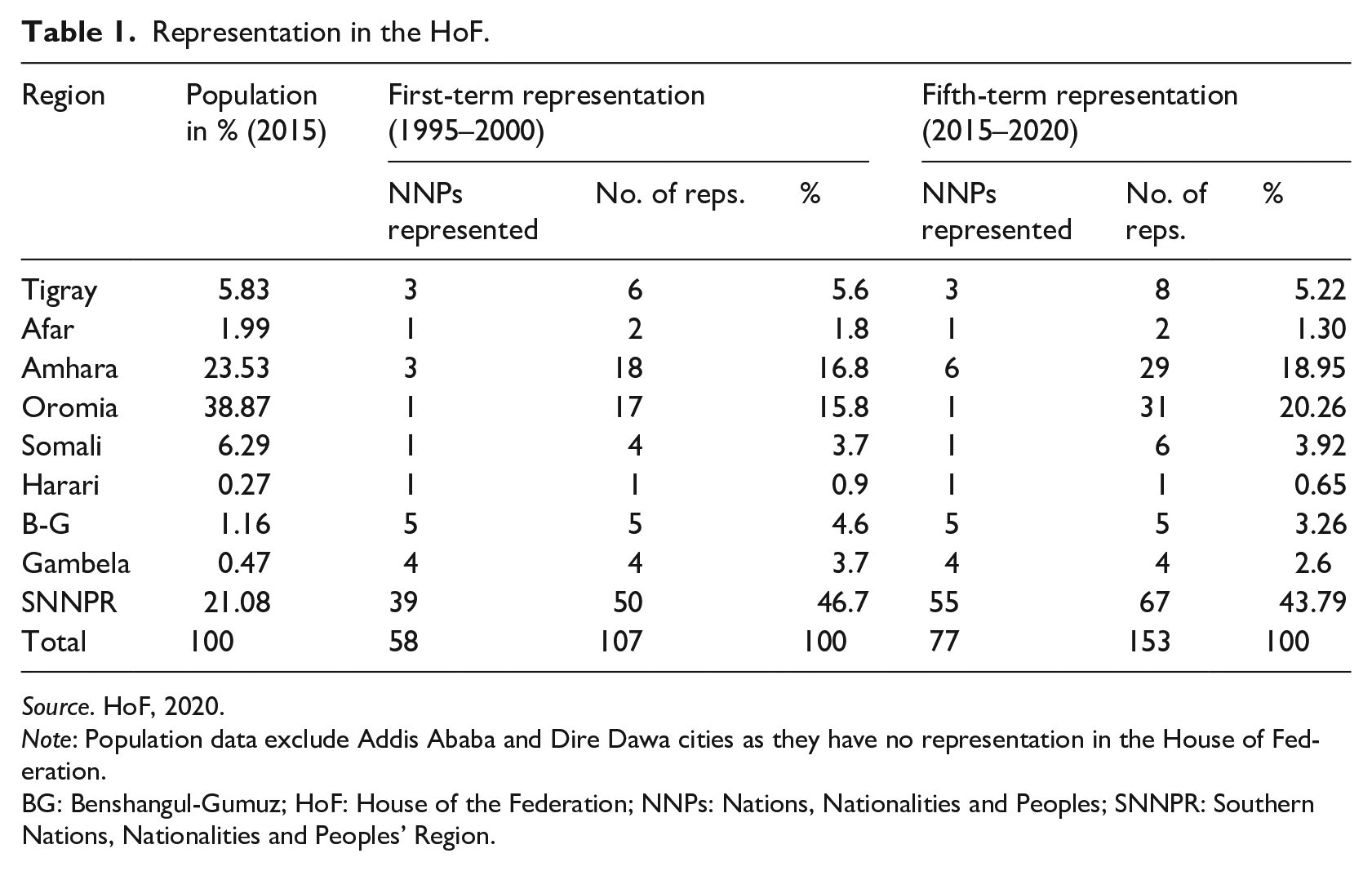
Source. HoF, 2020.
Note: Population data exclude Addis Ababa and Dire Dawa cities as they have no representation in the House of Federation.
BG: Benshangul-Gumuz; HoF: House of the Federation; NNPs: Nations, Nationalities and Peoples; SNNPR: Southern Nations, Nationalities and Peoples’ Region.
The regions’ ethnic composition varies from diverse SNNP (home to 55 ethnic groups) to homogeneous regions of Afar, Harari, Oromia and Somali. Mono-ethnic regions have one representative as a group because they have no territorial minority. Other regions have territorial minorities recognised in their respective regional constitutions. Amhara and Tigray have a single majority group, but they also have territorial minorities represented in the upper House. In Benshangul-Gumuz, Gambela and the SNNP regions, no single group forms a majority. Thus, the regions are represented in the House by delegates of different NNPs. The formula of representation neither absolutely favours populous regions nor heterogeneous units. If ethnic diversity were the sole criterion, representation rank would be SNNP followed by Amhara, Benshangul-Gumuz, Gambela, Tigray and the remaining units equally. If the population was the only criterion, Oromia would have the highest representation, followed by Amhara, SNNP, Somali and Tigray. Members of Ethiopia’s second chamber can be elected directly or indirectly by the regional legislative body (Art. 61). However, there has been no time when the people directly elect the members in practice. Unlike the lower House, Ethiopia’s upper House does not meet frequently but should meet at least twice annually (Art. 67).
All federal second chambers participate in law-making to a certain extent (Watts, 2008: 153–54; Gamper, 2018: 120). Ethiopia’s second chamber appears different in that it has no legislative power. The Constitution neither empowers the members to join the lower House to make laws nor legislate unilaterally. The House can only decide civil matters necessary ‘to establish and sustain one economic community’ (Art. 55(6)); and refer the matter to the federal parliament for legislation (Art. 34(1–3), Proclamation No. 251/, 2001). However, the House has non-legislative competencies pertinent to self-determination and secession, inter-regional disputes, authorising the federal intervention, fiscal transfers and constitutional amendments (Art. 62; Proclamation No. 251/, 2001). Among other things, the House’s power in deciding self-determination questions is crucial for diversity accommodation.
Ethiopia’s second chamber is also vested with adjudicative power, a competence assigned to ordinary courts in federations such as Australia, Canada and the United States and constitutional courts in Belgium and Germany (Tushnet, 2014: 41). The primary rationale justifying non-judicial interpretation is that the Constitution is a pact among the NNPs, and sovereign power is vested in them. Hence, NNPs’ delegates should interpret their agreement not to jeopardise their rights by individual judges. Some members of the constitutional drafting commission raised the option of instituting a constitutional court or assigning constitutional issues to the courts. However, the alternative was rejected (TGE, 1994). The House is assisted by the Council of Constitutional Inquiry (CCI), an auxiliary body composed of lawyers and ex-officio, in interpreting the Constitution. 3 The House accepts cases submitted to it for interpretation and forwards them to CCI for the latter to propose decisions (Art. 6, Proclamation and No250/, 2001).
Self-rule and federalism at regional levels
Ethiopia also adopted federal ideas at regional levels to accommodate diversity at subnational institutions and allow nationalities to exercise self-rule. Two Ethiopian regions, the Harari and SNNP, are unique in that they are bicameral like federations. The Harari’s second chamber, known as the Harari National Council, constitutes 14 directly elected representatives of the Harari nationality. The Council is empowered to preserve, nurture and develop the Harari nationality, language, culture and history. The Harari nationality constitutes less than 10% of the region’s population, despite the region’s name. It appears that the framers of the Harari region constitution considered such a scenario and included key provisions preventing the numerical minority Harari from becoming a political minority in the region named after them.
In SNNPR, the inherent nature of ethnic diversity in the region practically necessitates the bicameral arrangement. The functions, elections and compositions of the second chamber in the SNNP, which constitutes representatives of ethnonationalities in the region, known as the Council of Nationalities, are similar to the HoF SNNPR (2001). Observing the arrangement in the SNNPR, Vaughan and Tronvoll (2003: 84) described the region as ‘a federation in a federation’. The unicameral regions have a particular institution known as the Constitutional Interpretation Council accorded with constitutional adjudication power.
The federal constitution dictates the application of federal ideas at the subnational units. It encourages small ethnic groups to establish their self-government institutions in territories they form a majority. For example, Amhara and SNNP have nationality zones, for instance, the Oromo Nationality Zone in the Amhara region. A nationality zone grants territorial ethnonationalities in the region the right to self-rule as enshrined in the federal Constitution. Similarly, Liyu (special) woredas, found in the regions such as Amhara and SNNP, are meant to provide autonomy for such ethnonationalities. Liyu Woreda is for communities whose status may not qualify for nationality zone, though the criteria are unclear. The difference between nationality zone and Liyu Woreda is that the former is larger than the latter and can constitute two or more Woredas. Further, contrary to Woreda, Liyu Woredas do not report to the zones. Instead, they directly report to the regions. Besides allowing some autonomy in their local areas, such arrangement enabled territorial minorities to increase their influence at the regional level as the arrangement offered them special representation in regional institutions.
The politics of Ethiopia’s federalism
Appraising Ethiopia’s federalism cannot be seen in isolation from its dominant party regime, the leading force in designing and implementing Ethiopian federalism. The EPRDF, a coalition of four ethnically based parties formed by TPLF, dominated Ethiopian politics until PM Abiy Ahmed abruptly dissolved it in 2019 to form a nationalised party, Prosperity Party (PP), by merging all regional incumbent parties except the TPLF, who refused to merge into PP. 4 The four parties had dominated the four relatively strong regions of Amhara, Oromia, SNNP and Tigray. They also run the federal government together, though the TPLF was the main party in charge of critical decisions taken by the EPRDF (Aalen, 2006: 250; Merera, 2011: 667–669; Young, 1999: 321).
Affiliate parties ruled Afar, Benshangul-Gumuz, Gambela and Somali regions, constituent units officially designated as ‘developing’ regions. The parties in the peripheral regions had looser organisational links with the EPRDF. However, the TPLF was directly involved in the parties’ internal politics (Assefa, 2019: 169; Vaughan and Tronvoll, 2003: 134; Young, 1999: 343). The critical leadership role the TPLF played during the fight against the Derg, its military superiority and its dominance during the transition period enabled it to command the whole country (Aalen, 2006: 250). The EPRDF’s dominance started during the transition. Despite a wide array of ethnonational parties’ participation, the TPLF/EPRDF dominated the transition conference (Lyons, 1996: 121; Samatar, 2004: 1134). The party exploited the transition period to consolidate power rather than lead the country to a democratic federal order (Lyons, 1996: 121–127).
The TPLF-EPRDF’s dominance should be seen in connection with the party’s understanding of democracy as ‘Revolutionary Democracy’, where the vanguard party would be in charge of democratisation by leading the masses. It conceives democracy, quite divergently from the Western model, based on collective participation and consensus representation (Aregawi, 2009: 190; Vaughan and Tronvoll, 2003: 116–117). The party discipline and its internal decision-making principle, ‘Democratic Centralism’, which requires unconditional accountability of lower level officials to the higher level (Aalen, 2006: 250), is also against the building blocks of federalism. As critical decisions are made closed-door in the party structure, conflicts between the two-level governments are absent (e.g. Aalen, 2002: 83; Assefa, 2012: 459; Vaughan and Tronvoll, 2003: 120). Regional parties primarily extend central command into the lowest administrative units. Hence, they were messengers of the TPLF-led EPRDF, not genuine autonomy agents.
The party makes critical decisions and programmes and presents them to the parliament for formal approval (Yimenu, 2021: 147). As the party and state are welded, the party structure and decision-making process overshadowed the government institutions. State-party fusion is noted by the fact that every ruling party crisis was followed by governance crises. TPLF’s refusal to join PP and subsequent rhetoric confrontation escalating to a deadly war between Tigray and the federal government demonstrates this scenario. Because party and state are fused, and regional parties are inferior to the national party, self-determination right is also subordinated to the wishes of the hegemonic party-state. This has generated a vast gulf between the constitution and the practice of self-rule and accommodation.
The lack of democratic and free elections, because of the party’s lack of political will and fragmentation of the opposition, eliminated alternatives to the EPRDF. The exception was the 2005 general election when a positive campaign and polling was shown, followed by a post-election crackdown on dissent, repressive decrees and expansion of control structure down the local level. Consequently, multi-party representation was abolished (Aalen and Tronvoll, 2009: 194; Abbink, 2009: 11). Following election shock, the EPRDF took aggressive actions to monopolise powers (Vaughan, 2011: 620) and secured 99.6% and 100% of the federal parliament seats in the 2010 and 2015 elections (Arriola and Lyons, 2016: 77; Tronvoll, 2010: 130). With a score of 3.42 and a rank of 129 out of 167 states, Ethiopia became an ‘authoritarian one-party system’ (Freedom House, 2018).
There are several contradictory issues regarding federalism and accommodation of ethnonational diversity in Ethiopia. The first unclear issue is reconciling the constitution and the practical entitlement of regional status. The formula and the justifications in granting such rights at the birth of the federation are not clear. While Afar, Amhara, Harari, Oromo, Somali and Tigray could form their respective regions, others were not. While the small city-state of Harari is a region, dozens of ethnic groups in the SNNPR were merged. This became contentious and a source of conflicts as other ethnonationalities have demanded regional status.
The federation is constitutionally symmetrical; however, ethnonationalities have a striking asymmetry in exercising self-rule and enjoying constitutional rights. It is difficult to reconcile the constitutional provision that allows every ethnic group self-determination right, including secession with the dominant party's repression. For instance, ethnic zones of Gamo, Gurage, Hadiya, Kaffa, Kembata, Silte, South Omo and Wolaita demanded regional status, but the ruling party responded violently (Ezega News, 2019). The Sidama, one of the nations in the SNNPR that has been very vigorous to establish its regional government, became the 10th region of Ethiopia through a referendum held on 20 November 2019, after decades of violent repression (Addis Standard, 2020). Similarly, the South West Ethiopia Peoples’ region was negotiated and curved from the SNNPR as four zones, and one special woreda decided to secede from the region through a referendum (Borkena, 2020).
Demands concerning language rights, administrative structures and self-rule were met with state violence. For instance, the ruling party responded violently to protests by Wolaita ethnic group demanding zonal status and language matters from 1998 through 2000 (Aalen, 2002, 97). A protest by the Konso people demanding constitutional self-determination since 2016 has also been violently met (Addis Standard, 2020). A forceful amalgamation of several ethnic groups in one zone in the SNNPR has resulted in death and property destruction. The trend shows that historically marginalised ethnic groups remained sidelined and relegated despite the federal constitution that grants them equal rights with their fellows.
The second flaw in Ethiopia’s multinational federal order is determining representation in the second chamber. During the transition period, the proclamation that established national/regional self-government acknowledged 64 nations and nationalities (Art.3, Proclamation No 7/, 1992). However, only 58 NNPs were allowed to send their delegates to the HoF in the first term (Table 1). Similarly, although the 2007 national Census acknowledges 85 NNPs (Central Statistical Authority (CSA), 2007: 90–91), only 77 were represented in the House in the fifth term. Although the number of NNPs acknowledged and represented in the second chamber has increased over time, what guides such change is unclear.
The group’s ability to consistently assert its rights and push its demands to higher political bodies appear to explain such dynamics. As the HoF has crucial constitutional powers regarding self-determination, resolving internal boundary disputes and subsidy allocation, ensuring the representation of every group in the House is very important. Nonetheless, since each ethnic group is not equally represented, there is a considerable chance for minority ethnic groups to be dominated by populous ethnic groups. Furthermore, the constitutional exclusion of the HoF from the legislation process means nations and nationalities have no venue to participate in law-making at the national level. As a result, the lower House can quickly adopt laws that might systematically nullify minorities’ rights.
Another flawed feature of the Ethiopian model is that it tends to assume that each ethnic group has a primordial homeland with clear boundaries. Hence, it failed to strike a balance between the rights of indigenous and non-titular groups, creating tensions and conflicts across the regions (Aalen, 2011; Asnake, 2013). Ethnic conflict significantly increased over recent years following the fracturing of the ruling party that was once a preeminent force suppressing and forcefully moulding ethnonationalism (Aljazeera, 2021; Ishiyama, 2021: 1025). Recent literature by Shiferaw and Ishiyama (2021) suggests that ethnic federalism has generated ethnonationalism in Ethiopia. Indeed, the EPRDF politicised ethnicity to its advantage.
Nonetheless, neither the party nor the federal constitution created ethnicity and ethnonationalism in Ethiopia. Rather, both the EPRDF and the federal constitution resulted from ethnonationalism that toppled the Derg. More specifically, the Ethiopian student movement’s first interpretation of the notions of self-determination of nationalities within the Ethiopian empire state was the ideological foundation for political mobilisation based on ‘nationality’ in the country (Vaughan, 2003: 129). Federalism based on constitutionally entrenched identity recognition was only a response to legitimate grievances and powerful force on the ground. However, such mechanisms of diversity management could have been supplemented by processes for boosting inter-ethnic harmony, protecting non-territorial minorities and accommodating minorities at all stages of decision-making. Territorial and non-territorial groups’ rights should not be seen as a threat to each other, and attempts should be made to maintain a delicate balance between both demands.
The fourth crucial issue is regarding the special interest of Oromia region in Addis Ababa, the capital of the country and the Oromia region. The constitution states that the special interest of Oromia in Addis Ababa shall be respected, and particulars shall be determined by law (Art. 49). Nearly three decades after the constitution was endorsed, Oromia’s interest in the city is still neither defined by law nor accommodated informally. It became a source of grievance and has led to years of protests that the ruling party suppressed until the Oromo protest brought regime change in 2018 (De Wadla, 2018). Besides the interest in the city, Oromo people, who make up about 40% of the country’s population, have been demanding to make Afan Oromo (Oromo language) an additional working language of the federal government and Addis Ababa city. Such quests deserve a lasting solution as they can explode anytime to challenge the stability of the federation. Although Abiy Ahmed, an Oromo, was brought to power by Oromo protests in 2018, his administration made no serious attempt to address such legitimate grievances.
Conclusion
Pre-EPRDF Ethiopian regimes carried out the state-building project through subjugation and assimilation of ethnonational diversity. Since 1991, Ethiopia has adopted federalism to respond to identity questions and complete the state-building by restructuring the Ethiopian state in regions based on ethnonationality and language. Ethiopian NNPs have constitutionally asserted self-determination rights, including secession. The practice shows that federalism in Ethiopia has helped diverse groups exercise self-rule, practice their culture and language and participate in national government institutions. Thus, it has increased their feeling of inclusion in Ethiopian politics. The arrangement also minimised conflicts at the national level, although ethnically mobilised conflicts at the subnational level appear increased recently. Thus, Ethiopia’s federal experience has both success and failure, though the failures are not due to federal ideas but its practices. This might imply that federalism per se could not be a cause or a solution for inter-ethnic conflicts.
The ruling party’s ideologies and practice have significantly affected the implementation of federalism and the exercise of constitutionally proclaimed rights by creating an apparent contradiction between the constitutionally declared nationalities’ rights and the practice. Although every NNP are entitled to self-determination rights, only a few of them enjoy practically. The dominant party seed sowed during the transition period and the party structure planted since then provided centralisation dynamics to the federation. This begs the question of why do the governing elites preferred federalism in the first place if they do not want to live it.
Federalism was preferred because the previous imperial and centralised unitary regimes forged neither unity nor accommodated diversity. That means groups’ demand for autonomy has met with state- and nation-building concerns. When both centripetal and centrifugal forces are active, the question of which one would emerge victoriously is a matter of power and strategy. The governing elites strategically codified the federal pact by inserting the secession clause in the constitution, giving the impression that the federation is a voluntary union of nations and nationalities that can go apart any time they wish. However, the same governing elites limited its exercise through the dominant and centralised party regime. This means elites that dominated the federal formation had to grant the rights to self-rule, including secession to ethnonationalities but should put certain traps to restrict the units from going apart. Avoiding the risk of going apart would require a solid centre that navigates the operation of federalism. However, the centre went beyond the limit by directly interfering in regional affairs, nullifying the constitutional power divisions.
Such a scenario implies that post-conflict and post-centralisation governing elites encountering both centrifugal and centripetal aspirations might strategically codify autonomy to appease centrifugal actors but tactically constrain its exercise through legal and quasi-legal methods to accommodate centripetal objectives. Unless it is well balanced, such an approach is problematic as it can hinder the prospects of federalism in offering both accommodative mechanisms and state-building. Further, it brings the importance of federalism for accommodation and nation-building into question because both opportunities of federalism might be missed due to a powerful centripetal party system.
Insights from Ethiopia have broader implications for states embracing federalism. States embracing federalism should undergo a transition period to agree on the game’s rules, build regional capacity and implant necessary institutions and structures. However, the transition period should be taken prudently as some groups can dominate the process to strengthen their grip on power. During Ethiopia’s transition period, such a problem that a dominant party was implanted was observed, which impacted the federal process subsequently. Hence, transition periods should have clear objectives, legal framework and timeline as the centre may use such arrangements to extend its control into the regions.
Drawing constituent units’ boundaries should anticipate the implementation of the constitutions. Ethiopia’s transition period helped redraw regional boundaries. The number of regions reduced from 14 to 9 before full-scale federalism implementation. The number has increased to 11 since 2019. Such changes were possible because the procedures of making such amendments are included in the federal constitution, offering the flexibility needed to address demands emerging following the official adoption of federalism. New federations should anticipate such crucial issues before unpacking the federal constitution because failure to do so can be daunting for implementing federalism and generate tensions and conflicts.
The Ethiopian case also shows that states embracing federalism should cultivate a genuine multi-party system and invest in building democratic institutions as they are vital for building a robust federation and diversity accommodation. Equally, intergovernmental relations should be institutionalised to facilitate the relationships between the two tiers of government. Lack of a clear legal framework governing such issues can affect the implementation of federalism by making the party structure the main conduit linking the two levels of government and thus leads to a fusion of party and government. It can also lead to inter-regional hostility and conflicts. To sum up, giving a complete list of new federations’ challenges and prescribing how to tackle the problems are impossible as all is contextual. Nonetheless, anticipating the possible challenges contributes to the successful implementation of federalism, accommodation of diversity and the very stability of the states.
Footnotes
Funding
The author(s) disclosed receipt of the following financial support for the research, authorship, and/or publication of this article: This work was supported by the Open Society Foundations (grant number IN2018-45488).
