




Abstract
The underrepresentation of women in politics and factors that constrain their participation are core concerns for many scholars. This qualitative research goes beyond that to examine how women politicians negotiate those constraints in Nigeria. It provides a platform for women to articulate their experiences in a society where politics is masculinized and women’s subordination to male authority is considered a virtue. The study outlines how women have strategized pathways through patriarchal structures by deploying their femininity. It makes valuable contributions to the literature by accentuating the resilience of women in contexts where electoral dynamics undermine their participation and make access to the political space a privilege.
Keywords
Introduction
Nigeria is a federal republic modelled after the United States. The president has executive powers, while legislative powers reside in the National Assembly made up of two chambers – a 360-seat House of Representatives and a 109-member Senate. The current constitution was adopted in 1999 when the country transitioned to a civilian administration following 16 years of military rule. For most of its political history, Nigeria was not famous for smooth democratic transitions and change in administrations. Typically, the ruling party, unwilling to lose elections, would strive to stay in office at all costs or the military would intervene after disputed elections. In 2015, however, the country achieved a milestone when the ruling People’s Democratic Party (PDP) lost the presidential election to the opposition All Progressives Congress (APC), and administrations changed peacefully. This transition moved Nigeria closer to the threshold of democratization by meeting key criteria: alternation of government by free, fair and competitive multi-party elections; and the participation of the electorate through an unrestrained contest for elective positions and the exercise of the right to vote by citizens 18 years of age and above (Diamond and Morlino, 2005).
This historic achievement suggested democracy was deepening in Nigeria. However, the trajectory to democratic consolidation, reinforced with the 2019 elections, is problematized by the absence of increased political participation or a broadening of the political space for women. Although formal representation is enshrined in the Nigerian Constitution, women remain underrepresented in elective offices and political leadership positions two decades since the last military autocracy. Not only are women relatively invisible in the political landscape, but there remains an intractable notion among Nigerians, including women themselves, that politics is male territory, and women who venture into it are ‘outliers’. The persistence of this idea after five cycles of elections compels an examination of the socio-cultural and institutional apparatus that sustains it and the strategies adopted by the ‘outliers’ to negotiate access to the political space. We focus on this class of Nigerians because the low percentage of women in politics challenges a core principle shared by all democracies: the inclusion of ‘women as equal participants in the decision-making that affects their lives and their communities, is both a rights issue and an issue of democratic integrity’ (National Democratic Institute, 2021: Para. 2).
This qualitative research is therefore aimed at identifying the barriers to active and substantive participation of women in the Nigerian political system and specifically, the individual challenges that women encounter when they venture into the ‘male terrain’ of politics. It also seeks to study the strategies that female politicians have adopted to overcome these barriers. The study contributes valuable insights by moving beyond mere identification of barriers to examine the underrepresentation of women in Nigerian politics from the perspective of the women themselves. It focuses on their negotiation strategies for access and privilege. The study is therefore framed around the following research questions: (a) What are the factors that constrain Nigerian women from active participation in politics? (b) How do Nigerian women negotiate access to the political landscape? These questions are addressed through data generated from interviews with female politicians and their male allies (men who advocate for the inclusion of women in politics). ‘Participation’ encompasses active engagement demonstrated through party membership, voting and contest for elective offices.
The paper is structured into four sections including this introduction. In the next section, we present an overview of some existing research on female participation in politics generally but with emphasis on the Nigerian political landscape and the specific barriers encountered by female politicians in the country. The research method and techniques are also described in this section. The third section covers the results of the research with highlights on the various strategies through which women circumvent cultural and institutional barriers to negotiate access to the political space. The section provides a platform for women in politics to have a voice. We conclude in the final section with a discussion of the research findings.
Politics, female participation and representation
The quest to understand the marginalization of women in political systems is the subject of many studies, some of which have been spearheaded by the Nigerian state. In 1986, for instance, a Political Bureau established by the General Ibrahim Babangida Administration to undertake a comprehensive review of Nigeria’s political and socio-economic systems acknowledged a gender gap. It noted that ‘full involvement of women in politics is one method of defending women’s interests in society’ (Abdullah, 1993: 28). The committee recommended the allocation of 5% of legislative seats to women at all levels of government, but the Babangida Administration rejected it. The issue is therefore not a lack of awareness about the underrepresentation of women or the strategies needed to expand women’s presence in the political space.
Existing scholarship on Nigerian politics has consistently underscored the marginalization of women while identifying major obstacles against their political engagement. Previous studies focused on how the intersection of socio-economic and cultural norms leaves women on the margins of politics (Arowolo and Aluko, 2010; Okoosi-Simbine, 2012; Pogoson, 2012). There are other specific constraints, such as gender-based violence, in addition to these broad factors (Agbalajobi, 2021). Also, in a study of media visibility of frontline female politicians during the 2015 electoral cycle, Ette (2017) argues that news media engage in systemic reinforcement of patriarchal framing of politics, thus undermining women’s participation. Omojola and Morah (2014), however, attribute the media invisibility to news consumption patterns. They assert that women’s issues do not ‘fit in the logic of media commercialism which prioritizes profit and access to those with the means of purchase who are mostly men’ (p. 3). Most studies on media representation of women echo the assertion of symbolic ‘annihilation’ of women in the news (Tuchman et al., 1978) to underscore the invisibility of female politicians in the media. Other specific factors include: low literacy rates (Orisadare, 2019) which hinder women’s awareness of their political and democratic rights; failure of women’s organizations to champion the emancipation and liberation of women (Abdullah, 1993); and political violence (Okoosi-Simbine, 2012). A study by the Policy and Legal Advocacy Centre (PLAC, 2018), a non-governmental organization in Nigeria, also notes that women find it difficult to break into political positions because they are generally disadvantaged by gender ideology, cultural patterns, and predetermined social roles assigned to women and men as well as . . . poor childcare, inadequate health care, and poverty. (p. 19)
Arowolo and Aluko (2010) assert that Nigerian husbands are often reluctant to support their wives’ desires to engage in active politics, and women themselves believe that political participation would negatively impact the ability to perform their primary duties as caretakers, thus leading to ‘broken homes, [and] breeding of irresponsible children’ (p. 592).
To Okoosi-Simbine (2012), political parties are major obstacles for women who want to contest elections because parties are responsible for selecting candidates. The problem, she argues, ‘stems from the fact that women are not involved at the executive level or are not nominated or supported for strong positions in the parties – positions which would give them valuable political experience’ (p. 89). Consequently, women’s voices are muted or absent in places where critical decisions are made. Taking a socio-cultural perspective, Pogoson (2012) attributes women’s limited engagement to socialization processes grounded in ‘a culture of female subordination’ (p. 102). She argues that parties’ constitutions and manifestoes are consciously male-biased and based on fraternal networks: Men dominate the setting of agendas in all political parties; even the meeting hours reflect men’s timetables rather than women’s. Since men usually form the majority in a party’s structures, they tend to dominate the party hierarchy and are therefore in a position to influence the party’s internal politics. (Pogoson, 2012: 112)
As Mufti and Jalalzai (2021) observed about Pakistan, while parties are sometimes interested in nominating women to contest elections, selection processes often reflect patriarchal attitudes. Thus, ‘women face a double hurdle to power, with formidable obstacles not only to obtaining access to decision-making positions and processes but also to having influence within them’ (O’Neil and Domingo, 2016: 10). In Nigeria, constitutional provisions allow women to engage actively in politics, and some women have done so over the years, yet their marginalization has been normalized and woven into the fabric of the patriarchal political structure. This ‘masculinist’ perspective undergirds public perception of politics in ways that continue to privilege men. Consequently, men are granted easy access to public space, while women are treated as belonging to the domestic sphere (Dowler and Sharp, 2001; Pogoson, 2012). In other words, a ‘masculine blueprint’ still determines ‘what it means to be a politician, privileging men and granting them greater power and advantage, particularly during the electoral process’ (Williams, 2020: 3).
The problem of underrepresentation of women in politics is not unique to Nigeria or developing countries generally. Many mature democracies such as the United States continue to grapple with this issue (Ramos and Da Silva, 2020). However, the socio-cultural contexts and entrenched patriarchal institutions in developing countries complicate the problem to a greater degree than in Western countries. Paradoxically, it appears that African women, at least in several countries, are relatively politically empowered (Tamale, 2000). That is, when empowerment is measured by the percentage of women in parliament, in ministerial positions, and the number of years that a country has had a female head of state in the last 50 years (Hausmann et al., 2006). For instance, while there has never been a female president in the United States, arguably the most advanced democracy in the world, Liberia produced Africa’s first elected female president, Ellen Sirleaf Johnson, in 2005. Two women have been elected president since then: Ameenah Gurib-Fakim of Mauritius in 2015 and Sahle-Work Zewde of Ethiopia in 2018 (Ohemeng, 2019).
Furthermore, whereas the global average of women in parliament in 2020 was 26% and 23% in ministerial positions, Rwanda takes the lead globally in both categories at 61% of women in parliament and 55% of those holding ministerial positions. Indeed, for a brief period (1993–1994), Rwanda had a female prime minister, Agathe Uwilingiyimana, thus raising its ranking to the sixth position on the political empowerment sub-index of 155 countries surveyed for the 2021 Global Gender Gap Report. South Africa, Mozambique and Namibia rank among the top 20 countries on political empowerment.
Status of women and politics in Nigeria
Despite these glowing statistics across the continent, Nigeria, Africa’s most populous country, has not only failed to make significant progress in women representation in parliament and ministerial appointments but has steadily retrogressed in global ranking. When the current phase of democratization began in 1999, three women were elected to the Senate and 12 to the House of Representatives. Two rounds of elections later, the number of women in the Senate went up to eight (2007) but dropped to seven in 2011. In 2015, seven women won seats in the Senate and 20 were elected to the House of Representatives. Four years later, the number of women in the lower chamber dropped to 11. Overall, the national average for women’s participation has hovered around 6% for elective and appointive offices, which is below the West African sub-regional average of 15%. In January 2021, Nigeria had a 10.3% representation of women in ministerial positions (three out of 29) and 5.8% among members of parliament, thus ranking 149th (out of 155 countries) on political empowerment on the 2021 World Economic Forum Global Gender Gap Report (Table 1). It ranks 32nd out of 35 sub-Saharan African countries (besting only Chad, Mali and the Democratic Republic of Congo).
Global gender gap – Nigerian political empowerment index.
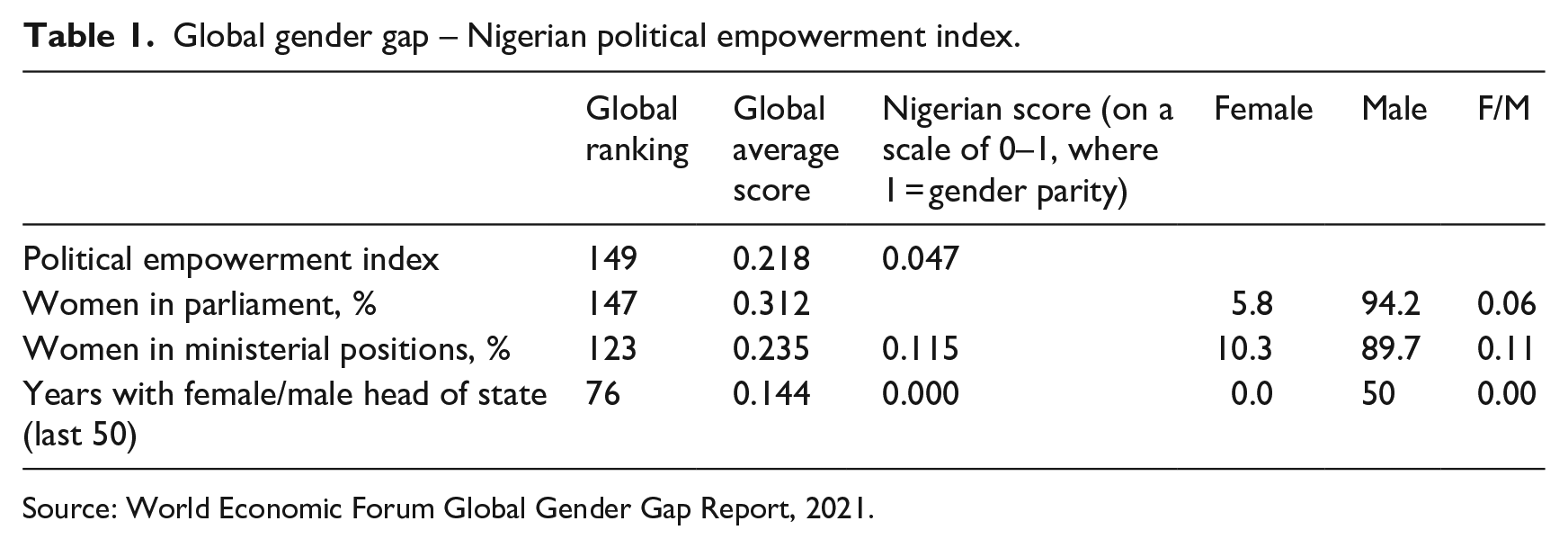
Source: World Economic Forum Global Gender Gap Report, 2021.
In the overall global gender gap index for 2021, Nigeria ranks 139th out of 156 countries (with a 63% gender gap) from the average scores of the indicators that constitute the Index: educational attainment (0.806), health and survival (0.967), economic participation and opportunity (0.687) and political empowerment (0.047). The score for health and survival looks promising, but it is an outcome of measures of variables such as maternal mortality rate and antenatal care for which there are no male comparisons. Of relevance to this study is the economic participation and opportunity score which is only higher than the political empowerment score (World Economic Forum, 2021). As will be discussed in the next section, economic resources (or the lack thereof) are significant challenges encountered by female politicians in Nigeria in greater dimensions than experienced by their male counterparts.
In marked contrast to many African countries, Nigeria has no electoral gender quota system. This is significant given that gender quota and proportional representation policies are regarded as effective strategies for increasing women’s political participation broadly (Bjarnegård and Zetterberg, 2011), and specifically expanding access in the legislative process (Bush, 2011; Franceschet and Piscopo, 2008) and leadership in political parties (Verge and de la Fuente, 2014). Underrepresentation of women in electoral politics is certainly a national problem in Nigeria, but it is more pronounced in northern Nigeria. According to investigations by The Sunday Punch, a widely circulated national newspaper, in Kano (a populous northern state), no woman has ever been elected into the state House of Assembly or the national House of Representatives. In 2019, 17 northern states did not elect women into their House of Assembly and the two major political parties (PDP and APC) did not have female candidates for the National Assembly in 19 states (Eniola, 2016). The underrepresentation of women in Northern Nigeria is similar to what occurred in many countries in Africa before the adoption of quotas broadened the political space for women resulting in increased female legislative representation (Tripp and Kang, 2008).
Despite the absence of official quota policies, there are various initiatives to address the low level of women’s participation in Nigerian politics. For example, in the build-up to the 2011 election, the Ministry of Women and Social Development launched the Nigerian Women Trust Fund to provide financial support to 230 female candidates. The First Lady at the time, Patience Jonathan, introduced the Women for Change Initiatives to encourage women to participate in politics. The Independent Electoral Commission (INEC, 2014) introduced a gender policy in 2014 to demonstrate its ‘commitment to sustainable and inclusive participation of all, irrespective of gender, both within the Commission and in the wider political system’, according to its chairperson, Professor Attahiru Jega (p. 11).
In addition to local initiatives, several international civil society organizations have funded capacity-building programmes to mobilize and mentor female politicians in major cities in the country. For example, in 2018, UN Women, the global champion for gender equality, sponsored a conference of political parties to discuss effective strategies to address the issue of women’s political powerlessness and underrepresentation in political party structure and governance (Orizu, 2018). A major outcome of the event was the publication of the Nigerian Women Charter of Demands outlining three key political imperatives: (a) demonstrate political will and commitment to gender equality and women’s empowerment; (b) improve women’s participation in politics and decision-making; and (c) demonstrate principled transformational leadership (Nigerian Women Trust Fund, 2018). All registered political parties, except the ruling party, APC, endorsed the charter. However, that charter and other investments in the expansion of women’s political participation did not yield tangible gains in the level of women’s representation in the 2019 general elections.
Most studies of women’s political participation in Nigeria have highlighted this lack of progress (Arowolo and Aluko, 2010; Okoosi-Simbine, 2012; Pogoson, 2012). This research builds on the foundation laid by some of these previous studies. However, we broaden the scope by exploring the issue from the perspective of the lived experiences of female politicians. Although it echoes some existing studies, it contributes fresh insights by detailing how women challenge identified obstacles to negotiate access to the political space. Focusing on the viewpoints of the women contributes empirical data to the literature and deepens knowledge of the complexities of political participation by women. More importantly, the approach creates space for women to have a voice.
Methodology and research techniques
The fieldwork for this research was conducted in Nigeria in 2016 and 2019. We interviewed a selection of female politicians and male allies in different cities in four of the six geopolitical zones in the country: north-central, south-east, south-west and south-south. Security concerns informed the decision to exclude travel to the north-central and north-west zones. The selection of participants was based on their media visibility, ranking in the political parties (e.g. as electoral candidates), and through the snowballing method. The women and some of their allies were members of the two major political parties, the PDP and APC, and others belonged to smaller political parties. To explore the experiences of female politicians at different levels of the political spectrum, semi-structured interview driven by an interview guide was utilized. This approach was most appropriate because it allowed the researchers to probe responses and encourage respondents to elaborate on their answers. As Lune and Berg (2016) note, the flexibility of semi-structured interviews enables researchers to pursue areas and ideas initiated by the participant. This can produce a ‘much more textured set of accounts from participants than would have resulted had only scheduled questions been asked’ (Lune and Berg, 2016: 70). Twenty-five women and 10 male allies were interviewed, and their responses form the bulk of the discussion in this article. All but two of the women had contested elections at various levels of government. The two women who had never contested for political office were active party members and campaigners. The interviews took place in locations preferred by the subjects, including hotel meeting rooms, offices and homes. Each interview session lasted between 45 and 60 minutes. All interviews were conducted in English, tape-recorded, transcribed and coded for analysis. The respondents, except one, consented to be identified, but we have exercised discretion in identifying them in the text.
We adopted a thematic approach for the analysis drawing excerpts from the interviews to illustrate commonalities and differences in the subjects’ accounts (Frederick, 2013). We created the space for the politicians to construct their narratives in ways that placed them at the centre of the study. In accordance with one of the goals of this research (namely, to give voice to the politically marginalized), we have included direct quotes from some of the research participants.
Narratives of barriers and challenges – research results and analysis
Each participant was asked the same set of structured questions about the gender-specific challenges that female politicians encounter. The details and personal circumstances were different, but all female respondents were unanimous in their identification of four major challenges in their political journeys. These are: bullying and intimidation, the patriarchal nature of the party structure, financial limitations and cost of elections, and ‘politics of insult’.
Bullying and intimidation
The women who were unsuccessful in their run for office spoke of intimidation and coercion by party leaders and godfathers – defined as wealthy men who ‘use their influence to block the participation of others in Nigerian politics’ (Albert, 2005: 82). Many research participants said they were asked to withdraw their candidacy from the party primaries and their male opponents were selected without due democratic processes. One woman said rules were often changed to privilege men. She cited an instance when the party leadership announced her absent male opponent as the winner of the primaries without votes being cast. Her candidacy was barely acknowledged. In other cases, voting systems were changed, and unscheduled meetings were held to compel female candidates to step down: Bullying and intimidation are some of the tactics that were used against women. No woman wants to die and leave her children so they will quietly step down. (Parliamentary candidate (PC1)) The godfathers ganged up against me. I couldn’t believe how they ganged up against me. It was very shocking. They tried to kidnap me on the day of the primaries. They attacked me with tear-gas and arrested me and some of my supporters. They do all kinds of things to keep women away. (Parliamentary candidate (PC2))
Another respondent who attempted to run for a position during the 2019 elections said the chair of her political party told her not to bother because there ‘was no vacancy’. In some cases, women who were successful at the primaries were intimidated to step down and were offered appointment as commissioners or advisers as compensation.
Patriarchal party structure
Besides obstructions by party leaders and godfathers, the organizational structure of the political parties systematically disempowers and disincentivizes women. As gateways to the political space, parties are pivotal in the recruitment of candidates but when women join, they are often assigned designated roles that do not convey power or require leadership skills. Or, as Pogoson (2012) also observed, ‘women are often pushed to certain positions that are in reality practically and strategically redundant’ (p. 103). For example, the two dominant parties allocate a single leadership role for women, which is the ‘woman leader’ position. Even as the parties make claims to gender inclusivity, this seems to be the highest position that women can aspire to in the party hierarchy. As a result, women are still primarily on the periphery of political parties. It is worth noting that women are rarely pioneers of political parties. As one of our respondents noted, Women are rarely involved at the formation stage of parties. Do the parties then make room for women when they join? Not really because when offices are assigned, one woman will be given the position of woman leader and yet she will not be involved in policy making processes. She is only needed when the issue is about welfare and mobilisation of women during elections. The truth is, when women are not represented in great numbers to contribute to policies, it is difficult to include things that concern women and when policies are being implemented, they will be implemented in ways that may affect women negatively. (Former parliamentarian (FP1))
Another research participant explained that even in parties that claim to be inclusive, There is a clear denial of access to the political space. Although it seems the space is open, when you are seen as a threat, space begins to narrow. Once you start gaining traction, when it seems you are on the verge of accessing power, space begins to close, if you are seen as an independent woman who has earned her right to participate, the party will create obstacles to keep you out. (Former parliamentarian (FP2))
Financial limitations and cost of elections
Access to political funding is also a critical barrier to women’s participation in politics across the world (Muriaas, Wang, and Murray, 2020). Financial resources impact electoral outcomes as well as the capacity to participate in politics. While negotiation for space is a dynamic process for every politician who lacks the resources to purchase access, or the political clout to demand it, the task is especially more daunting for women in a country where the average woman earns 58.4 Kobo for every Naira earned by men, representing 58.4%. In 2021, only 30% of managers in Nigerian corporations were women and just 13.9% of firms had female top managers according to the 2021 World Economic Forum Global Gender Gap Report. Women, especially those without wealthy godfathers and supporters, have a more arduous path to the political arena in a race where winners are determined by superior economic resources and privilege rather than political ideologies or visions: The reign of political godfathers in Nigeria who bankroll anointed sons (always male) and do everything including buying votes to make sure they win, means that women will always come last. Women are yet to have a lot of money with which to earn the sobriquet ‘political godmothers’ to be able to sponsor their political daughters. (Okoronkwo-Chukwu, 2013: 40)
Our research participants detailed how the ‘cost of doing politics’ is a significant impediment to participation particularly when parties raise the economic threshold for members aspiring to electoral offices. According to Oluremi Sonaiya, a presidential candidate in the 2015 elections, the monetization of politics is the greatest challenge for politicians. Voters expect and demand material incentives to vote. She said her attempts to convince voters to look beyond immediate gratification were unsuccessful: I was talking to a group of women and I asked them what they would prefer, rice, wrappers, head-ties or being able to go a hospital when they were pregnant and be sure they and their babies would leave the hospital alive because of the available services. They reflected for a short time and then said, ‘Yes, that would be the best thing, but right now, we need N2000 to buy rice’. (Sonaiya, presidential candidate)
Sonaiya’s encounter with the women highlights the impact of poverty on the representation of women in politics. Most impoverished voters prefer to sell their votes to the highest bidders, and since women generally lack the economic power to purchase access, they are easily excluded from any serious political contention.
The cost associated with contesting elections begins to pile up from the expression of interest to run for office. Although some of the major parties subsidize nomination forms for women and some offer them for free, most women said that arrangement works against them. One of our interviewees argued that ‘giving free forms is not an answer because those who pay for forms do not want to give way to those who got free forms. Why should someone pay and then not be allowed to win?’
While offering free or subsidized nomination forms to female candidates increases the number of women running on a party platform and confers positive publicity on the party for inclusiveness, the female candidates have no chances of getting elected if they do not have powerful ‘godfathers’ and a ‘war chest’ to fund their campaigns: In the Nigerian situation, politics has to do with money. Everything is about money. Funding is a major issue for women. It is what keeps women away . . . When money talks, women keep quiet because they will not go to the bank to borrow and they don’t have properties to use as collateral. The support from parties is not real if women are expected to have money to be able to participate. (Male ally and member of the PDP (MA1))
The women who achieved electoral success received financial support from many sources. Ekaete Ebong Okon, a former legislator in Akwa Ibom State, in the south-south, said she prepared herself financially to fund her campaign but still needed support from family and friends: I am an entrepreneur. Even though nobody keeps money hoping to engage in politics, it is good and necessary to have a financial backbone. When the person I was contesting against knew that I was buoyant enough to contest the election, . . . I was able to start off. I had a ladder that sprung me up and my husband came to assist me, and friends also came to assist me. (Okon, former state legislator)
Other women said they also depended on friends and families for financial support to fund their campaign. Itam Abang, a legislator, said, ‘without funding, you cannot do anything. You cannot depend on people for day-to-day campaigning. If you do that you will fall by the wayside’.
The ‘cost of politics’ does not only disincentivize women from electoral politics but entrenches patronage. The experiences of the women we interviewed confirmed the degree to which election costs present a major obstacle to women’s political participation and the central role of money as a determinant of women’s access to politics.
Politics of insult
Although some of the women suggested that socio-cultural norms are no longer imposing significant barriers on them, they decried what Bauer and Darkwah (2019) refer to as the ‘politics of insult’. The phrase describes the casting of aspersions on female politicians. Male politicians, they explained, routinely berate women for engaging in politics. One of our research participants described how women are verbally abused at party meetings and accused of being promiscuous and that the reason for attending political party gatherings was to ‘look for rich men’: I was called a prostitute and told I should be at home looking after my husband and children. Single women are particular vulnerable to abuse. They are called big girls. Women who are not able to handle insults give up when they are attacked. (Former parliamentarian (FP3))
The disrespect for female politicians does not occur only in the backrooms of state politics but sometimes plays out at the national level as well. For instance, in March 2016, a female senator, Abiodun Olujimi, presented a Gender and Equality Opportunities Bill to the Senate, detailing how women should be accorded unrestricted rights to participate in politics. Not only was the bill voted down by the male-dominated Senate on religious and cultural grounds, but a male senator went further to explain why the bill was unacceptable. He warned his colleagues: ‘We should not give women too much opportunity. They will come here and one day you will find all these women in this chamber, and they will mess up’ (Sahara Reporters, 2018).
While many Nigerians (both men and women) acknowledge the processes through which bullying and intimidation, patriarchal party structures, financial limitations and cost of elections, and contempt for women in politics (or politics of insult) contribute to discouraging women from active participation in politics, some self-identified male allies blamed women for their poor electoral representation. Moses Ekpo, deputy governor of Akwa Ibom, one of the states in the South-South geopolitical zone, and a member of the PDP, suggests that women are not stepping up to take on responsibilities. His ‘problem’, he said, is that women are not ‘putting themselves up’: I am disappointed that at this time in the nation’s development, we still have a relatively small number of women in politics. They say that they are not given opportunity. I can see the opportunity. First and foremost, to be involved in politics, you should belong to a political party. And I don’t think there is restriction on women registering for political parties except for the restriction by husbands who might say, ‘No, don’t register’.
1
(Ekpo, male ally and member of the PDP)
Most of the women interviewed agreed that they were, technically, free to join political parties. However, they rejected the assumption that party membership gives women the same opportunities as men or that all those women have to do to succeed is to ‘put themselves up’. Ndi Kato, a young politician and activist, argues that though the political space is partially open to women, ‘no one is prepared to create space at the table for women, so people look for excuses to keep their seats’. The message to women is You can come. You can enter the house but there are some rooms which you cannot enter . . . You are in the house; we have allowed you into the house. The house is for everyone but don’t go into that room. You should be satisfied that we have allowed you into the house. You can talk but nobody will listen to you. (Kato, political activist)
She also observed that in some parts of the country, socio-cultural norms also work against women. For example, there are some parts of the north that if a woman dares to go into politics, her family will protest against her because she will be seen as defying authority. Women, she asserted, are participating in politics, but the rules for engagement are different for them compared to their male counterparts.
Another area where women were said to be responsible for their political underrepresentation was their unwillingness to support or vote for other women. But this women-do-not-support-women discourse was contentious because while some of the women validated this view, those who achieved electoral success said they depended on women for their victory. Some of our research participants said the claim was a tool used by men to discredit women and that the perceived discord among women was caused by the men who mobilize women against women. One of the women who ran for office explained that It might have been true in the past, but it’s not true anymore. We are standing solidly behind each other, we’re encouraging each other. I know the strength that I draw from women around and I know that I also bring that kind of strength for them. It’s been quite encouraging. (Parliamentary candidate (PC3))
Itam Abang, the legislator, can relate to this. She attributes her success to rural women in her community who resisted all attempts by other political parties to rig the election: Women won me the election. The women sat down at the collation center and said, ‘let us see who can come and beat you here’. They said, ‘this is our daughter’. You know when women say no you can’t buy them. I spent time with the women and they, in turn, supported me. (Abang, state legislator)
Negotiating access and privilege: pathways to political significance
Unlike men, women must actively negotiate for access and their success can entail making strategic alliances with men which in turn reinforces patriarchal structures. They are also likely to suppress their femininity to gain respect and traction. A study of the political system in Singapore, for example, suggests that ‘women there make a conscious decision to operate like their male counterparts as a survival tactic . . .’ (Devasahayam, 2013, cited by Ross et al., 2020: 237). Certainly, the ability to negotiate by itself is often indicative of privilege and illustrates the configuration of power and authority within the political system. In Nigeria, access to power resides mostly in the hands of political godfathers who ‘dictate who participates in politics and under what conditions’ (Albert, 2005: 82). As gatekeepers, the godfathers constitute persistent obstacles in the paths to the political arena by determining who gets a seat at the table. Indeed, one of the research participants attributed the electoral defeat of many of 2019 candidates to lack of support from the gatekeepers: Most of the women did not have godfathers and did not stand a chance. The big parties make it difficult for women to contest. (Blessing Obediegwu, Independent National Electoral Commission)
Sponsorship from godfathers is desired by rising politicians (both male and female). However, it often comes at a price, namely, the disempowerment of the beneficiaries in ways that undermine their efficacy. Consequently, they go into office merely as proxies of the godfathers. Accounts of women’s representation in the Ugandan Parliament, for example, paint a grim picture of how female politicians were exploited by the gatekeepers who facilitated their access. ‘These women were expected to accept a subordinate and inferior place, and to defer to male authority. Female members cooperated dutifully by “knowing their place” and by actively supporting the “hand that fed them”’ (Refki et al., 2015: 55). But beyond the power of the ‘godfathers’ and sponsors is the problem of the political party structures. With no option for independent candidacy in Nigeria, political parties are instrumental to women’s participation because election contestants must belong to and be sponsored by a political party.
Despite these challenges, women who have political aspirations have successfully utilized different strategies to pave their paths to the political terrain. These strategies include traditional pipelines such as invitations and sponsorships to contest for elective positions, appointments, lobbying, and service to party leaders and the community. Invitations or appointments are typically a response to a policy of zoning, an informal strategy to approximate equitable distribution of political offices and rewards. At the national level, zoning entails balancing the north–south divide and the Christian–Muslim polarization.
As John Campbell, a former US ambassador to Nigeria and foreign affairs specialist, notes, One of the most important features of Nigerian politics since the restoration of civilian government has been the informal arrangement of power alternation known as zoning. Zoning was a tacit agreement among the country’s elite to alternate the presidency between candidates from the Christian South and Muslim North. Although not without its problems, zoning did provide a degree of political stability . . . (Campbell, 2013, xiv)
Some female politicians benefitted from this policy during the 2019 elections. One of our research respondents, a Muslim from Northern Nigeria, said she became politically active following an invitation to be the running mate of a presidential candidate, a Christian from the South. Until then, she said, she had no interest in politics. She recalls, Someone wanted to sponsor me to join either the APC or PDP, but I was not interested. He offered to do everything for me. All I had to do was say ‘yes’. I told my husband. He asked me what I wanted to do. I said to him ‘you are my husband, what do you want me to do?’ He told me to go on the journey and see how far it will take me. (Vice-presidential candidate (VPC1))
Although she did not achieve electoral success, she said the experience sensitized her to the need for women to be politically active. For this politician, an invitation granted her access to the political space. VPC1 did not have to negotiate because she was privileged by powerful godfathers. Even so, it was interesting to observe that although she was invited to participate on her own identity as a Muslim woman, she could not accept the invitation until her husband gave her permission to do so. She had subconsciously defaulted to her identity as a married woman. Even when she had received an unexpected invitation and promise of financial sponsorship from a godfather, she still needed to scale the hurdle of her marital status as her ultimate decision to access the political space depended on the goodwill of her husband.
Another pathway to political participation in Nigeria is by appointment to political positions. This approach resonates with the experiences of women in other parts of the world. In Ghana, for example, many women prefer appointive positions to electoral contest due to the high level of denigration in the political space and the financial costs of politics (Bauer and Darkwah, 2019,). Appointment confers media visibility, name recognition and political relevance, especially if the women become successful representatives of their communities. Some women often choose to remain in politics beyond their appointed tenure because opportunities to serve open doors and empower them to demonstrate their capabilities and earn the respect of their constituents. Thus, appointive positions sensitize women to the needs in their communities and enable them to introduce initiatives that highlight issues that matter to their constituents. This was the case for Akon Eyakenyi, a senator. Before her election in 2019, she served as a board member, state commissioner and federal minister. Her performance, she says, earned her the respect of the governor and support of her community to run for the senate seat.
Women also negotiate access through service to party leaders and godfathers. Some of our respondents said they were willing to serve the male political hierarchy, be respectful and submissive to them as a strategy to achieving their goals. One of them said, Women . . . should give men their respect and honour them. When women don’t give men respect, they get kicked out. Women should humble themselves and be respectful towards men. (Parliamentary candidate (PC4))
Another reported that she cooked for and served men during political meetings: If there was a meeting, I attended. I cooked for them. Even though I have a Ph.D., I did not mind serving. One day I said I would like to run for office and though there was (initial) opposition (but) when the men saw that I was serious they supported me. (State legislator (SL1))
Perhaps it was her constant presence during party events that resulted in visibility and familiarity or the deployment of her femininity in a patriarchal setting got her the support. Most of the women we interviewed also said they deferred to their male colleagues in their interactions with them as politicians. They justified their decision to be submissive and subordinate on religious and cultural practices. Their willingness to navigate and negotiate access through deference to the authority of party leaders without interrogating the gendered hierarchy of the leadership reflects women’s socially constructed status. While they aspire to participate in politics, they seem content to accept the limitations imposed on them as women. This uncontested acceptance of the status quo and framing of such within religious and cultural ethos grants women a seat at the table but not sufficient to make any transformative impact. Thus, many of the women aspiring to political positions in Nigeria pursue their goals by submitting in ways that leave unchanged the fundamental structures of patriarchy and societal perceptions about women in politics.
For the younger generation of female politicians, deference to the patriarchal structure is not their pathway of choice. Rather, they choose community service as a strategy that begins at the grassroots. One of our research participants, a political activist, holds the view that women can earn respect and public trust from their communities through service, adding, ‘when you have shown that you are capable, gender is no longer an issue. People will acknowledge that you have something to offer’ (Political activist (PA1)).
Another young activist said the focus should be on the younger generation. She stressed that we must start motivating girls to see themselves as leaders and get involved in political activities. Girls are traditionally reluctant to put themselves forward and we have been socialised to be modest while boys are encouraged to be vocal. We must change that pattern of thinking. (Political activist (PA2))
For some other women, a radical road less travelled is their preferred strategy for negotiating access. This often means joining emerging parties instead of established major political parties and their gendered hierarchy. Sonaiya, the first woman to win a party’s presidential nomination, chose to contest the 2015 election on the platform of KOWA, a small party registered by a group of civil society activists. The major parties, she said are ruled by godfathers and not readily open to women and therefore difficult for women to have a voice. ‘Women must be true to themselves. They should not join a party where they are just the garnishing’ (Sonaiya, presidential candidate). Another research participant, Eunice Atuejide, went a step further by forming a political party, National Interest Party (NIP), on which platform she contested as a presidential candidate during the 2019 elections: I forced my way in by forming a political party with people who have similar ideology as myself and that gave me space at the table. The political space is not open to women. Men will not make room for us; we have to change our society and not wait for society to change for us. Things are stacked against us. Men will not give us space. We have to bring our table. We can’t walk in there and expect men to make room for us. We have to take our table and chair and sit there. I do not expect magic to happen. (Atuejide, presidential candidate)
Other participants also asserted that women must not wait to be given space at the table but should step forward and claim their rights as citizens: Women must join political parties. We have to be there. Our presence will make a difference. We should be prepared for the insult because once we make it clear that we will not be deterred, they will have to accept us. Nobody will hand over power willingly to us. Women should not expect men to simply make room at the table for women. (Political activist (PA3))
Although most of our research participants called for electoral gender policies, they insisted women must not play the gender card as their main strategy for access but rather should exploit their numerical strength. When more women join political parties, their presence, our participants said, will eventually have an impact on political culture and practices.
Conclusion
The most important contribution of this study is the creation of space for female politicians to narrate their lived experiences and strategies for negotiating access to the political space in Nigeria. The study validates some of the accounts of women’s political experiences in previous studies. From our interviews, we identified some of the obstacles that female politicians encounter. These include the absence of internal democracy and transparency within political parties, the power of godfathers as gatekeepers, bullying and intimidation, financial limitations and cost of elections, and the ‘politics of insult’. These obstacles intersect to disincentivize female politicians from political participation, thus leading to the low percentage of women in elective and appointive positions in the country. There was a consensus among the research participants that the political party structure is a critical obstacle to women’s participation in politics. With a small group of gatekeepers making arbitrary and undemocratic decisions on the recruitment of election candidates, women are routinely at a disadvantage, especially as the selection criteria are not transparent.
Predicated on the understanding that in Nigeria, politics is masculinized, and masculinity is privileged, we conclude that women face unique challenges simply because they are women. However, beyond gender, women’s minimal presence in the political space in Nigeria is also an outcome of the interplay of several economic and socio-cultural factors and the patriarchal nature of the political system. Most Nigerian cultural and social practices legitimize male dominance and female subordination, thus casting women’s subservience as a celebrated virtue. The country’s two dominant religions (Christianity and Islam) also emphasize submission. Women are therefore socialized into passive political roles, and this militates against their engagement in politics. Consequently, the relative absence of women in major decision-making roles entrenches hegemonic patriarchy that reinforces the country’s masculine political culture and electoral system.
Despite these obstacles, women are exercising their agency by using different pathways to negotiate access and relevance in the political space; some by deferring to male authority, others by challenging it. While the prospect of a shift in favour of increased participation by women is relatively bleak, individual women continue to aim for the ‘political glass ceiling’. For this reason, the election of Kamala Harris as the US first female vice president could have a rippling effect on women’s participation in Nigerian politics.
Footnotes
Acknowledgements
The authors would like to thank their reviewers and the editorial team for their helpful feedback.
Funding
The author(s) disclosed receipt of the following financial support for the research, authorship and/or publication of this article: This work was supported by the University of Huddersfield’s Global Challenges Research Fund.
