




Abstract
Women are long ignored from the organized political arena across the world, but several initiatives have been taken for entrance of women in local-level politics. The main objective of the study is to provide an idea about effective and pseudo-participation of the women representatives and to bring out the factors responsible for kinds of participation. For that, district headquarters of West Bengal have been chosen. Two indices (political empowerment index (PAI) and political awareness index (PEI)) infer that the same category city has different degrees of women’s awareness and participation. The rate of pseudo participation is much higher than the effective participation.
Introduction
Though women represent half of the world’s population, their share in participatory politics is still ignored (UN Women, 2013). Participation, engagement and interest of women in political activities are quite less (Sharma, 2016). But in India, participation in the political arena at the local level has been ensured through the 73rd Constitutional Amendment Act (CAA) in 1992 in the rural areas and the 74th CAA in 1992 in urban areas which gave chance to the women to enter into the politics. The 74th CAA is considered as paradigm shifting in the urban governance system. The main aim of the act was to revitalize and strengthen the urban structure, to empower the backward section of the population and to decentralize the decision-making process through ward committees (Government of India, 1992). Women are better represented at the local level rather than at the state or national level (Kumari, 2006; UN Women, 2013). Reservation for women in local government is not just an opportunity, rather it is a responsibility to nurture their capability by effectively participating in solving the community problems and local area development process (Kumari, 2006).
Several studies suggest that males dominate politics as compared to females. Within the political hierarchy, women are more in the lower echelon of decision making than the higher echelon (UN Women, 2013). The main reason behind this is that with the responsibilities of local governance, it is easier for the women to manage family responsibilities, to set a suitable life-work balance; more seats are available with lesser competition; provision of reserved seats (in some countries) and more acceptance of women in city governance by the general public (Drage, 2001). Reservation gives an opportunity to the women to realize their capability in performing their rightful role in the governing process and to involve themselves in the improvement of the local area and the community of the area rather than getting certain number in (Kumari, 2006). This study wants to bring out how the women are utilizing the reservation opportunity in increasing their political participation and whether apart from reservation there are other factors which determine the rate of political empowerment.
Literature review
Conceptual issues
Participation in the general sense is engagement in any kind of activity. In the mid-1970s, development agencies used participation to measure the intervention in a more effective way (Cohen and Uphoff, 1977; Gaventa, 2004). In the 2000s, the concepts were used in the social arena, community or development projects, and gradually, they started resonating with democratic governance as a part of the rights of the citizen (Gaventa, 2004).
Participation is an abstract concept, and there are several modes of participation; while political participation is a voluntary, amateur activity related to the government, state and politics, it is not restricted to the specific phases, levels or areas. These activities are related to solving community problems or ‘attempts to alter systematic patterns of social behaviour’ being ‘devoted to influencing the collective life of the polity’ or aiming to ‘induce significant social reform’ (Van Deth, 2014). Democracy survives through the people’s political participation which can be also considered the essence of democracy.
Political participation cannot be conceptualized as a unidimensional set of activities, rather it has several modes like casting votes, donating money, running any offices, attending a political meeting and debate, party and campaign workers, community activists, contacting officials, protestors and communicators and so on (Milbrath, 1981; Van Deth, 2014). While political participation of representatives or women representatives in local governance is related to the engagement in the solving of the citizen’s problem related to any services, involvement and engagement in the ward’s activities, engagement in the ward office’s activities, preparing the minutes, attending in the board of council meeting and decision-making process, involvement in the overcoming of the difficulties and attending the training programme related to local governance. The inclusion in democratic decision-making processes ensures the sense of empowerment.
Empowerment is viewed as an aspect of capacity building, particularly for marginalized, unorganized and different deprived groups, classes and categories. It is considered the only appropriate answer to oppression, exploitation, injustice and the other maladies with which our society is beset by many politicians, publicists, social activists and a growing section of the intelligentsia. Empowerment is both the means of an end and the end in itself (Beteille, 1999). Empowerment is about social transformation. It is about power. Several studies found the three dimensions of empowerment: ‘power to’, ‘power with’ and ‘power within’. ‘Power to’ is associated with controlling their own life, whereas ‘power with is collective to negotiate everything like caste, gender, class, etc.’ and ‘power within’ is associated with the strategic gender awareness aspect (Banerjee and Samanta, 2020). Women empowerment is a varied and multidimensional concept (Samanta, 2009). It has several aspects like social, economic and political (Acharya and Ghimire, 2005; Gaonkar, 2004), but economic empowerment is of the utmost important (Gaonkar, 2004). There are two genetic concepts of the dimension of empowerment, one is static and another is dynamic. In the static concept, women’s empowerment is defined as their capacity to participate in decision-making and the notion of having an effective voice that can influence the decision-making process. But when women are unable to influence the decision, it is considered the disempowerment of the women. On the other hand, in dynamic concepts, empowerment is considered a decision-making process that enhances the individual’s capacity for decision making and implementing the same. Empowerment is not a given aspect, rather it has been acquired over the period by an individual or groups (Garba, 1999).
In this particular study, the empowerment is conceptualized in the context of involvement of the women councillors in the ward’s activity, participation in the decision-making process in the board of council meeting, the capacity of tackling any difficulties, participation in doing municipal works and capacity building training programme, individual’s political advancement in terms of awareness level and confidence and participation in politics beyond the reservation and in higher-level politics.
Governance concerns the forms of co-operation among state, private sectors and civil societies (Pierre, 1998). The word urban governance is just a replacement for the traditional concept of urban administration and management, and the former has a lot of rules and regulations, but the latter has concentrated on the decision making with more flexible means. Governance has two aspects: the performance aspect of governance which includes the public sector management, legal framework, economic liberalism and competence to form policies and deliver services, while the other, representational aspect of governance includes transparency, accountability, social justice, human rights and democracy (Harpham and Boateng, 1997). Urban governance plays an important role in the development of the urban region. It determines the quantity and quality of urban local services by giving the opportunity to the local people to participate in the decision-making process and influence accountability and transparency with the representatives (Slack and Cote, 2014).
The urbanization rate of the world is high, and it is projected that it will grow by two-thirds of the total population by 2050 from its recent 54% (United Nations, 2014) and half of the population of the world is the women, but they have only a limited role in urban governance, policy and decision making. Although the functional provisions affect men and women both, women have a minimal role because they are underrepresented in the urban local bodies (ULBs) (Prasad, 2014). The United Nations has been playing a pivotal role in greater representation and participation of women in local development. The UN’s Economic and Social Council passed a resolution in 1990 recommending an increased proportion of women in leadership positions about 30% by 1995 and 50% by 2000 (Prasad, 2014).
Indian scenario of women’s political participation in governance
To provide for adequate representation of scheduled caste (SC), scheduled tribe (ST) and women in the municipal bodies, provisions for reservation of seats have been done. The reservation of the seat for SC and ST categories will represent the exact proportion of the population of a particular ULB and one-third of the total SC/ST reserved seats will be reserved for the SC/ST women. This can be termed as reservation within the reservation. For women, one-third seats of the total seats will be reserved. All the seats will be filled by the direct election rather than selection. State Legislatures were not given any power to modify this reservation system even in favor of the backward class of the particular ULB (Election Commission for UTs, 2018; Government of India 1992).
Women have been marginalized from the mainstream of politics. Therefore, the reservation was one of the important ways for the entrants of the mainstream politics. Women empowerment refers to increasing the spiritual, political, social, educational, gender or economic strength of individuals and communities of women (Prasad, 2014; Sharma, 2016). The United Nations has enhanced empowerment by increasing people’s ability to bring change. As per the proposed framework of UNICEF, 1993 the components of women’s empowerment are welfare, access, conscientization, participation and control (Verma, 2009). Women empowerment is an international agenda and many national and regional plans are made. The United Nations adopted the Convention on the Political Rights of Women (CPRW) in 1952. Till date, several national and international conferences on women have been held, and concern was given on the women’s political participation and empowerment.
There are two objectives behind women’s inclusion in urban local government; the first is the women‘s political empowerment and the other is the developmental aspect of the city (Beall, 1996). The 74th CAA in India has been enacted to strengthen local-level governance by seeking to ensure adequate active participation of women in municipal bodies through the mechanism of reservation of seats for women (Ghosh, 2010) and the representatives developed in different ways in the course of 5 years in office, some becoming significant political players in their own right (John, 2007). This affirmative action has created a space for the women and provided them an opportunity to actively participate and perform in the local governing structures (Sharma, 2016). One study on Rohtak Municipal Council focussed that political parties played an important role in the local-level election and socio-economic characters do matter for the entrance of politics (Arora and Prabhakar, 1997). Another study on Kolkata and Howrah Municipal Corporations concluded that a large majority of women councillors in both are housewives and less formally educated who are much prone to be a proxy or namesake councillors. The study also shows that family political linkage has emerged as an important factor in urban local governance (Ghosh, 2010). Another study on the implementation of 74th amendment in four Indian mega cities: Chennai, Delhi, Calcutta and Mumbai, found that the socio-economic and political profiles of women councillors in all four cities have an interesting picture. But family connections and money are major influences for women ticket seekers in mega cities, which also improve the chances of being elected. It has also shown that women councillors have to perform a number of roles as people’s representatives and as members of the elected council and they have to balance two roles: as family members or private persons and as public figures (Lama-Rewal and Ghosh, 2005). Another study found that after the implementation of the 74th CAA, political participation of women in Narsapur Municipal Council, Andhra Pradesh, has increased to a considerable extent. Women face problems as new entrants due to lack of previous knowledge and experience (Rao, 2014). Women’s empowerment is mostly dependent on social and economic factors (Kumari, 2006; Prasad, 2014). In a study on Darjeeling, it is found that the women’s participation in decision making has changed after the enactment of 74th CAA (Chakrabarty et al., 2004).
Women’s role in urban governance is one of the most important questions for considering women’s political, social, economic, cultural and administrative empowerment. Women though constitute nearly half of the population of the country, their participation in urban governance, affairs and in decision-making is very low; they do not participate effectively and actively in urban governance, except few who are aware of urban governance. So, without their effective participation it is nearly impossible to attain the overall development (socio-economic as well as political) of a nation (Alsop and Heinsohn, 2005).
Women’s political participation in governance in West Bengal
Women are underrepresented in national politics. About 24.5% of women in the world participate in national politics (Inter Parliamentary Union, 2019). In the upper house, the share is 24.3%, while in the lower house, it is 24.6%. Women’s participation in national politics in India is no exception; it is only 14.36% (Inter Parliamentary Union, 2019), whereas one of the states of India, West Bengal, has a good share of the women’s representation (26.19%) in national politics. In the high (Parliament of India, Lok Sabha, 2020) and lower echelons of politics, the share is comparatively high in the maximum ULBs as West Bengal has tried to carry out the decentralization process beyond the constitutional provision. It is one of the few states which immediately after the first municipal elections in 1995 following the introduction of the 74th CAA, ensured that ward committees should be formed in all municipalities. The West Bengal Municipal Act, 1993, which was amended in 1994, has the provision for the formation of ward committees in each municipal ward. According to West Bengal Municipal (Ward Committee) Rules, 2001, some of the items which were amended in 2003 ward committees have been given more important functions and it is considered an engine for the doing ward-level activities. The West Bengal rules clearly indicate the constitution, composition, powers and functional domain of ward committee. Councillors elected from the ward will be the chairperson of the ward committee (Government of West Bengal, 2001). The decentralization is measured by the Ward Committees. Although the ambiguity act of ward committees creates defunct ward committees in most cities, but proper implementation leads to proximity and accountability between citizens and their representatives (Kundu, 2006). Chattopadhyay (2012) has found that though the participation increases the accountability among the citizen and their representatives, but there is a large gap between the concept and ground reality of participation. Chakrabarti (2007) talked about the governing process is inclusive for the middle-class people, but it is exclusive for the urban poor. Baud and Wit (2009) have identified that the poor see their elected representative as the main channel for their betterment. Harriss (2006) describes that the poor participates through an elected representative, the middle class through RWAs and slum dwellers through pradhan, that is, local head man. Chakrabarty et al. (2004) in their study in Darjeeling have shown that women’s participation in decision making has changed after the enactment of 74th CAA. Ghosh and Mitra (2004) concluded from their study on ward committees in West Bengal that the constitution of any institution with functional responsibility but without any financial power does not have honest intention on the part of state governments to take decentralization and participation reforms forward.
Study area
The study is concentrated in the some selected ULBs of West Bengal, which are economically less developed and located in the western most part of the state. According to the Human Development Report 2004, Puruliya (0.45) and Birbhum (0.47) are the less developed districts. Bankura and Medinipur (0.62) are moderately developed districts. But it is interesting to note that, the share of women in local-level politics is quite high in this region. Therefore, the Puruliya Municipality (PM), Bankura Municipality (BM), Bolpur Municipality (BoM) and Midnapore Municipality (MM) have been chosen for the study.
Methodology
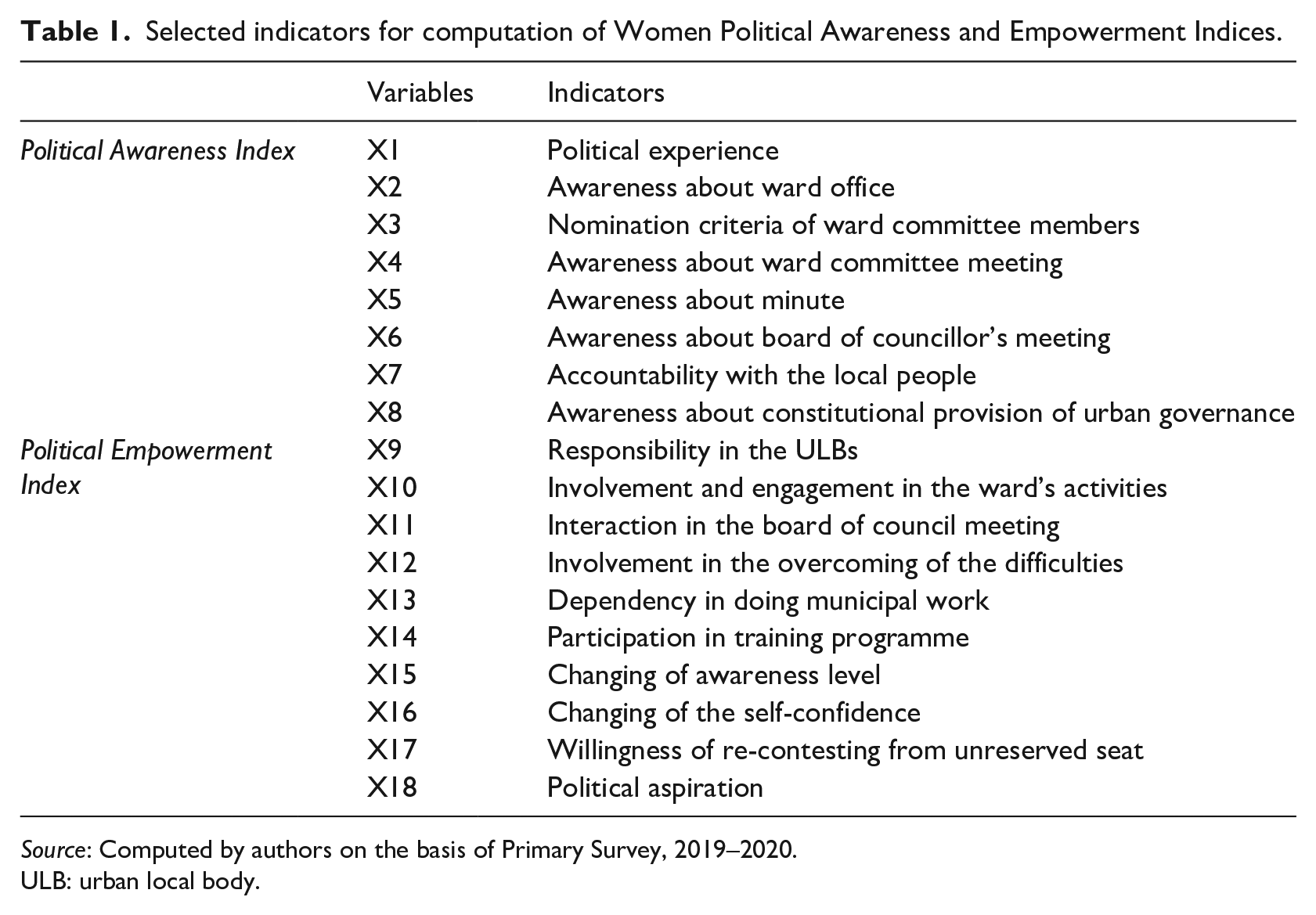
The women representatives in urban local governing institutions of PM, BM, BoM and MM have been surveyed. As a sampling method, purposive sampling has been used to select the women representatives (WRs). There are total 37 (11 + 10 + 8 + 9) women councillors in the four ULBs in the latest term, that is, 2015 to 2020 for PM, BM and BoM while 2013 to 2018 for MM. Of 37 WRs, 34 (10 + 8 + 8 + 8) WRs have been interviewed. Of 11, 10 WRs have been interviewed from PM, of 10, 8 WRs are interviewed from BM, 8 WRs from BoM and of 9, 8 WRs are interviewed from MM with the semi-structured schedule to trace their level of political empowerment and awareness. The study is done with the help of primary data collected from the women councillors. Both quantitative and qualitative methods have been used to know the degree of participation, that is, effective and pseudo participation of WR. The collected primary data have been summarized and represented through a simple frequency table and cartograms. Two indices have been calculated, for example, political empowerment index (PAI) and political awareness index (PEI) for analyzing the condition of women in the local governing process. The indicators which are associated with the local governance process and nature of participation are categorized into two groups. The indicators which are associated with knowledge about local governance are placed in the first group, while the indicators of the second group are associated with the nature of participation (Basu and Bauri, 2021). The indicators are as follows (Table 1).
Selected indicators for computation of Women Political Awareness and Empowerment Indices.
Source: Computed by authors on the basis of Primary Survey, 2019–2020.
ULB: urban local body.
The statistical technique, principal components analysis, has been applied to these indicators to calculate the weights of the two indices, that is, PAI and PEI. With the help of factor loadings and eigenvalues, the weights have been generated. This technique reduces the dimensionality of the variables but at the same time retaining the originality of the variables. The following formula is used to determine the indices which have been used by Basu and Bauri (2021).
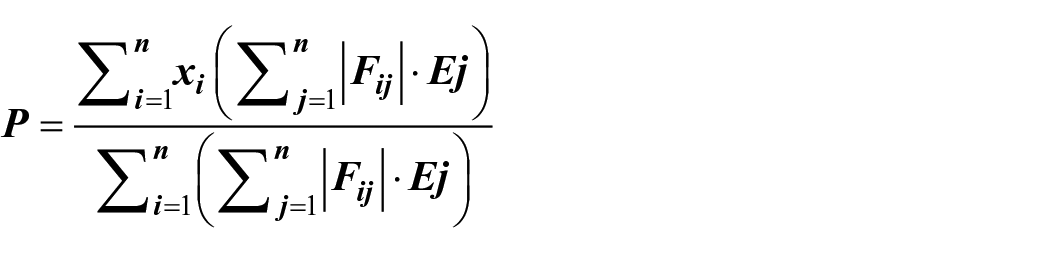
where P is the PAI and PEI, X is the ith indicator, F is the factor loading value of the Ith variable on the jth factor and E is the eigenvalue of the jth factor.
The study has also adopted a regression model where the PEI is considered as the dependent variable while social and economic factors are considered as independent variables, and their association has been estimated. As a qualitative method, case studies have been used to analyze the state of women representatives in urban local governance.
Results and Discussion
These four selected towns and cities are the district headquarters, with quite high local-level women’s participation in politics. The local governing process is carried out by the respective municipalities, for example, PM, BM, BoM and MM with municipal wards (smallest units for urban governance) varying from 20 to 25. PM has 23 municipal wards, out of which 11 municipal wards (ward numbers 1, 2, 3, 4, 6, 9, 11, 15, 17, 18 and 21) are represented by women councillors in the latest term, that is, 2015–2020 term. Among the 11 councillors, four (ward numbers 1, 4, 11 and 17) have contested from unreserved seats, and they got re-elected by competing with the male representatives. Three women councillors (ward numbers 6, 11 and 17) hold a higher position in the municipality, that is, members of the chairman-in-council (CIC). BM has 24 municipal wards, out of which 10 (ward numbers 2, 5, 6, 8, 10, 11, 15, 18, 21 and 23) are represented by women. Among the 10 councillors, two (ward numbers 6 and 10) contested from unreserved seats, and they got re-elected by competing with the male representatives. Even in the municipal apex body, that is, CIC is also represented by only one-woman councillor (ward number 21) and one was the MLA for Bankura constituency and also ex-chairperson of the municipality (ward number 10). BoM has 20 municipal wards, out of which eight (ward numbers 2, 3, 5, 7, 10, 14, 16 and 17) are represented by women. Among the eight councillors, one (ward number 16) contested from unreserved seats and got re-elected by competing with the male representatives. There is no woman councillor in the municipal apex body. MM has 25 municipal wards, out of which nine (ward numbers 1, 4, 5, 8, 13, 16, 19, 22 and 25) are represented by women. All of them come from the reserved seat. Even the municipal apex body is also represented by the three women councillors (ward numbers 1, 5 and 8).
Trends of women’s participation in local politics
Reservation has been seen as the key responsible factor which enables women to enter into politics and participate in the welfare of society. In PM, the women’s representation in the four terms (from 2000 to 2020) has always been more than one-third of the total seats and it has an increasing trend. From the last term (2010–2015), the representation has been increased by about 9.72% because four women representatives contested from unreserved seats and re-elected. In BM and BoM (2000–2020) and MM (1998–2018) municipalities, the share of women representatives in the consecutive four terms is more than and equal to one-third share, but it has a diminishing trend from the last two terms and the rate is 21.54%, 5.01% and 13.61%, respectively. The highest women representation is found in PM in the first term, that is, 2000–2005 (36.36%) and fourth term, that is, 2015–2020 (47.83%), while Midnapore and Bankura secured the highest women share in the second term (41.67%) and third term (47.8%), respectively (Figure 1). Therefore, reservation might be the entrant of women in politics, but in the present situation, it cannot be determined that it is the only factor which enables women to come into the sphere of governing process.
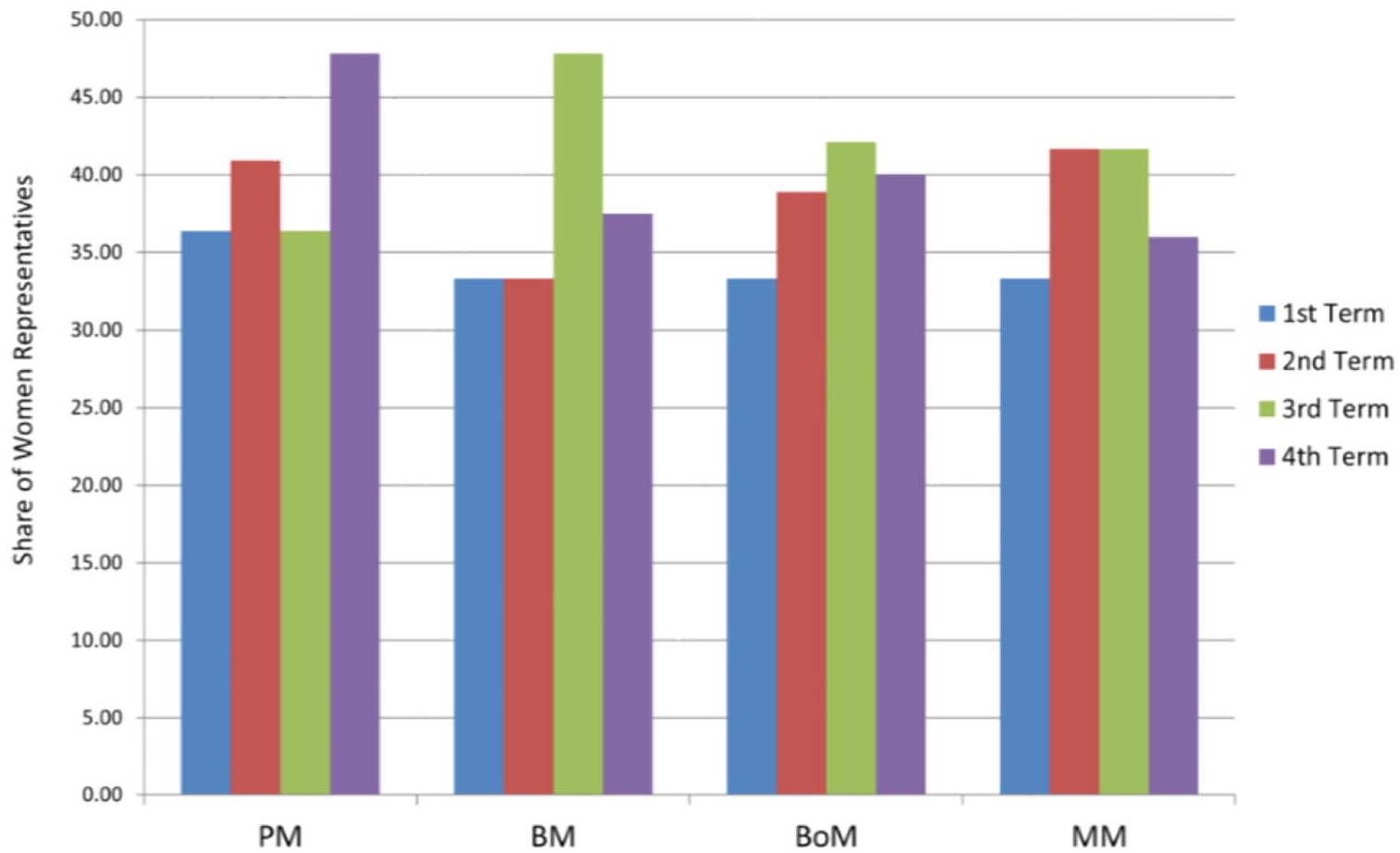
Term-wise share of women representatives in various municipalities.
Socio-economic-political background of the women councillors
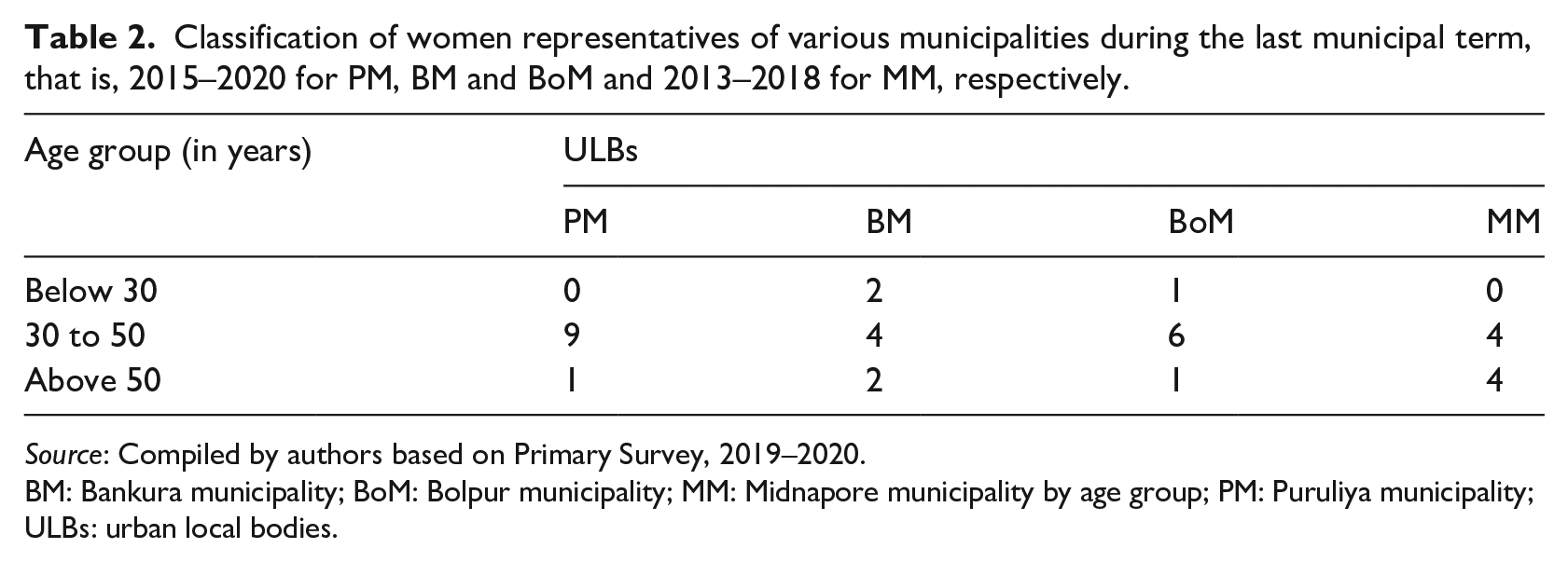
There are variations with respect to the social, economic and political backgrounds among the representatives across the ULBs and also within the ULBs. It is found that the middle-aged women are mainly engaged as councillors in all the ULBs followed by the upper-middle-age cohort, that is, above 50. The young age group rarely participated in the formal political sphere (Table 2).
Classification of women representatives of various municipalities during the last municipal term, that is, 2015–2020 for PM, BM and BoM and 2013–2018 for MM, respectively.
Source: Compiled by authors based on Primary Survey, 2019–2020.
BM: Bankura municipality; BoM: Bolpur municipality; MM: Midnapore municipality by age group; PM: Puruliya municipality; ULBs: urban local bodies.
All the ULBs have more representation from the general caste, while very few from SC and only MM have one scheduled tribe representation. Maximum councillors from all the ULBs are from Hindu background while there is one Christian in Bankura and one from Muslim religion from Purulia and Midnapore. All the women councillors are married in the four ULBs. Only one is a widow in PM. The presence of councillors from the political parties other than the present ruling one which is All India Trinamool Congress (AITC) is negligible. In Puruliya, among 10 councillors, one is from Communist Party of India (Marxist) (CPIM) and two are from Indian National Congress (INC). In Bankura, only one is from INC, and in Midnapore, only one is from CPIM. Maximum councillors are unemployed housewives. In each of Puruliya and Bolpur, only one is teacher. In Bankura, only one is a business woman, and in Midnapore, only one is a private tutor and only one is a retired teacher.
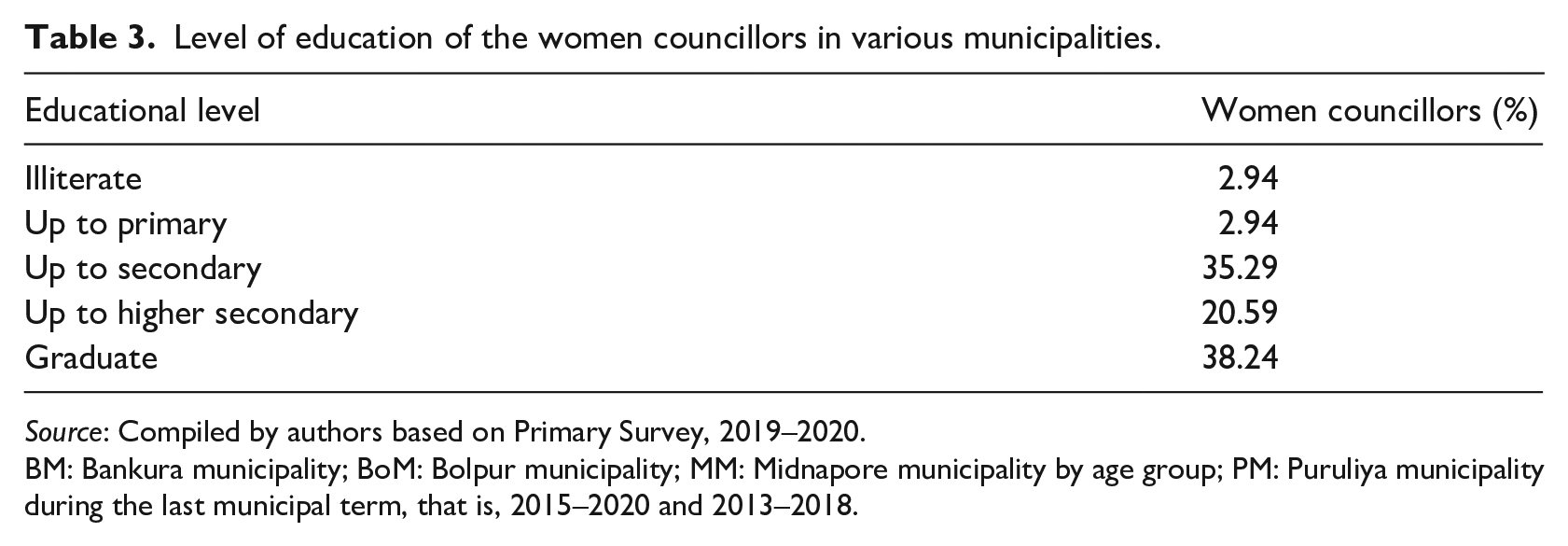
The educational attainment of the councillors is quite satisfactory (Table 3). In Bankura, more than 50% are educated up to graduate level while the share is less for PM, BoM and MM. In Puruliya and Bankura, 50% women councillors are educated up to the secondary level. There is only one councillor from Puruliya who does not have any formal education.
Level of education of the women councillors in various municipalities.
Source: Compiled by authors based on Primary Survey, 2019–2020.
BM: Bankura municipality; BoM: Bolpur municipality; MM: Midnapore municipality by age group; PM: Puruliya municipality during the last municipal term, that is, 2015–2020 and 2013–2018.
Although income is often considered an important attribute to get entry into the sphere of politics (Lama-Rewal and Ghosh, 2005), in the studied municipalities, the situation is just the contrary where most of the respondents reported having low family income. The income level of the women elected representatives varies highly (Figure 2). Maximum WRs have monthly income below Rs.15,000 and Rs.15,000–30,000 income groups. In Puruliya, the maximum has below Rs 15,000 monthly income, while in Bolpur, maximum WRs have Rs.15,000–30,000 monthly incomes. The income distribution is quite similar in BM and MM (N.B. Mention dollar to rupee conversion rate and date) (1.00 US Dollar = 74.149947 Indian Rupees on 2 October 2021).
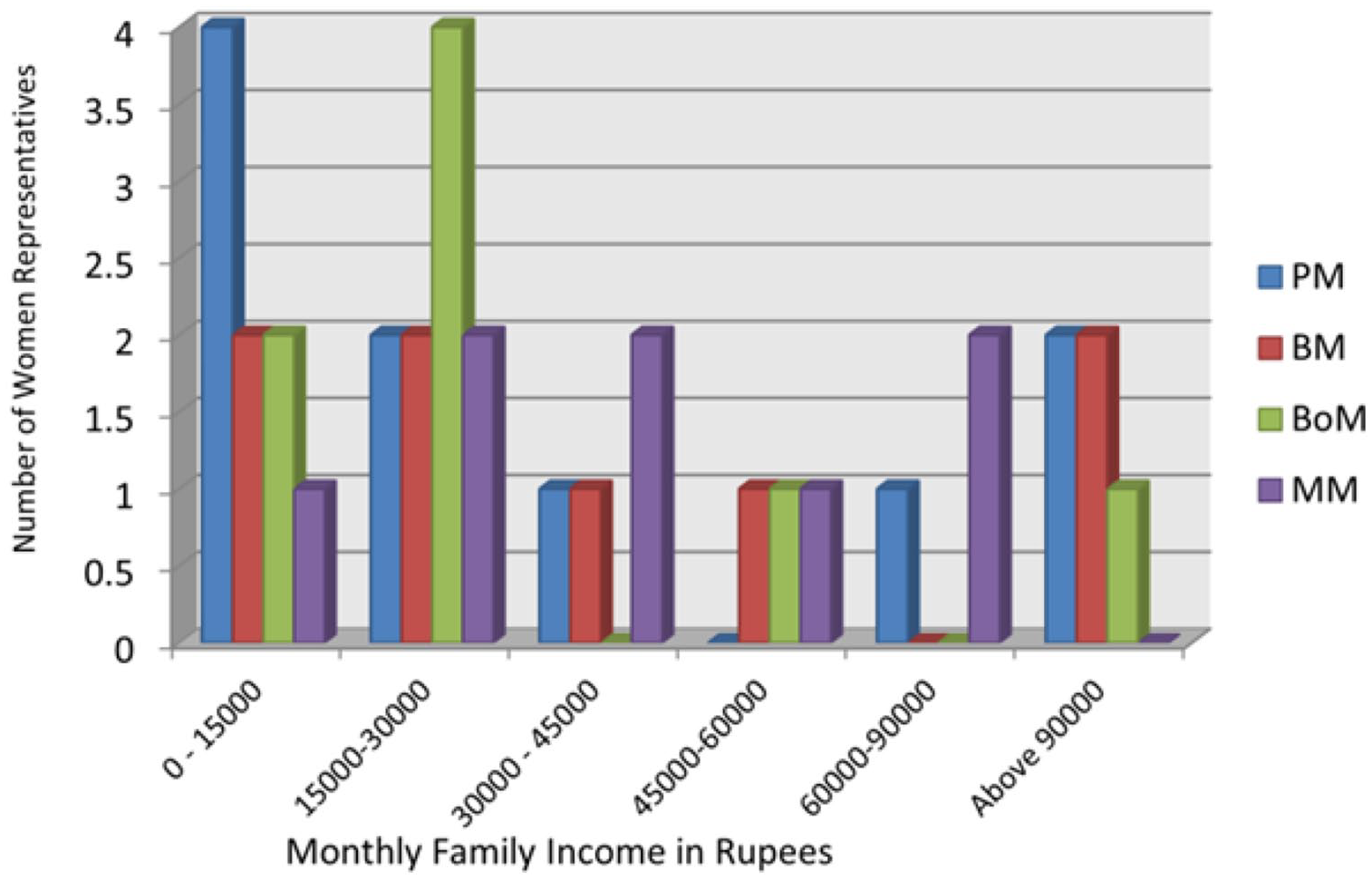
Monthly family income of women representatives.
Spatial comparison of degree of awareness and empowerment
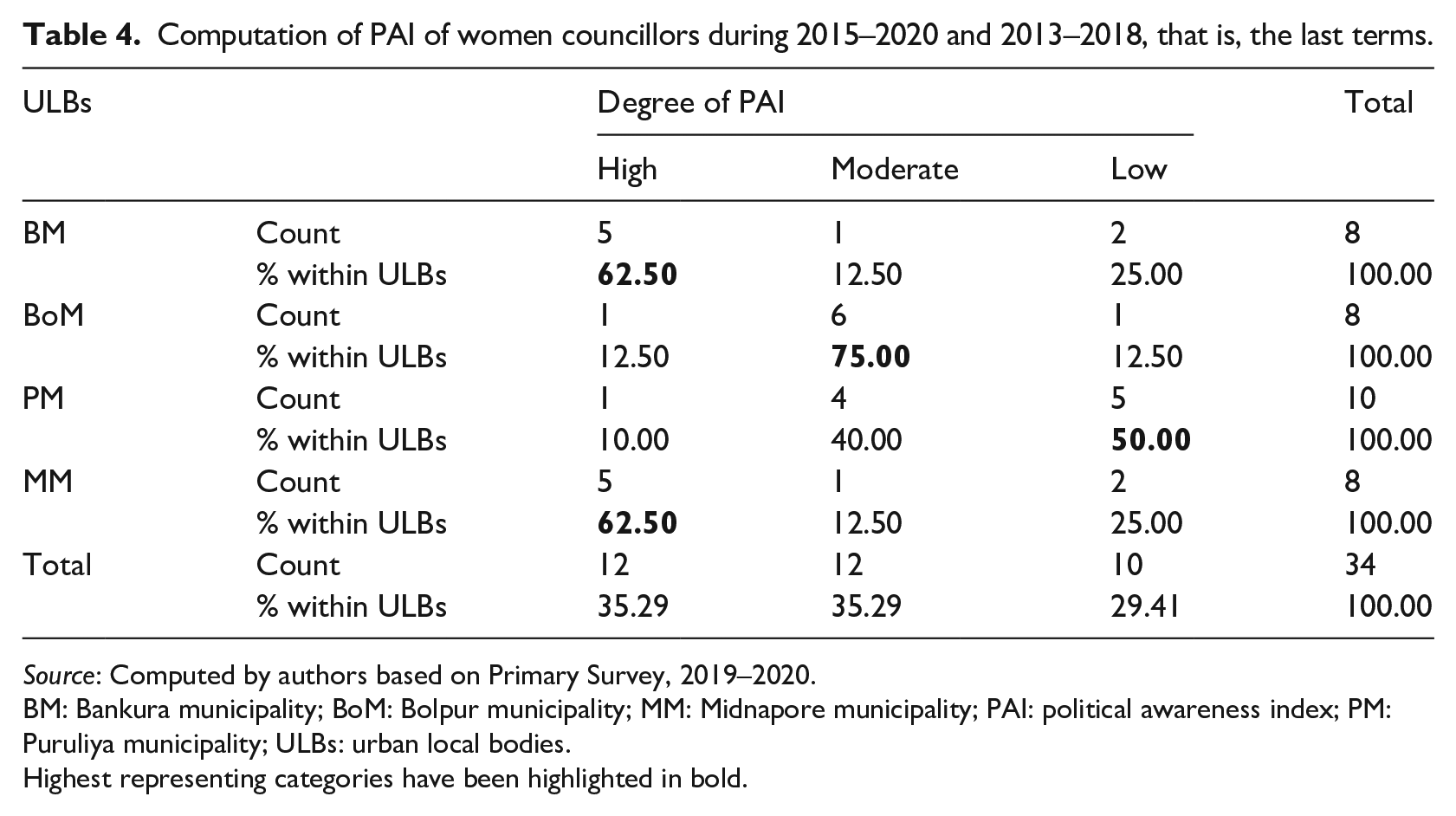
PAI has been calculated with the help of the indicators (Table 1), which are related to the urban governing process. Political experience (X1), awareness about minutes (X5) and nomination criteria of ward committee members (X3) have played an important role in creating the difference in score out of the total 8 factors selected. Apart from that awareness of constitutional provision of urban governance (X8), awareness about ward office (X2) and frequency of ward committee meetings (X4) are also important factors. Among the total 34 WRs, 35.29% are highly and moderately aware of the municipal provisions, while 29.41% WRs are less aware. In BM and MM, the awareness level among the WR is quite high (62.5%), while in BoM, it is 12.5%, and in PM, it is only 10%. Among the moderate level of awareness, BoM secured the highest rate (75%) followed by the PM (40%). Among the low level of awareness, WRs of PM are higher than the other three ULBs (Table 4).
Computation of PAI of women councillors during 2015–2020 and 2013–2018, that is, the last terms.
Source: Computed by authors based on Primary Survey, 2019–2020.
BM: Bankura municipality; BoM: Bolpur municipality; MM: Midnapore municipality; PAI: political awareness index; PM: Puruliya municipality; ULBs: urban local bodies.
Highest representing categories have been highlighted in bold.
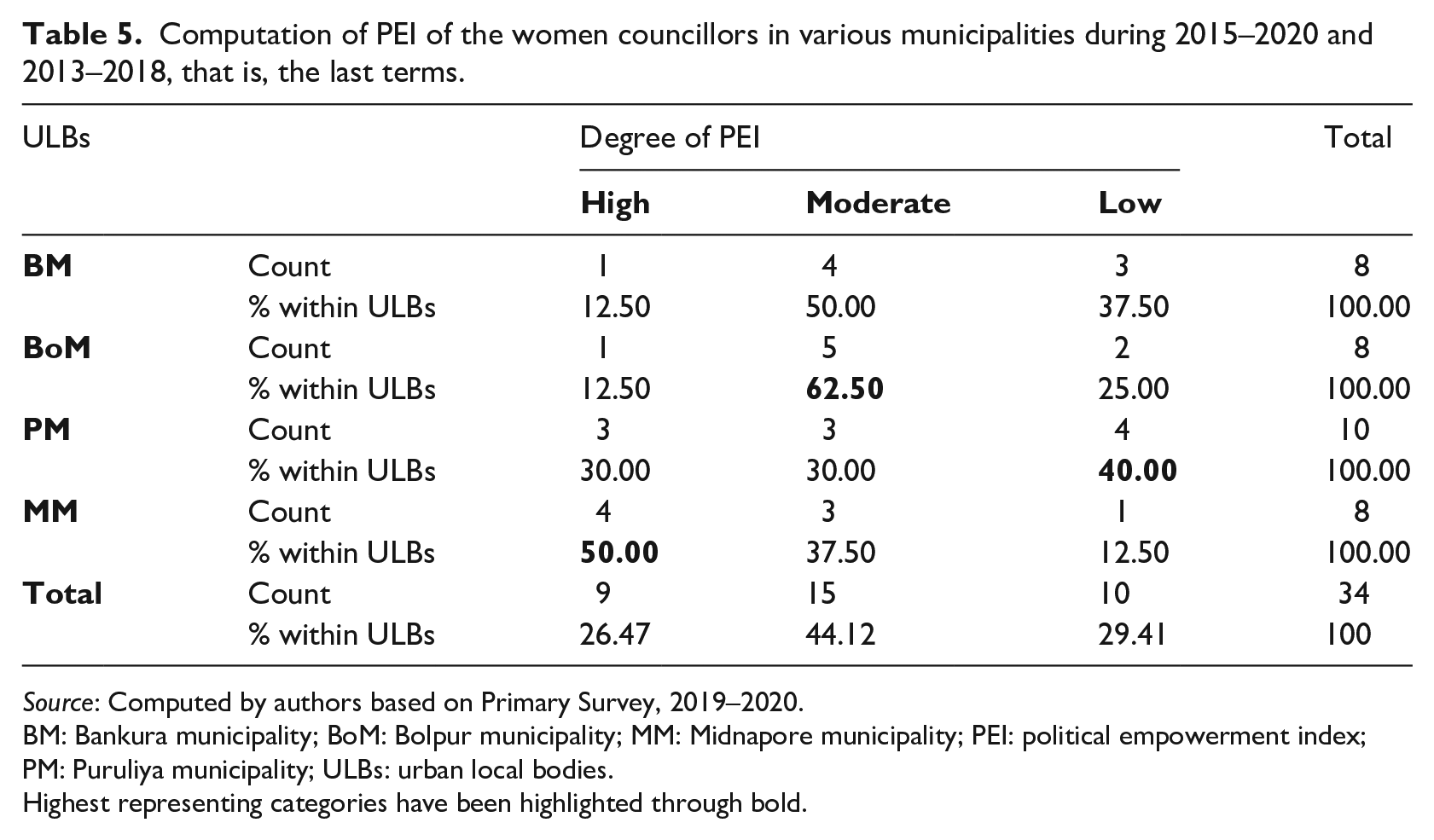
PEI has been calculated with the help of the indicators (Table 1), which are related to the nature of participation in the urban governing process. Interaction in Board of Council meeting (X11), involvement and engagement in the ward’s activities (X10) and changing awareness level (X15) have played an important role in creating the difference in score out of the total 10 factors selected. Apart from that dependency on doing municipal work (X13), willingness of re-contesting from unreserved sear (X17) is also an important factor. In the case of empowerment, of 34 WRs, 26.47% are highly empowered, 44.12% are moderately empowered and 29.41% are less empowered in the study area. Among the surveyed WRs, 50% are highly empowered from MM, while 30% are from PM and only 12.5% are from BM and BoM. Whereas the moderate empowerment rate is high in BoM (62.5%) followed by BM (50%), MM (37.5%) and PM (30%). The low empowerment rate is high in PM (40%) followed by BM (37.5%), BoM (25%) and MM (12.5%) (Table 5).
Computation of PEI of the women councillors in various municipalities during 2015–2020 and 2013–2018, that is, the last terms.
Source: Computed by authors based on Primary Survey, 2019–2020.
BM: Bankura municipality; BoM: Bolpur municipality; MM: Midnapore municipality; PEI: political empowerment index; PM: Puruliya municipality; ULBs: urban local bodies.
Highest representing categories have been highlighted through bold.
Hence, it can be said that women’s political awareness always increases the rate of women’s political empowerment. Among the high level of PAI and PEI, it is found that the women’s political empowerment is low but women’s political awareness is high in the three ULBs (BM, BoM and MM), while the opposite condition is found in PM where the political awareness low than but the political empowerment is high (Figure 3). The reason behind the low awareness is the experience in politics and the irregularity in holding the ward committee meeting even while they hold a higher position in municipalities, that is, a CIC member who is often titular (check whether this is what you tried to mean). They are involved as active participants in the municipality but less active in the regular ward-based activities. Hence, this kind of distribution is noted in PM.
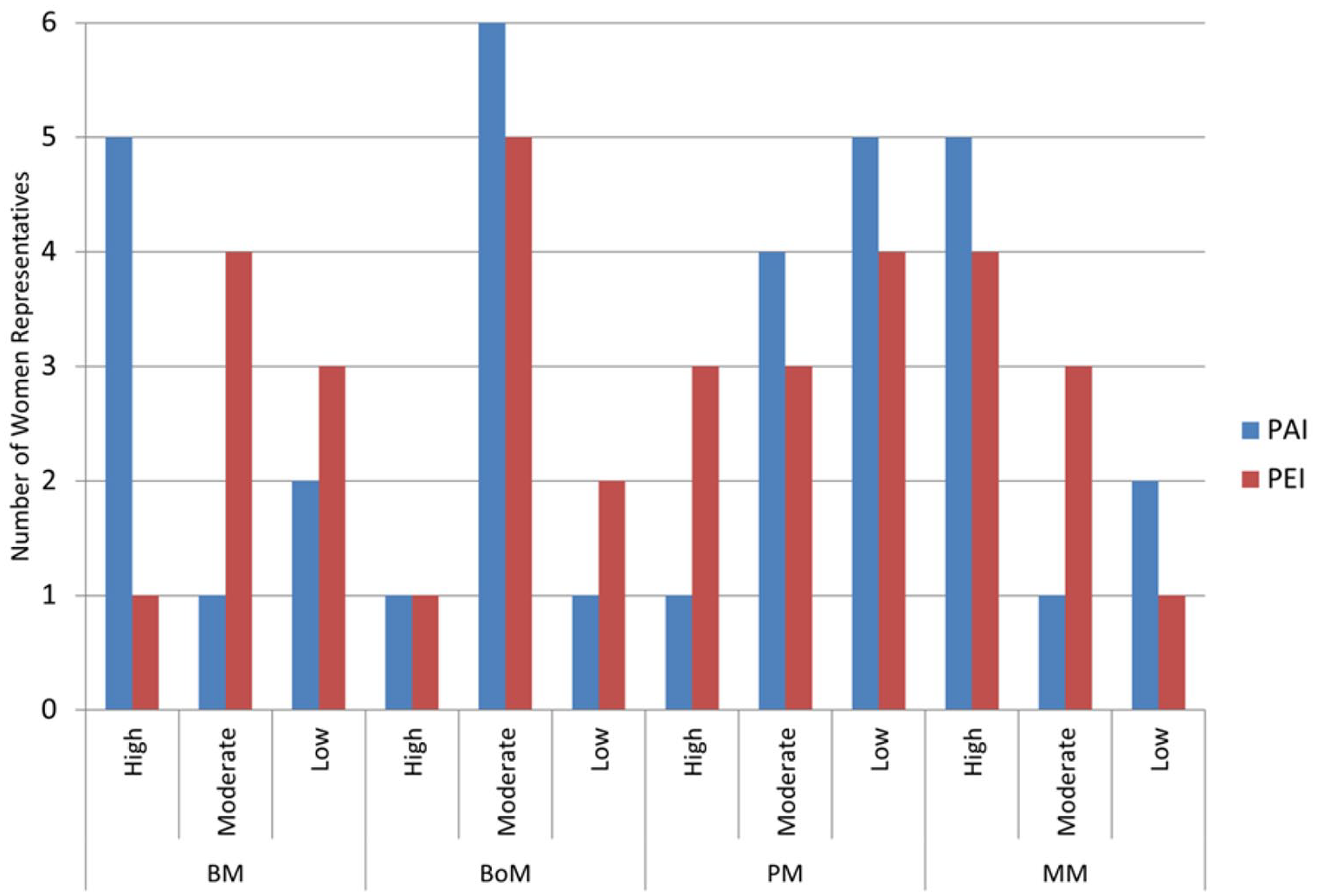
Comparison between PAI and PEI among the women councillors in various municipalities.
In the case of low level of PAI and PEI, the conditions in BM and BoM are the same, that is, PAI is less than PEI while PM and MM lie in the same category, that is, PAI is more than PEI. Hence, it can be said that the nature of the participation is varied within the same category of towns. Puruliya, Bankura and Midnapore are class I cities, but their rate of awareness and empowerment differ.
Determining factors of women’s political empowerment
In this section, the factors which are influencing women’s political empowerment are analyzed. The factors are level of education, experience in politics and given responsibilities in the municipalities. The particular hypothesis is
H0: PEI is not influenced by others’ responsibility, experience in politics and education level.
The Coefficient is calculated with the help of the following equation:

The relationship between political empowerment index and the others’ responsibility in municipalities, political experience and the level of education have been shown (Table 6). It is found that the value of p is 0.209, 0.074 and 0.271 for others’ responsibility, political experience and the level of education, respectively, which is more than 0.05 as we know p ⩽ 0.05. Therefore, the null hypothesis is accepted at 95% confidence interval. Hence, PEI is not dependent on the position in municipalities, political experience and the level of education. But there exists a positive relation though the coefficient is quite less, that is, 1.730, 0.084 and 0.030 with others’ responsibility in municipalities, political experience and the level of education, respectively. The adjusted R2 is 0.173, which indicates 17.3% of variability of WPEI are explained by the all mentioned factors.
Relationship of PEI with others’ responsibility, political experience and level of education for the women councillors in various municipalities.
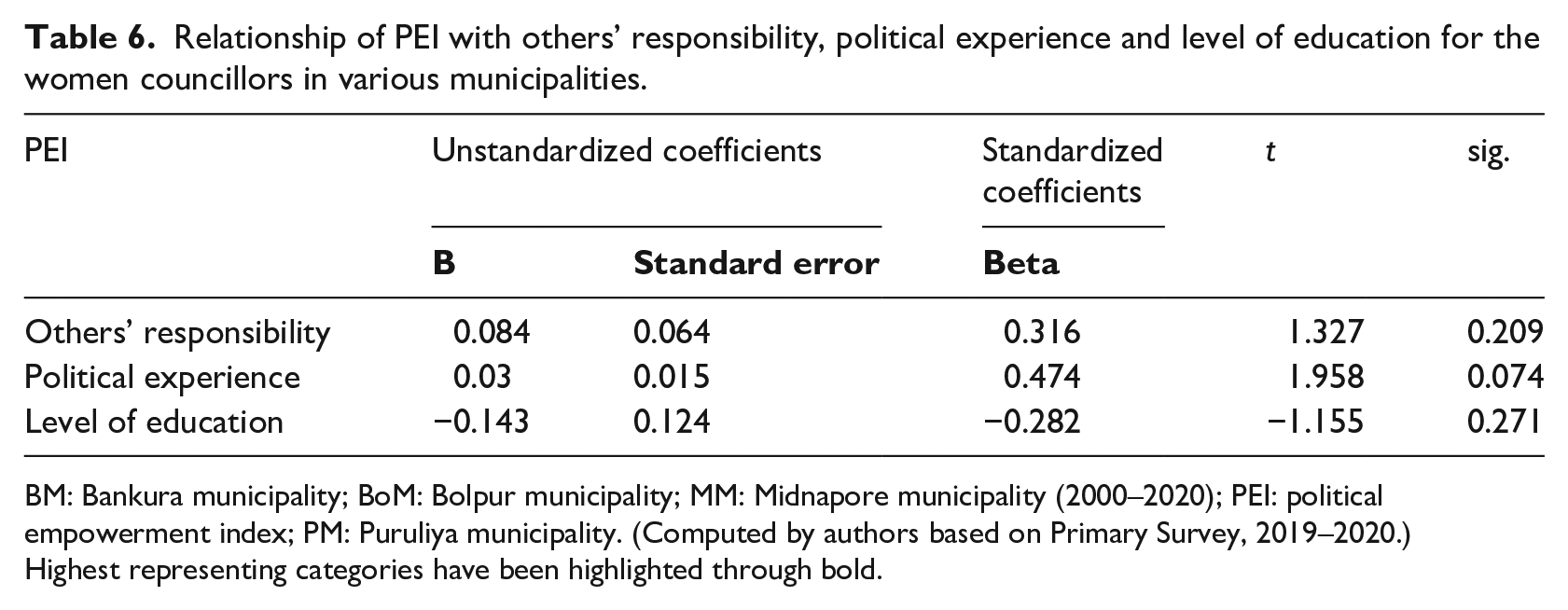
BM: Bankura municipality; BoM: Bolpur municipality; MM: Midnapore municipality (2000–2020); PEI: political empowerment index; PM: Puruliya municipality. (Computed by authors based on Primary Survey, 2019–2020.)
Highest representing categories have been highlighted through bold.
In this section, three case studies are done to explore the degree of empowerment. The study has found that few empowered representatives have actively participated in the local governing process, while there are more than 50% of representatives who are just namesake representatives because they came into the politics for holding on to the seat for the time being for their family as the seat was reserved.
Case 1: instance of high empowerment
RadhaMukhererjee (name changed) is a re-elected councillor from an unreserved seat in BM. She is from an old-age cohort and a graduate. She is a housewife from reputable background belonging to a joint family and her husband is a lawyer who is also an active member of the same party. She has been re-elected as a candidate of the party which is not in power, only because of the people for whom she has served actively from a long time period. She is an experienced candidate as she has been in politics from her early thirties having the full support of her husband; for the first time, she won from a reserved seat for the sake of local area development, and later, she contested the election from unreserved seat with male candidates in fray and won by a huge margin. She follows the provision of the ward committee formation and is more comfortable to work from home. The respondent is very active with regular ward visits, tries to resolve local issues, attends frequent board-of-council meetings, raises questions, places her demands and implements welfare projects as per the local needs. She attended the training workshop organized by the state government in 2017 which has increased her level of confidence. Although she is very active and she harbors higher political aspirations, she is not eager to switch loyalties from their own party.
Case 2: instance of low empowerment
Rima Saha (name changed) is a councillor from reserved seat in BoM. She is from a middle-age cohort and is married. She is educated up to the graduate level and she is a teacher by profession. She lives in a joint family. She was not involved in politics prior to the municipal elections, but when the ward was declared as reserved for woman representation, being a member of influential political family, her husband and brother-in-law persuaded her to contest and eventually won by a good margin. She narrates ‘I contested the election as my husband asked me to do so and I don’t have any interest in politics’. She barely knows a thing about the provisions of the ULBs though she used to attend the board-of-council meeting and inactively participate in discussion. The municipal works are done by her husband, brother-in-law and the ward committee members. She does not even visit the ward office. She did not attend the training workshop and her self-confidence has not increased with time. She does not want to contest election in the near future not even from a reserved seat. Her case is a least empowered representation which indicates token participation.
Case 3: instance of moderate empowerment
This is a classic case of reservation within the reservation. PurnimaMondal (name changed) is a councillor from a reserved seat, that is, the scheduled caste category in MM. She is from a middle-age cohort and married. She is educated up to secondary level and is a housewife. She lives in a nuclear family. She was not involved in politics prior to the municipal election, but when the ward was declared as reserved for woman representation, she was nominated as her husband was the general secretary of the party. She contested and won by a good margin. She narrates ‘I am still in the phase of learning and already have learnt so many things which I never experienced before come into the politics’. She attends the board-of-council meeting and moderately participates in the discussion. The municipal work is done by her and her husband, and the ward committee members. She rarely visits the ward office. She attended the training workshop, which boosted up her self-confidence. She wants to contest elections in the near future at the local level only, but she is not interested for the higher-level politics as she is comfortable to work with the local system. Despite all the socio-economic odds, she embodies a moderately empowered representation.
Conclusion
Women’s participation in world politics is still low (only 24.5%) and in India it is quite low (only 14.36%), while the share of women’s representation in local-level politics in West Bengal is comparatively high (above 33.35%). Reservation is playing an important role for the women entrant in the local-level politics and women are also participating in local-level politics beyond the reserved seats which is a good indicator of being politically empowered and influencing the decision-making process. But even in this process, only certain numbers of women have entered the politics to influence the decision-making process and actively participate in the local governance and assert their own position at the local level through their active participation and re-elected by their own choice rather than by force, others are just ‘namesake’ representatives or ‘proxy’ representatives. The in-depth analysis of the cases concludes that the power and family linkage are the influencing factors for the women representatives to enter into politics. They have come to the politics to hold the power for time being and they become just puppets. Some influential politicians or family members (like husband, son, father-in-law, father, brother-in-law and so on) controlled their activities. Hence, it can be said that though women’s share in local-level politics (ULBs) in West Bengal is high, but active participation is not satisfactory.
The degree of participation is conceptualized from PAI and PEI. Only 35.29% of women have a high political awareness level and only 26.47% of women are highly politically empowered. Maximum women are from moderate and low levels of awareness and empowerment. Therefore, it is considered that their participation or share is high, but their degree of participation is still not up to the level. They are still not as efficient rather they become pseudo participants.
The nature of participation varies from municipality to municipality. There is not any resemblance among similar kinds of cities like Bankura-Midnapore-Puruliya (Class I) and Bolpur (Class II). A similar pattern is found in the Bankura, Bolpur and Midnapore, while Puruliya has a different pattern because of its vast variability of the nature of participation. The reservation within reservation WRs is better performing in BM and MM where the downtrodden are gradually finding their own groove rather than in BoM and PM.
The reality of the women political participation at the local level germinates from the patriarchal values of the family which determines when women will participate in the politics and what will be the nature of participation. It creates proxy participation as the representatives are dependent on others for doing their municipal works. Their participation is limited to the formal spaces. There are very few representatives who are creating their own spaces of participation, that is, claimed and invited spaces of participation.
Footnotes
Acknowledgements
The authors are grateful to the Chairpersons and women councillors of the BM, BoM, MM and PM for their cooperation during the field survey.
Funding
The author(s) received no financial support for the research, authorship and/or publication of this article.
