




Abstract
Democracy promotion is undoubtedly one of Nigeria’s most important foreign policy objectives in Africa. Indeed, it has featured in the state’s foreign policy across successive administrations including military and civilian regimes. A fundamental question explored by this article is the dimension of power Nigeria deploys in its foreign policy objective of democracy promotion in Africa. Is it hard or soft, or a combination of the two (smart power)? Using three case studies – Sierra Leone, São Tomé and Príncipe and The Gambia – the article reveals that Nigeria has deployed all three dimensions of power. While this reflects the peculiar circumstances of these particular states in constitutional crisis, Nigeria’s domestic situation, including the type of political system (democratic or authoritarian) and the personality of the president at a given time, as well as trends in the global arena, are also germane. By its very nature, democracy promotion depends on a state’s soft power as the admirable domestic values of the soft power state attract other states to emulate its democratic practices. However, as the case study of Nigeria shows, a state can deploy soft, hard or smart power in its quest to promote democracy depending on the domestic circumstances of both the soft power and recipient states.
Keywords
Introduction
The collapse of the Soviet Union in the early 1990s and the subsequent triumph of liberal democracy has been marked by unprecedented vigour in Nigeria’s foreign policy of democracy promotion irrespective of regime type. This article engages a critical question regarding the dimension of power Nigeria deploys in its democracy promotion in Africa. Is it hard or soft power, or a combination of the two (smart power)? The state’s democracy promotion efforts in Liberia and Sierra Leone garnered international attention due to the resources utilised and the successes recorded in these states. It is, however, important to note that Nigeria’s promotion of democracy in this era was paradoxical as Abuja was under the military dictatorship of Sani Abacha whose stance on its West African neighbours partly aimed to direct global attention away from its domestic human rights abuses that culminated in Nigeria’s emergence as a pariah state (Omotola, 2008). Irrespective of the regime’s motivation, Nigeria achieved such remarkable success in these states that the United States noted that it would no longer intervene directly in conflict zones in Africa and henceforth rely on Nigeria (Bach, 2007). In the democratic era, Nigeria has promoted democracy in states such as Liberia, Guinea Bissau, Guinea, Niger, Mali, Togo, Côte d’Ivoire, São Tomé and Príncipe and The Gambia.
Nigeria’s promotion of democracy in Sierra Leone relied heavily on hard power as Abuja deployed its peacekeepers in the battlefield to oust the military rulers and restore President Ahmad Tejan Kabbah in 1998. Possible explanations for this course of action include the junta’s resolve to cling to power, Nigeria’s military rule and Abacha’s highhandedness, impunity and wilfulness. All these factors arguably contributed to the preference for a hard power strategy in Sierra Leone. In contrast, Nigeria’s democracy promotion in São Tomé and Príncipe in 2003 exuded a soft power approach. Although the juntas were initially determined to hold on to power, Abuja maintained a soft power strategy which might have been due to the fact that Nigeria had returned to democracy during that period, having held presidential elections that were won by President Olusegun Obasanjo in 1999, marking the end of successive military regimes in the country. Obasanjo, who was a military ruler between 1976 and 1979, handed over to a democratically elected administration. Thus, Obasanjo’s antecedents reveal that he is a democrat. In The Gambia, Nigeria deployed smart power in light of Yahya Jammeh’s resolve to cling to power. Nigerian President Muhammed Buhari, a former military head of state noted for his toughness and zero tolerance for indiscipline, could have possibly lost patience in the face of Jammeh’s shenanigans, hence the preference for a smart power approach.
Barring South Africa, compared with other African states, there has been relative growth in the literature on Nigeria’s soft power. Tella (2017, 2018b) and Ogunnubi and Isike (2018) engage the currencies, constraints and contradictions of Nigeria’s soft power. Some studies offer a comparative perspective. Ogunnubi and Isike (2015) compare Nigeria and South Africa’s soft power against the backdrop of their regional influence. Tella (2020) engages soft power individuals in Africa focusing on Nigeria’s Olusegun Obasanjo and South Africa’s Thabo Mbeki. Other studies focus on a specific aspect of Nigeria’s soft power capacity. For example, Adesina (2017) examines culinary diplomacy, and Idowu and Ogunnubi (2018) explore economic diplomacy, while Tella (2018a) investigates the salience of soft power in Boko Haram terrorism and counter-terrorism. However, no study has focused on the nexus between soft power and Nigeria’s democracy promotion and none has engaged how Nigeria deploys the different dimensions of power – hard, soft and smart – to promote its foreign policy objectives, hence the justification for this study.
This article is presented in seven parts. This section lays the foundation for the article, while the next section conceptualises the major terms – hard, soft and smart power – utilised. Section 3 provides an overview of Nigeria’s democracy promotion across Africa. The following three sections focus on the case studies and the different dimensions of power deployed in each case. The final section summarises the major findings and concludes the article.
Hard, soft and smart power
Hard power refers to an actor’s (state or non-state) capacity to determine the behaviour of other actors through its coercive resources, especially military and economic (Nye, 2004). A hard power state is well positioned to deploy these resources to threaten or coerce other states to achieve its foreign policy objectives. This can manifest in a number of ways including waging war, the threat of war, gun boat diplomacy, economic sanctions and diplomatic isolation. Globally, the United States and China are the most important hard power states in light of their status as the largest economies and the fact that they have the largest military budgets in the world (SIPRI, 2021; World Bank, 2021). It is partly for this reason that Washington and Beijing are the most powerful states in contemporary international politics. In Africa, Nigeria derives its influence on the continent partly from its hard power capacity, which is evident in its status as the largest economy and the fourth strongest military power on the continent (Global Fire Power, 2021; World Bank, 2021). This has found practical expression in Abuja’s economic sanctions against states such as Niger and Togo and peacekeeping in conflict zones such as Sierra Leone, Liberia and Sudan. Tables 1 and 2 illustrate how Nigeria fares among other African states with respect to economic capacity and military strength, respectively. As Table 1 shows, Nigeria is Africa’s largest economy ahead of Egypt and South Africa which are second and third, respectively, and Abuja is the fourth strongest state militarily behind Egypt, Algeria and South Africa. It is thus no wonder that Nigeria is a major aid donor (seen in its economic and financial assistance across Africa and beyond) and peacekeeper (evident in its peace mission in Liberia and Sierra Leone where Abuja was responsible for 80% of the troops and 90% of the budget) on the continent.
The eight largest economies in Africa.
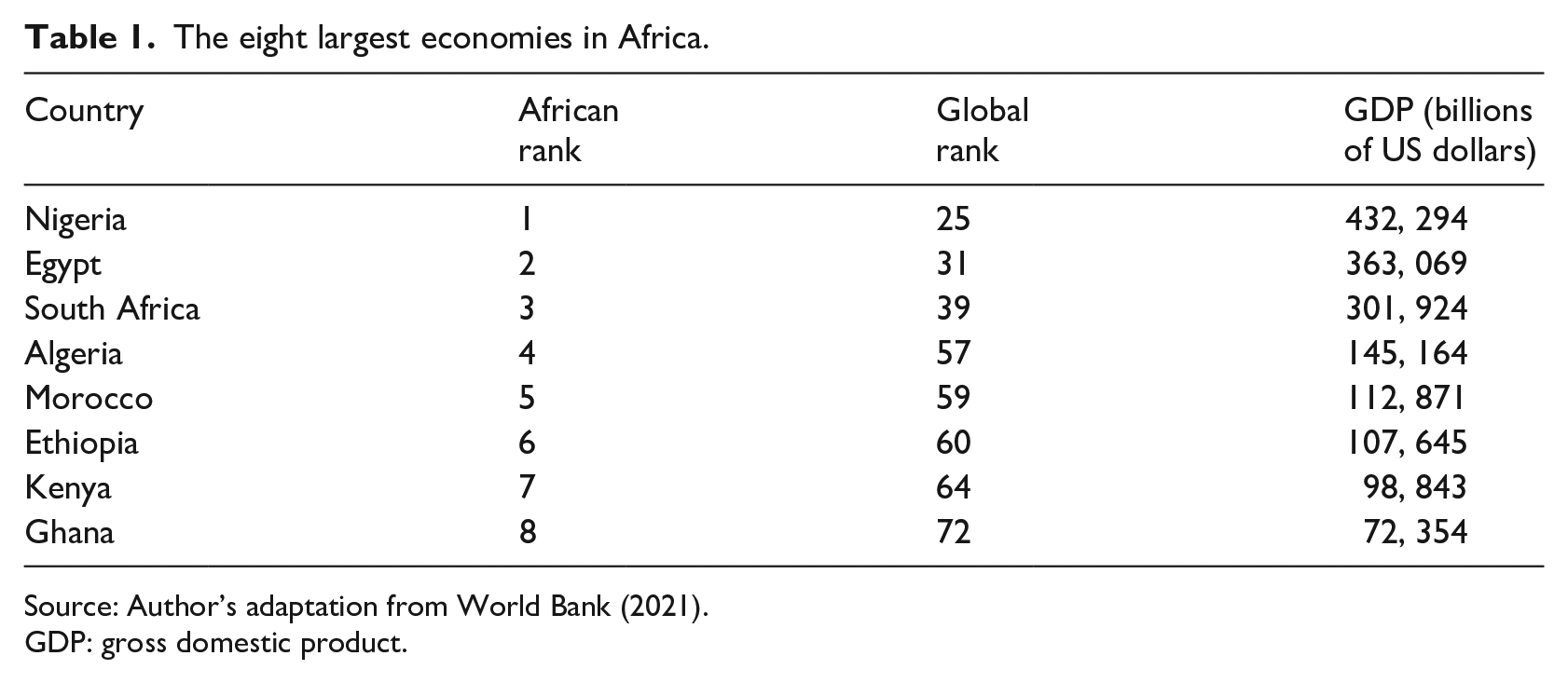
Source: Author’s adaptation from World Bank (2021).
GDP: gross domestic product.
African military strength ranking.
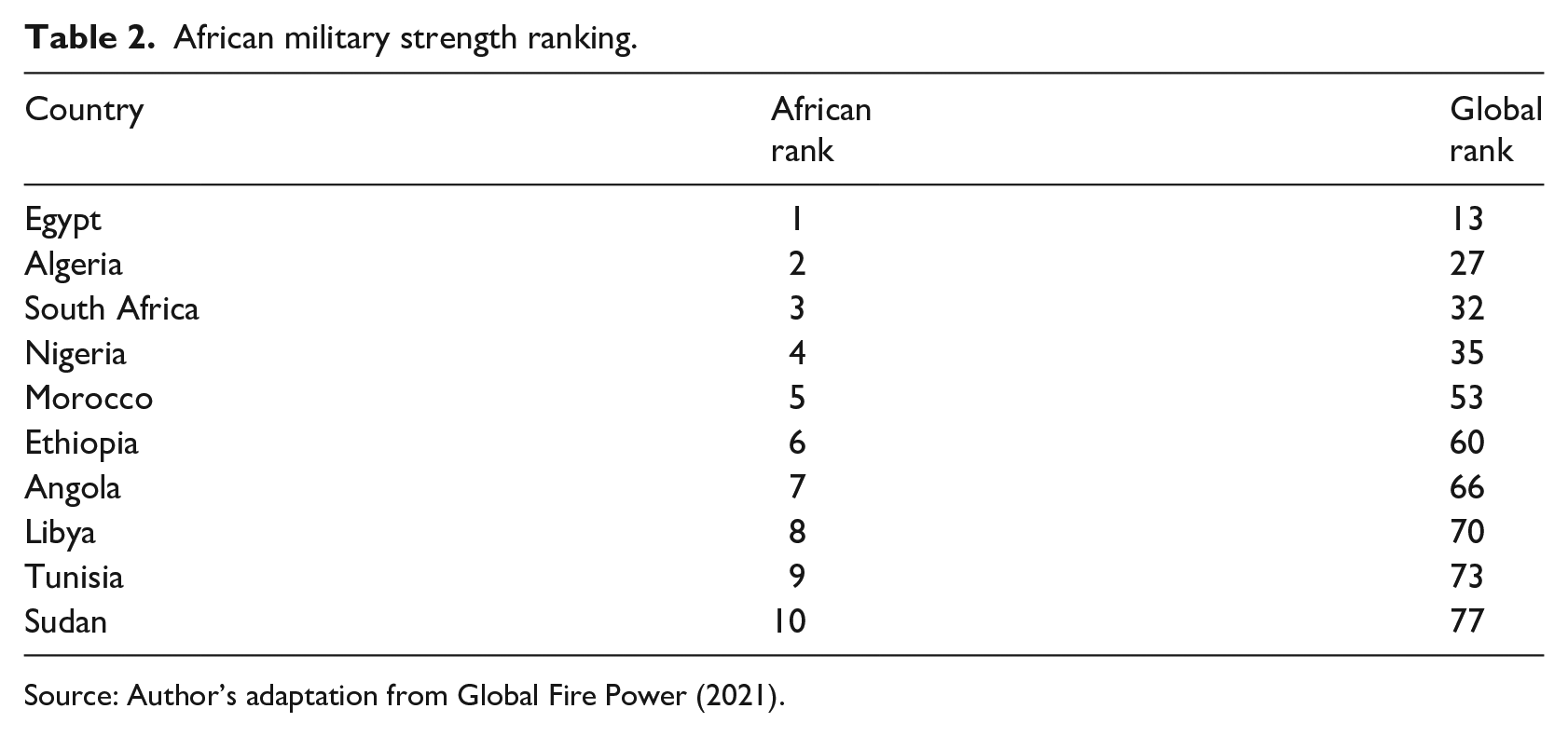
Source: Author’s adaptation from Global Fire Power (2021).
Soft power connotes an actor’s non-coercive capacity to determine the behaviour of other actors. In other words, it rests on the attractive sources of an actor’s capacity to influence the actions or inactions of other actors. Nye (2004) identifies the major sources of soft power as culture, political values and foreign policy. Globally, while the United States enjoyed enviable soft power in the past, partly thanks to Donald Trump’s administration, Washington’s power of attraction has declined significantly in recent years. For example, the 2021 Global Soft Power Index reveals that the United States dropped from the first position in 2020 to the sixth in 2021, outshone by Germany, Japan, the United Kingdom, Canada and Switzerland.
The sources of Nigeria’s soft power include Nollywood (film industry), Afrobeats (music industry), democracy promotion, peacemaking, aid and norm entrepreneurship, among others. In light of the robustness and reach of these sources, Abuja should arguably be the most significant soft power state on the continent. However, there is a gap between Nigeria’s soft power capacity and the realisation of its foreign policy objectives. This stems from constraints such as political corruption, domestic insecurity and an image problem that frustrate effective wielding of soft power. It is against this backdrop that Nigeria ranks fifth among the soft power states in Africa surpassed by Egypt, South Africa, Morocco and Algeria (See Table 3).
African soft power index.
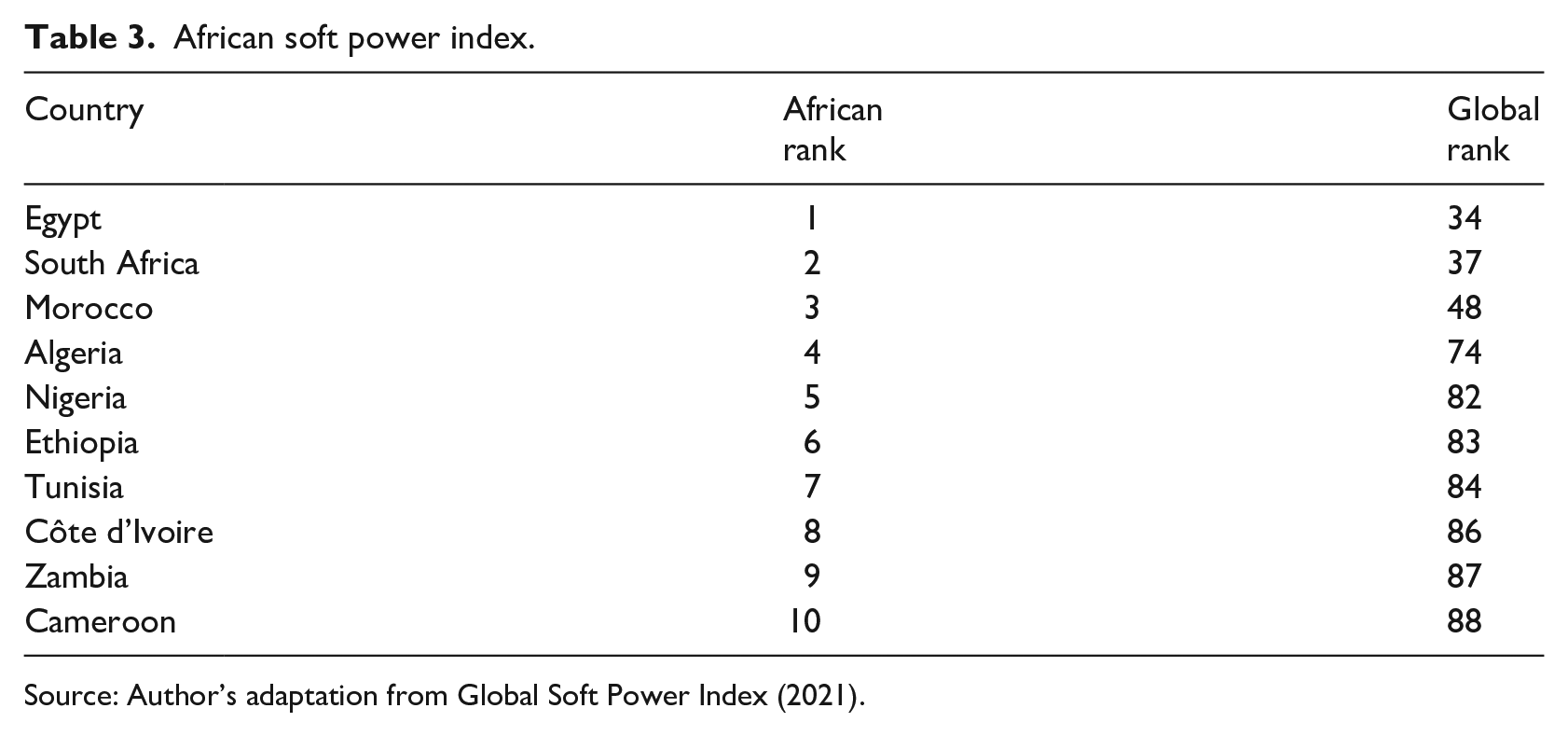
Source: Author’s adaptation from Global Soft Power Index (2021).
Smart power refers to a hybrid of hard and soft power. Some courses of action require elements of both and smart power is thus an effective combination of hard and soft power (Nye, 2009). The capacity to strike the right balance between the two is critical. During the Cold War, while the US hard power of economic and military might was bolstered by its soft power of democracy and pop culture, the Soviet Union’s hard power was reinforced by its soft power of socialism. Post-apartheid South Africa’s hard power, seen in its peacekeeping in Burundi and the Democratic Republic of Congo (DRC), is supplemented by its soft power of constitutionalism and charismatic leaders like Nelson Mandela and Thabo Mbeki (Tella, 2018c). Nigeria’s campaign against terrorism in West and Central Africa requires smart power to crush the insurgents on the battlefield (hard power) and make its ideology less attractive (soft power).
Before engaging how Abuja has wielded these various dimensions of power to achieve its foreign policy objective of democracy promotion, it is important to provide a synopsis of Nigeria’s experience as an exporter of democracy in Africa.
Nigeria’s democracy promotion in Africa
Nigeria’s return to democratic rule in 1999 after decades of successive military regimes has been accompanied by a foreign policy objective of democracy promotion across Africa. While the state’s military regimes promoted democracy in states such as Liberia and Sierra Leone, democratic Nigeria enjoys the moral authority that was lacking in the erstwhile authoritarian regimes. It is against this backdrop that Nigeria has played an unprecedented role in promoting democracy on the continent. Indeed, Abuja’s promotion of democracy across Africa rests upon sacrosanct principles including rejection of the overthrow of democratically elected governments, providing financial and technical aid to states in transition, supporting initiatives that enhance democracy and providing leadership in the areas of peace and conflict management (Omotola, 2008). It is in light of this that one can understand Abuja’s role as one of the major promoters of the criminalisation of unconstitutional seizure of power (coup d’état) at an Organisation of African Unity (OAU) Summit in 1999 and its active role in institutions such as the New Partnership for Africa’s Development (NEPAD) and the African Peer Review Mechanism (APRM) that promote good governance (Omotola, 2008).
In comparison with other sub-regional organisations in Africa such as the Southern African Development Community (SADC) and the East African Community (EAC), the Nigeria-led Economic Community of West African States (ECOWAS) has an admirable reputation for promoting democracy and peace. The ECOWAS 1999 Protocol on the Mechanism for Conflict Prevention and 2001 Protocol on Democracy and Good Governance provide the legal frameworks for Nigeria’s promotion of democracy and good governance, and peacemaking and peacekeeping in West Africa. Nigeria’s commitment to promoting peace on the continent, particularly since the 1990s often dovetails with democracy promotion (Khadiagala, 2018). Omotola’s (2008) observation is apt: As an importer of democracy who had to be compelled by a series of domestic and external pressures to democratise in the 80s and 90s, Nigeria has suddenly grown to become an exporter of democracy since her return to democracy in 1999. (p. 14)
In Liberia, Nigeria provided leadership in ECOWAS by being responsible for a large chunk of the military and financial costs and establishing the Economic Community Cease-Fire Monitoring Group (ECOMOG) to restore peace in Monrovia in the 1990s. Nigeria championed ECOWAS’s efforts in the Liberian civil war between 1991 and 1997, culminating in a number of peace agreements including the 1991 Yamoussoukro accord, the 1993 Cotonou agreement and the 1995 and 1996 Abuja accords and ultimately leading to the presidential election in 1997 that was won by Charles Taylor (Francis, 1999). As it turned out, this was a fragile peace as tensions continued to rise during Taylor’s presidency. With mounting pressure and military attacks by anti-Taylor forces and with no end in sight, ECOWAS, the African Union (AU) and external actors like the United States brokered a political settlement that resulted in Charles Taylor stepping down, his exile in Nigeria and a transitional government (Obi, 2009). The return to civil war between 1998 and 2003 prompted Nigeria to exercise leadership in ECOWAS to pave the way for the deployment of the United Nations Mission in Liberia (UNMIL) which played a critical role, particularly in terms of financial and technical aid, in ending the war, the 2005 democratic election of President Ellen Johnson-Sirleaf and reform of the country’s security sector (Burgess, 2020). Clearly, Abuja was a major player in entrenching democracy in Liberia.
In Guinea Bissau, ECOWAS ensured that the two rival military camps formed a government of national unity in 1998 (Khadiagala, 2018). However, conflict continued between the military and civilians, culminating in coups, attempted coups and assassinations (Khadiagala, 2018). While Guinea Bissau held democratic elections in 2000 and 2005, perpetual conflict between the political elites caused ECOWAS, in collaboration with the United Nations (UN), to establish a permanent presence in the state to resolve the conflict and assist in reforming the security service (Aggad and Miyandazi, 2017). The 2003 military coup that dislodged President Koumba Yala led to a delegation led by Nigerian President Olusegun Obasanjo, then AU chairperson, Ghanaian President John Kufuor, and then ECOWAS chairperson and Senegalese President Abdoulaye Wade being dispatched to Guinea Bissau. The negotiations resulted in an agreement on a civilian transitional government, the military’s immediate disengagement from politics and parliamentary and presidential elections to be held within 6 and 18 months, respectively (Bakare, 2019). Following the assassination of the chief of staff of the armed forces General Batista Tagme Na Waie and President João Bernardo Vieira in 2009, ECOWAS moved swiftly to protect state institutions and facilitate negotiations for a democratic government (Khadiagala, 2018). However, following the 2012 military coup, Nigerian-led ECOWAS not only imposed sanctions against the responsible military officers but diplomatic, military and economic sanctions against the state and deployed a peace mission that included troops from Nigeria, Senegal, Burkina Faso, Togo and Niger (Bakare, 2019). Conflict between the country’s president and prime minister in 2016 led to ECOWAS’s mediation which resulted in the 2016 Conakry Accord that turned out to be a mere plastering of wounds. This informed ECOWAS’s threats of sanctions against Guinea Bissau’s leadership in 2017 (Khadiagala, 2018).
It was the turn of Guinea between 2007 and 2009. The government responded violently to protests against the autocratic rule of President Lansana Conté, prompting ECOWAS to condemn its actions and subsequently establish a liaison office in Conakry to mediate between the government and the opposition (Khadiagala, 2018). However, this process was scuttled by a military coup following Conté’s death in 2008. ECOWAS responded by suspending Guinea’s membership of the sub-regional organisation, imposing sanctions and negotiating for a return to civilian rule (Khadiagala, 2018). These efforts resulted in Guinea’s democratic elections in 2010.
In Niger, following President Mamadou Tandja’s decision to hold a referendum on a new constitution that would extend the limit on the presidential term of office (that was coming to an end in 2009) and ensure his third term (Aggad and Miyandazi, 2017), ECOWAS suspended Niger’s membership and Nigeria considered the possibility of an intervention (Aggad and Miyandazi, 2017). However, the Nigerien military overthrew the Tandja regime in 2010 and vowed to restore democratic rule. ECOWAS lifted the sanctions it had imposed on the state after democracy was restored in 2011 (Khadiagala, 2018).
ECOWAS rejected the military coup in Mali in 2012 and called for restoration of the constitutional order. The sub-regional body subsequently imposed sanctions and facilitated negotiations with the coup plotters. The failure of negotiations and the advance of rebel forces into major cities ultimately prompted France’s military intervention in 2013 (Onuoha and Thurston, 2013). In 2020, a military coup led by Colonel Assimi Goïta ousted the civilian administration of President Ibrahim Boubacar Keïta. ECOWAS promptly suspended Mali’s membership, imposed financial and economic sanctions and called for an immediate return to the constitutional order (Akinola, 2020). Former Nigerian President Goodluck Jonathan led the mediation team. In light of the complexity of the situation, ECOWAS later called for a return to democracy within a year (Akinola, 2020).
Following the death of a long-term dictator, Gnassingbé Eyadéma, the Togolese parliament selected his son Faure Gnassingbé as president in 2005 in contravention of the state’s constitution that stipulates that the senate president must assume the role and organise elections within 60 days under such circumstances (Aggad and Miyandazi, 2017). Given Nigerian President Olusegun Obasanjo’s chairpersonship of the AU at the time, and in line with its international obligations as one of the most powerful members of the organisation, Nigeria was the first state to describe the development as a coup d’état. Obasanjo’s Special Assistant Femi Fani-Kayode noted that Nigeria would do anything to ensure peace and democracy in West Africa. Faure Gnassingbe’s visit to Nigeria to apologise and assure the latter of his good intentions was not enough to persuade Obasanjo who reiterated that the Nigerian-led ECOWAS had resolved to ensure a return to democracy in Togo within 60 days (Omotola, 2008). The subsequent ECOWAS sanctions forced Faure Gnassingbé to hand over power to an interim government and take part in national elections to assume the presidency.
In Côte d’Ivoire, the Nigerian government condemned the coup orchestrated by General Robert Guei that ousted President Henri Konan Bédié. Then Minister of Foreign Affairs, Sule Lamido, stated that ECOWAS would not accept a military regime in the sub-region and urged Guei to return the country to democracy within 6 months (Omotola, 2008). This position was further reiterated by President Obasanjo who noted that, ‘military coups remain an aberration irrespective of their raisons d’être’ and urged the military to initiate a rapid transition back to democracy’ (Omotola, 2008: 11). Nigeria subsequently provided leadership in ECOWAS which mediated the transition to democracy. A presidential election was held in 2000 and Laurent Gbagbo emerged as the winner (Omotola, 2008). Following the disputed 2010 elections in Côte d’Ivoire, Nigeria provided leadership in ECOWAS to shape international perceptions of who the winner was (Hartmann, 2017). After the Electoral Commission declared Alassane Ouattara the victor, ECOWAS urged incumbent President Gbagbo to accept the will of the people. Gbagbo remained unyielding, prompting Nigeria-led ECOWAS to threaten military action. It was, however, the French forces that ultimately dislodged Gbagbo.
Having provided an overview of Nigeria’s democracy promotion across Africa, I now turn to the dimension of power Nigeria deploys in pursuit of this critical foreign policy objective. To this end, the following three sections present the three key case studies – Sierra Leone, São Tomé and Príncipe and The Gambia.
Sierra Leone: hard power stratagem
In 1997, the Armed Forces Revolutionary Council (AFRC) – a segment of the Sierra Leonean military – collaborated with the Rebel Unity Front (RUF) – a rebel group on the Sierra Leone-Liberia border led by Foday Sankoh – to stage a military coup championed by Major Johnny Paul Koroma to dislodge the democratically elected government of President Ahmad Tejan Kabbah. ECOWAS’s intervention facilitated the signing of peace accords including the 1997 Conakry and 1999 Lomé agreements (Francis, 2009). While UN peacekeeping forces were deployed, it was the efforts of the Nigerian military administration of Sani Abacha through the platform of ECOWAS that resulted in the ousting of the military rulers and the restoration of President Kabbah in 1998 (Obi, 2009). Nigeria provided 12,000 of the 13,000-strong ECOMOG force and 90% of the finance to fight the AFRC and RUF (Obi, 2009), enabling the regional power to sway the direction of the peacekeeping efforts.
Beyond the use of force, ECOWAS facilitated negotiations between President Kabbah’s government and the leadership of the AFRC-RUF which culminated in offering the RUF amnesty and power sharing with the government, including granting RUF leader Foday Sankoh the position of Vice President (Obi, 2009). However, the rebels attacked Freetown (the capital) and captured some UN peacekeepers, prompting reinforcements from the UN, especially British forces. The UN peacekeepers eventually conquered the rebels and facilitated the 2002 elections won by Tejan Kabbah, signalling an end to the war (Obi, 2009).
The Sierra Leonean case presents the use of hard power in Nigeria’s democracy promotion as Abuja mobilised ECOMOG forces against Koromah’s AFRC. Indeed, Nigeria deployed coercion (hard power) using a multilateral framework to promote democracy in the country. While one of the Abacha regime’s motivations for intervening in Sierra Leone was to deflect global attention from its human rights abuses, the country displayed its military prowess with its intervention in Freetown. Abacha’s stance towards Sierra Leone reflected his tough personality and domestic politics as he had zero tolerance for opposing views and adopted coercive measures to remain in power and achieve his regime’s objectives. This was exemplified by his administration’s killing of environmental activists Ken Saro-Wiwa and eight others, among other instances of naked display of force. Indeed, Abacha was disappointed when ECOWAS decided at its summit in Abuja in 1997 that it would strengthen sea and air blockades rather than launch direct military operations in Sierra Leone. In the lead-up to the summit, Abacha tried to persuade ECOWAS to endorse the use of force to restore democracy in Freetown (Conciliation Resources, 1997). In the period immediately following the coup, the Abacha regime also used strong language and tough rhetoric to threaten the coupists. For example, on 2 August, Abacha stated, ‘I am constrained to say that the full sanctions and embargo will be applied, . . . I hope that the elements in Sierra Leone will see reason and return to the negotiating table’ (Sierra Leone Web, 1997: para. 103). Similarly, in a pre-summit briefing of the 20th ECOWAS summit in Abuja on 27–29 August, then Nigerian Information Minister Walter Ofonagoro noted that ‘Koroma should know that time is running out for him. No time to play game anymore’ and on 18 August, while speaking with his Ivorian counterpart President Henri Konan Bedie in Côte d’Ivoire, Abacha noted that the dialogue is still open, but then if the leadership in Sierra Leone is not reasonable, . . . then we will look at so many other options like the issue of sanctions, the issue of embargo, and where necessary, force can be used. (Sierra Leone Web, 1997: 28; 42)
Nigeria tapped into the full spectrum of hard power in its intervention in Sierra Leone including its economic strength, evident in its financial contribution and economic sanctions, and its military capacity seen in the military hardware and troops deployed. Abuja was able to do this, thanks to its hard power advantage over other ECOWAS members. For example, its population, which stood at 107 million at the time, outweighed the combined population of other ECOWAS members and its Gross National Product (GNP) was almost equal to the combined GNP of other West African states (McGregor, 1999). The 1981 ECOWAS Protocol Relating to Mutual Assistance provided the legal and moral basis for Nigeria’s intervention. Article 2 of the protocol stresses collective responsibility and article 16 notes that the head of state of a country under attack should send a written request to ECOWAS (McGregor, 1999). Nigeria justified its intervention when such written request was received from Côte d’Ivoire (McGregor, 1999). It is against this backdrop that at the 33rd OAU Summit in 1997 in Zimbabwe, the regional organisation decided to support ECOWAS’s efforts towards the restoration of democracy in Freetown (Francis, 1999).
An early sign of Nigeria’s hard power approach to the Sierra Leonean conflict was the Nigeria-led ECOMOG’s failed military strikes including aerial bombardments in Freetown to reverse the coup a week after the putschists plotted the coup (Francis, 1999). Abuja hoped that a quick surgical operation would restore the constitutional order in Freetown. As it turned out, the AFRC was resilient but this did not deter Nigeria. Abuja initially adopted a policy of containment and issued an ultimatum to the coupists to restore the democratic administration. However, following the breakdown in negotiations, government policy shifted to a hawkish approach as its military began to attack Freetown (Human Rights Watch, 1997) without consulting ECOWAS member states or ECOMOG and without securing a UN Security Council mandate for decisive military action (McGregor, 1999). This reflects an ultimate display of hard power as negotiations, consultation and diplomacy were shelved in favour of offensive operations against the Junta. Although the attacks were seemingly well orchestrated, the Nigerian government maintained that it was a spontaneous response to an attack by the forces of the coup plotters (McGregor, 1999).
Indeed, Nigeria was so resolute in its hard power approach that it adopted a unilateral stance in some of its operations as some of its military strikes were not endorsed by ECOWAS and the UN Security Council (Bangura, 2010). Berman and Sams (2000) observes that, ‘Whereas in Liberia, Nigeria had sought some form of ECOWAS authorization prior to intervening, in Sierra Leone, Nigeria responded militarily first and sought ECOWAS approval only after it had intervened’ (p. 114). Global condemnation of the coup partly contributed to the significant influence Nigeria wielded to achieve its desired outcomes in Sierra Leone.
While there were considerations for negotiations to resolve the crisis such as the Conakry peace plan which provided for cessation of hostilities, humanitarian assistance, reinstatement of democratic government and immunities for the junta, and the meeting between ECOMOG, the pro-democracy Civil Defence Force (the Kamajors) and the junta in 1997, the hard power dimension of the intervention undermined this dovish approach as for the first time in peace missions in Africa, Nigeria was ultimately able to ensure that West African states unanimously agree to the use of force to restore the constitutional order in Sierra Leone (Francis, 1999). Nigeria’s hard power stratagem was reinforced by the junta’s failure to honour its pledge to reinstate the democratically elected regime; instead, it announced its intention to remain in power until 2001 (Francis, 199). Abuja enjoyed the support of the UN as the regional power acted on chapter VIII of the UN Charter that provides for sanctions and embargos to impose economic and military sanctions on the Sierra Leonean regime. More specifically, the UN Security Council provided the Nigerian-led ECOWAS with the mandate to enforce land, sea and air blockades on the coup plotters (Francis, 1999).
Another important raison d’être for Abuja’s intervention was the Nigerian government’s agreement with former Sierra Leonean President Joseph Momoh’s administration following the establishment of ECOMOG to promote peacekeeping in Liberia. Some Nigerian troops were stationed in Sierra Leone under a status-of-forces agreement with the objective of supporting ECOMOG’s efforts in Liberia but also to help stabilise the Sierra Leonean government by offering training to the state’s military and preventing the rebels from overthrowing the government (Bangura, 2010). The Tejan Kabbah administration maintained this agreement while in power.
The battle between Nigerian forces under the umbrella of ECOMOG and the AFRC-RUF reached its peak in February 1998 when the former launched a full-scale, 2-week offensive against the latter, resulting in the crushing of AFRC-RUF government and forcing Johnny Paul Koroma and Foday Sankoh to flee Freetown (Bangura, 2010). This paved the way for Kabbah to be reinstated in March 1998. However, the rebels only hibernated for a short period before they launched another series of attacks against the Sierra Leonean government. Having lost the appetite for continued intervention, Nigeria and the international community had to accept the power sharing agreement – the Lome agreement – that ensued, as Kabbah shared power with Sankoh. Despite the agreement, Sankoh was insatiable and the deployment of the UN Mission in Sierra Leone (UNAMSIL) to quell possible conflicts in the lead-up to the 2002 elections did not achieve its purpose as he was involved in the illicit diamond trade and deployed the RUF to cause mayhem and intimidation during the election period, including attacks on a weak UNAMSIL (Goldmann, 2005). It was only in 2000 that UNAMSIL stepped up its efforts to defeat the RUF resulting in the arrest of Foday Sankoh and the 2000 Abuja Cease-Fire Agreement. This was followed by the disarmament process, the return of refugees and the withdrawal of UNAMSIL in 2002, marking the end of the Sierra Leonean civil war.
São Tomé and Príncipe: soft power gambit
While President Fradique de Menezes of São Tomé and Príncipe was attending the Leon Sullivan Summit in Nigeria in 2003, a coup led by Major Fernando Pereira ousted him from power. Then chairperson of the AU Joaquim Chissano consulted with Obasanjo and condemned the coup, stating that it violated the AU’s efforts to promote democracy on the continent. Similarly, Obasanjo urged the junta to return President Menezes to power and requested a meeting between Pereira and a Nigerian envoy. Other key African and international actors such as South Africa, Gabon, Portugal, the United States, the Community of Portuguese Language Countries (CPLP), the European Union and the UN condemned the coup (Kuranga, 2012).
These efforts resulted in the signing of a memorandum of understanding between the junta and the democratically elected government, prompting Obasanjo to note that ‘you may now, no doubt, agree that the return of President Menezes to power, and the restoration of democracy in the Democratic Republic of Sao Tome and Principe, was a remarkable achievement for Nigeria’s foreign policy’ (Porto, 2003: 35). Thus, rather than using coercion, Nigeria opted for a soft power stratagem manifested in the memorandum of understanding that brought together all the parties to the conflict to reach an amicable solution (Tella, 2018b). Indeed, ‘no official threats were made by Nigeria to militarily remove the junta, as that would be a contradiction of the official policy of the Federal Republic to use diplomacy first as its sole course of action’ (Kuranga, 2012: 55). This position was confirmed by President Menezes when he noted that Abuja did not intend to deploy its military to restore democracy in São Tomé. Nevertheless, one cannot completely discount the possibility of unofficial mild threats such as Obasanjo’s phone call to the Christian Democratic Front (FDC) leader Alerico Costa immediately after the coup in which the former allegedly cautioned the latter about the possible consequences of the coupists’ actions (Oshewolo, 2018). Similarly, Obasanjo and then AU Chair Joaquim Chissano seemingly weighed the possibility of military action during a meeting in Abuja.
Nevertheless, it is apparent that the coup plotters did not feel threatened by any external actors, including Nigeria. For example, donors such as the United States and the World Bank noted that they would re-evaluate their aid to São Tomé but this was worded in such a way that it did not really reflect a threat or coercive attempts to cease channelling aid to the African state and Nigeria did not announce suspension of its aid (Kuranga, 2012). Although Obasanjo served as military ruler between 1976 and 1979, his handover of power and smooth transition to a democratically elected regime in 1979 and his emergence as a civilian president in 1999 arguably demonstrated that he is a democrat and possibly shaped his perception of force (hard power) versus a diplomatic (soft power) approach in achieving his administration’s foreign policy objectives. This is reinforced by the prevailing democratic peace thesis in the international arena. It is within this context that one can understand Obasanjo’s preference for a soft power approach in resolving São Tomé and Príncipe’s crisis.
However, Nigeria’s non-recognition of the putschists presupposes that Abuja would not cooperate with São Tomé in the Joint Development Authority – joint ownership of oil blocks – (Kuranga, 2012), as Abuja insisted that it would only work with the democratically elected government of President Menezes. It is noteworthy that Nigeria’s relationship with São Tomé and Príncipe peaked in both political and economic terms following the establishment of the Joint Development Authority and the staging of the coup during the president’s visit to Abuja was seen as a slap in the face for the regional hegemon. Indeed, Nigeria was able to leverage on the Joint Development Authority as the agreement states that no state can unilaterally explore the oil block (Kuranga, 2012). Nigeria’s non-cooperation with the junta implied that the latter could not lay claim to any financial proceeds from the oil block which were vital for their survival.
After the completion of the memorandum of understanding on 23 July, three mediators – Congo-Brazzaville’s minister of foreign affairs Rodolphe Adada, Gabon’s minister of foreign affairs Jean Ping and Angola’s minister of the interior Osvaldo Serra Van Dunem – took the document to President Menezes who had flown to Libreville from Abuja to sign it (Kuranga, 2012). There were, however, questions around his safe return to São Tomé as the negotiations did not stress the disarmament of the rebels. Nigeria’s president then offered to guarantee his and his administration’s safety by flying to São Tomé with his presidential guard, key advisers and journalists in two planes to receive the news of both parties’ agreement to the memorandum and then flew to pick up Menezes in Libreville en route to São Tomé (Kuranga, 2012). After appearing at the Presidential Palace, both presidents visited the United Nations Development Programme (UNDP) headquarters, symbolising the end of the quagmire with the signing of the memorandum of understanding and the restoration of the constitutional order (Gerhard, 2003). During his short visit, Obasanjo addressed the military, stating that their concerns had been noted and would be addressed and urging them to defend the country’s constitution (Kuranga, 2012). The memorandum established an International Monitoring Commission that comprised Nigeria, South Africa, the United States and representatives of the Economic Community of Central African States (ECCAS), the AU, the CPLP and São Tomé’s presidency, parliament and the Armed Forces (Porto, 2003). The memorandum stressed that the coup plotters should be granted amnesty, and that no foreign troops would be stationed in the country and some of the military’s grievances should be addressed. The Obasanjo administration subsequently facilitated the São Tomé’s parliament’s adoption of a resolution that granted amnesty to the soldiers involved in the coup (Alli, 2010). This is another example of how Nigeria deployed soft power in resolving the crisis. Rather than adopting a hard power approach that punished the coupists through execution or jail terms, Abuja urged the São Tomé government to adopt a soft power stratagem in the form of amnesty.
It is equally germane that the AU had criminalised unconstitutional change of government across the continent prior to the 2003 coup. The 2000 Lomé Declaration on the Framework for an OAU Response to Unconstitutional Changes of Government provides the normative framework and the following definitions of unconstitutional change of government:
Military coup d’état against a democratically elected Government;
Intervention by mercenaries to replace a democratically elected Government;
Replacement of democratically elected Governments by armed dissident groups and rebel movements;
The refusal by an incumbent government to relinquish power to the winning party after free, fair and regular elections (AU, 2000).
The AU’s practical steps to reverse unconstitutional changes of government on the continent include immediate public condemnation of the change and a call for the restoration of the constitutional order, an unequivocal warning to the culprits and non-tolerance and non-recognition of the perpetrators’ regime (AU, 2000). It is partly against this backdrop that Nigeria’s role in São Tomé can be understood. As one of the major players in the AU and as a norm entrepreneur that ensured that its foreign policy was ingrained in the principles of the AU during its establishment, Abuja could not but fulfil its international obligations by defending the purpose and principles of the regional organisation. In other words, the Obasanjo administration thus had the institutional framework and legitimacy to intervene in the São Tomé constitutional crisis.
The Gambia: smart power initiative
The Gambian crisis arose as a result of President Yahya Jammeh’s rescission on 9 December 2016 of his earlier acceptance of the result of the 1 December presidential elections that declared opposition candidate Adama Barrow the winner. His acceptance of the result on 2 December was commended by ECOWAS and other international organisations, while the reversal prompted international condemnation. According to Bakare (2019), The Gambia was the first case where Nigerian-led ECOWAS intervention successfully managed to ‘restore democracy’ in the country by using the threat of force but without any use of direct physical violence . . . Nigeria’s previous peacekeeping operations in Liberia, Sierra Leone, and Guinea-Bissau had constantly involved both the use of threat of force and direct physical violence; however, the restoration of democracy in the country underscores an external intervention anchored on a collective mandate of the ECOWAS and the principle of multilateralism which embraced the collective participation of other regional blocs beyond West Africa. These regional blocs comprise the UN and AU. (pp. 6–7)
There were tensions in the lead-up to the December 2016 elections. For example, in April, the opposition organised protests and called for political reform, resulting in highhandedness on the part of the government and the arrest of 50 members of the opposition (Aggad and Miyandazi, 2017). It was expected that the election would be a walkover for President Jammeh who had been in power for 26 years. It therefore came as a shock when the electoral body declared opposition candidate Barrow the winner. Jammeh, who initially accepted the results and congratulated Barrow, rescinded his decision and announced that he would contest the result, citing irregularities. His decision not to hand over power prompted the Nigerian-led ECOWAS to move swiftly, noting that it would adopt any necessary measures to uphold the Gambian peoples’ mandate (Khadiagala, 2018). The soft power dimension of the intervention is seen in the mediation team comprising then ECOWAS chairperson, Liberian President, Ellen Johnson-Sirleaf, the Nigerian President Muhammadu Buhari, then Ghanaian President John Dramani Mahama and then Sierra Leonean President Ernest Bai Koroma (Hartmann, 2017) which was dispatched to the country. Indeed, on 9 January 2017, Nigerian Minister of Foreign Affairs Geoffrey Onyeama noted that the regional leaders that Nigeria consulted all agreed with the country’s preferred diplomatic approach and military intervention only as a last resort (Odigie, 2017). However, Jammeh remained adamant in clinging to power. On 10 December 2016, the UN Security Council also condemned Jammeh’s stance, reiterated that he should accept the will of the Gambian people and called on ECOWAS to guarantee stability in The Gambia (Odigie, 2017). This resulted in consideration of a hard power approach. On 14 January 2017, ECOWAS chiefs of staff met in Abuja to engage the establishment of the ECOWAS Military Intervention in The Gambia (ECOMIG) and by 18 January, Senegalese troops with contingents from Nigeria, Ghana, Togo and Mali began moving towards the Gambian border, while Nigerian forces set up a naval blockade (Hartmann, 2017).
Despite ECOWAS’s attempts at negotiations and mediation, as well as military threats, Jammeh remained unyielding, insisting on a fresh poll. This prompted ECOWAS to organise Barrow’s inauguration at the Gambian Embassy in Senegal and to send Senegalese troops to The Gambia (Bakare, 2019). ECOWAS gave an ultimatum to Yahya Jammeh to relinquish power by 19 January 2017 (the date of the inauguration of the president-elect), and in an operation codenamed ‘Operation Restore Democracy’, the sub-regional body’s troops prepared to enter The Gambia should he remain obstinate. After the swearing in of Barrow, The Gambia was placed under naval blockade and the Senegalese troops began their offensive, with minor skirmishes around Kanilai, Jammeh’s hometown. However, the military offensive was called off to allow more time for negotiations (Babani and Can, 2019).
ECOWAS called for Jammeh to accept the election results and ensure the safety of Barrow and the Gambian citizens. The dragging out of the initial negotiations informed the decision to deliberate the issue at the ECOWAS summit in Nigeria in 2017 and it was agreed that ECOWAS would continue with negotiations championed by the Nigerian and Ghanaian presidents, Muhammadu Buhari and John Mahama, respectively. They were mandated to liaise with Jammeh and Barrow to safeguard the Gambian constitution; agree on a timetable for the smooth transfer of power; consult with the AU and the UN in relation to the smooth transfer of power; and ensure the smooth exit of Jammeh to guarantee peace and stability in The Gambia (Odigie, 2017), as well as his attendance at the inauguration of the president-elect on 19 January 2017 in accordance with the Gambian constitution (Hartmann, 2017). Buhari, who was a Nigerian military ruler in the 1980s, had a reputation for toughness and zero tolerance for indiscipline. Although he was democratically elected in 2015 and his actions are constrained by democratic checks and balances, he continues to exhibit his tough personality in some of his policies, evident in his administration’s fight against Boko Haram particularly in his first 2 years in office. He perceived the terrorist activities of the group as a military problem and thus adopted a coercive posture towards his administration’s fight against the sect. It is also instructive to note that Buhari had just defeated incumbent president Goodluck Jonathan in the 2015 presidential election. President Jonathan conceded defeat, congratulated Buhari and oversaw a smooth transfer of power. This further enhanced Nigeria’s moral authority to intervene in the Gambian constitutional crisis. While Nigeria’s democracy dictated that Buhari should rely on a soft power approach, in light of Jammeh’s reluctance to step down, he was keen to consider military action. It is against this backdrop that Nigeria led the soft power dimension of the intervention (negotiations) and supported the Senegalese armed forces in its hard power context as Abuja deployed its naval and air forces to assist the Senegalese army (Tella, 2018b), demonstrating a smart power stratagem. The deficiency of soft power which became apparent in the frustrating negotiations dictated the need for the threat of force to achieve the desired outcomes.
The Gambia has always relied on Nigerian judges that are seconded to the former due to shortfalls in this critical skill. Indeed, during the crisis, five of the six judges in the Supreme Court were Nigerian and then Chief Justice of The Gambia Emmanuel Fagbenle is Nigerian (Ojakorotu and Olajide, 2021). Against this backdrop, Jammeh did not have confidence in the Nigerian dominated Supreme Court in his attempt to overturn the results of the elections, and requested then Chairperson of ECOWAS President Sirleaf-Johnson to deploy foreign judges to The Gambia to facilitate a quick hearing of his case (Ojakorotu and Olajide, 2021). This is another example of Nigeria utilising its soft power (diaspora diplomacy), seen in the influence of its judges in the Gambian Supreme Court and hard power (a possible threat of force), evident in Jammeh’s non-acceptance of Nigerian judges, to achieve its foreign policy of democracy promotion in The Gambia.
The restoration of democracy in The Gambia largely reflected a negotiated settlement and the threat of force which redounds to the use of smart power. In other words, ‘Nigeria claimed leadership of the mediation and participated in the military intervention without any clear material interests in the small country’ (Hartmann, 2017: 94). With the Senegalese forces at the border and the Nigerian air force and a warship in the Gambian airspace and waters, coupled with the series of negotiations, Jammeh ran out of options. He relinquished power on 20 January 2017 and was granted asylum in Equatorial Guinea (Odigie, 2017). As noted earlier, although there were minor skirmishes between the Senegalese forces and some Gambian armed forces, there was no serious direct confrontation between ECOWAS forces and the Gambian military. The support that the Nigerian-led ECOWAS received from the AU and the UN Security Council was critical in building the sub-regional organisation’s confidence to carry out its mission in The Gambia. While Senegal’s involvement in the conflict was largely informed by its quest to promote its interests as the Jammeh regime had supported the rebels in Casamance in Senegal and turned a blind eye to the smuggling of goods to Senegal, Nigeria had no clear material interests other than pursuing its foreign policy objective of democracy promotion across Africa.
Conclusion
Having been an importer of democracy, particularly in the lead-up to the 1999 presidential election that kick-started its fourth republic, Nigeria has emerged as an important exporter of democracy in Africa, seen in its democracy promotion in states such as Liberia, Sierra Leone, Togo and Mali as well as Côte d’Ivoire, São Tomé and Príncipe and The Gambia. This article examined the sources of power Nigeria deploys in its foreign policy of democracy promotion. Using three case studies – Sierra Leone, São Tomé and Príncipe and The Gambia – I argued that Nigeria has utilised the full spectrum of power, soft, hard and smart, depending on the circumstances in the states in constitutional crisis and the prevailing situation in Abuja, including the nature of the political system and the personality of the country’s president. The case of Sierra Leone presented a hard power approach as the military dictatorship of Sani Abacha deployed the full spectrum of hard power including economic sanctions and military force to restore democracy in Freetown. In São Tomé and Príncipe, Nigeria utilised a soft power approach that resulted in a memorandum of understanding between the coupists and President Menezes, and the restoration of the constitutional order. The Gambia revealed Nigeria’s exercise of smart power as Abuja led the negotiations and provided air and naval forces to assist the Senegalese army. These case studies clearly demonstrate Nigeria’s understanding of the full spectrum of the power dimensions that can be deployed in its foreign policy objective of democracy promotion in Africa.
Footnotes
Funding
The author(s) received no financial support for the research, authorship, and/or publication of this article.
