




Abstract
This article compares the evolution of China's and Japan's foreign policies to Lusophone Africa, focusing on the period post-2000. The lack of analysis on Beijing's and Tokyo's respective aid policies towards Portuguese-speaking African countries (Países Africanos de Língua Oficial Portuguesa, PALOP) makes this study relevant. Arguably, Japan's development “edge” over China in terms of the “aid model” approach towards PALOP countries is under threat. This raises questions about China's changing pattern of aid, characterised by an increasing amount of “soft” aid towards PALOP states outside of trade and investment relations, which is much in line with Japan's aid philosophy and, according to observers, less neocolonialist than Japan's previous aid practices. This paper asks which model of cooperation is morally better and which is more effective, as both donors have interests in PALOP countries beyond development assistance. It finds complementarities in the two countries’ aid allocation to PALOP states, such as poverty eradication given the sectoral diversity of Chinese aid, and the empowerment of local communities fostered by Japanese aid's emphasis on grassroots and human-security projects.
Foreign policy and development studies on China and Japan in Africa are relatively well known as both countries have been engaged with the continent since the mid-1950s (in the case of China) and the late 1960s (Japan). The issue of conflicting or complementary interests between their foreign policy goals in terms of national interests and similarities and differences in their aid programmes and development partnerships in Africa have been analysed by, among others, King (2007), Cornelissen and Taylor (2000), Raposo and Potter (2010), and Rose (2012).
The relatively small number of studies available on China's and Japan's relations toward Lusophone Africa – the Portuguese-speaking African countries known by the acronym PALOP: Angola, Cape Verde, Guinea-Bissau, Mozambique, and São Tomé and Príncipe – render this article relevant. Chabal et al. (2002) also note this shortcoming when compared to the literature on Asian aid to former French, British, and Dutch African colonies. The narrower Lusophone focus, which emphasises Portuguese decolonisation and its history rather than the problems of postcolonial Africa, has undermined deeper research (ibid.). Finally, the effects of the Cold War on PALOP states only perpetuated those countries’ postcolonial dependencies, leaving China and Japan in the background, which explains the lack of studies on Asian involvement in Lusophone Africa.
Available literature concerning Lusophone Africa concentrates mostly on each donor's economic and aid activities separately rather than looking at PALOP as a whole, the effect of which presented a skewed view of reality. Regarding China, Alves (2008) suggests that China's sudden economic interest in the Lusophone world starting at the turn of the millennium stands in contrast to the deep ideological and anticolonial support it provided to certain countries during the 1960s and 1970s, especially Angola and Mozambique. Recent research on Sino-African relations questions whether China is a neocoloniser in that it is extending its political and economic influence over African countries and their people (Lumumba-Kasongo 2011), or instead a promoter of “neo-decolonisation” as it helps African countries integrate into global value chains by enhancing their political and economic independence (Junbo and Frasheri 2014). Ilhéu (2011) analysed Beijing's role in Mozambique (2000–2008) from this latter perspective and concluded that although China's financial assistance has contributed positively to Mozambique's human and social development, bilateral trade is still negative. Furthermore, China imports mostly raw materials in exchange for manufactured products which, added to illegal logging and illegal fishing, suggest a neocolonial pattern, despite this being the exception rather than the rule. The case with regards to Angola seems to be similar (Junbo and Frasheri 2014). Jansson and Kiala (2009) also found that, overall, both Mozambique's government and its civil society welcome China's presence. This somewhat contradicts the findings of Lagerkvist and Jonsson (2011), who assert that China's economic presence in Mozambique has not led to any reduction in poverty nor has it translated into more aid being delivered as compared to Japan's development assistance.
As for Japan and PALOP, previous studies have centred on Japan's economic relations with former Portuguese colonies in Africa and Asia from a mercantilist perspective (Carvalho 2002); on Japan's aid relations with Lusophone Africa from an aid recipient perspective (Seabra 2011); and on the analysis of changes in Japan's ODA in the context of the Tokyo International Conference on African Development (TICAD) focusing on post–conflict-affected Angola and Mozambique compared to “traditional” recipient countries – namely, Ghana, Kenya, Tanzania, and Zambia (Carvalho 2011; Raposo 2014b).
This article adopts a qualitative research methodology to understand, first, the historical context of China's and Japan's engagement with PALOP and, second, their respective past and present foreign aid policy trajectories. Three underlying hypotheses sustain the research questions: First, the higher a PALOP country's colonial and postcolonial ideological interaction with the Soviet Union in opposition to the United States during the Cold War divide, the lower the interaction with China and Japan after the 1970s. A second hypothesis centres on Japan's development “edge” in the aftermath of the Cold War: the greater the engagement of Japan during the 1990s through TICAD, the higher its development superiority (or “edge”) over China in PALOP. The same applies to China but in reverse, as the institutionalisation of the Forum on China–Africa Cooperation (FOCAC) quickly challenged Japan's pivotal development position in Africa, with both countries using their multilateral mechanisms as competitive diplomatic tools to implement their African policy (Osei-Hwedie 2015). A third hypothesis sees aid as having a dual intent: to secure minerals and fishery resources for both economic and development purposes. This helps explain why since 1993/1994 in terms of Japan (TICAD and peace processes in Angola and Mozambique) and 2000 in terms of China (debut of FOCAC), both Asian countries have assigned PALOP more importance as a whole and each has taken strategic decisions to benefit both sides of its own partnership with specific PALOP countries, eventually outstripping either one another's competition or the Taiwan–Africa Progressive Partnership Forum established in 2007. For the PALOP states, the greater a country's opportunity to express itself and seek financial help either through TICAD or FOCAC, the greater the cooperation, compensating for the disadvantages of its small size, low per capita income, or narrow resource base. For China and Japan, the stronger the focus on the poorer PALOP countries (Cape Verde, Guinea-Bissau, and São Tomé and Príncipe) through TICAD and FOCAC, the greater the opportunity to demonstrate the merits of their development models to Africa in the face of political and economic criticisms hinting at neocolonialism as, according to Lumumba-Kasongo (2011: 247), neocolonialism implies domination and control. Ultimately, even resource-rich Angola and Mozambique cannot afford to rebuild after decades of civil war. The problem is that since 2000 the assertiveness of Asian countries’ development partnerships, particularly China's putting trade and investment before aid, makes Japan's ODA approach within TICAD seem outdated, offering no immediate results (Raposo 2014a). Tokyo began sensing that its position as the only Asian donor with a development partnership working with African leaders on African problems was at risk.
PALOP's Colonial Legacy: Implications for China and Japan's Foreign Policy
This section puts into perspective the colonial and postcolonial politics of PALOP states, as both Asian countries proudly state that unlike Western powers they never had colonies in Africa. Having in mind the first hypothesis – of China's role in backing liberation struggles in PALOP countries and of Japan's procolonial policy (supporting white regimes in South Africa and Portuguese-speaking African countries) and the latter's alliance with the United States – the repercussions on bilateral relations and aid flows to the newly installed independent governments up to the late 1980s, somewhat reluctant to adhere to Marxist, Maoist, or capitalist ideology, are paradoxical. As Chabal et al. (2002: 52) note, PALOP states’ links with the Soviet Union were not a free political choice but the best option given Cold War geopolitics. PALOP countries were no different from most authoritarian African states, lacking democratic institutions and a modern bureaucracy to spur development. Although China's ideological internationalism and “moral” obligations supported anticolonial struggles in PALOP countries, those states’ postcolonial international connections with the Soviet Union affected their relations with China. Japan was in a better position, because while China was giving support to the Mozambique Liberation Front (Frente de Libertação de Moçambique, FRELIMO) in Mozambique (through military training, equipment, and financing [Ilhéu 2011]) and to the three major organisations in Angola – the People's Movement for the Liberation of Angola (Movimento Popular de Libertação de Angola, MPLA), the National Front for the Liberation of Angola (Frente Nacional de Libertação de Angola, FNLA), and the National Union for the Total Independence of Angola (União Nacional para a Independência Total de Angola, UNITA), this last organisation being the only one mentioned in Chinese reports (Taylor 2006) – Japan had already resumed diplomatic relations with Portugal in 1952, allowing it to continue trading with Angola and Mozambique and ship Cape Verde fishery products as it had pre-World War II until those countries’ respective victories of independence (Carvalho 2002; Carneiro 2011).
The anticolonial wars in Angola (1961), Guinea-Bissau (1963), and Mozambique (1964) ended with the Carnation Revolution military coup of 25 April 1974 and independence for all PALOP states. They all sought a foreign policy independent from their former coloniser. However, prolonged civil wars lasting 27 years in Angola (1975–2002) and 16 years in Mozambique (1976–1992) under Marxist ideology negatively impacted their international relations with both China and Japan. Guinea-Bissau and Cape Verde, although socialist in “identity,” supported the Non-Aligned Movement and refused logistical support to the Soviet Union. They were rewarded with Western foreign aid, mostly from Scandinavia. As Eastern aid was limited, São Tomé and Príncipe aligned with the Third World but maintained relations with Portugal and the Western bloc as well as Angola for defence purposes (Chabal et al. 2002).
In the post-Cold War era, the postcolonial image of embedded socialism weakened with each PALOP country seeking its own development path while also benefitting from a shared language and identity. Therefore, in 1996 the five African states plus Brazil and Portugal established the Community of Portuguese-Speaking Countries (Comunidade dos Países de Língua Portuguesa, CPLP) to promote common national interests within international institutions – in particular, the United Nations and the European Community. With the support of Portugal in 2014, Japan was granted associate observer status at the CPLP. Like China with the Forum Macau (2003), Japan can now address mutual interests case by case as a complement to TICAD.
Table 1 1 shows that, with the exception of China and Angola, which recognised each other diplomatically in 1983, Japan and China established diplomatic relations with Lusophone Africa almost simultaneously during a period from 1974 to 1976. Following independence, Lusophone Africa's diplomatic relations with China and Japan waned. While Japan's alliance with the United States offered a logical reason, the break between China and the PALOP countries was unexpected.
All tables can be found in the Appendix, pages 75–78.
China and PALOP
As Sino-Soviet ideological rivalry spread to Lusophone Africa, China's political influence over Luanda and Maputo evaporated when Angola and Mozambique declared themselves Soviet-aligned, Marxist-Leninist states. A possible reason why China was discredited in Angola was that during Angola's civil war, China (like South Africa and the West) backed the FNLA against the victorious MPLA (Taylor 2006), and this defeat had political repercussions in Mozambique (Robinson 2012) and Cape Verde, as Amilcar Cabral, leader of the African Party for the Independence of Guinea and Cape Verde (Partido Africano da Independência da Guiné e Cabo Verde, PAIGC), gradually detached from the Chinese and Soviet camp and committed to the Non-Aligned Movement inspired by the Bandung movement (Chabal et al. 2002). This led to the suspension of China's relations with the PAIGC from 1967 to 1969 (Tavares 2010).
When Cape Verde became independent, China donated USD 1 million to the country (Law 1984). Chinese cooperation was maintained at a level sufficient to block Cape Verde's diplomatic recognition of Taiwan. Since 1977, several bilateral agreements (health, education, defence, trade, technical assistance, etc.) have been signed but aid has not increased (Tavares 2010). However, after the mid-1990s, Chinese development assistance followed private-sector investment in the archipelago (Horta 2012).
To regain Mozambique's confidence, China donated aid worth USD 59 million in 1975 and USD 3 million in 1977 (Law 1984). Beijing's final reconciliation with Maputo occurred in 1979 when Vice Premier Li Xiannian repaid President Samora Machel's 1978 visit to China (Jansson and Kiala 2009). Until 1990, China's cooperation with Mozambique translated into a USD 12 million line of credit to purchase equipment, raw materials, and consumer goods (Ilhéu 2011; Lagerkvist and Jonsson 2011). After 2000, profiting from a strategic cooperation with Brazil's agricultural research company EMBRAPA, China intensified loans for Mozambican large-scale rice production to alleviate poverty and increase both China's and Mozambique's food security. In 2008 (Ilhéu 2011) Beijing provided Mozambique with a USD 18 million loan to build a rice production centre near Maputo. As usual, the construction bid was won by a Chinese company: Hubei Co. Later, to maximise production, Xiangyang Wanbao Grain and Oil Investment Group joined the Hubei Gaza Friendship Farm with USD 1.6 million to develop 333 hectares of rice, test other crops, and provide technical assistance to local farmers (Bräutigam & Zhang 2013).
Despite a trade agreement in 1984 followed by a Joint Economic and Trade Commission in 1988, trade relations between China and Angola remained weak until the 1990s. The formal rejection of Marxism-Leninism in 1990/91, the diplomatic preference for Beijing over Taibei in early 1990s, protracted negotiations with the IMF to reopen post-conflict reconstruction development aid with donors, and the withdrawal of the Interim Poverty Reduction Strategy Paper previously submitted to the World Bank all served to boost Angola's economic relations with China (Corkin 2008; Carvalho 2011; Kiala and Ngwenya 2011; Inada 2013). In 2004 Zeng Peiyang, China's vice premier at the time, visited Angola, agreeing to a USD 2 billion loan and signing nine cooperation agreements in energy, mineral resources, infrastructure rehabilitation, and economic and technical cooperation (Corkin 2008).
China supported independence in Guinea-Bissau and São Tomé and Príncipe in 1975 with grants of USD 17 million and USD 3 million, respectively (Law 1984). Between 1975 and 1990, both African countries signed several economic cooperation and technical assistance agreements with Beijing in such areas as health, agriculture, and military assistance.
In 1990, after 26 years of uninterrupted diplomatic relations with China, Guinea-Bissau recognised Taiwan diplomatically in exchange for USD 20 million (Chan 1997). However, the ongoing civil war in 1998 helped restore full diplomatic relations with Beijing as Guinea-Bissau needed Chinese aid to tackle hunger and rebuild the country. In 2005, to prevent Taiwan from returning to Guinea-Bissau, Beijing provided direct budget assistance worth USD 4 million, humanitarian assistance for refugees, and education and health-sector aid. In exchange, Guinea-Bissau has supported China on human rights issues at the UN (Horta 2012), demonstrating that Chinese aid is not as unconditional as Beijing claims. Consequently, in 2006 Guinea-Bissau became the first country to sign a fishery agreement with Beijing, opening its Exclusive Economic Zone (EEZ) to Chinese fishing vessels (Horta 2010).
Taibei's response to Beijing's military exercises in waters surrounding Taiwan in 1995/96, resulting in the Third Taiwan Strait Crisis, was “one dollar diplomacy” meant to demonstrate the existence of two Chinas (Kondoh 2012). Taiwan donated USD 30 million to São Tomé and Príncipe in 1997 (Cheng and Shi 2009) plus USD 15 million in annual development aid (Seibert 2014). As a result, China cut diplomatic relations with São Tomé and Príncipe although they had dated back to 1975. In 2003, in an attempt to isolate Taiwan and assert its own presence in Lusophone Africa, Beijing offered São Tomé and Príncipe observer status at the first ministerial meeting of the Forum Macau (Macauhub 2006). The existence of oil in São Tomé and Príncipe contributed to China's invitation. In 2006 the Chinese state oil company Sinopec acquired a 28.7 per cent interest in the Joint Development Zone (JDZ) set up in 2001 by Nigeria and São Tomé and Príncipe (Seibert 2014). After 16 years of cool diplomatic relations, Beijing established a “liaison representation” business in São Tomé and Príncipe (Macauhub 2013a), showing a rare moment of political flexibility. At the 4th Ministerial Conference of the Forum Macau in November 2013, the National Petroleum Agency of São Tomé and Príncipe signed a product-sharing contract for oil exploration in its EEZ with the Hong Kong-registered private oil company Sinopec (Seibert 2014). China's pragmatism in cooperation policy should not be understood as an acceptance of the “status quo” over the Taiwan issue; rather, like the Japanese cooperation policy in Asia and Africa during the 1970 and 1980s, it represents a separation of national-interest politics from economics.
The Forum for Economic Cooperation between China and Portuguese-Speaking Countries (Forum Macau), established in 2003, functions as a transnational platform for China's global policy and connects China (through Macau) with Latin America (Brazil), Europe (Portugal), and Africa (PALOP). While FOCAC (and TICAD) have a multidimensional scope of cooperation ranging from politico-security issues to health, agriculture, and other areas of human development, the Forum Macau complements the results obtained at FOCAC with meetings between China and Lusophone trade ministers to expand economic relations between China and the Lusophone world. As a result, total trade between China and Lusophone countries soared from USD 5.6 billion in 2002 to USD 132.5 billion in 2014. In 2014 China's top Lusophone trade partner was Brazil, with total trade worth USD 86.9 billion, followed by Angola (USD 37.07 billion), and Portugal (USD 4.8 billion). Mozambique was China's fourth-ranked trading partner, with trade numbers reaching USD 3.6 billion. The trade between China and Cape Verde, Guinea-Bissau, Timor-Leste, and São Tomé and Príncipe totalled USD 145 million in 2014 (Forum China 2014). At the end of Forum 2013, all parties signed the Action Plan for Economic and Trade Cooperation 2014–2016, setting a target for bilateral trade between China and Lusophone countries of USD 160 billion by 2016 (Government Information Bureau 2014).
Japan and PALOP
Besides ideological Cold War differences, Japan also lacked an ODA philosophy, restricting its involvement with PALOP states (except Mozambique) to emergency relief and humanitarian assistance (Carvalho 2011).
To date, Japan has not issued a Country Assistance Programme (CAP) to any PALOP nation, though a country evaluation of Mozambique was carried out in 2009 (Raposo 2014b). Recently, project development programmes (so-called ODA “rolling plans”) were issued for Guinea-Bissau (2010), Angola (2012), and Mozambique (2013).
Within this diplomatic vacuum, TICAD became central to Japan's diplomacy towards PALOP states, first to Angola and Mozambique, priority countries under the three-pillar framework of TICAD drafted in 2003 (Carvalho 2011), and recently also to Cape Verde, Guinea-Bissau, and São Tomé and Príncipe. Japan opened embassies in Mozambique (2000) and Angola (2005) and established Japan International Cooperation Agency (JICA) offices in Mozambique (2003) and Angola (2007), illustrating its aid commitment to these two resource-rich countries. The remaining PALOP states are represented through Japanese embassies in Senegal and Gabon. TICAD and PALOP summits thereby became useful platforms for dialogue with Japan.
Angola's final ceasefire in 2002 enabled political, developmental, and economic relations to develop between Japan and Angola. Although Japan quickly recognised Angola's independence in 1976, Luanda did not open an embassy in Tokyo until 2000, and Japan, likewise, did not open one in Luanda until 2005. Angola's non-permanent seat on the UN Security Council in 2003 also served the US alliance with Japan. As a reward for Angola's support for the war in Iraq, Japan increased ODA to Angola from USD 27 million in 2002 to USD 33 million in 2003 (Raposo 2014b). Japan's reconstruction efforts in Angola within the third pillar (consolidation of peace) of TICAD also favoured economic relations with the INPEX Corporation, which acquired oil shares of Angola Japan Oil Co., AJOCO 91 Exploration Co., Ltd., and AJOCO Exploration Co. in Angola's offshore Blocks 3/91 and 3/85, the latter active since 1986 (Inpex 2006). In 2004, a joint venture between AJOCO and its affiliates, as of 31 March 2012 subsidiaries of Mitsubishi Corp. (Mitsubishi 2012), resulted in the acquisition of a 20 per cent share in Block 3/05 and 3/05A, the second-biggest stake after China's 25 per cent share in Sonangol (INA, n.d.). These licences run until 2030. In 2007 Angola's clearance of a USD 2.3 billion debt to the IMF opened the way for successive Japanese loans in 2010 (USD 93 million), 2012 (USD 148.7 million) (Raposo 2014b), and 2015 (USD 200 million) (Nikkei 2015). However, to receive this last loan, Angola has had to meet three conditions. It had to start issuing multiple-entry visas for Japanese citizens, improve international remittance services, and revise private-investment laws to facilitate Japanese businesses and counter China's growing presence in Angola (ibid.).
At TICAD-V in 2013, Japan and Mozambique signed the Agreement between Japan and the Republic of Mozambique on the Reciprocal Liberalisation, Promotion, and Protection of Investment. In January 2014, Prime Minister Shinzo Abe of Japan visited Mozambique and established a “Development Initiative based on Natural Gas and Coal,” a so-called “AMIZADE Partnership” (amizade meaning “friendship” in Portuguese) with Maputo that came with an assistance package of USD 670 million to further develop the Nacala Development Corridor. Additionally, six memoranda of understanding (MoU) in energy and finance were signed to increase economic partnerships. Since then, Angola and Mozambique, alongside TICAD, have become priority countries for JICA's programmes, implementing policy objectives to help them fully or partially deliver the United Nations’ Millennium Development Goals (MDGs) beyond 2015 (Raposo 2015).
Cape Verde's one-party system until 1991 and its small market explain Japan's lack of interest in the archipelago. The launch of TICAD in 1993 has served both countries’ interests. As one of the few African countries expected to meet all eight MDGs by 2015, Cape Verde has been diplomatically useful to Japan, particularly since TICAD-IV (2008), as MDGs are a TICAD priority. At a Japan–Cape Verde summit meeting during TICAD-V (2013), Prime Minister José Neves of Cape Verde requested Japanese assistance for tourism and infrastructure development. Prime Minister Abe replied with a yen loan to improve water supplies with Japanese technology.
Compared to other PALOP countries, Guinea-Bissau and São Tomé and Príncipe are not at the top of Japan's agenda, though, given their acute development needs, they should be. The fact that neither country was a traditional recipient of Japanese ODA cannot justify the low levels of ODA they have received since the 1990s, as Japan was one of the first developed countries to recognise the independence of each (Seabra 2011). Furthermore, theoretically, under the TICAD framework, all African countries regardless of their geographical size and fragility of income should be treated equally. So how can this be explained? Guinea-Bissau's first multiparty presidential elections in 1994 were followed by civil war in 1998/99 and a military coup in 2003. As a result, under the ODA Charter Japan suspended ODA to Guinea-Bissau and, following a military coup in 2012 that interrupted the presidential elections, Japan barred the country from TICAD-V. Between TICAD-IV and TICAD-V, Guinea-Bissau made progress on democracy and, after a mission to Bissau in 2008, Japanese ambassador Yukio Takasu, chairperson of the UN Peacebuilding Commission (PBC), included the fragile state in the PBC agenda (MOFA 2008). Following requests from Takasu coinciding with TICAD-IV, Japan enacted an ODA rolling plan with regards to Guinea-Bissau in 2010 and began assisting with poverty reduction and peace-building – two of the three main pillars of TICAD-IV – as major priorities in Guinea-Bissau.
Regarding São Tomé and Príncipe, following a corruption scandal in 2004 involving a former prime minister, Guilherme da Costa, and the sale of USD 1.3 million of rice donated by Japan, ODA except for humanitarian aid was suspended until 2007. In 2008, two months before TICAD-IV, São Tomé and Príncipe signed a fishing agreement allowing Japan to fish in its waters in exchange for technical cooperation and the construction of fishing facilities (Macauhub 2008). Again a ministerial meeting, this time at TICAD-V, helped São Tomé and Príncipe to get additional help from Japan in the form of 1,890 tons of rice to be resold to domestic wholesalers. As Japan is the biggest international supplier of rice, it is clear that São Tomé and Príncipe uses rice as a strategic lever to achieve food security (WFP 2011), but it is not enough to cover the basic needs of more than half of the population, who live below the poverty line.
TICAD's and FOCAC's Objectives, Policy Interests, and Development Models
To date, there have been five TICAD conferences, one every five years from 1993 to 2013, and six FOCAC ministerial conferences, the first in 2000 and the most recent in 2015. Japan's high-level policy dialogue with almost every African country and international development stakeholders at TICAD-I did not go unnoticed in China (Raposo 2014a). Like Japan, China reacted to the adjustments that Japan, France, and the United States were making to their African policies and accepted suggestions from African leaders to establish its own partnerships (Anshan et al. 2012).
While TICAD-I had, and still has, the altruistic goal of providing policy and guidelines for Africa's own stability and prosperity, FOCAC aims to strengthen cooperation between China and African states. Furthermore, while TICAD is broader in scope, fostering cooperation between Asia and Africa to help solve African problems, FOCAC is narrower as it seeks “common development” in terms of win-win cooperation.
For Japan, TICAD's ultimate aim is to secure African votes so that it can attain permanent UN Security Council membership and ensure a stable supply of oil resources and energy from Angola, Nigeria, Algeria, and recently Mozambique (Raposo 2014a).
As for China, its vulnerability in the international system explains the launch of FOCAC as a diplomatic instrument – first, to consolidate its engagement in Africa while resisting American dominance; second, to encourage African countries to follow the Chinese development model; and, third, to contain and limit Taiwan (Taylor 2004).
Besides political and resource interests, TICAD also serves Japanese and African development interests in that it challenges the OECD's Development Assistance Committee's (DAC) pressures to conform, the IMF's and World Bank's adjustment strategies, and the Washington Consensus on macro-economic principles and fiscal austerity (King 2007; Raposo 2014a).
The TICAD development model, based on Japanese aid and development experience with other Asian countries, links the post-Washington Consensus emphasis on sustainable development with its belief in reducing poverty through economic growth, and is much more attractive to African countries seeking a mutual and symmetric relationship (Osei-Hwedie and Osei-Hwedi 2010; King 2007). After FOCAC-IV and FOCAC-V, respectively in 2009 and 2012, China gradually diversified its agenda to include poverty reduction, food security, climate change, post-conflict reconstruction, and a post-MDGs framework and lessened its emphasis on economic and trade cooperation (Anshan et al. 2012: 45), bringing China's foreign aid objectives closer to those of TICAD. And, though both China and Japan employ the “trinity” of aid, investment, and trade, their development models differ in practice (Inada 2013). While China's development model (or, the Beijing Consensus) has no strings attached to its aid though it is tied to the interests of Chinese state-owned enterprises (SOEs), Japan's development model cannot “betray” DAC norms before engendering the development of the recipients. TICAD's model sees ODA for infrastructure and human resource development in Africa as a necessary first step to supporting the private sector (Raposo and Potter 2010). Furthermore, both partnerships use South–South cooperation to enhance Africa's self-reliance (Anshan et al. 2012; Raposo 2014a) with aid-for-trade policies to expand economic cooperation (FOCAC) and enhance sustainable economic growth based on human security (TICAD).
To claim the Chinese development model is better than Japan's is to ignore not only TICAD's achievements in African development both at the governmental level and in field offices (Raposo 2014a), as Maria Gustava, Asia desk director at the Foreign Ministry in Mozambique, has stated (cit. in Lagerkvist and Jonsson 2011), but also the fact that both donors employ the trinity approach, which is the basis of the so-called “East Asian model” (Ping 2013). This takes us to our second hypothesis, which suggests three major reasons why Japan lost its development “edge” over China in Lusophone and other African countries. First, in 1993 TICAD offered African leaders an alternative to the Western development model, something China was still unable to do. But by launching FOCAC in 2000, Beijing provided a new cooperation model promoting increased bilateral economic and trade cooperation, precisely what Africans (Anshan et al. 2012) were demanding of Japan (Raposo 2014a). Second, TICAD's emphasis on ODA over trade and FDI aligned with DAC conditions made it appear as a neocolonial tool. The third factor is TICAD's unwillingness or normative incapacity to match China's “quaternity” approach to an expanded “Angola model,” combining loan pledges to secure natural resources with trade, investment, and an aggressive Chinese labour force employed by Chinese firms in Angola (Inada 2013: 113). In 2009 the number of Chinese migrants in Angola reached an impressive 258,920, resulting in some hostility between the two countries’ governments, as Chinese workers were perceived as taking over the jobs of local people (Inada 2013: 116). Finally, the Japanese premier's recent tours in Africa simply cannot match China's state visit diplomacy – promoting Sino-African business interaction through continuous tours since 1995 (Anshan et al. 2012).
FOCAC's 2006 summit decided to establish three to five Special Economic Zones (SEZ) in Africa (Bräutigam and Xiaoyang 2011). In 2009, the Nacala region in Mozambique was made into an SEZ to help the country transition from agriculture to industry. The project includes constructing an international logistics centre to maximise the potential of the Beira Corridor (Zhang and Ilhéu 2014: 24). Cape Verde has also expressed strong interest in having an SEZ; despite its outstanding progress towards meeting MDGs, the decision would seem more politico-economic than developmental, as the archipelago is resource-poor.
To catch up with FOCAC practices, Japan changed its economic diplomacy strategy toward Africa. After Mozambique made Nacala an SEZ in 2007, in 2009 (following TICAD-IV) JICA launched ProSAVANA, a triangular public–private partnership (PPP) project in Mozambique designed to improve the livelihoods of communities through sustainable and new agriculture development models in the Nacala Development Corridor region with a market-orientated approach to exporting rice with a competitive edge. PPPs as instruments for expanding the Japan Business Federation's economic presence are essential to Japan's national security. The recent activities of Mitsui & Co. (2015) in oil and natural gas exploration in Mozambique confirm this. Also, aside from promoting joint economic forums to encourage mutual investment opportunities in Mozambique and Angola, Japan has been appointing ambassadors from the private sector to be effectively present. In September 2013 Takashi Kitahara from Mitsui & Co. was appointed ambassador to Gambia, Guinea-Bissau, and Senegal, and Shuichiro Nishioka from Mitsubishi Corp. was named ambassador to Malawi (cit. in Raposo 2015). This relates to our third hypothesis, detailed in the following section, which asks whether all sides share the same vision of, and benefit from, China's and Japan's development partnerships, or whether Chinese and Japanese aid are neocolonial instruments aimed at reinforcing the two countries’ political, economic, and resource dominance over PALOP states.
China's and Japan's Development Cooperation with PALOP
China's and Japan's aid allocation and trade volume with PALOP countries helps us understand the nature of their relationships. The high volume of aid from China and Japan towards social sectors in PALOP states illustrates their efforts towards poverty reduction. However, both donors also have economic motives. The only significant difference between them is that the total volume of China's aid and trade is far higher than Japan's, except in the case of São Tomé and Príncipe.
Chinese Aid and Trade
Excluding trade flows, Table 3 estimates the total amount of Chinese bilateral assistance (ODA-like), using a definition of ODA similar to the DAC's, and also “other official flows” (OOF) towards PALOP countries from 2000 to 2014.
Accordingly, Chinese aid amounts to approximately USD 11 billion with more than USD 11.6 billion of OOF, official investment, and FDI, totalling USD 22.6 billion. If we consider aid alone (without financial assistance), it exceeds the total amount of Japanese ODA to PALOP states by USD 9 billion, elevating China to the class of “superpower” in development assistance compared to Japan.
In Mozambique, Chinese aid amounted to USD 6.5 billion (with USD 2.1 billion in grants and USD 4.3 billion in loans aid) from 2000 to 2013, while OOF reached USD 1.6 billion during this period. Table 4 shows the composition of Chinese aid per sector, covering 73 projects mostly in transport and storage, government and civil society, health, education, agriculture, forestry, and fisheries.
Bilateral trade between China and Mozambique grew from USD 1.64 billion in 2012 to USD 2.33 billion in 2014. Mozambique's major exports to China include minerals and natural resources, prawns, sugar, and cotton. Main imports include mechanical equipment and spare parts, electrical appliances, manufactured goods, and textiles, confirming what the literature review revealed (Ilhéu 2011).
In Angola during the same period, Table 3 shows that Chinese cooperation stands in contrast to the pattern observed in Mozambique, as at USD 9.8 billion, Angola's received OOF is much higher than its aid flow, which stands at USD 3.9 billion, of which USD 747 million are in grants, USD 2.8 billion are in loans, and USD 294 million are in technical assistance. This is explained by Angola's greater capacity to repay loans to China. It also demonstrates that Beijing is concerned with developing countries’ debt sustainability. However, China's Exim Bank investments of nearly USD 1 billion to Mozambique, guaranteed through a national tuna company (EMATUM) bond (USD 850 million), is raising concerns about the sustainability of public debt in Mozambique (António et al. 2011).
Chinese cooperation with Angola covers 72 projects, with emphases on health, government and civil society, energy, and education (table 4). Regarding trade, Angola has been China's largest trading partner in Africa since 2006, replacing the United States. Total trade volume between Angola and China was USD 35.94 billion in 2013, with China importing USD 31.97 billion worth of goods from Angola and exporting USD 3.96 billion. China's main import from Angola is oil and its main exports to the country are electrical and mechanical products, building materials, and textiles, thus favouring a trade surplus.
Cape Verde's political stability has attracted Chinese small investors since the mid-1990s, which also explains the growing Chinese diaspora – 2,300 Chinese citizens currently live in Cape Verde. Following the first major state-owned investment of USD 55 million in a cement plant by the China Building-Material Industrial Corporation for Economic and Technical Cooperation in 2003 (Horta 2015), in 2005 Beijing provided USD 15.7 million to construct the national stadium. In 2015 China also delivered two vessels for patrolling Cape Verde's territorial waters. However, Chinese companies’ dumping costs and failure to involve local companies in their projects are threatening Cape Verdean firms (António et al. 2011). Despite some problems, Cape Verde's government welcomes Chinese investment. In July 2015, making use of the Sino-Portuguese platform to expand business overseas, Macau Legend Development Ltd. agreed to invest USD 275 million in a resort and games facility complex in exchange for a 25-year gaming concession on Santiago Island (Hombrebueno 2015).
To date, Chinese aid to Cape Verde has totalled USD 439 million (USD 305.6 million in grants and USD 133.6 million in loans, excluding debt relief) (China.aiddata.org 2015 [3 April]). Chinese aid per sector covers 20 projects, mostly in health, education, energy, and social infrastructures (table 4). Despite the one-way trade relationship with China, which amounted to just USD 61.9 million in 2013, during the second session of the Joint Commission for Economic Cooperation, Trade, and Technology held in Beijing in July 2015, both countries agreed to enter a new phase focused more on economic and business development than development aid.
Chinese development cooperation with Guinea-Bissau from 2000 to 2013 amounted to USD 256 million, of which USD 126 million were ODA-like (with USD 87.2 million in grants, USD 38 million in loans, and USD 1 million in technical assistance), the remaining USD 130 million being in OOF. Table 4 shows that Chinese aid to Guinea-Bissau covers 46 projects, highlighting government and civil society, health, education, social infrastructure, and agriculture. Bilateral trade between China and Guinea-Bissau amounted to USD 28.5 million in 2012 and, in the first nine months of 2014, reached USD 6 million, of which USD 4.96 million were Chinese imports (Forum 2014).
The exact volume of Chinese aid to São Tomé and Príncipe is unknown. In terms of cooperation from 1975 to 1997, China sent medical teams to São Tomé and Príncipe and provided a number of student visas for its citizens. In 1988, China built the Palace of Congress in São Tomé and Príncipe. In 2013 the USD 154 million agreement signed between the National Petroleum Agency of São Tomé and Príncipe and the Chinese subsidiary Sinopec increased the prospect of China building a deep-water port in the archipelago, a hydroelectric dam, and basic sanitation infrastructure (Macauhub 2013b).
Japanese Aid and Trade
From 1974 to 1999, Mozambique was Japan's primary PALOP aid recipient with USD 483.8 million, followed by Guinea-Bissau (USD 84 million), Cape Verde (USD 64.2 million), Angola (USD 61 million), and São Tomé and Príncipe with USD 25 million (Carvalho 2011). As Table 2 shows, from 2000 to 2013 this pattern barely changed. Mozambique still receives the bulk of Japanese ODA (more than USD 1.01 billion), followed by Angola (USD 531 million), Cape Verde (USD 314 million), Guinea-Bissau (USD 52 million), and São Tomé and Príncipe (USD 33 million). Overall, Japan's emphasis on human security as the guiding principle of its development cooperation to PALOP countries elevates the bottom-up strategy of JICA by combining the empowerment approach with local ownership.
Angola's natural resources and economic importance make it attractive to Japanese trading houses and infrastructure-related companies (Nikkei 2015), justifying the recent yen loans for rehabilitating the textile, energy, mining, and construction industries. Angola's post-2003 political stability and economic growth resulted in the February 2011 signing of an MoU with Japan on political consultations. It also expanded trade relations between the two countries. From 2010 to 2014, Japan did not rank among Angola's ten largest trading partners, apart from 2013 when it came in ninth. First place is held by China which, in 2013, absorbed 46 per cent of Angolan exports. In 2013 Japan exported industrial products worth USD 225 million (a 0.3 per cent share) to Angola in vehicles, metallic materials, and equipment and imported crude oil worth USD 302 million (a 1.4 per cent share of Japan world imports) (European Commission 2015).
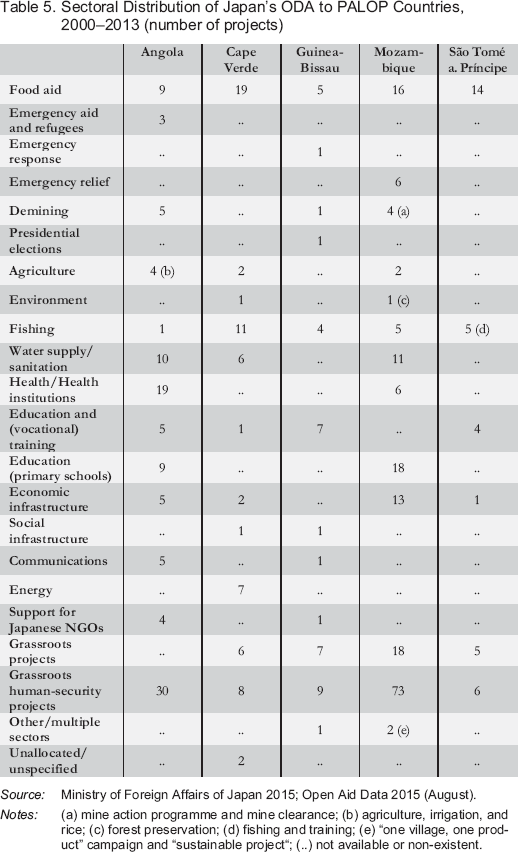
Table 5 shows that from 2000 to 2014 Japanese ODA covered 92 projects, mostly grassroots and human-security projects, followed by health, water sanitation and supply, education, economic infrastructure, and support for NGOs.
Because it achieved peace earlier than Angola, Mozambique's development relations with Japan are more dynamic, though several development and investment projects are not without their criticisms. Cases in point are the Mozambique Aluminum Smelting Project (Mozal) with a 25 per cent share owned by Mitsubishi Corporation, established in 2000; the ProSAVANA Japan–Brazil–Mozambique (JBM) agricultural development project that began in 2009; and the American firm Anadarko Petroleum Corp.'s plans for a joint venture with Japan's JERA Corp. to develop Mozambique's liquefied natural gas (LNG).
The problem with Mozal is that the aluminium smelter factory benefits mostly foreign interests rather than locals. On average, foreign investors, governments, and development banks receive USD 320 million a year from it while Mozambique's government receives only USD 15 million (Tran 2013). Despite the unequal profit distribution, 90 per cent of Mozal's workforce is local, and Mozal still spends USD 5 million a year on local communities’ social needs in terms of education, training, and health.
ProSAVANA, which has been epitomised as the greatest land grab in Africa, has concluded only 99 projects, meaning that of the 37 million hectares under contract, only 4.1 million (just 11 per cent) are being farmed (Wise 2015). Mozambique's National Farmers’ Union (União Nacional de Camponeses, UNAC) accused JICA and ProSAVANA investors of placing commercial interests ahead of the development ownership of the three million small farmers (ibid.). JICA was compelled to rethink its approach to the project that had supposedly aimed to improve security for local farmers (Raposo 2014a). Finally, the issue with Anadarko is that initial contracts did not include exporting LNG. The project has already cost USD 1 billion, and unless exporters can negotiate tax exemptions it could prove impossible to render LNG profitable by 2018. Meanwhile, Anadarko is accused of failing to fulfil compensation and resettlement pledges for some 3,000 villagers who characterise the project as a 17,000-acre land grab that does not support the local community (Maylie and Gilbert 2014).
As Table 5 shows, Japanese aid to Mozambique covers 150 projects with emphasis on grassroots and human-security projects, education, economic infrastructure, and water supply and sanitation. With regard to trade, in 2013 Japan was Mozambique's eighth-largest trading partner (total share of 2.3 per cent) and went up a notch to seventh place in 2014 (3.2 per cent share) (European Commission 2015). In 2013 Japanese exports to Mozambique reached USD 209 million with imports of USD 54 million.
Given the strength of Japan's ODA in general budget support to developing countries, Cape Verde invited Japan to participate in a transition support group in line with General Assembly Resolution 59/209 regarding smooth transition. With Cape Verde's graduation from least developed country status, Japan shifted its focus to ODA loans. Recently, JICA has granted two yen loans to Cape Verde. The first, in 2012 and worth USD 74.8 million, was for electricity transmission and distribution networks, and the second, in 2013 and worth USD 165 million, was for water supplies on Santiago Island (JICA 2012, 2013). From 2000 to 2013, excluding food security and humanitarian aid, Japanese ODA to Cape Verde covered 45 projects, particularly in fisheries (Cape Verde and Japan have a fishery agreement), followed by grassroots and human-security projects, energy, water supply and sanitation, and agriculture (Table 5). Trade relations with Japan are unbalanced as Cape Verde relies heavily on imports. In 2013 Japan exported goods worth USD 2.2 million, mostly automobiles, but did not import any goods (MOF 2015).
São Tomé and Príncipe's improved political stability and recent achievements on MDGs explain the relaunch of Japanese ODA to the archipelago following TICAD-IV as part of a bilateral cooperation programme intended to tackle poverty. The low volume of Japanese ODA to São Tomé and Príncipe is a reality, although Japan was the third-highest OECD donor to the country in 2008, after France and Portugal, and the second-highest from 2010 to 2013, after Portugal. Globally, excluding food and humanitarian aid, Japanese aid covers 21 projects, mostly in grassroots and human-security projects, fishing, and training and education. Regarding bilateral trade, in 2010 Japan exported USD 1.4 million to São Tomé and Príncipe and imported USD 13,526 worth of cacao. In 2013, Japan did not import any goods from São Tomé and Príncipe but exported more than USD 1.02 million (MOF 2015).
Regarding Guinea-Bissau, its eligibility for the UN Peacebuilding Fund (one of the pillars of the TICAD process) facilitated JICA's support towards building a sustainable peace. Ultimately, Japanese assistance depends on Guinea-Bissau's ownership of the social, economic, and institutional reforms the country needs. Regarding ODA, Japan ranked first among OECD/DAC donors to Guinea-Bissau in 2010 and third in 2008 and 2009 and from 2011 to 2013. Over the period from 2000 to 2013, Japan financed 33 projects, particularly in grassroots and human-security projects, education, and fishing (Table 5). Like São Tomé and Príncipe, Guinea-Bissau has a systematic trade deficit with Japan. In 2013 Japan's exports to Guinea-Bissau amounted to USD 123,012 while imports were just USD 5,600 (MOF 2015).
Conclusion
Postcolonial politics have interfered in China's and Japan's engagement in Lusophone Africa, confirming the first hypothesis. In 1993 Japan, through TICAD, reframed its aid policy to Africa. Among PALOP states, Angola and Mozambique benefitted most compared to Cape Verde, Guinea-Bissau, and São Tomé and Príncipe. In 2000 China launched FOCAC. As a result, Japan's development “edge” over China gradually waned as TICAD's and FOCAC's development agendas grew increasingly similar, thus confirming the second hypothesis and our argument that China's model of cooperation under FOCAC is a serious match for TICAD. This takes us to our third hypothesis and our initial problem of understanding which model of cooperation is better and less intrusive, as TICAD and FOCAC can both be viewed as neocolonial instruments reinforcing each donor's political and economic presence in PALOP countries. The evidence above shows that both partnerships approach Africa with good intentions, such as tackling poverty. However, the Africa–Asia relationship is still an unequal one and not the win-win partnership both donors claim. Although TICAD began correcting the imbalance by detaching itself from the United States, represented by the Washington Consensus model, China's Beijing Consensus appears more beneficial to the well-being of PALOP trade. Despite PALOP as a whole being important to both donors’ Africa policies, Angola's and Mozambique's resource values seem much more real, rendering the smaller PALOP states symbolic except for fishery resources and as tourist destinations. It seems China is doing more than Japan to transform the perverse model of development aid in exchange for raw materials. China openly provides financial assistance for development activities beyond resource extraction in poorer PALOP countries such as in terms of tourism in Cape Verde.
After TICAD-IV, Japan altered its economic diplomacy and became much more assertive than before, as the several Mozambican projects show, though they have not gone uncriticised, as described above. Nevertheless, China counts on Africa developing itself much more than Japan does. If there is neocolonialism from both donors, it manifests itself in the unequal distribution of profits by Japanese private investments in Mozambique and in China's unbalanced trade relations between the Forum Macau and PALOP, undermining the rhetoric of a “mutually beneficial relationship.” While aid volume reflects the priority that both donors accord each PALOP state in terms of policy interests, to talk of neocolonialism by China and Japan in PALOP states is exaggerated.
China's and Japan's aid allocation also reflects differences in development priorities. Although China's social allocation has increased substantially (it was residual prior to the turn of the new millennium), economic infrastructure is more highly prioritised in China than it is in Japan, as it represents a way of promoting their development model through economic growth. Finally, Chinese and Japanese aid implementation shows some complementarity, as China's aid allocation is more diverse; however, Japanese ODA puts a stronger focus on the implementation of grassroots and human-security projects to empower local communities in PALOP states.
Footnotes
Appendix
Sectoral Distribution of Japan's ODA to PALOP Countries, 2000–2013 (number of projects)
| Angola | Cape Verde | Guinea-Bissau | Mozambique | São Tomé a. Príncipe | |
|---|---|---|---|---|---|
|
|
9 | 19 | 5 | 16 | 14 |
|
|
3 | .. | .. | .. | .. |
|
|
.. | .. | 1 | .. | .. |
|
|
.. | .. | .. | 6 | .. |
|
|
5 | .. | 1 | 4 (a) | .. |
|
|
.. | .. | 1 | .. | .. |
|
|
4 (b) | 2 | .. | 2 | .. |
|
|
.. | 1 | .. | 1 (c) | .. |
|
|
1 | 11 | 4 | 5 | 5 (d) |
|
|
10 | 6 | .. | 11 | .. |
|
|
19 | .. | .. | 6 | .. |
|
|
5 | 1 | 7 | .. | 4 |
|
|
9 | .. | .. | 18 | .. |
|
|
5 | 2 | .. | 13 | 1 |
|
|
.. | 1 | 1 | .. | .. |
|
|
5 | .. | 1 | .. | .. |
|
|
.. | 7 | .. | .. | .. |
|
|
4 | .. | 1 | .. | .. |
|
|
.. | 6 | 7 | 18 | 5 |
|
|
30 | 8 | 9 | 73 | 6 |
|
|
.. | .. | 1 | 2 (e) | .. |
|
|
.. | 2 | .. | .. | .. |
Source: Ministry of Foreign Affairs of Japan 2015; Open Aid Data 2015 (August).
Notes: (a) mine action programme and mine clearance; (b) agriculture, irrigation, and rice; (c) forest preservation; (d) fishing and training; (e) “one village, one product” campaign and “sustainable project”; (..) not available or non-existent.