




Abstract
This article examines the elite construction of cultural landscapes in Harare. Since assuming the reins of power in the Zimbabwe African Nation Union (ZANU) in 1977, Robert Mugabe invented a political culture that conflated him with spirit mediums whom the nationalist movement had elevated to national deities and dead kings. Mugabe continued to cultivate this political culture in the post-colonial era using different discourses of self-presentation. The place-renaming exercise that the Mugabe regime implemented immediately after independence was part of Mugabe’s self-legitimating efforts. This article establishes that the place-renaming system in Harare projected Mugabe as a divine king.
Keywords
Introduction
Zimbabwe attained political independence in 1980, with Robert Mugabe assuming the reins of political power. The new regime reconstituted the cultural landscape to construct a new identity for the independent nation. The process included dismantling colonial relics, such as place names. The Names Alteration Act (1983) provided a legal framework for the process. This decolonisation process was done in a top-down manner by the Cabinet Committee on Place Names, constituted in 1982. The process honoured a new set of heroes. It honoured spirit mediums who provided political and spiritual leadership during the early phases of colonialism in the 1893–1896 war, fallen leaders of the nationalist movement who led the 1966–1979 liberation war, departed African traditional chiefs and kings, and regional political leaders who had supported the nationalist movement during the liberation struggle. Robert Mugabe is the only living hero of the liberation war that the decolonialisation process honoured, at least up to 2017 when he left office. 1 The construction of a national identity for most post-colonial societies encompasses celebrating the past. The process created a clear link between the past and the present. South Africa named places in honour of King Shaka, a Great Zulu King from antiquity, and fallen African National Congress (ANC) party and South African Communist Party (SACP) stalwarts who fought against the colonial apartheid system (Koopman, 2012). Kenya also honoured Dedan Kimathi and other legendary figures from Kenya’s past who contributed to the country’s independence by naming places in their honour (Wanjiru and Matsubara, 2017).
While the above is a common trend for most countries, the place-renaming system in Zimbabwe presents an odd form of commemoration where the incumbent president’s name is commemorated alongside the names of fallen legendary figures from the country’s history. While Mugabe’s name has been immortalised in almost every town in Zimbabwe, it appears that the aim of placing Mugabe within the hierarchy of national deities and fallen kings is more pronounced in Harare than elsewhere because there is a high concentration of place names that commemorate national deities and kings. This is not surprising since ruling regimes manipulate cultural landscapes of capital cities to present prescriptive interpretations of nationalism. Harare is the capital of Zimbabwe. In their research on capital cities in Africa, Bekker and Therborn (2012: 1) poignantly note: Capital cities have always played a central role in nation-building and state-building. These processes are both a symbolic movement and a quest to establish and maintain power. The nation-state projects its power through the urban landscape and spatial layout of the capital city. This power is manifested in the capital’s architecture, in its public monuments and the names of its streets and public spaces.
Usually, a capital city is an administrative centre of a country. This makes cultural landscapes in a capital city more ideologically significant to ruling regimes when compared with other urban centres in a nation. This article particularly focuses on the place-renaming trends in the Harare Central Business District (CBD) during the Mugabe era (1980–2017).
The above nature of toponymic commemoration is not politically innocent because political elites usually control the official place-naming system determining personalities and historical events and/or places to be remembered, and the location for such commemorations. Azaryahu aptly captures how political actors consciously imbue landscapes with their ideological views: The ruling order renders its own version, which comprises a substantial part of its ‘theory of the world.’ The political centre controls the means by which its representations of the world may be presented to the community at large. This political centre makes sure that only representations authorised and endorsed by itself, that is, of its own version of the past, are transmitted by the official channels of social communication. (1992: 353)
Urban official toponymy is part of a ruling regime’s symbols that transmit its political ideology. Mugabe’s determination to reconstitute cultural landscapes is expressed in his independence eve national address in 1980 when he said: ‘Independence will bestow on us a new . . . perspective, and indeed, a new history and a new past’ (Robert Mugabe quoted in Ashurst and Moyo, 2007: 26). This article views the place renaming that followed immediately after the attainment of independence as Mugabe’s way of presenting ‘a new history’ and ‘a new past’ for Zimbabwe. The relationship between Mugabe and other fallen nationalist leaders and fellow African leaders immortalised in the Harare cultural landscape demonstrates that Mugabe wanted to identify himself with his contemporaries and comrades-in-arms. It is the paradigmatic relationship between Mugabe, on the one hand, and national deities, and chiefs/kings, 2 on the other, that the place-renaming system created that needs to be subjected to academic scrutiny. This relationship raises the question: why is Mugabe commemorated in the same cultural landscape that immortalises national deities and dead traditional leaders from the African past? This study interrogates the political motives for placing Mugabe’s name in contiguity with those of national deities and African traditional leaders in Harare’s commemorative landscapes. This ritualisation of the dead for achieving political ends has also been theorised by Mbembe (2001: 115) when he speaks of the post-colony as ‘an economy of death’.
State actors usually ensure that cultural landscapes are constructed to serve political ends because they are deemed to bear inherent truth values. They shape and influence the public’s consciousness, political tastes, and attitudes. Unlike Chitando (2021: 5), who argues that ‘Mugabe did not arrogate the “demi-god” status to himself. His party and the generality of the Zimbabwean citizens had gradually but decisively accorded him that status’, this article demonstrates that he actively participated in the construction of that identity. Extant literature about Mugabe’s role in creating geographies of memory that constructed his superhuman identity looks at the architecture at the National Heroes Acre depicting his image towering above the people he leads toward the future, and the 1980 independence celebration iconography depicting Mbuya Nehanda hovering above him (Charumbira, 2013, 2015; Lan, 1985; Lyons, 2004; Machingura, 2012). This article contributes to the existing body of knowledge by exploring how Mugabe used the place-naming system to project himself as a ‘cultic hero’ and a reincarnation of some dead kings. To the best of the current researcher’s knowledge, no research has looked at place (re)naming in Zimbabwe from this perspective.
The person of Mugabe and the personality cult built around him have received cross-discipline attention. Tendi (2010) and Ndlovu-Gatsheni (2012) have explored the discursive creation of powerful ideologies about Mugabe, the person, in Zimbabwe, the region and the entire African continent. Duri (2018), Machingura (2012), Machingura and Musoni (2021), Ndlovu-Gatsheni (2009) and Ruzivo (2013) examine the construction of a personality cult around the person of Mugabe. Personality cults thrive in personality-based and illiberal political systems that characterise authoritarian regimes in the 20th and 21st centuries (Sobanet, 2018). The fetishisation of leaders dates back dates to antiquity, and the 21st century witnessed the emergency of personality cults around the persons of Vladimir Putin, Saddam Hussein, Bashar al-Assad, and the Kim monarchy of North Korea (Sobanet, 2018).
Sobanet (2018: 7) provides a concise characterisation of modern personality cults: (They) are engendered by politics directed at the masses and they are ‘patricentric’ – that is the object of veneration are men, the sacralisation of political power. Indeed, although existing in a secular society, the object of the leader cult is elevated and endowed with . . . ‘sacral aura’ or ‘sacrality’.
This demonstrates that personality cults have a mystic dimension. This is in sync with the intricate relationship between African spirituality and politics in Africa. The nature of this relationship led Ellis and Ter Haar (2004: 4) to give their publication the title Worlds of Power to capture the idea that ‘religion and politics in Africa are distinct but connected realms of power’. African traditional religious thought has a bearing on political practices throughout Africa. Ellis and Ter Haar (2004) submit that successive leaders of the Democratic Republic of Congo have created a personality cult based partly on African religious beliefs. Also, Liberia’s former president, Samuel Doe, claimed to have mystic powers to transfigure into different forms and various animals, and the ability to fly. Similar quasi-religious personality cults were established around the persons of Mobutu Sese Seko of Zaire, Gnassingbé Eyadéma of Togo, Hastings Kamuzu Banda of Malawi and Kwame Nkrumah of Ghana. In Zimbabwe, Mugabe also used aspects of African spirituality as necessary accessories for cultivating a personality cult around his person. Therefore, this study examines how the place-renaming exercise contributed to the merging of the religious and the political during Mugabe’s reign.
This study acknowledges that research, though scant, that directly or indirectly focuses on place (re)naming in Zimbabwe during the period of political transition from colonialism to independence exists. The running thread in this body of research is that the new government, under Mugabe, instituted a place-renaming exercise to supplant colonial identities and create a national identity for the new nation (Chabata, 2007, 2012; Mamvura, 2020a; Mangena, 2018; Mashiri and Chabata, 2010; Mushati, 2013; Pfukwa, 2012, 2018). The grand objectives of the place-renaming process were decolonisation and construction of a new identity for the new nation. However, a nuanced analysis of place renaming exhibits that it took the form of ‘instrumentalist nationalism’ (Tarusarira, 2016: 95) serving the sectional interests of the ruling elites, especially Mugabe himself. It had several other ‘sub-themes’. One such ‘sub-theme’ is the deployment of exclusionary autochthonous discourses to issues of belonging in Zimbabwe (Mamvura, 2020b). This article demonstrates that Mugabe mobilised aspects of African culture and spirituality in sustaining his political career. This dimension of the form of nationalism that the Mugabe regime instituted in Zimbabwe has evaded scrutiny in the existing research on place renaming.
There are several studies that have focused on the relationship between religion and politics during Mugabe’s 37-year rule in Zimbabwe (1980–2017). However, some of the literature has focused on how Mugabe (and his cheerleaders/parrots) manipulated Christianity to cultivate a personality cult around him (see, for example, Chitando, 2013; Musendekwa, 2018; Vengeyi, 2011). On the other hand, some studies have examined how Mugabe deployed African traditional religion ideals to gain political expediency. Taringa and Museka (2021) posit that Mugabe retrieved and appropriated the following African traditional religion elements into his leadership: domestication of the ancestral tradition, chieftainship tradition, scapegoating through witchcraft, rituals in honour of the dead, and revival of traditional religio-cultural festivals. Chitando (2015) demonstrates how Mugabe deployed the Nehanda tradition to defy real or imagined forces he thought were opposing the land reform programme in the 2000s. There is a need to analyse the extent to which Mugabe treated Harare as a discursive terrain for constructing a new geography of memory that aided him in retaining political power for 37 years. Therefore, this article seeks to contribute towards reflections on the nexus between landscape, African traditional religion, culture and power during Mugabe’s tenure in Zimbabwe. It demonstrates that official place naming usually projects state or elite hegemonic political ideologies. Toponymic practices constitute political paraphernalia because hegemony can ‘speak through space’ (Myers, 1996: 244).
Theory
Theoretically, this study is modelled around critical toponymy. The critical approach to toponymy has several foci (see, for example, Light and Young, 2014; Rose-Redwood et al., 2010, 2017). It is beyond the purview of this study to discuss them. This article focuses on the politics of place naming. Based on this theme, critical toponymy shifted the focus from the place name itself to viewing place naming as a political enterprise (Rose-Redwood, 2011; Rose-Redwood et al., 2010). It views place naming as a process through which political power is exercised (and sometimes contested). Rather, it is an important terrain that political elites use to engrave desired agendas and official visions of the past into landscapes humans interact with daily (Adebanwi, 2012; Alderman, 2002; Azaryahu, 1996, 2009; Light and Young, 2014). While critical toponymic scholarship puts more emphasis on the political meanings of place names, Azaryahu (2011) demonstrates the limitation of this scholarship because it peripherises the communicative meanings of commemorative place names. Azaryahu (2011: 31) endeavours to go beyond the traditional boundaries of critical toponymic scholarship to appreciate the ‘role of users of names as cocreators of meaning’. Following this line of thinking, this article deploys the tenets of a Gramscian approach to place naming developed by Puzey and Vuolteenaho (2016) and Vuolteenaho and Puzey (2017).
Gramsci’s notion of hegemony is anchored on the premise that hegemony is not only constructed through the coercion of the dominated, but also relies on the consent from the subordinated. Using both processes, the hegemon can influence the governed’s ways of perceiving reality. Consent is the sense of collaboration or subscription to the leadership by the ruled (Laclau and Mouffe, 1985). The ultimate reason is to make the ideas of the dominant group appear natural to the dominated group. This stems from the goal of the ruling elites ‘to impose their ideological view as unquestioned common sense’ (Puzey and Vuolteenaho, 2016: 75). The Gramscian approach to place naming is critical in exploring how Zimbabweans, as consumers of political ideologies, consented to the political ideology that the place-renaming exercise sought to market. The cultural landscape is a discursive terrain for communicating and negotiating meanings.
Puzey and Vuolteenaho develop a Gramscian approach to place naming, drawing from Gramsci’s more general writings (Puzey and Vuolteenaho, 2016; Vuolteenaho and Puzey, 2017). They appreciate the merits of using Gramscian perspectives to enrich and further develop the critical approach to toponymy. In their view, Gramscian frameworks can be deployed in exploring the nature of everyday power structures and understanding the functionality of place naming in the construction of and the subsequent maintenance of hegemony. The Gramscian notion of hegemony makes it possible for exploring the underlying objectives of the place-renaming system in consolidating and solidifying Mugabe’s political power.
Political agendas and place renaming in Harare
The assignment of names to places by the state or state-appointed agencies is a deliberate act of imbuing the cultural landscape with a particular political ideology that supports the hegemonic order (Azaryahu, 1996, 2009; Light and Young, 2014). Guided by this main tenet of critical toponymy, this section explores how place renaming promoted the maintenance of Mugabe’s political legitimacy and stranglehold on power by presenting him as a spiritually anointed leader and the new king of Zimbabwe.
Place naming and the divine ordination of Mugabe
This section analyses the political objectives that the Mugabe regime sought to achieve by celebrating Mugabe’s name and the names of spirit mediums that resisted the imperial mission in Zimbabwe in the same cultural landscape. This was not coincidental since the construction of memorial landscapes is a political process. Commenting on the political nature of the designing and planning of memorials, Dwyer (2002) posits that memory actors with the state mandate to define the past make deliberate choices and biases in determining what constitutes commemorative landscapes.
The place-renaming process in Harare saw Nehanda Street replacing Victoria Street, while Pioneer Street became Kaguvi Street. It also renamed a building that houses government offices (formerly Earl Grey II Building) in honour of Sekuru Kaguvi in Harare. Throughout the history of Zimbabwe, there have been several Nehanda spiritual mediums. However, the one that political leaders in the Zimbabwe African National Union – Patriotic Front (ZANU-PF) have idolised in memorial discourses throughout the liberation war and the post-colonial era is Nehanda Charwe (Charumbira, 2015; Chitando, 2021). Her prophecy, before the colonial government executed her for murdering a white Native Commissioner in 1898, that her bones would rise again is widely believed to have been fulfilled in the Second Chimurenga (and the Third Chimurenga). 3 The medium of Kaguvi was Gumboreshumba. He was also murdered alongside Nehanda. The two spirit mediums were also political leaders because they mobilised African insurrection during the First Chimurenga in 1896–1897.
Other equally important spirit mediums immortalised in the Harare cultural landscapes are Chaminuka and Mukwati. Coghlan Building was renamed Chaminuka Building. It houses the offices of the Ministry of Energy and Power Development. The place-renaming process also changed Earl Grey I to Mukwati Building. The offices of the Ministry of Industry and Commerce and the Ministry of Youth, Indigenisation and Economic Empowerment are in this building. Chaminuka was a senior spirit of western and central Mashonaland. The medium of this spirit was called Pasipamire. Before his death, allegedly at the hands of the Ndebele warriors, he predicted the coming of the whites and the fall of Lobengula (Ranger, 1967). Mukwati actively participated in the Mwari cult as a priest. 4 Ranger (1967) shows that he assumed the role of a spiritual commander during the Ndebele uprisings of 1893. The white settler regime wanted to eliminate Mukwati, and he fled to the Shona people and linked up with Kaguvi to fight against the white settlers until the death of Kaguvi in 1897. He later died among the Korekore people. The nationalist movement had elevated all the above spirit mediums to national deities in protest songs and general political discourse during the liberation war period.
Robert Mugabe’s name exists in the same cultural landscape with the names of the above national deities. This symbolically indexed that Mugabe was a divinely installed president whose hegemony was sanctioned by the national deities. Interestingly, the street named after Mugabe intersects with those named in honour of Kaguvi and Nehanda (see Figures 1 and 2). Dwyer (2002) argues that the relative location of a memorial is not incidental but constitutes an integral component of its meaning. The cultural landscape of Harare presented the African cultural traditions where spirit mediums are responsible for anointing kings and chiefs. The place-renaming system placed the presidency beyond the reach of mere mortals since it was an office customised for the divinely ordained Mugabe. The ultimate objective was to ward off competition from other political players who lacked anointment from national ancestors. Place names actively participated in building and sustaining a deep-rooted personality cult around the person of Mugabe that propelled his political career. However, this posed a danger to multiparty democracy because the presidential office had been imbued with sacrality. This invalidated the democratic principle that requires occupants of political offices to get the people’s mandate by winning in an election.
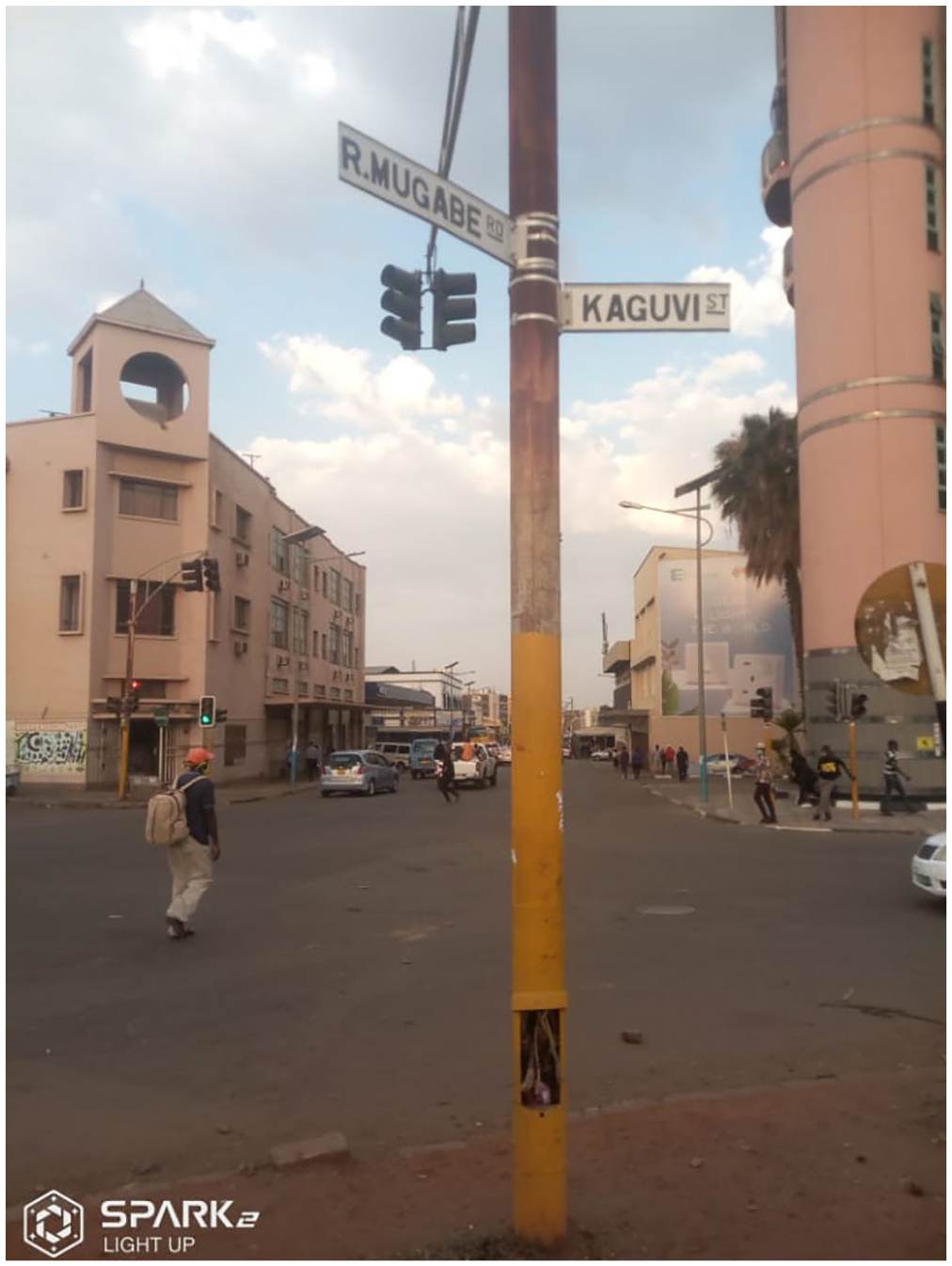
Kaguvi street sign in Harare Central Business District (CBD).
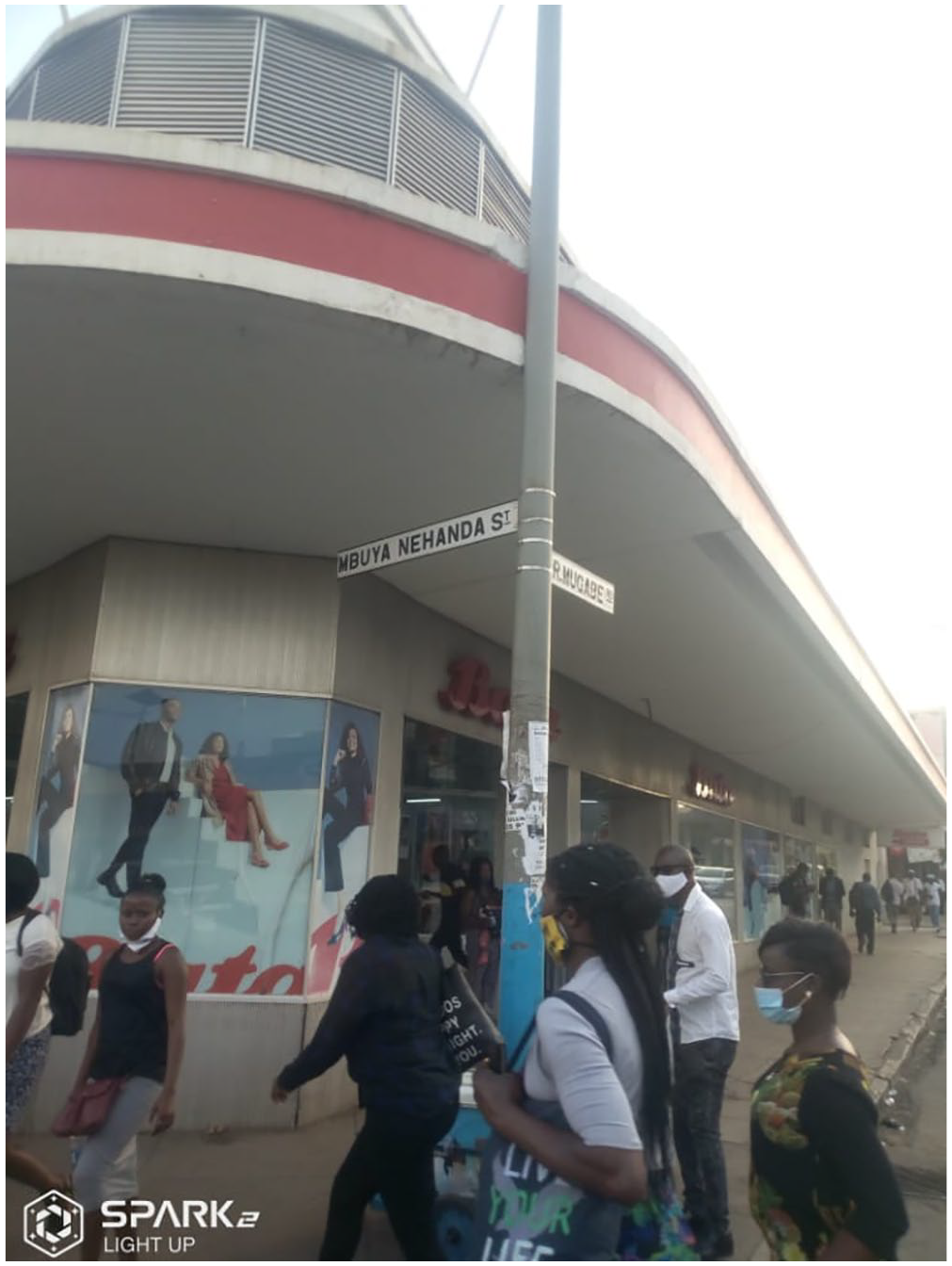
Mbuya Nehanda street sign in Harare Central Business District (CBD).
It is critical to mention that out of all the national deities, Mugabe had chosen Nehanda as his ‘patron saint’ presumably because of his attachment to his mother who raised the family single-handedly after the father allegedly abandoned the family (Chitando, 2021).
The ideology of the spiritually anointed leadership of Mugabe pervades Mugabe’s several other attempts of self-projection. The Mugabe regime created an Independence Day poster in 1980 that depicted Mugabe as the ‘ordained one’ of national ancestors represented by Nehanda (see Figure 3). The captions on the poster read ‘Mbuya Nehanda: First Chimurenga 1896’ on the top circle, while ‘Robert Gabriel Mugabe: First Prime Minister, Zimbabwe 1980’ appears on the lower circle. The art communicates the same idea that the Mugabe regime printed on party regalia during the political campaigns for the 1980 elections, depicting Nehanda’s head and shoulders hovering over those of Mugabe. Commenting on this iconography, Lan (1985: 218) posits that it projects ‘the warrior of the past guiding, supporting and recommending this triumphant warrior of the present’.
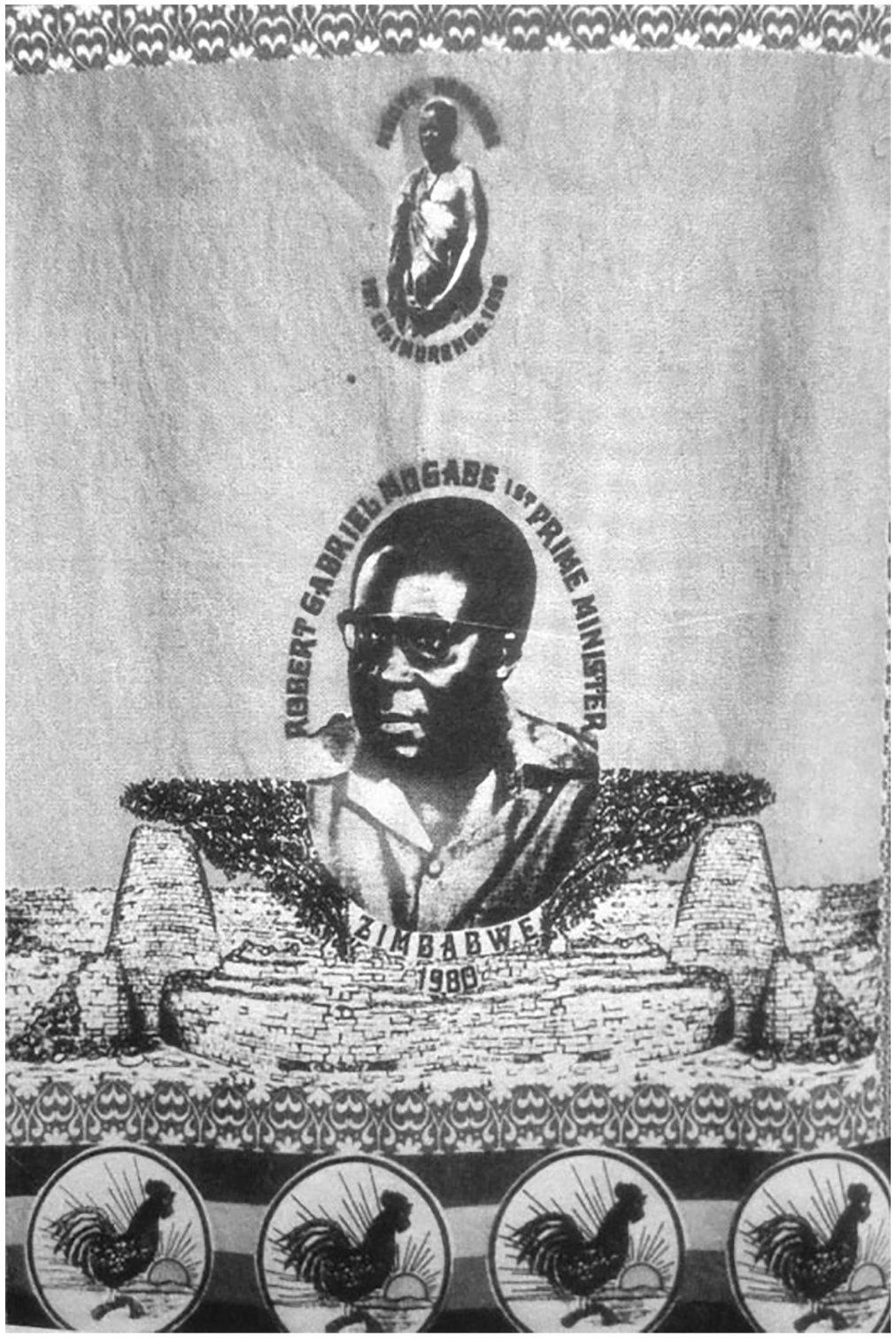
Iconography for the independence celebrations in 1980.
On another level, the place-renaming exercise demonstrates that Mugabe walks in the footsteps of the national ancestors represented by Nehanda. Mugabe would invoke Nehanda’s name by making an oath in her name to threaten opposition political actors, ‘Ndinopika naMbuya vangu Nehanda [I swear by my ancestral spirits] that will never happen. I will not allow Tsvangirai and his bosses to taste this seat. Never, ever!’ (Meredith, 2008: 239). Through this statement, Mugabe claims to be a direct descendant of Nehanda, making him the natural candidate for the presidency of Zimbabwe.
The Mugabe regime also popularised the journey that Mugabe (and Tekere) embarked on to Mozambique and how they got some assistance from Chief Rekayi Tangwena and his wife who was a spirit medium. ZANU-PF ensured that the journey had mythical proportions in Zimbabwean lore because it reinforced the divine electiveness of Mugabe ideology (Chigumadzi, 2018; Chitando, 2020; Machingura, 2012; Ruzivo, 2013). Edgar Tekere, a close ally of Mugabe who later turned fierce critic, recounted how Chief Tangwena got the instructions from his wife to ensure the safe passage of the two in the face of a possible attack from the Rhodesian forces. Mbuya Tangwena performed some rituals and gave Chief Tangwena specific instructions: You must take these people now, take them now. You must walk throughout the night and she described to them the route they were to take and warned Chief Tangwena of dire consequences if he disobeyed the instruction by saying that ‘these people are the property of the country and if they fall into enemy hands it will be a serious crime for you to commit, Rekayi’. (Holland, 2008: 44; emphasis added)
Despite referring to the duo – Mugabe and Tekere – the phrase ‘property of the country’ indexes the divine electiveness of Mugabe because he presented himself as the one who had been invested with divinity, and not Tekere, in the post-colonial state. Mbuya Tangwena’s proclamation projected Mugabe as an embodiment of the wishes of the ancestral spirits, a pre-ordained leader (Machingura, 2012). The Mugabe regime would make Chief Tangwena a national hero partly because of his role in Mugabe’s journey to Mozambique. It also honoured Chief Tangwena in the Harare streetscapes.
Mugabe as the modern king of Zimbabwe
The ancestral ordination of Mugabe, discussed in the above section, also depicts Mugabe as a king. The office of the chief is sacred, and the occupant is imbued with mystic powers. Being sacred beings, chiefs perform rituals for the benefit of the entire chiefdom. In African traditional culture, a chief derives legitimacy from the spirit elders of the chiefdom. For this reason, spirit mediums preside over the coronation of chiefs (Machingura, 2012). The place-naming system projected Mugabe as a leader who had been sacralised by the national ancestors.
The place-renaming process gave the names of the departed chiefs to streets and buildings. Most of the chiefs fought against the colonial system during the 1896 First Chimurenga war. Some of the renamed buildings house government ministries’ offices, while some are used by the judiciary as presented in Table 1.
List of chiefs honoured in Harare commemorative landscape.
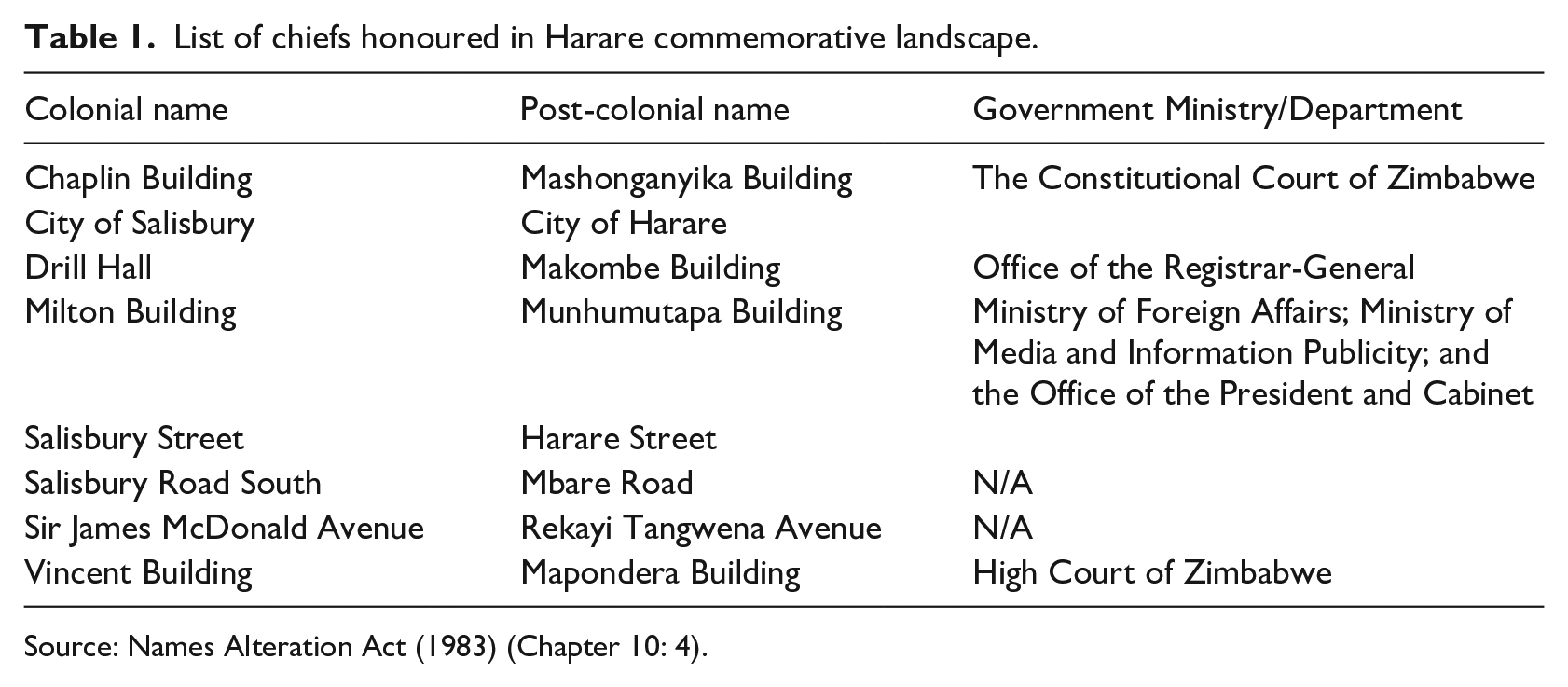
Source: Names Alteration Act (1983) (Chapter 10: 4).
The Mugabe regime honoured paramount Shona chiefs Makombe, Mapondera and Mashonganyika. All three fought against the colonial system. Chiefs Mbare and Harare were displaced to pave the way for the creation of Salisbury during the colonial era. Munhumutapa was the title for the occupant of Munhumutapa (invariably known as Mwenemutapa) chieftainship. The Mutapa (short for Munhumutapa) state was a Shona confederation established in the 15th century. It was an empire that ruled over many other tribes who could keep their own chiefs but were obliged to forward tribute to the Munhumutapa (Ranger, 1967).
The naming of government buildings after past African chiefs was a deliberate act for painting Mugabe as the reincarnation of the old political leaders with the same sacred authority that Shona chiefs of yesteryear embodied. It projected Mugabe as the natural successor to the departed chiefs by commemorating him in the same memorial landscape with them. This political position was anchored in the African traditional belief that the legendary power of early departed chiefs remains the powerful guardians of the chiefdom and that they continue their rule through chiefs who acted as their successors (see, for example, Bourdillon, 1988). In this scheme of things, the naming of the building that houses the Office of the President and Cabinet after Munhumutapa, one of the greatest dynasties of the pre-colonial era, gave Mugabe an identity of an heir apparent to one of the greatest dynasties in Shona history. He wanted to paint his rule as an unavoidable outcome of history. Commenting on the construction of public memory meant to legitimate a political status quo, Azaryahu makes the following observation: The official version of the ‘past’ legitimises the existing (and hence, ruling) order by arguing that it is an inevitable outcome of ‘history.’ The ‘past’ grants the ruling social and moral order an air of naturalness, presenting it as part of the ‘cosmic order,’ which cannot be questioned . . . The ‘past’ is constructed as a chronological narrative which progresses in time and in which selected events and acting personalities are organised into sequential and causal chains . . . These chains lead . . . to the inevitable status quo, the ‘present,’ which is identified with the ruling social and moral order. (1992: 354)
Mugabe wanted to claim the traditional authority to rule over the entire territory in the manner of the old Mutapa kings. The Mutapa state covered a vast area that covers parts of the present-day Zambia, Mozambique and Zimbabwe (Ranger, 1967). The building that Mugabe named in honour of Munhumutapa assumed the identity of the modern dare (king’s court) for Mugabe, the new king.
The buildings that house new courts of law were named after Shona chiefs and kings. The judiciary is a critical arm of government in the system of separation of powers amongst government arms. However, Mugabe stood accused of interfering with the independence of the judiciary (Meredith, 2008). Thus, he was acting more like the traditional king who presides over civil and criminal cases in the kingdom. Ranger (2008) rightly notes that Mugabe derives his power from the dead kings. Vale (1999) also observes that Mugabe’s unbridled appetite to derive legitimacy from old kings saw him claiming a direct family lineage to another Mugabe who once ruled the area of Great Zimbabwe. This was going to give him the right to rule Zimbabwe as an heir to some old chieftainship that once ruled the Great Zimbabwe. Since Zimbabwe derived its name from the Great Zimbabwe, Mugabe became the natural leader of the new nation. This desperate claim was a way of seeking traditional validation for his leadership.
The royal identity of Mugabe that the place-renaming system communicated partly explains his unbridled distaste for opposition. Traditional leadership concentrates power in the hands of the incumbent chief, who must not have opposition elements in the chiefdom. Mugabe systematically suffocated dissenting voices within and outside his party. He expelled all members of ZANU-PF who dared to challenge him. For example, Dzikamai Mavhaire got fired from the party after he moved a motion in parliament on 10 February 1998 to amend the constitution, arguing that the president’s term of office should be limited to two five-year terms, instead of an unlimited number of six-year terms (Meredith, 2008). Edgar Tekere and Margaret Dongo suffered the same fate. Mugabe acted as the one centre of power for the party since he was solely responsible for punishing real or imagined disloyalty.
Outside ZANU-PF, the Mugabe regime never created a conducive political environment for multiparty democracy. It cultivated a ‘culture of intolerance’ for political diversity since it viewed elections as battles, and political opponents as enemies to be annihilated rather than as political competitors (Muzondidya, 2009). Mugabe used violence to crush the Nkomo-led Zimbabwe African People’s Union – Patriotic Front (PF-ZAPU) and Tekere’s Zimbabwe Unity Movement (ZUM). The Mugabe regime also persecuted the leadership and supporters of the Movement for Democratic Change (MDC) party, a political outfit formed in 1999. Sensing an unprecedented opposition, Mugabe issued what he called a ‘declaration of war’ against the opposition MDC while addressing a rally in Bindura district on 10 April 2000: ‘The MDC will never form the government of this country, never ever, not in my lifetime or even after I die. Ndingakupikirei ndinomuka chidhoma – I swear my ghost will come after you’ (Meredith, 2008: 177).
Mugabe also exhibited intolerance for political diversity by advocating for a one-party state policy in Zimbabwe. This policy was meant to declare Mugabe as a life president who exercises absolute control over the state without any opposition to audit his system of governance. Mugabe openly talked about his intention that ZANU-PF should ‘rule forever’ (Meredith, 2008: 79). Immediately after the attainment of independence, Mugabe faced opposition mainly from the Rhodesian Front, a political outfit mainly for the white community, and Nkomo’s PF-ZAPU. He moved quickly to liquidate the opposition. He stampeded PF-ZAPU into a unity government in the form of the Unity Accord in 1987. This literally meant that ZANU swallowed PF-ZAPU (Ndlovu-Gatsheni, 2008). Masunungure (2004) argues that whites had 20 seats reserved for them in terms of the constitutional provisions of the Lancaster House Agreement. Driven by its intolerance to opposition politics, the Mugabe regime effected a constitutional amendment, the Constitution of Zimbabwe Amendment (No. 6), which meant to squash organised white politics in the Zimbabwean parliament by abolishing these seats.
The abolition of the white seats in parliament and the signing of the Unity Accord meant that ZANU-PF had no opposition. This created a clear sailing path for Mugabe to implement his long-time dream of a one-party state. He immediately centralised power as the head of state, head of government and commander-in-chief of the defence forces in his hands by assuming the executive presidency in 1987. The position also granted him the powers ‘to dissolve parliament and declare martial law and the right to run for an unlimited number of terms of office’ (Meredith, 2008: 79). His party, ZANU-PF, instituted an institutional framework for a legislated one-party state by creating the Ministry of Political Affairs in 1988, later known as the Ministry of National Affairs, and housed it at the party headquarters in Harare. This ministry was later disbanded, but its function was continued through the Ministry of Youth Department, Gender and Employment Creation (Masunungure, 2004). The discourse of Mugabe as chief was to be revived after his death in 2019. His family insisted that Mugabe was a chief during his lifetime, and his burial was supposed to be done ‘privately’ following burial rites for chiefs.
Consent
Place names, alongside other discourses of self-presentation, act as the visible manifestation of the appropriation of symbolic production customised to legitimate hegemonic interests. Mugabe deliberately configured the cultural landscape intending to influence public consciousness. This argument is consistent with the emphasis in critical toponymic scholarship on the potency of cultural landscapes in ‘making the political authority, ideological persuasions . . . to be the “natural order” of the world’ in the minds of the governed (Rose-Redwood et al., 2017: 11). In terms of the Gramscian approach to place naming, the governed should consent to the ideology that the hegemon presents because power is not exercised in exclusive unidirectional terms where the ruling elites simply dominate subordinate groups. The hegemonic discourse that the place renaming presented to the public could only be effective if the ruled population perceived it as such. The Zimbabwe religio-political terrain was saturated with a belief in the direct influence of national ancestors in political affairs since the country was emerging from a protracted liberation war in which spirit mediums played a central role in providing prophetic and ideological inspiration. Spirit mediums initiated the early African insurgence in the 1890s and inspired the Second Chimurenga through such activities as the mobilisation of the masses (see, for example, Bourdillon, 1984/5; Charumbira, 2013; Chung, 2006; Lan, 1985). This scenario is consistent with the tenets of the Gramscian approach to place naming that an effective hegemony can only be won and sustained through existing ideologies and traditions (Vuolteenaho and Puzey, 2017). In this case, Mugabe wanted his political hegemony to receive popular consent from the ruled by anchoring his political hegemony on the Shona existing ideologies and traditions.
It is critical to mention that place renaming generated consent complemented by other strategies of governing, such as coercion and patronage. Mugabe was known for using coercion, political clientelism and populist policies to elicit support (Mamdani, 2009; Muzondidya, 2009). However, there were some Zimbabweans who strongly believed that Mugabe was an indubitable heir to the national ancestors and that his rulership was sanctified by the national deities. Chitando (2020: 12) rightly notes that Mugabe’s followers can be put into two categories: conformers and colluders. Conformers tend to be motivated by fear, while colluders were fully converted believers. He observed that ‘Mugabe had more colluders than conformers since many people shared his world-view’, with a good number of the colluders being fanatics. As early as 1987, ZANU-PF members were already singing what Chitando (2021: 6) calls ‘praise and worship’ songs to Mugabe, their demi-god and cultic figure. When parliament declared Mugabe Executive President during a ceremony on 30 December 1987, the proceedings were accompanied by the refrain ‘You are the only one’ (Meredith, 2008: 79). This was a demonstration of consenting to Mugabe’s leadership. This idea pervades the ZANU-PF political culture. The usual party slogan was ‘Pamberi naVaMugabe’ (Forward with Mr Mugabe). This slogan indexed that Mugabe was the party itself, not just the face of the party as it was supposed to be. During election campaigns, the slogan was usually modified to ‘VaMugabe Chete Chete’ (Mr Mugabe only).
During Mugabe’s political career, it was not uncommon for him to receive several gifts meant for chiefs in African traditions. This demonstrated that the people who brought such gifts had accepted that Mugabe was the supreme chief in Zimbabwe. Mugabe usually got pangolins as presents on his birthdays, Independence and Heroes Day celebrations. Commenting on a pangolin as a taboo animal, Machingura (2012) observes that it is a delicacy only eaten by lawful chiefs or spirit mediums because it is believed ordinary people can go mad or get cursed by the spirits if they eat it. Closely related to receiving gifts traditionally meant for chiefs, ZANU-PF supporters also presented Mugabe with a ‘royal throne’ during his 90th birthday celebrations, covered with leopard and crocodile skins, lion furs and two huge claws (Telegraph, 2014). This symbolically likened the presidency to the royal office of chiefs. Given that Mugabe was old enough to contemplate retirement and members of his party were jostling to succeed him, this symbol reinforced the royal ideology that Mugabe was a life president. Thus, anyone who wished to succeed Mugabe could only do so after his demise.
Mugabe’s supporters marketed his longevity as a visible ancestral approval of his leadership (Chitando, 2020; Mlambo, 2021). Challenging his leadership was interpreted as an act of rebelling against the spirit world. At the age of 90, the ZANU-PF party endorsed Mugabe as its sole presidential candidate at its 6th People’s Congress held in December 2014. Some senior ZANU-PF members were even advocating for Mugabe to continue at the helm of the affairs of the state when he was visibly incapacitated due to old age as late as 2017, the same year that he was upstaged. Again, no one wanted to come out in the open to declare presidential ambitions. Yet the existence of rival factions in the party was a clear indication that Mugabe should retire and have someone assume the presidency. Leaders of the factions supported the idea that Mugabe should rule for as long he wished, with others going into overdrive to declare that even if he were to die, he would ‘rule from the grave’. Succession was a taboo subject in ZANU-PF. The proverb ‘hapana zuva rinobuda rimwe risati ranyura’ (no sun rises before another one has set) was used to pacify anyone who had presidential ambitions. To the purveyors of this ideology, the fact that Mugabe himself had difficulty walking was inconsequential: ‘he was the sun that had not yet set!’ (Chitando, 2021: 10). This is consistent with the African belief that no discussion about replacing a sitting chief should be held unless there are special circumstances that can warrant his ‘destooling’, such as health conditions (leprosy, going blind, becoming insane, developing fits) (see, for example, Amoah, 1988).
ZANU-PF supporters composed several songs and jingles that celebrated Mugabe as a cultic hero. One example is that of a former cabinet minister, Elliot Manyika, whose song ‘VaMugabe mudzimu wedu’ (Mr Mugabe is our ancestor) situates Mugabe within the hierarchy of the national spirit elders (Chitando and Tarusarira, 2017). The sacrality of Mugabe might also explain the obeisance that members of ZANU-PF show to him. Male cabinet ministers such as Patrick Chinamasa (then Minister of Legal Affairs), Emmerson Mnangagwa (then Minister of Defence) and the then Vice President John Nkomo used to kneel in public before greeting and talking to Mugabe. Only women are expected to kneel when greeting male elders in the Shona culture to show respect.
While Mugabe instituted a political hegemony that received widespread consent within his party, and even amongst the general Zimbabwean populace, it is critical to mention that this was not without resistance and opposition. Muzondidya (2009) demonstrates that Mugabe faced opposition both inside and outside his party. Party members such as Edgar Tekere, Byron Hove, Sydney Malunga, Welshman Mabhena and Lazarus Nzarayebani openly criticised some party policies, such as the one-party state policy and socialism. While the two could not sail through because of dissent within the party ranks, Mugabe had to impose a de facto one-party state policy by crushing the opposition and closing the democratic space. Masunungure (2004) demonstrates that opposition politics in Zimbabwe has been in travail because ZANU-PF can tolerate opposition politics only to the extent that they do not threaten its hold on power. Outside the party, university students staged massive demonstrations against the Mugabe regime over allegations of corruption and abuse of state power in October 1989. The food riots that erupted in January 1998, and the several street protests that the opposition forces and civil society organisations called for indicated dissent against Mugabe’s rule. The opposition, MDC and several civic organisations mobilised their followers and sympathisers to protest over the declining economy caused by Mugabe’s bad governance. During the waves of protests that gripped Harare in 2016, some protesters defaced and removed Mugabe street signs. Some protesters dumped the removed signs in dustbins. This was a symbolic act demonstrating their wish to see Mugabe leaving office. However, all these acts of resistance did not result in the democratisation of the political landscape in Zimbabwe. Mugabe remained a powerful king who eschewed opposition until the day he unceremoniously left office in November 2017.
The different forms of protests discussed above did not take away sacrality from the person of Mugabe. The general term of address that Zimbabweans used for Mugabe was Mudhara (literally: old man). It reflected not only his advanced age, but the reverence that society accorded him as an elder. On another level, the same opposition political leaders who were advocating for Mugabe’s removal accepted that Mugabe had some superhuman qualities. Chitando (2021) poignantly notes that when opposition forces formed a coalition government with ZANU-PF between 2009 and 2013, Mugabe charmed Morgan Tsvangirai, Arthur Mutambara, Nelson Chamisa and Tendai Biti. They unanimously applauded Mugabe’s ‘unique personality’, and, in the process, Mugabe’s ‘opponents became part of the “praise and worship” team that extolled his putative unique leadership qualities’ (Chitando, 2021: 6). Apart from the criticism that Mugabe received from different sections of Zimbabwe, the general picture was that he remained such an enigmatic figure to the generality of Zimbabwe. Everything about him was deified to such an extent that Zimbabweans came to accept that ‘there was something about Mugabe that was not found in all other Zimbabweans’ (Gunda, 2020: 74). Mugabe’s imagined sacred qualities partly explain why most Zimbabweans have nostalgic memories of his rule given the deteriorating human condition under the current administration. The general feeling among Zimbabweans is that they made a monumental error when choreographers of the military-induced operation hoodwinked them into participating in the march meant to pile pressure on Mugabe to leave office in November 2017. After Mugabe’s departure, several memes and jokes began circulating on social media with people expressing their wish to see Mugabe’s return.
Conclusion
An official place-naming system presents the ruling elites’ ideological values. It is a deliberate political process meant to inscribe political ideologies onto the cultural landscape. This is the core concern of critical toponymic scholarship. The cultural landscape is deemed to portray an undisputed truth value. The general populace is influenced by what comes to them in visual form. Street names existing as visual texts on street signs influence people’s political tastes and attitudes. The Mugabe regime constructed a geography of memory in Harare that created a royal ideology around Mugabe and projected him as the heir apparent to the national ancestors who had led resistances during the early phases of colonialism. It has been demonstrated how other strategies of self-presentation communicated the same aspects, such as the architecture at the National Heroes Acre and the iconography ZANU-PF created to celebrate independence in 1980. The place-renaming system invested Mugabe with divinity. In terms of the Gramscian approach to place naming, the political hegemony that the Mugabe regime instituted demonstrates the cultural roots of power because it was anchored in beliefs already in circulation in Zimbabwe and cultural traditions practised in the immediate society.
The article has explored the salience of consent in consolidating dominant ideologies among the governed. It has been demonstrated that ZANU-PF supporters accepted the sacrality of Mugabe and the position of a chief that he claimed for himself. Mugabe’s rule faced opposition within and without his party, ZANU-PF. Despite the opposition, the greater part of the Zimbabwean populace accepted that Mugabe was a unique leader who had some extraordinary qualities. The article has shown that Mugabe’s system of governance had several resemblances to the African traditional one. This was deliberately done to secure his political career by protecting him from competition and criticism. Viewed this way, place renaming became part of the Mugabe’s political symbols that helped him retain political power. It served to naturalise Mugabe’s rule, demonstrating that he was divinely consecrated to lead the country by the national deities. He derived his authority from the national spirit elders who can only be challenged at one’s peril. However, the sacrality that characterised Mugabe’s governance system threatened democracy inside and outside his party.
