






Abstract
This article presents the author's approach to the study of cultural landscape genesis. Historical and geographical reconstruction of Urals and Siberia served as the empirical basis of the study. A hypothesis that highlights some of the basic morphological components of the cultural landscape on the scale of a given region is set forth based on that reconstruction. Communications and cultural values have been classified as the primary morphological components. The article compares the cultural landscape's communicative structure and two main forms of communication. The first form includes land communication routes and regional settlement patterns, which establish a kind of communicative framework for the cultural landscape of the region. The second form is the circle of social and cultural interactions that directly or indirectly affect the economic development and life activities of regional communities. Each of these forms of communication reflects a certain pattern of cultural values that is specific to a given form of economic development in a geographical region or to a particular historical era. Using this approach, the article studies the spatial organization of the cultural landscape of the Urals and Siberia in an attempt to explain the cultural diversity of various parts of present-day Russia.
Keywords
Introduction
It was characteristic of the Soviet era to attempt to homogenize the cultural life of the nation's regions in accordance with prevailing ideological doctrine. However, over a long period of time many of Russia's historical, cultural, and ethnic characteristics have been subject to suppression or deprivation of opportunities for development. After the collapse of the Soviet Union, the process of regeneration of many long-standing cultural, ethnic and religious traditions started. This has caused massive transformations in the social and cultural life of society, and it has greatly transformed the architectural and environmental appearance of many cities. These processes continue to unfold rapidly at the present time.
The cultural heritage and contemporary social and cultural life of the Asian part of Russia, which includes all of the nation that lies east of Urals, are quite complex and varied. This is a consequence of the fact that in this area, at different periods of Russian colonization and development, a number of different, sometimes fundamentally different, economic systems predominated. Each of these evolved from a particular pattern of settlement that was unique in both its economic and cultural features. Therefore, most regions of Urals and Siberia are currently full of economic and cultural contrasts. Large, fast-growing cities and industrial settlements that serve the mechanical engineering and oil and gas industries are located next door to small historic towns, to vast agricultural zones, and to areas where Northern native minorities use the land for traditional purposes (reindeer herding, hunting and gathering, etc.). This diversity often precludes the application of just one discipline (be it history, ethnography, sociology, or cultural studies) to conduct integrated research into the cultural heritage and contemporary social and cultural life of these regions. In an attempt to solve this problem, over the past ten years we have developed a multi-disciplinary methodology to perform a spatial analysis of a number of cultural processes that took place in the regions. The concept of cultural landscape plays an integral role in this multi-disciplinary approach because it allows a comprehensive review of the spatial organization of the material and spiritual culture of various local communities to be carried out.
Communications and values in the morphology of the cultural landscape of Urals and Siberia
The increasing attention of today's society to the concept of “cultural landscape” attests to the relevancy and urgency of conducting comprehensive research into the inextricable links between the various aspects of human existence and their contexts. This research must take great care to avoid the extremes of atomistic, “one-dimensional” interpretations of culture – for example, by regarding a given culture simply as a collection of material artifacts or as a strictly linear unfolding of defined social and demographic processes (Birks, 1988; Nassauer, 1995; Rubinshtein, 2010; Salter, 1971; Sauer, 1925, pp. 36–48; Sauer, 1927, pp. 154–214; Wallach, 2004).
Due to its interdisciplinary nature, the cultural landscape concept has always been open to including the methodologies of private research efforts across a range of different subjects (historical, geographical, philosophical, cultural, ethnographic, etc.).
The first task of our study was to develop a morphological classification of the spatial organization of the region's cultural landscape that would best fit the socio-cultural and geographical features of Urals and Siberia.
The structure of the cultural landscape of a separate area or region is defined first in the methodology under development as a system of communication and shared values.
The structure by which values are communicated across a cultural landscape can be compared with two main forms of communication. The physical form includes land communication routes (river routes, roads, and railways). This form is central to the geographical spread of information and values. The second form derives from the wide range of social and cultural interactions that directly or indirectly accompany the economic development of an area and the daily life of its communities. This second form of communication reflects and reinforces relationships among specific ethnic or socio-cultural groups, provides a means for the transmission of cultural heritage, and preserves cultural archetypes.
The manner in which each of these forms of communication unfolds mirrors a particular system of cultural values that is characteristic either of the regional economic structure or of a historical era. In this way, we can speak generally about the values of pre-industrial, industrial, and post-industrial development as addressed in the conceptual schema of periodic societal development proposed by Alvin Toffler and Daniel Bell (Bell, 1973; Toffler, 1980).
One can highlight the dominance of specific value systems particular to any given historical era of a country. In our case, examples of these systems include a radical transformation of the nature of cultural values which have predominated at different times in Russia. This kind of transformation occurred as a result of the reforms of the Russian Tsar Peter the Great, the revolution of 1917, and during a number of industrialization periods in the twentieth century.
On a lesser scale, the “small values” of local communities can be considered from a similar point of view. These “small values” define the socio-cultural identity of a locality.
It should be noted that each type of society has its own characteristic forms of communications that are related to the economic development of its territory. Thus, communication in pre-industrial society developed mainly along routes of natural dispersion (seas, rivers, steppes). In industrial society, this changed to dispersion via man-made routes (roads and railways, the laying down of telegraph and telephone lines). In post-industrial society, communication via networks (e.g., the telecommunications and broadcasting industries, regionalized service agencies, corporate and industrial conglomerates, production and distribution hubs, etc.) has become the dominant modality.
It should be emphasized immediately that in this context, the term “network” does not exactly mean a form, but rather a structural principle of communications that nurtures and disseminates social and cultural innovations in a post-industrial environment. By their nature, the post-industrial forms of development, unlike earlier forms, can be largely correlated with the process of “internal colonization” – that is, progressive settlement within a given area. This means that it is not development of that area “from scratch,” but rather the cultural and economic identity that evolves from an earlier period – in this case, the area's industrialization phase. But along with this, there is now a tendency to “virtualize” the development process – today's information technology is bypassing land-based communications and can drastically alter specific features of an area's cultural landscape. This can be illustrated by comparison to the globalization process: prototypes of mass culture and consumption patterns, which change the attitudes, values, and lifestyle of local populations, are easily transmitted by mass media, commercial, and service networks to locations otherwise remote from modern civilization.
For Urals and Siberia, the communication modality predominating at any given point in time has always served as the essential “skeleton” of the spatial organization of their cultural landscapes. In addition to serving as the distribution means of certain forms of economic development, these modalities have always been critical conveyors of cultural examples and values.
Referring to the history of Urals and Siberia, we can give several examples showing that although certain forms of economic development lost their relevance and geographical direction over time, they nevertheless maintained their cultural impact through implicit forms of communication that continued to exert considerable influence on aspects of the cultural landscape that grew in new directions.
An integrated historical, geographical, and socio-cultural reconstruction of the economic development processes in a certain area can be considered as the key to a better understanding of its present economic, social, and cultural features. An example of this is seen in how the establishment of land-based communications affected economic development of Siberia. In Siberia's thinly populated but vast territory, the routes of development have always been of special significance. They did not simply serve as avenues of communication, but also played a unique role in instituting certain prototypes of economic, social and cultural values. Therefore, a systematic review of the historical and geographical aspects of these development routes provides not only a more complete understanding of specific historical processes, but can also yield greater insight into the contemporary social and cultural environment of Siberia.
As a methodological basis for productive research into the structural and communicative elements of regional cultural landscape morphology, we have adopted the concept of “support frame,” which is a recent development in the field of geographical science in Russia.
Frame-based approaches to spatial analysis of social and economic processes were first proposed in Russia by Nikolay Baranskij in the 1950s (Baranskij, 1980). The concept of support frame as it was subsequently developed holds that a set of junction (urban) and linear (transportation network) elements provides the foundation for development of spatial models of individual, administrative, economic, and socio-demographic aspects of regional life activities. In particular, this approach treats a given region's support frame as the structural and communicative basis of its identity.
In the historical geography of Siberia's development, it is possible to separate two main types of frame-like structural and communicative elements of the cultural landscape. The first type includes linear Trans-Siberian railroads, stretching from the central part of Russia to the Pacific coast. The second type includes nodal regional settlement systems, consisting of cities and connecting roads. Each type can be considered a kind of communication system that disseminates the particular values that shape Siberia's cultural landscape.
Trans-Siberian communication modalities as the linear basis of the spatial structure of Urals and Siberian cultural landscapes
The Babinov road, constructed shortly after the camping of Yermak's (Yermak (born between 1532 and 1542 – died 1584) was a Cossack who led the Russian conquest of Siberia) can be considered as the basis of the first linear route of Siberian colonization (Witzenrath, 2007; Yermak's Campaign in Siberia, 1975). During this period, the availability of reliable land routes was necessary for Russia to secure its eastern frontier beyond the Urals. Construction of the road started in 1595 and continued for two years. In 1597 the road reached Nerom-Car – the settlement of Siberian natives Voguls, located at the head waters of the Tura River. Establishment of the town of Verkhoturye occurred one year later.
Soon this road was extended to the first Russian towns founded in Siberia – Tyumen and Tobolsk. Throughout the seventeenth century and the first half of the eighteenth century, it was the only official line of communication between the European part of Russia and Siberia. This was primarily due to the opening of the Verkhoturye customs house in 1600. Without exception, everyone traveling to and from Siberia was obliged to undergo the customs process, which consisted mainly of levying the tax on furs that was of great value to the Russian state. For nearly 150 years, the Babinov Road, named after Artemiy Babinov, the peasant who founded it, served as the route for the colonization of Siberia (Lincoln, 2007).
The Babinov road became one of the main connecting links of the first network of land and river routes, which for the purpose of this study is called the “Siberian route”. During the seventeenth and first half of the eighteenth centuries, this route linked Central Russia and the eastern frontier that was being settled by pioneers. The Russian geographer Vadim Pokshishevskij wrote: “With this first step, Russians began a process of constant expansion that took them – in a little more than 50 years, the length of only a single lifetime! – to the Pacific coast.” (Pokshishevskij, 1951, c. 31).
Of primary interest to this study is historical evidence that can shed light on the factors and attitudes which formed the cultural landscape of this first route of colonization of Urals and Siberia.
In the early stages of Russia's colonization of Siberia, the economy was based mainly on trading. Initially, this took the form of fur-trapping and the collection of yasak taxes (tribute in furs) from the indigenous population of Siberia. Subsequently, the imposition of Russian administrative and cultural practices on newly colonized areas became a high-priority task in Solikamsk, Verkhoturye, Tyumen, Tobolsk, Tara, Yenisei, Irkutsk and other towns that sprang up along the Siberian route in the seventeenth century and the first half of the eighteenth century. The first objectives in accomplishing this task included the creation of government offices and the construction of churches, monasteries, and educational institutes.
The second half of the eighteenth century was marked by the loss of the Siberian route's former importance in the colonization and economic development of Urals and Siberia. The new system of Trans-Siberian railways that was built a few hundred miles to the south took over this leading role (Naumov, 2006; Wood, 2011).
There were several reasons why these changes occurred. First, it was in the northern taiga regions of Siberia that Russian colonization met with the least amount of opposition from native inhabitants. This factor determined the development of northern river and land routes during the seventeenth century. It was only in the eighteenth century, after the frontier settlements on the southern borders of Urals and Siberia had been established, that an opportunity arose for unimpeded settlement of the fertile forest-steppe zones. The reforms of the Russian emperor Peter the Great greatly influenced the course of events that ultimately led to development of the Trans-Siberian Railway. The establishment of the new capital of Russia the city of St. Petersburg and greater access to the Black Sea weakened the pre-eminent commercial position previously held by the Russian North, leading inevitably to the later decline of such towns as Velikiy Ustyug, Kargopol, Solvychegodsk, and other settlements that were important for development of the Siberian route in the seventeenth and eighteenth centuries. Another crucial factor in locating the Trans-Siberian Railway to the south of those cities was the formation of major industrial centers in Urals and the Altai region during that period.
The system of values characteristic of pre-industrial forms of economic development predominated in the cultural landscape of such early outposts of Siberian colonization as Cherdyn, Solikamsk, Verkhoturie, and Tobolsk. These cities’ original sections, where religious activities were always more important than secular ones, were smoothly blended into their natural surroundings. By contrast, in the development of Urals factory cities like Yekaterinburg, Nizhny Tagil, and Nevyansk during the eighteenth century, one can clearly identify the reflection of industrial values, including secularization of the cultural landscape and the desire to make the forces of nature and the structure of society submit to the pragmatic objectives of industrial production.
In the second half of eighteenth century the growing influence of new, mainly industrial, centers of economic, social and cultural development of the region (e.g., Perm, Yekaterinburg, Omsk, and Krasnoyarsk) contributed to the shift of many portions of the Siberia route a few hundred miles to the south. This process was marked by the official opening in 1783 of the Great Siberian Road, which was the forerunner of the Trans-Siberian Railway that was built a hundred years later (Marks, 1991).
It was characteristic of this period that a number of cities (e.g., Solikamsk, Verkhoturie, Tobolsk, Tara, and Yeniseisk) that played a key role in the early colonization of Siberia were relegated to secondary status in the region. Once the major transit routes that served as the vectors of progress and innovation moved away from these cities, further development of their cultural landscapes was arrested. Gradually, they evolved from being centers of change to serving as showcases of cultural conservatism, perpetuating many of the now-archaic cultural values that existed at the time they were founded (Fedorov, 2004).
Today, although these towns are not directly linked to each other by a single road network, in the cultural landscape of the regions under consideration, they form a kind of historical and geographical line – an invisible line of force that merges and focuses different aspects of certain material values and spiritual culture (Fig. 1).
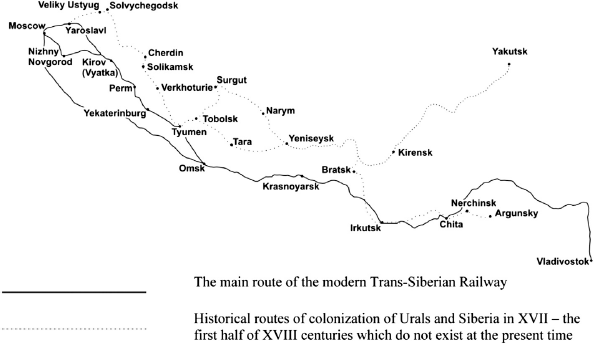
Basic linear support frames of the cultural landscape of Urals and Siberia.
Most of these towns today serve as custodians of important traditional cultural values that define the spiritual, historical, and cultural identity of the regions in which they are located. Many of them (e.g., Cherdyn, Solikamsk, Verkhoturie, and Tobolsk) have preserved extensive areas of their striking original architecture and landscaping that reflect elements of traditional customs, folklore, and spiritual life. Christian shrines that are particularly revered, unique historical and architectural monuments, and major museum collections are to be found in many of these towns.
The main routes of the Great Siberian Road, and later of the Trans-Siberian Railway, became a new geographic vector for the expansion of Asian Russia. Agricultural, commercial, and industrial development of Urals and Siberia advanced by leaps and bounds along this vector. In the eighteenth century, distinctive regional patterns of settlement began to appear throughout the area of the Great Siberian Road. These patterns prefigured the way some parts of Urals and Siberia have developed up to the present day.
One of the first well-defined industrial regions of Russia – Perm province arose from the industrial development of mining areas of Urals toward the end of the eighteenth century. It originated with the foundation of a number of large industrial settlements in Urals early in the eighteenth century by members of the wealthy factory owners family Demidovs, who had been granted a wide range of administrative and economic powers by Tsar Peter the Great. Key milestones in the development of Perm province were marked by, first, the establishment of the Nevyansky production plant in 1700. One year later, this plant produced the first ton of cast iron. In 1720, the Nizhny Tagil production plant was built; soon it became one of the largest industrial centers in Urals. In 1723, the city of Yekaterinburg was founded. In 1781, the city of Perm was founded on the site where the Yegoshikhinsky production plant had been built. Perm became the administrative capital of the region, which was soon reorganized as Perm province. During the eighteenth century, these new economic centers in Urals increasingly determined the course of further development in the region, unintentionally pushing earlier outposts of its development such as Cherdyn, Solikamsk, and Verkhoturie into the background.
By the middle of the nineteenth century, there were already about 260 factory towns in Perm province, which constituted almost half of the industrial settlements in all of Russia. Historian and ethnographer P.S. Bogoslovskij described this particular pattern of settlement as “Urals mining industrial civilization” (Ban'kovskij, 2004), thereby emphasizing its existence as a distinctive region that grew as result of industrial development. In addition to its outstanding economic value, the region contained many unique cultural features of the local community.
Industrialization of the Urals factory cities resulted in a special cultural landscape. The first organizing elements of this landscape came from large industrial enterprises. Later on, various religious and secular institutions typical of that period built upon these elements. Workers’ settlements, which resembled the agrarian communities from which the majority of the population came, formed around these urban nuclei. As this process unfolded, there was a growing need for reliable land communications between the factory cities so that coordination of production efforts would not be limited to occurring only within a single city, but could be scaled up to cover the entire industrial region. This type of articulated communication structure took shape in the middle Urals by the end of the eighteenth century when Perm province was established. Thus, in the process of industrializing Perm province, an extensive system of land roads connecting its major production centers was established. The linchpin of the region was the Gornozavodsk Railway, which opened in 1865 and linked major industrial centers of the area, including the towns of Perm, Nizhny Tagil and Yekaterinburg (Hudson, 1986).
Over time, the structure of the region's support frame underwent an evolutionary transformation. The economic and social importance of its component local settlements began to decrease. An example of this was the gradual devaluation of the region's once-important fishing, hunting, and crafts industries.
In other cases (as, for example, in major industrial cities such as Perm, Nizhny Tagil, and Yekaterinburg), one can trace the line of development from original industrial practices to later forms of industrial development that built upon those practices.
Subsequently, new waves of industrial development became the most significant factors affecting the evolution of the cultural landscape of Urals. This was connected with the development of capitalism in Russia in the second half of the nineteenth century, the industrialization of the 1930s, and the evacuation of many large industrial enterprises from European Russia to Urals and Siberia during the World War II. In 1934, after the Urals region's brief existence as an administrative entity, Perm province was divided into the Perm and Sverdlovsk regions. Despite this division, these two regions continue to be an easily recognizable historical and cultural “core” area of Urals that reflects many of the characteristic values of both the old industrial and the modern industrial cultures.
Another major industrial region was taking shape in the 1960s in the oil and gas fields in the northern part of the Tyumen area (“Tyumen North”), and it was developing according to a fundamentally different scheme. At the start of its large-scale industrial development, the northern tier of western Siberia was very thinly populated. Huge tracts of Western Siberia were practically uninhabited and difficult to survive in because of the extreme climate and the isolation from “mainland Russia.” The scant population of the region consisted of small native tribes of the north like the Khanty, Mansi, Nenets, and Selkup, and Russian old-timers who continued to engage in traditional economic activities based on trading. After the discovery of extensive oil and gas deposits in the 1950s and 1960s, the first objective of the area's economic development was limited to laying out a grid for the as-yet unpopulated industrial production complex. The spatial structure of this grid was defined by the construction of workers’ settlements, the locations of which were tied to where the oil and gas fields were to be developed. Initially, the population of these settlements was mostly transient, consisting mainly of technical experts and shift workers drawn from different parts of the country. But over time, permanent settlement of the new development zone occurred, and this later resulted in the formation of a new type of regional industrial community.
In addition, the formation of the regional settlement pattern's support frame displayed several special features not previously encountered. Except for rare instances of new industrial development centers replacing earlier Russian settlements – this would include the cities of Salekhard, Khanty-Mansiysk, and Surgut and the town of Berezovo, all of which replaced early outposts established in the northern tier of Western Siberia during the sixteenth and seventeenth centuries – in most cases these new settlements were created “from scratch” in the vicinity of large oil and gas fields or industrial facilities. Due to this particular circumstance, many towns and villages were located at a distance of hundreds of miles from each other, and air transport provided the only reliable means of communication between them for a long time.
By the early 1980s, dozens of towns and large settlements had sprung up in the Tyumen North area. In these towns and settlements, well-equipped accommodations were quickly built, and a complete social infrastructure soon developed.
However, the process of forming a regional support frame here in many cases lagged significantly behind the actual physical growth of the towns and settlements. This was primarily due to the inhospitable and sometimes extreme climate, which presented a serious obstacle to the construction of land-based communication facilities.
To ensure connection of the Tyumen North area with the “mainland” great effort was made initially to establish transportation and communication systems that ran in a north-south direction. The first of these were the oil and gas pipelines. Then a north–south transportation route that included a railroad and a motor vehicle highway connecting Tyumen and the largest industrial sites of the Tyumen North area was completed in the late 1960s. It this route currently operates along the axis of Tyumen – Tobolsk – Surgut – Novy Urengoy. Next, a railway branch line and a highway were constructed to link Novy Urengoy and Yamburg in order to transport shift workers and cargo to the large Arctic gas field located there. The town of Labytnangy is the terminus of the railway line that passes through Vorkuta in the direction of Moscow. A railway line between Yekaterinburg and the Priobye settlement passes through Nyagan and some other towns located to the west of the Khanty-Mansiysky autonomous district.
The impact of inadequate land-based communication systems is illustrated by the support frame of the Tyumen North area, which still lacks an east–west system to connect the most important cities that lie along that axis. This has prevented the complete integration of communications within the area, which has negatively affected the overall quality of the area's social and economic development. We can thus conclude that the way Tyumen's support frame has evolved has in many ways directly influenced the vitality and sustainability of the area's social and economic existence (Fig. 2).
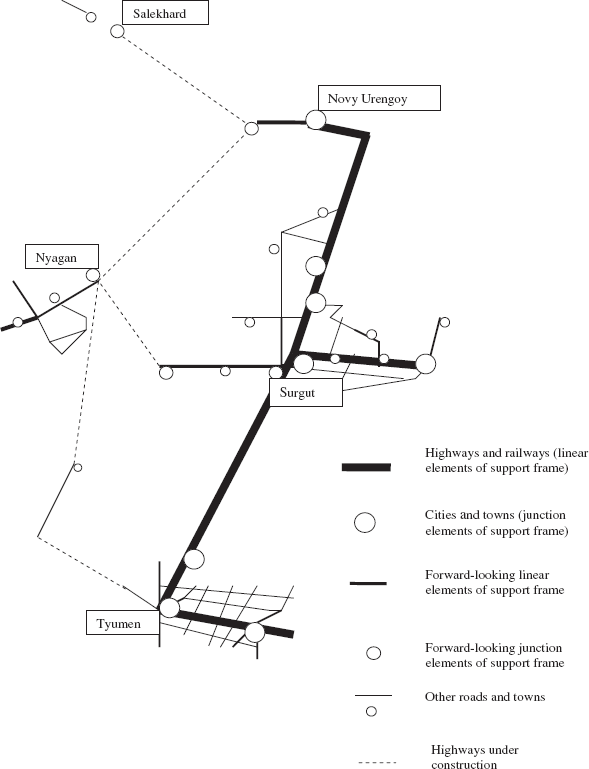
Scheme of the support frame of the Tyumen region (authors of the scheme – M. Ganopolsky and S. Litenkova).
In the history of the industrial development of Tyumen North, one can identify the successive stages through which the area's value paradigm evolved. At first, the main goal of development was straightforward: do whatever it takes to create an industrial complex that will maximize mining production. Therefore, many of the first industrial settlements appearing during this period were purely utilitarian and, in fact, were not designed for long-term living. After this initial phase, however, the focus shifted to establishing permanent facilities and towns for the worker population that could provide more diversity and complexity to the cultural landscape and would enhance public awareness of the region's special ecological, social, and cultural issues.
Although industries based on the exploitation of natural resources continue to play a critical role in the economic and social life of the region, attention is increasingly being given to other options for regional development. These include returning to a more traditional, pre-industrial way of life, and moving toward a post-industrial socio-economic model. Putting into practice the first of these two possibilities would require protecting the tribal lands of indigenous northern peoples so that they could continue to pursue their traditional lifestyle (reindeer breeding, hunting, fishery, etc.), and it would mean encouraging those who came to the area during its industrialization to revive the small business orientation of the area's early Russian settlers. The second option would require the region to push development of non-industrial sectors such as education, information technology, tourism, and various service occupations.
The morphological structure of today's cultural landscape of Urals and Western Siberia can be represented as a series of separate layers. Each layer is composed of the historical routes of development and the settlement systems that appeared around those routes, and it reflects the cultural values characteristic of those systems.
The itinerary followed by the “Siberian route” of the seventeenth and early eighteenth centuries is the oldest in the history of Russia's colonization of Urals and Siberia. The cultural landscapes of the most important towns located along it – Cherdyn, Solikamsk, Verkhoturie, Tobolsk, Tara, and Yeniseisk – have many similarities today. This is evidence that most nodal elements of the route, although separated from each other by hundreds of miles, are rightly considered as a single historical and cultural area. Because these cities were initially built as outposts on the eastern frontiers of the Russian state, their architectural aspects mirrored their natural environment. Most of them were founded on the banks of rivers, often in upland terrain which was preferred for military and defensive purposes. The most prominent features of the cultural landscape are mostly concentrated in the central portion of each of these towns, which was usually the site of the fort that constituted the core of the original outpost. Most of the structures found in these core areas today were built during the seventeenth or early eighteenth centuries, and were intended either for civil purposes – such as the voevode's (local governor's) residence, the town hall, and the central market – or for religious ones, such as churches and monasteries. Residential quarters for the general population were constructed in the vicinity of these buildings.
By contrast, the cultural landscape of many of the small historical towns located along the Siberian route contains very few of the secular institutions and industrial elements usually found in areas that have a more advanced economy. Today, these towns play an important role in the spiritual and cultural life of their respective regions. The headquarters of Orthodox Church dioceses are located there, as are the oldest and most venerated monasteries, chapels, and holy places. In each town there is a regional museum with a large and important collection of historical and cultural items. In addition to their collecting, research, and exhibition activities, these museums often spearhead efforts to preserve and restore the historic appearance of the towns.
In the everyday life of many towns located along this route, many elements of the quaint lifestyles, patterns of social intercourse, and economic systems that are unique to these places are plainly evident. Taken together, these elements determine the special qualities of the cultural landscape of this historic route of economic development and serve as a constant backdrop for its social and cultural activities, which have changed little with time.
Obviously, since most of these towns are important spiritual, historical, and cultural centers, they are largely responsible for determining each region's cultural identity. Thus, in many regions of Urals and Siberia today, we can identify a distinct pattern of role differentiation between current and former regional capitals. In this pattern, the current capitals serve primarily as centers of administrative operations and commercial innovation, whereas the essential role of the former capitals was as conservators and propagators of Russian cultural heritage and traditions. The pattern is exemplified in the following pairings of current and former regional capitals: Perm – Solikamsk; Yekaterinburg – Verkhoturye; Tyumen – Tobolsk; Omsk – Tara; Tomsk – Narym; and Krasnoyarsk – Yeniseisk (Fig. 3).
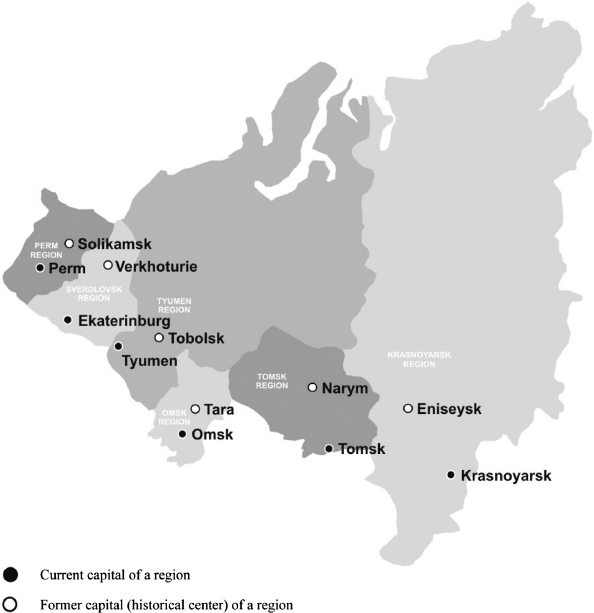
Current and former capitals of the regions of Urals and Siberia.
A number of Western Siberia's “merchant cities” – trading centers and market towns such as Kungur, Kamyshlov, Irbit, Yalutorovsk, and Ishim – that were established on, or close to, the route of the Great Siberian Road have retained a cultural landscape that reflects many of the attributes of the period during the nineteenth and early twentieth centuries when they were at their socio-economic and cultural high points. These aspects are captured stunningly and most characteristically by the estate homes and church buildings, most of which were built by the ruling merchant class, that are those cities’ visual centerpieces.
Elements of original merchant traditions can be identified in the current economic systems of the merchant cities. In Urals and Western Siberia, such traditions still provide an important functional basis for the production and distribution of agricultural products from nearby farming areas. While most of the cities founded in the seventeenth and early eighteenth centuries along the Siberian road now lie on the geographical peripheries of their respective regions, the economic model embodied in the concept of “merchant city” nevertheless continues to be the one that most fully meets the needs of the province. Generally, the social and cultural environment of such cities is slower-paced and subject to less change, so it is easier there to maintain the customs and traditions of an earlier time. Over the last decade, there has been a renewed interest in many of the traditions that were responsible for the success of the merchant cities in the nineteenth and early twentieth centuries. For example, in 2002 the municipal council of Ishim decided to revive the tradition of the St. Nicholas Fair, which had helped drive the city's growth for hundreds of years. The fair serves mainly to strengthen economic ties with nearby rural districts and to identify new markets where locally manufactured goods can be sold. This illustrates a trend toward reviving special types of socio-economic communications, such as trade fairs, upon which those cities used to rely. Against the backdrop of a rapid decline in the area's industrial production since the 1990s, many cities such as Irbit and Kamyshlov that have strong merchant traditions have been able to reinvigorate and give new direction to their economies.
The pathways of early industrial development in Urals and Western Siberia are generally discernible throughout the area. But most of them are situated in the Middle and Southern Urals and date from the eighteenth century, when the first industries began to appear established there. In contrast to that of the “merchant cities,” the cultural landscape of the provinces is often dominated by industrial production complexes, which are represented by the communities that grew up around factories and mines. These were exemplified by several early centers of heavy industry in the Middle Urals, the most important of which were the sprawling metalworks at Nevyansk, Nizhny Tagil, Alapaevsk, Nizhnyaya Salda and elsewhere that were established in the eighteenth century by the wealthy factory owners Demidov family, and mining centers such as Aramil, Polevskoy, Sysert, and Degtyarsk where valuable minerals were extracted and refined.
Today, many of the industrial enterprises and factories around which these towns were founded either do not exist anymore or do not play an important role in regional economic life. Despite this fact, the values of initial economic development that shaped the cultural landscape of these cities continue to define many of the features of their modern social and cultural life. The history of cities of this type shows how forms of commercial development that were once important to the life of a given region, but eventually lost their economic usefulness, are often transformed over time into traditions that define the cultural identity of the locale. The cultural landscape of small towns that were once located on the defensive periphery of the steppe zone of the Southern Urals and the western Siberian plain is a case in point. In the 1990s, the frontier status of their geographic location was brought sharply into focus in connection with the collapse of the Soviet Union. This coincided with a burgeoning revival of the traditional culture of the Cossacks, who have protected the borders of Russia for centuries.
The points at which the diversity of cultural landscapes is most evident in the urbanized parts of Urals and Siberia are found where Trans-Siberian Railroad lines intersect with the internal support frames of regional settlement systems. Thus, in the cultural landscapes of such cities as Tyumen and Irkutsk, which were located first – in the seventeenth and early eighteenth centuries – on the route of the Siberian road, then on the Great Siberian Road, and finally on the path of the Trans-Siberian Railway, one can trace the presence of a wide range of cultural values that are characteristic of different historical periods and economic infrastructures.
The evolution of the cultural landscapes of several other major cities in Urals and Siberia – such as Perm, Yekaterinburg, Chelyabinsk, Omsk, and Novosibirsk – took place in a similar manner, although their specific details varied. Throughout the twentieth century, values associated with the expansion of heavy industry predominated. Today in the twenty-first century, an economic and socio-cultural infrastructure that is reflective of post-industrial values is beginning to be built on the original industrial foundation of these cities.
On the basis of the abovementioned facts and observations, the following important conclusion can be drawn: in most of the cases considered here, values epitomized by the cultural landscape of a given direction or pattern of settlement are the subtle but constant shapers of the distinctive socio-cultural features of a particular place. Thus, despite generational changes in the local population, and despite changes in architectural design and composition, the archetypal values of an area prevail and continue to exert influence by embodying the essence of its cultural landscape. On the other hand, a cultural landscape remains vibrant only as long as it is nurtured by a community of people who can genuinely appreciate and reflect its values. Disruption of this relationship can be viewed as the main reason why cultural landscapes become fragmented or are destroyed altogether.
The morphological structure of the cultural landscape in modern areas of Urals and Siberia can be regarded as a variety of cultural values that come into focus along identifiable routes of economic development and regional settlement.
The historical trends discussed above highlight one of the key features of the current socio-cultural situation in Russia – the increasing differentiation of the values that comprise its cultural landscape. Accordingly, assessment of the impact that this differentiation may have on the future social and cultural development of Russia's present-day regions takes on a special relevance. The status of the roles played by both land-based and socio-cultural communications in the life of those regions is a key indicator of that impact.
Thus, despite the rapid computerization of many aspects of everyday life and the spread of post-industrial approaches to regional development throughout Russia, questions concerning the status of communication modalities that form the linear and internal support frames of communities are more pressing today than ever before. In the 1990s, due to a dramatic rise in transportation costs and a significant reduction in the volume of domestic land and air transportation in many regions, the problem of economic and socio-cultural isolation of individual regions and localities began to acquire a new urgency. While the major hub cities that are proximally influenced by the linear support frame of the Trans-Siberian Railway have readily continued to implement centrally planned economic and socio-cultural changes, most of Russia's other enormous Asian expanses have become increasingly isolated and divergent economically, socially, and culturally.
It is becoming much more common within any given region to find socially and economically dynamic administrative and commercial centers located right next door to so-called “depressed” areas, which primarily include small towns and rural settlements. These trends are a manifestation of new social and cultural problems that are challenging the regions of twenty-first century Russia. What is occurring in those regions can be compared to individual nations that experience increased cultural disintegration. Just as individual points in our three-dimensional universe are becoming more separated and isolated from each other, it is increasingly evident that the domain of cultural communication is likewise breaking into isolated fragments. The adoption of a dynamic, innovative culture by one set of communities and the restoration of a conservative tradition-based culture by another set of communities leads to intensified spiritual and cultural communication problems within the region as a whole. This is tantamount to a conflict in evaluative and philosophical interpretations of the cultural landscape by different social and cultural groups living within the same region and, consequently, to the lack of a common cultural language.
One striking example of such a conflict in values is the history of industrial development of Tyumen North. For several centuries, its territory was subject to very specific traditional uses of natural resources as enculturated by local indigenous peoples such as the Khanty, Mansi, Nenets, Evenk, and Komi-Zyrian. A distinctive feature of the traditional culture of these peoples is a strong belief that all of nature has a soul and that human impact on natural processes should be minimized. In effect, they created cultural landscapes that essentially sanctified the surrounding space instead of transforming it to achieve a goal. The environment was regarded as a holistic entity full of sacred meaning, for which disharmony and destruction were, in fact, equivalent to destroying the integrity of a human being living in it.
From the standpoint of the value system shared by the people who started the intensive industrial development of the northern territories, the extreme nature of the local environment was perceived as a hostile force. There are well-known examples of tragic collisions between the values and worldviews of northern old-timers practicing the traditional use of natural resources and proponents of industrialism arriving in the north, the consequences of whose activities in many cases included not only irreparable damage to the fragile northern ecology, but also the destruction of many cultural landscapes that had evolved from the way of life and the economy of the indigenous population.
At the present time, public awareness of the damaging effects of industrialization is often measured by the visible presence of an older traditional culture and way of using natural resources. This awareness is expressed today by attempts at actions, including support for intellectual and ecological tourism as an alternative means of regional development, that will restore or preserve many historical, cultural, and natural resources. However, unconstrained implementation of alternative programs like these is associated with the emergence of a whole set of new socio-cultural issues that require scientific evaluation and presentation of practical recommendations aimed at reducing the accompanying destructive effects.
The many-faceted nature of the cultural landscape of Urals and Siberia, which contains in its morphological structure traces of many traditional cultures as well as elements of new cultural forms, can be imagined as a type of organism that will thrive only under conditions conducive to spiritual and cultural growth as well as to getting and putting to effective use the resources needed to sustain physical life. The theoretical underpinnings of this perspective on the criteria for harmonious regional development can be traced to the concept of polarized landscape, as introduced by the Russian geographer Boris Rodoman. He proposed an ideal model of the cultural landscape of a region or an individual settlement that is founded on the principle of proportional alternation of different functional areas (administrative, industrial, historical, cultural, residential, recreational, etc.) that not only perfectly complement but also “work” for each other. As Rodoman noted: “The way in which any important natural or cultural resource differs from place to place is in itself an important resource, just as its availability is” (Rodoman, 2002, p. 23). Taking this approach, it becomes apparent that the key to balanced and harmonious regional life is the diversity of values in the region's cultural landscape, which is enhanced by the availability of both a branched network of transportation “arteries” and a “nervous system” consisting of a web of cultural communications.
In this regard, one of the important research tasks in relation to the socio-cultural aspects of developing post-industrial regional communities is to find new interpretations of old development principles. This means, in the first place, understanding the significance of the particular conditions of, and pathways taken by the cultural and spiritual life of a given region, and assessing the social and cultural potential of cultural values that have evolved there in the context of critical issues faced by that region today.
The results of such studies can have wide application. They can serve as practical guidelines for the development of individual areas (regions, municipalities etc.), especially by modeling their social and cultural perspectives and their openness to certain economic and cultural innovations.
The cultural landscapes of many historical towns of Urals and Siberia which have lost their former economical value, today preserves a lot of outstanding traditions of a domestic cultural heritage. Our research approach can be applied for the development of cultural and educational tourism which would consider historical connections between different regions of Russia and their common cultural heritage.
It is possible on the basis of the research to create different educational programs and textbooks which would be devoted to regional cultural studies.
And, at last, development of this research approach can help to get deeper understanding the following topical questions: what is a place of the regions of the Asian part of Russia in global economical, social, and cultural processes and what civilizational ways are most suitable to its future development.