




Abstract
Mining companies increasingly adopt trusts, foundations, and funds as part of their efforts to obtain and maintain a social license to operate and corporate social responsibility (CSR) strategies for community development. Using qualitative methodology, this article examined host communities’ perceptions of two mining company-financed trust funds in Ghana. The interviews revealed that although the community members considered some aspects of the trust funds positively, the trust funds’ overall objectives to promote meaningful participation of local community members and contribute to local development had not been met. Inadequate planning and needs assessments, and inflexibility in externally framed CSR practices that were unfavorable to the operational contexts, were among the key factors undermining the success of the trust funds.
Keywords
Introduction
Large-scale natural resource extraction can generate intense political, social, economic, and environmental challenges in the host communities. In resource-rich developing countries like Ghana, these include land dispossession, environmental degradation, and loss of livelihoods, and more than often outweigh the benefits of extraction (Andrews, 2018; Poncian, 2018). Ghana is among the top 10 largest gold producers in the world and passed South Africa as the largest producer in Africa in 2018. In 2017 its mining sector contributed 16% of total state revenues, and gold contributed 96% of the mineral export revenues, with total export receipts from gold being almost US$6 billion (GCM, 2018). Ghana’s mining communities, however, are marked by inadequate compensation for the losses related to extractions, inequitable distribution of mineral revenues, and poor socioeconomic conditions (Bloch and Owusu, 2012; Armah et al., 2014; Lujala and Narh, 2020).
The situation in the communities hosting large-scale mining in Ghana and elsewhere has led the governments and extractive companies alike to recognize the need to ensure a positive impact of extraction in the host communities (Arrellano-Yanguas, 2011) and obtain a consent from the affected communities to operate—the social license to operate (SLO) (Koivurova et al., 2015; Demuijnck and Fasterling, 2016). An SLO refers to the acceptance or approval by communities and stakeholders to host mining activities and indicates that these activities are considered legitimate in the eyes of the community (Demuijnck and Fasterling, 2016). Within the extractive industry, SLO can be viewed as a strategy to lessen tensions between the company and host communities and take stakeholder interests into account in decision-making, as well as a foundation for diverse corporate social responsibility (CSR) strategies seeking to promote community development and local content (Constanza, 2016; Jones, 1999; Whitehouse, 2003). The SLO is intangible, dynamic, and non-permanent; it has to be earned and then maintained, and it can change as the community acquires new information, for example, about the mining, its consequences, the company, or its CSR practices.
As part of their CSR portfolio and to obtain and maintain their SLO, extractive companies increasingly adopt trusts, funds, and foundations 1 as their strategies for benefit-sharing 2 and community development (McElroy, 2012; Wall and Pelon, 2011). These funds often manage substantial amounts of money. For example, the global resources company BHP (formerly BHP Billiton) established the Mozal Community Development Trust in Mozambique in 2001 and pledged an annual contribution of 1% of pre-tax profits, which yielded approximately USD 2.5 million per year (Castel-Branco and Goldin, 2003; Wall and Pelon, 2011). Such large contributions imply that trust funds can potentially provide alternative paths for host communities to accrue benefits from mineral extraction, and for companies to enhance their contribution to community development (Songi, 2015; Wall and Pelon, 2011).
Despite the potentially transformative role of trust funds, and several studies on relations between mining companies and host communities (e.g., Kolk, 2016; Maconachie, 2012; Standing, 2014; Standing and Hilson, 2013; Yap, 2017), scant attention has been paid to trust funds. Kasimba and Lujala (2018), one of the few exceptions studying trust funds, examined transparency and participation practices in trust funds in Ghana, while Pacheco (2012) focused on trust funds as strategies for sustaining benefit flows to host communities after a mine closure in Bolivia. Songi (2015), in turn, examined the potential of trust funds as a benefit sharing mechanisms in the context of oil extraction in Nigeria.
Adding to the previous literature on trust funds, this article examines host communities’ perceptions on trust funds when viewed as corporate strategies for community development. It does so through a qualitative case study of the Obuasi Community Trust Fund in Ashanti Region and the Newmont Ahafo Development Foundation (NADeF) in Brong-Ahafo Region, Ghana, which were respectively established by the AngloGold Ashanti (AGA) and Newmont Ghana Gold Limited. The article addresses two research questions: (a) How are the activities of trust funds perceived by host communities with regard to the implemented programs and projects? (b) What implications do the choices and types of implemented programs and projects have on trust funds as corporate strategies for community development? Further, the study seeks to contemplate the theoretical and practical boundaries of trust funds as CSR strategies for local development and to obtain and maintain an SLO.
Except for McElroy (2012), who studied the relationship between the normative and business case motivations for mining companies’ CSR activities using trust funds as the case, little empirical evidence is available on the success of trust funds as mining companies’ CSR strategies at local community level in resource-rich developing countries. Yet, in 2014 the NADeF in Ghana, whis is one of the two trust funds studied in this article, won a CSR award as Africa’s best social impact investment vehicle toward improving the conditions of their host communities from the European Union’s African Chamber of Commerce. In 2017, the National Philanthropy Forum in Ghana also named NADeF the Corporate Foundation Philanthropist of the Year for its long-standing contribution to sustainable socioeconomic development and improvements to the lives of the Ahafo communities (Andrews, 2019).
By adopting a bottom-up approach that gives particular attention to CSR at local community level, this article forms an entry point for understanding trust funds as systematic approaches to community development, and it also contributes to the broader literature on corporate engagement with the development agenda. To study trust funds as a specific form of CSR is also important, as previous research has suggested that corporate-led development in resource-rich developing countries remains obscure and effort is required to create a CSR agenda that is genuinely development oriented (Andrews, 2016; Fox, 2004; Frynas, 2005; Osei-Kojo and Andrews, 2018).
The rest of the article proceeds as follows. The next section presents a conceptual understanding of the linkage between SLO and CSR and highlights key issues for our analysis of trust funds as CSR strategies for community development. Thereafter, an overview of the study area and data collection and analysis are provided, followed by the presentation of the case studies. Next, the findings are presented and discussed. The final section concludes with some recommendations.
SLO and CSR
This section addresses the linkage between SLO and CSR and highlights key issues that are critical for an analysis of trust funds as forms of CSR strategies for community development in the context of the extractive industry in resource-rich developing countries. These key issues include stakeholder participation in decision-making, company engagement with community development, and taking responsibility for the negative consequences of extraction.
Obtaining and maintaining an SLO requires an engagement between the extractive company, government, and local stakeholders to ensure that the extraction contributes to local development and that the negative impacts on host communities are minimized and mitigated (Pedro et al., 2017). Similar multi-stakeholder engagements are at the core of CSR, which companies use to address their obligations to society beyond making profit to their owners, and to mitigate social and ecological problems that arise from their operations (Idemudia, 2008; Idemudia, 2011). Within the extractive industry, CSR is used to transfer benefits from the extraction to host communities and respond to adverse environmental and other consequences of mining (Kemp, 2010).
CSR within the extractive sector has been promoted by organizations central for the extractive industry such as the International Council on Mining and Metals (ICMM) and the International Finance Corporation (IFC). The ICMM’s ninth principle for sustainable development requires collaboration between member companies and host communities as a strategy to enhance social, economic, and institutional development by addressing poverty and wider development issues in the affected communities (ICMM, 2014). On their part, the IFC provides global performance standards for the extractive industry that promote strategic social or community investment as a blueprint for companies to attract foreign investments and deliver long-term benefits from mining projects (IFC, 2010).
For the analysis of trust funds set up by mining companies, two key issues relating to the linkage between SLO and CSR come into play: meaningful stakeholder participation and the companies taking responsibility for the negative consequences of its activities. First, SLO is based on the inclusion and meaningful participation of all the affected stakeholders, including community members (Pedro et al. 2017; Prno, 2013; Prno and Slocombe, 2014). Stakeholder participation in decision-making is also a key concern in diverse CSR policies and strategies that promote local stakeholders’ involvement in the management and use of extractive resources and revenues they generate (IFC, 2015). This promotion is often premised under the assumption that mineral extraction in resource-rich developing countries often occurs in a context characterized by weak institutions and poor governance (Frederiksen, 2019; Guler et al., 2002; Matten and Moon, 2008; Wiig and Kolstad, 2010). In the context of trust funds, stakeholder involvement is also viewed important as it is thought to contribute to shared (and better) governance of revenues allocated to community development (Wall and Pellon, 2011).
Second, both SLO and CSR emphasize the need for mining companies to acknowledge the implications of their activities, and to take responsibility for them. That is, companies are expected to respond to affected communities’ concerns and requests by delivering on their commitments, operating in a responsible and accountable manner, and addressing local developmental issues (Idemudia, 2011; Pedro et al., 2017). These expectations resonate with the assumed benefits of trust funds: the ability to enhance the positive impact of large-scale mining on local content and development (Wall and Pellon, 2011).
Despite their potential, both SLO and CSR practices come with limitations. According to Brueckner and Eabrasu (2018), SLO—despite its growing popularity—does not have a clear definition, which limits the transferability of findings of SLO studies across different contexts. For Van Putten et al. (2018), an issue with SLO in the extractive industry is its opportunistic usage that often favors the corporate sector. Used opportunistically, SLO can undermine the formal regulatory processes for natural resource management. Further, CSR practices in Ghana and elsewhere have not produced significant positive transformations in host communities (Andrews, 2016; Hilson, 2012; Osei-Kojo and Andrews, 2019).
The disappointing outcomes of SLO and CSR practices have led to views that the mainstream use of the two concepts are detached from the priorities and realities in developing countries and that they are not particularly relevant to local contexts and actors (Blowfield and Frynas, 2005; Kemp and Owen, 2013). Therefore, similar to calls for a reimagination of SLO (Van Putten et al., 2018), there is a need to address the detachment of CSR from the needs of the communities it is supposed to benefit and CSR’s context-specificity (Matten and Moon, 2008). Regarding the context, Wall and Pellon (2011) emphasize that programs and projects supported by a trust fund should be appropriately defined and based on an extensive social assessment that mirror a well-understood operational context. For example, when the focus is on unemployment, the managers of funded programs should take into consideration that in the most cases, unemployment in mining communities is at least partially a consequence of hosting large-scale mining due to, for example, displacement of farmers and artisanal miners (Mares, 2012; Persaud et al., 2017; Yankson and Gough, 2019).
Therefore, to speak of trust funds as strategies for CSR and obtaining and retaining SLO, they should account for the role of business (in this case, mining) in creating the challenges for which they intend to find solutions (Blowfield and Frynas 2005; Idemudia, 2011). Accordingly, when examining host community perceptions on trust fund activities, it is crucial to consider the mining industry’s role in creating the challenges the trust funds seek to address. In addition, it is important to examine whether companies use trust funds simply to anchor their legitimacy and to obtain SLO, or whether the funds are used as sincere strategies to promote community development and participation.
Data and methods
The material used in this study was collected in Ghana’s Ashanti and in Brong-Ahafo Regions (Figure 1) between October 2015 and April 2016. In Ashanti, Obuasi is a town well known for its gold deposits (also known by the term sikakrom, meaning rich city), and the capital of Obuasi Municipality. Large-scale mining in the municipality has been dominated by AGA (formerly Ashanti Goldfields Corporation) since 1897, and out of Obuasi’s surface area, 20% is under AGA’s concession, which has led to a strong linkage between AGA and the area’s socioeconomic activities (Okoh, 2014). In 2012, gold production from Obuasi Municipality accounted for over half of all production in Ghana, and AGA had a capital expenditure of USD 185 million in the municipality and produced 17,500 lb. (ca. 8,000 kg) of gold (Asuah and Ankoye, 2016).
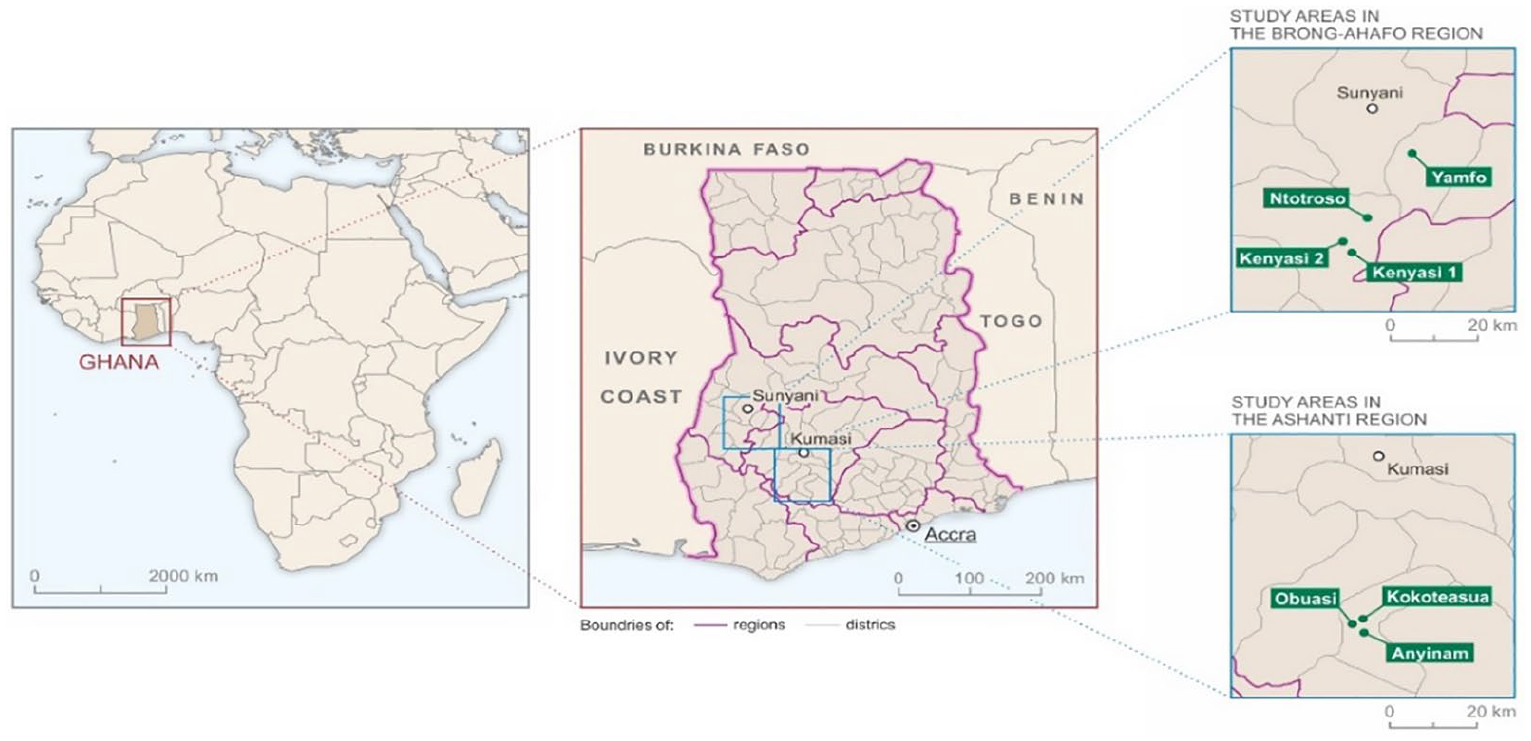
Map showing Ghana in relation to Africa, and the study areas.
In Brong-Ahafo Region, large-scale gold mining began more recently, in the 1990s, and today the gold mining is dominated by Newmont Gold Ghana’s subsidiary, Newmont Ahafo. Newmont Ahafo began commercial production in 2006 (Newmont Ghana Gold Limited (NGGL), 2005). The concession, which covers ca. 40 km 2 , is located in Asufiti District. It has impacted over 1700 households, leading to two new resettlement villages at a cost of USD 14 million (Mares, 2012). Three years after Newmont Ahafo commenced mining, it produced gold worth USD 528 million, and in 2017 it contributed 12% of the total gold production in Ghana (Ghana Chamber of Mines (GCM), 2018).
The material for the study was collected using semi-structured interviews. The first meetings with the study participants were through the help of a local journalist, a resident of Obuasi. The journalist was purposively contacted as he had good knowledge of communities affected by mining. After a 2-hour conversation and a tour in Obuasi town, the first formal interview was conducted. After this introduction to the field, further participants were sought by asking the initial participants to suggest people in other communities who could contribute to answering the interview questions.
The strategy that was used to recruit research participants for this study resembles the snowball technique. However, as snowballing could have led biases in respondent selection, opinions from diverse respondents were actively sought. The interviewees represent various social, political, religious, and economic levels and classes. 60% of the participants were males. All interviewees were adults whose lives were affected by mining either directly or indirectly, or who lived in areas in which the studied trust funds operated. For expert knowledge on the operations of the trust funds, various stakeholder group representatives were purposively sought and contacted through emails, phone calls, and preliminary fieldwork. These included company representatives, trust fund officials, local government representatives, representatives of traditional authorities, community activists, and non-governmental organization (NGO) representatives.
In total, 43 individual interviews (21 in Ashanti Region and 22 in Brong-Ahafo Region) and three group interviews (one in Ashanti Region and two in Brong-Ahafo Region) were held. Although the interviews were conducted mainly in English, translation to the local language, Twi, was used whenever necessary. The interview process involved securing the interviewees’ consent to participate in the study, and if they agreed to the terms and use of the information they provided, the interviews were audio-recorded. The interviews were transcribed and coded manually to sort and identify various perceptions on the major themes for this study, namely community development, shared benefits, and social responsibility.
Secondary study material included company reports and documents available on NADeF’s website. The Obuasi Community Trust Fund did not have a website, and the interviewed officials said that the information relating to the fund was included on AGA’s internal website, and thus was not available to the public. It was, therefore, difficult to access records and information about the Obuasi Community Trust Fund: there were no documents available about the agreement between AGA and the Government of Ghana, no official records on project outputs funded by the fund, except in newspapers when they were being commissioned, and no information on procedures for the distribution of funds or how members of the steering committee were selected.
Obuasi Community Trust Fund and NADeF
Obuasi Community Trust Fund
The Obuasi Community Trust Fund was formed in 2004 and is part of the company’s CSR and sustainability programs. At its inception, AGA pledged 1 USD per ounce of gold produced and a further 1% net profit earned to the trust fund. The fund’s objective is to enhance the development of local communities affected by the mining in Obuasi Municipality and the neighboring Bekwai Municipality, Amansie Central District, Adansi North District, and Adansi South District. Obuasi Community Trust Fund’s office is located 10 meters from AGA’s sustainability department office, displaying a poster stating that the fund’s vision is “funding local businesses and community projects, generating employment, and growing talents.”
During the fieldwork, an official at the trust fund’s office said that between 2006 and 2012, the trust fund had received approximately USD 2.7 million from AGA. However, no records of further financial inputs were available after 2012. The official explained that this was a result of the reorganization of AGA and a temporary closure of the mine. According to the Obuasi Community Trust Fund’s secretariat, it had funded various projects such as water boreholes, public toilets, micro-credit schemes, educational facilities and scholarships, and other social amenities, including sports grounds (Figure 2). Unfortunately, it was not possible to document the amount of funding spent on various projects and initiatives.
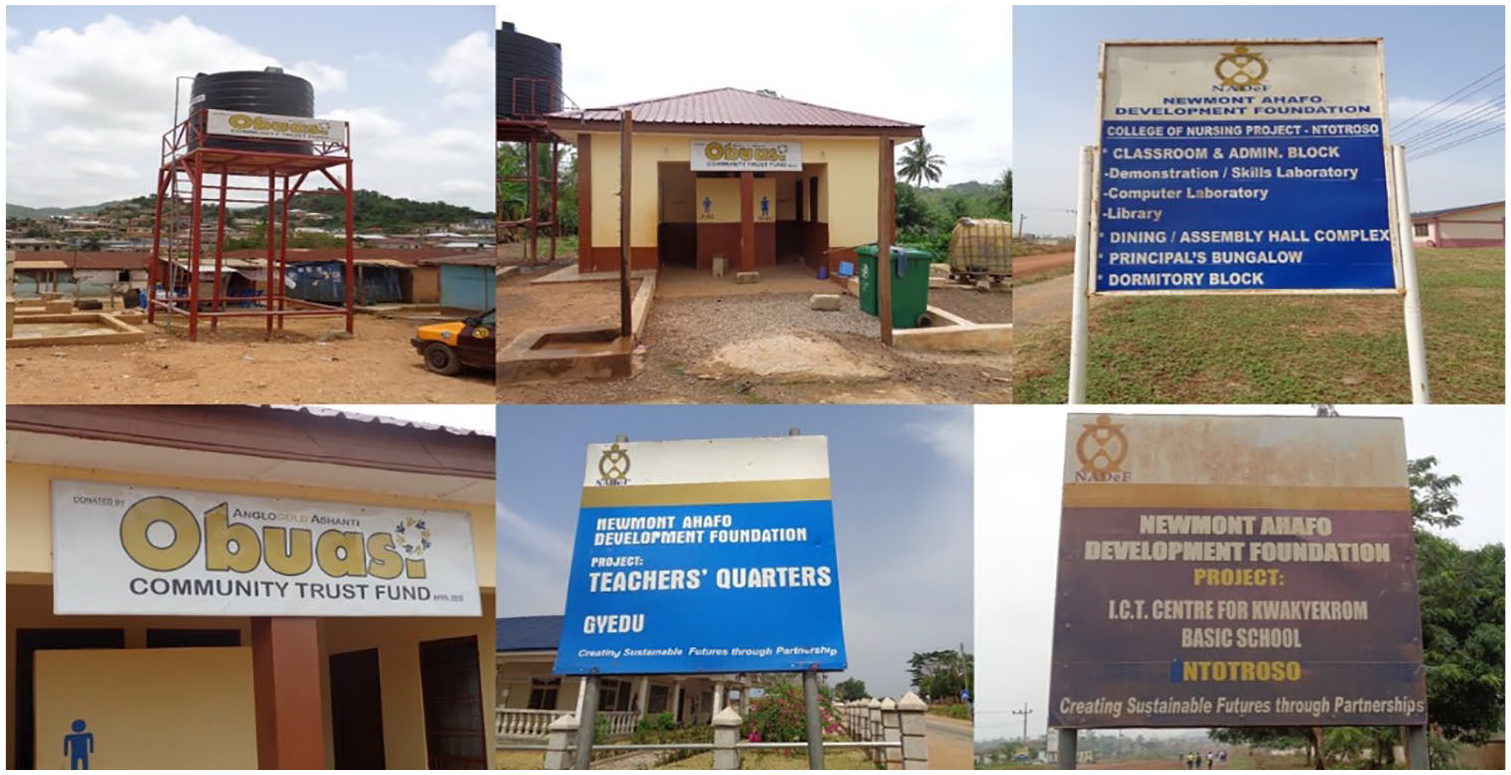
Programs and projects run by the Obuasi Community Trust Fund and NADeF (Photo by Kasimba in 2016).
Furthermore, the Obuasi trust fund secretariat explained that the processes and procedures for both identifying community needs and selecting projects to be funded involved community facilitators who were responsible for outreach on behalf of the trust fund. The information gathered during the fieldwork revealed that the communities could send project funding requests to the fund, but it was unclear both for us and the community members how this was done in practice due to lack of information. In general, it seems that there were no standard procedures or guidelines, at least not easily accessible to the public. But according to information from the trust fund office, by 2016, the trust fund had provided scholarships for 100 senior high school students worth about USD 12,150. Furthermore, according to an online newspaper, in 2018, the trust fund spent about USD 60,000 on the construction of a five-unit toilet, a bathroom, and mechanized boreholes, a chief’s palace, and a senior high school (Myjoyonline, 2018).
NADeF
NADeF is a sustainable community development foundation formed in 2008 and based on company–community agreements viewed as part of Newmont’s efforts to acquire the initial SLO for its operations (Andrews, 2019; Boakye et al., 2018). NADeF has as a vision to empower communities through grants, knowledge sharing, and capacity building to promote sustainable development (Danso et al., 2016). Newmont Ahafo commits 1 USD per ounce of gold produced and a further 1% net profit earned to NADeF’s operations. NADeF has a secretariat office in Ntotroso community and serves 10 communities within Tano North District and Asufiti District: Kenyasi 1, Kenyasi 2, Yamfo, Ntotroso, Wamahinso, Gyedu, Terchire, Adrobaa, Susuanso, and Afrisipakrom, which had a combined population of 33,537 at the time the NADeF was established (Newmont Ahafo Development Foundation (NADeF), 2008).
Eight years after its formation, NADeF had accrued about USD 23 million, and according to the chairperson, the trust fund had been a success, with the implementation of over 100 projects (Danso et al., 2016; NADeF, 2016). For example, in 2017, NADeF spent about USD 850,000 on 10 different projects and programs, including a 3-day capacity-building workshop to train 450 heads of school, construction of maternity blocks and public toilets, and support for apprentices to learn skills such as dressmaking and welding (NADeF, 2018).
The programs and projects funded by the Obuasi Community Trust Fund and NADeF are similar in many ways. Both trust funds focus on human resource development through funding scholarship programs, information and communications technology (ICT) centers, and construction of classroom blocks; contributing to economic empowerment (self-reliance) through apprenticeships, micro-credit schemes, and skills training; and providing health amenities such as toilets, sports facilities, and mechanized boreholes for water.
Findings
The findings show that most community members were not convinced that the programs and projects implemented by the trust funds could be considered as substantial benefits. Three issues stood out in the host communities’ perceptions on activities of the studied trust funds as CSR strategies for community development: (a) insufficient planning and needs assessment, which led to projects’ outputs being detached from the local realities, (b) business interests prioritized over sincere social responsibility, and (c) inflexibility of externally framed CSR practices that were not entirely favorable for the operational contexts.
Project outputs versus local realities
Some community members perceived the operations and activities of the trust funds as positive and beneficial. For instance, a man in Kenyasi 1 said that the skills training had reduced the skepticism toward Newmont: “some people used to complain, but now we don’t hear them. Some work in the mine, and some are car mechanics.” Similar views were recorded in Obuasi, where a female resident claimed that she had found work as a seamstress after participating in a sewing project and a lady she knew had also started her own grocery shop business after receiving a loan from a micro-credit scheme program: “AGA gives us a chance to be independent.” A woman in Kenyasi 1 also said that ICT facilities that NADeF had implemented contributed to closing the North–South digital divide: “now our children can also learn like schoolchildren in Europe.” A teacher, however, was less certain about the usability and importance of the ICT facilities, indicating that more basic needs would need to be first covered: “maybe NADeF should ensure that schools have stable electricity and Internet connection first.” The other interviews also revealed that the operations and activities of the trust funds often lacked sufficient planning and needs assessment. As a consequence, the funded projects were often viewed as not prioritizing the greatest needs people had, or were perceived to be providing solutions that did not yield the best outcomes for the community members.
Insufficient planning and needs assessment resulted in a view that too often the funds’ projects were detached from the local realities. Arguing that not everyone is a businessman, a male resident of Ntotroso said: “They [NADeF] should teach people how to do business before giving them loans.” In his view, the micro-credit schemes and skills training sometimes disregarded the underlying issues compatible with successful economic empowerment, such as good business skills. At worst, some of the programs were perceived as mere quick fixes, and sometimes they exacerbated the problems they were intended to solve: “people with no business expertise perform poorly, and when it happens, they abandon the business. But they have to pay the loans. So, some of them end up being poorer” (NGO representative, Obuasi).
Reinforcing the detachment of the funds and their projects from the local realities was the emergence of feelings of marginalization. In some interviews, the participants thought that the training and micro-credit programs had pushed them to involuntarily abandon their former livelihood activities. For example, in an artisanal mining community in Obuasi Municipality, Anwiam, which is adjacent to the AGA concession, the miners argued that they did not need any other skills, and that the idea that they lacked skills did not make sense to them. A self-proclaimed spokesman for the miners said that four generations of his family had been artisanal miners, and mining was the only job he had ever had: “but I cannot do it without being called an encroacher. We need land to continue with our mining tradition.”
According to the miners, they needed mining spaces and an opportunity to obtain loans to buy better equipment. One miner said that even though the miners were regarded as galamsey (illegal miners), that was not how they saw themselves: “this is how we earn money, if they want to help us, they should give us space to mine . . . we need support to buy new machines. They should not only give it to people starting grocery shops.” Similarly, a farmer in Obuasi Municipality explained that people’s failure to find unemployment was not because they lacked skills but due to land dispossession. The land had been their main source of livelihood prior to the expansion of industrial mining in Obuasi: “we were farmers, traders, and miners before AGA. They should find out what we need to improve our livelihoods, not teach us how to do new things.”
Many of the interviewees disagreed with the project prioritization. Pointing to this, a man in Obuasi said: “They spent money on the chief’s palace instead of fixing our roads.” When asked what she thought the trust funds should prioritize, a female resident in Obuasi answered: “this road is very bad, and we also don’t have a clinic to take small [sick] children. We have to take trotro [public transport]. It costs money, and medicine is also expensive.” Furthermore, despite ICT facilities being viewed by some participants as beneficial, they provoked a sense of misplaced priority. Concerns about the ICT projects were expressed by a young man in Ntotroso, who claimed the computers donated by NADeF were outdated and there were no funds for their maintenance: “you can see that some have been used before and just refurbished. The software programs are old, and there is no money for upgrades or maintenance.” In response to the claims of inadequate prioritization, an official of the Obuasi Community Trust Fund said that as much as the concerns and needs—for example, with roads and health care—were viewed as part of AGA’s responsibility, they only showed people’s high expectations of the trust fund: “the trust fund operates on behalf of AGA, but we can’t fix all the problems in Obuasi.”
Business interests above social responsibility
Although both NADeF and the Obuasi Community Trust Fund claim commitment toward community development, some interviewees perceived the funds as strategies to merely protect the business interests of Newmont and AGA, viewing them as a form of tokenism and not genuinely concerned with social responsibility. The interviews with the trust fund officials confirmed that business interests were part of the motivation to set up the two funds. A NADeF official informed that the fund was a strategy for Newmont to share benefits from gold mining with the Ahafo communities, and “to avoid interference with their business.” In Obuasi, the trust fund’s representative said that besides the need to create opportunities for communities to benefit from the company’s operations, the trust fund had been established as a strategy to protect AGA’s business interests: “the trust fund was formed to improve their [AGA’s] relationship with the communities, especially after a long period of conflicts between AGA and the galamsey, who posed a risk to the company’s operations.”
The perceived value and type of the implemented programs and projects caused several participants to question the extent to which the trust funds were motivated by a genuine sense of social responsibility. An NGO representative in Obuasi stated: “it does not make sense that a company making millions of dollars in profit constructs a 20-seater public toilet for 500 people without piped water supply. This is not community development but pure window dressing.” A similar view was aired by a frustrated retired teacher in Obuasi said, “You can’t go around drilling boreholes here and there and donate some books to a school and call this community development. These only make the companies look good, while they keep most of the benefits.” A similar view was also recorded in Kenyasi 1, where “monumental” facilities such as toilets stamped with the donor’s name “Newmont” led a female NGO worker to say that Newmont only cared about visible projects that positively enhanced their reputation: “so they have boreholes and toilet facilities everywhere with their names to show they are the good guys.”
When reflecting on what might lead to the perceived blurred line between protection of business interests and social investment, a local businessman in Ntotroso said that the challenge faced by NADeF was that it was controlled by Newmont and it only served as a tool for obtaining an SLO: “they [Newmont] decide how everything is done and will only do things that give legitimacy to protect their business.” In addition, the business case for CSR was mentioned by a prominent NGO executive, who blamed the various projects on the lack of laws to regulate and govern CSR practices in Ghana. She argued that mining companies in the country were not obligated to establish trust funds: “these are just compliances to the investors and member organizations to legitimize the mining business, not for the communities.”
Inflexibility of externally framed CSR practices
To underscore the importance of adhering to standard requirements, a representative of AGA said: “We are an international company and everything we do is based on international standards and requirements from CSR to community development.” However, the interviews revealed that inflexible procedural requirements and global standards that informed the operations of the trust funds posed some limitations for effective engagement in community development, in particular when it came to adaptation of the funds to their operational context.
With regard to inflexibility, even the trust fund officials found their frameworks limiting on some occasions: an official from NADeF explained that operating in accordance with a particular standard, such the design of the trust funds, did not allow NADeF to meet the immediate needs and expectations of some community members: “sometimes it is difficult for us because people can come with problems that we can’t solve. Some ask for cash for hospital bills or school fees, but this is not within our framework, and responsibility.” The Obuasi Community Trust Fund’s project coordinator added: “When people ask for school fees support, we tell them to wait until scholarship grants are announced.” According to a media personality in Obuasi, the challenge lay in the inflexible and context-insensitive frameworks that guided the trust funds’ operations: “They don’t give room for adjustments, and in many ways fail to match the realities in our communities.”
Further, it was found that, as a common policy standard practiced in most community development initiatives, the public–private partnership informed the collaboration between the local government (district/municipality assemblies) and the trust funds. However, this collaboration was found to slow down project implementation. Further, an NGO representative in Kenyasi 1 said: “The district assemblies lack the capacity to help in feasibility studies, needs assessment, monitoring, and when the projects are handed over to them [the local government], no one is there to maintain them.” These findings suggest that challenges can arise in a private–public collaboration that seeks to implement development projects in local communities.
Discussion
Although NADeF and the Obuasi Community Trust Fund have the potential to address people’s needs living in the host communities, our findings show that their contribution to community development has been limited. These findings resonate with previous studies showing that there are major challenges in managing extractive resources and revenues they generate in resource-rich developing countries like Ghana (e.g. Andrews, 2016; Gilberthorpe and Papyrakis, 2015; Gilberthorpe and Banks, 2012; Idemudia, 2014; Osei-Kojo and Andrews, 2019; Pedro et al., 2017; Slack, 2012).
Indeed, our findings show that the limitations of the studied trust funds have negatively impacted the funding companies’ success in maintaining their SLOs and curtailed the positive impact of CSR on community development. These limitations manifest across issues related to a lack of meaningful inclusion of all key stakeholders in decision-making, particularly when it comes to community members’ influence on decisions regarding how the available funds are used and projects are implemented. These limitations can potentially diminish the extent to which such CSR practices can lead to a positive impact in communities affected by mining operations.
Whereas the involvement of local stakeholders, including community members, in making decisions on the use of revenues is one of the driving forces to establish trust funds (Viveros, 2017; Wall and Pelon, 2010), this was lacking in the practices of the studied trust funds. This is in line with other studies on SLO and CSR practices that have documented that community participation often is weak, unrepresentative, or marginalizes certain groups (Brueckner and Eabrasu, 2018; Constanza (2016). To address issues related to participation, Pedro et al. (2017) suggest a move to a “sustainable development license to operate,” which could better address some of the governance challenges in the extractive industries’ engagement with communities. According to Pedro et al. (2017), such an augmented SLO should aim for more than just contributing to socioeconomic development, but to promoting sustainable development through a holistic multi-level and multi-stakeholder governance framework.
The need for a new SLO framework that emphasizes the multi-stakeholder engagement in decision-making processes, as suggested above, has important implications for the operations of trust funds such as NADeF and the Obuasi trust fund. As Van Putten et al. (2018) argues, an SLO framework that accentuates stakeholder participation can contribute to minimizing erratic decision-making and inequitable approval processes, which risk prioritizing the needs of the corporate sector rather than those of the affected communities. Thus, the new SLO framework proposed by Pedro et al. could be useful for the extractive industry in Ghana, where there is a growing disillusionment among many local stakeholders in mining communities and which is not captured by the present fragile SLO practices (Ofori and Ofori, 2019). Our study also captures such a disillusionment: despite the trust funds’ stated efforts to involve local stakeholders, particularly the community members, in decision-making, they feel that they are not allowed to meaningfully participate in the funds’ decision-making and influence what types of projects get funded.
Our results also indicate that the absence of meaningful engagement of community members in needs assessments further stimulates perceptions that the trust funds overlook some underlying factors that could lead to a selection of more appropriate projects and programs. From a CSR perspective, Newell and Frynas (2007) highlight the significance of the beneficiaries’ participation in designing, selecting, and implementing, enforcing, and monitoring programs and projects as critical elements to the success of community development. The lack of meaningful participation in the selection and implementation of programs and projects initiated by the studied trust funds has, for instance, led to situations in which people can get micro-credits but not the necessary skills training they need to fully benefit from the opportunity. Such quick fixes limit the extent projects funded by trust funds can contribute to substantial and sustainable empowerment and development.
Further, the prioritization of skills training in masonry and dressmaking over artisanal mining in Obuasi highlights the failure of addressing problems and challenges introduced by the presence of the large corporation in the area, which is a recognized weakness of the CSR-type development agenda (Dartey-Baah et al., 2015; Andrews, 2016; Campbell, 2012; Idemudia, 2011; Osei-Kojo and Andrews, 2019). In many mining communities in Ghana, high unemployment is at least partially related to hosting large-scale mining. The reasons for this date back to the structural adjustment reforms in the country in the 1980s, which aimed at attracting foreign investments, fostering employment opportunities, and eradicating poverty, but which did not fully account for most people’s dependence on land for their various livelihood activities (Aryee, 2001; Hilson and Potter, 2005). Through the land acquisitions and environmental degradation that have come with the increased large-scale mining operations, many people have been displaced or have lost the basis for their livelihoods, while at the same time the mining industry and state have not been able to create enough employment opportunities in mining or other sectors. In addition, because of the lack of skills, the few job opportunities in the mining industry have often been captured by individuals from outside the host communities, exacerbating the unemployment situation (Baah-Boateng, 2013; Tsikata, 1997).
The perceived limited contribution of the trust funds to development can be partially attributed to the external framings of CSR policies and programs, which do not always fit in all contexts (Utting, 2003). As found in this study, some demands put forward by community members, such as for hospital bills and school fees to be covered, were beyond the responsibility of the trust funds because of their rigid procedural frameworks that did not allow for the provision of immediate solutions to the beneficiaries’ problems. This also illustrates some uncertainties as to what benefits can be claimed from the trust funds as development actors, and what should be the responsibility of other stakeholders such as the local and national government.
Taken together, the findings from the study support the argument that corporations’ objectives in their development agendas often are incompatible with the context of their operations, and might not meet the objective of solving problems of the wider society (Blowfield, 2005; Frynas, 2008). The findings in this article particularly speak to a recent study conducted by Osei-Kojo and Andrews (2018) in Ghana that found disparities between CSR practices and the beneficiaries’ perceptions, which revealed misplaced priorities, high expectations from affected communities, and inadequate involvement of beneficiaries as some of the factors that undermined CSR.
Conclusion
This study sought to provide insights into the linkage between the theoretical and actual practices of NADeF and the Obuasi Community Trust Fund as community development actors. It examined host communities’ perceptions about the operations, functions, and activities of the trust funds as corporate strategies for community development. The findings show that the implemented programs and projects have not contributed positively to the funding companies’ efforts to maintain their SLO. Further, viewed as forms of CSR, the evidence strongly suggests that the trust funds’ objectives to contribute to development and meaningful participation in the host communities have not been met.
One reason for the limited success in addressing the socioeconomic challenges in the host communities was that the challenges are simply more intricate than the solutions provided by the trust funds. Furthermore, as many of the challenges were closely related to the large-scale mining in the area, they could not be solved on the basis of the assumption that they were outside the control of the industry.
Based on the findings from this study, three key recommendations that are relevant to the practices of trust funds and research concerning the linkage between CSR and development, particularly in a resource-rich developing country such Ghana, can be highlighted:
To ensure that trust funds contribute to inclusive development their programs and projects need to be based on extensive needs assessment, with meaningful participation by and consultation with the beneficiaries in order to identify the relevant projects and initiatives to be funded.
The needs assessment should consider the role of the mining industry in creating the problems to be solved, for example, in augmenting unemployment in the affected area.
Trust funds should be designed so that they can easily adapt and accommodate to their operational context and changes in it.
Footnotes
Acknowledgements
We thank the Editor, two anonymous reviewers, Winfried Ellingsen, Sarah Khasalamwa-Mwandha, Ståle Angen Rye, Sabrina Scherzer, Kendra Dupuy, Roy Maconachie, Hilde Refstie, and the seminar and conference participants at the Department of Geography, NTNU, and TrAcevenues workshops for their useful comments and suggestions. Tomasz Opach is thanked for drawing the map used in the article. We are grateful to the residents of Obuasi and Ahafo communities, the NGO representatives, and the employees of the Obuasi Community Trust Fund and NADeF for sharing their knowledge, views, and perceptions with us. Special thanks to Ellimah Kojo and Emmanuel Agyemfra Boateng, both from Obuasi.
Funding
The author(s) disclosed receipt of the following financial support for the research, authorship, and/or publication of this article: This work was supported by the Research Council of Norway under Grant 231757 and the Academy of Finland under Grants 309206 and 314143.
