




Abstract
This paper analyses responses from Chinese university students to China’s most successful blockbuster to date, Wolf Warrior 2. Responses revealed racialized language objectifying the black African Other and affirmation of existing scepticisms towards Sino-African relations. It is argued that these responses must be understood within the context of trust these students have in the mediated messages they encounter, the Chinese leadership, the hearsay of social networks, and film industry standards established by Hollywood, all of which precondition Chinese student understandings of ‘Africa’ and ‘Africans’ that informs their viewing experience. Trust in the nation’s film industry, however, also suggests Chinese cinema may have the ability to improve racial awareness among Chinese audiences. To do so though, would require a shift in the film industry’s objectives from its current efforts in patriotic education, to portraying China and the Chinese as one of many within an interconnected global community.
Introduction
In 2018, Xi Jinping pledged 50,000 government scholarships for tertiary education to be awarded to African students as part of the Forum on China-Africa Cooperation (FOCAC) Beijing Action Plan (2019–2021) (Forum on China-Africa Cooperation, 2018). Chinese university campuses have historically been hotbeds for anti-African racism (Cheng, 2011), and even in transnational education contexts today, Chinese student anti-African racism can be found (Martin, 2020). As avid consumers of China’s booming commercial film industry (Global Times, 2016), how Chinese university students understand the cinematic portrayal of a homogeneous ‘Africa’ and ‘African peoples’ in the nation’s film industry is a timely point for investigation.
Released during the celebrations for the 90th anniversary of the People’s Liberation Army (PLA), Wolf Warrior 2 (Wu, 2017) accrued US$883m at the Chinese box office alone, and became the first non-Hollywood film production to be listed in the top 100 all-time grossing films (Box Office Mojo, 2020). While Wolf Warrior 2 (hereafter WW2) is a commercial film in its production and distribution, as Yang (2016: 80–81) explains, the Chinese Communist Party (CCP) has never ceased to ‘operate a sophisticated system of regulation and censorship in order to reinforce its overall control of the film industry’, nor ignore ‘the role that film can play in political ideology’, despite the industry’s marketization in the early 2000s. Accordingly, Shi and Liu (2019) argue WW2 should be understood in the context of President Xi Jinping’s China Dream campaign in the film’s efforts to reignite a modern national hero that typifies China’s rise as a global power and inspire new expressions of Chinese nationalism.
The film’s premise centres on the protagonist, Leng Feng, a retired PLA special forces operative who resides in an undisclosed African location. When African rebel forces led by Western missionary forces attack the town, the PLA finds itself unable to act on international lands to rescue its citizens at a remote Chinese factory. Leng Feng personally resolves to rescue the stranded Chinese workers and, amidst a visual smorgasbord of China’s military power and explicit violence, brings down the rebel forces and saves Chinese and African lives. While WW2 attempts to position the heroic Chinese protagonist in binary opposition to a corrupt and colonialist ‘West’, however, the film does so in a deeply volatile and disease-ridden make-believe country referred to as ‘Africa’ (非洲, feizhou). Whether intentionally or not, WW2 diminishes the rich diversity of cultures and peoples that are found across Africa into a homogeneous entity for storytelling convenience. As this study reveals, this homogenizing process is, in turn, unavoidably reflected in audience understandings of the film’s narrative.
Western film critics met WW2 with concerns about the despairing portrayal of black Africa the film espoused. WW2 was described by Frank Scheck (2017) for the Hollywood Reporter as being full of ‘relentless Chinese jingoism’; by the BBC’s blog as ‘nationalist’ (BBC News, 2017); and by Simon Abrams (2017) for RogerEbert.com, as being ‘built on the back of racist assumptions that would, in a European or American narrative, be rightfully criticized for being part of an ugly “white savior” power fantasy and “racism”’. To such criticism, WW2’s director, Wu Jing, responded: With the rise of China and the Belt and Road Initiative, our prowess is establishing. Given the fact that we have been pressed for so many years, we are in need of an outlet, in need of a stronger country to protect our hard-earnings, and thus in need of a national hero, an iconic figure. Every audience has the patriotic spark in his heart, and has been looking forward to someone to ignite it. I simply threw in a small fire into it. What really burned up was the patriotic feeling of all Chinese people. We should thank this timing. Only a strong country can protect us, so to be truly patriotic is to love yourself, and to love yourself is to be more patriotic (Chinese Film Market, 2018).
The purpose of this paper is not to argue that WW2 is responsible for present-day racism among Chinese university students or that all Chinese university students are racist. Nor does it attempt to prove or disprove the racist qualities of the film. It is proposed, rather, that Chinese university student reception of WW2 be understood within the framework of trust in the collective agency of the Chinese nation and that racialized readings of the film are a by-product of this process.
Trust exists when vulnerability in social exchange is present due to the ambiguity of another’s motives, intentions and values. As Lahno (2017: 144) explains, collective agency, therefore, relies on a ‘normative frame of trust’, and recognizing others as members of the same group (i.e. that of the nation), ‘is trusting that they share these commitments’. Trust therefore, ‘constitutes a common understanding of how things are done in the group and indicates agreement on the distribution of rights and responsibilities among the members of the group’. In the context of this study, therefore, trust is seen to be manifest in expectation of the Chinese state’s leadership and military to protect China’s citizens; in official and unofficial mediated messages circulating in China; in hearsay from personal social networks; and in the nation’s filmmaking approaches. Understanding the collective group’s agency, however, and building trust within this collective entity, relies on recognition of what the group is not. As Spencer (2006: 8) explains, ‘[W]e create ideals and typifications and the Other presents us with tests and measures for these ideals’. These ideals and typification of a trustworthy collective Chinese agency in WW2 this paper argues, are tested vis-à-vis a symbolic, yet ambiguous, homogeneous black African Other.
From its inception, racism ‘described incidences in the world community of animus between groups based on visible physical differences’ (Bowser, 2017: 573). Today racism is often culturally, institutionally and individually reinforced, and recognizable in the racialized outcomes of public policies, economic structures, social inequality and integration programmes that present as ‘colour-blind’ (Bowser, 2017). Just as the Belt and Road Initiative that Wu Jing aligns with the film’s production claims to overlook race, religion and politics in its ambitions for a shared economic prosperity for all national signatories, so too may WW2 not have intended to be racist in its production. Nor may Chinese university students perceive themselves to be racist in their understandings and interpretations of the film. As is revealed, however, the 87 Chinese university students who took part in this study could be seen to racially rationalize African poverty, cultural weaknesses and ‘Otherness’ in drawing on their understandings about their own nation’s development, military power and filmmaking approaches.
Chinese universities and anti-African racism
Racism towards people of colour in China is not a contemporary phenomenon as Dikötter’s (2015) research has well-articulated. Exacerbated by a monoethnic understanding of the nation (Martin, 2020), China’s schooling system has been argued to lack anti-racism and cultural diversity education (Cheng, 2011). For China’s young adult population born in the 1990s and 2000s, conceptualizing a Chinese race through the state’s school-based ‘Patriotic Education Campaign’ (Zhao, 1998) from 1991 onwards has served to position a unified Chinese race as victims of Western and Japanese aggression (Wang, 2008). This is while engendering notions of a homogeneous Chinese race by exoticizing China’s own ethnic minorities (and in some cases racially different) as colourful anomalies to the ruling elite norms of the majority Han Chinese (Gladney, 1994). As Cheng (2011: 562) explains: For historical and ideological reasons, the Chinese people are aware of their history of being victims of Western and Japanese racism but are often blind to their own racism, and society does not provide anti-racist education or promote public awareness of sensitivity to racism. Such tendencies suggest that a racism with Chinese characteristics will keep growing as China continues to be a global power.
African students first started coming to China in the 1960s as part of China’s attempts to establish itself as a leader of the Third World. Despite post-Cultural Revolution shifts in foreign policy away from the Third World during the 1980s, African students still represented the overwhelming majority of inbound foreign students to China (Sautman, 1994). Tensions between Chinese and African students on Chinese campuses during this time were fraught regarding inter-racial relationships, violence, targeted discrimination, racism and poor living conditions. Anti-African student protests by Chinese students in Shanghai (1979), Tianjin (1986), Nanjing (December 1988) and Beijing (1989) exposed a nation’s youth desirous of China’s development path to be aligned with that of the more advanced ‘West’ and not the backwardness of underdeveloped nations of the Third World (Sullivan, 1994). The most dramatic of these student protests took place in Nanjing (1988), when so severe were the anti-African student riots that all African students were evacuated from Nanjing by the local government. Sautman’s (1994) surveys of Chinese university students in the aftermath of the riots revealed Chinese university students associated black African students with China’s peasantry classes. Their darkness of skin and poverty were considered synonymous with the backwardness of slavery and agricultural labour. Local student rejection of African international students was thus argued to be a symbolic rejection of the material benefits students believed China shared with the underdeveloped allies of the Third World via aid programmes, and the Chinese elite shared with the peasantry classes under Mao and his successor leaderships’ aims for a classless society (Cheng, 2011; Sullivan, 1994).
Anti-African racism today has been found to have shifted from the streets to smart phone communications services. As Martin’s (2020: 895) recent study into Chinese international students in Australia revealed, Chinese student anti-African racism is ‘embedded into complex, transnational racialized hierarchies’ that do not cease to exist simply by leaving China to undertake university education abroad. The importance of smart phone communications services such as WeChat (微信) to spread alarms about ‘“black gang members” supposedly “targeting Chinese students”’, was paramount to Chinese students becoming ‘generically afraid of “black people” and unwilling to encounter them in the street’ (Martin, 2020: 901). Student anti-African racism, therefore, needs to be understood as something not simply confined to Chinese campuses, but to have transnational implications, and exacerbated by modern communications.
Conflicting mediated messages
With the expansive introduction of digital communications in China (online streaming platforms, smart phone communications, the Internet) and the marketization of China’s media industries, Chinese university students today find themselves continually immersed in a mediated world. Without exposure to people of African origin in their everyday lives, a heavy reliance on Chinese media and entertainment necessarily informs their understandings of their African counterparts. Mediated messages that Chinese consume about Africa, however, are highly contradictory. On the one hand, official state media support an ‘African friendly’ narrative through English language CGTN’s Africa Live news programme (Marsh, 2016), and state-produced documentaries about Sino-African engagement (Madrid-Morales and Gorfinkel, 2018; Puppin, 2017). State-produced entertainment in the form of TV dramas, too, feature Chinese doctors idyllically working as volunteers in Africa (Ferry, 2012). Scholars appear in agreement that these productions serve to ‘reinforce China and its people as heroes of globalization . . . that reconfigure China from a minor third world subject to a major player on the world stage’ (Ferry, 2012: 206), while ‘manufacturing consent and guaranteeing social stability’ (Puppin, 2017: 132) to legitimize China’s re-engagement with Africa.
Xi Jinping’s leadership, as well as his public-facing team, further reinforce these understandings with official discourse of a ‘community of common destiny’ (Zhang, 2018) and ‘win-win’ cooperation (Alves, 2013). As knowledge producers, the Chinese academy responsible for intellectualizing the leadership’s ideology also advances this thinking through both the teaching of university students and a growing number of think tank activities associated with Chinese universities (Lin and Deng, 2018). Accordingly, the academe plays a significant role in propagating China’s engagement with African nations as desirable and historically determined (Huang, 2018).
It would be too simplistic to assume that the Chinese state’s public facing messages about China’s intentions in Africa are intentionally deceitful. Rather, the criticism must be that the mediated messages are imbalanced. As Li (2016: 150) explains, information flows are ‘related to China-Africa relations, rather than African stories only’. Accordingly, while top-level messages about Sino-African relations are mediated through state-backed Sino-centric frames, the African Other is objectified as merely a symbol of Chinese growth and global power. The realities of the African people specifically are glossed over and discourse about racial difference and intolerance is ignored.
A telling example of this practice was state TV producer, CCTV’s, ‘Nairobi-Mombasa Railway’ comedy sketch in China’s Spring Festival Gala broadcast on 14 February 2018 to approximately 700 million viewers on the Mainland. The comedy sketch celebrated the success of China’s high-speed rail (HSR) construction in Kenya and was performed by a group of Chinese-speaking African men and women. Chinese actress, Lou Naiming, acted in the role of an African mother in blackface with a grossly exaggerated posterior and pet monkey in tow (Figure 1). The pet monkey, whose full-bodied attire covered most identifying physical features was also cast with an African national. While international condemnation followed, China’s foreign ministry spokesman, Geng Shuang, declared criticisms of the sketch were simply the Western media trying to drive a wedge between ‘impregnable’ China-African relations (Bhaya, 2018), rather than seizing the opportunity to address state-backed objectification of the African Other.
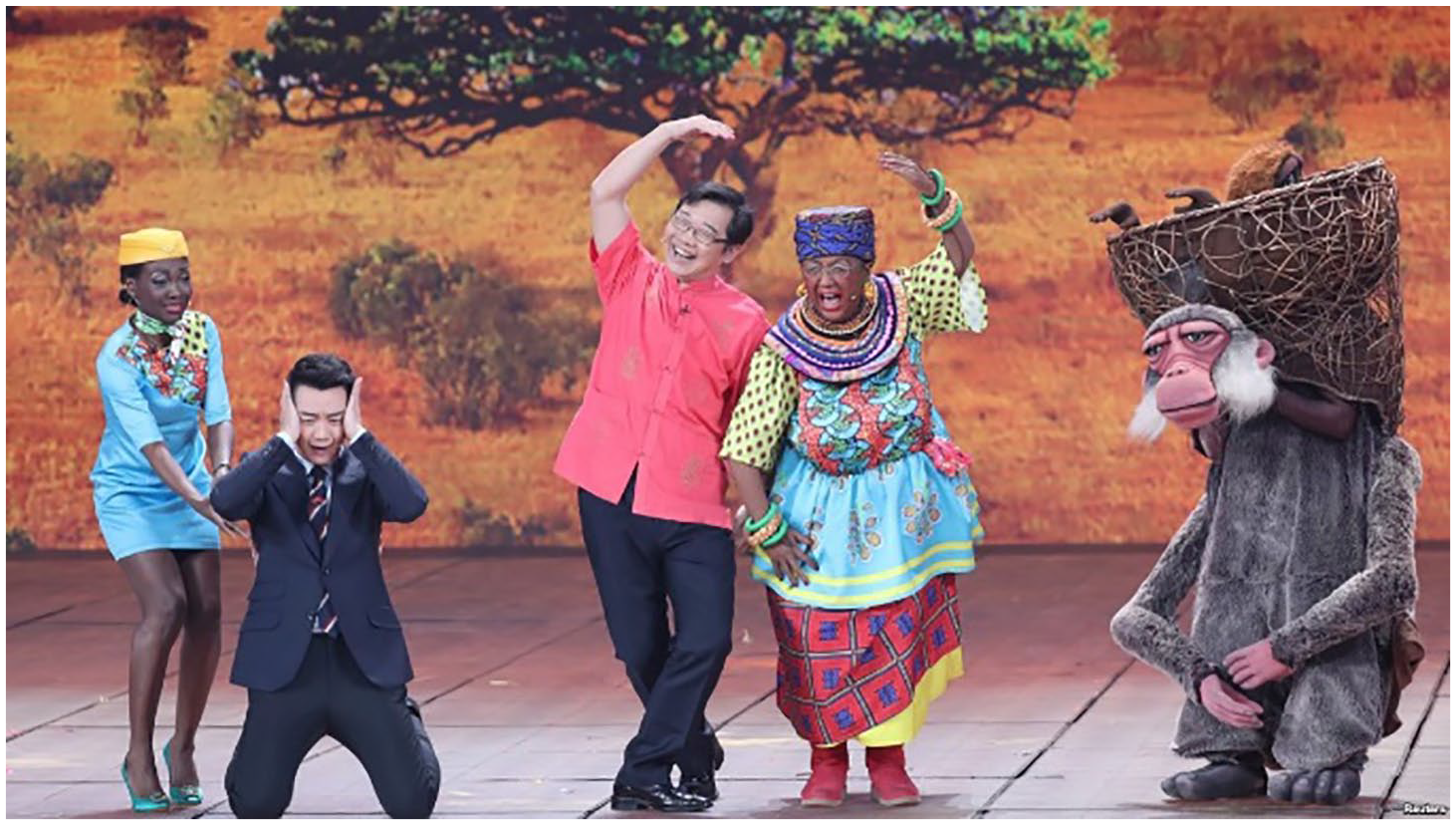
‘I love Chinese people! I love China!’ says Lou Naiming.
The Spring Festival Gala’s faux pas8 could be easily brushed aside if it was not for the degree of trust Chinese audiences have been shown to have in the credibility of their state-owned media that produces the Gala (China Central TV, CCTV), otherwise recognized as the ‘mouthpiece’ of the Chinese leadership (Li and Zhang, 2018; Liu and Bates, 2009; Stockmann, 2013; Xu, 2012; Zhang et al., 2014). Leadership, it should be noted, that is also found to be deeply trusted by its citizenry in comparison with global standards (Shen and Guo, 2013; Zhong and Chen, 2013). Despite foreign broadcasters’ efforts to produce Chinese language content, 2 Guo and Wu’s (2009) research finds that Chinese youth aged 15–25 years old do not in fact seek foreign media as an alternative to that produced within China. What constitutes ‘alternative’ media regarding African relations for many Chinese, Li (2016) explains, is often rather hearsay in China’s digital space and on social media platforms such as WeChat. This is concerning if the studies into China’s social media are to be believed. Shen’s (2009: 426) study into Chinese online discourse found that references to ‘“poor”, “lazy”, “sexist” and “threatening”’ Africans served to enforce the superiority of China’s development capacities and civility. Pfafman et al. (2015: 547) found that complaints about Chinese foreign aid to Africa were utilized to mask Chinese frustrations about their own fears of governmental and economic neglect and instability. And Cheng (2011) concluded that online anti-African rhetoric functioned to mobilize Chinese nationalism. All agree that inter-racial relationships between Chinese women and African men featured prominently in social media as examples of national shame and warnings of a deteriorating moral compass in contemporary Chinese society (Cheng, 2011; Pfafman et al., 2015; Shen, 2009).
The top-level declarations of close friendship between China and the African nations, therefore, appear to be underpinned by both state and non-state media’s racist objectification of the very friends China supposedly has. For many Chinese, mixed mediated messages mean they are left to imagine their nation’s relationship with ‘Africans’ based on little understanding of the cultural and ethnic diversity that exists in Africa. Indeed, in Lan’s book (2017), for example, she expresses marvel at the degree of trust that her Chinese informants placed in these very conflicting official and unofficial messages about ‘Africa’ and ‘Africans’, and by extension, the subsequent confidence they expressed about a race they knew little about. Without race education (Cheng, 2011) or an alternative to the racist presumptions presented in officially and unofficially mediated messages, racism is thus rationalized and made socially acceptable, and used in opposition to defining a Chinese collective agency built on trust both in the Chinese leadership and among Chinese. Africa, and discourse of race and racism, therefore, appear to serve a particular purpose, and are merely secondary concerns.
Method
What follows are the results of semi-structured discussions conducted with 87 Chinese university students studying at a private Chinese university. Due to the fees structure, this university is realistically only accessible to Chinese children of the wealthy. Students reported coming from cities all across China, and were at the time of the discussion groups enrolled in studies in the humanities. Students first completed a questionnaire individually, then engaged in an hour-long group discussion. The screening of WW2 was integrated as part of the course programme, and on the following day, students were separated into one of six groups. It should be noted, the group discussions were led by the Western author, and aided by a Chinese postgraduate student, who both provided translation assistance if required and transcribed the group discussion recordings in the aftermath. Accordingly, the performative nature and desire to express politically acceptable opinions on the part of the students cannot be completely dismissed. Provided either for the benefit of the foreign/Chinese researchers, their class peers, or driven by their own commitment to the research process, these comments reveal in combination an understanding of what these students considered acceptable and necessary discourse appropriate for sharing in such a forum. This in itself makes their feedback worthy of consideration.
Three students reported they knew people (family members and friends) who had been or were currently working in Africa. One of these students had visited family in Tanzania, and another two students had plans to visit Morocco on an organized tour. All but the student who had visited Tanzania confirmed they had never spoken to a black African, and the only person they had engaged with from anywhere within Africa was a white South African English teacher in their university. Africa was identified as having been studied in secondary schooling geography classes, and all other information had been learned through the Chinese media and hearsay from social networks. Students were assured their anonymity in the reporting process and names have been changed in the reporting of events.
A military’s ability to protect
Pre-discussion questionnaires revealed an exceptional 82% (71/87) of the students had ‘some confidence’ (60%) and a ‘lot of confidence’ (22%) in China’s president Xi Jinping to make the right decision in terms of Chinese foreign policy. This reflects earlier studies that argue regime trust among urban Chinese is strong (Zhong and Chen, 2013). Of these 82% of students, 21/71 (30%) agreed they were ‘satisfied’ with the way things are going in China, while the other 50/71 (70%) stated they were ‘somewhat satisfied’. State television and social networks were nominated as their main sources of information about Africa and Sino-African relations. Two students reported watching Chinese produced documentaries about African wildlife; and a third student recalled a TV show featuring Chinese celebrities travelling through Africa. As Lucy (Group 2) explained, I know China has helped Africa a lot by what the government has done there building roads and railroads. According to Chinese news reports about Africa and online articles I have read, it’s always about the Chinese government’s work in Africa. . .but I think I know more about animals in Africa than about the people.
Only 24% (21/87) of students expressed they openly ‘disliked’ the film due to the excessive action and exaggerated sentimentality; while five students (6%) earnestly stated they ‘liked’ the film because they thought it was well-made and brought pride to the Chinese people. The remaining 61/87 (70%) students agreed with the phrase, ‘mamahuhu’ (马马虎虎), or ‘so-so’. When asked why students either disliked the film or were ‘so-so’ in their evaluation, two salient themes across all groups were noted: firstly, the film’s hero was too exaggerated in his ability to single-handedly save hundreds of civilians and to physically tolerate such sustained violence as the film portrays; and secondly, their general distaste for violence in cinema. ‘So-so’, however, implied there were some aspects more palatable than others. Students explained their more positive responses to the film to be related to the pride in their nation the film made them feel, and the sense of security the strength of the military gave them: Wolf Warrior 2 made me feel proud to be Chinese, the film made me feel safe knowing that wherever in the world I am, the Chinese military will protect me. (Louise, Group 1) My favourite was the scene of the passport at the very end of the film when the passport says that no matter where I am a powerful country is behind me. This made me feel very safe, very emotional. (Brenda, Group 4) I enjoyed seeing how powerful the Chinese military is, it made me feel safe. (Sarah, Group 2) When the flag was raised by Leng Feng on his arm, it really moved me to love my country. (Heather, Group 2)
Despite never having faced war or social or political upheaval, WW2 inspired a surprising sense of imminent threat to the personal safety of these Chinese students. Only one student (Bobby, Group 3) was familiar with the mass evacuation of over 30,000 Chinese from Libya in 2011 (Zerba, 2014) to which he drew similarities with the narrative of WW2. Other students, however, could not explain their fears. Three groups (Group 1, 2 and 6) even unanimously agreed feeling unsafe about travel outside of China, and felt WW2 reflected the dangers they might encounter. Students could not, however, say with certainty who they believed such violence would be inflicted by.
While a general sense of uncertainty about being Chinese outside of China was observed, so was a heightened trust in the Chinese military to protect them. These sentiments support Naftali’s (2014) argument that recently revamped military-sanctioned media products marketed to the Chinese youth serve to re-stimulate patriotic respect for the military. Such media products are designed to target a generation brought up in a depoliticized and non-violent economically reformed China.
When subsequently asked what the moral of the film was, students responded with similar themes to why they had liked the film. A tally of responses across the six focus groups revealed three moral readings of the film: (a) You should be proud if you are Chinese; (b) China is strong enough to have relationships with other countries and can save its own citizens as well as other country’s citizens if need be; and (c) The Chinese soldier is ‘strong’ and faces all challenges. The agreement across all focus groups about the moral of the film was clear. So much so that Leanne (Group 6) revealed she had not watched the film prior to the organized screening because: I was scared to see the film, not because of the violence, but because everyone on my social media was saying that if you love your country you will support the film. I did not go to see it because I heard it was violent, because . . . what if I did not like the film? I was afraid to tell people that I did not like the film – because I love my country.
In contrast to the sensitivities of the Western film critics, for Chinese audiences first and foremost, their primary focus was on China’s military and political power, and a reaffirmation of trust in the Chinese state and by extension the PLA when watching the film. Not one student related their evaluations of the film to aspects of race. As William (Group 5) explained: The point of the film was to show China’s power. To make it believable you couldn’t put it in America or Europe. So, they just chose Africa. This is why they did not specify the nation it is set in, because it might insult the country. Set anywhere else it would be unbelievable.
The utility of a non-descript African Other was thus explained as aiding the film’s truth about China’s strength and accordingly, the need for trust in the collective agency of the Chinese nation.
Understanding Africa and Africans in Wolf Warrior 2
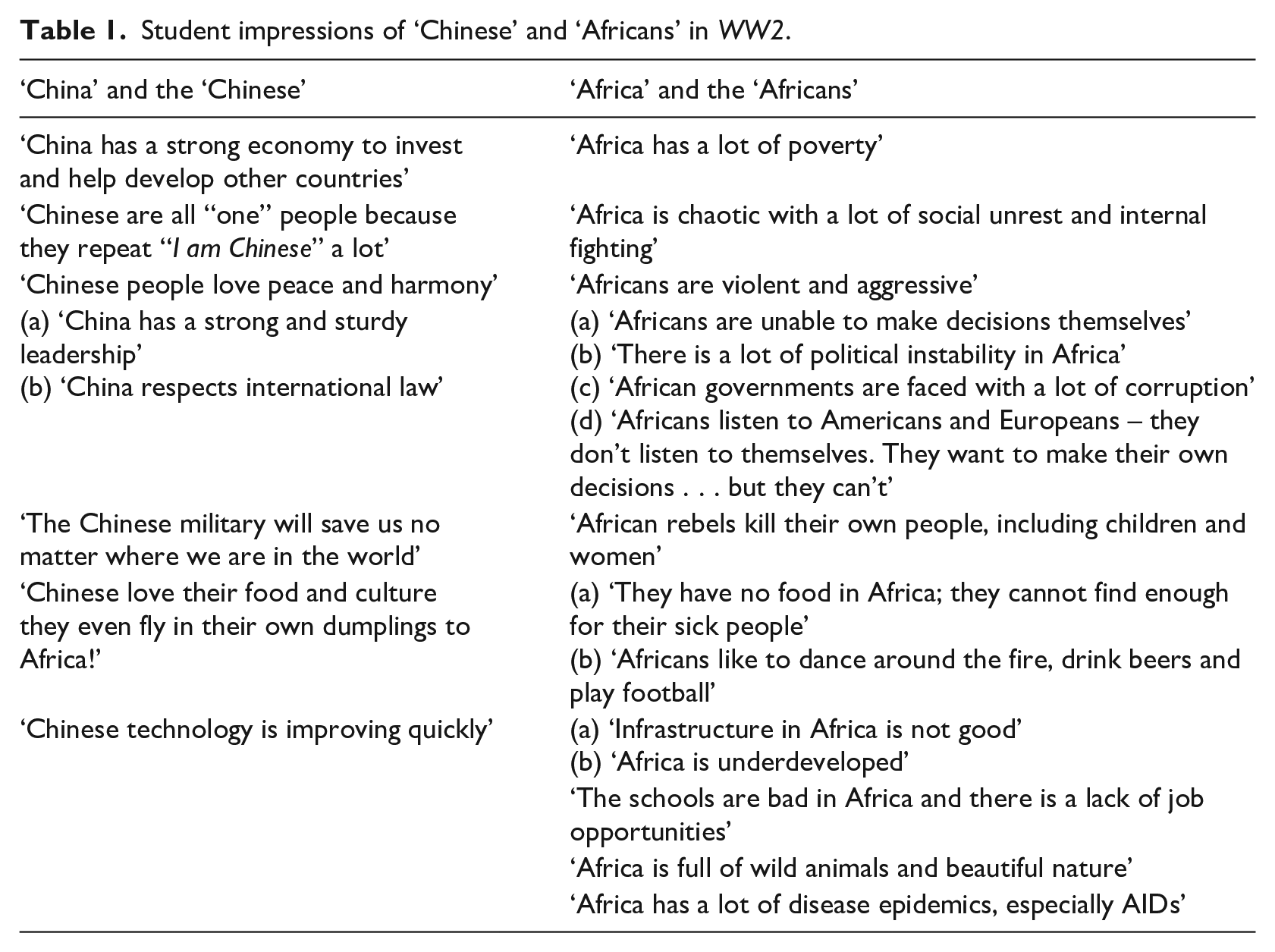
If WW2 was intended to portray China’s power, then Africa’s weaknesses were what made this truth so convincing. Students were asked to list how ‘China’ and the ‘Chinese’ were portrayed in WW2, then to list how ‘Africa’ and ‘Africans’ were portrayed. Student responses revealed that for almost all salient ‘Chinese’ attributes, an equally salient ‘African’ attribute was identified (see Table 1). Yet, with slightly more negative African attributes than admirable Chinese attributes, the imbalance appeared to aid the belief in the validity of China’s strengths.
Student impressions of ‘Chinese’ and ‘Africans’ in WW2.
When asked whether the portrayals they saw in the film about Africa were accurate, the majority (80%) believed the impressions of Africa were ‘close to accurate’. A much smaller minority of 12/87 (14%) students stated they were unsure. Yet even sensing that some exaggeration existed in the film’s depiction, these students found it difficult to denounce the accuracy of the film’s portrayals. As it was, students confirmed they felt very uninformed about their African counterparts, and only two students (including the one who had been to Tanzania) believed the film was an ‘inaccurate’ portrayal.
Accordingly, the great majority were left unconvinced the impressions they gained were entirely inaccurate. As Marie (Group 3) mused, ‘There may be some countries in Africa as rich as developed countries. . . but I just don’t know’. Marie’s response is not altogether surprising if we consider the conviction that these Chinese students had about their feelings of safety and security and trust in their stable and trustworthy leadership in the initial stages of the group discussion. If the film’s portrayal of China’s power and civilized superiority was to be trusted, then by extension so must the portrayal of a weaker Africa and its uncivilized African peoples. To question the depiction of ‘Africa’ in WW2 would be to question the portrayal of ‘China’.
These uncertainties about what is accurately portrayed in WW2 are not unique to this group of young Chinese adults. A survey conducted by China Youth Daily and Sina.com in 2006 revealed that 71.7% of respondents claimed they knew ‘very little’ about Africa, while 10% knew nothing at all; 21.3% had learned what little they knew from the internet, and 21.2% learned what little they knew from film and TV. Respondents primarily associated Africa with ‘Poverty and Underdevelopment’, ‘AIDS’ and ‘Wildlife’ (Li and Rønning, 2013: 105–108). These impressions were reconfirmed once more by a second survey conducted by the Global Times, a tabloid associated with the state-owned People’s Daily in 2009 (Li and Rønning, 2013).
In a vacuum of actual references to draw from, students drew on hearsay from their trusted social networks to show that a collective thinking beyond themselves informed their perceptions of the film’s accuracy. As Cindy (Group 1) explained, My dad says his African friends have told him that in recent years, the Chinese gave lots of money to build a railroad, but that African people think Chinese are silly because we just give them money. Yet they [Africans] also believe there is a China threat, and so. . . I think African people should help themselves, and not always ask Chinese people to give them money.
And Shirley (Group 4) too, offered her insights, I heard that in Africa one man can have many wives, and the women have to do all the house work even if they have a job, and men just get to play.
While such notions about African men or Chinese aid to Africa are not in fact present in WW2, Shirley’s connections to her hearsay and Cindy’s reference to her father’s immediate experience working with Africans were examples of students attempting to legitimize in the group environment their perceptions of accuracy to their peers. Claire (Group 4), however, was not entirely convinced: Well, I went to Sri Lanka, and I think what I saw in the film, makes me think that Africa is sort of the same as Sri Lanka. So, I think Africa cannot be so dangerous.
Although arguably well-intentioned, Claire’s comment indicated she believed broad sweeping comparisons of diverse cultural groups found in different parts of the world, and with little relationship, were useful in understanding the African context. Claire’s comment, however, had little to do with Shirley’s comment about Africa’s patriarchal values. It became clear, students were necessarily clutching to all and any reference points to explain their sense-making of the presentation of a homogeneous ‘Africa’ within the film.
For Sandra (Group 6), her father’s friend’s insights assured her of the film’s accuracy in presentation as she confidently explained: A friend of my father, the boss of a factory, has been in Africa for a few years. The first principle he told us is, never make friends with Africans, because the first time you give him a cigarette and candy he will smile, and if you keep doing this you will be invited for a drink in his home, but this happens very seldom. He says, the best you can hope for, is that the first day you give him a cigarette, he will smile at you, and the next day, they will treat you like you don’t know each other. He also told us that Africans are lazy and stupid, so he often needs institutional support to get them to keep working. And if someone pays them more money, they will leave you.
Sandra’s reference to her father’s role in delivering these insights was not an isolated case, with Jessie (Group 2) revealing her father believed the film’s portrayal of Africa was true, while Michelle (Group 3) spoke of leaving the cinema with her father and her six-year-old younger brother who declared he never wanted to go to the ‘country’ of ‘Africa’. The role of trusted personal networks in confirming broader impressions appeared important to these students.
After watching WW2, only five students confirmed they would like to travel to Africa (including the two that had plans to go to Morocco and the student who had been to Tanzania). For others, they explained: If I knew nothing about Africa, then I would not go after seeing this film; but I didn’t want to go to Africa before the movie, and now I REALLY don’t want to go. (Alex, Group 2) I admit, before this movie I wanted to go to Africa to see the animals – but now I must admit, I am a little bit afraid. (Priscilla, Group 2)
While for Magda (Group 6) perhaps emboldened by Sandra’s comment (above), the conversation about travel to Africa inspired a reflection on a comment made by her mother: My mother told me I’m not allowed to marry a black African. She is afraid that if I marry an African, I will move to Africa, which is dangerous. It’s better in her opinion to move to the USA or Europe.
Asked whether the same problem existed for her to marry an American or European of African heritage, Magda confirmed to giggles from her classmates: If I meet a black person in Europe or USA my mother said she’ll allow it only if he is as good looking as Barack Obama.
Using WW2 as a template from which to ask students to explain their impressions of ‘Africa’ and ‘Africans’ inspired a surprising range of connections and ideas that students drew from to make sense of the propositions the film made. The sharing of these impressions within a group environment not only reflected the vacuum of information and familiarity these students have with the diversity of people and cultures in Africa they brought to their viewing of WW2, but furthermore, the film provided the confidence for students to feel assured that the hearsay they had encountered might indeed have some legitimacy and to share this publicly. With little objection raised by student peers, it appeared that the rationalization of racialized speech was indeed socially acceptable, or perhaps alternatively and also likely, simply unrecognizable.
Trust in a film industry’s formula
Wolf Warrior 2 was released commercially in film markets as diverse as those of the USA, Australia, Europe, South Africa, South East Asia, Brazil and Russia. Accordingly, WW2 must be understood within historical contexts of cinematic representations of the African continent and its peoples that predate the Chinese production. In particular, the context of Hollywood cinema, which ‘consistently represent[s] Whites in a positive light – for what they have done for and given to Africa, not what they have done to and continue to do to Africa or get from Africa’ (Walker and Rasamimanana, 1993: 8). Arguably, the portrayal of the African region and African peoples for the sake of inciting Chinese patriotism is done so unapologetically by the film’s director because sensationalized portrayals of the African continent have already been widely accepted by global film audiences. Using Hollywood as a case in point, students could be found to defend China’s film industry’s right to produce WW2: Hollywood does it, so why can’t China? This was a movie shot like any Marvel film – why should we accept American values in American films – we are Chinese and we are members of this nation, so why should we not accept what our government says? (Bobby, Group 3) I am ok with advocating the strength of the country. When Hollywood does this, they claim they are the best, and this is ok because they are proud of their country, and China should do this too. But the film is too fake, China is simply copying Hollywood, without their own creativity. But this is how we show our patriotism – like America. We are still a developing country and we need to learn from someone how to do this. (Sam, Group 3)
As a market leader in commercial filmmaking, ‘Brand Hollywood’ (Grainge, 2008) reaches audiences across the world and occupies the great majority of film distribution channels. As world leaders in filmmaking, student trust in the Hollywood blockbuster formula was used to rationalize China’s own filmmaking approaches. This deference to Hollywood and Chinese film industry professionals, even made Sally (Group 3) question her own ‘so-so’ evaluation: The reviews of the film were all good [in China], so I think the film must be a good film . . . even if I did not like it myself. I am not a film expert!
3
Steeped in understandings of a global filmmaking hierarchy that matched the current world order, WW2 placed America – both as a nation and as a film industry – as most powerful, Africa as weakest and China as the rising power in between. In the initial stages of economic reforms, Schein (1994) argued that the consumption of ‘whiteness’ in newly imported media products from the USA to China distinguished a global cosmopolitanism among China’s growing urban middle classes. Today, the consumption of a symbolic African ‘blackness’ as WW2 presents, arguably serves to establish trust in a national imagination of a militarily powerful, and economically and politically stable, Chinese collective.
Sino-African ‘friendships’
In the opening scenes of WW2, as the protagonist Leng Feng finds himself caught in a rebel siege and having sought refuge at the Chinese embassy, the Chinese Ambassador subdues the rebel forces surrounding the embassy by claiming, ‘Put down your weapons. China and Africa are friends’. Students were asked how they understood the ambassador’s comments and what responsibilities the Chinese may have in their engagements with the African nations and people? While the majority of students opted out of this conversation with a simple shrug of their shoulders or an ‘I don’t know’, Group 5’s conversation was particularly insightful: Hmm, I don’t know if China and Africa are ‘friends’ – it’s more like the relationship is based on both our ‘interests’. (Anne) I think this film is showing that China has ethics for their behaviour in Africa, but not responsibility to help Africa. (Gerald) Well, the film doesn’t show the Africans asking Chinese for help – so yeah, I think China should only help in Africa if they’re asked to help. (Sarah)
While Anne rounded up the discussion by saying: Throughout history China and Africa have had no relationship – America and Europe made problems in Africa. They are the ones who should be responsible for helping Africa.
Indeed, this notion of responsibility inspired a different conversation about Sino-African engagement in Group 4, when Susan asked: Look, in the film I don’t understand why Leng Feng attempts to save everyone. If we bring them [the African workers] back here [to China], what do we do with them?
To which a discussion about international agreements to care for refugees and asylum seekers ensued. Surprised she had never heard of the ‘refugee’ and quick to wonder about China’s role in these international agreements, Susan asked her classmates incredulously: Oh. . . do we [China] have refugees?
Although students appeared to be uninformed and deeply disconnected from global affairs beyond that which they received in terms of hearsay and state-mediated information, it is true that WW2 does attempt to suggest that Sino-African relations are strong. Scenes in the film consciously include visions of mixed-race couples and elements of racial harmony among the Chinese factory workers that are the focus of Leng Feng’s rescue mission. Yet, these students were not entirely convinced. The notion of a Sino-African friendship appeared to be an abstract concept far from the realities of everyday life and steeped in racial discrepancies. Furthermore, Sino-African relations were situated within a reasoning that China’s activities in Africa were for a particular means to an end, and not a lasting desire for cultural connectivity or shared visions that looked beyond racial difference.
Conclusion
Chinese university students will soon be placed at the heart of Xi Jinping’s cultural exchange strategy with the announcement of 50,000 scholarships for African students to study in China. In a country historically fraught with anti-African racism, Chinese university student responses to the blockbuster, Wolf Warrior 2, suggest attitudes towards and impressions of black Africans continue to draw negative connotations with poverty, low civility and distrust. These connotations are drawn through a number of factors beyond that of the film’s production itself, although the film’s objectification of the African Other to present a powerful China was indeed an influencing factor. These additional factors include trust in mediated messages that offer both Sino-centric stories of Sino-African relations and racist assertions, trust in social network hearsay, trust in the state and the PLA to protect, and, by extension, trust in a state’s oversight of its cinema production to reflect global industry standards set by Hollywood and ideological agendas. In trusting the patriotic values espoused by the film, by extension, the undesirable qualities of a backwards and politically unstable Africa were also to be believed and trusted.
In a vacuum of education about racial awareness and cultural diversity, racialized speech about ‘Africans’ appeared publicly acceptable among these university students. Even in cases where some doubt could be observed, to distrust the film’s portrayal was to question the trustworthiness of the Chinese filmmakers and the sentiments the film espoused. Or in one case, to fear having one’s love for one’s country questioned. Efforts to address racial awareness on Chinese university campuses will be paramount for the success of Xi Jinping’s cultural diplomacy strategy to engage the educated youth of Africa going forwards. While concerning, these findings do, however, suggest that such deference to a nation’s cinema among its audiences, and the state that oversees the nation’s film production and media, could in fact play a significant role in improving people-to-people relations between Chinese and Africans. Indeed, industry rumours about the suspension of the third instalment of the Wolf Warrior series, for example, suggests that there is some sensitivity to the negative international reception of the film among China’s authorities (Grainge文娱研究院, 2018).
For this to occur though, it would require the CCP and state interests in ideological engineering through the film industry to find a balance between domestic (national identity formation and patriotic education) and international (improvements to foreign relations) storytelling needs. So far, history has shown the former rather than the latter is the focus of Chinese commercial filmmaking. Accordingly, China’s rise and power in juxtaposition to a foreign and racialized African Other will likely continue into the foreseeable future in entertainment and news production. This is despite a very real opportunity to rewrite the narrative of Sino-African relations, and significantly, this would be despite having a young adult population socialized to trust in the nation’s film industry’s authority to write such narratives as their primary audience.
Footnotes
Funding
The author disclosed receipt of the following financial support for the research, authorship, and/or publication of this article: This research was made possible by the XJTLU Research Development Fund.
