




Abstract
This research examines how more introverted leaders respond to the social requirements of their leadership roles. Drawing on research on forecasted negative affect, we investigated whether such leaders enact fewer role-congruent behaviors (extraverted and leader-like behavior) throughout the workday due to anticipated negative affect. Moreover, we examined the extent to which role congruent behaviors predict thriving across all leaders, albeit with a weaker relationship anticipated for more introverted leaders. Using a 10-day daily diary study of 197 leaders (1231 observations), results confirmed that more introverted leaders engaged in less extraverted (but not less leader-like) behavior, due to heighted anticipated negative affect. Furthermore, enacting extraverted and leader-like behavior predicted greater thriving for all leaders, with the positive effect of enacting extraverted behavior being weaker for more introverted leaders. Overall, these findings indicate that, while leaders lower in extraversion anticipate challenges, they can still thrive in leadership roles, albeit through different pathways.
Individuals scoring lower on the introversion–extraversion continuum (i.e., introverts) often face challenges in leadership roles; such individuals are perceived as not being “leader-like” and tend to be perceived as less effective in their leadership positions (e.g., Bono & Judge, 2004; Javalagi et al., 2024; Judge et al. 2002; Landis et al., 2022; Wilmot et al., 2019). This disadvantage compared to extraverts (i.e., individuals scoring higher on the introversion–extraversion continuum) can partially be explained by the relationship between extraversion and extraverted behavior (e.g., being talkative, energetic, assertive, bold; see Fleeson, 2001; Fleeson & Gallagher, 2009), which are often viewed as essential for meeting the social demands of leadership roles (e.g., when interacting with others; Clack, 2017; Hogan et al., 1994).
However, other studies have shown that introverts do behave extraverted in assigned leadership roles (e.g., counterdispositional behavior; Spark & O’Connor, 2021), but do so less often than their extraverted counterparts, perhaps because it is more depleting (e.g., Kuijpers et al., 2022). In addition, there are circumstances where introverts achieve superior team performance outcomes, such as when leading proactive teams (Grant et al., 2011). While prior research has examined introverted leadership effectiveness in certain contexts (e.g., Grant et al., 2011) and how introverts forecast negative affect in experimental settings (e.g., Spark et al., 2018), less is known about how leaders lower in extraversion regulate their role-congruent behaviors over time in real-world leadership settings and how this regulation impacts their wellbeing.
To foster the individual strengths of more introverted leaders while maintaining their wellbeing, it is important to examine not only whether leaders lower in extraversion engage in role-congruent behaviors but also the factors that shape their willingness and ability to do so. Understanding these dynamics can provide insight into how such leaders navigate leadership demands and how their behavioral adaptation relates to thriving at work (see, e.g., Blevins et al., 2022).
In this research, we investigate the role of forecasted negative affect in explaining the daily behavior of more introverted leaders and its implications for their thriving. Specifically, we examine whether introversion in leaders is disadvantageous due to its relationship to less extraverted and leader-like behavior—such as influencing group decisions and leading conversations—and if so, why. Building on whole trait theory (e.g., Fleeson, 2001) and forecasted affect research (Zelenski et al., 2013), we propose that more introverted individuals with an existing formal leadership role anticipate an increase in negative affect in upcoming social interactions (meetings, etc.) requiring extraverted behavior. This negative affective forecasting, in turn, should result in less role-congruent behavior by more introverted leaders during the day (i.e., extraverted and leader-like behavior). Furthermore, we investigate the consequences of enacting extraverted and leader-like behavior for more introverted leaders, with a specific focus on their personal growth. Although they may anticipate experiencing negative affect in upcoming social interactions, we expect that engaging in role-congruent behavior will still be beneficial. However, compared to their more extraverted counterparts, they should feel less vigorous and experience a lower sense of learning (i.e., thriving).
To empirically test these ideas, we conducted a 10-day daily diary study with organizational leaders, capturing daily variations in behavioral expectations, affective forecasts, enacted behaviors, and thriving. This approach enables us to examine within-person behavioral dynamics over time, offering novel insights into how introverted leaders regulate their behavior in response to daily leadership demands.
In summary, we propose and test a moderated serial mediation model (see Figure 1) in which daily expectations of extraverted behavior lead to forecasted negative affect, which in turn reduces role-congruent behavior enacted during the workday. This role-congruent behavior—encompassing both extraverted and leader-like behaviors—is ultimately linked to thriving experiences as reported in the evening, with trait extraversion moderating these relationships. This methodology enables us to examine short-term dynamics not captured by cross-sectional designs, thus making several contributions to the literature on leadership and personality.
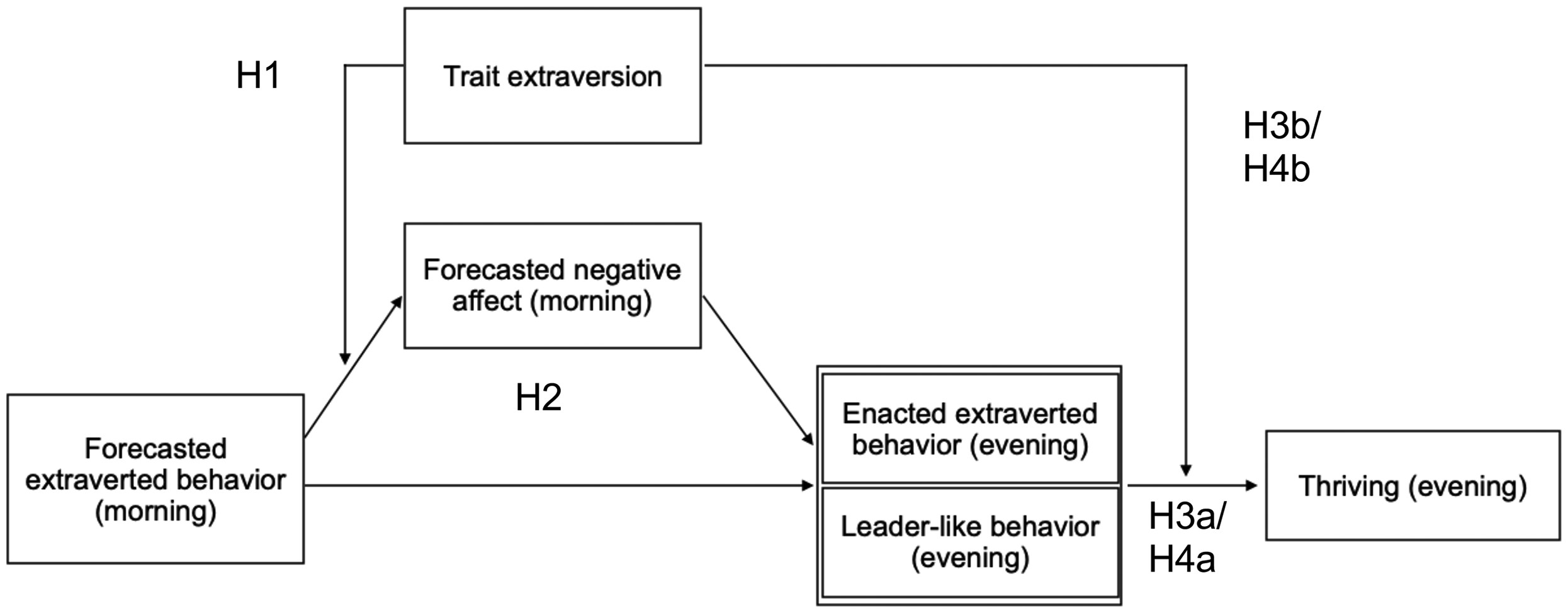
Overall study model. Note. Level 1 are within-person variables, the level 2 variable extraversion is between-person. Enacted extraversion and leader-like behavior were assessed in the evening and represent the leaders’ levels of leader and extraverted behavior throughout the day (retrospective).
First, we contribute to the literature on whole trait theory and counterdispositional behavior (i.e., the difference between one's momentary and average state level; Kuijpers et al., 2021). By examining the role of extraversion and forecasted negative affect in the prediction of two different behavioral outcomes, we contribute to a more comprehensive understanding of which behaviors may—or may not be—truly “counterdispositional.”
Second, we contribute to the knowledge on leader thriving by exploring role congruent behavior as a novel potential driver of thriving in leaders. We investigate whether leaders are more likely to thrive when regularly engaging in extraverted and leader-like behavior. Thriving goes beyond affective outcomes, which are often studied in the field of extraverted behavior (e.g., Kuijpers et al., 2022; Margolis & Lyubomirsky, 2020; Pickett et al., 2020), and includes not only a hedonic (vitality) but also a eudaimonic component of wellbeing (learning; see Ryan & Deci, 2001; Spreitzer et al., 2005). Research is mixed regarding whether counterdispositional behavior serves to increase or decrease wellbeing (e.g., Kuijpers et al., 2021; Leikas et al., 2021) in the short- to mid-term. Our findings therefore clarify how counterdispositional behavior relates to thriving. As thriving is related to important work-related outcomes (e.g., wellbeing, task performance; Kleine et al., 2019), knowledge about predictors of thriving is especially relevant for more introverted leaders seeking to thrive in leadership roles and for organizations seeking to foster thriving in their leaders.
Third, contributing to the literature on a more balanced perspective of introversion (Blevins et al., 2022), our study extends knowledge on how more introverted leaders experience, and respond emotionally to, their leadership role. While previous experimental research has found that introverts tend to forecast negative affect prior to social behavior in simulated leadership tasks (Spark et al., 2018), it is possible that more introverted individuals in ongoing leadership positions have adapted to the social demands of leading and no longer make such negative affective forecasts. This shift in focus from emergent to established leadership roles highlights how more introverted leaders adapt over time in real-world settings. In addition, through our use of a daily diary design, we are able to examine daily within-person relationships between more introverted leaders’ feelings and behaviors.
Theoretical Background
Introversion and Leadership
The term introvert characterizes individuals with lower levels of the personality trait extraversion. That is, in contrast to individuals with a tendency to be outgoing in social interactions, who experience high positive affect, and are motivated to obtain social status (DeYoung, 2013), more introverted individuals tend to be relatively quiet, reserved, shy, and silent (DeYoung et al., 2007; John & Srivastava, 1999). Extraverts, on the other hand—the individuals having higher levels on the introversion–extraversion continuum—positively anticipate interacting with others (Depue & Collins, 1999).
Existing research often emphasizes the advantages of extraversion for leadership (Araujo-Cabrera et al., 2017; Bono & Judge, 2004; Judge et al., 2002; Karlsen & Langvik, 2021; Wilmot et al., 2019; Zhang et al., 2022) while also acknowledging that other personality traits like conscientiousness or neuroticism are also of high importance (e.g., for promotions; Kordsmeyer et al., 2024). Moreover, individuals with a moderate level of extraversion, known as ambiverts (Grant, 2013), may achieve optimal outcomes in certain situations. Although introverts have been shown to be effective in specific leadership contexts, such as when leading proactive teams (Grant et al., 2011), research has largely focused on leadership effectiveness rather than the daily behavioral strategies introverted leaders use in their roles.
In this study, we focus on how leaders lower in extraversion regulate their behaviors across daily leadership interactions and the implications of these behaviors for their wellbeing. Specifically, we consider how more introverted leaders engage in role-congruent behaviors—behaviors aligned with leadership expectations—and how these behaviors relate to their thriving. We define role-congruent behavior as including both (a) extraverted behaviors (e.g., being talkative, energetic, assertive, and bold; Fleeson & Gallagher, 2009) and (b) leader-like behaviors, which involved social leadership actions such as influencing group decisions, leading conversations, and taking charge (Spark et al., 2018). While extraverted and leader-like behaviors are related, they are conceptually and empirically distinct. For instance, Spark and O’Connor (2021) found a correlation between extraverted behavior and leader emergence (i.e., being perceived as leader-like) of r = 0.16, suggesting that extraversion alone does not fully explain leader-like behavior. It is possible that one behaves extraverted without enacting leader-like behaviors (e.g., engaging in small talk during coffee breaks) or enacts leader-like behaviors without being extraverted (e.g., inform employees transparently about company decisions and processes, or convey trust in their competencies). Compared to extraverted behaviors, leader-like behaviors are more task-specific to the leader role, and can, in principle, be performed in an extraverted or an introverted manner. Additionally, we specifically operationalize leader-like behaviors as those necessitating social interaction, such as taking charge of group decisions or being the primary leader within a group, aligning with definitions from Spark et al. (2018).
Introversion and Counterdispositional Behavior
According to whole trait theory, people are capable of behaving against their dispositional preferences and frequently do so. Traits are defined as density distributions of states, with introversion characterized by a distribution centered toward the introverted end of the extraversion continuum (Fleeson & Jayawickreme, 2015). Thus, being introverted means one's behavioral tendencies (states) are typically quiet, reserved, and less assertive—but moment-to-moment behaviors may vary considerably (Kuijpers et al., 2021). According to recent meta-analytic findings, status attainment in leadership often depends on individuals’ capability to regularly enact extraverted behaviors (Grosz et al., 2024). Introverts are thus disadvantaged because they tend to enact these behaviors less frequently, and the question is why.
Many decisions (and thus behaviors) in everyday life are based on affective forecasts (e.g., Wilson & Gilbert, 2003) and these forecasts are themselves influenced by levels of trait extraversion. For example, Zelenski et al. (2013) investigated the interaction between trait extraversion and enacted extraverted behavior on affective forecasts. Specifically, participants were asked to anticipate how they would feel about having to enact either introverted or extraverted behavior in imminent activities (all activities involved interaction with others). Participants were then asked how they felt immediately after the activities. The authors found that introverts were particularly susceptible to overestimating how much negative (but not positive) affect they would experience. Spark et al. (2018) extended Zelenski et al.'s (2013) work by examining the role of affective forecasts in leader emergence. In their experiment with university students, the relationship between trait extraversion and leader emergence was found to be mediated through forecasted negative affect (but not forecasted positive affect). Thus, more introverted students were less likely to emerge as leaders because of their anticipated negative affect about being required to engage in counterdispositional behavior. These affective forecasts can be either in relation to social situations (e.g., team meetings) or to the behavior itself (e.g., being talkative, outgoing, and assertive). Zelenski et al. (2013) and Spark et al. (2018) suggest that introverts will expect to feel discomfort or unease both due to the nature of certain social settings and the pressure to exhibit extraverted behaviors. We focus on expectations regarding behaving extraverted, although we recognize the importance of forecasts regarding situations as well.
We propose that these findings from laboratory studies are particularly relevant for more introverted leaders in their working lives. Unlike experimental settings that examine single encounters, leadership in real-world organizations requires ongoing social interactions throughout the day. Leaders frequently engage in meetings, discussions, and decision-making situations that demand extraverted behaviors. As a result, more introverted leaders repeatedly anticipate upcoming extraverted behaviors, which we expect to heighten their forecasted negative affect. However, we do not propose that anticipated leader-like behavior is associated with forecasted negative affect. Rather, we assume that introverts' forecasted negative affect stems from the expectation of enacting extraverted behaviors specifically—such as high-energy communication, assertiveness, or outward sociability. For more extraverted leaders, in contrast, the relationship between forecasted extraverted behavior and forecasted negative affect should be negative or nonsignificant (Zelenski et al., 2013). While more extraverted leaders are expected to anticipate less negative affect than more introverted leaders when forecasting extraverted behavior, it remains unclear whether their level of anticipated negative affect decreases proportionally with the amount of extraverted behavior planned, or if they consistently expect low levels of negative affect regardless of the extent of extraverted behavior anticipated.
The relationship between morning forecasted extraverted behavior and morning forecasted negative affect is positive for more introverted leaders and negative or nonsignificant for more extraverted leaders.
Feeling negatively about anticipated extraverted behavior, in turn, might hinder introverted leaders from engaging in role-congruent behaviors. Laboratory studies have already shown that forecasted negative affect is linked to less engagement in extraverted behavior (Zelenski et al., 2013) and less leadership emergence (Spark et al., 2018). Thus, forecasted negative affect can be an explanation for why introverts do not act extraverted more frequently and are not perceived as enacting leader-like behaviors more often (even by themselves; Spark & O’Connor, 2021). Based on the rationale for hypothesis 1 and the laboratory findings on consequences of forecasted negative affect, we assume that, at the beginning of the workday, more introverted leaders anticipate negative affect when they imagine having to act extraverted, which results in less extraverted and leader-like behavior throughout the day.
Trait extraversion moderates the mediated path from morning forecasted extraverted behavior to enacted extraverted behavior (H2a) and to leader-like behavior (H2b) during the workday via morning forecasted negative affect. Specifically, we hypothesize that forecasted extraverted behavior will positively predict forecasted negative affect in more introverted leaders, and that the forecasted negative affect will be negatively associated with enacted extraverted behavior and leader-like behavior.
Counterdispositional Behavior and Thriving
We extend prior research on the consequences of counterdispositional behavior for affective outcomes by investigating personal growth, specifically thriving. Thriving refers to the joint sense of vitality (experience of personal growth by feeling energized and alive) and learning (experience of personal growth by having a sense of acquiring and applying knowledge), thus combining the hedonic and eudaimonic components of wellbeing (Ryan & Deci, 2001; Spreitzer et al., 2005). When people thrive, they experience progress and momentum at work (Carmeli & Spreitzer, 2009, p. 169).
Thriving is an important precursor to other wellbeing and performance outcomes. As Kleine et al. (2019) summarized in their meta-analysis, thriving is moderately positively correlated with subjective health (rc = .39), strongly negatively correlated with burnout (rc = −.53), and has beneficial outcomes in terms of job attitudes and performance. Also, thriving is socially embedded (Spreitzer et al., 2005), and therefore especially interesting for examining relationships with personality traits and behaviors which depend on social interactions. Finally, to the knowledge of the authors, thriving in leaders has been rarely studied. Very few studies examined the effect of manager role stress on both employees’ and managers’ thriving (Lin et al., 2022), leaders’ thriving in terms of resilience-research (Ledesma, 2014; Patterson et al., 2009), and self-leadership (e.g., Abid et al., 2021).
We propose that extraverted behavior should be positively related to thriving because of the following reasons. First, according to the model of thriving (Spreitzer et al., 2005), one important antecedent of thriving is heedful relating, which is being attentive to others and having cooperative and supportive interactions (Niessen et al., 2012; Paterson et al., 2014). Indeed, as Kleine et al. (2019) and Liu et al. (2021) showed meta-analytically, heedful relating predicts thriving. Therefore, extraverted behavior should be related to thriving as it is social at its core. Second, extraverted behavior has strong links to positive affect (e.g., Margolis & Lyubomirsky, 2020; see also van Allen et al., 2021), which is positively correlated with thriving (rc = .52; Kleine et al., 2019). Third, warm relationships with others and being friendly have been shown to promote vitality (Atwater & Carmeli, 2009; Shraga & Shirom, 2009). Finally, when leaders engage in social interactions, they might gain information and experience opportunities for learning. As Spreitzer et al. (2005) argue, heedful relating can promote learning experiences, as it enables people to acquire knowledge and skills by learning from the strategies and approaches used by others. Indeed, Carmeli et al. (2009) and Niessen et al. (2012) found high-quality relationships or heedful relating predicted learning. Yet, we acknowledge that extraverted behavior is not necessarily always and directly associated with learning (i.e., extraverted behavior occurs also in contexts in which people are not learning) but provides opportunities to learn through social interactions.
Leaders’ enacted extraverted behavior during the workday is positively related to thriving at the end of the workday.
However, we propose that more introverted individuals should benefit less from acting extraverted in terms of thriving compared to more extraverted individuals. Because a person's trait level is their average behavioral level (Fleeson & Jayawickreme, 2015), a more extraverted individual naturally behaves extraverted more often and enjoys social interactions. Such behavior should promote thriving without any, or only low, costs (e.g., investment of effort). However, more introverted individuals should thrive to a lesser extent than extraverts when they behave extraverted in their daily working life. The more introverted leaders are, the more they are engaging in counterdispositional behavior when acting extraverted. Acting above or below the typical level of sociability might make introverts more tired (Jacques-Hamilton et al., 2019) and more likely to exert self-control (Leikas et al., 2021; Milyavskaya & Inzlicht, 2017). Indeed, Pickett et al. (2020) found that engaging in counterdispositional extraverted behavior was related to depleted vitality about an hour later, and Kuijpers et al. (2022) found within-person fluctuations in acting out of character to be related to experiences of lower positive and higher negative affect, potentially explained by higher levels of depletion. However, Kuijpers et al. (2021) showed that three months of cumulative counterdispositional extraverted behavior did not predict positive emotions and affect. Additionally, Kritzler et al. (2024) did not find consistent evidence for interactions between personality states and traits in their three longitudinal studies. Yet, as we focus on short-term changes in within-person experiences of thriving, the extraverted behavior should be more costly for more introverted leaders and, therefore, they should experience less vitality and learning (i.e., thriving) than more extraverted individuals.
Trait extraversion moderates the relationship between enacted extraverted behavior during the workday and thriving at the end of the workday, in that the positive relationship is weaker for more introverted leaders.
Enacting leader-like behaviors means engaging in role-congruent behavior; thus, one perceives one's enacted behavior as fitting the demands of the leadership role. Studies have shown that successfully mastering assigned tasks and meeting expectations relates to more positive affect and therefore vitality (see Fisher & Noble, 2004). Moreover, leader-like behavior should provide several opportunities to learn. For example, when individuals engage in leadership behavior, they are better positioned to learn about social interactions and communication dynamics and will be more likely to obtain new information by exchanging knowledge with other people (e.g., Carmeli et al., 2009; Niessen et al., 2012; Spreitzer et al., 2005). Therefore, we also expect leader-like behavior to be positively related to thriving.
Leader-like behavior during the workday is positively related to thriving at the end of the workday.
Again, more introverted individuals should benefit less in terms of thriving from engaging in leader-like behaviors than more extraverted individuals. As extraverts enjoy social interactions, and many leadership tasks require social interactions, leader-like behavior is role- and personality-congruent for more extraverted leaders, whereas it is role-congruent but perhaps counterdispositional for more introverted leaders. Even though leader-like behaviors, in principle, can be enacted in an extraverted or introverted manner, we argue that leader-like behavior is associated more with, for example, being dominant or actively approaching subordinates. Therefore, we expect that more introverted leaders should benefit less from enacting leader-like behaviors and thus thrive less due to the possible costs of counterdispositional behavior.
Trait extraversion moderates the relationship between leader-like behavior during the workday and thriving at the end of the workday, in that the positive relationship is weaker for more introverted leaders.
Method
Participants and Procedure
Participants were recruited via a panel provider (respondi AG) in Germany in June and July 2021, when working from home due to the COVID-19 pandemic was no longer mandatory in Germany and many leaders were back in the office. Participants received up to 400 “mingle-points” depending on the number of questionnaires being answered (100 mingle points equal 1€). Mingle points can be exchanged for a transfer to a bank account, a shopping voucher, or a donation of the cash value.
Following the recommendations of Simmons et al. (2011), we have set a sample size of 150 participants due to practical reasons prior to data collection: The study was time-consuming, especially for leaders who typically have heavy workloads and tight schedules; leaders were asked to complete a general questionnaire and to participate in a diary study twice a day for 10 working days. To increase the likelihood that 150 to 200 participants would remain in the sample after data matching and exclusion of poor responders, we over-recruited.
In sum, 1,027 panelists expressed interest in participating in the study and completed a screening survey in which they reported whether they worked full time (>35 h per week) and had a leadership position. If participants met the inclusion criteria (leadership position and working full time), they were asked to complete the general survey. From them, 435 leaders completed the general survey, but we excluded 19 participants who initially stated that they have a leadership position but reported that they do not have any subordinates, 10 leaders who reported divergent information about their working hours compared to the information they provided in the screening questionnaire (i.e., who now reported < 35 h per week), 44 speeders (< 6 min; Wood et al., 2017), and five leaders who did not pass an attention check.
In the end, we invited 357 leaders to complete the diary survey. After passing a screen-out question (“Will you be working today?”), participants had to fill in the morning survey (available from 05:30 AM to 10:00 AM) and evening survey (available from 05:00 PM to 09:30 PM). Participants completed 1,544 morning surveys (43% of all invitations) and 1,272 evening surveys (36% of all invitations). The final sample included 206 participants who participated on at least two complete days. After matching the diary data with the general questionnaire data, the final sample consisted of 197 leaders with diary data from on average 6.25 days (SD = 2.62; range 2–10 days; n(level1) = 1,231; 142 of the leaders (72%) have participated on five or more complete days).
The 197 leaders (61% male) had an average age of 49.73 years (SD = 10.37; range 27–65 years) and a job tenure of M = 9.95 years (SD = 8.44; range 0.50–44.33 years). On average, the leaders reported working 42.80 h per week (SD = 5.55) and led an average of 48.91 subordinates. 1 The leaders worked from home 1.92 days per week on average (SD = 2.05; N = 187). An average of 33% of the participants’ subordinates worked from home each day (SD = 36.85). Further, we asked the participants each morning to assess how they planned to communicate during that workday. On average, the participants expected to communicate each day 45% face-to-face (SD = 37.48), 21% via videoconference tools (SD = 30.22), and 32% on the phone (SD = 29.89).
Measures
The scales measuring leader-like behavior and thriving were translated into German and then back-translated into English. All other scales were already available in German. For measuring enacted extraverted behavior, we used a different scale than for trait and forecasted extraversion. Our preference was to use the BFAS framework in our trait and forecasted measure because (1) it does not suffer limitations of many shorter measures, (2) it has become good practice to employ hierarchical measures of trait extraversion in leadership research following the Do and Minbashian (2014) meta-analysis which demonstrated that extraversion aspects might differentially impact leadership outcomes (see also Karlsen & Langvik, 2021), and (3) question/item-based measures of extraversion translate into forecasted extraversion questions more easily than adjective-based measures. As the BFAS has never been used (nor validated) at the state/enacted level, we used the adapted (validated) Big Five Mini-Markers to measure enacted extraverted behavior. For an overview over all extraversion-related items used, see Table A1 in the Appendix. The presentation of all diary-based measures follows the order in which they were assessed.
Trait Extraversion (General Survey)
Trait extraversion was assessed using the 20 items from the German translation of the Big Five Aspects Scale (BFAS-G; Mussel & Paelecke, 2018). This scale consists of the two subscales enthusiasm and assertiveness, which are assessed with 10 items each. The BFAS was explicitly designed and validated to assess stable trait-level differences (Mussel & Paelecke, 2018). Participants were asked to rate how much they agreed or disagreed with each statement on a seven-point Likert scale (1 = strongly disagree to 7 = strongly agree). A sample item for assertiveness is “I take responsibility” and a sample item for enthusiasm is “It is easy for me to make new friends.” We used the combined scale for trait extraversion in the present study. Revelle's omega total reliability coefficient was good (ω = .87; see Revelle & Zinbarg, 2009).
Diary Study
Control Variables
Data Analysis
We conducted multilevel analyses using R (available at http://r-project.org) to analyze the hierarchical data (days, level 1, nested in persons, level 2). To confirm the a priori factor structure, we conducted a multilevel confirmatory factor analysis (MCFA) in the package “lavaan” (Rosseel, 2012). To test for potential overlap, we distinguished between forecasted extraverted behavior and forecasted negative affect from the morning questionnaire as well as among enacted extraverted behavior, leader-like behavior, and thriving from the evening questionnaire. The MCFA with forecasted extraverted behavior and forecasted negative affect as separate factors on levels 1 and 2 revealed an acceptable fit, χ2 (df = 68) = 345.16, p < .001 (Comparative Fit Index [CFI] = 0.92; Root Mean Square Error of Approximation [RMSEA] = 0.06). The MCFA with enacted extraverted behavior, leader-like behavior and thriving as separate factors (three higher-order facets, thriving consists of two subfacets on both levels) demonstrated good fit, χ2 (df = 198) = 705.20, p < .001 (CFI = 0.94; RMSEA = 0.05). All items loaded on their respective factors above .40. Hypotheses were tested with hierarchical linear regression analyses using the packages “lme4” (Bates et al., 2015), “lmerTest” (Kuznetsova et al., 2017), and “mediation” (Tingley et al., 2014). The cross-level interactions were plotted using an online tool by Preacher et al. (2006). Simple slopes were calculated using the “reghelper” package (Hughes, 2020). In the first step of the hierarchical linear regression analysis, we included the control variables. The hierarchical linear regression analyses used mixed effects models. We tested random slopes when the models yielded a better fit (indicated in the tables) compared to models with fixed slopes. To test the significance of the model changes we used −2 Log-Likelihood. Level 1 variables were person-mean centered and level 2 variables were grand-mean centered.
Results
First, we examined the proportion of between-person and within-person variance of the study variables assessed at the day level (ICC(1), see Table 1). As the ICC(1) ranged between .536 and .691, multilevel modeling was required to test our hypotheses. Tables 1 and 2 show the mean values, SDs and intercorrelations for levels 1 and 2 data.
Means, Standard Deviations, and Correlations at the Within-Person Level (Level 1).
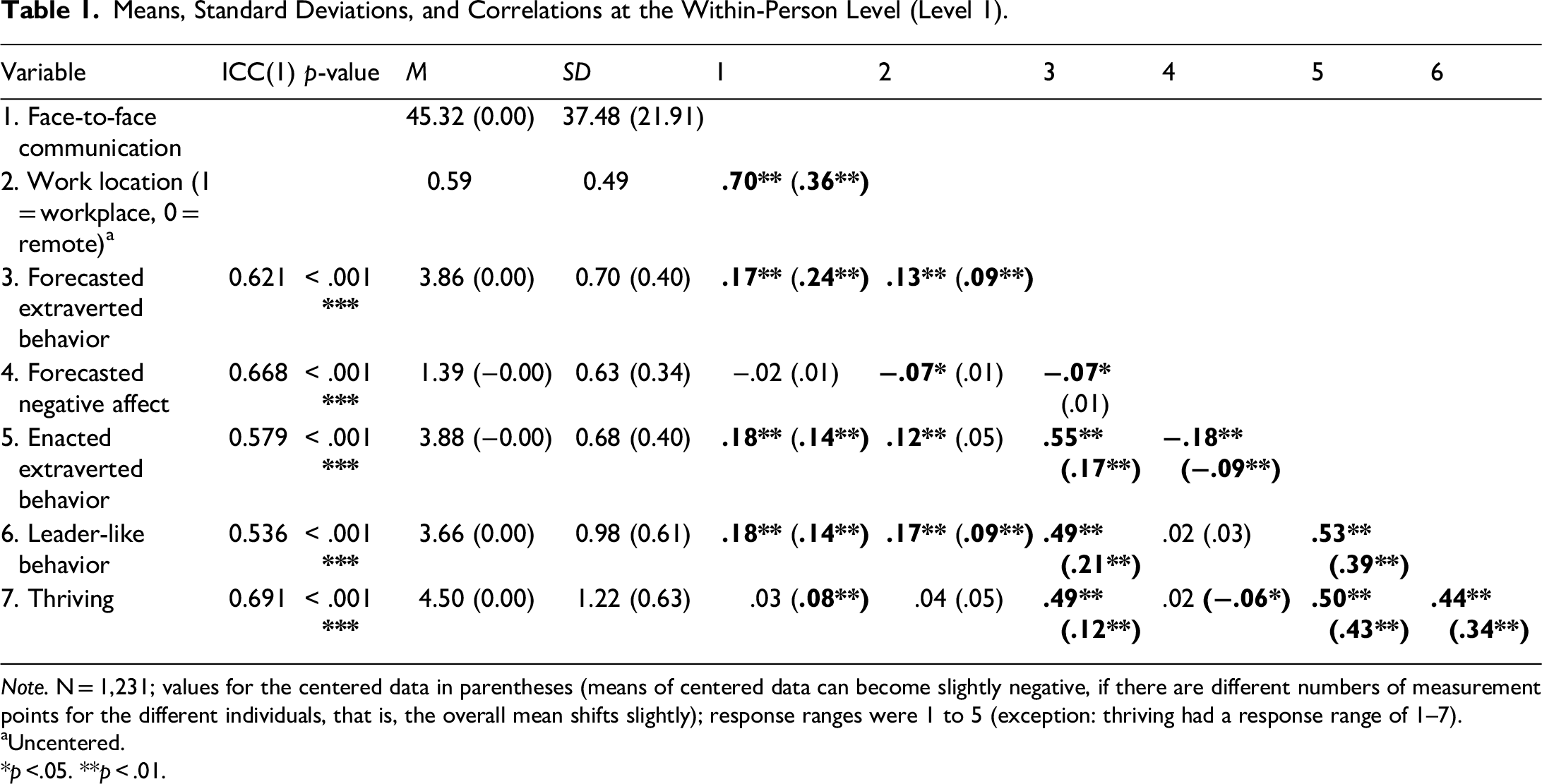
Note. N = 1,231; values for the centered data in parentheses (means of centered data can become slightly negative, if there are different numbers of measurement points for the different individuals, that is, the overall mean shifts slightly); response ranges were 1 to 5 (exception: thriving had a response range of 1–7).
Uncentered.
*p <.05. **p < .01.
Means, Standard Deviations, and Correlations at the Between-Person Level (Level 2).
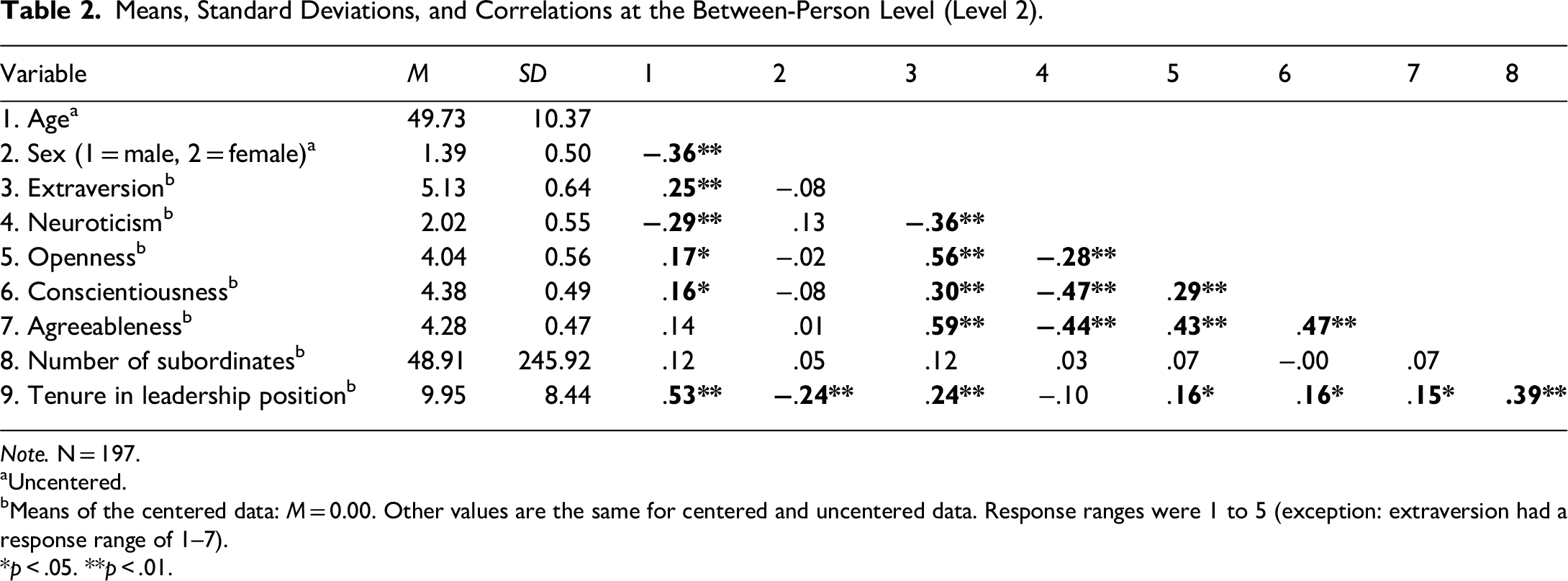
Note. N = 197.
Uncentered.
Means of the centered data: M = 0.00. Other values are the same for centered and uncentered data. Response ranges were 1 to 5 (exception: extraversion had a response range of 1–7).
*p < .05. **p < .01.
Hypothesis 1 proposed that trait extraversion moderates the relationship between forecasted extraverted behavior in the morning and forecasted negative affect in the morning. Hierarchical multilevel regression analysis showed that the cross-level interaction between forecasted extraverted behavior and trait extraversion predicting forecasted negative affect was significant (est = −0.12, SE = 0.04, p = .01; see Table 3). To plot the cross-level interaction and calculate simple slopes, we used percentile values for trait extraversion (5%, 25%, 50%, 75%, and 95%). For the most introverted leaders (5th percentile; grand-mean centered trait extraversion = −1.08, which equates to a value of 4.05 on the original seven-point extraversion scale), more extraverted behavior was significantly related to more forecasted negative affect (simple slope = 0.12, SE = 0.05, p = .02; see Figure 2). In contrast, for the most extraverted leaders (95th percentile; grand-mean centered trait extraversion = 0.98, which equates to a value of 6.11 on the original seven-point extraversion scale), forecasted extraverted behavior was significantly related to less forecasted negative affect (simple slope = −0.11, SE = 0.05, p = .04). At the other levels of trait extraversion, the simple slopes were not significantly different from zero. In sum, the results supported hypothesis 1.
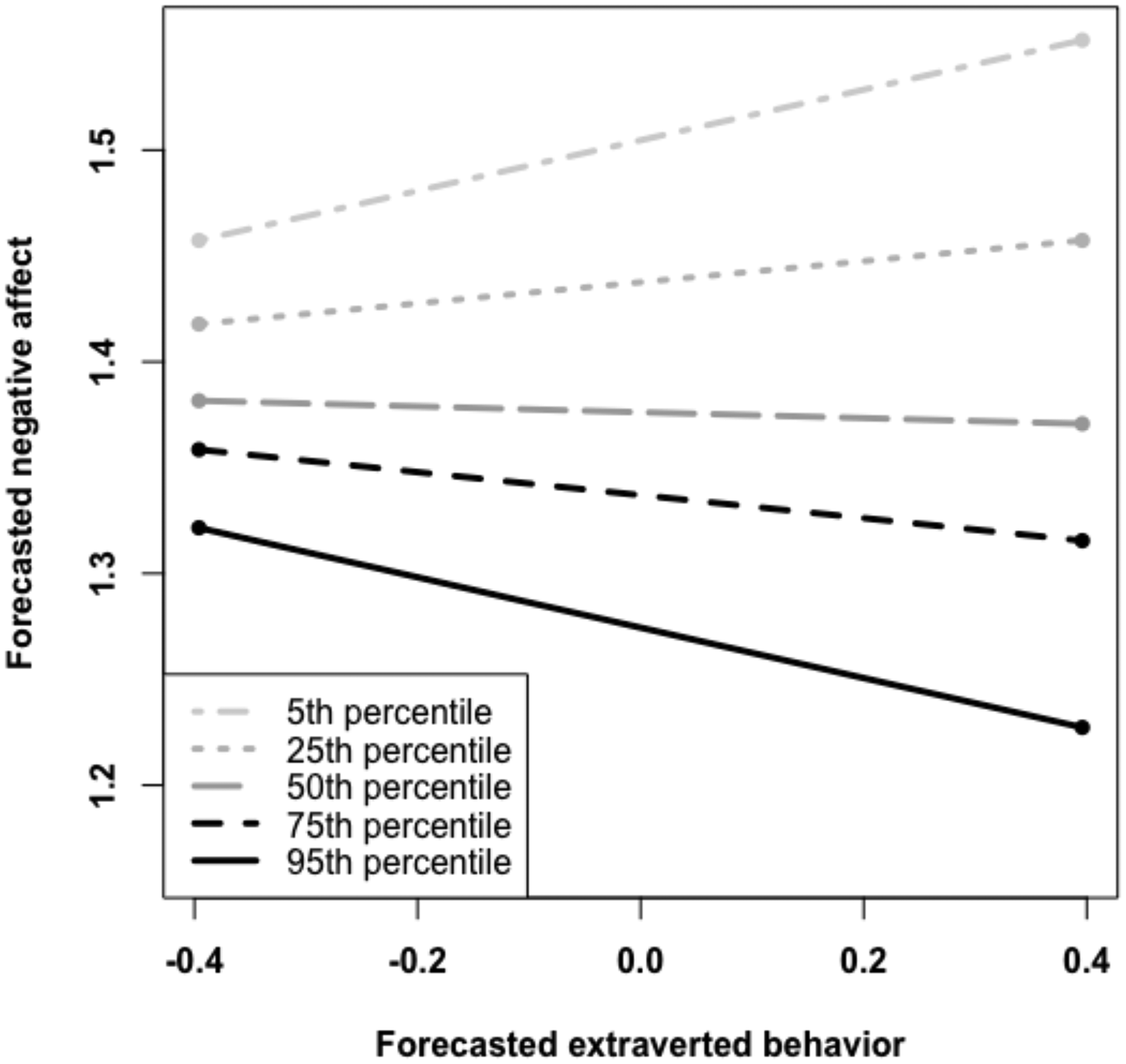
Relationships between forecasted extraverted behavior and forecasted negative affect at very low to very high values of the moderator (extraversion): percentiles (5%, 25%, 50%, 75%, and 95%).
Results of Hierarchical Linear Models Predicting Forecasted Negative Affect.
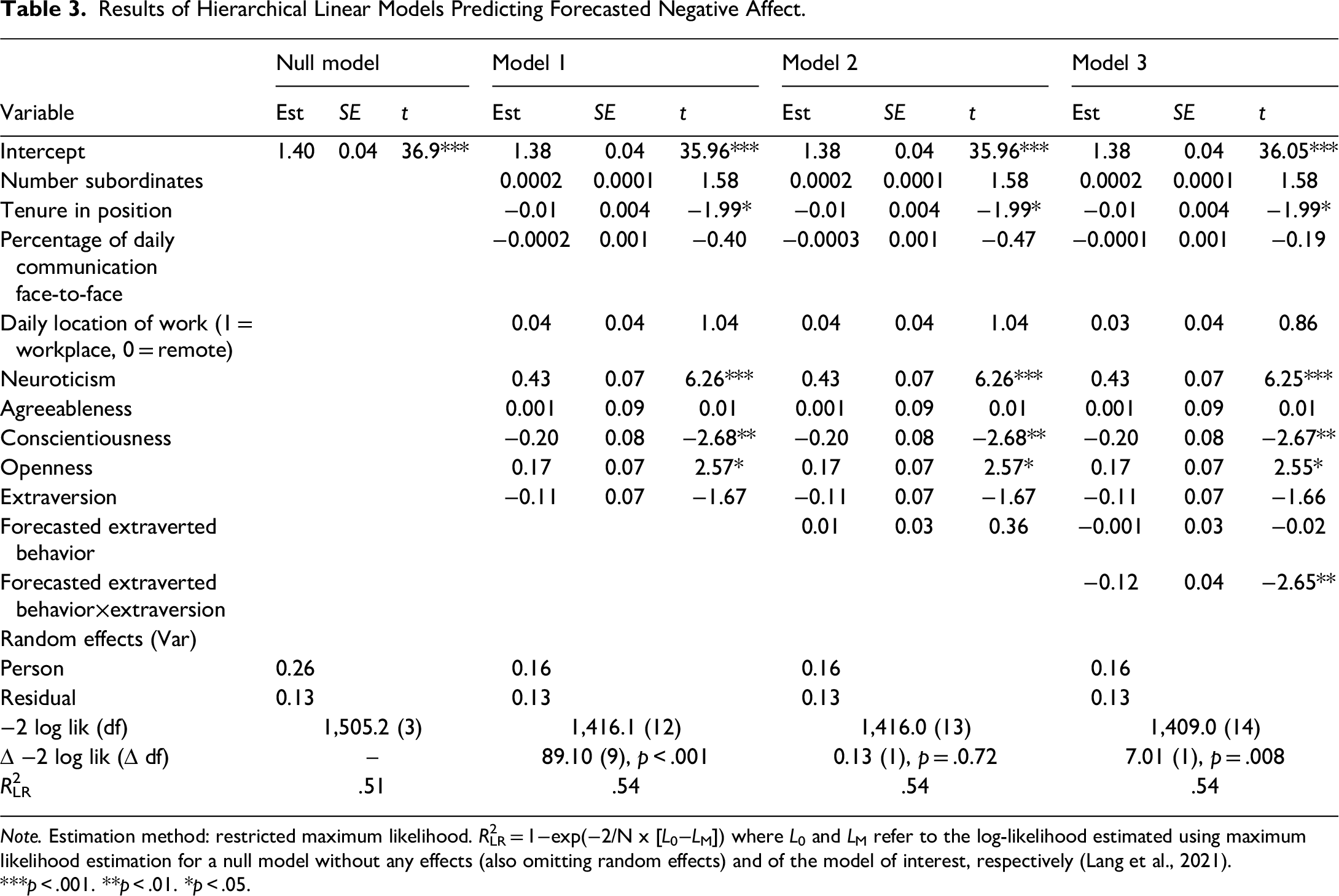
Note. Estimation method: restricted maximum likelihood. R2LR = 1−exp(−2/N x [L0−LM]) where L0 and LM refer to the log-likelihood estimated using maximum likelihood estimation for a null model without any effects (also omitting random effects) and of the model of interest, respectively (Lang et al., 2021).
***p < .001. **p < .01. *p < .05.
Hypothesis 2 proposed that trait extraversion moderates the indirect effect of forecasted extraverted behavior in the morning on enacted extraverted behavior (H2a) and on enacted leader-like behavior (H2b) during the workday through forecasted negative affect in the morning. Two moderated mediation analyses showed that the indirect effects for enacted extraverted behavior were significant for the most introverted and the most extraverted leaders (see Table 4). For the most introverted leaders (5th percentile), the more they anticipated having to act extraverted that day in the morning, the less extraverted behavior they enacted throughout the day, as they predicted at the beginning of their workday that they would experience more negative affect due to this extraverted behavior (ind. effect = −0.01, p = .02). For the most extraverted leaders (95th percentile), by contrast, forecasting more extraverted behavior was related to enacting more extraverted behavior, mediated through forecasted negative affect (ind. effect = 0.01, p = .04). We did not find a mediated moderation effect for leader-like behavior. Therefore, only hypothesis 2a was supported.
Results for Tests of Conditional Indirect Effects of Forecasted Extraverted Behavior on Enacted Extraverted Behavior/Leader-Like Behavior via Forecasted Negative Affect, at Very Low to Very High Values of the Moderator (Extraversion): Percentiles (5%, 25%, 50%, 75%, and 95%).
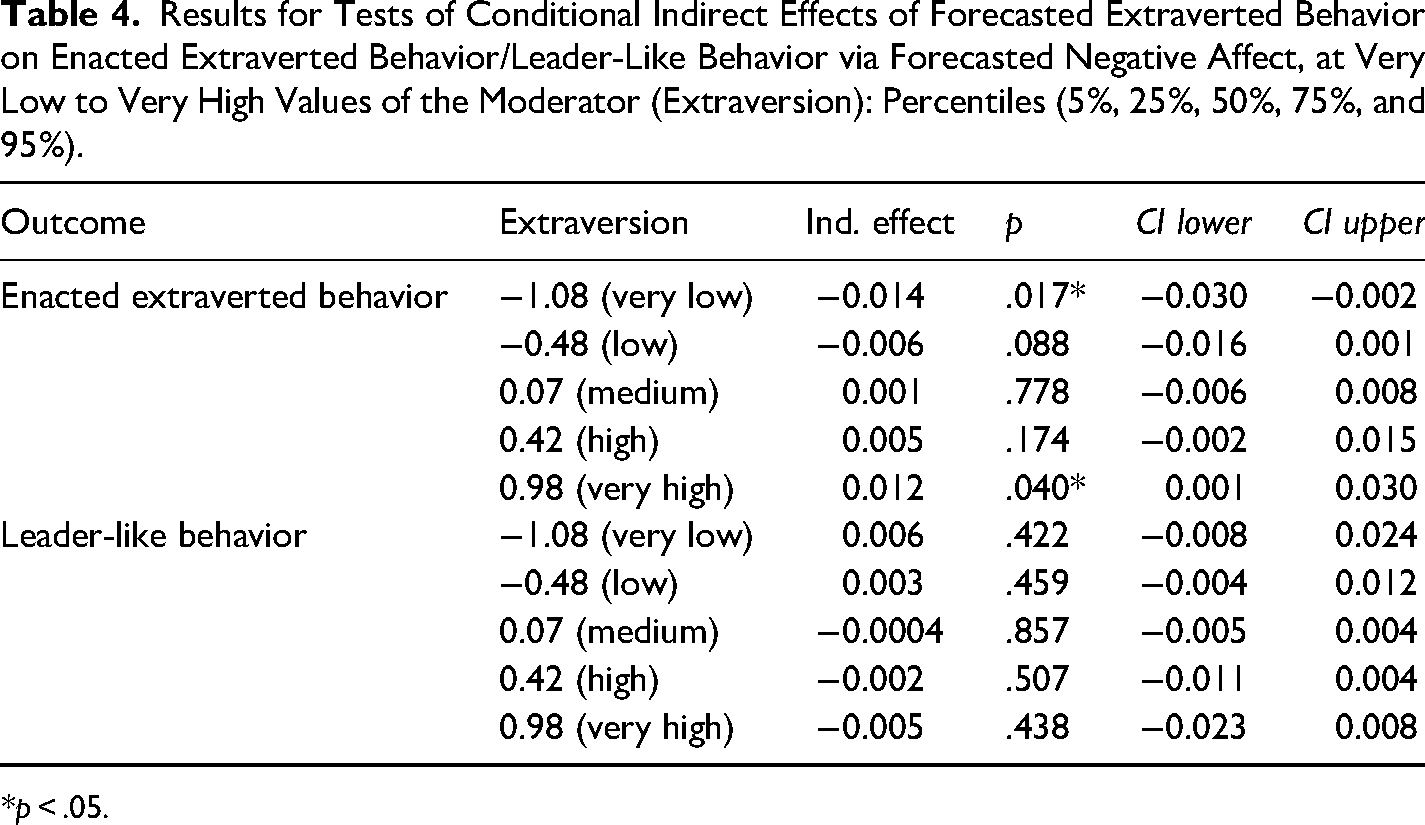
*p < .05.
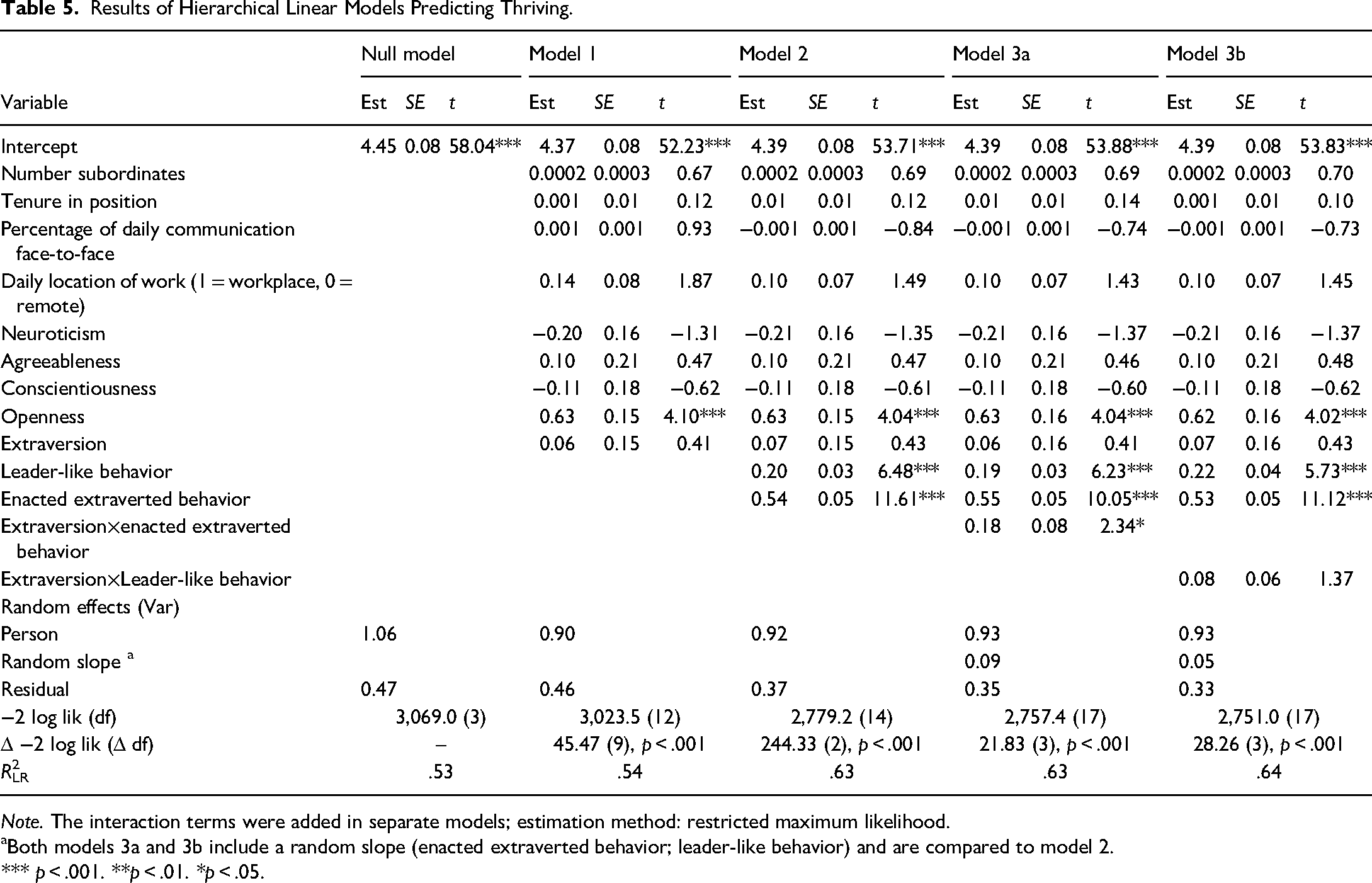
Hypotheses 3a and 4a proposed positive relationships between enacted extraverted behavior and thriving and between leader-like behavior and thriving, respectively. Both hypotheses 3a and 4a were supported, as enacted extraversion (est = 0.54, SE = 0.05, p < .001; see Table 5, model 2) and leader-like behavior (est = 0.20, SE = 0.03, p < .001; see Table 5, model 2) positively predicted thriving.
Results of Hierarchical Linear Models Predicting Thriving.
Note. The interaction terms were added in separate models; estimation method: restricted maximum likelihood.
Both models 3a and 3b include a random slope (enacted extraverted behavior; leader-like behavior) and are compared to model 2.
*** p < .001. **p < .01. *p < .05.
Hypotheses 3b and 4b proposed that the relationship between engaging in role-congruent behaviors during the day (enacted extraverted behavior and leader-like behavior, respectively) and thriving in the evening depends on trait extraversion. The cross-level interactions were included in separate analyses. Hypothesis 3b was supported (est = 0.18, SE = 0.08, p = .02; see Table 5, model 3a), 2 but hypothesis 4b was not (est = 0.08, SE = 0.06, p = .17; see Table 5, model 3b), as only the cross-level interaction between trait extraversion and enacted extraverted behavior predicting thriving was significant. The plot of the significant cross-level interaction (see Figure 3) and the simple slope analysis revealed that the more introverted the leaders were, the weaker the relation between enacted extraversion and thriving (most introverted leaders [5th percentile]: simple slope = .35, SE = .10, p < .001; more introverted leaders [25th percentile]: simple slope = .46, SE = .06, p < .001; leaders with medium levels of trait extraversion [50th percentile]: simple slope = .56, SE = .05, p < .001; more extraverted leaders [75th percentile]: simple slope = .62, SE = .07, p < .001; most extraverted leaders [95th percentile]: simple slope = .73, SE = .10, p < .001).
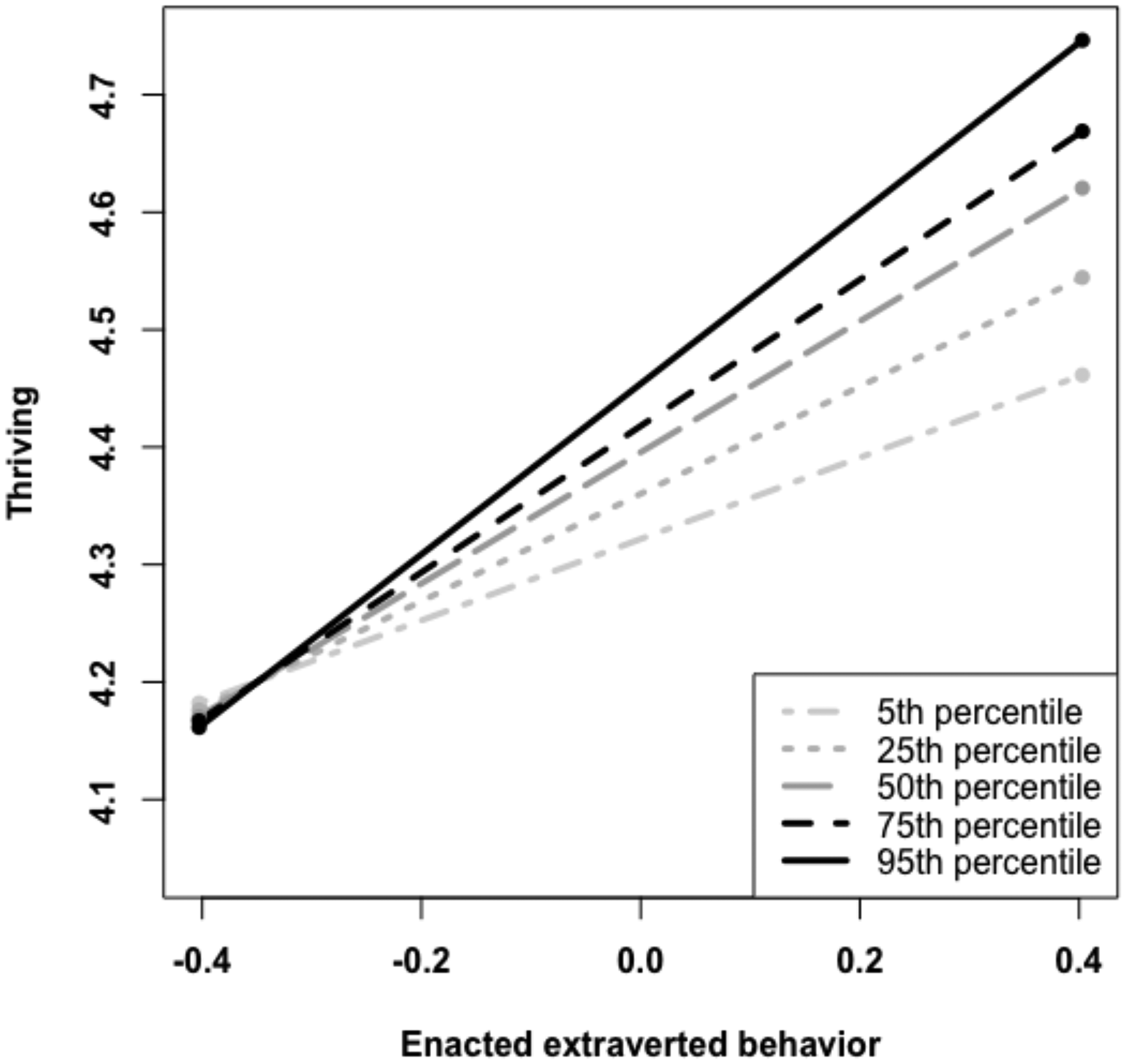
Relationships between enacted extraverted behavior and thriving at very low to very high values of the moderator (extraversion): percentiles (5%, 25%, 50%, 75%, and 95%).
Discussion
The goal of the present diary study was to examine (1) whether and why more introverted leaders engage in less extraverted and less leader-like behaviors in their daily working life, and (2) if they engage in extraverted and leader-like behavior, whether they can benefit from it in terms of thriving, even though such behavior goes against their disposition. By using data of 197 leaders from a 10-day daily diary study we were able to examine within-person relationships between (more introverted) leaders’ forecasted affect when they anticipate extraverted and role-congruent but counterdispositional behavior. Our findings support the assumption that forecasted negative affect (based on anticipated extraverted behavior) in the morning matters for the extent to which the most introverted leaders actually engaged in extraverted behavior during the workday, but not how much leader-like behavior they enacted during the workday. In addition, role-congruent behavior (enacted extraverted behavior and leader-like behavior) during the day was related to more thriving: as expected, the relationship between extraverted behavior and thriving was weaker (albeit still positive) for the most introverted leaders, while the relationship between leader-like behavior and thriving was not. This finding suggests that introverts have the potential to thrive, even when their actions diverge from their natural disposition.
Theoretical Implications
We have responded to the call by Zelenski et al. (2013) to investigate personality differences and counterdispositional behavior over extended periods outside the laboratory context. Specifically, we investigated whether the effects of affective forecasts among more introverted individuals are evident in ongoing leadership roles. We found that, at the beginning of their workday, the most introverted leaders anticipated that they would experience more negative affect when they forecast situations requiring extraverted behavior, which was related to less enacted extraverted behavior. This finding is in line with past laboratory research on leader emergence suggesting that introverts engage in less extraverted behavior when forecasting negative affect (e.g., Spark et al., 2018; Zelenski et al., 2013) and supports the notion of an affective forecasting error (Zelenski et al., 2013). Our finding might indicate that more introverted leaders have not learned to correctly predict how they will feel when they meet the (social) requirements of the leadership role; they still anticipate negative affect for social interactions. This idea is in line with Zelenski et al.'s (2013) assumption that experience is not enough, because introverts often behave extraverted (and thereby experience positive affect; Fleeson et al., 2002), and “if experience was enough, we should not see the forecasting differences we do” (p. 1105). In sum, our findings indicate that forecasted negative affect still plays a role amongst more introverted individuals who have made it into a leadership role. Moreover, by replicating the results of previous studies (e.g., Spark et al., 2018; Spark & O’Connor, 2021; Zelenski et al., 2013) while considering the other Big5 as control variables, we ensure that our model specifically tests whether, for individuals with equal levels of these other traits, differences in extraversion predict forecasted negative affect.
Unexpectedly, we did not find that the most introverted leaders rate their performance on important tasks (i.e., influencing group decisions, leading conversations in groups, and being the real leader of the group) lower than more extraverted leaders when they anticipated feeling negatively. Moreover, there was no direct relation between forecasted negative affect and leader-like behavior. This might indicate the affective forecasting error's explanation of why introverts engage in less extraverted behavior (Zelenski et al., 2013) even though they seem to enjoy it (Fleeson et al., 2002; McNiel et al., 2010; McNiel & Fleeson, 2006; Zelenski et al., 2012) does not hold for a broader range of, albeit related, leadership behaviors. Leadership behavior tends to be task-specific to the leadership role and can in principle be performed in a more extraverted or more introverted manner. More introverted leaders might have learned to perform leader-like behavior in ways more congruent with their personality (e.g., by being more receptive to employee proactivity and by taking more time to listen to and consider their ideas and suggestions, see Grant et al., 2011).
Yet, we assessed only leader-like behaviors requiring social interactions which limit the generalization of the results across all types of leader-like behavior. Therefore, it is important for future research to examine other leader-like behaviors such as task behaviors (i.e., activities that contribute to the team's primary tasks, such as completing team-relevant assignments), and boundary behaviors (i.e., coordination and consultation with outside constituents with the goal of creating resources that facilitate team performance; see Lanaj & Hollenbeck, 2015). Further, future research might examine relations-oriented (e.g., supporting, developing, and empowering) and change-oriented (e.g., advocating and envisioning change, facilitating collective learning) leadership behaviors (see Yukl, 2012). There already is existing literature pointing to extraversion being positively related to follower ratings of change and production leadership behavior, which seems to be due to the subfacet assertiveness. However, the subfacet excitement seeking seems to be related to lower self-ratings of production behavior, and lower subordinate ratings of employee behaviors (Karlsen & Langvik, 2021). Future research could thus benefit from further analyses on subfacet level. 3 Furthermore, in contrast to previous studies (e.g., Spark et al., 2018; Spark & O’Connor, 2021), we examined self-reported leader-like behavior and did not include peer reviews. Therefore, future research should investigate whether other-ratings of leader-like behavior lead to different results than self-ratings.
As expected, both enacted extraversion and leader-like behavior predicted thriving. We also found that trait extraversion moderated the relationship between extraverted behavior and thriving, but not between leader-like behavior and thriving, suggesting that even though performing key tasks in the leader role probably is counterdispositional behavior for introverts, these behaviors do not necessarily appear to be negative in terms of thriving. Most of the leaders in the sample were experienced and therefore we suggest that they were capable of meeting role requirements and benefitted from a high level of job autonomy, which meant that they may have been able to thrive in their daily leadership tasks regardless of their level of trait extraversion. As leaders can take on different roles, have a high level of job autonomy, and perform a variety of tasks that go beyond extraverted behavior, not all leadership tasks are necessarily counterdispositional for introverts. Moreover, a high degree of job autonomy allows leaders to craft their roles and ensure a good fit between their needs, skills, and abilities (Wrzesniewski & Dutton, 2001). In sum, even though acting like a leader should be counterdispositional for more introverted leaders, experience, job autonomy, and the variety of different tasks might be reasons why they also can benefit from such behaviors. Future research should use this as a base for examining additional moderators and other outcomes to further uncover the positive (or negative) effects of counterdispositional behavior. Moreover, future research should also examine the possibility that acting in role congruent ways may lead to thriving via extrinsic rewards (i.e., meets others’ expectations) but could have some negative impacts or costs intrinsically (i.e., feelings of inauthenticity and fatigue).
Practical Implications
Our results show that leadership is a complex role that includes far more than the requirement to act extraverted and that more introverted individuals might also benefit from leader-like behaviors. The leaders we studied have held leadership positions for an average of 10 years, and regardless of personality, leader-like behavior over the course of the day was associated with greater thriving at the end of the day. Additionally, even though less than their more extraverted counterparts, our results are in line with findings that introverts’ extraverted behavior can also relate to higher positive affect, lower negative affect, and lower fatigue (e.g., Kuijpers et al., 2021; Leikas et al., 2021). As such, our results challenge stereotypes about introversion in leadership and underline that an individual's level of extraversion should not be the primary factor when considering who fits leader roles. Even though the most introverted leaders in our sample experienced less thriving when they enacted extraverted behavior than extraverts, leader-like behavior seems to be beneficial regardless of the trait. Thus, our results highlight that leader-like behavior, which can be enacted in different ways regardless of personality, might be more relevant than trait extraversion itself. Therefore, instead of emphasizing personality in leadership selection processes, supervisors and human resource managers should acknowledge that, in order to thrive, it might be more important to encourage leaders to enact leader-like behaviors aligning with their trait. This finding also has implications for leadership development programs, as introverts may benefit from reframing their expectations and focusing on behavioral adaptability rather than trait-based limitations. In doing so, organizations can benefit from a greater and more diverse pool of (emerging) leaders and strengths (Blevins et al., 2022).
Limitations
Despite using a diary design to study the dynamic relationships between affective and behavioral measures in the field, the study also has some limitations. First, even the most introverted leaders in our sample tended to be ambiverts (5th percentile: value of 4.05 on the seven-point introversion–extraversion scale). It is possible that more introverted leaders rated themselves as more extraverted than they are, due to either their leader role identity or social desirability. Another reason might be that more extraverted individuals have an advantage in entering leadership positions (Grant et al., 2011; Spark et al., 2022), meaning that there is a lack of “truly” introverted leaders and we therefore had no such persons in our sample. However, the score of 4.05, while above the midpoint in absolute terms, represents the lowest range of extraversion in our sample. Thus, these individuals are meaningfully more introverted than their peers, and with more leaders scoring below the mean of the scale, we would expect even stronger effects. Moreover, as indicated by the intercorrelations and effects among the other Big5 besides extraversion, it might be that that introverts in leadership positions differ from introverts in the general population in other personality traits (or other interpersonal attributes like positive self-concept traits as summarized by Badura et al., 2022) which are important for leadership emergence and behavior (e.g., agreeableness; Blake et al., 2022; or an authoritarian personality; Ensari et al., 2011), which should be further examined in future research. However, these correlations do not undermine the validity of our findings, as our statistical models explicitly account for them to isolate extraversion's unique contribution.
Second, the majority of the scales employed were translated into German and subsequently back-translated into English. We did not validate these scales, and thus we cannot ensure that no meaning of the items was lost in the translation process.
Finally, we cannot completely rule out the possibility that the experience of thriving biased the assessment of enacted extraversion because of the concurrent measurement of the predictors and outcome variables. However, we assessed all measures in the respective predictor-mediator-outcome order. Moreover, our main hypotheses focused on (cross-level) interaction effects, and interactions are generally less affected by common method bias (Evans, 1985; Siemsen et al., 2010). As we person-centered the data, we also removed individual differences in response bias (Beal & Weiss, 2003).
Conclusion
Our study explored the question of how more introverted individuals who have become leaders enact their leadership role in daily working life. First, it has been shown that the most introverted leaders engaged in less extraverted behavior because they associated this behavior with negative affect. Thus, our results confirm the importance of introverts’ affective forecasting not only for leader emergence but also for actual leaders in organizations, which suggests that short-term effects shown in experiments are relevant for everyday life. Perhaps more importantly, the most introverted leaders enacted just as much leader-like behaviors as extraverted leaders, despite their propensity to engage in negative affect forecasting. We suggest leader-like behavior is a more distal outcome as it is required of them in their leadership duties, whereas behaving extraverted is more of choice, and thus more resistant to the anticipation of negative affect. Second, when more introverted leaders engaged in extraverted behavior, that is, behaved against their disposition, they did not seem to be at a disadvantage, as they still experienced thriving, albeit less so than more extraverted leaders.
Footnotes
Author Contributions
All authors contributed to the study conception and design. Material preparation, data collection and analysis were performed by JS and CN. The first draft of the manuscript was written by JS and CN and all authors wrote parts of and commented on previous and the final versions of the manuscript. All authors read and approved the final manuscript.
Consent to Participate
Informed consent was obtained from all individual participants included in the study.
Data Availability
The datasets generated during and/or analyzed during the current study and the code are available from the corresponding author on reasonable request.
Declaration of Conflicting Interest
The authors declared no potential conflicts of interest with respect to the research, authorship, and/or publication of this article.
Ethical Approval
We have followed the guidelines of ethics approval of the German Research Council. We did not have an official ethical approval, as following the ethical guidelines is usually sufficient in Germany for assessing low-invasive self-reported measures as personality measures (Big5), affect, and behavior.
Funding
The author(s) disclosed receipt of the following financial support for the research, authorship, and/or publication of this article: This research was funded by the Australian Government through the Australian Research Council Discovery Project funding scheme (project DP190100848).

Notes
Appendix
Overview Over All Extraversion-Related Measures Used in the Study and the Respective Items. Note. Trait extraversion was assessed using 20 items from the German translation of the Big Five Aspects Scale (BFAS-G; Mussel & Paelecke, 2018). This scale consists of enthusiasm and assertiveness subscales, which are assessed with 10 items each. Forecasted extraverted behavior for the workday was assessed with five items adapted from the BFAS (DeYoung et al., 2007). Enacted extraverted behavior was measured with five items from Thompson's (2008) Big Five Mini-Markers.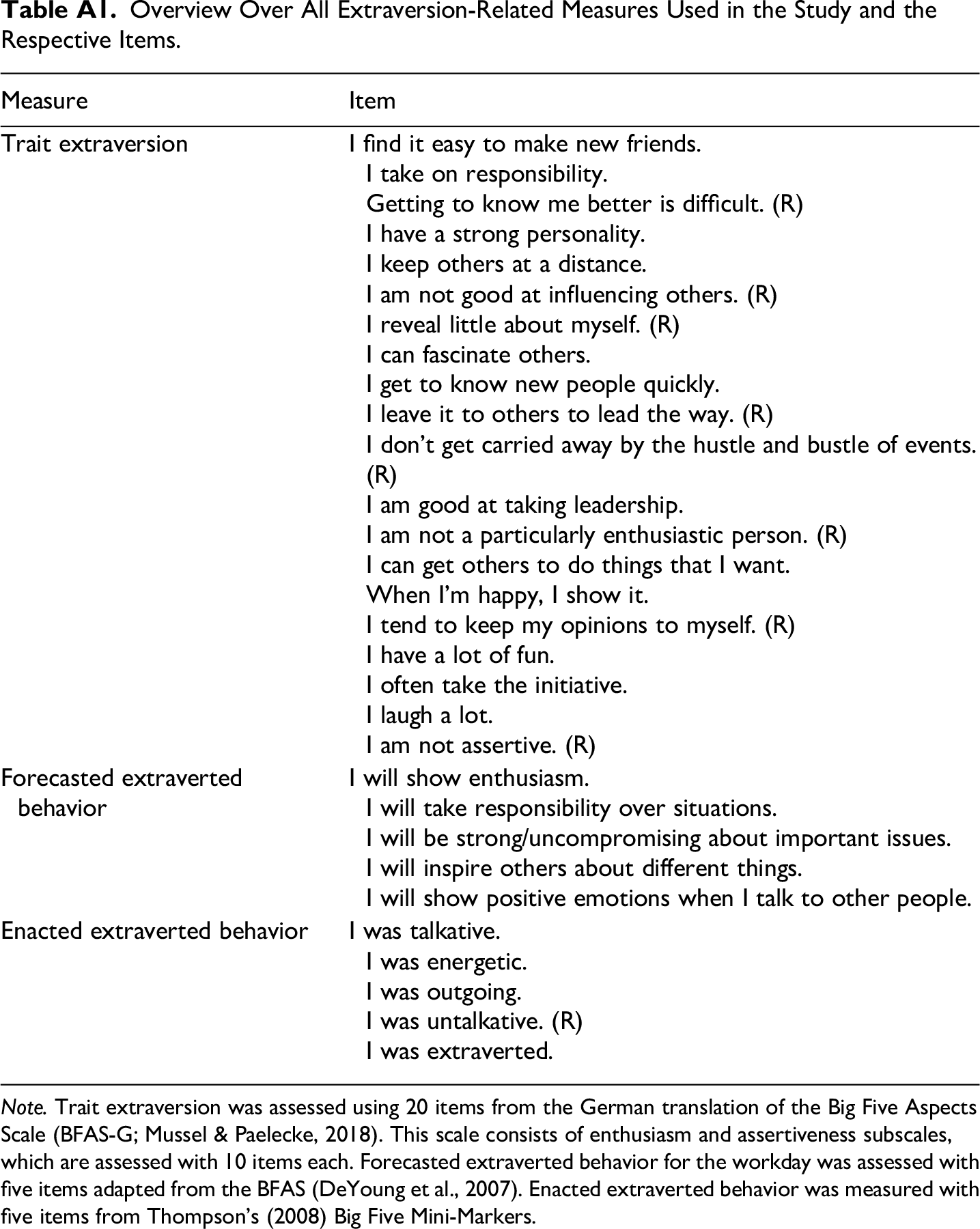
Measure
Item
Trait extraversion
I find it easy to make new friends.
I take on responsibility.
Getting to know me better is difficult. (R)
I have a strong personality.
I keep others at a distance.
I am not good at influencing others. (R)
I reveal little about myself. (R)
I can fascinate others.
I get to know new people quickly.
I leave it to others to lead the way. (R)
I don't get carried away by the hustle and bustle of events. (R)
I am good at taking leadership.
I am not a particularly enthusiastic person. (R)
I can get others to do things that I want.
When I'm happy, I show it.
I tend to keep my opinions to myself. (R)
I have a lot of fun.
I often take the initiative.
I laugh a lot.
I am not assertive. (R)
Forecasted extraverted behavior
I will show enthusiasm.
I will take responsibility over situations.
I will be strong/uncompromising about important issues.
I will inspire others about different things.
I will show positive emotions when I talk to other people.
Enacted extraverted behavior
I was talkative.
I was energetic.
I was outgoing.
I was untalkative. (R)
I was extraverted.