




Abstract
In this study, we shed light on the underlying psychological mechanism of the negative impact of change fatigue on employees’ extra-role performance, which represents a positive change outcome. Drawing from self-determination theory in combination with job demands–resources theory, we assume that the negative impact of change fatigue on extra-role performance is mediated by psychological need satisfaction. Furthermore, by considering the buffer hypothesis in job demands–resources theory, we hypothesize that self-leadership represents a sufficient personal resource to compensate for the negative effects of change fatigue. To test our hypotheses, we investigated a two-wave sample from a German insurance company. The results partially confirm our theoretical predictions. For organizational practitioners, the results imply that self-leadership represents a valuable personal resource for employees to mitigate the psychological consequences of fatigue caused by organizational change. Thus, especially organizations that are undergoing change may provide training for employees to learn to apply self-leadership strategies.
Keywords
In contemporary organizations, change is considered a constant, which in turn is related to ambivalent and constantly evolving work-related goals (Albrecht et al., 2020; Kebede & Wang, 2022; Vakola & Petrou, 2018). During organizational change, we suggest that employees’ extra-role performance is particularly valuable for organizational success since behaviors that go beyond the prescribed work goals through showing initiative and responsibility might enable employees to quickly adapt to new and unknown situations (Albrecht et al., 2023; Jiambalvo, 1979; Koopmans et al., 2011). Moreover, Albrecht et al. (2023) considered proactive behaviors of employees to reflect their willingness to actively engage in new ways of thinking and behavior. From this, it can be concluded that extra-role performance represents a positive change outcome. Although organizational change aims to improve long-term organizational performance (Wynen et al., 2019), extensive change measures might psychologically affect employees (Ashford, 1988; Rafferty & Griffin, 2006), causing change fatigue (de Vries & de Vries, 2023; Klag et al., 2015). Empirical evidence on the negative effects of change fatigue on employees’ well-being supports this assumption (e.g., Bernerth et al., 2011; Brown et al., 2018; Ouedraogo & Ouakouak, 2021). However, literature addressing behavioral consequences of change fatigue is still sparse (Cox et al., 2022), which is why we intend to provide insights into the relation between change fatigue and extra-role performance. From a self-determination theoretical perspective, change fatigue might decrease employees’ extra-role performance by reducing their satisfaction with the three basic psychological needs for autonomy, competence, and relatedness as it is embellished by the perception of organizational change being overwhelming and a corresponding loss of sense of control (Bernerth et al., 2011; Karasek, 1979).
Considering self-determination theory, we assume that self-leadership has self-determining properties that contribute to an individual's psychological need satisfaction and help to improve work-related behaviors by initiating new ways of thinking and adapting new behaviors (Bakker et al., 2021; Bakker & van Woerkom, 2017). Gagné et al. (2022) proposed an increased need for resources with motivating characteristics, such as self-leadership, for employees to feel self-regulated in the face of organizational change. Accordingly, self-leadership might be particularly important for the psychological need satisfaction and the extra-role performance of employees facing extensive changes which are reflected by change fatigue (Albrecht et al., 2023). To further investigate this assumption, we draw upon the buffer hypothesis in job demands–resources theory, according to which self-leadership may compensate for the psychological consequences of change fatigue on employees’ extra-role performance (Bakker & Demerouti, 2007; Hobfoll, 1989; Manz, 1986). Furthermore, the empirical results of Bakker et al. (2021) underline the relevance of self-leadership for psychological need satisfaction in the presence of high cognitive demands. By considering this and regarding psychological need satisfaction to be a channeling function of change fatigue on extra-role performance, we further investigate whether self-leadership compensates for the negative impact of change fatigue on employees’ psychological need satisfaction.
This study contributes to the literature in three ways. By viewing change fatigue through the lens of job demands–resources theory, we test its applicability in the context of organizational change. Moreover, we integrate self-determination theory into job demands–resources theory by considering psychological need satisfaction as an intermediary of the influence of change fatigue on employees’ extra-role performance. This enables us to investigate the underlying psychological mechanism of the behavioral effects of change fatigue. Self-leadership is suggested to compensate for the negative impact of change fatigue on psychological need satisfaction and extra-role performance. Finally, this allows for an investigation of the buffer hypothesis in job demands–resources theory by considering self-leadership as a moderator of the influence of change fatigue on employees’ psychological need satisfaction and extra-role performance.
Theoretical Model
Change Fatigue
In general, organizational change is implemented to adapt to a changing environment or to maintain or improve the functioning of the organization (Albrecht et al., 2020). However, change management research shows that organizational change is associated with negative effects on employees as well, suggesting that organizational change can be emotionally stressful for employees (Chen et al., 2013; Cox et al., 2022; Thundiyil et al., 2015). This in turn might discourage them from behaving in a way that is beneficial for organizations undergoing changes, highlighting the employees’ perceptions of organizational change as a key indicator of the success of change initiatives. If employees perceive organizational change as excessive and overwhelming, it is referred to as change fatigue (Bernerth et al., 2011). Considering the theory of fatigue (Cameron, 1973), change fatigue represents a response to change-related stress faced over time (Ouedraogo & Ouakouak, 2021). Change fatigue constitutes a novel and relatively unresearched construct. As shown by Cox et al. (2022), this is reflected in an ambiguous conceptualization in the current literature. Some authors have referred to change fatigue as discomfort, frustration, and cynicism regarding change measures (Abrahamson, 2000; Ace & Parker, 2010). From the perspective of the theory of fatigue, however, change fatigue comprises a passive response to organizational change whereas the above-mentioned emotional states are accompanied by pessimism about the success of organizational change that is more akin to constructs such as change cynicism (Beil-Hildebrand, 2005; McMillan & Perron, 2013; Ouedraogo & Ouakouak, 2021; Reichers et al., 1997). Other authors have referred to change fatigue as a state of exhaustion that is accompanied by an incapability to adapt to changes (Cox et al., 2022). From this perspective, change fatigue represents an emotional resistance toward change (Cox et al., 2022; Elving et al., 2011). However, accounting for the theory of fatigue once more, change fatigue rather represents a reactive antecedence to emotional resistance in the form of exhaustion or change resistance (Bernerth et al., 2011; Cameron, 1973; Ouedraogo & Ouakouak, 2021). Therefore, we define change fatigue as a reactive emotional state that represents the employee's perception of organizational change as too much, constantly occurring as well as a desire for organizational stability (Bernerth et al., 2011).
An Integrative View of Self-Determination within Job Demands–Resources Theory
Self-determination theory is based on the fundamental assumption that the influence of environmental factors on individuals’ behaviors is largely mediated by the extent to which their basic psychological needs for autonomy, competence, and relatedness are satisfied (Deci et al., 2017; Deci & Ryan, 1985b). Psychological need satisfaction is a psychological concept that refers to the fulfillment of the basic needs considered essential to maintaining human well-being (Hull, 1943; Ryan & Deci, 2017). All three psychological basic needs are suggested to be equally important and “typically interrelated” (Ryan & Deci, 2017, p. 248). The need for autonomy involves the desire for the congruence of one's behavior with one's authentic interests and values. Feeling effective and capable of undertaking tasks meets the need for competence. The need for relatedness is reflected in a desire to efficiently contribute and feel socially related to others (Deci & Ryan, 2014; Ryan & Deci, 2017). Applying self-determination theory to the workplace, the environmental factors that influence employees’ psychological need satisfaction refer to work characteristics as well as to their individual differences (Deci et al., 2017; Deci & Ryan, 1985a). According to self-determination theory, we suggest that the satisfaction of employees’ basic needs for autonomy, competence, and relatedness increases their extra-role performance, as it releases employees’ personal investment to exhibit work-related behaviors that go beyond their formally prescribed work goals (Cerasoli et al., 2014; Deci & Ryan, 2000; Koopmans et al., 2011).
Since change fatigue is an affective state resulting from the change-related stress faced over time, it is suggested to be associated with psychological costs. Albrecht et al. (2020) referred to employees’ intellectual, physical, psychological, and social responses to a changing work environment that deplete employees’ energy and well-being as change-related job demands. Therefore, change-related job demands represent job stressors that result from work characteristics that require high levels of effort from which employees do not recover (Bakker et al., 2007; Meijman & Mulder, 1998). Consistent with the conceptualization of change-related job demands (Albrecht et al., 2020), change fatigue in this study represents an emotional reaction to a changing work environment, which is characterized by perceiving organizational change as too much and tiresome, and is accompanied by a desire for its absence. As change fatigue represents an energy-depleting affective state resulting from a demanding workplace, it constitutes a hindering factor that may result in health-impairment (Folkman & Lazarus, 1985; van Broeck et al., 2010). Empirical evidence regarding the negative impact of change fatigue on employees’ mental health supports this assumption (Bernerth et al., 2011; Cox et al., 2022). Therefore, considering self-determination theory, we suggest that employees’ change fatigue results in dissatisfaction with the basic needs for autonomy, competence, and relatedness. This dissatisfaction, in turn, hinders employees from displaying work behaviors that are beneficial to the organization which is reflected in reduced extra-role performance. In this study, extra-role performance is conceptualized as the willingness to exert extra-effort at work and exhibit supportive behaviors toward the work environment, which is characterized by responsibility and initiative (Jiambalvo, 1979; Koopmans et al., 2011).
Job demands–resources theory was developed to explain the influence of job demands and resources on employee well-being and organizational outcomes, taking into account possible interactions between job demands and resources (Bakker & Demerouti, 2007; Demerouti et al., 2001). It comprises a dual-process model, involving a health-impairment pathway and a motivational pathway (Bakker & Demerouti, 2007). Job demands are assumed to require physical, cognitive or emotional efforts that can cause psychological distress resulting in the impairment of organizational outcomes (Demerouti et al., 2001). Resources, on the other hand, represent personal or organizational work-related aspects that positively impact organizational outcomes because of their motivating properties. According to Kahn and Byosserie (1992), resources can act as a buffer for the psychological consequences of job demands by moderating the corresponding responses or altering employees’ perceptions and cognitions (Bakker et al., 2005, 2023).
Self-leadership relates to self-control and intrinsic motivation as a means of regulating one's own behavior (Bandura, 1986; Deci & Ryan, 1985a; Manz & Sims, 1980). Therefore, we view self-leadership as a personal resource that enables employees to self-sufficiently optimize their cognitions and behaviors to accomplish work-related activities and tasks (Bakker et al., 2021; Bakker & van Woerkom, 2017). Manz (1986) conceptualized self-leadership as a process of self-influence through strategies regarding behavior orientation, natural rewards, and constructive thought patterns (Houghton & Neck, 2002; Manz & Neck, 2013). Houghton et al. (2004) proposed that natural reward strategies primarily relate to individuals’ emotional stability and therefore state a natural predisposition for self-leadership behavior. In this study, we construe self-leadership in accordance with Houghton et al. (2012), who do not consider natural reward strategies within their conceptualization, contributing to the salience of comprehending self-leadership as a set of learnable cognitive strategies (Houghton et al., 2004; Manz, 1986). Accordingly, we view self-leadership as a set of strategies regarding behavior awareness and volition, constructive cognition, and task motivation (Houghton et al., 2012). Behavior awareness and volition strategies are behavior-focused ones, such as self-observation and self-goal setting (Houghton et al., 2012). They entail intentionally dealing with behavioral patterns and can be used to identify ineffective behavioral patterns as well as to implement functional ones (Houghton & Neck, 2002). Constructive cognition strategies are based on constructive thought pattern strategies such as self-talk and the evaluation of own beliefs and assumptions; they thus focus on observing, discovering, evaluating, and directing thought patterns (Houghton et al., 2012; Manz & Sims, 1991). Strategies regarding task motivation combine the self-motivational aspects of behavior-focused and constructive thought pattern strategies and facilitate the intrinsically motivating aspects of work by visualizing successful performance or self-rewards (Houghton et al., 2012; Houghton & Neck, 2002).
Neck (1996) emphasized self-leadership to be an efficient means that can be utilized to alter one's cognitive response to organizational change. However, there is little and contradictory empirical evidence for the direct impact of self-leadership on employees’ perception of organizational change (Moradpour et al., 2017). Instead of assuming that self-leadership directly influences change-related variables, Stewart et al. (2019) propose that self-leadership is beneficial during organizational change as it encourages employees to cope with difficult situations in the future through behavioral changes and building cognitive capacities. Along with evidence for a positive impact of self-leadership on extra-role performance (Shen, 2023), this assumption is supported by the empirical evidence of Marques-Quinteiro et al. (2019), who demonstrated that self-leadership is beneficial for employees’ adaptive performance during organizational change. Self-leadership enables autonomous behavioral orientation as its strategies are aimed at strengthening the reliability of internal beliefs and assumptions (Deci et al., 2017; Houghton & Neck, 2002). Therefore, self-leadership is assumed to strengthen employees’ psychological need satisfaction which is empirically supported by Bakker et al. (2021). Accordingly, self-leadership may represent a personal resource that fosters psychological need satisfaction and extra-role performance (Bakker & Demerouti, 2007). While we assume change fatigue decreases employees’ extra-role performance by reducing their psychological need satisfaction, following job demands–resources theory, self-leadership may buffer the negative impacts of change fatigue by providing a sense of self-determination.
Change Fatigue and the Mediating Role of Psychological Need Satisfaction
From a job demands–resources theoretical perspective, change fatigue is assumed to produce psychological costs and contribute to resource loss as it represents an energy-depleting affective state (Bakker et al., 2023; van Broeck et al., 2010). Therefore, we suggest that change fatigue decreases the satisfaction of the basic psychological needs of autonomy, competence, and relatedness as resources are considered central for the fulfillment of basic human needs according to self-determination theory (Bakker & Demerouti, 2007; Deci & Ryan, 1985b). Change fatigue is accompanied by the perception of organizational change being unmanageable, which promotes the feeling of being externally controlled rather than self-determined at one’s workplace (Bernerth et al., 2011). According to self-determination theory, feeling externally controlled reduces the perception of authority over one's own scope of action, which may decrease the need satisfaction for autonomy (Deci et al., 2017). Moreover, change fatigue due to the emergence of new tasks and routines that result from excessive organizational changes may contribute to the perception of missing out on sufficient knowledge and the perception of one’s own skills and knowledge as being redundant and less efficacious, thus decreasing the need satisfaction for competence (Deci et al., 2017; van Emmerik et al., 2009). Organizational change requires employees to adapt to new circumstances, which can lead to less identification with the changed aspects of their work environment and organization (Bernerth et al., 2011; Rafferty & Griffin, 2006). Deriving from this, the desire for organizational stability reflected by change fatigue may be accompanied by a desire for a sense of belonging to one's work environment and organization, thereby resulting in a lower need satisfaction for relatedness (Bernerth et al., 2011). Moreover, change fatigue may decrease an employee’s sense of security that is established by a familiar and stable work environment, which may further reduce their perception of relatedness (Lang-Lehmann et al., 2022; Strauss & Parker, 2015).
Furthermore, in line with self-determination theory, we assume that psychological need satisfaction is positively related to extra-role performance by establishing autonomous motivation to exert extra efforts at work (Deci et al., 2017; Van den Broeck et al., 2010). The need satisfaction of autonomy might be positively related to extra-role performance, as the perception of freedom of decision-making increases the accessibility of voluntary behaviors that support employees’ work environments (Haivas et al., 2013; Ryan & Deci, 2017). Moreover, perceiving a greater scope of action may facilitate proactive and initiative work behaviors (Crant, 2000; Den Hartog & Belschak, 2012; Frese et al., 1996). Employees who perceive themselves as competent may possess sufficient job knowledge; this could encourage them to find solutions to work-related challenges that lie beyond their formal job descriptions (Bindl & Parker, 2011; Ryan & Deci, 2017). Finally, the need for relatedness is associated with a desire to be recognized as a meaningful group member by others (Chen et al., 2015). If this desire is perceived as satisfied, employees may feel connected within their work environment; therefore, taking responsibility and committing to challenging tasks beyond their regular work obligations might seem less risky (Detert & Burris, 2007; Strauss & Parker, 2015). The employees who perceive their need for relatedness to their work environment as satisfied may also be deeply invested in their job and therefore strive to improve their work environment by proactively taking on especially demanding tasks.
Deriving from the statements above, we argue that change fatigue reduces the satisfaction of the basic needs for autonomy, competence, and relatedness which in turn leads to decreased extra-role performance. Therefore, accounting for self-determination theory, we suggest that psychological need satisfaction represents a channeling function that mediates the negative effect of change fatigue on employees’ extra-role performance:
Psychological and Behavioral Consequences of Self-Leadership
Considering self-determination theory, self-leadership strategies encourage autonomous behavior orientation and therefore contribute to employees’ psychological need satisfaction (Deci et al., 2017). The employees who implement self-leadership strategies are able to make decisions based on self-controlled cognitive processes, which might satisfy their need for autonomy (Ryan & Deci, 2017). Moreover, self-leadership helps employees establish a connection with their job-related abilities, thereby fostering a feeling of personal proficiency and contributing to a feeling of competence (Ryan & Deci, 2017). The need for relatedness may be satisfied by using self-leadership strategies that relate to goal achievement, since focusing on one's personal success may foster the perception of one's own behavior as being beneficial to the environment (Deci & Ryan, 2000; Weick, 1979). Self-leadership may also enhance employees’ positive emotions through the anticipation of self-selected rewards for successful work (Bakker & van Woerkom, 2017). Positive emotions are accompanied by the tendency of individuals to approach and feel related to others (Fredrickson, 1998; Waugh & Fredrickson, 2006). Deriving from the statements above, we hypothesize:
Self-leadership helps employees analyze and reevaluate their individual attitudes and behaviors toward their job (Houghton & Neck, 2002). Recognizing the enjoyable aspects of work can encourage the willingness to take on challenging tasks at work (Houghton et al., 2003). Moreover, self-leadership fosters behavioral awareness which comprises the ability to detect whether one's actions are sufficient to accomplish work-related tasks (Deci & Ryan, 2000). This, in turn, may foster extra-role performance through the implementation of functional behavioral patterns that lead to self-initiated improvements in work-related competences and knowledge (Koopmans et al., 2011). In addition, the mental visualization of one's own success and the ability to reinforce an internal drive to accomplish work-related tasks might increase extra-role performance by establishing a willingness to find new solutions to work-related challenges within employees (Harunavamwe et al., 2020; Inam et al., 2023). Therefore, we hypothesize:
How Change Fatigue and Self-Leadership Interact with Each Other
Change fatigue represents an emotional reaction to organizational change that reduces psychological need satisfaction as it entails resource loss and produces psychological costs. Considering job demands–resources theory, the psychological consequences of employees’ responses to job demands can be buffered by such personal resources that tie in with the underlying mechanism (Bakker et al., 2005; Bakker & Demerouti, 2007). Owing to its self-determining properties, we assume that self-leadership compensates for the psychological costs associated with change fatigue (Bakker & Demerouti, 2007; Hobfoll & Shirom, 2000).
Change fatigue refers to the perception of change measures being a universal influence on the personal work environment that has to be acquiesced to (Bernerth et al., 2011). The arising perceived lack of control might be compensated for by self-leadership, as it enables employees to effectively influence their work environment—for instance, by shaping their goal-achievement processes (Houghton & Neck, 2002; Manz, 1986; Seligman, 1991). Therefore, the negative effect of change fatigue on the need satisfaction for autonomy among employees might be compensated if their self-leadership is high. Moreover, change fatigue embodies the perception of organizational change not being manageable, which might decrease the perception of personal competence (Bernerth et al., 2011). Self-leadership strategies that increase the awareness of one's personal abilities might mitigate the negative effects of change fatigue, and result in the retention of employees’ need satisfaction for competence (Houghton & Neck, 2002; Ryan & Deci, 2017). If change fatigue arises from change measures that actually require employees to develop additional skills and knowledge, self-leadership may help them to identify and develop sufficient abilities, which may contribute to improving their perception of competence (Houghton & Neck, 2002; Manz & Sims, 1980). As stated earlier, change fatigue may reduce the perception of relatedness by decreasing employees’ sense of belongingness to the personal work environment (Strauss & Parker, 2015). Self-leadership may compensate for this perception by encouraging employees to manage their behavioral patterns, which contributes to the perception of benefiting one's work environment (Burns, 1980; Ellis, 1962; Houghton & Neck, 2002). Therefore, we suggest that the impairing effect of change fatigue on psychological need satisfaction is weaker for employees with high levels of self-leadership (Gagné & Deci, 2005; Rotter, 1966):
Furthermore, considering the buffer hypothesis in job demands–resources theory, we suggest that self-leadership includes essential properties that can compensate for the negative indirect effect of change fatigue on extra-role performance which is mediated by psychological need satisfaction (Bakker & Demerouti, 2007; Deci et al., 2017). To this effect, we suggest that employees experiencing change fatigue know the feeling of not being in charge of their environment. This might bring into focus the importance of self-leadership in fostering self-control and the ability to orient one's behavior (Manz, 1986). Thus, self-leadership might help employees shift their focus from organizational change as an environmental factor that is beyond their control to those aspects of work that they do have control over. Using self-leadership strategies might ultimately lead to the exploitation of self-leadership's potential to self-reliantly support the functioning of one's work environment, as individuals aim to retain what they value (Hobfoll et al., 2018). We also assume that self-leadership leads to positive emotions that may compensate for the negative emotions resulting from change fatigue (Bakker & van Woerkom, 2017). Evidently, it might be especially important for employees with change fatigue to broaden their consciousness and proactively engage in finding solutions for work challenges (Cangiano et al., 2017; Fredrickson, 1998). Deriving from the statements above, we assume the following:
Method
Participants and Procedure
To assess the hypothesized model (Figure 1), we conducted a two-wave survey in a large German insurance company with approximately 11,000 employees. The first study (T1) was conducted in April 2023, followed by the second study (T2) in June 2023. Agile transformation was performed in the internal service sector of the company during data collection which was accompanied by digitalization and the restructuring of working teams and corresponding hierarchical structures. Approximately 2,760 employees working in the internal service sector were asked to respond to an online survey administered via the intranet of the company. Participation was voluntary. To evaluate the psychological mechanism of employees’ change fatigue interacting with their self-leadership, the participants were asked to respond to the survey statements with respect to themselves (Breevaart et al., 2016). We linked the datasets from T1 and T2 using an individual code that had to be provided by the participants in both surveys, as the privacy policies of the company did not allow for the assessment of personal data such as employee contact information. Of the 583 completed surveys in T1, 303 cases could be unambiguously matched to cases from T2, resulting in a re-participation rate of 52%. After data cleansing, the final dataset comprised 281 cases (n = 281). Overall, 46.26% of the participants were female. Owing to the company's privacy policies, we assessed the participants’ age by asking for the five-year period in which they were born. The age category of participants between 58-63 years was the most strongly represented (22%). The participants aged 18–22 years represented the smallest share (0.4%). Overall, 46.80% of the sample's population was at least 53 years of age. 1 Further, 14.94% of the participants were employed in management positions. In T2, 35.23% of the participants worked in an agile organizational structure. The participants worked 39.38 h (SD = 5.21) on average per week and 24.56 h (SD = 10.33) on average from home.
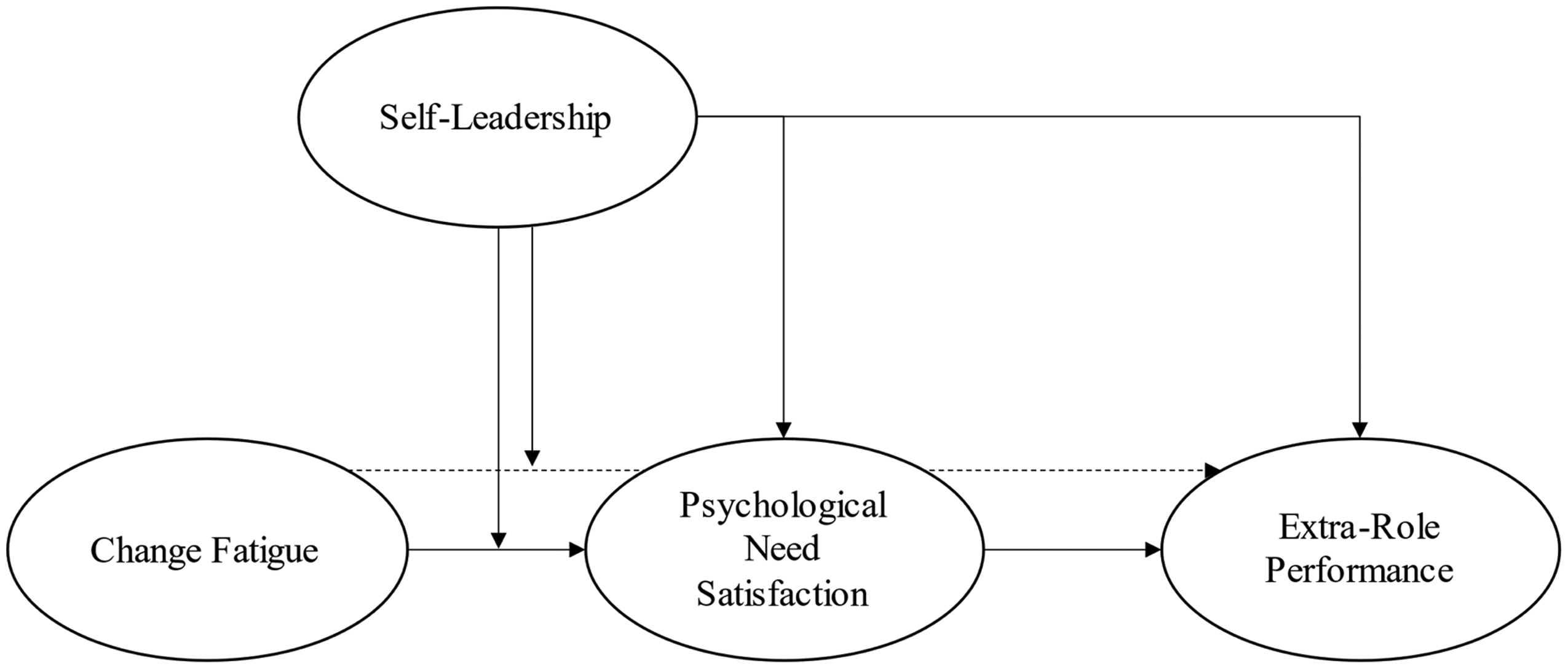
Hypothesized model.
Measures
The back translation method introduced by Brislin (1970) was followed to translate the items of the scales for change fatigue and extra-role performance from English to German. One scientist and two research assistants who are native German speakers and fluent in English independently conducted the back translation.
Change Fatigue
Change fatigue was assessed with the help of a six-item scale developed by Bernerth et al. (2011) which the participants evaluated in T1. Since the six-item solution of the measurement model showed an insufficient fit to the data according to the model fit, three items were removed under consideration of the measures’ content validity. Therefore, in this study, change fatigue is reflected by three items that entail its reactive characteristics toward organizational change. 2 Following Bernerth et al.'s (2011) definition, change fatigue refers to an employee's perception of organizational change as extensive and is characterized by weariness regarding all the changes as well as by a desire for stability. An exemplary item is as follows: “I am tired of all the changes in this company.” The items were rated on a five-point Likert scale ranging from 1 (totally disagree) to 5 (totally agree) (α = .84).
Self-Leadership
To assess self-leadership, the participants evaluated the Abbreviated Self-Leadership Questionnaire in T1 (Houghton et al., 2012). The questionnaire is an evolved, short version of the Revised Self-Leadership Questionnaire (Houghton & Neck, 2002). It contains three factors representing (1) strategies toward behavior awareness and volition, as exemplified by the item “I work toward specific goals I have set for myself”; (2) strategies regarding constructive cognition, exemplified by the item “I think about my own beliefs and assumptions whenever I encounter a difficult situation”; and (3) strategies toward task motivation, exemplified by the item “I visualize myself successfully performing a task before I do it”. Each factor is reflected by three items. We used the German translation from the German version of the Revised Self-Leadership Questionnaire (Andreßen & Konradt, 2007). The items were rated on a five-point Likert scale ranging from 1 (totally disagree) to 5 (totally agree) (α = .75).
Psychological Need Satisfaction
To measure psychological need satisfaction, we used three factors from the German version of the Basic Psychological Need Satisfaction and Frustration Scale (B. Chen et al., 2015; Heissel et al., 2018). The participants evaluated the corresponding statements in T2. Each factor is reflected by four items. The factors refer to (1) autonomy satisfaction, assessed by the exemplary item “I feel that my decisions reflect what I really want”; (2) competence satisfaction, exemplified by the item “I feel I can successfully complete difficult tasks”; and (3) relatedness satisfaction, exemplified by the statement “I feel connected with people who care for me and for whom I care.” The items were rated on a five-point Likert scale ranging from 1 (totally disagree) to 5 (totally agree) (α = .74).
Extra-Role Performance
To assess extra-role performance, we adapted four items from the contextual performance scale of the Individual Work Performance Questionnaire (Koopmans et al., 2014). The participants evaluated the statements in T2 considering the past few weeks at work. An exemplary item is stated as follows: “I kept looking for new challenges in my job.” The items were rated on a five-point Likert scale ranging from 1 (never) to 5 (always) (α = .83).
Controls
We incorporated five control variables to prevent biased results triggered by the unobserved influencing properties of the sample (Wooldridge, 2020). The control variables were chosen based on theoretical considerations regarding their influence on the independent as well as dependent variables in the hypothesized model (Becker, 2005; Spector & Brannick, 2011). Ugurluoglu et al. (2015) suggested that, with increasing age, individuals’ focus shifts from self-referred behaviors that help shape their own identity to the pursuit of predetermined steps to achieve established life-related goals. Therefore, a higher age might be accompanied by an evolving need for stability (D’Intino et al., 2007). Accordingly, we controlled for the age of the participants, as it could influence their affective reactions to organizational change, their inclination toward extra-role performance, and the extent to which self-leadership satisfies their psychological basic needs. Accounting for the company's privacy policies, we assessed age as a categorical variable by asking the participants for their year of birth (1 = 2001–2005; 10 = 1956–1960). Drawing upon attribution theory with regard to gender stereotypes, we integrated gender as a control variable (0 = male; 1 = female), since women and men might show differences in their work-related behaviors and performance owing to the gender outcome expectations incorporated into their self-concepts (Deaux, 1976; Luksyte et al., 2013, 2023). To rule out alternative explanations triggered by agile transformation within the company, we controlled for whether the participants worked in an agile or a traditional organizational structure (Becker, 2005). To this end, we asked the participants in T2 whether they personally work in an agile organizational structure (0 = yes; 1 = no). We integrated the share of working hours spent working from home as fourth control variable. Gagné et al. (2022) suggested that the motivational conditions for working in virtual environments are different from those for traditionally working at a permanent workplace. Moreover, those employees who regularly work from home during agile transformation might perceive the corresponding organizational changes differently due to spatial distance and the dependence on their digital workplace. Working from home was calculated as the proportion of weekly hours worked from home out of the total working hours per week; the participants were asked to evaluate these in T2. Finally, we controlled for the negative affect of the participants to isolate the potential bias regarding the effect of employees’ change fatigue. We adapted three items regarding negative affect from the German version of the short form of the positive and negative affect schedule (I-PANAS) (Breyer & Bluemke, 2016; Thompson, 2007). In T1, participants were asked to indicate how often they are generally “Afraid” for example. The items were rated on a five-point Likert scale ranging from 1 (very rarely) to 5 (very often) (α = .69).
Strategy of Analysis
Assessment of the Measurement Models
To evaluate the measurement models, we performed confirmatory factor analysis using covariance analytical structural equation modeling with the lavaan package in R version 4.3.1 (R Core Team, 2023; Rosseel, 2012). We used the Satorra–Bentler correction for the maximum likelihood estimator to attain robust estimations despite the violation of the multivariate normality assumption of the data (Satorra & Bentler, 2001). In line with the theoretical and measurement conceptualization of self-leadership and psychological need satisfaction, both measurement models were operationalized as second-order constructs (Heissel et al., 2018; Houghton et al., 2012). First, we evaluated the consistency reliability and convergent validity of the corresponding lower-order constructs and of the one-dimensional measurement models of change fatigue and extra-role performance. To test the internal consistency reliability of the measures, we assessed Cronbach's α (Cronbach, 1951) and composite reliability (CR) (Bagozzi & Phillips, 1982). Behavior awareness and volition showed unsatisfactory values considering the cutoff criteria proposed by Nunnally and Bernstein (1994) (α = .67 < .70, CR = .53 < .70). After removing the item with the lowest factor loading (FL = .36), all constructs showed satisfactory values, indicating internal consistency reliability. To test for convergent validity, we assessed the average variance extracted (AVE), which was satisfactory for all constructs except autonomy satisfaction (AVE = .49 < .50) and constructive cognitions (AVE = .49 < .50). Nevertheless, in line with the suggestion of Fornell and Larcker (1981), construct validity can still be considered because their CR exceeded .60. Second, we assessed the Cronbach's α, CR, and AVE of the higher-order constructs of self-leadership and psychological need satisfaction. All values were found to be satisfactory. All factor loadings, Cronbach's α, CR, and AVE are depicted in Table A2 in Appendix A. Third, we tested the discriminant validity of the constructs using the Fornell–Larcker criterion and the Heterotrait-Monotrait (HTMT) ratio to further assess construct validity. No discriminant issues could be detected (Fornell & Larcker, 1981; Henseler et al., 2015). The HTMT values are shown in Appendix A in Table A3. Finally, we assessed the model fit of the measurement models by considering χ2/d.f. as a descriptive fit measure (Jöreskog & Sörbom, 1982), the root mean square error of approximation (RMSEA) as an approximative inference statistical fit measure (Browne & Cudeck, 1993), the standardized root mean squared residual (SRMR) as an absolute fit measure (Hu & Bentler, 1999), and the comparative fit index (CFI) as a fit measure for model comparison (Homburg & Baumgartner, 1995). The model fit of self-leadership as a three-factor model was found to be satisfactory (χ2 = 49.44, p < 0.001, d.f. = 17, RMSEA = 0.08, SRMR = 0.07, CFI = 0.95) and surpassed the model fit of the one-factor solution (χ2 = 211.62, p < 0.001, d.f. = 27, RMSEA = 0.16, SRMR = 0.09, CFI = 0.73). The model fit of the three-factor model of psychological need satisfaction was also satisfactory (χ2 = 76.87, p < 0.001, d.f. = 51, RMSEA = 0.04, SRMR = 0.04, CFI = 0.97) and showed a better model fit than the one-factor solution (χ2 = 367.91, p < 0.001, d.f. = 54, RMSEA = 0.14, SRMR = 0.11, CFI = 0.66). Extra-role performance showed a satisfactory model fit (χ2 = 2.22, d.f. = 2, p = 0.330, RMSEA = 0.02, SRMR = 0.02, CFI = 1.00).
Assessment of the Hypothesized Model
To additionally evaluate the second-order factor structure of self-leadership and psychological need satisfaction, we compared the four-factor solution of the hypothesized model (χ2 = 84.21, p < 0.001, d.f. = 59, RMSEA = 0.04, SRMR = 0.05, CFI = 0.98) to a six-factor model by considering the lower-order constructs of self-leadership as three factors (χ2 = 202.14, d.f. = 120, p < 0.001, RMSEA = 0.05, SRMR = 0.06, CFI = 0.95), which had an inferior fit to the data. Considering χ2/df and CFI, the six-factor model, which includes the lower order constructs of psychological need satisfaction as three factors, showed a lower model fit than the hypothesized four-factor model (χ2 = 291.41, d.f. = 194, p < 0.001, RMSEA = 0.04, SRMR = 0.05, CFI = 0.95). The second-order solutions of self-leadership and psychological need satisfaction were thus a better fit to the model than the corresponding three-factor models.
The data regarding all the variables within the hypothesized model were collected based on the self-disclosures of the participants. The resulting single-source design of the survey might therefore cause common method variance (Podsakoff et al., 2003). Common method variance refers to the variance of the relations within the hypothesized model being attributable to the measurement method rather than to the variance within the relevant constructs (Fiske, 1982). To test for common method variance, we conducted two empirical tests. First, we performed Harman's single-factor test by comparing the model fit of all the items being summarized to one factor to the model fit of the hypothesized four-factor model to check whether common method variance presents a major problem (Podsakoff et al., 2003). The total variance shared by one single factor was 26.37%, falling below the recommended threshold of 50% (Harman, 1976). Moreover, the single-factor model showed no satisfactory model fit (χ2 = 793.61, p < 0.001, d.f. = 77, RMSEA = 0.18, SRMR = 0.16, CFI = 0.42). The measurement method thus fails to satisfactorily explain the variances within the constructs of interest. Second, we conducted an unmeasured latent factor technique to test whether a method factor on the level of the measurement models significantly improves the model fit of the hypothesized four-factor model (Bagozzi & Phillips, 1982). Our results showed no such indication considering the χ2-difference test proposed by Jöreskog (1971) (Δχ2 = 0.18 < 3.81, χ2 = 84.39, p = 0.013, d.f. = 58, RMSEA = 0.04, SRMR = 0.05, CFI = 0.98). Therefore, we can conclude that the data at hand are not significantly affected by common method variance. Finally, the model fit of the hypothesized model was found to be satisfactory (χ2 = 109.36, p < 0.001, d.f. = 72, RMSEA = 0.04, SRMR = 0.05, CFI = 0.97), and remained so even after integrating the control variables (χ2 = 248.62, p < 0.001, d.f. = 142, RMSEA = 0.05, SRMR = 0.06, CFI = 0.93). The model fit of all tested models can be found in Table A4 in Appendix A.
Results
Hypothesis Discussion
To test the hypotheses, we conducted a multiple regression analysis using the PROCESS package in R version 4.3.1. We tested hypothesis 1 using Hayes’ (2022) model 4 and hypotheses 2 to 5 by implementing Hayes’ (2022) model 8 using bootstrapping with 5,000 samples (Hayes, 2009). To simplify the interpretation of the effects conditional on the moderator and to reduce potential multicollinearity between the interaction term and the predictors, we mean-centered the predictor variables prior to analysis (Iacobucci et al., 2016). Furthermore, we used the “moments” option in PROCESS to report the interaction effects for the mean as well as the plus and minus one standard deviation from the mean of the moderator to account for the actual distribution characteristics of self-leadership (Hayes, 2022). Moreover, we controlled for whether the obtained data met all the prerequisites for multiple regression analysis (Hayes, 2022; Wooldridge, 2020). Using the rainbow test developed by Utts (1982), we confirmed that the relationships in the regression model are sufficiently linear. The skewness and kurtosis of the residuals did not indicate a substantial derivation from normality distribution, and the Durbin–Watson test indicated no autocorrelation among the residuals (Durbin & Watson, 1950, 1951). Based on the results of the Breusch–Pagan test, heteroscedasticity was found to not pose any problems (Breusch & Pagan, 1979). Further, we found no indication of multicollinearity when we considered the variance inflation factors between the dependent variables, which remained below a value of three (Mason & Perreault, 1991). Table 1 presents the descriptive statistics and correlations, and Table 2 presents the regression analysis results.
Descriptive Statistics and Correlations.
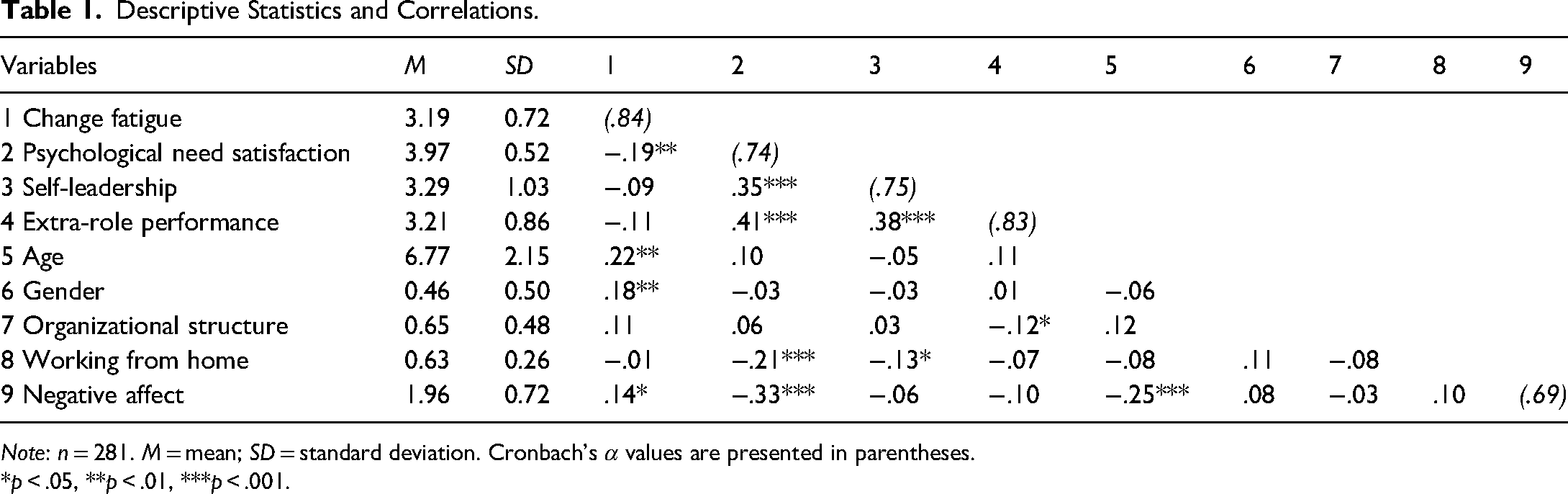
Note: n = 281. M = mean; SD = standard deviation. Cronbach's α values are presented in parentheses.
*p < .05, **p < .01, ***p < .001.
Regression Analysis Results with Control Variables (Moderated Mediation Model).
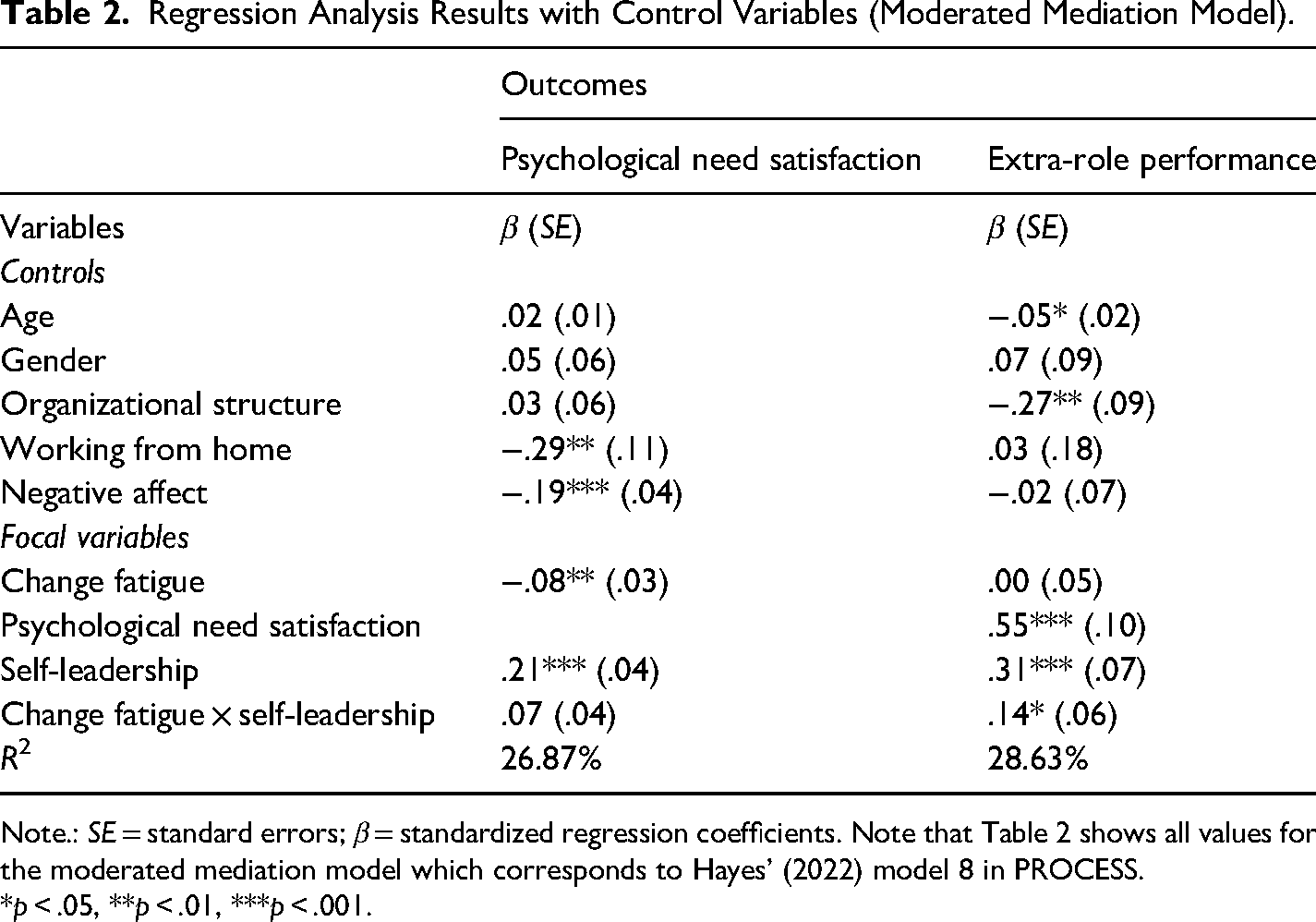
Note.: SE = standard errors; β = standardized regression coefficients. Note that Table 2 shows all values for the moderated mediation model which corresponds to Hayes’ (2022) model 8 in PROCESS.
*p < .05, **p < .01, ***p < .001.
As per hypothesis 1, the effect of change fatigue on extra-role performance is mediated by psychological need satisfaction. Using Hayes' (2022) model 4, the results show that change fatigue significantly relates to psychological need satisfaction (β = −.09, p < .01) but not to extra-role performance (β = .01, p = .830). Moreover, psychological need satisfaction positively relates to extra-role performance (β = .72, p < .001). To test for the indirect effect, we performed bootstrapping using a 95% confidence interval (CI). The indirect effect of change fatigue on extra-role performance was found to be significant, supporting hypothesis 1 (ab = −.06, 95% CI [−.11, −.002]). Hypothesis 2 predicted a positive relation between self-leadership and psychological need satisfaction, which was supported empirically (β = .21, p < .001). In hypothesis 3, we proposed a positive relation between self-leadership and extra-role performance, which found empirical support as well (β = .31, p < .001). Note that both the reported effects apply to average levels of change fatigue. Hypothesis 4 predicted that self-leadership weakens the relation between change fatigue and psychological need satisfaction such that the negative relation is weaker if self-leadership is higher. The corresponding interaction is depicted in Figure 2. According to the simple slope analysis, change fatigue decreased psychological need satisfaction if self-leadership was lower (β = −.13, p < .01) but did not significantly decrease psychological need satisfaction if self-leadership was higher (β = −.03, p = .384). However, the interaction effect of self-leadership and change fatigue was not found to significantly relate to psychological need satisfaction (β = .07, p = .072; pseudo-R2 Δ = 1%). Evidently, the corresponding empirical results do not support hypothesis 4.
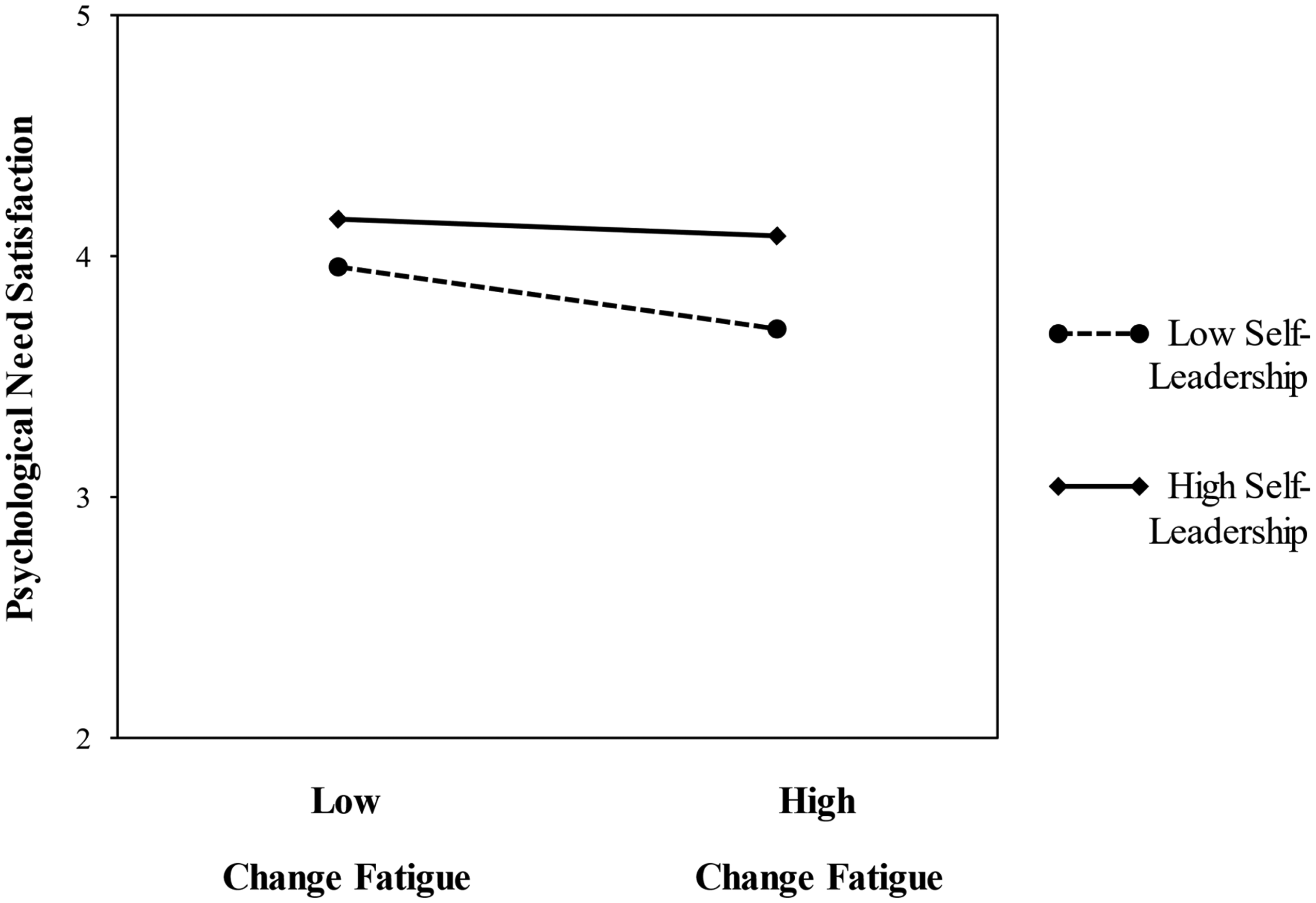
The moderating role of self-leadership on the relation between change fatigue and psychological need satisfaction.
Hypothesis 5 suggests that self-leadership moderates the mediated relation between change fatigue and extra-role performance via psychological need satisfaction such that the negative indirect relation is weaker if self-leadership is higher. The interaction effect between change fatigue and self-leadership was found to positively relate to extra-role performance (β = .14, p = .025; pseudo-R2 Δ = 1%), thus supporting hypothesis 5. Figure 3 illustrates the interaction proposed in hypothesis 5. Since the relation between change fatigue and extra-role performance was totally mediated by psychological need satisfaction and had no significant direct relation, the direct relation between change fatigue and extra-role performance was not significant for lower levels of self-leadership (β = −.10, p = .15) as well as for higher levels of self-leadership (β = .10, p = .10). Nevertheless, the indirect relation of change fatigue and extra-role performance mediated by psychological need satisfaction was found to be significantly negative for lower levels of self-leadership (ab = −.10, 95% CI [−.126, −.021]) and not significant for higher levels of self-leadership (ab = −.02, 95% CI [−.049, .022]).
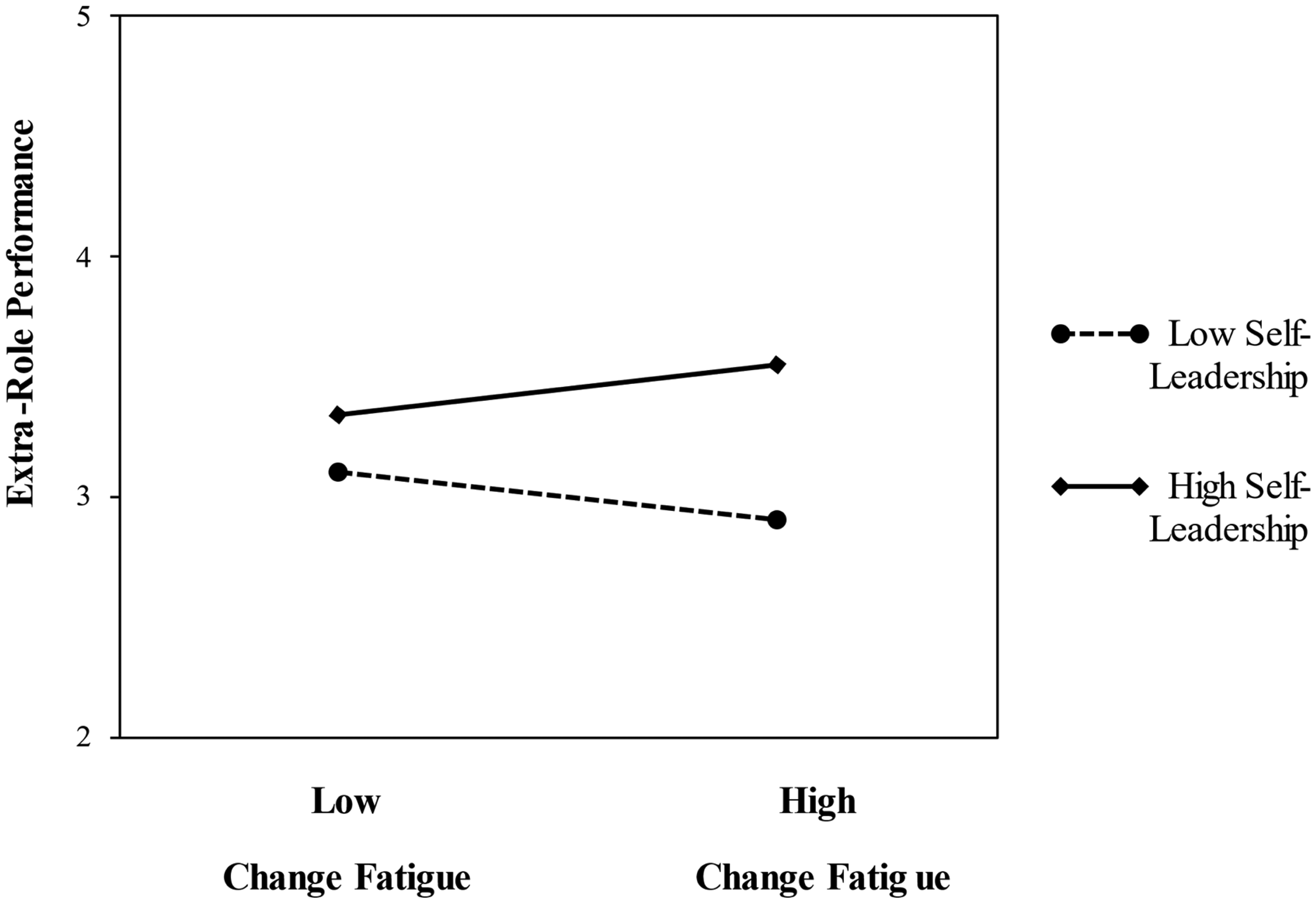
The moderating role of self-leadership on the relation between change fatigue and extra-role performance.
With the help of the index of moderated mediation, we additionally determine the association between the indirect effect and the moderator in our hypothesized model (Hayes, 2015). The bootstrap confidence interval for the index of moderated mediation (a1b3 = .04, 95% CI [.0002, .0910]) does not include zero. Since the bootstrap interval is close to zero, we repeated the calculation with 10,000 bootstrap samples to check the robustness of this result. The calculation with 10,000 bootstrap samples yielded similar values to those obtained with 5,000 bootstrap samples (a1b3 = .04, 95% CI [.0002, .0914]). From this can be concluded that self-leadership moderates the indirect effect of change fatigue on extra-role performance via psychological need satisfaction. The index of moderated mediation was found to be positive, therefore the effect of change fatigue on extra-role performance mediated by psychological need satisfaction becomes more positive as self-leadership increases (Hayes, 2015). The hypothesized model explains 26.87% of the variance in psychological need satisfaction and 28.63% of the variance in extra-role performance. 3
To determine the robustness of our empirical results, we performed a regression analysis without control variables (Becker, 2005). The corresponding results are reported in Table 3. This analysis found that all regression coefficients have similar magnitudes and significance levels, thus indicating robust empirical results.
Regression Analysis Results Without Control Variables (Moderated Mediation Model).
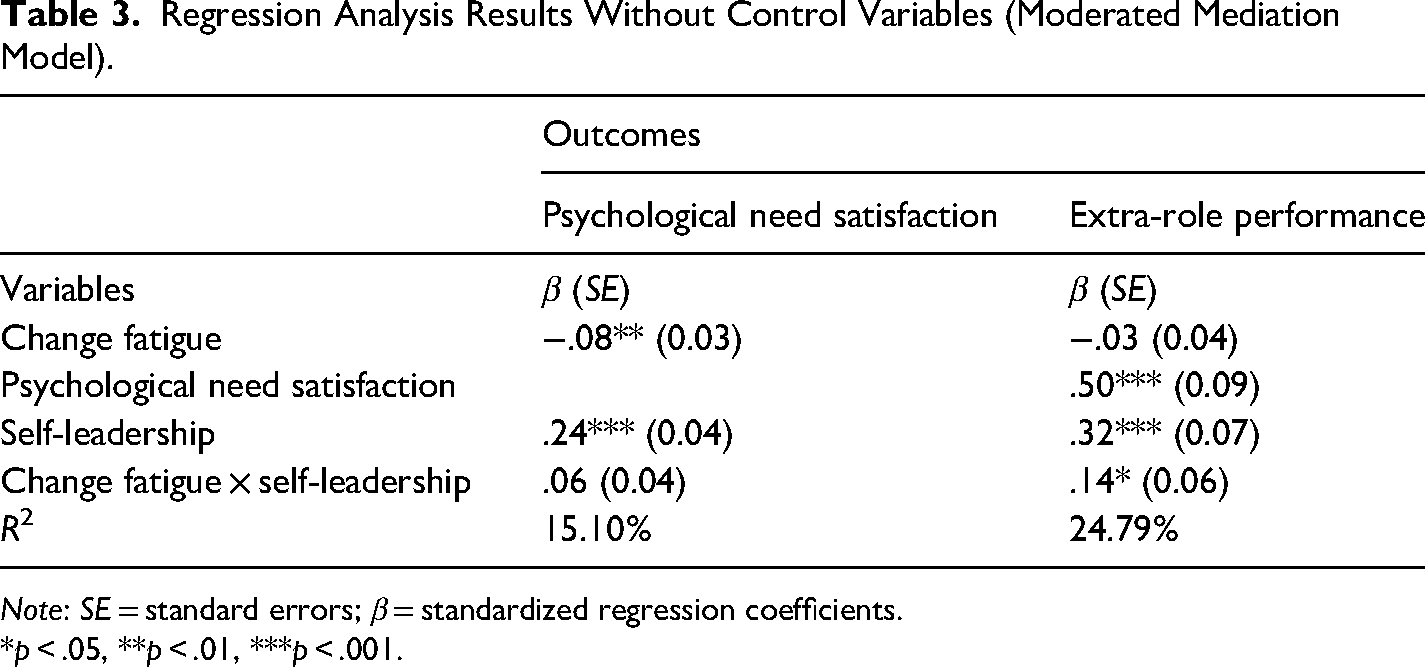
Note: SE = standard errors; β = standardized regression coefficients.
*p < .05, **p < .01, ***p < .001.
Additional Analysis
Although job demands and resources are assumed to be linked based on the job demands–resources model (Bakker & Demerouti, 2007), we suggest that change fatigue and self-leadership interact with each other without depending directly on each other and are thus exogenous variables. Change fatigue does not comprise active reactions to organizational change that might directly impair self-leadership behavior (Beil-Hildebrand, 2005; Bernerth et al., 2011). Furthermore, self-leadership is assumed to be internally driven; the corresponding changes to the individual workplace are thus self-initiated and should not contribute to change fatigue (Houghton & Neck, 2002; Manz & Neck, 2013). Nevertheless, self-leadership may impede the occurrence of change fatigue if its strategies are directed toward the perception of and coping with organizational change (Albrecht et al., 2020). However, in the present study, self-leadership is conceptualized as a personal resource utilized at an individual's workplace to cope with tasks that lay within the personal area of responsibility. Change fatigue and self-leadership were not found to be related to each other considering the corresponding correlation coefficient (ρ = −.09, p = .145) and the z-value (z = −1.2 > −1.65), which indicates the statistical independence of both constructs. This supports our assumption of there being no direct interdependence between change fatigue and self-leadership. In addition, change fatigue is not assumed to directly influence employees’ extra-role performance because it represents a passive reaction to—and rather a silent acceptance of—organizational change (Beil-Hildebrand, 2005). This assumption is in line with previous works, which assumed that change fatigue goes unnoticed in regard to employees’ behavioral and performance-related outcomes (Beaulieu et al., 2023; McMillan & Perron, 2013). Extra-role performance, however, is associated with proactivity, which might be interfered by the silent reactivity that change fatigue comprises. Change fatigue and extra-role performance were not found to be significantly correlated (ρ = −.11, p = .058). Also, the relation could not be empirically verified based on the regression analysis results (β = .01, p = .830). Taking this into account, we find that the passivity comprised by change fatigue is limited to the perception of organizational change in the first instance. Therefore, corresponding spillover effects on employees’ performance outcomes are likely to be fully mediated by emotional or cognitive processes, such as psychological need satisfaction. This reinforces the salience of our hypothesized model.
Since psychological need satisfaction and extra-role performance were both measured at the same time (T2), we tested whether they might be reversely related by considering the influence of change fatigue. We conducted a multiple regression analysis by employing the Hayes (2022) model 4 to test whether extra-role performance mediates the relationship between change fatigue and psychological need satisfaction. We found that change fatigue is not related to extra-role performance (β = −.05, p = .322). However, extra-role performance was found to be significantly related to psychological need satisfaction (β = .23, p = .000). This result is not surprising, as extra-role performance might generally satisfy basic psychological needs to some extent by promoting self-determination. Nevertheless, the effect size of the hypothesized relation is substantially larger (β = .72, p < .001), which supports our hypothesized direction of effect. Furthermore, the indirect effect of change fatigue on psychological need satisfaction through extra-role performance is not significant (ab = −.01, 95% CI [−.04, .001]), whereas the direct effect of change fatigue on psychological need satisfaction remains significant (β = −.08, p = .006). Given Zhao et al.'s (2010) framework for understanding the effects of mediation, our findings concerning the reversed relation indicate a problematic theoretical framework. Therefore, overall, these results provide support for the validity of our hypothesized mechanism that change fatigue reduces extra-role performance exclusively by decreasing psychological need satisfaction.
We suggested that self-leadership compensates for the direct impact of change fatigue on psychological need satisfaction and the indirect impact on extra-role performance. The empirical results at hand do not indicate a moderating influence of self-leadership on the relation between change fatigue and psychological need satisfaction. However, we empirically verified the assumption regarding the moderating effect of self-leadership on the indirect relation between change fatigue, psychological need satisfaction, and extra-role performance by means of hypothesis 5. From this point of view, change fatigue and self-leadership can change and shift employees’ behavioral control orientation, which is consequently suggested to be influenceable by the behaviors and affective reactions to external events of individuals. Rotter (1966) noted that an individual's locus of control is also determined by their personality, referred to as general control orientation by Deci and Ryan (1985a). This inspires the question of whether it is the employees’ change fatigue interacting with their self-leadership or whether the differences within their underlying personality traits account for the differences in their extra-role performance. To test this assumption, we integrated general self-efficacy 4 as a representation of a relatively stable conceptualization of an internal locus of control as an additional control variable into Hayes’ (2015) model 8, reproducing hypothesis 5 (Rotter, 1966). Self-efficacious individuals are assumed to show greater endurance in the face of challenges, and this corresponds to our finding of general self-efficacy being negatively related to change fatigue (β = −.14, p = .016) (Avey et al., 2008; Stewart et al., 2019). Furthermore, general self-efficacy was found to be significantly related to self-leadership (β = .33, p < .001). This is in line with findings from Houghton et al. (2004), who specified self-leadership as a learnable behavior predetermined by personality traits to a certain extent (Deci & Ryan, 1985a; Manz, 1986; Williams, 1997). Nevertheless, the integration of general self-efficacy as a control variable did not lead to changes regarding the significance level and magnitude of the hypothesized moderated mediation effect. Deriving from that, general self-efficacy does not substantially account for the differences in extra-role performance. This supports the claim that individuals’ behavioral control orientation is influenceable by their emotional states and behaviors, thereby backing the theoretical foundation of hypothesis 5.
Discussion
In this study, a psychological mechanism of change fatigue is investigated under consideration of employees’ self-leadership to investigate the behavioral consequences of change fatigue and to shed light on the relevance of self-leadership during organizational change. Drawing from the buffer hypothesis in job demands–resources theory, we suggested self-leadership compensates for the negative effect of change fatigue on employees’ psychological need satisfaction and extra-role performance. The hypothesized model was assessed using a two-wave study conducted in a German insurance company with the help of multiple regression analysis. The results show that the negative effect of change fatigue on extra-role performance is fully mediated by psychological need satisfaction. Self-leadership increases psychological need satisfaction and extra-role performance. Moreover, self-leadership moderates the mediated relation between change fatigue and extra-role performance via psychological need satisfaction. If self-leadership is lower, change fatigue indirectly influences extra-role performance negatively by decreasing psychological need satisfaction. If self-leadership is higher, change fatigue does not significantly impact extra-role performance.
Theoretical Implications
This study contributes to the literature in several ways. First, it reveals the role of change fatigue as a negative affective perception of organizational change that decreases the need satisfaction for autonomy, competence, and relatedness. In accordance with self-determination theory, change fatigue does not directly relate to extra-role performance, as the negative relation is totally mediated by psychological need satisfaction. This underpins the role of employee change fatigue as a silent threat to employees’ behavioral outcomes (Beaulieu et al., 2023). Until now, in the job demands–resources theory literature, psychological need satisfaction has mostly been considered a motivational mechanism through which job resources foster work engagement (Bakker et al., 2023; Bakker & Demerouti, 2007; Van den Broeck et al., 2008). However, since needs are defined as universal necessities for human well-being and development (Harlow, 1958; White, 1959), from a self-determination theoretical perspective, psychological need satisfaction is considered crucial for psychological health which has been widely backed up empirically (Ryan & Deci, 2001, 2017; Tang et al., 2020). This further reinforces the integration of self-determination theory into job demands–resources theory (Bakker & Demerouti, 2007; Ryan & Deci, 2017). It might therefore be considered whether psychological need satisfaction represents a facilitation of psychological health and thus states an intermediary within the health-impairment process of job demands–resources theory as well. Focusing on psychological health by considering psychological need satisfaction within the health-impairment process of job demands–resources theory might especially be relevant when applying it to the context of organizational change. Changes to their work environment require employees to learn new skills and methods and disrupt established networks which might reduce their need satisfaction for autonomy, competence, and relatedness resulting in malaise and negative organizational outcomes (Albrecht et al., 2020; van Emmerik et al., 2009). Therefore, researchers investigating change-related consequences for employees’ behavioral or performance-related outcomes should consider psychological need satisfaction a potentially meaningful channeling function within the health-impairment process, especially by taking into account the impact of change-related emotional responses such as change fatigue. In a similar vein, Gagné et al. (2022) highlighted that focusing on employees’ basic psychological needs is crucial to understand how future workplaces must be designed to promote change-oriented employee behaviors (Griffin et al., 2007). However, organizational change is a broad concept that may contribute to workplace design in both demanding and supportive ways. To evaluate work characteristics that are neither demands nor resources from the perspective of job demands–resources theory, their potential to either promote motivation or consume energy must be assessed depending on their positive or negative manifestations (Bakker & Demerouti, 2024). Organizational change may manifest itself in employees’ change-related responses, which deplete energy and therefore represent change-related job demands (Albrecht et al., 2020). If individual reactions to organizational change are viewed as change-related job demands, their evaluation depends on the employees’ subjective perception of the situation (Lazarus & Folkman, 1984), as is also the case with change fatigue. However, job demands are generally considered objective work characteristics that hold relatively similar meanings for all employees (Bakker & Demerouti, 2007; Lepine et al., 2005; van Broeck et al., 2010). Future research should therefore focus on the link between change-related work characteristics and corresponding employee reactions in order to further explore the possible applications of job demands–resources theory in the context of organizational change.
The empirical results furthermore provide evidence for the buffer hypothesis within job demands–resources theory and support the corresponding assumption regarding the elevated motivational potential of personal resources—such as self-leadership—in the presence of change fatigue (Bakker & Demerouti, 2007; Hobfoll, 1989). The consideration of psychological need satisfaction as an intermediary of the effect of change fatigue on extra-role performance enabled us to disclose the compensating properties of self-leadership with regard to change fatigue. As the indirect negative effect of change fatigue on extra-role performance via psychological need satisfaction is fully compensated in employees with high levels of self-leadership, our study provides evidence for self-leadership as a sufficient personal resource that compensates for the behavioral consequences of employees’ change-related symptoms of fatigue (Beaulieu et al., 2023). This may be particularly insightful for the change management literature, as it shows that the psychologically draining impacts of change measures such as change fatigue do not necessarily impede positive change outcomes if employees are equipped with effective personal resources. The results of this study therefore underline the relevance of employees’ self-determination in the context of organizational change, which can be facilitated by self-leadership.
While self-leadership buffers the consequences of change fatigue for employees’ extra-role performance, the moderating effect of self-leadership on the relation between change fatigue and psychological need satisfaction could not be verified. This indicates the universal relevance of change fatigue for employees’ psychological need satisfaction; implying that the employees’ psychological consequences of change fatigue on employees are rather independent of their self-leadership. Nevertheless, our empirical results revealed that the relation between change fatigue and psychological need satisfaction is significantly negative if self-leadership is lower (β = −.13, p = .001) and not significant if self-leadership is higher (β = −.03, p = .384). From this can be concluded that employees with high levels of self-leadership experience no psychological impairments from change fatigue. For employees who have low levels of self-leadership on the other hand, change fatigue negatively impacts their psychological need satisfaction. Therefore, there is an indication that self-leadership might compensate for the psychological consequences of change fatigue. However, our findings regarding the interaction effect of change fatigue and self-leadership on psychological need satisfaction are not robust. We could conclude that the psychological consequences of change fatigue are relatively persistent and that, in view of this, exceptional self-leadership is required to maintain one's basic psychological needs. We advise future researchers to go into further depth and investigate the mechanisms through which organizational changes generate psychological consequences. Moreover, the extent to which personal resources such as self-leadership contain the prerequisites for preventing the emergence of change-related psychological consequences could be further investigated.
Practical Implications
The empirical results add value to the relatively unexplored topic of change fatigue in the organizational change literature by investigating internal service employees in a process of agile transformation (Cox et al., 2022). Employees engaging in extra-role performance are especially important for organizations in times of change, which are generally accompanied by ambiguous work-related tasks, goals, and processes (Rafferty & Griffin, 2006). Employees are therefore required to take initiative and behave responsibly (Griffin et al., 2010; Jiambalvo, 1979). It could be shown that employees’ change fatigue does not directly relate to their extra-role performance. However, this study reveals an underlying mechanism of how change fatigue impedes employees’ extra-role performance by reducing their psychological need satisfaction. For practice, this might imply that the employees who are fatigued by change do not instantly show behavioral changes, which is why change fatigue might remain undetected for a long time. However, eventually over time, change fatigue might disrupt behaviors that are beneficial to the organization, as it initiates a psychological process that leads to decreased extra-role performance. Employees should therefore be provided with motivational properties to exhibit their extra-role performance in order to increase organizational persistence during times of instability (Ghitulescu, 2013; Griffin et al., 2010). In this context, our empirical findings underline the importance of self-leadership for employees’ psychological need satisfaction and extra-role performance because of its properties that compensate for the influence of change fatigue. It could be shown that high self-leadership fully compensates for the negative indirect effect of change fatigue on extra-role performance. For the employees who engaged in high levels of self-leadership , change fatigue was found to have, on average, no behavioral consequences when it comes to extra-role performance. Therefore, in times of organizational change, employees should be enabled to exploit the full potential of their self-leadership skills. This provides several practical implications for human resource management. Integrating self-leadership training into the current training programs may improve the existing workforce's self-leadership abilities. Some individual personality traits have been suggested to have “a natural inclination toward engaging in self-leading behaviors” (Houghton et al., 2004, p. 438). Therefore, self-leadership training with more advanced instructions might be necessary for employees without such natural predispositions for self-leadership. In conclusion, the scope and design of the provided self-leadership training should be strategically planned, as their success depends on the several predispositions of the participants. Accordingly, and considering the resource allocation toward transformational processes within organizations undergoing changes, the recruitment processes may be aligned to attract employees who are naturally inclined to self-leadership. Further, training recruiters to detect the personality traits of applicants that contribute to the likelihood of them being naturally effective self-leaders may be beneficial. Moreover, repetitive training programs over time might facilitate the absorption of training content through the capitalization of existing self-leadership abilities (Goldsby et al., 2021).
Limitations and Opportunities for Future Research
Some limitations must be considered when interpreting the results of this study. First, the data were collected based on self-reports, and the evaluations of all the variables were based on a single source. Therefore, common method variance may exist, which is assumed to lead to biased empirical results (Podsakoff et al., 2003). Nevertheless, we implemented Harman's single factor test and the unmeasured latent method factor technique to disclose potential common method variance, of which we found no empirical indication (Podsakoff et al., 2003, 2012). Moreover, we examined the underlying psychological process of the impact of change fatigue and self-leadership on employee behaviors, which is likely to be inaccessible for others and therefore best evaluated by the employees themselves (Breevaart et al., 2016; Ghitulescu, 2013). Nevertheless, future research might extend this research design by adding objective performance measures, as proposed by Bakker and Demerouti (2007), to empirically study the effects of change fatigue and reinforce the importance of self-leadership for organizational success during organizational change. The indicators for change-related organizational success may include financial figures such as return on change investment, or operating figures regarding the organizations’ innovation and adaptability (Albrecht et al., 2020; Costanza et al., 2016; Denison et al., 2014). Furthermore, it has to be noted that the data for psychological need satisfaction and extra-role performance were collected at the same time which is why we cannot assume causal relationships. Moreover, our results indicate that the behavioral implications of change fatigue tend to develop gradually, which is why researchers should allow for a larger time lag between the data collection of the independent and dependent variables in future research. Researchers might then be able to identify time-based effects of change-relevant resources such as self-leadership in the context of organizational change in a differentiated manner.
The empirical results of this study contribute to the change management literature by disclosing a potential psychological mechanism through which change fatigue affects employees’ extra-role performance (Albrecht et al., 2023; Bernerth et al., 2011). We thus contribute to the little-researched topic of change fatigue. However, there are limitations regarding the measure of change fatigue that must be considered. Since the measurement scale developed by Bernerth et al. (2011) showed an insufficient model fit in this study, we measured change fatigue using three items from the scale that comprise employees’ passive reactions to organizational change. In the current literature, there is some indication that the measure does not correspond particularly well to samples of employees from the insurance and finance industry (de Vries & de Vries, 2023). However, to the best of our knowledge, the scale from Bernerth et al. (2011) is the only validated measure for change fatigue up to this point. 5 This calls for further scale development, whereby industry-specific attributes to change fatigue must be considered. In a similar vein, different types of organizational change might be perceived and responded to differently by employees, resulting in different forms of change fatigue. We examined an organization in which agile transformation affected the hierarchical structures of teams as technical and disciplinary management was separated. In such circumstances, employees are more likely to perceive such changes as external events and feel fatigued by the changes that happen around them than by a perceived necessity for self-initiated changes. This contradicts an exemplary item of the change fatigue scale that refers to the changes that the respondents themselves are supposed to implement (Bernerth et al., 2011). Additionally, it might be useful to add items that apply to the change measures implemented in the respective organizations in future research. This might improve the understanding of the specific situation of the participants studied. Finally, change fatigue represents a phenomenon observed in practice (MacIntosh et al., 2007; McMillan & Perron, 2013; Valusek, 2007) that has only become part of scientific research in recent years (Bernerth et al., 2011). As pointed out by Cox et al. (2022), its understanding reaches from hot affective states, such as change-directed cynicism and rejection which is not clearly delineable from change resistance (Abrahamson, 2000; Ace & Parker, 2010), to change-directed fatigue, representing a rather cold affective state (Bernerth et al., 2011). This calls for further conceptual refinement of change fatigue.
Our empirical results reveal how self-leadership compensates for the negative consequences of organizational change that are exacerbated by change fatigue. Nevertheless, self-leadership might include properties to improve employees’ coping with organizational change as well. As suggested by Albrecht et al. (2020), the self-leadership strategies that are aimed at coping with change might prevent the development of change-related job demands, such as change fatigue, if taught prior to the implementation of change measures (Ace & Parker, 2010). Additional research regarding the conceptualization of change-related self-leadership is thus needed to extend the understanding of its potential impact during organizational change. Additionally, in this study, psychological need satisfaction empirically was operationalized as a second-order construct, which is theoretically salient regarding the hypothesized model and in line with the measures’ conceptualization (Heissel et al., 2018). Although all the three basic needs are suggested to be interrelated, their relevance in the researched psychological process might vary, which calls for future research on the individual roles of the satisfaction of autonomy, competence, and relatedness (Gagné & Deci, 2005; Haivas et al., 2013).
Finally, regarding the generalizability of our empirical results, do note that all data were collected in a large German insurance company. Nevertheless, contemporary organizations are constantly changing; therefore, the results regarding employees confronted with agile transformation might apply to several industries contingent on organizational transformation (Albrecht et al., 2020). However, the sectoral characteristics of the employees who belong to the insurance class must be considered when transferring the empirical results to employees in other industries. Moreover, the age distribution of the sample indicates a workforce of relatively high average age. This corresponds to awareness regarding the aging workforce within the insurance class in Germany, highlighting the viability of the results of this study for the insurance industry (Versicherungsbote, 2023). Also, note that, compared to younger employees, change fatigue is higher among older employees, indicating a greater need for self-leadership as a compensatory mechanism. This must be considered when transferring the results to industries characterized by more volatile work environments and workforces younger than those from the insurance class.
Conclusion
This study provides empirical support for the integration of self-determination theory and job demands–resources theory by considering change fatigue a change-related job demand and self-leadership a change-relevant personal resource. The results of this study reveal that the negative relation between employees’ change fatigue and extra-role performance is fully mediated by their psychological need satisfaction. Employees' self-leadership is positively related to their psychological need satisfaction and extra-role performance. If self-leadership is higher, the mediated relation between change fatigue and extra-role performance via psychological need satisfaction is weaker, indicating a compensatory mechanism of self-leadership in mitigating the psychologically draining consequences of organizational change.
Supplemental Material
sj-docx-1-jab-10.1177_00218863241297704 - Supplemental material for Lead Yourself through Change: How Self-Leadership Buffers the Impact of Change Fatigue on Employee Outcomes
Supplemental material, sj-docx-1-jab-10.1177_00218863241297704 for Lead Yourself through Change: How Self-Leadership Buffers the Impact of Change Fatigue on Employee Outcomes by Verena Linnenborn and Margret Borchert in The Journal of Applied Behavioral Science
Footnotes
Acknowledgements
The authors would like to thank Stephanie Kelm and Lisa Seck for their help with data collection and for all the food for thought and helpful suggestions throughout the writing process.
Declaration of Conflicting Interests
The authors declared no potential conflicts of interest with respect to the research, authorship, and/or publication of this article.
Funding
The authors received no financial support for the research, authorship, and/or publication of this article.

Supplemental Material
Supplemental material for this article is available online.
Notes
Appendix A
Model Comparisons with Hypothesized Model.
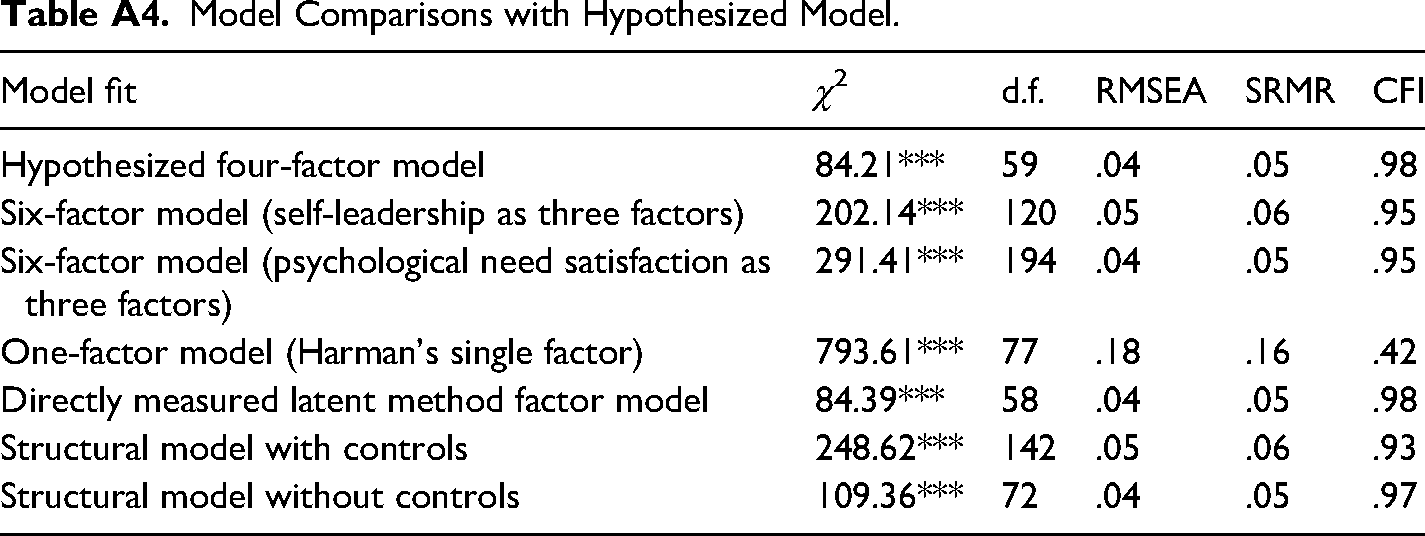
| Model fit | χ 2 | d.f. | RMSEA | SRMR | CFI |
|---|---|---|---|---|---|
| Hypothesized four-factor model | 84.21*** | 59 | .04 | .05 | .98 |
| Six-factor model (self-leadership as three factors) | 202.14*** | 120 | .05 | .06 | .95 |
| Six-factor model (psychological need satisfaction as three factors) | 291.41*** | 194 | .04 | .05 | .95 |
| One-factor model (Harman's single factor) | 793.61*** | 77 | .18 | .16 | .42 |
| Directly measured latent method factor model | 84.39*** | 58 | .04 | .05 | .98 |
| Structural model with controls | 248.62*** | 142 | .05 | .06 | .93 |
| Structural model without controls | 109.36*** | 72 | .04 | .05 | .97 |
References
Supplementary Material
Please find the following supplemental material available below.
For Open Access articles published under a Creative Commons License, all supplemental material carries the same license as the article it is associated with.
For non-Open Access articles published, all supplemental material carries a non-exclusive license, and permission requests for re-use of supplemental material or any part of supplemental material shall be sent directly to the copyright owner as specified in the copyright notice associated with the article.
