



Abstract
We review the research on organization design from 2000 to 2023, inclusive. We identify four major approaches to organization design in the contemporary literature: configuration, control, channelization, and coordination. We discuss the key streams of research that characterize each of these approaches, as well as three emerging areas of research: AI and organizational decision-making, flat organizations, and multiple goals. Beyond the specific contributions of individual papers and streams of work, our review makes a number of high-level observations across approaches. We identify patterns that characterize this body of work, the methods used, open questions for future research, and a discussion of organization design as a theory. Collectively, these observations define the state of organization design research and may provide scholars with a foundation for future research.
Keywords
Introduction
Organization design concerns formal and informal organizational attributes, including structures, processes, and systems; their antecedents; and the influence they have on the organization, its constituent units, and its members. Design choices have been a central interest of management scholars at least since the seminal contributions of sociologists and the Carnegie School to the study of organizations (Burns & Stalker, 1961; Cyert & March, 1963; March & Simon, 1958; Simon, 1947; Weber, 1922/1978). Motivated by an interest in the appropriate division of labor and integration of effort within an organization (Burton & Obel, 1984; Lawrence & Lorsch, 1967; Mintzberg, 1979), organization design research has, despite ebbs and flows, proliferated over the years. The domain of study is currently experiencing a remarkable resurgence with a growing variety of research agendas (Joseph, Baumann, Burton, & Srikanth, 2018a). Yet, despite its growth and increasing sophistication (or perhaps because of it), the literature appears to have become highly fragmented. Studies differ in their conceptualization of the organization, featured design choices, mechanisms, and assumptions of human behavior underlying their operation. 1 One can get lost in the myriad of possible combinations without truly understanding the collective wisdom on organization design and the outcomes that follow.
The cause of this fragmentation stems in part from the fact that organization design has not been uniformly treated as a theory but rather a domain of study. In much of the prior literature, what makes a study an “organization design” study is mainly the key constructs of interest (such as hierarchy or modularity) and their normative implications. Compounding the problem is that scant effort has been made to review the literature, and those that exist provide only a partial picture. A few review articles on related but separate topics include organization design (typically structure) as a small part of their review (e.g., Gavetti, Levinthal, & Ocasio, 2007; Posen, Keil, Kim, & Meissner, 2018; Sengul, Almeida Costa, & Gimeno, 2019). A handful of articles focus on only a particular segment of the literature; a particular design feature, such as activity systems (Siggelkow, 2011); a particular theoretical lens, such as information processing (Joseph & Gaba, 2020); or a particular methodology, such as simulation methods (Baumann, Schmidt, & Stieglitz, 2019). 2 Several segments of the literature are not covered in any previous review or are covered in reviews that are decades old (e.g., Drazin & Van de Ven, 1985). Fragmentation and failure to take stock of contemporary research are problematic because they make it difficult to clearly identify the boundaries of the field, its contributions to understanding organizations, and how researchers may use its insights to push the organization design research forward.
In this article, we attempt to address these shortcomings. Following a brief overview of foundational work, we review the contemporary organization design literature by examining articles published between 2000 and 2023, inclusive, in the top management journals. We identify key research streams in the contemporary organization design literature that elaborate organization-level design features, their antecedents, and their implications, as well as three emerging areas of research. We describe common patterns in the literature, as well as the gaps, to help scholars craft a research agenda on organization design.
Foundations Of Organization Design Revisited
Work by Taylor (1911), Fayol (1916), Weber (1922/1978), and Barnard (1938) are often considered to be among the earliest studies in organization design. These early studies established bureaucracies as a primary form of organizing, characterized by specialized roles and governed by hierarchical authority and rules. The next wave of scholars in the 1950s and early 1960s advanced the study of organization design by examining (1) the role of internal structure in decision-making processes and (2) the role that the external environment played in design choices. The Carnegie School of scholars—Herbert Simon, Jim March, and Richard Cyert—emphasized the first and examined “the effects of organizational structure and conventional practice on the development of goals, the formation of expectations and the execution of choices” (Cyert & March, 1963: 1). The bounded rationality of organizational members, their interdependencies and inherent conflicts, and the need for coordination at the firm level were central features of the behavioral theory of the firm, as was the organizational structures necessary to adjudicate these challenges.
Studies that examined the external environment as a driver of organization design characterized organizations as social and political systems that adapted as they interacted with their external environment. These studies showed that firms’ internal organization are likely to differ markedly across firms that face different environments, across firms that face different instances of similar environments, and within firms over time as their external environments changed. For example, Burns and Stalker (1961) note that industrial firms in turbulent and complex environments tended to develop organic structures characterized by decentralization, a lack of formally defined tasks, and an emphasis on horizontal rather than vertical coordination. Firms in stable and simple environments tended to develop mechanistic structures characterized by higher levels of centralization, formalization, and specialization. That organizations vary in their structural complexity and design in response to key contingencies—such as size, strategy, and uncertainties in their task environments (Chandler, 1962; Woodward, 1965)—was later formalized in contingency theory. Different structures must be applied to the extent that tasks vary with their environmental uncertainty (Thompson, 1967). Accordingly, organizations vary with the extent of which they are differentiated (segmented into subunits) and integrated (coordinated across those subunits) (Lawrence & Lorsch, 1967).
Gradually, theorists began to link task uncertainty and the organization’s information-processing demands to alternative organizing modes. Accordingly, in the 1970s, an information processing view emerged that proposed that an organization’s design should match the organization’s demand for information with its information processing capacity (Galbraith, 1974; Marschak & Radner, 1972; Tushman & Nadler, 1978). By implication, a firm facing high information processing requirements (e.g., due to high interdependence across its units or high uncertainty in its industry) may need to increase information processing capacity through coordination mechanisms (e.g., cross-functional teams, integrating roles, liaisons) to match its heightened information processing needs. Ultimately, scholars settled on a configurational view characterized by a multiple contingency model, which suggests that the internal features of an organization’s design must fit together and fit with the external context if the firm is to perform well (e.g., Burton & Obel, 1984; Miles & Snow, 1978).
In the following decades, the popularity of contingency theory declined (Shenkar & Ellis, 2022) and the topic of organizational design receded from attention as a productive line of inquiry for management scholars just as the managerial challenges of organization design were becoming more complex. Still, a few scholars in the 1980s and 1990s continued work in the domain, contributing to the foundations of contemporary research on organization design (e.g., Burton & Obel, 1988; Egelhoff, 1982; Miles & Snow, 1994; Mintzberg, 1993; Nadler & Tushman, 1988).
Contemporary Research On Organization Design
We sought a review approach that would help us conduct an in-depth and systematic analysis of the contemporary organization design literature. Given the breadth and depth of this literature, we aimed to be as comprehensive as possible. We outline our methodology for the literature review, including the literature search, article selection, and categorization in online appendix B, and list the 350 articles included in our review in online appendix C.
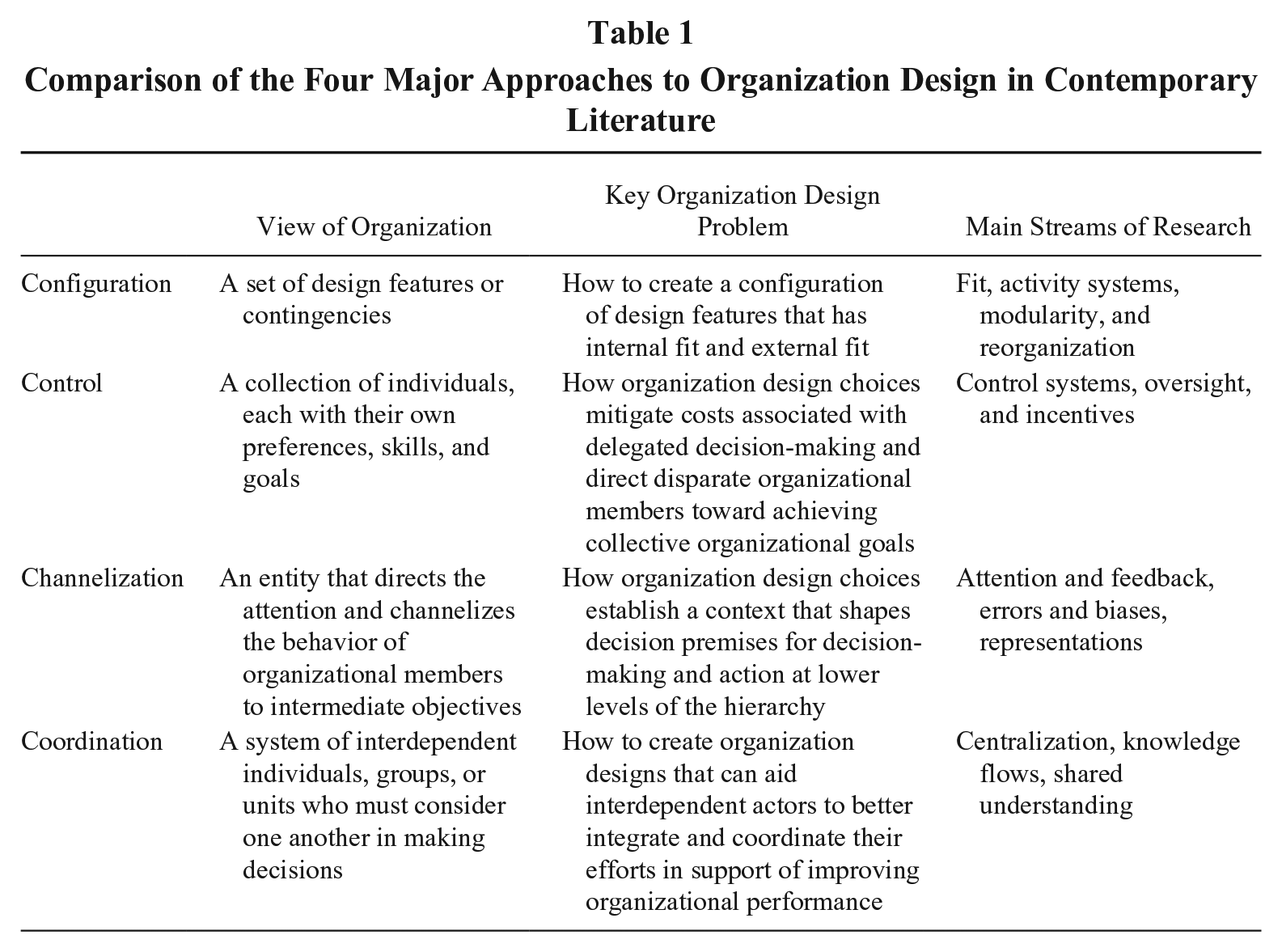
There are four distinct major approaches to organization design in the contemporary literature: configuration, control, channelization, and coordination. These approaches, although related, differ in the way they view the organization, the key organization design problem they seek to address, and design features and theoretical mechanisms characterizing the streams of research that constitute them (Table 1).
Comparison of the Four Major Approaches to Organization Design in Contemporary Literature
Configuration
A configuration approach to organization design has its roots in contingency theory and views the organization as a set of design choices or contingencies (Burton & Obel, 2004; Burton, Obel, & Håkonsson, 2021). In this approach, the key concern is how to create a configuration of design features that has internal fit and external fit. Internal fit is present when the various features of the design (e.g., goals, activities, structure, people, processes) demonstrate complementarities—that is, they are reinforcing, whereby the benefits of one design feature benefit from the presence and alignment of another. External fit is present when the internal configuration of design features aligns with information processing requirements of the environment. Designs that achieve internal and external fit result in better performance outcomes whereas misfits result in lower performance (Burton & Obel, 2018; Donaldson & Joffe, 2014; Williams & Mitchell, 2004). Studies continue to find support for contingency theory in a variety of contexts (Arora, Belenzon, & Rios, 2014; Koufteros, Peng, Lu, & Peters, 2014; Turkulainen & Ketokivi, 2013).
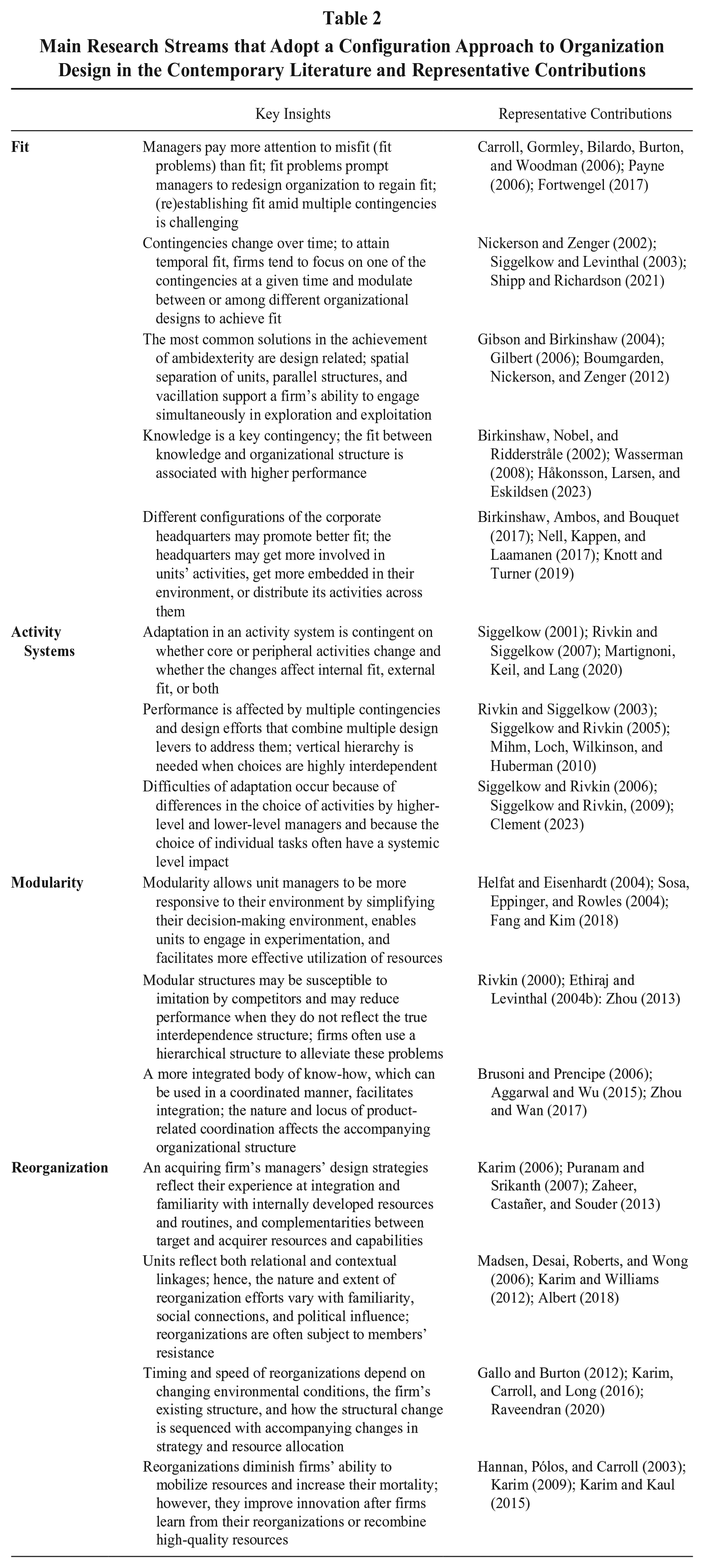
Contemporary research adopting a configuration approach advances prior work along four main streams of work: fit, activity systems, modularity, and reorganization (Table 2).
Main Research Streams that Adopt a Configuration Approach to Organization Design in the Contemporary Literature and Representative Contributions
Fit
The first important development in this stream is greater attention to the dynamics of fit. This shift originates from a growing interest in misfit, which is synonymous with misalignments, mismatches, gaps, and undesired design properties, and is reflected when one or more contingencies diminishes performance (Burton, 2020: 1). Misfit is a major problem for organizations. For example, in a case study of Toyota, Camuffo and Wilhelm (2016) document how its vaunted Toyota Production System generated a misfit when Toyota shifted its focus to growth. Quality deteriorated as accelerated hiring and expanded global footprint led to poor training and high turnover, making it difficult for manufacturing plants to adhere to the basic tenets of lean production.
Studies suggest that managers pay more attention to misfit rather than fit, indicating that greater effort is invested in the alleviation of fit problems (misfits) rather than the search for fit (Carroll et al., 2006). Misfit prompts managers to identify the source of the misfit and redesign the organization to regain fit. Hence, managers continuously adjust contingencies as a function of changes in competition, technologies, regulation, trends, or other sources of feedback (Donaldson, 2001). This pattern frames configuration as a dynamic task (Nissen, 2014), because it is necessary to create continual (re)alignment across a multitude of different levers of design and to develop capabilities to support such dynamics (Caspin-Wagner, Lewin, Massini, & Peeters, 2013). For example, Duvald (2019) finds that misfits require adjustments to information processing and operational routines on a continuing basis. In line with these observations, Helfat and Karim (2014) present a framework for fit between organization design and routines, where the likelihood of modularity and top management involvement with business units depend on how much business units’ routines change and are unit specific. As the routines change, so may the need for coordination within the organization to avoid misfit.
This emphasis on misfit amid multiple contingencies has drawn attention to the challenges in (re)establishing fit. Firms may have difficulty in reestablishing fit because of inherent tradeoffs and inconsistencies between the functional demands of the organization (e.g., of quality and of efficiency) (Payne, 2006), interdependent tasks (Clement, 2023), or changing parameters that do not impact external and internal fit equally. Regarding the latter, Fortwengel (2017) finds that hierarchy can help create internal fit but may hamper the organization’s ability to achieve external fit, whereas informal networks may aid in the creation of external fit but require compromises that diminish internal fit. Siggelkow (2001) shows that environmental changes that create both external and internal misfit make it obvious to the firm that it has to change its activities to regain fit. However, environmental changes that leave the internal fit among a firm’s complementary activities intact yet decrease the appropriateness of the set of choices vis-à-vis the external environment are difficult for the firm to manage since the internal logic of the activities remains unchanged.
The second significant development in fit studies is the consideration of temporality in achieving fit. Temporal fit is the idea that different contingencies change over the life of the organization or the product lifecycle; there is no single permanent optimal organization design that must be continually managed. When managers face multiple contingencies at successive stages of an innovation’s lifecycle, they tend to choose designs that optimize for one contingency while addressing other contingencies to the greatest extent possible (Westerman, McFarlan, & Iansiti, 2006). This observation resonates with a structural modulation perspective, which suggests that firms modulate between or among different organizational designs to achieve fit (Nickerson & Zenger, 2002). By modulating or cycling an organization’s formal structure over time, they improve the functioning of the informal organization (e.g., communication patterns) and at least temporarily approximate levels of functionality unachievable when organizations remain fixed with a particular structure. For example, Siggelkow and Levinthal (2003) find performance improves when firms temporarily decentralize to units to explore alternative activity configurations but then centralize to better coordinate activities across units. Such modulation is especially helpful in the case of new ventures, given the rapid succession of various internal and external developments that they go through (Alexy, Poetz, Puranam, & Reitzig, 2021; Jones & Schou, 2023) and the need to both exploit entrepreneurial opportunities and discover those opportunities in the first place (Hsieh, Nickerson, & Zenger, 2007). Counter to Burns and Stalker’s (1961) logic, Sine, Mitsuhashi, and Kirsch (2006) find that new ventures in turbulent, emergent economic sectors perform better with higher levels of formalization, specialization, and administrative intensity. These findings resonate with studies that challenge the conventional wisdom suggesting less structure is better for dynamic, high velocity environments (Davis, Eisenhardt, & Bingham, 2009).
A third development is the examination of structural configurations that help firms achieve ambidexterity, which refers to a firm’s ability to engage simultaneously in exploration and exploitation. Achieving ambidexterity requires balancing the demands of pursuing discontinuous innovation and new capabilities and, simultaneously, the demands of pursuing incremental innovation and leveraging existing firm capabilities (Gibson & Birkinshaw, 2004; see Raisch, Birkinshaw, Probst, & Tushman, 2009, for a review). The most common solutions are design related. Spatial separation involves the creation of separate, and typically decentralized, organizational units that, respectively, explore and exploit (Gilbert, 2006; Hill & Birkinshaw, 2014). Parallel structures include project teams, networks, or routines that operate alongside the primary structure and allow exploration and exploitation to co-occur within a single unit (Gulati & Puranam, 2009; Jansen, Tempelaar, Van den Bosch & Volberda, 2009; Rogan & Mors, 2014). A third solution is vacillation, which refers to temporally and sequentially alternating between organizational structures that promote either exploration or exploitation. Vacillation is based on the idea that over time the firm will achieve high levels of exploration and exploitation but not at the same time (Boumgarden et al., 2012; see also Siggelkow & Levinthal, 2003).
The fourth development concerns the introduction of knowledge as a key contingency factor influencing fit and the design of organizations. For example, Birkinshaw et al. (2002) argue that knowledge observability (ease of understanding by looking at the final product) and system embeddedness (importance of context for knowledge comprehension) limit the need for high levels of interactions between units. This latter argument is in line with Wasserman (2008), who finds that high level of knowledge separability (that the constituent elements of data can be collected independently) lends itself to a greater vertical division of labor. In terms of performance outcomes, Victer (2020) finds that the fit between the organizational structure and applied knowledge (in the form of technology) leads to increased performance (in the form of superior organizational capabilities), echoing the main premise of contingency theory. Knowledge, its transfer, and interdependencies are themselves subject to contingencies related to individual, organizational, and environmental characteristics (Levine & Prietula, 2012), such as situational awareness (Håkonsson et al., 2023).
The final set of studies explore alternative configurations of the corporate headquarters, its various roles, and its activities over time (see Kunisch, Menz, & Collis, 2020 for a review). This research demonstrates that the corporate office can provide resources and knowledge as well as informal suggestions and encouragement that go beyond the immediate task (Asakawa, 2020), engage in boundary spanning activities that facilitate connections and mutual understanding between individuals in different units and with external actors (customers, suppliers) (Birkinshaw et al., 2017), and allocate supervisory and coordination responsibilities to increase knowledge acquisition and improve coordination (Zhou, 2015). To better aid its constituent units, the headquarters may become embedded in its subsidiaries’ local environment to increase its understanding of that environment (Nell & Ambos, 2013) or disaggregate its activities and delegate them across the organization (Nell et al., 2017). Furthermore, studies increasingly focus on headquarters’ role in the differentiation and integration of subunits (Van de Ven, Leung, Bechara, & Sun, 2012), as well as in managing interunit competition and cooperation (Dellestrand, Kappen, & Lindahl, 2020; Knott & Turner, 2019). Successful involvement of headquarters in unit affairs is contingent on the proximity of headquarters to the unit (Glaeser, Glaeser, & Labro, 2023; Kim, Cunningham, & Joseph, 2023), unit managers involvement in problem-solving, as well as the nature of unit problems (Decreton, Tippmann, Nell, & Parker, 2023).
Activity systems
The second stream of studies, directly related to the fit literature, begins by considering the firm as an activity system—a system of interdependent choices concerning activities, policies, structures, capabilities, and resources (see Siggelkow, 2011, for a review). In this context, interdependence refers to the number of interactions between choices, the pattern of those interactions (Rivkin & Siggelkow, 2007; Siggelkow, 2002), and the rules guiding them (Albert, Kreutzer & Lechner, 2015).
There are three main lines of inquiry that have evolved in parallel. The first line of inquiry is concerned with varying degrees of interdependence among choices and the implications of those interdependencies for performance. Studies examine what happens in an activity system when elements are added, reinforced, or deleted and when the elements are considered to be core vs peripheral. Successful adaptation is contingent on whether the firm experiences changes to internal fit, external fit, or both (Siggelkow, 2001). Changes to core activities may improve fit more than change to peripheral activities but may also degrade fit more rapidly (Martignoni et al., 2020).
The second line of inquiry is concerned with the performance implications of efforts that combine multiple design levers, such as hierarchy, communication, and incentives. Studies examining these relationships confirm the fit hypothesis, that performance is affected by multiple contingencies (Rivkin & Siggelkow, 2003). For example, to ensure mutually destructive choices are not made, firms should reward decentralized managers with firm-wide incentives or utilize a centralized approach to decision-making when the environment is turbulent (Siggelkow & Rivkin, 2005). Both vertical hierarchy and divisionalization (into units with limited interdependencies) increase search stability and speed but at a cost of solution quality (Mihm et al., 2010). A general finding of this line of inquiry is that vertical hierarchy is needed when choices are highly interdependent and that benefits accrue when the organization does not foreclose too early on alternatives (Rivkin & Siggelkow, 2003).
Relatedly, the third line of inquiry concerns activity systems characterized by coupled search within multilevel hierarchies. Coupled search refers to instances where higher-level managers search for a set of activities or choices that shapes lower-level search for a set of choices that may have reciprocal influence and impact performance (Siggelkow & Rivkin, 2006, 2009). Coupled search is commonly reflected in efforts by higher-level managers to find superior combinations of firm-wide activities and parallel efforts by lower-level managers to find superior combinations of corresponding operational activities. The extent of interdependencies and the differences in the frequencies of these efforts often obscure, for managers, the true impact of sets of choices occurring at different levels.
Modularity
A third stream of work examines modular designs that confine most interdependencies to within self-contained organizational units and minimize the interdependencies between the units. A common finding articulated in this stream are the benefits of modularity. First, modularity simplifies the decision-making environment, limiting the cognitive complexity associated with many interacting units and activities (Baldwin & Clark, 2000). In this way, the division of labor associated with modularity allows units to be more responsive to demands in their environment (Ethiraj & Levinthal, 2004b; Lee, Hoehn-Weiss, & Karim, 2016). Second, modularity keeps the perturbations in one unit from negatively affecting other units (Fang & Kim, 2018). By decomposing the organization and corresponding tasks, unit managers may readily acquire, process, and utilize information necessary for the successful achievement of their subgoals while limiting disruptions in one unit from affecting other units of the firm (Burton & Obel, 1984). Third, modular structures may allow for more effective utilization of resources (Galunic & Eisenhardt, 2001; Helfat & Eisenhardt, 2004; Karim, 2006). Studies show that stronger within-unit interactions promote coordination and experimentation to better address external demands and to find the right mix of activities to increase performance (Fang & Kim, 2018; Sosa et al., 2004).
A related line of inquiry examines the limitations of modularity and factors that may alleviate them. Modular structures involve a tradeoff in that they enable performance gains through innovation (Ethiraj, Levinthal, & Roy, 2008) and their flexibility (De Waard, Volberda, & Soeters, 2013) but, at the same time, set the stage for those gains to be eroded through imitation (Rivkin, 2000). Also, modular structures in which units have overlapping charters (i.e., the businesses in which a unit actively participates) are likely to experience more intra-firm competition that can serve as a motivator but also as a source of internal organizational conflict (Birkinshaw & Lingblad, 2005). Modular structures may also negatively impact performance if they do not reflect the true underlying nature of existing interdependencies (Ethiraj & Levinthal, 2004b). Over-modularization can limit performance because decision-makers may ignore the actual interactions among choices and thus make choices that are beneficial to the unit but not the overall organization. Under-modularization can limit adaptation because it limits the number of parallel experimentations. Firms often employ a hierarchical structure to alleviate some of these problems as it improves coordination because of its emphasis on vertical information processing (Zhou, 2013) while allowing locally adaptive activities of units (Ethiraj & Levinthal, 2004a).
A final area of inquiry in this stream concerns the mirroring hypothesis, which suggests that a modular product architecture should be accompanied by a structure where different organizational units are put in charge of separate components of the technology and require little interaction (see Colfer & Baldwin, 2016, for a review). Advances to this line of inquiry have centered on uncovering new relationships and boundary conditions about when this hypothesis holds. For example, studies show that the relationship between product design and the organizational form may vary with the knowledge or perceptions underlying a technology or product architecture. A more integrated body of know-how can lead to a more integrated organizational structure because the firm benefits from a structure that allows for such knowledge to be used in a coordinated manner (Brusoni & Prencipe, 2006). Conversely, differing individual product architecture representations—itself a function of individual roles in the organization—may conflict with the organization design prescribed by senior managers and impede efforts to coordinate (Mattarelli, Bertolotti, Prencipe, & Gupta, 2022). Additionally, studies show that the nature and locus of product-related coordination affects the accompanying organizational structure. Coordination performance of a firm tends to decrease with its product variety due to resulting complexity (Zhou & Wan, 2017). However, Aggarwal and Wu (2015) argue that it is important to understand whether the locus of coordination within a firm is across product modules or within them.
Reorganization
Reorganization studies emphasize the change of design elements within a firm. But rather than emphasizing fit (as previously mentioned), they primarily focus on the implications for realizing synergies and gaining new knowledge. There are two distinct change processes that characterize reorganizations: restructuring and reconfiguration (Girod & Karim, 2017; Girod & Whittington, 2017), although these terms are not always consistently used in the literature. Restructuring involves fundamental changes in the structural archetype around which resources and activities are grouped and coordinated across the entire company, such as eliminating hierarchical layers or going from a functional structure to a matrix structure. Reconfiguration involves the addition, deletion, and recombination of units (which includes either combining or separating existing units) without modifying the company’s underlying structure. Much of the literature falls in this latter category.
In reconfiguration studies, units are conceived of as bundles of resources and routines that are identifiable patterns of activities embodied in human and capital assets (Karim & Mitchell, 2004). One line of reconfiguration studies focuses on post-merger integration and the design changes that an acquiring firm’s managers make to leverage synergies. Firms use acquisitions to both build on existing resources as well as to obtain substantially different resources (Karim & Mitchell, 2000). Karim (2006) argues that acquired units are often recombined together with, or may be molded and used within, legacy units due to managers’ familiarity with internally developed resources and routines. Zaheer et al. (2013) find that complementarities between target and acquirer resources and capabilities are less likely to prompt structural reconfiguration but more likely to increase communication, knowledge sharing, and coordination. Puranam and Srikanth (2007) show that experience with integration plays a major role in improving the coordination benefits and limiting the potential costs associated with the loss of the acquired firm as an independent source of ongoing innovation. Viewing post-merger integration as a dynamic process, Kroon, Noorderhaven, Corley, and Vaara (2022) emphasize that ongoing interactions are needed to ensure transaction synergies are realized.
Another area of inquiry in this stream emphasizes the role of managers and executives in reorganization. Because units reflect both contextual linkages (e.g., activities) and relational (e.g., interpersonal) linkages between managers, the nature and extent of their reconfiguration varies (Albert, 2018; Karim, 2012). For example, units are more likely to be recombined if they receive executives from internally developed units (than executives from acquisitions) since they have social ties to individuals within the core of the organization (Karim & Williams, 2012). Focusing on the role of middle managers in reorganizations, Livijn (2019) shows that they modify and adapt the incomplete top-level design with new processes and routines at the operating level to obtain fit for the organization. Studies also document that it is important for managers to consider the fact that organizational members often actively resist reorganization efforts. Notably, Madsen et al. (2006) emphasize managing as ongoing design (in other words, continuous redesign) because of the resistance that can arise in response to a new design effort. Pushback can result in further design changes creating an iterative process of feedback and redesign (see also Vaast & Levina, 2006).
Another related development in this stream pertains to the temporality of reorganization decisions. Karim et al. (2016) show that firms initiate structural recombinations during periods of industry growth but reduce and delay recombination efforts during periods of industry turbulence and changes in top management to fully process information and learn about how structural changes will align them with the new environment. Moreover, a firm’s existing structure affects the timing of its reorganization decisions. Raveendran (2020) demonstrates that reorganizations occur more quickly in firms with more homogenous units (where individuals have the same functional expertise, such as marketing or R&D) rather than heterogeneous units (where individuals have distinctive areas of expertise like those in subunits of an M-form firm). The findings of Gallo and Burton’s (2012) simulation suggest that how quickly a firm changes its structure to a new one is also affected by how the structural change is sequenced with accompanying changes in the firm’s strategy and resource allocation.
Finally, studies in this stream have shown that reorganizations can have both positive and negative effects on organizational outcomes. On the one hand, the disruption from reorganization diminishes a firm’s ability to mobilize resources (Hannan et al., 2003). So, organizational mortality following a reorganization increases with interdependence among the firm’s units and their viscosity, which refers to the time it takes a unit to respond to the changes and bring other elements into conformity (fit) through the cascading of subsequent changes. On the other hand, Karim (2009) finds that, while reorganization initially hurts innovation, it subsequently improves innovation because firms need to learn from their reorganizations before there are positive outcomes. Structural recombination will have a positive effect on innovation when there are substantial intraorganizational knowledge synergies, when path dependence is low, and when knowledge resources are of high quality, limiting disruption (Karim & Kaul, 2015). Garud, Kumaraswamy, and Sambamurthy (2006) find that seeding a firm’s design elements with generative properties—features promoting consistency and reliability as well as learning and change—enhances the firm’s ability to adapt its organization to changing contingencies.
Control
A control approach to organization design views the organization as a collection of individuals, each with their own preferences, skills, and goals. Studies adopting this approach are concerned with how design choices mitigate costs associated with delegated decision-making and direct disparate organizational members toward achieving collective organizational goals. Such costs include agency costs that arise when self-interested subordinates act opportunistically and make self-serving decisions (Fama, 1980; Jensen & Meckling, 1976) as well as costs associated with inefficient individual choices and decisions. Control efforts entail creating alignment between organizational goals and choices of organizational members by utilizing various control mechanisms (Gibbons, 2005; Sitkin, Cardinal, & Bijlsma-Frankema, 2010), such as prescribing and evaluating their actions (behavioral controls) and monitoring their results (output controls).
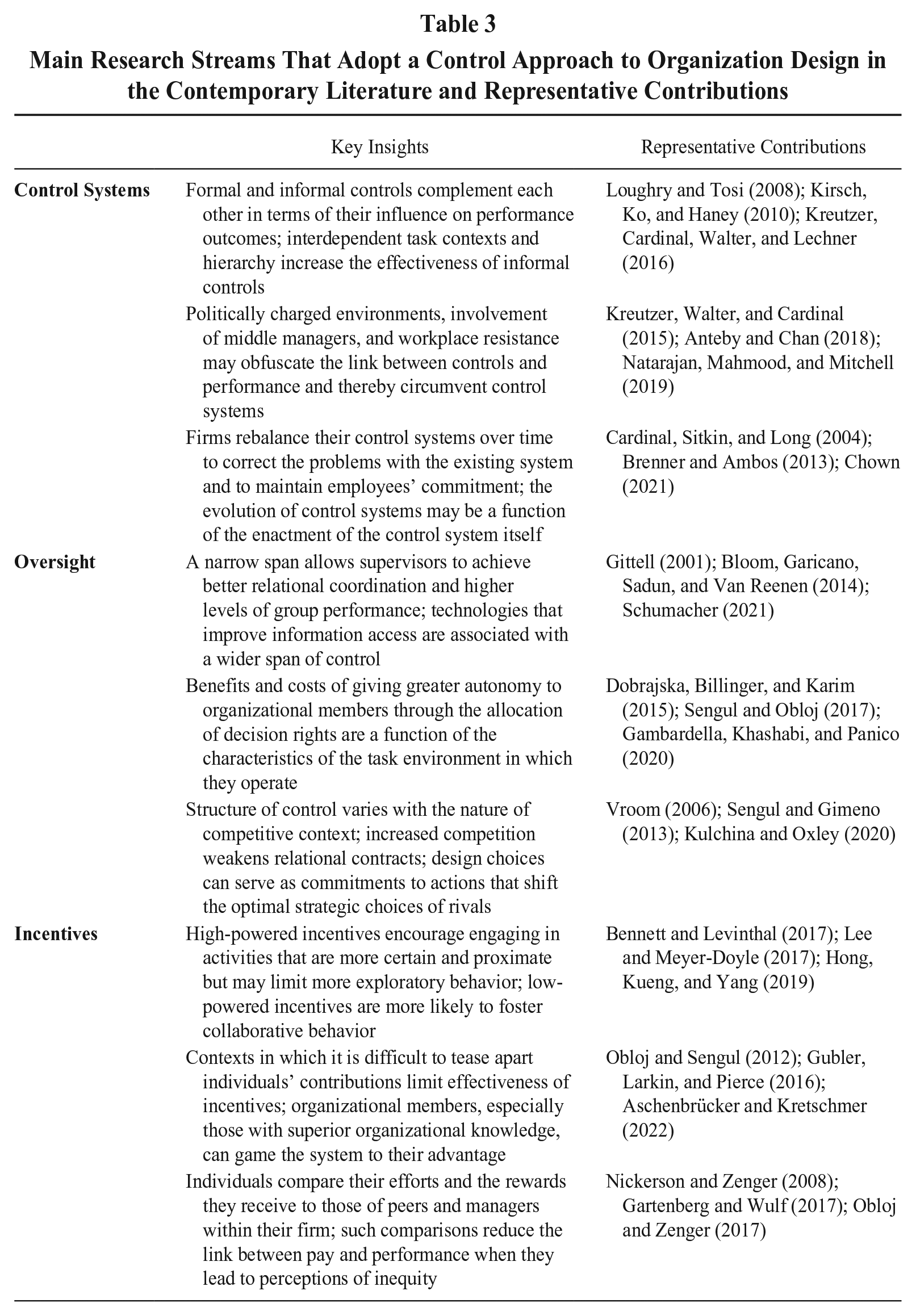
Contemporary control research advances prior studies along three main streams of work: control systems, oversight, and incentives (Table 3).
Main Research Streams That Adopt a Control Approach to Organization Design in the Contemporary Literature and Representative Contributions
Control systems
Control systems are meant to align individuals’ activities, capabilities, and performance in service of the organization (Turner & Makhija, 2006). Organizations usually use formal controls, such as policies, incentives, and targets, as well as informal controls such as peer monitoring and culture (Cardinal et al., 2004).
A development in this stream is the examination of structural contingencies that increase the effectiveness of informal controls as a part of an organization’s control system. These contingencies are important because formal and informal controls complement each other in terms of their influence on performance outcomes (Kreutzer et al., 2016; Walter, Kreutzer, & Kreutzer, 2021). Contemporary studies highlight two structural contingencies: interdependencies and hierarchy. Interdependencies between peer members increase the effectiveness of peer monitoring, a form of informal control that occurs when peers act as agents of the organization or its management. Interdependent task contexts—where the choices and activities of one individual depend on those of another—increase information exchange and enable members to understand what their peers are working on and reduces uncertainty about how they will perform (Loughry & Tosi, 2008). Hierarchy, in the form of formal authority, may also facilitate the usage of informal controls. Through meetings and interactions, hierarchy can promote a common vision of tasks, a common understanding of demands, and a common approach to problem-solving. In doing so, the hierarchy can make up for a lack of behavioral and output control mechanisms and increase cooperative behavior (Kirsch et al., 2010). The hierarchy may also set policies to guide unit managers in the creation of formal contracts that complement informal agreements between units and serve as inter-unit communication and commitment devices (Magelssen, 2020; Magelssen, Rich, & Mayer, 2022).
Another line of inquiry pertains to the examination of contingencies that may obfuscate the link between control and performance and thereby circumvent the usefulness of certain types of control mechanisms. Much of this comes from the introduction of information asymmetry. Illustratively, Kreutzer et al. (2015) find that politically charged environments increase the information asymmetry problem inherent in behavior control, exacerbate its perceived subjectivity, and increase the potential for individuals to pursue self-interest and own goals at the expense of organizational goals and interests. The involvement of middle managers may also increase information asymmetry and exacerbate the agency problem. This is because senior managers only have a limited understanding of middle managers’ activities, and middle managers are not subject to the same kind of external scrutiny as senior managers. Middle managers are more likely to pursue actions that benefit themselves, especially in the presence of uncertainty and lower monitoring (Natarajan et al., 2019).
Another contingency that limits the effectiveness of control mechanisms is workplace resistance, which refers to “act[s] intended to mitigate claims by management on workers or to advance workers’ claims against management” (Hodson, 1995: 80). Organizational members can pursue resistance using various strategies, from simple work avoidance and absenteeism to more severe strategies such as theft and sabotage. Resistance can also manifest discursively in that members may vocalize their opposition to certain controls and name particular acts of resistance (Prasad & Prasad, 2000). Workplace resistance often creates a cycle where resistance leads to more control by the organization, which leads to more resistance. Anteby and Chan (2018) document such an effect, showing that behavior control (member surveillance) leads organizational members to interpret the surveillance as coercive and to engage in resistance activities. Management then uses these actions to justify greater surveillance, which in a self-defeating cycle, further exacerbates the resistance activities of employees. However, deviance can be attenuated when employees’ view monitoring as a tool to ensure greater fairness and recognition and, correspondingly, when their perceptions of justice are high (Thiel, Bonner, Bush, Welsh, & Garud, 2023).
A third area of inquiry in this stream of research focuses on the evolution of control systems instead of contingencies that regulate them. The central idea is that firms may rebalance their control systems over time—in that they may add or remove features or change the emphasis on particular features—to correct the problems with the existing system and to ensure the continual commitment of employees to providing their human capital. For example, a firm may add formal control measures when the informal system is insufficient or add informal control when the formal system is found lacking (Cardinal et al., 2004). Illustratively, Brenner and Ambos (2013) find that to maintain balance, multinational corporations alter the mix of formal and informal controls on their subsidiaries over time. However, it is possible that such efforts, when not carefully articulated, may create a momentum that swings the firm past a potentially optimal mix. For example, Cardinal et al. (2004) show that too much formalization and output control following a period of informal control increased animosity between managers and employees and eventually prompted the departures of employees.
It is worth noting that the evolution of control systems may be a function of the enactment of the control system itself. Mazmanian and Beckman (2018) observe that individuals develop and then become committed to achieving goals through a ritual of quantification—a process through which key financial figures are developed. Process controls (which structure the budgeting cycle) and informal controls (which promote related work routines and emotional investment in them) foster collective support and shared belief in the objective authority of numbers to motivate action. In parallel, Chown (2021) documents that a new control mechanism is redesigned as it spreads across units of a firm through interactions between managers and employees. Members engage in an iterative learning process and discover how to (re)design the control mechanism to ensure that it delivers the intended outcomes. This finding is similar to Valentine’s (2018) study of organization learning, which finds that obligations associated with hierarchical positions can be renegotiated.
Oversight
A key mechanism of formal control that evokes foundational theories of bureaucratic organization is oversight of subordinates through hierarchical authority. From a control lens, oversight allows managers to contain value diverting actions of subordinates (agency costs) and to increase efficiency through coaching and feedback, and thereby (re)creating alignment between the actions and choices of subordinates and organizational goals.
A development in this stream is consideration of conditions under which narrow vs. wide span of control (i.e., number of subordinates reporting to a manager) may be more beneficial in organizations. Gittell (2001) finds that supervisors with smaller spans achieve higher levels of group performance. This is mainly because a narrow span allows supervisors to achieve better relational coordination through working with, and providing coaching and feedback to, their subordinates. This finding resonates with Schumacher (2021), who shows that CEOs with high dominance—an idiosyncratic character trait strongly associated with a desire for influence and control and, hence, arguably lower inclination to engage in relational coordination—have a significantly larger personal span of control and delegate fewer decision rights than less-dominant CEOs. Studies also note that the level and type of involvement of hierarchy in subordinate organizational members’ and units’ decision-making is affected by information and communication technology (Zenger & Hesterly, 1997). However, it is important to distinguish between information technology (which reduces the cost of acquiring information) and communication technology (which reduces the cost of asking for and providing directions). Bloom et al. (2014) study both and show that technologies that improve communication are associated with lower autonomy (see also Mazmanian, Orlikowski, & Yates, 2013) whereas technologies that improve information access are associated with greater autonomy and with a wider span of control.
Another development is the elaboration of whether and under what conditions organizational members (typically unit managers) would be subject to high oversight or given greater autonomy. A central takeaway from such studies is that the benefits and costs of giving greater autonomy to organizational members are a function of the characteristics of the task environment in which they operate. For example, Dobrajska et al. (2015) find that whether or not organizational member(s) who hold the formal authority for a task and who exercise that authority are the same person is a function of specialization and the match between required knowledge and expertise. Studying scientists who are central to value creation efforts in industrial research projects, Gambardella et al. (2020) show that efficiency is the main driver of scientists’ autonomy when the level of resources that enhance their productivity are high and motivation is the main driver when those resources are low. In parallel, Hong (2020) finds that when managers and high-skilled employees are externally hired, decision rights are reallocated to the level of the hierarchy where external hiring occurs to utilize newly acquired human capital more effectively. Sengul and Obloj (2017) observe that anticipated behavioral biases, such as unit managers’ responses to performance shortfalls, may also drive the allocation of decision rights because increased oversight may help achieve realignment. A study by Dattée, Arrègle, Barbieri Lawton, and Angwin (2022) on Lamborghini and its parent company Audi demonstrates that autonomy is negotiated through a dynamic process between corporate managers’ autonomy-reduction efforts and unit managers’ autonomy-extension efforts—the result of which is an oscillation in the subunit managers’ discretion over resource-orchestration decisions over time.
A third development in this stream is the recognition that competitive context may influence the structure of control in firms (Sengul, 2018, 2019; Vroom, 2006). Increased competition weakens self-enforcing relational contracts that accompany delegation decisions due to lower anticipated future economic rents and are associated with a lower likelihood of delegation. Illustratively, Kulchina and Oxley (2020) find that foreign entrepreneurs are less likely to delegate decisions to local agents, who are more reliant on self-enforcing agreements than domestic firms when the expected level of competition in the target market is high. In addition, intrafirm competitive spillovers, which occur when subsidiaries’ interests are not aligned (due to, e.g., competing brands or competition across multiple markets), require intervention by headquarters to facilitate coordination. Sengul and Gimeno (2013) document that French multi-industry firms manage multimarket competition by delegating most business-level decisions to subsidiaries while simultaneously limiting their action space for resource commitments through constraints on the scope of decision rights and constraints on available resources, a phenomenon that they refer to as constrained delegation. By implication, the allocation of decision rights varies both across units of the same firm (see also McElheran, 2014) and across types of decisions.
Incentives
Control mechanisms and systems typically include some form of incentive, such as bonuses, awards, or promotions. The objective of every incentive system is to create an alignment between employees’ compensation and organizational objectives, leading them to make choices that positively contribute to the objectives of the organization as they seek to optimize their own individual benefits.
Drawing on previous studies documenting the effectiveness of high-powered financial incentives in organizations (e.g., Lazear, 2000), much of the organization design literature in this stream studies the implications of the power of incentives on the magnitude and direction of effort allocation. Incentives may be categorized as high-powered if they closely link an individuals’ compensation to their performance outcomes or as low-powered if that link is weak. High-powered incentives—such as pay-for-performance—partially shift the risk from the organization to organizational members, making them more likely to engage in activities that are more certain and proximate (i.e., will pay off sooner than later). Thus, high-powered incentives are likely to yield predictable ideas and activities and limit more exploratory behavior, which is uncertain and pay off only occasionally (Lee & Meyer-Doyle, 2017), whereas low-powered incentives—such as base salary—are more likely to foster collaborative behavior (Lee & Puranam, 2017). As a result, firms that adopt high-power incentives are likely to decentralize more tasks from headquarters to employees (Hong et al., 2019). These observations resonate with Bennett and Levinthal (2017), who predict that early high-growth firms may use high-powered incentives; moderate-growth firms may put more emphasis on large salary increases contingent on promotion; and mature, slow-growth firms may use low-powered incentives. Recent studies observed that incentives, in addition to their power, may also differ in their firm specificity (Kryscynski, 2021; Kryscynski, Coff, & Campbell, 2021). Incentives that demonstrate higher firm specificity, such as Disney’s employee discounts on parks and merchandise, provide more utility for the average employee in the focal firm than similar incentives at competitor firms.
A second development in contemporary research is the examination of the contingencies that limit the effectiveness of incentives. External contingencies, such as product market competition, may moderate the effectiveness of pay-for-performance schemes. Illustratively, Khashabi, Heinz, Zubanov, Kretschmer, and Friebel (2021) find that both weak competition (due to limited potential to gain residual market from rivals and the resulting reduction in effort allocation) and strong competition (due to higher likelihood of competitive response) weakens the effectiveness of pay-for-performance. Internal contingencies such as task interdependence may also limit the effectiveness of incentives because they make it more difficult to tease apart individuals’ contributions. Especially susceptible to this concern are the settings that emphasize innovation or creativity, given the need for coordination (Kretschmer & Puranam, 2008), added importance of professional norms (Cardinal, 2001), and intrinsic motivation (Baumann & Stieglitz, 2014) for such work. Difficulty in accurately evaluating the performance of individuals (especially those in bigger groups or at higher hierarchical levels, which both obfuscate their individual contributions) is a major concern for managers unless they have mechanisms to identify covariation between an employee’s presence and her team’s productivity (Uribe, Carnahan, Meluso, & Austin-Breneman, 2022). Such difficulty in evaluating employees for team-based performance also leads to greater attention to those dimensions that are more easily measured or controlled (Zenger & Marshall, 2000). Notably, the very presence of financial incentives for some dimensions of performance (and not others) may crowd out intrinsic sources of motivation and performance in tasks not included in the incentive regime (Aschenbrücker & Kretschmer, 2022). Thus, incentives affect the allocation of effort and attention to the incentivized but also unincentivized tasks (Gubler et al., 2016).
A related concern is incentive gaming, which refers to actions and choices of organizational members that exploit the imperfect observability of effort allocation and asymmetric ability to measure different tasks to maximize their pay, potentially at the expense of organizational objectives. The more value is diverted by employees, the less effective an incentive regime becomes. Most high-powered incentives suffer from the gaming problem. For example, the probability of financial misrepresentation increases with the proportion of stock options in a company’s CEO’s pay, who has an incentive to inflate stock prices artificially (Harris & Bromiley, 2007). Salespeople, facing a decrease in sales goals in a product category (which increases return to effort), are likely to sell more in that category but may reduce sales with the introduction of goal ratcheting, which will make it more difficult for them to attain bonuses in a future period (Brahm & Poblete, 2018). A development in this area of research has been the examination of the dynamics of incentive gaming. For example, following a change in a firm’s incentive regime, its members are likely to learn, early on, how to be more productive. However, over time, they are likely to place greater emphasis on learning how to game the system (Obloj & Sengul, 2012). Naturally, firms attempt to avoid such behavior, but members tend to become more proficient at it over time. Managers with superior organizational knowledge are not only more able to increase their productivity but also more able to manipulate work to increase incentive payouts to themselves (Frank & Obloj, 2014), although their ability to do so is limited by lack of employment opportunities (De Stefano, Bidwell, & Camuffo, 2022).
A third development in the stream of research on incentives focuses on problems associated with social comparison—whereby individuals make sense of their value and standing via comparisons with similar others. Individuals seek equity and fairness in rewards and compare their effort and the rewards they receive to that of others (Obloj & Zenger, 2022). When peer comparisons lead to perceptions of inequity, individuals will either alter their inputs or outputs or cognitively distort the differences to limit perceived inequity, and such actions decrease the efficacy of performance-based incentives (Larkin, Pierce, & Gino, 2012). For example, Gartenberg and Wulf’s (2017) study suggests that division managers compare pay against both their peers (horizontal comparison) and the chief executive officer (vertical comparison) within their firm and that such comparisons can lead to perceptions of inequity, reducing the link between pay and performance. The negative impact of social comparisons may be especially pronounced when peers are physically or socially proximate (Obloj & Zenger, 2017) and has been theorized to motivate firms to externalize certain activities to avoid such immediate comparisons (Nickerson & Zenger, 2008). Employees who are more successful and higher in the hierarchy and whose self-esteem is more dependent on continued success can react to unfavorable social comparison by either engaging in deceptive acts that enhance their reported achievement compared to others (Edelman & Larkin, 2015) or by seeking remuneration in less observable forms (Wong, Cheng, Lam, & Bamberger, 2023).
Channelization
A channelization approach to organization design conceives of the organization as an entity that directs the attention and “channelizes” the behavior of organizational members to intermediate objectives (Simon, 1947: 110). Studies adopting this approach are concerned with how design choices establish a context that shapes decision premises for decision-making and action at lower levels of the hierarchy. Accordingly, in these studies, the organization serves to “place the organization members in a psychological environment that will adapt their decisions to the organization objectives and will provide them with the information needed to make these decisions correctly” (p. 92). Although both control and channelization studies recognize the mechanisms that managers use to direct organizational members to act in desired ways to meet an organization’s objectives, channelization studies tend to prioritize the psychology of organization members, the social context of decision-making, and the situational mechanisms that may affect particular decision-making contexts or opportunities (Elsbach, Barr, & Hargadon, 2005; Joseph & Gaba, 2020).
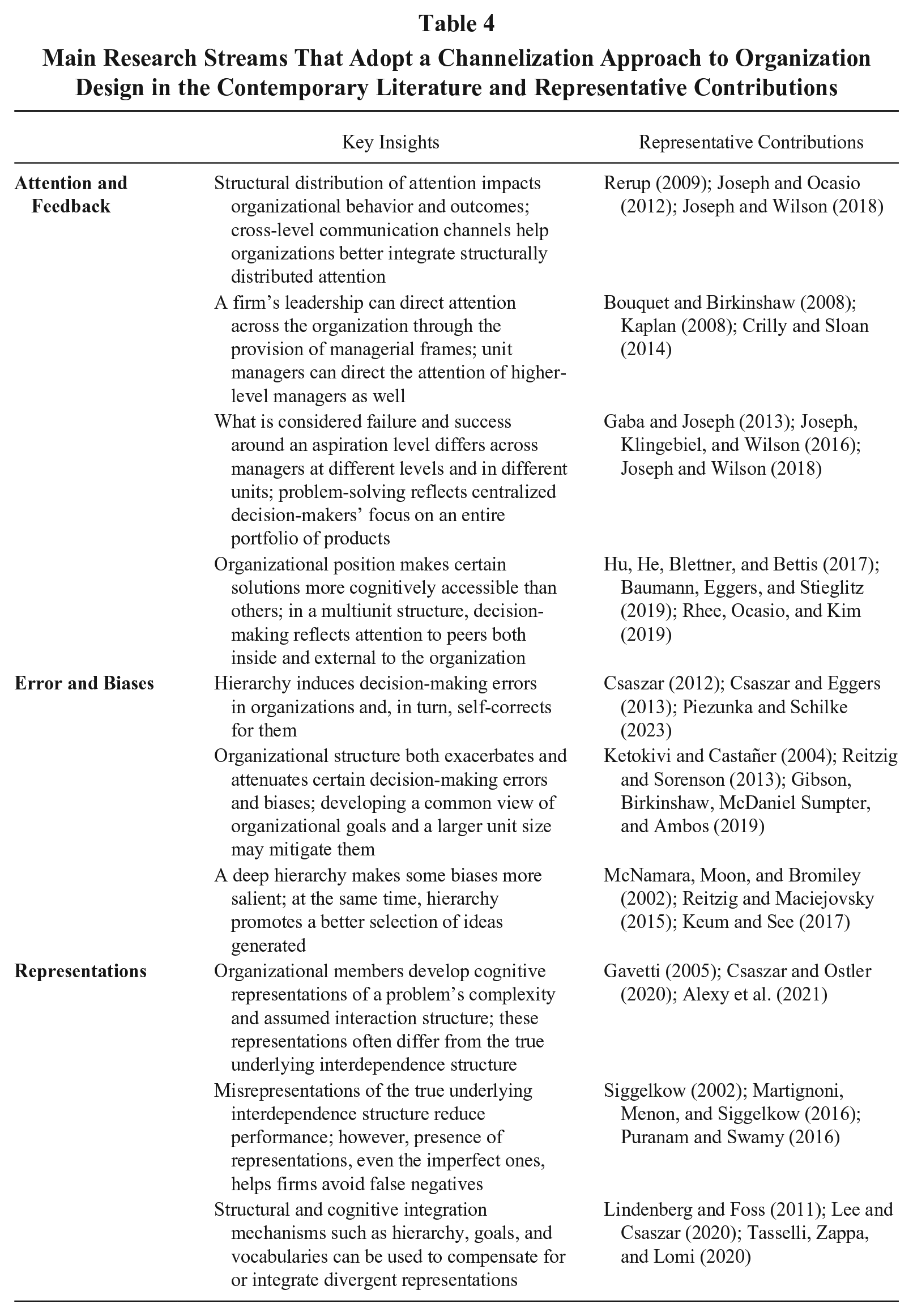
Contemporary research adopting a channelization approach advances prior work along three streams: attention and feedback, errors and biases, and representations (Table 4).
Main Research Streams That Adopt a Channelization Approach to Organization Design in the Contemporary Literature and Representative Contributions
Attention and feedback
Organization design’s attention-directing implications have been foundational to organizational research. As Simon (1947) noted, and as Ocasio (1997) elaborated in advancing the attention-based view (ABV), organizational behavior is strongly influenced by the limited attentional capacity of decision-makers and by the effect of an organization’s design on the attention that decision-makers pay to key issues and solutions that together constitute the firm’s agenda. Thus, to adopt an ABV is to recognize that managerial attention may be strongly influenced by the firm’s formal design (Joseph & Gaba, 2020).
Building directly on foundational work, recent studies in this stream recognize that both hierarchy and divisionalization impact organizational attention. For example, corporate-level managers are likely to focus attention on firm-wide strategic problems and solutions, and divisional-level managers are likely to focus on operational issues and opportunities. Such a distribution of attention can make it difficult to advance solutions detrimental to a particular unit but beneficial to the overall organization (Joseph & Wilson, 2018; Ocasio & Joseph, 2018). The structural distribution of attention can also create differences in the way the organization responds to environmental uncertainty, with corporate-level managers demonstrating a much lower level of uncertainty aversion than subsidiary managers (Dutt & Joseph, 2019).
The distribution of attention must be complemented with mechanisms that can better integrate attention. Here, contemporary research has highlighted the importance of communication channels that not only integrate levels in the organization but also more tightly couple key issues and initiatives through situated attention (Joseph & Ocasio, 2012). It is through such attentional integration that a firm may triangulate attention—that is, combine stability, vividness, and coherence of attention to comprehend the same issue with greater clarity and depth throughout the hierarchy (Rerup, 2009).
Another development in this stream is the examination of the role of a firm’s leadership in directing attention through provision of managerial frames that provide a lens through which decision-makers interpret the world and serve as a precursor to attention and action (Kaplan, 2008). For example, the provision of frames through the corporate hierarchy has been shown to shape various attention patterns—including attention to growth opportunities (Joseph & Wilson, 2018), stakeholders (Crilly & Sloan, 2014), or even conflict between nation-states (Jacobides, 2007)—so as to ensure more coherent and appropriate responses that benefit the entire organization. Of course, it is also possible for unit managers to direct the attention of higher-level managers, especially if the unit has voice and weight. In such instances, the unit may benefit from increased access to resources and higher discretion in decision-making (Bouquet & Birkinshaw, 2008).
Channelization also features the relationship between organization design, performance feedback, and decision-making. Research in this stream makes two main observations pertinent to organization design. First, for individual managers, what constitutes the content of their aspirations, what is considered failure and success around an aspiration level, and what is considered an appropriate “solution” to performance problems will vary by their position in the organization. For example, corporate and business unit managers prioritize, respectively, on overall firm and unit performance (Gaba & Joseph, 2013). Corporate managers are not solely concerned with the risk or performance outcomes associated with any particular product and oversee resource allocation across an entire portfolio of products. Thus, they are quicker to cull poor-performing products than unit managers (Joseph et al., 2016).
Second, in multiunit firms, units not only make external comparisons with similar peers but also make internal comparisons with other units. Because they are in competition for internal firm resources, units face closer and more comparative evaluation of their performance with other units. In line with these predictions, units have been shown to put emphasis on the performance of competitors in order to justify their own performance internally (Vissa, Greve, & Chen, 2010) as well as aspirations of peer units (Baumann, Eggers, & Stieglitz, 2019; Hu et al., 2017). Also, their position among peer units within the organization makes certain problems and solutions more cognitively accessible than others (Hu & Bettis, 2018; Rhee et al., 2019).
Errors and biases
One of this stream’s most important developments is the examination of the link between organizational structure and decision-making errors, which builds on Sah and Stiglitz (1986), who provide “a parsimonious mechanism to explain how micro decisions (individual choices) are aggregated by an organizational architecture into macro behaviors (organization-level performance)” (Csaszar, 2012: 612; see also Christensen & Knudsen, 2010). In particular, hierarchy has been shown to induce decision-making errors. Relative to decentralized structures (polyarchies), hierarchies accept fewer projects, make more omission errors, and make fewer commission errors (Csaszar, 2012). As a result, delegation in decentralized structures is relatively more beneficial for exploration (Csaszar, 2013) and is helpful when expertise is diverse within the firm and when the matching of the problems to those who can solve them is efficient (Csaszar & Eggers, 2013). At the same time, individuals within more centralized decision-making structures may attempt to self-correct for these errors. For example, Christensen, Dahl, Knudsen, and Warglien (2023) argue that the centralized structure’s more stringent selection environment causes members to adapt project acceptance thresholds (reservation levels) and become less conservative in evaluating projects.
Decision-making structures can have a variety of other unintended organizational-level consequences. For example, Piezunka, Aggarwal, and Posen (2022) find that structures that are effective at aggregating information are not effective at fostering individual learning because they only get feedback on organizational choices. Piezunka and Schilke (2023) argue that a more stringent decision-making structure (i.e., higher voting threshold) increases the amount of support required for a given project to be greenlit at the organizational level, which should result in fewer investments getting approved. However, a more stringent decision-making structure also increases individuals’ tendency to provide their support for investment since the decision-making structure ostensibly attenuates people’s concern that their (biased) information may cause them to support the wrong investment.
A related line of research examines the processes that mediate the relationship between structure and decision-making errors. Different organizational structures are associated with different frames and motivations (Foss & Weber, 2016; Weber, Foss, & Lindberg, 2023) and have been shown to exacerbate or attenuate certain biases and errors. For example, because of divisionalization and corresponding in-group bias—the tendency of individuals to identify with and favor members of their own groups—unit members systematically undervalue ideas associated with members of the organization outside their unit (Reitzig & Sorenson, 2013). Similar biases can also be observed vertically, with ideas flowing down from higher levels of the hierarchy. For example, Gibson et al. (2019) found evidence of a hierarchical erosion effect whereby individuals’ perceptions about organization-wide practices become less favorable the lower one goes in the hierarchy. Similarly, Schweisfurth, Schöttl, Raasch, and Zaggl (2023) found that ideas of hierarchical peers are often evaluated more favorably, especially if ideas are novel and hard to evaluate.
As a hierarchy becomes deeper, other biases may also become salient. When individual decision-makers face more layers of approval, they may begin to exhibit an evaluation apprehension bias and diminished sense of control over the final decision (Reitzig & Maciejovsky, 2015). As a result, the number of proposals generated at lower levels may decline since individuals may be less motivated to voice new ideas. Further, the imposition of hierarchy and corresponding increase in oversight restricts information processing and increases efforts to maintain control, which can result in an escalation of commitment to a failing course of action (McNamara et al., 2002). At the same time, a hierarchy might promote a better selection of ideas since organizational filtering may encourage a fuller and more careful consideration of ideas beyond one’s own (Keum & See, 2017).
Research offers some solutions to mitigate these biases. For example, it may be useful to create larger units to mitigate in-group biases since the likelihood of forming dyadic relationships between organizational members decreases with subunit size (Reitzig & Sorenson, 2013). Also, engaging organizational members in strategic planning efforts and communicating and articulating organizational goals ameliorates position bias, allowing members to develop a common view of organizational goals (rather than focus on parochial goals) and focus on their position in the organization as a whole (Ketokivi & Castañer, 2004). In new ventures, confidence biases may be managed by selectively matching the decision-making structure to entrepreneurs’ biases (Chen, Elfenbein, Posen, & Wang, 2022).
Representations
A subset of studies that adopt the channelization approach explicitly recognizes that because of environmental complexity, individuals focus on their immediate environment, create corresponding simplified representations to better understand it, and make satisficing decisions (Simon, 1955, 1957). These representations, derived from the structural properties of the organization as well as from individual experience, serve as interpretation devices and assist individuals in categorizing environmental signals, managing uncertainties, processing feedback, and focusing attention. These internal representations may be shared among organizational decision-makers and may be partially or fully held alongside external representations such as concrete artifacts, frameworks, or other visual representations (Csaszar, 2018). Internal representations are partially influenced by the design of the organization (e.g., hierarchy, divisionalization) that ultimately guides which issues and initiatives the organization will pursue (Levinthal, 2017). For example, Junge, Luger, and Mammen (2023) find that organizational structure affects CEOs’ (mis)perceptions of the competitive environment.
Organizational members, especially those in a differentiated structure, often hold different (and often divergent) perceptions of issues that impact how they interact with one another and with the external environment. Such differences in perceptions may make it difficult for a firm to develop and enact coherent strategies or ensure coordinated responses to environmental cues and changes. Weak cues or ambiguous signals may receive less attention from higher-level managers than from lower-level managers since the firm’s local environment, operational experiences, and action-outcome relationships become more difficult to interpret at higher levels in the hierarchy (Gavetti, 2005). Another problem highlighted by studies in this stream is the poor assessment of the complexity of the internal or external environment. Organizational members develop complex cognitive representations of an organization’s problems reflected in representational complexity (Csaszar & Ostler, 2020), interdependence representations (Martignoni et al., 2016), and logics of organizing (Alexy et al., 2021). These representations often differ from the true underlying interdependence structure (e.g., interactions among internal activities) or external complexity (e.g., interactions between the firm and its environment).
Misrepresentations can create difficulties in coordination and reduce performance, especially when the representations reflect complementary activities (rather than substitute activities; Siggelkow, 2002) or are overly simplified (versus overly detailed) ones of internal interdependencies (Martignoni et al., 2016). On the other hand, simplified representations are not always detrimental to performance. For example, they can prevent members from accepting misleading feedback (false negatives) even when they are imperfect (Puranam & Swamy, 2016). By avoiding false negatives, the firm can avoid foreclosing on options too quickly, which may ultimately be beneficial for performance. Csaszar and Ostler (2020) argue that whether a firm is better off using simple or complex representations of its task environment depends on the environment’s actual complexity and especially on the firm’s knowledge about the environment.
Finally, contemporary studies point out that organizations may need to employ either structural or cognitive integration mechanisms to compensate for or to integrate divergent representations. For example, hierarchy can aid in information processing, promoting search (Gavetti, 2005), creating collective (shared) interpretations of a changing environment, and coming up with effective solutions (Lee & Csaszar, 2020). Other integration mechanisms that organizations may employ include: standards of action (Dougherty, 2001), which are vivid, simple representations of value creation that frame work and that are reenacted in practice; normative goal frames (Lindenberg & Foss, 2011), which are focal goals that reflect desired improvements for an individual’s group or unit; and common vocabularies (Tasselli et al., 2020) or common communication codes (Hsieh et al., 2007), which may sustain communication patterns and ties across organizational boundaries.
Coordination
A coordination approach to organization design views the organization as a system of interdependent individuals, groups, or units that must consider one another in making decisions. The key concern in this approach is how to create organizations that can aid interdependent actors to better integrate and coordinate their efforts in support of improving organizational performance. Thus, organization design studies adopting a coordination approach examine how design choices allow an organization to achieve what organizational members or units could not do alone (Burton & Obel, 2018; Okhuysen & Bechky, 2009). Although the issue of coordination shows up in other approaches to organization design (notably configuration and channelization), studies adopting this approach make explicit and central the coordination problem associated with the division of labor and focus on the design attributes that address those problems and the corresponding information processing and performance implications.
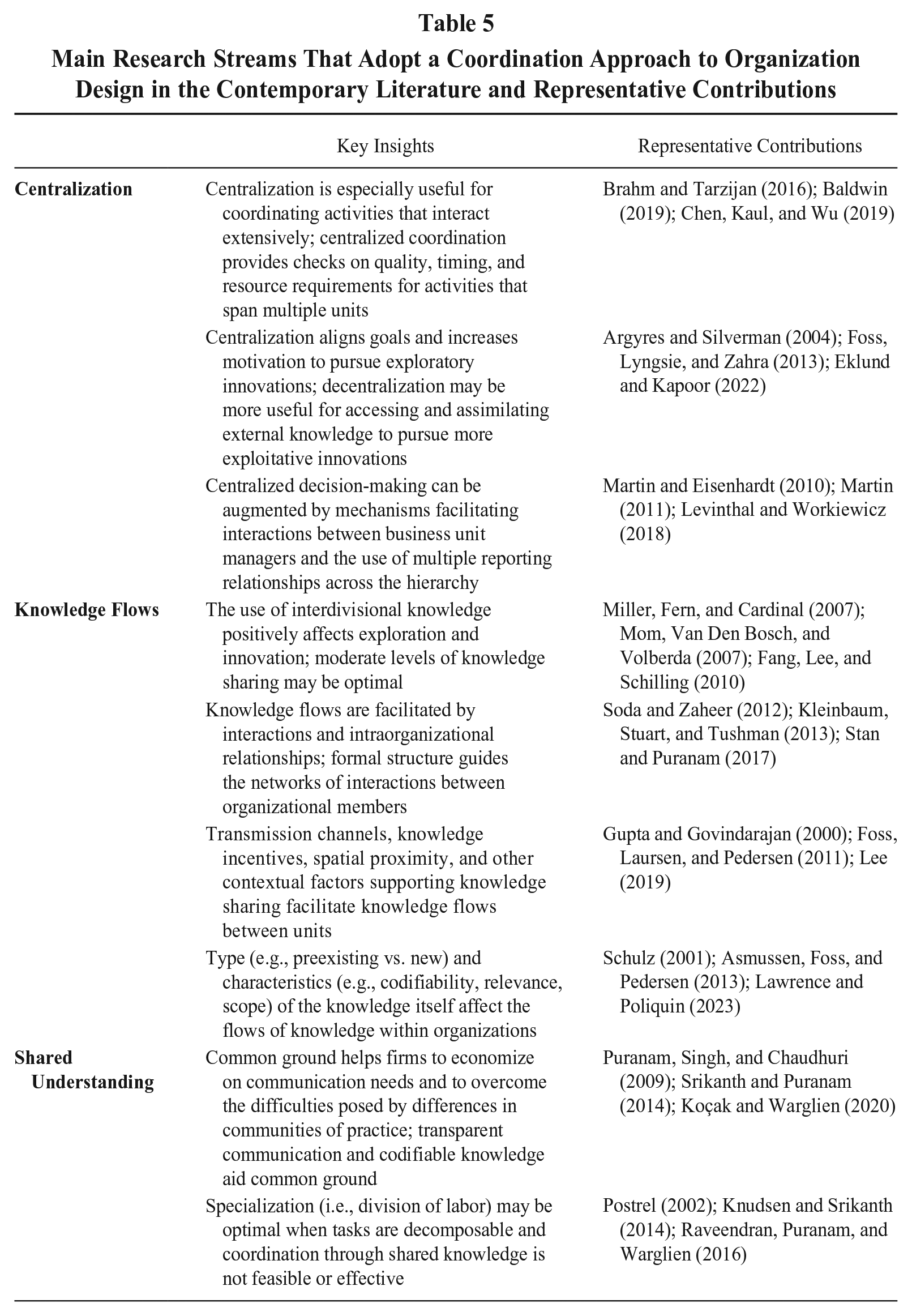
Contemporary research adopting a coordination approach advances the literature along three streams of work: centralization, knowledge flows, and shared understanding (Table 5).
Main Research Streams That Adopt a Coordination Approach to Organization Design in the Contemporary Literature and Representative Contributions
Centralization
Centralization in the context of coordination reflects whether the locus of decision-making authority is concentrated at the top of an organizational hierarchy or is distributed to lower-level decision-makers (Mintzberg, 1979), with an aim to better integrate and coordinate efforts of disparate organizational units and members in support of higher organizational performance. Locus of authority may or may not overlap with the locus of activity, which can be concentrated (e.g., into a single R&D unit for the entire corporation) or dispersed throughout the organization (e.g., with R&D activity taking place in separate business units). Differing from the oversight in control studies, which are concerned with containing value-diverting actions of individual units or organizational members, centralization in coordination studies is primarily concerned with integration and information processing.
Departing from the early literature examining the conditions that lead to centralized structures, studies in the last two decades have focused on when and how (de)centralization conditions coordination and subsequent performance. Centralization may be especially useful for hierarchical structures that need to coordinate activities that interact extensively for three main reasons. First, hierarchical structures increase the awareness of interdependencies between units for a centralized decision-maker (Baumann, 2015; Puranam, Raveendran, & Knudsen, 2012). High levels of centralized coordination at the top of the organization are beneficial in that it serves as a mechanism to provide checks on quality, timing, and resource requirements for activities that span multiple units (e.g., Joseph, 2023) or organizational members (e.g., Kellogg, 2022). For example, when the firm is vertically integrated, centralization better avoids production bottlenecks in the overall system (Baldwin, 2019; Karim, Lee, & Hoehn-Weiss, 2023) and helps ensure that two adjoining steps of the value chain can mutually adapt to each other through internal negotiation (Arnold, Elsinger, & Rankin, 2021) or to an external disturbance that impacts one or both steps (Brahm & Tarziján, 2016). The value of centralized decision-making is especially apparent in these situations since units are unable to make changes to activities based on their own needs (Chen et al. 2019) and require a centralized effort to do so.
Second, centralization aligns goals and increases motivation to pursue risky or exploratory innovation. For example, Argyres and Silverman (2004) find that centralized R&D generates exploratory innovations with a larger and broader impact on subsequent technological evolution because divisions do not have strong incentives to innovate outside their line of business, and corporate researchers are not tied to the immediate business concerns of downstream activities. Centralization impacts innovation breadth by increasing internal knowledge flows (Eklund, 2022) and, in particular, by increasing the connectedness of internal inventor networks (Argyres, Silverman, & Rios, 2020). Centralization encourages inventors to seek out new collaborators to produce innovations benefitting multiple divisions, subsequently widening the scope of both R&D and innovation impact. Third, a centralized hierarchical authority serves as a means to manage conflict between units, stemming from the misalignment of information or interests among them (Puranam, 2018). Whereas within-unit conflicts can be resolved by managers of the units, between-unit conflicts must be escalated and require hierarchy (Lee, Ilseven, & Puranam, 2023).
On the other hand, decentralization may be more useful for accessing and assimilating external knowledge in support of more exploitative innovations, especially when paired with internal coordination mechanisms that allow for cross-divisional knowledge sharing (Foss et al., 2013; Jansen, Van Den Bosch, & Volberda, 2006). For example, Leiponen and Helfat (2011) found that having R&D activity in multiple locations instead of a single location enables firms to access a broader set of external sources of knowledge in pursuit of imitative rather than new-to-the-market innovations. However, the benefits of decentralizing R&D must be weighed against its costs, including the challenge of integrating diverse external knowledge (Ahuja & Katila, 2004). The value of decentralized decision-making increases with the value of local adaptation but decreases with the value of within-firm coordination (McElheran, 2014), which echoes findings in configuration studies that show hierarchy is useful amidst high levels of interdependencies. Decentralized R&D organizations offer greater incentives for managers to replenish their firms’ pipelines but face limits in internal knowledge flows that can facilitate inventions, leading them to seek inventions from external sources (Eklund & Kapoor, 2022).
Another development in this stream is the examination of mechanisms that can augment conventional centralized decision-making. One mechanism through which this occurs is a hierarchical structure with multiple reporting relationships. Matrix organizations, for example, utilize multiauthority relations whereby managers have two (or more) bosses. A marketing manager may report directly to their business unit general manager but have a dotted-line reporting relationship to the chief marketing officer. The dual hierarchy allows both for the effective specialization of units and for coordination between units (Levinthal & Workiewicz, 2018). Managers in such structures develop a better capacity for collaboration, knowledge sharing, and conflict management challenges, which can be applied to other areas of their environment that also require similarly complex coordination (Sytch, Wohlgezogen, & Zajac, 2018). A second mechanism is a multi-business team comprised of business unit general managers (Martin, 2011). These teams (usually one layer below the executive office) create opportunities to learn about valuable resources in other units and negotiate the details of any resource sharing that is necessary to carry out corporate initiatives (Martin & Eisenhardt, 2010). For example, Martin (2011) finds that such a team’s capacity to adapt corporate initiatives leads to superior collaborations than what a purely centralized corporate-centric process would yield.
Knowledge flows
Another stream of coordination studies focuses on integration through flows of knowledge between organizational members and units. Knowledge flow—or the diffusion of knowledge—is generally reflected in linkages and communication among interdependent members and is used to support learning (Argote, Guo, Park, & Hahl, 2022) and coordination. Much of this work focuses on mechanisms that improve horizontal information flow and echoes early work that emphasized lateral linking mechanisms such as direct contact between members, liaisons, task forces, and committees (Galbraith, 1977).
Studies in this stream find significant returns to the use of interdivisional knowledge. For example, research shows that the use of interdivisional knowledge positively affects exploration activities (Mom et al., 2007). Furthermore, the positive effect of the use of interdivisional knowledge on the impact of an invention is stronger than the effect of using knowledge from within divisional boundaries or from outside firm boundaries (Miller et al., 2007). However, the returns appear to have limits. Studies on the optimal amount of knowledge sharing are sparse; although building on March’s (1991) model, Fang et al. (2010) recommend moderate levels. Moderate levels of knowledge sharing lead to the highest equilibrium performance by enabling superior ideas to diffuse across groups without reducing organizational diversity too quickly.
A development in this stream is the documentation of the role played by organizational members in specific positions and by intraorganizational relationships in facilitating knowledge flows. For example, boundary-spanning roles increase the knowledge flow between units, especially among individuals who have high levels of metaknowledge (i.e., knowledge of who knows what in their respective groups) (Mell, van Knippenberg, van Ginkel, & Heugens, 2022) and among individuals with strong network connections, structure, and range (Tortoriello, Reagans, & McEvily, 2012). Similarly, Stan and Puranam (2017) find that integrator roles channel information flow to allow for coordinated adaptation and exercise informal authority so as to control the rate of learning between specialists within an organization. Other studies focus on the informal properties of the organization, such as the organization’s network of interpersonal and intraorganizational relationships. For example, Tsai (2002) shows that informal lateral relations increase knowledge sharing among units that do not compete with each other for internal resources. Schulz (2003) observes that informal relations with providers of knowledge facilitate both horizontal and vertical knowledge transfers to units; also, units that send more knowledge to others are likely to receive more knowledge in return.
Informal organization underlying knowledge flows is shaped by formal structure in three main ways. First, formal organizational structure delimits opportunities for informal interactions among organizational members thereby shaping the network and subsequent outcomes (see Argyres et al., 2020; Hunter, 2015). The likelihood of social connections forming between a pair of organizational members tends to decrease with the path length of the chain of command connecting them (Hunter, Bentzen, & Taug, 2020). This leads scholars to find a higher proportion of homophilous interactions within formal organizational structures than across their boundaries (Kleinbaum et al., 2013). That is, social interactions are more likely to take place between people in the same business units, job functions, and offices. Second, formal structure may create a network regeneration effect whereby, over time, successful interaction patterns are kept, and those that do not add value are discontinued. In the absence of formal structure, interactions are prone to decline within organizations because maintaining interactions requires effort, but breaking them does not (Clement & Puranam, 2018). Researchers have also noted that the effects of formal structure may be a function of selection rather than treatment. Illustratively, Kleinbaum and Stuart (2014) show that it’s not that membership in the corporate office creates broad networks but that individuals with broad networks tend to seek out coordination-focused jobs, many of which are in the corporate office. Third, research finds that consistency between features of the formal and informal structure has both advantages and disadvantages. For example, Soda and Zaheer (2012) find that greater consistency between formally and informally derived networks is beneficial for individual performance in that this consistency reinforces information processing and member role expectations, resulting in more efficient and effective task execution. However, inconsistency between formal and informal structure may benefit the organization by motivating dissimilar but jointly valued employee behaviors, promoting ambidexterity (Gulati & Puranam, 2009).
Another line of inquiry is the examination of contextual factors supporting knowledge sharing. For example, Gupta and Govindarajan (2000) show that knowledge transfers within multinational corporations are positively associated with the richness of transmission channels, the knowledge stock of the subsidiary providing the knowledge, and the receiving subsidiary’s motivational disposition to acquire and the capacity to absorb the incoming knowledge. Spatial proximity improves the quantity and quality of communication, increases interpersonal liking, and facilitates a common identity, and thus it increases knowledge flows between peers and leads to exploration (Lee, 2019). Also, greater use of knowledge incentives (i.e., rewarding employees for knowledge acquisition and sharing) and internal communication, along with greater delegation, positively contribute to a firm’s innovation performance (Foss et al., 2011). Monteiro, Arvidsson, and Birkinshaw (2008) posit that knowledge transfers within multinational corporations are initiated by problemistic search of the receiving subsidiary.
Central to this line are characteristics of the knowledge itself, including the relevance (Schultz, 2003) or relatedness of knowledge (Hansen, 2002) for the receiving unit and codifiability of knowledge (Garicano & Wu, 2012), all of which make knowledge easier to transfer. For example, Schulz (2001) finds that collecting new knowledge intensifies vertical knowledge flows when the new knowledge is relevant because it prompts greater processing and attention. Likewise, Lawrence and Poliquin (2023) find that a greater knowledge scope—the variety of knowledge across an organization’s members—leads to an expansion of the hierarchy in order to lower coordination costs. In cases where there is a great deal of absorption of new information from the external environment (e.g., through boundary spanners), it is important that units maintain the preexisting knowledge, as this may have value for other units within the firm (Asmussen et al., 2013).
Shared understanding
A third stream of coordination studies focus on the role of shared understanding for coordinating activities within the firm. Distinct from the representation studies in channelization, which largely focuses on how structure shapes individual mental models or cognitive representations, here the emphasis is on “shared knowledge that enables interacting agents to accurately adjust and align their actions—in other words, to coordinate successfully” (Puranam et al., 2009: 317). Shared understanding comes from a variety of mechanisms, but this stream has primarily focused on common ground—knowledge that is shared and known to be shared (Bechky, 2003).
Common ground aids in overcoming the difficulties posed by differences in communities of practice, such as their language and conceptualization of the product or production process (Bechky, 2003), and leads to a shared understanding of the situation at hand. It may also help firms economize on explicit communication even in situations of complex interdependence. These benefits make the use of common ground prevalent within firms (Srikanth & Puranam, 2014). For example, Puranam et al. (2009) found that common ground may serve as a substitute for formal structural integration by the acquiring firm following technology acquisitions. Common authority or procedures are rendered unnecessary because the acquirer and target share sufficient knowledge to allow for coordination and value creating efforts related to the technology. The development of such common ground benefits from the codifiability of knowledge (Garicano & Wu, 2012), transparent communication (Koçak & Warglien, 2020), and decay of prior organizational codes (Joseph, Rhee, & Wilson, 2023; Koçak & Puranam, 2022).
Another development in this stream is the recognition of the limits of shared knowledge and, accordingly, the benefits of specialization (i.e., division of labor). Common ground can, for example, lead to joint myopia as the organizational members may engage in the same suboptimal search (Knudsen & Srikanth, 2014). Specialization—which may be object-based (e.g., product organization in an M-form firm) or activity-based (e.g., functional organizations around R&D, engineering, manufacturing, marketing, sales, and distribution; Raveendranet al., 2016)—on the other hand, limits the interdependencies between units, increases the focus on one’s own local environment, and reduces the need for coordination.
Reitzig and Puranam (2009) recognize the gains to intermediate levels of specialization: some cross-functional knowledge has advantages since it allows some individuals to inhabit multiple “thought worlds” and function as boundary spanners between functions thereby increasing coordination. Similarly, Postrel (2002) argues that specialist capability can substitute for knowledge shared across specialties, and hence, knowledge integration depends mostly upon the relative costs of acquiring shared knowledge (or what he calls trans-specialist knowledge) and specialist capability. Coordination problems in the presence of specialization and interdependencies may be mitigated if designers can establish a predetermined set of design rules to which specialists conform (Baldwin & Clark, 2000) or create the necessary predictive knowledge that allows one agent to act as though he or she can accurately predict other agents’ actions (Puranam et al., 2012).
Emerging Streams of Research
In the process of identifying the major approaches described previously, we also identified three emerging streams of research, which cut across the four approaches. These streams are internally coherent areas of research that have attracted a great deal of interest from scholars and practitioners alike in recent years. They are populated with studies that were published in the last half of our sample period, with most published in the last five years. These streams are AI and organizational decision-making, flat organizations, and multiple goals.
AI and organizational decision-making
Although the connections between artificial intelligence (AI), organizational theory, and organizations date back decades (see Csaszar & Steinberger, 2022), only recently is AI having a more widespread impact on the strategic and operational activities of firms (Raj & Seamans, 2019). AI’s purported advantages over human decision-making include eliminating biases, re-weighting of information to yield better statistical models, and pooling information to allow better updating of those models. Its main contribution is to provide a means to increase information processing and comprehend large amounts of data and elevate the quality of decisions.
Algorithmic decision-making may be conceived as a form of division of labor between humans and AI, and the required coordination between them may be conceived of as an organization design problem (Puranam, 2021). Still, very little is known about the information processing in which humans and algorithms, through some form of coordination, produce a decision, and the impact of such decisions. Some may argue that AI should reduce the information processing requirements demanded of individuals and increase an organization’s overall information processing capacity (i.e., to make better decisions faster) thanks to its nearly instantaneous analysis of big data. At the same time, data-driven decision-making may make other information processing demands on the organization (Brynjolfsson & McElheran, 2016), and consequently, information processing costs may increase. For example, Lebovitz, Lifshitz-Assaf, and Levina (2022) found that in hospitals, radiologists had to increase information processing to accommodate AI information. Explicating the complex relationship between AI-assisted information processing and decision-making requires that we understand how decision-makers who use this technology sort through the information acquired and integrate it with existing knowledge and experience.
AI and related technologies (robotics) may also have implications for the organizational structure. For example, Dixon, Hong, and Wu (2021) observe that investments in robotics predict an increase in the span of control within the organization. The effect is due to a decrease in managerial-level employees (due to a decreased need for monitoring) and an increased need for nonmanagerial workers with complementary skills. It is possible that the formal organizational structure may also impact how decision-makers process algorithm-provided information in support of decision-making. According to the late Jim March, “Insofar as robots perform the physical tasks of organization and artificial intelligence performs the management tasks, organizations will still exist and their design will still be critical; but the issues and their resolution will be somewhat different” (Dong, March, & Workiewicz, 2017: 17).
Flat organizations
Flat organizations are those that operate in the absence of an authority structure or, at least, with large spans of control for a single decision-maker and (usually) high levels of autonomy for other organizational members (Foss & Klein, 2022). Studied through a number of lenses such as bossless organizations (Romme, 2019), self-managing organizations (Lee & Edmondson, 2017; Maurer, Bach, & Oertel, 2023), and actor-oriented architectures (Fjeldstad, Snow, Miles, & Lettl, 2012; Martela, 2019; Snow, Fjeldstad, & Langer, 2017), flat organizations are argued to improve a variety of organizational outcomes including communication, customization, and innovation. The flat organization form has received a lot of attention from managers, consultants, the popular press, and management researchers in recent years. This level of attention ostensibly reflects both purported advantages of this form and its increasing prevalence. Billinger and Workiewicz (2019: 1) note a “slow but steady replacement of traditional top-down hierarchies with more decentralized structures where employees are given significant autonomy in how to carry out their work or which projects to undertake.” The demand for flat organization is a function of bureaucratic growth, declining competitiveness, innovation, and rising costs of firms, as well as workers seeking greater satisfaction from autonomy in their work (Lee & Edmondson, 2017). However, more work on its drivers is needed.
Although studies have chronicled that CEOs’ spans of control increased (Guadalupe, Li, & Wulf, 2014) and the hierarchy got relatively flatter in large corporations in 1980s and 1990s (Rajan & Wulf, 2006), no systematic efforts have been made to assess the relative prevalence of flat organization (Billinger & Workiewicz, 2019). Much of the scholarly focus has been on technology, internet, and software startups (e.g., Github, Valve, Zappos) operating in one of a small number of industries (e.g., Puranam & Håkonsson, 2015). Large firms persist and most, if not all, large companies, including all the largest technology companies in the world, have hierarchical structures. These patterns reflect Lee and Edmondson’s (2017: 36; see also Leavitt, 2004; Pfeffer, 2013) observation that, “The formal managerial hierarchy in modern organizations is as persistent as are calls for its replacement.”
Some of the cases used to illustrate flat structures have moved away from this design choice, further increasing the doubts about the suitability of the form. For example, Burton, Håkonsson, Nickerson, Puranam, Workiewicz, and Zenger (2017) observe that Github, once the model for flat organizations, began to replace its flat organizational structure in 2014, with greater hierarchical decision-making in response to coordination problems. The firm found that often the wrong projects were pursued, resources were inefficiently allocated, and the timing of projects left holes in the firm’s strategy. Some other canonical examples witnessed a shadow hierarchy emerge. For example, Foss and Dobrajska (2015) document that, at Valve, a company that kept the flat structure, saw an informal hierarchy quickly emerge, with key individuals creating fiefdoms and wielding a great deal of informal power. Studies have also documented that flat organizations are not only difficult to sustain but also difficult to transition into. Many efforts by large hierarchical structures to become flat have been unsuccessful, mainly because such efforts often suffer from the incomplete implementation of the form (creating what configurational researchers would call misfit) or from major failures of coordination (Foss, 2003; Luo, Van de Ven, Jing, & Jiang, 2018). In fact, Lee (2022) documents that even startups, which some argue require a flat organization to succeed, benefit from hierarchy. These observations call for a strong theory about the conditions in which flat organizations are advantageous, what makes them work in these situations, and the various types of integration mechanisms needed for them to effectively coordinate and integrate activities.
Multiple goals
Vibrant discussions surrounding the roles, purposes, and objectives of companies in recent years (Battilana, Obloj, Pache, & Sengul, 2022) have rekindled scholarly interest among organizational scholars in the implications of multiple goals (Audia & Greve, 2021). The pursuit of multiple goals, many of which are weakly or negatively correlated, is problematic because both feedback and the mapping from actions to performance can be ambiguous (Joseph & Gaba, 2015; Levinthal & Rerup, 2021), which may create difficulties in establishing decision criteria (Sundaram & Inkpen, 2004) and may lead to coordination challenges (Audia & Greve, 2021; Gaba & Greve, 2019; Hu & Bettis, 2018). Further, the extent of these problems tends to increase with the number of goals that an organization pursues (Ethiraj & Levinthal, 2009), as each additional goal results in the substitution of effort and attention from other goals (Stevens, Moray, Bruneel, & Clarysse, 2015). This was confirmed empirically by Obloj and Sengul (2020) who find that, for most goals, performance on any given performance dimension increases when it is pursued as a goal but decreases with the number of other concurrently pursued goals.
Scholars have proposed a number of design solutions to the problem of decision-making amid multiple goals. The first set of solutions entails some form of separation. There are three such strategies for dealing with multiple goals (Ethiraj & Levinthal, 2009). The first strategy, goal myopia, is to focus on a single goal to guide managerial action. The second separation strategy, temporal differentiation, is to focus on a single goal but allow this goal to vary over time. Goals are pursued sequentially so that each goal becomes activated over time. Recent research finds that low performance on a lower-priority goal spurs reaction only when performance on a higher-priority goal signals success (e.g., Stevens et al., 2015), indicating that temporal separation of, or at least sequential attention to, multiple goals is observed in organizations. The third strategy, spatial or structural differentiation, is to structurally separate units and their corresponding goals. This separation can be horizontal (Ethiraj & Levinthal, 2009) or vertical across levels of the hierarchy (Gaba & Joseph, 2013). Although intuitive, studies note that there are limits to this strategy in that firms may not be able to modularize to the level of the goal due to the interdependencies in the task environment (Bidwell, 2010; Hu & Bettis, 2018).
The second set of solutions emphasizes the benefits of frequent and sustained social interactions. Battilana, Sengul, Pache, and Model (2015) show that spaces of negotiation—arenas of interaction that allow members of each group to discuss the tradeoffs that they need to make in pursuing multiple goals—can serve as a salient mechanism to enable sustained coordination across structurally differentiated groups. They also observe that “the intense socialization and ongoing routines that shaped staff members’ understanding of the organization’s superordinate goal, and of their mutual interdependencies, ensured the effective functioning of spaces of negotiation” (p. 1678). Similarly, Obloj and Sengul (2020) find that the frequency of face-to-face board of directors’ meetings alleviates the cost of a multiplicity of organizational goals (see also Ghosh & Wu, 2023), but reliance on information and communications technology (which is often used as a substitute for face-to-face coordination meetings) exacerbates it. A burgeoning literature examining hybrid organizations that combine aspects of multiple organizational forms—such as social enterprises that combine aspects of business and charity at their core—complement these insights (e.g., Battilana, Pache, Sengul, & Kimsey, 2019; Ebrahim, Battilana, & Mair, 2014; Pache & Santos, 2010; Smith & Besharov, 2019).
State Of Organization Design Research
In the preceding pages, we reviewed the organization design studies published between 2000 and 2023 in major management and organization journals. Beyond the specific contributions of individuals’ papers and streams of work, our review makes several high-level observations across approaches. These observations pertain to the following: (1) composition of strands of contemporary organization design research, (2) patterns that characterize this body of work, (3) open questions for future research, and (4) a discussion of organization design as a theory. Collectively, these observations define the state of organization design research and, as we will discuss in the following sections, chart its future.
Composition of Strands of Contemporary Organization Design
As we have articulated, there are four distinct, albeit related, approaches to organization design: (1) configuration, (2) control, (3) channelization, and (4) coordination. Although some papers fit under multiple approaches, a majority map predominantly to a single approach. These four approaches differ in the way they view the organization, the key organization design problem they seek to address, and design features and theoretical mechanisms that characterize the streams of research that constitute them (see Table 1).
Studies adopting the configuration approach account for 40% of organization design publications in our review period, followed by studies adopting coordination approach (24%), control approach (19%), and channelization approach (17%) (see Figure 1). 3 Of the 13 main streams of research in the contemporary organization design literature, by far the most salient one is fit. In all, 24% of all organization design studies focus on different aspects of fit. Our review corroborates with the observation of earlier studies that fit remains the most influential design perspective of organizations (Joseph, 2018). The next set of streams in terms of salience are centralization (10%), knowledge flows (9%), and incentives (8%).
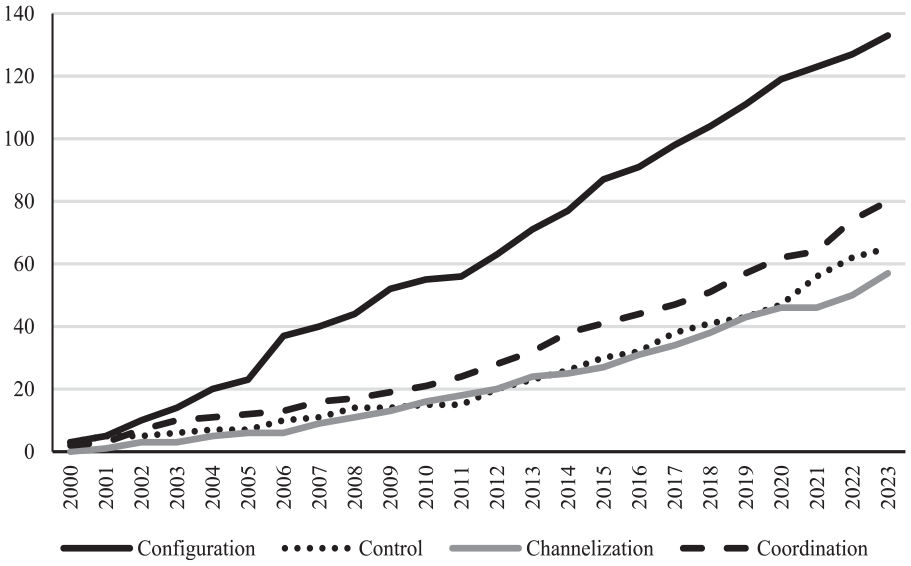
Cumulative Number of Publications in the Four Major Approaches to Organization Design, 2000–2023
Several observations regarding the composition and evolution of research streams within each approach are in order (Figure 2). In configuration, fit was constantly the most prominent stream throughout the observation window. Reorganization was the second-largest stream, followed by modularity as the third largest. After they gained steam in 2007 and 2004, respectively, these two streams grew in parallel in the following years. Among studies adopting the control approach, those on incentives and oversight experienced a relatively more pronounced growth in the past ten years. The three streams that adopt the channelization—attention and feedback, errors and biases, and representations—were equally prominent, but it is worth noting that attention and feedback became an active area starting in 2007, several years after the other two streams. In coordination, centralization, which has experienced a more pronounced growth in recent years, and knowledge flows are the most prominent streams.
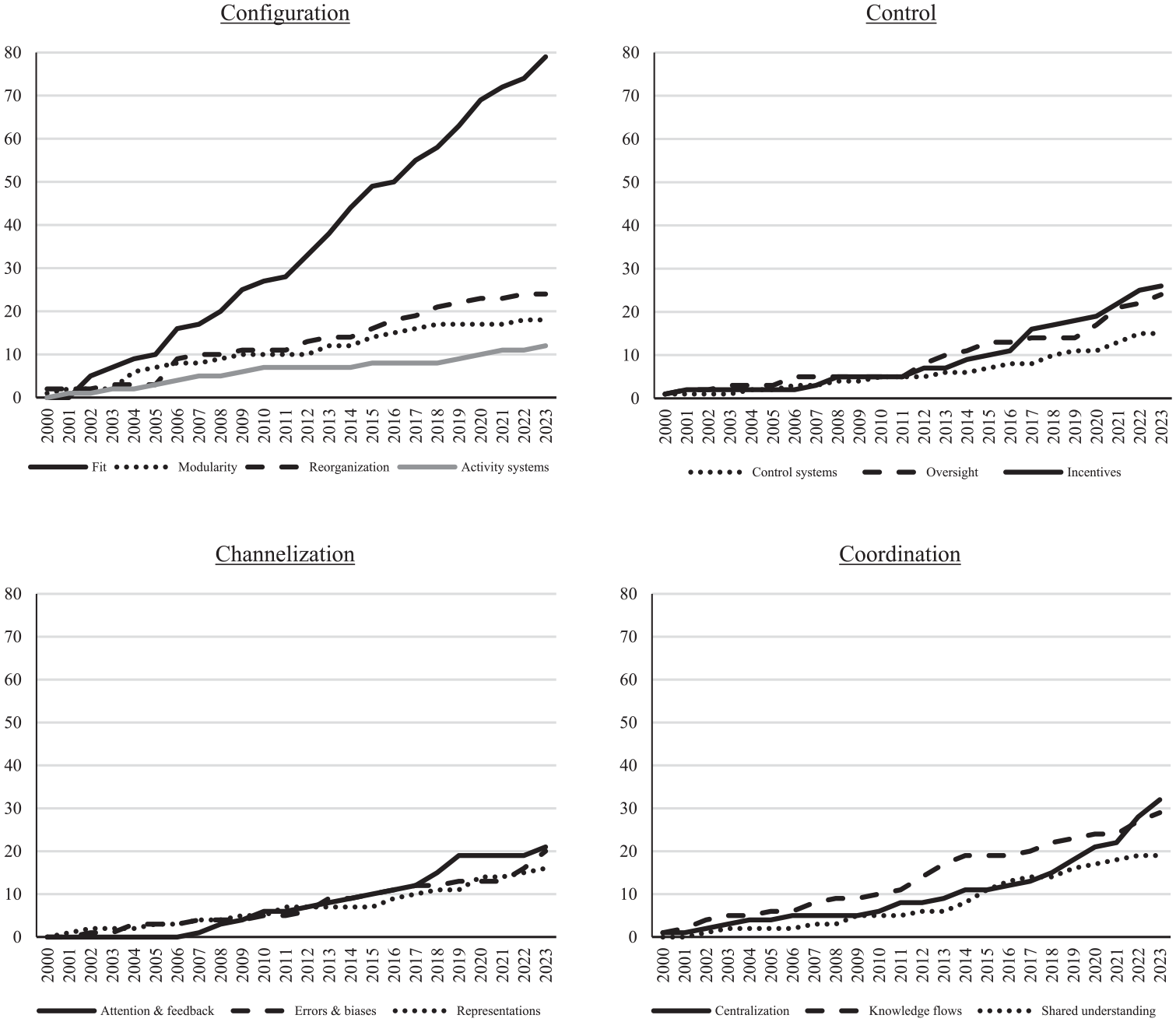
Cumulative Number of Publications in the Four Major Approaches to Organization Design, by Stream, 2000–2023
Patterns in the Contemporary Research in Organization Design
Several patterns emerged from our review of the contemporary organization design literature and its evolution. Of these patterns, we highlight three that we deem to be particularly salient: levels of organization design, dynamics of organization design, and methods used in organization design research.
Levels of organization
Organization-level studies, which we reviewed in this paper, account for a majority of organization design work since 2000. In all, 69% of articles that focus on design features and their implications are at the organizational level or discuss design more generally (corresponding to 335 and 15 articles, respectively, adding up to a total of 350 articles that constitute our review), instead of lower-level units of analysis (e.g., teams) or higher-level units of analysis (e.g., interorganizational). This is not surprising since many questions, mechanisms, and assumptions of the field are operational at this level. 4
Organization design studies at other levels can be grouped into four topics. Those focused on communities study the design of entities, such as online communities and decentralized autonomous organizations (e.g., Dahlander & O’Mahony, 2011; Levine & Prietula, 2014; Riedl & Seidel, 2018). Interorganizational studies explore the design mechanisms that govern the relationships between organizations such as alliances, consortia, platforms, and public-private partnerships (e.g., Albers, Wohlgezogen, & Zajac, 2016; Kapoor & Agarwal, 2017; Reuer & Devarakonda, 2016; Srikanth & Puranam, 2011). Studies on teams examine composition, structure, and other design attributes within and between groups of individuals (e.g., Aggarwal, Hsu, & Wu, 2020; Argote, Aven, & Kush, 2018; Bunderson & Boumgarden, 2010; Sosa, Gargiulo, & Rowles, 2015). Work design studies explore the design choices with respect to work arrangements, flows, and procedures, and the implications of these choices (e.g., Griffith, Nordbäck, Sawyer, & Rice, 2018; Hasan, Ferguson, & Koning, 2015; Huising, 2014; Pentland, 2003). Each of these topics constitute a distinct area of research, much of which does not concern organization design.
Interorganizational design and team design each correspond to 35% of these studies, followed by those on communities (19%) and work design (11%). As graphed in Figure 3, organization design work on teams experienced the steadiest publication and growth in our review period. Community-focused and interorganizational design studies, on the other hand, started to gain significant pace in 2010s. We believe this reflects growing academic interest in information and communication technology–supported organizational forms that proliferated in 2000s, such as online user communities (Dahlander & Frederiksen, 2012; Shah & Nagle, 2020), open-source software collectives (He, Puranam, Shrestha, & von Krogh, 2020; Jeppesen & Lakhani, 2010), crowdsourcing websites (Klapper & Reitzig, 2018; Piezunka & Dahlander, 2015), decentralized autonomous organizations (Hsieh, Vergne, Anderson, Lakhani, & Reitzig, 2018; Lumineau, Wang, & Schilke, 2021), and meta-organizational entities (Gulati, Puranam, & Tushman, 2012) such as platforms and ecosystems (e.g., Adner, 2012; Kapoor, 2018; Rahman & Valentine, 2021; Wareham, Fox, & Giner, 2014).
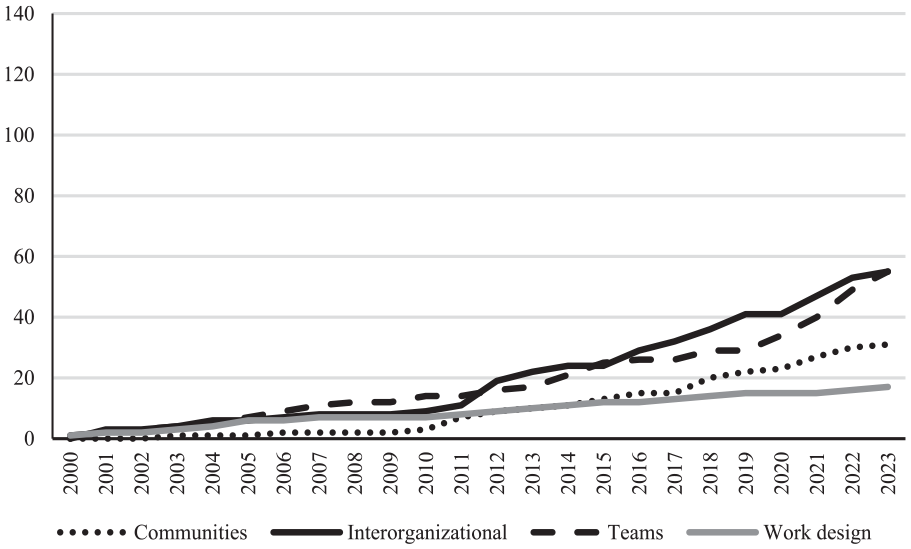
Cumulative Number of Organization Design Publications at Alternative Levels, 2000–2023
It is important to note that there are also perspectives that abstract away from a particular level of organization. The most prominent in the contemporary literature is the microstructural approach, which boils down the complexity of organizations to a few fundamental problems of organizing and corresponding patterns of interactions among members. Considering complex organizations as collections of smaller, simpler, and recurring patterns of “micro” organizations, studies adopting this perspective typically focus the processes of disaggregation and reaggregation (Puranam 2018).
Dynamics of organization design
While most studies in the literature focus on exploring the relationships between contingencies and design choices or, more commonly, the link between design choices and outcomes, contemporary studies have increasingly conceived organization design as an effort that requires continual adjustment and should therefore be studied as a dynamic process. Organizations have been shown to alter their design over time (e.g., Carroll et al., 2006), and reorganizations are necessarily built on prior reorganizations (e.g., Raveendran, 2020). Although not all aspects of design are equally open to change (Alexy et al., 2021), continual adjustment is often necessary given the changing external environment and the importance of adaptation, flexibility, and renewal for survival and performance.
Of course, the observation that an organization’s design changes over time (as the contingencies it faces change) is not new. 5 However, contemporary studies take a fresh look at the mechanisms that characterize the dynamics of organization design. In the configuration approach, entrainment (Pérez-Nordtvedt, Payne, Short, & Kedia, 2008; Shipp & Richardson, 2021), structural modulation (Nickerson & Zenger, 2002; Siggelkow & Levinthal, 2003) and reconfiguration (e.g., Girod & Whittington, 2015; Karim et al., 2016) studies, as well as studies that highlight misfits and managerial efforts to correct them (e.g., Camuffo & Wilhelm, 2016; Westerman et al., 2006), all recognize that organization design requires continual attention and adjustment by managers. They also note that the required continual adjustment can be achieved through mechanisms such as generative design features (Garud et al., 2006), rules for redesign (Albert et al., 2015), and middle managers who often shoulder a disproportionate burden for implementation (Livijn, 2019). Likewise, control studies conceive the use of control systems as dynamic (Cardinal et al., 2004; Chown, 2021). They recognize that control systems, incentives, and performance measures lose their effectiveness over time, in part due to gaming by employees, and have to be renewed (Obloj & Sengul, 2012), and the resulting designs reflect ongoing tensions between corporate managers (who usually seek more control) and unit managers (who seek less) (Dattée et al., 2022). Coordination research shows that continuous adjustment between people (e.g., Clement & Puranam, 2018) and units (e.g., Martin, 2011) is needed for coordination and requires mechanisms such as integrators (Knudsen & Srikanth, 2014; Stan & Puranam, 2017). Dynamics are particularly salient in the channelization literature in which adaptation and learning are central. For example, social comparison processes (e.g., Baumann, Eggers, & Stieglitz, 2019; Hu et al., 2017) and responses to performance feedback (e.g., Joseph et al., 2016; Rhee et al., 2019) reflect both process and structure. Illustratively, Joseph and Ocasio’s (2012) study of GE’s architecture showed a continually shifting architecture of communication channels that drives the attentional variation, selection, and retention of key issues and initiatives that in turn establish the firm’s strategy.
Methods used in organization design research
Approaches to studying organization design have generally been diverse (Figure 4). In our review period, quantitative studies using archival data (23%) and qualitative studies (20%) were the most common, followed by modeling and simulation studies (16%), quantitative studies using survey data (16%), and verbal theory studies (that do not include models, simulations, or any of aforementioned empirical approaches) (16%). Multiple methods were used only in 6% and experiment used only in 3% of the studies.
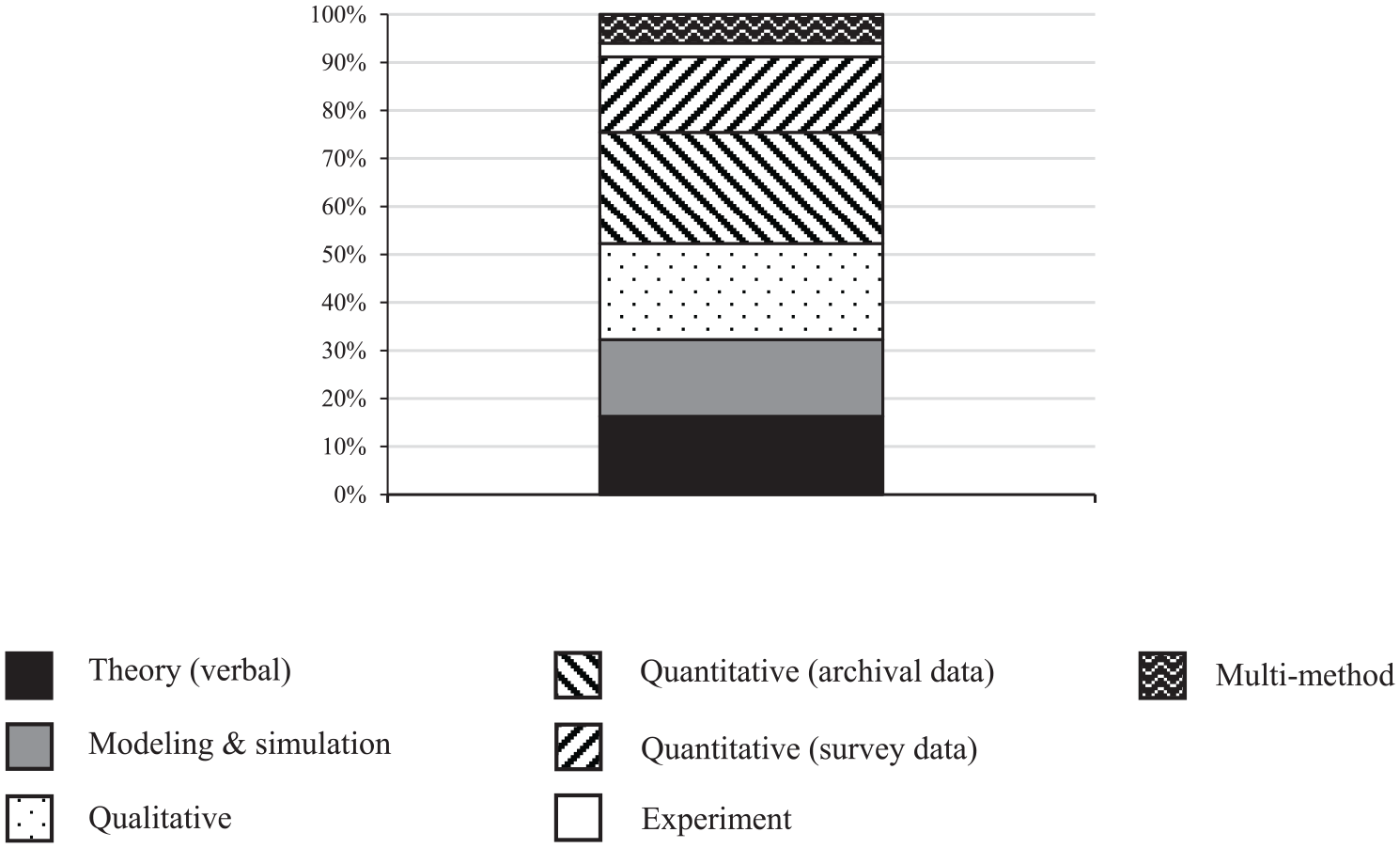
Methods Used in the Four Major Approaches to Organization Design in the Contemporary Literature
However, this aggregate picture masks the salience of specific approaches in different streams of work (Figure 5). Modeling and simulation studies were used in a majority of activity systems studies (75%); quantitative studies using archival data were used in a majority of attention and feedback studies (52%) and half of reorganization studies (50%). In six streams, two approaches collectively accounted for a majority of publications: control systems (qualitative + survey, 73%), errors and biases (modeling & simulations + archival, 60%), fit (qualitative + verbal theorizing, 51%), knowledge flows (archival + survey, 89%), modularity (archival + modeling & simulations, 56%), and representations (modeling & simulations + verbal theorizing, 63%). The remaining streams—centralization, incentives, oversight, and sharing understanding—were methodologically more diverse, although quantitative studies using archival data were pronounced in incentive studies (35%). In parallel, hinting at opportunities for future research, some approaches are remarkably scarce in certain streams, like formal theorizing (modeling & simulations) in control systems, attention & feedback, and knowledge flows; qualitative studies in activity systems, incentives, and errors & biases; quantitative studies (using archival or survey data) in activity systems, representations, and shared understanding; and experiments outside incentive studies. We believe these patterns reflect the natural fit between methods and certain topics (such as the use of experiments in studying incentives) as well as the relative scarcity of suitable data for the line of inquiry at hand (such as activity systems). It is also plausible that theory papers, both formal and verbal, are relatively less common in older and more established areas of research (such as control systems and knowledge flows) and relatively more common in younger areas of research that are in greater need of theory development (such as activity systems and representations).
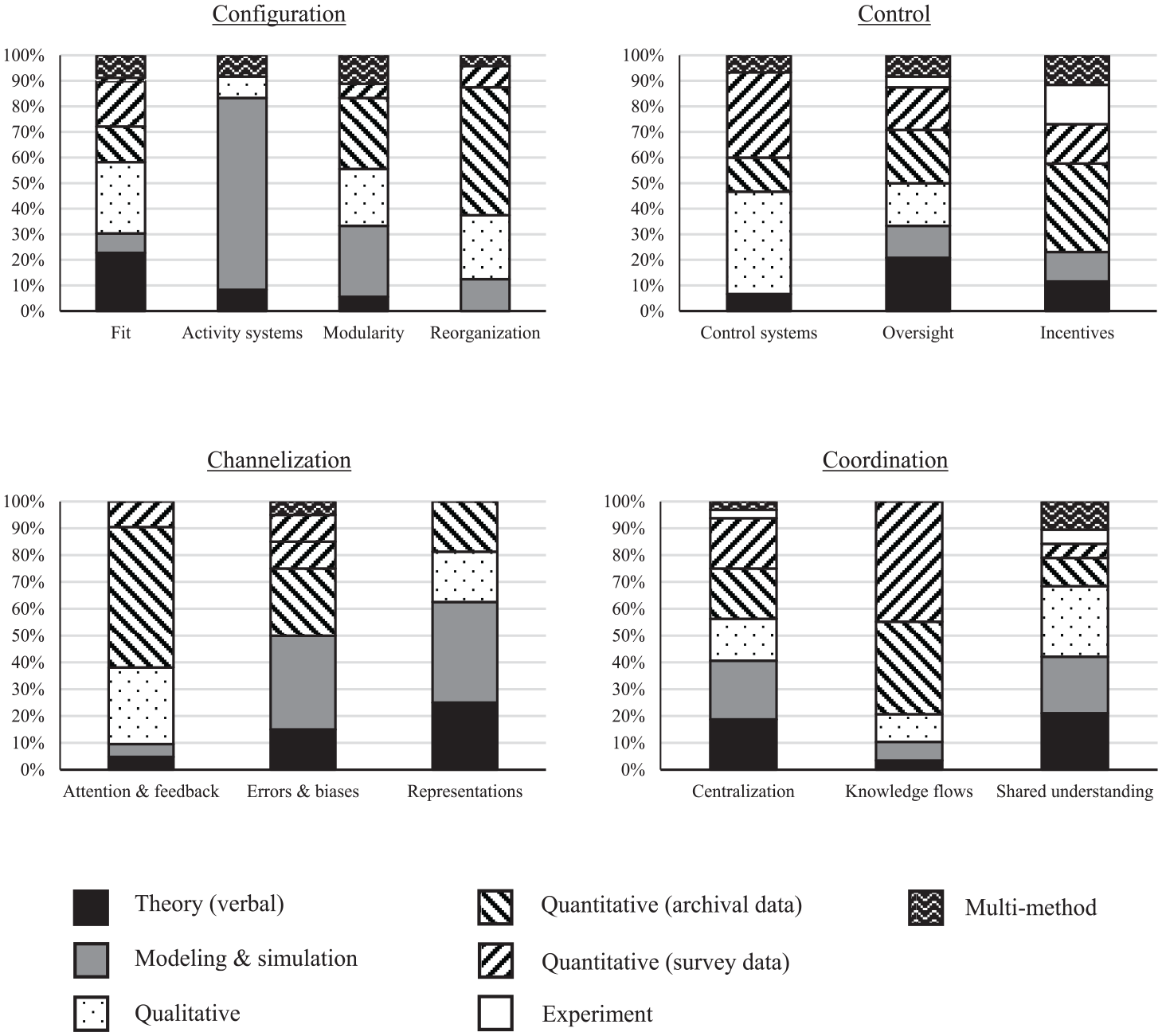
Methods Used in the Four Major Approaches to Organization Design in the Contemporary Literature, by Stream
In terms of trends, comparing the first and the second halves of our review period, the number of modeling and simulation, qualitative, survey, and multi-method studies remained about the same but declined as a percentage of total publications, as the growth since 2012 appears to be mainly from studies using other methods. Verbal theorizing experienced a modest increase, from 12% to 19%, mainly due to the fit studies using this approach, and experiments, which were virtually absent in the first half of our review period, began to be used. The most pronounced increase was in the share of quantitative studies using archival data, from 13% to 28%. While obtaining detailed information on the internal organization continued to be challenging and the use of case studies (e.g., Joseph & Ocasio, 2012), survey data (e.g., Sengul & Obloj, 2017), and hand-collected data (e.g., Raveendran, 2020) remained prevalent, new studies increasingly exploited datasets with organizational data across a large sample of firms and industries (e.g., Zhou, 2013, 2015) contributing to the generalizability of the findings. Another welcome development was the use of creative approaches to obtain proxy measures of internal organization. For example, studies used job titles to obtain reasonable proxies for several aspects of design, such as functional specialization of the top management team or depth of the hierarchy (e.g., Guadalupe et al., 2014; Lee & Csaszar, 2020), 6 even though construct validity of such measures for other aspects of design has remained questionable. Empirical operationalization and identification challenges continue to be major concerns for the contemporary empirical organizations design research, as with the broader field of management.
Open Questions
Our mapping of the literature highlights several gaps and research opportunities in terms of theory development, topics, and mechanisms. Naturally, specific avenues for individual areas of research are too numerous and outside the scope of this review, but we will highlight a few.
Arguably the greatest opportunity lies in the three emergent streams that we identified. For example, scholars may find opportunities to examine contextual factors and boundary conditions that may contribute to variations in the quality of human-AI decision-making and learning. More research is needed to examine how humans and algorithms coordinate in support of desired organizational outcomes and minimize decision-making errors. The adoption of generative AI also promises to be an avenue for research on expanding the limits of human information processing capacity and new organization designs as well as new mechanisms of organizational control (e.g., Cameron & Rahman, 2022; Kellogg, Valentine, & Christin, 2020) and coordinated search through ensembled decision-making.
In studying flat organizations, future research should assess the validity of the claim that flat organizations are replacing hierarchies—the popular bossless company narrative (cf. Foss & Klein, 2022)—and for what environments flat organizations are best suited. As Reitzig (2022) points out, echoing themes of fit, flat structures may work under some but not all circumstances. Also, if flat organizations are growing in prevalence, it is not clear whether it is due to an ecological process by which the population of flat organizations is growing by demonstrating greater fitness, or whether older bureaucratic organizations are adapting by shedding layers in favor of a flat structure. Further, the role of coordination and integration mechanisms needs further exploration, both at the organizational level as well as other levels of analysis such as DAOs (e.g., Hsieh & Vergne, 2023), communities (Shah & Nagle, 2020), and meta-organizations (e.g., Kretschmer, Leiponen, Schilling, & Vasudeva, 2022).
In the study of multiple goals, still much less is known about the levers of design outside the mechanisms we summarized. For example, does the joint pursuit of social and financial goals really benefit from an organization with distributed decision rights, a deliberative culture, and employee ownership, as Battilana, Fuerstein, and Lee (2018) speculate? Does the optimum span of control increase with the number of goals (as a wider span grants greater autonomy and empowerment to employees) or decrease with it (as a narrower span allows better relational coordination via coaching, feedback, and working together)? In addition, it is not clear how the pursuit of multiple goals responds to different organizational incentives and technologies. 7 In parallel, the long-time assertion, by scholars of the Carnegie perspective, that managerial representations of the problem space maps to the goal structure could use revisiting. For example, what is the role of a goal hierarchy in communities or flat organizations? How does the structuring and management of attention in new organizational forms via subgoals impact decision-making (Ocasio & Wohlgezogen, 2010)? More generally, a large majority of existing empirical studies on design choices under multiple goals are qualitative, indicating that the field will benefit from more large-sample quantitative studies to get a better understanding of the empirical regularities.
In addition to opportunities related to emerging streams of research, there are a number of open questions that pertain to the field of organization design in general. For example, we call for more research bringing forth value appropriation as a central organization design concern. A large majority of organization design research focuses on value creation (i.e., through innovation, e.g., Eklund & Kapoor, 2022). Yet, organization design can also directly influence value appropriation by creating alignment, or “loss prevention” in Chandler’s (1991) words, or by shaping competitive interactions between firms (Sengul, 2018). Bringing forth such influences can prompt researchers to explore a novel set of questions. Similarly, novel combinations of approaches and mechanisms can meaningfully add to the literature. For example, even as “the effects of an incentive regime (‘I act like this because this is in my best interests’) cannot be cleanly separated from cognition (‘I act like this because this is what I believe to be the case’)” (Kaplan & Henderson, 2005: 517), we are aware of no empirical study examining them jointly.
It also might be useful to consider new ways of applying well-established theories through an organizational design lens to understand important managerial problems. Recent examples are encouraging. Karim et al. (2023), drawing on the literature on resource allocation, examine the performance implications of aligning resource characteristics and organization design features and find that aligning resource fungibility and slack with the decision-making structure and task complexity is key to better performance. Joseph et al. (2023) draw on March’s mutual learning model (where organizational members learn from the organizational code and the organizational code learns from members) to show, through an organization design lens, how membership turnover at the corporate and unit levels has different effects on organizational learning and subsequent impact on innovation. Sengul and Yu (2024), drawing on the categorization literature, argue that categorical expectations influence which activities of a multidivisional firm are grouped together in specific divisions and how they are reconfigured. Using TCE, Weber et al. (2023) examine the “costs and competencies” of different hierarchical forms in terms of specific motivations and, in turn, conditions of hierarchical failure.
Despite the emphasis on planned design in much of the literature, a small but growing body of work has begun to recognize its emergent aspects (Levinthal, 2021). Like deliberate versus emergent strategies (Mintzberg & Waters, 1985), it is plausible that certain or most aspects of design in an organization may be in place without being explicitly planned. For example, an important thread that connects the early work of contingency theorists with more modern expressions of the theory is the observation that the environment’s primary impact on design is through explicit efforts to solve design problems with respect to competition (e.g., Burton et al., 2021; Englmaier, Foss, Knudsen, & Kretschmer, 2018; Sengul, 2018). However, we have little evidence for the generative mechanisms that yield such emergence (Eisenman, Paruchuri, & Puranam, 2020). For example, self-selection has been shown to have advantages over hierarchical staffing under certain conditions (Ketkar & Workiewicz, 2022; Raveendran, Puranam, & Warglien, 2022), but more work is needed. When does self-selection into projects and organizations occur and what are the performance implications? It would also be useful to understand how planned vs. emergent designs perform under different circumstances. Although emergent structures have been shown to have negative impacts on culture (Camuffo & Wilhelm, 2016) and performance (Puranam et al., 2009), further research may uncover positive associations. It is also plausible that design choices, like delegation, may yield the same or similar outcomes even when they are not designed in full anticipation of their consequences or put in place without being explicitly planned (Sengul, Gimeno, & Dial, 2012).
One of the most salient omissions in the field is the study of the internal organization of platform companies. We need a deeper understanding of the inner workings of the firms that own or operate within a platform and whether our existing theories can be used to predict their behavior and outcomes. Missing from this body of work is a close look at the structures and processes needed to make such firms function effectively. We also need a deeper understanding of the fit between the internal organization and its ecosystem. Ecosystems give rise to a new tradeoff between the benefits of creating a separate structure for corporate experiments and the ability to leverage partner relationships to create alignment at scale, which in turn shapes how firms seeking to lead in their ecosystem should design themselves (Adner, 2021). How should firms structure their attention, incentives, information flow, and levers of authority to enable the hoped-for activity on the outside? How should firms design the interface between a focal organization and complementors in the ecosystem (Kapoor, 2014)?
Also, we call for more studies examining the link between organization design and diversity, equity, and inclusion (DEI). Illustratively, Dobbin and Kalev (2022) observe that for successful DEI efforts, it is necessary to change existing management systems that make it difficult for women and people of color to succeed rather than relying solely on training programs. It is possible that greater DEI in corporate leadership may result in fundamentally different organizational structures, which may also be conditioned by new identities and logic that emerge from the prevailing institutional pressures. It is important to understand how organization design choices emerging from the interactions of a broader group of stakeholders might create or prevent structures for inclusivity in decision-making and capabilities for producing changes in prevailing institutions.
More generally, we call for continued efforts to study new organizational forms that involve “a novel and unique set of solutions” to the problems of organizing (Puranam, Alexy, & Reitzig, 2014: 177) and to understand the emerging ones. Burton and Obel (2018: 1) argue that the study of organization design “should be scientific-based and forward-looking” in the sense that the effort should be directed at “designing organizations in contexts and situations that are new and have not been seen before” (see also Romme, 2003). Such an approach often entails either experimentation, a pattern in line with the prevalence of computational models in the organization design research, or unearthing and understanding new, and so rare, organizational forms via case studies of firms adopting such forms (e.g., Baumann et al., 2018; Fjeldstad et al., 2012). As Puranam et al. (2014) astutely note, the observation of a new organizational form does not always call for new theorizing because the core tenets of the form might already be recognized and established in different contexts. When descriptive reality doesn’t match normative prescriptions, however, we should learn from the reality observed and revise our theories of organization or devise new ones.
This brings us to our last point, the relevance to the practice of organization design. Organization design is a highly practical field of research in management because, in essence, it studies the levers that are under direct control of managers. Managers need to create proactive processes to anticipate, identify, and interpret changes in their environment (Huber, 2016) and design organizations that meet the demands of that environment. Managers understandably struggle, especially in highly turbulent and dynamic environments, where not only environmental demands, production technologies, and economic conditions evolve but also do the tools of organizing. Worren, van Bree, and Zybach (2019: 1) report that the most frequently encountered challenges by consultants who support managers in redesigning their organizations are “(1) creating realistic estimates regarding the time and resources required to complete the project, (2) understanding patterns of collaboration or information exchange across units in the organization, (3) handling political aspects of the re-design process and helping participants ‘see the bigger picture’ (as opposed to ‘protecting their own turf’), and (4) evaluating whether the new organizational model has had the intended effects.” Organization design research can contribute to the practice in devising ways to overcome these challenges. We join Romme’s (2003: 569) call for directing research “toward more rigorous research, to produce outcomes that are characterized by high external validity but that are also teachable, learnable, and actionable by practitioners.”
Organization Design as a Theory
The proliferation of organization design studies that we have reviewed raises the question of whether there exists, independently of the individual theories that inform these studies, a theory of organization design. After all, having an established theory could bring coherence and predictive power, leading to a deeper understanding of the subject matter, stimulating intellectual progress, and advancing the training of doctoral students. As we noted at the beginning, organization design has not been uniformly treated as a theory but rather a domain of study. Shapira (2011: 15) defines a theory as an analytic structure or system that attempts to explain a particular set of empirical phenomena. Theories are characterized by assumptions, logical derivations based on those assumptions, and specific predictions that naturally follow from the derivations. A theory should be formulated in a way that makes it clear how to falsify or refute it through hypothesis testing. How does the organization design literature compare?
To start with, an organization, the central entity of interest, is uniformly seen as a complex system: a system made of subsystems—comprised of individuals, groups, units, and larger entities themselves comprised of subsystems—that interact with one another to achieve a collective outcome and are (at least partially) affected by the external environment (see, for example, Burton et al., 2021). Further, the views of the organization and the key design problems that characterize the major approaches in contemporary organization design are complementary (see Table 1). This view provides a foundation for theory.
In addition, there are several design-related hypotheses proven to be empirically robust and extremely useful for managers. For example, the fit hypothesis states that designs that achieve fit with the external environment and among the design elements that constitute them yield better performance than those with misfits and that there is not one best organization design as it depends on a variety of internal factors and the external environment (Burton & Obel, 2004). The mirroring hypothesis states that the formal structure of an organization “mirrors” the design of the underlying technical system, and mirrored (and partially mirrored) systems perform well whereas unmirrored ones do not (Colfer & Baldwin, 2016). The near-decomposability hypothesis states that a nearly decomposable system—in which components within a subsystem interact strongly, while interactions between different subsystems are weaker but still present—has evolutionary advantages because each subsystem can evolve toward greater fitness with little dependence upon the changes taking place in other subsystems (Simon, 1996).
There are also boundary conditions that generate predictions that are falsifiable. Organization design works through a variety of features and mechanisms, and those designs that yield better decisions, greater flexibility or adaptation, or higher performance do so under certain boundary conditions related to other internal and external factors. For example, centralized decision-making is not universally “better” for organizing. Its utility is contingent, in part, on the behavior desired (e.g., faster decision-making, more exploratory innovation, greater need for coordination) and its interactions with other organizational features.
However, it is also important to recognize that the variety of mechanisms and underlying assumptions in the literature may make a more general theory of organization design difficult to achieve. 8 For example, while the coherence of this body of work has benefited from its behavioral foundations, studies differ in their assumptions of rationality. It is also true that the plurality of logics, identities, coalitions, and preferences is not universally assumed nor is the extent and nature of ambiguity in information and the environment.
Yet, even if organization design does not yet meet the stringent standards as a theory, its elevated status as a “science of the artificial” (Simon, 1996) provides a focus on and lens for which to understand, in terms of organizing, “what should be” (Burton & Obel, 2011: 467). The generative potential of design thinking and activities has implications for a forward-looking, normative approach to organizing in the face of complexity and ambiguity (Rindova & Martins, 2021). Given its forward-looking and normative approach, it is only natural that the field of organization design should continue to provide a platform for a variety of perspectives, methods, and theories and for the expression of design as an area of scientific inquiry that provides an important source of understanding of what it means to organize. Many of their interrelationships and correlations have been established after years of empirical testing and refinement and, as a result, give organization design the platform to provide managers recommendations on what designs yield effective and efficient outcomes and support the approaches detailed in this review.
Conclusion
Organization design has significant implications for the broader study and practice of management and has been an important and growing area of research for management scholars. We provided a structured review of the organization design literature since the turn of the 21st century. Taking stock of more than two decades of work allowed us to identify four main approaches to organization design—configuration, control, channelization, and coordination—and multiple streams of research associated with each of these approaches, as well as three areas of recent interest (AI, flat organizations, and multiple goals). Our review also allowed us to make a number of observations with respect to the state of the organization design research. Collectively, these observations offer several insights into the future of the field. We hope that this review will help further bolster this vibrant field and stimulate new studies that deepen, expand, and challenge the existing conceptions of the modern organization.
Supplemental Material
sj-pdf-1-jom-10.1177_01492063241271242 – Supplemental material for Organization Design: Current Insights and Future Research Directions
Supplemental material, sj-pdf-1-jom-10.1177_01492063241271242 for Organization Design: Current Insights and Future Research Directions by John Joseph and Metin Sengul in Journal of Management
Footnotes
Acknowledgements
We would like to thank Ron Adner, Julie Battilana, Rich Burton, Felipe Csaszar, Nicolai Foss, Vibha Gaba, Samina Karim, Tomasz Obloj, Phanish Puranam, Libby Weber, Maciej Workiewicz, Maggie Zhou, editor Gokhan Ertug, two anonymous reviewers for helpful comments and suggestions, and Simon Yoon for excellent research assistance. Both authors contributed equally to this paper.

Supplemental material for this article is available with the manuscript on the JOM website.
Notes
References
Supplementary Material
Please find the following supplemental material available below.
For Open Access articles published under a Creative Commons License, all supplemental material carries the same license as the article it is associated with.
For non-Open Access articles published, all supplemental material carries a non-exclusive license, and permission requests for re-use of supplemental material or any part of supplemental material shall be sent directly to the copyright owner as specified in the copyright notice associated with the article.
