




Abstract
This paper examines the transformative impact of Artificial Intelligence (AI) on innovation management, highlighting the profound organizational shifts necessary to fully leverage its potential. As AI adoption surges, organizations face unprecedented opportunities to accelerate their innovation processes, from early trend identification to product diffusion. However, realizing these benefits requires a comprehensive strategic alignment. This includes rethinking innovation strategy, restructuring organizational set-up, redefining roles, and collaborative practices. By examining these pivotal aspects, this paper identifies critical knowledge gaps and further poses thought-provoking questions designed to stimulate both academic inquiry and managerial innovation. Our goal is to inspire researchers and managers to rethink their approach to innovation management in an AI-driven landscape.
Introduction
The rapid advancement of AI (artificial intelligence) is fundamentally reshaping industries, with innovation management standing at the forefront of this transformation. As AI adoption surges to 72% in 2024 (McKinsey, 2024), its influence is expanding across industries and business functions at an unprecedented rate. This significant growth, compared to five years ago (Fountaine et al., 2019; McKinsey, 2024), underscores a broad shift toward AI integration. However, despite this momentum, organizations still lack experience and expertise needed to fully leverage AI in their innovation projects.
While AI offers powerful tools for accelerating innovation—ranging from trend identification and technology scouting to customer problem analysis, idea generation, prototype testing, and automating the marketing and diffusion of innovations (Roberts & Candi, 2014; Tekic & Füller, 2023)—successful implementation requires more than just technological adoption. Organizations may need to undergo significant, and at times existential, changes to effectively integrate AI into their innovation management processes (Füller et al., 2022; Tekic & Koroteev, 2019).
Successful innovation management hinges on a tailored strategy, an effective organizational structure, and a workforce with the right mindset and skills (Clark & Wheelwright, 1995; Roberts, 2007). Moreover, innovation must be managed across departmental and functional boundaries, and increasingly, across organizational borders, integrating a network of external players—such as users, customers, suppliers, partners, startups, competitors, and regulators—through appropriate tools and methods (Chesbrough, 2003; Roberts, 2007).
Following the conceptual approach described at Figure 1, this paper addresses critical organizational changes necessary to harness AI's potential in innovation management. We outline the underlying challenges that must be overcome, focusing on the strategic, structural, and collaborative dimensions essential for successful AI-based innovation management. Our goal is to prompt progress in the field and to inspire researchers and managers to rethink innovation management in an AI-driven world.
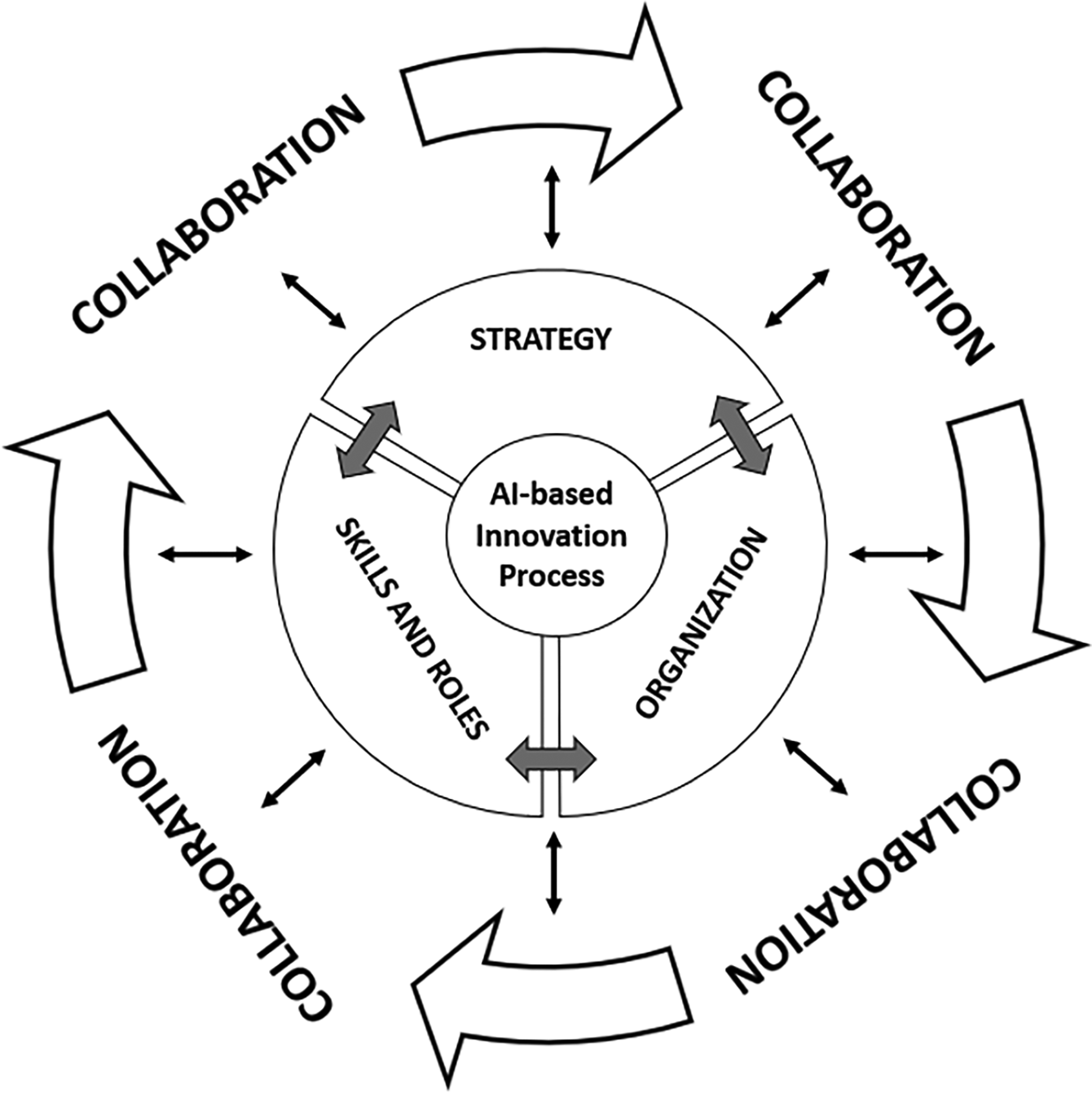
Overview of the conceptual approach.
Rethinking Strategy
Success with AI, as with other digital technologies, hinges on developing a well-crafted strategy (Brock & von Wangenheim, 2019; Kane et al., 2015; Tekic & Koroteev, 2019). This strategy should guide organizations in ethically and effectively leveraging AI, discerning when AI is applied to the right business opportunities and when it is adopted merely as a trend. Once organizations determine AI's role in innovation management, they must decide how to proceed—allocating resources, deciding between centralized AI units or decentralized experts, managing data, and aligning AI initiatives with business goals. The following key questions have to be addressed when rethinking the strategy.
Productivity vs. organizational benefits. The assumption that AI-driven productivity improvement at the individual level will seamlessly translate into organizational benefits is not always valid. While employees might organically adopt AI tools for task such as generating texts, analyzing trends, or writing code, integrating AI at the organizational level is far more complex. It requires embedding AI into the core processes, structures, and culture. To effectively leverage AI for identifying customer needs—like Beiersdorf did by analyzing 2 million posts related to body care in online forums to discover critical user problems (Kakatkar et al., 2020)—or for scouting technologies by tracking patent data trends (Tekic & Füller, 2023), companies need to invest in talent, establish dedicated AI units, adopt robust data management practices, and align AI initiatives with business goals to leverage AI effectively. They must also balance automation with human creativity to ensure AI complements, rather than stifles, human ingenuity. Additionally, they face the choice between hiring external consultants for immediate expertise and investing in in-house talent for sustainable growth. Ultimately, for AI to maximize, it must be seen as an integral part of the business strategy, not just a tool.
Exploitation vs. exploration. Artificial Intelligence adoption may require rethinking the equilibrium between incremental and radical innovation in their portfolios, which could lead to reevaluating organizational structures (Benner & Tushman, 2003; Tushman & O’Reilly, 1996). As general-purpose technology (Brynjolfsson & Mitchell, 2017), AI has the potential to drive transformative innovation across industries. However, many companies struggle with managing radical innovation and frequently fail (Roberts, 2007). The strategic dilemma lies in whether to apply AI to improve existing products or to focus on new business models. This decision could have significant implications for the innovation process, including whether to centralize AI capabilities—which would maintain consistent standards, foster specialized expertise, and streamline resource allocation—or distribute them across departments, which could drive widespread adoption and tailor solutions to specific needs. The same question, asked from a different perspective, is when should companies treat AI-powered innovations as disruptive (Christensen, 1997) and build more decentralized organizational structures with independent business units, and when should they keep it more centralized, as the logic of optimal data management for AI suggests (Ng, 2016)? First, companies should become knowledgeable and experienced about using AI technology before trying to resolve the innovators’ dilemma with AI.
Ethical foundation. As data become a crucial asset for companies, managing it effectively while ensuring ethical integrity and maintaining data security and privacy is a key challenge. The dangers of data exploitation and ethical implications cannot be overlooked. Companies must draw clear ethical boundaries, avoiding AI application that manipulate behavior, invade privacy, or exploit data unethically. Balancing innovation with ethical considerations is essential for maintaining trust and long-term success. Further research is needed into ethical AI governance and how companies can create value in a way that benefits both business and society.
Rethinking Organizational Setup
In the age of AI, the challenge for innovation management lies in creating an organizational structure that effectively incorporates AI technologies to enhance innovation, productivity, and performance (Dell’Acqua et al., 2023). The immediate impact of AI is on labor efficiency, automating both routine and complex tasks, optimizing processes, and providing advanced analytics that enable organizations to innovate with fewer human resources. This transformation is evident across industries, from medicine, where AI enhances diagnostic accuracy and personalized treatments (NCI, 2024; Rajpurkar et al., 2022), and accelerate drug discovery (GEN, 2019; Workman, 2021), to software development (Becker et al., 2023; Yetiştiren et al., 2023), and consulting, where AI boosts productivity (Dell’Acqua et al., 2023) and creativity (Boussioux et al., 2024).
Structural shifts for AI-driven organizations. One of the most pressing questions is whether AI will dramatically reduce the demand for human labor or if the resources needed to implement AI will balance out these reductions. Will we witness the rise of new tech giants with minimal workforces or simply organizations with redefined labor profiles? Regardless of the answer, the shift toward flatter, more agile structures and cross-functional teams centered around AI specialists is becoming crucial (Boussioux et al., 2024; Dell’Acqua et al., 2023). Artificial Intelligence–driven decision-making relies on real-time data, and innovation teams will require fewer but more specialized roles to maximize efficiency.
Redefining roles and task allocation. As AI takes on more responsibilities, traditional organizational concepts—such as task division, task allocation, reward provision, and information provision (Puranam et al., 2014)—must be reevaluated. Artificial Intelligence is reshaping how organizations address these core functions, enhancing innovation capacity and driving competitive advantage. In an AI-driven environment, effective task division requires a deep understanding of what AI's can do better than humans (Tekic et al., 2019). For example, in software development, AI can automate routine coding tasks, allowing system architects to focus on strategic decisions and prompt engineering. In medicine, AI algorithms can analyze complex data sets, such as medical images and lab results, to identify patterns that may escape human specialists, enabling doctors to concentrate on interpreting these findings within the broader context of patient care.
This shift demands a reassessment of roles and workflows to maximize the strengths of both AI and human collaborators. The challenge lies in the rapid pace of AI advancement, which requires frequent updates to AI–human collaboration practices (Tekic & Füller, 2023). As AI automates more tasks, managers must rethink task allocation, ensuring that both human and AI agents are assigned roles that play to their strength. For instance, while AI can manage routine customer inquiries, human agents are freed to tackle more complex issues requiring empathy and nuanced understanding of customers’ needs.
Evolving reward systems and information provision. As AI assumes a greater role, traditional reward systems may also need to evolve. Human workers may require new incentives that emphasize creativity, problem-solving, and innovation rather than routine task completion. Although AI does not require rewards, its contribution can be recognized in performance assessments, potentially justifying enhanced compensation for the human teams that manage and collaborate with AI systems.
Finally, AI significantly improves information flows by processing large data sets and delivering actionable insights, which support timely decision-making. Artificial Intelligence–driven communication tools can streamline information exchange within organizations, reducing cognitive load on employees and enabling them to focus on critical thinking and strategic planning. As organizations rethink task division, allocation, reward structures, and information management in light of AI's growing role, a fundamental question arises: Are entirely new organizational models necessary, or can existing structures be adapted to fully harness AI's potential?
Rethinking Roles and Skills for Innovation
The success of AI is inextricably linked to human intelligence, at least for the foreseeable future. To fully harness AI's potential, companies need not only a robust strategy and organizational setup but also skilled personnel capable of developing and utilizing AI tools. This requires teams to strengthen their capabilities, particularly in two emerging roles: AI-implementers and AI-complementors (Tekic & Füller, 2023). Artificial Intelligence implementers—including data scientists, programmers, and machine learning specialists—are crucial for building data infrastructure and creating the AI tools that drive innovation. Their technical expertise is the backbone of any AI initiative, enabling companies to develop cutting-edge products, processes, and services. Artificial Intelligence–complementors—are domain experts, often trained in design thinking, who ensure that AI solutions are aligned with the company's needs and operations. They creatively redefine tasks to enhance AI's effectiveness, ensuring that while machines handle problem-solving, human insight remains essential for problem-finding (Verganti et al., 2020). These roles are pivotal for integrating AI-driven innovations into business operations. However, a global shortage of AI talent (The Economist, 2024; World Economic Forum, 2024) and ongoing reshuffle of tech workforce (TechCrunch, 2024), raise important queries that warrant further exploration.
Talent acquisition. The shortage of AI talent means that innovation teams may struggle to attract the necessary skill sets. As AI startups continue to attract high valuations and significant venture capital investment, top talents may be drawn away from established companies. This trend could have significant implications for innovation management, particularly in companies outside the top-tier corporates and trendy startups, where the lack of skilled labor could stifle innovation efforts. Consequently, companies may be forced to prioritize AI projects differently, potentially sidelining other innovation initiatives.
Skill development. It is crucial to determine whether there is a core set of AI skills essential for innovation managers. If such a skill set does not exist, organizations face the challenge of motivating employees to acquire these new skills and upskilling their workforce. This issue ties into the broader themes of employee development and organizational learning, especially in fast-evolving technological landscapes. Companies must develop strategies to ensure their workforce remains capable and adaptable amid technology continues to advance.
Teaming and incentivization. A key challenge for companies is how effectively they can synchronize and incentivize collaboration between AI-implementers and AI-complementors. Ensuring that AI-complementors have visibility and influence in problem-solving processes is crucial. Companies must also support continuous learning and adaptation, particularly for AI-complementors, to maintain a dynamic and effective innovation ecosystem.
Rethinking Collaboration
In the AI era, collaboration is not just a supplementary activity but a critical driver for innovation. Success hinges on a company's ability to engage in complex and open collaborations, which are essential for data collection, technology acquisition, talent attraction, and leveraging diverse experience (Tekic & Füller, 2023). Artificial Intelligence innovators must prioritize building and expanding their networks, connecting with both potential traditional partners such as customers and universities, and nontraditional such as hospitals, schools, and city councils. These atypical partners, although often inexperienced in business collaborations or encumbered by bureaucracy, possess essential data that can fuel new business models. One of the central challenges in these collaborations is managing the balance of control and benefit-sharing among various stakeholders—data owners (e.g., patients) or creators (e.g., researchers), database owners (e.g., hospitals, academic publishers), and data users (e.g., tech companies such as Google and Microsoft that use data to train their AI systems). High-profile legal cases and disputes within the academic community (BBC News, 2021; IHE, 2024) underscore the need for clear, equitable arrangements that define benefits and responsibilities. Furthermore, it is crucial to explore how open innovation practices specifically related to data acquisition differ from traditional practices and what implications these differences have for organizations. With ongoing disputes over data ownership, copyright infringement, and compliance with terms of service related to AI model training, companies must navigate these complex waters more carefully (New York Times, 2023; TechSpot, 2024; Verge, 2023).
The collaboration between AI and humans is also emerging as a transformative force in innovation, blending AI's computational power with human creativity and strategic insight (Boussioux et al., 2024; Dell’Acqua et al., 2023). While this synergy holds immense promise, it also presents challenges due to the unprecedent pace of AI development and the relative lack of experience managing these collaborations. Artificial Intelligence is already accelerating discoveries and streamlining the innovation process, yet the future dynamics of AI–human collaboration remain uncertain. A key challenge in AI–human collaboration is that as humans share more with AI, AI learns and may increasingly take over tasks traditionally handled by humans, raising concerns about job displacement. Strategies are needed to ensure that AI augmentation enhances, rather than replaces human roles. Establishing frameworks for ethical and productive AI–human collaboration is critical to driving groundbreaking advancements and reshaping the innovation landscape.
Conclusion
The integration of AI into innovation management presents organizations with unparalleled opportunities to enhance their innovation process. However, realizing the full potential AI-based innovation requires a fundamental rethinking of strategy, organizational setup, skills, and collaboration frameworks.
Strategically, companies must craft AI-savvy strategies that ensure ethical, impactful innovation. This involves discerning when and how to apply AI effectively, ensuring that productivity gains at the individual-level translate into broader organizational success. Organizationally, companies must adapt their structures to accommodate AI technologies, striking a balance between exploitative and exploratory innovation while fostering a culture of continuous learning and agility. This also involves addressing AI's impact on labor efficiency and exploring new organizational forms that can seamlessly integrate AI-driven workflows effectively.
The roles and skills required for successful AI-based innovation are rapidly evolving, necessitating a reconfiguration of innovation teams to include both AI-implementers and AI-complementors. These roles are critical for seamlessly integrating AI into business operations and maximizing its potential. Collaboration becomes increasingly vital in the AI era, as it enhances access to valuable data, technologies, talent, and experience. Effective AI-driven innovation requires complex, open collaboration that extends beyond internal departments to include a diverse range of external partners—from customers and suppliers to hospitals and educational institutions. The synergy between human creativity and AI's computational power not only holds the promise of groundbreaking advancements but it also brings challenges, such as concerns over job displacement and the shifting roles of human workers. By strategically addressing these challenges and fostering effective AI–human collaboration, organizations can achieve transformative innovation and maintain a competitive edge in the AI-driven landscape.
Further research is crucial to explore theses critical aspects—ensuring that innovation is pursued with ethical integrity and public trust, balancing explorative and exploitative potential, synchronizing the roles of AI-implementers and AI-complementors, managing the dynamics of AI–human collaboration in innovation, and integrating nontraditional partners into the process. Addressing these questions will provide valuable insights into how organizations can fully harness AI's potential in innovation. We hope this paper will serve as a catalyst for further exploration in this exciting and transformative journey.
Footnotes
Authors’ Note
Declaration of Generative AI and AI-Assisted Technologies in the Writing Process: During the preparation of this work, the authors used ChatGPT 4o to improve readability and language of the manuscript. After using this tool, the authors reviewed and edited the content as needed and take full responsibility for the content of the publication.
Declaration of Conflicting Interests
The author(s) declared no potential conflicts of interest with respect to the research, authorship, and/or publication of this article.
Funding
The author(s) disclosed receipt of the following financial support for the research, authorship, and/or publication of this article: Zeljko Tekic acknowledges the support provided by the Graduate School of Business, HSE University for conducting this research, under Research Project No. 2022.011P (OIDIGITAL).
