




Abstract
Value creation and capture in innovation ecosystems has been researched from two different perspectives: territorial (analysing city/regions) and platforms (analysing hub companies/firms). However, there is a gap in relation to the similarities and differences of value creation and capture for each of these perspectives of innovation ecosystems. Thus, our objective is to identify, through a systematic review, what are the contributions of the platform and territorial perspectives to the literature on value creation and capture in innovation ecosystems. We used Web of Science database and analysed 42 articles in English issued between 2010 and 2021. Our results identified similarities in the dimensions strategies, mechanisms of value creation and procedural view, as well as differences in relation to mechanisms of value capture, critical factors of success and value dimensions for each of the perspectives. At the end, we suggested an investigation agenda for future studies in these field.
Introduction
In 2010, Adner and Kapoor wrote one of the most relevant articles in the field of innovation ecosystems (1,178 citations in the Web of Science database by February 2023). In their publication, the authors examined the relationship between the sequence and structure of value creation and the results of competition for value capture in innovation ecosystems. Building upon this perspective, in our article, we also consider that value creation is dependent on the subjective perception of a designated user who serves as the central figure in the creation of value (Lepak et al., 2007). Thus, value is established by the beneficiary (Vargo & Lusch, 2008) and can be phenomenological, co-created, emergent and multidimensional (Vargo et al., 2017). Based on an innovation ecosystem perspective, value can be co-created in joint activities among universities, companies, the civil society and government entities (Ritala et al., 2013) to generate benefits to users in different levels (i.e., individual, organizational or society). In this sense, each innovation ecosystem actor searches to capture the value from the ecosystem according to their organizational objectives. Consequently, each actor can benefit in multiple ways from innovation projects: intrinsic or social rewards, and, nonpecuniary or pecuniary extrinsic rewards (Chesbrough et al., 2018). Therefore, an innovation ecosystem is formed by companies, universities, government and civil society which aim to create and capture value from collaborative innovation activities around a joint value proposition (Jacobides et al., 2018; Ritala et al., 2013). Value creation and capture has become a popular research topic in innovation ecosystems, as evidenced by studies conducted by Dattée et al. (2018) and Khademi (2020). Effective strategies for creating and capturing value are essential for companies that aim to enter and thrive within an ecosystem (Randhawa et al., 2021).
Value creation and capture in ecosystems was the subject of a systematic literature review carried out by Khademi (2020). The author identified the main research topics in the area: the mechanisms, critical factors of success, challenges and strategies of value creation and capture. However, an aspect that was not explored in depth in Khademi’s (2020) review is the strategies, mechanisms and critical factors of success of value creation and capture specific to each of the analysis perspectives of innovation ecosystems. According to Thomas and Autio (2020), innovation ecosystems can be examined from both a territorial and non-territorial perspective.
The territorial perspective can be carried out mainly at the levels of a city, an urban district or a region. Non-territorial analysis refers to the hub firm and its complements, which do not necessarily inhabit the same local, as long as they belong to the same industry or platform (Thomas & Autio, 2020).
The literature on value creation and capture in innovation ecosystems also identifies two analytical perspectives, which we refer to as platform and territorial (Santos & Zen, 2022). The platform perspective has emphasized the study of hub firms from different sectors (Kapoor & Klueter, 2021) and the territorial approach analyses regional innovation ecosystems (Oskam et al., 2021) and innovation ecosystems in cities (Visnjic et al., 2016).
Thus, we argue that there is a gap in the literature in relation to the strategies, mechanisms and critical factors of success of value creation and capture according to each of these analysis perspectives in innovation ecosystems (platform and territorial). Each perspective may present differences regarding strategies, mechanisms and critical factors of success of value creation and capture among the actors. Furthermore, orchestrating diverse actors, such as municipal governments, companies and citizens requires the proper alignment of various incentives within this type of stakeholder arrangement (Linde et al., 2021).
Therefore, this article aims to carry out a systematic literature review to identify what are the contributions of the platform and territorial perspectives to the literature on value creation and capture in innovation ecosystems. We describe the current panorama of publications in the area and the strategies, mechanisms and critical factors of success of value creation and capture in innovation ecosystems. As theoretical contributions, we compare six dimensions of analysis of value creation and capture in innovation ecosystems and propose a research agenda in the field.
This article is theoretically justified as it advances the understanding of the differences and similarities between the platform and territorial approaches in innovation ecosystems for the analysis of value creation and capture. Empirically, the article is justified as it presents strategies, mechanisms and critical factors of success of value creation and capture that may be relevant to business managers, university managers, public managers and non-profit organizations working in innovation ecosystems.
Method
We conducted a systematic literature review, a process that enables scientific and transparent replication (Tranfield et al., 2003). For operationalization purposes, we adopted the Preferred Reporting Items for Systematic Reviews and Meta-Analysis (PRISMA) protocol indicated by Moher et al. (2009) and Da Silva and Amaral (2019).
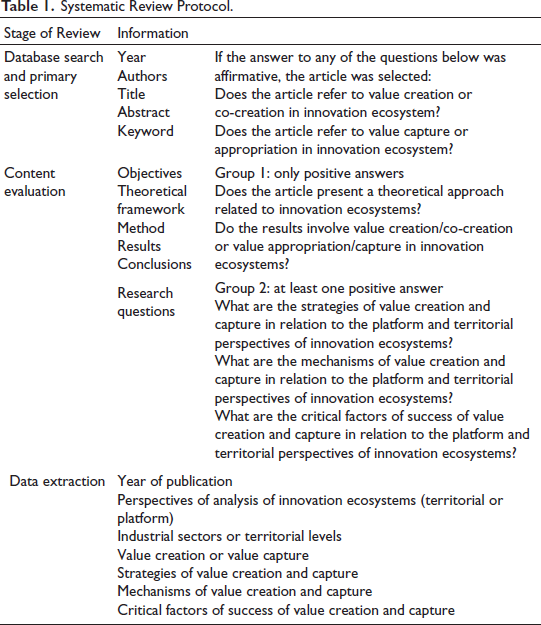
Following Da Silva and Amaral’s (2019) approach, we started by defining the research questions, selecting the appropriate article-search database, and identifying relevant search terms to achieve our research objectives. We formulated three research questions to guide our literature review:
What are the strategies of value creation and capture regarding the platform and territorial perspectives of innovation ecosystems?
What are the mechanisms of value creation and capture in relation to the platform and territorial perspectives of innovation ecosystems?
What are the critical factors of success of value creation and capture concerning the platform and territorial perspectives of innovation ecosystems?
Next, we accessed the Web of Science database to search for articles available in online journals, published in English, in the ‘Business’ and ‘Management’ knowledge areas, from 2006, date of the seminal publication by Adner (2006) on innovation ecosystems, to 2021. The search was performed on March 7, 2022.
We chose a group of search terms according to the objectives of the review. Below, we present the two search algorithms used in the Web of Science database:
‘innovation ecosystem*’ AND (‘value creation’ OR ‘value cocreation’ OR ‘value co-creation’);
‘innovation ecosystem*’ AND (‘value capture’ OR ‘value appropriation).
We found 131 articles: 114 articles on value creation/co-creation and 17 articles on value capture/appropriation. We excluded 11 articles, as they appeared in both value creation and value capture searches. Then, we evaluated the contents of title, abstract and keywords, in order to identify whether the articles could contribute to answering the research questions. We selected the relevant data from the articles and registered them in electronic spreadsheets. Figure 1 provides the flow diagram of the systematic review.
PRISMA Protocol for Systematic Literature Review.
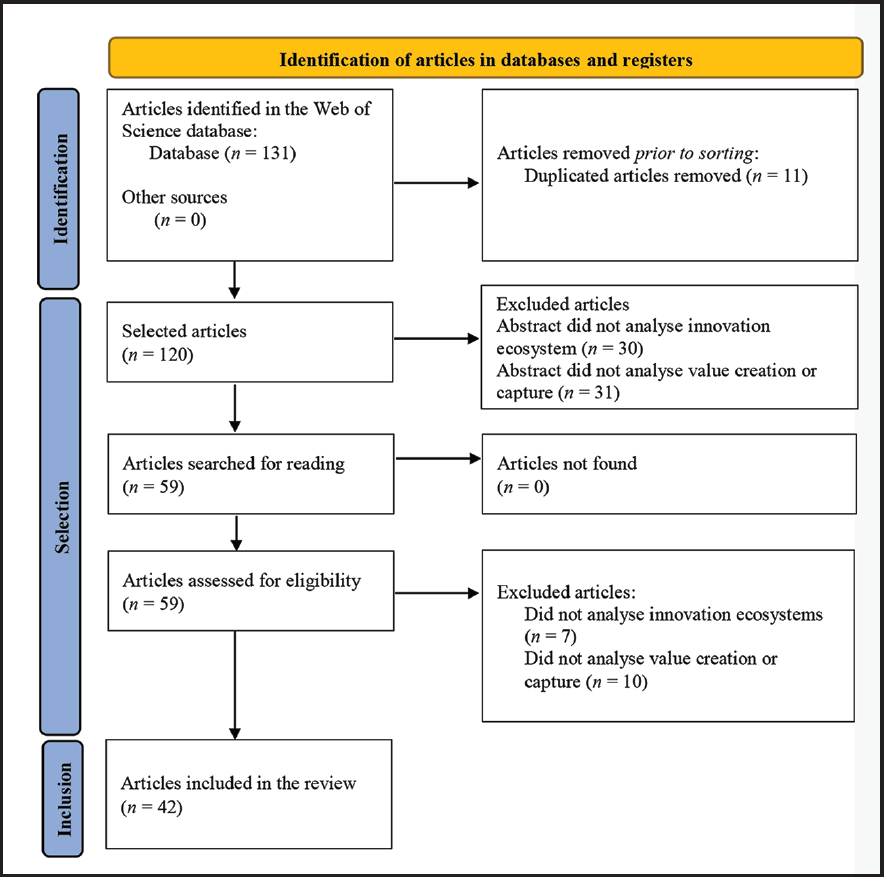
We excluded 61 articles after reading the titles, abstracts and keywords, as the abstract did not present relationships with innovation ecosystems or value creation/capture. Thus, in the following stage, 59 articles remained eligible for full reading and content assessment. The introduction section, theoretical framework, method, results/discussions and final considerations of these articles were analysed, and the questions were answered (inclusion and exclusion criteria). We separated these two questions: for group one, all answers must be affirmative. For group two, at least one of the answers must be positive. After the complete reading of the articles, we excluded 17 articles, with 42 articles remaining for final analysis.
Finally, we extracted data from the articles and analysed them qualitatively through content analysis. Table 1 provides the review protocol.
Systematic Review Protocol.
Results
Descriptive Analysis of Results
We identified 42 articles in our analysis (Table 2). A total of 41 articles (97.6% of the sample) researched value creation or co-creation. Of these, 22 publications jointly analysed value creation/co-creation and value capture. Only one article analysed value capture exclusively. These findings support Khademi’s (2020) claim that there are more publications on value creation and few studies on value capture in ecosystems.
Distribution of Articles—Year of Publication, Authors, Perspective of Analysis and Research Emphasis (Value Creation or Capture).
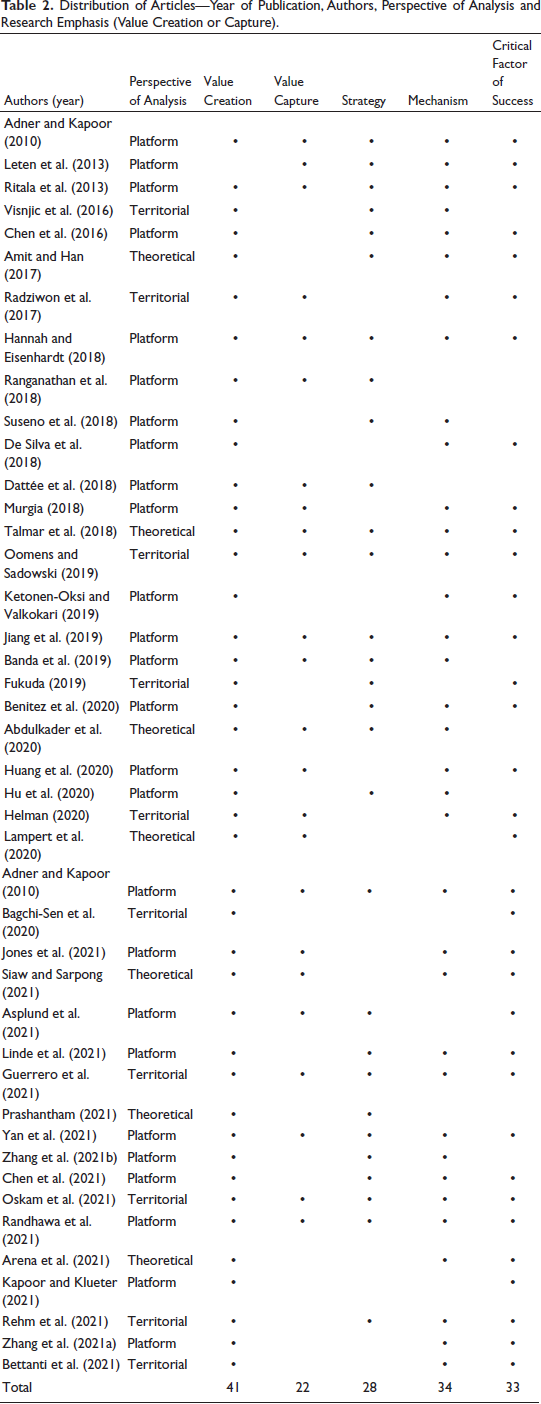
Afterwards, we classified the articles according to the perspective of analysis. Articles exploring ecosystems of companies from different sectors were classified as ‘platform perspective’. Articles approaching cities, regions or nations were classified as ‘territorial perspective’. In addition to these two perspectives, a third perspective concerns theoretical-conceptual analyses which, unlike the two other perspectives, do not contribute empirically to the results.
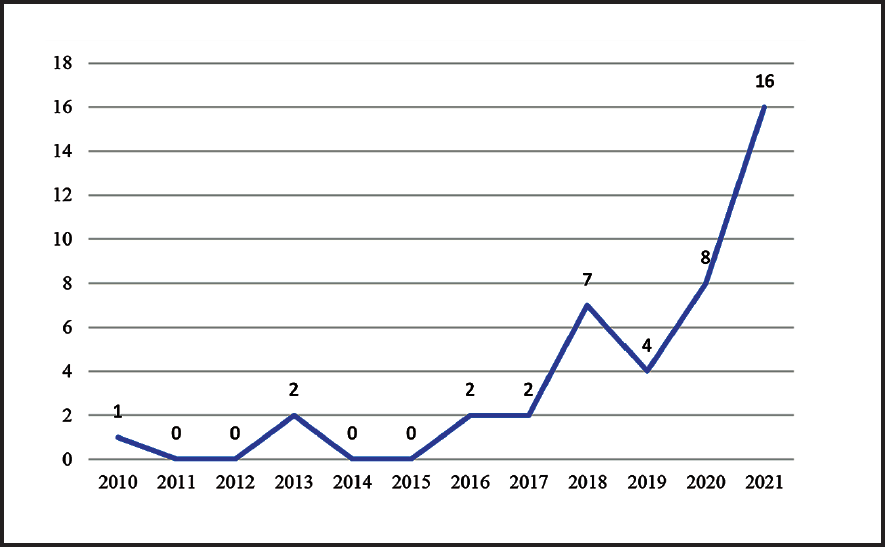
We categorized the articles in relation to the research questions to identify which of them contribute to the strategies, mechanisms and critical factors of success of value creation and capture in innovation ecosystems. We also evaluated the articles according to the year of publication to check the evolution over time in Figure 2. Despite a drop in 2019, there has been an increase in the trend of article publishing since 2018. This growth starts in 2018, with 35 articles published until 2021 (representing 83.3% of the publications).
Article Distribution by Year of Publication.
Then, we categorized the empirical articles according to the perspectives of analysis and their respective research contexts. Publications have advanced in two different perspectives. The first refers to the platform perspective of innovation ecosystems (25 publications), which aim at analysing how hub companies and firms (and their complements) create and capture value within their innovation ecosystems. The second concerns the territorial perspective and analyses value creation and capture within a geographically delimited context (10 publications), such as a city, a region or a country by heterogeneous actors (universities, government, civil society and also companies).
The platform perspective has mainly researched digital ecosystems, software and artificial intelligence industries. For instance, the healthcare sector presents research related to bone prosthesis implant companies, regenerative medicine and gene therapies. The articles also analyse the automotive, electronics, telecommunications industry and mechatronics, nanoelectronics and semiconductor companies. Other sectors analysed are defence/aerospace, universities and research institutions, start-ups, manufacturing industries, chemical industry as well as nuclear and solar energy.
Publications addressing the territorial perspective were carried out mainly in cities and metropolitan regions. The cities of Almere, Eindhoven and Amsterdam and Chicago, London Wroclaw and Vienna were the subject of research. Two studies were carried out in metropolitan regions: one in the Amsterdam region and another in the Munich metropolitan area.
Value creation and capture was also researched at the regional level: in a region of Denmark, and in Lombardy (Italy), in the United Kingdom regions (Bagchi-Sen et al., 2020) and Japan innovation ecosystem (Fukuda, 2019). Guerrero et al. (2021) described the creation and capture of social and economic value in three programs oriented towards the promotion of Social Purpose Organizations in Mexico.
Value Creation and Capture in Innovation Ecosystems: The Platform Perspective
The main strategies of value creation and capture from the platform perspective are related to the coordination structures of the innovation ecosystem and mainly depend on the characteristics of the actors, the sector and the phase of ecosystem development.
One strategy is to initiate value co-creation and sharing in a centralized manner by an actor (Benitez et al., 2020) or with a small group of key suppliers (Chen et al., 2016). In a second moment, the strategy evolves into a larger network of actors and complementors. Afterwards, the value can be shared across an extended network and, finally, the value can be shared within the innovation ecosystem (Chen et al., 2016).
Another approach is the vertical integration, which can be a strategy to manage interdependence (Adner & Kapoor, 2010). However, traditional governance models may face difficulties in new ecosystems in situations of high uncertainty (Kapoor & Klueter, 2021), as it is a challenge to demonstrate the creation and extraction of economic value in disruptive innovation environments (Banda et al., 2019). The platform framework is also a strategy to link actors with a common value proposition (Yan et al., 2021).
Collaboration between actors is the main mechanism of value creation in innovation ecosystems (Jones et al., 2021). Attracting actors to meetings, establishing a shared value foundation, common goals and vision are important activities for value creation (Ritala et al. 2013). Thus, the difficulty of combining heterogeneous parts of the network, such as public and private actors (Asplund et al., 2021) can affect value co-creation.
The literature describes examples of mechanisms of value creation and co-creation and collaboration between universities and companies (Yan et al., 2021) involving the sharing of research and development costs (Ritala et al., 2013). However, R&D collaborations are a dynamic phenomenon which evolve over time (Benitez et al., 2020).
Value creation can also be the result of collaborative activities between different types of actors such as end users contributing to a digital platform (Suseno et al., 2018), through the cooperation of manufacturing companies and users (Hu et al., 2020), between a group of private companies (Jiang et al., 2019) or between public and private initiatives (Asplund et al., 2021).
The main mechanisms of value capture are contracts (Adner & Kapoor, 2010), business models that clearly convey how value will be captured between partners (Huang et al., 2020; Ritala et al., 2013). The motivations of each actor to create value are also considered value capture mechanisms (Ritala et al., 2013). A public research institution appropriates the value by charging a fee from client companies, transferring technologies and creating spin-offs (Banda et al., 2019). Universities can be motivated by reputation (Asplund et al., 2021). Companies appropriate value by gaining prior knowledge of research results with academic partners (Leten et al., 2013) or by increasing the expected number of users of new technology (Huang et al., 2020).
The critical factors of success of value creation and capture described are related to the structure of interdependence and the location of the technological challenges of the hub-firm and its external partners (Adner & Kapoor, 2010), to the multiple needs of the various types of actors (Ritala et al., 2013) and the technological uncertainties related to the ways in which actors contribute to the value creation and capture proposition (Kapoor & Klueter, 2021).
The tensions and conflicts between competition and collaboration can also be understood as a critical factor of success value creation and capture (Hannah & Eisenhardt, 2018; Jones et al., 2021). If, on the one hand, companies cooperate a lot, they may not actually capture value. On the other hand, if they compete too much, they may not create the value. Only when the appropriation of an individual actor’s value is assured, an ecosystem can balance competitive and cooperative tensions (Jiang et al., 2019).
Trust (Asplund et al., 2021), conflict management (Jones et al., 2021), commitment, reciprocity and power (Benitez et al., 2020) are critical factors of success necessary to maintain knowledge sharing over time. Thus, cultural differences and geographic distances can cause difficulties and conflicts with the value appropriation (Jiang et al., 2019). Negotiations regarding value appropriation can also be more difficult due to the larger number of actors in the ecosystem (Murgia, 2018).
To establish a solid ecosystem, it is necessary to clearly establish responsibilities, rights and interests (Chen et al., 2021), as unclear rules regarding value distribution reduce the enthusiasm of actors to collaborate (Huang et al., 2020).
In summary, we identified that the platform perspective presents contributions in different contexts. Publications indicate the importance of analysing the coevolutionary and dynamic characteristic of strategies, mechanisms and critical factors of success in relation to the different stages of development of innovation ecosystems (procedural view). From this perspective, perceptions of value are mainly related to the economic dimension.
Value Creation and Capture in Innovation Ecosystems: Territorial Perspective
The territorial perspective emphasizes the relevance of coordination in innovation ecosystems as a key strategy for value creation and capture. At the city level, the city hall can act as a vertical integrator, which interacts directly with stakeholders, consolidating their respective contributions (Visnjic et al., 2016). Another strategy is for the municipal government to act as a hub platform (Visnjic et al., 2016). The actors interact with each other to create value rather than providing their products to the city hall.
The literature describes the mechanisms of value creation, such as collaborative relationships (Oomens & Sadowski, 2019) and the creation of measures for open value exchange (Oskam et al., 2021). First, the actors in the innovation ecosystem need to have common goals (Radziwon et al., 2017) and a well-defined and shared vision of value propositions (Oomens & Sadowski, 2019). It is also necessary to attract proactively the involvement of stakeholders (Rehm et al., 2021). During the formation stage of an innovation project, it is crucial for the actors to align their expectations regarding value creation activities, as well as activities that lead to capturing individual value at the company level (Oomens & Sadowski, 2019). According to Helman (2020), each actor can create value in different ways: companies and start-ups create value by growing and promoting themselves; incubators and coworking spaces by helping start-ups to develop with funding opportunities and physical space. Technology parks create value by organizing networking events that help start-ups and small businesses expand their connections without huge investments. Universities and research institutions create value by providing technical/scientific advice. The government by supporting innovative actions and attracting new investors, and the civil society by advising and supporting along with offering financial opportunities (Helman, 2020).
The literature describes the mechanisms of value capture. Companies and start-ups capture value through increased income/turnover. Incubators and coworking spaces through the profits and actions of supported start-ups. Technology parks, universities and research institutions capture value by developing innovations. The government by attracting new residents, increasing the city’s relevance and enabling the promotion of broader sustainable regional development (Helman, 2020).
The literature also explains the main critical factors of success of value creation and capture. Informal agreements, flexibility of individual roles and adjustment of value targets over time are important critical factors of success (Oskam et al., 2021). However, the realignment of public and private goals of stakeholders to continuously create and capture value may be a challenge (Oomens & Sadowski, 2019).
Following the initial phase of formation, the strategic harmonization of ecosystem partners becomes pivotal. Oskam et al. (2021) suggested that it is necessary to understand the perception of the meaning of value for each actor, as the perception of value evolves according to the development of ecosystem. The semantic barriers between the academia and the market in the creation/execution of innovation leads to low innovative performance at an early stage, as well as a low level of commercialization (Helman, 2020).
The risks of adopting a new technology in a city and the risk-prone culture (Bettanti et al., 2021) are also reported as critical factors of success. Innovations that focus on local problems are more likely to be adopted by users (Rehm et al., 2020) if population participation occurs.
The literature also describes the learning capabilities of actors as critical factors of success. Oskam et al. (2021) depicted learning-based action, experimentation and openness to new opportunities as critical factors of success to create value in innovation ecosystems. Bagchi-Sen et al. (2020) stated that university spin-offs create additional value in their regions by launching products and services. However, university research results need to reach society not only through publications, but through technology transfer (Bettanti et al., 2021). Thus, decreases in public investments in science, technology and innovation can make a national innovation ecosystem more vulnerable (Fukuda, 2019). Public subsidies and funding (Oomens & Sadowski, 2019), bureaucracy and excessive regulation limit value creation (Bettanti et al., 2021) and are also critical factors of success in an innovation ecosystem. Guerrero et al. (2021) affirmed that openness to change, economic profile, tax and labour market regulations are challenges for the creation and capture of economic and social value in emerging economies.
The territorial perspective mainly analyses success cases in developed countries and, to a lesser extent, ecosystems with difficulties and emerging countries. Furthermore, empirical studies seek to analyse the heterogeneity of quadruple helix actors. As a result, perceptions of value are not restricted only to the economic dimension, but also present contributions in the socioenvironmental dimensions.
Summary of Contributions and Research Agenda
Comparative Analysis of Platform and Territorial Perspectives
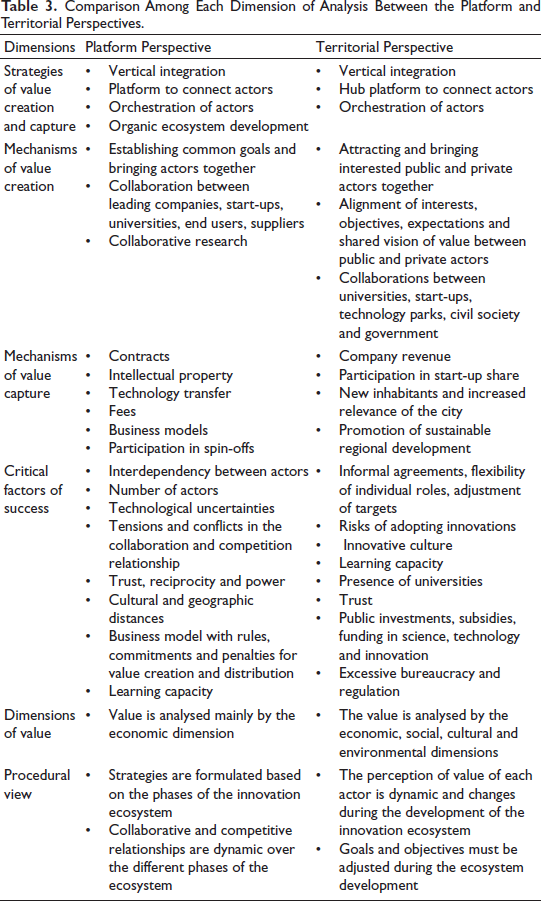
We compared the results between the platform and territorial perspectives and found similarities and differences in each of the six dimensions of analysis. On the one hand, there are common elements between the platform and territorial perspectives: both analyse value creation and capture with a procedural view over time, in accordance with ecosystem development. Each actor (or the ecosystem itself) adopts coordination strategies that can be more or less centralized (or decentralized). There is a need to align objectives and interests among the actors, and the value creation mechanisms are mainly based on collaborative relationships between actors.
On the other hand, there are different elements between the two approaches. The mechanisms of value capture are distinct between the two perspectives because there are different types of actors and organizational objectives. This singularity creates differences in the perception of value among heterogeneous actors. The territorial perspective has a different challenge from the platform approach, which is to align the different types of interests between actors, such as government, universities, civil society and companies. This multiplicity of objectives is not restricted to the economic dimension, as described by the platform perspective.
There is greater complexity in the territorial perspective in establishing common goals and, mainly, in keeping these different interests aligned over the development of the innovation ecosystem, as different values motivate these actors in value creation and capture. Consequently, the critical factors of success of the territorial perspective include social, cultural, institutional, normative, legal and governmental aspects, and not only the technological, organizational/economic critical factors of success described by the platform perspective.
This comparison reinforces our comprehension about value creation and capture presenting different results between the platform and territorial perspectives of innovation ecosystems. This finding indicates that there is a need to research each of these perspectives with distinction in all dimensions, but mainly in relation to the value dimension, the mechanisms of value capture and critical factors of success. However, both perspectives are similar in relation to the procedural view, the mechanisms of value creation and the strategies of value creation and capture. Table 3 compares each dimension of analysis between the platform and territorial perspectives.
Comparison Among Each Dimension of Analysis Between the Platform and Territorial Perspectives.
Suggestions for Future Research on Value Creation and Capture in Innovation Ecosystems
From the analysis of the current scenario of publications, we have prepared a research agenda on value creation and capture for the platform and territorial perspectives of innovation ecosystems. Table 4 provides five specific suggestions for each of these perspectives.
Research Agenda for Future Studies on Value Creation and Capture in Innovation Ecosystems.
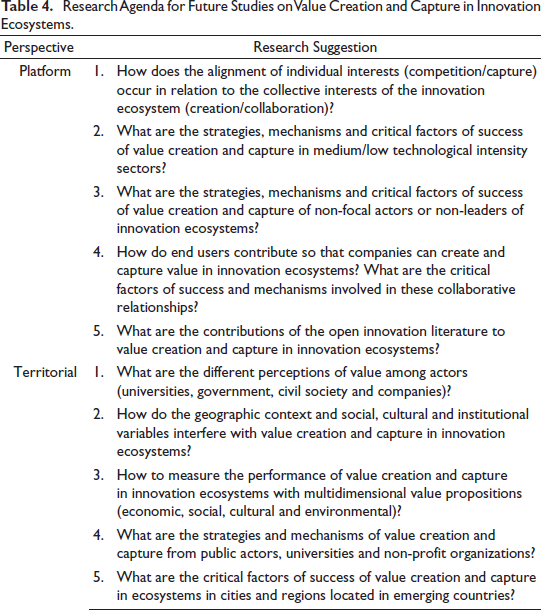
Our suggestions aim at developing this field in topics that have not yet been studied or have little contribution from current research.
Final Considerations
This study aimed at carrying out a systematic review of the literature on value creation and capture in innovation ecosystems. We presented three theoretical contributions. First, we differentiated which publications are related to each of the perspectives of analysis of value creation and capture in innovation ecosystems. Mainly we showed that the perspectives of analysis have six similar dimensions, but different elements of analysis that consider the empirical peculiarities of each of these perspectives. Our second contribution was the comparative synthesis of dimensions for the analysis of value creation and capture in innovation ecosystems between the platform and territorial perspectives. Thirdly, we developed a research agenda with ten suggestions for further studies on these two perspectives.
Our article also presents managerial contributions, as we described to business managers, university managers, public managers and civil society entities a synthesis of what are the strategies, mechanisms and critical factors of success of value creation and capture in innovation ecosystems. These results can be useful in actions both at ecosystem and organizational levels.
Our research also has limitations. First, we consulted only one database and only articles published in journals. This study can be extended to other bases and include other types of publications. With this, other dimensions of analysis can emerge from this literature and complement the theoretical comprehension of this subject. Moreover, value creation and capture differs from one sector to another, and from one territory to another. Therefore, our results cannot be considered normative for all territorial or business contexts, but only as basic principles for studies on innovation ecosystems.
Footnotes
Acknowledgments
An initial version of this article was previously published in Portuguese at the XLVI Encontro da ANPAD (EnANPAD) in 2022. The initial version underwent relevant changes in its content for the current submission. The initial version can be accessed at:
Author’s Contributions
Conceptualization: Carlos Alberto Frantz dos Santos and Aurora Carneiro Zen; Methodology: Carlos Alberto Frantz dos Santos and Aurora Carneiro Zen; Formal analysis and investigation: Carlos Alberto Frantz dos Santos; Writing – original draft preparation: Carlos Alberto Frantz dos Santos and Aurora Carneiro Zen; Writing – review and editing: Carlos Alberto Frantz dos Santos and Aurora Carneiro Zen; Supervision: Aurora Carneiro Zen.
Declaration of Conflicting Interests
The authors declared no potential conflicts of interest with respect to the research, authorship and/or publication of this article.
Funding
The authors disclosed receipt of the following financial support for the research, authorship, and/or publication of this article: The authors received financial support for Fundação de Amparo à Pesquisa do Estado do Rio Grande do Sul (FAPERGS) provided through process number 19/2551–0001695-6 and to the Coordenação de Aperfeiçoamento de Pessoal de Nível Superior (CAPES) through number 88881.369049/2019–01.
