




Abstract
How can teams make sense of a complex organizational transformation and be ready to change? These questions must be addressed as organizations turn towards team-based structures to become more reactive. During organizational transformations, we argue team reflexivity enables team members to share interpretations of changes, leading to the development of team change vision—the overarching sense of direction for simultaneous change initiatives. We further argue that team reflexivity is more effective for teams with greater team tenure dispersion and additive team tenure. We tested and found support for our theory using time-lagged, survey-based data from 70 teams at a Canadian governmental organization. Overall, our study contributes to team readiness to change literature by identifying team reflexivity as a central information-processing activity enabling teams to develop a team change vision during an organizational transformation and by clarifying the effect of team tenure on such activity.
Keywords
Introduction
Organizations rely on work teams to adapt over time (Harvey et al., 2022; Mathieu et al., 2019). Unlike larger organizational units like departments or divisions, work teams are said to be more ready to change and to address complex situations quickly (Maynard et al., 2015). This is in part because teams can more easily develop a shared change vision that aligns with concurrent organizational changes (Harvey & Kudesia, 2023). They do so by engaging in processes enabling members to discuss and ponder over environmental cues, such as team reflexivity (Konradt et al., 2016; Schippers et al., 2014; Tesler et al., 2018). However, the composition of a team can significantly influence its capacity for reflexivity, either facilitating or hindering the realization of the benefits associated with reflective practices (Bresman, 2013; Edmondson et al., 2001; Edmondson & Harvey, 2018; Leblanc et al., 2022).
Team tenure is often thought to impact team reflexivity (Katz, 1982; Katz & Allen, 1982), although its influence is not always straightforward (Gonzalez-Mulé et al., 2020; Harvey et al., 2022; Schippers et al., 2017a). While past research has looked at the role of the average time that members have spent together—the additive perspective—on team reflexivity (e.g., Chen et al., 2018), little attention has been given to the dispersion perspective, that is the distribution of tenure across team members (Gonzalez-Mulé et al., 2020). This is important because novel forms of teamwork—created by swift membership transitions and increasing diversity of members—are becoming more prevalent and pose significant research methodological hurdles (Edmondson & Harvey, 2017; Kerrissey et al., 2020). The distribution of team tenure can influence what information is processed within teams, and the extent of the benefits derived from such processing (Harrison & Klein, 2007; Harvey et al., 2022). The dispersion perspective may thus offer valuable insights into how teams adapt and evolve in the face of shifting circumstances.
As depicted in Figure 1, this study aims to explore the role of team reflexivity and team tenure in facilitating the development of a change vision and, in turn, enhancing teams’ readiness for change. Building upon research on team adaptation (Burke et al., 2006; Hinsz et al., 1997; Maynard et al., 2015; Randall et al., 2011) and readiness to change (Armenakis et al., 1993; Rafferty et al., 2013), we develop new theory by integrating both the additive and dispersion perspectives of team tenure. Specifically, we suggest that teams with greater additive tenure are usually better equipped to develop a change vision and their readiness to change through team reflexivity due to accumulated shared experience. However, despite the potential benefits, these teams may still encounter difficulties in disrupting habitual routines (Bresman, 2013; Edmondson et al., 2001; Gersick & Hackman, 1990). Consequently, we posit that introducing greater tenure dispersion could serve as a mitigating strategy. This is because a diverse range of experiences and perspectives can stimulate richer discussions, invite external viewpoints, and ultimately challenge habitual routines. To test our theory, we collected data from 70 teams undergoing a major transformation within a Canadian governmental administration. Our findings show that team reflexivity enhances the team's readiness to change through the development of a team change vision, and that this process is particularly effective within teams with both greater additive tenure and greater tenure dispersion.
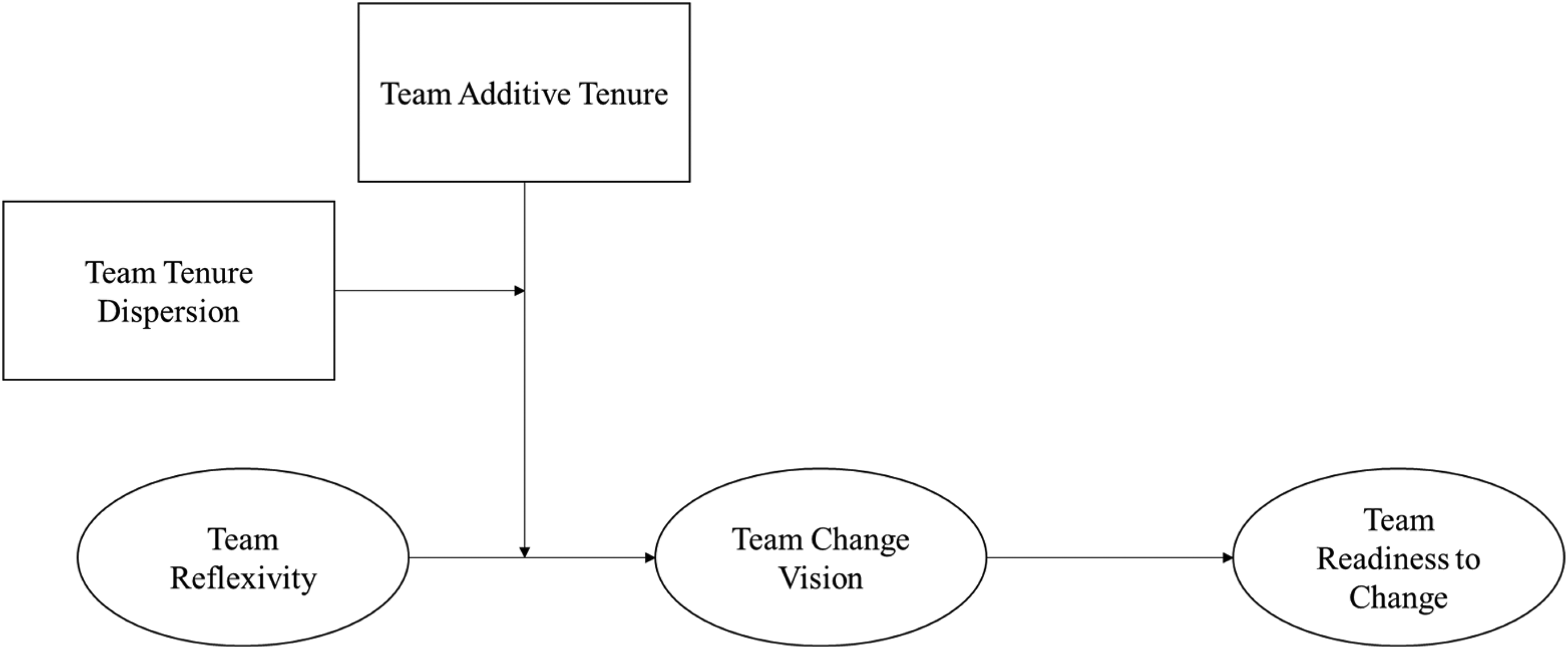
Theoretical model.
Our study makes two key contributions to the literature. First, it provides new grounds for the study of team tenure and shared cognitions in groups, which remains a key factor in team effectiveness (Tannenbaum & Salas, 2020). Our study adds specificity as to why and when team tenure provides the foundation for teams to reap the benefits of team reflexivity. By exploring how tenure dispersion impacts such team processes, researchers may uncover nuanced strategies for promoting effective team adaptation through shared cognitions. Second, our study adds to the burgeoning view of collective attitudes towards change (Bouckenooghe et al., 2019; Harvey & Kudesia, 2023), which complements the larger body of research that has considered them only as an individual phenomenon (e.g., Eby et al., 2000; Holt et al., 2007). We accomplish this by conceptualizing team change vision and team readiness to change as important emergent states. By doing so, we also broaden the nomological network of team reflexivity that has been at the center of research on change and innovation in organizations over the past two decades but had yet to be linked to organizational change concepts (Harvey et al., 2022).
Theory and Hypotheses
We draw on research on team adaptation, defined as “the capacity of teams to gather information from the performance environment and use it to make functional adjustments to team strategies, behaviors, role structures, and resource allocations” (Randall et al., 2011, p. 526; see also Burke et al., 2006; Hinsz et al., 1997; Maynard et al., 2015). From this perspective, adaptation unfolds from information-processing and the development of shared cognitions, guiding the team to collectively assess the situation and prepare for necessary adjustments. Experts in human factors frequently employ the term “situational awareness” to encapsulate this phenomenon (see Salas et al., 2017). Comprehension and projection, or the team's ability to interpret what is going on in the environment in a meaningful way and anticipate what is likely to happen, are key parts of teams’ situational awareness (Salas & Tannebaum, 2020). The awareness of its situation enables a vision to emerge within the team, that is the “shared idea of a valued outcome which provides the motivation for the team's work” (West & Unsworth, 1998, p. 5; see also Hackman, 2011; Hackman & Wageman, 2005). Managers can support this process by communicating clearly and consistently about goals and strategies (Chai et al., 2020), but team members tend not to remain passive and also contribute to the vision (Pearce & Ensley, 2004; West & Unsworth, 1998; Zhang et al., 2012). We consider these fundamental underpinnings of team adaptation to further understanding of teams dealing with shifting circumstances, specifically their readiness to change.
Readiness to change encompasses “members’ beliefs, attitudes, and intentions concerning the necessity of changes and the organization's capability to effectively implement those changes” (Armenakis et al., 1993, p. 681). It is related but different than other team, change-related concepts such as team plasticity and team evolution. Team plasticity involves the team's capacity to be flexible and adapt under pressure, responding to contingencies while safeguarding long-term success (Abrantes et al., 2022). It primarily focuses on the team's ability to be adaptable in the face of challenges and uncertainty, rather than the shared attitude towards change, as seen in readiness to change. Team evolution (Morgan et al., 1993), for its part, centers on the development of cohesion, trust, and performance, over time. Though it includes some aspects of adjustment to environmental demands, it does not specifically address the overall attitude of a team towards change. This distinction is key because it underscores that even highly adaptable and well-developed teams can resist change, often due to their adaptability being oriented towards preserving the existing status quo rather than proactively embracing new initiatives. Resistance to change can be multifaceted, driven by factors like fear of the unknown, apprehensions about potential disruptions, or a perception that proposed changes are at odds with the team's established norms and values (Oreg et al., 2011). Consequently, assessing team readiness to change offers deeper insights into a team's willingness to invest efforts and resources in facilitating the successful implementation of change.
At the team level, readiness to change has been conceptualized through a composition model of emergence (see Kozlowski & Klein, 2000), suggesting that it exhibits isomorphism and identical properties across levels (Rafferty et al., 2013). Consequently, it retains the same meaning as at the individual level but can manifest at the team level. As social interactions significantly influence the development of these emergent states (Kozlowski & Klein, 2000; Marks et al., 2001), team tenure and tenure dispersion become key factors, reflecting how team dynamics and shared perceptions are shaped by cumulative experience and tenure distribution.
The Mediating Effect of Team Change Vision
When teams face changing circumstances, we posit that they need to develop a change vision, which refers to the collective understanding of the overall direction for concurrent change initiatives. Team change vision originates from employees’ individual cognition but materializes as a collective phenomenon (see Kozlowski & Klein, 2000; Mohammed et al., 2010). It therefore classifies as a cognitive team emergent state, which captures “properties of the team that are typically dynamic in nature and vary as a function of team context, inputs, processes, and outcomes” (Marks et al., 2001, p. 357). As employees interact within a team, we argue, they discuss interpretations of environmental cues, which can lead to the formation of a shared cognitions about the organization's overarching direction in the context of change.
Developing a team change vision can be challenging during organizational transformation. Organizational change can lead to uncertainty and ambiguity (Harvey & Kudesia, 2023), causing doubt about future events and misunderstandings of cause-and-effect relationships in the environment (Bordia et al., 2004; Johnson, 2016). A team change vision closely aligns with the specific challenges, objectives, and opportunities of the team, providing a more immediate and personalized context compared to a broader organizational vision. The ways in which team members interact together is likely to influence the development of such shared cognitions.
Team reflexivity, or “the extent to which team members collectively reflect upon the team's objectives, strategies, and processes, as well as their wider organizations and environments, and adapt them accordingly” (West, 2000, p. 3), may be particularly beneficial for teams seeking to form a shared vision in the context of change. Scholars emphasize the role of team reflexivity in developing shared mental models in teams (e.g., Burke et al., 2006; Konradt et al., 2016; Rosen et al., 2011). This construct not only encompasses other team processes such as team monitoring—the “observation of the activities and performance of other team members during a task” (Dickinson & McIntyre, 1997, p. 25)—and debriefing—“a type of work meeting in which people discuss, interpret, and endeavour to learn from a recent event during which they collaborated” (Allen et al., 2018, p. 505)—but also includes an adaptive component, which is relevant in the context of organizational change (Harvey et al., 2022).
Through reflexivity, teams can integrate team members’ individual perspectives, leading to a better understanding of complex situations (De Jong & Elfring, 2010; Leblanc et al., 2022; West, 2000). Notably, highly reflexive teams refrain from hastily reaching a consensus, potentially resulting in a more comprehensive and less muddled understanding of the environment (Harvey & Green, 2022; Rafferty et al., 2013; Schippers et al., 2014). In the context of organizational change, we expect team reflexivity to enable teams to better understand the interdependencies between different change initiatives, creating an enhanced vision of change within the team.
Shared cognitions can serve as a motivational force for team members who can better respond to changes (Aubé et al., 2015). It enables team members to accurately answer critical questions for effective teamwork (Tannenbaum & Salas, 2020; West & Unsworth, 1998). It helps teams answer critical questions about what, why, and how the changes will occur, clarifying the rationale and enhancing the motivation for change (Armenakis et al., 1993; Rafferty & Minbashian, 2019). Additionally, members of teams with a stronger change vision can better anticipate the team's requirements, offer support, reinforce implicit communication, and coordinate actions, all of which can support readiness to change (DeChurch & Mesmer-Magnus, 2010). We therefore propose that:
The Moderating Effects of the Additive Team Tenure and Team Tenure Dispersion
Team tenure, equating to the accumulation of shared experience among team members, may influence the benefits teams can reap by being reflexive (Edmondson & Harvey, 2017; Gersick, 1991; Gonzalez-Mulé et al., 2020). Scholars argue that team members need some time together before team processes can function well (Edmondson & Harvey, 2018; Salas et al., 2017; Schippers et al., 2003; van der Vegt et al., 2010). However, the interplay between tenure and reflexivity in teams is not straightforward (Harvey et al., 2022). This may be due to scholars operationalizing team tenure in different ways. Some scholars use the additive perspective, which focuses on the average amount of time that team members have spent on the team, while others take the dispersion perspective, capturing the variance of individuals’ time on the team (Gonzalez-Mulé et al., 2020). To develop a more thorough understanding of how tenure impacts the benefits of reflexivity in teams, we consider both perspectives.
Teams with a high additive tenure may be more capable of developing shared cognitions about change through reflexivity than teams with low additive tenure (Chen et al., 2018). This is because team members working together for a significant amount of time accumulate knowledge and experience about the team and the team's task (Chen et al., 2018; DeChurch & Mesmer-Magnus, 2010; Gonzalez-Mulé et al., 2020). This makes it easier to identify what needs to be changed and provides a common knowledge base to mobilize during reflexive episodes (Chen et al., 2018; Harvey et al., 2023; Lippmann & Aldrich, 2016). However, the extent to which reflexive teams with higher additive tenure develop a shared vision about change, and feel ready to change, may vary according to their level of tenure dispersion. On the one hand, we expect that teams with both high additive tenure and high tenure dispersion will benefit even more from team reflexivity since they can simultaneously take advantage of shared experience, while also accessing novel insights from newcomers (Gonzalez-Mulé et al., 2020; Subramony & Chadwick, 2021). Indeed, tenure dispersion involves some differences in terms of knowledge, experiences, and perspectives among team members (Leung & Chiu, 2010; Schippers et al., 2017), which can further the benefits of reflexivity in teams. These have the foundation to put newcomers’ insights to good use, ultimately enhancing their abilities to better craft their shared cognitions.
On the other hand, when teams with higher additive tenure have lower levels of tenure dispersion, they may overly routinize team reflexivity, affecting their positive adaptive outcomes (Gersick & Hackman, 1990; Schippers et al., 2003). As such, teams who have been working together for a long time, and have not welcomed newcomers recently, can overly focus on inside sources of information when engaging in reflexivity (Katz, 1982). This, we argue, can limit the ability of teams to develop a change vision because their reflexivity is restricted within their established patterns of thinking and problem-solving. Their overall vision about the team may be stronger, but their collective understanding of change in the environment is likely weakened compared to teams who can count on more novel perspectives. The absence of novel inputs and viewpoints, we argue, hinders the team's ability to envision alternatives, ultimately constraining their shared views and sentiments about change. Despite investing the same effort in being reflexive than teams with higher tenure dispersion, these longer-tenured teams may not experience the same gains. Therefore, we propose:
Methods
This study was conducted in a Canadian governmental administration where administrative teams, IT teams, and service teams were undergoing major organizational transformation. Employees mainly work in teams to develop financial solutions to contribute to the population's financial security based on data processing, statistical, and actuary activities. We adopt Hackman and Wageman's (2005) definition, which suggests that teams are composed of two or more employees, with common goals and a certain degree of interdependence to achieve them. We considered employees as members of a team if they were listed under the specified team and if they were a member of the organization (consultants and external employees were excluded). Each team has its own manager, goals as well as broader organizational objectives, necessitating team member's collaboration and inter-team coordination.
The organization had launched a major organizational transformation six months before our study, which included multiple change initiatives (i.e., implementation of a matrix structure, establishment of best coordination practices, review of key performance indicators). The overarching goal of the transformation was to encourage boundary-spanning activities between departments and optimize customer services. The organization allowed us to pursue our research agenda by collecting data through two surveys separated by one year in exchange for an anonymized report that outlined the trends found in their organization. The report was provided at the end of data collection and included recommendations based on the current state of the literature in change management.
For the first wave, surveys were distributed to 569 employees (98 teams) using their corporate email address provided by the human resources department. The first page of the survey informed the participants about research ethics and response confidentiality. Once per week for three weeks, participants were reminded to complete the survey voluntarily. We received 449 (78.91%) valid and completed surveys. For the second wave, the same distribution technics were used. Surveys were distributed one year later to the 449 employees. We received 304 (67.71%) valid, paired, and completed surveys. Using email addresses and official internal organizational charts, we regrouped all participants in their respective teams. We lost 28 teams due to a lack of response rates (i.e., less than 40%). Our final sample is composed of 70 (71%) teams with a within-team response rate of 40% to 100% (mean = 70%), average size of 6.44 (SD = 3.03).
Measures
All measures were taken on a 7-point Likert scale (1: strongly disagree; 7: strongly agree) except for additive team tenure and team tenure dispersion. All respondents were instructed to respond to the items in relation to their work team as part of their function. Because employees may belong to more than one team in matrix structures, their managers identified which teams they had to answer the survey for. The change initiatives were also defined, and examples were provided in the prompt of those scales.
(T1) Team reflexivity
We used De Jong and Elfring's (2010) scale of reflexivity. Derived from Schippers et al. (2007), this scale captures weather teams reflect on their process and objectives. Samples for this scale are “In this team we often review the feasibility of our objectives,” and “In this team we regularly discuss whether we are working effectively together” (α = .94).
(T1) Team change vision
We needed a scale to assess the perception of the team concerning teams’ understanding of simultaneous change initiatives. We composed a 4-item scale inspired by Harvey's (2002) organizational context and understanding the change sub-dimensions of his checklist for change and Anderson and West (1998) team vision scale. Initially, we had generated 9 items for this study. We then asked three managers to rate and comment on the items knowing the scale's targeted concept. Five items were removed based on their comments and were then tested in a pilot study. Items for this scale are “The change initiatives lead us in a clear direction,” “The change initiatives follow one another at a pace that creates meaning,” “The change initiatives are at odds with each other” (reverse-scored), and “Every change contributes to the same overarching goal” (α = .90). We performed a confirmatory factor analysis of the scale for this study. Our results support the overall fit of this scale (χ ² = 2.67; df = 2; CFI = 1.00; TLI = .99, RMSEA = .07; SRMR = .02).
(T1) Additive team tenure
Additive team tenure was assessed using multiple choice of six months of tenure range brackets (except for the first bracket of 0–3 months and the last bracket of 34 months and more). As the organization just underwent a fusion between two entities, all of the teams that participated in this study were formed within three years of this study. This limits the possible outliers in our data. Participants were asked to indicate how long they were assigned to their team specifically. To assess team tenure, we then aggregated the answers.
(T1) Team tenure dispersion
The standard deviation of team members’ team tenure was also assessed by aggregating the team tenure measure with the standard deviation instead of the mean. This enables us to consider the dispersion between the tenure of team members and differentiates teams that have been working together for the same average of time from those who have not.
(T2) Team readiness to change
We adapted four items from Rafferty and Minbashian's (2019) scale of individual-level readiness to change and shifted the referent “I” to “We” (Chan, 1998). Participants were asked to give their answers in relation to their team. Items are “We are ready for these organizational changes”, “We are fully supportive of these changes”, “We look forward to these changes”, and “We would consider ourselves open to these changes” (α = .92).
Control variable
Team size. Team size was added to our model as a control variable since previous research has demonstrated that it has negative relation with certain team outcomes related to change (Schippers et al., 2015).
Validity Evidence for our Measures
Confirmatory factor analysis
We performed a CFA to verify and confirm the validity and distinctiveness of our measures. We modeled our three latent variables, each observed through their respective items while allowing covariation between latent variables. The goodness-of-fit indices suggested a satisfactory structure (χ² = 63.05; df = 42; CFI = 1.00; TLI = 1.00, RMSEA = .016; SRMR = .051). All items loaded significantly with their respective latent variable (min = .71, max = .96). We subsequently proceeded to alternative model comparisons (see Table 1). Considering the possible theoretical crossover between team readiness to change, reflexivity, and team change vision, we tested different three-factor models where items of these variables were regrouped under the same latent factor. Finally, we also tested a one-factor model that linked all items of every variable of this study under the same latent factor. All fit indices and chi-square difference test show that our model provides the best fit for the data.
Comparison of Alternative Models.
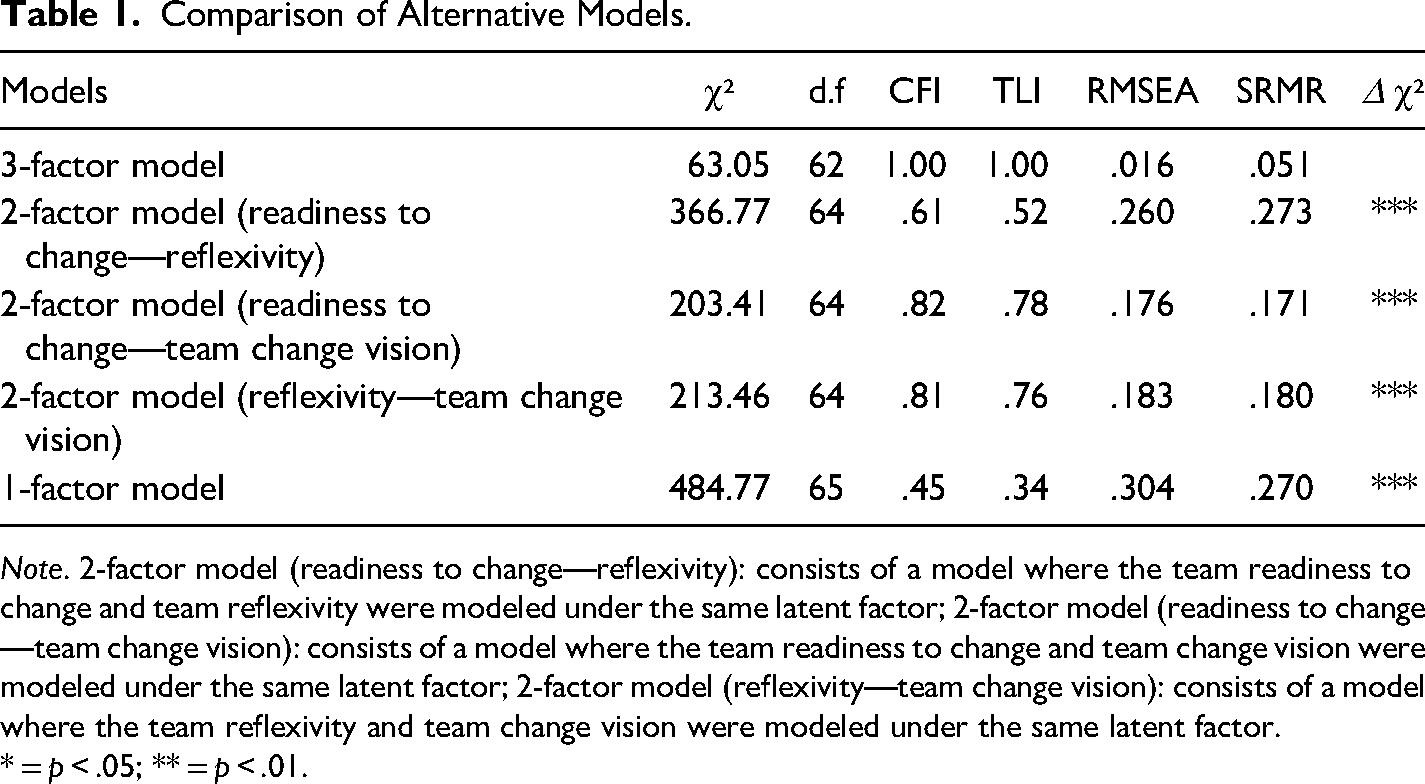
Note. 2-factor model (readiness to change—reflexivity): consists of a model where the team readiness to change and team reflexivity were modeled under the same latent factor; 2-factor model (readiness to change—team change vision): consists of a model where the team readiness to change and team change vision were modeled under the same latent factor; 2-factor model (reflexivity—team change vision): consists of a model where the team reflexivity and team change vision were modeled under the same latent factor.
* = p < .05; ** = p < .01.
Data Aggregation
Since we consider team-level constructs, we assessed data aggregation indices. To demonstrate sufficient within-group and between-group heterogeneity, we computed the rwg(j), ICC (1), and ICC (2) for each variable (Chen & Bliese, 2002). Adopting LeBreton and Senter's (2008) cut-off criteria, we obtained a strong agreement for team reflexivity (rwg(j) = .71, SD = .32), team change vision (rwg(j) = .77, SD = .23), and team readiness to change (rwg(j) = .86, SD = .17). All ICC (1) scores were > 0, and the associated one-way analyses of variance were all significant at p < .05. As for the ICC (2), we obtained .43 for team change vision, .34 for team reflexivity, and .36 for team change readiness. Although the suggested cut-off of ICC (2) is suggested at .60 by Glick (1985), more recent studies argue this is an arbitrary criterion (LeBreton & Senter, 2008). ICC (2) index is influenced by the number of raters (employees) per group. Therefore, according to Siangchokyoo and Klinger (2021), a value of greater than .25 is still acceptable when the rwg(j) is high and when the ICC (1) and its F-test results have met the criterion. We therefore proceeded to aggregate our data.
Convergent and discriminant validity
To assess construct validity, we first computed the average variance extracted (AVE) and the composite reliability (CR). Results show that all AVE indices were higher than .50, and CR indices were higher than .70, thus demonstrating convergent validity. We then computed the maximum shared variance (MSV) for each latent factor of the model (Fornell & Larcker, 1981). Since all factors’ AVE indices were higher than their respective MSV, we can confirm the factors’ discriminant validity as well.
Analytic Procedure
We proceeded to the analysis of our data using structural equation modeling techniques with the Lavaan V.06-8 package in R (Rosseel, 2012). A mediation and a Monte Carlo (MC) bootstrap analysis using a 95% confidence interval with a 5,000 samples (Preacher & Selig, 2012) was produced to test the mediation effect of team change vision (Hypothesis 2), and to report the indirect effect of the three-way interaction. MC bootstrapping is a recommended model where more complex indirect effects are of interest and when sample is small (Preacher & Selig, 2012; Williams & MacKinnon, 2008). As for the moderation analysis, we proceeded to the double mean-centered technique (Lin et al., 2010) to create a latent factor with the product of the team reflexivity items, additive team tenure, and the team tenure dispersion. Following an exploratory factor analysis (EFA) analysis of the team reflexivity scale, we took the top three variables for the moderation latent variables to free some degrees of freedom and reduce collinearity. We then proceeded to a simple slope analysis using the probe3wayMC function of the semTools R package (Schoemann & Jorgensen, 2021).
Results
Means, standard deviations, and bivariate correlations for all variables are presented in Table 2. With our theoretical two-way moderated mediation model (χ ² = 308.27; df = 240; CFI = .96; TLI = .95; RMSEA = .064; SRMR = .062), we first hypothesized that team change vision mediates the relationship between team reflexivity and team readiness to change. Team reflexivity has a positive relationship with team change vision (β = .65, p < .01) and team change vision also has a positive relationship with team readiness to change (β = .58, p < .01). Our results demonstrate a significant indirect effect between team reflexivity and team readiness to change (γ = .373, LLCI = .105; ULCI = .608; p < .01). Hypothesis 1 is thus supported (Table 3).
Means, Standard Deviations, Correlations, and Reliabilities of Studied Variables.
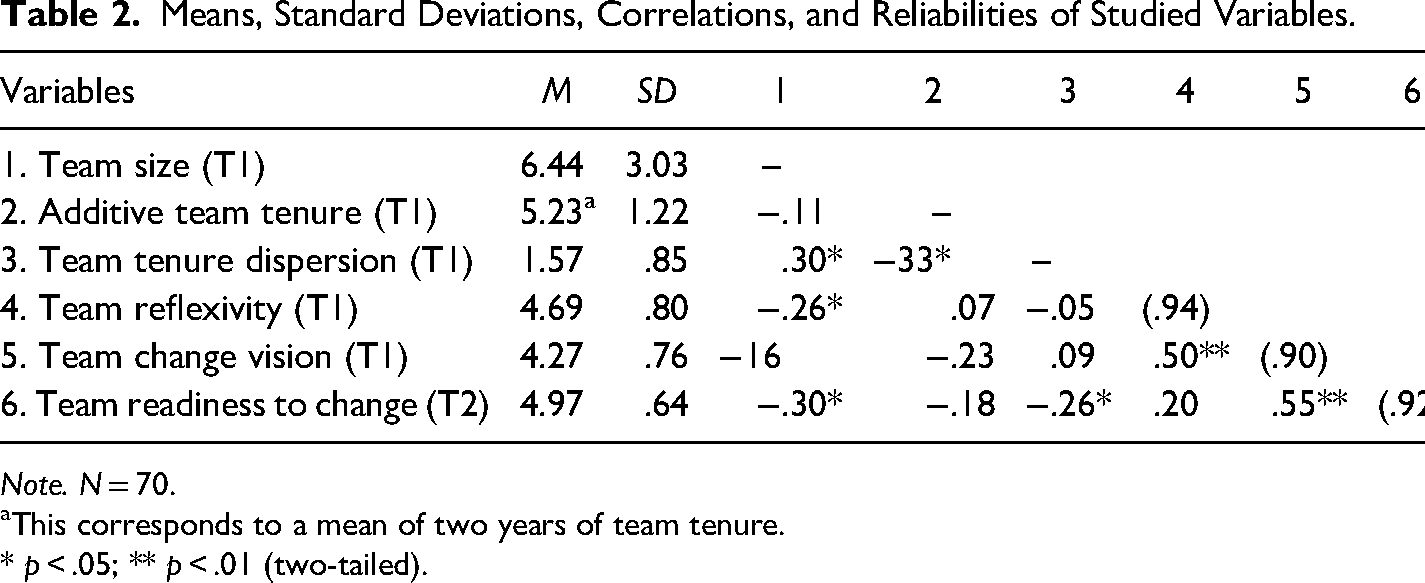
Note. N = 70.
This corresponds to a mean of two years of team tenure.
* p < .05; ** p < .01 (two-tailed).
Results of the Full Model.
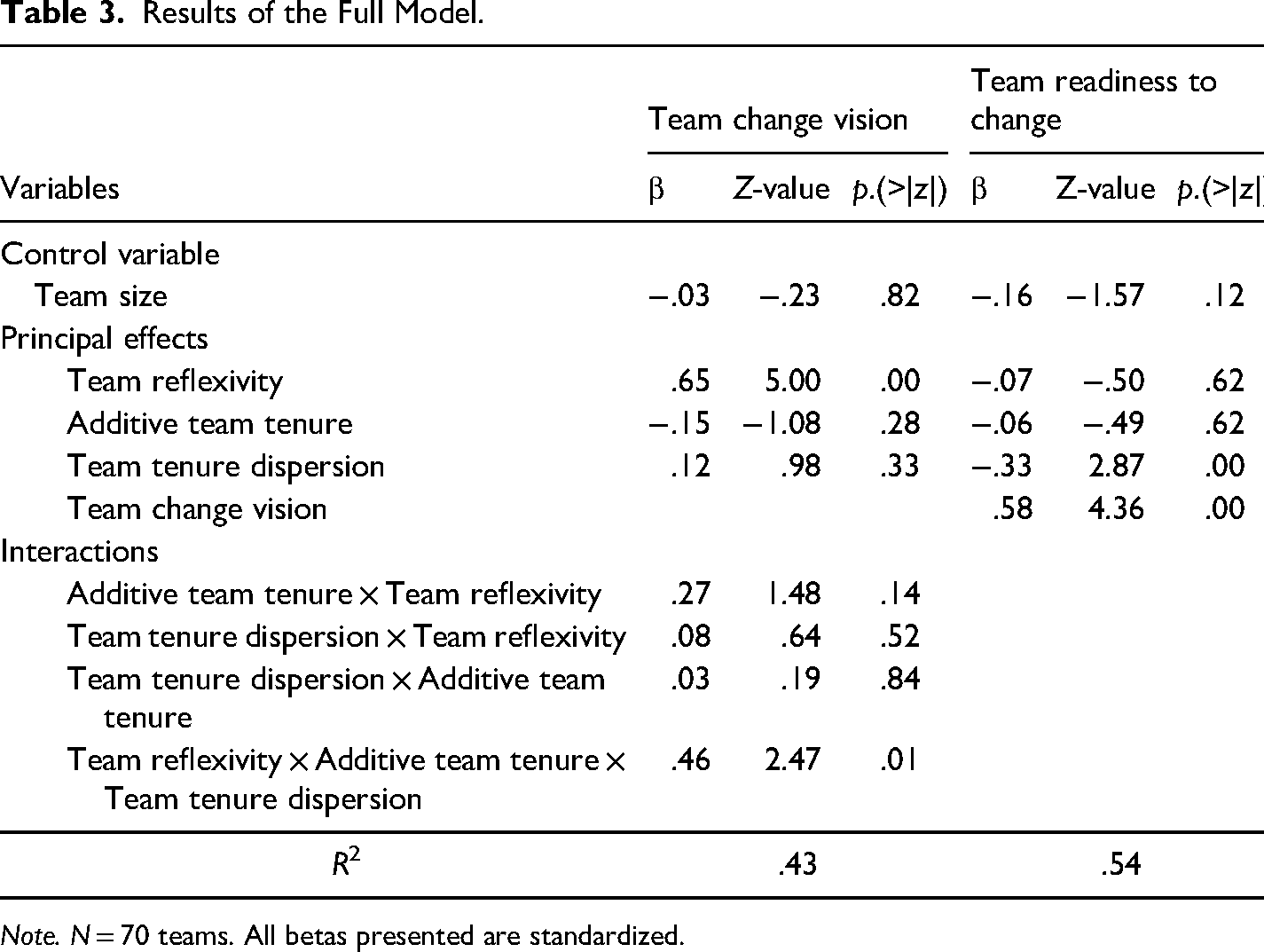
Note. N = 70 teams. All betas presented are standardized.
Hypothesis 2 posited that the interaction between additive team tenure and team tenure dispersion moderates the indirect relationship between team reflexivity and team readiness to change (via team change vision), such that team reflexivity has a greater positive indirect effect on team readiness to change when both additive team tenure and team tenure dispersion are high. We found that the coefficient of the moderation is significant (β = .46, p < .01).
To provide a better understanding of the moderation effect of team tenure on team change vision, we performed a three-way interaction analyses. These analyses will provide details of how different levels of additive team tenure and team tenure dispersion will affect the relationship between team reflexivity and team change vision. We thus considered two standardized levels of additive team tenure and team tenure dispersion: 1 SD over and below the mean of additive team tenure and team tenure dispersion (see Table 4). Results demonstrate that team reflexivity has a positive and significant effect on team change vision for teams with high additive team tenure and high team tenure dispersion (β = 1.22, p < .01), for teams with low additive team tenure and low team tenure dispersion (β = .65, p < .01), and for high additive tenure and low team tenure dispersion (β = .46, p < .01). Team reflexivity has no significant effects for teams with low additive team tenure and high team tenure dispersion. As depicted in Figure 2, teams characterized by high additive tenure but low tenure dispersion (e.g., experienced members overall, and no or few newcomers) do not benefit as much from reflexivity than teams with both high additive tenure and high tenure dispersion (e.g., experienced members overall, and several newcomers). However, the latter teams’ shared vision of change suffers the most from a lack of reflexivity.
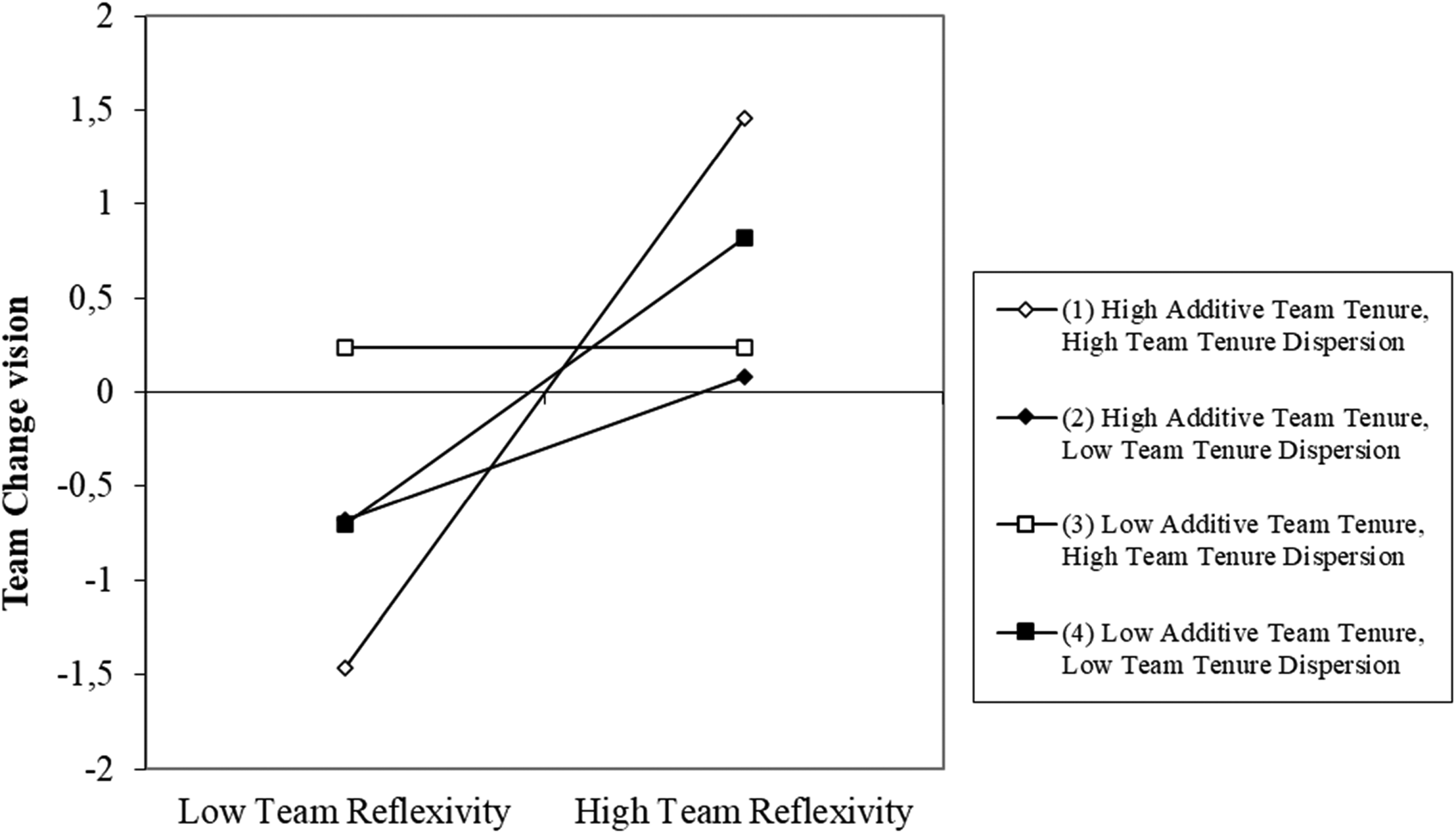
Three-way interaction plot.
Conditional Effects of Team Reflexivity on Team Change Vision.
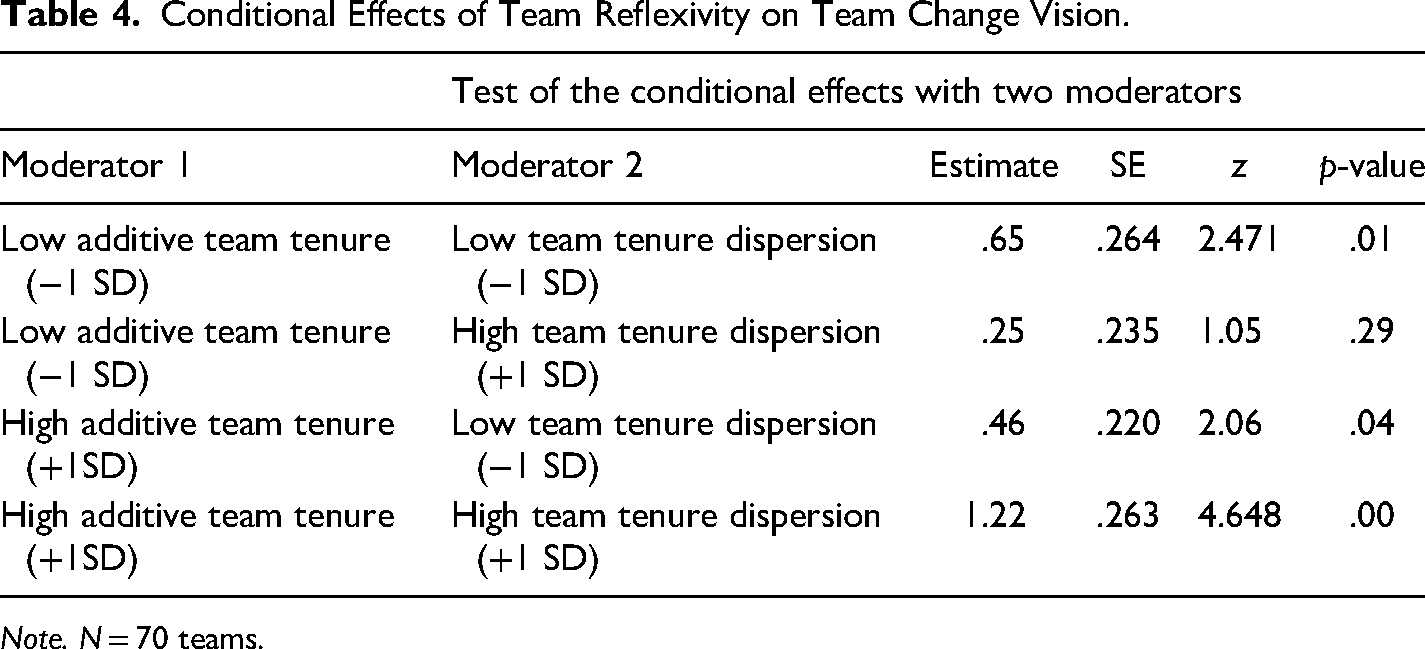
Note. N = 70 teams.
Using the MC bootstraps results with a 95% confidence interval and a 5,000 sample, we found a significant indirect effect of the three-way interaction (additive team tenure × team tenure dispersion × team reflexivity) on team readiness to change through team change vision (γ = .18, [.011, .438], p < .05). Hypothesis 2 is therefore supported.
Discussion
We considered how teams become ready to change through the development of a team change vision and how team tenure influences these processes. We argued and showed that team reflexivity is a key mechanism, and it is most effective in teams with high levels of both additive tenure and tenure dispersion. Furthermore, our results indicate that reflexivity supports teams with both low levels of additive tenure and tenure dispersion (e.g., inexperienced members overall, and no or few experienced members). Even when shared experiences and knowledge about the tasks and responsibilities are lacking, this team process still acts as a positive tool for developing shared cognitions during change. However, reflexivity does not appear to produce positive effects on such shared cognitions when a team has lower additive tenure alongside high tenure dispersion (e.g., inexperienced members overall, and several experienced members). The results from this contingent analysis offer several theoretical and practical implications.
Theoretical Implications
Our study makes key theoretical contributions. First, by combining additive tenure and tenure dispersion, we are better able to explain the effectiveness of a key team process in reflexivity. The accumulated knowledge from experienced members has been argued to be the strongest mechanism for team tenure to affect performance (Gonzalez-Mulé et al., 2020), namely through increased job control and team support (Chen et al., 2018). This research underscored the significance of team longevity (e.g., Edmondson et al., 2001), that is, with time spent in a particular setting, team members develop knowledge and expertise specific to their context, enabling them to perform better as a team. Our study adds nuance to this by integrating a workgroup diversity perspective into the consideration of team tenure dynamics (Harrison & Klein, 2007; Subramony & Chadwick, 2021). If team members bring distinct and relevant knowledge and experience to the team, then these differences may also enhance the team's information pool, thereby expanding the team's resources to build on when reflecting. Therefore, we show that the combination of overall experience and dispersion in team tenure make certain team processes, such as team reflexivity, more effective. This helps understand the questions raised by scholars about the benefits of team reflexivity (e.g., Moreland & McMinn, 2010) and it charts a new path into the study of key features of team design.
Looking more specifically at teams characterized by both high additive tenure and high tenure dispersion, our results show that reflexivity appears needed to integrate newcomers’ perspectives, thereby supporting organizational change. When they are less reflective, these teams tend to exhibit reduced capability in formulating a vision for change. This contributes to the existing literature, which recognizes knowledge diversity as a potential driver of performance in teams, but only under specific conditions, with studies indicating its capacity to increase creativity and challenge established norms (Drach-Zahavy & Trogan, 2013; Edmondson & Harvey, 2017, 2018; Homberg & Bui, 2013). This also means that knowledge diversity within tenured teams does not guarantee that teams will be ready to change. Rather, it is team reflexivity that enables such benefits. Future research could provide further insights on this matter. For instance, additional information about who are the newcomers could also help understand how tenure dispersion can enhance or hinder the benefits of certain team processes on longer-tenured teams. Studies could also delve into the temporal aspect of this relationship. Longitudinal studies that track changes in team reflexivity and performance over time as teams’ tenure evolves could provide a more comprehensive understanding of the dynamic nature of these relationships. This could shed light on whether the initial benefits of accumulated experience and diversity of viewpoints continue to accrue or if there are diminishing returns over time.
Second, our study bridges the team dynamics and organizational change literatures by developing and testing theory about the emergence of readiness to change at the team-level. Readiness to change has been predominantly explored at the individual level, despite the calls to consider it in groups (Bouckenooghe, 2010; Rafferty et al., 2013). We therefore add to recent exemplar studies who have shown that change-related concepts matter at the team-level (e.g., Harvey & Kudesia, 2023). Team readiness to change provides ground for both change and team scholars to join forces and forge ahead to help develop more adaptive organizations. Bridging the teams and change literatures helps extend the nomological network of team reflexivity. Team reflexivity has been predominantly oriented towards team emergent states such as team potency or self-efficacy (e.g., see Lines et al., 2021) and transaction memory (e.g., Oertel & Antoni, 2015), and thus linking it with organizational change constructs introduces a fresh dimension to its understanding and application.
Our focus on team reflexivity also changes the scholarly discourse on organizational change too. Change recipients tend to be viewed as more passive participants as the role of instigating change is attributed to senior managers and executives (Kotter, 2012; Stouten et al., 2018). From this perspective, vision is something that is communicated or conveyed, and rarely considered in terms of something that can emerge. Conversely, the literature on teams has directed its focus toward shared cognitions (e.g., Abrantes et al., 2022; Konradt et al., 2016; Mohammed et al., 2010), and some forms of collective vision (e.g., Pearce & Ensley, 2004). As such, our study highlights that teams can be active participant in developing change-related outcomes through team reflexivity. This opens up new avenues for research as to how teams may collectively develop homogenous emotions and beliefs about change. It could be interesting to look at conditions under which positive or negative emotions about change are spread through reflexivity within a team. This has been an important topic that received little attention from change scholar (Harvey & Kudesia, 2023; Oreg et al., 2018; Rafferty et al., 2013).
Finally, by conceptualizing and testing change-related vision at the team level, our study expands important work on team vision (Anderson & West, 1998; West & Unsworth, 1998). This answers the call for more research on vision that goes beyond the role and style of leadership in its transmission and on the content of the vision (Berson et al., 2016). Team vision may be overly general in terms of its content. Teams’ tasks and responsibilities tends to increase in terms of their scope and complexity (Mathieu et al., 2019). As such, it is reasonable to expect that teams may have different shared vision, according to their different tasks, projects, and responsibilities. Specifying the content of the vision under study may enable scholars to gain specificity and this opens new avenues of research. For instance, when considering vision in general (e.g., a team's main purpose), it is possible that a vision about change exhibits varying levels of consistency with the pre-existing organizational vision. It is therefore reasonable to anticipate that teams fostering a robust overall vision encounter challenges in formulating a comprehensive vision for navigating organizational change. This is another exciting avenue for future research that comes with bridging research on teams and organizational change.
Practical Implications
First, the finding that team readiness to change exists at the team level has practical implications for managers. Our analysis highlights that prevailing research has predominantly centered on individual change readiness, sidelining the crucial dimensions of work group and organizational change readiness. Yet, envisioning a scenario where an individual showcases high change readiness within a work group and organizational context characterized by low change readiness is conceivable (Rafferty et al., 2013). In such instances, gauging individual readiness in isolation before implementing change could yield a flawed grasp of change success likelihood. Consequently, there emerges an imperative to cultivate collective readiness to change through the implementation of group-based interventions aimed at nurturing positive change-oriented beliefs and sentiments.
Our study positions reflexivity as a process that can help teams make sense of multiple changes. While managers may apprehend the effect of team members reflecting together in times of complex organizational transformation, our study shows that they should welcome that opportunity. In fact, they may consider team-based interventions that stimulate reflexivity in their team. For instance, managers may organize workshops to identify synergy between different change initiatives and link these change initiatives to the organizational strategy. A following workshop may concentrate on how these change initiatives affect their tasks and team goals. These types of workshops are intrinsically linked to reflexivity, as they require a systematic reflection on complex matters, while also being driven by discussion-based processes, which differs from simply transferring information about changes. Another type of intervention that is a quick and effective tool for performance in complex situations is debriefing sessions (Tannenbaum & Cerasoli, 2013). These sessions should occur regularly, allowing team members to openly discuss their experiences, challenges, and insights related to the ongoing change. By providing a safe space for reflection and dialogue, teams can collectively process the change, identify potential roadblocks, and develop adaptive strategies, fostering a heightened state of readiness for navigating the evolving organizational landscape.
Additionally, while team-based structures can enhance responsiveness (Harvey et al., 2022), some teams might also exhibit inertia due to longer member tenure. During organizational transformations, staffing decisions become pivotal for maximizing the benefits of reflexivity processes within work teams. Our advocate for the mixing of newcomers and more experienced employees offers a valuable tool for organizations seeking to embrace transformation and progress. Instead of perceiving tenure dispersion as a source of conflict, emphasizing reflexivity in diverse teams prompts a perspective shift. Practitioners can highlight how diverse teams bring together a range of experiences, skills, and perspectives, which can be harnessed collectively to drive change. This approach taps into fresh newcomer perspectives and tenured employee wisdom, resulting in a synergistic effect surpassing that of working solely with newcomers or tenured members.
Finally, to promote reflexivity in teams with higher tenure and higher dispersion during change, managers can cultivate an environment that is psychologically safe for interpersonal risk-taking. The pandemic has posed a grand challenge, catalyzing unprecedented inter-organizational collaboration. This trend is becoming increasingly prevalent in our modern world (Edmondson & Harvey, 2018), expanding the relevance of psychological safety beyond the confines of our understanding grounded in more stable, well-bounded work teams (e.g., Bresman & Zellmer-Bruhn, 2013; Harvey et al., 2019). Creating such psychologically safe context entails creating an environment where team members, and especially newcomers, feel secure sharing their thoughts openly. By valuing every team member's voice and facilitating open communication, managers can harness psychological safety to boost the effectiveness of reflexive processes within their teams (Edmondson, 2003; Edmondson & Harvey, 2017). Without such efforts, teams with higher additive tenure and tenure dispersion will be less capable of generating a change vision, making them less ready to change. This aligns with our findings, emphasizing the role of team reflexivity in bridging different perspectives and enhancing team readiness during change.
Limitations and Future Studies
Our study is not without limitations. A more holistic comprehension of team readiness for change can be developed in future exploration beyond shared cognitions, namely considering emotional factors, as advocated by change scholars (e.g., Oreg et al., 2018; Rafferty et al., 2013). Given the prevailing emphasis on the emotional dimension in research on team emergent states, an intriguing opportunity emerges for further investigation. Additionally, we do not control for other potential cognitive antecedents to team readiness to change (e.g., change discrepancy, change appropriateness, change self-efficacy, principal support, change valence) that would allow further examining the explained variance of team change vision. Team change vision may encompass the effect of other cognitive factors such as change discrepancy, change appropriateness, and change valence, but more research is needed to make that assessment.
We have focused on one team process while teams can learn and adapt through other processes (Harvey et al., 2022, 2023). Thus, further research should prioritize examining how additive tenure and tenure dispersion impact diverse learning activities, including vicarious learning, contextual learning, and experimental learning. Team processes can be geared towards exploitation or exploration, and they can occur inside or outside the team (Harvey et al., 2022, 2023). Reflexive learning falls within internal exploitation, emphasizing integrating varied perspectives within the team to enhance processes and strategies in response to changing conditions. Conversely, contextual, and vicarious learning occur externally to the team. The impact of tenure features might be less pronounced on external team processes, given teams’ exposure to outside knowledge. To comprehensively understand these effects, future research needs to explore this relationship across all types of team processes.
Another promising avenue for further research lies in the replication of our study across diverse settings. We focused on teams that we part of a governmental organization going through a significant transformation; hence outcomes might diverge when examining a context characterized by stability. Teams may not necessarily see the added value of looking at new perspectives of newcomers when change is not needed or demanded by the organization. Additionally, the types of teams may also change the way that additive tenure and tenure dispersion may influence the benefits of team reflexivity. In some cases, for instance, governmental teams or teams within the army, tenure and hierarchical relationships are an important future that change dynamics within the team. As such, theses team members may prioritize and give more importance to tenured members, therefore diminishing the importance of tenure dispersion.
Future research should also explore team members’ familiarity as a vital moderator or control variable. Even in teams with high tenure dispersion, familiarity among members who have collaborated before can negate the benefits of tenure dispersion. Additionally, the literature on power dynamics and team learning (e.g., Bunderson & Reagans, 2011; Van der Vegt et al., 2010) can provide depth to our findings, since it underscores the need to consider both structural aspects (e.g., team tenure) and the underlying social dynamics to understand what influences team dynamics. For instance, longer-tenured members with unique, powerful information might withhold it for political gains (Wittenbaum et al., 2004), impeding the development of shared cognitions (Bunderson & Reagans, 2011). Other studies (e.g., Bunderson & Sutcliffe, 2003; Edmondson, 2002) also show that stratification or inequality in power relation affects learning and adaptation in teams. As such, future research integrating these insights to our theory could be valuable.
Finally, team reflexivity and team change vision were measured concurrently. Despite our statistical analyses suggesting that these constructs are distinct, and that common method bias did not impact our hypothesis testing, the correlation between both variables remains high. Also, since our study is cross-lagged, we cannot speak to causality in our model. Future longitudinal studies are needed.
Conclusion
As organizations struggle with the complexities of transformation, they increasingly rely on team-based structures to increase their responsiveness. Our research demonstrates that team reflexivity plays a pivotal role in preparing teams for change. Notably, its effectiveness is most pronounced in teams marked by both higher additive tenure and tenure dispersion. The dynamic interplay between team members’ experiences and diverse viewpoints is key in shaping a shared vision for change and in elevating overall team readiness to change. Our study advances our comprehension of the intricate interplay between team composition and readiness for change, opening new avenues for both theoretical exploration and practical applications in the realm of team dynamics and change management.
Supplemental Material
Footnotes
Declaration of Conflicting Interests
The authors declared no potential conflicts of interest with respect to the research, authorship, and/or publication of this article.
Funding
The authors disclosed receipt of the following financial support for the research, authorship, and/or publication of this article: The authors has received financial support from the Social Sciences and Humanities Research Council of Canada [435-2022-0642] and from the Fonds de recherche du Québec – Société et culture [337029].

Supplemental Material
Supplemental material for this article is available online.
Correction (August 2024):
Article updated with the addition of online supplemental material.
References
Supplementary Material
Please find the following supplemental material available below.
For Open Access articles published under a Creative Commons License, all supplemental material carries the same license as the article it is associated with.
For non-Open Access articles published, all supplemental material carries a non-exclusive license, and permission requests for re-use of supplemental material or any part of supplemental material shall be sent directly to the copyright owner as specified in the copyright notice associated with the article.
