




Abstract
This study investigates how employees may use proactive work strategies to satisfy their basic psychological needs during the coronavirus disease 2019 (COVID-19) pandemic. We use self-determination theory to hypothesize that daily self-leadership (e.g., goal setting, constructive cognition) and playful work design (PWD; redesigning work to be more fun/challenging) satisfy basic psychological needs and facilitate job performance. We also predict that the use of these proactive strategies is particularly important when individuals ruminate a lot about the COVID-19 crisis. Daily diary data collected among a heterogeneous group of employees largely confirm these theoretical predictions. For organizational practitioners, this study thus suggests that it is important to encourage employees to be proactive. Although this may be challenging during crises, leaders could provide autonomy and feedback to foster self-leadership and PWD. In addition, organizations may offer training interventions so that employees learn to apply these proactive work strategies.
Coronavirus disease 2019 (COVID-19) has disrupted almost every aspect of daily living. People around the world are confronted with forced isolation and social distance, economic hardship, and fears of contracting a potentially lethal disease (Polizzi et al., 2020). Since the beginning of 2020, we are inundated with news about COVID-19 all day, every day. This has resulted in increased feelings of anxiety/depression and reduced life satisfaction (Li et al., 2020). Previous research has shown that exposure to major negative life events is associated with increased mental and physical health problems (Luhmann et al., 2012), and negatively impacts people's functioning at work (Mather et al., 2014). One important explanatory variable is rumination—repetitively and passively focusing on symptoms of distress and the possible causes and consequences of these symptoms (Nolen-Hoeksema et al., 2008).
In the present diary study, we investigate how employees may use self-determination strategies to satisfy their basic psychological needs on a daily basis during the COVID-19 pandemic. We use a refined version of self-determination theory (Bakker & Van Woerkom, 2017; Ryan & Deci, 2000) to argue that daily self-leadership and playful work design (PWD) will generate resources that satisfy basic psychological needs and facilitate job performance under conditions of serious threat. Self-leadership (e.g., Manz, 1986; Neck & Houghton, 2006) is a process of cognitive and behavioral self-evaluation and self-influence whereby individuals achieve the self-direction and self-motivation needed to shape their behaviors in positive ways. PWD (Bakker et al., 2020b; Scharp et al., 2019) refers to the process of proactively creating conditions during work that foster enjoyment and challenge. These two proactive work strategies may be especially effective in the midst of the COVID-19 pandemic, because they help individuals take goal-directed action, increase social support, and develop a sense of mastery. Moreover, we argue that the use of self-determination strategies to gain psychological resources is particularly important on the days when individuals ruminate a lot about the coronavirus crisis—while working from home or at the workplace. We employed a quantitative diary study to minimize the bias and error that occur when people provide global and retrospective reports about transient experiences (Fisher & To, 2012).
With this study, we contribute in three important ways. First, we contribute to self-determination theory by testing whether and when proactive work strategies can satisfy basic psychological needs. Our study expands previous research that—despite the name of the theory (self-determination)—has largely ignored the active role of the individual (cf. Bakker & Van Woerkom, 2017; see, for an exception, Bakker & Oerlemans, 2019). Second, we contribute to the proactive work behavior literature by showing how self-leadership and PWD help employees to perform well while confronted with a very serious life threat. Although the COVID-19 pandemic is a constant threat, we argue that self-leadership and PWD are particularly important for need satisfaction and performance when the threat is salient and individuals ruminate a lot about the pandemic (see also, Bakker & Van Wingerden, 2021). Finally, we contribute to practice by showing how organizational and developmental practitioners may encourage employees to use proactive work strategies to cope with crises and perform well. We discuss several possible interventions that can be used to encourage employees to use self-leadership and PWD.
Theoretical Background
Self-determination theory (Deci & Ryan, 2000) proposes that humans experience volition and well-being when three basic psychological needs are satisfied: the needs for autonomy, competence, and relatedness. Accordingly, individuals are more autonomously motivated when they (a) take personal initiative and feel psychologically free (deCharms, 1968); (b) feel effective and experience a sense of mastery (White, 1959); and (c) interact with, are connected to, and matter in the lives of others (Baumeister & Leary, 1995). Although self-determination theory assumes that human beings are proactive and determine their own destiny, most studies have focused on how the environment or other individuals (e.g., coaches, teachers, and supervisors) may support the satisfaction of psychological needs (Ng et al., 2012; Su & Reeve, 2011). In a work context, research has shown that when the organization designs workplaces with sufficient job resources (e.g., support, job control, skill variety, and feedback), needs are more likely to be satisfied. In such organizations, employees report higher levels of well-being, work engagement, and commitment, and lower levels of job strain and burnout (Van den Broeck et al., 2016).
In this study, we propose that employees may use proactive work behavior to satisfy their basic psychological needs during the COVID-19 pandemic—either while working from home or at the workplace. Proactive work behavior refers to “self-initiated, anticipatory action aimed at changing either the situation or oneself.” (Bindl & Parker, 2011, p. 567). Specifically, we propose that individuals may use daily self-leadership and PWD to reshape their thoughts and behaviors in a way that satisfies basic needs and facilitate job performance under conditions of serious threat. Strauss and Parker (2014) have argued that when people set proactive goals, they challenge themselves—creating opportunities to use various skills and feel competent. On days when employees proactively redirect their attention and behaviors toward their daily work activities, they are likely to feel agentic and self-directed—satisfying their basic psychological need to be autonomous (deCharms, 1968). In addition, when people use (pro)social forms of proactive behavior—for example, help their colleagues, make jokes, or ask for support and feedback—they can satisfy their need to feel connected to others. Indeed, Bakker and Oerlemans (2019) found that on days employees proactively crafted their structural job resources (e.g., job control, opportunities for growth), they satisfied their momentary needs for autonomy and competence. On days employees proactively crafted their social job resources (e.g., social support and feedback), they satisfied their momentary need for relatedness. Self-determination theory (Deci & Ryan, 2000) posits that the satisfaction of these basic psychological needs has important behavioral consequences. On the days when employees’ needs are satisfied, their work activities are driven more by a sense of autonomous motivation (i.e., internal rewards), and less by controlled motivation (i.e., extrinsic rewards). Because of this intrinsic motivation, employees are likely to invest more effort and perform at a higher level (cf. Leroy et al., 2015).
Self-Leadership
Self-leadership (e.g., Manz, 1986; Neck & Houghton, 2006) refers to the appraisal and regulation of one's own cognitions and behaviors. Various strategies have been described in the literature, including self-observation, self-goal setting, task motivation, constructive cognition (e.g., self-talk), and self-reward (Neck et al., 2017). These self-leadership strategies require some initiative and make individuals aware of why and when they show certain thoughts and behaviors, increase self-motivation, and improve performance (Harari et al., 2021). For example, self-goal setting contributes to goal achievement, satisfaction of basic needs for autonomy and competence, as well as job performance, because goals help to focus and direct effort—particularly when they are specific, challenging, and attainable (Locke & Latham, 1990; Strauss & Parker, 2014). In addition, individuals who visualize and mentally rehearse the successful performance of a task in advance (i.e., task motivation) are more likely to perform well, because they have already performed the actual performance in their mind (Zimmerman, 2000). Moreover, when individuals become aware of unproductive behaviors by actively evaluating the accuracy of beliefs and assumptions, they can reshape their behaviors in more positive directions (i.e., constructive cognition).
Research has provided considerable evidence for the effectiveness of self-leadership in influencing work engagement and job performance (Breevaart et al., 2014; Stewart et al., 2019). Stewart and colleagues argue that individuals have a fundamental desire to exercise self-leadership based on the underlying needs for freedom and autonomy. We propose that self-leadership is particularly important during the COVID-19 pandemic (see also, Kniffin et al., 2021). While working from home, self-leadership strategies are important because the features that normally characterize employees’ jobs are not readily available. To create challenges and mobilize social support, employees need to use self-goal setting and take the initiative to contact their colleagues and clients through (video) calls, e-mail, and text messaging applications. Such self-leadership will likely satisfy the psychological needs for competence and relatedness, because employees actively mobilize their social resources that help to perform well (Bakker & Demerouti, 2017; Bakker & Van Woerkom, 2017). For employees with essential jobs, the immediate focus is on helping people in need, preventing exposure to the coronavirus, and keeping the organization afloat. Under such conditions, it is crucial that employees take initiative and satisfy their own basic psychological needs for autonomy, competence, and relatedness.
PWD
PWD refers to the process through which employees proactively create conditions within work activities that foster enjoyment and challenge without changing the design of the job itself (Bakker et al., 2020b; Scharp et al., 2019). Through PWD, employees optimize the personal experience of work. According to Scharp and colleagues, they may do so in two different ways. First, employees may redesign their work activity to be more fun, for example, by reframing a work situation to provide oneself and others with amusement (Barnett, 2007). Second, employees may playfully design their work by creating a form of competition with themselves, for example, by trying to beat the clock when performing a task (Miller, 1973).
By integrating amusement, humor, and entertainment into their existing tasks, workers develop interpersonal relationships, satisfy their need for relatedness, and are more likely to enjoy their work (Robert, 2017). In addition, by competing with oneself given the work tasks that need to be completed, individuals set goals and make the work activity more meaningful. In this way, employees can satisfy their need for competence, prevent boredom and make their work more engaging. In a recent diary study, Scharp et al. (2021) showed that designing work tasks to be more fun helped employees deal with daily “communion hindrance demands”, such as interpersonal conflicts, social isolation, and emotionally demanding interactions with clients. Through PWD, these workers managed to stay engaged and perform well. In another study, Bakker and Van Wingerden (2021) showed that PWD weakened the positive links between rumination about the COVID-19 pandemic and depressive complaints as well as exhaustion. PWD changes the experience of work without changing the content of work. By redesigning the work activity so that it is more interesting and more fun, individuals improve the internal organizational environment (Parker & Collins, 2010).
Similar to job crafting, PWD may make work activities more challenging. However, there are important differences (see also, Bakker et al., 2020a). Job crafting refers to proactively seeking new job resources (e.g., creating opportunities for personal growth, asking for feedback), and seeking new challenges (e.g., mentoring a colleague; starting a new project; Tims et al., 2013). PWD refers to the proactive, behavioral work orientation that designs fun and competition by imposing the experiential qualities of play on existing work (Scharp et al., 2019). Cognitive crafting (Wrzesniewski & Dutton, 2001) is more closely related to PWD than other forms of job crafting due to its focus on reframing. However, whereas cognitive crafting refers to expanding the perception of task boundaries or focusing perceptions on tasks that are most meaningful (Berg et al., 2013), PWD refers to proactively changing the experience of ongoing work activities by designing these activities to be more fun and challenging (Bakker et al., 2020b).
By making work activities more playful, individuals create internal rewards (i.e., fun, mastery) that satisfy basic needs. In this way, people may increase their autonomous motivation to invest effort in the task (Mainemelis & Ronson, 2006), create a sense of belongingness (Sandelands, 2010), and stimulate energetic performance (Barnett, 2007). In a recent study, Scharp and colleagues (2019) showed that employees were more enthusiastic about their work and more creative on the days they used more PWD. In the present study, we assume that employees will perform better on days when they design their work to be more playful, because on these days, they satisfy their basic psychological needs and are more autonomously motivated for work (Deci & Ryan, 2000; Strauss & Parker, 2014).
Self-Determination When Coping With Threat
A central proposition in SDT is that individuals are growth-oriented organisms who actively interact with their environment (Deci & Ryan, 2000). Thus, individuals have an inner drive to actualize their potential—that is, to gain knowledge, seek challenges, and cultivate their interests. They strive to integrate and meaningfully organize these new experiences into a harmonious and authentic sense of self (Van den Broeck et al., 2008). We propose that this tendency to extend and organize one's experiences is particularly important when individuals are confronted with or anticipate a loss of resources, such as condition resources (e.g., employment, tenure), personal resources (e.g., key skills, optimism), or energy resources (e.g., money, vitality). Hobfoll (1989; Hobfoll et al., 2018) has argued that individuals experience stress when confronted with threat and are motivated to conserve their resources under these circumstances. He proposed that people must invest their resources to protect against resource loss, recover from losses, and gain new resources. Moreover, resource investment and resource gain become more important when anticipated or actual resource loss is high—like is the case now that individuals are confronted with COVID-19.
Integrating these assumptions in self-determination theory, we propose that proactive work strategies, that is, self-leadership and PWD, are most important when they are needed most, namely when individuals ruminate a lot about COVID-19. This idea is consistent with Bakker and Van Woerkom's (2017) self-determination framework, which proposes that self-determination is most important when people are exposed to stressors. The framework explicitly refers to job-related stressors/demands, but in the present paper, we argue that rumination about COVID-19 may also act as a daily stressor. Rumination is a cognitive emotion regulation strategy that refers to thinking about thoughts and feelings associated with a negative event (Garnefski & Kraaij, 2006). Although people who ruminate sometimes feel that rumination may help to manage their emotions, it is an ineffective regulation strategy (Smith & Alloy, 2009), because it leads to a mental representation of the negative event, which leads to prolonged stress reactions (i.e., the perseverative cognition hypothesis; Brosschot et al., 2006). Indeed, research shows that rumination is positively related to anxiety and depressive symptoms (Garnefski & Kraaij, 2006), and negatively related to problem-solving, motivation, and concentration (Davis & Nolen-Hoeksema, 2000; Smith & Alloy, 2009).
Several previous studies are consistent with the claim that the use of self-determination strategies is particularly important on days individuals ruminate a lot about the current crisis. Hochwarter et al. (2008) used five studies to examine the role of self-determination resources in coping with hurricane-induced job stress. The results showed that self-determination capacity (i.e., ability to adapt, manage energy resources, use recovery strategies) neutralized adverse reactions. Moreover, in two studies, they found that access to more resources led to improved job satisfaction as hurricane-induced stress increased. The authors argued that the heightened levels of engagement required for navigating high-demand/stress situations promoted the acquisition of additional resources. Using a quantitative diary design in a work context, Schmitt et al. (2012) found that the use of selection, optimization, and compensation strategies (i.e., strategies to actively regulate limited resources) was especially important to prevent fatigue on days employees experienced high problem-solving demands. In a similar vein, Scharp et al. (2021) showed that employees stayed engaged in their work and consequently were able to maintain their performance levels on demanding workdays if they playfully designed their work.
Self-leadership is particularly important on days individuals ruminate about COVID-19, because behavioral awareness helps to focus and direct effort. When people ruminate but simultaneously manage to take action, they will have a sense of agency (Bandura, 2006). In addition, daily constructive cognition (e.g., self-talk) helps to make sense of the overwhelming conditions of COVID-19, and in that way fosters the satisfaction of daily psychological needs and job performance. Similarly, PWD is particularly important and effective on days individuals ruminate about the COVID-19 pandemic, because designing the work tasks to be more enjoyable is intrinsically motivating and may generate social resources. For example, using exaggerated nonverbal behaviors and drama to joke with colleagues during a video call may satisfy the basic needs for autonomy and relatedness, lower job stress, and generate psychological resources needed for adequate performance. In addition, designing tasks to be competitive (e.g., using deadlines, beating the clock) will satisfy the needs for autonomy and competence, and will indirectly boost job performance. Moreover, self-leadership and PWD may also buffer the negative impact of rumination on need satisfaction, because both self-determination strategies distract attention away from the pandemic, and help to generate the engagement needed to perform well (Breevaart et al., 2014; Scharp et al., 2019).
Method
Participants and Procedure
In April 2020, four graduate students recruited the participants as part of their master's thesis requirements. Individuals were eligible to participate in the study if they worked at least 4 days per week. The students informed employees of the objectives of the study and collected their e-mail addresses if they agreed to participate. Participants received an e-mail with a link to the survey at the end of each day at 4 pm for five consecutive days (i.e., a regular working week). The survey started with an informed consent procedure. On the first day, the survey also contained some additional questions about demographics. To stimulate participation on all 5 days, participants could win a prize in a raffle if they filled out five questionnaires.
Out of the 193 individuals who were contacted, 129 employees completed at least three out of five daily questionnaires before midnight (n = 129 × 4.32 = 557 observations), resulting in a response rate of 66.84%. The sample equally represents men (49.2%) and women (50.8%). 1 On average, participants were 35.03 years of age (SD = 13.23) and worked 38.52 h a week (SD = 6.34). Employees were employed in a wide variety of occupational sectors including health care (10.0%), finance and insurance (10.0%), manufacturing (9.0%), communication technology (8.3%), trade (8.3%), an unspecified professional background (26.7%), or other sectors such as government, construction, or education (27.7%). Finally, participants worked 8.25 h (SD = 3.65) a day on average. On most days they worked from home (61.2%), and they did not take care of any children during work (96.8%).
Measures
Participants rated all statements on a 7-point scale (1 = strongly disagree, 7 = strongly agree). We adjusted the timeframe of the items so that they referred to the day. All scales showed acceptable reliabilities (Table 1).
Means, SD, Within-Person Level (Below the Diagonal) and Between-Person Level (Above the Diagonal) Intercorrelations and Internal Consistencies (Cronbach's Alpha on the Diagonal) Between the Study Variables (n = 129 Persons, n = 557 Days).
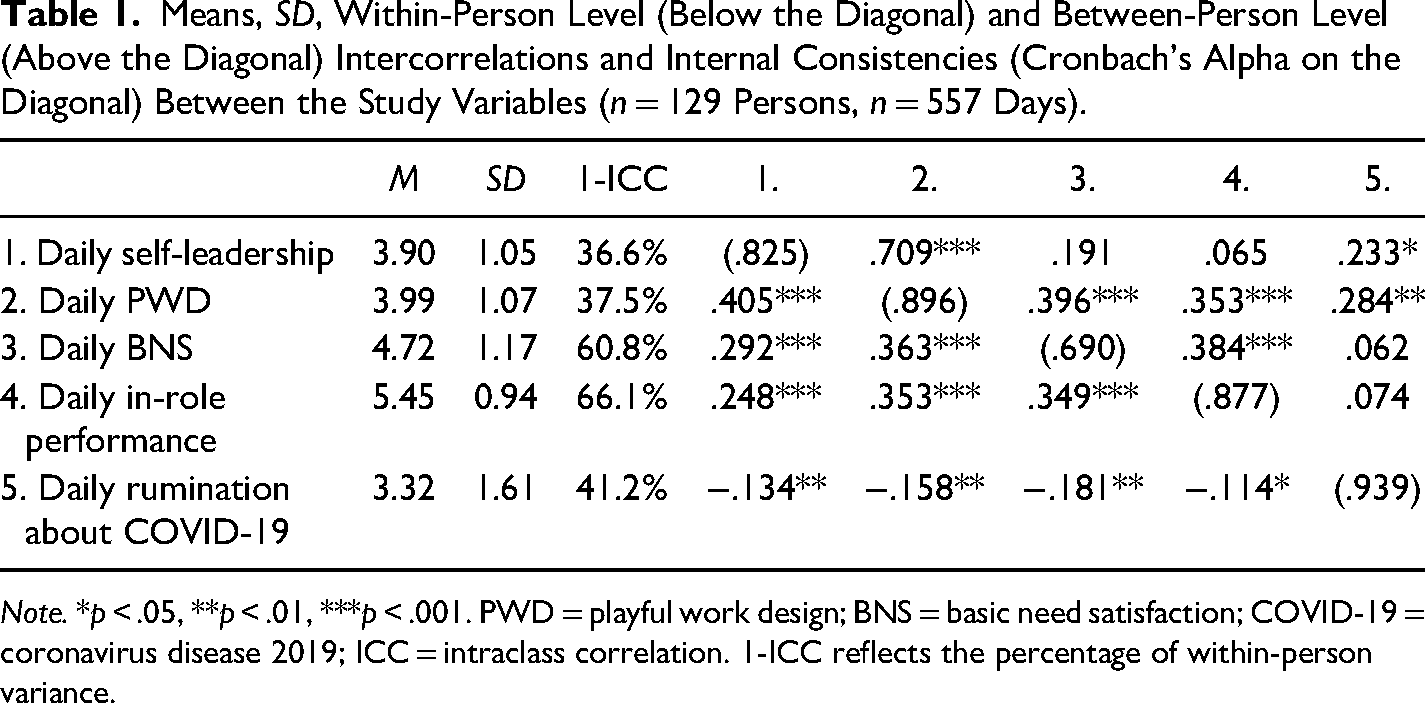
Note. *p < .05, **p < .01, ***p < .001. PWD = playful work design; BNS = basic need satisfaction; COVID-19 = coronavirus disease 2019; ICC = intraclass correlation. 1-ICC reflects the percentage of within-person variance.
Self-Leadership
We assessed self-leadership with the 9-item self-leadership questionnaire (Houghton et al., 2012; Houghton & Neck, 2002). The scale measures three facets: “Today, I established specific goals for my own performance” (i.e., behavior awareness and volition), “Today, I pictured in my mind a successful performance before I actually did the task” (i.e., task motivation), and “Today, I sometimes talked to myself (out loud or in my head) to work through difficult situations” (i.e., constructive cognition).
PWD
We used the 12-item instrument developed by Scharp et al. (2019) to measure PWD. Example items are “Today, I used my imagination to make my job more interesting” (i.e., designing fun), and “Today, I tried to make my job a series of exciting challenges” (i.e., designing competition).
Basic Need Satisfaction
We assessed psychological need satisfaction with the 3-item scale developed by Bakker and Oerlemans (2019). The scale measures each of the basic needs proposed by Deci and Ryan (2000) with one item. The items are: “Today, I satisfied my need for autonomy (decided what I did myself)”, “Today, I satisfied my need for connectedness (feeling of belonginess)”, and “Today, I satisfied my need for autonomy competence (showed what I can)”.
Job Performance
We measured job performance using four of the nine items included in Goodman and Svyantek’s (1999) subscale for the assessment of task performance. An example item is “Today, I demonstrated expertise in all job-related tasks”.
Rumination about COVID-19
Rumination about COVID
Strategy of Analysis
We analyzed the data in Mplus version 7.4 (Muthén & Muthén, 1998–2017). Because our data has a nested structure with days (n = 557 data points) nested within persons (n = 129 individuals) and our hypotheses only concern within-person (rather than between-person) differences, we used Mplus’ TYPE = COMPLEX option to account for the nested structure of the data (for a discussion on accounting for vs. modeling clustering, see McNeish et al., 2017). This option adjusts the chi-square test of model fit and the standard errors for nonindependence of observations. In addition, we person-mean centered our daily variables so that the associations represent intraindividual differences in PWD, self-leadership, rumination, and basic need satisfaction (Ohly et al., 2010). To test the moderated mediation hypotheses, we followed Hayes’ (2015; 2018) conditional process analysis. This analysis provides an index of moderated mediation (a3b), which tells us whether the indirect effect of daily self-leadership (X1) and daily PWD (X2) on daily in-role performance (Y) through daily basic need satisfaction (M) is a linear function of rumination about COVID-19 (W). Bias-corrected bootstrap confidence intervals are used to test the significance of this statistic (see Hayes, 2015; 2018 for more information). Finally, we used the Excel sheet for two-way interaction effects to plot our interaction effect (Dawson & Richter, 2006).
Results
Descriptive Statistics
The means, SD, alpha reliabilities, intraclass correlations (ICCs), and correlations between the study variables are shown in Table 1. The ICCs show that a little over half of the variance in basic need satisfaction and in-role performance is explained by differences within persons (60.8% and 66.1%, respectively), while for self-leadership, PWD, and rumination about COVID-19, a little under half of the variance is explained by within-person differences (36.36%, 37.5%, and 41.2%, respectively).
Confirmatory Factor Analysis
We conducted a confirmatory factor analysis (CFA) to test the construct validity of our variables. The CFA consisted of our five study variables and their indicators: PWD (two dimensions), self-leadership (three dimensions), rumination about COVID-19 (four items), basic need fulfillment (three items), and in-role performance (four items). All indicators loaded significantly onto their intended factors (range: .52–.93; p‘s < .001) and the model showed a reasonable fit to the data χ2 (94) = 350.935, CFI = .91, TLI = .88, RMSEA = .07; SRMR = .06 (Hu & Bentler, 1999; MacCallum, Browne, & Sugawara, 1996).
Mediation Hypotheses 2
Hypotheses 1 and 2 state that, respectively, daily self-leadership and daily PWD are positively related to daily in-role performance through daily basic need satisfaction. These two hypotheses were tested simultaneously, and the results showed support for both of them. First, we found that both daily self-leadership (b* = .173, SE = .068 p < .05, 95% CI [.039, .392]) and daily PWD (b* = .292, SE = .060 p < .001, 95% CI [.174, .411]) were positively related to daily basic need satisfaction. Second, daily basic need satisfaction positively related to daily in-role performance (b* = .240, SE = .052 p < .001, 95% CI [.139, .341]). Third, the results supported the indirect effects from daily self-leadership to daily in-role performance (b* = .041, SE = .030 p < .05, 95% CI [.003, .080]) and from daily PWD to daily in-role performance (b* = .070, SE = .022 p < .01, 95% CI [.026, .114]) through daily basic need satisfaction. Finally, daily PWD was also directly related to daily in-role performance (b* = .233, SE = .056 p < .001, 95% CI [.124, .342]), whereas daily self-leadership was not (b* = .084, SE = .063 p = .181, 95% CI [−.039, .206]). We, therefore, continued with the model excluding the direct effect from daily self-leadership to daily in-role performance but including the direct effect from daily PWD to daily in-role performance. This model showed a good fit to the data (χ2 = 1.765 (1), CFI = .992, RMSEA = .037, SRMR = .018), and explained 15.6% of the variance in daily basic need satisfaction and 18.1% of the variance in daily in-role performance.
Moderated Mediation Hypotheses
Hypotheses 3 and 4 state that the indirect relation of daily self-leadership (H3) and daily PWD (H4) with daily in-role performance through daily basic need satisfaction is stronger on days when individuals ruminate more (vs. less). We tested these hypotheses simultaneously, and, in addition, building on the findings regarding H1 and H2, included the direct effect between daily PWD and in-role performance. For reasons of parsimony, we did not include the nonsignificant association between daily self-leadership and in-role performance. The results of the mediated moderation analysis are presented in Table 2. First, we found that daily basic need satisfaction is higher on days that employees engage in more self-leadership (standardized b* = .134, SE = .056 p < .05, 95% BC-CI [.030,.248]) and more PWD (b* = .287, SE = .060, p < .001, 95% BC-CI [.167, .402]). Second, daily in-role performance is higher on days when employees’ basic needs are more satisfied (b* = .254, SE = .049, p < .001, 95% BC-CI [.161, .347]) and when employees engage in more PWD (b* = .262, SE = .050, p < .001, 95% BC-CI [.166, .360]). Additionally, we found a significant interaction effect between daily self-leadership and daily rumination about COVID-19 on daily basic need satisfaction (b* = .149, SE = .075, p < .05, 95% BC-CI [.011, .304]; see Figure 1). However, we did not find a significant interaction effect between daily PWD and daily rumination about COVID-19 on daily basic need satisfaction (b* = .002, SE = .046, p = .961, 95% BC-CI [−.088, .093]). Finally, in support of Hypothesis 3, we found that the indirect relation of daily self-leadership with daily in-role performance through daily basic need satisfaction is stronger on days that employees ruminate more (vs. less) about COVID-19 (a3b = .044, SE = .023, 95% BC-CI [.006, .098]). Specifically, the moderated mediation was significant at high levels (i.e., +1SD above the mean) of daily rumination about COVID-19 (b = .081, SE = .032, 95% BC-CI [.030, .156), but not at low levels (i.e., −1SD below the mean) of daily rumination about COVID-19 (b = .001, SE = .026, 95% BC-CI [−.053, .053). Contrary to our expectations, we did not find a moderated mediation effect for daily PWD (b = .001, SE = .014, 95% BC-CI [−.027 ,.028), which means that Hypothesis 4 was not supported. The model fit indices available for this type of analysis in Mplus showed an excellent data fit (RMSEA = .035, SRMR = .018). The model explained 19.1% of the variance in daily basic need satisfaction and 18.1% of the variance in daily in-role performance. The final model included standardized coefficients is graphically presented in Figure 2.
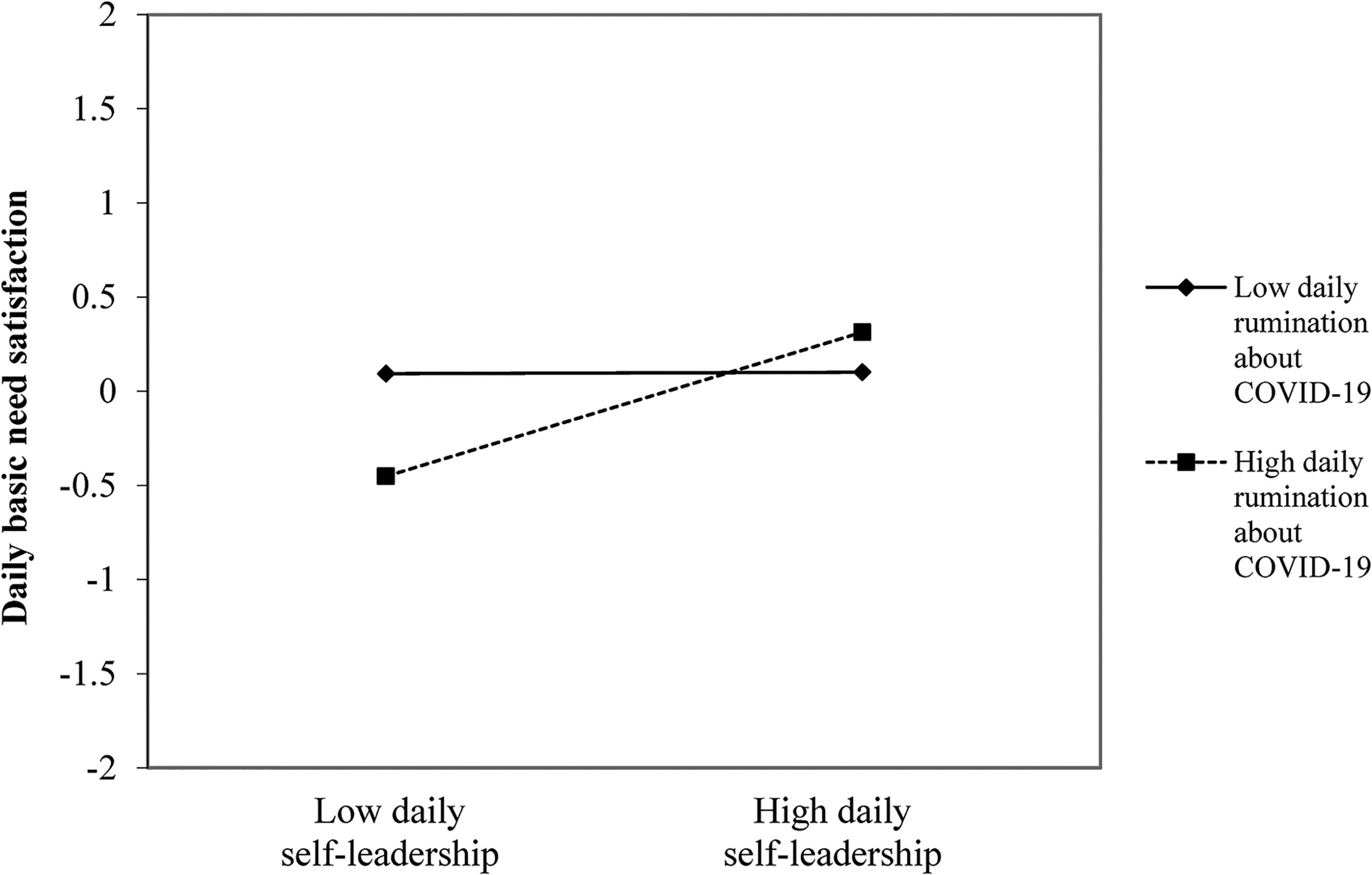
Interaction effect of daily self-leadership and daily rumination about coronavirus disease 2019 (COVID-19) on employees’ daily basic need satisfaction.
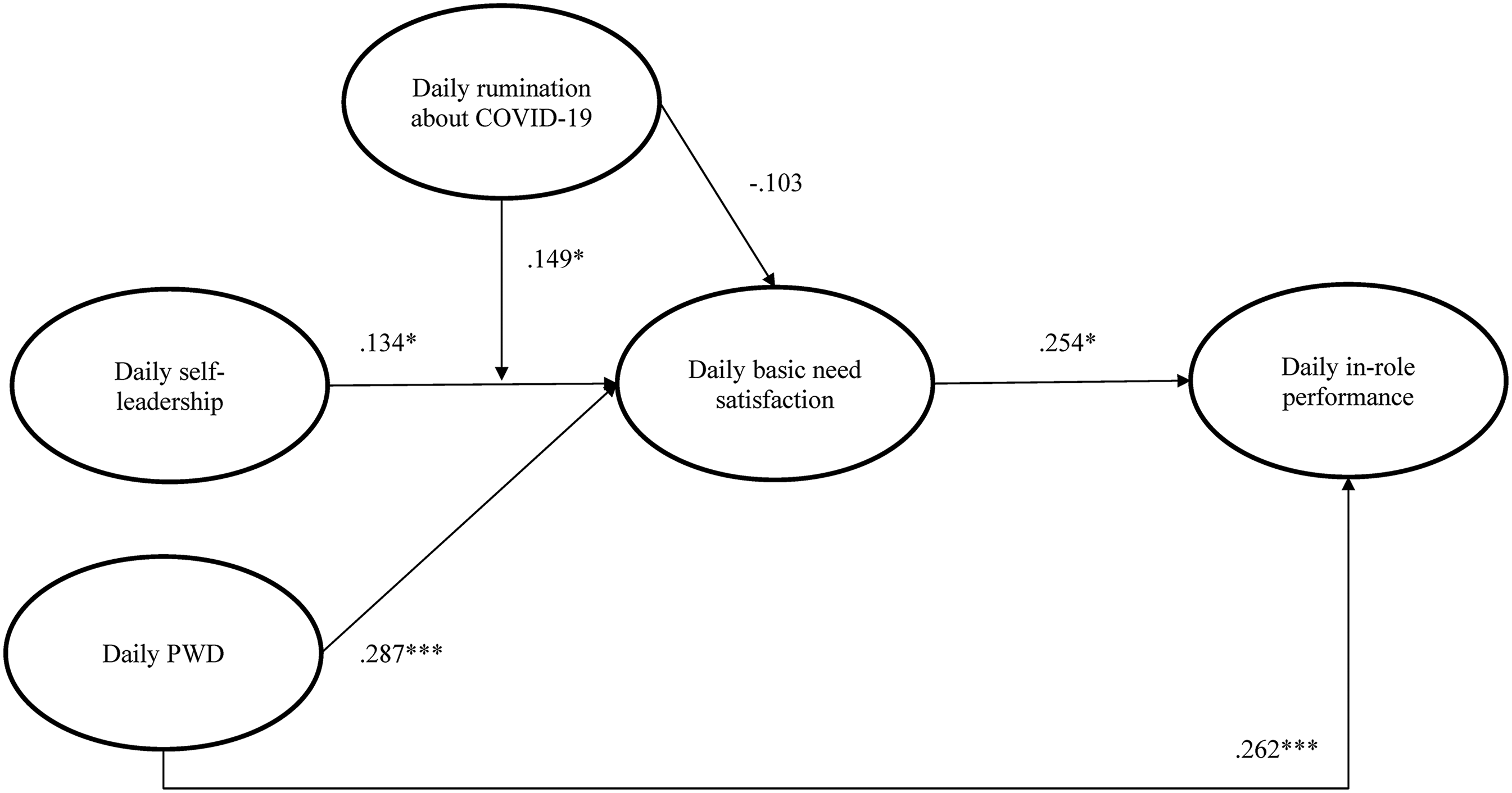
Final moderated mediation model, standardized coefficients.
Unstandardized Regression Coefficients (With Standard Errors) of the First Stage Moderated Mediation Model.
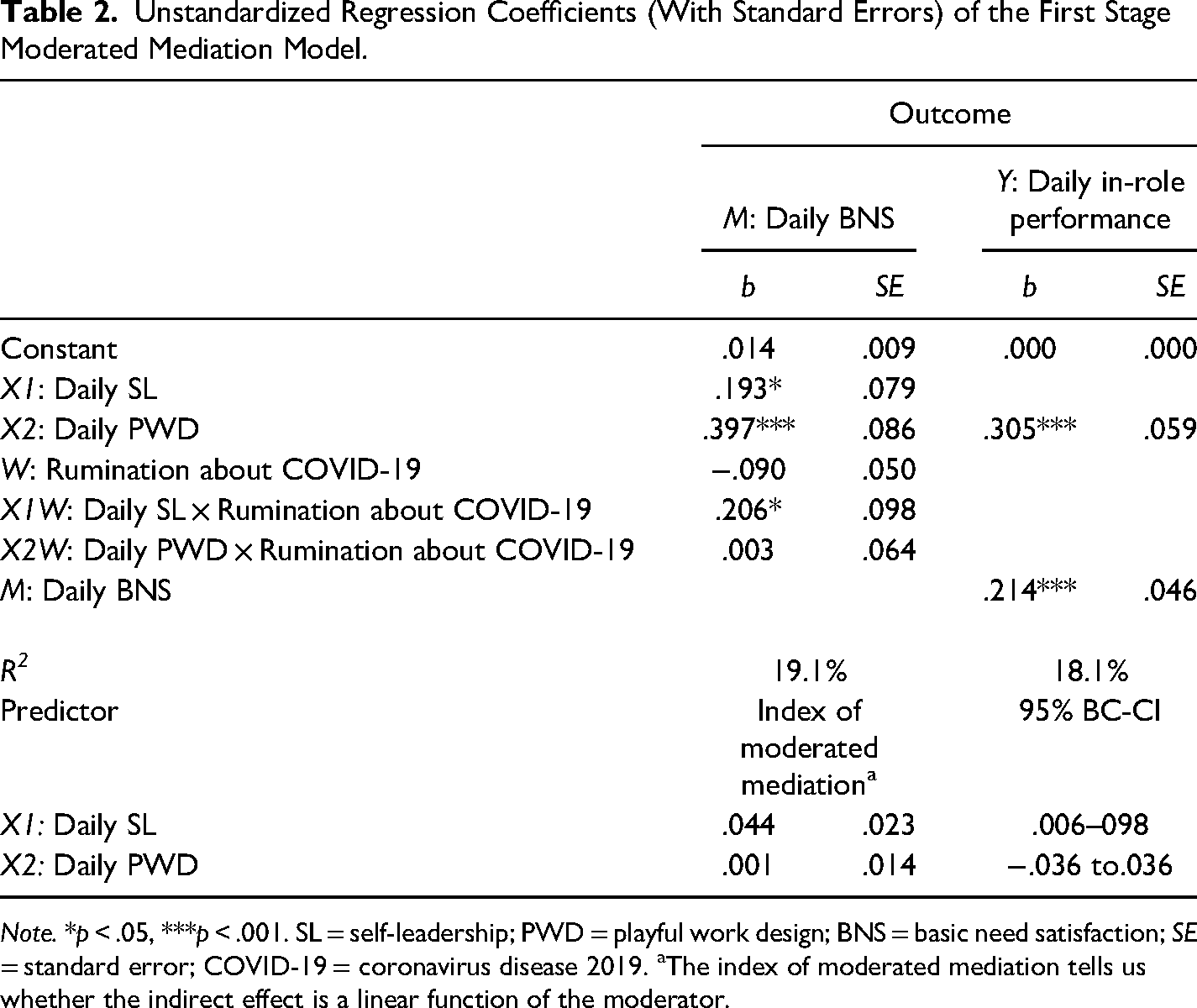
Note. *p < .05, ***p < .001. SL = self-leadership; PWD = playful work design; BNS = basic need satisfaction; SE = standard error; COVID-19 = coronavirus disease 2019. aThe index of moderated mediation tells us whether the indirect effect is a linear function of the moderator.
Discussion
This study refines and expands self-determination theory (Ryan & Deci, 2000) by proposing that self-determination is particularly important when individuals are confronted with a serious life threat, namely COVID-19. Using Bakker and Van Woerkom's (2017) self-determination framework, we argued and found that daily self-leadership and PWD are positively related to job performance through the satisfaction of basic psychological needs. In addition, we found that self-leadership (but not PWD) was particularly related to job performance through basic need satisfaction on days when people ruminated about the COVID-19 pandemic. In what follows, we will discuss the most important theoretical implications. In addition, we discuss the practical implications of our findings by outlining how organizational practitioners can use the new insights to encourage employee self-leadership and PWD.
Theoretical Contributions
The first contribution of the present study is that we expand self-determination theory (Bakker & Van Woerkom, 2017; Deci & Ryan, 2000; Vansteenkiste et al., 2020) by proposing that individuals can use self-determination strategies to proactively satisfy their own basic psychological needs. Our study expands previous research that has largely ignored the active role of the individual in satisfying one's basic needs. Previous studies have particularly shown that the availability or provision of job resources like social support and job autonomy can satisfy basic needs (Slemp et al., 2018; Van den Broeck et al., 2016). Specifically, this research has shown that employees flourish in organizations with enriched jobs or with leaders that provide sufficient job resources, because employees’ needs are satisfied. However, self-determination is more than having the freedom to decide what to do, how to do it, and when to do it (i.e., autonomy). In our view, it is crucial to actually enact (cf. Daniels, 2006) one's autonomy by taking personal initiative. Previous research has suggested that this can be done by proactively optimizing the design of the job by seeking job resources and job challenges (i.e., job crafting; Bakker & Oerlemans, 2019; Tims et al., 2013). The present study suggests that self-leadership and PWD are alternative proactive strategies through which employees may satisfy their own basic psychological needs. Although the two strategies were positively related in the present study, particularly the daily use of these strategies showed limited overlap and unique relationships with need satisfaction and performance. Self-leadership behaviors like setting clear goals and refocusing attention help to satisfy the needs for autonomy and competence, whereas, for example, designing the work tasks to be more fun for others involved and to be more competitive satisfies the needs for autonomy, relatedness, and competence.
These findings are particularly important since the data were collected in the midst of the COVID-19 crisis, in April 2020. On average, participants worked from home about 60% of the days, requesting a proactive attitude to satisfy the needs for relatedness, autonomy, and competence needed to perform well. However, participants from some sectors like health care and construction mostly worked at the workplace under constrained conditions. Additional analyses showed that there were no significant differences in the effectiveness of both proactive strategies for days when employees worked from home versus at the workplace. This may suggest that the proactive strategies were equally helpful for employees working in different sectors and under rather different conditions. The second contribution of this study is therefore that it provides convincing evidence that self-determination strategies help to function well while confronted with a very serious life threat. While working from home, self-leadership strategies are important because employees need to proactively search for resources, for example, by contacting their colleagues and clients through (video) calls. For employees with essential jobs, the immediate focus is on helping people in need and preventing exposure to coronavirus, and thus it is crucial that employees take the initiative to also satisfy their own basic psychological needs.
We found partial evidence for the contention that self-determination is particularly important on days individuals ruminate about COVID-19. Our findings indicated that there were substantial fluctuations in rumination from day to day, most likely as a consequence of the (local) news about the crisis or because of distracting activities. The findings showed that daily self-leadership was particularly related to job performance through basic need satisfaction on the days people ruminated about the COVID-19 pandemic. This finding is consistent with Hobfoll’s (1989) claim that gaining resources is particularly important when confronted with potential resource loss. Previous research has indicated that job and personal resources are particularly important in predicting work engagement when job demands are high (Bakker et al., 2007; Hakanen et al., 2005). The present study expands these findings by showing that individuals can proactively mobilize their own psychological resources to function well—particularly when it is crucial to make meaning through structured activities, namely when ruminating about the threat. Since statistical interactions can be interpreted in several ways, it is interesting to also look at the impact of rumination under conditions of low self-leadership. The results indicated that rumination about the CVID-19 pandemic was particularly negatively related to basic need satisfaction when self-leadership was low (vs. high). Thus, self-leadership also seemed to act as a buffer against the undesirable impact of rumination on need satisfaction (cf. the findings of Bakker & Van Wingerden, 2021). Finally, it should be noted that the interaction effect of PWD and rumination was nonsignificant, indicating that PWD worked largely independent from the amount of rumination.
Potential Limitations
This study has several limitations. The use of self-reports raises the issue of common method variance. Analyzing within-person relations where the focus is on deviations from the baseline mitigates this problem to a certain extent, especially when statistical interaction effects are hypothesized (McClelland & Judd, 1993). In addition, the model variables were not strongly related—suggesting that the use of a daily diary survey did not cause extreme overlap between the measures. Nevertheless, multimethod studies are needed to add confidence to our conclusions regarding the impact of self-determination strategies on basic need satisfaction and job performance. For example, future studies may want to include objective indicators of daily job performance to guard against some of the problems of cognitive reinterpretation people do when reporting about their own functioning. In the current study, because of the pandemic, we consciously chose to use self-reports. That is, performance ratings would be difficult to obtain when employees work from home and we did not want to overburden participants.
Second, although we analyzed the impact of self-leadership and PWD on basic need satisfaction and performance, it is also plausible that those who perform well are more likely to be proactive. Indeed, those who perform well have a good reason to feel self-efficacious, and self-efficacy has been found to be a predictor of proactive behaviors (e.g., Den Hartog & Belschak, 2012; Parker et al., 2006). However, self-determination theory suggests that proactive behaviors influence basic need satisfaction and performance (Ryan & Deci, 2000). Thus, we can build on strong theory and findings to argue that self-leadership and PWD predict basic need satisfaction and performance. Nevertheless, future research may use intervention designs in which self-leadership and PWD are manipulated using, for example, an online training intervention so that the causal order of the variables is under control.
Finally, Bakker and Van Woerkom (2017) proposed four different self-determination strategies, namely self-leadership, job crafting, PWD, and strengths use. To avoid complicated analyses, the present study focused on self-leadership and PWD. Can self-determination also take the form of job crafting and strengths use? Some recent studies have indeed shown that job crafting is predictive of need satisfaction at the day level (Bakker & Oerlemans, 2019; Van Wingerden et al., 2017). However, there is only indirect evidence for the contention that strengths use leads to basic need satisfaction. In their review, Bakker and Van Woerkom argue and show that when employees capitalize on their strong points, they can be authentic, feel energized, and flourish. This suggests that strengths use satisfies the basic needs for autonomy and competence. Indeed, Van Woerkom and Meyers (2019) found that a strengths intervention led to higher levels of personal growth initiative and self-efficacy. Nevertheless, it would be interesting and important to directly test the relationship between strengths use, basic need satisfaction, and job performance in future research, and to investigate whether stressors such as rumination about COVID-19 or other major life events can moderate these relationships.
Practical Implications
Despite these limitations, this study provides practical insights for organizational change and development practitioners. First, practitioners may encourage employees to become more proactive. They could facilitate self-leadership and PWD through employee training interventions or leadership interventions. Organizations that wish to promote PWD through training can build on play theory and the current findings. First, since intrinsic motivation is a key aspect of play (Petelczyc et al., 2018), participation in PWD interventions should be voluntary. In addition, organizational developers may stimulate intrinsic motivation throughout the intervention by designing training activities that are both challenging and fun. Second, since play can be considered a skill (Csikszentmihalyi, 1975), interventions should increase trainees’ (a) knowledge regarding the principles of PWD through lectures and (b) skills through interactive exercises (Scharp et al., 2021). Moreover, to increase the effectiveness of the intervention, trainees should set Specific, Measurable, Achievable, Relevant, and Time-Bound (SMART) goals regarding when and where they will playfully redesign their work activities.
Organizational developers may also train leaders in how to facilitate follower self-leadership and PWD. Although this may be challenging in the midst of a crisis like COVID-19 since the social distancing forces us to keep distance from others, several (online) initiatives can be deployed. For example, leaders may learn to redesign jobs so that employees are encouraged to use more self-leadership strategies (Wang et al., 2017). This could be achieved through instrumental leadership, for example, by providing autonomy, support, and feedback (Breevaart et al., 2014). Leaders may also encourage self-leadership and other proactive work behaviors using transformational and empowering leadership—that is, by stimulating employees to approach work problems actively in different ways, and by transferring power from themselves to employees (Hetland et al., 2018; Thun & Bakker, 2018). Leaders may empower followers to make their own decisions by providing decision-making authority over work, additional responsibilities, and various other job resources (Ahearne et al., 2005).
Our study shows that rumination about COVID-19 fluctuates from day to day. Especially on days employees ruminate a lot, it is important for them to use self-leadership behaviors including goal setting and constructive cognition to satisfy their daily psychological needs and promote their job performance. When employees manage to take action, they experience a sense of agency and volition (Bandura, 2006). Moreover, daily self-talk and positive thoughts help to make sense of the overwhelming conditions of COVID-19, and in that way foster the satisfaction of daily psychological needs and job performance. Paradoxically, rumination may also make it more difficult to use self-leadership, as rumination is associated with depressive/anxiety symptoms and cognitive problems (Nolen-Hoeksema et al., 2008; Smith & Alloy, 2009). Such symptoms potentially undermine people's motivation and capability to initiate action (cf. Bakker & De Vries, 2021). Indeed, in the current study, there were (weak) negative relationships between (a) rumination about COVID-19 and (b) self-leadership and PWD. This suggests that it is more challenging to engage in proactive work behavior when it is really needed. Organizational practitioners may help employees by making them realize that—especially in times of crises—rumination is a natural tendency that doesn't need to be suppressed (Nolen-Hoeksema et al., 2008). It has been shown that acceptance of unwanted experiences such as rumination is related to more positive feelings which may help to refocus on effective self-determination behaviors (Nolen-Hoeksema et al., 2008; Vilardaga et al., 2013), thus making proactive work behavior more likely.
Finally, since research suggests that proactive work behavior is fatiguing (Evans et al., 2016), organizational practitioners should encourage employees to engage in recovery activities during daily leisure time. This can be done through leisure activities that facilitate psychological detachment and relaxation (Demerouti et al., 2009). When employees recover, they replenish their energy resources. In this way, they take care of their physical and mental energy and will be more motivated and able to employ proactive work strategies in the longer term.
Conclusion
The current study shows that employees are active agents in the satisfaction of their own basic needs. We refine self-determination theory by showing that when employees use self-leadership and PWD, they satisfy their daily psychological needs and keep up their daily job performance. Additionally, we theorized and found that the use of self-leadership strategies is particularly important on days when employees ruminate about a life-threatening situation—that is, the COVID-19 pandemic. Although it is particularly difficult to use self-leadership strategies on these days, such strategies help sustain employees’ basic need satisfaction and consequently, their job performance.
Footnotes
Acknowledgments
The authors would like to thank Sarina Verwijmeren, Ellemarijn de Geit, Anouk van der Ende, and Esther van Saase for their help with data collection.
Declaration of Conflicting Interests
The author(s) declared no potential conflicts of interest with respect to the research, authorship, and/or publication of this article.
Funding
The author(s) received no financial support for the research, authorship, and/or publication of this article.
