




Abstract
Technology-mediated change management (TMCM) refers to an organization's use of digital technologies to facilitate change implementation. The use of digital technology is deeply penetrating change practice. However, alarmingly, few have theorized about or empirically investigated TMCM. A rich body of research informs change management, however, less is known about how technologies are changing the nature of managing the change itself. We stimulate new conversations on this topic by discussing how TMCM provides both valuable benefits and creates new risks in terms of the (a) adaptiveness, (b) personalization, and (c) openness of the change process. TMCM requires urgent attention as it has the potential to help shape the future of change research and practice. We call for scholarship that is reflexive about both the benefits and risks associated with TMCM and we offer directions for research in this relatively new area that may very well determine the future of our field.
Keywords
Digital technology impacts how change is managed in a way that was unimaginable just a decade ago. Many change processes have been augmented by digital technologies—computerized tools or devices that generate, store, or synthesize data (Sebastian et al., 2017; Yoo et al., 2012). Because successfully realizing change remains a common challenge for organizations (Oreg & Berson, 2019; Stouten et al., 2018), these digital technologies are becoming integral to change processes as they promise to increase the likelihood of a successful change implementation. Organizations have begun to experiment with these technologies to better coordinate, influence, and monitor change initiatives in real-time (DiLeonardo et al., 2020; Rottner et al., 2019). Although these practices are fast-evolving in organizations across many industries, theoretical development and empirical insight is lacking on this new way of managing change. Our understanding of how to navigate change seems to be locked into traditional top-down and step-by-step models (Worley & Mohrman, 2014), leaving us stranded in the predigital age (Jick & Sturtevant, 2017). Hence, in this essay we hope to motivate an overdue conversation among scholars about how digital technology is fundamentally altering the change process in terms of its adaptiveness, personalization, and openness, and is meaningfully shaping the future of managing change.
Technology-mediated change management (TMCM) refers to an organization's use of digital technologies to influence or engage change stakeholders during change implementations. Digital technology aids with data collection, processing, and decision making and data can come in various forms such as words, images, app-usage, or traditional survey scale responses collected via mobile applications, social media, wearable devices, or sensors (Sebastian et al., 2017; Yoo et al., 2012). By collecting and analyzing data, organizations can gain a comprehensive view into a change progress and tailor their interventions accordingly. For instance, leaders can track progress made toward important change outcomes by measuring objective digital behavioral indicators (e.g., app usage, click rates) and respond to emerging anomalies quickly (Ewenstein et al., 2015). They can also analyze change employees’ attitudes or needs digitally in real-time, gain critical insights about change obstacles, and adapt processes accordingly.
Although TMCM opens up opportunities to overcome information processing limitations and enable evidence-based change management (Rousseau et al., 2008; Rynes & Bartunek, 2017), it also creates risks. For example, technology can be used to direct, evaluate, or discipline employees (Kellogg et al., 2020), which has the potential to result in employee manipulation and control (Cram & Wiener, 2020). Thus, the advent of digital technologies to manage change begs several questions that change scholars need to address going forward. We know very little about the types of technology currently used, how managers use them, when stakeholders accept them, and how they not only impact change practice, but also shape the way scholars conduct research. Change scholarship to date has made strides in several areas such as change leadership (Oreg & Berson, 2019) or prescriptive models of change (Stouten et al., 2018), but remains firmly grounded in the predigital age. Scholars have not yet investigated the benefits and risks associated with the use of digital technologies for mediating social interactions and augmented work activities during change processes, even though TMCM has the potential to fundamentally reshape the way change itself is enacted.
The lack of scholarly attention on this phenomenon is not just surprising but also worrying given widespread use of digital technology in change practice (DiLeonardo et al., 2020) and the ongoing challenges of successfully realizing organizational change (Stouten et al., 2018). Indeed, some have described the future of change implementation as “digital” (Jick & Sturtevant, 2017) and called for research in that area (Weiser et al., 2020). Recently, scholarly work has begun apply technology-oriented theoretical frameworks to understand how to better lead teams (Larson & DeChurch, 2020) or explore how technology advances strategy making in organizations (Rottner et al., 2019), but we have limited insight into how technology can support or hinder change management. More focused work is needed to understand the benefits and risks associated with TMCM. One reason that may explain this lack of attention to this timely topic may be due to the research-practice gap in the management field (e.g., Rynes & Bartunek, 2017; Rynes et al., 2007). Because of this, we are especially concerned that prescriptions coming from practice are positively-biased (e.g., Ewenstein et al., 2015) and potentially overlook the ‘dark side’ and unintended consequences of TMCM (see Giermindl et al., 2021 on the dark side of people analytics).
Benefits and Risks of Digital Technology for Navigating Change
The permeation of digital technology in managing change has presented opportunities for researchers to explore the potential benefits and risks posed for stakeholders. Next, we discuss how digital technologies shape (a) adaptiveness (i.e., allows individuals to respond quickly to moving conditions), (b) personalization (i.e., tailors interventions to individual needs), and (c) openness (i.e., promotes transparency and involvement of stakeholders) of the change process. We explore key benefits and risks for stakeholders within these areas and offer research questions for future work. See Table 1 for an overview.
How Digital Technology Influences Change Management.
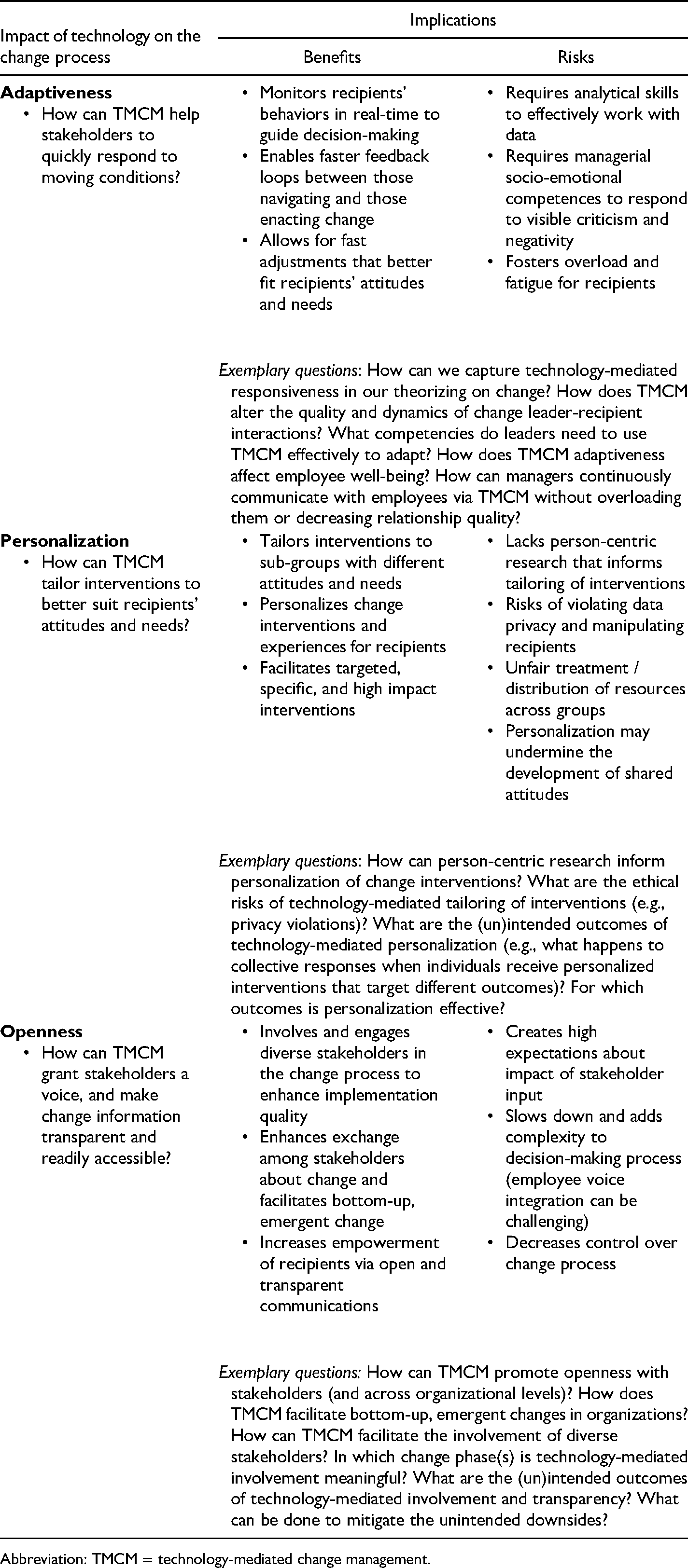
Abbreviation: TMCM = technology-mediated change management.
Adaptiveness
Adaptiveness refers to the enhanced ability of individuals employing TMCM to respond quickly to moving conditions during implementation. Strategy implementation scholars have recently called for more adaptive lenses to examine how “organization[al members] make sense of and enact strategies” in practice (Weiser et al., 2020, p. 969) and the role technology can play in this process. Consultants have also called for increased technology use to enable more “agile” approaches to change management (e.g., Clayton, 2021; Ewenstein et al., 2015). Indeed, TMCM creates valuable benefits for enhancing the adaptiveness of individuals during change processes. Many organizations already use experience sampling methods and people analytics as a “listening” mechanism to keep a pulse on employee change engagement and to respond quickly to new conditions. For instance, some use tailored weekly surveys—also called pulse surveys (e.g., measuring change beliefs; see Armenakis et al., 2007)—that are linked to additional HR data sources and are used to generate real-time change analytics dashboards (Ledet et al., 2020). Others track behavioral indicators such as the usage of online trainings, or click rates on change information, to assess engagement (Fuller, 2014). This enables change leaders to detect areas with low or decreasing levels of engagement and to instantly initiate countermeasures. Such applications can easily be extended by “algorithmic recommending” (Kellogg et al., 2020) that not only detects anomalies, but that also generates recommendations for countermeasures and can even execute them autonomously (e.g., a notification to the group leader reporting the anomalies to motivate action). Taken together, TMCM promises enhanced sensemaking and responsiveness to realize quick adjustments of activities that better fit stakeholders’ needs and attitudes.
Yet, the use of such technologies comes with poorly understood risks and require certain leader competencies—not only statistical, but also emotional—to effectively work with data in real-time. On the one hand, change leaders may lack the necessary data literacy to ask the right analytical questions, interpret data correctly, and draw appropriate conclusions for effective adaptations. Indeed, value creation from data comes when change leaders are able to “democratize, contextualize, experiment and execute data insights in a timely manner” (Zeng & Glaister, 2018, p. 105). Hence, data scientists may need to come into play, requiring a separate set of stakeholders that drive change. On the other hand, leaders are likely to be confronted with a copious amount of continuous, unfiltered negative feedback (e.g., fueled through social media, see Toubiana & Zietsma, 2017) and need to be emotionally competent (Huy, 1999), finding ways to react appropriately and avoid defensive reactions.
There are risks directly for employees as change recipients as well. The low-cost availability of such technologies may trigger leaders to overuse data collection methods (e.g., surveys)—trying to back-up each and every change decision and to adjust interventions in cycles that are low in temporal distance—such that they increase overload and stress for employees. Moreover, employees may infer leader intentions through the regular use of certain questions and respond in ways that promote their own interests (e.g., answer strategically to manage impressions). In other words, TMCM may bias the way of responding, and thereby the inputs to the analyses from which decisions are being made. This can be detrimental for change recipients, as they may miss out on much needed interventions (e.g., stress and conflict interventions).
Hence, although scholars have called for more “adaptive” theoretical lenses on strategic change implementation (Weiser et al., 2020) and practitioners use technology to become more responsive, many questions remain to be answered. Foremost, how can TMCM enable a more adaptive change process? How can we capture technology-mediated responsiveness in our theorizing on change? How does TMCM alter the quality and dynamics of change leader-recipient interactions? What competencies do leaders need to use TMCM effectively and become more responsive? How does TMCM adaptiveness employee well-being? How can managers be in touch with employees on a continuous basis via TMCM without overloading them or decreasing relationship quality?
Personalization
TMCM also provides valuable opportunities to analyze big data and better tailor interventions to different stakeholder attitudes and needs. Tailoring can also cater to the idiosyncratic needs of each unique individual and organizational context. Data analytics allow leaders to consider one or more characteristics related to the change “recipient” (e.g., department, hierarchical level, psychological traits, change readiness) and use this information to adapt the intervention in terms of content, delivery, and/or timing. Better aligning the interventions (e.g., communication, training) with the needs of the recipient to increase intervention-recipient congruence can, in turn, enhance intervention effectiveness. For instance, some organizations overcome ‘standardized’ approaches by using smartphone-generated data to personalize change communications to better target groups with different attitudes and needs (DiLeonardo et al., 2020).
From a recipient's perspective, personalized interventions may enhance the change experience. Digitally enhanced personalization facilitates targeted, specific, and high-impact interventions that provide employees with the necessary resources and support (e.g., information, training) to navigate change at the right point in time. Indeed, research suggests that the use of game design elements in real-world contexts can satisfy different psychological needs (Sailer et al., 2017) and can offer inspiration about how change implementations may be personalized to enhance the employee experience. For example, employees can voluntarily download an application on their smartphone and answer questions about the perceived change benefits and efficacy. Based on their responses, the application would automatically provide tailored information (e.g., a video message from the CEO emphasizing benefits of the change vs. a short, animated video of how the change will be implemented) according to the specific employee's current beliefs. The level of personalization that may be made possible in the future as technology advances by using computational agents to optimize communication may be startling (e.g., to predict how a recipient wants to be spoken to based on internal social network data). Indeed, communication researchers expect that such futuristic ideals will become reality as we enter the age of AI-mediated communication: “interpersonal communication [will] not simply [be] transmitted by technology, but modified, augmented, or even generated by a computational agent to achieve communication goals” (Hancock et al., 2020, p. 89).
However, digitally enhanced personalization also creates certain risks. Current change research has rarely used person-centric analytical methods (e.g., latent profile and transition analyses, Morin et al., 2020; Woo et al., 2018) to explore configurations of attributes that differentiate change respondents and identify typologies of respondents. Hence, we have little insight into useful and evidence-based typologies of change recipients that may inform the tailoring of interventions (and we do not know if tailoring is even effective for individual outcomes). Importantly, person-centric (e.g., latent profile) analyses raise various ethical questions and concerns of data privacy violations. Privacy violations can arise if HR data (e.g., gender, age) is used inappropriately for some analyses such that an individual can be identified. Moreover, leaders can use sensitive information to give just-in-time feedback and may (unintentionally) unfairly manipulate groups of recipients. Another risk implicit with personalization is that certain groups of people will not have experienced helpful interventions that other groups have access to. Relatedly, it remains unclear how individually personalized interventions shape collective change responses when personalized interventions construct diverging realities for different recipients.
This opens up interesting directions for future research. How can research leveraging person-centric methodologies generate useful typologies of change recipients that allow personalization of interventions? How can technology-mediated interventions be personalized to change recipients’ typologies without violating privacy concerns and creating ethical issues? What are the unintended outcomes of personalization (e.g., what happens to collective change responses when individuals receive personalized interventions)?
Openness
TMCM provides opportunities to grant multiple stakeholders access to actively take part in the organizational discourse on change and make this discourse transparent (“democratic change”). Building on research on the open strategy movement (Hautz et al., 2017; Tavakoli et al., 2017), openness has two important dimensions: inclusion of multiple stakeholders into change-making and transparency of change information. Both dimensions, how individuals are included in the change and transparent change communication, are also emphasized in traditional change research as critical levers to enhance support and implementation quality (Oreg & Berson, 2019; Stouten et al., 2018).
TMCM promises advantages for implementation quality by taking into account the input of a large set of participants to enable and increase engagement with the change. Broad engagement can be enhanced by using social media technology such as wikis, blogs, or social networks (Rottner et al., 2019); the use of technology to involve thousands of people in change-making has been documented in several organizations (see Tavakoli et al., 2017, for examples). Given the complexity of many organizational environments, social media may provide a unique opportunity to prompt information exchange among organizational members that allows for greater interconnectivity and collaboration during change initiatives.
Some organizations use social networks to foster collaborative creation in the strategic change process (Rottner et al., 2019) in which change leaders visibly interact with stakeholders from across the organization in real-time. Using internal social networks can help foster employee change acceptance because they create instant connections in which employees can share information and find answers quickly across organizational levels. In general, social media also allows employees to sidestep hierarchy formalities and directly communicate bottom-up with critical actors from higher levels. Indeed, social media may increase interconnectivity and collaboration among distant internal groups (Leonardi & Vaast, 2017) such that it facilitates bottom-up, emergent (more organic) changes in organizations (Wee & Taylor, 2018).
Other organizations use blogging technology during change (e.g., host an idea competition via blogs). In order to inform change decisions, companies will collate stakeholder input by collecting and mining massive amounts of written feedback from employees’ blogs. For instance, IBM established so called ‘virtual jams’ that ask employees to submit their written input to specific change initiatives digitally (see IBM Values-Jam, Hemp & Stewart, 2004). These data are then analyzed using textual analysis such as topic modeling (Hannigan et al., 2019) to distill key insights. The goal with this type of TMCM is to involve a large number of stakeholders in the change process to enhance input quality.
However, using TMCM to enhance openness also creates new risks and unintended consequences. To begin with, employees may add pressure to change leaders to visibly integrate any input into the change process (Hautz et al., 2017). In this regard, it is not uncommon for leaders to disappoint employee expectations. Unfortunately, this often leads to reductions in future employee contributions, or, at the very least, a diminished willingness to support a change—even sparking change cynicism (Bommer et al., 2005). Additionally, the frequency with which a leader involves stakeholders consumes resources. The inclusion of a diverse set of voices takes time and may undermine decision-making speed and accuracy. These constraints need to be balanced against the benefits of TMCM used to increase change openness.
Moreover, social media can fuel emotion-sharing about change—in particular, negative emotions are shared and venting can occur—and debates can get of control such that they foster collective resistance, polarization, and ultimately change failure (Kanitz et al., forthcoming). Indeed, the use of big data technologies can enhance collaboration, but also can also intensify competitive dynamics and fuel emotional processes, depending on the motivation of use and the design of the technology (Cepa, forthcoming). Finally, it is unclear if involving stakeholders using digital means generates the same input or co-creation quality as face-to-face initiatives that are often seen as critical interventions for change and organizational development practitioners. Indeed, scholars have recently argued that the extensive use of technology-mediated social interaction suppresses psychological processes that contribute to collaborative creativity (Jarvenpaa & Välikangas, 2020). Thus, TMCM used to enhance openness likely necessitates careful technology design, trust between stakeholders, and a strong, collectively-endorsed goal.
These issues we point to can be developed further across several areas for future research. How can social media promote openness with diverse change stakeholders, or across organizational levels? How does TMCM facilitate bottom-up, emergent changes in organizations? How can technology facilitate inclusion of diverse stakeholders? In which change phase(s) is technology-mediated involvement meaningful? What are the unintended outcomes when organizations leverage social media to increase involvement and transparency (e.g., losing control)? What can be done to mitigate the downsides?
Conclusion
TMCM creates benefits but also risks for stakeholders by fundamentally altering the adaptiveness, personalization, and openness of the change process. We envision the future of managing change as a continuous process in which stakeholders enact change through technology-mediated collaboration. Yet, the making of this future requires theoretical and empirical insights to leverage the benefits and anticipate the risks that technology may bring. Such an approach may lead us to not outright reject risk-laden technologies, but rather, to re-imagine and re-design them so that they complement stakeholders during a change process. We call for research at the intersection of organizational behavior, strategy, and information systems to examine how TMCM is changing the nature of change management itself. This important, yet underexplored, topic area may very well be the future of our field.
Footnotes
Declaration of Conflicting Interests
The authors declared no potential conflicts of interest with respect to the research, authorship, and/or publication of this article.
Funding
The authors received no financial support for the research, authorship and/or publication of this article.
