




Abstract
The generative change model identifies the underlying process that has produced success in a variety of Dialogic Organization Development (OD) and large group intervention cases. It works with widespread stakeholder engagement and self-organizing properties of human systems, to create rapid, transformational change. It appears better suited to managing complex, adaptive challenges than traditional planned change. The paper briefly describes the model and explains one aspect of it in more depth, the use of purpose, instead of vision, to guide the change process.
For the past several years I have been trying to understand what is going on when leaders and OD consultants transform organizations. One answer has been the principles now labeled Dialogic OD. Recently, Bob Marshak and I have developed another answer that I hope you will find helpful—the generative change model (Bushe, 2013, 2020; Marshak & Bushe, 2018). This model attempts to systematize what actually happens when Dialogic OD programs lead to the kinds of rapid, transformational change found in published cases of appreciative inquiry (Fry et al., 2002; Ludema et al., 2003; Whitney & Trosten-Bloom, 2010), Future Search (Weisbord, 1992), and other Dialogic OD methods (Bushe & Marshak, 2015) as well as descriptions of successful transformational change that are not method specific (e.g., Beer & Nohira, 2000; Higgs & Rowland, 2011; Hoyt et al., 2010; Pascale et al., 2000). The generative change model is an antidote to the planned change model and overcomes many of the widely noted deficiencies of traditional planned change, particularly when dealing with complex and adaptive challenges (Heifetz, 1994).
Since complex situations are those where it is not possible to understand and predict cause and effect except in retrospect envisioning a solution that actually solves such issues is a hit or miss affair. A more consistently successful approach is to try some safe-fail experiments and see what happens. Snowden and Boone (2007) call these “probes.” Collins and Hansen (2011) call this process “fire bullets, then cannonballs.” Rather than assuming anyone is smart enough to anticipate all the possible permutations of all the factors influencing a situation ahead of time (the vision), assume you cannot predict what will work. Instead, launch as many probes as possible and learn as you go. When something works, scale it up. There are many other names for probes, like experiments, pilot projects, prototypes, and so on. What you do, essentially, is to keep firing bullets until you hit something; then you bring in the cannon.
The generative change model identifies the steps required to engage the people who will have to change (stakeholders), in conversations where they come up with new ideas (probes) they are willing to act on. They are encouraged to self-initiate action while leaders pay attention to what is working and what is not working. The good ideas and innovations are scaled up, and opportunities for advancing the change agenda are capitalized on. More importantly, the generative change process creates a more adaptive, agile organization, better able to tackle increasing complexity and produce far more change far more quickly than anyone familiar with planned change would consider reasonable (Bushe, 2020).
Some key differences between generative change and the traditional planned change approach are: (1) it relies on purpose, not vision; (2) rather than identifying the right answer and then trying to implement, you try out many different possible answers and cultivate what results; and (3) leaders play their most significant role after probes are launched, not before. Given space limitations I will only comment here on #1 (Figure 1).
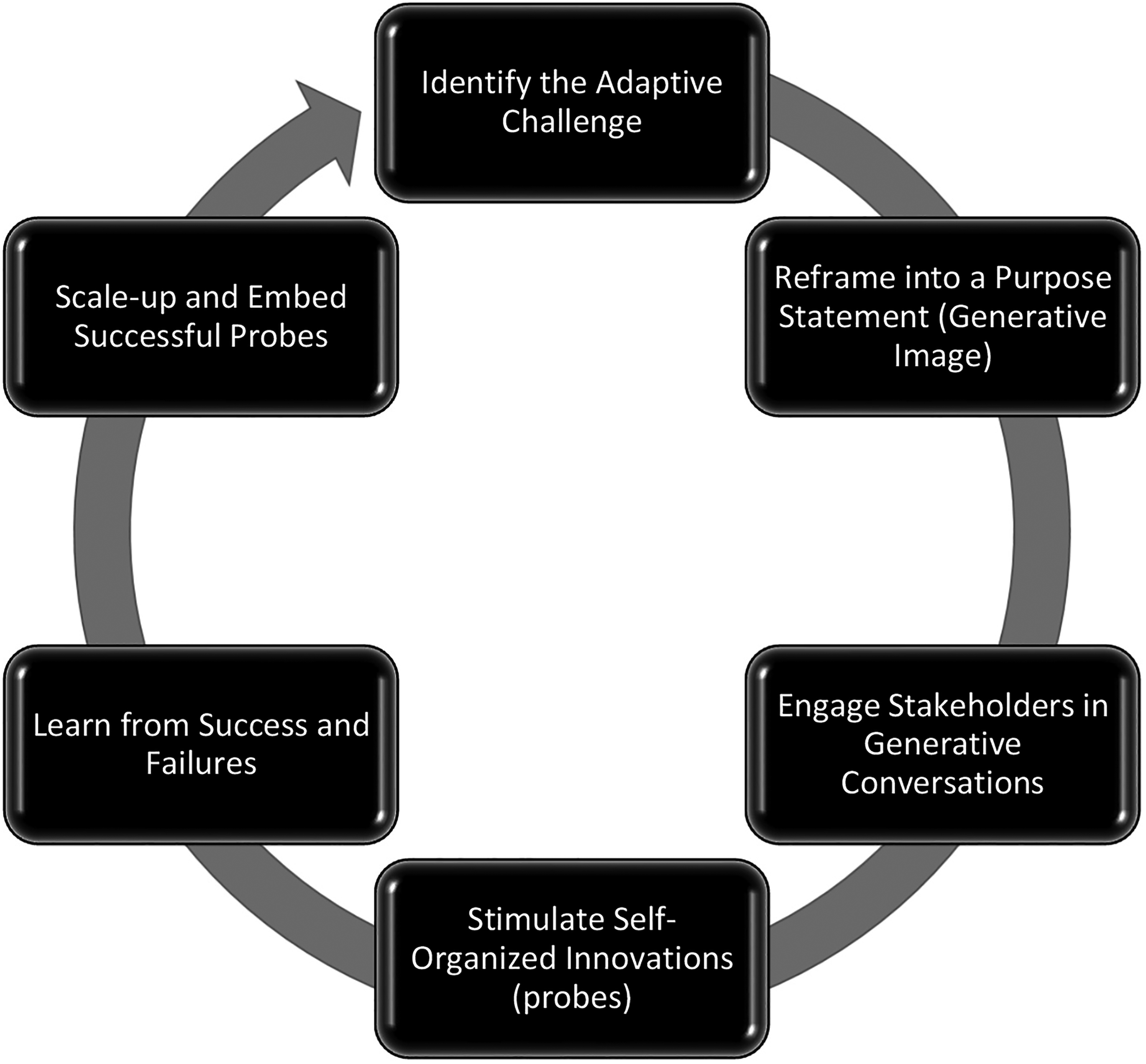
The generative change model (from Bushe, 2020).
Purpose, Not Vision
A purpose is different from a vision or goal, and it is essential for successful generative change. Vision is necessary for top-down, planned change processes to have any chance of success. But they are too much of a straight-jacket for the emergent, generative approach to change. A vision describes a future state. A vision is the solution to a problem. A purpose describes what the group or organization is trying to do every day. It can often describe a state you may never attain, like zero defects or accident free work.
A vision is a specific way to attain a purpose. For example, delighting customers is a purpose. The 100% on time delivery is a vision for how to accomplish that purpose. If a leadership group decides this is the best way to attain that purpose, others have to line up behind that vision (buy the vision, get on the bus, etc.). There is much less room for experimentation, and for tapping into the creativity and intrinsic motivations in the people who will have to change. 100% on-time delivery is only one way to delight customers and may not be the most important thing to some customers. What happens to all the ideas that front line employees, who deal with customers every day, have for how to delight customers? How much less committed to delighting customers will they feel if they are being stressed by a 100% on-time delivery promise, especially if it is for customers who have other priorities that cannot be satisfied because of constraints from on-time delivery?
When people have a common purpose, they are far more likely to self-organize in a way that supports the collective good. When they do not have a common purpose, they are more likely to self-organize in a way that supports their individual needs, wants, and agendas. Inherent in leaders’ hesitation to use loosely guided, emergent change processes, is a belief that people mainly look after themselves and not the organization's needs. But when people care about accomplishing the same thing, left to themselves, they will self-organize in the best way they know how to succeed (Mele, 2012).
We have at least two decades with multiple cases of successful generative change, but they have been called many different things and have emphasized different aspects of their processes, so researchers and practitioners have not had a common model for comparison or study. Because generative change calls for a different type of leadership (Bushe, 2019) it is not well understood or practiced in contemporary organizations. Hopefully, this model will help change that.
Footnotes
Declaration of Conflicting Interests
The author declared no potential conflicts of interest with respect to the research, authorship, and/or publication of this article.
Funding
The author received no financial support for the research, authorship and/or publication of this article.
