




Abstract
At the beginning of 2020, the operations of the Finance Hub of the Americas (FHoA) at pharmaceutical company GlaxoSmithKline (GSK) were suddenly forced to shift entirely from face-to-face to remote work. To handle this challenge, an FHoA team started a team development process aimed at strengthening teamwork in virtual environments. The intervention was grounded in the principles of generative leadership and dialogic organization development. Through a scholar-practitioner collaboration that focused on identifying the drivers of the successful transition to remote work, we build a three-step process of team development using the metaphor of organic growth: (1) sowing, (2) nurturing, and (3) flourishing. Using GSK's example, we illustrate how this process became a simple but powerful strategy to help teams thrive in a virtual environment. The core of the process uses generative questions to configure a structured but adaptable process that can be easily implemented in different contexts and situations.
Keywords
In 2020, most organizations around the world were forced to shift from face-to-face to remote work. COVID-19 radically changed organizational dynamics, having a huge effect on teamwork (Feitosa & Salas, 2020). Experts suggest that this is the beginning of a tremendous change, because the number of people who work remotely will increase exponentially in the coming years—Global Workplace Analytics estimates that 25–30% of the US workforce will work remotely by the end of 2021, up from only 3.6% before COVID-19 1 . To help organizations succeed in the transition to remote work we describe a strategy to develop virtual teams, which is built upon a scholar-practitioner collaboration that combines the experience of Author 2 in leading virtual teams in multinational companies (for more than a decade) with the research by Author 1 on team development. We illustrate the proposed strategy through the lessons learned by a team of the Finance Hub of the Americas (FHoA) at the international pharmaceutical company GlaxoSmithKline (GSK).
The COVID-19 pandemic forced the FHoA to transition to remote work in less than a month. To handle this challenge, an FHoA team (supported by Author 2) started a team development process aimed at strengthening teamwork in a virtual environment. They based the process on the principles of generative leadership and dialogic organization development, approaches that give primacy to language, narratives, dialogues, and questions to create self-organized or emergent change (Bushe & Marshak, 2014; Dunham, 2008). Throughout a year of successful implementation, Author 2 and the FHoA team identified a set of practices that help increase their cohesion and coordination, facilitating their transition to virtual teamwork. Author 1 helped make sense of the intervention process to identify what could explain its success. After assessing the process together (including Author 2's similar experiences), it became clear to us that the intervention activated the generative capacity of the team, which we conceptualize as a team's ability to design its future, expand its current ways of acting (e.g., creating and enacting new ideas, narratives, and practices), and cultivate the social tissue that enables it to develop.
Based on this idea, we build a framework for virtual team development based on a three-step process using the metaphor of organic growth: (1) sowing, (2) nurturing, and (3) flourishing. We ground this process in the power of generative questions. Namely, questions that (1) open up new possibilities for action—opening, (2) capture the attention of the listener—anchoring, and (3) explore new meanings and assumptions about reality (in this case teamwork)—deepening (Vogt et al., 2003). Table 1 shows how each of the components of a generative question helps direct the team through the proposed three-step process. We now describe how the process unfolded at FHoA.
A Three-Step Process to Develop Virtual Teams: Lessons Learned at GSK.
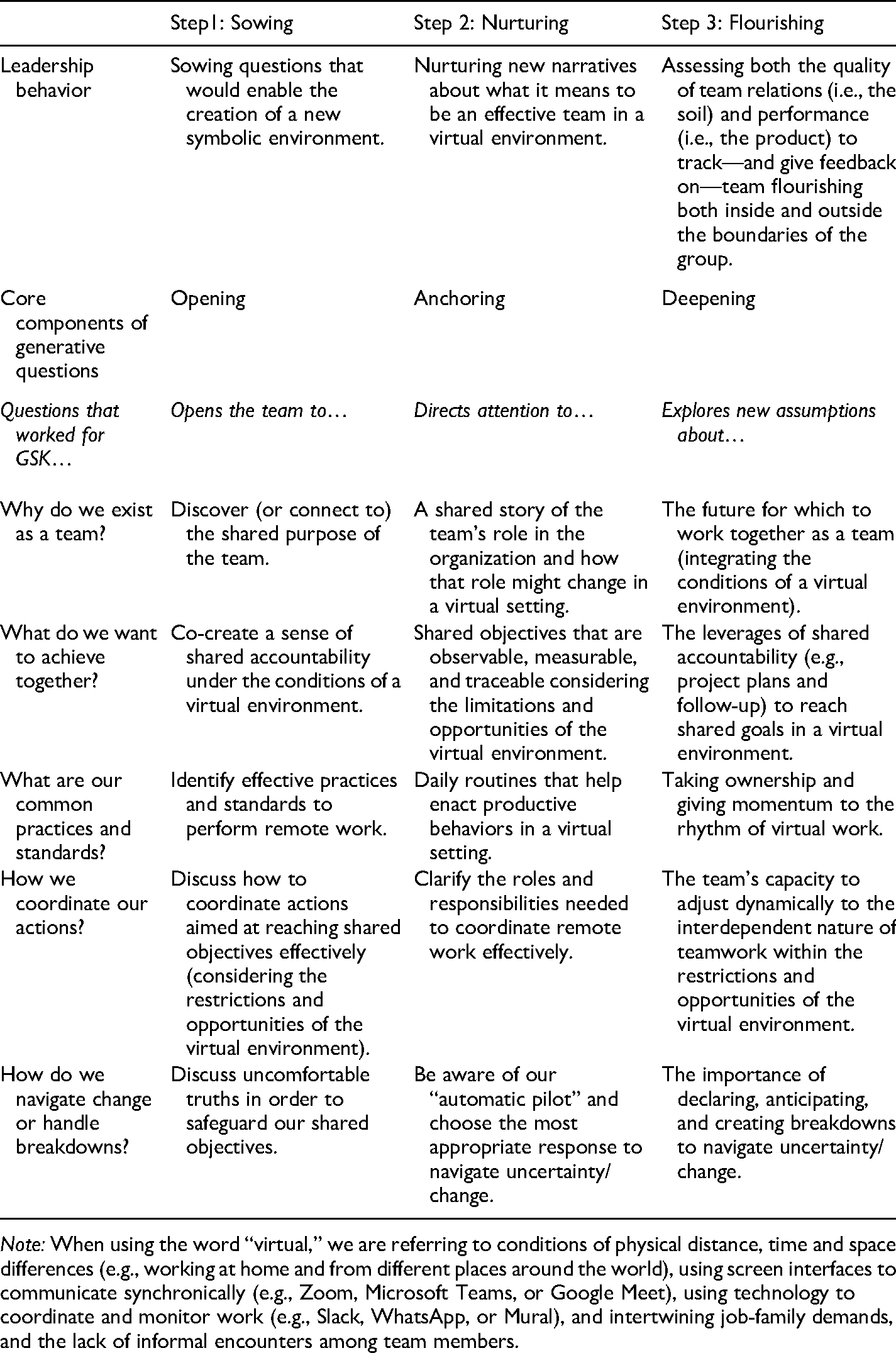
Note: When using the word “virtual,” we are referring to conditions of physical distance, time and space differences (e.g., working at home and from different places around the world), using screen interfaces to communicate synchronically (e.g., Zoom, Microsoft Teams, or Google Meet), using technology to coordinate and monitor work (e.g., Slack, WhatsApp, or Mural), and intertwining job-family demands, and the lack of informal encounters among team members.
First, we learned that leaders and team members must realize that we live in a world of meaning-making (Weick, 1995). This is not a novel idea, but we have seen that it is hard to practice for executives when they hold a mechanistic view of organizations. When the FHoA team leader integrated this idea (i.e., became part of the leadership mindset), we observed that he became aware of the generative capacity of his team and understood how the power of dialogues and questions can help shape new and better realities. A key leadership behavior that helped spark the FHoA team's generative capacity was to sow questions that enabled the creation of a new symbolic environment, one that embraced the features of remote work in a creative and positive manner. Table 1 summarizes the five questions that worked for GSK, helping the team connect to a shared purpose, generate shared accountability, establish common practices and standards, articulate effective coordination, and navigate uncertainty/change.
Second, we learned the leader must create conditions that enable generative questions to nurture new narratives about what it means to be an effective team in a virtual environment. In order to make this happen, the team leader asked the five questions shown in Table 1 sequentially to look more closely into discovering and creating effective ways of functioning consideringthe opportunities and restrictions of a virtual environment (e.g., distance, time and space differences, screen interface, and remote coordination). At GSK, the team carried out four team-building activities aimed at working through one question per month. At a kickoff meeting (one hour) the team discussed “why” it exists and created a baseline for measuring success. The team then implemented four training workshops (two hours each) to discuss each of the remaining four questions and learn about related practices that could be implemented regularly. Each workshop was followed by a learning circle (one-hour each) to “anchor and deepen” both cognitive and behavioral change (see Table 1). The process concluded with a session in which the team assessed the entire process, its performance, and the learning outcomes. Additionally, the leader received individual coaching to learn to reinforce new practices, gain skills to manage meetings as developmental spaces, and “walk the talk.”
Finally, we learned that teams need to have indicators to assess positive growth. These indicators should measure both the quality of team relations (i.e., the soil) and performance (i.e., the product) to track team flourishing both inside and outside the boundaries of the group. The GSK team chose five measures: trust, promises, coordination, accountability, and results (Dunham, 2008; Lencioni, 2002). After five months, the team improved from an average of 3.5 (warning zone) to an average of 4.4 (successful zone) on a scale of 1 to 5—see Figure 1. The team leader reported three key lessons for the team. First, the team learned how to work interdependently in a virtual setting, which involved meaning-making regarding the potentially different nature of shared purpose, goals, practices, and performance standards to coordinate remote work effectively (seeding). Second, the team became a cohesive entity with a shared sense of accountability and trust, embracing the challenges and opportunities of the virtual setting (nurturing). Finally, the team learned to be more flexible and adaptable, which was vital for successfully navigating the uncertainty of the COVID-19 crisis (flourishing).
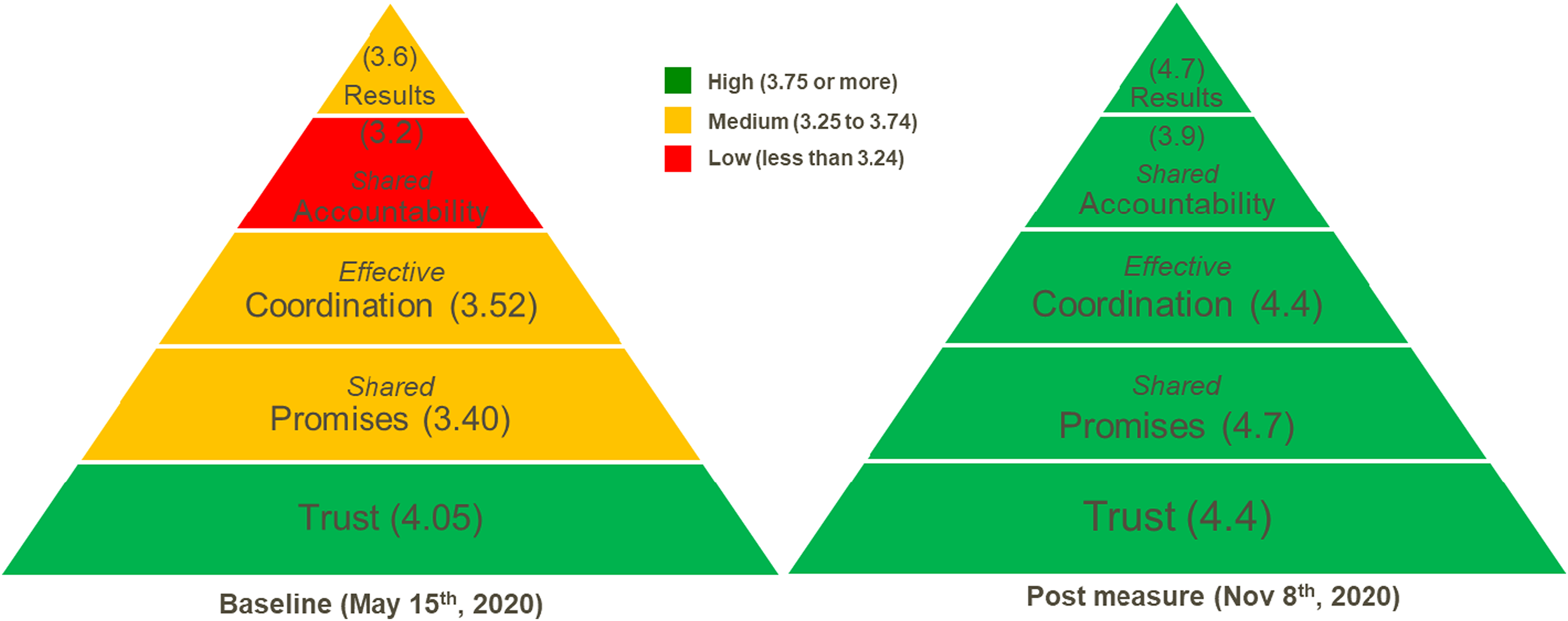
Measurement of team functioning before and after the team intervention.
Concluding Remarks
This paper offers insights about the power of generative questions to direct a process of team development in a virtual environment. Using the premise that we live in a world of meaning-making, we describe a simple but powerful strategy—grounded in the principles of generative leadership and dialogic organization development—that helps virtual teams thrive. This is a structured, adaptable process, that can be easily implemented in different contexts and situations to succeed in the transition to remote work.
Footnotes
Declaration of Conflicting Interests
The author(s) declared no potential conflicts of interest with respect to the research, authorship, and/or publication of this article.
Funding
The author(s) received no financial support for the research, authorship and/or publication of this article.
