




Abstract
In this essay, we are arguing that the field of organizational change and development is positioned to face the challenges of researching change and changing for the next decade and beyond. The core values in the field—that researching change and enacting changing are collaborative ventures undertaken in the present tense where the outcome is actionable knowledge, and that it serves the practical ends of organizations and generates the knowledge of how organizations change—are of utmost relevant for the emerging workplace and organizations. Through differentiated consciousness interiority challenges the polarizations that beset the field (between science and practice) and provides an integrative process focused on the operations of human knowing.
In their exploration of the development of the philosophy of social science, Coghlan et al. (2019) have mapped the nature of understanding of the field of organization development and change (ODC). Central to this understanding is how ODC is a philosophy, a social science, and an array of practical tools to help organizations change (Schein, 2010). As our response to the call to reflect on “we know where organizational change has been, but where is it headed?” as triggered by the coronavirus disease 2019 pandemic, we explore our vision of the future of researching change and changing. We do this in terms of two core values, and these are the central point of this essay: that researching change and enacting changing is a collaborative venture undertaken in the present tense where the outcome is actionable knowledge, that is, it serves the practical ends of organizations and generates robust knowledge of how organizations change. Our further point is that these values are enabled through a differentiation of consciousness of interiority. The remainder of this essay explains what we mean and its implications for ODC scholar practitioners.
Collaborative Inquiry as a Mechanism for Generating Actionable Knowledge
Researching change and changing is understood to be a collaborative process that occurs in the present tense. This orientation is grounded in systematic conversations and honest dialogue between those who are insiders to the organization and researchers who are outsiders with the aim of both addressing changing and creating practical knowledge about organizational change (Shani & Coghlan, 2021). The collaborative nature of the inquiry process is aided by the establishment of learning mechanisms that provide the platform for the integration of multiple perspectives, enables discoveries, and which trigger mind shifts, the development of new mindsets, and new meaning creation.
Collaborative inquiry seeks to be helpful in changing an organizational system and in creating practical knowledge through that collaborative change process. It draws on different forms of knowing: relational knowing as the researchers and organizational members build a partnership and engage in dialogue; theoretical knowing in the scientific data of financial reports and performance metrics; and presentational knowing through the creation of generative imagery that engages participants in conversations that give energy and focus to framing a desired future. These forms of knowing come together in practical knowing through addressing the challenges facing the organization and articulating learning from the process that is useful for others.
The collaborative inquiry project involves a true partnership that centers on action, research, and inquiry between different actors. Each actor brings different expectations, experiences, and knowledge base (theoretical, practical, and methodological) to the collaborative inquiry initiative. At the core of meaningful collaborative projects, one can find distinct high-quality relationships that are the engine of the project (Mohrman & Shani, 2008). Designing and facilitating the emerging relationships requires honest conversations from the get go about every aspect of the study and its context, investment in the alignment of purpose and vision, the continuous incorporation of the context complexity into the process, the design and development of learning mechanisms, and the collaborative design and enactment of the co-led project guided by interiority orientation.
Practical Knowing, Theory, and Interiority
People learn about themselves and the world within which they live in diverse ways through different ways of knowing (Shani & Coghlan, 2021). One way is through the trial and error of everyday living, where they learn experientially. This is the realm of practical knowing and is where most of people's daily engagement occurs. Practical knowing relates to the changing of organizations and its meaning for their members. It is a descriptive, subject-centered context of knowing, while it is interested in new knowledge creation, it is not interested in universal solutions. There is also the realm of theory which is the realm of systematic and ordered explanations that are provided by research. In the realm of theory people are interested in things not as they relate to them but rather as things relate to one another in a verifiable manner. The explanation has to be accurate, clear, and precise so the ambiguities of practical language are averted. The critical difference between the two realms is that in the practical mode people are the reference point, that is, the company is doing well. In the realm of theory, the reference point is how things relate to each other, that is, figures in a balance sheet.
The realms of practical knowing and of theory provide different and disparate views of the world, for instance, as to whether the financial figures mean the firm is doing well or not. These realms of meaning are reflected as differentiation of consciousness. In the business and organizational world, there is the theoretical world of finance, strategy, and effectiveness that are expressed through performance metrics, financial analysis, and so on. In the realm of practical knowing, there is the experience of envisioning, learning, changing, success, and failure. Both are real. The question then is, by what mechanism do people recognize the realm of theory and the realm of practical knowing, recognize the value of both and be able to move from one realm to another? The third realm, interiority, emerges as an answer to this question.
Interiority is the process whereby people attend to is the cognitional operations within themselves, that is, the data of consciousness. This is a personal process in which people can catch themselves in the act of knowing and bring it into their conscious awareness (Coghlan, 2017). By attending to both the data of their consciousness (how they are experiencing, questioning, understanding, and judging) as well as to the data of sense (what they see and hear in the external data) researchers can engage with the empirical data of their experiencing, the intellectual data of their understanding (by abductive reasoning in the context of discovery), and the rational data of their judgments (by deductive or inductive reasoning in the context of verification). In engaging in collaborative research that is directed toward cogenerating actionable knowledge, interiority involves drawing on differentiation of consciousness and attending to what is occurring in the present tense within the context of learning mechanisms (Shani & Docherty, 2003) and particularly to the process of abductive reasoning (Shani et al., 2020).
The Social Science of Researching Change and Changing
Underpinning our argument in this essay is that the social science of researching change and changing is founded on producing knowledge in the context of application (Coghlan et al., 2020; Mirvis et al., 2021) and on the researcher as an engaged scholar (Van de Ven, 2007). What does this approach mean for the future of research? For the researcher? How might collaborative researchers think about themselves in this role? How might they be trained or educated to be collaborative researchers? We have grounded our answer to these questions through the notion of differentiated consciousness and interiority, that is, how we attend to how we know in different ways. As we envision the next decades of researching change and changing, we focus on the researcher in collaborative inquiry and point to challenges and opportunities for collaborative inquiry as a mechanism for changing organizations and for theorizing about change.
The field of organization development and change is an eclectic one and draws on many forms of scientific investigation and theory formulation: a deductive form of knowledge creation that draws on a statistical mode of inquiry to achieve explanation; an inductive interpretist paradigm for understanding, and action research that generates actionable knowledge through deliberate engagement in changing. Interiority enables engaged scholars to appreciate the contribution that each form of knowing makes to the social science of change and to the practice of changing. Questions of science can be settled by appealing to observable data. However, in the world of interiority, data are not sensible or observable but belong to the private world of intentional consciousness. Hence the centrality of interiority to bring privately held meanings into a shared space for joint exploration and the creation of collectively shared meaning.
The Skills of the Researcher
We are arguing that interiority is a core skill for the future of ODC researchers. Accordingly, we think it needs to be part of their education and training. To conduct a collaborative inquiry, researchers need to be able to recognize the mode of knowing in which they engage when dealing with the scientific nature of data that is externalized in financial and statistical forms and attend to how they come to a judgment as to the sufficiency and efficacy of that data. They also recognize the knowing they engage in when they are working with the interpretive data of meaning that emerges through reflection on experience and conversations. In the collaborative process, they need to recognize how they are in the realm of relational knowing as they engage in building partnerships of inquiry and action and when they draw on presentational forms of knowing when generative imagery is created to express the present or an envisaged future. Knowing the difference between these different realms of knowing, valuing each's contribution to the collaborative research process, recognizing which is needed in a given situation and being skilled at engaging in each one through differentiated consciousness is the key skill of interiority.
Concluding Remarks
In this essay, we are arguing that the field of organizational change and development is positioned to face the challenges of researching change and changing for the next decade and beyond. The core values in the field—that researching change and enacting changing are collaborative ventures undertaken in the present tense where the outcome is actionable knowledge, and that it serves the practical ends of organizations and generates the knowledge of how organizations change—are of utmost relevant for the emerging workplace and organizations. Through differentiated consciousness, interiority challenges the polarizations that beset the field (between science and practice) and provides an integrative process focused on the operations of human knowing (Figure 1).
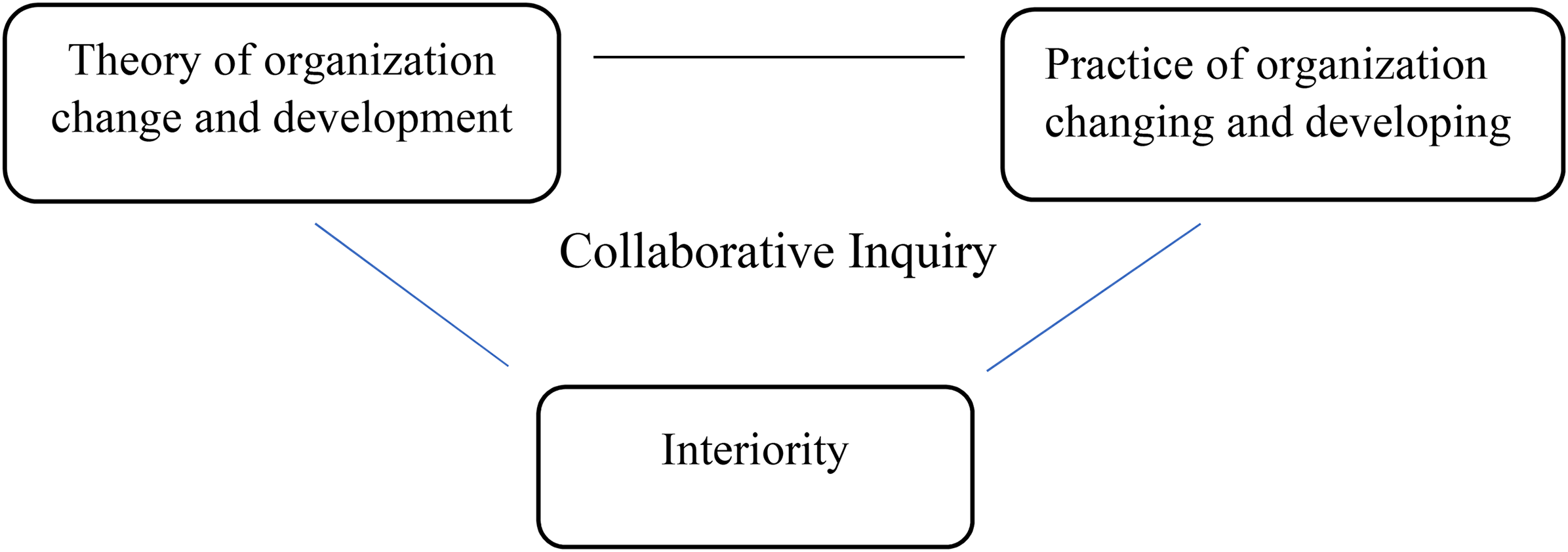
Interiority as integrating researching change and changing.
In conclusion, we offer three counsels for ODC researchers as an orientation and as competencies:
Practice attending how you come to know what you know as it occurs. Catch how you question experience, receive insights, test or verify them, and come to reasonable judgments. In other words, internalize the operations of your knowing so that knowing how you know becomes a learned skill and a skill that you can help the partners in the collaborative project learn. Refine your meta-level mental model in terms of interiority as it takes place to guide your action and research. Differentiation of consciousness, whereby the realms of theory and practical knowing are understood through interiority enables you to develop the perspective and skills to engage with the different realms of knowing congruent with the needs of the change and changing situation. Role modeling the process can enhance the partners' ability to articulate their meta-level models and can facilitate the creation of shared meta-level mental models. Adopt a collaborative orientation and establish collaborative learning mechanisms. As we have advanced in this essay, at the core of the metal-level mental model for ODC field are partnership and collaboration. Developing partnership, emphasizing collaborative inquiry, establishing the learning mechanism as the platform for collaboration, building partnerships, and continuously facilitating collaborative relationships and collaborative actions, guided by the social science philosophical orientation, provides an action map for the ODC scholar practitioner.
We believe that these three orientations and competencies expressed as counsels provide a firm foundation for the continuous development of the future of ODC research and practice. Paradoxically, it takes an act of interiority to enter into exploring them.
Footnotes
Declaration of Conflicting Interests
The authors declared no potential conflicts of interest with respect to the research, authorship, and/or publication of this article.
Funding
The authors received no financial support for the research, authorship, and/or publication of this article.
