




Abstract
The Parahitakaraṇam is a fragmentary astronomical text of unknown authorship, existing only in a single palm-leaf manuscript whose date of composition is also uncertain. The text focuses its attention on one single step in the computation of planetary positions, that is, the calculation of planetary mean longitudes. Nevertheless, it presents several interesting issues. The text is also engaged in conversation with a canonical astronomical text of the Kerala genre, the Karaṇapaddhati. This paper provides a translation of the source text. Mathematical notes and worked examples are also provided to illustrate the computational process, which encodes several variations, sometimes quite subtle, in the case of each planetary computation.
Introduction
The output of what has now come to be known as the ‘Kerala School of Mathematics’ is a substantial body of work that continues to benefit from scholarly attention and analysis. Although largely absent in Datta and Singh’s History of Hindu Mathematics, 1 several of what are now regarded as canonical works of the Kerala genre are listed by Sen in A Bibliography of Sanskrit Works on Astronomy and Mathematics, Part 1, 2 published over 30 years later. In 1972, K. V. Sarma provided the first comprehensive compilation of mathematical and astronomical works composed in Kerala in his A Bibliography of Kerala and Kerala-Based Astronomy and Astrology, and also compiled the biographical details of many of these scholars, as adduced from manuscript evidence, in a separate volume, titled History of the Kerala School of Hindu Astronomy. 3 Since then, several works have been critically edited and translated, and new works continue to come to light periodically.
The text referred to here as the Parahitakaraṇam is one that has just recently come to light, and that exists, so far as we know, in only one version, in the collection of the Oriental Research Institute and Manuscripts Library of Kerala University, Thiruvananthapuram, Kerala, as a palm leaf manuscript catalogued as Ms. 5820-C. 4 It is a brief formulaic expository text that focuses on just one step in the larger astronomical procedure of computing true planetary positions, namely, on the computation of planetary mean longitudes. It is unknown if this forms part of a larger commentary, or if it was a compositional exercise dedicated solely to the exposition of this single step. With the briefest of invocations and colophons, it contains no biographical information, and its authorship, dating and provenance remain entirely unknown at the present time.
Within the Kerala mathematical tradition, the term ‘parahita’ typically refers to the system of planetary computations developed by the 7th century astronomer, Haridatta, and has been described in his treatise, the Grahacāranibandhana. 5 It must be pointed out that the text under discussion in this paper bears no resemblance to this older astronomical work. Although the present text is referred to in this paper by the name of Parahitakaraṇam, and it has been titled by the Manuscripts Library under the same name, it must also be pointed out that nowhere does the text refer to itself by this title. The curatorial notes contained on the paper flap on the outer wooden board that holds this manuscript and others together identifies it as a jyotiṣa text by the name of Parahitakaraṇam, and notes that it is accompanied by a Malayāḷam commentary. However, the closest reference in the text to anything resembling this title comes only in its closing sentence which states: ‘This is the parahita procedure for computing the khaṇḍas and their associated corrected longitudes’. It would appear that it is entirely on the strength of this statement that the Manuscripts Library has assigned the text its current name. In the interest of consistency therefore, this paper also refers to the text contained in Ms. 5820-C using the title of Parahitakaraṇam, based on these two references, although the name as such does not occur anywhere within the body of the text. Interestingly, the library catalogs list Ms. 5820-C with the title of Parahitagaṇitam, as noted in endnote 4 of this paper.
The source manuscript and text
Ms. 5820 is an assortment of multiple palm leaf manuscripts, all of which belong to the jyotiṣa category. The curator’s label over the top flap of the anthologized collection specifies the following four distinct manuscripts:
(a) Jātakasāra (kerala bhāṣā vyākhyopetaḥ).
(b) Nakṣatradaśādigaṇitam (kerala bhāṣā).
(c) Parahitakaraṇam (kerala bhāṣopetam).
(d) Ṛtuphalam (kerala bhāṣā).
As noted earlier, Ms. 5820-C is the only identified existing version of this text. This manuscript is written in a neat and very readable Malayāḷam script, on palm leaves that are in quite good condition. It consists of nine folios with writing on both sides; however, the mathematical section only comprises five of these folios, with the remaining four folios taken up with assorted astrological tables and data, and a short section of text that is purely astrological in nature. Further, as the Library’s cover page details note that twelve folios of this manuscript deal with astrological material, and only four such folios are to be found currently, it appears possible that this latter section of the text may be incomplete.
In this paper, our analysis focuses solely on the mathematical section of the text that comprises the palm leaves numbered from 121 to 130. Beginning with a brief invocation, and ending with a short concluding sentence, this text would appear to have been composed as a distinct and self-contained section within the larger anthology that together comprises Ms. 5820-C (Figure 1).

First folio of Ms. 5820-C, the Parahitakaraṇaṃ.
Verses and commentary
The mathematical text of the Parahitakaraṇam opens with the briefest of invocations – a mere ‘hariḥ’ – and then directly quotes three Sanskrit verses, which also appear in the opening chapter of the Karaṇapaddhati. 6 The first two are in the longer sragdharā meter, and the third is in the indravajrā meter. In the Karaṇapaddhati, these occur respectively as verses 3, 12 and 13, as found in the Pai et al. (2018) edition of this text.
The rest of the text is a commentary composed in fairly accessible Malayāḷam and explicates the mathematical procedure encoded in these three verses. The verses themselves encode information within a structure that implicitly presupposes a general rule, with the variations and individual particularities detailed within the verses. The commentarial text is an exercise in detailing the computational procedure for each planetary body under consideration, which involves an outline of the general procedure along with the specific changes to be made in the context of each celestial body whose mean longitude is being computed. As such, one perspective on this text would be that it is unduly repetitive, while another would be that it provides the necessary methodological clarity for a practitioner or even for a beginning student. This leads us to the necessity for a deeper textual and linguistic analysis of this brief, and perhaps even fragmentary, tract.
Textual analysis
The text contains neither any biographical information on the writer in the form of a colophon, nor any information on the scribe by whom it would have been copied. Further, the invocation consists of merely a single word, and the concluding line of the text summarily indicates that the explanatory commentary describing the procedure is now complete. These aspects of textual composition suggest that the commentary may have been composed either for purposes of personal professional practice by a lone practitioner, or for pedagogical purposes to educate beginning students in the associated computational techniques. In the latter eventuality, it is also possible that the text was composed by a student to demonstrate his proficiency in having mastered the procedure with the requisite fluency. In any case, for reasons discussed below, it appears highly unlikely that the text was ever used for practical or pedagogical purposes by scholars of mathematics and astronomy or by specialized academies where such knowledge was developed, systematized and taught.
The Parahitakaraṇam displays several errors of spelling and punctuation, and a general inconsistency in the application of conventional spellings and punctuation throughout the text. Other errors range in type from terminological mistakes to grammatical inaccuracies to careless mistakes in writing; in most cases, these have been identified and corrected, but in some cases, where they are retained in their original form, the underlying rationale is addressed in the accompanying endnotes. The three verses presented at the start of the text also show variations from their equivalents in the Karaṇapaddhati. There are also minor variations in interpretation of these verses as they are presented in the Parahitakaraṇam and in the Karaṇapaddhati. All of these instances have been identified in detail in the endnotes that accompany the source text in the ‘Translation’ section of this paper.
These linguistic inconsistencies would appear to suggest that not only was the text not copied out by a professional scribe, but also that this was an acceptable level of language proficiency for the writer and/ or the eventual user of the text. Regardless of whether these were the personal notes of a practicing astrologer, or the offering of a student designed to demonstrate his understanding and mastery of the topic at hand, the Parahitakaraṇam can undoubtedly be classified as a karaṇa text – the category of formularies and procedural manuals that sought to simplify and make accessible the concepts and methods contained in the more arcane disciplinary treatises of mathematics and astronomy.
Translation
As described in the ‘Supplemental material’ to this article (available online) which presents the source text, the text opens with a small section in Sanskrit verse, which is then followed by an extensive Malayāḷam commentary. Both are written in the same Malayāḷam script, but since the two sections are linguistically distinct, they are presented in two separate sections below.
Translation of the Sanskrit source text: The Parahitakaraṇam opens with three Sanskrit verses, whose translations are presented below. 7
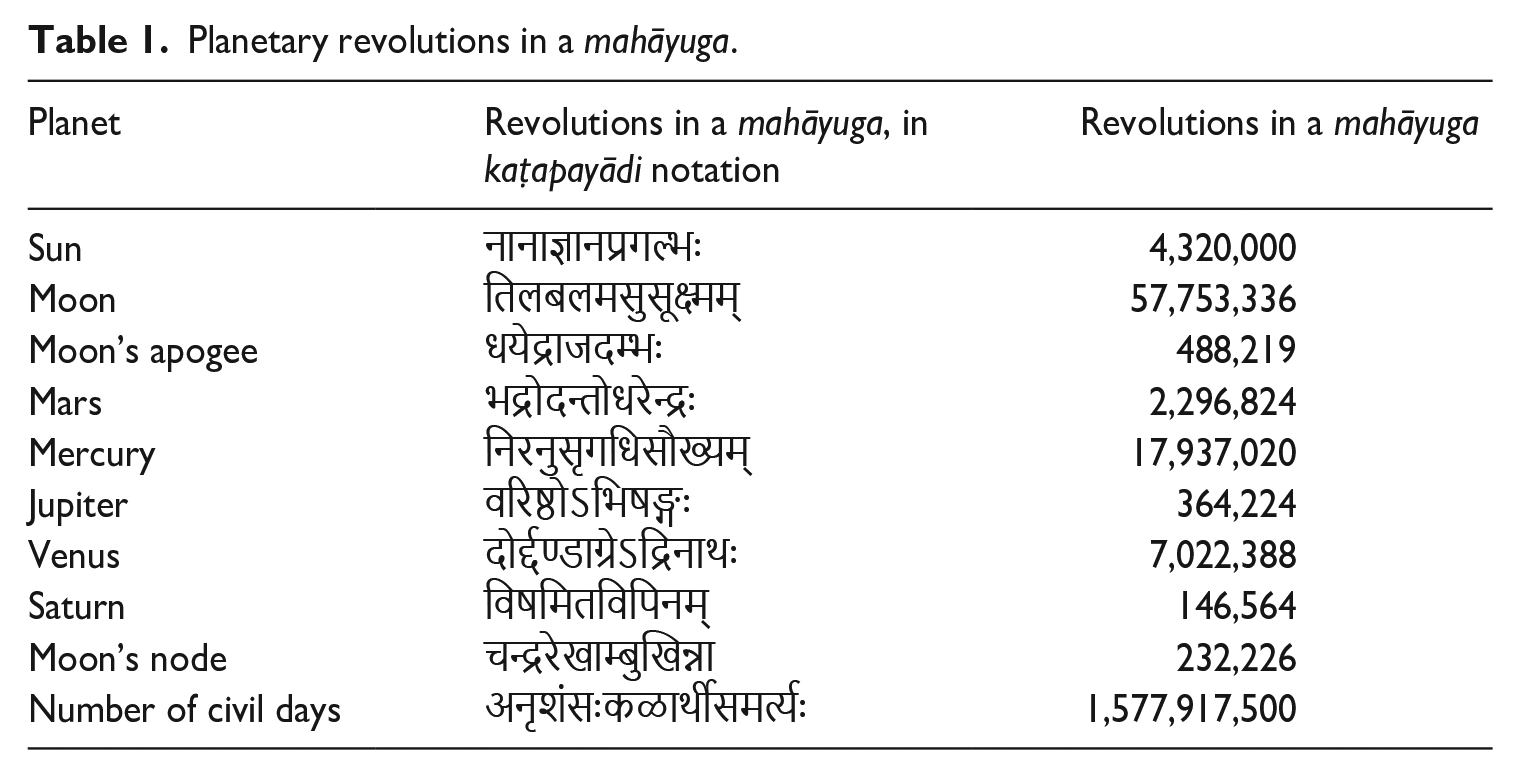
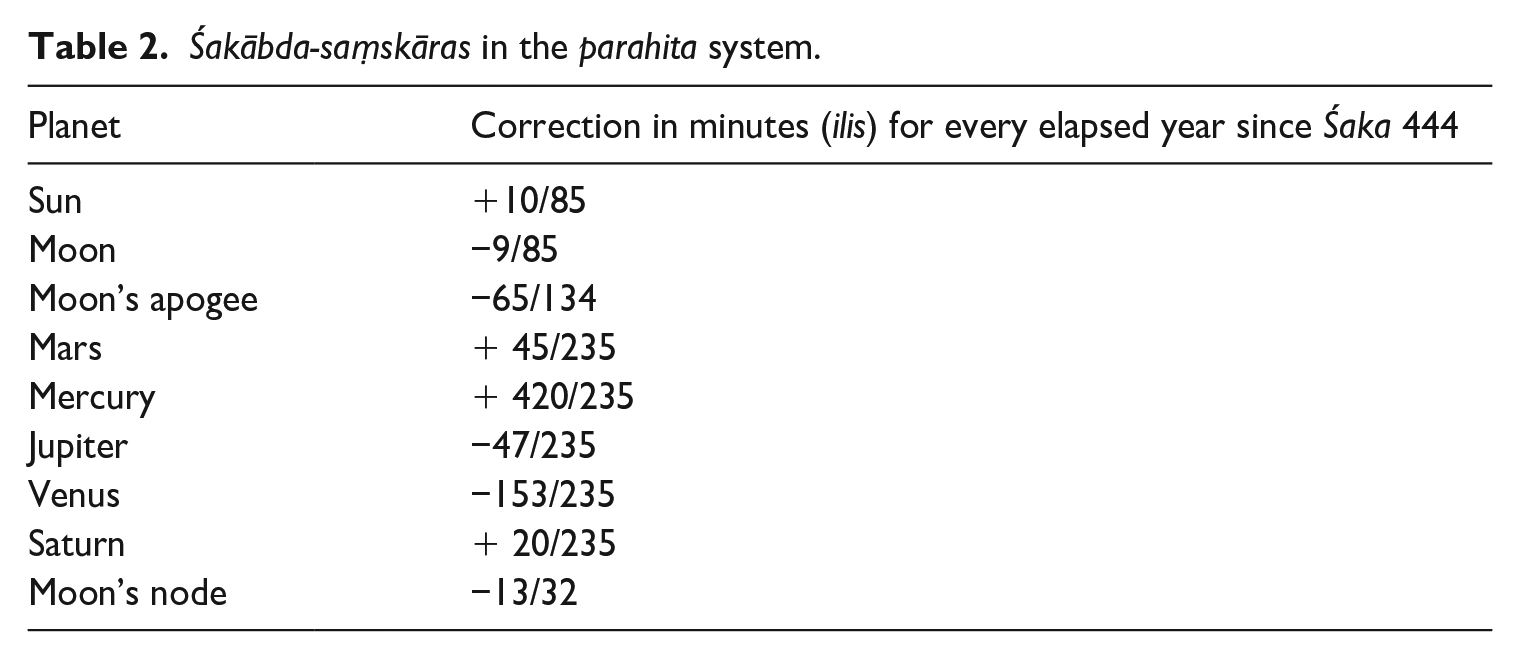
The number of revolutions of the Sun and the rest [of the planets] are 4,320,000, 57,753,336, 488,219, 2,296,824, 17,937,020, 364,224, 7,022,388, 146,564, and 232,226. The number of civil days [in a mahāyuga] is 1,577,917,500. (Verse 1). After subtracting 444 from the śaka year and multiplying [respectively] by 9, 65, and 13, and dividing [respectively] by 85, 134 and 32, [the resulting values in] the units of minutes subtracted from the [respective] longitudes are the [corrected] longitudes of the moon, its apogee and its node [respectively].
8
Multiplying [respectively] by 45, 420, 47, 153 and 20, and dividing by 235 gives the longitudes for Mars and the rest. Addition [is prescribed] for Mercury, Mars and Saturn, and subtraction for Jupiter and Venus, and the sun is exempted. (Verse 2) The mean longitude of the sun, in degrees, multiplied by 10, further multiplied by 9 and the rest as stated here, and divided by 85 and the rest, are to be applied [respectively] to the moon and the rest, in units of thirds. (Verse 3)
Translation of the Malayāḷam commentarial text: These three Sanskrit verses are followed by an extensive, and somewhat repetitive, commentary in Malayāḷam. Following is the translation of this Malayāḷam commentary in full. For readability, the commentary has been sectioned into separate paragraphs that each deal with the computations for consecutive celestial bodies in the order previously enumerated.
The procedure for these computations is as follows: Having kept the [number of civil days elapsed since the start of] kali [at one place], it is multiplied by the number of revolutions of the sun [in a mahāyuga], namely, nānājñānapragalbhaḥ (4,320,000) [recorded at another place], and divided by the divisor, namely, the number of civil days (bhūdina-paryyayam),
9
namely, anṛśaṃsaḥkaḷārtthīsamartyaḥ (1,577,917,500), which has been kept [at yet another place]; the result so obtained is called vṛthāphalam. And then, multiply [the successive remainders] consecutively by 12, 30 and 60, and divide [by the number of civil days, as specified earlier], and [the result thus obtained is expressed in rāśis] up to minutes.
10
Then multiply [the next three successive remainders] consecutively by 60, [and divide by the number of civil days, as specified earlier] and so derive the vilis, gurvakṣaras and talparas. (seconds, fourths, and thirds).
11
The mean value so obtained is kept aside and converted to units of rāśi and tiyyati (degrees), and multiplied by 10 and divided by 85 (manda). If the result thus obtained is considered to be in units of vili and the rest, and added [to the mean longitude of the sun], a more precise value of the mean longitude is obtained. This gives the [fractional portion of the current] revolution of the sun. This is the method for obtaining the dhruva value (mean longitude at a given point in a desired epoch) of the sun. In order to check whether or not this [value] is appropriate [i.e., comparable to the accurate value], take an already known khaṇḍa value [from a pre-existing, readily available, already calculated table of khaṇḍas and their corresponding dhruvas], compute the mean longitude of the sun [corresponding to the difference between the desired ahargaṇa and this selected khaṇḍa] add [using the correction method described above,] the correction computed for this difference, and add the dhruva value [corresponding to the chosen khaṇḍa in the table already referred to] for a [more] precise value. This is [the calculation for] the sun. Next, [the procedure for] the moon (candra) is stated. Having kept the [number of civil days elapsed since the start of] kali [at one place], it is multiplied by [the number of revolutions of the moon in a mahāyuga,] tilabalamasusūkṣmaṃ (57,753,336) [recorded at another place], and divided by the divisor, namely, the number of civil days (bhūdina-paryyayam), namely, anṛśaṃsaḥkaḷārtthīsamartyaḥ (1,577,917,500), and the result so obtained is the vṛthāphalam. And then, multiply [the successive remainders] consecutively by 12, 30 and 60, and divide [by the number of civil days, as specified earlier], and [the result thus obtained is expressed] up to minutes. Then multiply [the remainder] by 60, and divide [by the number of civil days, as specified earlier] and so derive the vili; once again, multiply by 60 and divide, and the gurvakṣara so obtained is kept aside; yet again, multiply by 60 and divide, and set aside the resulting talpara.
12
Next, taking the number of śaka years elapsed with respect to the desired ahargaṇa
13
and subtracting 444 from it, multiply the resultant value by 9 (dhana) and divide by 85 (manda); the result is multiplied by 60
14
and expressed in units of ili (minutes) and the rest, and subtracted from the [mean longitude of the] moon. Thus, a more precise value of the mean longitude is obtained. In order to check whether or not this [value] is appropriate [i.e., comparable to the accurate value], take the khaṇḍa which had been chosen earlier [in the computation of the sun], compute the mean longitude of the moon [corresponding to the difference between the desired ahargaṇa and this selected khaṇḍa] add [using the correction method described above,] the correction computed for this difference, and add the dhruva value [corresponding to the chosen khaṇḍa in the table already referred to] for a [more] precise value. This is the computation for the moon. Next, [the procedure for] the moon’s apogee (tuṅga) is stated. Having kept the [number of civil days elapsed since the start of] kali [at one place], it is multiplied by [the number of revolutions of the moon’s apogee in a mahāyuga,] dhayedrājadambho (488,219) [recorded at another place], and divided by the divisor, namely, anṛśaṃsaḥkaḷārtthīsamartyaḥ (1,577,917,500), and the result so obtained is the vṛthāphalam. Then, multiply [the successive remainders] by 12, 30 and 60 [expressed not in decimal numerals as before but in kaṭapayādi notation as priya, nāga and nīta],
15
and divide [at each multiplicative step by the number of civil days, as specified earlier],
16
and [the result thus obtained is expressed] up to minutes. Then multiply [the remainder] by 60, and divide [by the number of civil days, as specified earlier] and derive the vili. Once again, multiply by 60 and divide, and place the talpara so obtained below it. Once again, multiply by 60 [here, the number 60 is uniquely represented using a distinct system of numerical representation of digits]
17
and divide, and set aside the resulting gurvakṣara. Next, taking the number of śaka years elapsed with respect to the desired ahargaṇa and subtracting 444 from it, multiply the resultant value by 65 (śatam) and divide by 134 (vailakṣyam); the result expressed in minutes (ili) and the rest is subtracted [from the mean longitude of the moon’s apogee]. Then three rāśis are to be added to [this corrected mean longitude of] the moon’s apogee. In order to check whether or not this [value] is appropriate [i.e., comparable to the accurate value], take the khaṇḍa [which had been chosen earlier in the computation of the sun and moon], compute the [mean longitude of the] moon [corresponding to the difference between the desired ahargaṇa and this selected khaṇḍa] add [using the correction method described above,] the correction computed for this difference, and add the dhruva value [corresponding to the chosen khaṇḍa in the table already referred to] for a [more] precise value. If there is no difference between the two [the two values which are the computed corrected mean longitude and the value computed using the tabulated khaṇḍa and dhruva], this [corrected value] is accurate. This is the procedure for the precise longitude of the moon’s apogee. Next, [the procedure for] Mars (covva) is stated. @ @ @ @
18
Having kept the [number of civil days elapsed since the start of] kali [at one place], it is multiplied by [the number of revolutions of Mars in a mahāyuga,] bhadrodantodharendraḥ
19
(2,296,824) [recorded at another place], and divided by the divisor, namely, anṛśaṃsaḥkaḷārtthīsamartyaḥ (1,577,917,500), and the result so obtained is the vṛthāphalam. Then, multiply [the successive remainders] by 12, 30 and 60, and consecutively divide [by the number of civil days, as specified earlier], and [the result thus obtained is expressed] up to minutes. Next, taking the number of śaka years elapsed with respect to the desired ahargaṇa and subtracting 444 from it, multiply the resultant value by 45 (śobha) and divide by 235 (māgaram); if to the value [of the mean longitude of Mars] is added this result expressed in ili and the rest, the accurate value [of Mars’ longitude] is obtained. In order to check whether or not this [value] is appropriate [i.e., comparable to the accurate value], take the khaṇḍa which had been chosen earlier [in the earlier computations], compute the mean longitude of Mars [corresponding to the difference between the desired ahargaṇa and this selected khaṇḍa] add [using the correction method described above] the correction computed for this difference, and add the dhruva value [corresponding to the chosen khaṇḍa in the table already referred to]; if there is no difference between the two [the two values which are the computed corrected mean longitude and the value computed using the tabulated khaṇḍa and dhruva] this [corrected value] is [a more] precise value. This is how the precise longitude of Mars is to be obtained. Next, [the procedure for] Mercury (budha) is stated. Having kept the [number of civil days elapsed since the start of] kali [at one place], it is multiplied by [the number of revolutions of Mercury in a mahāyuga,] niranusṛgadhisaukhyaṃ (17,937,020) [recorded at another place], and divided by the divisor, namely, anṛśaṃsaḥkaḷārtthīsamartyaḥ (1,577,917,500), and the result so obtained is the vṛthāphalam. Then, successively multiply [the successive remainders] by 12, 30 and 60, and divide [consecutively by the number of civil days, as specified earlier], and [the result thus obtained is expressed] up to minutes. Next, taking the number of śaka years elapsed with respect to the desired ahargaṇa and subtracting 444 from it, multiply the resultant value by 420 (nīrūḍhaṃ) and divide by 235 (māgaram); this result [expressed] in ili and the rest is added to [the mean longitude of] Mercury. Next, in order to check whether or not this [value] is appropriate [i.e., comparable to the accurate value], take the khaṇḍa which had been chosen earlier [in the earlier computations], compute the mean longitude of Mercury [corresponding to the difference between the desired ahargaṇa and this selected khaṇḍa] add [using the correction method described above] the correction computed for this difference, and add the dhruva value [corresponding to the chosen khaṇḍa in the table already referred to]; if there is no difference between the two [the two values which are the computed corrected mean longitude and the value computed using the tabulated khaṇḍa and dhruva] this [corrected value] is [a more] precise value. This is the procedure for computing the precise longitude of Mercury. Next, [the procedure for] Jupiter (vyāḻa) is stated. Having kept the [number of civil days elapsed since the start of] kali [at one place], it is multiplied by [the number of revolutions of Jupiter in a mahāyuga,] variṣṭhobhiṣaṅgaḥ (364,224) [recorded at another place], and divided by the divisor, namely, anṛśaṃsaḥkaḷārtthī [here, anṛśaṃsaḥkaḷārtthīsamartyaḥ is what is intended, although it is not specified in full] (1,577,917,500), and the result so obtained is the vṛthāphalam. Then, successively multiply [the successive remainders] by 12, 30 and 60, and divide [consecutively by the number of civil days, as specified earlier], and [the result thus obtained is expressed] up to minutes. Next, taking the number of śaka years elapsed with respect to the desired ahargaṇa and subtracting 444 from it, multiply the difference by 47 (saṃvil) and divide by 235 (māgaram); this result [expressed] in ili and the rest is subtracted from [the mean longitude of] Jupiter to get its corrected longitude. To check whether or not this [value] is appropriate [i.e., comparable to the accurate value], take the khaṇḍa which had been chosen earlier [in the earlier computations], compute the mean longitude of Jupiter [corresponding to the difference between the desired ahargaṇa and this selected khaṇḍa] add [using the correction method described above,] the correction computed for this difference, and add the dhruva value [corresponding to the chosen khaṇḍa in the table already referred to]; if there is no difference between the two [the two values which are the computed corrected mean longitude and the value computed using the tabulated khaṇḍa and dhruva] this [corrected value] is [a more] precise value. This is the procedure for computing the corrected longitude of Jupiter. Next, [the procedure for] Venus (śukra) is stated. Having kept the [number of civil days elapsed since the start of] kali [at one place], it is multiplied by [the number of revolutions of Venus in a mahāyuga,] dorddaṇḍāgredrinātho (7,022,388) [recorded at another place], and divided by the divisor, namely, anṛśaṃsaḥkaḷārtthī [as in the case of Jupiter earlier, anṛśaṃsaḥkaḷārtthīsamartyaḥ is what is intended here, although it is not specified in full] (1,577,917,500), and the result so obtained is the vṛthāphalam. Then, multiply [the successive remainders] by 12, 30 and 60, and divide [consecutively by the number of civil days, as specified earlier], and [the result thus obtained is expressed] up to minutes. Next, taking the number of śaka years elapsed with respect to the desired ahargaṇa and subtracting 444 from it, multiply the resultant value by 153 (gaṇaka) and divide by 235 (māgaram); this result is multiplied by 60 and [expressed] in ili and the rest, and is subtracted from the mean longitude [of Venus] to get its corrected longitude. To check whether or not this [value] is appropriate [i.e., comparable to the accurate value], take the khaṇḍa which had been chosen earlier [in the earlier computations], compute the mean longitude of Venus [corresponding to the difference between the desired ahargaṇa and this selected khaṇḍa] add [using the correction method described above,] the correction computed for this difference, and add the dhruva value [corresponding to the chosen khaṇḍa in the table already referred to]; if there is no mutual difference [between the two values, which are the computed corrected mean longitude and the value computed using the tabulated khaṇḍa and dhruva], this [corrected value] is [a more] precise value. This is the procedure for [computing the corrected longitude of] Venus. Next, [the procedure for] Saturn (śani) is stated. Having kept the [number of civil days elapsed since the start of] kali [at one place], it is multiplied by [the number of revolutions of Saturn in a mahāyuga,] viṣamitavipinaṃ (146,564) [recorded at another place], and divided by the divisor, namely, anṛśaṃsaḥkaḷārtthīsamartyaḥ (1,577,917,500), and the result so obtained is the vṛthāphalam. Then, multiply [the successive remainders] by 12, 30 and 60, and divide [consecutively by the number of civil days, as specified earlier], and [the result thus obtained is expressed] up to minutes. Next, taking the number of śaka years elapsed with respect to the desired ahargaṇa and subtracting 444 from it, multiply the resultant value by 20 (nara) and divide by 235 (māgaram); this result is multiplied by 60 and [expressed] in ili and the rest, and is added to [the mean longitude of] Saturn. Thus, its corrected longitude is obtained. To check whether or not this [value] is appropriate [i.e., comparable to the accurate value], take the khaṇḍa which had been chosen earlier [in the earlier computations], compute the mean longitude of Saturn [corresponding to the difference between the desired ahargaṇa and this selected khaṇḍa] add [using the correction method described above,] the correction computed for this difference, and add the dhruva value [corresponding to the chosen khaṇḍa in the table already referred to]; if there is no mutual difference [between the two values, which are the computed corrected mean longitude and the value computed using the tabulated khaṇḍa and dhruva], this [corrected value] is [a more] precise value. This is the procedure for computing the corrected longitude of Saturn. Next, [the procedure for] the moon’s node (rāhu) is stated. Having kept the [number of civil days elapsed since the start of] kali [at one place], it is multiplied by [the number of revolutions of the moon’s node in a mahāyuga,] candrarekhāṃbukhinnā (232,226) [recorded at another place], and divided by the divisor, namely, anṛśaṃsaḥkaḷārtthīsamartyaḥ (1,577,917,500), and the result so obtained is the vṛthāphalam. Then, successively multiply [the successive remainders] by 12, 30 and 60, and successively divide [by the number of civil days, as specified earlier], and [the result thus obtained is expressed] up to minutes. Next, taking the number of śaka years elapsed with respect to the desired ahargaṇa and subtracting 444 from it, multiply the resultant value by 13 (layam) and divide by 32 (rāgam); this result [expressed] in ili and the rest, is subtracted from [the mean longitude of] the moon’s node. Next add 6 rāśis to it. Then, to perform the maṇdala-śodhana, take 12 rāśis (or 360 degrees), and if the longitude obtained by the division above is subtracted from it, the corrected longitude is obtained. To check whether or not this [value] is appropriate [i.e., comparable to the accurate value], take the khaṇḍa which had been chosen earlier [in the earlier computations], compute the mean longitude of the moon’s node [corresponding to the difference between the desired ahargaṇa and this selected khaṇḍa], add [using the correction method described above,] the correction computed for this difference, and add the dhruva value [corresponding to the chosen khaṇḍa in the table already referred to]; if there is no mutual difference [between the computed corrected mean longitude and the value computed using the tabulated khaṇḍa and dhruva] this [corrected value] is [a more] precise value. This is the parahita procedure for computing the khaṇḍas and their associated corrected longitudes.
20
Mathematical notes and comparative analyses
Uncorrected planetary mean longitudes
The first Sanskrit verse of the text encodes the number of planetary revolutions in a mahāyuga, and these are presented in Table 1.
Planetary revolutions in a mahāyuga.
Let
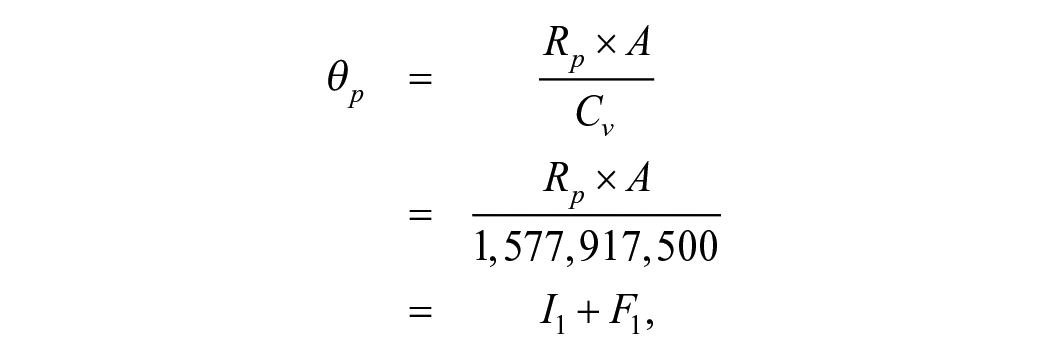
where

The integral part of the above equation (

Here, the integral part,

Here, the integral part,

Here, the integral part,

Here, the integral part,

Here, the integral part,

Although this is the general procedure followed in calculating the mean longitude for all planets, there are some additional steps prescribed in the case of the moon’s apogee and the moon’s node. For the moon’s apogee, 3 rāśis (90 degrees) are added as a final step. In the case of the moon’s node, the additional steps involve adding 6 rāśis (180 degrees) to the result, and then subtracting this value from 12 rāśis (360 degrees). In the case of the moon’s node, these two steps are equivalent to a single step of subtracting from 6 rāśis.
Next, this general procedure is illustrated with a specific example, taking the case of the moon. We use the date of June 21, 2024 which corresponds to an ahargana value of 1,872,017.
For the moon,

The integral part, 68,517, represents the number of completed revolutions from the beginning of kali upto the point of ahargaṇa. The fractional part 0.66762 is multiplied by

Thus, 8 rāśis have been covered by the moon in the current revolution. The fractional part, 0.011454683, multiplied by

Here, the moon has covered 0 degrees, and the number of minutes it has covered in the current degree is got by multiplying 0.343640477 by

Here, the moon has covered 20 minutes in the current degree, and the number of seconds covered in the current minute is obtained by multiplying 0.61842862 by

Here, the moon has covered 37 seconds in the current minute, and the number of thirds covered in the current second is obtained by multiplying 0.10571695 by

So, the moon has covered 6 thirds in the current second, and the number of fourths covered in the current third is got by:

So, the moon has covered 20 fourths in the current third. Thus, the mean longitude of the planet can be expressed as

Corrected planetary mean longitudes
The procedure above provides the uncorrected mean longitudes of the planets. The next set of verses provides a correction term which is to be applied to the [uncorrected] mean longitude of the planets, in the form of a multiplier and divisor pertaining to each planet. The commentary of the Parahitakaraṇam interprets the set of verses where these parameters are enumerated differently from the Karaṇapaddhati and its commentaries. 22
This correction, known as the śakābda correction and prescribed in Verses 2 and 3 of the Parahitakaraṇam, is denoted below as

where
Śakābda-saṃskāras in the parahita system.
Now, in the previous example, the uncorrected mean longitude of the moon is given as

Applying the moon’s parameters specified in the above table to the equation for the correction term,
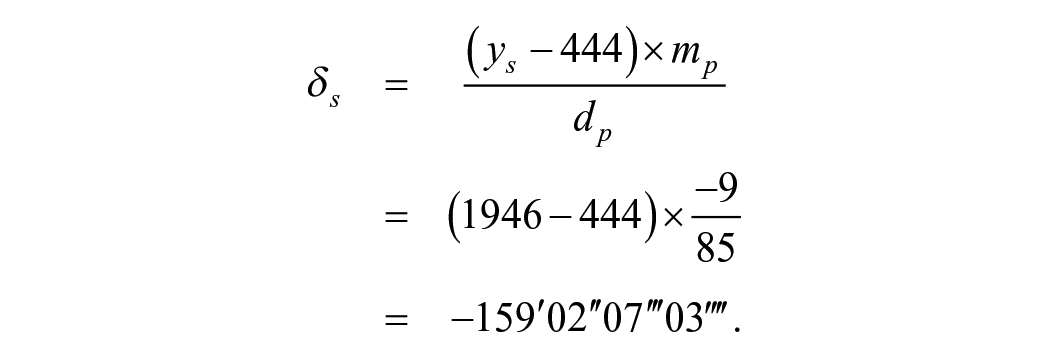
Therefore, the corrected mean longitude of the moon (
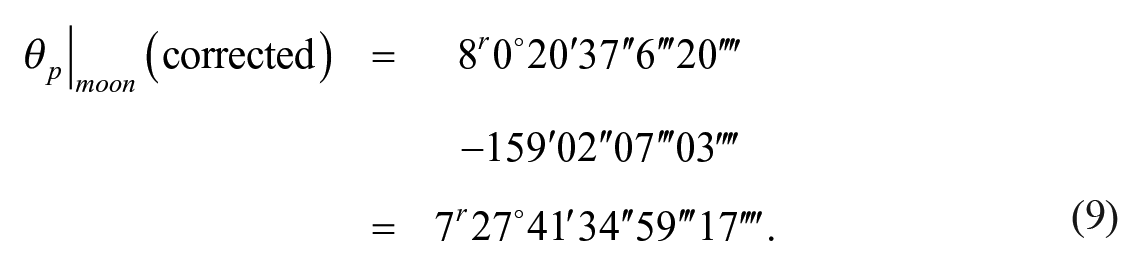
Similarly, the corrected mean longitudes for all the planets have been computed and summarized in the second column of Table 4. It is noteworthy that the Parahitakaraṇam interprets the correction procedure for the planets somewhat differently from the Karaṇapaddhati. The Karaṇapaddhati does not mention a correction term for the sun, whereas the Parahitakaraṇam specifies it as
The verification procedure of the Parahitakaraṇam
The Parahitakaraṇam introduces a novel verification procedure to check the accuracy of the computations following the above procedure. This necessitates the use of an already tabulated set of planetary dhruva 24 values pertaining to a fixed khaṇḍa value. Here, for the purpose of calculation, we have adopted the khāṇḍa parameter and corresponding planetary dhruva values shown in Table 3. These values are taken from an earlier printed Malayāḷam commentary, and would have been typically available in astronomical tables of the period.
Planetary dhruva values corresponding to khaṇḍa = 1,772,786.
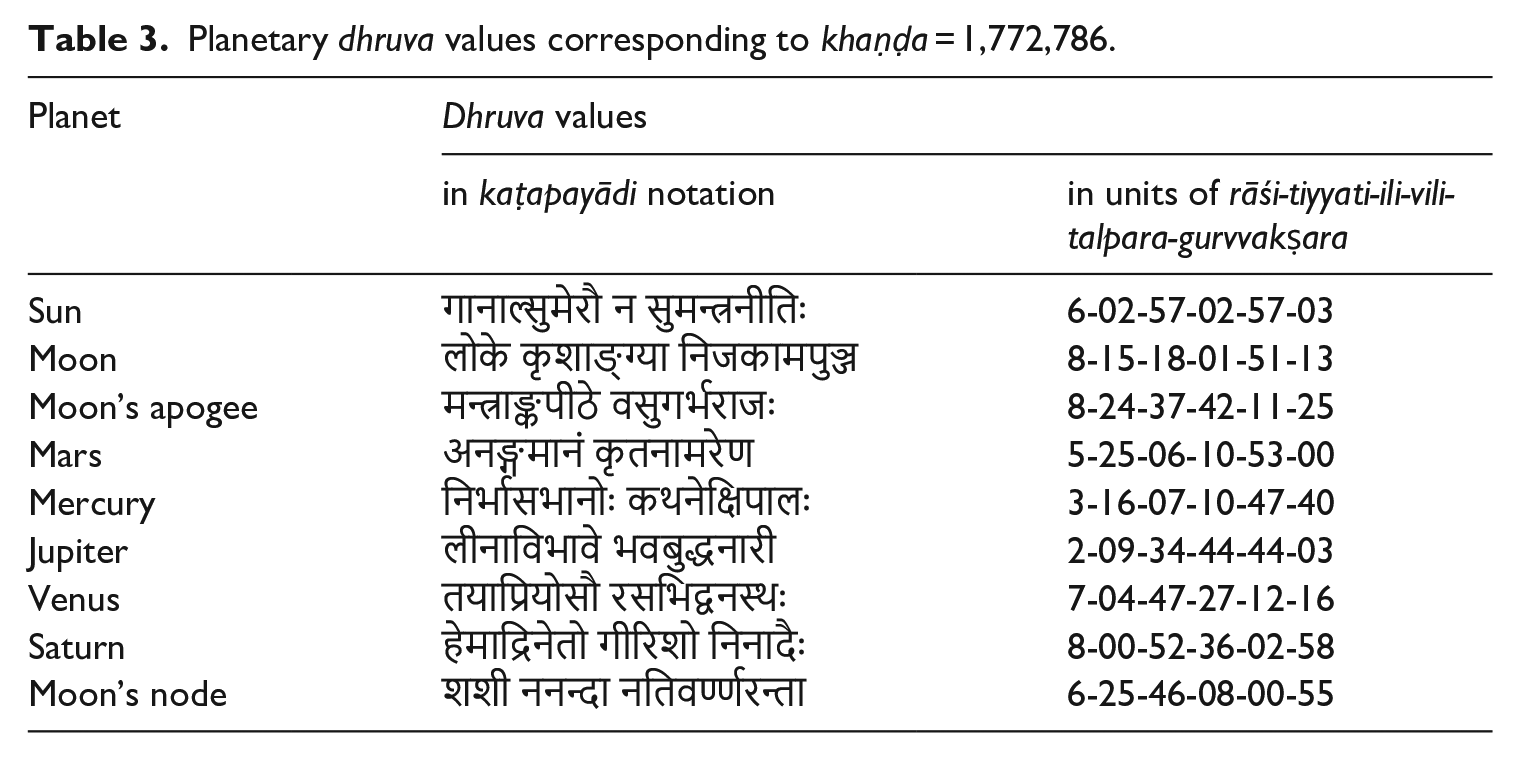
The verification procedure first involves finding the difference between the ahargaṇa and khaṇḍa, and then then applying the same procedure detailed above to the value of this difference. As part of this process, the correction procedure detailed above is also applied, and further, an additional step involving the addition of the appropriate dhruva values to the corrected planetary mean longitude corresponding to this difference is applied. This is illustrated below with the example of the verification procedure pertaining to the corrected mean longitude of the moon, continuing with the example above.
Let the khaṇḍa,

Now, following the procedure outlined above, the uncorrected mean longitude of the moon for
Let
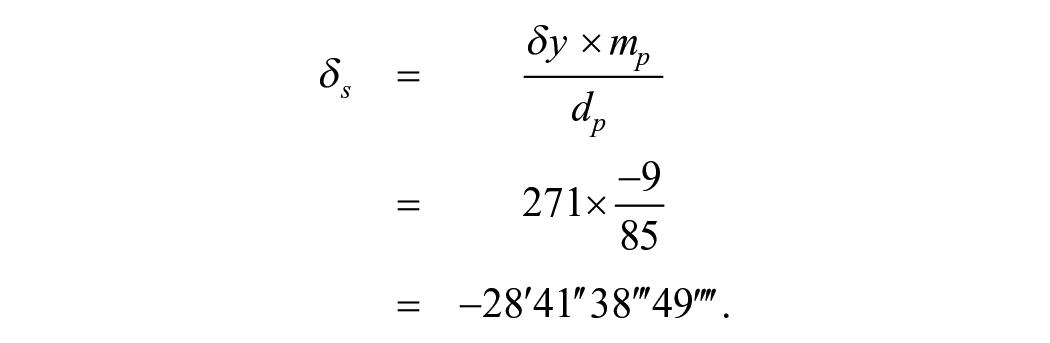
Applying the correction term above to the uncorrected mean longitude of the moon now gives the value of the corrected mean longitude of the moon as
The dhruva value for the moon,
This verified result for the corrected mean longitude of the moon and the extent of deviation between the two are presented in Table 4, which also includes similar calculations for the remaining planets.
Comparison of Parahitakaraṇam values of corrected mean longitude for June 21, 2024.
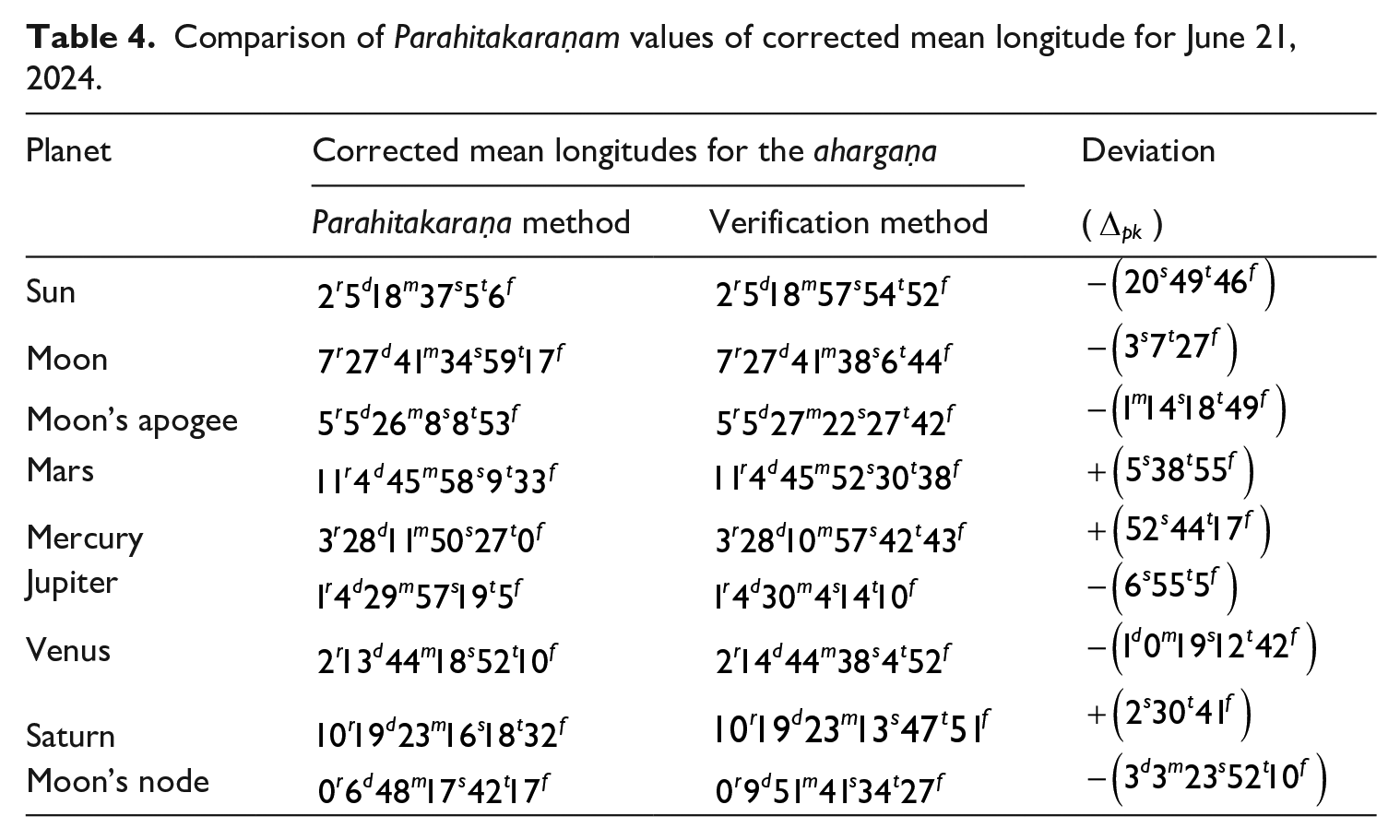
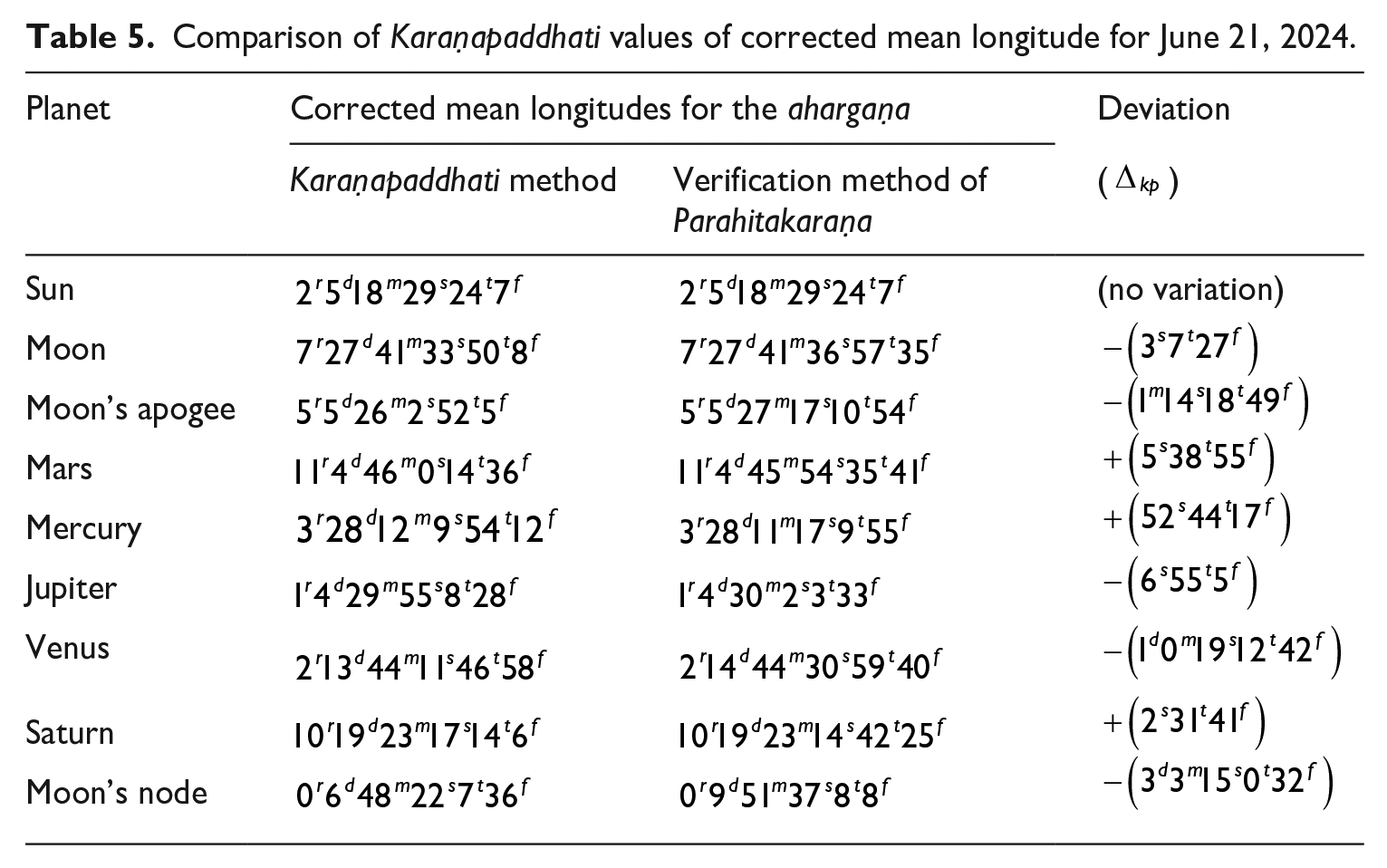
Similarly, Table 5 recreates the same results following the method of the Karaṇapaddhati, and then applies the verification method outlined in the Parahitakaraṇam to these values, and also lists the deviation between these two sets of values in the third column.
Comparison of Karaṇapaddhati values of corrected mean longitude for June 21, 2024.
Concluding remarks
Although titled the Parahitakaraṇam, this text differs considerably from the Grahacāranibandhana of Haridatta, who is generally considered to be the founder and primary exponent of the parahita system. Further, while this text references verses from the canonical Karaṇapaddhati, its interpretation of these verses and its computational methodology shows some significant variations from the Karaṇapaddhati’s procedures. This text also presents a novel verification procedure, hitherto not encountered in earlier texts. A more detailed analysis of this text from a pedagogical and methodological standpoint will be forthcoming in a future article.

Representation of the number 60.

Use of special symbol.
Supplemental Material
sj-pdf-1-jha-10.1177_00218286251346592 – Supplemental material for Parahitakaraṇam: A medieval formulary manual in the Kerala vernacular for calculating planetary mean longitudes
Supplemental material, sj-pdf-1-jha-10.1177_00218286251346592 for Parahitakaraṇam: A medieval formulary manual in the Kerala vernacular for calculating planetary mean longitudes by Priyamvada Nambrath and Venketeswara R. Pai in Journal for the History of Astronomy
Footnotes

Supplemental material
Supplemental material for this article is available online.
Notes
Notes on contributor
Supplementary Material
Please find the following supplemental material available below.
For Open Access articles published under a Creative Commons License, all supplemental material carries the same license as the article it is associated with.
For non-Open Access articles published, all supplemental material carries a non-exclusive license, and permission requests for re-use of supplemental material or any part of supplemental material shall be sent directly to the copyright owner as specified in the copyright notice associated with the article.
