




Abstract
In 2022, Gysembergh et al. published a paper in JHA claiming ‘New evidence for Hipparchus’ Star Catalogue’. In this paper we challenge this hypothesis by stating that (a) we disagree with their astronomical dating and find inconsistencies by using the given numbers, and (b) the terminology and the data format used in the palimpsest do not match Hipparchus or anybody else. Therefore, the palimpsest does not prove anything about Hipparchus’s star catalogue nor did Hipparchus use rectangular constellation borders. Specifically, the constellation of Corona Borealis, typically depicted as a circle since Babylonian times, is not considered a rectangle by Hipparchus. Furthermore, a palimpsest that cannot be dated properly does not confirm the long-known relationship between Hipparchus and Ptolemy as the authors claim.
Introduction
Peter J. Williams published a newly discovered palimpsest of the mediaeval Codex Climaci Rescriptus (henceforth CCR). 1 In JHA 55, 4, Gysembergh, Williams and Zingg 2 proposed an interpretation of one fragment, claiming that it contains new evidence for Hipparchus’ lost Star Catalog being significantly more accurate than his successor Claudius Ptolemy.
In this article, we check their astronomical interpretation. Thankfully, we made use of the edition and translation of Hipparchus’s Commentary to Aratus and Eudoxus by Manitius (1894), 3 the unpublished English translation by MacFarlane and Mills provided in 2014, 4 Toomer’s (1984) 5 translation of the Almagest that is based on Heiberg’s (1898) edition of the text and the free astronomy software Stellarium. 6 Additionally, we have drawn on a dissertation on the reconstruction of Hipparchus’s celestial globe 7 whose findings were not considered by the interpretation of the palimpsest presented by Gysembergh et al.
Extraction of information
The text preserves a characterization of the constellation Corona Borealis (στέφανος) as a constellation of the northern hemisphere (ἐν τῷ βορείῳ ἡμισφαιρίῳ). In antiquity, a constellation was considered ‘northern’ if it was north of the ecliptic. However, the constellation is both, ‘north of the ecliptic’ and ‘north of the equator’, so this statement does not point to any specific coordinate system. The equatorial coordinate system would be the more intuitive one because of the continuous apparent motion of the celestial sphere during the night. However, the star catalogue in Ptolemy’s Almagest uses an ecliptic coordinate system in order to provide stability one coordinate (latitude) over time and make the other coordinate (longitude) easily computable for readers in the centuries to come after the author. 8 In another book (Alm. V), Ptolemy describes a complex instrument of multiple rings with which he claims to be able to measure the ecliptic coordinates directly. 9 Gysembergh et al. (2022) claim to have found that Hipparchus used an armillary sphere and that he used an equatorial frame of reference. Hence, this hypothetical armillary sphere would be different from the instrument described in the Almagest. As there is no older description of an armillary sphere (only a later one, called ‘meteoroscope’ in Ptolemy’s Geography 10 which is even more complex than the one described in the Almagest consisting of six rings instead of eight), there is no reason to conclude from the numbers found in the palimpsest that Hipparchus used an armillary sphere.
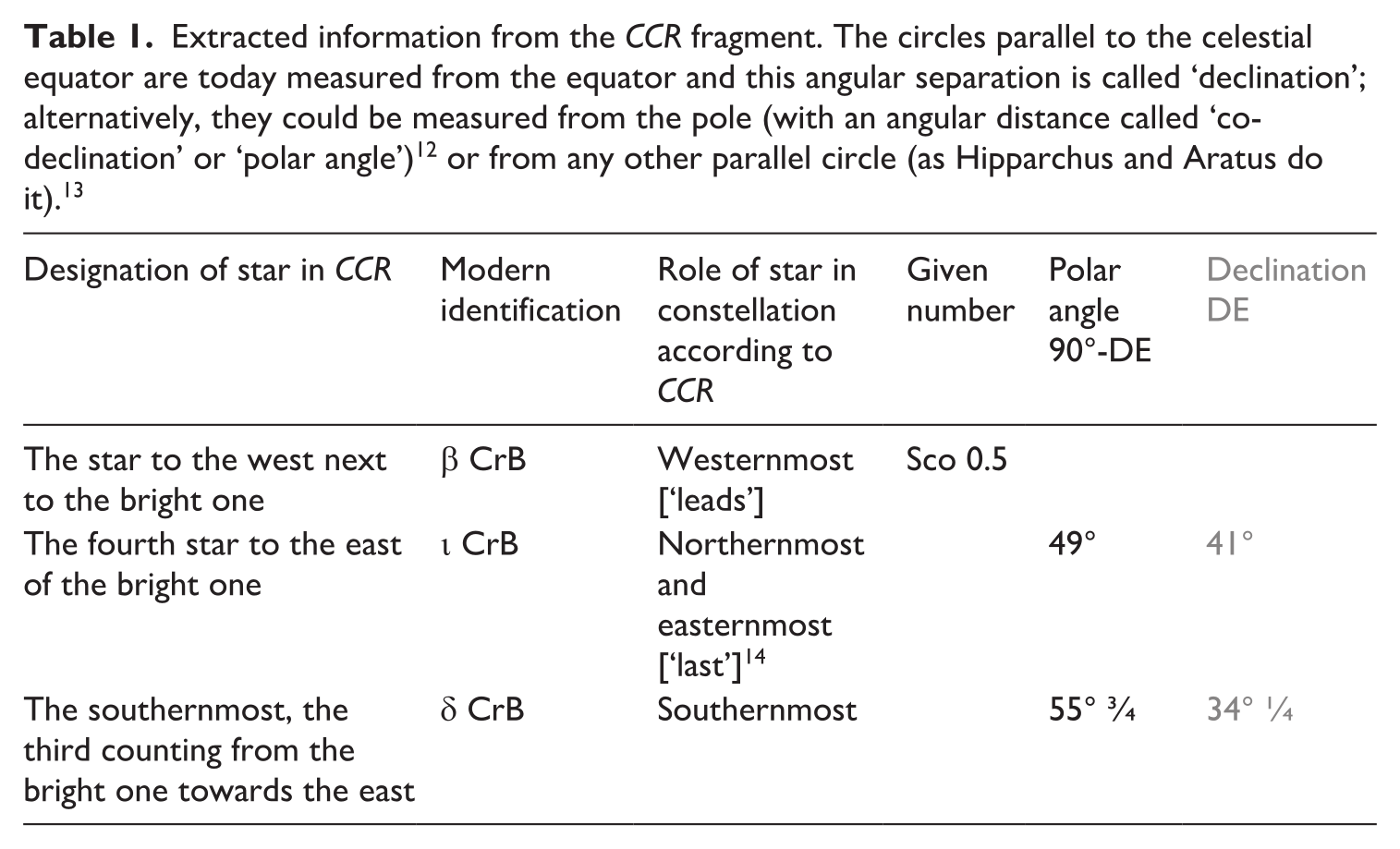
The text of the palimpsest continues with a rough characterization of the area of Corona Borealis in the sky by its northernmost, southernmost, easternmost and westernmost star. The westernmost point of a constellation does not automatically imply a westernmost line of a rectangle 11 ; a circle would also have a westernmost point. The modern readers seem to derive the rectangle from the fact that a point is simultaneously northernmost and easternmost but considering the spherical motion of the sky this conclusion is not necessary. The width and height of the area in degrees on the sphere indicate roughly an area but not necessarily a boundary box. The CCR fragment mentions three stars with the data compiled in Table 1:
Extracted information from the CCR fragment. The circles parallel to the celestial equator are today measured from the equator and this angular separation is called ‘declination’; alternatively, they could be measured from the pole (with an angular distance called ‘co-declination’ or ‘polar angle’) 12 or from any other parallel circle (as Hipparchus and Aratus do it). 13
We will examine whether they are taken from Hipparchus’ texts. His Commentary on the poem by Aratus and a now lost star catalogue (or register) by Eudoxus has three parts. In the first part, Hipparchus discusses inaccuracies in the popular verses and their supposed source in Eudoxus’s writings. In the second part, Hipparchus presents his own very schematic way of describing risings and settings of constellations with simultaneous culminations. As culminating stars are a measure of time, Hipparchus appends a list of ‘hour stars’, that is, stars marking hour lines (or lines of right ascension/hour angle as it is called in our terminology), which forms the third part of his book. This last part already demonstrates that right ascensions are used by Hipparchus and there is no need for this to be proven by modern scholarship. The research question on Hipparchus’ coordinate system targets the state of the ecliptic coordinate system: (i) did he use orthogonal ecliptic coordinates in his lost star catalogue, which Ptolemy could have directly copied? (ii) did Hipparchus measure direct ecliptic coordinates (which Ptolemy claims to have performed with the armillary sphere in Alm. V), or was the equatorial ‘longitude’ in his star catalogue (the right ascension) measured with a clock, or were they even copied from earlier Greek or Babylonian measurements? These questions are discussed in Hoffmann, Hipparchs Himmelsglobus but the new CCR manuscript is unfortunately not able to contribute to this research.
Hipparchus’s frame of reference in the first and second part of his Commentary is bound to Aratus’s description and therefore uses simultaneously rising/setting ecliptic degrees and simultaneously culminating ecliptic degrees. This is not an orthogonal coordinate system. For example he states in I.5.4
For, no star lies under the one in the tip of the Dragon’s tail, except the northern of those which lead in the Rectangle [of UMa]. The star in the tip of the Dragon’s tail holds its place on a parallel circle at about 3° of the Lion. And the star in question, the one of the Rectangle, holds its place a little less than 3° of the Lion.
Here, Hipparchus describes the position of two culminating stars (λ Dra, α UMa) by stating that the point of the ecliptic ‘Leo 3° culminates simultaneously. Rephrased in our mathematical language, he states that this point and the two stars share a common right ascension (which we are able to compute with a simple coordinate transformation 15 of the point with ecliptic coordinates (λ, β) = (Leo 3°, 0) to equatorial coordinates). Although he does not mention a specific equatorial coordinate (RA, DEC), it is clear from geometry that he uses an equatorial frame of reference although the only given number is on the line of the ecliptic.
Similar passages are found in I.7.11 16 where he connects a star in the ‘middle of the heaven’ (culminating) to a simultaneously culminating point of the ecliptic and a simultaneously rising point of the ecliptic, and in II.2.25 17 where he directly gives a declination of a star. Thus, there is absolutely no doubt from Hipparchus directly that he used both orthogonal equatorial coordinates, right ascension and declination. However, this does not at all prove anything concerning his lost star catalogue because its format might have deviated from the direct measurements and the information read from a globe (an analogue calculator) which he used to write his Commentary. For instance, Hoffmann, Hipparchs Himmelsglobus 18 pointed out that Hipparchus while writing his Commentary did not use magnitudes. If Pliny’s 19 claim is correct that he measured (and possibly invented) magnitudes as an expression of stellar brightness for his lost star catalogue and the surviving Commentary does not witness them, there could have been a step of reformatting in between. In other words: it is not excluded that Hipparchus observed equatorial coordinates and computed ecliptic coordinates from them using a globe or an analemma instrument, as Sidoli has also suggested. 20
Comparison of terminology
Number format
Half degrees
The new palimpsest states for Corona Borealis: ‘τοῦ σκορπίου τῆς α̅ μ°τὸ ἥμισυ’ which is translated by Gysembergh et al. (Note 2) as ‘0.5 degrees of the Scorpion’. Literally it is written ‘of the Scorpion of the first degree the half’ better rendered as ‘the half of the first degree of the Scorpion’.
When Hipparchus refers to the first part of an ecliptic sign, his terminology is ἀρχή (origin or beginning) because zero as a number was not yet in use. In Book III, V.8 he describes the hour circle of β CrB in these terms: ‘The second one-hour interval is delineated at about the beginning of (ἀρχή) the Scorpion by . . . ’. The number ‘0.5°’ or ‘zero plus a half’ is not easily expressible with ‘a half after the origin’ and he uses another number format anyway. In case of the hour stars Hipparchus mentions intervals of angular separation from the hour line. In his originally own text on rising and setting constellations, 21 half degrees are expressed with a reference to the next full degree, for example, in the case of the rising of the Crown 22 : Χηλω̃ν ε’ μοίρας μέσης ( . . . the fifth degree halved), 23 in our numbers: 4.5° (or 5° minus a half). The case of the first half degree of a sign would be given by Hipparchus as ‘the first degree halved’ as proven in the case of the rising of the Snake 24 : ἕως Τοξóτου μοίρας α’ μέσης (‘the first degree halved’ or 1° minus a half). Although the mathematical meaning is the same, Hipparchus differs from wording in the new palimpsest which gives ‘one degree, the half’ (cf. Table 2).
Comparison of wording in the palimpsest and Hipparchus.

Hipparchus’s manuscript has the schema ‘[constellation] rises/sets with the fraction of the ecliptic from X to Y’. Thereafter, he gives the stars that he used to determine these degrees. In contrast, the palimpsest directly speaks of star coordinates. Hoffmann, in her reconstruction of Hipparchus’s globe, argued that this globe was embedded in a (wooden?) horizontal plane and had a physical (wooden?) meridian circle. 25 Hipparchus would have used this globe to write his scholarly commentary on Aratus and, as physically built circles and planes have a thickness, these tools of measurement will have covered a fraction of the globe’s scales (e.g. the scale engraved in the ecliptic). Hippachus’s ‘μοίρας’ would therefore not refer to points (ticks on a line) but to the segments of the great circle that are covered by a physically built plane or circle. Together with the fact that the smallest unit Hipparchus uses is 0.5°, this leads to the conclusion that the built measurement tools on his globe covered sections of half degrees. 26
Rendering of size
An additional issue is the terminology concerning the size of a constellation. The palimpsest uses the terms ‘length’ and ‘width’ which is interpreted by Gysembergh et al. as referring to the extent in ecliptic longitude and latitude, respectively. In Hipparchus’s preserved text on the rising and setting of constellations, he does not use these terms. His rather schematic descriptions of the simultaneously rising/setting and culminating degrees of the ecliptic are always concluded with the statement about the duration of the process of rising or setting of the specific constellation. For Corona Borealis, his data of simultaneously passing ecliptic degrees is summarized in Table 3: supposing that he took one of these intervals as ‘length’ of the constellation, would that be the 7.5°λ (or 10.5°λ) that transit the horizon simultaneously during the rising (setting) or one of the intervals of culmination?
Data given by Hipparchus and intervals computed by us (bold).
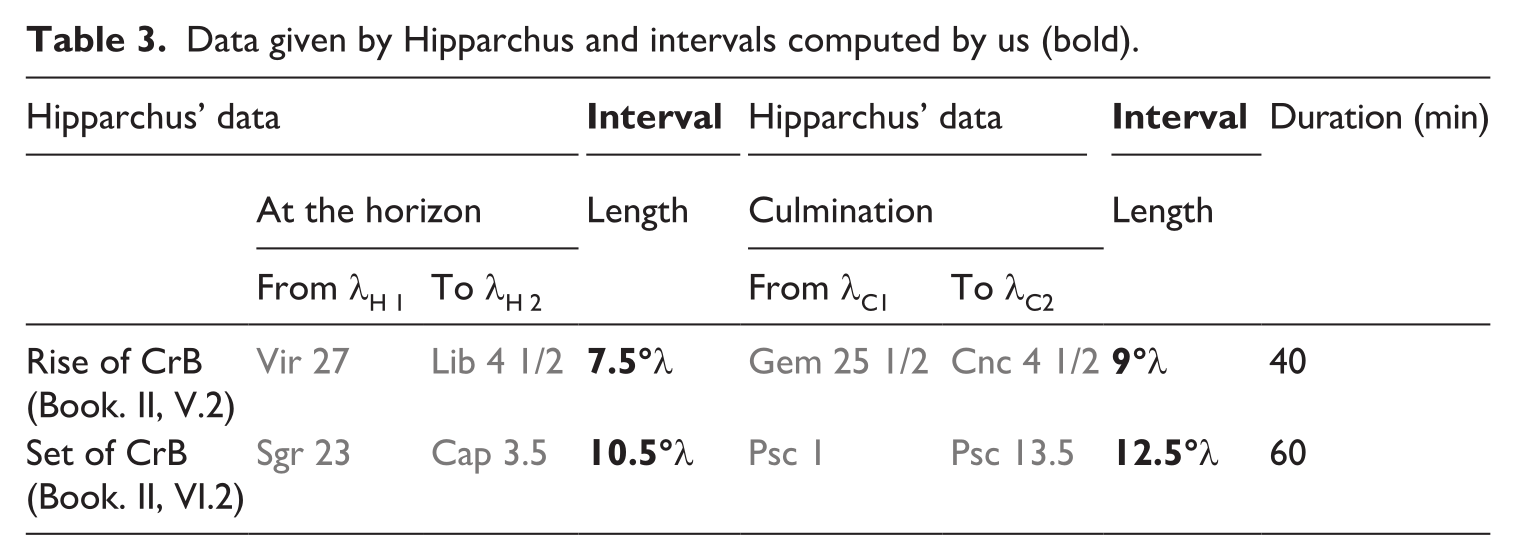
Table 3 shows that for Hipparchus, the rising Crown was shorter than the setting Crown. This is a strong argument against the claim by Gysembergh et al. that there had been constellations borders similar to those internationally defined in the 1920s. 27
Thus, Gysembergh et al. interpret their text in the CCR as a rephrasing of Hipparchus’s terminology concerning half degrees by the later scribe. Furthermore, Hipparchus does not speak about the ‘length’ and ‘width’ of a constellation but only about the duration of its rising and setting. Hipparchus does not give degrees but hours (or fractions of hours) to describe their size which again emphasizes the rephrasing. The palimpsest does not have Hipparchus’s terminology and style!
Star names
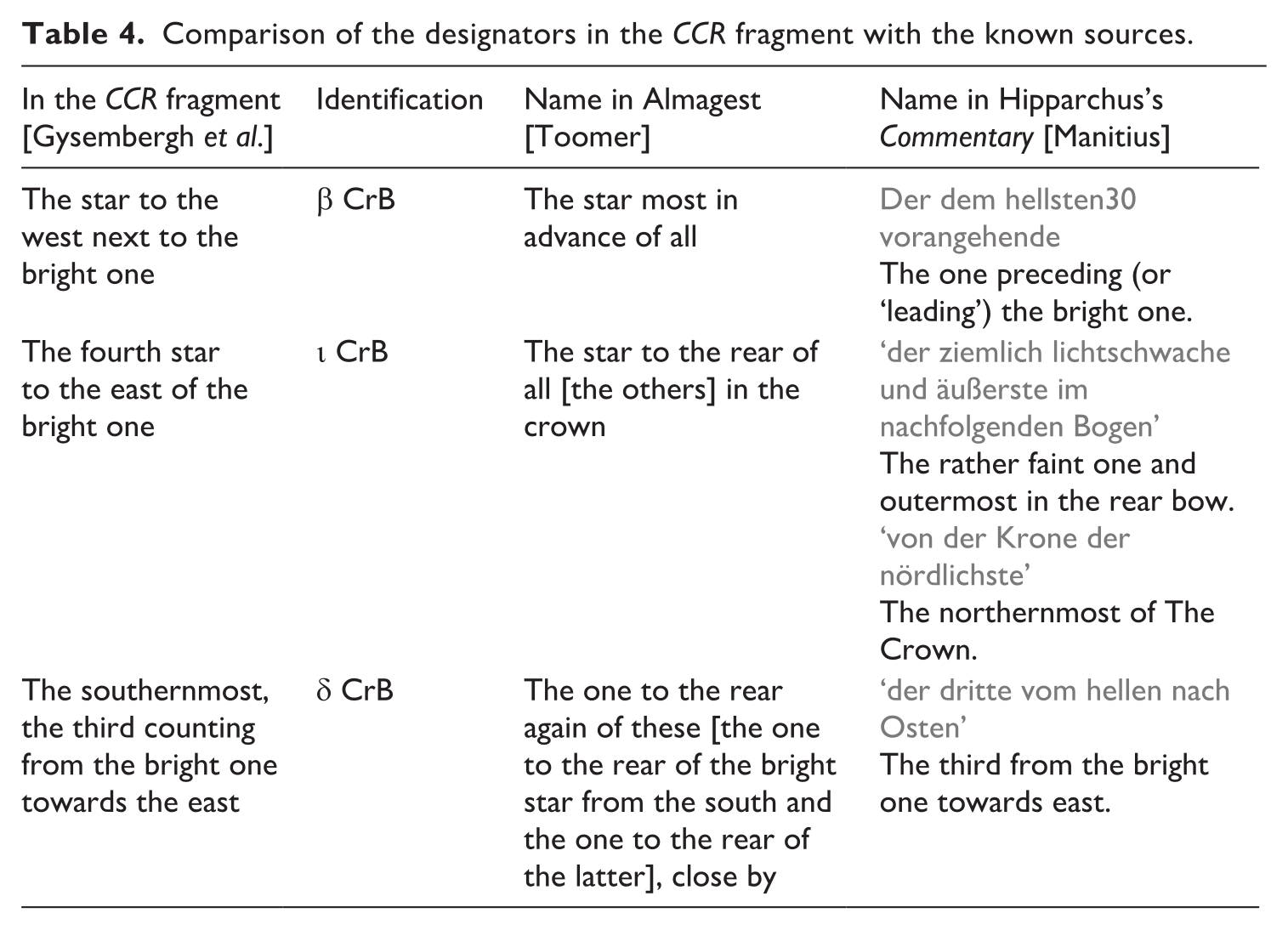
The designations of the stars in the ancient star lists are compared in Table 4. The first star rising is β CrB in all three texts, the Almagest, Hipparchus’ Commentary and the CCR fragment. It is described as ‘the most advanced one’ in the Almagest while Hipparchus’ designates it ‘the one in front of the bright one’ 28 and the CCR fragment calls it ‘the star to the west next to the bright one’. The first star setting is not the same as the first star rising. 29 The first one setting is ‘the bright one’ (α CrB, see Figure 1) which is correctly stated by Hipparchus – but not distinguished in the CCR fragment. In terms of the last star of the constellation that rises and sets, Hipparchus, the Almagest (‘rear of all’) and the CCR manuscript all refer to ι CrB although this is not true for the setting as shown in Figure 1. It is a common mistake of all three star lists.
Comparison of the designators in the CCR fragment with the known sources.
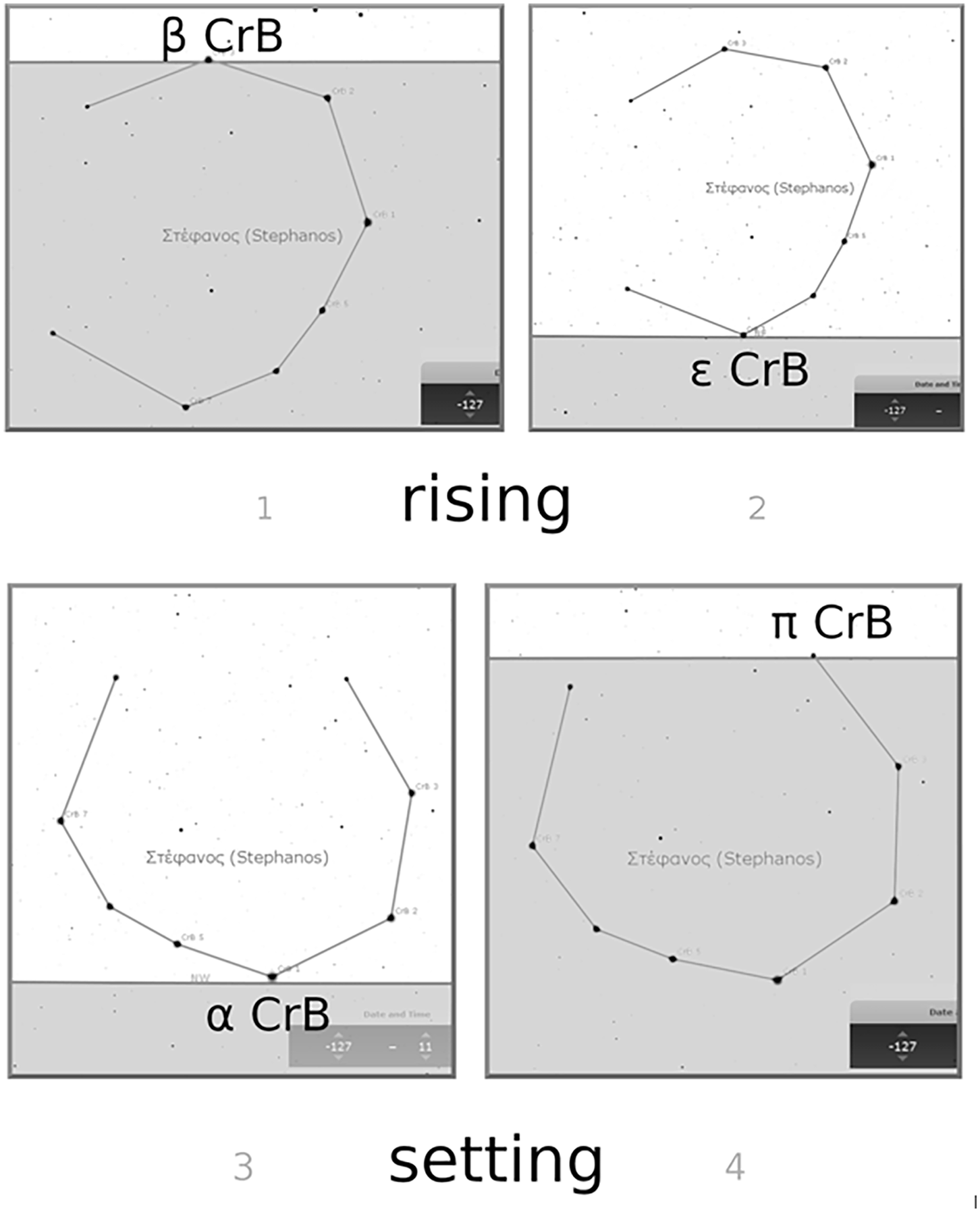
Corona Borealis rising (subfigures 1+2) and setting (subfigures 3+4) at the 36° latitude north for which Hipparchus made his computations. Straight line: local horizon, simulation with Stellarium (the inner label is the constellation name displayed in the software). First star rising β CrB, last one rising ε CrB, first one setting α CrB, last one setting π CrB.
Actually, ι CrB is mentioned twice in Hipparchus’s section on setting stars: First, as the last star setting of Corona Borealis where he calls it ‘the rather faint one and outermost in the rear arc’ 31 and second, as ‘the last one of the Crown’ 32 culminating simultaneously with the beginning of the setting of Auriga (ι Aur) at the right ascension of the section Vir 2 on the ecliptic. 33 In the Almagest star catalogue ι CrB is listed as ‘the rear of all in the crown’ with fourth magnitude like all the other stars in the ring. In contrast, Hipparchus is right that ι CrB is rather faint (4.95 mag) in comparison to the other stars (typically roughly 4 mag with the exception of α CrB with 2.2 mag). 34 Independently of the magnitudes, because of the simple shape of the asterism the identifications are certain although the wording to describe the star is not consistent.
Concluding, the designations of β CrB and δ CrB in the new fragment are more similar to Hipparchus’s wording than to Ptolemy’s because these two authors refer all stars to the bright one while Ptolemy’s designators refer some points to the previous in his list. Obviously, Ptolemy’s method only works in a catalogue with a subsequent listing and not in a plain text like Hipparchus’s one. As in Hipparchus’ Commentary, the fragment does not provide a complete list of stars (like in a catalogue).
However, the exact wordings in Hipparchus and the CCR fragment are different and the new palimpsest does not provide more than three star names while Hipparchus’s Commentary gives 505 designators, referring to 320 different stars 35 among which 20% (62–67 depending on identification) can be reconstructed with full coordinates and 73% are given with their right ascension. 36 As the three phrases to designate the stars in the CCR and Hipparchus’s text deviate from each other and more samples are not provided, it cannot be concluded whether the text of the CCR palimpsest is or is not based upon Hipparchus’s work. The description of star positions may be independently written or may share common sources.
This does not allow for any conclusion on the source of the fragment: We can only state that the exact wording in the fragment is neither copied from any of the preserved texts by Ptolemy nor by Hipparchus.
Comparison of numbers
Ptolemy
The ecliptic coordinates given in the Almagest, provide longitudinal degrees in Libra for all three stars (Table 5). Therefore, the degrees in the CCR fragment are not copied from the Almagest.
Comparison of the data in the fragment with the preserved data and computed with Stellarium for the epoch and equinox of 137 CE.
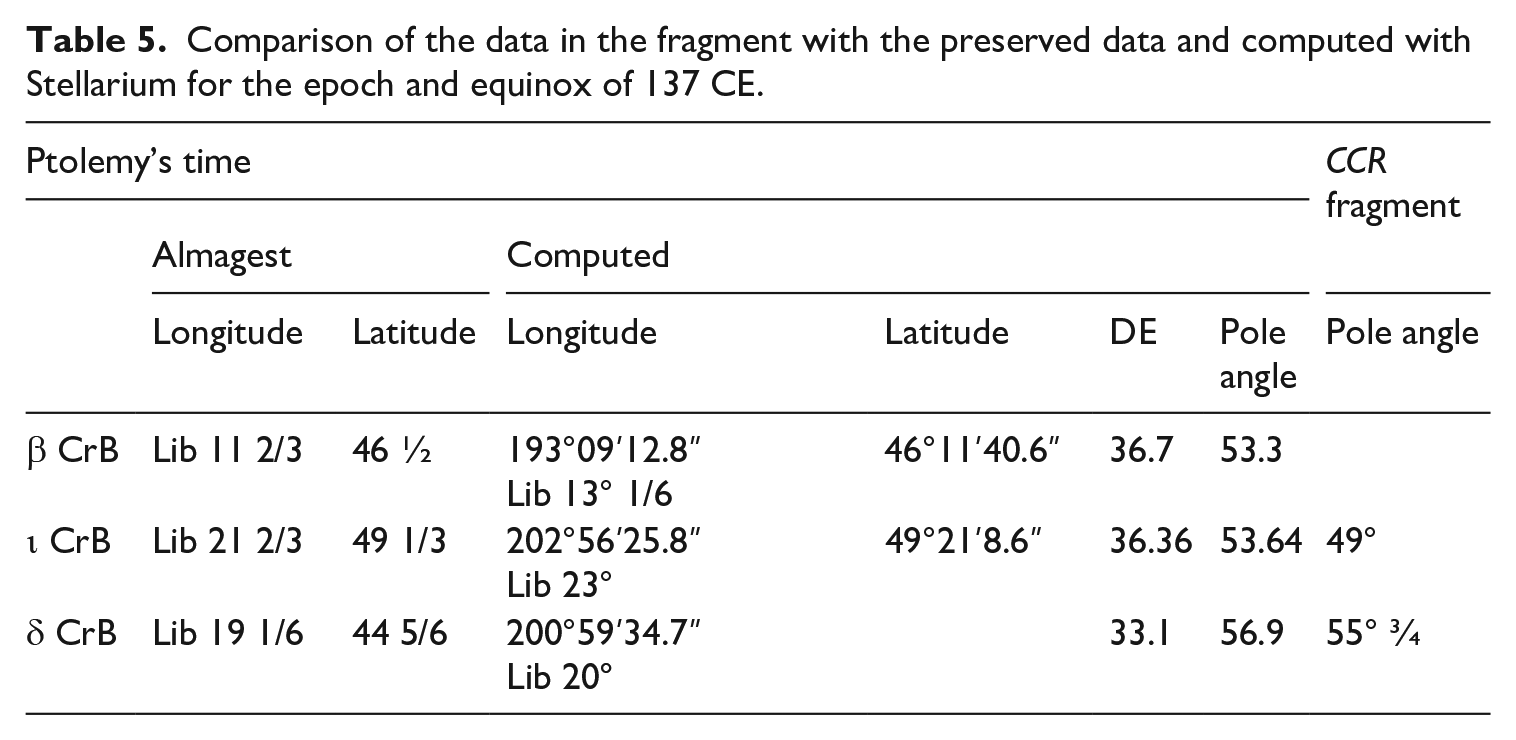
The table shows that even the polar angle in Ptolemy’s time does not match the angle given in the text. The fractions of the degrees in the CCR manuscript are not as small (10ʹ) as in the Almagest, too.
Hipparchus
For Hipparchus’ manuscript the situation is a bit more complicated because there are no orthogonal coordinates. The computed coordinate ‘ecliptic longitude’ λ for the three stars would still be in Libra implying that the palimpsest does certainly not fit Hipparchus’s time if this number is interpreted as ecliptic longitude. β CrB had the ecliptic degree of Sco 0.5 (210°30ʹλ) as late as the years 1383–1385 CE. Supposing that the text underlying the Coptic manuscript is more than a millennium older, this number cannot refer to ecliptic longitudes directly. Yet, as Hipparchus uses various frames of reference that are not necessarily orthogonal, one might find a different type of coordinate. 37 In the first part of his Commentary (II.1–II.4), discussing Aratus verse-by-verse is bound to his frame of reference of observable risings/settings (horizon frame). Yet, Hipparchus gives 42 declinations, 38 34 transits through the horizon, 5 pairs of coordinates (right ascension, declination) and 27 longitudes and right ascensions. 39 In the second part (Book II.5–III.4), he follows a very strict new schema of simultaneously rising/setting ecliptic longitudes and simultaneously culminating longitudes (in our language: right ascensions or hour angles defined by points on the ecliptic) 40 while in the third part (Book III.5) of his commentaries, he defines hour stars with mere right ascensions 41 and without any reference to the ecliptic. Hence, Hipparchus’ last section cannot be related to the new palimpsest, only the simultaneous culminations fulfil the criteria of matching the format ‘zodiacal sign, number’.
As stated above, nobody seriously doubts that Hipparchus made use of an equatorial frame of reference because it is explicitly given in the text but this frame is not unique to Hipparchus (it is the traditional frame of reference that has been used in Babylonian astronomy and by Hipparchus’ contemporary, cf: the many examples that are compared to Hipparchus in Hoffmann, Hipparchs Himmelsglobus). The uniqueness in Hipparchus’s frame of reference is his simultaneously culminating ecliptic degree. It appears as if he was about to change to ecliptic coordinates (which was already common in contemporary Babylonian lists of ‘normal stars’ 42 ), but was bound to Aratus’s horizonframe when he commented on him. His resulting schema of reading right ascensions by using the meridian of a globe marking a section of the ecliptic with a scale is a non-orthogonal frame that combines all three coordinate systems.
The studies of errors in Hipparchus’s text in comparison to other historical sources, for example, Ptolemy’s Almagest, studied by Grasshoff in The History of Ptolemy’s Almagest, and various Babylonian texts, studied by Hoffmann in Hipparchs Himmelsglobus, contributed to the understanding of transfer of knowledge. 43 Hipparchus never confuses right ascensions and ecliptic longitudes as it would be required by Gysembergh et al. when they read ‘Sco 0.5’, equalling 210°λ as 210.5°RA (their Table 5). It is part of his criticism of Aratus that one could misunderstand from the poem that the zodiacal signs could be used in the same way as right ascensions/hour angles for time keeping. We will discuss this issue in the following paragraphs on the specific information in the palimpsest.
β CrB
Hipparchus mentions β CrB culminating simultaneously with the ecliptic degree Sco 2.5 while the last star of Cassiopeia (ζ Cas) rises (Book II, Cap. V, §9). 44 In this frame of reference (simultaneous culminations), Hipparchus (Sco 2.5) is not consistent with the CCR fragment (Sco 0.5). In other words: if the newly discovered CCR fragment gave a simultaneous culmination, it would contradict Hipparchus’ original text by 2° which cannot be explained by a simple writing error.
β CrB is also mentioned by Hipparchus in his list of hour stars in the second appendix of the text (Book III.V.8). There, he states that the star is 2 hours and 2 minutes east of the autumn colure. Translated to our common terms for coordinates, this equals the right ascension 12 hours + 2 hours 2 minutes = 14 hours 02 minutes (210.5°RA). Here, obviously Hipparchus contradicts his earlier statement of β CrB being at right ascension Sco 2.5 (=212.5°RA). He states that the ‘middle one among the three bright stars in the forehead’ (δ Sco) of the Scorpion is at the same right ascension. This star (δ Sco) is also given as simultaneously culminating with the end of the rising of Cassiopeia and simultaneously culminating with the ecliptic degree Sco 2.5 which is identical with the simultaneous culmination directly given for β CrB itself (cf. Table 6). 45 The fact that Hipparchus’ statements about the right ascension of these two stars (β CrB and δ Sco) in the second part of his Commentary contradicts his statements in its third part is a specific confirmation of the conclusion by Hoffmann that Hipparchus’s hour stars are based on a different source than his schematic risings and settings because of different error bars of the two data sets.
Comparison of the data in the fragment with the preserved and computed data. The simulation (with Stellarium) proves Hipparchus correct and the CCR deviating.
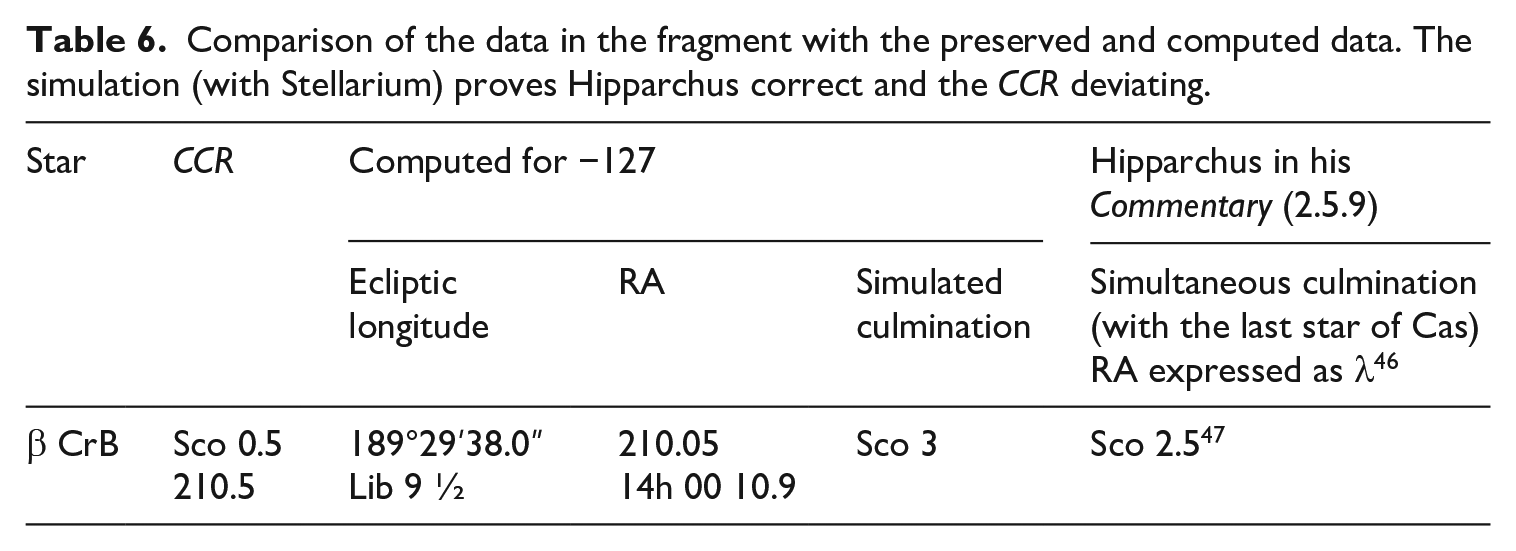
The number given in the text (‘Sco 0.5’) is not a right ascension but a point on the ecliptic. This ecliptic degree has a right ascension of 208.5°RA in Hipparchus’ time. Hipparchus referring to the star β CrB at 210.5°RA culminating during the rise of the last star of Cassiopeia correctly gives the degree of the ecliptic that culminates with this right ascension (Sco 2.5). The palimpsest simply takes ‘Sco 0.5’ which means ‘210.5° of along the ecliptic’ (or 210.5°λ) as ‘210.5° along the equator’ which is mathematically wrong. The author of the CCR mixes the coordinate systems.
In other words: Hipparchus states β CrB to be at 210.5°RA and culminating together with Sco 2.5 (=212.5°λ) while the palimpsest claims β CrB to be at Sco 0.5 (=210.5°λ) equalling 208.5°RA.
Conclusion: Hipparchus’s Commentary to Aratus gives no reason to interpret the number connected to the star β CrB in the CCR fragment as a derivative of Hipparchus’ text.
ι CrB
The CCR preserves a pole distance for this star but in Hipparchus’s Commentary to Aratus, no measure for the latitude or declination of this star is mentioned. Thus, we cannot compare it.
CCR mentions the westernmost point of CrB at Sco 0.5 equalling 210.5° longitude. As the length (or width) is given in the text as 9 1/4 degree, the easternmost point should be at 219.75° longitude (Sco 9 ¾). 48 Supposing that the easternmost and westernmost points of the constellation are marked by stars, the easternmost point should be at the ‘last star rising’ or/and ‘last star setting’ which is in all of our texts ι CrB. If this proved correct and the ‘length’ or ‘width’ is given in the ecliptic coordinate system, ι CrB should be at 219.75°.
However, none of the premisses here is certain: (i) It is not at all certain that the beginning and end of a constellation are marked by stars, and (ii) it is not given in what coordinate system the ‘length’ is meant. In Ptolemy’s works (the Almagest and the Geography), the Greek terms ‘length’ and ‘width’ are used for the coordinates in orthogonal spherical coordinates (modern: longitude and latitude). In contrast, Hipparchus gives ‘durations’ for the processes of risings and settings implying that he has a concept of width or length that equals the modern right ascension. For Corona Borealis, he states ⅔ of an hour (40 minutes, 10°RA) for the rising of the constellation but 1 hour (60 minutes, 15°RA) for its setting. Astronomically, this makes sense only if he simulated the rising and setting with an instrument (e.g. with a globe as assumed by Hoffmann, or with an analemma tool as Sidoli proposed) because this is where the astronomical effect of image field rotation over a circular horizon line comes into play (cf. Figure 1). The different durations for rising and setting also prove that he did not have the concept of a fixed ‘length’ (or boundary lines) of a specific constellation.
It should be remarked that the duration of 10° for the rising of Corona Borealis fits the ‘length’ in the CCR fragment within the error bars for right ascensions of roughly 1° (Hoffmann) 49 but the difference between the length (9.25°) and the setting duration (15°RA) exceeds the typical uncertainty of Hipparchus’s measurements by 288%. The fact that the values (9.25° and 10°, or 9.25° and 15°) differ at all, disproves Hipparchus as the source for the CCR. These two numbers could still be derived from the same source (the same globe or armillary sphere) but the CCR data is not a copy of Hipparchus’s text. However, it should be pointed out that Hipparchus’s data can be interpreted in the way that 9° of the ecliptic culminate simultaneously while the constellation of CrB sets (Table 7) but the rest of Hipparchus’s data says that 7.5° of the ecliptic rise simultaneously, 10.5° set simultaneously and 12.5° culminate during its setting. Thus, no certain conclusion can be drawn from the few numbers of the manuscript.
Comparison of the data in the fragment with the preserved and computed data.
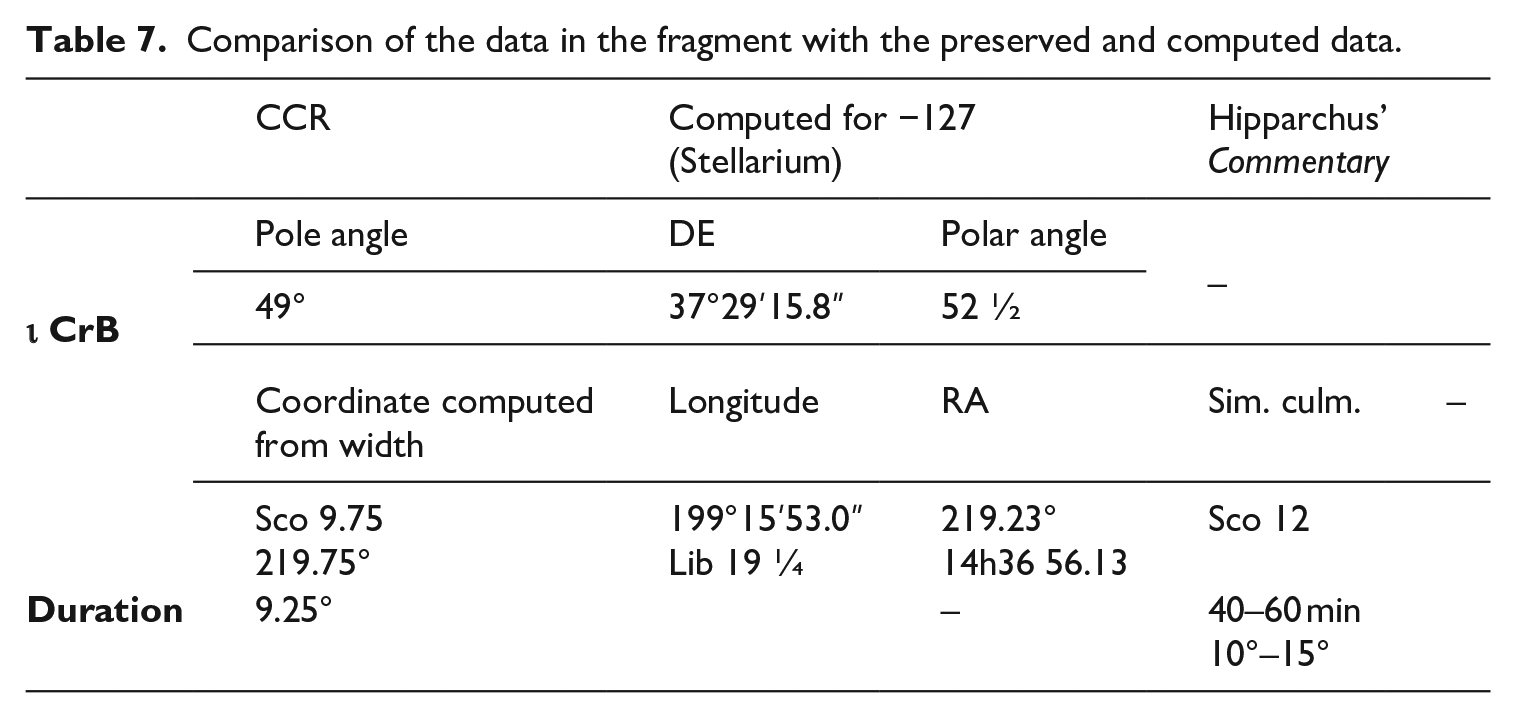
Conclusion: we cannot establish that the information about ι CrB in CCR are taken from Hipparchus. The only number directly written in CCR (the pole distance) has no counterpart in the Commentary and the possibly indirectly given number of the longitude-like coordinate cannot be properly interpreted as the frame of reference is unknown.
δ CrB
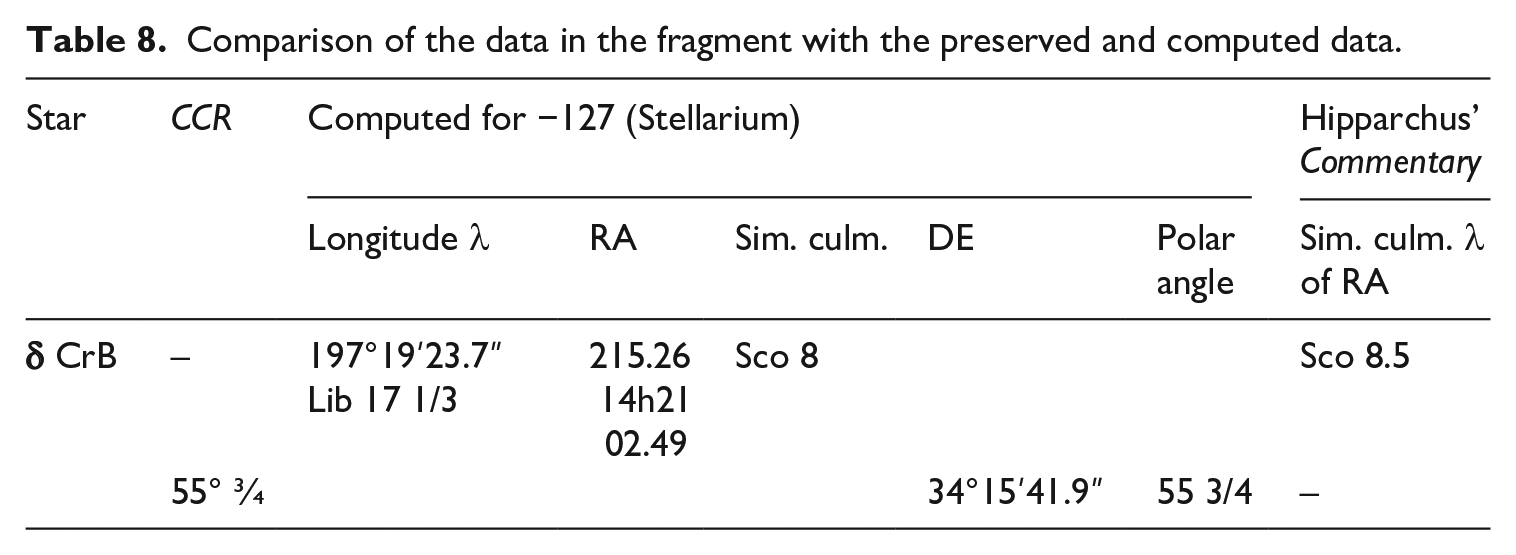
δ CrB is mentioned by Hipparchus as culminating simultaneously with the ecliptic degree Sco 8.5 during the rising of the last star in Sagittarius but no longitude or right ascension is given in the CCR fragment. The only number given in the palimpsest is the polar distance of 55° ¾ but no star of Corona Borealis is mentioned with a declination-like coordinate in Hipparchus’ critique on Aratus. The computation with Stellarium proves Hipparchus’s number for the simultaneous culmination correct and matches the polar angle in the palimpsest. However, no certain statement can be made on the connection of the two datasets because no direct comparison is possible (see Table 8).
Comparison of the data in the fragment with the preserved and computed data.
Conclusion on the date of the CCR fragment
Trying to derive the date of the text from the coordinates is challenging: For the longitude-like coordinate it is unknown if an ecliptic longitude or a right ascension is meant. The latitude-like coordinate is a declination (expressed in a different way than defined today).
If the longitude-like coordinate for β CrB (0.5°) referred to an ecliptic longitude, the historical date of this number would be the 14th century CE. If it was a right ascension read at the point where the RA-circle intersects the ecliptic (during the simultaneous culmination, cf. figures of the reconstructed globe and its practice in Hoffmann, Hipparchs Himmelsglobus), the date would be roughly 300 BCE, that is, much before Hipparchus’ time. Thus, the given numbers do not match Hipparchus’s time. The only way to match them to Hipparchus is the assumption of a misreading.
Tables 6 and 7 both display the same decimal number in the field of ‘ecliptic point mentioned in the CCR’ and ‘right ascension in Hipparchus’ time’. Hence, Hipparchus made a star catalogue in his observational coordinates (according to Duke in 2002, Sidoli in 2004, Hoffmann in 2017 his observational frame was equatorial: RA, DEC), and somebody else some centuries later interpreted these mere numbers as ecliptic coordinates (like in the Almagest). It appears as if the scribe of these numbers misread a given number of right ascension from Hipparchus’ time as an ecliptic degree. It cannot be excluded that this earlier writing under the Coptic manuscript was erased because it was found erroneous. If this proves correct and the numbers date back to Hipparchus, it will disprove the assumption by Gysembergh et al. that palimpsest’s coordinates were given in any correct frame of reference (neither in equatorial coordinates nor in ecliptic coordinates nor in any sort of projection that Hipparchus used).
However, the construction of the connection to Hipparchus with the longitudes given in the manuscript, needs to be cross-checked with the declinations and this does not lead to a common date (Table 9). The dates for which the polar distances of δ CrB and ι CrB match the numbers given in the palimpsest are around 150 BCE and around 900 BCE, respectively. The declination value for ι CrB deviated from the one in Hipparchus’ time by 2.5°. The error bar of the declinations given by Hipparchus is 1° (Hoffmann, Hipparchs Himmelsglobus); it applies for his direct measurements but the declinations of these specific stars are not given in the text. As Gysembergh et al. claim the differences of the numbers in the palimpsest result from copying text, the argument of error bars for the palimpsest is not allowed: The concept of an error bar derives from statistics (e.g. hundreds of measurements of positions with the same globe or armillary sphere) and is irrelevant for the process of copying text. It does not allow conclusions on (random) transformation of the original dataset by copyists.
A summarizing comparison of historical epochs for which the data directly given in the CCR fragment are valid.
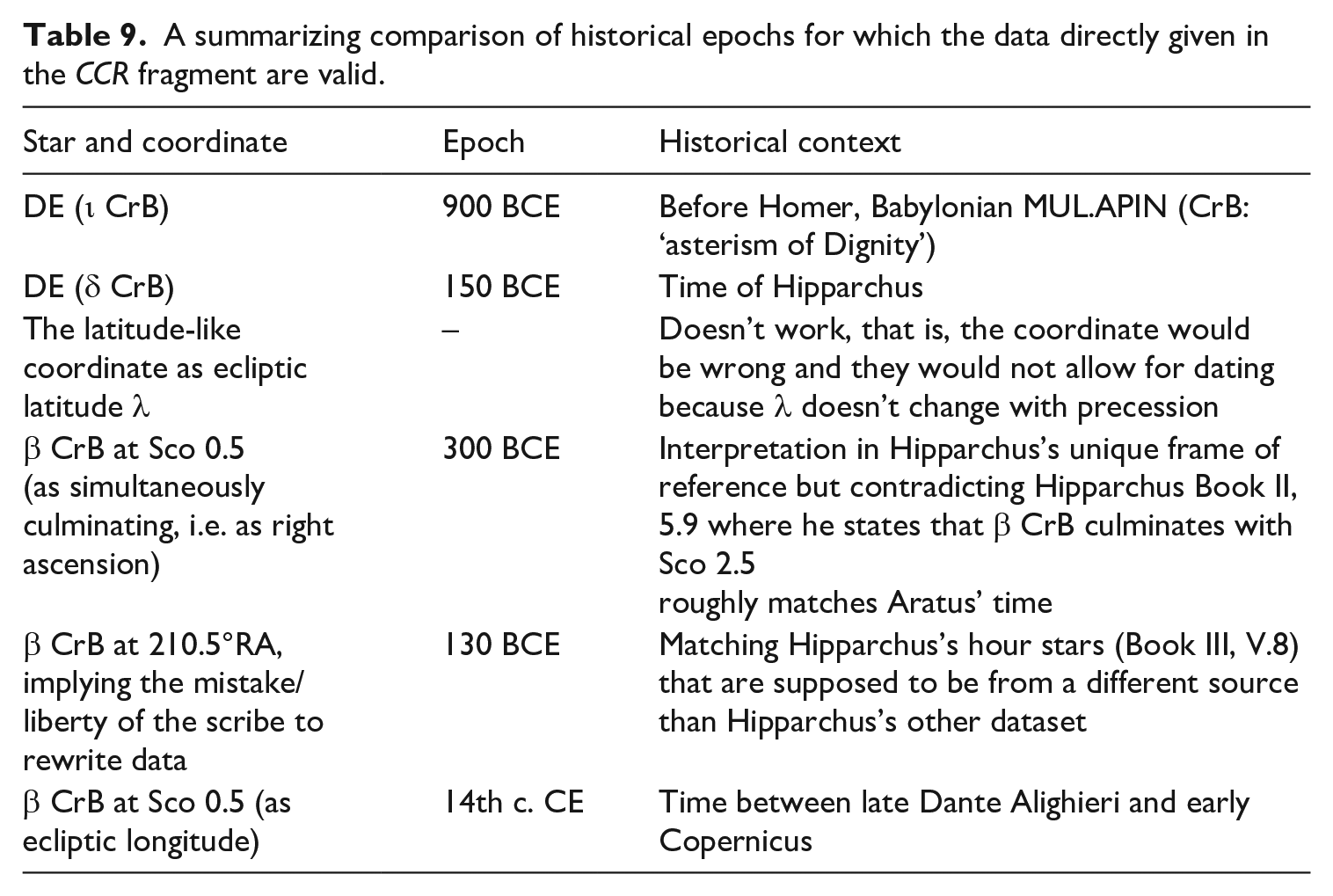
Taking all data (declinations and longitudes) of the palimpsest into account, they do not point to Hipparchus as source. Instead, they lead to different conclusions of the date and the differences in numbers can by no means made fitting by applying error bars (as suggested by Gysembergh et al.): see Table 9 for the summary.
The summary of the derived historical epochs in the CCR fragment clearly shows this data’s inconsistency. Only one of four numbers matches Hipparchus’s time (50%–75% don’t) and to interpret it this way, we need to suppose a mistake by the scribe. This suggests that the CCR fragment is corrupted and cannot be interpreted in connection to any specific historical author (might it be Aratus, Hipparchus or anyone else).
In order to link the data in this fragment to Hipparchus’ schematic description of rising and setting constellations which is suggestive because of the similar data format, we need to interpret additional mistakes by the mediaeval scribe: postulating that the scribe took the liberty to rewrite a number he found in earlier text, we could assume the following procedure:
Hipparchus’ star catalogue had been written in equatorial coordinates. That means, he probably wrote a tabular list with the columns ‘star name’, ‘right ascension’, ‘declination’ (or polar angle) as already suggested by Duke in 2002 (Note 37). With this list he made a globe as virtually modelled by Hoffmann, Hipparchs Himmelsglobus. When Hipparchus wrote the Commentary on Aratus, he framed his ‘right ascensions’ as ‘simultaneously culminating degrees of the ecliptic’.
The scribe of the CCR fragment did not understand that Hipparchus projected the ecliptic degrees on the equator by giving ‘simultaneously culminating ecliptic degrees’. He considered the list of ‘right ascensions’ as a list of ecliptic longitudes like in Ptolemy’s Almagest.
So, this scribe re-wrote a number of right ascension like ‘210 degrees’ (written in Greek letters as σ καὶ ι µ°) as a number of parts ‘from Scorpius’ (τοῦ σκορπίου) which is astronomically wrong because the number was defined in a different coordinate system (right ascension is defined on the celestial equator, zodiacal signs are defined on the ecliptic, and equator and ecliptic are inclined by 23.5°–24°).
Still, the declinations must be copied from a different source because they don’t match Hipparchus’s time – even when applying Hipparchus’s error bars. If we followed Gysembergh’s conclusion that the scribe copied the right ascensions from Hipparchus’ lost star catalogue (with equatorial coordinates, both RA and DEC), we would wonder why he took the effort to get declinations from another source.
Concluding, we have either the possibility to read the text of the CCR fragment literally and the astronomical dating returns divergent numbers scattering more than a millennium. Alternatively, we postulate several mistakes by an inexperienced scribe and link the data to Hipparchus’s time without matching Hipparchus’s terminology.
In either case, the data in the given fragment cannot be used to reconstruct Hipparchus’s star catalogue directly and they neither prove nor disprove that Hipparchus used an armillary sphere – in contrast, they prove an equatorial setup for Hipparchus’s measurements (as long known) and the (known) non-orthogonal frame of reference. The armillary sphere as Ptolemy describes it in Alm. V. is invented to measure ecliptic coordinates directly in the sky, and Hoffmann, Hipparchs Himmelsglobus has pointed out that Hipparchus had more than one source of equatorial data because various subsets of data have different error bars. Furthermore, in either way of the interpretation, the Greek astronomical text underlying the CCR fragment seems to be erroneous. It is not to be considered as the ‘lost star catalogue of Hipparchus’ but as an erased text that was corrupted in the moment of its writing.
Footnotes
Acknowledgements
We thank the editor, James Evans, for helpful comments to improve the readability and to adjust the paper to JHA house style.
Notes on contributors
Funding
The author(s) disclosed receipt of the following financial support for the research, authorship, and/or publication of this article: SMH thanks the Austrian Academy of Science for funding her work with an Otto Neugebauer Fellowship.
