




Abstract
New evidence for ancient Greek astronomer Hipparchus’ lost Star Catalogue has come to light thanks to multispectral imaging of a palimpsest manuscript and subsequent decipherment and interpretation. This new evidence is the most authoritative to date and allows major progress in the reconstruction of Hipparchus’ Star Catalogue. In particular, it confirms that the Star Catalogue was originally composed in equatorial coordinates. It also confirms that Ptolemy’s Star Catalogue was not based solely on data from Hipparchus’ Catalogue. Finally, the available numerical evidence is consistent with an accuracy within 1° of the real stellar coordinates, which would make Hipparchus’ Catalogue significantly more accurate than his successor Claudius Ptolemy’s.
Introduction
Hipparchus’ lost Star Catalogue is famous in the history of science as the earliest known attempt to record accurate coordinates of many celestial objects observable with the naked eye. 1 However, contrary to Ptolemy’s later Star Catalogue as preserved in the Almagest and Handy Tables, direct evidence for the content of Hipparchus’ is scarce. His only extant work is the Commentary on the Phaenomena, a discussion of earlier writings on positional astronomy by Eudoxus of Cnidus and Aratus of Soli. 2 Only a few references in later authors reflect stellar coordinates going back to Hipparchus – these are found mainly in the Aratus Latinus, a Latin translation of Aratus’ astronomical poem Phaenomena and related material. As noted by Neugebauer, the stellar coordinates in the Aratus Latinus agree with Hipparchus’ time, and the codeclination of α UMi in the Aratus Latinus agrees exactly with the value ascribed to Hipparchus by Ptolemy (Geography I, 7, 4). 3
Multispectral imaging of the ancient Greek palimpsest known as the Codex Climaci Rescriptus (henceforth CCR) has revealed new evidence for Hipparchus’ Star Catalogue. 4 Jamie Klair, then an undergraduate student at the University of Cambridge, first noticed the astronomical nature of the undertext on some folios in 2012, and Peter Williams first observed the presence of astronomical measurements in 2021. Indeed, some of the folios in this manuscript (ff. 47–54 and f. 64) stem from what was originally an ancient codex containing Aratus’ Phaenomena and related material, datable on palaeographic grounds to the fifth or sixth century CE.
Whereas the Aratus Latinus reflects only the Hipparchan boundaries of three circumpolar constellations (UMa, UMi and Dra), the dismembered Aratus codex of which several leaves made their way into CCR appears to have contained similar entries for all constellations. At present, the Hipparchan boundaries of the constellation Corona Borealis can therefore be recovered from the undertext of CCR (which was erased by the 9th or 10th c., when it was re-used to write Syriac translations of texts by John Climacus). No further material reflecting Hipparchan constellation boundaries has yet come to light from CCR; however, although pages stemming from the same codex (i.e. 47v, 49r, 52v and 53r) have not yet revealed legible text, it is possible that more will be recovered in the future. 5 It is also possible that folios from the ancient codex are extant in some of the other palimpsests at Saint Catherine’s Monastery of the Sinai. 6
Figures 1 to 3 show images of folio 53v at three stages in the multispectral process. Colour versions of the images are available in the online version of the Journal.
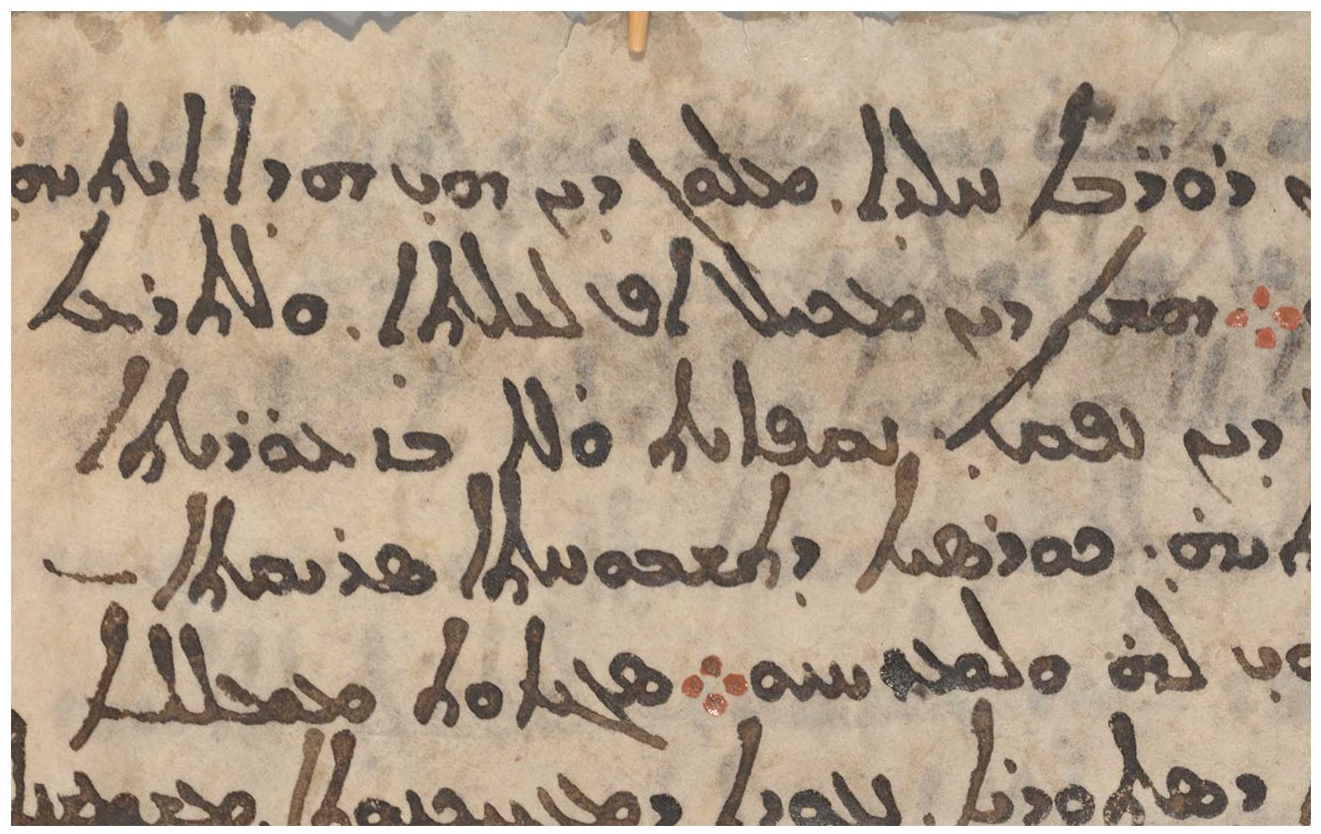
Detail of f. 53v, beginning of the first column of undertext (Syriac overtext in dark brown, and faint traces of a few letters of the undertext).
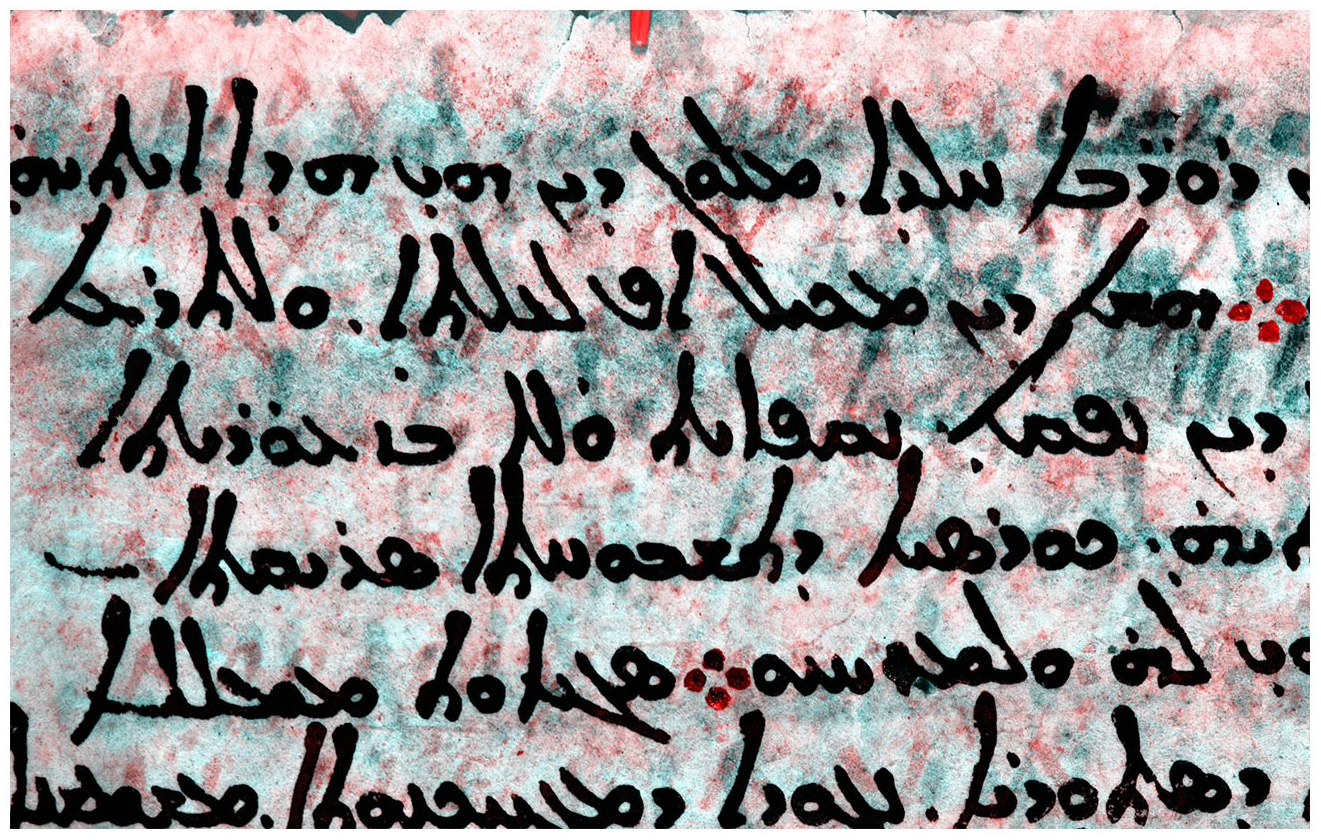
Detail of f. 53v (multispectral image, by the Early Manuscripts Electronic Library and the Lazarus Project of the University of Rochester processed by Keith T. Knox: the enhanced Greek undertext appears in red below the Syriac overtext in black).
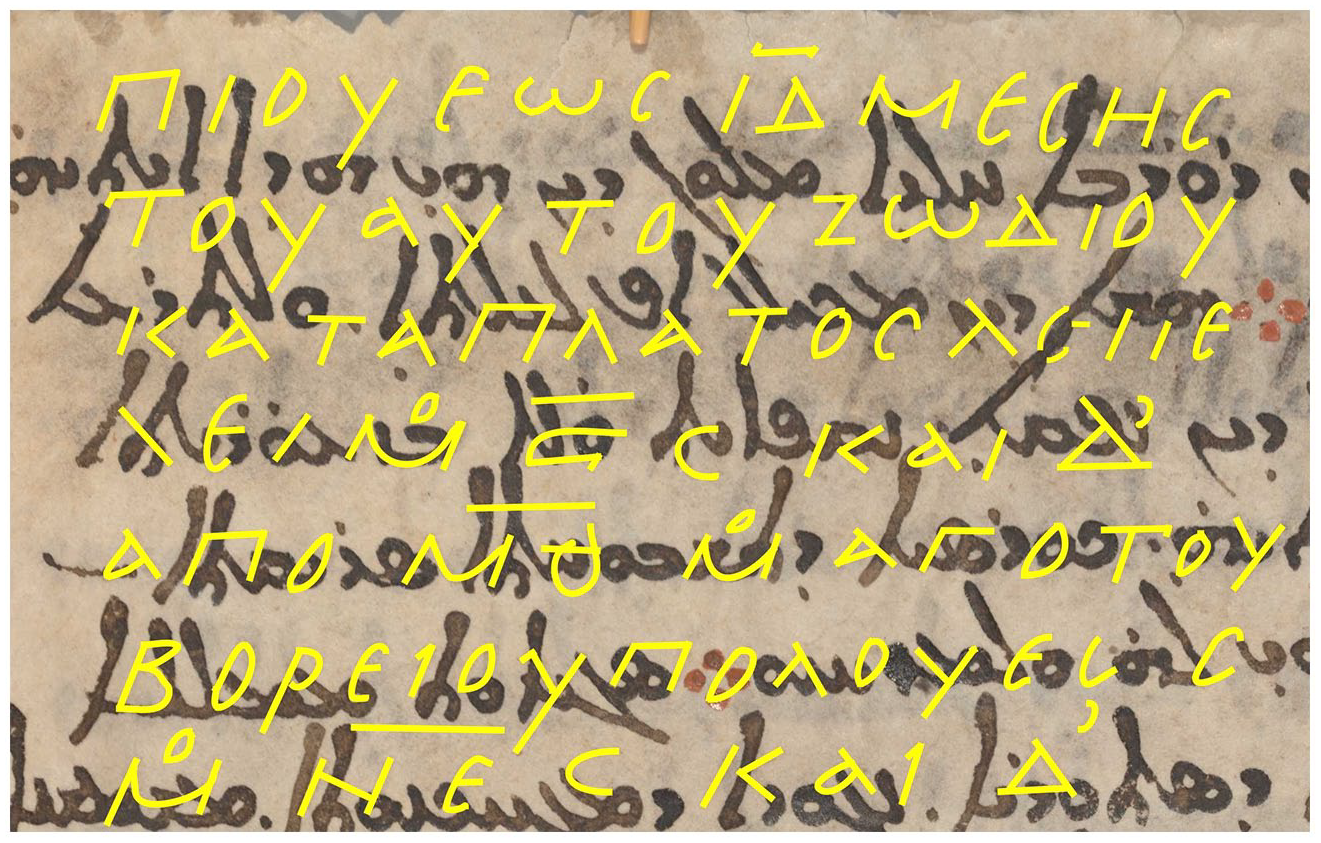
Detail of f. 53v (yellow tracings based on full set of multispectral images).
The new evidence for Hipparchus’ Star Catalogue in CCR
We give here a simplified transcription and translation of the relevant sections of the text from 48r and 53v, with our clarifications in parentheses
7
: Ὁ στέφανος ἐν τῷ βορείῳ ἡμισφαιρίῳ κείμενος κατὰ μῆκος μὲν ἐπέχει μ̊ θ̅ καὶ δ̅ ́ ἀπὸ τῆς α̅ μ̊ τοῦ σκορπίου ἕως ι̅ <καὶ> δ̅ ́ μ̊ τοῦ αὐτοῦ ζῳδίου. Κατὰ πλάτος δ᾽ ἐπέχει μ̊ ς̅ C καὶ δ̅ ́ ἀπὸ μ̅θ̅ μ̊ ἀπὸ τοῦ βορείου πόλου ἕως μ̊ ν̅ε̅ C καὶ δ̅ ́. Προηγεῖται μὲν γὰρ ἐν αὐτῷ ὁ ἐχόμενος τοῦ λαμπροῦ ὡς πρὸς δύσιν ἐπέχων τοῦ σκορπίου τῆς α̅ μ̊ τὸ ἥμισυ. Ἔσχατος δὲ πρὸς ἀνατολὰς κεῖται ὁ δ′ ἐχόμενος ἐπ᾽ ἀνατολὰς τοῦ λαμπροῦ ἀστέρος [. . .] τοῦ βορείου πόλου μ̊ μ̅θ̅· νοτιώτατος δὲ ὁ γ′ ἀπὸ τοῦ λαμπροῦ πρὸς ἀνατολὰς ἀριθμούμενος ὃς ἀπέχει τοῦ πόλου μ̊ ν̅ε̅ C καὶ δ̅ ́. Corona Borealis, lying in the northern hemisphere, in length spans 9°¼ from the first degree of Scorpius to 10°¼
8
in the same zodiacal sign (i.e. in Scorpius). In breadth it spans 6°¾ from 49° from the North Pole to 55°¾. Within it, the star (β CrB) to the West next to the bright one (α CrB) leads (i.e. is the first to rise), being at Scorpius 0.5°. The fourth
9
star (ι CrB) to the East of the bright one (α CrB) is the last (i.e. to rise) [. . .]
10
49° from the North Pole. Southernmost (δ CrB) is the third counting from the bright one (α CrB) towards the East, which is 55°¾ from the North Pole.
The first section states the extension of the constellation in μῆκος (‘length’) and πλάτος (‘breadth’), expressed for each as a value in degrees equal to the difference by two extremal coordinates. The second section names the stars at each extremity and repeats their extremal coordinates, thus mapping out the smallest spherical rectangle containing all the stars considered part of the constellation. Thus, it seems likely that the numerical data in the first section were originally derived from the coordinates in the second section. The concept of constellation boundaries underlying both sections is both similar to and different from its present-day analogue: these boundaries are drawn along vertical lines of right ascension and horizontal parallels, like today, but they make up simple rectangles instead of the intricate shapes introduced by Eugène Delporte (1882–1955).
Let us now discuss the numerical values given in the text. First, we need to explain the text’s unusual terminology. The term ‘length’ expresses the East-West extension of a constellation, while ‘breadth’ expresses its North-South extension. Position on a North-South axis is expressed as an angle ‘from the North Pole’ (like codeclination in an equatorial coordinate system). Position on an East-West axis is expressed by the combination of a zodiacal sign, which refers to a 30° arc (e.g. Scorpius for 210°–240°), and of a figure in degrees and fractions of degrees, which specifies the position within this arc. Thus, ‘the first degree of Scorpius’, which in principle refers to the interval between 0° exclusive and 1° inclusive, is equivalent here to the modern notation 211° (yielding a total East-West extension of 9°¼, as stated in the Greek text).
The northernmost and southernmost boundaries of CrB are stated twice in no uncertain terms. The easternmost and westernmost boundaries are more problematic. The corrupt passage about the easternmost boundary contains the numerals for 10 (ι) and 4 (δ), and can easily have derived from an original 10°¼. Indeed, in ancient Greek numerical notation, the confusion of a number and its reciprocal was frequent, because the sign denoting the fraction, the keraia, was slight: thus, δ′ (=¼) and δ (=4) were easily confused. The westernmost boundary is indicated first as being at 211°, then as being at 210°½. The first figure is consistent with an East-West extension of 9°¼ (assuming the correction 10°¼ mentioned above), and seems preferable at first glance. However, 210°30′ is the value indicated in Hipparchus’ Commentary (III, 5, 8, p. 274 Manitius) for the right ascension of β CrB, and must therefore be preferred. The figure 211° may easily have arisen through a copying error; and ensuingly, the East-West extension may have been corrected from an original 9°¾ to restore consistency with the position of the westernmost boundary. Assuming this interpretation of the discrepancy regarding the westernmost boundary, the boundaries of CrB are summarised in Table 1.
Boundaries of Corona Borealis according to CCR.
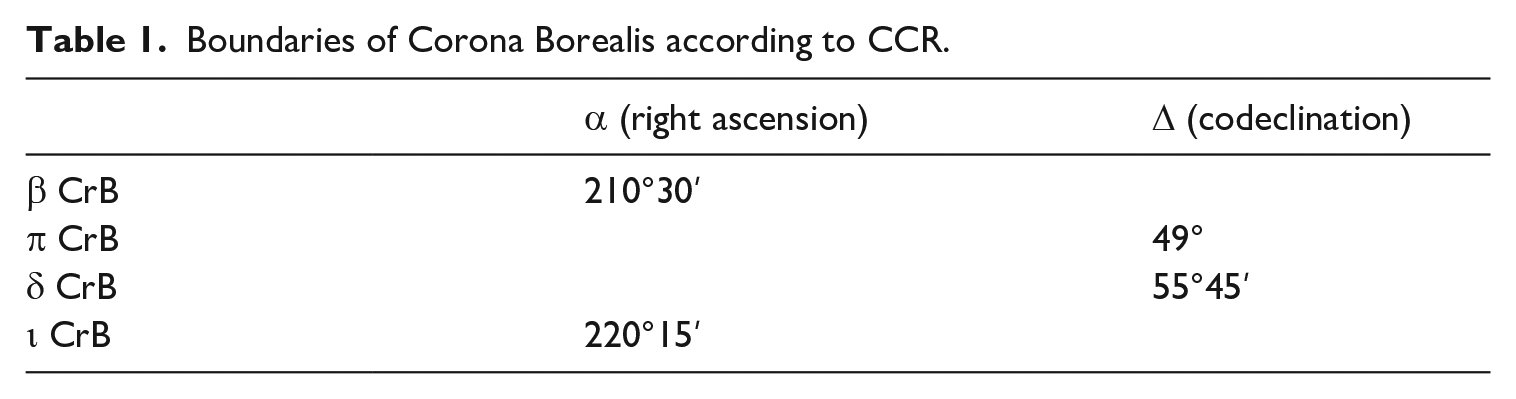
These coordinates are accurate to within 1° for the epoch of Hipparchus’ star catalogue (ca. 129 BCE), 11 as can be verified with planetarium software such as Stellarium or by checking against Dennis Duke’s and Gerd Graßhoff’s lists of equatorial coordinates for the time of Hipparchus. 12 Furthermore, they confirm that Hipparchus’ star catalogue was composed in equatorial, not ecliptical, coordinates, which has long been a matter of contention. 13 It should be noted that the terminology of μῆκος (‘length’) and πλάτος (‘breadth’) is unusual for astronomical coordinates in an equatorial, not ecliptical, frame of reference. The practice of expressing right ascension with the combination of an artificial zodiac sign and a number of degrees is also highly unusual, and attested only in Hipparchus’ Commentary. 14 The matching astronomical epoch and terminology provide strong evidence that the coordinates in CCR originated with Hipparchus.
Reassessing the evidence for Hipparchus’ Star Catalogue in Aratus Latinus
By providing comparative material, the Greek text also allows a better understanding of the related sections in the Aratus Latinus (henceforth also AL). AL is an early medieval translation into Latin, made in Northern France (most probably in Corbie Abbey) in the 8th c., of a Greek codex containing the Phenomena of Aratus and related material. 15 In particular, AL contains sections on the boundaries of the circumpolar constellations, the Greek original of which now appears to have followed the same structure and terminology as the section on Corona Borealis in the CCR text. 16
Hipparchus had already been identified as the ultimate source of the coordinates in these sections of AL over a century ago by Georg Dittmann, based on the observation that the codeclination of β UMi matches the figure quoted by Ptolemy in his Geography (I, 7, 4). 17 Emanuel Gürkoff and Otto Neugebauer further discussed the philological issues at hand. 18 However, evidence from AL has only received passing mention in scholarly discussion of Hipparchus’ and Ptolemy’s Star Catalogues. 19
It would go beyond the scope of this paper to discuss at length the philological issues in these passages, where the vagaries of textual transmission are compounded by the translator’s imperfect knowledge of Greek. 20 But it is of interest to summarise the numerical information about the boundaries of the circumpolar constellations Ursa Major, Ursa Minor and Draco according to Hipparchus that can be recovered from the Aratus Latinus.
Ursa Major
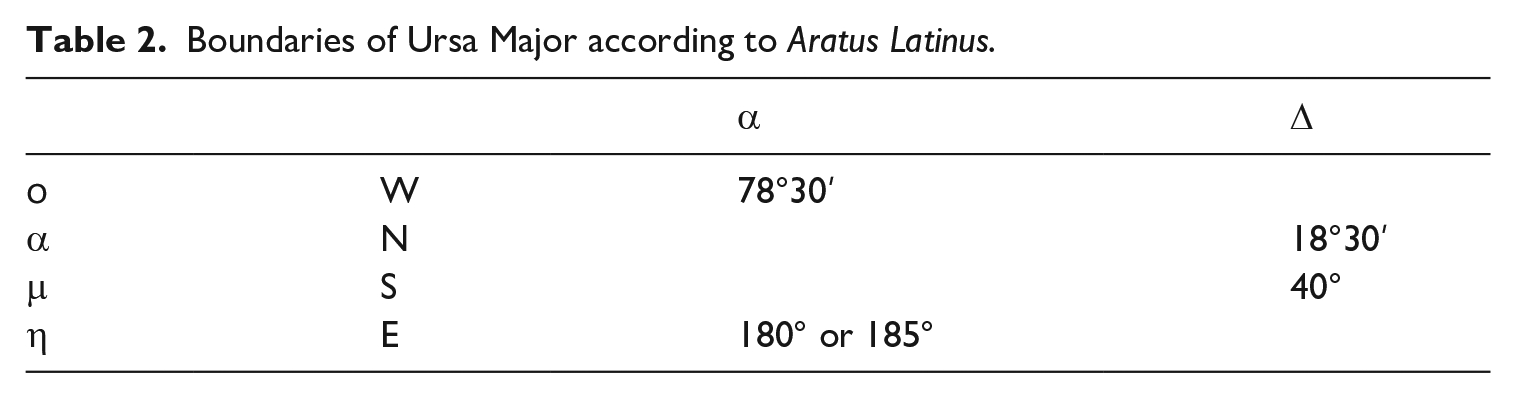
The text of Aratus Latinus indicates a North-South extension of 23° for Ursa Major, where 21°½ is expected, as shown by Table 2.
Boundaries of Ursa Major according to Aratus Latinus.
Ursa Minor
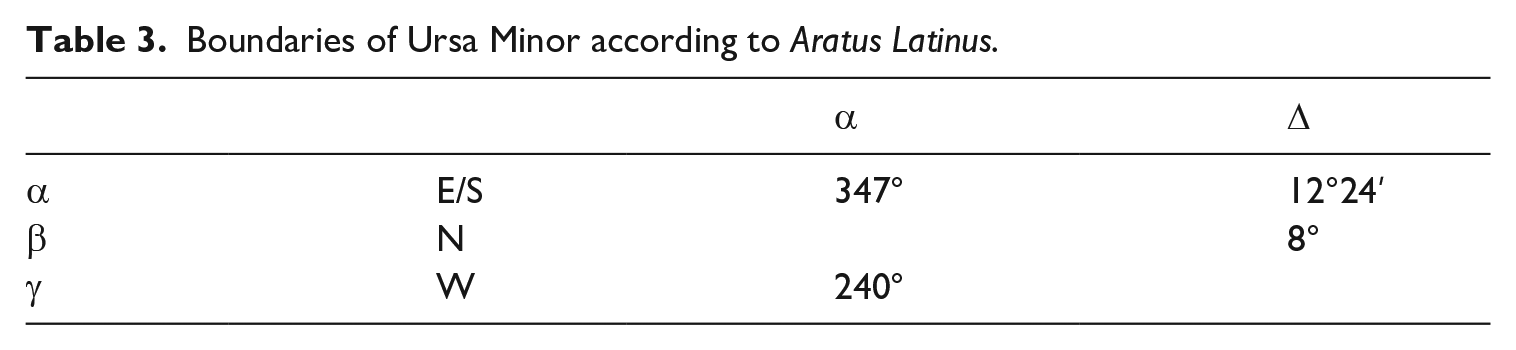
The text of Aratus Latinus indicates an East-West extension of 97°, presumably due to a scribal error for 107°; and a North-South extension of 1°½, presumably due to a common uncial error in the Greek text for 4°½. See Table 3.
Boundaries of Ursa Minor according to Aratus Latinus.
Draco
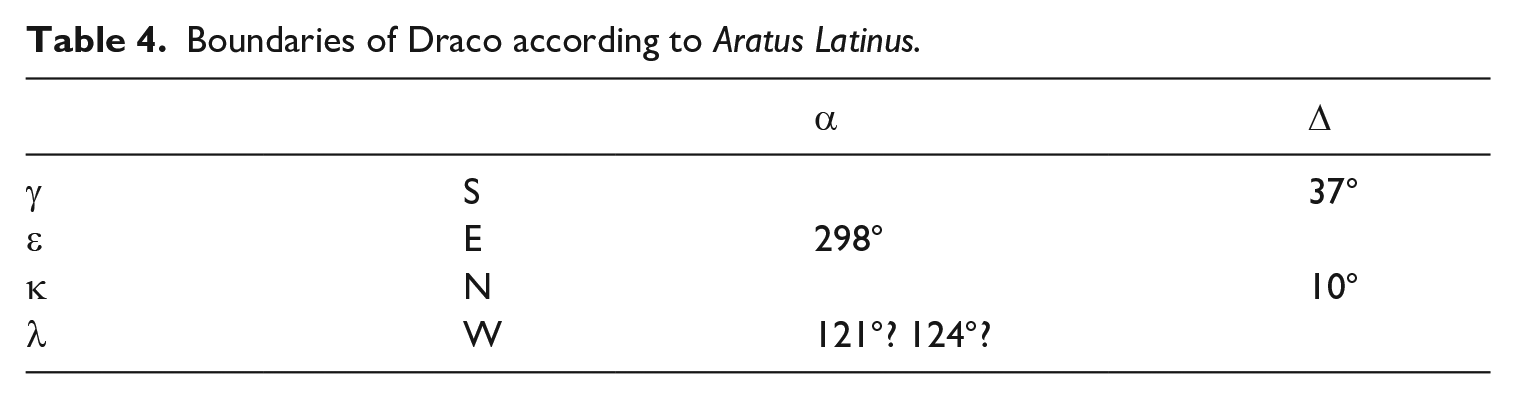
The text of Aratus Latinus indicates a North-South extension of 27° (following manuscript P), which is consistent with the figures for γ and κ Dra. See Table 4.
Boundaries of Draco according to Aratus Latinus.
In order to recover coordinates in Hipparchus’ Star Catalogue, the Aratus Latinus material is possibly more reliable than Hipparchus’ Commentary, as it comes from manuscripts that are earlier than the earliest known manuscript of the Commentary (11th c.). Recent study of the indications about the number of stars per constellation has shown that numerals in Aratus Latinus are highly reliable, agreeing in 28 of 34 cases (i.e. over 82% of the time) with the original number of stars per constellation in the Hipparchan catalogue, where this number can be reconstructed. 21 At any rate, AL and CCR provide evidence for Hipparchus’ Star Catalogue that is independent from Hipparchus’ Commentary.
Comparison with coordinates from Hipparchus’ Commentary
For eight of the stars figuring in CCR and AL, either right ascension, codeclination or both are also indicated in Hipparchus’ Commentary (noted α Comm and Δ comm in Table 5). Remarkably, the values indicated for these stars in the Commentary mostly agree with those given in CCR and Aratus Latinus (values given in the Commentary were collected by Marx 2020 22 and checked by the present authors; bold font indicates values present both in the Commentary and in CCR/AL).
Star coordinates given in both Hipparchus’ Commentary and CCR or Aratus Latinus.
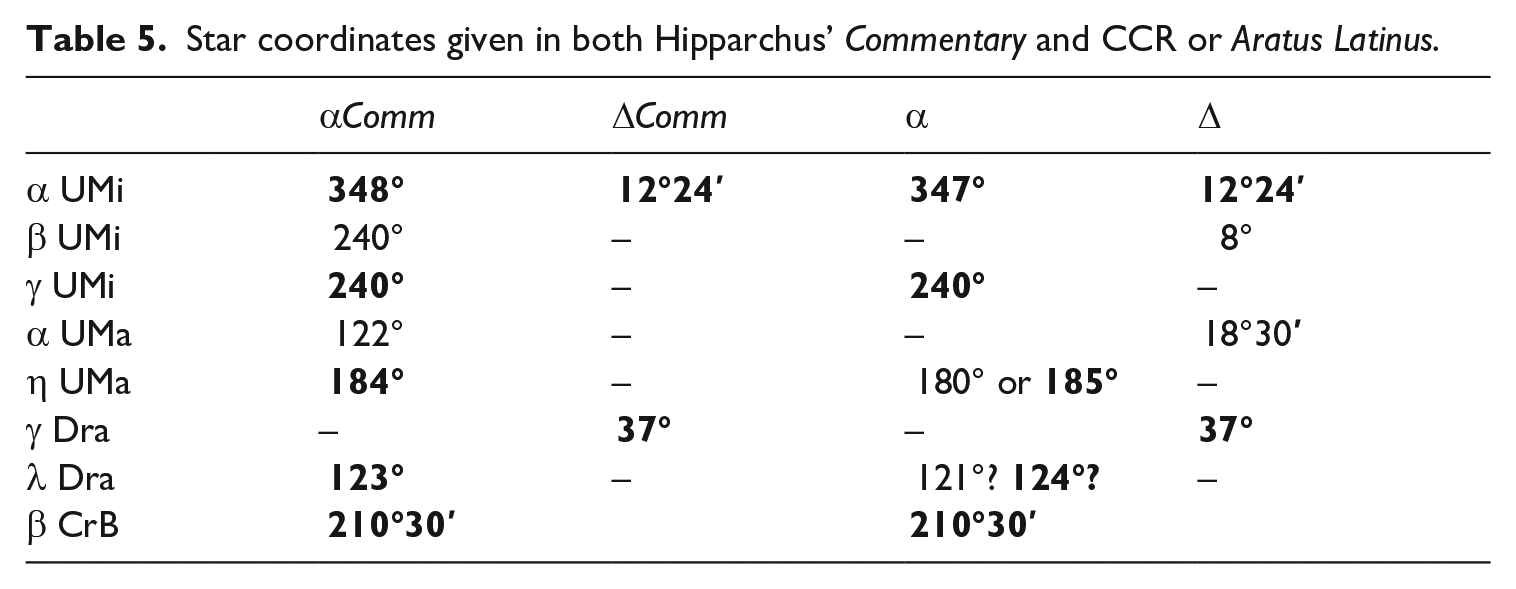
Out of seven cases where the same coordinate is indicated in the Commentary and CCR/AL, perfect agreement is observed in four cases. In two of the three cases where a discrepancy is observed, the text in Aratus Latinus is so corrupt that it is impossible to decide what the original figure was. Finally, in one case, concerning the right ascension of α UMi, a discrepancy of one degree is observed. This high rate of consistency suggests that both the Commentary and the CCR/AL material ultimately go back to the same source text, and thus confirms the common assumption 23 that Hipparchus’ Commentary was written after his Star Catalogue.
In two cases, the CCR/AL material contains the codeclination of a star for which the Commentary material only provides the right ascension. In these two cases (β UMi and α UMa), we can thus form coordinate pairs. We therefore have two further test cases for the hypothesis that Ptolemy’s Star Catalogue was obtained by systematically adding a precession constant to each star’s ecliptic coordinates according to Hipparchus. If this hypothesis is correct, we should expect Hipparchus’ coordinates for β UMi and α UMa to be possibly rounded numbers near (α = 238°; Δ = 8°25′) and (α = 121°46′; Δ = 18°49′). 24 Thus, in the case of β UMi, Ptolemy clearly didn’t merely add a precession constant to Hipparchus’ coordinates, but either made his own observations or used sources independent from Hipparchus. In the case of α UMa, on the other hand, Ptolemy may well have been dependent upon Hipparchus’ star catalogue.
The accuracy of Hipparchus’ Star Catalogue and its relationship with Ptolemy’s
In the above tables, where two possible figures have been indicated due to textual difficulties, at least one of these figures is accurate to within 1° for Hipparchus’ time; elsewhere, all coordinates are accurate to this extent. This level of accuracy is remarkable, because, by analogy with Ptolemy’s Star Catalogue, one would expect some large errors, that is, larger than 1°. 25 Incidentally, such a high level of accuracy may have contributed to the survival of material from Hipparchus’ Star Catalogue long after Ptolemy’s Almagest became the standard handbook of mathematical astronomy in the Greek world. However, the sample size being relatively small, it is also possible that there were large errors in parts of Hipparchus’ Star Catalogue that were not preserved by CCR and Aratus Latinus.
It is also remarkable that the coordinates from CCR and Aratus Latinus are not consistent with the hypothesis that the data in Ptolemy’s Star Catalogue were arrived at simply by applying a precession constant to Hipparchus’ data. This can be shown by Table 6, where Hipparchus’ data are compared with the Almagest coordinates adjusted for precession to 129 BCE, denoted αAlm and ΔAlm. 26 (Figures in italics are not attested in Hipparchus’ Commentary.)
Comparison of star coordinates from Hipparchus’ Star Catalogue and Ptolemy’s.
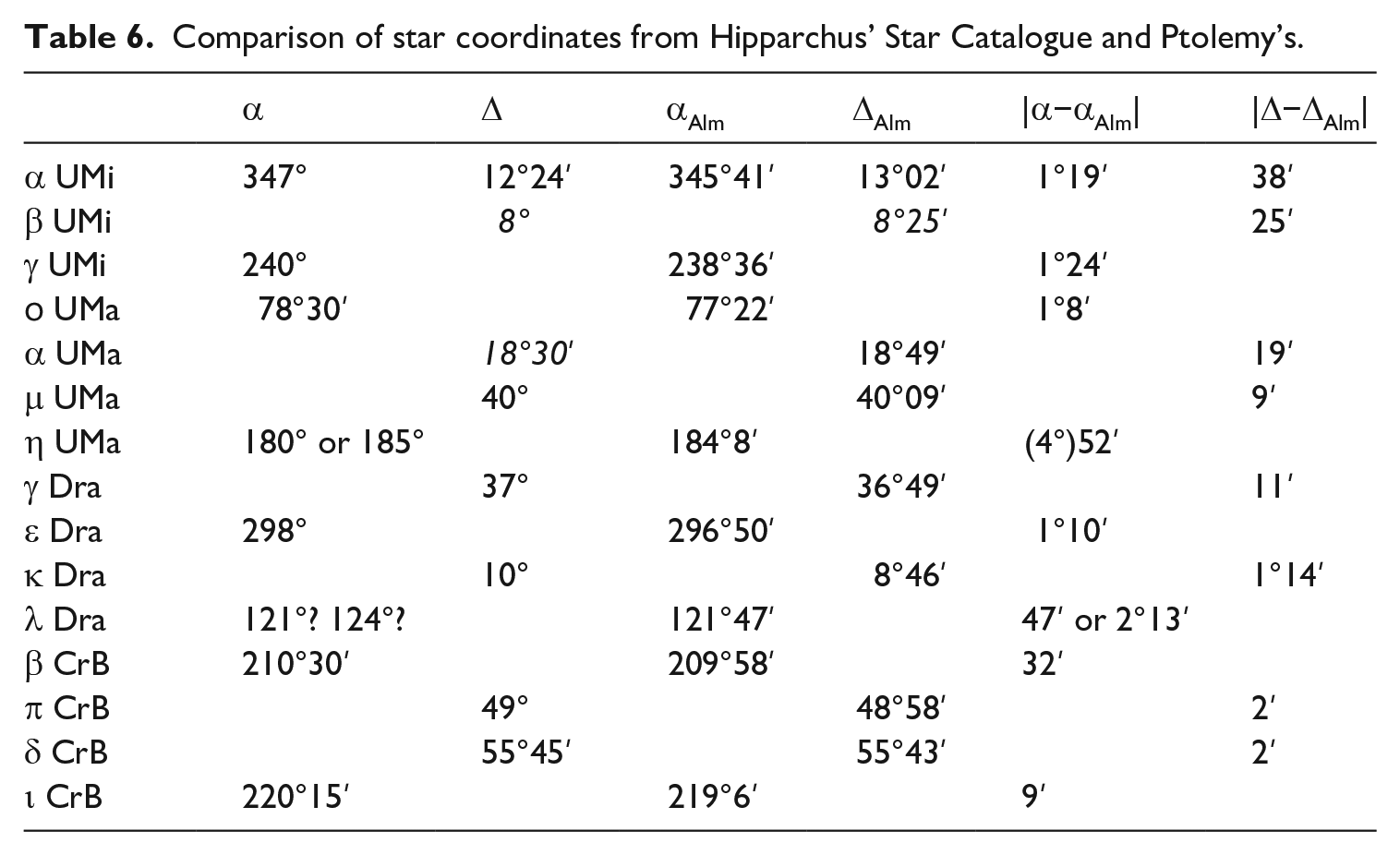
If Ptolemy had converted Hipparchus’ equatorial coordinates to ecliptic coordinates and then added 2°40′ to the longitudes, we would expect columns 2 and 3 of Table 6 to be reasonably close to columns 4 and 5. Of course, Ptolemy rounds his coordinates to intervals of 1/6° or ¼°. Thus, discrepancies of up to 10′ or 15′ would not be inconsistent with such a direct use of Hipparchus’ data. But, as can be seen from the last two columns of the table, many of the differences are substantially greater than this. These observations are consistent with the view that Ptolemy composed his Star Catalogue by combining various sources, including Hipparchus’ Catalogue, his own observations and, possibly, those of other authors. Indeed, it would follow from this that Hipparchus’ Catalogue may have been considerably more accurate than Ptolemy’s, that is, with a significantly higher rate of coordinates accurate to within less than 1°. This would be consistent with the evidence from CCR and Aratus Latinus, where potentially 100% of coordinates are accurate to within less than 1°.
The comparatively small sample size and the philological issues in both CCR and Aratus Latinus prevent us from analysing the distribution of errors in Hipparchus’ catalogue. Therefore, we cannot draw any further conclusions about the methods and instruments used by Hipparchus to observe the firmament. Considering the equatorial coordinate format, it seems safe to assume nevertheless that, if his observations were conducted with an armillary sphere, this must have been an equatorial armillary sphere, and not an ecliptic armillary sphere like Ptolemy’s; however, it is also possible that the measurements were taken with a dioptra, which may have been easier to operate. 27
Footnotes
Acknowledgements
The multispectral imaging and image processing that led to this article were performed by a team from the Early Manuscripts Electronic Library, the Lazarus Project of the University of Rochester, and the Rochester Institute of Technology. The authors’ work was supported by the Centre National de la Recherche Scientifique (Gysembergh), Tyndale House, Cambridge (Williams) and Sorbonne Université (Zingg).
Correction (January 2023):
This article has been updated to include Acknowledgement Section.

Notes
Notes on Contributors
Victor Gysembergh is a CNRS research professor at the Centre Léon Robin (Sorbonne Université). He is currently working on an edition of the fragments of Eudoxus of Cnidus, as well as on editions of Claudius Ptolemy’s treatise On the Analemma and his recently discovered treatise on the Meteoroscope. Peter J. Williams is Principal of Tyndale House, Cambridge, and is a biblical philologist who has been leading the research team investigating the Aramaic and Greek underwriting of Codex Climaci Rescriptus. Emanuel Zingg is a postdoctoral researcher at the Centre Léon Robin (Sorbonne Université) in Paris. He is currently working on editions of Ptolemy’s treatise On the Analemma and his recently discovered treatise on the Meteoroscope.