




Abstract
MS Vienna, Österreichische Nationalbibliothek, 5311, fol. 137r, contains an unusual record of astronomical observations, among which are measurements of solar and stellar altitudes carried out with large quadrants in Bologna, Montpellier, and Genoa between 1305 and 1312. An analysis of this observational data reveals a high level of precision and accuracy, as the astronomer responsible achieved a mean error of only 0;2° during an extended run of measurements of solar noon altitudes made between December 1305 and March 1306. Other passages on the same manuscript page mention Johannes de Luna, a German astrologer-astronomer active in Bologna between c.1299 and 1312. References to his name in 14th-century manuscripts shed light on his involvement in contemporary attempts to correct the Toledan Tables and revise their model of precession on an observational basis.
Introduction
In a short note published during the final year of his life, Lynn Thorndike (1882–1965) drew attention to the presence of the name Iohannes de Luna Theutonicus in the first column of MS Vienna, Österreichische Nationalbibliothek, 5311, fol. 137r, which preserves an intriguing record of measurements of solar and stellar altitudes carried out in Bologna, Montpellier, and Genoa during the years 1305–1312. 1 Thorndike’s main contribution at the time was to suggest an identification with “Joannes a Luna,” who is mentioned in passing in Mauro Sarti and Mauro Fattorini’s prosopography of professors at the University of Bologna (first edition 1769). Sarti and Fattorini describe him as a “a vain and puffed up professor astrology” who attained academic fame in Bologna in the early 1300s after having moved there from Germany. 2
Since the publication of Thorndike’s note, the observations that accompany Johannes’s name in the aforementioned Vienna manuscript have been mentioned very sporadically in the literature, 3 but no edition or in-depth discussion of this source has so far been made available. The present article seeks to close this specific gap in our knowledge as well as to provide new information on the astronomical activities of Johannes de Luna, which have left traces in at least two other 14th-century manuscripts. I shall discuss the evidence relating to Johannes in the first half of this article, which sheds some new light on the efforts of Italian astronomers in the early 14th century to study the rate and accumulated value of precession. The second half will concentrate on the remaining observations recorded on fol. 137r of the Vienna manuscript, which, rather than stemming from Johannes de Luna, were probably made by a second astronomer who was active in Bologna in 1305–1306, in Montpellier in 1306, and in Genoa in 1311–1312. A transcription of the entire text on fol. 137r will be provided in an Appendix at the end of this article.
Observations attributed to Johannes de Luna
According to research published in 1920 by Guido Zaccagnini, the presence of Johannes de Luna at the University of Bologna is attested as early as 1299, the year in which he received the licence to teach medicine after passing examination in July. Earlier the same year, in March, Johannes had been fined for breaking the city’s curfew. 4 He is referred to as both astrologer and professor of medicine (astrologus et artis fixice professor) in a document dated June 1303, in which the Commune of Bologna promised him an annual payment of six bushels of wheat on the condition that he would stay in the city and offer his services to the community. 5 He was clearly still a member of the university in February of 1308, when a cobbler named Bonafide stood trial for having stabbed and wounded Johannes with a knife. The court documents give the victim’s name as “Johannes, [son of] Lord William, a German, de Valegio, who is otherwise called master Johannes della Luna” and present him as “professor and doctor in medical sciences and in the [seven liberal] arts.” In listing these arts, the text distinguishes between astrologia de motibus (i.e., astronomy) and astrologia de effectibus, sive operibus (i.e., astrology), calling the latter “philosophy itself” (que est ipsa phylosophia). 6
An intriguing spotlight on Johannes’s activities as an astrologer is cast by the records of the trial against Robert de Mauvoisin, archbishop of Aix-en-Provence from 1313 to 1318, who was forced to resign after having being accused of divinatory practices as well as other wrongdoings. In a deposition before a papal inquisition, dated 17 December 1317, Robert spoke about his experience of consulting Master Johannes de Luna when he was a student in Bologna in c.1305. From this report it emerges that Johannes was known for offering his clients so-called interrogations, a particularly controversial form of astrology in which answers to various questions were generated by casting a horoscope for the moment the question is posed. 7 According to Robert, Johannes would for this purpose aim his astrolabe at the sun from a window, presumably so he could establish the time and ascendant as a function of the solar altitude. Apart from attending Johannes’s house on at least one such occasion, Robert had also been the recipient of a confidential letter in which the astrologer predicted that the newly elected Pope Clement V (1305–1314) was going to survive a mass accident involving a crumbling wall. Such an accident indeed came to pass at the pope’s coronation in Lyon on 14 November 1305, when one of the city’s walls collapsed near Clement and killed several bystanders. 8
Johannes de Luna’s name appears a total of three times on two different pages of MS Vienna, Österreichische Nationalbibliothek, 5311 (=V), which assembles a large number of astronomical, astrological, and optical texts, copied by mostly the same hand in approximately the middle of the 14th century.
9
Mention has already been made of the record of astronomical observations on fol. 137r, which begins with the statement that “Master Johannes de Luna, the German” (Magister Iohannes de Luna Theutonicus) claimed to have determined empirically (dixit se expertum) the following data for the latitude of Bologna:
Maximum solar noon altitude: 69;9° Minimum solar noon altitude: 22;2° Amplitude of declination (arcus eorum): 47;7° Obliquity of ecliptic: 23;33,30° Latitude: 44;25° Co-latitude (altitudo Arietis): 45;35°.
These values are basically consistent, though one should note that Johannes’s co-latitude of 45;35° was obtained by rounding down or ignoring the seconds in 22;2° + 23;33,30° = 45,35,30°. The actual latitude of Bologna’s city center is c.44;30°, meaning that the error in Johannes’s values for the latitude and co-latitude was relatively moderate. 10 While the text is silent on the year(s) in which these measurements were made, one may compare the results with the situation in 1305, which is the earliest of the years mentioned later on fol. 137r. In that year, the Sun reached its maximum apparent noon altitude on 14 June at 69;2°. Its minimum apparent noon altitude, observable on 13 December, was 22;1°. In 1312, which is the latest year mentioned on the same page, the maximum and minimum values (on 13 June and 13 December) were practically the same. 11 It follows that Johannes’s result for the minimum noon altitude at the winter solstice was in error by a mere +0;1°, which approaches the limit of naked-eye observability. 12 His result for the summer solstice was slightly worse at +0;7°.
It is hardly a coincidence that Johannes’s two altitude values harmonize perfectly with the value for the obliquity of the ecliptic that was transmitted via the Toledan Tables, which is 23;33,30°. 13 Doubling this value gave an amplitude of solar declination of 47;7°, which happens to be the precise difference between Johannes’s reported altitudes of 69;9° and 22;2°. It may well be that his measurements were guided by this assumed difference, such that at least one of the two altitudes was adjusted after the fact to ensure conformity. This may ultimately explain why his result for the winter solstice is significantly better than that for the summer solstice.
The name Iohannes de Luna appears a second time on the same manuscript page (fol. 137ra) below a tabular list of solar altitude measurements, which will be discussed in the second half of this article. Rather than belonging to the table in question, Johannes’s name is more likely to have been placed there because he was the originator of the text that appears directly below it, and which seems thematically unrelated. This text, perhaps an excerpt from a larger work, documents someone’s attempt to derive the rate of precession from the historical changes in the ecliptic longitude of Spica (α Vir). The astronomer in question had found this star to be at 192;50° at the end of 1305. He also knew that Ptolemy had assigned to Spica a longitude of 176;40°, which led to the conclusion that the longitudes of the fixed stars had increased by 16;10° between AD 140—the approximate date of Ptolemy’s star catalogue—and the completed year 1305. Dividing 16;10° by 1305 − 140 = 1165 years allowed the author to derive a precession rate of 1° in slightly more than 72 years (in fact: c.72;3,43°/year), which was a more accurate value than those normally encountered in Latin astronomy up to this time (such as 1°/100 years, 1°/70 years, or 1°/66 years). 14 He concludes that “according to this” (secundum hoc) the stars have moved 0;10° for every 12 years since Ptolemy’s time, “provided their motion is steady” (si motus ipsarum est equalis). As he knew from reading Ptolemy’s Almagest (7.3), an increase of precisely this magnitude followed from some observations made by the ancient astronomer Timocharis (third century BC), who recorded the position of Spica 12 years apart.
The fact that the stellar observations recorded in the Almagest concealed a precession rate that was actually swifter than Ptolemy’s own 1°/100 years was evident to more than one Latin astronomer in the first decade of the 14th century. We find another allusion to it in Peter of Abano’s Lucidator dubitabilium astronomiae, which was composed between 1303 and 1310. Peter, too, mentions a motion of 1° in 72 years, albeit without providing the kind of detailed justification we are given in the Vienna manuscript. 15 Even the latter text remains silent on how the author had managed to find the longitude of Spica for the end of 1305, as the author merely writes that his value 192;50° was obtained “through reason” or “through argument” (inveni per rationem), which may refer to computation. According to modern data Spica’s ecliptic longitude on 31 December 1305 was 194;10°, from which would have followed an increase relative to Ptolemy of 17;30° and a precession rate of 1° in c.66 1/2 years. It may be worth noting that the more moderate increase of 16;10° assumed in our text comes fairly close to the 16;12° that were used to update Ptolemy’s star catalogue in MS Nuremberg, Stadtbibliothek, Cent. VI.22, fols. 2r–8v (s. XIV1/2). 16 The year to which this longitude increase applies is here given as AD 1300.
Whether or not Johannes de Luna was personally responsible for finding the longitude of Spica cited in V, it is clear from another source that some of his observations concerned the phenomenon of precession. MS Erfurt, Universitätsbibliothek, Dep. Erf. CA 4° 367 (s. XIV) contains extended excerpts from the canons to a set of astronomical tables for Freiburg im Breisgau (fols. 108v–121v) as well as from the tables themselves (102v–108r), which apparently go back to a certain Werner of Freiburg.
17
One of the preserved canons, which is worth quoting in full (fol. 116r–v), deals with the motion of the eighth sphere:
Annis Christi 1312 perfectis, incipiendo annum a Martio, verificatus est motus 8e spere in civitate Bononiensi per magistrum Iohannem de Luna Theutunicum. Et invenit per longam considerationem retrohabitam quod tunc temporis erat motus octave spere 10 gradus et 30 minuta, 52 secunda, 45 tertia, 31 quarta et quolibet anno movetur secundum hunc modum tantum 0 minuta, 52 secunda, 45 tertia, 31 quarta et huic correctioni et positione consentit per omnia magister Beneintendi, astrologus domini canis in Lombardia. Secundum Thebit vero movetur 8a spera omni anno tantum 27 secunda, 48 tertia, 22 quarta. Et secundum istum fuit motus 8e spere in civitate Bononiensi anno Christi 1310 in kalendis Marcii 9 gradus, 31 minuta, 15 secunda, 16 tertia. Secundum alios movetur in 28 annis Christi 16 minuta et 48 secunda. Que autem harum opinionum verior sit, lectoris iuditio reliquatur. Ego autem semper teneo ac tenui ac secutus sum correctionem magistri Iohannis de Luna. Advertendum etiam quod magister Wernherus sepe et sepius dixit mihi quod omnes astrologi in Ytalia tenent firmiter opinionem Ptholomei et Albategni, scilicet quod 8a spera semper et continue movetur ab occidente versus orientem secundum ordinem signorum, quamobrem motus 8e spere secundum eosdem semper est addendus et numquam subtrahendus.
When 1312 years of Christ were completed, such that the year begins from March, the motion of the eighth sphere was examined [verificatus] in the city of Bologna by Master Johannes de Luna the German. And he found by means of a long series of past observations [per longam considerationem retrohabitam] that the motion of the eighth sphere was then 10;30,52,45,31° and that according to this way it is moved annually by exactly 0;0,52,45,31°. And Master Beneintendi, a Dominican astrologer in Lombardy, agrees completely with this correction and position. But according to Thābit the eighth sphere is moved annually by exactly 0;0,27,48,22°. According to him the motion of the eighth sphere in the city of Bologna on 1 March 1310 was 9;31,15,16°. According to others it is moved by 0;16,48° in 28 years of Christ. But I shall leave it up to the reader to decide which of these opinions is closer to the truth. I, for my part, always have upheld, and still do, and have followed the correction of Master Johannes de Luna. One should also note that Master Werner has told me time and again that all astrologers in Italy hold steadfastly to the opinion of Ptolemy and al-Battānī, namely, that the eighth sphere always and continuously moves from west to east according to the order of signs, for which reason the motion of the eighth sphere according to these [astronomers] is always additive and never subtractive.
The author of this passage appears to have been one of Werner of Freiburg’s students, who had heard his master speak about his studies in Italy and about the opinions and practices followed by astronomers in this region. The claim that all Italian astronomers currently accepted a steady, unidirectional form of precession, while probably something of an exaggeration, reflects a stage in the development of Latin astronomy at which the precession model associated with the Toledan Tables had come under intense scrutiny and criticism. This model, which was commonly attributed to Thābit ibn Qurra, imagined precession as a bi-directional “access-and-recess” motion. It also predicted a drastic slowing down of the forward motion of the eighth sphere in the early 14th century, which was not confirmed by observations. 18 According to Werner’s student, Thābit’s model gave the motus of the eighth sphere on 1 March 1310 as 9;31,15,16°, with motus here referring to the accumulated difference between the sidereal and tropical frames of reference. This difference is close to, but not quite the same as the c.9;31,50° predicted for the same date by the Toledan Tables. 19 What is far more irritating is the claim that Thābit posited an annual motion of the eighth sphere of 0;0,27,48,22°. A motion of this rate would complete 1° in c.129;28 years. In actual fact, the Toledan tables for the “access and recess” operated with a much swifter rate equivalent to 0;5,19,14° per Julian year of 365 days, which referred to the circular motions of the sidereal heads of Aries and Libra around a fixed “mean” equinoctial point.
When it comes to Johannes de Luna, we learn that his Bolognese observations, whatever they may have been, showed the motus of the eighth sphere at the end of 1312 to be 10;30,52,45,31°. According to the Toledan Tables, the corresponding value for 28 February 1313 (i.e., the end of a year beginning on 1 March 1312) would have been c.9;33°. Johannes’s value is thus roughly 0;58° greater than that predicted by the tables. An empirical method by which such a correction could be achieved is described in the introduction to William of Saint-Cloud’s Almanach planetarum, written in 1292. His preliminary steps included measurements of the solar noon altitudes at the solstices, from which he inferred the local geographic latitude and co-latitude. The latter value was the same as the meridian altitude of the equinoctial points, which opened a way towards inferring the time of an equinox from solar noon altitudes observed on nearby dates. Having established the time of the vernal equinox in 1290 by such means, William computed the corresponding sidereal longitude of the Sun according to the common tables, finding a discrepancy of 10;13°—the motus of the eighth sphere. 20
It is probably no coincidence that Johannes de Luna’s solar observations for Bologna, as recorded at the start of V, fol. 137ra, concern several of the same preliminary parameters, which accordingly could have served him in his efforts to establish the motus at the end of 1312. The remarkable level of precision in his reported result, which encompasses sexagesimal thirds and fourths (10;30,52,45,31°), could have been achieved by subtracting from a tropical longitude of 0° or 180° (i.e., the tropical longitude at an equinox) a very precise calculated sidereal value (e.g., 0° − 349;29,7,14,29° = 10;30,52,45,31°). That said, certain suspicions are raised by the fact that Johannes’s motus at the end of 1312 features precisely the same sexagesimal seconds, thirds, and fourths as his reported value for the annual rate of precession: 10;30,52,45,31° versus 0;0,52,45,31°/day. This makes it seem as if the result for the end of 1312 was achieved by assigning to 1311 an arbitrary value of 10;30° and adding to it the annual increase. Here and elsewhere, the numerical information we receive from Werner’s student, or from the scribe in the Erfurt manuscript, must be regarded with some caution.
Whatever the case, the high precision of Johannes’s result is mirrored in a note added to MS Groningen, Universiteitsbibliotheek, 102, fol. 86v, which consists in a partially erased table showing the motus in the years 1332–1335 to the fourth sexagesimal-fractional place. The entries in this table have suffered heavily from erasure and corruption, making it difficult to draw conclusions from the numbers that are still legible. They suggest that the original entries belonged to the approximate range of 10;40–10;50°. The existence of some link with the canon in the Erfurt MS is suggested by the table’s heading, which states that the following value reflects the “corrections of the Masters of Bologna” and is valid for the beginning of March after 1331 completed years of the Christian era (Anno ab incarnatione domini Ihesu Christi in principio Martii perfectis 1331 annis fuit motus octave spere secundum correctiones magistrorum Bononiensium). The annotator responsible for the Groningen table thus followed the same calendrical convention (of counting completed years and beginning them from March) as the canon mentioning Werner of Freiburg. The fact that this table appears immediately below another note mentioning the geographic coordinates of Freiburg makes this similarity seem even less coincidental.
A motus of 10;41,47° is recorded in the right margin of MS Vatican City, Biblioteca Apostolica Vaticana, lat. 3118, fol. 53r (s. XIV1/2), which contains the table ordinarily used for computing this parameter according to the Toledan “access-and-recess” model (Tabula equationis motus accessionis et recessionis 8e spere et est distantia Arietis et Libre ab equatore). Marginal annotations on the same page report the computed values for 1335 (top margin) and the completed years 1326–1328 (bottom margin) as well as a value of 9;33,26° without a year (right margin; possibly intended for 1313). Below the latter annotation an identical hand attributes a motus of 10;41,47° to Cecco d’Ascoli, once again without specifying the year (secundum Cecchum de Eschulo motus octave spere est). Cecco taught astrology at the University of Bologna in 1322–1324, 21 which probably narrows down the range of years to which this value might have applied. If we accept, as per the canon in the Erfurt MS, a motus of 10;30,52,45,31° at the start of March 1313 and also reckon with Johannes de Luna’s alleged annual increase of 0;0,52,45,31°, the motus at the start of March 1324 should be 10;40,33,6,12°. It seems safe to conclude that Cecco’s value reflects another effort by a Bolognese master to correct the Toledan motus, but one which apparently was not directly dependent on Johannes de Luna.
That efforts of this nature were underway in Bologna even before Johannes de Luna or Cecco d’Ascoli is suggested by the testimony of another Bolognese master and teacher of astrology, Bartholomew of Parma, who was active during the 1280s and 1290s. 22 The earliest manuscript of Bartholomew’s Tractatus spere (1297/98) carries a gloss, added in all likelihood by Bartholomew himself, in which the motus of the eighth sphere for 1298 is given as 10;23°. 23 We are once again dealing with a ‘corrected’ value vis-à-vis the Toledan Tables, whose motus value for the end of 1298 would have been 9;26,35°. One may also mention a passage in Peter of Abano’s Lucidator dubitabilium astronomiae, where he states that the value predicted for the present (nunc) by Thābit and Azarquiel (i.e., by the Toledan Tables) is 9;27,16°, which would point approximately to the middle of 1302. Peter contrasts this with a value of 10;30,10° supposedly found by observers who came after Azarquiel and Thābit and who instead accepted Ptolemy’s model of steady precession. 24
Out of the Italian astronomers mentioned thus far, only Johannes de Luna is credited with a rate of precession specific to him. 25 Werner of Freiburg’s student, in the chapter cited above, claims that Johannes found that the eighth sphere moves at an exact annual rate of 0;0,52,45,31° and that he was followed in this regard by the (otherwise unknown) Dominican astrologer Beneintendi. This rate of motion is not quite compatible with the 1°/72 years = 0;0,51,25 . . . °/year that result from the longitudes of Spica in the aforementioned passage in V, fol. 137r. Rather, an annual motion of 0;0,52,45,31° would imply 1° in c.68;14 years. Coincidence or not, this happens to be nearly double the rate of the linear term of precession in the Alfonsine Tables, which is 0;0,0,4,20,41,17,12°/day or 1° in c.136;7 years. 26
A final manuscript source that seems worth mentioning in this context is MS Admont, Stiftsbibliothek, 318, fol. 5r, where two annotations in the upper margin give the motus of the eighth sphere on 11 March 1327 and at the end of 1328 as, respectively, 10;47,2,47° and 10;47,57,31°. We are here dealing with the echo of yet another correction of the Toledan motus, which would have been c.9;40° at the end of 1328. The two motus values cited in the Admont manuscript differ by 0;0,54,44°, whereas a further annotation on the same page gives the annual rate of motion as 0;0,52,44°. The difference between the latter value and that attributed to Johannes de Luna in the aforementioned Erfurt manuscript (0;0,52,45,31°/year) is very small indeed, raising the possibility that they are somehow linked.
The third mention of Johannes de Luna in V is found on fol. 134v, which offers a unique sequence of short notes addressing the inadequacies of the Toledan Tables when it came to predicting the observed positions of the planets.
27
It would appear that the growing recognition of this inadequacy among Latin astronomers contributed in no small part to the rise of the Alfonsine Tables, which supplanted the Toledan Tables in the course of the first half of the 14th century. Indeed, the author in V, fol. 134v, refers to the tabule Alfontii as being more recent (noviores) than the other tables and notes the greater accuracy of their mean motions and equations.
28
Prior to their adaption, those working with the Toledan Tables sometimes sought a provisional remedy in making certain additions to or subtractions from the Toledan mean-motion radices. A well-known example is William of Saint-Cloud, who devoted part of the introduction to his Almanach planetarum to discussing the astronomical observations that had led him to conclude that the radices in the Tables of Toulouse (a Latin offshoot of the Toledan Tables) were 1;15° too low in the case of Saturn, 1° too high in the case of Jupiter, and 3° too high in the case of Mars.
29
The author in V, fol. 134v, documents other corrections of this general character, attributing one of them to Magister Iohannes de Luna:
Saturn: +1;56° Jupiter: −1° Mars: −2° Eighth sphere: +1°
The addition of 1° to the equation of the eighth sphere agrees in an approximate sense with the discrepancy of c.0;58° that emerges from the previously cited chapter in the canons to the Tables of Freiburg, which attests to Johannes de Luna’s determination of the motus of the eighth sphere at the end of 1312. In fact, the same source mentions Johannes in a second chapter, this time as part of a discussion of the errors in the Toledan mean-motion radices. We are told that Iohannes de Luna Theutonicus proposed the following corrections to these radices, which were once again seconded by Master Beneintendi, the Dominican astrologer in Lombardy:
Saturn: +1;30° Jupiter: −1;21° Mars: −3;0° Moon: +0;22°.
The passage goes on to note that the radices for the Sun and the inner planets do not require any changes, but that it is necessary to subtract 0;40 hours from the times of conjunction and opposition computed with the Toledan Tables. 30 This subtraction of 40 minutes from the mean syzygy times, together with the corresponding correction of the mean lunar motion by +0;22°, is already familiar from William of Saint-Cloud’s Almanach planetarum. 31 Aside from adding these two values to the corrections allegedly proposed by Johannes de Luna, the Freiburg canon is clearly at odds with V (fol. 134v) when it comes to his corrections for the three superior planets, giving a different value in each instance. The reasons behind this discrepancy are far from clear. However, the same values that are attributed to Johannes in the Freiburg canon also appear in the aforementioned MS Groningen, Universiteitsbibliotheek, 102, whose connection with Freiburg has already been remarked upon. On fol. 88v of this manuscript, a note reports on a rectificatio of the Toledan Tables carried out by the Masters of Bologna, who allegedly used a torquetum for this purpose. 32 What follows are the same additions and subtractions as cited in the Freiburg canon.
No trace of any of these corrections is found in a copy of the Toledan Tables in MS Erfurt, Universitätsbibliothek, Dep. Erf. CA 2° 38, fols. 16r–55v (Italy, s. XIIImed), which nevertheless appears to have passed through Johannes de Luna’s hands. 33 Among the more unusual elements included in this set are ascension tables for a geographic latitude of 37;57°, which is here identified as the latitude of Palermo (fol. 23r–v), and two copies of a unique set of syzygy tables with a start in AD 880, here said to be valid for Sicily (fols. 48r–v, 53v–54r). 34 The first page of the tables (fol. 16r) carries the rubricated heading Incipiunt tabule Tolletane que sunt magistri Iohannes Theotonici, with Iohannes Theotonici written in faint black on top of an erasure. The tables for planetary mean motions are here all accompanied by instructions on how to adapt their standard values to the meridian of Bologna (fols. 33r, 34v, 38r, 42r, 44r, 46r). They prescribe subtractions from the mean-motion radices that are equivalent to a time difference of 1;26h, implying that Bologna is situated 21;30° east of Toledo (the actual longitudinal distance between the two cities is c.15;22°). In most cases, the annotator also supplies the value of the corrected radix for 690 completed years in the Islamic calendar, which suggests that Iohannes Theotonicus worked with these tables between 23 December 1291 and 11 February 1320. Both the location and the time frame support identifying this “Johannes the German” with Johannes de Luna, who taught at Bologna in the early 14th century.
Observations in Bologna, Montpellier, and Genoa
The remaining material found on fol. 137r of V appears to have originated with someone other than Johannes de Luna. This astronomer speaks in the first person and documents a series of observations made in three different cities: Bologna (1305–1306), Montpellier (1306), and Genoa (1311–1312). 35 The first entry in this account concerns two measurements of the solar noon altitude taken at Bologna on 14 December 1305. Our astronomer presumably selected this date on the assumption that it coincided with the winter solstice. The Toledan Tables, if left unadjusted for geographic longitude, place the time of the winter solstice (270° tropical longitude) on the same date at c.01:43 p.m., very close to the noon in question. Modern calculation for the latitude of Bologna (44;29,38°) indicates that the lowest apparent solar noon altitude of 1305 was already on 13 December, at 22;1,4°. The apparent noon altitude on 14 December was only marginally greater, however, at 22;1,8°.
The author in V tells us that he used two different quadrants to measure the solar noon altitude on the latter date. A “small quadrant” (cum quadrante parvo) showed him an altitude between 22 1/6 and 22 1/5°, which is equivalent to 22;10°–22;12°. From the way the author expresses this result, it appears that the small quadrant in question had no graduation for individual minutes, but only for larger sub-divisions such as 0;10° or perhaps quarter-degrees. Individual minutes may have been displayed by the graduation on the “large quadrant” (cum quadrante magno), seeing as it enabled our author to find an altitude of 22;7°. This exceeds the optimal result according to modern calculation by only 0;6°. The author explicitly writes that he “rectified” this large quadrant (per me rectificato), which may simply be a reference to the labor involved in fixing the instrument on the meridian. Whatever the case, the passage constitutes a valuable testimony to someone’s effort to make the same observation with two different instruments and compare the results. This may be the first such attested case in the history of Latin astronomy.
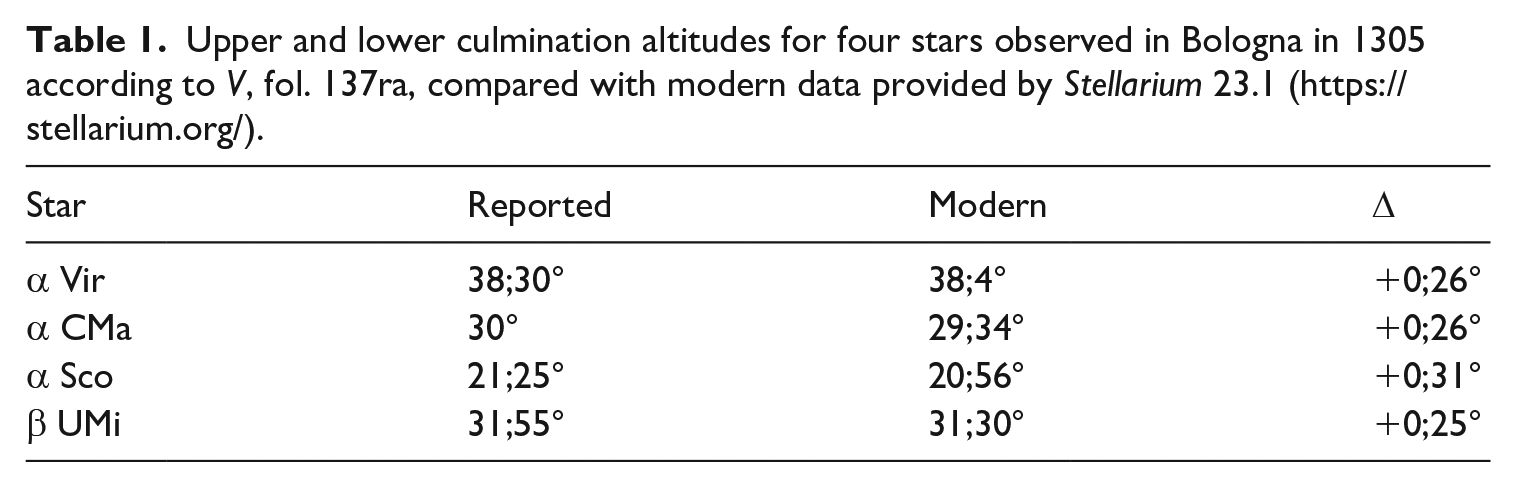
The next entry in the same manuscript column concerns the altitudes of three different stars at upper culmination (maior altitudo stellarum), as measured in Bologna during 1305: Spica (α Vir), Sirius (α CMa), and Antares (α Sco). It again mentions that these measurements were made with a large quadrant (per quadrantem magnum), which lends a degree of support to the idea that the Bolognese solar and stellar observations go back to the same astronomer. A further entry adds the altitude at lower culmination (minor altitudo) of Kochab (β UMi), which is here described as the “brighter star of the two that are called ‘brothers’, which are in the rectangle of Ursa Minor” (stelle lucidioris duarum que dicuntur fratres que sunt in quadro Urse Minoris). The other star referenced here must be Pherkad (γ UMi), which together with Kochab forms a readily identifiable two-star asterism circling the pole. Our author also highlights that he observed the altitude of Kochab with particular care (subtiliter) and multiple times (pluries) using a “large rectified quadrant” (cum magno quadrante rectificato).
All four stellar altitudes reported in this section of the text are multiples of 0;5°, which could be taken as a hint that the quadrant used for these specific observations was graduated only for steps of 0;5° rather than individual minutes. One should also note that observations of the lower culmination altitude of a circumpolar star such as Kochab would have required a north-facing quadrant, whereas the upper culminations of the other three stars all occur above the southern horizon, in the same direction as the sun at noon. This suggests that the “large rectified quadrant” mentioned in connection with Kochab was either a different instrument than the large quadrant of the preceding passage, or that the latter instrument was re-oriented at least once during the course of its use.
Despite this difference in orientation, all four recorded culmination altitudes exhibit a fairly similar additive error within the range 0;25°–0;31° (see the column for Δ in Table 1). The error in the case of the solar noon altitude at the winter solstice was likewise additive, but much smaller at 0;6°. A clear improvement in accuracy is also revealed by the subsequent entries in V, fol. 137ra, which amount to an extensive list of solar noon altitudes measured on 20 December 1305 as well as on 23 dates between 3 January and 1 March 1306, which in the manuscript are displayed in a tabular format. Besides the date in the Julian calendar, the author also specifies the day of the week, which provides a safeguard against potentially corrupt numbers and thus usefully minimizes doubts in comparing the reported data with modern computation.
Upper and lower culmination altitudes for four stars observed in Bologna in 1305 according to V, fol. 137ra, compared with modern data provided by Stellarium 23.1 (https://stellarium.org/).
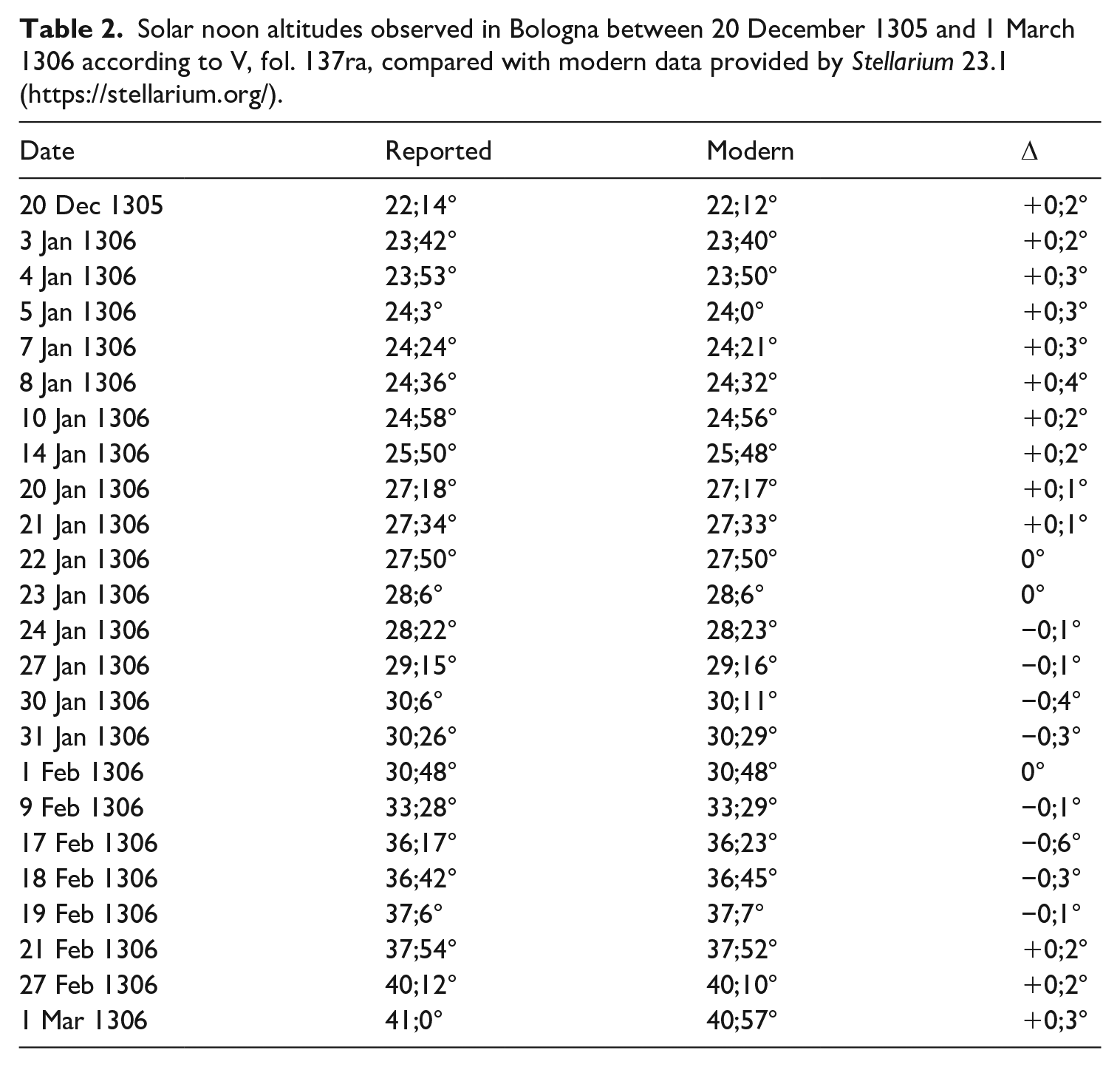
In addition to the 23 dates for which noon altitudes are provided, the tabular list has two additional entries for 6 and 9 January, which merely report the fact that no observation was made on these dates (non quesivi). As before, the author characterizes the instrument he used to obtain the data for early 1306 as a “large rectified quadrant” (cum quadrante magno rectificato). He also underlines the high degree of accuracy of his measurements, noting that his results were obtained verissime. That this was not an empty boast can be gauged from Table 2, which shows the error or difference (Δ) between each measurement (including that of 20 December 1305) and the apparent solar noon altitude according to modern calculation. In 9 out of 24 documented measurements, the value of Δ is ±0;1° or less, which may be considered an optimal result given the limitations of the human eye. Overall, the altitudes in Table 2 exhibit a mean error of only 0;2°, which is still an excellent level of accuracy for an extended series of naked-eye observations. 36 The size and direction of Δ undergoes some noticeable shifts in the course of the documented 2-month period, which may be the result of adjustments to the instrument or changes in location. This hypothesis becomes especially plausible in instances where Δ varies much less between observations made on consecutive days than after larger gaps in the calendrical sequence. In the case at hand, the most accurate cluster of data is a sequence of six observations made over 8 days from 20 to 27 January, during which Δ remained within ±0;1°. This sequence is separated by a 6-day gap from the previous cluster of seven observations made between 3 and 14 January. Here Δ is consistently additive and bounded between +0;2° and +0;4°. The greatest change in Δ between two consecutive observations is from −0;1° on 9 February to −0;6° on 17 February, which also happens to be the largest chronological gap (8 days) in this record.
Solar noon altitudes observed in Bologna between 20 December 1305 and 1 March 1306 according to V, fol. 137ra, compared with modern data provided by Stellarium 23.1 (https://stellarium.org/).
It may be idle to speculate about the precise type of quadrant employed in these measurements. The possibilities include, but are not necessarily limited to, a mural quadrant of the type first described in Ptolemy’s Almagest (1.12) as well as in some Arabic sources available in Latin before 1300. 37 In devices of this type, solar altitudes were found via the shadow cast by a cylindrical peg against the graduated quadrant inscribed on a plain vertical surface. It is also imaginable that the instrument referred to as quadrans in this source was instead equipped with an alidade, which would have pivoted on the center of the inscribed quarter circle. An instrument of the latter type is described in Bernard of Verdun’s Tractatus super totam astrologiam, which seems to date from the late 13th century. 38 Whatever the case, the astronomer’s ability to find results that were precise to the minute of arc might potentially imply an inscribed quadrant large enough to allow for the display of 90° × 60° = 5400 segments or partitions. Even if these partitions were spaced just 1 mm apart, this would have required a radius of at least 3.437 m = 11.276 ft. That devices of this size were indeed built and used in the early 14th century may be inferred from the testimony of Jean des Murs, whose observation of the solar noon altitude on 13 March 1319 relied on an instrument with a reported radius of 15 ft. 39
The final two entries on V’s fol. 137r concern observations that were made in Montpellier in 1306 and in Genoa in 1311–1312. If these reports stem, as seems likely, from the same astronomer as the solar observations in Table 2, this would imply that he relocated from Bologna to Montpellier in 1306 at some point between 1 March and 14 June, the day of the summer solstice. For this solstice, the text reports a solar noon altitude of 70°, without specifying the date. At the latitude of Montpellier, the maximum solar noon altitude of 1306 was 69;55° on 14 June (Δ = +0;5°). The author also observed the year’s minimum solar noon altitude, which according to him was found on 15 December. The result of this observation was originally written as 23;10°, but the scribe later marked the 10 arc-minutes for deletion. In fact, the lowest noon altitude of 1306 was that of 14 December, at 22;54°, but the difference relative to the observable altitude on 15 December would have been negligible. The stated result of 23° is, hence, in excess by 0;6°, the same error as that attained at the previous winter solstice in Bologna. From the difference between the two solstitial noon altitudes, which is 47°, the author was able to infer the latitude and co-latitude of Montpellier, which he gives, respectively, as 43;30° and 46;30°. The center of Montpellier is in fact located at a latitude of c.43;37°.
In addition to the data just mentioned, the entry for Montpellier states the altitudes at upper culmination of Sirius (α CMa) and Altair (α Aql). The culminations of these two stars would not have been observable at the same time of the year. Altair could have been observed in mid-June and Sirius in mid-December, which suggests that these stellar altitudes were measured around the same time as the solstitial solar noon altitudes mentioned in the same entry. The author’s finding for Sirius is expressed as 30° plus either 40 or 45 minutes of arc (40 vel 45 minuta). As with the round stellar altitudes cited for Bologna in the left-hand column fol. 137r (see Table 1), this is indicative of an instrument whose graduation was limited to steps of 0;5°. Modern calculation for Montpellier reveals that Sirius at the time reached a culmination altitude of 30;27°, so the error in this estimate is between 0;13° and 0;18°. Altair’s culmination altitude is given in V as 53;30°, which is 0;10° below the correct value of 54;40°.
The entry concerning Genoa mentions the city’s latitude as well as three solar noon altitudes that were measured there in 1311–1312. It also refers to a “large quadrant” (per magnum quadrantem) in language familiar from the entries concerning the observations made in Bologna in 1305–1306. This time the author does not give a specific date for the minimum solar noon altitude, but merely remarks that he observed for several days around the time of the winter solstice (pluribus diebus circa solsticium hyemale). Operating in this way, he found a noon altitude of 22;0°. This result stays 0;6° behind the apparent solar noon altitude on 14 December 1311, which according to modern computation was 22;6°. One month later, on 14 January, the astronomer found a noon altitude of 25;32°. Modern computation shows 25;47° for the same date (Δ = −0;15°). This error seems unusually large and invites the hypothesis that the author here followed the Toledan Tables in counting calendrical dates from the previous noon. If this is so, 14 January in this passage refers to noon of 13 January, on which the noon altitude was 25;34° (Δ = +0;2°). The reported result for 22 January is 27;20°. Once again, the error becomes smaller if we assume the date refers to noon of 21 January, on which the apparent solar noon altitude was 27;31° (Δ = −0;11°). It was 27;47° one day later (Δ = −0;27°).
When it comes to Genoa’s geographic latitude, the author’s finding is rather accurate: 44;27° compared to a modern value of c.44;24° (Δ = +0;3°). The method he used to establish this result appears to have differed from the one employed previously in Montpellier or by Johannes de Luna in Bologna. There is no sign in this entry that he also observed the solar noon altitude at the summer solstice, which would have been a prerequisite for finding the obliquity of the ecliptic on a strictly empirical basis. Rather, the author seems to indicate that the local latitude of 44;27° was somehow implied by the two results mentioned ahead of it in the same entry, which are those for the solar noon altitudes on 14 January 1312 and at the previous winter solstice (ex quibus sequitur quod latitudo Ianue sit 44 gradus et 27 minuta). This may mean that he inferred the latitude via the solar declination on these dates, which he could have obtained from the relevant tables. Taken together, the data cited in this passage imply that the negative or southern declination at the winter solstice was 90° − 44;27° − 22° = 23;33°, while the southern declination on 14 January was 90° − 44;27° − 25;32° = 20;01°. These values do not differ dramatically from those the Toledan Tables provide for solar ecliptic longitudes of 270° (−23;33,30°) and 301° (−20;2,7°). According to the same tables, a longitude of 301° would have been reached close to noon of 13 January 1312, which appears to vindicate the hypothesis that “14 January” in this passage refers to the prevous noon.
The notes on fol. 137r of V do not discuss any of the practical concerns that may have motivated the various observations reported on this manuscript page. At least in the case of Montpellier and Genoa, however, the documented measurements of solar altitudes were clearly geared towards finding local latitude, which was an essential data point for a wide range of astronomical and astrological purposes. Among these were the construction and adjustment of various instruments such as astrolabes, horary quadrants, and sundials, the construction and use of certain computational tables (e.g., for oblique ascensions and houses), and the casting of horoscopes. Observations of the culmination altitudes of certain stars, as reported for Bologna and Montpellier, could have served a similar purpose, as here an addition or subtraction of their known declination made it possible to the obtain the co-latitude.
It is less obvious why the astronomer found it necessary to make the more extensive series of solar altitude measurements that is documented for Bologna in early 1306. One context in which daily solar noon altitudes could be of practical interest was that of time-measurement and time-finding, as reflected in various astronomical tables that related solar altitudes to the time of day. 40 Another possibility is that the individual who recorded these observations was interested in studying the solar declination, which he could have done by comparing the results of his measurements against the local co-latitude established by Johannes de Luna (possibly his teacher). Such comparisons could have served the purpose of testing or correcting existing declination tables, which were typically cast for one quadrant of the ecliptic, that is, for a 90°-range of solar longitudes. 41 In principle, the observations needed to test or construct a declination table could be confined to the period between one equinox/solstice and the next, which may be part of the explanation why the record for Bologna in 1305–1306 extends to less than 3 months after the winter solstice.
Whatever his actual motivating reasons, the astronomer who made these observations was evidently capable of operating at a high level or precision and accuracy, aided by the use of sufficiently large instruments. By documenting this success, fol. 137r of V gives us a precious window into the empirical side of Latin astronomy in the early 14th century.
Footnotes
Appendix: Transcription of MS Vienna,Österreichische Nationalbibliothek,5311,fol. 137r
|137ra| Magister Iohannes de Luna Theutonicus dixit se expertum quod maior altitudo solis Bononie est 69 gradus et 9 minutorum. Et minor 22.2. Arcus earum 47.7 medium, quod est declinatio tota 23.33.30. Et latitudo eius est 44.25. Et altitudo Arietis 45.35.
Anno domini 1305, 14 die Decembris, cum quadrante parvo reperi maiorem altitudinem solis Bononie 22 gradus et 6e vel 5te unius gradus. Sed cum quadrante magno per me rectificato consideravi eam 22 gradus et 7 minuta.
Maior altitudo stellarum fixarum subscriptarum in meridiano Bononie, ut accepi per quadrantem magnum eodem anno Christi 1305:
Spice sive Alaazel 38.30 Alahabor 30.0 Cordis Scorpionis 21.25.
Minor vero altitudo stelle lucidioris duarum que dicuntur “fratres,” que sunt in quadro Urse Minoris considerata per me subtiliter et pluries cum magno quadrante rectificato Bononie dicto anno: 31.55. Et erat tempore Ptolomei in Cancro 17.10; latitudo eius ab ecliptica in septemtrionem 72.50; secunde magnitudinis. 42
Item die Lune, 20 die Decembris, eodem anno 1305 inveni altitudinem maiorem solis in meridie Bononie 22.14.
Anno a kalendis Ianuarii incipiendo 1306 vel a kalendis Martii 1305 consideravi altitudinem solis maiorem in meridie Bononie cum quadrante magno rectificato et inveni ipsam ita esse verissime in infrascriptis diebus.
Author’s note
C. Philipp E. Nothaft is a £50-fellow at All Souls College, Oxford. He has published widely on the history of astronomy in the Middle Ages, including the recent monograph Graeco-Arabic Astronomy for Twelfth-Century Latin Readers (Leiden: Brill, 2023).
