




Abstract
In this reply, the aim of the authors is to correct the calculation errors on solar depression angle and azimuth angle as recognized by Dr. Dalin in his critical review. However, these updated and corrected calculations do not affect the possibility for Antonio Colla of having observed the Noctilucent Cloud (NLC) plausible both in the direction and for the duration he described in his observations. In this reply, the authors offer two different interpretations in this regard.
Keywords
Premise
We are grateful and want to thank Dr. Peter Dalin for his critical comments on our paper. Thanks to them, we have revisited all the data, and the calculus of the article and we have found, as Dr. Dalin pointed out, a mistake in the calculation of the solar depression angle. Nevertheless, this error does not invalidate the possibility that the Antonio Colla observed a noctilucent cloud the evening of 18 June 1840, in Parma, Italy, as we explain in the next sections. We have organized this reply following the order of the Dr. Dalin’s comment. First, we have analyzed the solar depression angle. Second, we have computed the sky area available to observe a Noctilucent Cloud (NLC), and finally we have analyzed the area in which Colla observed the NLC taking into account the keywords used by Colla in his description and suggesting two possible interpretations of the Colla’s words.
Solar depression angle
The elevation angle and the Azimuth computed by Dr. Dalin are correct. We have verified them with the HORIZONS Web-interface of the American National Aeronautics and Space Administration (NASA) (https://ssd.jpl.nasa.gov/horizons.cgi?s_type=1#top).


The error in the paper is due to a human error. We computed different depression angles for different interpretations of the observational time before to be sure that the time used by Colla was the Local Solar Time. We wrote in the paper a wrong depression angle that was referred to –1 h with respect to the time of the Colla’s observation. For this reason, we apologize to The Holocene readers. Notwithstanding the starting and ending hours and the type of time used by Colla were correctly understood and described in the paper.
Area of the sky, in which it was potentially possible to observe an NLC for the day and times of the Colla’s observation
Dr. Dalin, following the methodology of Gadsden and Schröder (1989), provides a figure of the upper edge of the twilight sky arc determining the illuminated area of an NLC for the correct solar depression angle corresponding to the start (20:03:44 UT) and the end (21:18:44 UT) of the observation made by Antonio Colla. This figure shows some errors or misinterpretations that we want to summarize here:
The twilight sky arc at the beginning of the Colla’s observation (20:03:44 UT)
The twilight sky arc at the beginning of the Colla’s observation (20:03:44 UT) is incorrectly computed by Dr. Dailin. We have recalculated the sky arc using the formulas proposed by Gadsden and Schröder (1989) but with the correct input provided by Dr. Dalin, that is, solar depression angle β = −8.43° and solar azimuth angle a = 315.6° and we have obtained the following; for a better interpretation of the formulas, we provide the figure of Gadsden and Schröder (1989) about the geometry of viewing (Figure 1)


With R the radius of the local sphere considering an ellipsoidal model for the Earth’s surface (6378 km), H being the estimated height of the NLC (i.e. 85 km), and h the screening height (h = 5 km).
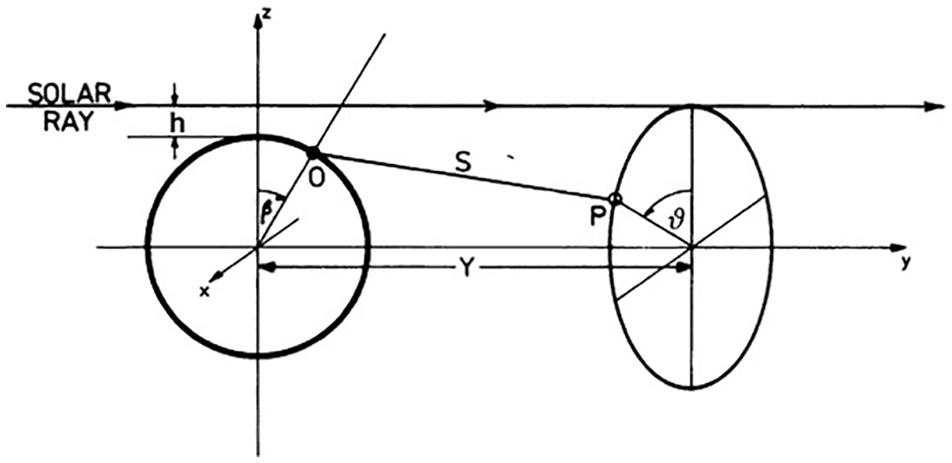
The geometry of observation of the edge of the illuminated area of a noctilucent cloud display. The Sun is assumed to be a point source; the y-axis passes through the centers of the Sun and the Earth. An observer at 0 defines the plane (y, z) of the solar meridian; the Sun is at a depression angle, β, at the observer. The Earth (radius R) projects a cylindrical shadow which is increased in radius by the screening height h. The locus of P, a point on the edge of the shadow, lies at a distance (R + H) from the center of the Earth where H is the height of the noctilucent cloud (P is shown in the diagram lying at an angle ϑ outside of the meridian plane).
The elevation angle of the arc (e, in degree) is therefore

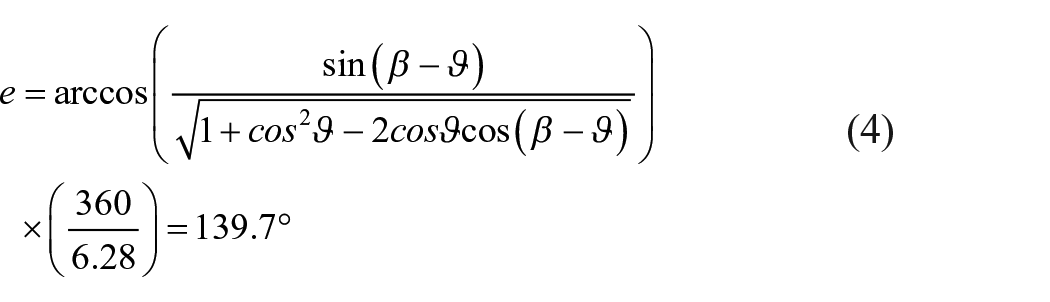
and the range in azimuth angle (Δa) can be obtained starting calculations by equation (5)

inserting the above values and the values of S = 1034.9 and Y = 1013.8 calculated with equations (6) and (7)


The range in azimuth angle (Δa) in degrees is 85.6°.
As calculated by Dr. Dalin, the azimuth angle of the sun position (aSun) at this time is 315.6°; therefore, the sky arc will pass through these 3 points (abscissa: azimuth angle from north; ordinate: elevation angle)

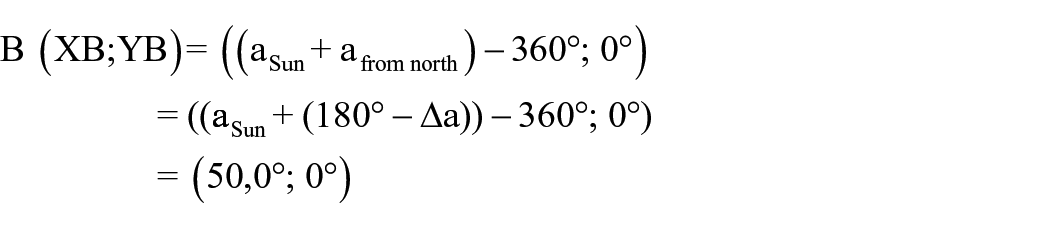
and the vertex of the parabola V (XV; YV) = (aSun; 139,7°) = (315.6°; 139.7°) that extends at an elevation angle of 139.7 ° above the sun position (i.e. 315.6° NW direction) passing through the zenith toward the 135.6°, that is, the SE direction. For this reason the vertex coordinates of this arc can also be defined starting from the SE direction as V’(XV’; YV’) = (aSun – 180°; 180° – 139.7°) = (315.6° – 180°; 40.3°) = (135.6°; 40.3°) but with the visible area external to the sky arc parabola (highlighted in yellow in Figure 2). A 3D sketch in Figure 3 further clarifies the geometry.
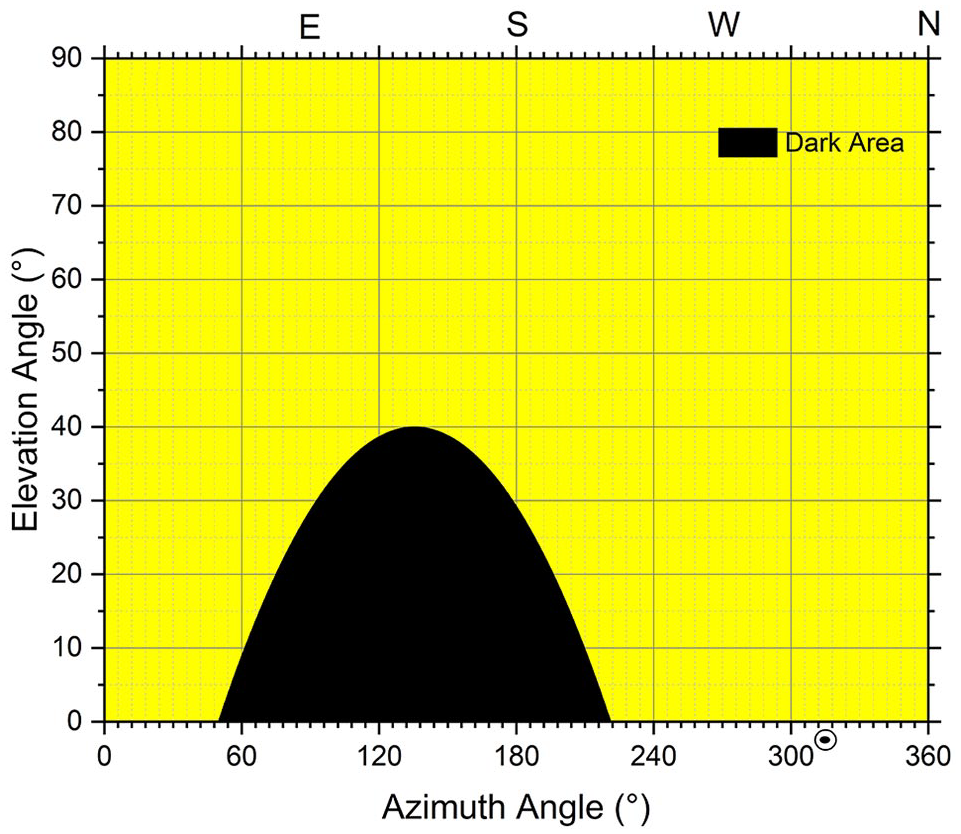
Twilight sky determining the illuminated area of an NLC (yellow color) for solar depression angle of −8.43° (20:03:44 UT).
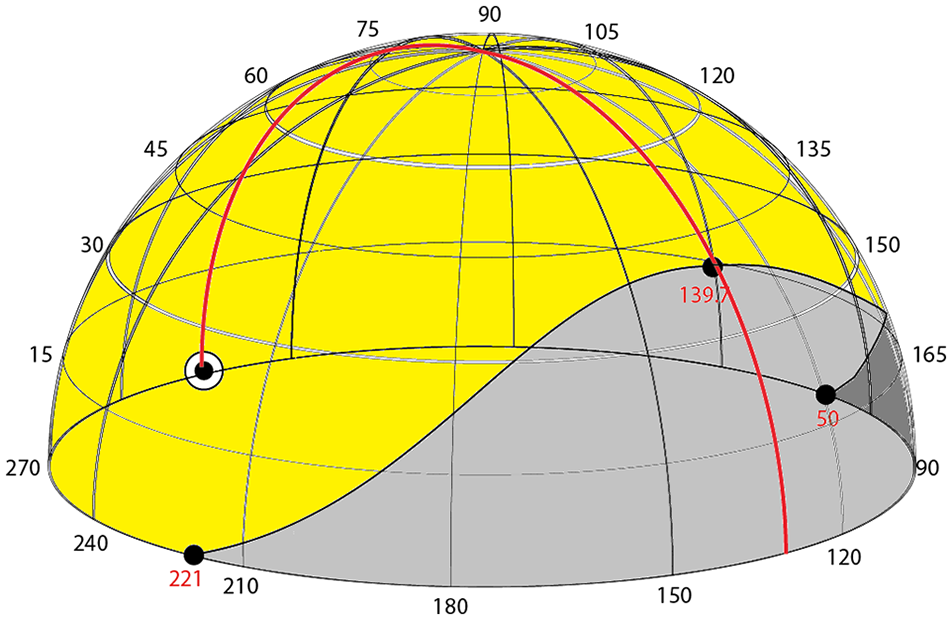
Twilight sky determining the illuminated area (yellow color) of an NLC for solar depression angle of −8.43° (20:03:44 UT) represented by a 3D sketch.
The twilight sky arc at the end of the Colla’s observation (21:18:44 UT)
The twilight sky arc at the end of the Colla’s observation (21:18:44 UT) is correctly computed by Dr. Dalin. Anyway, we have recomputed using the formulas by Gadsden and Schröder (1989) with the correct input provided by Dr. Dalin as follows:
When the solar depression angle is β = −16.38°


with R = 6378 km; H = 85 km.
The elevation angle (in degree) is therefore

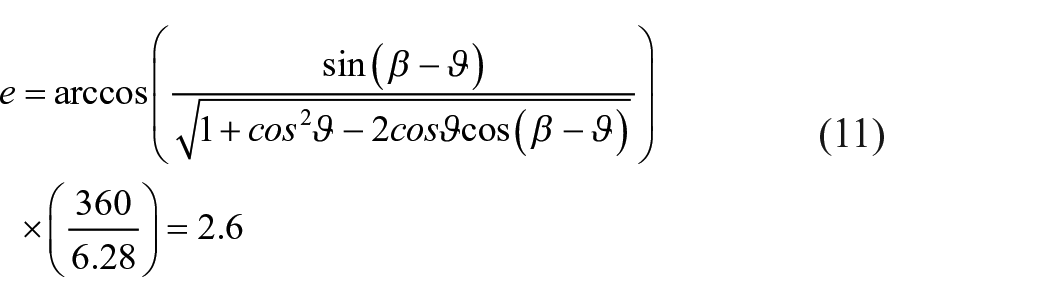
and the range in azimuth angle (Δa) can be obtained starting calculations by equation (12)

inserting the above values and the value of S = 1308.3 and Y = 1013.7 calculated with the respective equations (13) and (14) below


The range in azimuth angle (Δa) in degrees is (90° – 52.1°) + 90° = 127.9°.
As calculated by Dr. Dalin, the azimuth angle of the sun position at this time is 331.11°; therefore, the sky arc, at the end of Colla’s observation, passed for the 3 points below (abscissa: azimuth angle from north; ordinate: elevation angle)

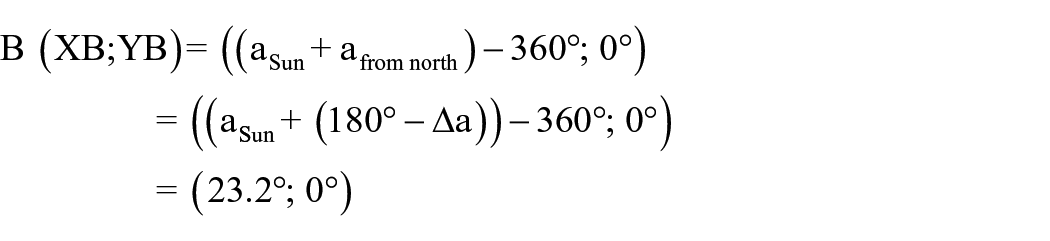

(highlighted in yellow in Figure 4).
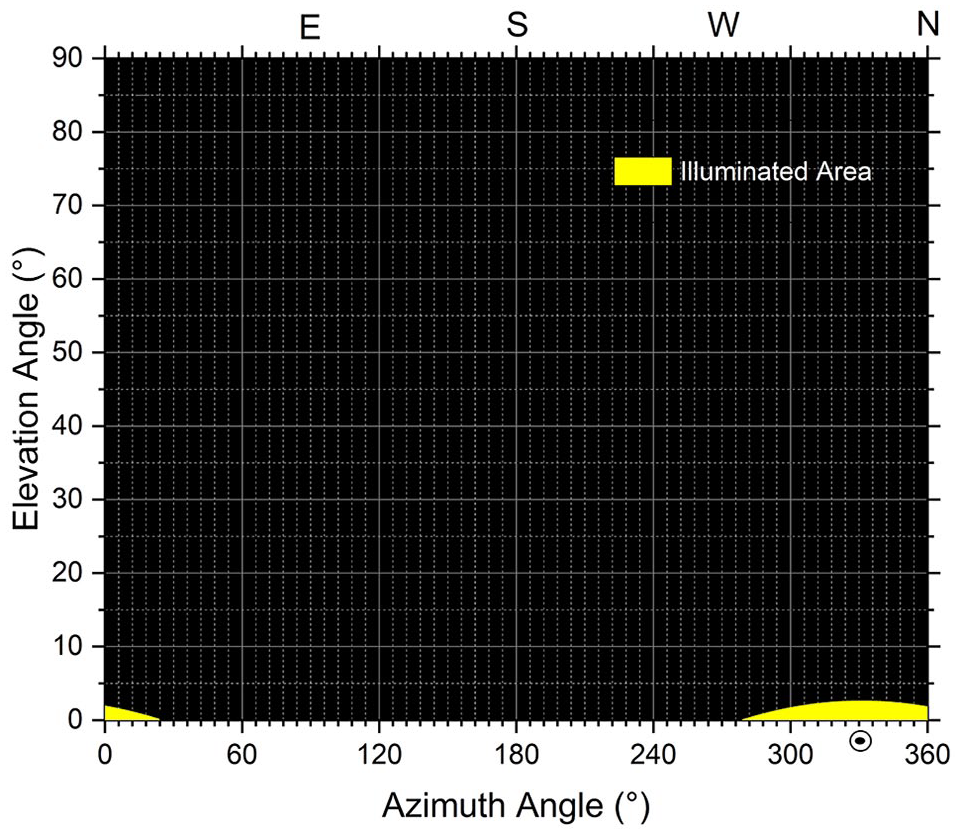
Twilight sky determining the illuminated area (yellow color) of an NLC for solar depression angle of –16.38° (21:18:44 UT).
Area in which Antonio Colla possibly saw the NLC
We do not understand clearly how Dr. Dalin interpreted the direction of the observation made by Colla (blue square in the Figure 1 in the Dr. Dalin comment). He supposed that the observation was from the azimuth angle ranging between 180° and 225° (aprox.) during the 1 h 15 min duration of the Colla’s observation.
We revised the whole Colla’s description, carefully, evaluating each single word he used to describe the phenomenon.
Colla [referring to the area in which he observed this phenomenon] said:
[information on the direction at the beginning of the observation] ‘osservammo nella direzione del mezzodi’; this means, ‘we observed in the southward direction’ or sourthern”, and then
Although we understand that these information leave room for interpretation, they need to be considered all together to provide the most likely interpretation. Based on this, here we propose two possible interpretations:
Southward means south
Our first interpretation is based on a literal reading of the information related to the NLC direction reported by Colla [i.e. the word: southward]. Colla did not write exactly at south but rather he used a word less precise that provides a certain variability in degrees with respect to the exact south direction equals to 180°. Notwithstanding, in Bertolin and Domínguez (2020), and in this first interpretation we assume the observation direction was centered exactly at South (azimuth angle = 180°) and we consider 22° the diameter of the cloud. This is the most restrictive assumption possible but as reported in Figure 5a, even in such a ‘worst-case’ scenario, it was possible for Colla to observe an NLC in the time and in the area of the sky he described. Obviously, if we consider that southern direction could be used to refer any direction among SE (135°) and SW (225°), the area in which Colla could have observed the NLC becomes larger (Figure 5b). In this first interpretation, Colla could see the NLC at the start of the observation but he could not see the NLC at the end of the observation (21:18:44 UT). The time period in which Colla could see the NLC depends on how many degrees we interpret or ‘define’ the word: southward direction. But in any case, under these assumptions the NLC was visible during less than 1 h 15 min.
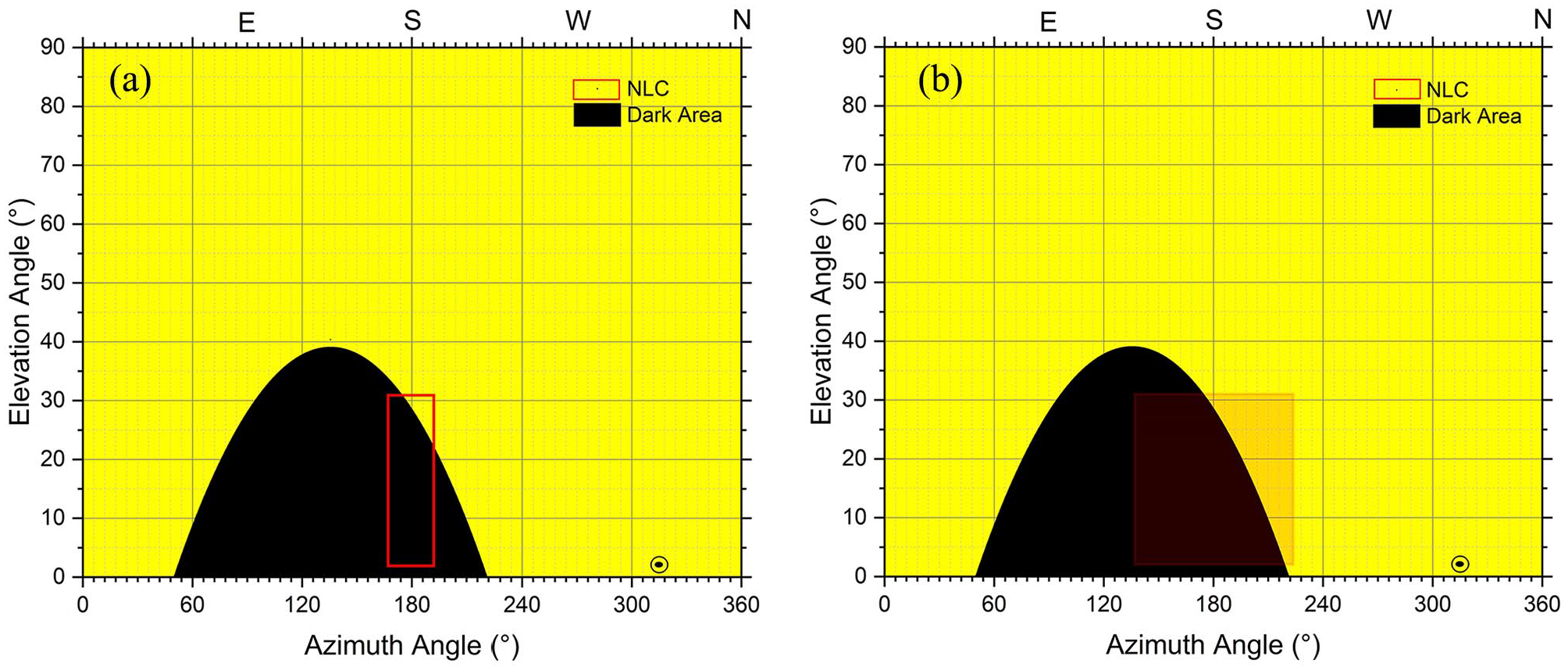
(a) Twilight sky determining the illuminated area of an NLC for solar depression angle of −8.43° (20:03:44 UT) (yellow color) and the area of observation as described by Colla (red rectangle) in the hypothesis it was centered exactly at South direction. (b) Same twilight sky but with area of observation (light red colored rectangle) as described by Colla in the hypothesis of considering southern direction as any direction among SE (135°) and SW (225°).
Southward is considered with respect to the direction in which Colla was observing
Our second interpretation is based not on a precise direction on the horizon (i.e. exactly at South) but rather on reporting the observational area during the whole observational phenomenon recorded by Colla. To do this, we asked ourselves:
What was the primary observational interest of Antonio Colla at that time of the day?
What was he observing just a moment before the beginning of the phenomenon (i.e. the NLC) that attracted his interest distracting him from his primary interest?
We searched for evidences for supporting our answers to these questions as follows. From our research, we found out that Colla recorded the ephemeris reporting the exact time of the beginning and of the end of the astronomical twilight on a daily base. These times were then – once a year – published in his Giornale Astronomico per uso comune (Colla, 1841). In this publication he reported sometime as daily data and more often in form of a summary the beginning of the astronomical sunrise and the end of the astronomical sunset every 10 days over the 12 months.
Based on this finding, our more likely answer is that Colla was at the top of the Specola (i.e. the Astronomical Observatory) in that moment, to record the end of the evening twilight time as he did every day. This finding supports that his primary interest was to record the end of the astronomical twilight and that his original direction of observation – before the starting of the NLC – was the sun direction (i.e. 315°). Under this perspective, the choice of the word used by Colla in his description that is, ‘we observed toward South or Southward’ has more sense. In such a case, his observational main direction could have been in the azimuth angle ranging between 180°<a < 315°. Under this assumption, the NLC could be observed during the whole period he described in his notes, that is, from 20:03:44 UT (Figure 6a) to 21:18:44 UT (Figure 6b).
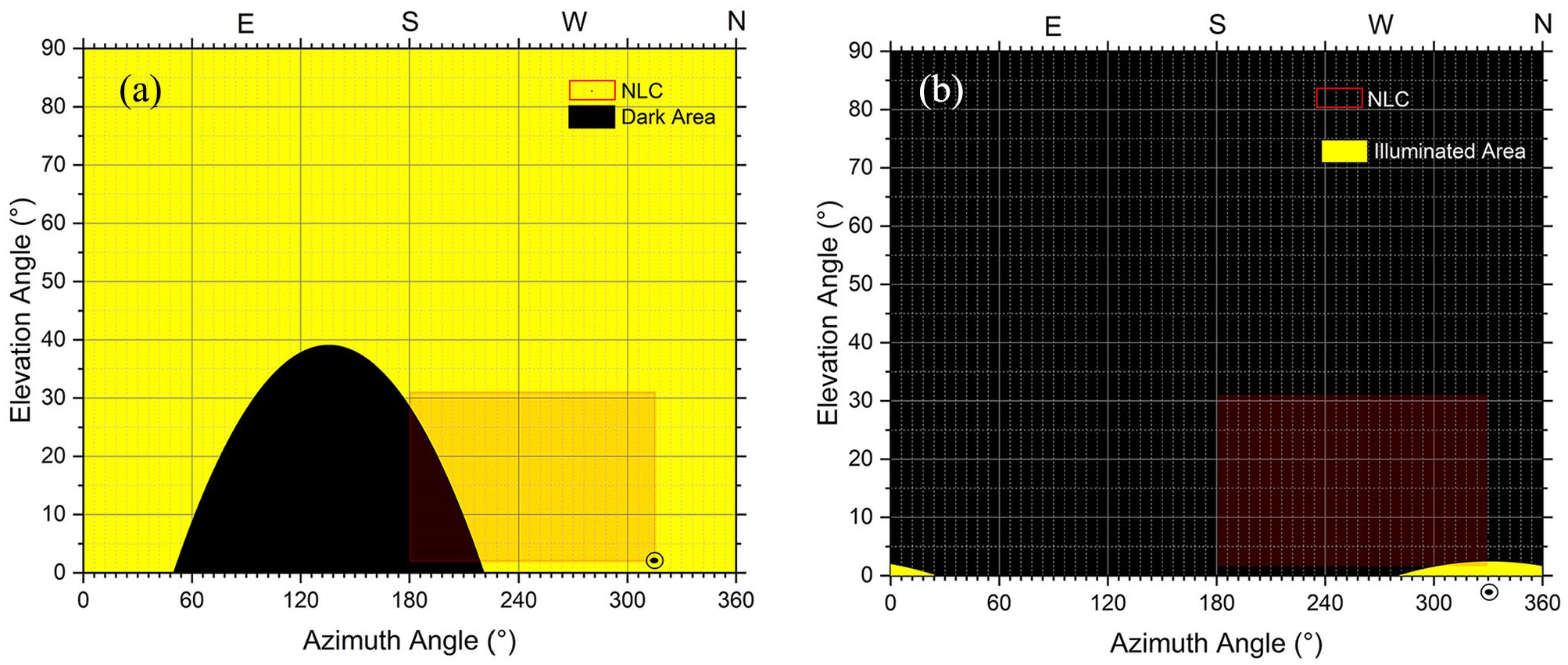
(a) Twilight sky determining the illuminated area of an NLC for solar depression angle of −8.43° (20:03:44 UT) (yellow color) and the area of observation (light red colored rectangle) as reported by the temporal description done by Colla in the hypothesis southern direction was with respect to the main observational direction in which Colla was observing an instant before the beginning of the phenomenon (180° < a < 315°). (b) Twilight sky determining the illuminated area of an NLC for solar depression angle of −16.38 (21:18:44 UT) (yellow color) and the area of observation as described by Colla (light red colored rectangle) in the hypothesis southern direction was with respect to the main observational direction in which Colla was observing an instant before the beginning of the phenomenon (180° < a < 315°).
Conclusion
The historic observations of unknown phenomena by an observer are difficult to interpret. Frequently the observer is not focused on features that nowadays describe the phenomenon. In this particular case, although the description is detailed, some aspects are open to interpretation, mainly related to the ‘southern’ direction of the observation. Different interpretations on the direction of the observation result in different possible areas to observe the NLC. Moreover, the parameters chosen to compute the sky area in which the NLC is visible, that is, H, h can slightly modify the results. Also, it is important to remark that the Gadsden and Schröder (1989) method does not consider some effects that can expand the visible area, for example, the appreciable diameter of the solar disk or the refraction of sunlight in the low atmosphere. Moreover, we cannot discard that an NLC had some displacement during the observation. Although this displacement is not clearly described by Colla, common speed of NLC is around 20 to 100 m/s (Gadsden and Schröder, 1989). A displacement of the NLC to the NW during the observation can enlarge the duration of the visibility of the NLC in our first hypothesis or can better support our second hypothesis. Anyway, we cannot find any plausible interpretation that avoid completely the possibility of Colla of having observed an NLC that night. Moreover, we want to remark that many facts not related with the direction of the observation fit very well with the observation of NLC, that is, phosphoric cloud, structure described, date, time, and duration.
